
Shri Bahegavankar L.G. Assistant Professor





Description: Shri Bahegavankar L.G. Assistant Professor Department of English Swa.Sawarkar Mahavidyalaya , Beed. Refresher Course in E-Governance E-Learning lgbahegavankargmail.com Roll No.01 Presentation on Organs of Speech Organs Of Speech Organs
Related Topics
Download Presentation
"Shri Bahegavankar L.G. Assistant Professor" is the property of its rightful owner. Permission is granted to download and print the materials on this website for personal, non-commercial use only, and to display it on your personal computer provided you do not modify the materials and that you retain all copyright notices contained in the materials. By downloading content from our website, you accept the terms of this agreement.
Presentation Transcript
slide1. Shri Bahegavankar L.G.
Assistant Professor
Department of English
Swa.Sawarkar Mahavidyalaya , Beed.
Refresher Course in E-Governance & E-Learning
lgbahegavankar@gmail.com
Roll No.01 Presentation on Organs of Speech<br>
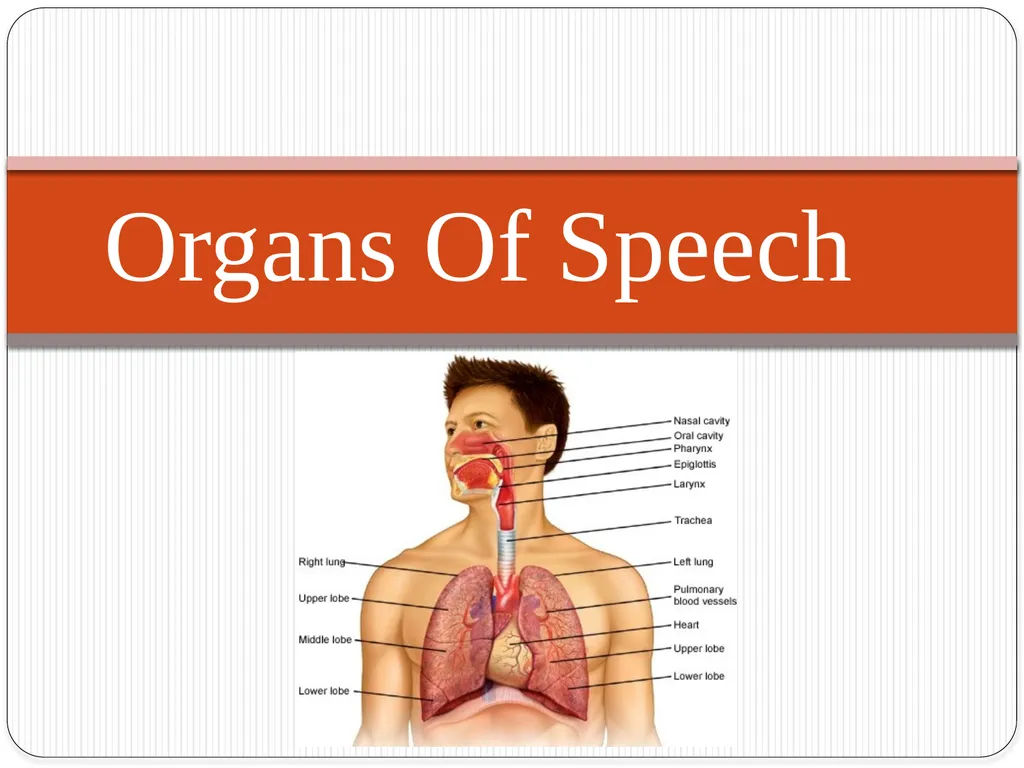
slide2. Organs Of Speech<br>
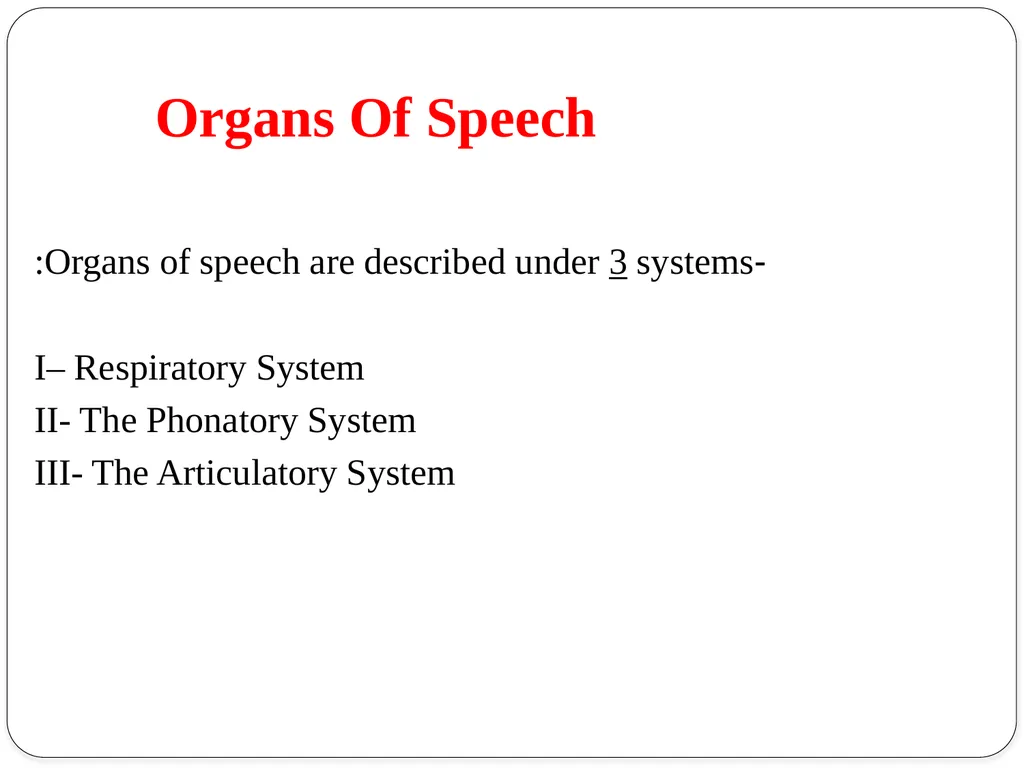
slide3. Organs Of Speech -Organs of speech are described under 3 systems:
I– Respiratory System
II- The Phonatory System
III- The Articulatory System<br>
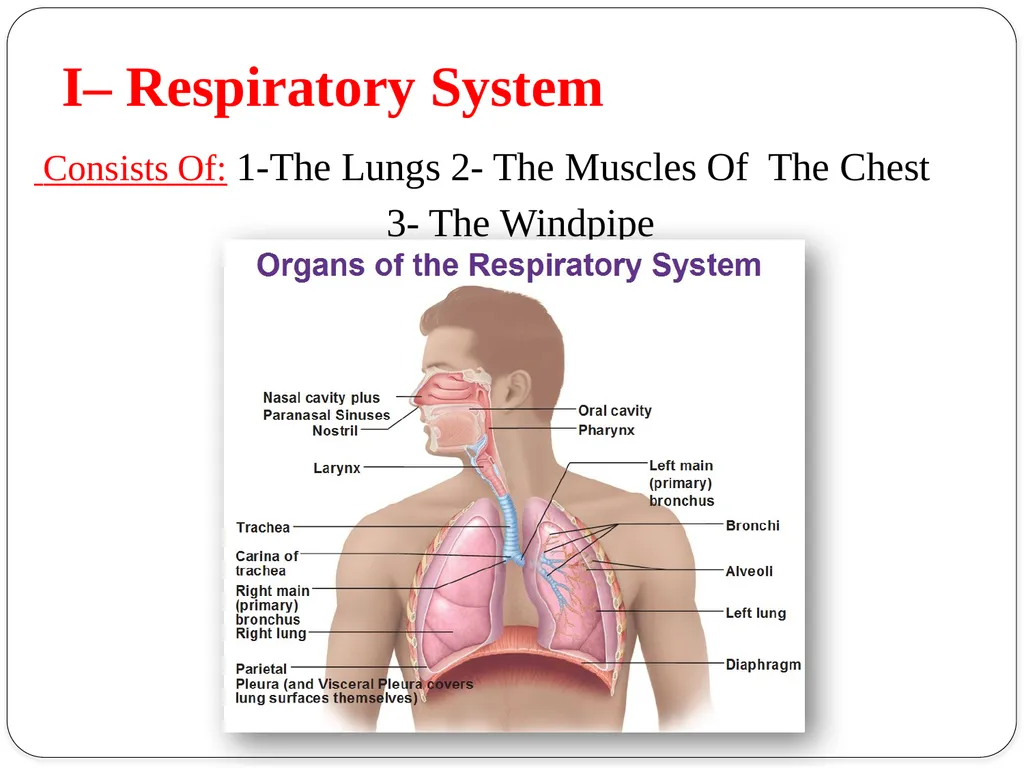
slide4. I– Respiratory System Consists Of: 1-The Lungs 2- The Muscles Of The Chest
3- The Windpipe<br>
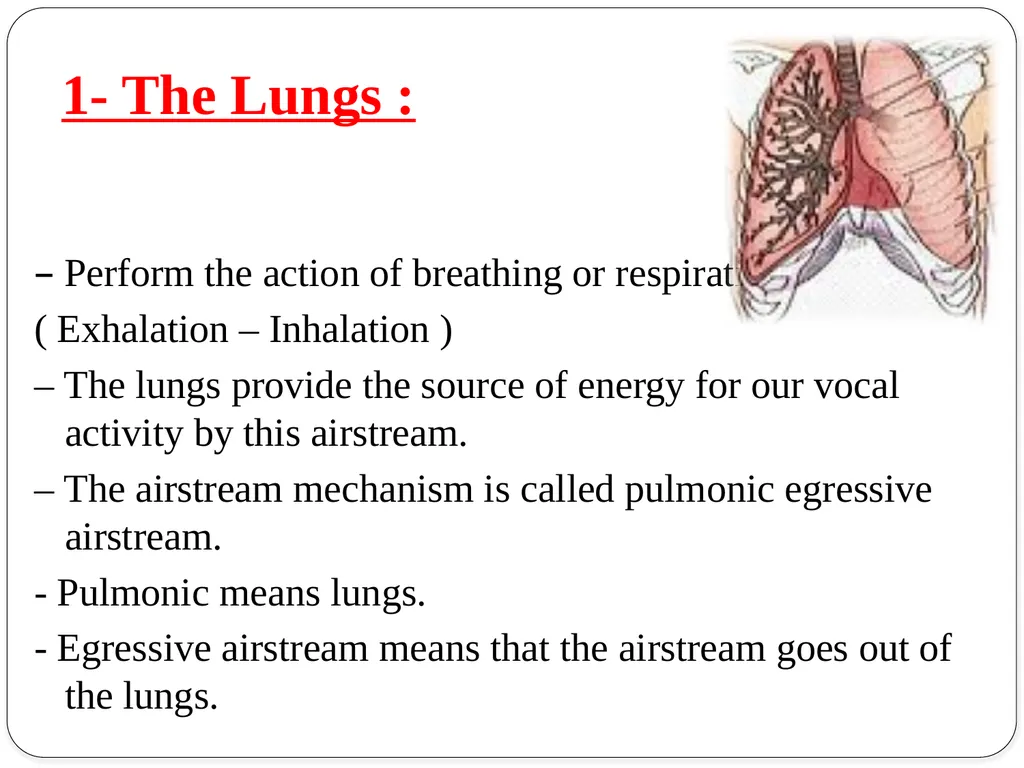
slide5. 1- The Lungs : – Perform the action of breathing or respiration.
( Exhalation – Inhalation )
– The lungs provide the source of energy for our vocal activity by this airstream.
– The airstream mechanism is called pulmonic egressive airstream.
- Pulmonic means lungs.
- Egressive airstream means that the airstream goes out of the lungs.<br>
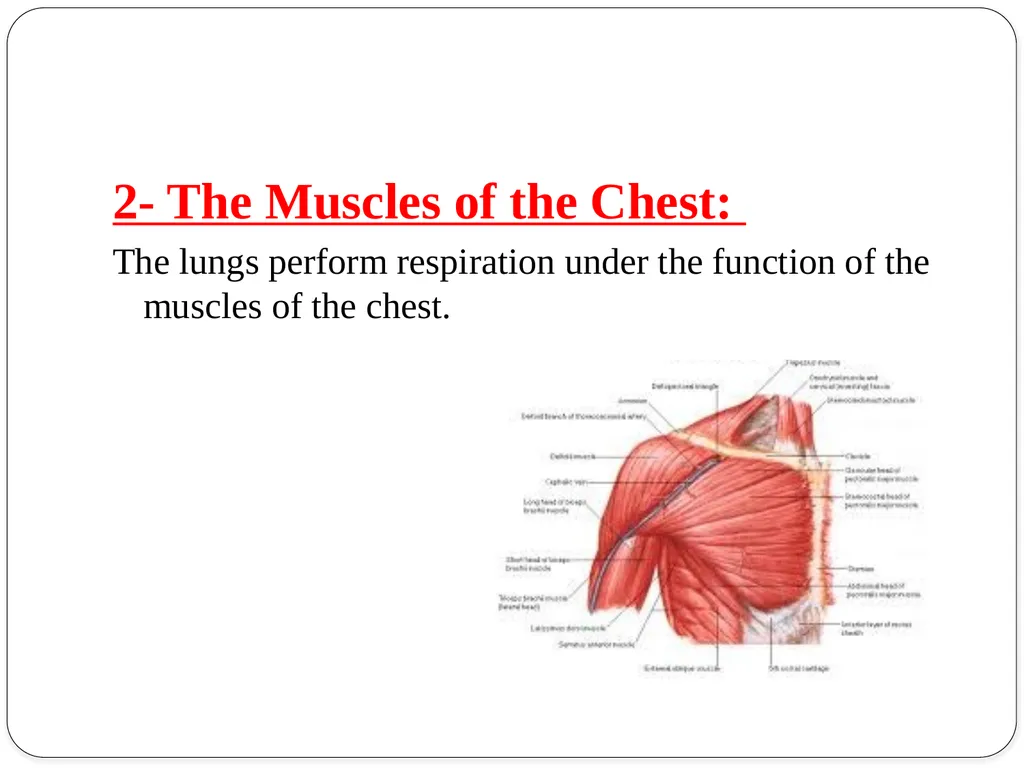
slide6. 2- The Muscles of the Chest:
The lungs perform respiration under the function of the muscles of the chest.<br>
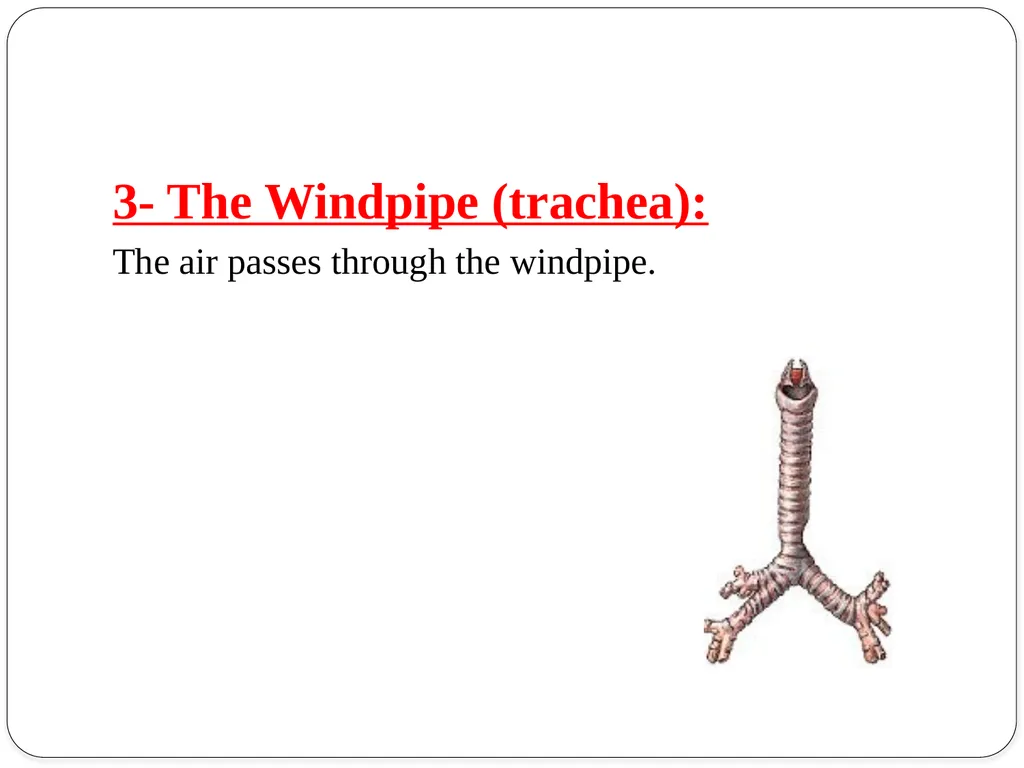
slide7. 3- The Windpipe (trachea):
The air passes through the windpipe.<br>
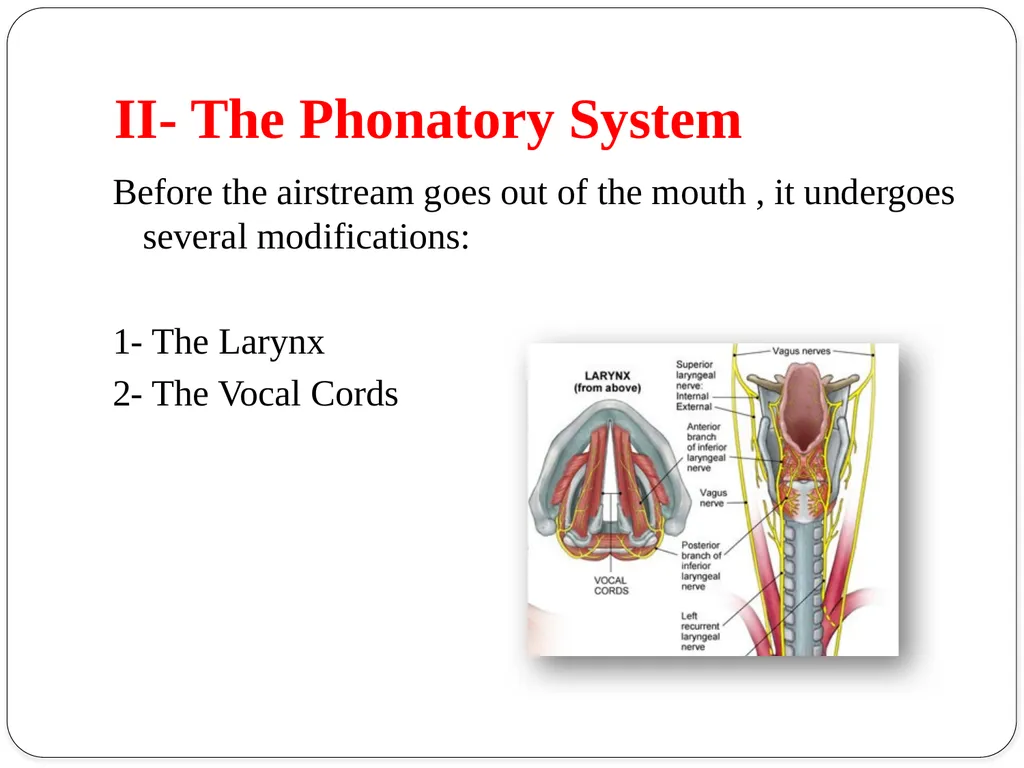
slide8. II- The Phonatory System Before the airstream goes out of the mouth , it undergoes several modifications:
1- The Larynx
2- The Vocal Cords<br>
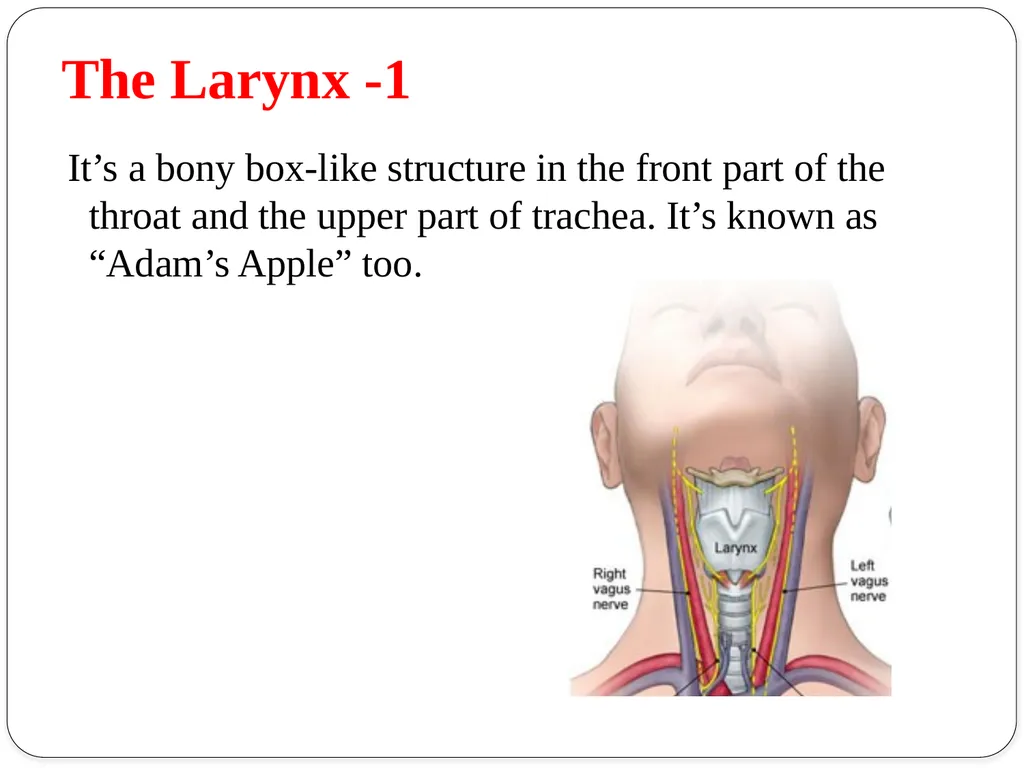
slide9. 1- The Larynx It’s a bony box-like structure in the front part of the throat and the upper part of trachea. It’s known as “Adam’s Apple” too.<br>
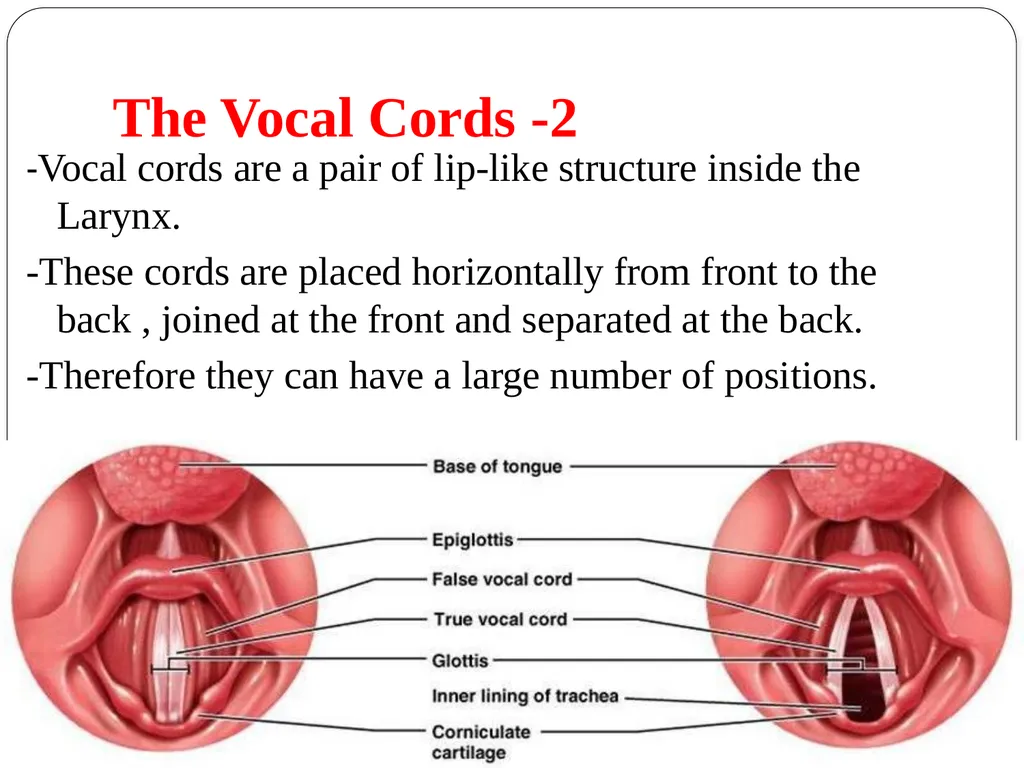
slide10. 2- The Vocal Cords -Vocal cords are a pair of lip-like structure inside the Larynx.
-These cords are placed horizontally from front to the back , joined at the front and separated at the back.
-Therefore they can have a large number of positions.<br>
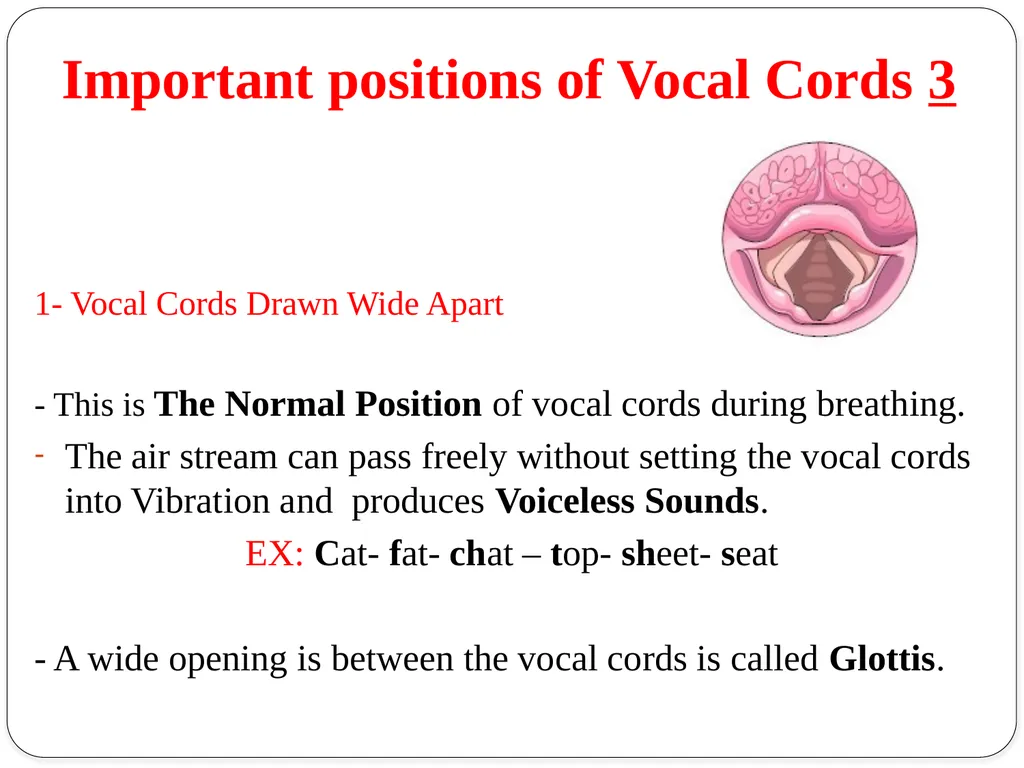
slide11. 3 Important positions of Vocal Cords 1- Vocal Cords Drawn Wide Apart
- This is The Normal Position of vocal cords during breathing.
The air stream can pass freely without setting the vocal cords into Vibration and produces Voiceless Sounds.
EX: Cat- fat- chat – top- sheet- seat
- A wide opening is between the vocal cords is called Glottis.<br>
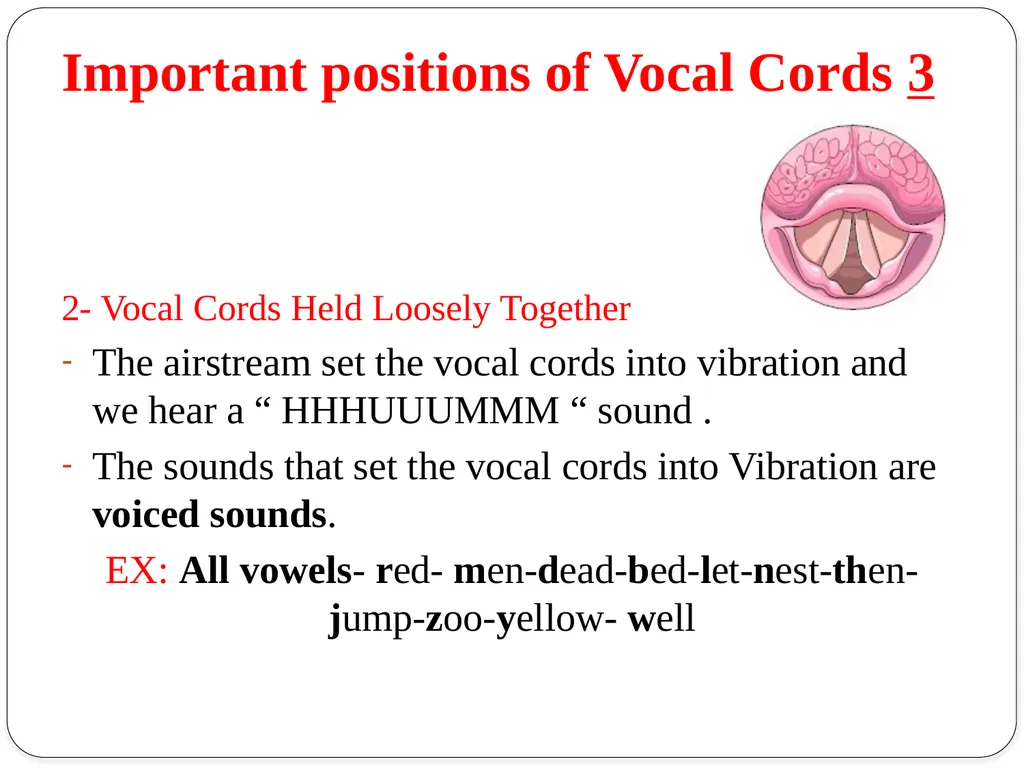
slide12. 3 Important positions of Vocal Cords 2- Vocal Cords Held Loosely Together
The airstream set the vocal cords into vibration and we hear a “ HHHUUUMMM “ sound .
The sounds that set the vocal cords into Vibration are voiced sounds.
EX: All vowels- red- men-dead-bed-let-nest-then-jump-zoo-yellow- well<br>
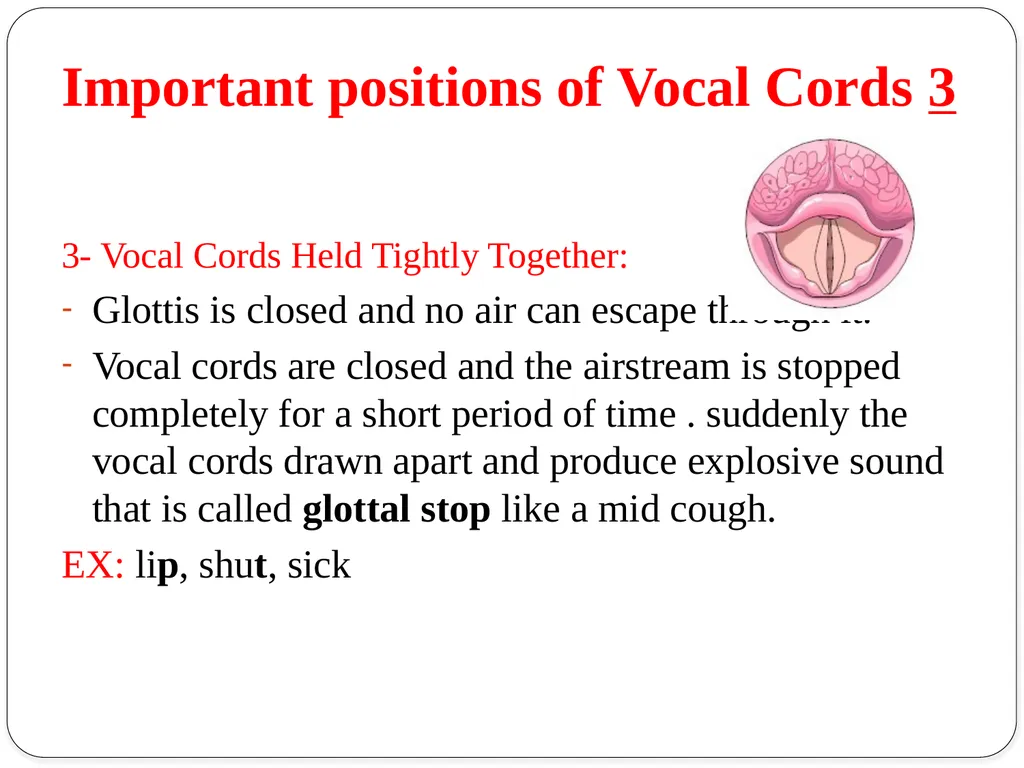
slide13. 3 Important positions of Vocal Cords 3- Vocal Cords Held Tightly Together:
Glottis is closed and no air can escape through it.
Vocal cords are closed and the airstream is stopped completely for a short period of time . suddenly the vocal cords drawn apart and produce explosive sound that is called glottal stop like a mid cough.
EX: lip, shut, sick<br>
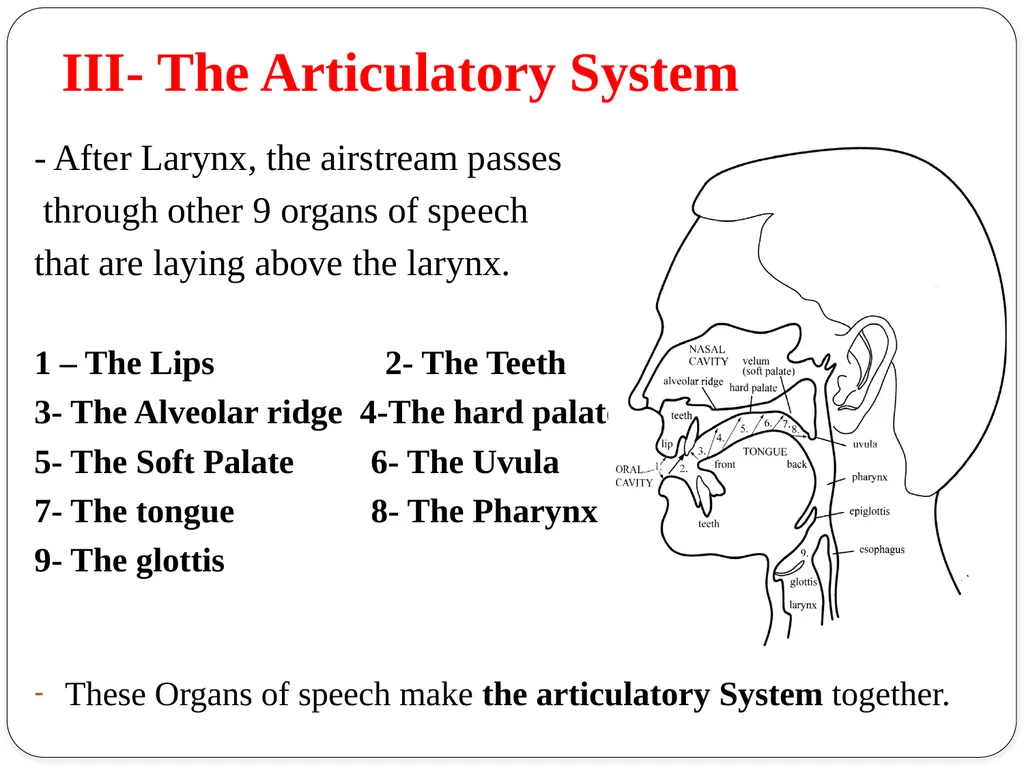
slide14. III- The Articulatory System - After Larynx, the airstream passes
through other 9 organs of speech
that are laying above the larynx.
1 – The Lips 2- The Teeth
3- The Alveolar ridge 4-The hard palate
5- The Soft Palate 6- The Uvula
7- The tongue 8- The Pharynx
9- The glottis
These Organs of speech make the articulatory System together.<br>
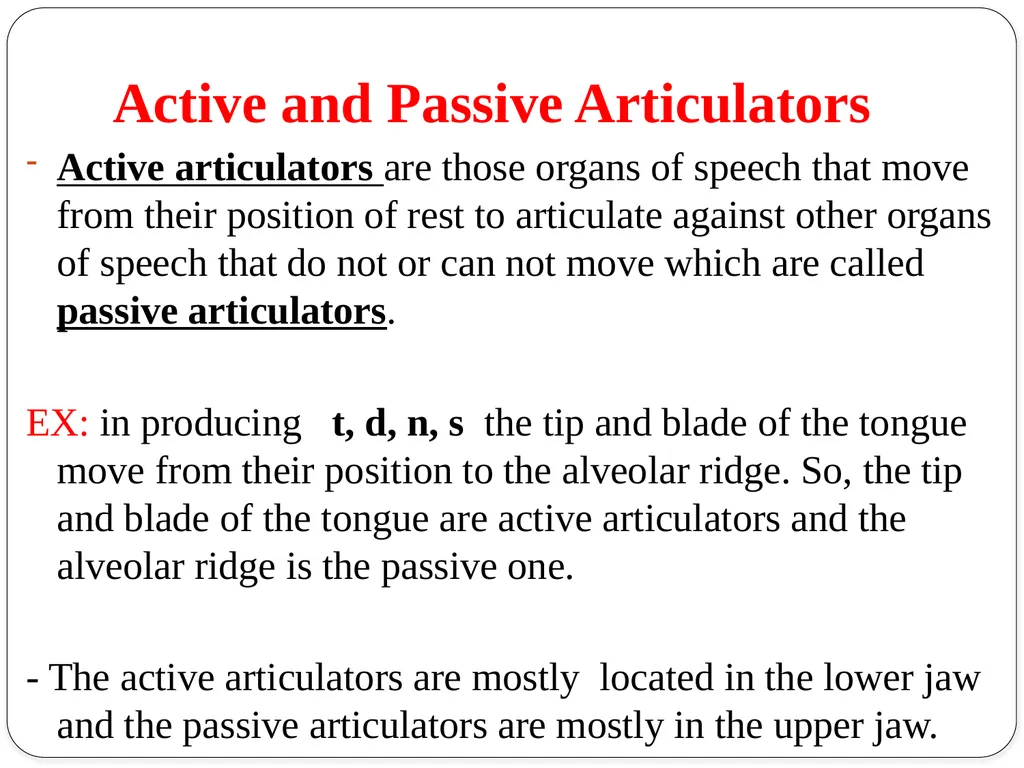
slide15. Active and Passive Articulators Active articulators are those organs of speech that move from their position of rest to articulate against other organs of speech that do not or can not move which are called passive articulators.
EX: in producing t, d, n, s the tip and blade of the tongue move from their position to the alveolar ridge. So, the tip and blade of the tongue are active articulators and the alveolar ridge is the passive one.
- The active articulators are mostly located in the lower jaw and the passive articulators are mostly in the upper jaw.<br>
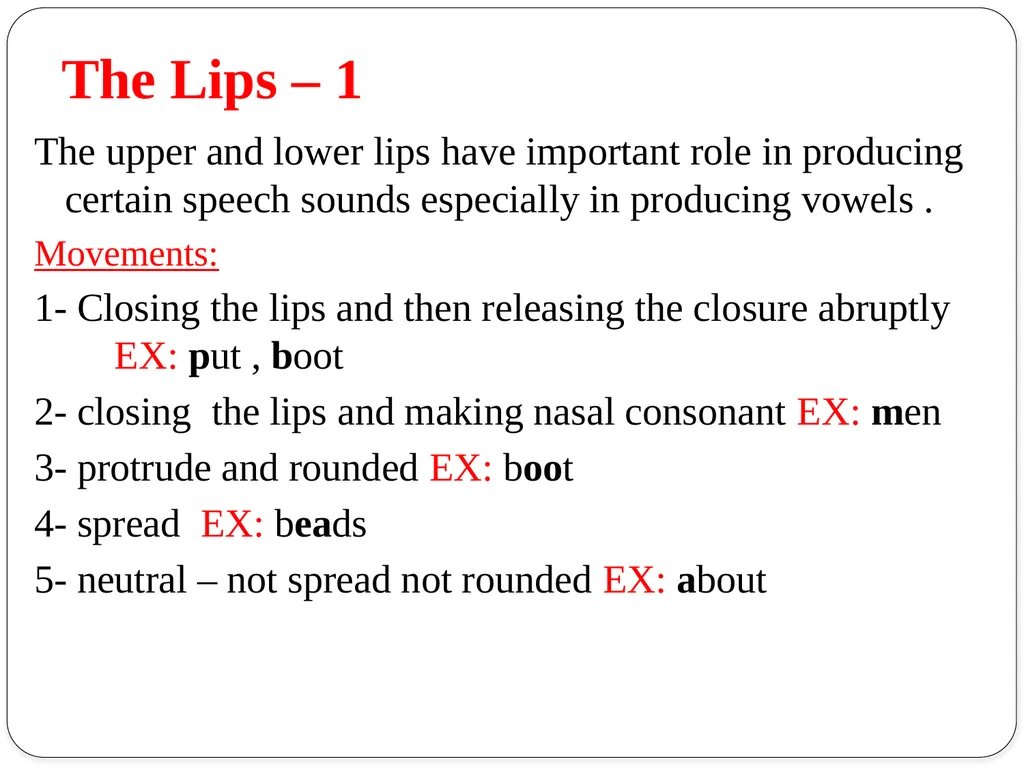
slide16. 1 – The Lips The upper and lower lips have important role in producing certain speech sounds especially in producing vowels .
Movements:
1- Closing the lips and then releasing the closure abruptly EX: put , boot
2- closing the lips and making nasal consonant EX: men
3- protrude and rounded EX: boot
4- spread EX: beads
5- neutral – not spread not rounded EX: about<br>
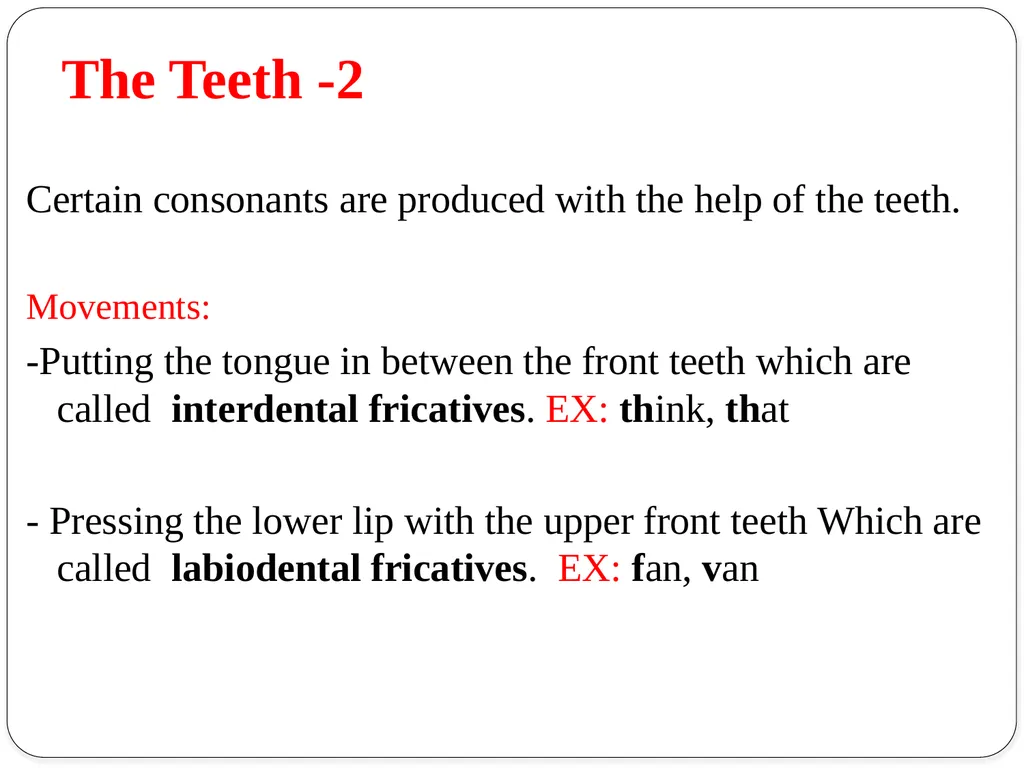
slide17. 2- The Teeth Certain consonants are produced with the help of the teeth.
Movements:
-Putting the tongue in between the front teeth which are called interdental fricatives. EX: think, that
- Pressing the lower lip with the upper front teeth Which are called labiodental fricatives. EX: fan, van<br>
slide18. 3- The Alveolar Ridge It’s located just behind the upper front teeth and consonantal sounds like t, d, n, l, s, z are produced here.
Movements:
Tongue tip or blade touches the alveolar ridge. EX: l, n
making a complete closure by the tip of the tongue and the alveolar ridge, followed by a sudden release of the closure . EX: t, d
Narrowing the passage of the air at the alveolar ridge and forcing the air out through this passage
EX: s, z<br>
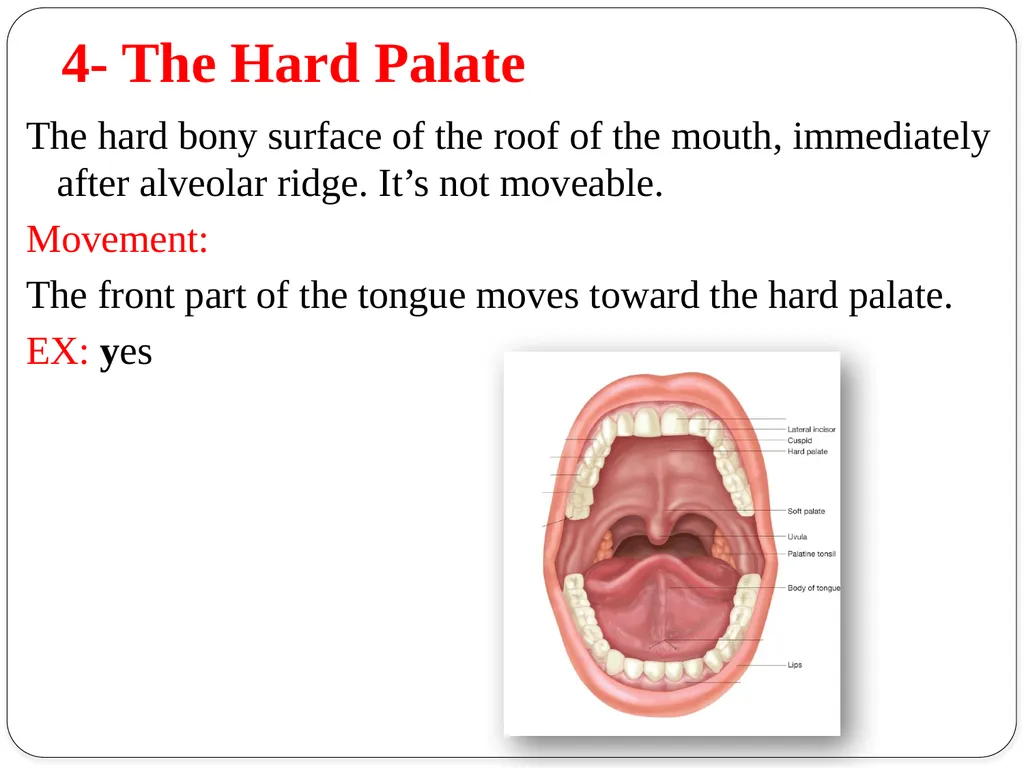
slide19. 4- The Hard Palate The hard bony surface of the roof of the mouth, immediately after alveolar ridge. It’s not moveable.
Movement:
The front part of the tongue moves toward the hard palate.
EX: yes<br>
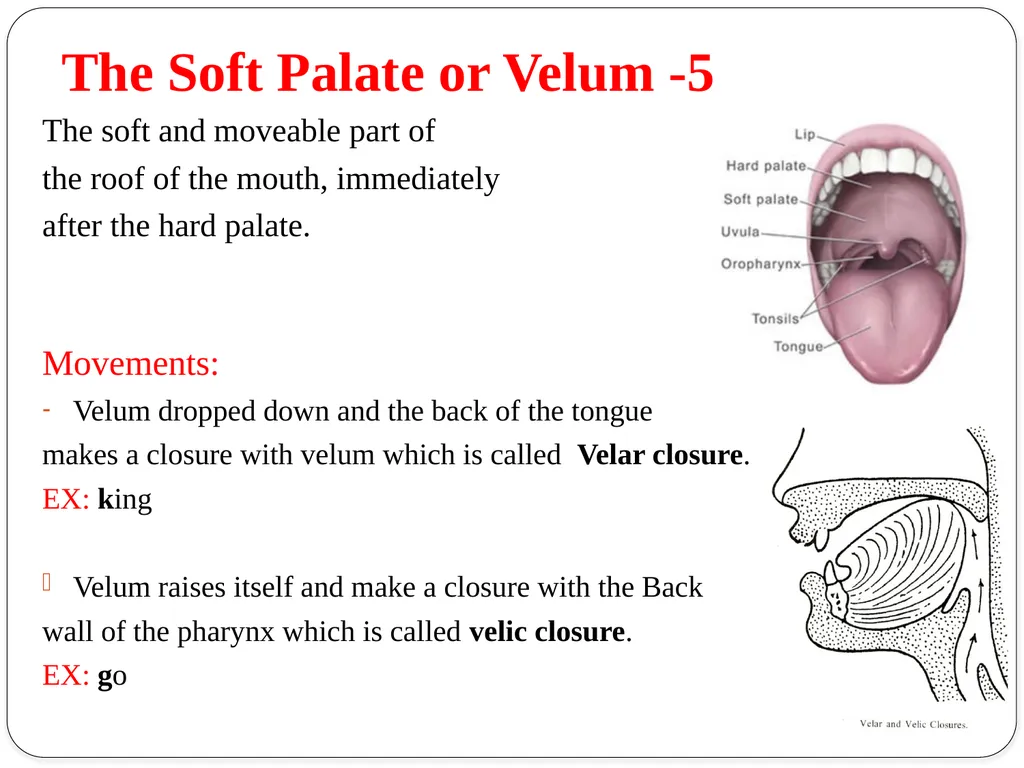
slide20. 5- The Soft Palate or Velum The soft and moveable part of
the roof of the mouth, immediately
after the hard palate.
Movements:
Velum dropped down and the back of the tongue
makes a closure with velum which is called Velar closure.
EX: king
Velum raises itself and make a closure with the Back
wall of the pharynx which is called velic closure.
EX: go<br>
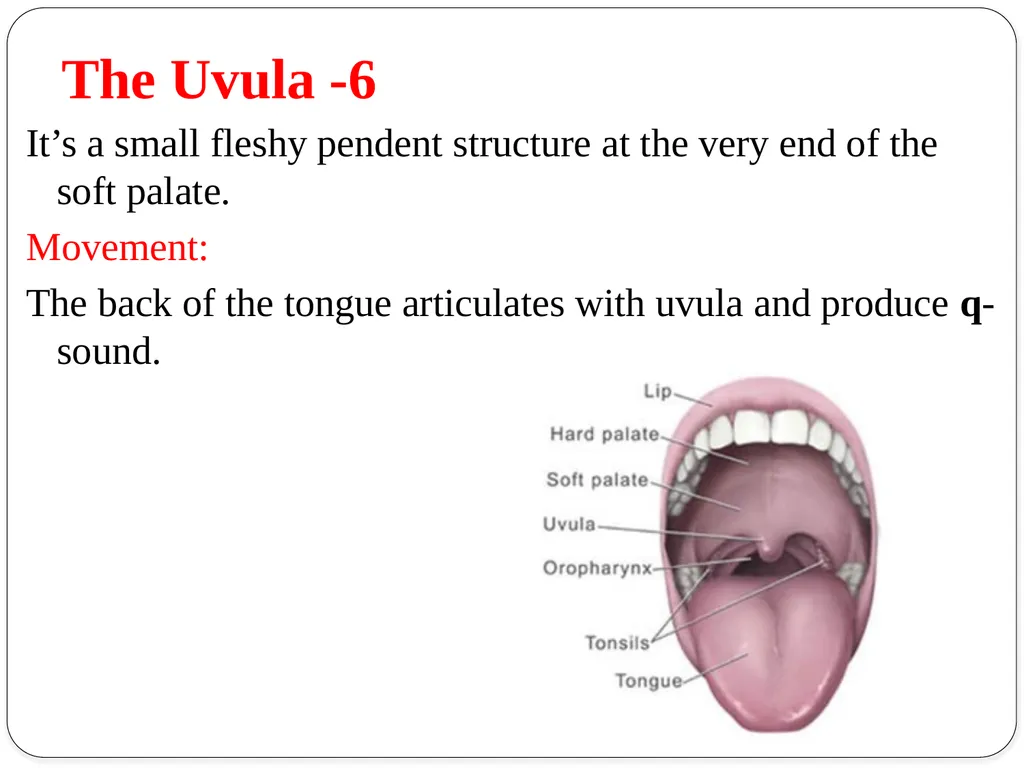
slide21. 6- The Uvula It’s a small fleshy pendent structure at the very end of the soft palate.
Movement:
The back of the tongue articulates with uvula and produce q- sound.<br>
slide22. 7- The Tongue -It’s the most important single organ of speech.
-Even in many languages the word TONGUE means Language too.
-It’s flexible and can make a large number of gestures to produce speech sounds.
- It has different parts:
1- tip 2- blade 3– front
4– back 5- rims<br>
slide23. Different parts of the tongue 1- The Tip: When the tongue is the state of the rest , it’s the part that is lying behind the lower front teeth.
2- The Blade: It ‘s lying the opposite side of the alveolar ridge.
3- the Front: It faces the hard palate.
4- The Back: It’s on the opposite side of the soft palate.
5- The Rims: They are the edges of the tongue.<br>
slide24. Movements Of The Tongue Any part of the tongue can be moved to produce speech sounds
The tip and the blade make a contact with the alveolar ridge:
EX: ten, do, noon
The front of the tongue may be raised toward the hard palate:
EX: yet, unit, sea
The back of the tongue makes a contact with the soft palate:
Ex: Kill, girl<br>
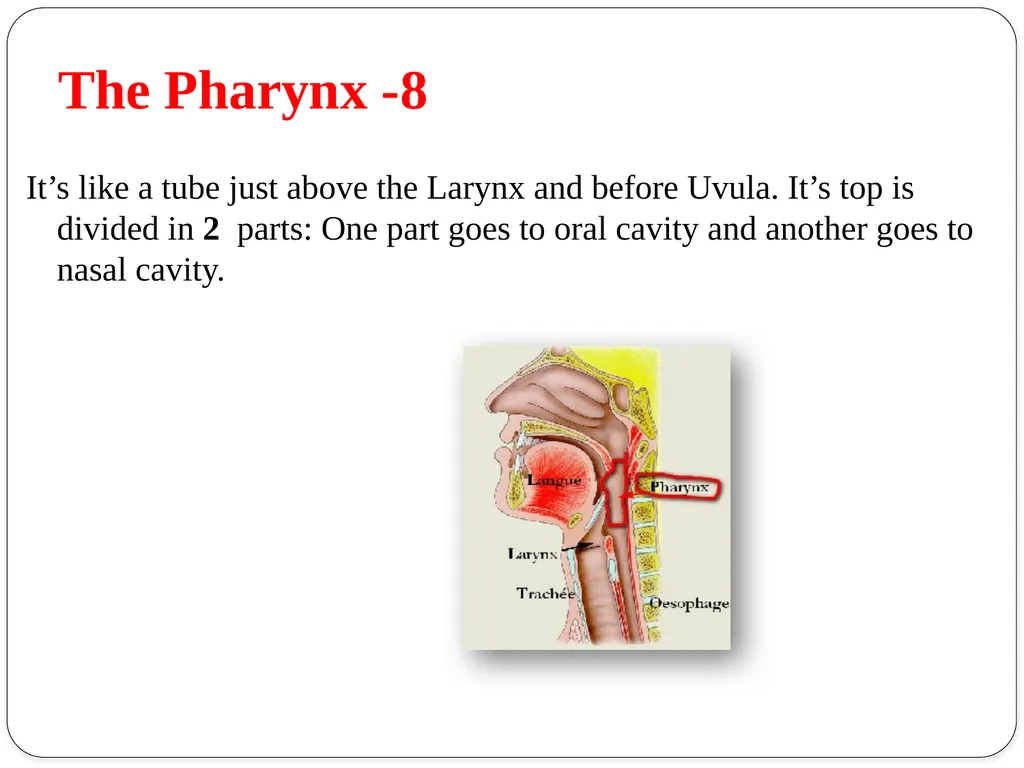
slide25. 8- The Pharynx It’s like a tube just above the Larynx and before Uvula. It’s top is divided in 2 parts: One part goes to oral cavity and another goes to nasal cavity.<br>
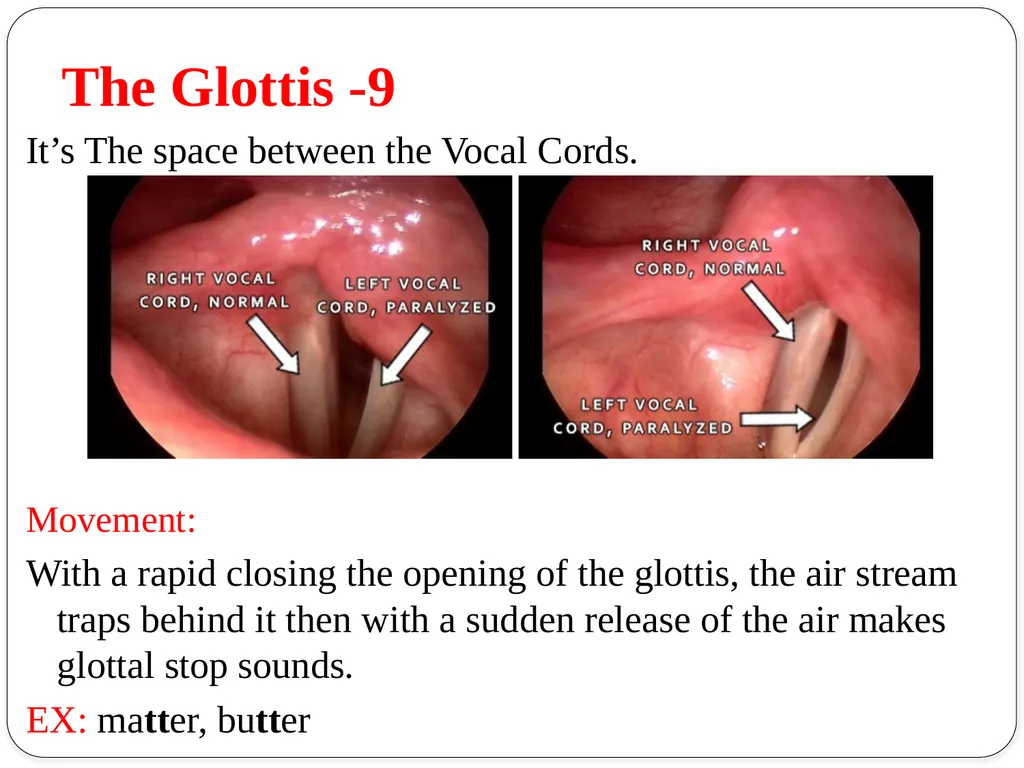
slide26. 9- The Glottis It’s The space between the Vocal Cords.
Movement:
With a rapid closing the opening of the glottis, the air stream traps behind it then with a sudden release of the air makes glottal stop sounds.
EX: matter, butter<br>
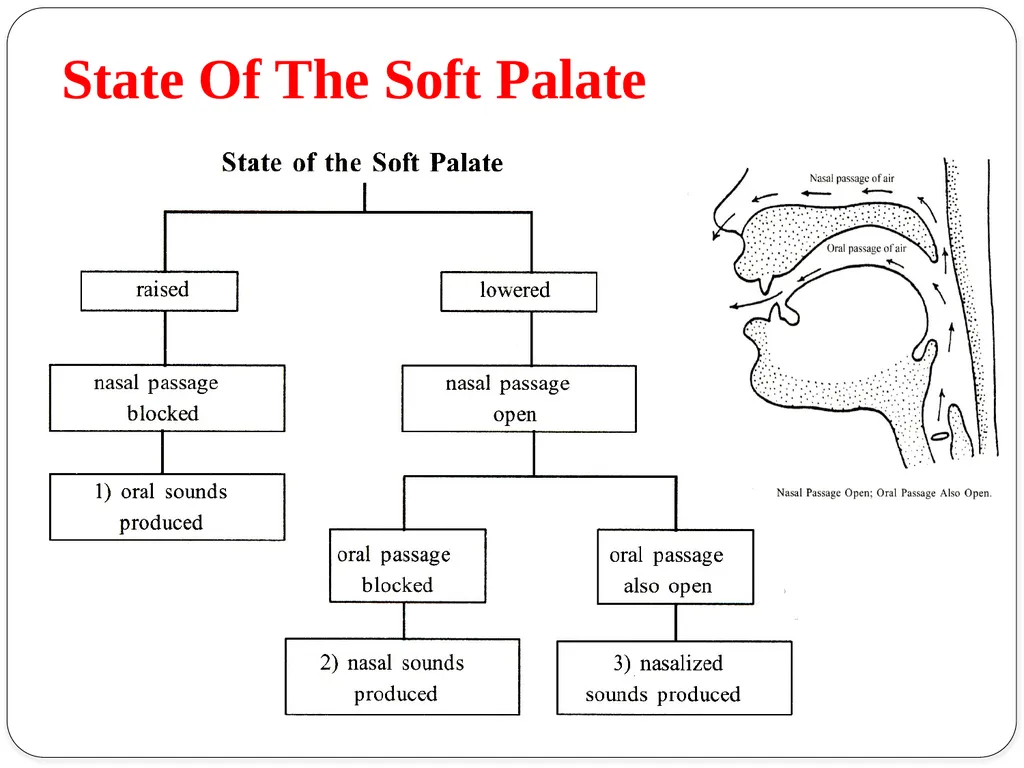
slide27. Oral and Nasal Cavities The air is pushed by the lungs and travels through the mouth which is called oral cavity or through the nose which is called nasal cavity.<br>
slide28. State Of The Soft Palate<br>
slide29. It's over !<br>
Assistant Professor
Department of English
Swa.Sawarkar Mahavidyalaya , Beed.
Refresher Course in E-Governance & E-Learning
lgbahegavankar@gmail.com
Roll No.01 Presentation on Organs of Speech<br>
slide2. Organs Of Speech<br>
slide3. Organs Of Speech -Organs of speech are described under 3 systems:
I– Respiratory System
II- The Phonatory System
III- The Articulatory System<br>
slide4. I– Respiratory System Consists Of: 1-The Lungs 2- The Muscles Of The Chest
3- The Windpipe<br>
slide5. 1- The Lungs : – Perform the action of breathing or respiration.
( Exhalation – Inhalation )
– The lungs provide the source of energy for our vocal activity by this airstream.
– The airstream mechanism is called pulmonic egressive airstream.
- Pulmonic means lungs.
- Egressive airstream means that the airstream goes out of the lungs.<br>
slide6. 2- The Muscles of the Chest:
The lungs perform respiration under the function of the muscles of the chest.<br>
slide7. 3- The Windpipe (trachea):
The air passes through the windpipe.<br>
slide8. II- The Phonatory System Before the airstream goes out of the mouth , it undergoes several modifications:
1- The Larynx
2- The Vocal Cords<br>
slide9. 1- The Larynx It’s a bony box-like structure in the front part of the throat and the upper part of trachea. It’s known as “Adam’s Apple” too.<br>
slide10. 2- The Vocal Cords -Vocal cords are a pair of lip-like structure inside the Larynx.
-These cords are placed horizontally from front to the back , joined at the front and separated at the back.
-Therefore they can have a large number of positions.<br>
slide11. 3 Important positions of Vocal Cords 1- Vocal Cords Drawn Wide Apart
- This is The Normal Position of vocal cords during breathing.
The air stream can pass freely without setting the vocal cords into Vibration and produces Voiceless Sounds.
EX: Cat- fat- chat – top- sheet- seat
- A wide opening is between the vocal cords is called Glottis.<br>
slide12. 3 Important positions of Vocal Cords 2- Vocal Cords Held Loosely Together
The airstream set the vocal cords into vibration and we hear a “ HHHUUUMMM “ sound .
The sounds that set the vocal cords into Vibration are voiced sounds.
EX: All vowels- red- men-dead-bed-let-nest-then-jump-zoo-yellow- well<br>
slide13. 3 Important positions of Vocal Cords 3- Vocal Cords Held Tightly Together:
Glottis is closed and no air can escape through it.
Vocal cords are closed and the airstream is stopped completely for a short period of time . suddenly the vocal cords drawn apart and produce explosive sound that is called glottal stop like a mid cough.
EX: lip, shut, sick<br>
slide14. III- The Articulatory System - After Larynx, the airstream passes
through other 9 organs of speech
that are laying above the larynx.
1 – The Lips 2- The Teeth
3- The Alveolar ridge 4-The hard palate
5- The Soft Palate 6- The Uvula
7- The tongue 8- The Pharynx
9- The glottis
These Organs of speech make the articulatory System together.<br>
slide15. Active and Passive Articulators Active articulators are those organs of speech that move from their position of rest to articulate against other organs of speech that do not or can not move which are called passive articulators.
EX: in producing t, d, n, s the tip and blade of the tongue move from their position to the alveolar ridge. So, the tip and blade of the tongue are active articulators and the alveolar ridge is the passive one.
- The active articulators are mostly located in the lower jaw and the passive articulators are mostly in the upper jaw.<br>
slide16. 1 – The Lips The upper and lower lips have important role in producing certain speech sounds especially in producing vowels .
Movements:
1- Closing the lips and then releasing the closure abruptly EX: put , boot
2- closing the lips and making nasal consonant EX: men
3- protrude and rounded EX: boot
4- spread EX: beads
5- neutral – not spread not rounded EX: about<br>
slide17. 2- The Teeth Certain consonants are produced with the help of the teeth.
Movements:
-Putting the tongue in between the front teeth which are called interdental fricatives. EX: think, that
- Pressing the lower lip with the upper front teeth Which are called labiodental fricatives. EX: fan, van<br>
slide18. 3- The Alveolar Ridge It’s located just behind the upper front teeth and consonantal sounds like t, d, n, l, s, z are produced here.
Movements:
Tongue tip or blade touches the alveolar ridge. EX: l, n
making a complete closure by the tip of the tongue and the alveolar ridge, followed by a sudden release of the closure . EX: t, d
Narrowing the passage of the air at the alveolar ridge and forcing the air out through this passage
EX: s, z<br>
slide19. 4- The Hard Palate The hard bony surface of the roof of the mouth, immediately after alveolar ridge. It’s not moveable.
Movement:
The front part of the tongue moves toward the hard palate.
EX: yes<br>
slide20. 5- The Soft Palate or Velum The soft and moveable part of
the roof of the mouth, immediately
after the hard palate.
Movements:
Velum dropped down and the back of the tongue
makes a closure with velum which is called Velar closure.
EX: king
Velum raises itself and make a closure with the Back
wall of the pharynx which is called velic closure.
EX: go<br>
slide21. 6- The Uvula It’s a small fleshy pendent structure at the very end of the soft palate.
Movement:
The back of the tongue articulates with uvula and produce q- sound.<br>
slide22. 7- The Tongue -It’s the most important single organ of speech.
-Even in many languages the word TONGUE means Language too.
-It’s flexible and can make a large number of gestures to produce speech sounds.
- It has different parts:
1- tip 2- blade 3– front
4– back 5- rims<br>
slide23. Different parts of the tongue 1- The Tip: When the tongue is the state of the rest , it’s the part that is lying behind the lower front teeth.
2- The Blade: It ‘s lying the opposite side of the alveolar ridge.
3- the Front: It faces the hard palate.
4- The Back: It’s on the opposite side of the soft palate.
5- The Rims: They are the edges of the tongue.<br>
slide24. Movements Of The Tongue Any part of the tongue can be moved to produce speech sounds
The tip and the blade make a contact with the alveolar ridge:
EX: ten, do, noon
The front of the tongue may be raised toward the hard palate:
EX: yet, unit, sea
The back of the tongue makes a contact with the soft palate:
Ex: Kill, girl<br>
slide25. 8- The Pharynx It’s like a tube just above the Larynx and before Uvula. It’s top is divided in 2 parts: One part goes to oral cavity and another goes to nasal cavity.<br>
slide26. 9- The Glottis It’s The space between the Vocal Cords.
Movement:
With a rapid closing the opening of the glottis, the air stream traps behind it then with a sudden release of the air makes glottal stop sounds.
EX: matter, butter<br>
slide27. Oral and Nasal Cavities The air is pushed by the lungs and travels through the mouth which is called oral cavity or through the nose which is called nasal cavity.<br>
slide28. State Of The Soft Palate<br>
slide29. It's over !<br>