
Sickle Cell Disease: Core Concepts for the
TA
Published · 17 slides · 0 views
1 / 1
Description
Sickle Cell Disease: Core Concepts for the Emergency Physician and Nurse Incentive Spirometry to Reduce the Risk of Acute Chest Syndrome in Patients Hospitalized with Sickle Cell Disease Claire Vandewalle, RN, BSN Paula Tanabe, PhD, RN,
Related Topics
Share
Embed code
Download this presentation From Below
"Sickle Cell Disease: Core Concepts for the" is the property of its rightful owner. Permission is granted to download and print the materials on this website for personal, non-commercial use only, and to display it on your personal computer provided you do not modify the materials and that you retain all copyright notices contained in the materials. By downloading content from our website, you accept the terms of this agreement.
Presentation Transcript
01
Sickle Cell Disease: Core Concepts for
the Emergency Physician and Nurse
Incentive Spirometry to Reduce the Risk of Acute Chest Syndrome in Patients Hospitalized with Sickle Cell Disease Claire Vandewalle, RN, BSN
Paula Tanabe, PhD, RN, FAEN, FAAN
Associate Professor
Duke University, Schools of Nursing and Medicine<br>
Paula Tanabe, PhD, RN, FAEN, FAAN
Associate Professor
Duke University, Schools of Nursing and Medicine<br>
02
Objectives Describe how as a nurse you would instruct the patient on use of the incentive spirometer.
Identify one strategy to decrease pain when using the incentive spirometer.<br>
Identify one strategy to decrease pain when using the incentive spirometer.<br>
03
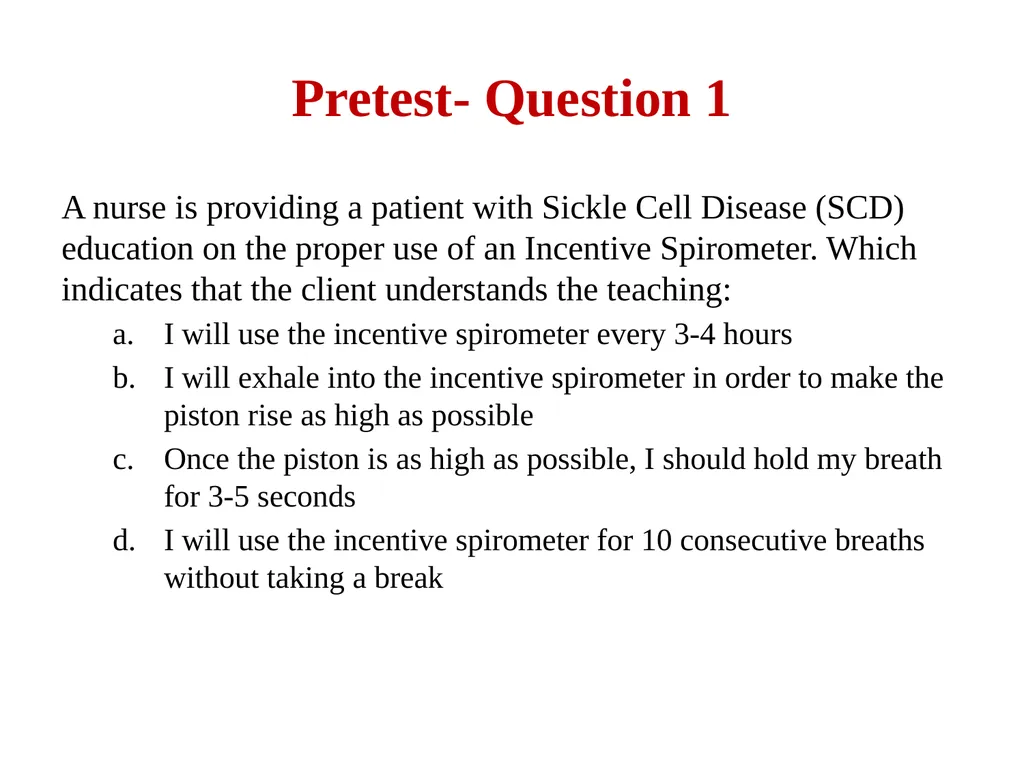
Pretest- Question 1 A nurse is providing a patient with Sickle Cell Disease (SCD) education on the proper use of an Incentive Spirometer. Which indicates that the client understands the teaching:
I will use the incentive spirometer every 3-4 hours
I will exhale into the incentive spirometer in order to make the piston rise as high as possible
Once the piston is as high as possible, I should hold my breath for 3-5 seconds
I will use the incentive spirometer for 10 consecutive breaths without taking a break<br>
I will use the incentive spirometer every 3-4 hours
I will exhale into the incentive spirometer in order to make the piston rise as high as possible
Once the piston is as high as possible, I should hold my breath for 3-5 seconds
I will use the incentive spirometer for 10 consecutive breaths without taking a break<br>
04
Pretest- Question 2 A patient is struggling to use their Incentive Spirometer correctly. What advice can be provided to help them be more successful?
Try to avoid coughing while using the Incentive Spirometer
Hug a pillow while using the Incentive Spirometer to reduce pain
If the piston doesn’t reach the marker, lower the marker so you don’t have to use as much effort
Use it only if you are feeling up to it<br>
Try to avoid coughing while using the Incentive Spirometer
Hug a pillow while using the Incentive Spirometer to reduce pain
If the piston doesn’t reach the marker, lower the marker so you don’t have to use as much effort
Use it only if you are feeling up to it<br>
05
Overview of
Acute Chest Syndrome (ACS) 1 New radiodensity, or infiltrate, on chest x-ray2
Fever and respiratory symptoms (tachypnea, cough, dyspnea)2
Cause often unknown3
Triggered by pulmonary vaso-occlusion (VOC) (bone infarction, pulmonary embolus)4,5
VOC associated with infection, asthma, and hypoventilation4,5
Risk factors: increasing age, asthma, smoking, surgery3<br>
Fever and respiratory symptoms (tachypnea, cough, dyspnea)2
Cause often unknown3
Triggered by pulmonary vaso-occlusion (VOC) (bone infarction, pulmonary embolus)4,5
VOC associated with infection, asthma, and hypoventilation4,5
Risk factors: increasing age, asthma, smoking, surgery3<br>
06
Epidemiology of ACS1 A leading cause of premature death in SCD6,7
Adult death rate = 4.3%8
Child death rate = 1.1% 8
50% of SCD patients experience ACS at some point9
78% associated with VOC10
Not usually the presenting condition but develops often within 48-72 hours of hospital admission10<br>
Adult death rate = 4.3%8
Child death rate = 1.1% 8
50% of SCD patients experience ACS at some point9
78% associated with VOC10
Not usually the presenting condition but develops often within 48-72 hours of hospital admission10<br>
07
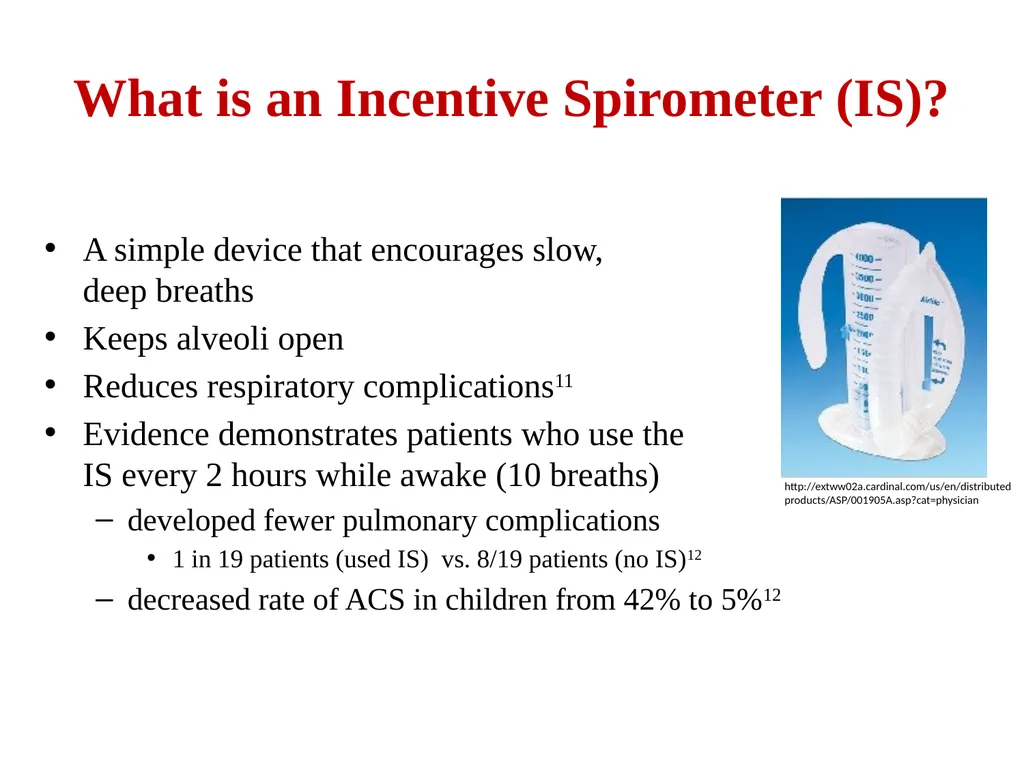
What is an Incentive Spirometer (IS)? A simple device that encourages slow, deep breaths
Keeps alveoli open
Reduces respiratory complications11
Evidence demonstrates patients who use the IS every 2 hours while awake (10 breaths)
developed fewer pulmonary complications
1 in 19 patients (used IS) vs. 8/19 patients (no IS)12
decreased rate of ACS in children from 42% to 5%12 http://extww02a.cardinal.com/us/en/distributed
products/ASP/001905A.asp?cat=physician<br>
Keeps alveoli open
Reduces respiratory complications11
Evidence demonstrates patients who use the IS every 2 hours while awake (10 breaths)
developed fewer pulmonary complications
1 in 19 patients (used IS) vs. 8/19 patients (no IS)12
decreased rate of ACS in children from 42% to 5%12 http://extww02a.cardinal.com/us/en/distributed
products/ASP/001905A.asp?cat=physician<br>
08
Patient Instruction Video:
How to use IS 11, 13, 14, 15 Spanish: https://www.youtube.com/watch?v=XAZ1JteEfgk English: https://www.youtube.com/watch?v=rljd81e0qwQ Copy and paste the link into your browser.<br>
09
Extra tips for successful use of IS11, 13 To ease pain with IS, hold pillow tightly to abdomen
If dizzy, slow down and take a break
Cough after each breath to clear secretions
Keep within reach to remind for regular use
Encourage patients to use during commercial breaks when watching TV
If patient has costocondritis, encourage use, but you may need to decrease the frequency of use if pain is aggravated<br>
If dizzy, slow down and take a break
Cough after each breath to clear secretions
Keep within reach to remind for regular use
Encourage patients to use during commercial breaks when watching TV
If patient has costocondritis, encourage use, but you may need to decrease the frequency of use if pain is aggravated<br>
10
How to order Verify the physician used the SCD order set & IS is ordered
If a nurse driven protocol is available, initiate this
Verify order: q 2 hours while awake, 10 breaths, and at night if awake<br>
If a nurse driven protocol is available, initiate this
Verify order: q 2 hours while awake, 10 breaths, and at night if awake<br>
11
Documentation Located in Maestro: Doc flowsheet/ Assessments/Respiratory intervention
Time
Number of repetitions
Average volume (mL)
Encourage patients to keep a record for the nurse by using the log found in the incentive spirometer packaging.<br>
Time
Number of repetitions
Average volume (mL)
Encourage patients to keep a record for the nurse by using the log found in the incentive spirometer packaging.<br>
12
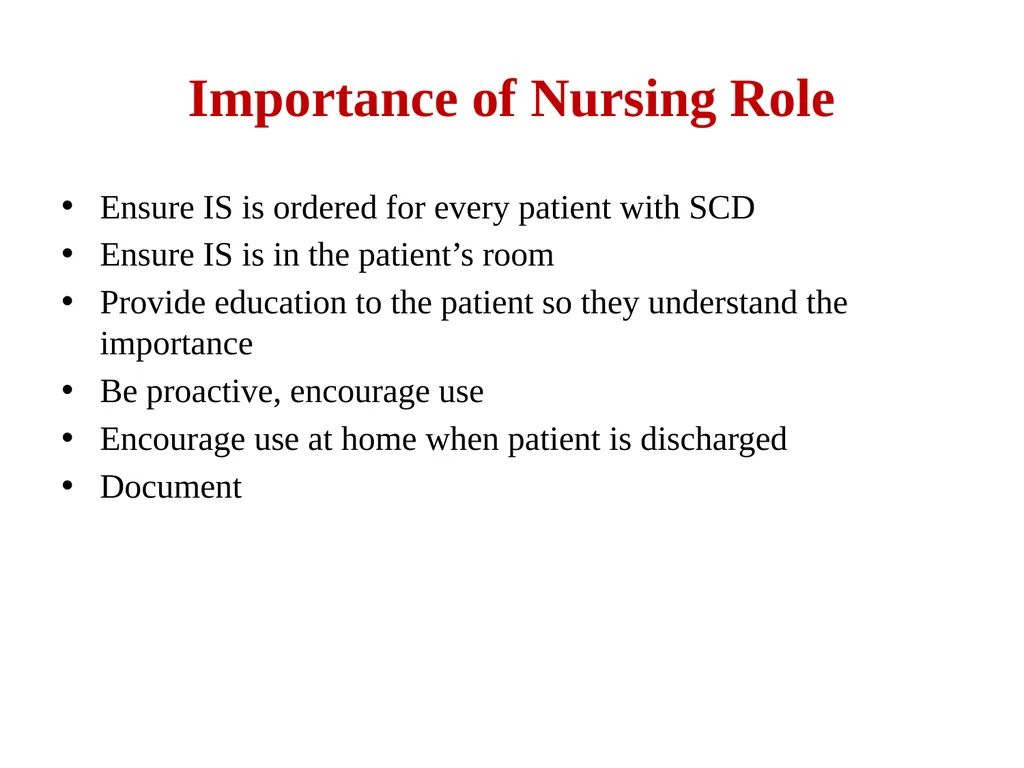
Importance of Nursing Role Ensure IS is ordered for every patient with SCD
Ensure IS is in the patient’s room
Provide education to the patient so they understand the importance
Be proactive, encourage use
Encourage use at home when patient is discharged
Document<br>
Ensure IS is in the patient’s room
Provide education to the patient so they understand the importance
Be proactive, encourage use
Encourage use at home when patient is discharged
Document<br>
13
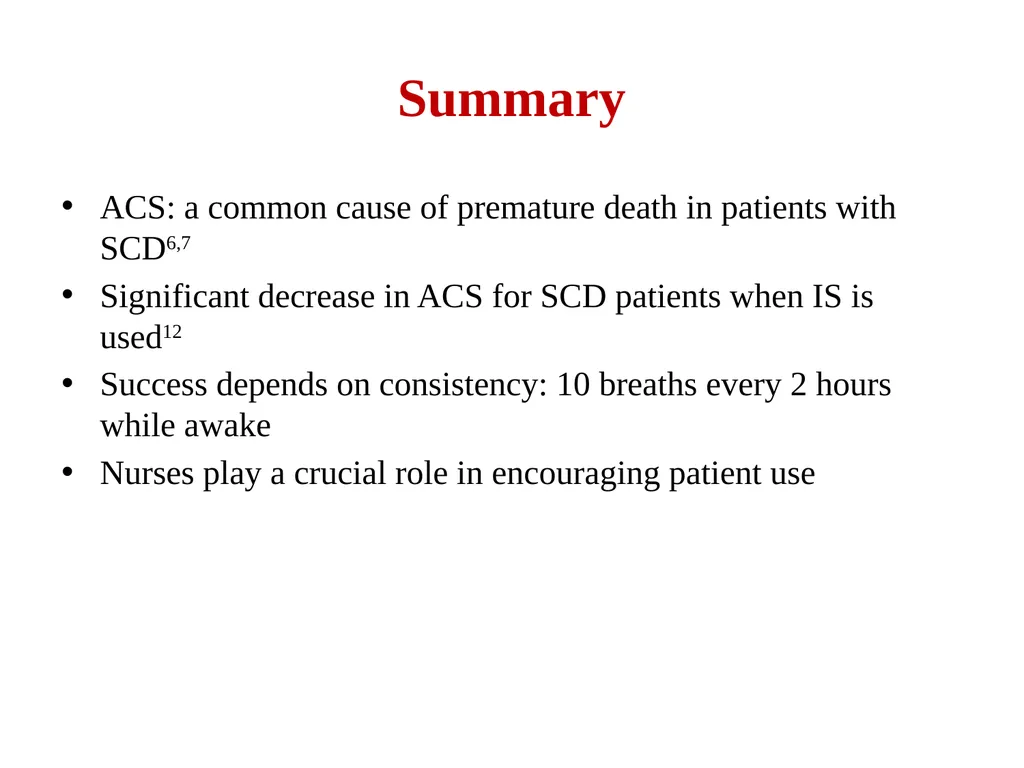
Summary ACS: a common cause of premature death in patients with SCD6,7
Significant decrease in ACS for SCD patients when IS is used12
Success depends on consistency: 10 breaths every 2 hours while awake
Nurses play a crucial role in encouraging patient use<br>
Significant decrease in ACS for SCD patients when IS is used12
Success depends on consistency: 10 breaths every 2 hours while awake
Nurses play a crucial role in encouraging patient use<br>
14
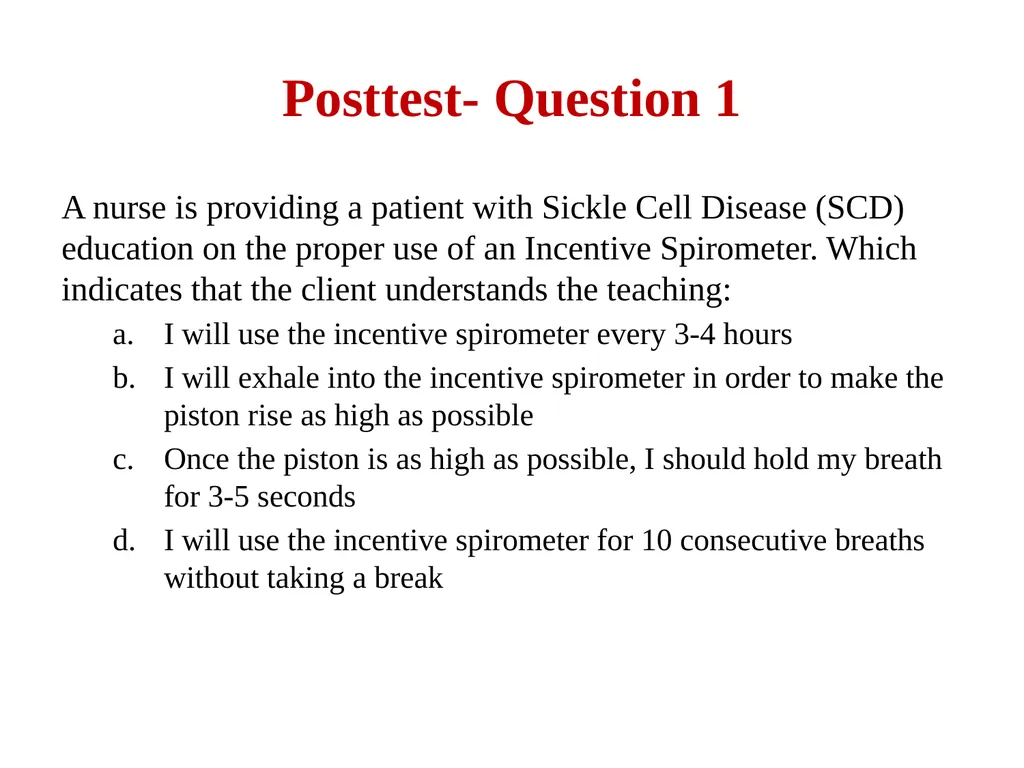
Posttest- Question 1 A nurse is providing a patient with Sickle Cell Disease (SCD) education on the proper use of an Incentive Spirometer. Which indicates that the client understands the teaching:
I will use the incentive spirometer every 3-4 hours
I will exhale into the incentive spirometer in order to make the piston rise as high as possible
Once the piston is as high as possible, I should hold my breath for 3-5 seconds
I will use the incentive spirometer for 10 consecutive breaths without taking a break<br>
I will use the incentive spirometer every 3-4 hours
I will exhale into the incentive spirometer in order to make the piston rise as high as possible
Once the piston is as high as possible, I should hold my breath for 3-5 seconds
I will use the incentive spirometer for 10 consecutive breaths without taking a break<br>
15
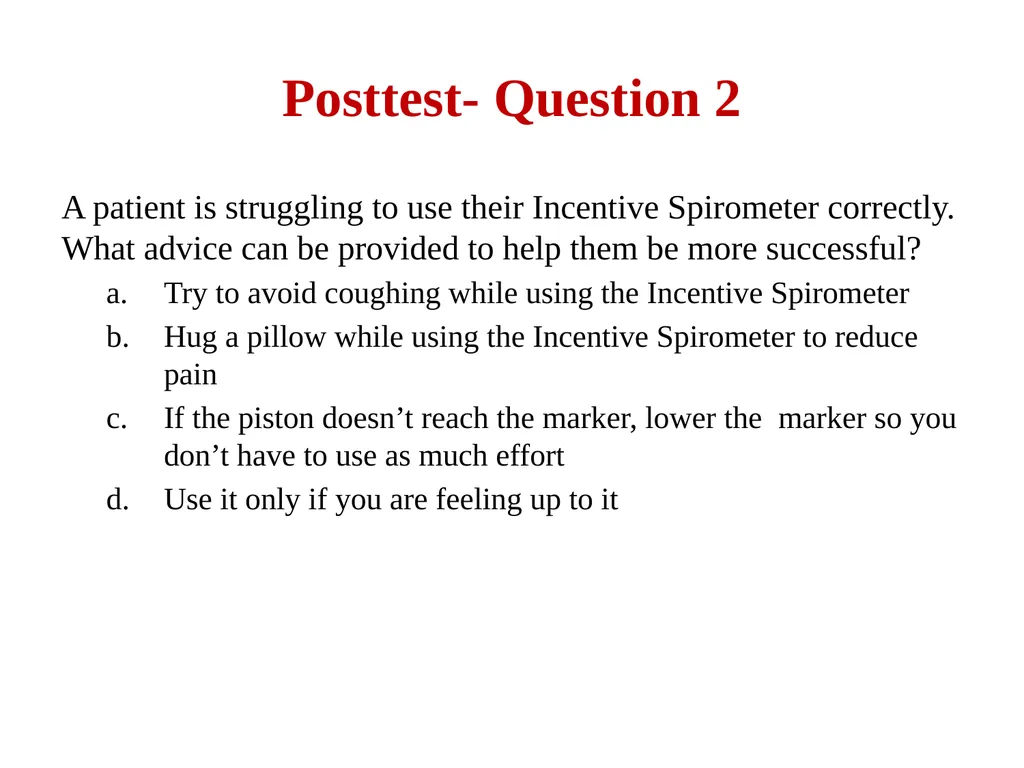
Posttest- Question 2 A patient is struggling to use their Incentive Spirometer correctly. What advice can be provided to help them be more successful?
Try to avoid coughing while using the Incentive Spirometer
Hug a pillow while using the Incentive Spirometer to reduce pain
If the piston doesn’t reach the marker, lower the marker so you don’t have to use as much effort
Use it only if you are feeling up to it<br>
Try to avoid coughing while using the Incentive Spirometer
Hug a pillow while using the Incentive Spirometer to reduce pain
If the piston doesn’t reach the marker, lower the marker so you don’t have to use as much effort
Use it only if you are feeling up to it<br>
16
Posttest Answers & Rationale Question 1
Answer : c) Once the piston is as high as possible, I should hold my breath for 3-5 seconds
Rationale: a) is not correct because IS should be used every 2 hours, not every 3-4. b) is not correct because patients should inhale, not exhale. c) is correct: patients should hold their breath for 3-5 seconds at the top of the inhale. d) is not correct because patients should take a break to avoid dizziness.
Question 2
Answer: b) Hug a pillow while using the Incentive Spirometer to reduce pain
Rationale: a) is not correct because patients should be encouraged to cough to clear secretions. b) is correct: Hugging a pillow helps reduce pain. c) is not correct because patients should aim for the marker even if they don’t make it all the way. d) is not correct because it is important to use it regularly, not just when feeling good.<br>
Answer : c) Once the piston is as high as possible, I should hold my breath for 3-5 seconds
Rationale: a) is not correct because IS should be used every 2 hours, not every 3-4. b) is not correct because patients should inhale, not exhale. c) is correct: patients should hold their breath for 3-5 seconds at the top of the inhale. d) is not correct because patients should take a break to avoid dizziness.
Question 2
Answer: b) Hug a pillow while using the Incentive Spirometer to reduce pain
Rationale: a) is not correct because patients should be encouraged to cough to clear secretions. b) is correct: Hugging a pillow helps reduce pain. c) is not correct because patients should aim for the marker even if they don’t make it all the way. d) is not correct because it is important to use it regularly, not just when feeling good.<br>
17
References Field, J.J. & DeBaun, M.R. (2013). Acute chest syndrome in adults with sickle cell disease. UpToDate. Retrieved from
http://www.uptodate.com/contents/acute-chest-syndrome-in-adults-with-sickle-cell-disease
Ballas S.K., Lieff S., Benjamin L.J., et al. (2010). Definitions of the phenotypic manifestations of sickle cell disease. American Journal of Hematology 85:6.
Acute Chest Syndrome. (2013). Sickle Cell Disease: Core Concepts for the Emergency Physician and Nurse. Emergency Department Sickle Cell Disease: Crisis management and beyond. Duke University. Retrieved from http://sickleemergency.duke.edu/educational-resources/short-presentations-online-learning
Melton, C.W. Haynes, J.A. (2006). Sickle acute lung injury: role of prevention and early aggressive intervention strategies on outcome. Clinics in Chest Medicine 27:487.
Gladwin, M.T., Vichinsky, E. (2008). Pulmonary complications of sickle cell disease. New England Journal of Medicine 359: 2254.
Platt O.S., Brambilla, D.J., Rosse, W.F., et al. (1994). Mortality in sickle cell disease: Life expectancy and risk factors for early death. New England Journal of Medicine 330:1639.
Thomas, A.N., Pattison, C., Serjeant, G.R. (1982). Causes of death in sickle-cell disease in Jamaica. British Medical Journal (Clinical Research Edition) 285:633.
Vichinsky, E.P., Styles, L.A., Colangelo, L.H., et al. (1997). Acute chest syndrome in sickle cell disease: clinical presentation and course. Cooperative Study of Sickle Cell Disease 89:1787.
Castro, O., Brambilla, D.J., Thorington, B., et al. (1994). The acute chest syndrome in sickle cell disease: incidence and risk factors. The Cooperative Study of Sickle Cell Disease 84:643.
Maitre, B., Habibi, A., Roudot-Thoraval, F., et al. (2000). Acute chest syndrome in adults with sickle cell disease. Chest 117:1386.
How to use an incentive spirometer. (2012). The Ohio State University Wexner Medical Center. Retrieved from https://patienteducation.osumc.edu/documents/in-sp-mouth.pdf
Bellet, P.S., Kalinyak, K.A., Shukla, R., Gelfand, M.J., & Rucknagel, D.L. (1995). Incentive spirometry to prevent acute pulmonary complications in sickle cell diseases. The New England Journal of Medicine 333(11): 699-703.
Dugdale, D.C. (2012). Using an incentive spirometer. MedlinePlus Medical Encyclopedia. Retrieved from http://www.nlm.nih.gov/medlineplus/ency/patientinstructions/000451.htm
How to use an incentive spirometer. (2013). Cleveland Clinic Treatments and Procedures. Retrieved from http://my.clevelandclinic.org/services/surgery/hic_how_to_use_an_incentive_spirometer.aspx
McConnell, E.A. (1993). Teaching your patient to use an incentive spirometer. Nursing 93(23)2: 18.<br>
Ballas S.K., Lieff S., Benjamin L.J., et al. (2010). Definitions of the phenotypic manifestations of sickle cell disease. American Journal of Hematology 85:6.
Acute Chest Syndrome. (2013). Sickle Cell Disease: Core Concepts for the Emergency Physician and Nurse. Emergency Department Sickle Cell Disease: Crisis management and beyond. Duke University. Retrieved from http://sickleemergency.duke.edu/educational-resources/short-presentations-online-learning
Melton, C.W. Haynes, J.A. (2006). Sickle acute lung injury: role of prevention and early aggressive intervention strategies on outcome. Clinics in Chest Medicine 27:487.
Gladwin, M.T., Vichinsky, E. (2008). Pulmonary complications of sickle cell disease. New England Journal of Medicine 359: 2254.
Platt O.S., Brambilla, D.J., Rosse, W.F., et al. (1994). Mortality in sickle cell disease: Life expectancy and risk factors for early death. New England Journal of Medicine 330:1639.
Thomas, A.N., Pattison, C., Serjeant, G.R. (1982). Causes of death in sickle-cell disease in Jamaica. British Medical Journal (Clinical Research Edition) 285:633.
Vichinsky, E.P., Styles, L.A., Colangelo, L.H., et al. (1997). Acute chest syndrome in sickle cell disease: clinical presentation and course. Cooperative Study of Sickle Cell Disease 89:1787.
Castro, O., Brambilla, D.J., Thorington, B., et al. (1994). The acute chest syndrome in sickle cell disease: incidence and risk factors. The Cooperative Study of Sickle Cell Disease 84:643.
Maitre, B., Habibi, A., Roudot-Thoraval, F., et al. (2000). Acute chest syndrome in adults with sickle cell disease. Chest 117:1386.
How to use an incentive spirometer. (2012). The Ohio State University Wexner Medical Center. Retrieved from https://patienteducation.osumc.edu/documents/in-sp-mouth.pdf
Bellet, P.S., Kalinyak, K.A., Shukla, R., Gelfand, M.J., & Rucknagel, D.L. (1995). Incentive spirometry to prevent acute pulmonary complications in sickle cell diseases. The New England Journal of Medicine 333(11): 699-703.
Dugdale, D.C. (2012). Using an incentive spirometer. MedlinePlus Medical Encyclopedia. Retrieved from http://www.nlm.nih.gov/medlineplus/ency/patientinstructions/000451.htm
How to use an incentive spirometer. (2013). Cleveland Clinic Treatments and Procedures. Retrieved from http://my.clevelandclinic.org/services/surgery/hic_how_to_use_an_incentive_spirometer.aspx
McConnell, E.A. (1993). Teaching your patient to use an incentive spirometer. Nursing 93(23)2: 18.<br>