Simple Covalent Molecules Higher LOW STAKES QUIZ You now need to do the low stakes quiz on Google Forms that goes with this lesson Learning Objectives To explain the properties of simple molecules. To explain why polymers are solids at room
"Simple Covalent Molecules Higher LOW STAKES QUIZ" is the property of its rightful owner. Permission is granted to
download and print the materials on this website for personal, non-commercial use only, and to display it
on your personal computer provided you do not modify the materials and that you retain all copyright
notices contained in the materials. By downloading content from our website, you accept the terms of this
agreement.
Presentation Transcript
01
Simple Covalent Molecules Higher<br>
02
LOW STAKES QUIZ You now need to do the low stakes quiz on Google Forms that goes with this lesson<br>
03
Learning Objectives To explain the properties of simple molecules.
To explain why polymers are solids at room temperature.<br>
04
What is a molecule. INPUT:
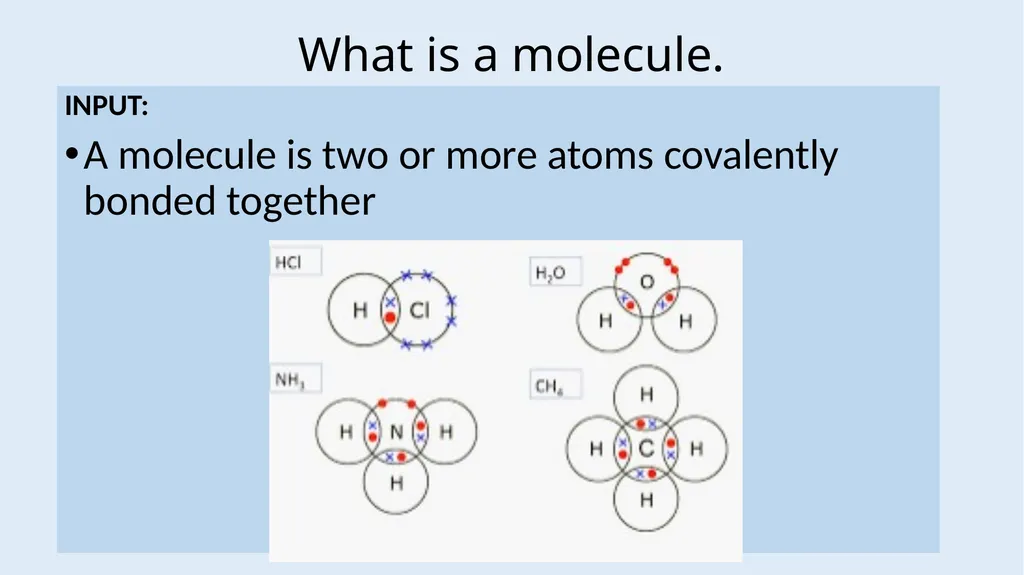
A molecule is two or more atoms covalently bonded together<br>
05
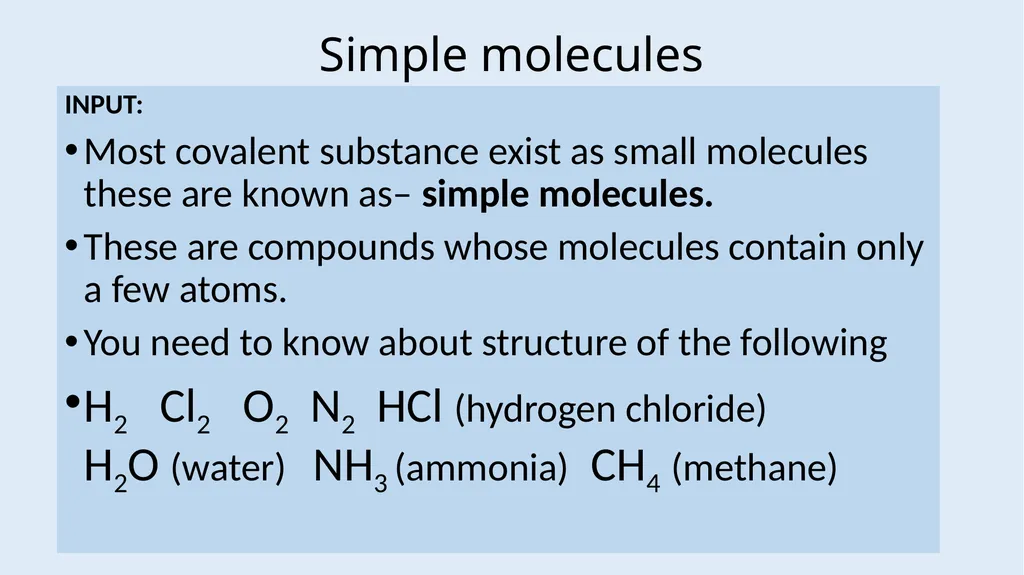
Simple molecules INPUT:
Most covalent substance exist as small molecules these are known as– simple molecules.
These are compounds whose molecules contain only a few atoms.
You need to know about structure of the following
H2 Cl2 O2 N2 HCl (hydrogen chloride) H2O (water) NH3 (ammonia) CH4 (methane)<br>
06
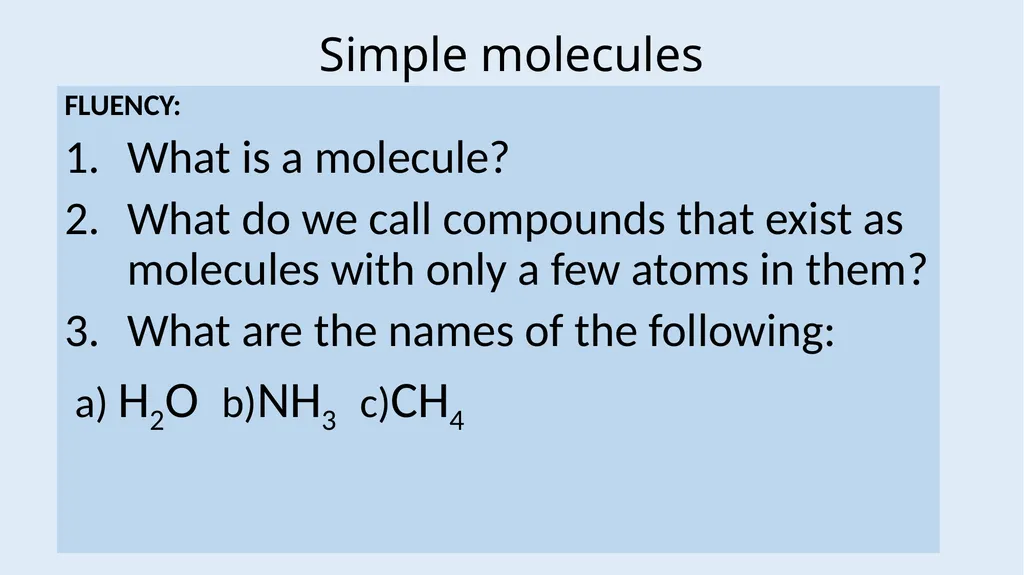
Simple molecules FLUENCY:
What is a molecule?
What do we call compounds that exist as molecules with only a few atoms in them?
What are the names of the following:
a) H2O b)NH3 c)CH4<br>
07
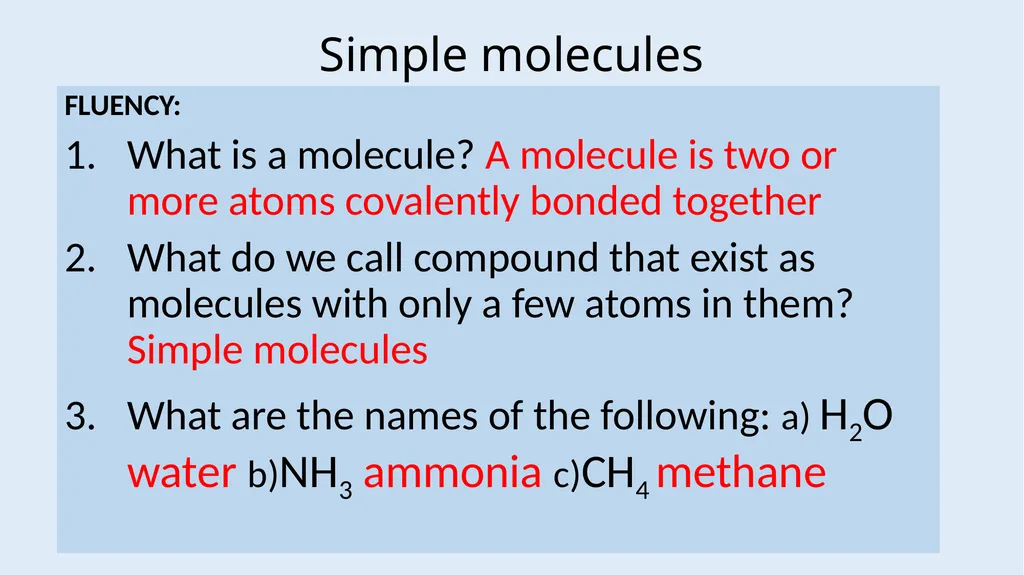
Simple molecules FLUENCY:
What is a molecule? A molecule is two or more atoms covalently bonded together
What do we call compound that exist as molecules with only a few atoms in them? Simple molecules
What are the names of the following: a) H2O water b)NH3 ammonia c)CH4 methane<br>
08
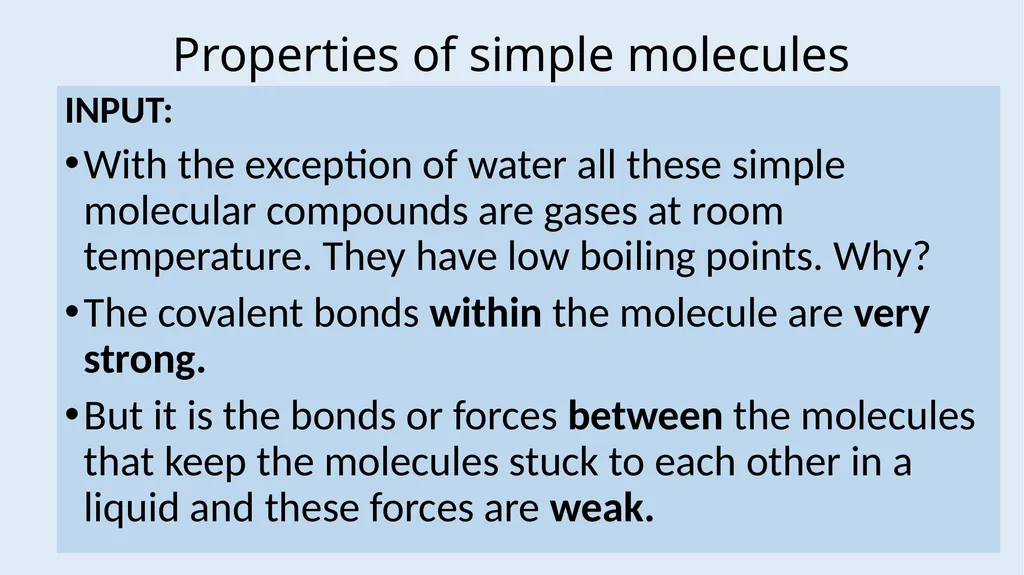
Properties of simple molecules INPUT:
With the exception of water all these simple molecular compounds are gases at room temperature. They have low boiling points. Why?
The covalent bonds within the molecule are very strong.
But it is the bonds or forces between the molecules that keep the molecules stuck to each other in a liquid and these forces are weak.<br>
09
Intermolecular Bonds INPUT:
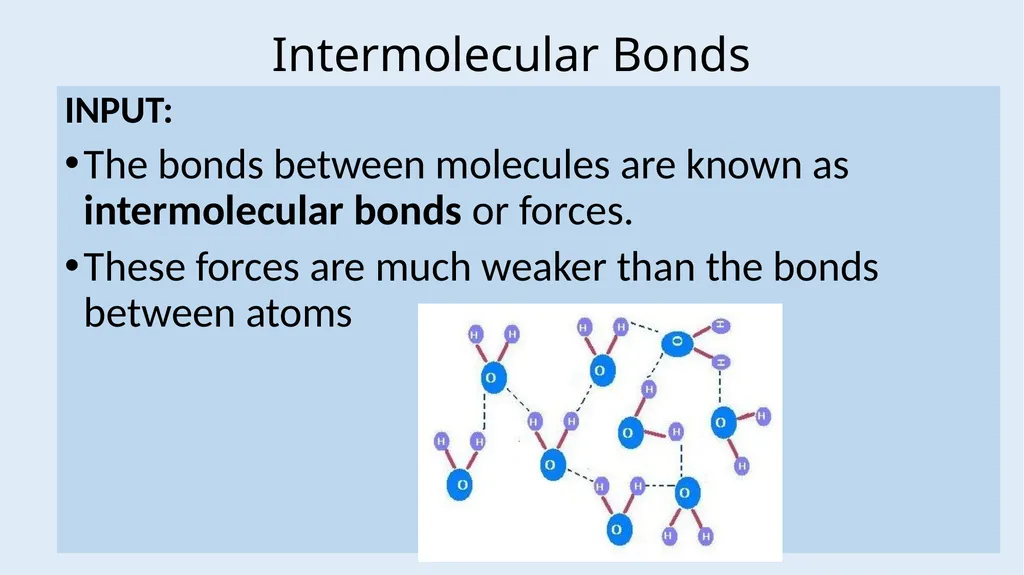
The bonds between molecules are known as intermolecular bonds or forces.
These forces are much weaker than the bonds between atoms<br>
10
Intermolecular Bonds INPUT:
It takes very little energy to break these intermolecular bonds
The molecules move apart and the compound turns into a gas
This means that simple molecules have very low boiling points.<br>
11
Intermolecular Bonds Fluency:
What do we call the bonds between the atoms inside a molecule?
What do we call the bonds or forces between the molecules?
Which of these bonds is strongest?<br>
12
Intermolecular Bonds Fluency:
What do we call the bonds between the atoms inside a molecule? Covalent bonds
What do we call the bonds or forces between the molecules? Intermolecular bonds (forces)
Which of these bonds is strongest? Covalent<br>
13
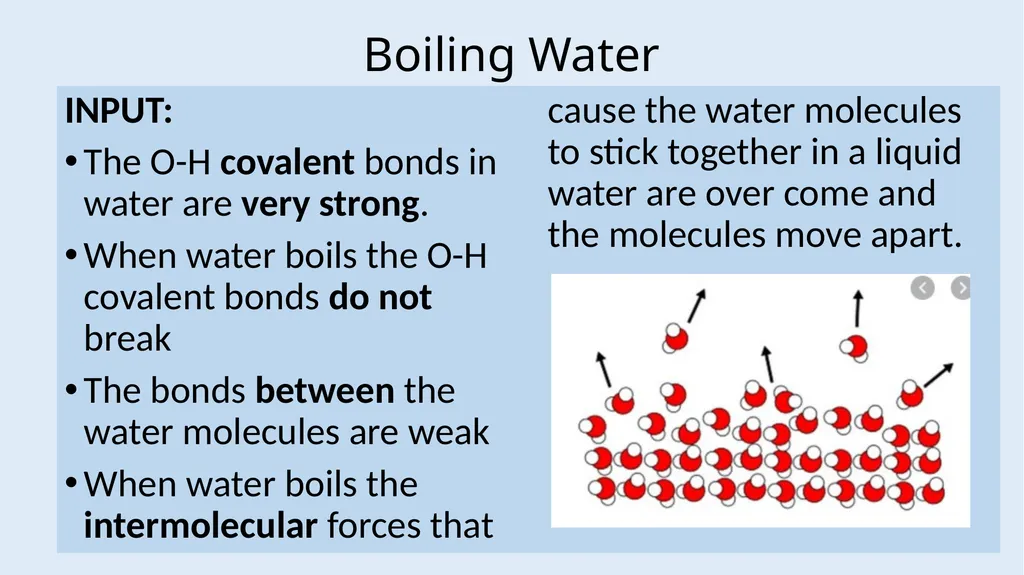
Boiling Water INPUT:
The O-H covalent bonds in water are very strong.
When water boils the O-H covalent bonds do not break
The bonds between the water molecules are weak
When water boils the intermolecular forces that cause the water molecules to stick together in a liquid water are over come and the molecules move apart.<br>
14
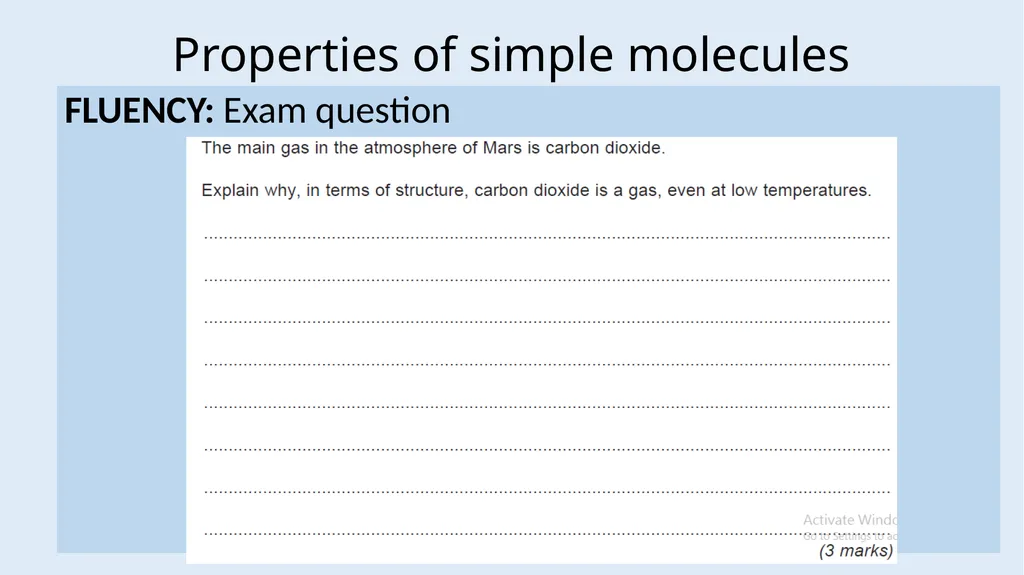
Properties of simple molecules FLUENCY: Exam question<br>
15
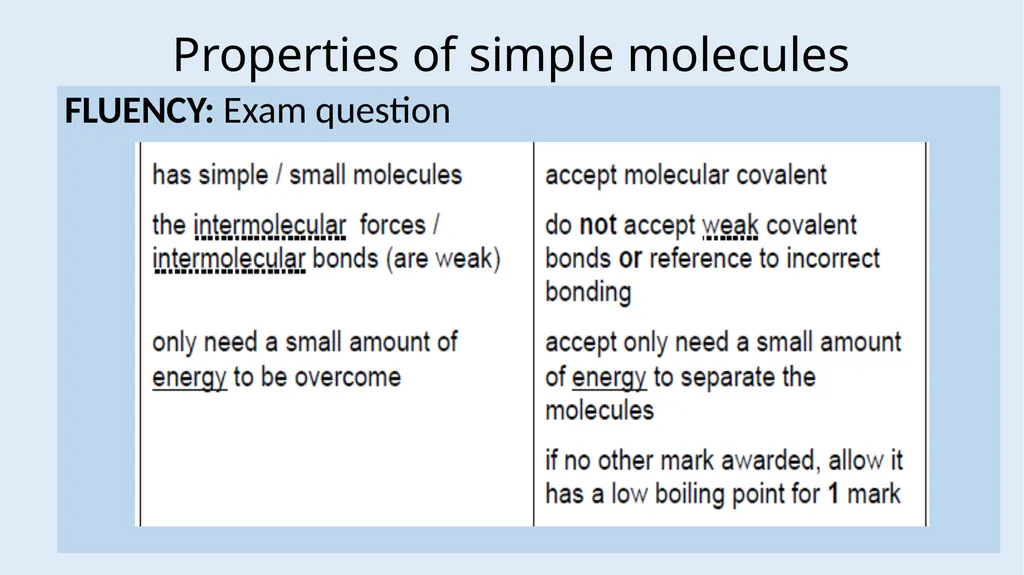
Properties of simple molecules FLUENCY: Exam question<br>
16
Properties of simple molecules INPUT:
Although all intermolecular forces are weak some are stronger than others
They depend on the size of the molecule (number of electrons): the bigger the molecule the stronger the intermolecular forces and the more likely the compound is to be a liquid (or solid for some huge molecules) at room temperature.<br>
17
Polymers INPUT:
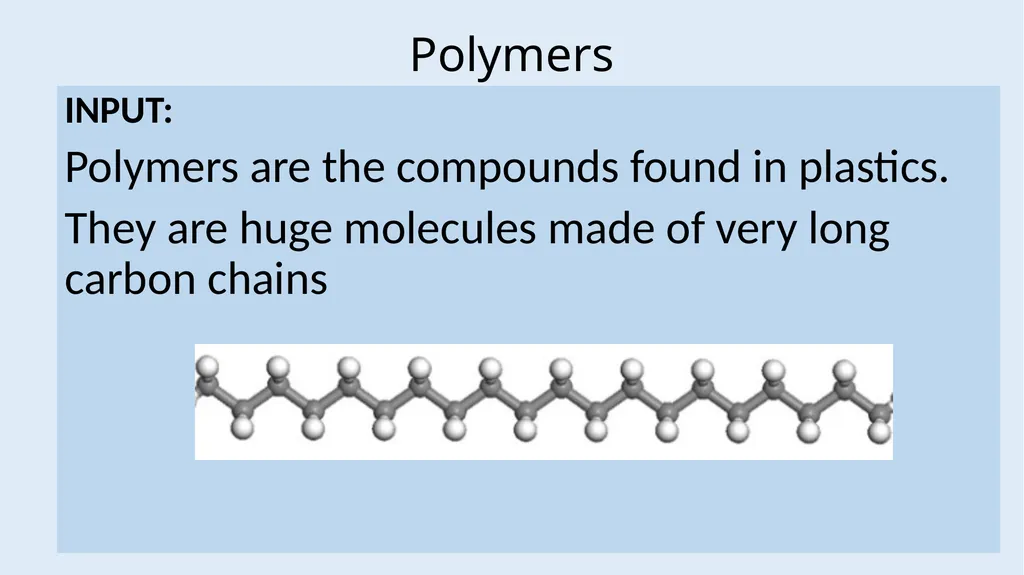
Polymers are the compounds found in plastics.
They are huge molecules made of very long carbon chains<br>
18
Polymers INPUT:
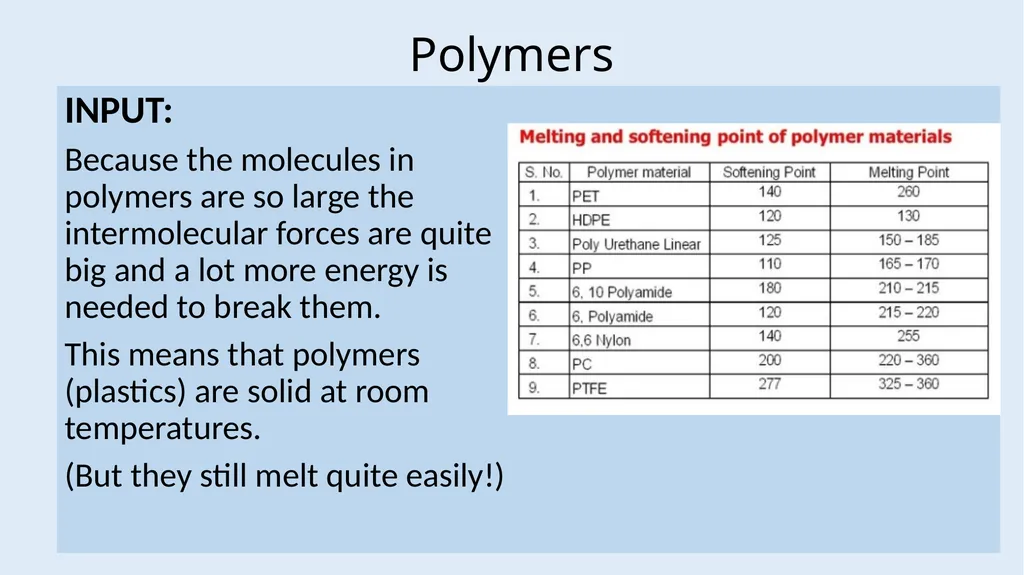
Because the molecules in polymers are so large the intermolecular forces are quite big and a lot more energy is needed to break them.
This means that polymers (plastics) are solid at room temperatures.
(But they still melt quite easily!)<br>
19
Polymers Fluency:
What do we call the very long molecules that make up plastics?
Why do these molecules have comparative strong intermolecular forces?
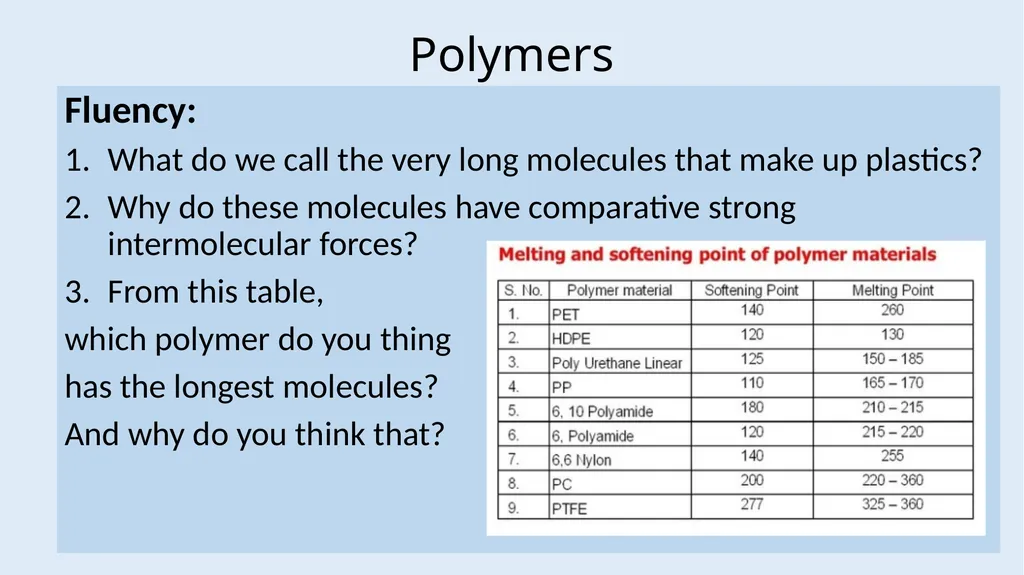
From this table,
which polymer do you thing
has the longest molecules?
And why do you think that?<br>
20
Polymers Fluency:
What do we call the very long molecules that make up plastics? Polymers
Why do these molecules have comparative strong intermolecular forces? They are very large (contain lots of atoms)
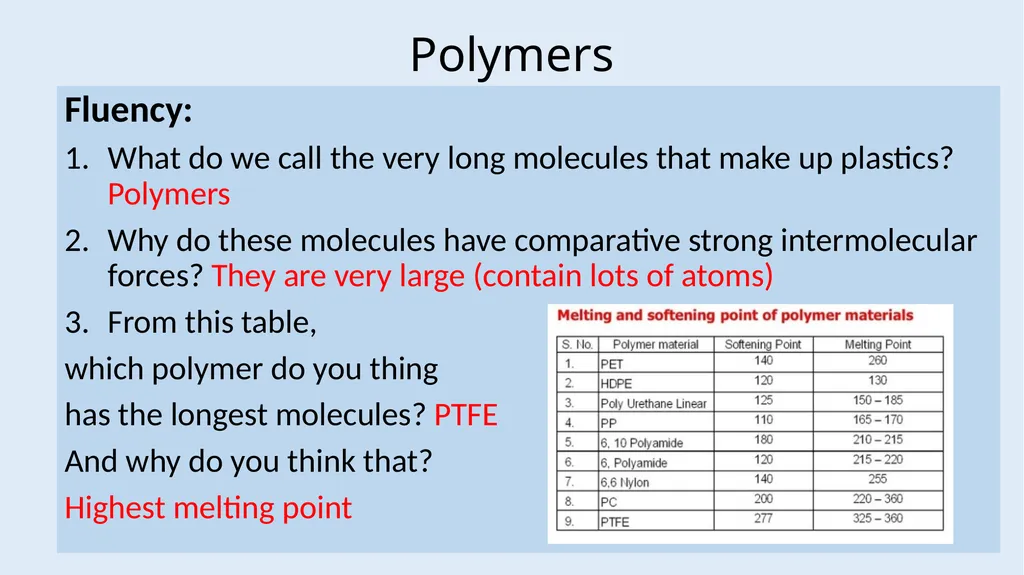
From this table,
which polymer do you thing
has the longest molecules? PTFE
And why do you think that?
Highest melting point<br>
21
Polymers INPUT:
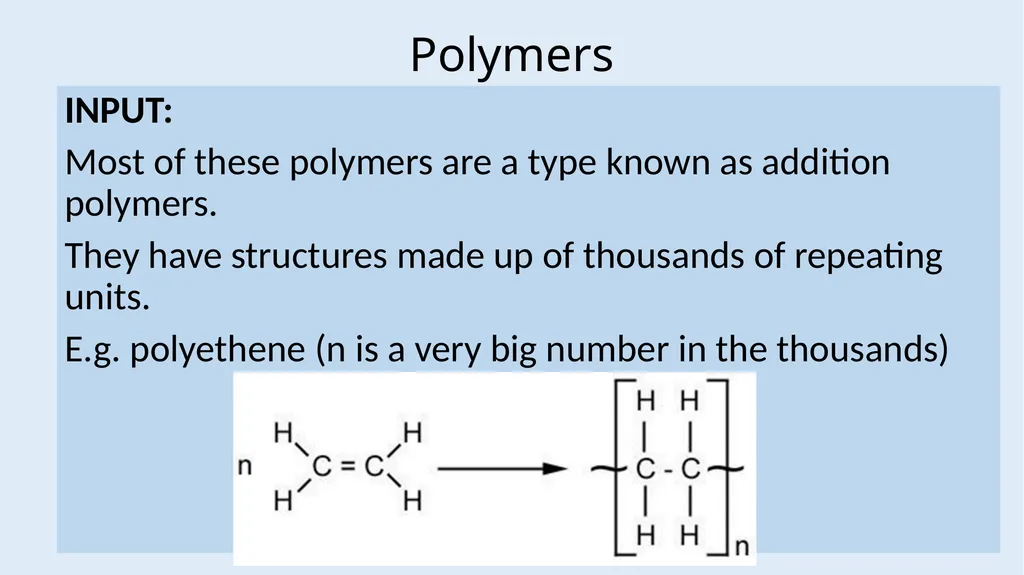
Most of these polymers are a type known as addition polymers.
They have structures made up of thousands of repeating units.
E.g. polyethene (n is a very big number in the thousands)<br>
22
Polymers INPUT:
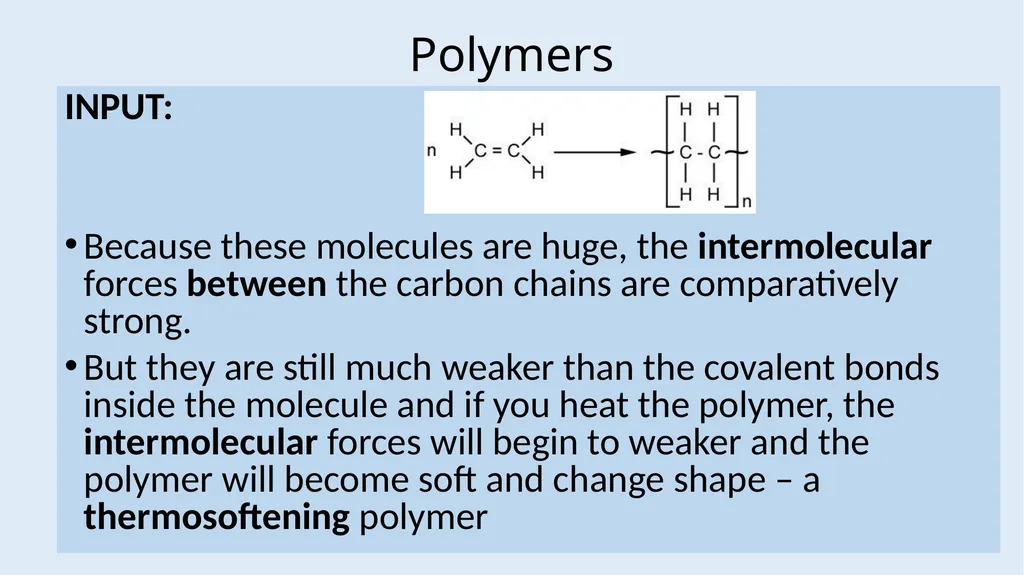
Because these molecules are huge, the intermolecular forces between the carbon chains are comparatively strong.
But they are still much weaker than the covalent bonds inside the molecule and if you heat the polymer, the intermolecular forces will begin to weaker and the polymer will become soft and change shape – a thermosoftening polymer<br>
23
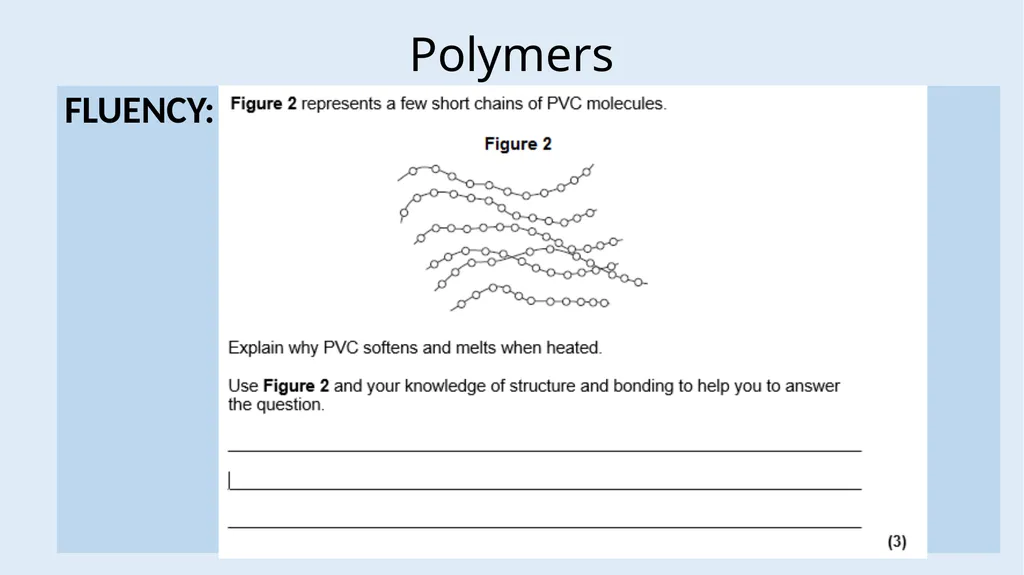
Polymers FLUENCY:<br>
24
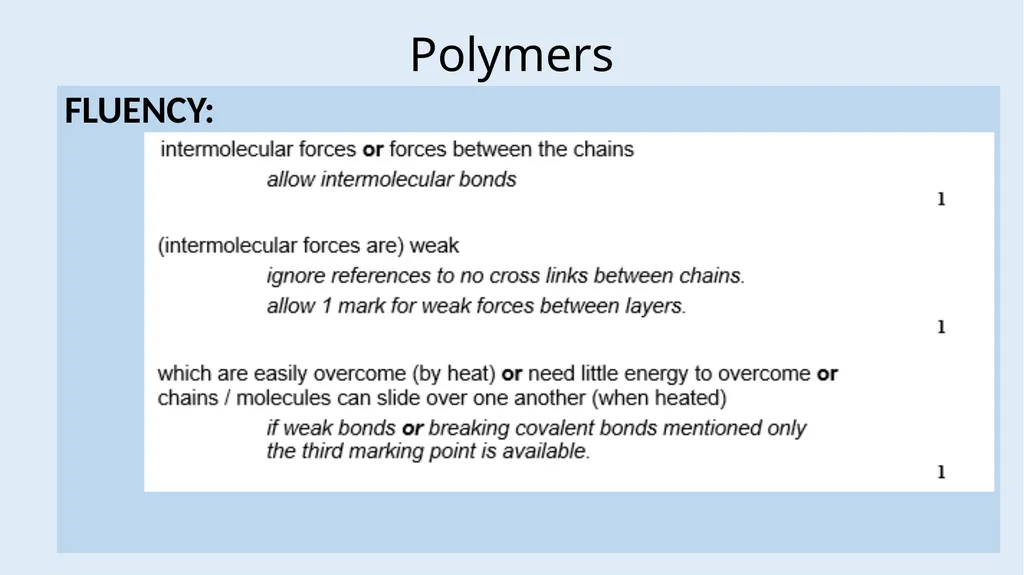
Polymers FLUENCY:<br>
25
EXIT TICKET You now need to do the exit ticket task on Google Forms that goes with this lesson<br>