
Situational Awareness This material was produced
CS
Published · 57 slides · 0 views

1 / 1




Description
Situational Awareness This material was produced under a grant (SH-27666-SH5) from the Occupational Safety and Health Administration, U.S. Department of Labor. It does not necessarily reflect the views or policies of the U.S. Department of
Related Topics
Share
Embed code
Download this presentation From Below
"Situational Awareness This material was produced" is the property of its rightful owner. Permission is granted to download and print the materials on this website for personal, non-commercial use only, and to display it on your personal computer provided you do not modify the materials and that you retain all copyright notices contained in the materials. By downloading content from our website, you accept the terms of this agreement.
Presentation Transcript
01
Situational Awareness This material was produced under a grant (SH-27666-SH5) from the Occupational Safety and Health Administration, U.S. Department of Labor. It does not necessarily reflect the views or policies of the U.S. Department of Labor, nor does the mention of trade names, commercial products, or organization imply endorsement by the U.S. Government. This material was produced under a grant (SH-27666-SH5) from the Occupational Safety and Health Administration, U.S. Department of Labor. It does not necessarily reflect the views or policies of the U.S. Department of Labor, nor does the mention of trade names, commercial products, or organization imply endorsement by the U.S. Government.<br>
02
In this module, we will discuss: What is Situational Awareness?
Decision Making During Potentially High-Stress Situations
Communication
Physical and Mental stress
Human Factors
Employee Rights and Responsibilities<br>
Decision Making During Potentially High-Stress Situations
Communication
Physical and Mental stress
Human Factors
Employee Rights and Responsibilities<br>
03
What is Situational Awareness? What is Situational Awareness?<br>
04
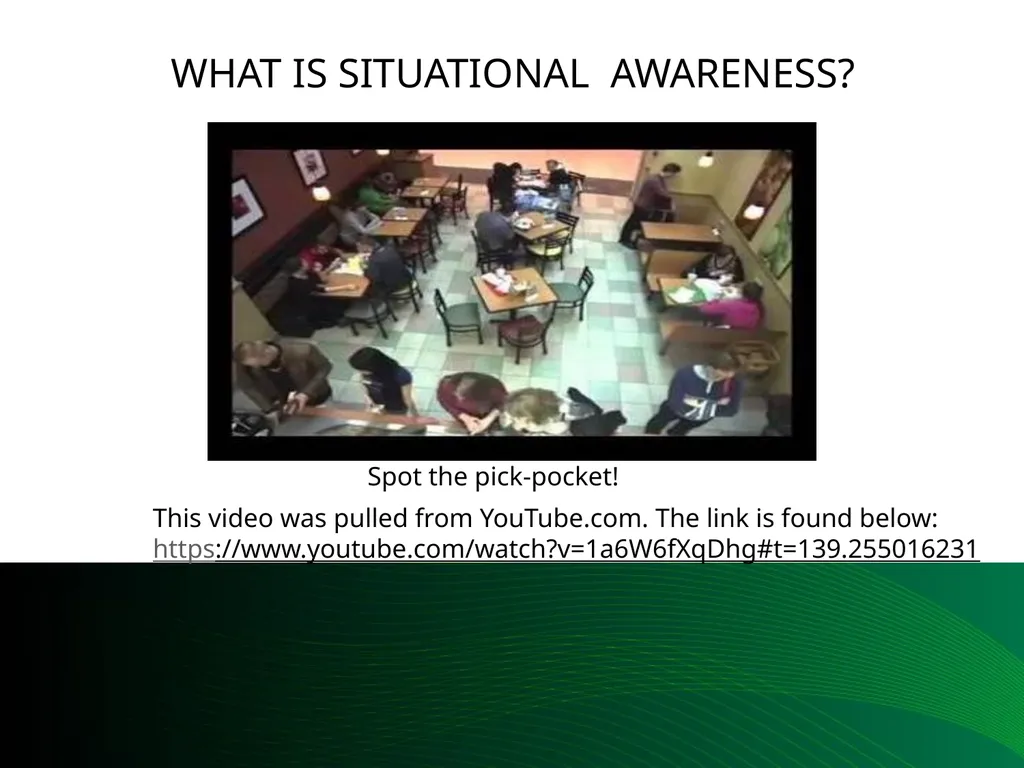
What is situational awareness? Spot the pick-pocket! This video was pulled from YouTube.com. The link is found below:
https://www.youtube.com/watch?v=1a6W6fXqDhg#t=139.255016231<br>
https://www.youtube.com/watch?v=1a6W6fXqDhg#t=139.255016231<br>
05
What is situational awareness? Did you find the pick-pocket?
Did you find the pick-pocket video challenging?
What about the video made it challenging?
Have you been in situations where your attention was drawn to multiple
things simultaneously?
Have you, up to this point, had a near miss on the job site?
If so, would you say luck played a huge role?<br>
Did you find the pick-pocket video challenging?
What about the video made it challenging?
Have you been in situations where your attention was drawn to multiple
things simultaneously?
Have you, up to this point, had a near miss on the job site?
If so, would you say luck played a huge role?<br>
06
Situational awareness is: Knowing what is going on all around you by having the ability to:
Identify
Process
Comprehend
Respond to
…critical elements of information regarding the environment in which you
are located.<br>
Identify
Process
Comprehend
Respond to
…critical elements of information regarding the environment in which you
are located.<br>
07
Identifying critical elements of information Identifying critical elements of information<br>
08
Situational awareness is: 1. Identifying critical elements of information.
During the pick-pocket video, you were asked to identify the pick-pocket. With the information you were given, were you able to identify the critical elements of information in the video?
If you were able to identify the pick-pocket before given the information about the location and time of the video, would you say a fair amount of luck was involved?<br>
During the pick-pocket video, you were asked to identify the pick-pocket. With the information you were given, were you able to identify the critical elements of information in the video?
If you were able to identify the pick-pocket before given the information about the location and time of the video, would you say a fair amount of luck was involved?<br>
09
Situational awareness is: 1. Identifying critical elements of information. (continued)
If we focus all or most of our attention to one or two items, we lose situational awareness because there are more than one or two elements in any given situation, especially construction.
The following video is a great representation of identifying critical elements of information:
Note: The video you are about to view is called Brian’s Video. Brian will ask questions during the video. Please write down your answers to his questions on the sheet provided.<br>
If we focus all or most of our attention to one or two items, we lose situational awareness because there are more than one or two elements in any given situation, especially construction.
The following video is a great representation of identifying critical elements of information:
Note: The video you are about to view is called Brian’s Video. Brian will ask questions during the video. Please write down your answers to his questions on the sheet provided.<br>
10
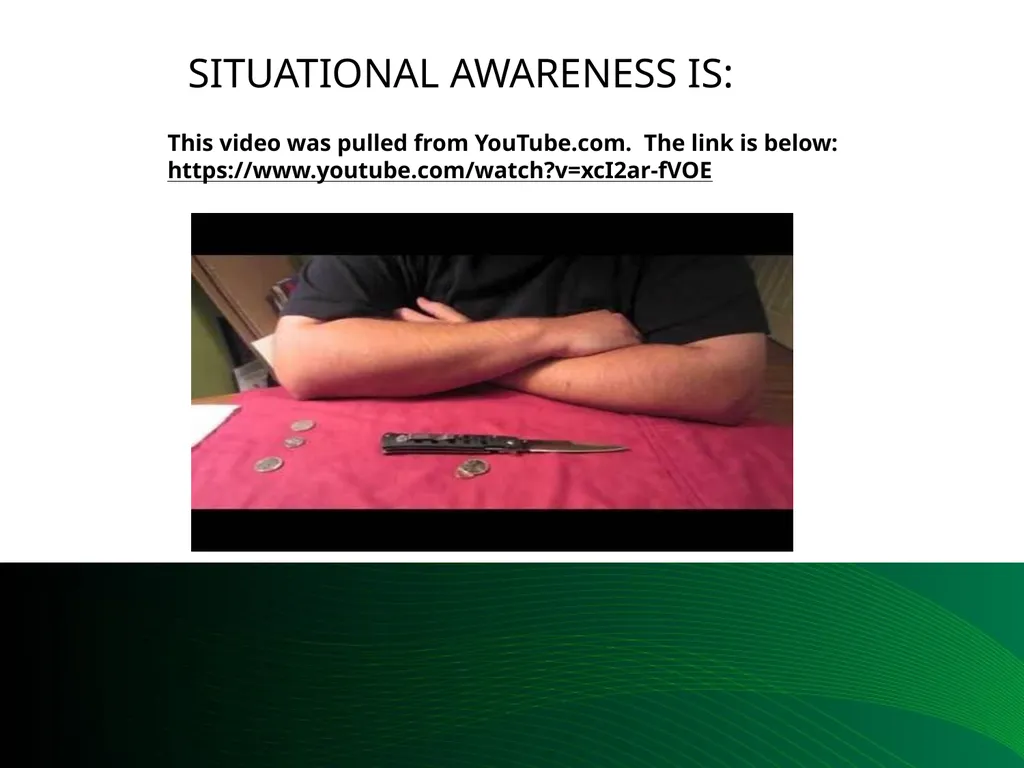
Situational awareness is: This video was pulled from YouTube.com. The link is below:
https://www.youtube.com/watch?v=xcI2ar-fVOE<br>
https://www.youtube.com/watch?v=xcI2ar-fVOE<br>
11
Processing Critical Elements Processing Critical elements<br>
12
Situational awareness is: 2. Processing critical elements of information.
Once you have identified critical elements of information, that information needs to be processed. Unfortunately, this is not always an easy task.
Read the following problem and solve on the sheet provided:
There are three playing cards lying face up, side by side on a table in the following configuration:
A five is just to the right of a two. A five is just to the left of a two. A spade is just to the left of a club. A spade is just to the right of a spade. What are the order and number of cards on the table?<br>
Once you have identified critical elements of information, that information needs to be processed. Unfortunately, this is not always an easy task.
Read the following problem and solve on the sheet provided:
There are three playing cards lying face up, side by side on a table in the following configuration:
A five is just to the right of a two. A five is just to the left of a two. A spade is just to the left of a club. A spade is just to the right of a spade. What are the order and number of cards on the table?<br>
13
Situational awareness is: 2. Processing critical elements of information. (continued)
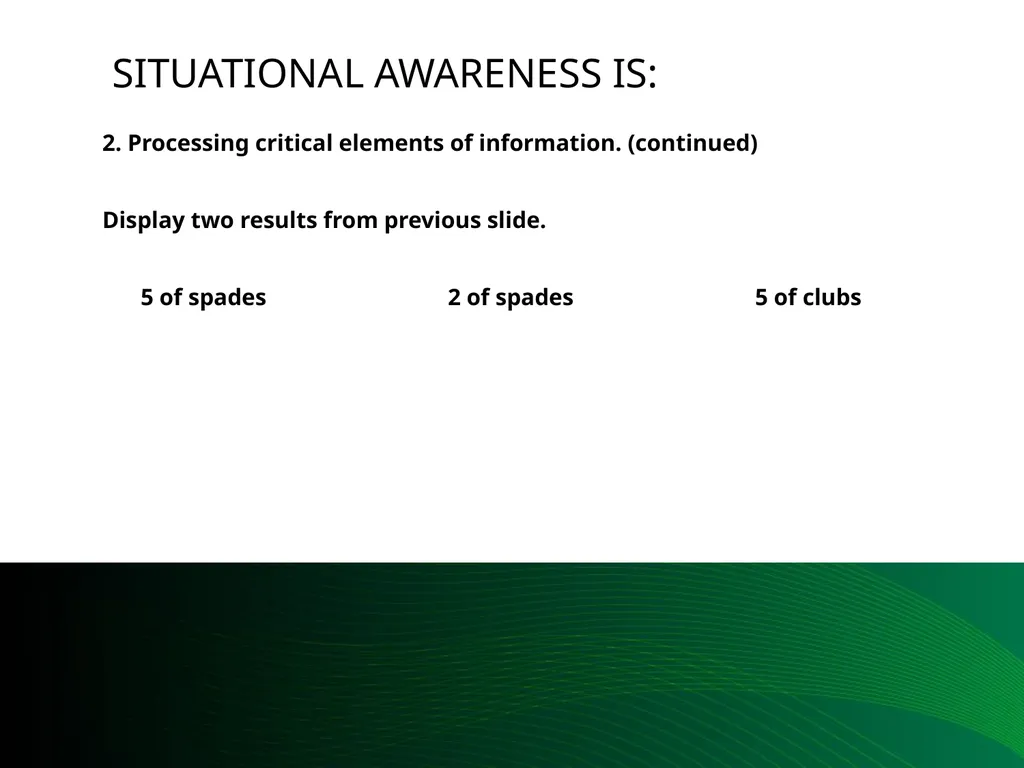
Display two results from previous slide.
5 of spades 2 of spades 5 of clubs<br>
Display two results from previous slide.
5 of spades 2 of spades 5 of clubs<br>
14
Situational awareness is: 2. Processing critical elements of information. (continued)
The exercise on the previous few pages allowed us to demonstrate our
processing of critical elements of information. However, this was a controlled,
stress free demonstration. Let’s try another example with element(s) of
stress added.
Read the following and solve on the sheet provided:<br>
The exercise on the previous few pages allowed us to demonstrate our
processing of critical elements of information. However, this was a controlled,
stress free demonstration. Let’s try another example with element(s) of
stress added.
Read the following and solve on the sheet provided:<br>
15
Situational awareness is: 2. Processing critical elements of information. (continued)
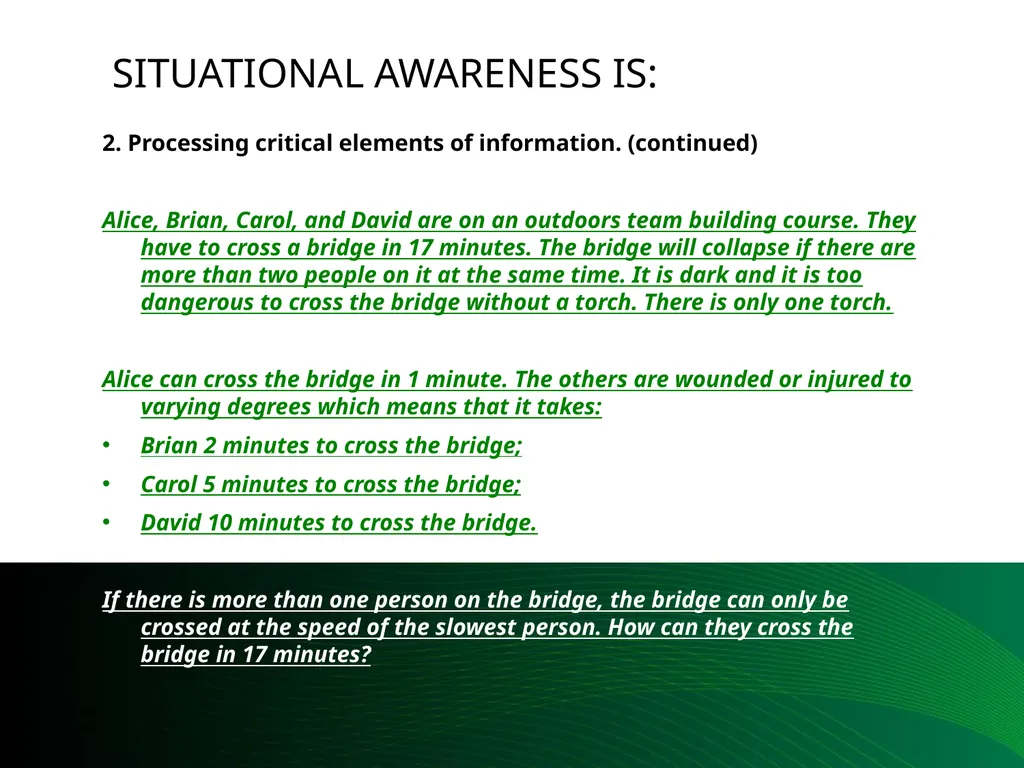
Alice, Brian, Carol, and David are on an outdoors team building course. They have to cross a bridge in 17 minutes. The bridge will collapse if there are more than two people on it at the same time. It is dark and it is too dangerous to cross the bridge without a torch. There is only one torch.
Alice can cross the bridge in 1 minute. The others are wounded or injured to varying degrees which means that it takes:
Brian 2 minutes to cross the bridge;
Carol 5 minutes to cross the bridge;
David 10 minutes to cross the bridge.
If there is more than one person on the bridge, the bridge can only be crossed at the speed of the slowest person. How can they cross the bridge in 17 minutes?<br>
Alice, Brian, Carol, and David are on an outdoors team building course. They have to cross a bridge in 17 minutes. The bridge will collapse if there are more than two people on it at the same time. It is dark and it is too dangerous to cross the bridge without a torch. There is only one torch.
Alice can cross the bridge in 1 minute. The others are wounded or injured to varying degrees which means that it takes:
Brian 2 minutes to cross the bridge;
Carol 5 minutes to cross the bridge;
David 10 minutes to cross the bridge.
If there is more than one person on the bridge, the bridge can only be crossed at the speed of the slowest person. How can they cross the bridge in 17 minutes?<br>
16
Situational awareness is: 2. Processing critical elements of information. (continued)
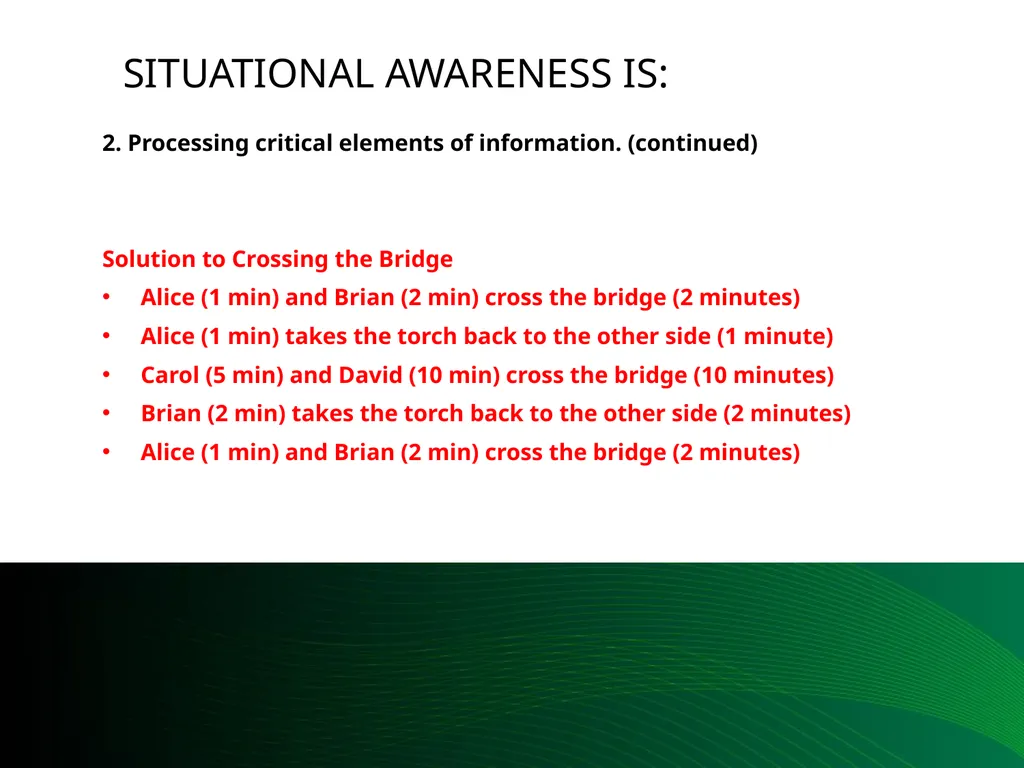
Solution to Crossing the Bridge
Alice (1 min) and Brian (2 min) cross the bridge (2 minutes)
Alice (1 min) takes the torch back to the other side (1 minute)
Carol (5 min) and David (10 min) cross the bridge (10 minutes)
Brian (2 min) takes the torch back to the other side (2 minutes)
Alice (1 min) and Brian (2 min) cross the bridge (2 minutes)<br>
Solution to Crossing the Bridge
Alice (1 min) and Brian (2 min) cross the bridge (2 minutes)
Alice (1 min) takes the torch back to the other side (1 minute)
Carol (5 min) and David (10 min) cross the bridge (10 minutes)
Brian (2 min) takes the torch back to the other side (2 minutes)
Alice (1 min) and Brian (2 min) cross the bridge (2 minutes)<br>
17
Situation al awareness is: 2. Processing critical elements of information. (continued)
Did anyone find the find the answer in the allotted time?
Why is this problem difficult?<br>
Did anyone find the find the answer in the allotted time?
Why is this problem difficult?<br>
18
Situational awareness is: 2. Processing critical elements of information. (continued)
Please Take out a piece of paper and answer the following questions without taking your eyes off your paper
What Is the color of the walls?
How many lights are on the celling?
How many people are participating in this course?
Where is the nearest fire extinguisher?
Is there any markings or posters on the walls? If so what do they say?<br>
Please Take out a piece of paper and answer the following questions without taking your eyes off your paper
What Is the color of the walls?
How many lights are on the celling?
How many people are participating in this course?
Where is the nearest fire extinguisher?
Is there any markings or posters on the walls? If so what do they say?<br>
19
Situational awareness is: 2. Processing critical elements of information. (continued)
Your mind is always gathering information, but it also rejects information it deems unimportant.
The goal of this situational awareness training is to develop what your mind is retaining into what you need to identify as safe and unsafe atmospheres<br>
Your mind is always gathering information, but it also rejects information it deems unimportant.
The goal of this situational awareness training is to develop what your mind is retaining into what you need to identify as safe and unsafe atmospheres<br>
20
Situational awareness is: 2. Processing critical elements of information. (continued)
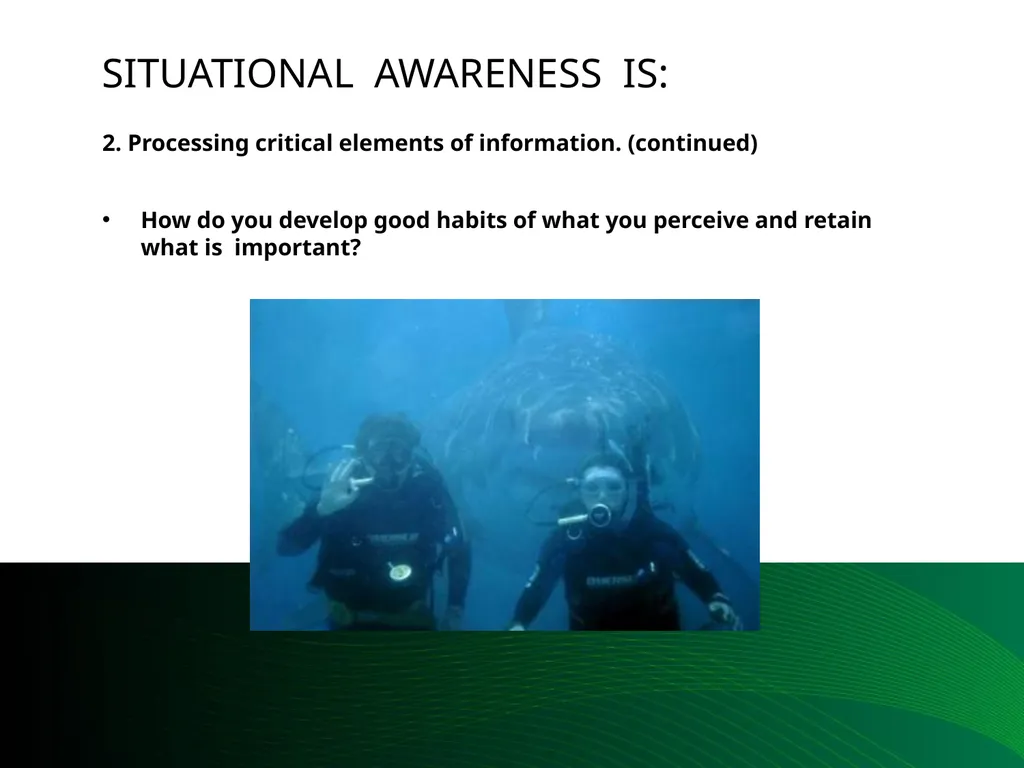
How do you develop good habits of what you perceive and retain what is important?<br>
How do you develop good habits of what you perceive and retain what is important?<br>
21
Situational awareness is: 2. Processing critical elements of information. (continued)
Training
Know how to identify different safety hazards within the worksite, and what could create a hazard in the future. Have it programed within your mind of what could happen….
To know what needs to be identified as a hazard we need to look at:
Past
Present
Future<br>
Training
Know how to identify different safety hazards within the worksite, and what could create a hazard in the future. Have it programed within your mind of what could happen….
To know what needs to be identified as a hazard we need to look at:
Past
Present
Future<br>
22
Situational awareness is: Past
What the given set of factors were in the past, and what the given outcome was.
If there had previously been an accident what were the variables that lead up to it and what could have been changed?
What areas of the site pose the biggest risk?<br>
What the given set of factors were in the past, and what the given outcome was.
If there had previously been an accident what were the variables that lead up to it and what could have been changed?
What areas of the site pose the biggest risk?<br>
23
Situational awareness is: Present
Are there variables in the workplace now that could potentially damage an individual
Is everyone following work safe practices?
Has all the equipment been properly inspected & maintained?
Is appropriate PPE being worn and worn correctly?<br>
Are there variables in the workplace now that could potentially damage an individual
Is everyone following work safe practices?
Has all the equipment been properly inspected & maintained?
Is appropriate PPE being worn and worn correctly?<br>
24
Situational awareness is: Future
Given the set of factors right now could they develop into a hazard into the future?
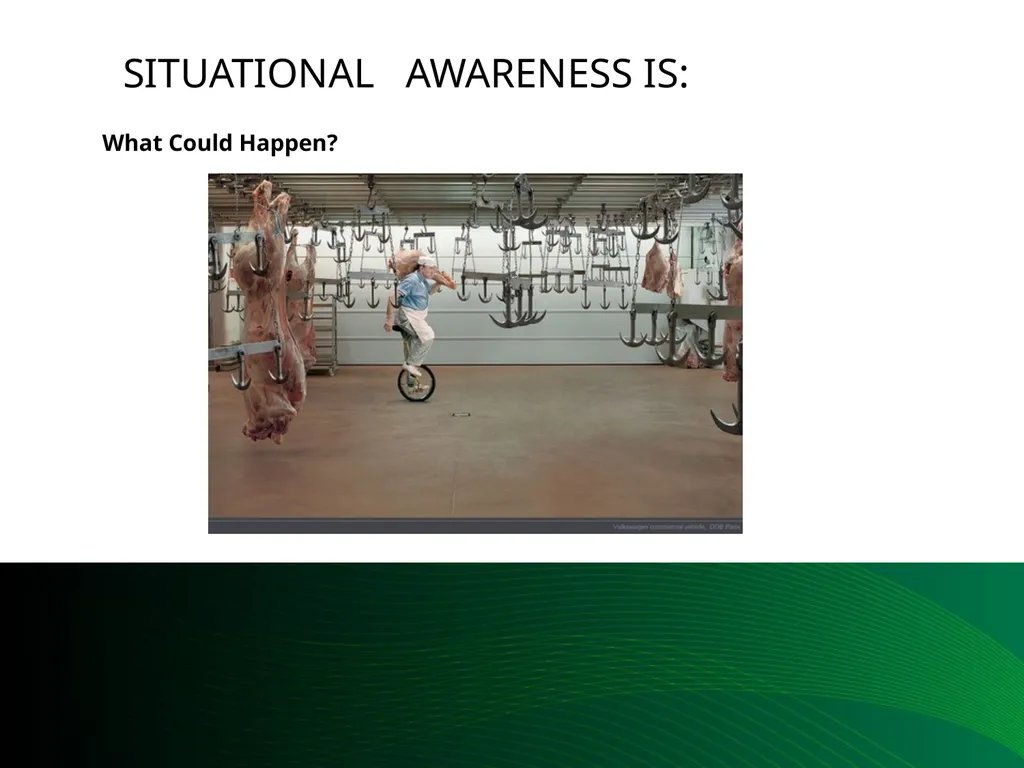
What Could Happen?
What variables are changing into a hazard?
How do I protect from future hazards?<br>
Given the set of factors right now could they develop into a hazard into the future?
What Could Happen?
What variables are changing into a hazard?
How do I protect from future hazards?<br>
25
Situational awareness is: https://www.youtube.com/watch?v=cG07DqewQN0<br>
26
Comprehension of critical information Comprehension of critical information<br>
27
Situational awareness is: 3. Comprehending the critical elements of information
Identifying what is ACCUALLY happening
Just because it looks like the work practice is safe doesn’t mean it really is. Stress along with changing conditions constantly interfere with Perception.
We use our background knowledge and apply it to every day life, from that we might gain a misconceived notion about what’s really going on.<br>
Identifying what is ACCUALLY happening
Just because it looks like the work practice is safe doesn’t mean it really is. Stress along with changing conditions constantly interfere with Perception.
We use our background knowledge and apply it to every day life, from that we might gain a misconceived notion about what’s really going on.<br>
28
Situational awareness is: 3. Comprehending the critical elements of information (continued)
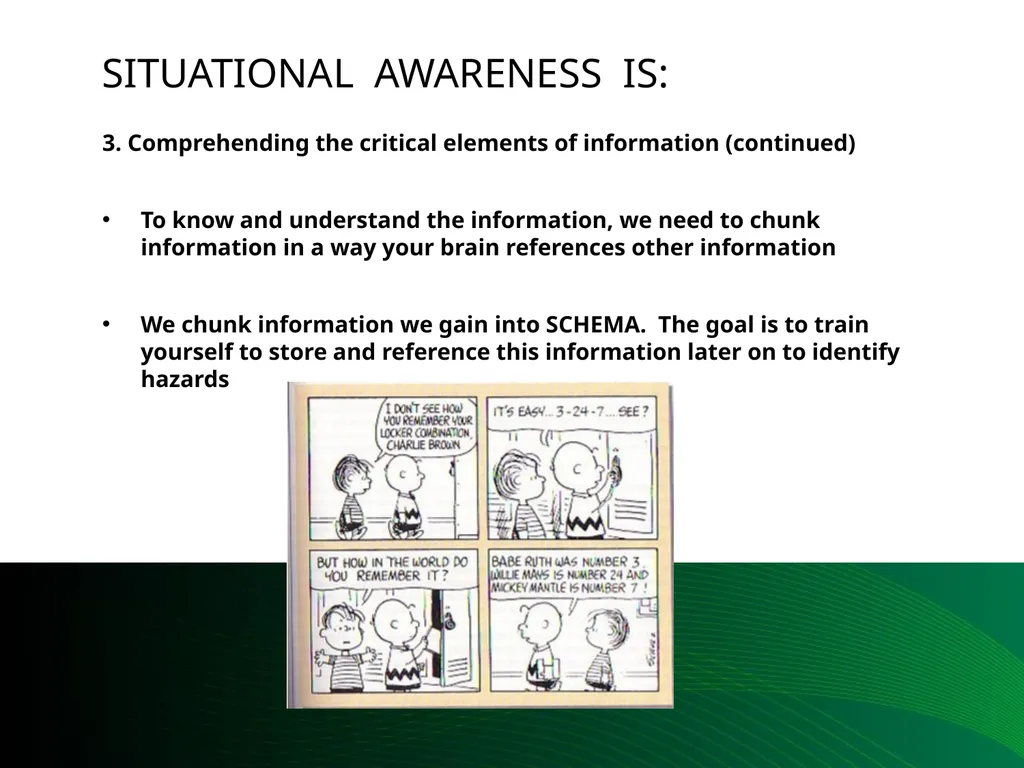
To know and understand the information, we need to chunk information in a way your brain references other information
We chunk information we gain into SCHEMA. The goal is to train yourself to store and reference this information later on to identify hazards<br>
To know and understand the information, we need to chunk information in a way your brain references other information
We chunk information we gain into SCHEMA. The goal is to train yourself to store and reference this information later on to identify hazards<br>
29
Situational awareness is: 3. Comprehending the critical elements of information (continued)
We don’t always know what is happening in our environment. We might believe we do, but our judgements are often clouded from too much information. So we counter some of the interfering with filtering.
Information Filtering- taking out all the information that isn’t relevant to your situation<br>
We don’t always know what is happening in our environment. We might believe we do, but our judgements are often clouded from too much information. So we counter some of the interfering with filtering.
Information Filtering- taking out all the information that isn’t relevant to your situation<br>
30
Situational awareness Is: 3. Comprehending the critical elements of information (continued)
Identifying what COULD happen with the given set of factors
You need to identify if the set of factors change “could a accident happen?” if the given set of factors can cause hazardous conditions what could be changed to make the site safe?<br>
Identifying what COULD happen with the given set of factors
You need to identify if the set of factors change “could a accident happen?” if the given set of factors can cause hazardous conditions what could be changed to make the site safe?<br>
31
Situational awareness is: What Could Happen?<br>
32
Situational awareness is: 3. Comprehending the critical elements of information (continued)
Predicting how the given factors will change over time.
Human
Equipment
Weather
Chemicals
Electronics
Many Many more…
We are all Human and all make mistakes, don’t let your mistakes cost a life.<br>
Predicting how the given factors will change over time.
Human
Equipment
Weather
Chemicals
Electronics
Many Many more…
We are all Human and all make mistakes, don’t let your mistakes cost a life.<br>
33
Situational awareness is: 3. Comprehending the critical elements of information (continued)
Things Blocking Situational Awareness Comprehension
• Perception based on faulty information processing.
• Excessive motivation.
• Complacency.
• Overload.
• Fatigue.
• Poor communications.<br>
Things Blocking Situational Awareness Comprehension
• Perception based on faulty information processing.
• Excessive motivation.
• Complacency.
• Overload.
• Fatigue.
• Poor communications.<br>
34
Situational awareness is: 3. Comprehending the critical elements of information
Things Blocking Situational Awareness Comprehension (continued)
• Perception based on faulty information processing.
Misinterpretation of given information
Past experiences cloud judgement
New situations
Unable to process conflicting information<br>
Things Blocking Situational Awareness Comprehension (continued)
• Perception based on faulty information processing.
Misinterpretation of given information
Past experiences cloud judgement
New situations
Unable to process conflicting information<br>
35
Situational awareness is: 3. Comprehending the critical elements of information
Things Blocking Situational Awareness Comprehension (continued)
• Excessive motivation.
Pressure to get the job done
Dead line
Boss/Supervisor
Family<br>
Things Blocking Situational Awareness Comprehension (continued)
• Excessive motivation.
Pressure to get the job done
Dead line
Boss/Supervisor
Family<br>
36
Situational awareness is: 3. Comprehending the critical elements of information
Things Blocking Situational Awareness Comprehension (continued)
• Complacency.
Work environment
Hazards haven’t happened before
Used to the work load<br>
Things Blocking Situational Awareness Comprehension (continued)
• Complacency.
Work environment
Hazards haven’t happened before
Used to the work load<br>
37
Situational awareness is: 3. Comprehending the critical elements of information
Things Blocking Situational Awareness Comprehension (continued)
• Overload.
Take on too much work
Wanted to impress
Too much New information to process<br>
Things Blocking Situational Awareness Comprehension (continued)
• Overload.
Take on too much work
Wanted to impress
Too much New information to process<br>
38
Situational awareness is: 3. Comprehending the critical elements of information
Things Blocking Situational Awareness Comprehension (continued)
• Fatigue.
Too great of workload
Personal life
Long day
Other thoughts on your mind<br>
Things Blocking Situational Awareness Comprehension (continued)
• Fatigue.
Too great of workload
Personal life
Long day
Other thoughts on your mind<br>
39
Situational awareness is: 3. Comprehending the critical elements of information
Things Blocking Situational Awareness Comprehension (continued)
• Poor communications.
No-one knows you need help
Not Given enough information
Given too much information
Who is in charge of what
Unanswered questions<br>
Things Blocking Situational Awareness Comprehension (continued)
• Poor communications.
No-one knows you need help
Not Given enough information
Given too much information
Who is in charge of what
Unanswered questions<br>
40
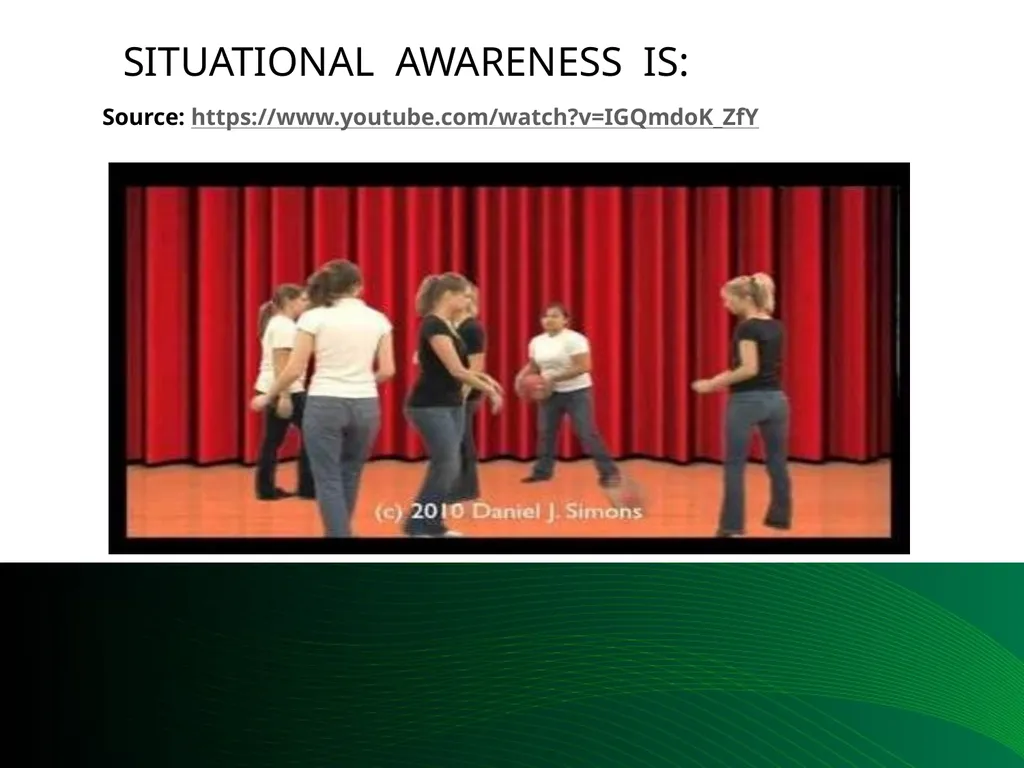
Situational awareness is: Source: https://www.youtube.com/watch?v=IGQmdoK_ZfY<br>
41
Responding to Critical Information Responding to Critical Information<br>
42
Situational awareness is: 4. Responding to critical information
How are you going to respond to the different information you are given?
How are you going to fix the different variables presented throughout the site?
How you are going to maintain the safe atmosphere?
How are you going to respond to added variables?
How will you react to a given hazard?<br>
How are you going to respond to the different information you are given?
How are you going to fix the different variables presented throughout the site?
How you are going to maintain the safe atmosphere?
How are you going to respond to added variables?
How will you react to a given hazard?<br>
43
Situational awareness is: 4. Responding to critical information (continued)
High Stress Environment
Many factors can Induce high stress, and high stress can affect our judgement, and our decision making abilities.
Trying to keep a clear and level head is difficult but possible.
Look at variables subjectively and choose the safest option<br>
High Stress Environment
Many factors can Induce high stress, and high stress can affect our judgement, and our decision making abilities.
Trying to keep a clear and level head is difficult but possible.
Look at variables subjectively and choose the safest option<br>
44
Situational awareness Is: 4. Responding to critical information (continued)
As soon as you can identify a hazard in the workplace you should do everything possible to fix the hazard
Communicate the hazard to others
Eliminate the hazard all together
Hierarchy of controls
If you are unable to fix it: get someone who can & protect workers until it is corrected<br>
As soon as you can identify a hazard in the workplace you should do everything possible to fix the hazard
Communicate the hazard to others
Eliminate the hazard all together
Hierarchy of controls
If you are unable to fix it: get someone who can & protect workers until it is corrected<br>
45
Situational awareness is: 4. Responding to critical information (continued)
After you complete the changes re-evaluate them to ensure the problem is in fact eliminated and not just replaced with a new one.<br>
After you complete the changes re-evaluate them to ensure the problem is in fact eliminated and not just replaced with a new one.<br>
46
Maintaining Situational Awareness MaintainiNg Situational Awareness<br>
47
Maintaining Situational Awareness When changes occur within the workplace, let others know and hazards that might be present
Monitor the performance of everyone on site
Give safety information to anyone who is on site
Identify potential or existing problems
(i.e. equipment-related or operational)
Demonstrate awareness (know what process are happening)
Explain what should be done to eliminate the hazards
Eliminate hazards and protect workers<br>
Monitor the performance of everyone on site
Give safety information to anyone who is on site
Identify potential or existing problems
(i.e. equipment-related or operational)
Demonstrate awareness (know what process are happening)
Explain what should be done to eliminate the hazards
Eliminate hazards and protect workers<br>
48
Maintaining Situational Awareness Know what task is being started and when its estimated time of completion
keep re assessing the work environment to ensure safe atmosphere
explain to everyone what they are expected to do to ensure a safe work environment
Stay Calm even when in stressful environments<br>
keep re assessing the work environment to ensure safe atmosphere
explain to everyone what they are expected to do to ensure a safe work environment
Stay Calm even when in stressful environments<br>
49
Employee Rights and responsibilities<br>
50
Employee Rights & Responsibilities
Occupational Safety and Health Act of 1970 To assure safe and healthful working conditions for working men and women
By authorizing enforcement of the standards developed under the Act
By assisting and encouraging the States in their efforts to assure safe and healthful working conditions
By providing for research, information, education, and training in the field of occupational safety and health…<br>
By authorizing enforcement of the standards developed under the Act
By assisting and encouraging the States in their efforts to assure safe and healthful working conditions
By providing for research, information, education, and training in the field of occupational safety and health…<br>
51
You have the right to:
A safe and healthful workplace
Know about hazardous chemicals
Information about injuries and illnesses in your workplace
Complain or request hazard correction from employer Employee Rights & Responsibilities<br>
A safe and healthful workplace
Know about hazardous chemicals
Information about injuries and illnesses in your workplace
Complain or request hazard correction from employer Employee Rights & Responsibilities<br>
52
Employee Rights & Responsibilities
You have the right to: File a confidential complaint with OSHA to have their workplace inspected.
Receive information and training about hazards, methods to prevent harm, and the OSHA standards that apply to their workplace. The training must be done in a language and vocabulary workers can understand.
Get copies of their workplace medical records.
Participate in an OSHA inspection and speak in private with the inspector.<br>
Receive information and training about hazards, methods to prevent harm, and the OSHA standards that apply to their workplace. The training must be done in a language and vocabulary workers can understand.
Get copies of their workplace medical records.
Participate in an OSHA inspection and speak in private with the inspector.<br>
53
Employee Rights & Responsibilities Continued: File a complaint with OSHA if they have been retaliated or discriminated against by their employer as the result of requesting an inspection or using any of their other rights under the OSH Act.
File a complaint if punished or discriminated against for acting as a “whistleblower” under the additional 21 federal statutes for which OSHA has jurisdiction.<br>
File a complaint if punished or discriminated against for acting as a “whistleblower” under the additional 21 federal statutes for which OSHA has jurisdiction.<br>
54
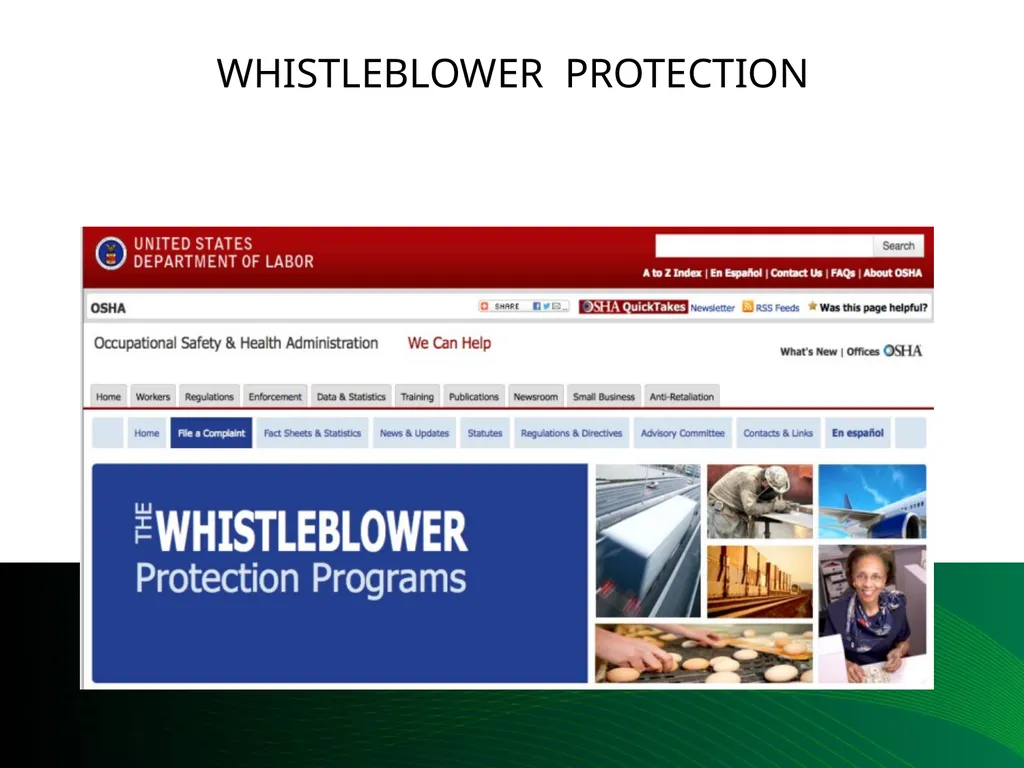
Whistleblower Protection OSHA's Whistleblower Protection Program enforces the whistleblower provisions of more than twenty whistleblower statutes protecting employees who report violations of various workplace safety, airline, commercial motor carrier, consumer product, environmental, financial reform, food safety, health insurance reform, motor vehicle safety, nuclear, pipeline, public transportation agency, railroad, maritime, and securities laws. Rights afforded by these whistleblower acts include, but are not limited to, worker participation in safety and health activities, reporting a work related injury, illness or fatality, or reporting a violation of the statutes.<br>
55
Whistleblower Protection Whistleblower Protection Advisory Committee (WPAC) was established to advise, consult with, and make recommendations to the Secretary of Labor and the Assistant Secretary of Labor for Occupational Safety and Health on ways to improve the fairness, efficiency, effectiveness, and transparency of OSHA's administration of whistleblower protections. In particular, the committee advises OSHA on the development and implementation of improved customer service models, enhancements in the investigative and enforcement process, training, and regulations governing OSHA investigations. In addition, WPAC advises OSHA in cooperative activities with other federal agencies that are responsible for areas covered by the whistleblower protection statutes enforced by OSHA.<br>
56
Whistleblower Protection<br>
57
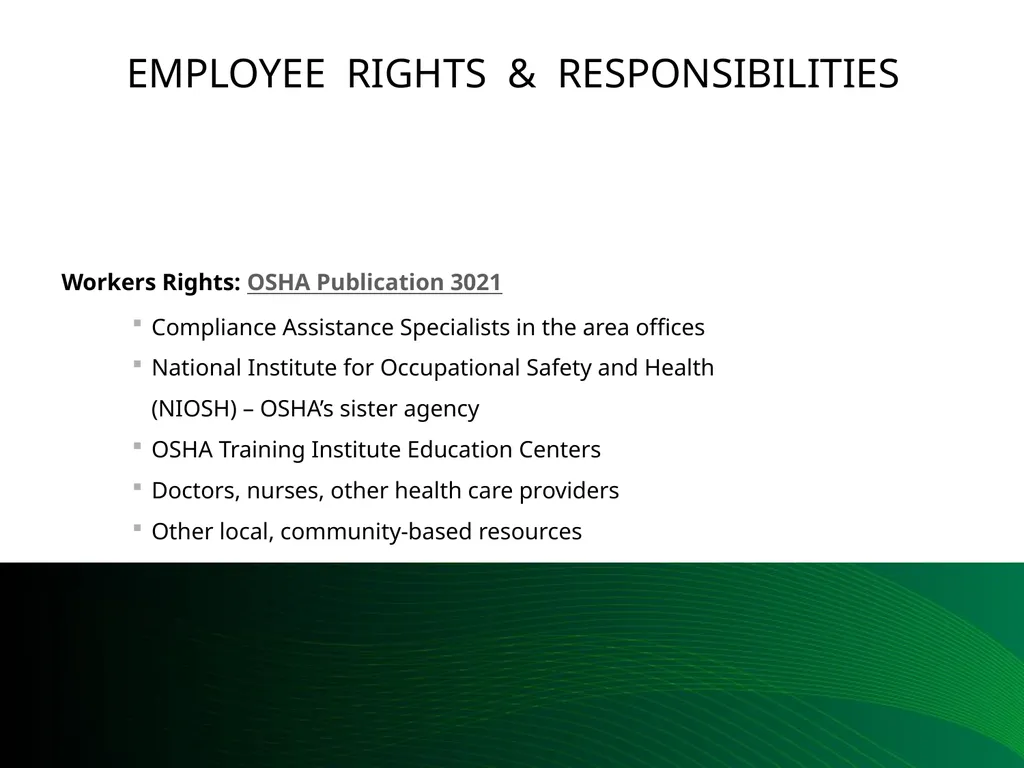
Employee Rights & Responsibilities Workers Rights: OSHA Publication 3021
Compliance Assistance Specialists in the area offices
National Institute for Occupational Safety and Health (NIOSH) – OSHA’s sister agency
OSHA Training Institute Education Centers
Doctors, nurses, other health care providers
Other local, community-based resources<br>
Compliance Assistance Specialists in the area offices
National Institute for Occupational Safety and Health (NIOSH) – OSHA’s sister agency
OSHA Training Institute Education Centers
Doctors, nurses, other health care providers
Other local, community-based resources<br>