
SIX SHARED GOALS Sharing evidence, learning, new













Description: SIX SHARED GOALS Sharing evidence, learning, new tools and experience to support your work to end child marriage Monthly webinar February 2024 Learning Series Photo: Girl Up Initiative, Uganda Interpretation ENGLISH - This session will have
Related Topics
Download Presentation
"SIX SHARED GOALS Sharing evidence, learning, new" is the property of its rightful owner. Permission is granted to download and print the materials on this website for personal, non-commercial use only, and to display it on your personal computer provided you do not modify the materials and that you retain all copyright notices contained in the materials. By downloading content from our website, you accept the terms of this agreement.
Presentation Transcript
slide1. SIX
SHARED
GOALS Sharing evidence, learning, new tools and experience to support your work to end child marriage Monthly webinar
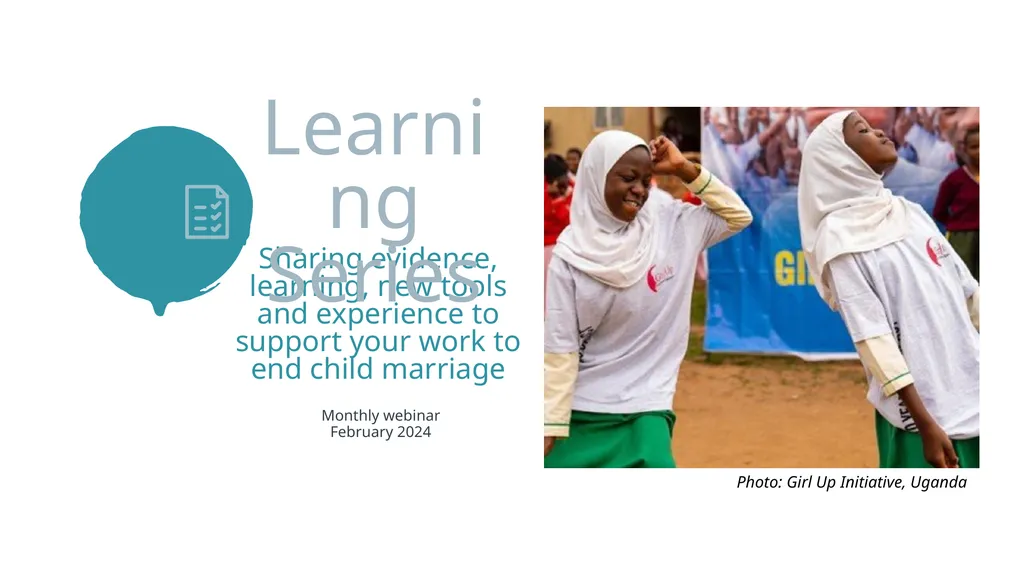
February 2024 Learning Series Photo: Girl Up Initiative, Uganda<br>
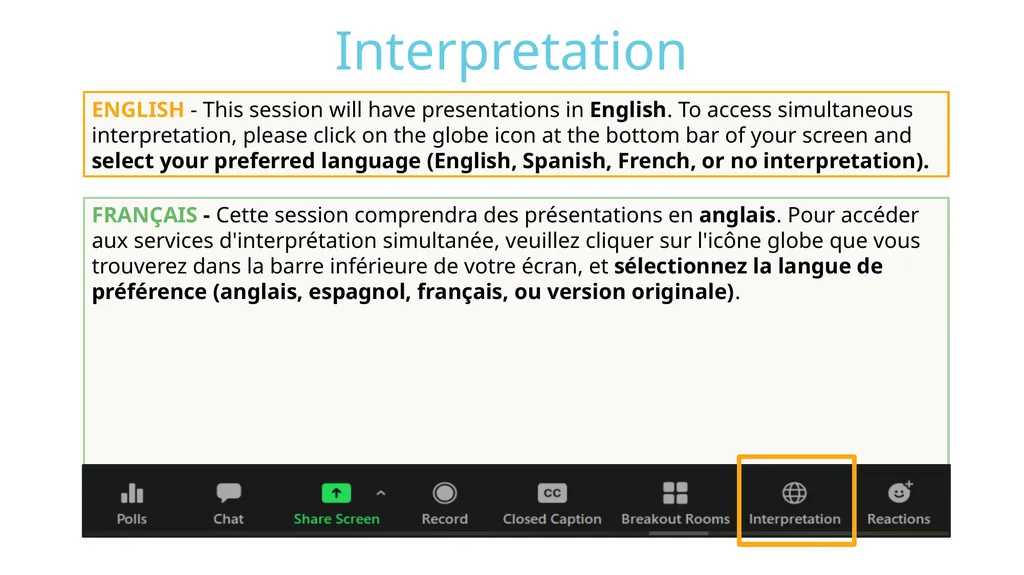
slide2. Interpretation ENGLISH - This session will have presentations in English. To access simultaneous interpretation, please click on the globe icon at the bottom bar of your screen and select your preferred language (English, Spanish, French, or no interpretation). Español - Esta sesión tendrá presentaciones en inglés. Para acceder a los servicios de interpretación simultánea, por favor haga clic en el icono del globo que encontrará en la barra inferior de su pantalla, y seleccione su idioma de preferencia (inglés, español, francés, o versión original). français - Cette session comprendra des présentations en anglais. Pour accéder aux services d'interprétation simultanée, veuillez cliquer sur l'icône globe que vous trouverez dans la barre inférieure de votre écran, et sélectionnez la langue de préférence (anglais, espagnol, français, ou version originale).<br>
slide3. THE IMPACT OF AGE OF MARRIAGE AND SEXUAL CONSENT LAWS ON CHILD MARRIAGE AND GIRLS’ RIGHTS Learning series session FEBRUARY 2024<br>
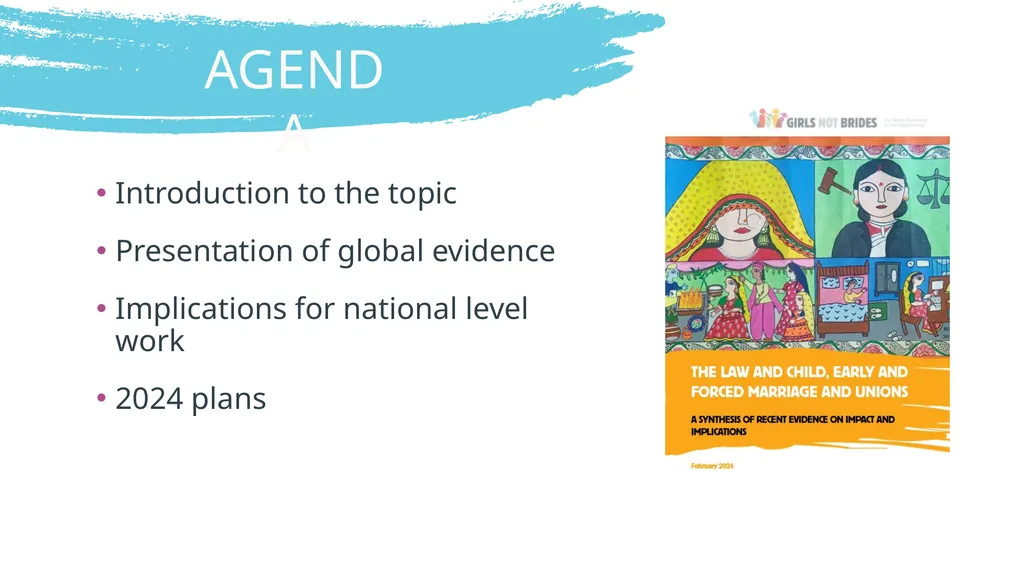
slide4. Introduction to the topic
Presentation of global evidence
Implications for national level work
2024 plans AGENDA<br>
slide5. 153 of 198 countries have minimum age of marriage 18 laws.
52% countries have 18 no exceptions marriage laws.
38 countries had different minimum age of marriage under the law for women and men.
6 countries did not specify any minimum age at all. Countries with minimum age of marriage laws 2019<br>
slide6. What helps and what hinders to tip the scales in favour of delayed marriage? Minimum age of marriage laws
Growing support for girls’ education
Growing awareness of the harms of unwanted early pregnancy
Positive normative environment that rejects the practice of child marriage (declarations, resolutions)
Changing hearts and minds by supporting behaviour change among individuals, in communities and society. Discriminatory norms that hold the practice of child marriage in place and act as roadblocks to laws
Normative counterpoints: exceptions and pluralistic legal systems.
Systems and structures that systematically uphold male privilege and other inequalities and reinforce discriminatory norms. Adapted from Greene, M. and Stiefvater, E (2019)<br>
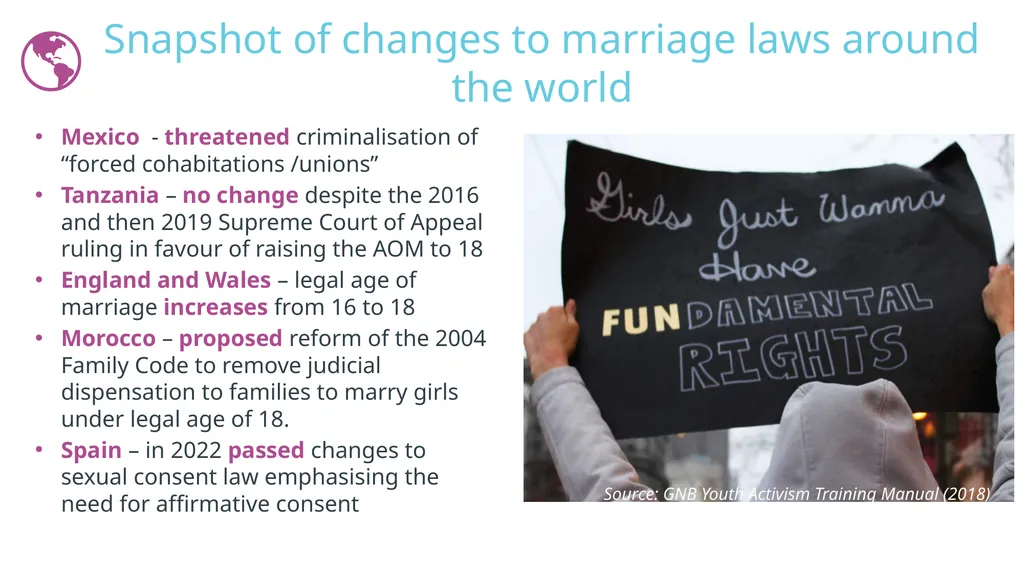
slide7. Snapshot of changes to marriage laws around the world Mexico - threatened criminalisation of “forced cohabitations /unions”
Tanzania – no change despite the 2016 and then 2019 Supreme Court of Appeal ruling in favour of raising the AOM to 18
England and Wales – legal age of marriage increases from 16 to 18
Morocco – proposed reform of the 2004 Family Code to remove judicial dispensation to families to marry girls under legal age of 18.
Spain – in 2022 passed changes to sexual consent law emphasising the need for affirmative consent Source: GNB Youth Activism Training Manual (2018)<br>
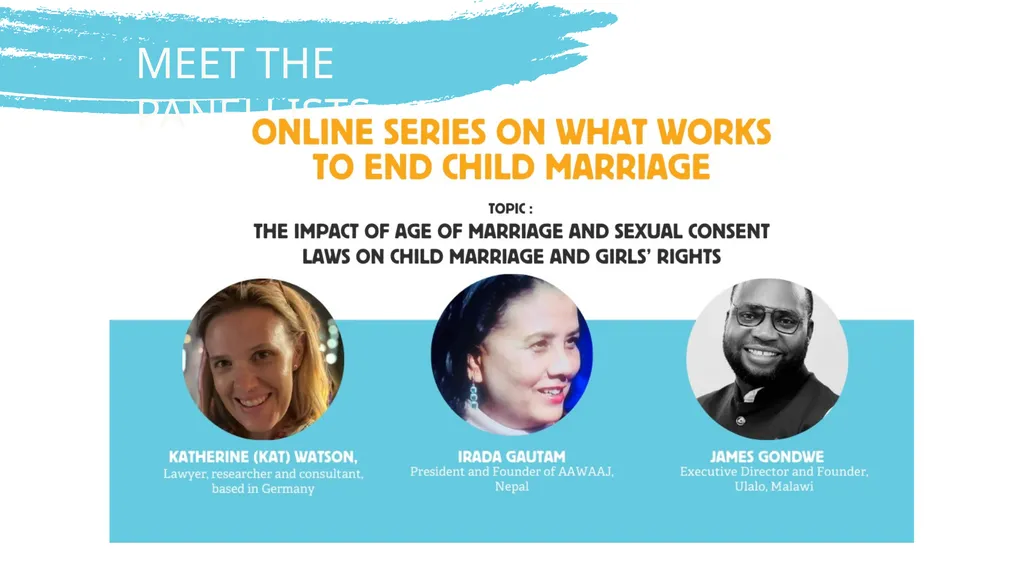
slide8. MEET THE PANELLISTS<br>
slide9. Recent evidence on the impact and implications of child marriage law A global synthesis
February 2024<br>
slide10. Research questions
Human rights framework
Primary findings
Ways forward
Six things to remember AGENDA<br>
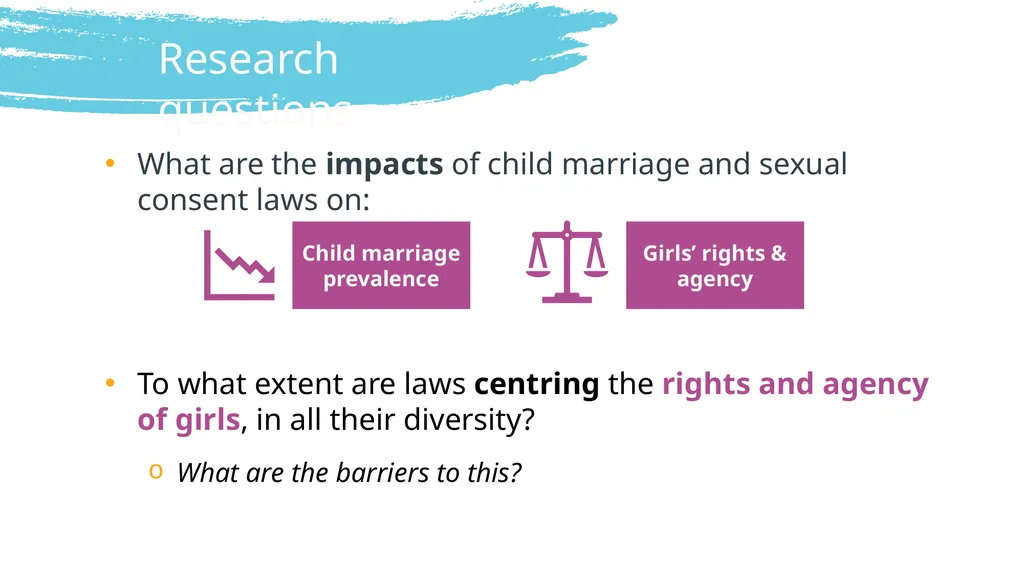
slide11. Research questions<br>
slide12. What are the impacts of child marriage and sexual consent laws on:
To what extent are laws centring the rights and agency of girls, in all their diversity?
What are the barriers to this? Child marriage prevalence Girls’ rights & agency Research questions<br>
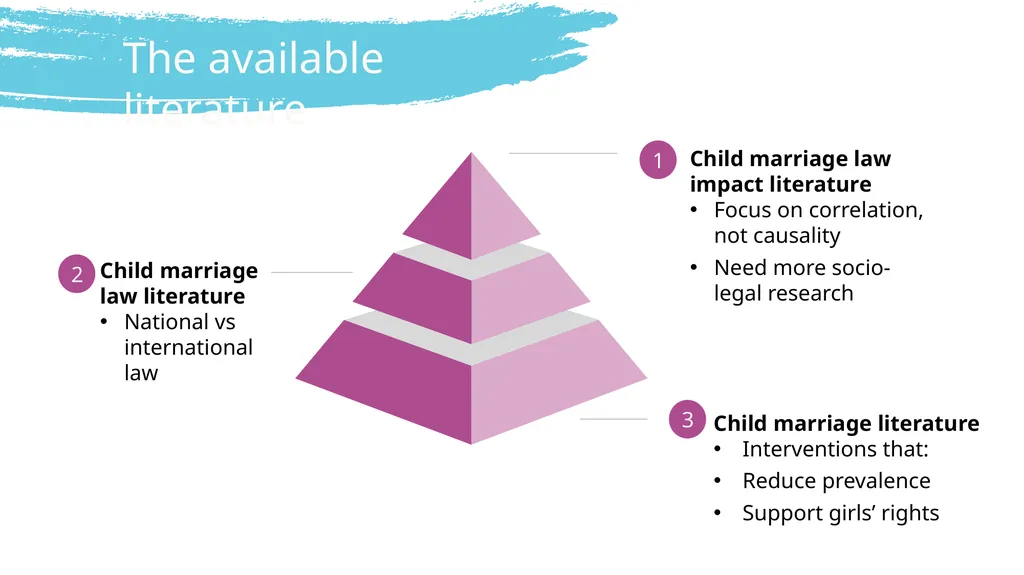
slide13. Child marriage literature
Interventions that:
Reduce prevalence
Support girls’ rights Child marriage law literature
National vs international law Child marriage law impact literature
Focus on correlation, not causality
Need more socio-legal research 2 1 3 The available literature<br>
slide14. Human rights framework<br>
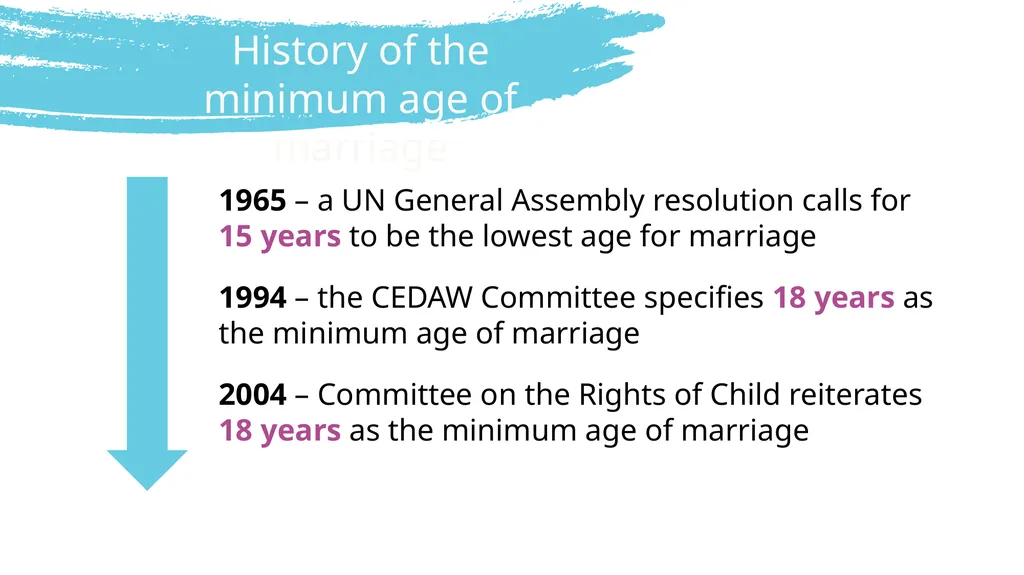
slide15. 1965 – a UN General Assembly resolution calls for 15 years to be the lowest age for marriage
1994 – the CEDAW Committee specifies 18 years as the minimum age of marriage
2004 – Committee on the Rights of Child reiterates 18 years as the minimum age of marriage History of the minimum age of marriage<br>
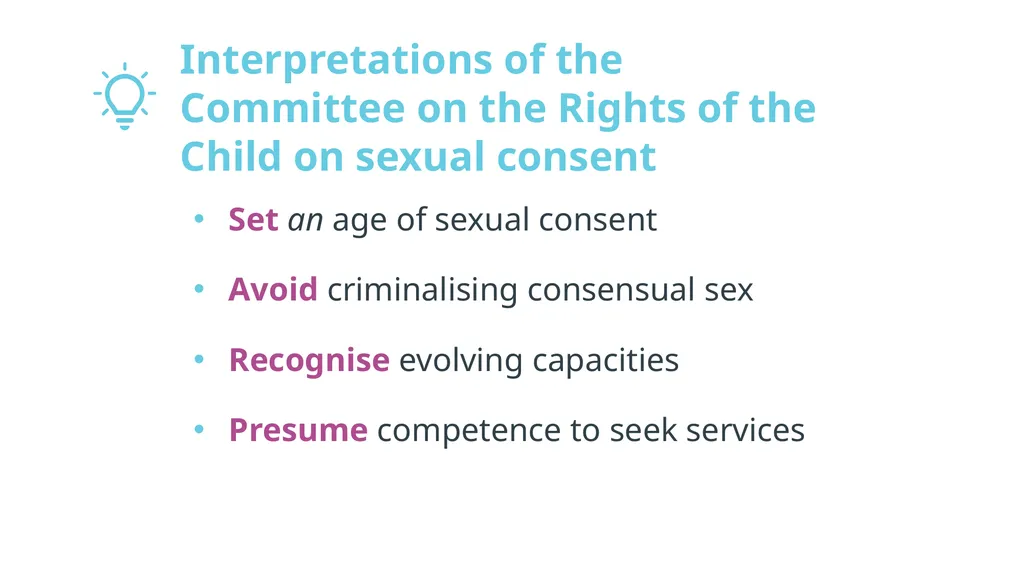
slide16. Interpretations of the Committee on the Rights of the Child on sexual consent Set an age of sexual consent
Avoid criminalising consensual sex
Recognise evolving capacities
Presume competence to seek services<br>
slide17. The law and prevalence<br>
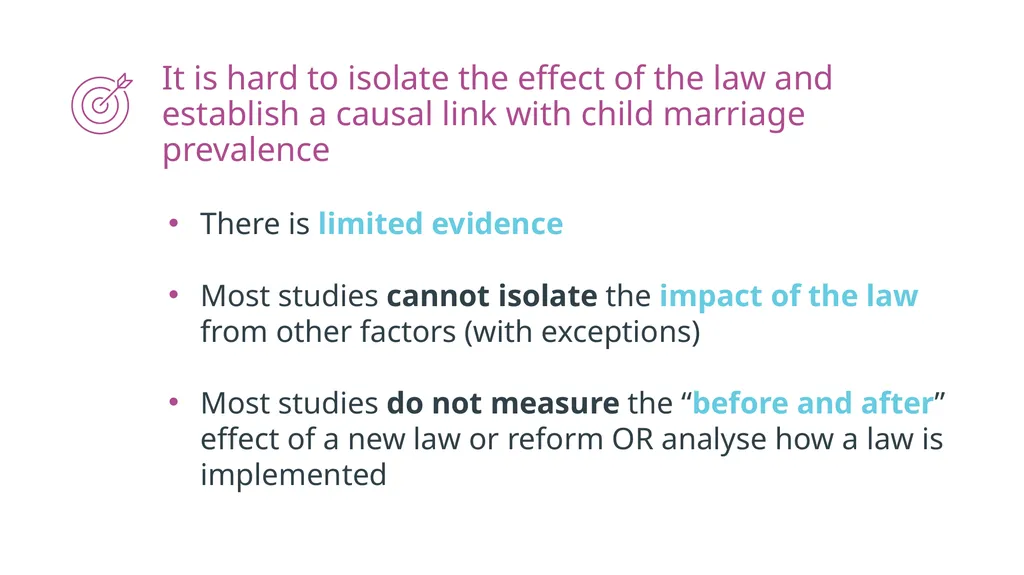
slide18. It is hard to isolate the effect of the law and establish a causal link with child marriage prevalence There is limited evidence
Most studies cannot isolate the impact of the law from other factors (with exceptions)
Most studies do not measure the “before and after” effect of a new law or reform OR analyse how a law is implemented<br>
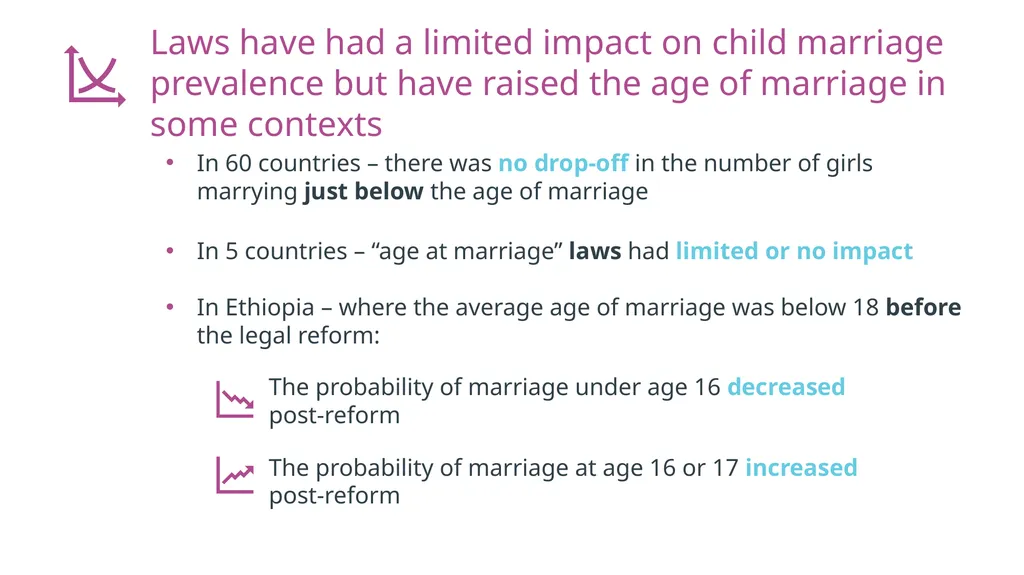
slide19. Laws have had a limited impact on child marriage prevalence but have raised the age of marriage in some contexts In 60 countries – there was no drop-off in the number of girls marrying just below the age of marriage
In 5 countries – “age at marriage” laws had limited or no impact
In Ethiopia – where the average age of marriage was below 18 before the legal reform: The probability of marriage under age 16 decreased post-reform The probability of marriage at age 16 or 17 increased post-reform<br>
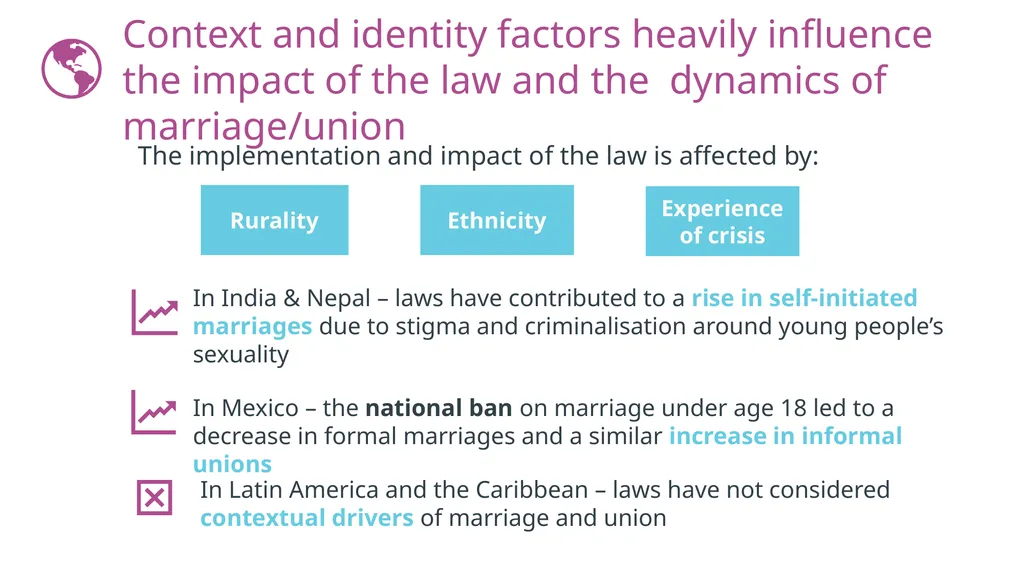
slide20. Context and identity factors heavily influence the impact of the law and the dynamics of marriage/union The implementation and impact of the law is affected by: Rurality Ethnicity Experience of crisis In India & Nepal – laws have contributed to a rise in self-initiated marriages due to stigma and criminalisation around young people’s sexuality In Mexico – the national ban on marriage under age 18 led to a decrease in formal marriages and a similar increase in informal unions In Latin America and the Caribbean – laws have not considered contextual drivers of marriage and union<br>
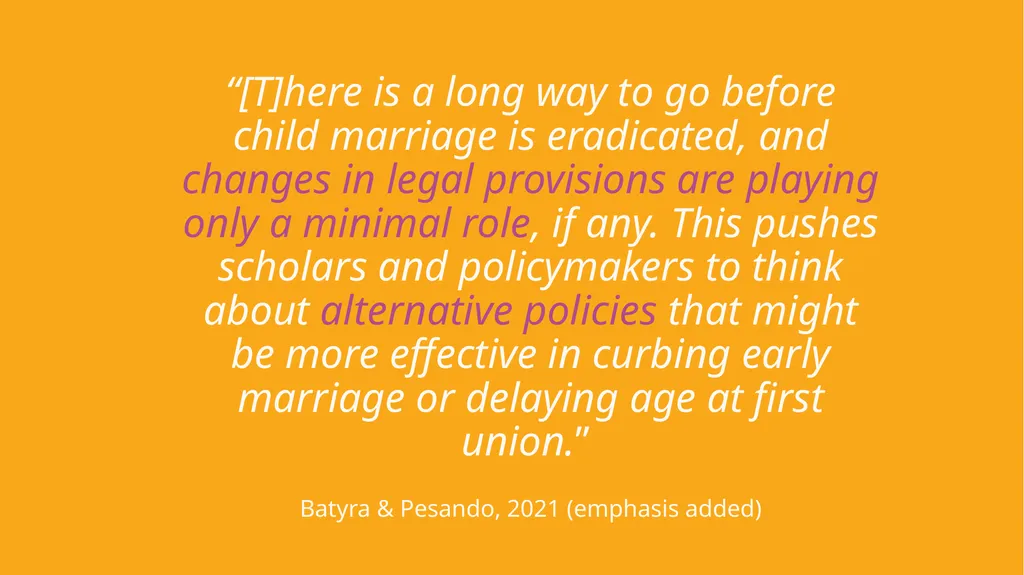
slide21. “[T]here is a long way to go before child marriage is eradicated, and changes in legal provisions are playing only a minimal role, if any. This pushes scholars and policymakers to think about alternative policies that might be more effective in curbing early marriage or delaying age at first union.”
Batyra & Pesando, 2021 (emphasis added)<br>
slide22. The law and agency & rights<br>
slide23. The law does not match adolescents’ realities and their evolving capacities are rarely considered “Adolescence” is a relatively new legal category
Criminalising adolescent sexuality and/or raising the age of sexual consent does not reflect reality
Judges can apply evolving capacities in their interpretations of individual cases
But reform driven by judicial interpretation rather than lawmakers can lead to slow implementation and uptake<br>
slide24. Criminalising adolescent sexuality blocks their access to sexual and reproductive health information and services Laws interacted with norms in 8 countries to restrict adolescents' access to SRHR information and services
In some countries, there are contradictions between the age of sexual consent and the right to access SRH services in health policy
Providers refuse to offer SRH services to adolescents for fear of legal repercussions<br>
slide25. “...many children and young people who are not legally recognised as able to consent to sex are in fact sexually active, and in need of sexual and reproductive health services. This dilemma has given rise to a hodgepodge of confused legal, policy and programmatic measures which place various age-based limitations on children’s decision-making…”
Yarrow et al, 2014 (emphasis added)<br>
slide26. The law is weaponised against girls but also not available for those who need access to justice In El Salvador – communities believe sexual consent laws are intended to prevent young people from being sexually active
In India and Nepal – parents are using the law to break up marriages they disapprove of, including where they are inter-caste
In India – the law is rarely used to support girls who have experienced forced marriage<br>
slide27. The use of punitive approaches has a range of consequences in girls’ lives In Ethiopia, Malawi and Egypt – punitive legal approaches drive child marriage underground, where girls cannot access services, social support or justice
In Mexico – the criminal law could exacerbate existing marginalisations due to greater penalties when cases involve people of Indigenous or Afro-Mexican descent
Girls can face harassment or emotional abuse by law enforcement officials when they make a complaint, or social stigma from communities
Legal enforcement often replaces efforts to enhance the welfare of girls and young women, and their communities<br>
slide28. Barriers to justice for girls<br>
slide29. Girls and their allies face barriers to justice Lack of anonymity in reporting cases of child marriage to the police
Uncertainty due to conflicting laws or discrepancies between formal and informal law
State birth and marriage registration systems are often under-resourced and staff are unprepared
Lack of awareness in communities about laws and policies
Girls cannot access legal systems without a legal adult
Financial barriers due to cost of legal representation<br>
slide30. Ways forward<br>
slide31. Embed legal advocacy in a comprehensive, gender-transformative approach to gender equality 1<br>
slide32. Contextualise, contextualise, contextualise What does this look like? 2 More research to understand the specificities of how laws impact the whole population, and girls in all their diversity
Legal advocacy informed by deep understandings of evolving capacities in each context
Understanding how (criminal) laws shape and respond to the prevalence of different types of marriage and unions<br>
slide33. Address barriers to girls’ access to justice Legal literacy campaigns for girls and their communities to increase awareness of the law and the rights and protections it offers for girls
Working with girls to understand their needs and advocating with them for changes to address them
Ensuring support services and legal aid are available to girls who have been forced into marriage 3 What does this look like?<br>
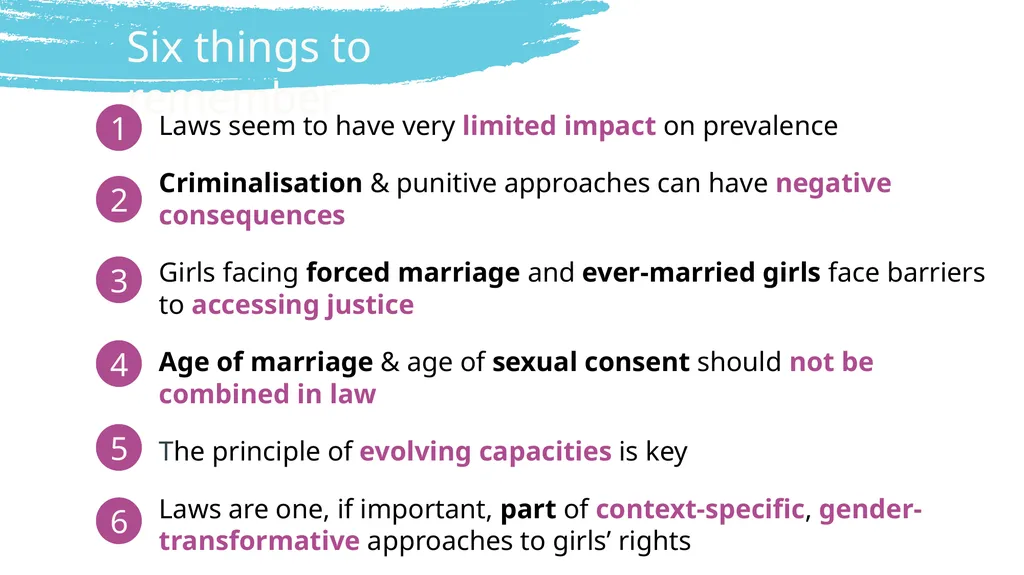
slide34. Laws seem to have very limited impact on prevalence
Criminalisation & punitive approaches can have negative consequences
Girls facing forced marriage and ever-married girls face barriers to accessing justice
Age of marriage & age of sexual consent should not be combined in law
The principle of evolving capacities is key
Laws are one, if important, part of context-specific, gender-transformative approaches to girls’ rights 2 3 4 5 6 Six things to remember 1<br>
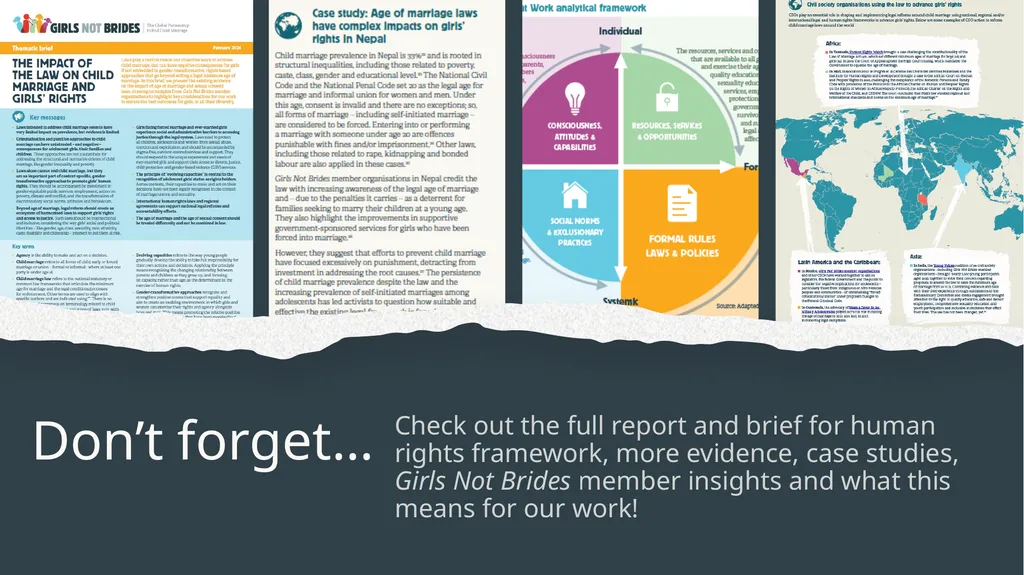
slide35. Don’t forget… Check out the full report and brief for human rights framework, more evidence, case studies, Girls Not Brides member insights and what this means for our work!<br>
slide36. Thank you<br>
slide37. What this means for advocacy and practice A country perspective of the implications of this evidence from Nepal and malawi<br>
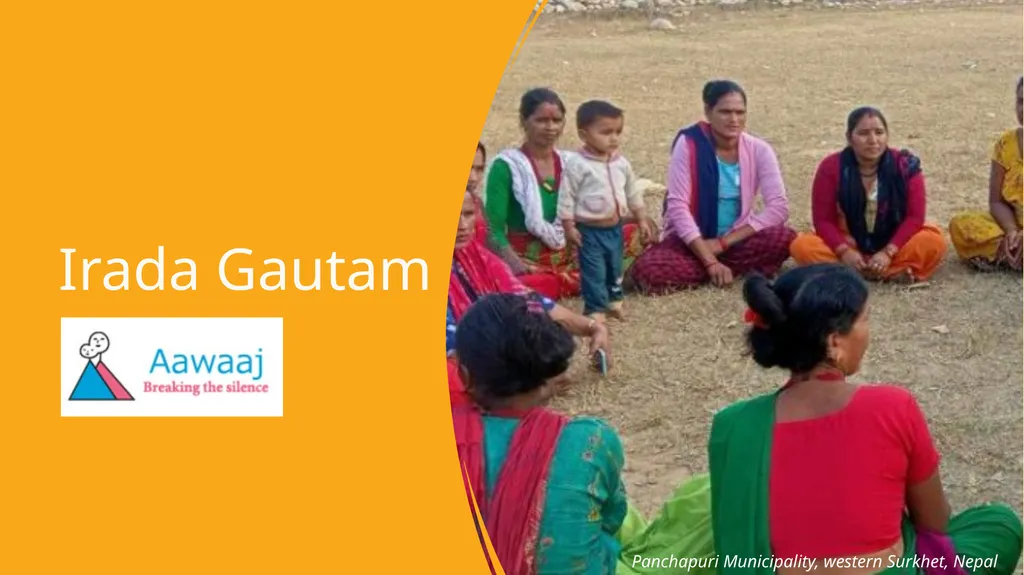
slide38. Irada Gautam Panchapuri Municipality, western Surkhet, Nepal<br>
slide39. 1. Child marriage in Nepal Child marriage prevalence in Nepal is 33%
20 is the legal minimum age for marriage and informal union for women and men.
Marriage under the age of 20 – with or without consent - is illegal, void, with no exceptions with fines and / or imprisonment
Self-initiated marriages are on the rise.
Age of marriage has increased from 14/15 to 16-18.
“Where any person has sexual intercourse with a woman without her consent or with a girl child below 18 years of age even with her consent, the person shall be considered to commit rape on such woman or girl child.” National Penal Code, 2017.<br>
slide40. 2. AAWAAJ: justice and empowerment Breaking the silence on sexual abuse and exploitation through social mobilization;
Child protection, child helpline and child friendly spaces;
Community support mechanism against gender-based violence;
Temporary shelter support centre and social integration for women and children;
Community and family mediation;
Counselling, care and support;
Lobbying, advocacy and campaigning against gender-based violence, child sexual abuse, exploitation and trafficking;
Strengthening local governance and community development; Key aspects for good practices in the prevention of Violence, Abuse, Exploitation & Trafficking (AAWAAJ)<br>
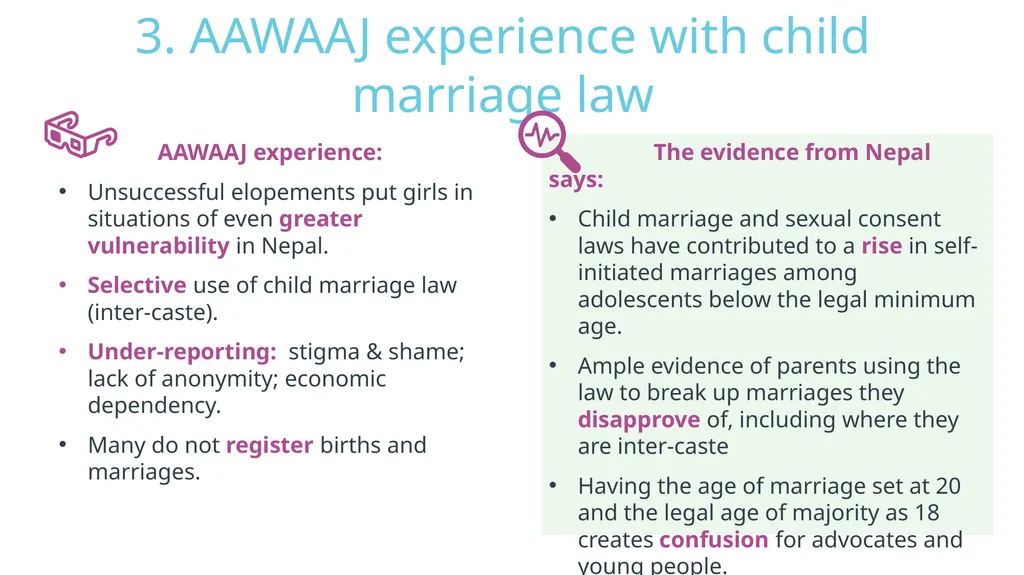
slide41. 3. AAWAAJ experience with child marriage law AAWAAJ experience:
Unsuccessful elopements put girls in situations of even greater vulnerability in Nepal.
Selective use of child marriage law (inter-caste).
Under-reporting: stigma & shame; lack of anonymity; economic dependency.
Many do not register births and marriages. The evidence from Nepal says:
Child marriage and sexual consent laws have contributed to a rise in self-initiated marriages among adolescents below the legal minimum age.
Ample evidence of parents using the law to break up marriages they disapprove of, including where they are inter-caste
Having the age of marriage set at 20 and the legal age of majority as 18 creates confusion for advocates and young people.<br>
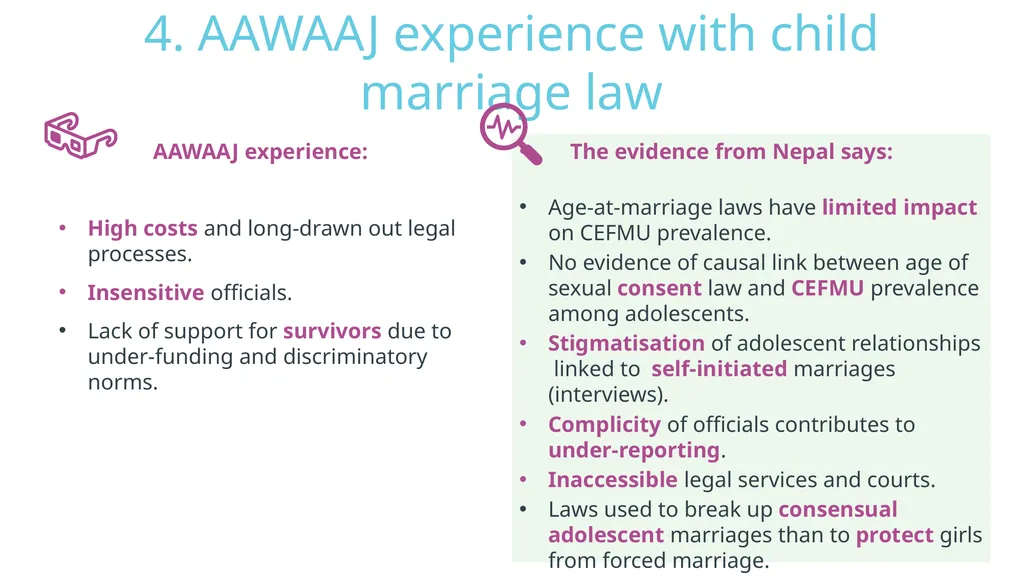
slide42. 4. AAWAAJ experience with child marriage law AAWAAJ experience:
High costs and long-drawn out legal processes.
Insensitive officials.
Lack of support for survivors due to under-funding and discriminatory norms. The evidence from Nepal says:
Age-at-marriage laws have limited impact on CEFMU prevalence.
No evidence of causal link between age of sexual consent law and CEFMU prevalence among adolescents.
Stigmatisation of adolescent relationships linked to self-initiated marriages (interviews).
Complicity of officials contributes to under-reporting.
Inaccessible legal services and courts.
Laws used to break up consensual adolescent marriages than to protect girls from forced marriage.
Global synthesis report<br>
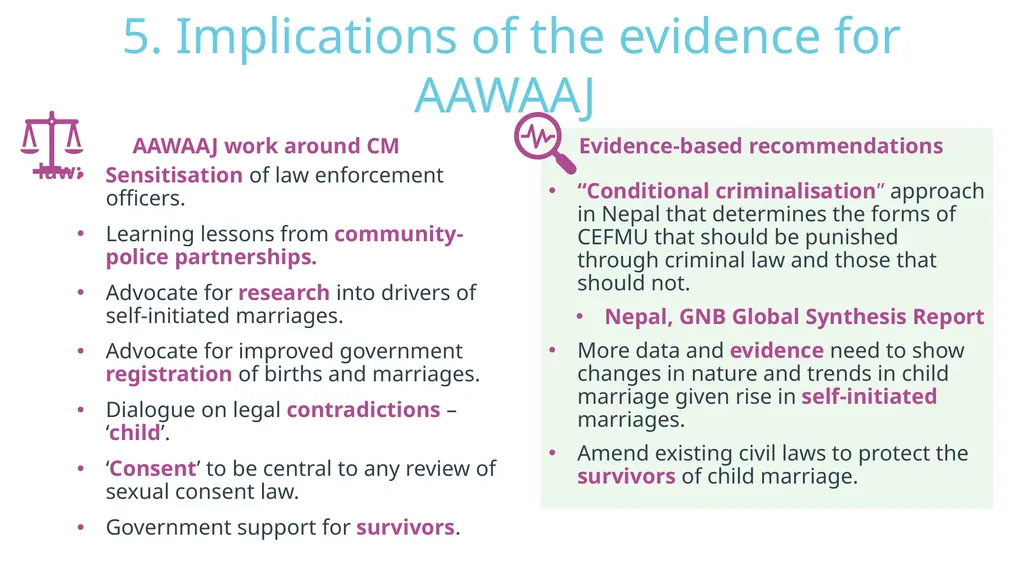
slide43. 5. Implications of the evidence for AAWAAJ Sensitisation of law enforcement officers.
Learning lessons from community-police partnerships.
Advocate for research into drivers of self-initiated marriages.
Advocate for improved government registration of births and marriages.
Dialogue on legal contradictions – ‘child’.
‘Consent’ to be central to any review of sexual consent law.
Government support for survivors. AAWAAJ work around CM law:<br>
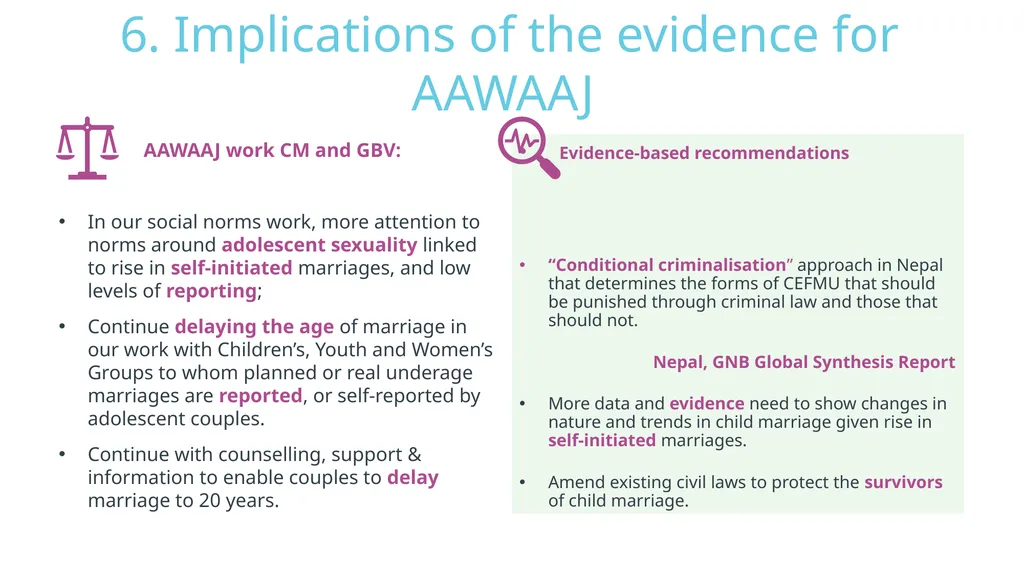
slide44. 6. Implications of the evidence for AAWAAJ AAWAAJ work CM and GBV:
In our social norms work, more attention to norms around adolescent sexuality linked to rise in self-initiated marriages, and low levels of reporting;
Continue delaying the age of marriage in our work with Children’s, Youth and Women’s Groups to whom planned or real underage marriages are reported, or self-reported by adolescent couples.
Continue with counselling, support & information to enable couples to delay marriage to 20 years. Evidence-based recommendations
“Conditional criminalisation” approach in Nepal that determines the forms of CEFMU that should be punished through criminal law and those that should not.
Nepal, GNB Global Synthesis Report
More data and evidence need to show changes in nature and trends in child marriage given rise in self-initiated marriages.
Amend existing civil laws to protect the survivors of child marriage.<br>
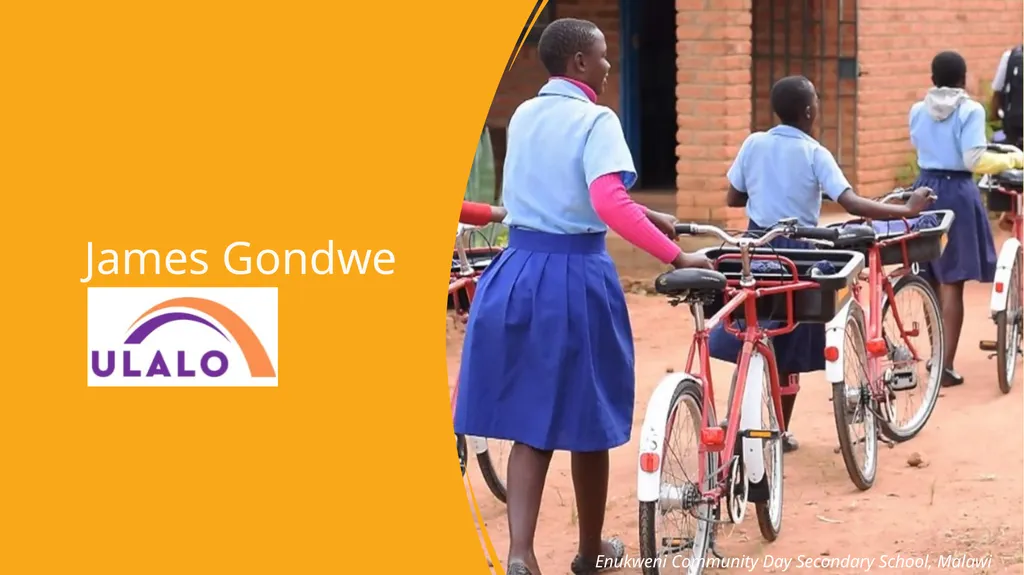
slide45. James Gondwe Enukweni Community Day Secondary School, Malawi<br>
slide46. 1. Child marriage in Malawi Child marriage prevalence in Malawi is 38%: 41% rural/ 22% urban; 49% poorest / 19% richest; 52% no schooling;
Most marriages are formal but there are a significant number of informal unions.
18 is the legal minimum age for marriage and sexual consent.
2017 Constitutional amendment removed marriage with parental consent for 15-18 year olds.
Community by-laws and customary law common.
2023 Penal Code Amendment decriminalises consensual adolescent sex providing age difference less than 2 years<br>
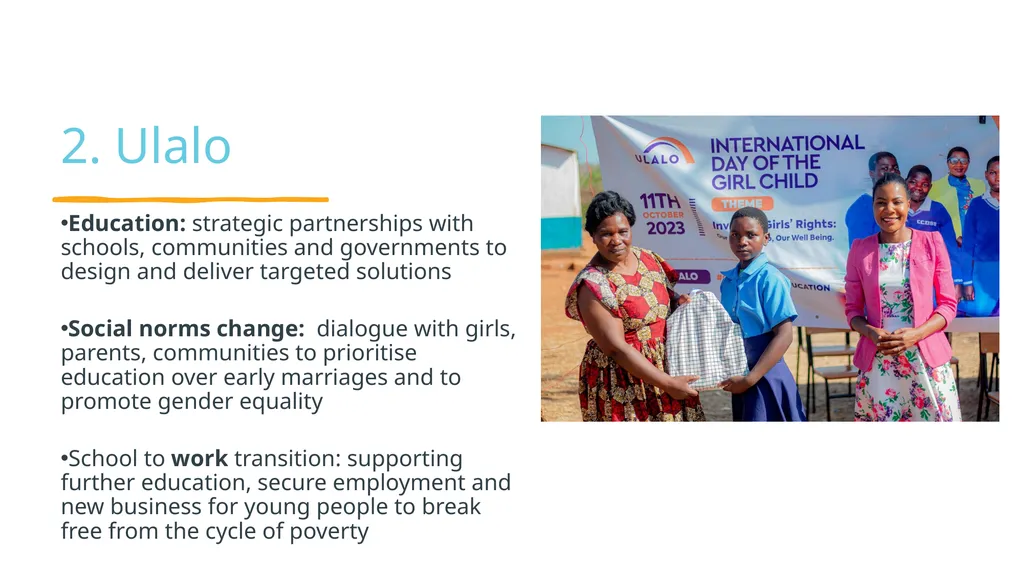
slide47. 2. Ulalo Education: strategic partnerships with schools, communities and governments to design and deliver targeted solutions
Social norms change: dialogue with girls, parents, communities to prioritise education over early marriages and to promote gender equality
School to work transition: supporting further education, secure employment and new business for young people to break free from the cycle of poverty<br>
slide48. 3. Ulalo experience with child marriage law Ulalo experience:
Low awareness of the law .
Selective use of the law, rather than universal right.
Inaccessibility of the law and justice: economic dependence; stigma; influence. Evidence from Malawi says:
Child marriage has decreased but little evidence to suggest link with changes in the law.
Contradictions in laws compromises rights of girls: age of marriage higher than age of majority; child protection law defines child as below 16.
Laws relating to sexuality and marriage - alongside norms that impact their implementation - restricted adolescents' access to information and services around their sexual and reproductive health and rights.<br>
slide49. 4. Ulalo experience with child marriage law Ulalo experience:
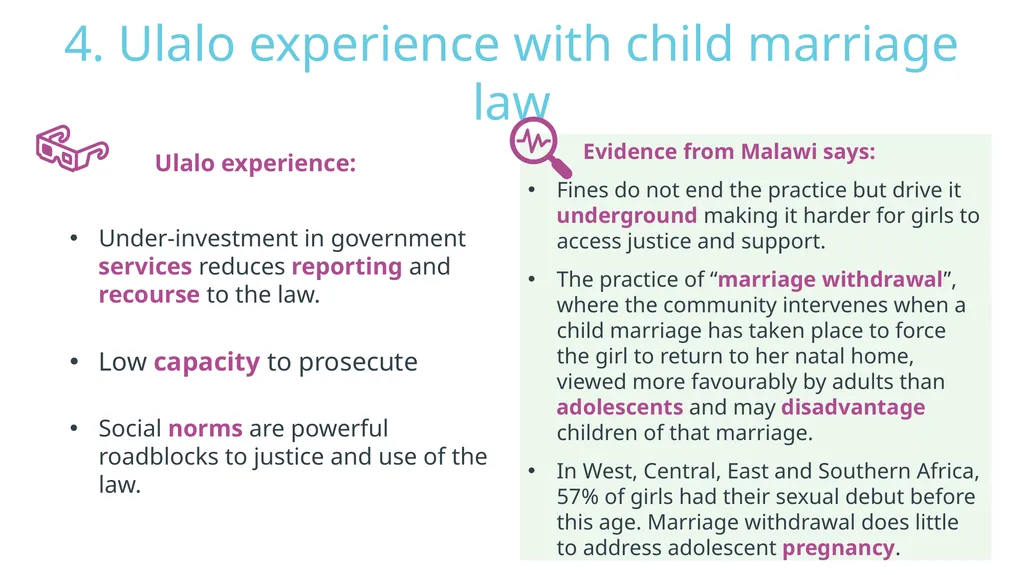
Under-investment in government services reduces reporting and recourse to the law.
Low capacity to prosecute
Social norms are powerful roadblocks to justice and use of the law. Evidence from Malawi says:
Fines do not end the practice but drive it underground making it harder for girls to access justice and support.
The practice of “marriage withdrawal”, where the community intervenes when a child marriage has taken place to force the girl to return to her natal home, viewed more favourably by adults than adolescents and may disadvantage children of that marriage.
In West, Central, East and Southern Africa, 57% of girls had their sexual debut before this age. Marriage withdrawal does little to address adolescent pregnancy.<br>
slide50. 5. Implications of the evidence for Ulalo Ulalo and the National Partnership:
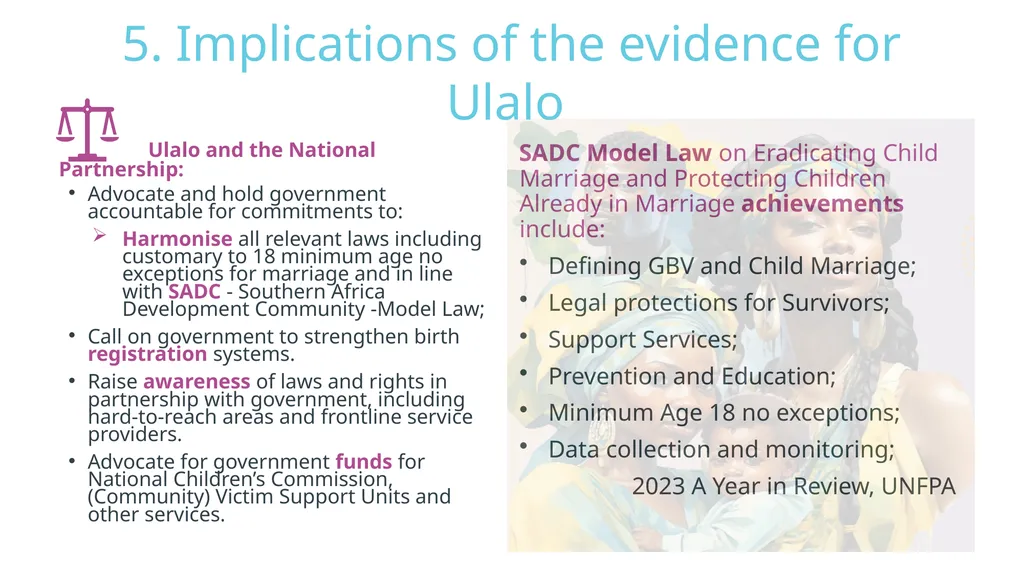
Advocate and hold government accountable for commitments to:
Harmonise all relevant laws including customary to 18 minimum age no exceptions for marriage and in line with SADC - Southern Africa Development Community -Model Law;
Call on government to strengthen birth registration systems.
Raise awareness of laws and rights in partnership with government, including hard-to-reach areas and frontline service providers.
Advocate for government funds for National Children’s Commission, (Community) Victim Support Units and other services. SADC Model Law on Eradicating Child Marriage and Protecting Children Already in Marriage achievements include:
Defining GBV and Child Marriage;
Legal protections for Survivors;
Support Services;
Prevention and Education;
Minimum Age 18 no exceptions;
Data collection and monitoring;
2023 A Year in Review, UNFPA<br>
slide51. 6. Implications of the evidence for Ulalo Ulalo and the National Partnership
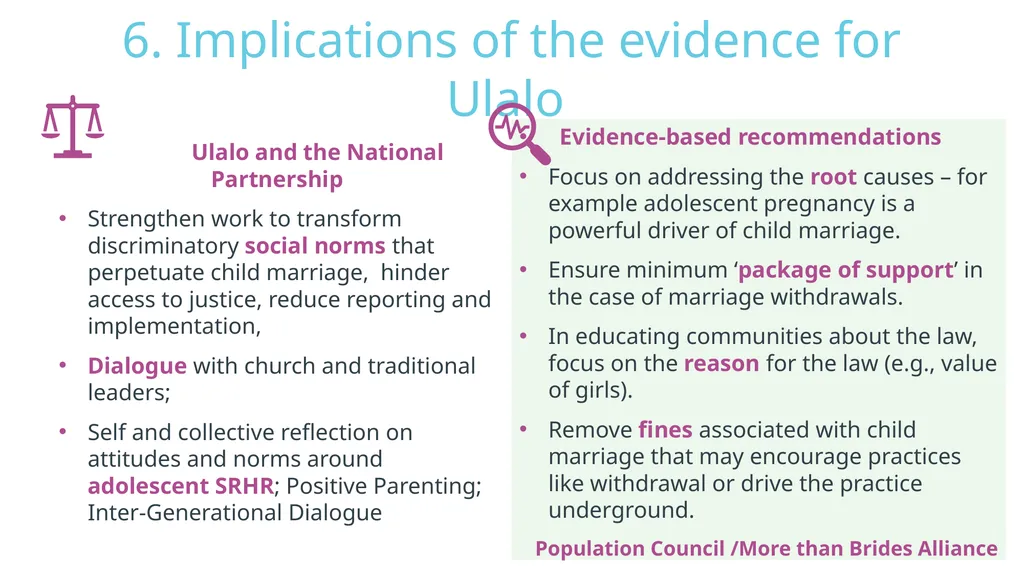
Strengthen work to transform discriminatory social norms that perpetuate child marriage, hinder access to justice, reduce reporting and implementation,
Dialogue with church and traditional leaders;
Self and collective reflection on attitudes and norms around adolescent SRHR; Positive Parenting; Inter-Generational Dialogue Evidence-based recommendations
Focus on addressing the root causes – for example adolescent pregnancy is a powerful driver of child marriage.
Ensure minimum ‘package of support’ in the case of marriage withdrawals.
In educating communities about the law, focus on the reason for the law (e.g., value of girls).
Remove fines associated with child marriage that may encourage practices like withdrawal or drive the practice underground.
Population Council /More than Brides Alliance<br>
slide52. 2024 Plans<br>
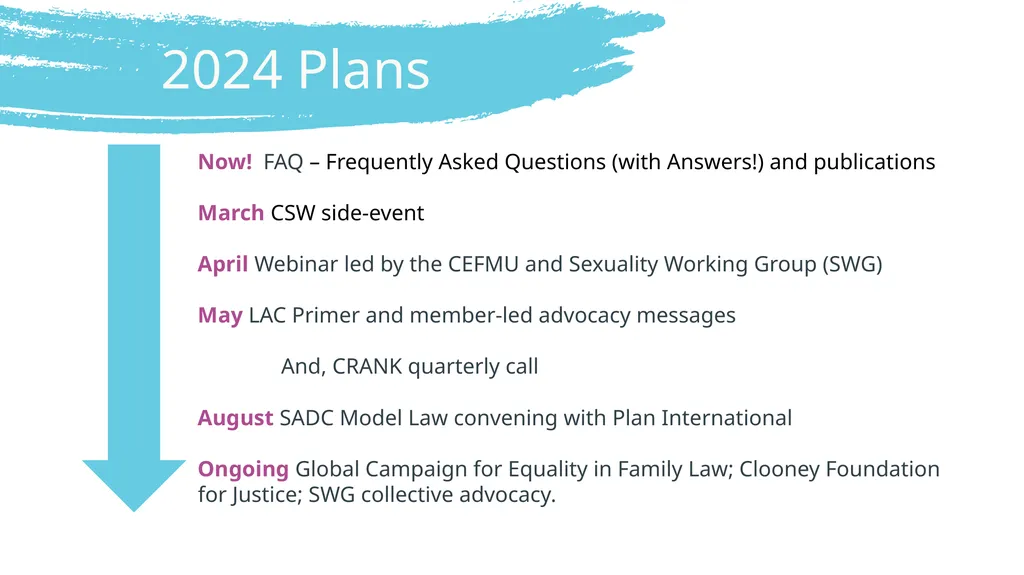
slide53. Now! FAQ – Frequently Asked Questions (with Answers!) and publications
March CSW side-event
April Webinar led by the CEFMU and Sexuality Working Group (SWG)
May LAC Primer and member-led advocacy messages
And, CRANK quarterly call
August SADC Model Law convening with Plan International
Ongoing Global Campaign for Equality in Family Law; Clooney Foundation for Justice; SWG collective advocacy. 2024 Plans<br>
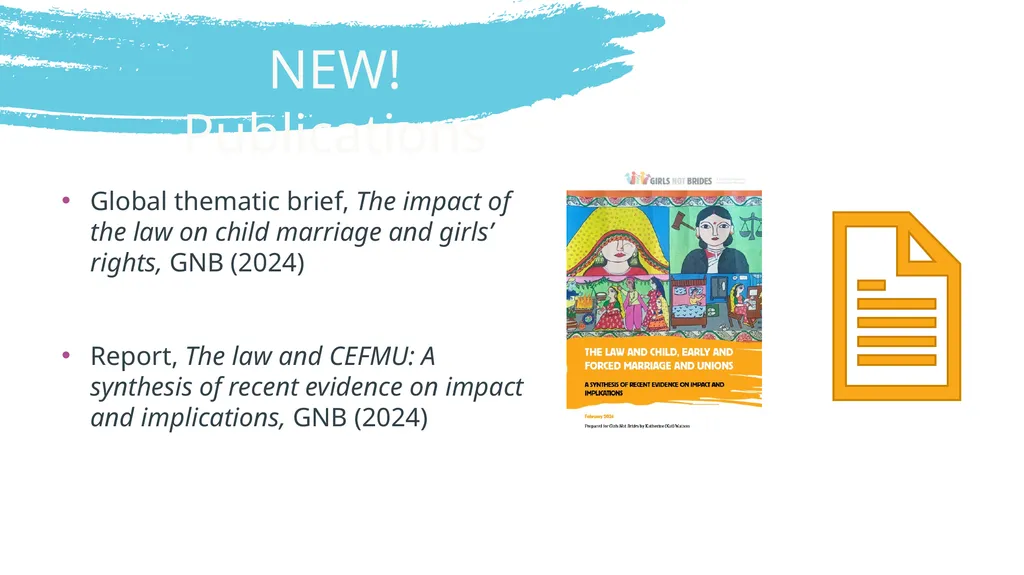
slide54. NEW! Publications Report, The law and CEFMU: A synthesis of recent evidence on impact and implications, GNB (2024) Global thematic brief, The impact of the law on child marriage and girls’ rights, GNB (2024)<br>
slide55. GLOBAL CHANNELS LATIN AMERICA AND CARIBBEAN FOLLOW GIRLS NOT BRIDES ON SOCIAL MEDIA TO LEARN MORE<br>
slide56. THANK YOU<br>
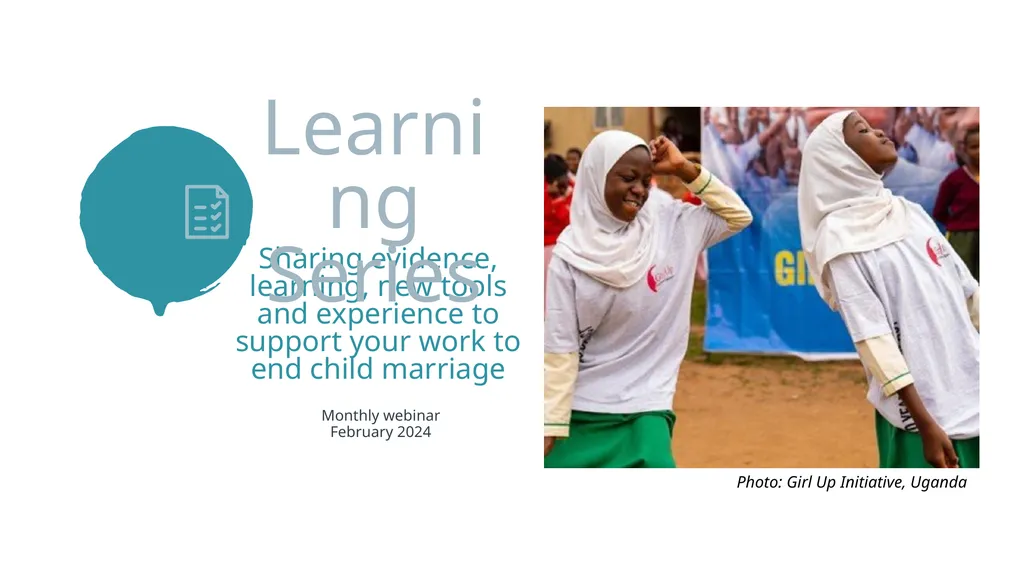
February 2024 Learning Series Photo: Girl Up Initiative, Uganda<br>
slide2. Interpretation ENGLISH - This session will have presentations in English. To access simultaneous interpretation, please click on the globe icon at the bottom bar of your screen and select your preferred language (English, Spanish, French, or no interpretation). Español - Esta sesión tendrá presentaciones en inglés. Para acceder a los servicios de interpretación simultánea, por favor haga clic en el icono del globo que encontrará en la barra inferior de su pantalla, y seleccione su idioma de preferencia (inglés, español, francés, o versión original). français - Cette session comprendra des présentations en anglais. Pour accéder aux services d'interprétation simultanée, veuillez cliquer sur l'icône globe que vous trouverez dans la barre inférieure de votre écran, et sélectionnez la langue de préférence (anglais, espagnol, français, ou version originale).<br>
slide3. THE IMPACT OF AGE OF MARRIAGE AND SEXUAL CONSENT LAWS ON CHILD MARRIAGE AND GIRLS’ RIGHTS Learning series session FEBRUARY 2024<br>
slide4. Introduction to the topic
Presentation of global evidence
Implications for national level work
2024 plans AGENDA<br>
slide5. 153 of 198 countries have minimum age of marriage 18 laws.
52% countries have 18 no exceptions marriage laws.
38 countries had different minimum age of marriage under the law for women and men.
6 countries did not specify any minimum age at all. Countries with minimum age of marriage laws 2019<br>
slide6. What helps and what hinders to tip the scales in favour of delayed marriage? Minimum age of marriage laws
Growing support for girls’ education
Growing awareness of the harms of unwanted early pregnancy
Positive normative environment that rejects the practice of child marriage (declarations, resolutions)
Changing hearts and minds by supporting behaviour change among individuals, in communities and society. Discriminatory norms that hold the practice of child marriage in place and act as roadblocks to laws
Normative counterpoints: exceptions and pluralistic legal systems.
Systems and structures that systematically uphold male privilege and other inequalities and reinforce discriminatory norms. Adapted from Greene, M. and Stiefvater, E (2019)<br>
slide7. Snapshot of changes to marriage laws around the world Mexico - threatened criminalisation of “forced cohabitations /unions”
Tanzania – no change despite the 2016 and then 2019 Supreme Court of Appeal ruling in favour of raising the AOM to 18
England and Wales – legal age of marriage increases from 16 to 18
Morocco – proposed reform of the 2004 Family Code to remove judicial dispensation to families to marry girls under legal age of 18.
Spain – in 2022 passed changes to sexual consent law emphasising the need for affirmative consent Source: GNB Youth Activism Training Manual (2018)<br>
slide8. MEET THE PANELLISTS<br>
slide9. Recent evidence on the impact and implications of child marriage law A global synthesis
February 2024<br>
slide10. Research questions
Human rights framework
Primary findings
Ways forward
Six things to remember AGENDA<br>
slide11. Research questions<br>
slide12. What are the impacts of child marriage and sexual consent laws on:
To what extent are laws centring the rights and agency of girls, in all their diversity?
What are the barriers to this? Child marriage prevalence Girls’ rights & agency Research questions<br>
slide13. Child marriage literature
Interventions that:
Reduce prevalence
Support girls’ rights Child marriage law literature
National vs international law Child marriage law impact literature
Focus on correlation, not causality
Need more socio-legal research 2 1 3 The available literature<br>
slide14. Human rights framework<br>
slide15. 1965 – a UN General Assembly resolution calls for 15 years to be the lowest age for marriage
1994 – the CEDAW Committee specifies 18 years as the minimum age of marriage
2004 – Committee on the Rights of Child reiterates 18 years as the minimum age of marriage History of the minimum age of marriage<br>
slide16. Interpretations of the Committee on the Rights of the Child on sexual consent Set an age of sexual consent
Avoid criminalising consensual sex
Recognise evolving capacities
Presume competence to seek services<br>
slide17. The law and prevalence<br>
slide18. It is hard to isolate the effect of the law and establish a causal link with child marriage prevalence There is limited evidence
Most studies cannot isolate the impact of the law from other factors (with exceptions)
Most studies do not measure the “before and after” effect of a new law or reform OR analyse how a law is implemented<br>
slide19. Laws have had a limited impact on child marriage prevalence but have raised the age of marriage in some contexts In 60 countries – there was no drop-off in the number of girls marrying just below the age of marriage
In 5 countries – “age at marriage” laws had limited or no impact
In Ethiopia – where the average age of marriage was below 18 before the legal reform: The probability of marriage under age 16 decreased post-reform The probability of marriage at age 16 or 17 increased post-reform<br>
slide20. Context and identity factors heavily influence the impact of the law and the dynamics of marriage/union The implementation and impact of the law is affected by: Rurality Ethnicity Experience of crisis In India & Nepal – laws have contributed to a rise in self-initiated marriages due to stigma and criminalisation around young people’s sexuality In Mexico – the national ban on marriage under age 18 led to a decrease in formal marriages and a similar increase in informal unions In Latin America and the Caribbean – laws have not considered contextual drivers of marriage and union<br>
slide21. “[T]here is a long way to go before child marriage is eradicated, and changes in legal provisions are playing only a minimal role, if any. This pushes scholars and policymakers to think about alternative policies that might be more effective in curbing early marriage or delaying age at first union.”
Batyra & Pesando, 2021 (emphasis added)<br>
slide22. The law and agency & rights<br>
slide23. The law does not match adolescents’ realities and their evolving capacities are rarely considered “Adolescence” is a relatively new legal category
Criminalising adolescent sexuality and/or raising the age of sexual consent does not reflect reality
Judges can apply evolving capacities in their interpretations of individual cases
But reform driven by judicial interpretation rather than lawmakers can lead to slow implementation and uptake<br>
slide24. Criminalising adolescent sexuality blocks their access to sexual and reproductive health information and services Laws interacted with norms in 8 countries to restrict adolescents' access to SRHR information and services
In some countries, there are contradictions between the age of sexual consent and the right to access SRH services in health policy
Providers refuse to offer SRH services to adolescents for fear of legal repercussions<br>
slide25. “...many children and young people who are not legally recognised as able to consent to sex are in fact sexually active, and in need of sexual and reproductive health services. This dilemma has given rise to a hodgepodge of confused legal, policy and programmatic measures which place various age-based limitations on children’s decision-making…”
Yarrow et al, 2014 (emphasis added)<br>
slide26. The law is weaponised against girls but also not available for those who need access to justice In El Salvador – communities believe sexual consent laws are intended to prevent young people from being sexually active
In India and Nepal – parents are using the law to break up marriages they disapprove of, including where they are inter-caste
In India – the law is rarely used to support girls who have experienced forced marriage<br>
slide27. The use of punitive approaches has a range of consequences in girls’ lives In Ethiopia, Malawi and Egypt – punitive legal approaches drive child marriage underground, where girls cannot access services, social support or justice
In Mexico – the criminal law could exacerbate existing marginalisations due to greater penalties when cases involve people of Indigenous or Afro-Mexican descent
Girls can face harassment or emotional abuse by law enforcement officials when they make a complaint, or social stigma from communities
Legal enforcement often replaces efforts to enhance the welfare of girls and young women, and their communities<br>
slide28. Barriers to justice for girls<br>
slide29. Girls and their allies face barriers to justice Lack of anonymity in reporting cases of child marriage to the police
Uncertainty due to conflicting laws or discrepancies between formal and informal law
State birth and marriage registration systems are often under-resourced and staff are unprepared
Lack of awareness in communities about laws and policies
Girls cannot access legal systems without a legal adult
Financial barriers due to cost of legal representation<br>
slide30. Ways forward<br>
slide31. Embed legal advocacy in a comprehensive, gender-transformative approach to gender equality 1<br>
slide32. Contextualise, contextualise, contextualise What does this look like? 2 More research to understand the specificities of how laws impact the whole population, and girls in all their diversity
Legal advocacy informed by deep understandings of evolving capacities in each context
Understanding how (criminal) laws shape and respond to the prevalence of different types of marriage and unions<br>
slide33. Address barriers to girls’ access to justice Legal literacy campaigns for girls and their communities to increase awareness of the law and the rights and protections it offers for girls
Working with girls to understand their needs and advocating with them for changes to address them
Ensuring support services and legal aid are available to girls who have been forced into marriage 3 What does this look like?<br>
slide34. Laws seem to have very limited impact on prevalence
Criminalisation & punitive approaches can have negative consequences
Girls facing forced marriage and ever-married girls face barriers to accessing justice
Age of marriage & age of sexual consent should not be combined in law
The principle of evolving capacities is key
Laws are one, if important, part of context-specific, gender-transformative approaches to girls’ rights 2 3 4 5 6 Six things to remember 1<br>
slide35. Don’t forget… Check out the full report and brief for human rights framework, more evidence, case studies, Girls Not Brides member insights and what this means for our work!<br>
slide36. Thank you<br>
slide37. What this means for advocacy and practice A country perspective of the implications of this evidence from Nepal and malawi<br>
slide38. Irada Gautam Panchapuri Municipality, western Surkhet, Nepal<br>
slide39. 1. Child marriage in Nepal Child marriage prevalence in Nepal is 33%
20 is the legal minimum age for marriage and informal union for women and men.
Marriage under the age of 20 – with or without consent - is illegal, void, with no exceptions with fines and / or imprisonment
Self-initiated marriages are on the rise.
Age of marriage has increased from 14/15 to 16-18.
“Where any person has sexual intercourse with a woman without her consent or with a girl child below 18 years of age even with her consent, the person shall be considered to commit rape on such woman or girl child.” National Penal Code, 2017.<br>
slide40. 2. AAWAAJ: justice and empowerment Breaking the silence on sexual abuse and exploitation through social mobilization;
Child protection, child helpline and child friendly spaces;
Community support mechanism against gender-based violence;
Temporary shelter support centre and social integration for women and children;
Community and family mediation;
Counselling, care and support;
Lobbying, advocacy and campaigning against gender-based violence, child sexual abuse, exploitation and trafficking;
Strengthening local governance and community development; Key aspects for good practices in the prevention of Violence, Abuse, Exploitation & Trafficking (AAWAAJ)<br>
slide41. 3. AAWAAJ experience with child marriage law AAWAAJ experience:
Unsuccessful elopements put girls in situations of even greater vulnerability in Nepal.
Selective use of child marriage law (inter-caste).
Under-reporting: stigma & shame; lack of anonymity; economic dependency.
Many do not register births and marriages. The evidence from Nepal says:
Child marriage and sexual consent laws have contributed to a rise in self-initiated marriages among adolescents below the legal minimum age.
Ample evidence of parents using the law to break up marriages they disapprove of, including where they are inter-caste
Having the age of marriage set at 20 and the legal age of majority as 18 creates confusion for advocates and young people.<br>
slide42. 4. AAWAAJ experience with child marriage law AAWAAJ experience:
High costs and long-drawn out legal processes.
Insensitive officials.
Lack of support for survivors due to under-funding and discriminatory norms. The evidence from Nepal says:
Age-at-marriage laws have limited impact on CEFMU prevalence.
No evidence of causal link between age of sexual consent law and CEFMU prevalence among adolescents.
Stigmatisation of adolescent relationships linked to self-initiated marriages (interviews).
Complicity of officials contributes to under-reporting.
Inaccessible legal services and courts.
Laws used to break up consensual adolescent marriages than to protect girls from forced marriage.
Global synthesis report<br>
slide43. 5. Implications of the evidence for AAWAAJ Sensitisation of law enforcement officers.
Learning lessons from community-police partnerships.
Advocate for research into drivers of self-initiated marriages.
Advocate for improved government registration of births and marriages.
Dialogue on legal contradictions – ‘child’.
‘Consent’ to be central to any review of sexual consent law.
Government support for survivors. AAWAAJ work around CM law:<br>
slide44. 6. Implications of the evidence for AAWAAJ AAWAAJ work CM and GBV:
In our social norms work, more attention to norms around adolescent sexuality linked to rise in self-initiated marriages, and low levels of reporting;
Continue delaying the age of marriage in our work with Children’s, Youth and Women’s Groups to whom planned or real underage marriages are reported, or self-reported by adolescent couples.
Continue with counselling, support & information to enable couples to delay marriage to 20 years. Evidence-based recommendations
“Conditional criminalisation” approach in Nepal that determines the forms of CEFMU that should be punished through criminal law and those that should not.
Nepal, GNB Global Synthesis Report
More data and evidence need to show changes in nature and trends in child marriage given rise in self-initiated marriages.
Amend existing civil laws to protect the survivors of child marriage.<br>
slide45. James Gondwe Enukweni Community Day Secondary School, Malawi<br>
slide46. 1. Child marriage in Malawi Child marriage prevalence in Malawi is 38%: 41% rural/ 22% urban; 49% poorest / 19% richest; 52% no schooling;
Most marriages are formal but there are a significant number of informal unions.
18 is the legal minimum age for marriage and sexual consent.
2017 Constitutional amendment removed marriage with parental consent for 15-18 year olds.
Community by-laws and customary law common.
2023 Penal Code Amendment decriminalises consensual adolescent sex providing age difference less than 2 years<br>
slide47. 2. Ulalo Education: strategic partnerships with schools, communities and governments to design and deliver targeted solutions
Social norms change: dialogue with girls, parents, communities to prioritise education over early marriages and to promote gender equality
School to work transition: supporting further education, secure employment and new business for young people to break free from the cycle of poverty<br>
slide48. 3. Ulalo experience with child marriage law Ulalo experience:
Low awareness of the law .
Selective use of the law, rather than universal right.
Inaccessibility of the law and justice: economic dependence; stigma; influence. Evidence from Malawi says:
Child marriage has decreased but little evidence to suggest link with changes in the law.
Contradictions in laws compromises rights of girls: age of marriage higher than age of majority; child protection law defines child as below 16.
Laws relating to sexuality and marriage - alongside norms that impact their implementation - restricted adolescents' access to information and services around their sexual and reproductive health and rights.<br>
slide49. 4. Ulalo experience with child marriage law Ulalo experience:
Under-investment in government services reduces reporting and recourse to the law.
Low capacity to prosecute
Social norms are powerful roadblocks to justice and use of the law. Evidence from Malawi says:
Fines do not end the practice but drive it underground making it harder for girls to access justice and support.
The practice of “marriage withdrawal”, where the community intervenes when a child marriage has taken place to force the girl to return to her natal home, viewed more favourably by adults than adolescents and may disadvantage children of that marriage.
In West, Central, East and Southern Africa, 57% of girls had their sexual debut before this age. Marriage withdrawal does little to address adolescent pregnancy.<br>
slide50. 5. Implications of the evidence for Ulalo Ulalo and the National Partnership:
Advocate and hold government accountable for commitments to:
Harmonise all relevant laws including customary to 18 minimum age no exceptions for marriage and in line with SADC - Southern Africa Development Community -Model Law;
Call on government to strengthen birth registration systems.
Raise awareness of laws and rights in partnership with government, including hard-to-reach areas and frontline service providers.
Advocate for government funds for National Children’s Commission, (Community) Victim Support Units and other services. SADC Model Law on Eradicating Child Marriage and Protecting Children Already in Marriage achievements include:
Defining GBV and Child Marriage;
Legal protections for Survivors;
Support Services;
Prevention and Education;
Minimum Age 18 no exceptions;
Data collection and monitoring;
2023 A Year in Review, UNFPA<br>
slide51. 6. Implications of the evidence for Ulalo Ulalo and the National Partnership
Strengthen work to transform discriminatory social norms that perpetuate child marriage, hinder access to justice, reduce reporting and implementation,
Dialogue with church and traditional leaders;
Self and collective reflection on attitudes and norms around adolescent SRHR; Positive Parenting; Inter-Generational Dialogue Evidence-based recommendations
Focus on addressing the root causes – for example adolescent pregnancy is a powerful driver of child marriage.
Ensure minimum ‘package of support’ in the case of marriage withdrawals.
In educating communities about the law, focus on the reason for the law (e.g., value of girls).
Remove fines associated with child marriage that may encourage practices like withdrawal or drive the practice underground.
Population Council /More than Brides Alliance<br>
slide52. 2024 Plans<br>
slide53. Now! FAQ – Frequently Asked Questions (with Answers!) and publications
March CSW side-event
April Webinar led by the CEFMU and Sexuality Working Group (SWG)
May LAC Primer and member-led advocacy messages
And, CRANK quarterly call
August SADC Model Law convening with Plan International
Ongoing Global Campaign for Equality in Family Law; Clooney Foundation for Justice; SWG collective advocacy. 2024 Plans<br>
slide54. NEW! Publications Report, The law and CEFMU: A synthesis of recent evidence on impact and implications, GNB (2024) Global thematic brief, The impact of the law on child marriage and girls’ rights, GNB (2024)<br>
slide55. GLOBAL CHANNELS LATIN AMERICA AND CARIBBEAN FOLLOW GIRLS NOT BRIDES ON SOCIAL MEDIA TO LEARN MORE<br>
slide56. THANK YOU<br>