
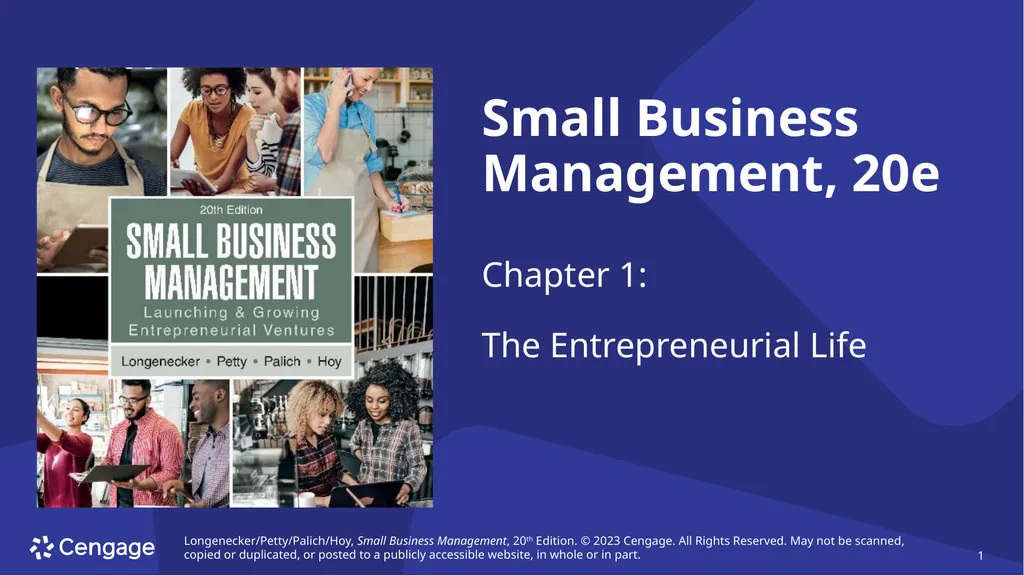
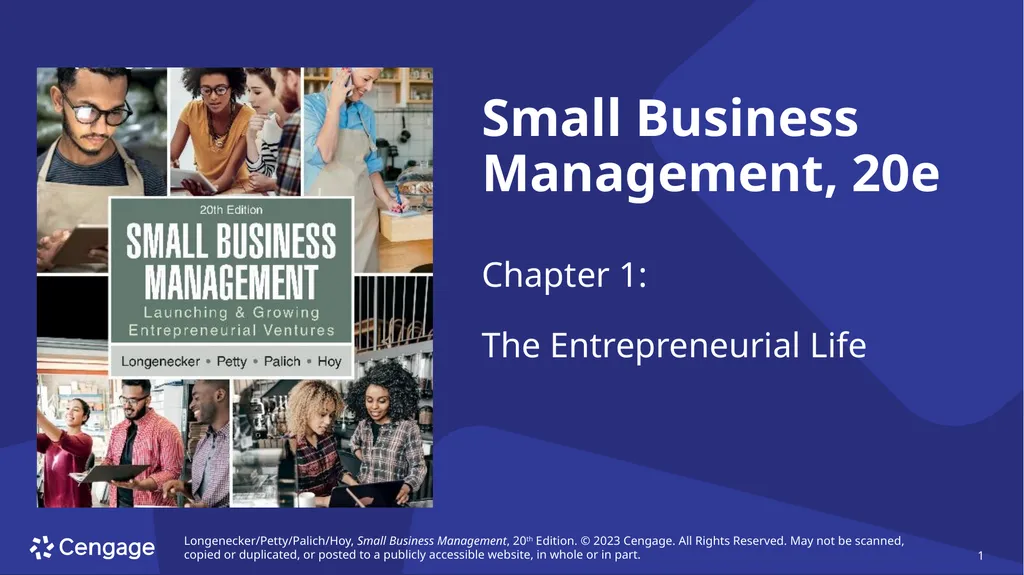
Small Business Management, 20e Chapter 1: The
TD
Published · 45 slides · 0 views
1 / 1
Description
Small Business Management, 20e Chapter 1: The Entrepreneurial Life LongeneckerPettyPalichHoy, Small Business Management, 20th Edition. 2023 Cengage. All Rights Reserved. May not be scanned, copied or duplicated, or posted to a publicly
Related Topics
Download this presentation From Below
"Small Business Management, 20e Chapter 1: The" is the property of its rightful owner. Permission is granted to download and print the materials on this website for personal, non-commercial use only, and to display it on your personal computer provided you do not modify the materials and that you retain all copyright notices contained in the materials. By downloading content from our website, you accept the terms of this agreement.
Share
Embed code
Presentation Transcript
01
Small Business Management, 20e
Chapter 1: The Entrepreneurial Life Longenecker/Petty/Palich/Hoy, Small Business Management, 20th Edition. © 2023 Cengage. All Rights Reserved. May not be scanned, copied or duplicated, or posted to a publicly accessible website, in whole or in part.<br>
02
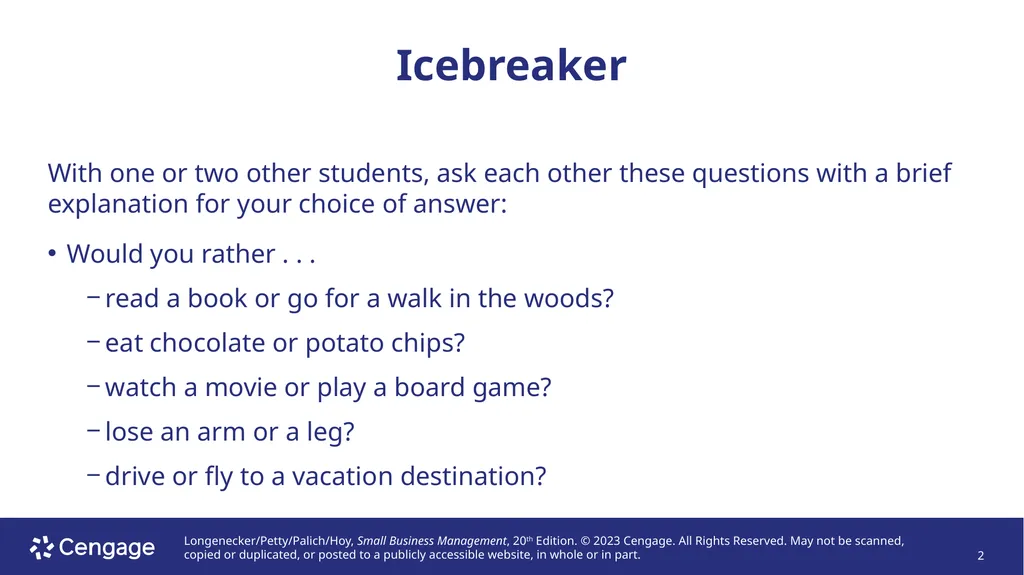
Icebreaker With one or two other students, ask each other these questions with a brief explanation for your choice of answer:
Would you rather . . .
read a book or go for a walk in the woods?
eat chocolate or potato chips?
watch a movie or play a board game?
lose an arm or a leg?
drive or fly to a vacation destination?<br>
Would you rather . . .
read a book or go for a walk in the woods?
eat chocolate or potato chips?
watch a movie or play a board game?
lose an arm or a leg?
drive or fly to a vacation destination?<br>
03
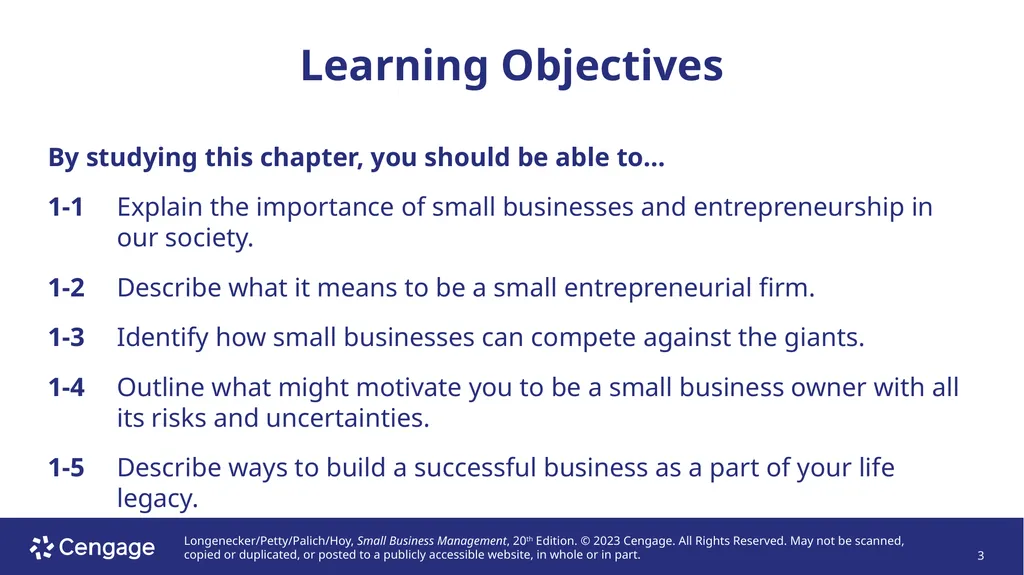
Learning Objectives By studying this chapter, you should be able to…
1-1 Explain the importance of small businesses and entrepreneurship in our society.
1-2 Describe what it means to be a small entrepreneurial firm.
1-3 Identify how small businesses can compete against the giants.
1-4 Outline what might motivate you to be a small business owner with all its risks and uncertainties.
1-5 Describe ways to build a successful business as a part of your life legacy.<br>
1-1 Explain the importance of small businesses and entrepreneurship in our society.
1-2 Describe what it means to be a small entrepreneurial firm.
1-3 Identify how small businesses can compete against the giants.
1-4 Outline what might motivate you to be a small business owner with all its risks and uncertainties.
1-5 Describe ways to build a successful business as a part of your life legacy.<br>
04
Unit 1-1 Small Size, Big Significance<br>
05
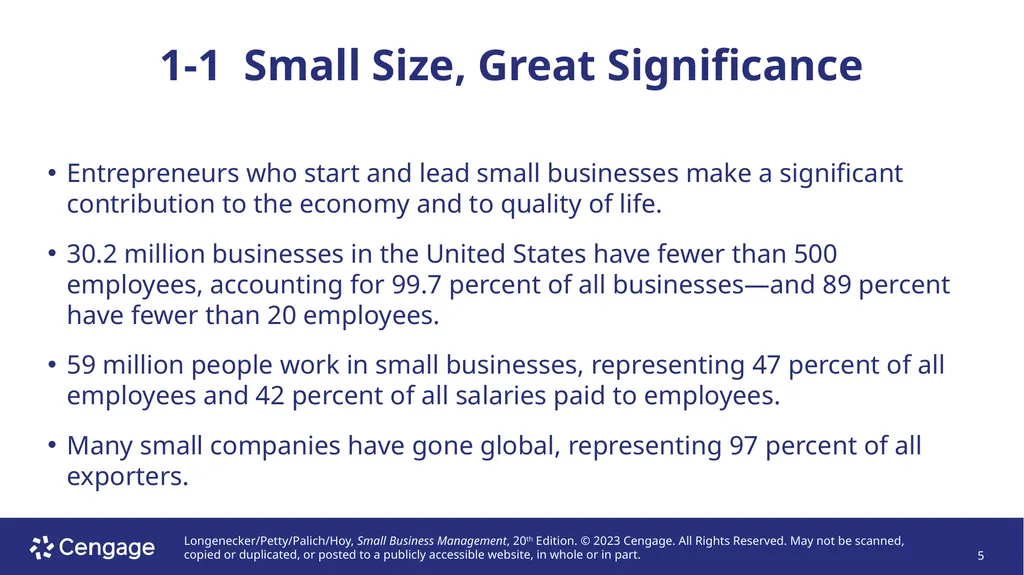
1-1 Small Size, Great Significance Entrepreneurs who start and lead small businesses make a significant contribution to the economy and to quality of life.
30.2 million businesses in the United States have fewer than 500 employees, accounting for 99.7 percent of all businesses—and 89 percent have fewer than 20 employees.
59 million people work in small businesses, representing 47 percent of all employees and 42 percent of all salaries paid to employees.
Many small companies have gone global, representing 97 percent of all exporters.<br>
30.2 million businesses in the United States have fewer than 500 employees, accounting for 99.7 percent of all businesses—and 89 percent have fewer than 20 employees.
59 million people work in small businesses, representing 47 percent of all employees and 42 percent of all salaries paid to employees.
Many small companies have gone global, representing 97 percent of all exporters.<br>
06
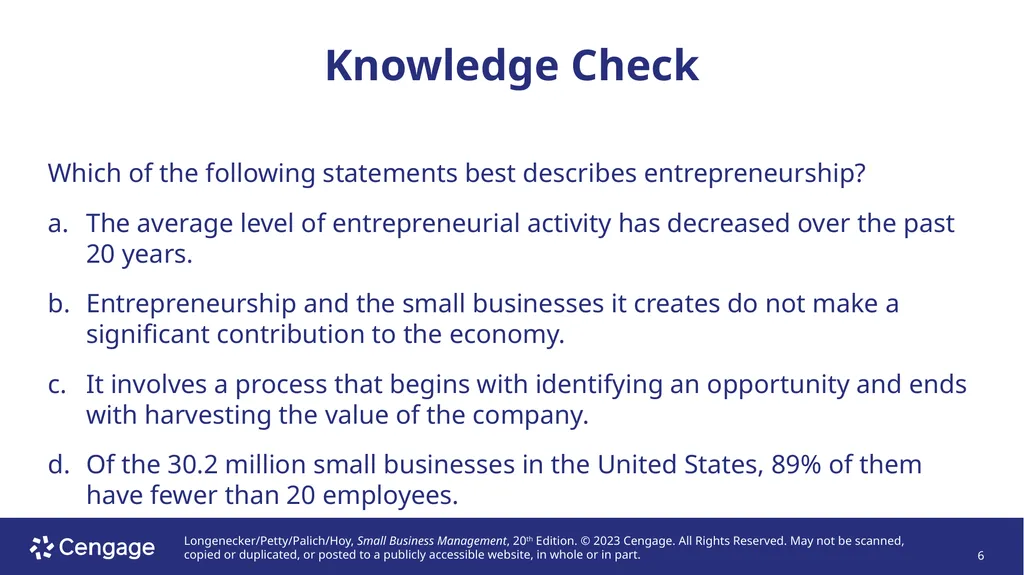
Knowledge Check Which of the following statements best describes entrepreneurship?
The average level of entrepreneurial activity has decreased over the past 20 years.
Entrepreneurship and the small businesses it creates do not make a significant contribution to the economy.
It involves a process that begins with identifying an opportunity and ends with harvesting the value of the company.
Of the 30.2 million small businesses in the United States, 89% of them have fewer than 20 employees.<br>
The average level of entrepreneurial activity has decreased over the past 20 years.
Entrepreneurship and the small businesses it creates do not make a significant contribution to the economy.
It involves a process that begins with identifying an opportunity and ends with harvesting the value of the company.
Of the 30.2 million small businesses in the United States, 89% of them have fewer than 20 employees.<br>
07
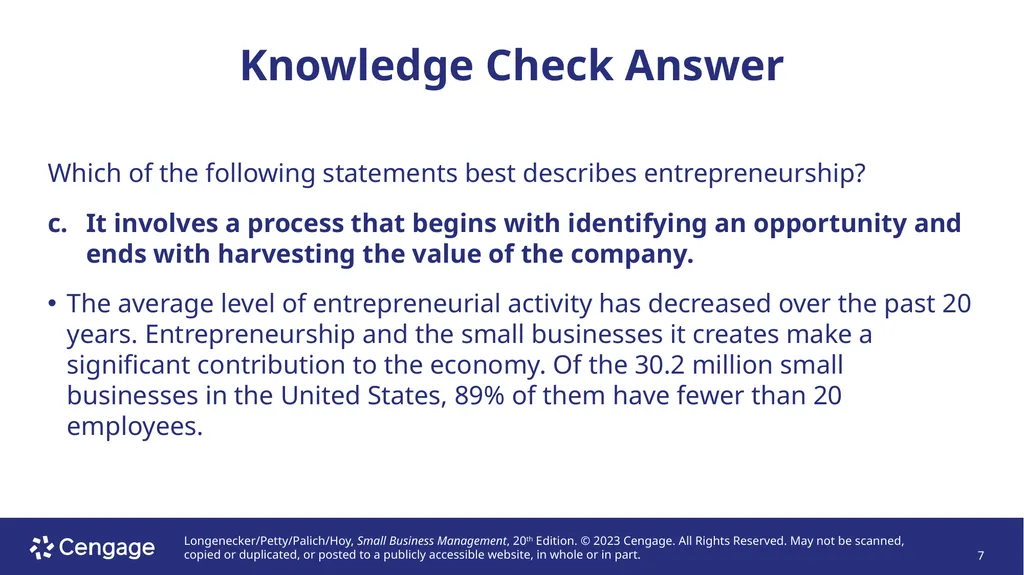
Knowledge Check Answer Which of the following statements best describes entrepreneurship?
It involves a process that begins with identifying an opportunity and ends with harvesting the value of the company.
The average level of entrepreneurial activity has decreased over the past 20 years. Entrepreneurship and the small businesses it creates make a significant contribution to the economy. Of the 30.2 million small businesses in the United States, 89% of them have fewer than 20 employees.<br>
It involves a process that begins with identifying an opportunity and ends with harvesting the value of the company.
The average level of entrepreneurial activity has decreased over the past 20 years. Entrepreneurship and the small businesses it creates make a significant contribution to the economy. Of the 30.2 million small businesses in the United States, 89% of them have fewer than 20 employees.<br>
08
Unit 1-2 Small Business and Entrepreneurship<br>
09
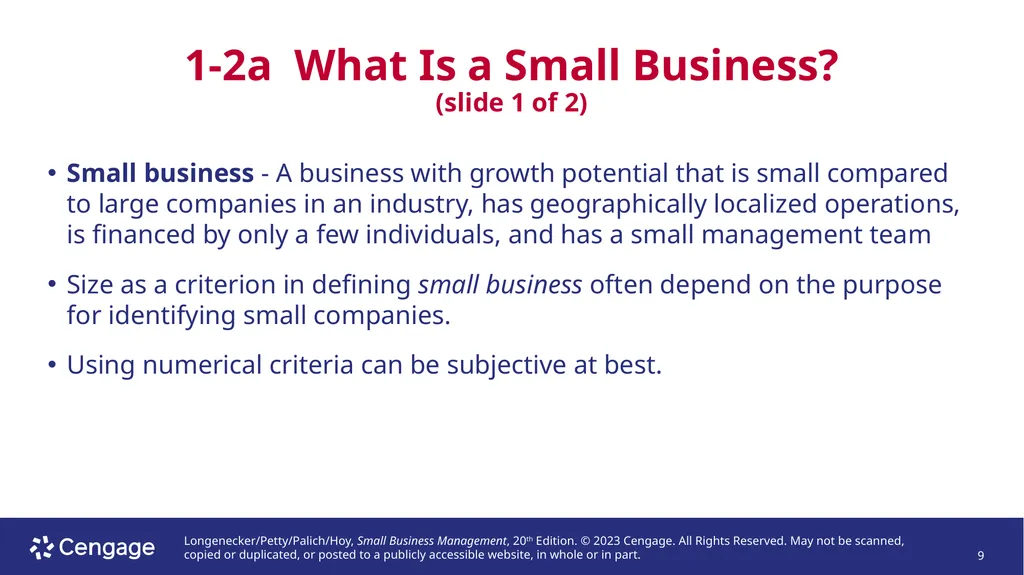
1-2a What Is a Small Business?
(slide 1 of 2) Small business - A business with growth potential that is small compared to large companies in an industry, has geographically localized operations, is financed by only a few individuals, and has a small management team
Size as a criterion in defining small business often depend on the purpose for identifying small companies.
Using numerical criteria can be subjective at best.<br>
Size as a criterion in defining small business often depend on the purpose for identifying small companies.
Using numerical criteria can be subjective at best.<br>
10
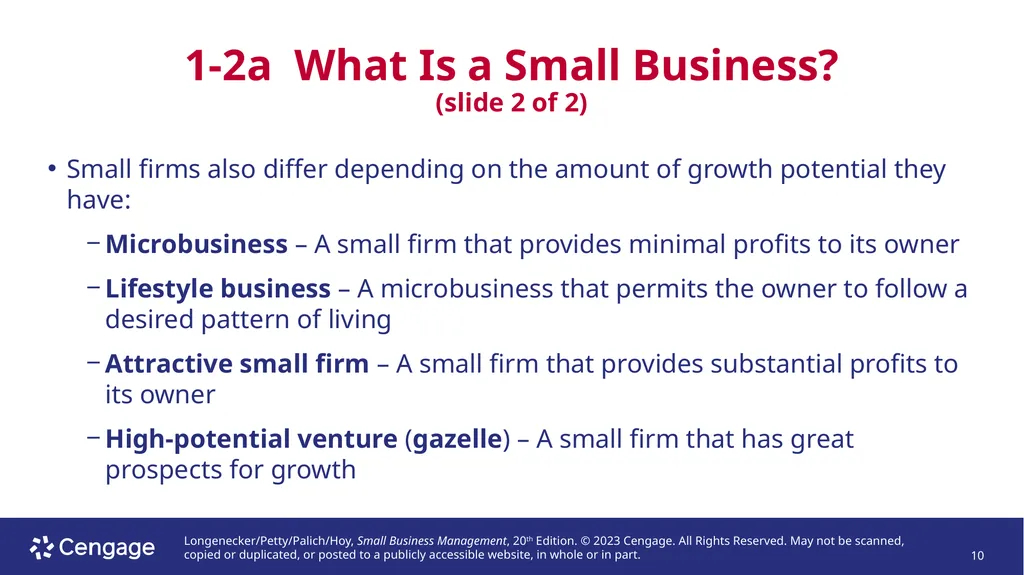
1-2a What Is a Small Business?
(slide 2 of 2) Small firms also differ depending on the amount of growth potential they have:
Microbusiness – A small firm that provides minimal profits to its owner
Lifestyle business – A microbusiness that permits the owner to follow a desired pattern of living
Attractive small firm – A small firm that provides substantial profits to its owner
High-potential venture (gazelle) – A small firm that has great prospects for growth<br>
Microbusiness – A small firm that provides minimal profits to its owner
Lifestyle business – A microbusiness that permits the owner to follow a desired pattern of living
Attractive small firm – A small firm that provides substantial profits to its owner
High-potential venture (gazelle) – A small firm that has great prospects for growth<br>
11
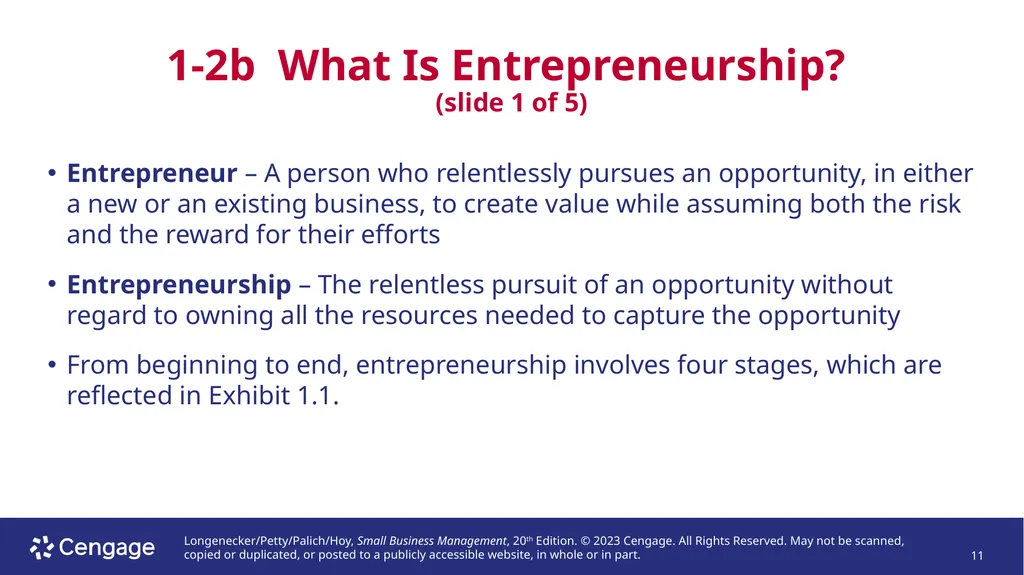
1-2b What Is Entrepreneurship?
(slide 1 of 5) Entrepreneur – A person who relentlessly pursues an opportunity, in either a new or an existing business, to create value while assuming both the risk and the reward for their efforts
Entrepreneurship – The relentless pursuit of an opportunity without regard to owning all the resources needed to capture the opportunity
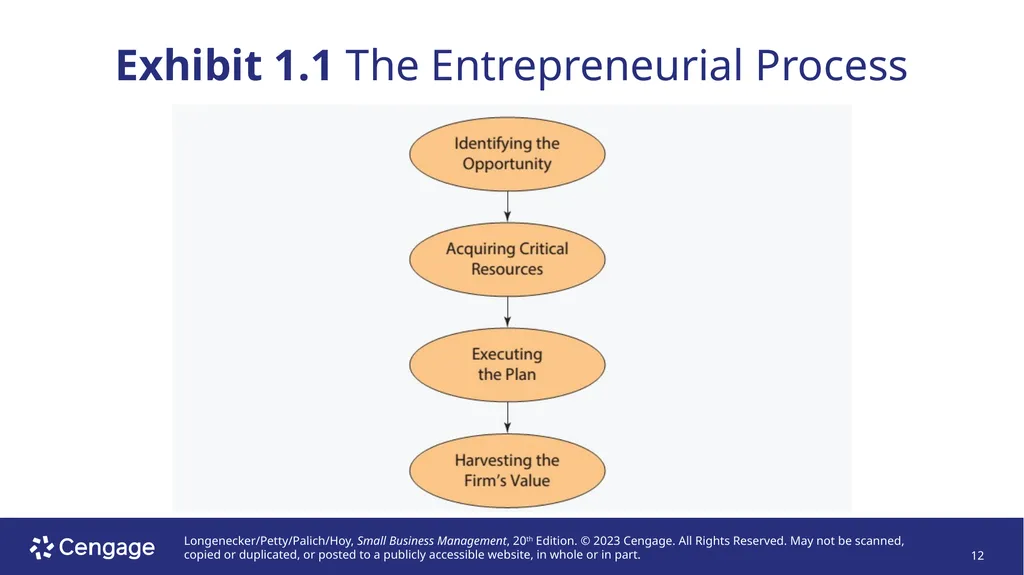
From beginning to end, entrepreneurship involves four stages, which are reflected in Exhibit 1.1.<br>
Entrepreneurship – The relentless pursuit of an opportunity without regard to owning all the resources needed to capture the opportunity
From beginning to end, entrepreneurship involves four stages, which are reflected in Exhibit 1.1.<br>
12
Exhibit 1.1 The Entrepreneurial Process<br>
13
1-2b What Is Entrepreneurship?
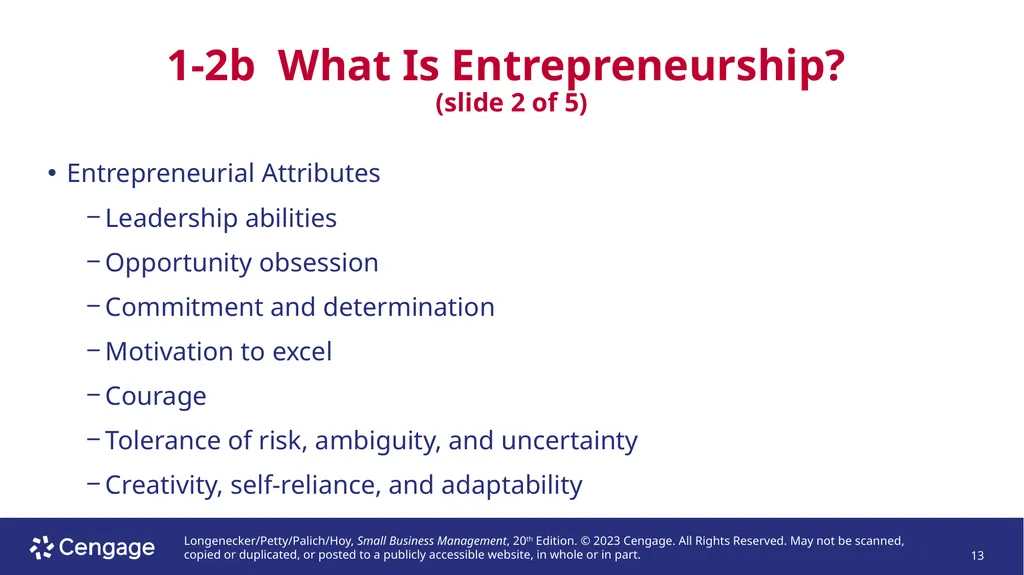
(slide 2 of 5) Entrepreneurial Attributes
Leadership abilities
Opportunity obsession
Commitment and determination
Motivation to excel
Courage
Tolerance of risk, ambiguity, and uncertainty
Creativity, self-reliance, and adaptability<br>
Leadership abilities
Opportunity obsession
Commitment and determination
Motivation to excel
Courage
Tolerance of risk, ambiguity, and uncertainty
Creativity, self-reliance, and adaptability<br>
14
1-2b What Is Entrepreneurship?
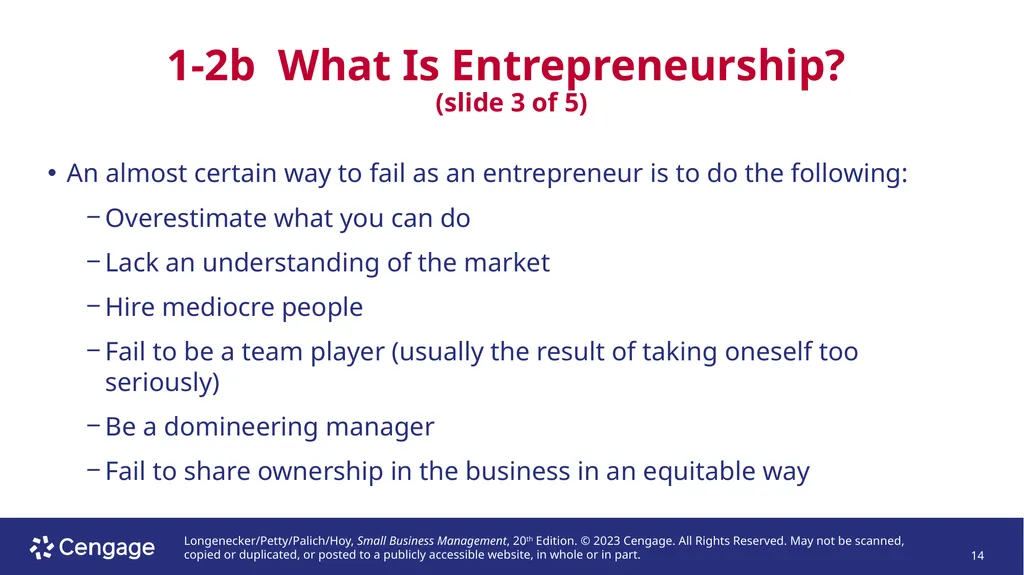
(slide 3 of 5) An almost certain way to fail as an entrepreneur is to do the following:
Overestimate what you can do
Lack an understanding of the market
Hire mediocre people
Fail to be a team player (usually the result of taking oneself too seriously)
Be a domineering manager
Fail to share ownership in the business in an equitable way<br>
Overestimate what you can do
Lack an understanding of the market
Hire mediocre people
Fail to be a team player (usually the result of taking oneself too seriously)
Be a domineering manager
Fail to share ownership in the business in an equitable way<br>
15
1-2b What Is Entrepreneurship?
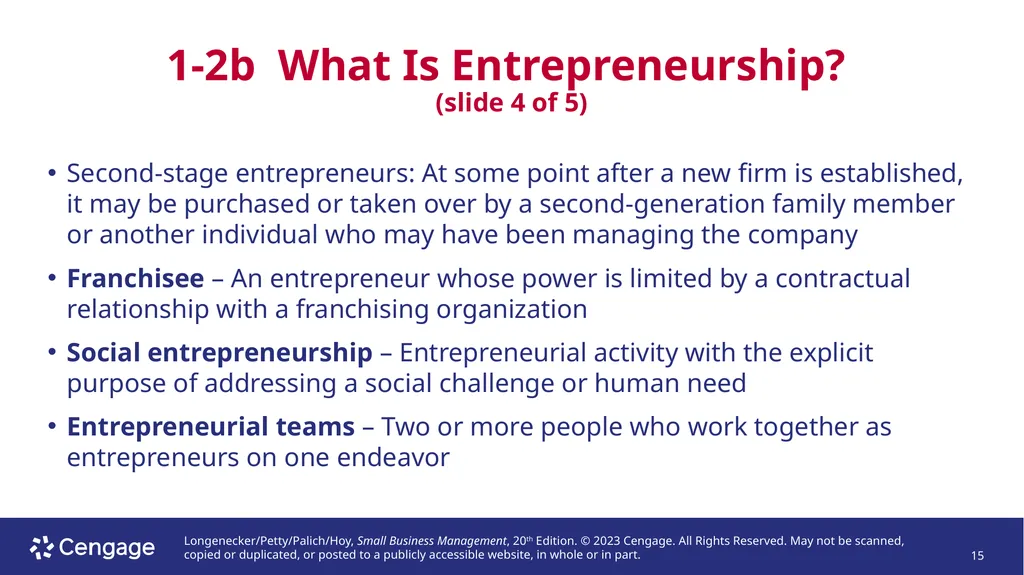
(slide 4 of 5) Second-stage entrepreneurs: At some point after a new firm is established, it may be purchased or taken over by a second-generation family member or another individual who may have been managing the company
Franchisee – An entrepreneur whose power is limited by a contractual relationship with a franchising organization
Social entrepreneurship – Entrepreneurial activity with the explicit purpose of addressing a social challenge or human need
Entrepreneurial teams – Two or more people who work together as entrepreneurs on one endeavor<br>
Franchisee – An entrepreneur whose power is limited by a contractual relationship with a franchising organization
Social entrepreneurship – Entrepreneurial activity with the explicit purpose of addressing a social challenge or human need
Entrepreneurial teams – Two or more people who work together as entrepreneurs on one endeavor<br>
16
1-2b What Is Entrepreneurship?
(slide 5 of 5) Intrapreneurship – An employee within an existing corporation who assumes responsibility for taking a new idea and converting it into a profitable product, service, or a process
Thus, an intrapreneur mostly creates value for the company, rather than starting their own new business.
A primary benefit for an intrapreneur is having access to corporate resources, combined with the economies of scale enjoyed by a large corporation.
A drawback is that employees who exhibit an entrepreneurial spirit can become frustrated by the bureaucracy within large corporations.<br>
Thus, an intrapreneur mostly creates value for the company, rather than starting their own new business.
A primary benefit for an intrapreneur is having access to corporate resources, combined with the economies of scale enjoyed by a large corporation.
A drawback is that employees who exhibit an entrepreneurial spirit can become frustrated by the bureaucracy within large corporations.<br>
17
Discussion Activity 1 What do you see as the potential benefits and drawbacks of owning a microbusiness?<br>
18
Discussion Activity 1 Debrief What do you see as the potential benefits and drawbacks of owning a microbusiness?
Also known as lifestyle businesses, microbusinesses offer a way for owners to have more flexibility in their daily life. Microbusinesses can be a way for some owners to monetize a hobby as well. A potential drawback might be minimal profits or income uncertainty, depending on the size of the business.<br>
Also known as lifestyle businesses, microbusinesses offer a way for owners to have more flexibility in their daily life. Microbusinesses can be a way for some owners to monetize a hobby as well. A potential drawback might be minimal profits or income uncertainty, depending on the size of the business.<br>
19
Unit 1-3 Can a Small Company Really Compete
with Big Companies?<br>
with Big Companies?<br>
20
1-3 Can a Small Company Really Compete
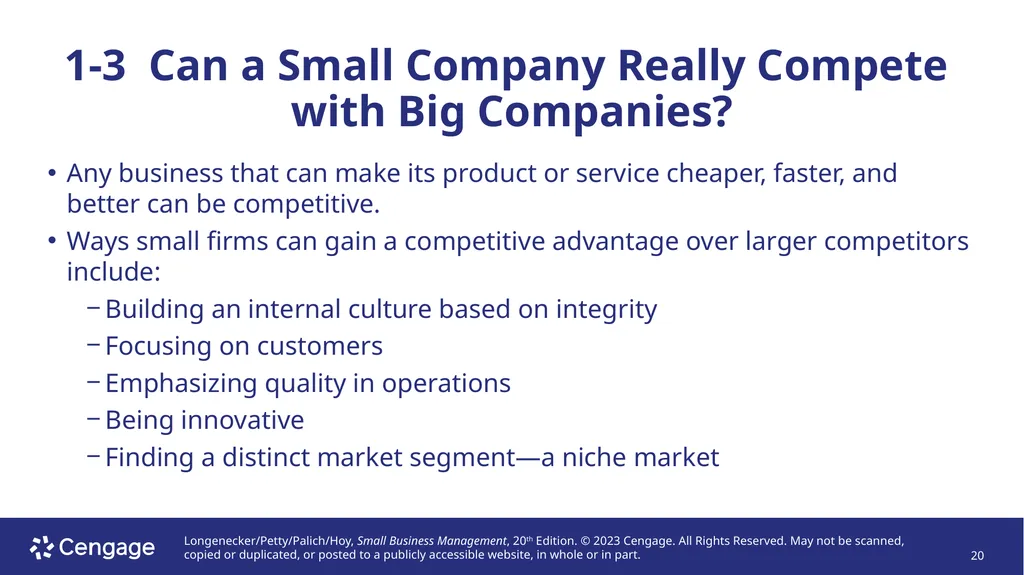
with Big Companies? Any business that can make its product or service cheaper, faster, and better can be competitive.
Ways small firms can gain a competitive advantage over larger competitors include:
Building an internal culture based on integrity
Focusing on customers
Emphasizing quality in operations
Being innovative
Finding a distinct market segment—a niche market<br>
Ways small firms can gain a competitive advantage over larger competitors include:
Building an internal culture based on integrity
Focusing on customers
Emphasizing quality in operations
Being innovative
Finding a distinct market segment—a niche market<br>
21
1-3a Commitment to Integrity The starting point of any competitive advantage is having a commitment to integrity.
Consistently operating with integrity can set a small business apart.
Building a reputation of trustworthiness is the foundation of business relationships.<br>
Consistently operating with integrity can set a small business apart.
Building a reputation of trustworthiness is the foundation of business relationships.<br>
22
1-3b Customer Focus Small businesses have greater potential to provide good customer service than larger firms do.
Advantage of being able to serve customers directly and effectively, avoiding the layers of bureaucracy and corporate policies that tend to stifle employee initiative<br>
Advantage of being able to serve customers directly and effectively, avoiding the layers of bureaucracy and corporate policies that tend to stifle employee initiative<br>
23
1-3c Quality Performance Small business owners are often able to insist on high levels of quality without experiencing the frustration of a large-company C E O who may have to push a quality philosophy through layers of bureaucracy.<br>
24
1-3d Innovation Innovation, both in products or services and in competitive strategies, is within the reach of a small business in ways that were not thought possible a few years ago.
Access to technology has helped smaller firms compete and, in many cases, has clearly leveled the playing field with larger companies.<br>
Access to technology has helped smaller firms compete and, in many cases, has clearly leveled the playing field with larger companies.<br>
25
1-3e Niche Markets Numerous small businesses are uniquely positioned to capture niche markets.
Niche market – A specific group of customers with an identifiable but narrow range of product or service interests<br>
Niche market – A specific group of customers with an identifiable but narrow range of product or service interests<br>
26
Discussion Activity 2 Why do you think niche markets may work especially well for small businesses?<br>
27
Discussion Activity 2 Debrief Why do you think niche markets may work especially well for small businesses?
Almost all small businesses try to shield themselves from competition by targeting specific customers who have an identifiable but very narrow range of product or service interests that comprise a niche market. Numerous small businesses are uniquely positioned to capture these markets. Most successful entrepreneurs are not overly concerned about their ability to compete with their larger counterparts.
Because large corporations are bureaucracies, with bureaucrats as managers, large companies, with few exceptions, often have difficulty creating effective incentives to encourage employees to think entrepreneurially. Considerable evidence suggests that most workers in today’s huge corporations are simply not engaged in their work.
The bottom line: small companies with an entrepreneurial culture can compete well.<br>
Almost all small businesses try to shield themselves from competition by targeting specific customers who have an identifiable but very narrow range of product or service interests that comprise a niche market. Numerous small businesses are uniquely positioned to capture these markets. Most successful entrepreneurs are not overly concerned about their ability to compete with their larger counterparts.
Because large corporations are bureaucracies, with bureaucrats as managers, large companies, with few exceptions, often have difficulty creating effective incentives to encourage employees to think entrepreneurially. Considerable evidence suggests that most workers in today’s huge corporations are simply not engaged in their work.
The bottom line: small companies with an entrepreneurial culture can compete well.<br>
28
Unit 1-4 Motivations for Owning a Business<br>
29
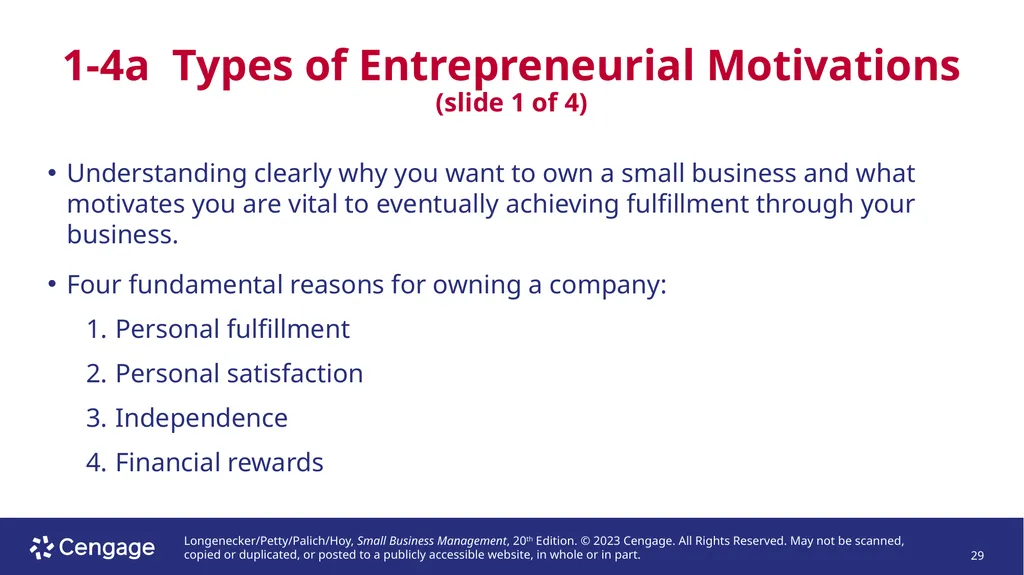
1-4a Types of Entrepreneurial Motivations (slide 1 of 4) Understanding clearly why you want to own a small business and what motivates you are vital to eventually achieving fulfillment through your business.
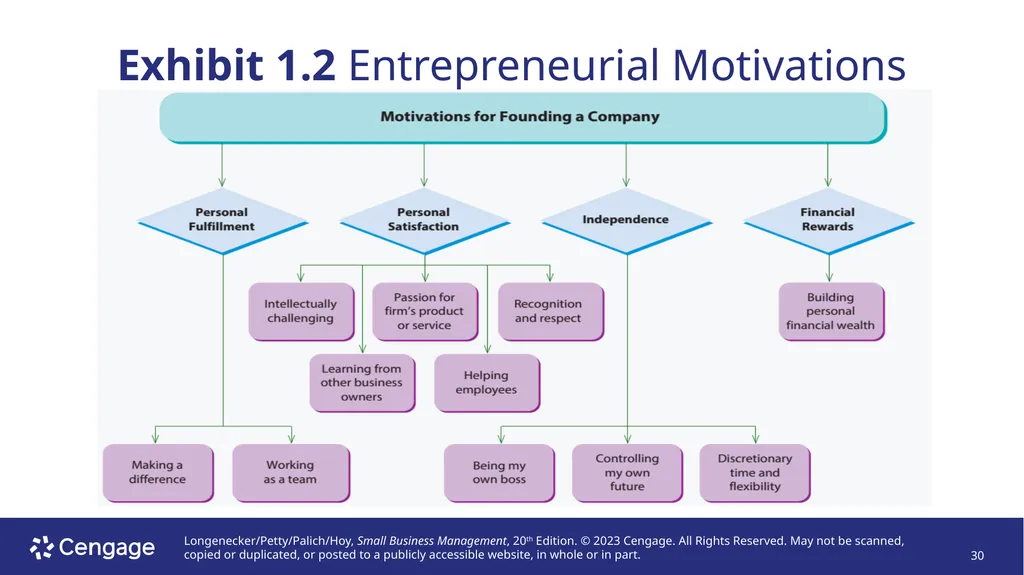
Four fundamental reasons for owning a company:
Personal fulfillment
Personal satisfaction
Independence
Financial rewards<br>
Four fundamental reasons for owning a company:
Personal fulfillment
Personal satisfaction
Independence
Financial rewards<br>
30
Exhibit 1.2 Entrepreneurial Motivations<br>
31
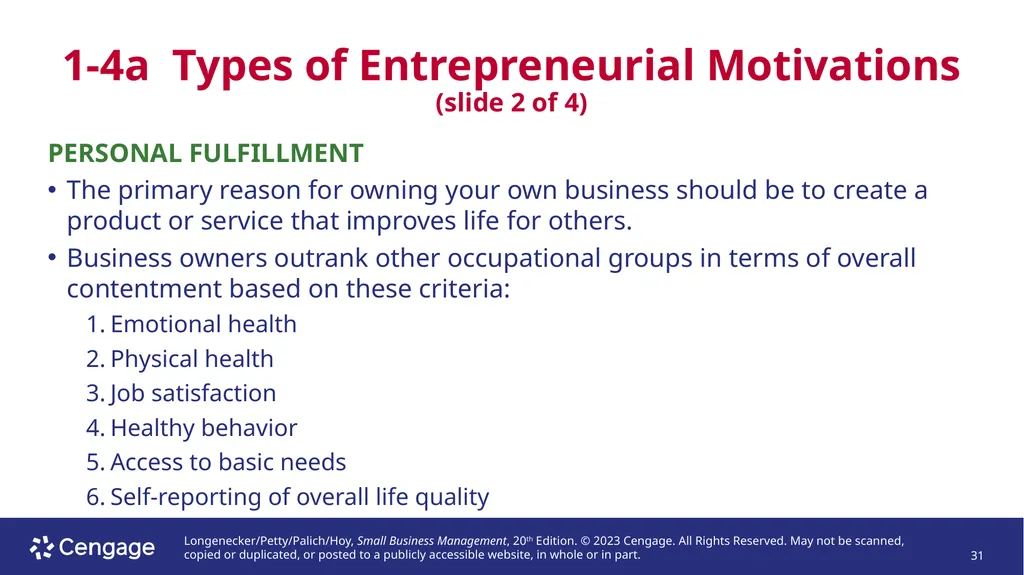
1-4a Types of Entrepreneurial Motivations (slide 2 of 4) PERSONAL FULFILLMENT
The primary reason for owning your own business should be to create a product or service that improves life for others.
Business owners outrank other occupational groups in terms of overall contentment based on these criteria:
Emotional health
Physical health
Job satisfaction
Healthy behavior
Access to basic needs
Self-reporting of overall life quality<br>
The primary reason for owning your own business should be to create a product or service that improves life for others.
Business owners outrank other occupational groups in terms of overall contentment based on these criteria:
Emotional health
Physical health
Job satisfaction
Healthy behavior
Access to basic needs
Self-reporting of overall life quality<br>
32
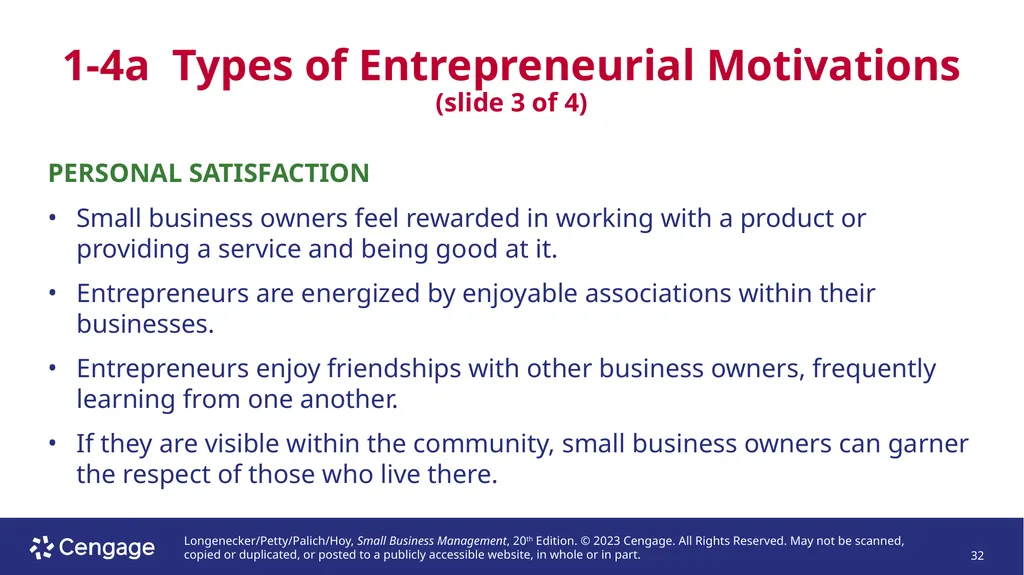
1-4a Types of Entrepreneurial Motivations (slide 3 of 4) PERSONAL SATISFACTION
Small business owners feel rewarded in working with a product or providing a service and being good at it.
Entrepreneurs are energized by enjoyable associations within their businesses.
Entrepreneurs enjoy friendships with other business owners, frequently learning from one another.
If they are visible within the community, small business owners can garner the respect of those who live there.<br>
Small business owners feel rewarded in working with a product or providing a service and being good at it.
Entrepreneurs are energized by enjoyable associations within their businesses.
Entrepreneurs enjoy friendships with other business owners, frequently learning from one another.
If they are visible within the community, small business owners can garner the respect of those who live there.<br>
33
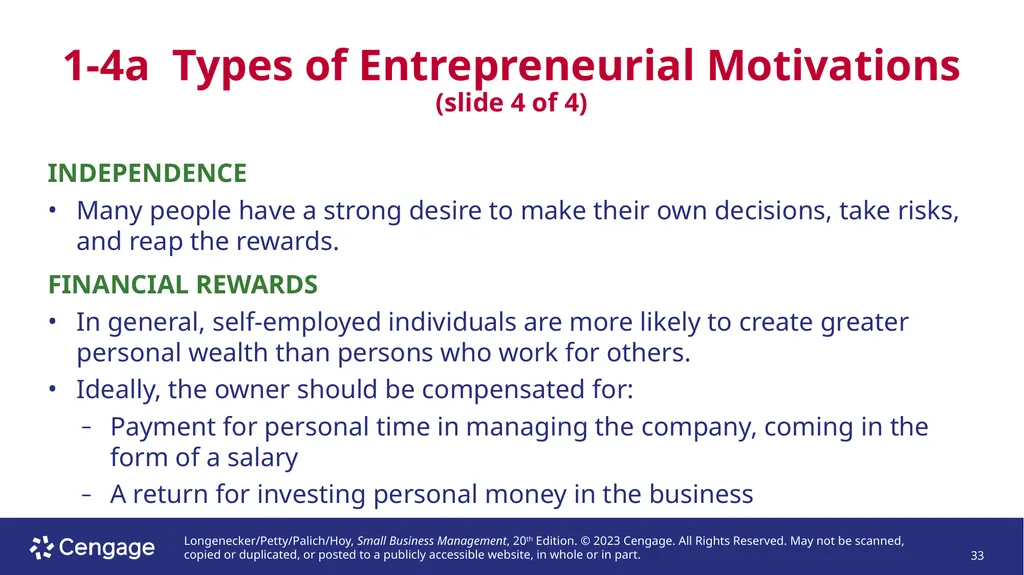
1-4a Types of Entrepreneurial Motivations (slide 4 of 4) INDEPENDENCE
Many people have a strong desire to make their own decisions, take risks, and reap the rewards.
FINANCIAL REWARDS
In general, self-employed individuals are more likely to create greater personal wealth than persons who work for others.
Ideally, the owner should be compensated for:
Payment for personal time in managing the company, coming in the form of a salary
A return for investing personal money in the business<br>
Many people have a strong desire to make their own decisions, take risks, and reap the rewards.
FINANCIAL REWARDS
In general, self-employed individuals are more likely to create greater personal wealth than persons who work for others.
Ideally, the owner should be compensated for:
Payment for personal time in managing the company, coming in the form of a salary
A return for investing personal money in the business<br>
34
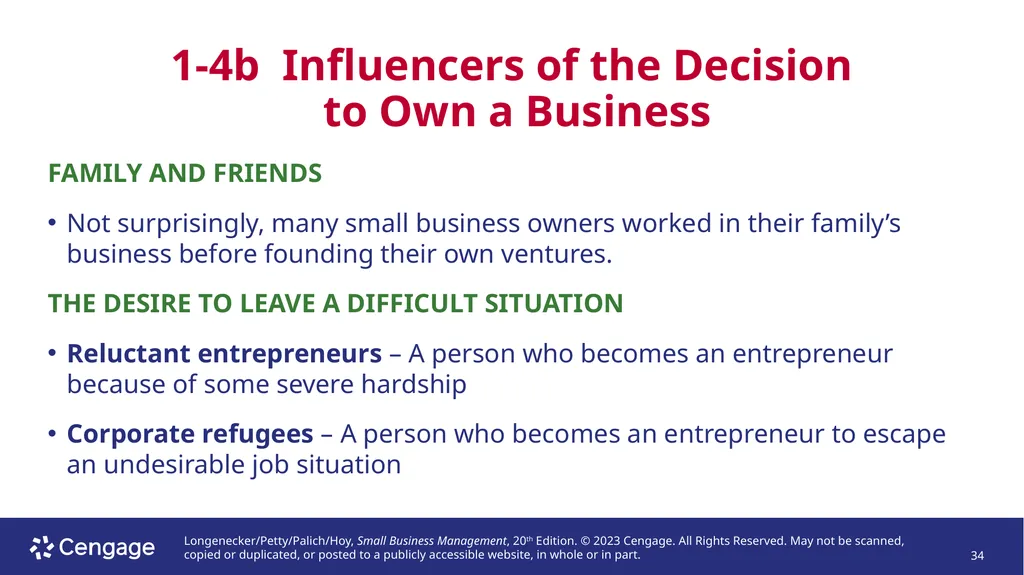
1-4b Influencers of the Decision
to Own a Business FAMILY AND FRIENDS
Not surprisingly, many small business owners worked in their family’s business before founding their own ventures.
THE DESIRE TO LEAVE A DIFFICULT SITUATION
Reluctant entrepreneurs – A person who becomes an entrepreneur because of some severe hardship
Corporate refugees – A person who becomes an entrepreneur to escape an undesirable job situation<br>
Not surprisingly, many small business owners worked in their family’s business before founding their own ventures.
THE DESIRE TO LEAVE A DIFFICULT SITUATION
Reluctant entrepreneurs – A person who becomes an entrepreneur because of some severe hardship
Corporate refugees – A person who becomes an entrepreneur to escape an undesirable job situation<br>
35
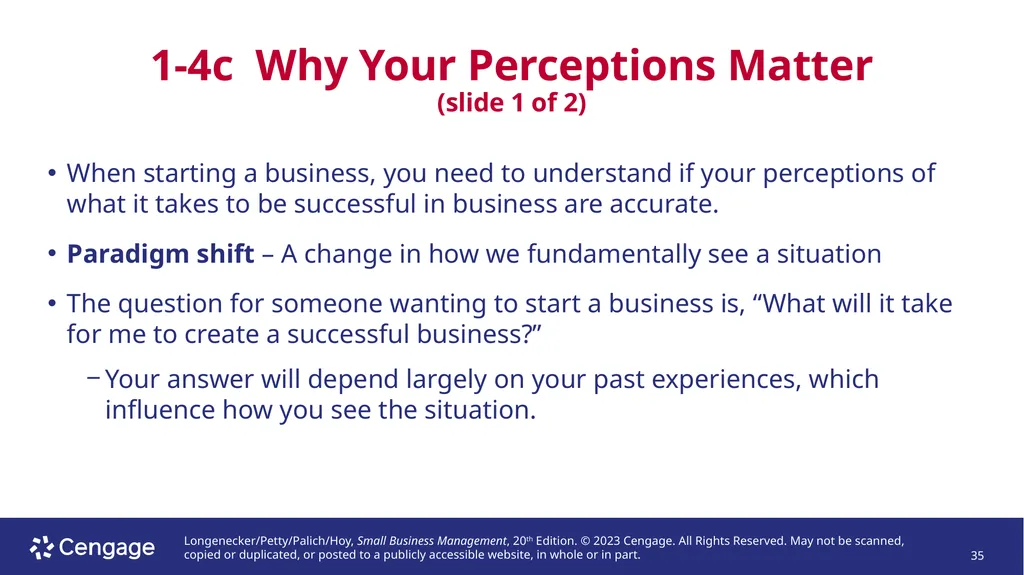
1-4c Why Your Perceptions Matter
(slide 1 of 2) When starting a business, you need to understand if your perceptions of what it takes to be successful in business are accurate.
Paradigm shift – A change in how we fundamentally see a situation
The question for someone wanting to start a business is, “What will it take for me to create a successful business?”
Your answer will depend largely on your past experiences, which influence how you see the situation.<br>
Paradigm shift – A change in how we fundamentally see a situation
The question for someone wanting to start a business is, “What will it take for me to create a successful business?”
Your answer will depend largely on your past experiences, which influence how you see the situation.<br>
36
1-4c Why Your Perceptions Matter?
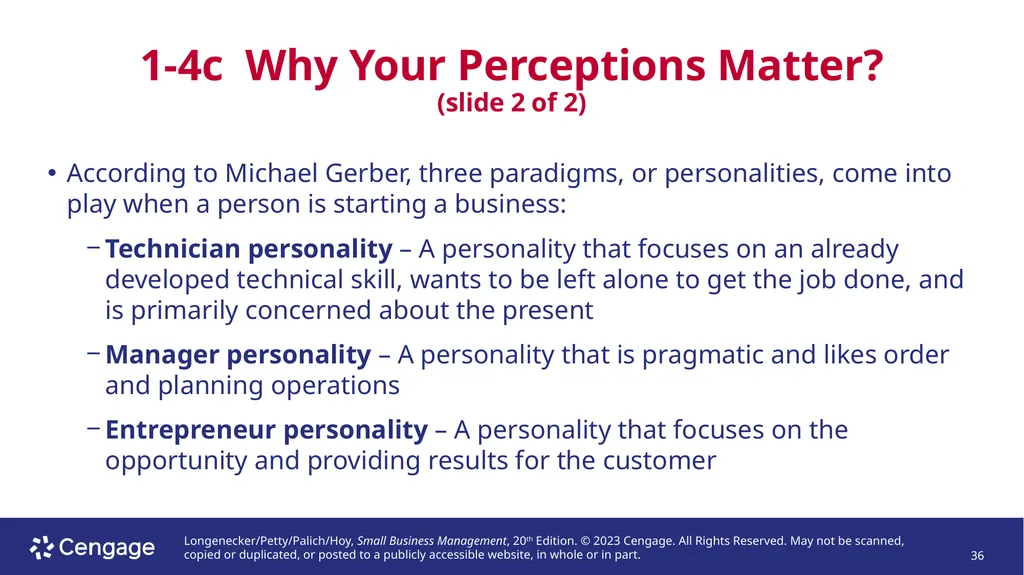
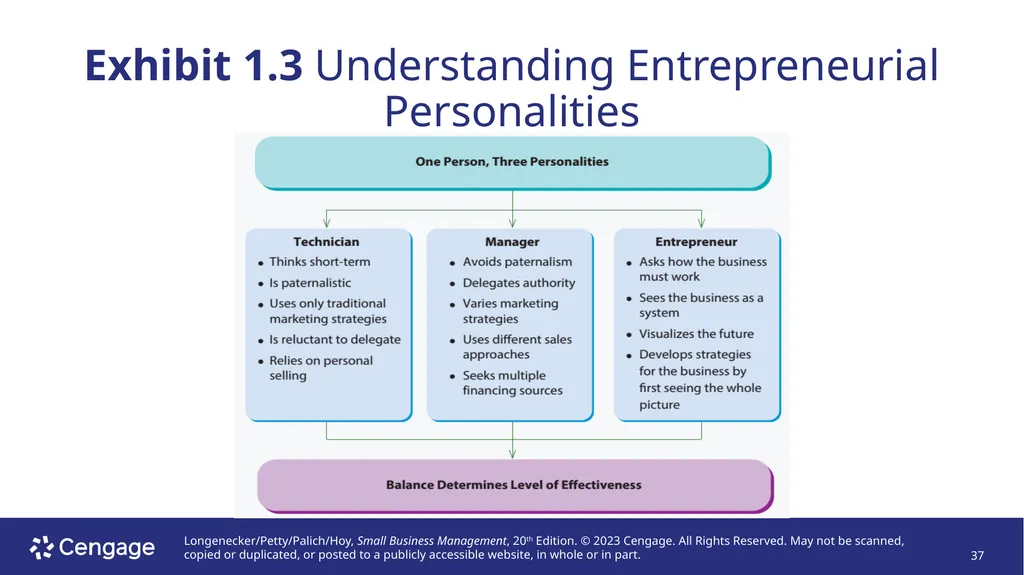
(slide 2 of 2) According to Michael Gerber, three paradigms, or personalities, come into play when a person is starting a business:
Technician personality – A personality that focuses on an already developed technical skill, wants to be left alone to get the job done, and is primarily concerned about the present
Manager personality – A personality that is pragmatic and likes order and planning operations
Entrepreneur personality – A personality that focuses on the opportunity and providing results for the customer<br>
Technician personality – A personality that focuses on an already developed technical skill, wants to be left alone to get the job done, and is primarily concerned about the present
Manager personality – A personality that is pragmatic and likes order and planning operations
Entrepreneur personality – A personality that focuses on the opportunity and providing results for the customer<br>
37
Exhibit 1.3 Understanding Entrepreneurial Personalities<br>
38
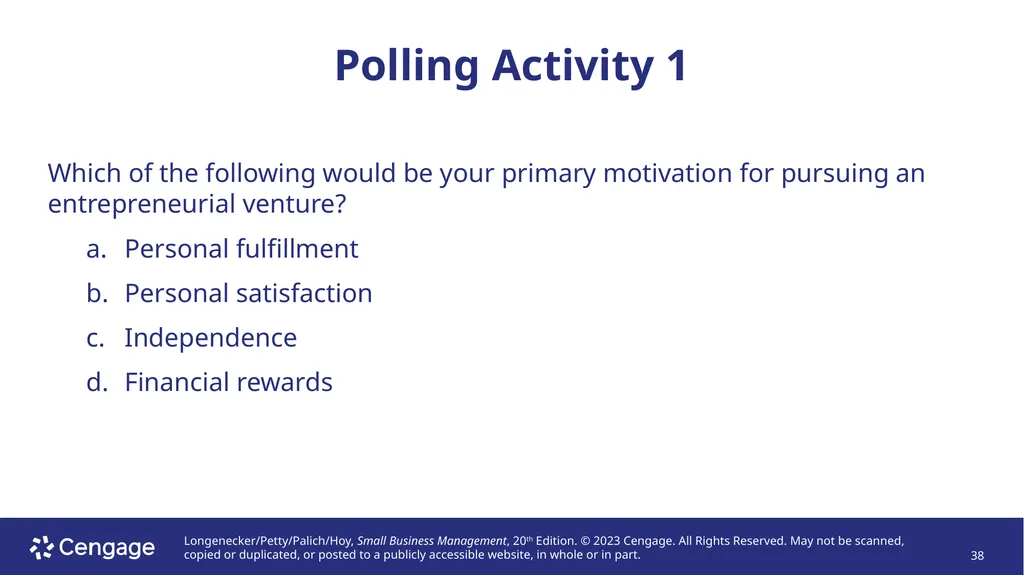
Polling Activity 1 Which of the following would be your primary motivation for pursuing an entrepreneurial venture?
Personal fulfillment
Personal satisfaction
Independence
Financial rewards<br>
Personal fulfillment
Personal satisfaction
Independence
Financial rewards<br>
39
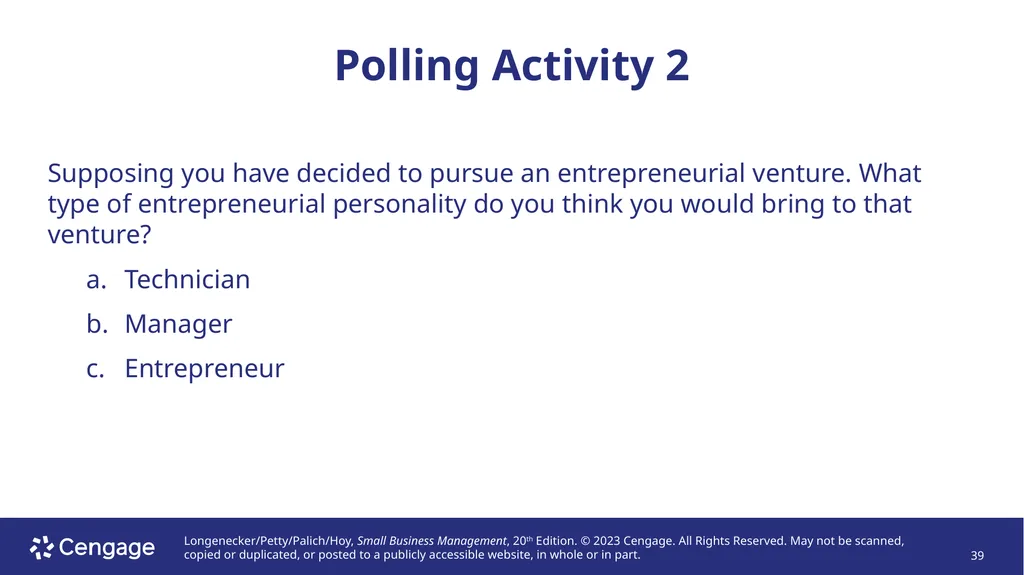
Polling Activity 2 Supposing you have decided to pursue an entrepreneurial venture. What type of entrepreneurial personality do you think you would bring to that venture?
Technician
Manager
Entrepreneur<br>
Technician
Manager
Entrepreneur<br>
40
Unit 1-5 What Do You Want Your Legacy to Be?<br>
41
1-5 What Do You Want
Your Legacy to Be? Entrepreneurial legacy – Material assets and intangible qualities passed on to both heirs and society
Building a legacy is an ongoing process that begins with the launch of the firm and continues throughout its operating life.
Part of the legacy is the company’s contribution to the community.
A worthy legacy includes a good balance of values and principles important to the entrepreneur.<br>
Building a legacy is an ongoing process that begins with the launch of the firm and continues throughout its operating life.
Part of the legacy is the company’s contribution to the community.
A worthy legacy includes a good balance of values and principles important to the entrepreneur.<br>
42
Discussion Activity 3 What is the point of an entrepreneurial legacy, and how might a person build one?<br>
43
Discussion Activity 3 Debrief What is the point of an entrepreneurial legacy, and how might a person build one?
A legacy is what one leaves behind or passes on to one’s heirs and to others. An entrepreneurial legacy refers to the entrepreneurial aspect, the business side, of one’s legacy, and thus is concerned with what the business experience has meant to all those affected. This includes the tangible elements such as financial resources passed on to heirs and others and also the intangible elements such as the impact of the entrepreneurial experience on family relationships and the example of entrepreneurial integrity or avarice given to the community.
Building a legacy is an ongoing process that begins with the launch of the firm and continues throughout its operating life. Building a legacy resembles building an effective internal culture: insist on acting with integrity, focus on customers, emphasize quality in operations, and encourage innovation.<br>
A legacy is what one leaves behind or passes on to one’s heirs and to others. An entrepreneurial legacy refers to the entrepreneurial aspect, the business side, of one’s legacy, and thus is concerned with what the business experience has meant to all those affected. This includes the tangible elements such as financial resources passed on to heirs and others and also the intangible elements such as the impact of the entrepreneurial experience on family relationships and the example of entrepreneurial integrity or avarice given to the community.
Building a legacy is an ongoing process that begins with the launch of the firm and continues throughout its operating life. Building a legacy resembles building an effective internal culture: insist on acting with integrity, focus on customers, emphasize quality in operations, and encourage innovation.<br>
44
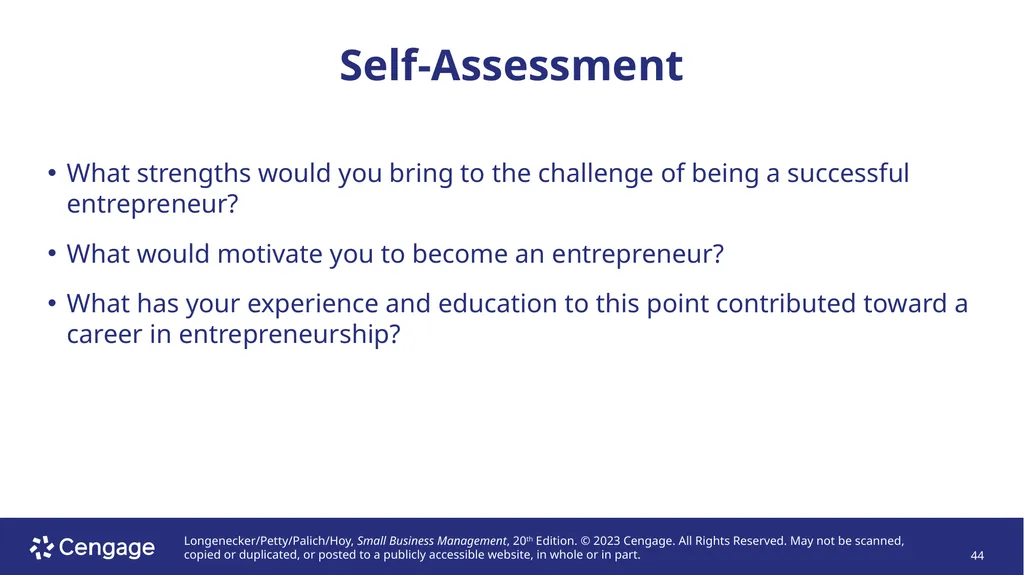
Self-Assessment What strengths would you bring to the challenge of being a successful entrepreneur?
What would motivate you to become an entrepreneur?
What has your experience and education to this point contributed toward a career in entrepreneurship?<br>
What would motivate you to become an entrepreneur?
What has your experience and education to this point contributed toward a career in entrepreneurship?<br>
45
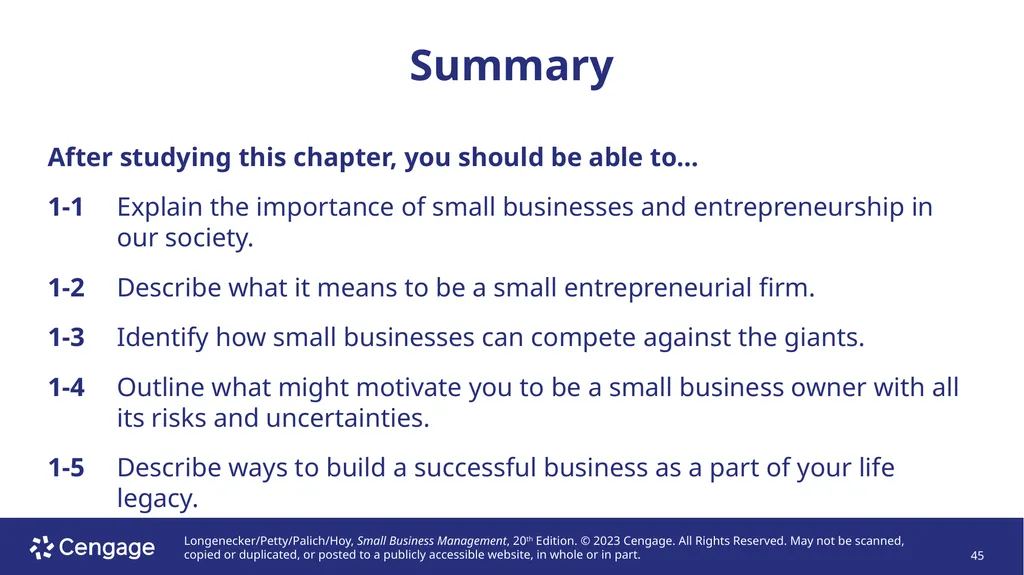
Summary After studying this chapter, you should be able to…
1-1 Explain the importance of small businesses and entrepreneurship in our society.
1-2 Describe what it means to be a small entrepreneurial firm.
1-3 Identify how small businesses can compete against the giants.
1-4 Outline what might motivate you to be a small business owner with all its risks and uncertainties.
1-5 Describe ways to build a successful business as a part of your life legacy.<br>
1-1 Explain the importance of small businesses and entrepreneurship in our society.
1-2 Describe what it means to be a small entrepreneurial firm.
1-3 Identify how small businesses can compete against the giants.
1-4 Outline what might motivate you to be a small business owner with all its risks and uncertainties.
1-5 Describe ways to build a successful business as a part of your life legacy.<br>