
SNAKE BITE & ENVIRONMENTAL EMERGENCIES 1 Presented



Description: SNAKE BITE ENVIRONMENTAL EMERGENCIES 1 Presented by:- Dileep Kumar, 2IC OBJECTIVES Upon completion of this unit you will be able to - Describe Snake bite and its control. Explain Environmental emergencies and its PHT. 2 HISTORY OF SNAKE
Related Topics
Download Presentation
"SNAKE BITE & ENVIRONMENTAL EMERGENCIES 1 Presented" is the property of its rightful owner. Permission is granted to download and print the materials on this website for personal, non-commercial use only, and to display it on your personal computer provided you do not modify the materials and that you retain all copyright notices contained in the materials. By downloading content from our website, you accept the terms of this agreement.
Presentation Transcript
slide1. SNAKE BITE & ENVIRONMENTAL
EMERGENCIES 1 Presented by:- Dileep Kumar, 2IC<br>
slide2. OBJECTIVES Upon completion of this unit you will be able to -
Describe Snake bite and its control.
Explain Environmental emergencies and its PHT. 2<br>
slide3. HISTORY OF SNAKE Jurassic age
Tertiary age 3<br>
slide4. FAMILY OF SNAKE There are 11 family of snake
Three family are poisonous
Elapidae
Viperidae
Hydrophile 4<br>
slide5. Snake bites are a common occurrence, however 90% of the land snakes found in our country are not poisonous.
In majority of cases, death takes place due to fright and not due to bite from a poisonous snake. 5 FAMILY OF SNAKE<br>
slide6. There is considerable color and pattern variation and it takes a trained eye to identify snakes correctly; it is not recommended that you should attempt to handle snakes 6 FAMILY OF SNAKE<br>
slide7. SNAKES 2500 - 3000 SPECIES WORLDWIDE
500 VENOMOUS SPECIES
52 POISONOUS SPECIES IN INDIA
INCIDENCE > 5 MILLION PER YEAR
DEATH IN TRANSIT, ? TRUE INCIDENCE 7<br>
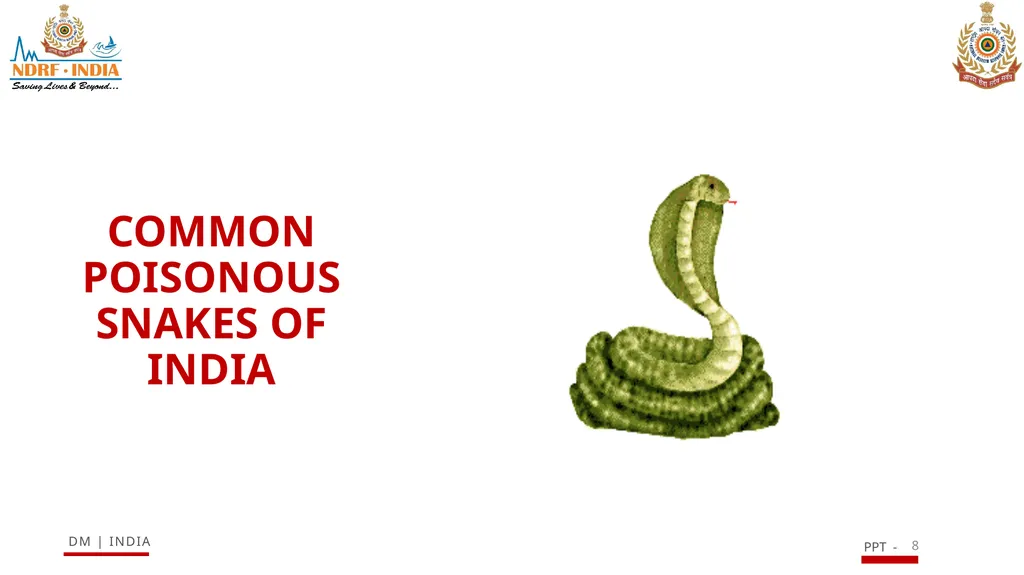
slide8. 8 COMMON POISONOUS SNAKES OF INDIA<br>
slide9. Spectacle cobra
Monocle cobra
King cobra
Common krait
Banded krait
Russell viper 9 COMMON POISONOUS SNAKES OF INDIA<br>
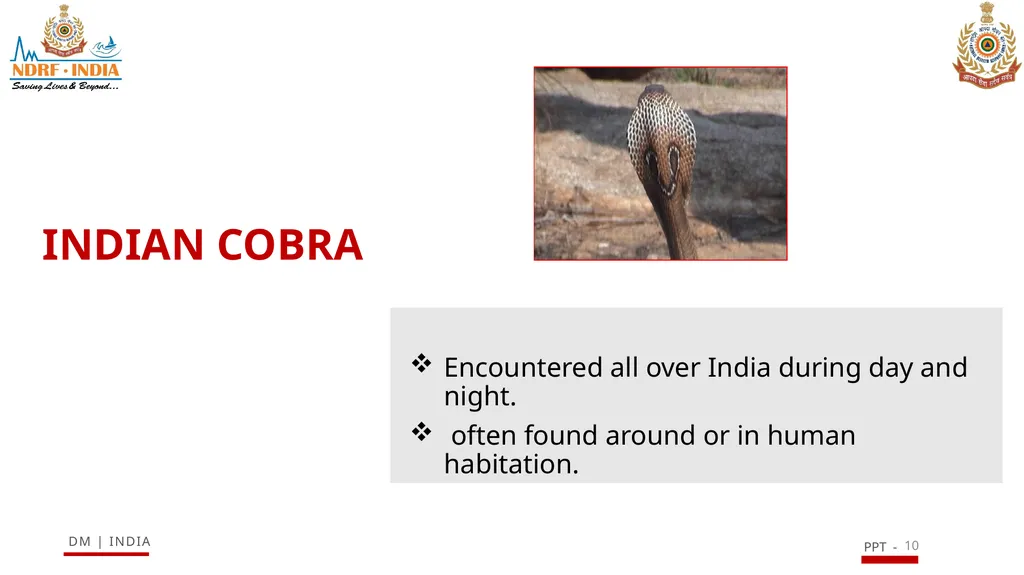
slide10. 10 Encountered all over India during day and night.
often found around or in human habitation. INDIAN COBRA<br>
slide11. This is the Indian Cobra. It is identified by the hood which has a spectacle mark.
Cobras are likely to spread their hood and hiss loudly when agitated.
Found in most parts of the country.
It is often seen in bathrooms, dark corners of houses, dwelling rooms, stable, servants' quarters of old bungalows and jungles.
It is active in day as well as night 11 INDIAN COBRA<br>
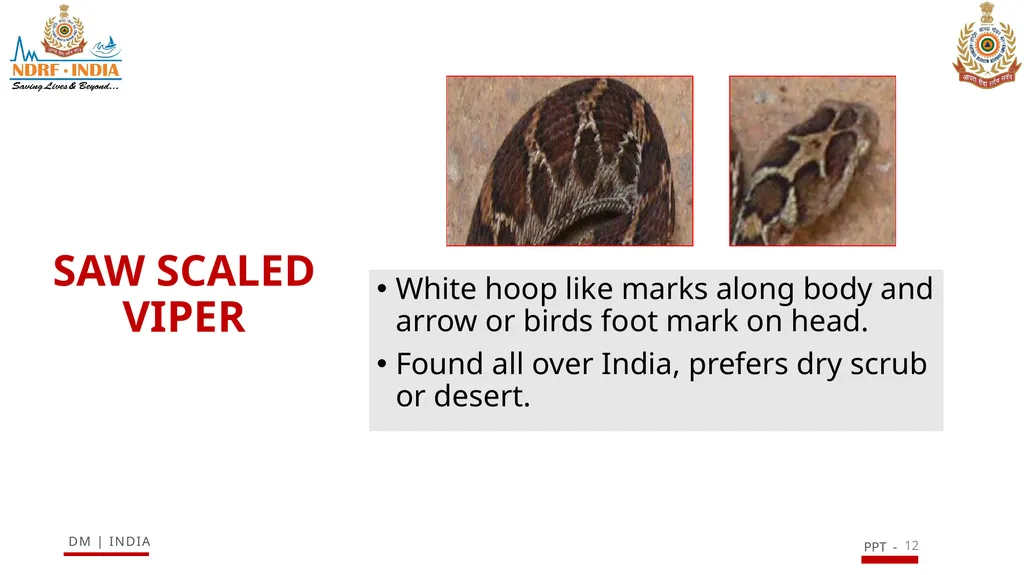
slide12. SAW SCALED VIPER White hoop like marks along body and arrow or birds foot mark on head.
Found all over India, prefers dry scrub or desert. 12<br>
slide13. This is the Pharos or Saw scaled viper. It’s back is usually marked with black blotches of inverted V shaped markings
It is a small viper found all over India.
It abounds in Western India more than in any other part. It prefers open dry rocky country or arid deserts. 13 SAW SCALED VIPER<br>
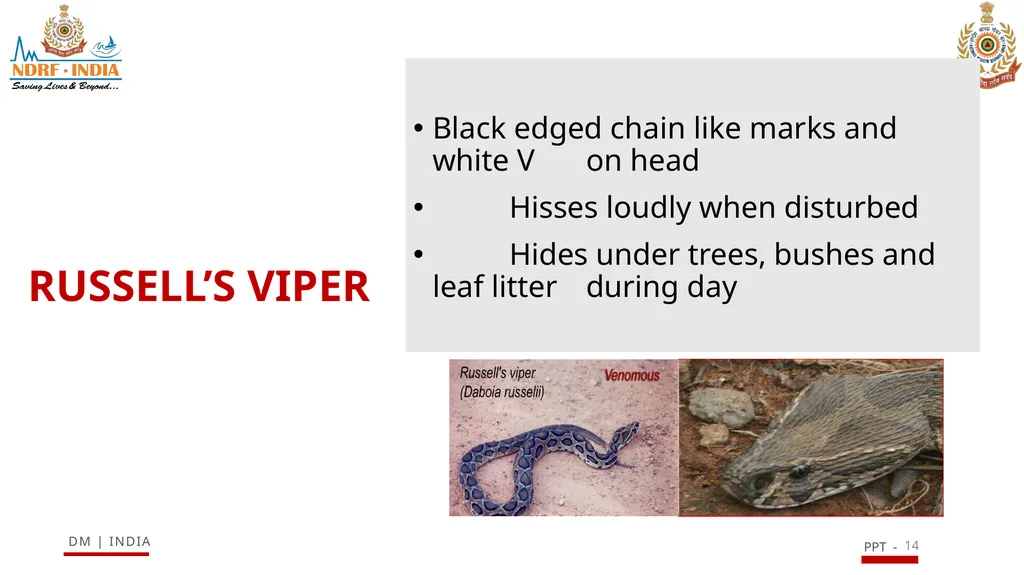
slide14. RUSSELL’S VIPER Black edged chain like marks and white V on head
Hisses loudly when disturbed
Hides under trees, bushes and leaf litter during day 14<br>
slide15. This is Russell’s viper. It is a big stumpy snake 1/2 to 2 meters long with a short tail.
It’s back is also marked with black blotches of inverted V shaped markings
It has the loudest hiss and biggest of fangs
It prefers open country, cultivated fields and bushy or grassy fallow lands.
It is nocturnal and slow in its movements but is aggressive and holds its ground when aroused. 15 RUSSELL’S VIPER<br>
slide16. Majority of the snake bites are from these
four common poisonous snakes of India :
The Indian Cobra,
The common Krait,
Saw scaled viper and the
Russell’s viper 16<br>
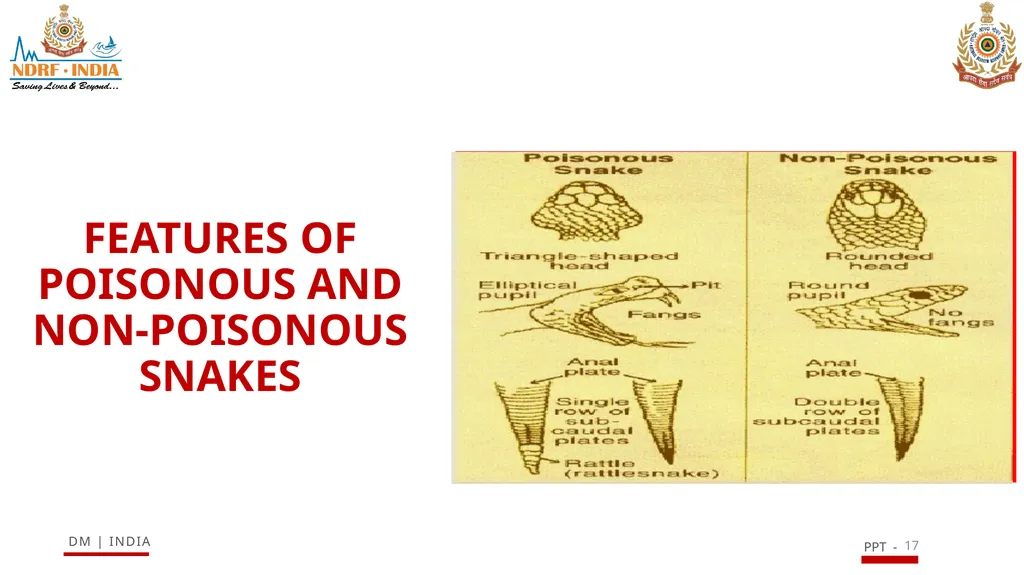
slide17. FEATURES OF POISONOUS AND NON-POISONOUS SNAKES 17<br>
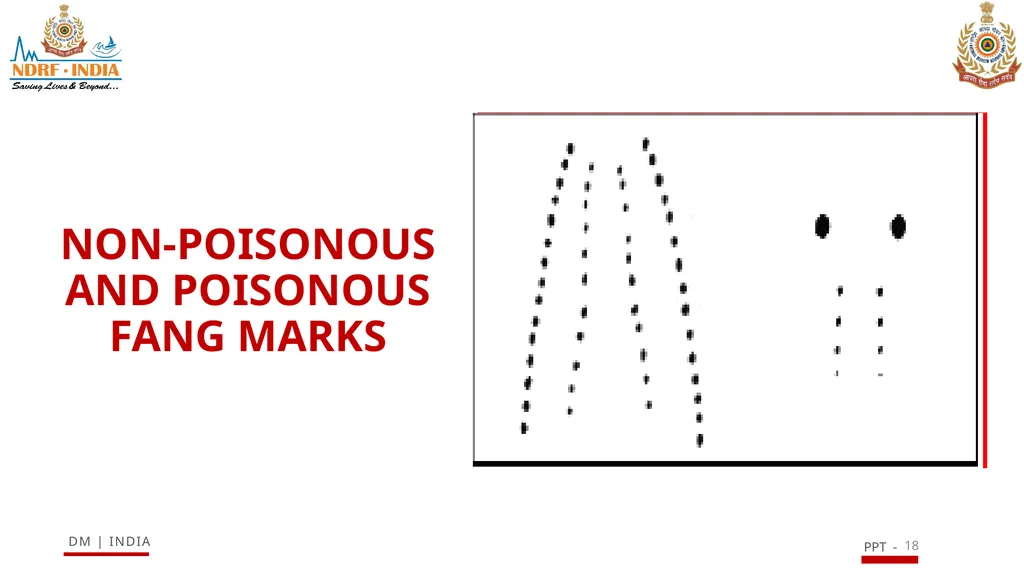
slide18. NON-POISONOUS AND POISONOUS FANG MARKS 18<br>
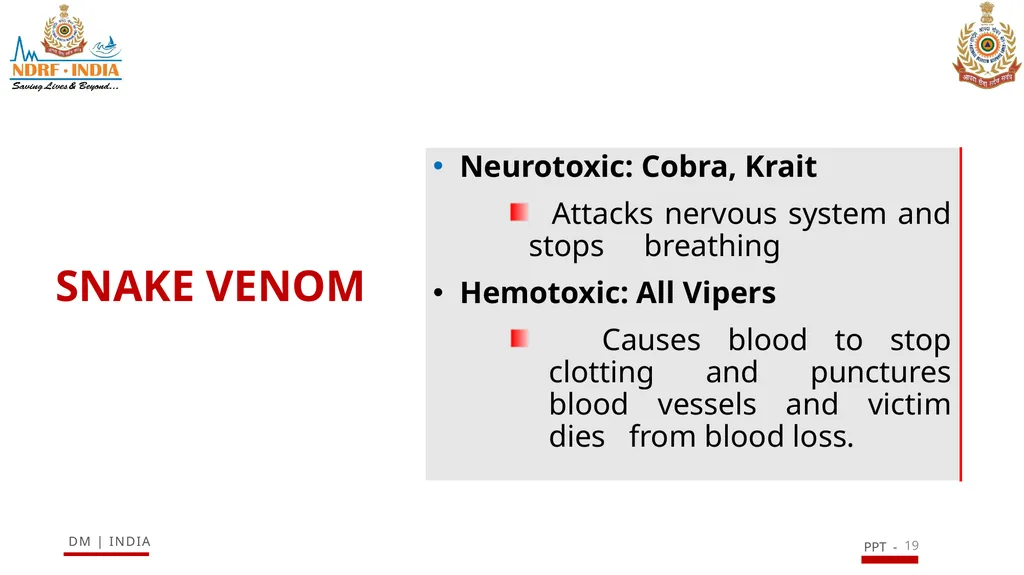
slide19. SNAKE VENOM 19 Neurotoxic: Cobra, Krait
Attacks nervous system and stops breathing
Hemotoxic: All Vipers
Causes blood to stop clotting and punctures blood vessels and victim dies from blood loss.<br>
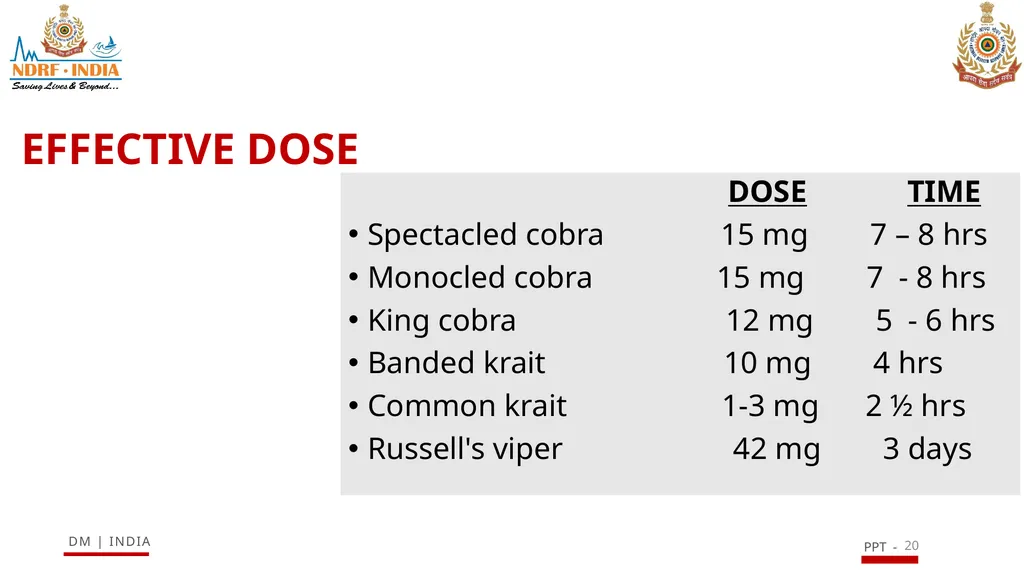
slide20. EFFECTIVE DOSE DOSE TIME
Spectacled cobra 15 mg 7 – 8 hrs
Monocled cobra 15 mg 7 - 8 hrs
King cobra 12 mg 5 - 6 hrs
Banded krait 10 mg 4 hrs
Common krait 1-3 mg 2 ½ hrs
Russell's viper 42 mg 3 days 20<br>
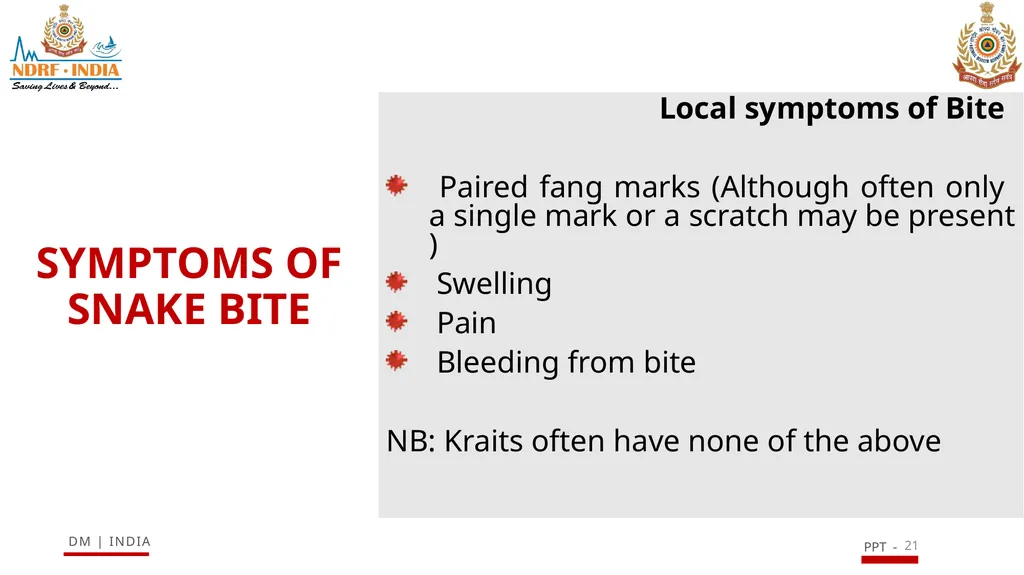
slide21. SYMPTOMS OF SNAKE BITE Local symptoms of Bite
Paired fang marks (Although often only a single mark or a scratch may be present )
Swelling
Pain
Bleeding from bite
NB: Kraits often have none of the above 21<br>
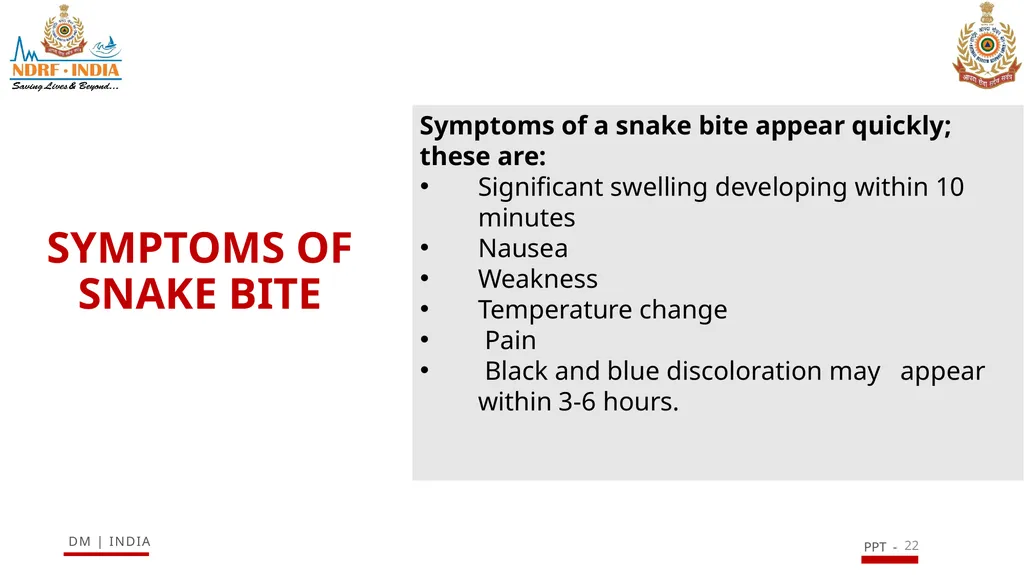
slide22. Symptoms of a snake bite appear quickly; these are:
Significant swelling developing within 10 minutes
Nausea
Weakness
Temperature change
Pain
Black and blue discoloration may appear within 3-6 hours. 22 SYMPTOMS OF SNAKE BITE<br>
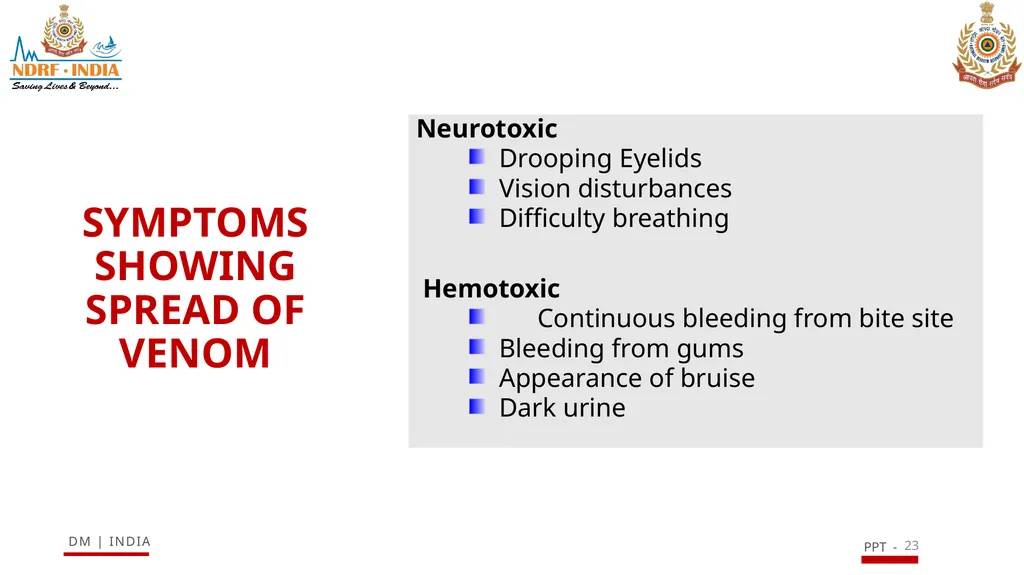
slide23. SYMPTOMS SHOWING SPREAD OF VENOM Neurotoxic
Drooping Eyelids
Vision disturbances
Difficulty breathing
Hemotoxic
Continuous bleeding from bite site
Bleeding from gums
Appearance of bruise
Dark urine 23<br>
slide24. Calm the patient down to slow down blood circulation and retard the spread of venom.
Have the victim lie down with the affected limb lower than the heart. 24 FIRST AID<br>
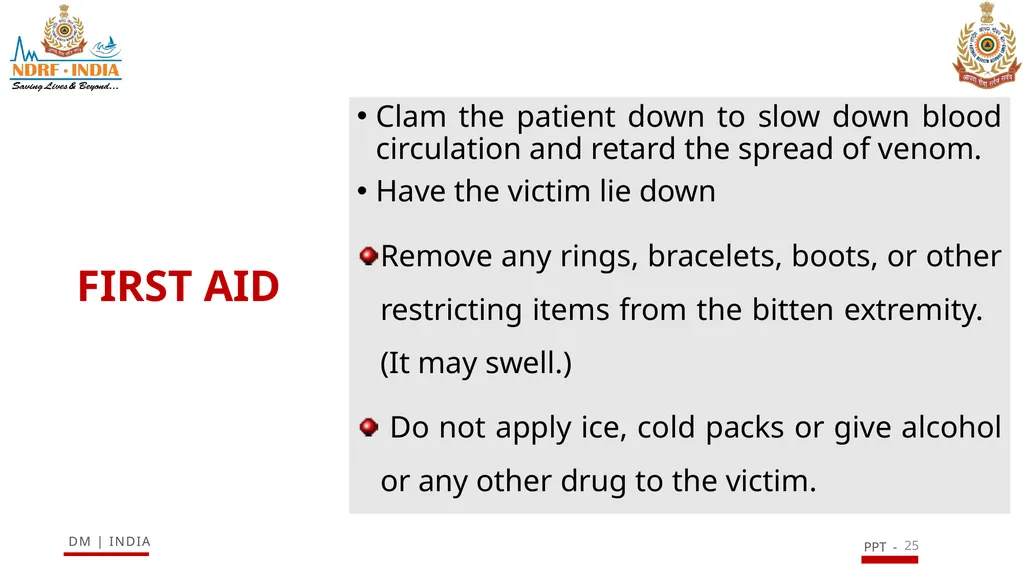
slide25. FIRST AID Clam the patient down to slow down blood circulation and retard the spread of venom.
Have the victim lie down
Remove any rings, bracelets, boots, or other restricting items from the bitten extremity. (It may swell.)
Do not apply ice, cold packs or give alcohol or any other drug to the victim. 25<br>
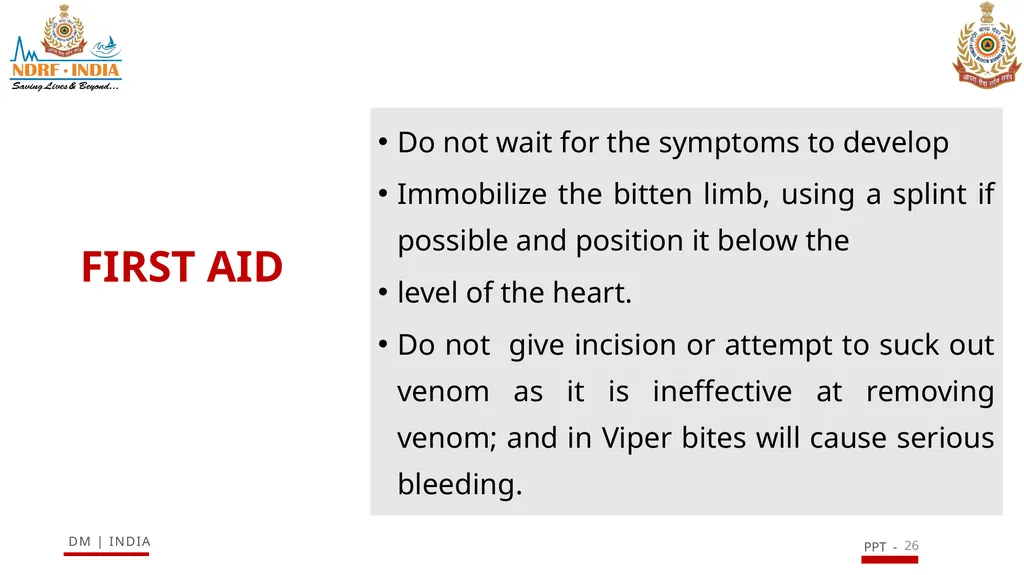
slide26. 26 Do not wait for the symptoms to develop
Immobilize the bitten limb, using a splint if possible and position it below the
level of the heart.
Do not give incision or attempt to suck out venom as it is ineffective at removing venom; and in Viper bites will cause serious bleeding. FIRST AID<br>
slide27. In Cobra and Krait bites, the victim may stop breathing. They are not dead, start
This can be Life Saving 27 FIRST AID<br>
slide28. DO’S Keep victim calm.
Immediately have the victim lie flat without moving.
Immobilize the bitten limb, using a splint if possible and position it below the level of the heart.
Get the victim to hospital urgently, lying flat, if possible. 28<br>
slide29. DON’TS Do Not apply any tourniquet or compression bandage.
Do Not cool the area of the bite.
Do Not try to catch the snake, we do not need another victim, but take it to hospital if already killed.
Do Not give the victim alcoholic drinks or Aspirin. 29<br>
slide30. MYTHS ABOUT SNAKES 30<br>
slide31. MYTHS A Snake means DEATH.
Snake bites can be cured by mantras, tantric, magic spells, roots and herbs etc. They have all been tested by scientists and proved that they DO NOT work.
Snakes are revengeful!
Snakes are guardians of wealth!
Old snakes have hair on them!
Snakes hypnotize!
Snakes sway to the music of the flute! 31<br>
slide32. Cobras, particularly the King Cobras wear a Nagmani that makes one a millionaire!
Snakes suck milk from the udders of cows by coiling around their legs!
Snakes like the sweet pungent smell of the 'Kevada' or the 'Raat Rani'! 32 MYTHS<br>
slide33. ENVIRONMENTAL EMERGENCIES HEAT CRAMPS
HEAT EXHAUSTION
HEAT STROKE 33<br>
slide34. HEAT CRAMPS SIGN AND SYMPTOMS
Severe muscle cramps
Exhaustion
Nausea
Periods of fainting 34<br>
slide35. PHT FOR HEAT CRAMPS Move the patient to a cool area.
Give the patient water(salt water). The muscle cramp should be alleviated after drinking water.
“The patient needs the water more than the salt do not delay giving water to look for salt. Commercial electrolytes or oral rehydrate on solution (ORS) can also be used” 35<br>
slide36. HEAT EXHAUSTION SIGN AND SYMPTOMS
Rapid shallow breathing
Weak pulse
Cold, clammy and pale skin
Weakness
Dizziness 36<br>
slide37. PHT FOR HEAT EXHAUSTION Move the patient to a cool place to rest.
Remove or loosen clothing as necessary to cool the patient without causing chills.
Place the patient in a supine position with legs elevated 20 to 30 cm.
Administer oxygen per local protocol
Give water, but not to an unconscious patient. 37<br>
slide38. HEAT STROKE SIGN AND SYMPTOMS
Deep rapid breathing
Rapid pulse fluctuating in strength
Dry, hot skin
Dilated pupils
Loss of consciousness
Convulsions or Muscular tremors 38<br>
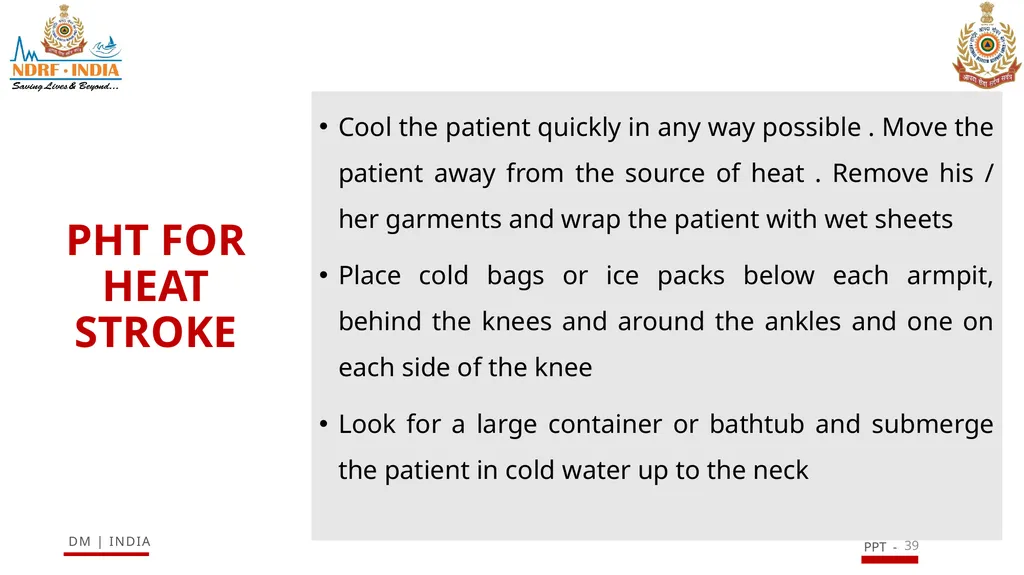
slide39. PHT FOR HEAT STROKE Cool the patient quickly in any way possible . Move the patient away from the source of heat . Remove his / her garments and wrap the patient with wet sheets
Place cold bags or ice packs below each armpit, behind the knees and around the ankles and one on each side of the knee
Look for a large container or bathtub and submerge the patient in cold water up to the neck 39<br>
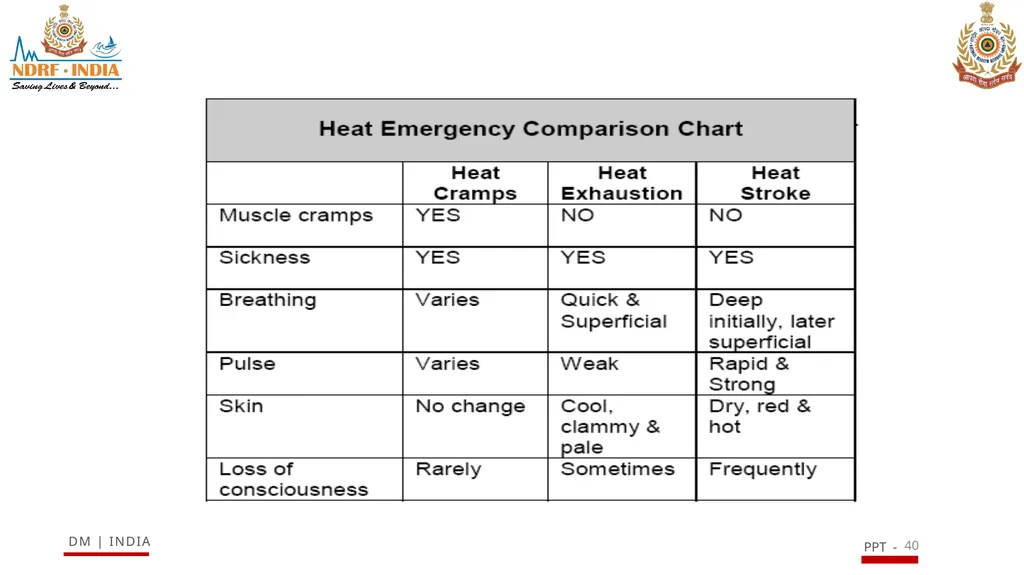
slide40. 40<br>
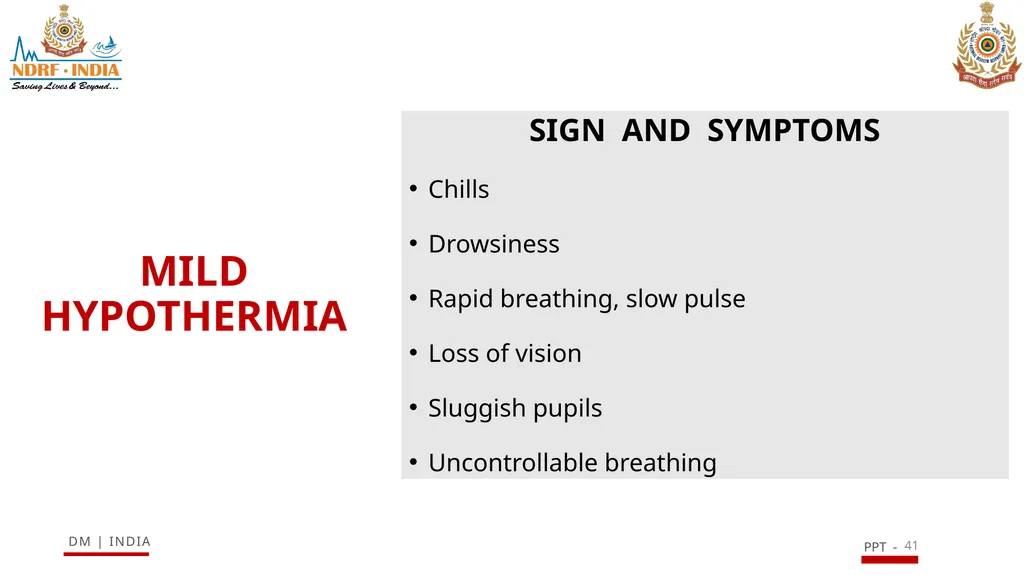
slide41. MILD HYPOTHERMIA SIGN AND SYMPTOMS
Chills
Drowsiness
Rapid breathing, slow pulse
Loss of vision
Sluggish pupils
Uncontrollable breathing 41<br>
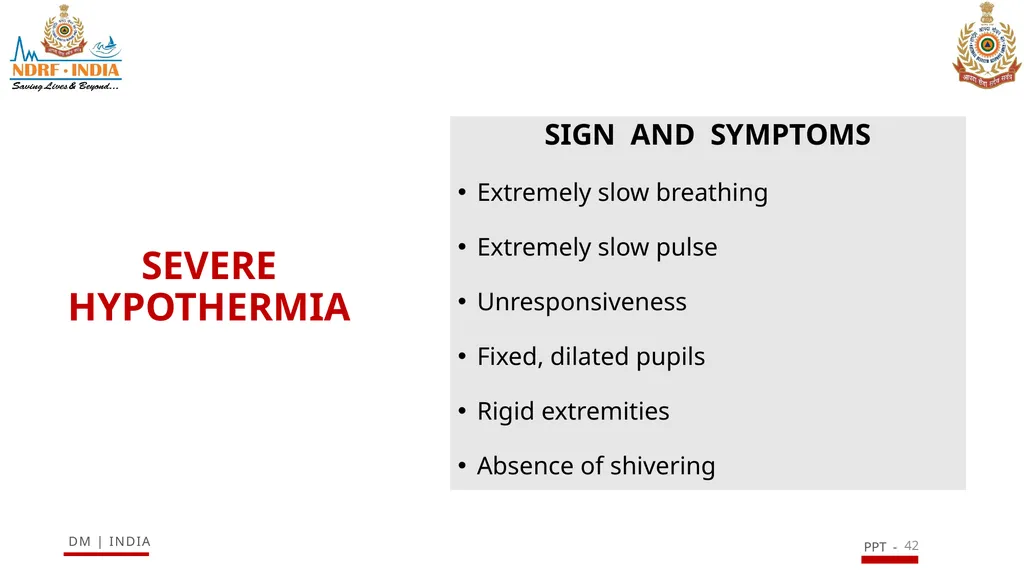
slide42. SEVERE HYPOTHERMIA SIGN AND SYMPTOMS
Extremely slow breathing
Extremely slow pulse
Unresponsiveness
Fixed, dilated pupils
Rigid extremities
Absence of shivering 42<br>
slide43. PHT FOR HYPOTHERMIA Conduct initial assessment and physical exam.
Remove the patient from the cold environment.
Maintain open airway and administer oxygen per local protocol.
Remove any wet clothing and cover patient with a blanket. Keep the patient dry.
If the patient is alert, offer warm liquids (non-stimulant) slowly. Constantly assess vital signs. 43<br>
slide44. FROSTBITE OR LOCAL COLD INJURIES SIGN AND SYMPTOMS
Loss of sensation to the effect area.
Affected area skin becomes white. Dark skin will turn pale.
Sometimes swollen, blistered and white 44<br>
slide45. REVIEW 45 Upon completion of this unit you are now able to –
Describe Snake bite and its control.
Explain Environmental emergencies and its PHT.<br>
slide46. 46 ANY QUESTION?<br>
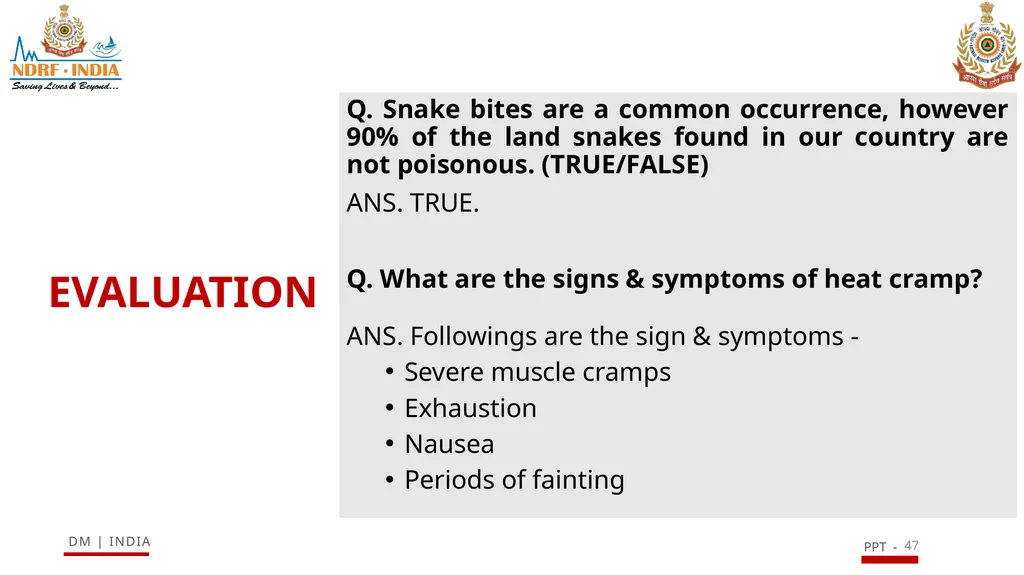
slide47. EVALUATION 47 Q. Snake bites are a common occurrence, however 90% of the land snakes found in our country are not poisonous. (TRUE/FALSE)
ANS. TRUE.
Q. What are the signs & symptoms of heat cramp?
ANS. Followings are the sign & symptoms -
Severe muscle cramps
Exhaustion
Nausea
Periods of fainting<br>
slide48. 48 THANK YOU<br>
slide2. OBJECTIVES Upon completion of this unit you will be able to -
Describe Snake bite and its control.
Explain Environmental emergencies and its PHT. 2<br>
slide3. HISTORY OF SNAKE Jurassic age
Tertiary age 3<br>
slide4. FAMILY OF SNAKE There are 11 family of snake
Three family are poisonous
Elapidae
Viperidae
Hydrophile 4<br>
slide5. Snake bites are a common occurrence, however 90% of the land snakes found in our country are not poisonous.
In majority of cases, death takes place due to fright and not due to bite from a poisonous snake. 5 FAMILY OF SNAKE<br>
slide6. There is considerable color and pattern variation and it takes a trained eye to identify snakes correctly; it is not recommended that you should attempt to handle snakes 6 FAMILY OF SNAKE<br>
slide7. SNAKES 2500 - 3000 SPECIES WORLDWIDE
500 VENOMOUS SPECIES
52 POISONOUS SPECIES IN INDIA
INCIDENCE > 5 MILLION PER YEAR
DEATH IN TRANSIT, ? TRUE INCIDENCE 7<br>
slide8. 8 COMMON POISONOUS SNAKES OF INDIA<br>
slide9. Spectacle cobra
Monocle cobra
King cobra
Common krait
Banded krait
Russell viper 9 COMMON POISONOUS SNAKES OF INDIA<br>
slide10. 10 Encountered all over India during day and night.
often found around or in human habitation. INDIAN COBRA<br>
slide11. This is the Indian Cobra. It is identified by the hood which has a spectacle mark.
Cobras are likely to spread their hood and hiss loudly when agitated.
Found in most parts of the country.
It is often seen in bathrooms, dark corners of houses, dwelling rooms, stable, servants' quarters of old bungalows and jungles.
It is active in day as well as night 11 INDIAN COBRA<br>
slide12. SAW SCALED VIPER White hoop like marks along body and arrow or birds foot mark on head.
Found all over India, prefers dry scrub or desert. 12<br>
slide13. This is the Pharos or Saw scaled viper. It’s back is usually marked with black blotches of inverted V shaped markings
It is a small viper found all over India.
It abounds in Western India more than in any other part. It prefers open dry rocky country or arid deserts. 13 SAW SCALED VIPER<br>
slide14. RUSSELL’S VIPER Black edged chain like marks and white V on head
Hisses loudly when disturbed
Hides under trees, bushes and leaf litter during day 14<br>
slide15. This is Russell’s viper. It is a big stumpy snake 1/2 to 2 meters long with a short tail.
It’s back is also marked with black blotches of inverted V shaped markings
It has the loudest hiss and biggest of fangs
It prefers open country, cultivated fields and bushy or grassy fallow lands.
It is nocturnal and slow in its movements but is aggressive and holds its ground when aroused. 15 RUSSELL’S VIPER<br>
slide16. Majority of the snake bites are from these
four common poisonous snakes of India :
The Indian Cobra,
The common Krait,
Saw scaled viper and the
Russell’s viper 16<br>
slide17. FEATURES OF POISONOUS AND NON-POISONOUS SNAKES 17<br>
slide18. NON-POISONOUS AND POISONOUS FANG MARKS 18<br>
slide19. SNAKE VENOM 19 Neurotoxic: Cobra, Krait
Attacks nervous system and stops breathing
Hemotoxic: All Vipers
Causes blood to stop clotting and punctures blood vessels and victim dies from blood loss.<br>
slide20. EFFECTIVE DOSE DOSE TIME
Spectacled cobra 15 mg 7 – 8 hrs
Monocled cobra 15 mg 7 - 8 hrs
King cobra 12 mg 5 - 6 hrs
Banded krait 10 mg 4 hrs
Common krait 1-3 mg 2 ½ hrs
Russell's viper 42 mg 3 days 20<br>
slide21. SYMPTOMS OF SNAKE BITE Local symptoms of Bite
Paired fang marks (Although often only a single mark or a scratch may be present )
Swelling
Pain
Bleeding from bite
NB: Kraits often have none of the above 21<br>
slide22. Symptoms of a snake bite appear quickly; these are:
Significant swelling developing within 10 minutes
Nausea
Weakness
Temperature change
Pain
Black and blue discoloration may appear within 3-6 hours. 22 SYMPTOMS OF SNAKE BITE<br>
slide23. SYMPTOMS SHOWING SPREAD OF VENOM Neurotoxic
Drooping Eyelids
Vision disturbances
Difficulty breathing
Hemotoxic
Continuous bleeding from bite site
Bleeding from gums
Appearance of bruise
Dark urine 23<br>
slide24. Calm the patient down to slow down blood circulation and retard the spread of venom.
Have the victim lie down with the affected limb lower than the heart. 24 FIRST AID<br>
slide25. FIRST AID Clam the patient down to slow down blood circulation and retard the spread of venom.
Have the victim lie down
Remove any rings, bracelets, boots, or other restricting items from the bitten extremity. (It may swell.)
Do not apply ice, cold packs or give alcohol or any other drug to the victim. 25<br>
slide26. 26 Do not wait for the symptoms to develop
Immobilize the bitten limb, using a splint if possible and position it below the
level of the heart.
Do not give incision or attempt to suck out venom as it is ineffective at removing venom; and in Viper bites will cause serious bleeding. FIRST AID<br>
slide27. In Cobra and Krait bites, the victim may stop breathing. They are not dead, start
This can be Life Saving 27 FIRST AID<br>
slide28. DO’S Keep victim calm.
Immediately have the victim lie flat without moving.
Immobilize the bitten limb, using a splint if possible and position it below the level of the heart.
Get the victim to hospital urgently, lying flat, if possible. 28<br>
slide29. DON’TS Do Not apply any tourniquet or compression bandage.
Do Not cool the area of the bite.
Do Not try to catch the snake, we do not need another victim, but take it to hospital if already killed.
Do Not give the victim alcoholic drinks or Aspirin. 29<br>
slide30. MYTHS ABOUT SNAKES 30<br>
slide31. MYTHS A Snake means DEATH.
Snake bites can be cured by mantras, tantric, magic spells, roots and herbs etc. They have all been tested by scientists and proved that they DO NOT work.
Snakes are revengeful!
Snakes are guardians of wealth!
Old snakes have hair on them!
Snakes hypnotize!
Snakes sway to the music of the flute! 31<br>
slide32. Cobras, particularly the King Cobras wear a Nagmani that makes one a millionaire!
Snakes suck milk from the udders of cows by coiling around their legs!
Snakes like the sweet pungent smell of the 'Kevada' or the 'Raat Rani'! 32 MYTHS<br>
slide33. ENVIRONMENTAL EMERGENCIES HEAT CRAMPS
HEAT EXHAUSTION
HEAT STROKE 33<br>
slide34. HEAT CRAMPS SIGN AND SYMPTOMS
Severe muscle cramps
Exhaustion
Nausea
Periods of fainting 34<br>
slide35. PHT FOR HEAT CRAMPS Move the patient to a cool area.
Give the patient water(salt water). The muscle cramp should be alleviated after drinking water.
“The patient needs the water more than the salt do not delay giving water to look for salt. Commercial electrolytes or oral rehydrate on solution (ORS) can also be used” 35<br>
slide36. HEAT EXHAUSTION SIGN AND SYMPTOMS
Rapid shallow breathing
Weak pulse
Cold, clammy and pale skin
Weakness
Dizziness 36<br>
slide37. PHT FOR HEAT EXHAUSTION Move the patient to a cool place to rest.
Remove or loosen clothing as necessary to cool the patient without causing chills.
Place the patient in a supine position with legs elevated 20 to 30 cm.
Administer oxygen per local protocol
Give water, but not to an unconscious patient. 37<br>
slide38. HEAT STROKE SIGN AND SYMPTOMS
Deep rapid breathing
Rapid pulse fluctuating in strength
Dry, hot skin
Dilated pupils
Loss of consciousness
Convulsions or Muscular tremors 38<br>
slide39. PHT FOR HEAT STROKE Cool the patient quickly in any way possible . Move the patient away from the source of heat . Remove his / her garments and wrap the patient with wet sheets
Place cold bags or ice packs below each armpit, behind the knees and around the ankles and one on each side of the knee
Look for a large container or bathtub and submerge the patient in cold water up to the neck 39<br>
slide40. 40<br>
slide41. MILD HYPOTHERMIA SIGN AND SYMPTOMS
Chills
Drowsiness
Rapid breathing, slow pulse
Loss of vision
Sluggish pupils
Uncontrollable breathing 41<br>
slide42. SEVERE HYPOTHERMIA SIGN AND SYMPTOMS
Extremely slow breathing
Extremely slow pulse
Unresponsiveness
Fixed, dilated pupils
Rigid extremities
Absence of shivering 42<br>
slide43. PHT FOR HYPOTHERMIA Conduct initial assessment and physical exam.
Remove the patient from the cold environment.
Maintain open airway and administer oxygen per local protocol.
Remove any wet clothing and cover patient with a blanket. Keep the patient dry.
If the patient is alert, offer warm liquids (non-stimulant) slowly. Constantly assess vital signs. 43<br>
slide44. FROSTBITE OR LOCAL COLD INJURIES SIGN AND SYMPTOMS
Loss of sensation to the effect area.
Affected area skin becomes white. Dark skin will turn pale.
Sometimes swollen, blistered and white 44<br>
slide45. REVIEW 45 Upon completion of this unit you are now able to –
Describe Snake bite and its control.
Explain Environmental emergencies and its PHT.<br>
slide46. 46 ANY QUESTION?<br>
slide47. EVALUATION 47 Q. Snake bites are a common occurrence, however 90% of the land snakes found in our country are not poisonous. (TRUE/FALSE)
ANS. TRUE.
Q. What are the signs & symptoms of heat cramp?
ANS. Followings are the sign & symptoms -
Severe muscle cramps
Exhaustion
Nausea
Periods of fainting<br>
slide48. 48 THANK YOU<br>