
SOCIAL ISSUES IMPACTING THE TEACHER SHORTAGE Jodi
SB
Published · 30 slides · 0 views

1 / 1
Description
SOCIAL ISSUES IMPACTING THE TEACHER SHORTAGE Jodi Newby May 8, 2023 The Teacher Shortage Growing, worldwide problem In US 2018 approximately half actively looking 53 looking for new profession nationwide core subject shortages Indiana
Related Topics
Share
Embed code
Download this presentation From Below
"SOCIAL ISSUES IMPACTING THE TEACHER SHORTAGE Jodi" is the property of its rightful owner. Permission is granted to download and print the materials on this website for personal, non-commercial use only, and to display it on your personal computer provided you do not modify the materials and that you retain all copyright notices contained in the materials. By downloading content from our website, you accept the terms of this agreement.
Presentation Transcript
01
SOCIAL ISSUES
IMPACTING THE TEACHER SHORTAGE Jodi Newby
May 8, 2023<br>
May 8, 2023<br>
02
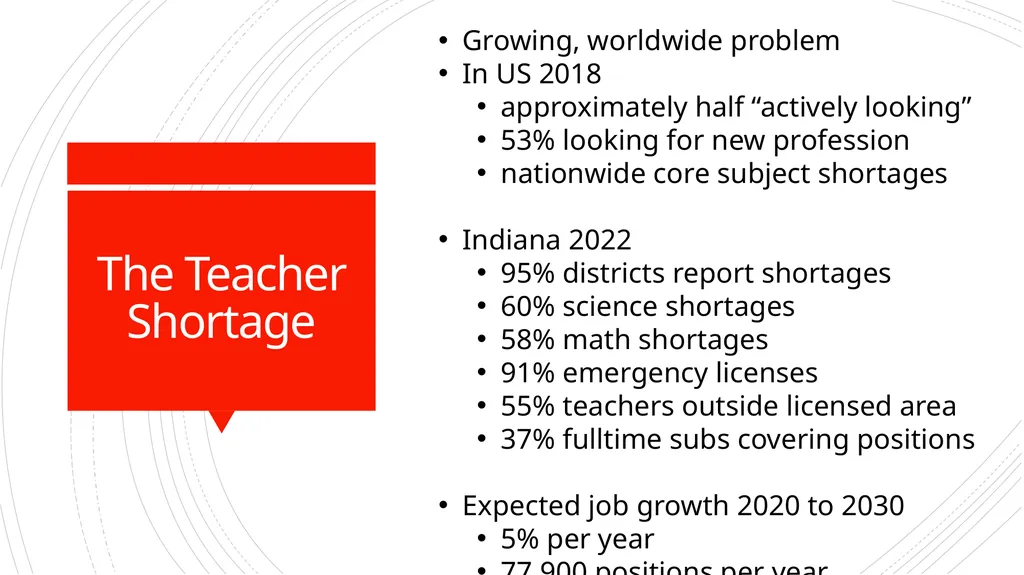
The Teacher Shortage Growing, worldwide problem
In US 2018
approximately half “actively looking”
53% looking for new profession
nationwide core subject shortages
Indiana 2022
95% districts report shortages
60% science shortages
58% math shortages
91% emergency licenses
55% teachers outside licensed area
37% fulltime subs covering positions
Expected job growth 2020 to 2030
5% per year
77,900 positions per year<br>
In US 2018
approximately half “actively looking”
53% looking for new profession
nationwide core subject shortages
Indiana 2022
95% districts report shortages
60% science shortages
58% math shortages
91% emergency licenses
55% teachers outside licensed area
37% fulltime subs covering positions
Expected job growth 2020 to 2030
5% per year
77,900 positions per year<br>
03
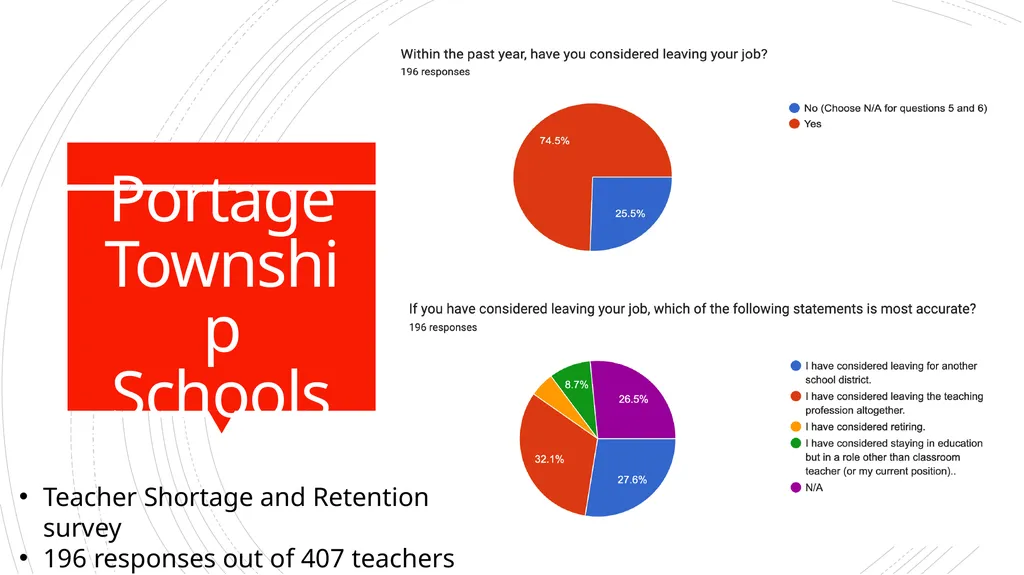
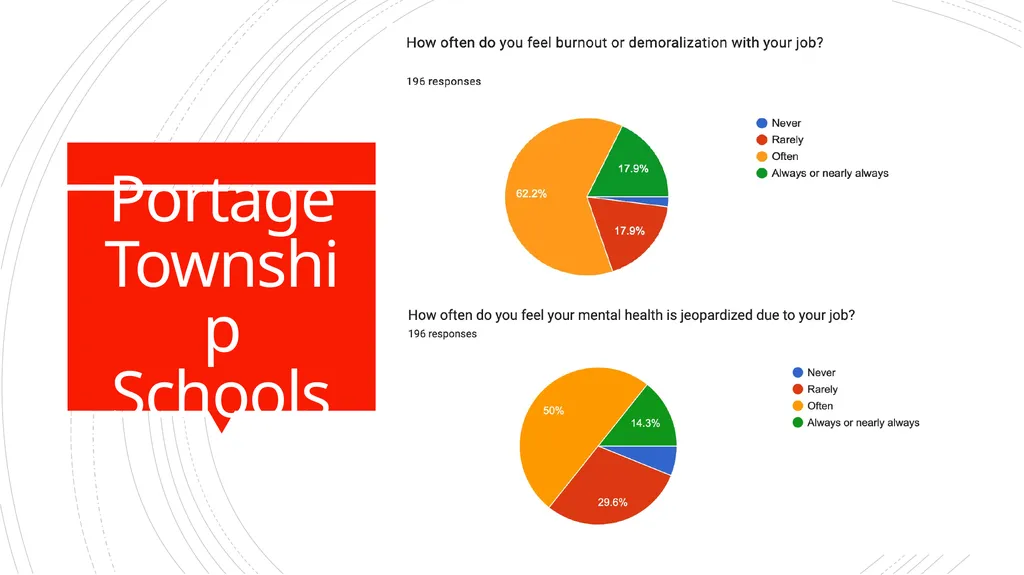
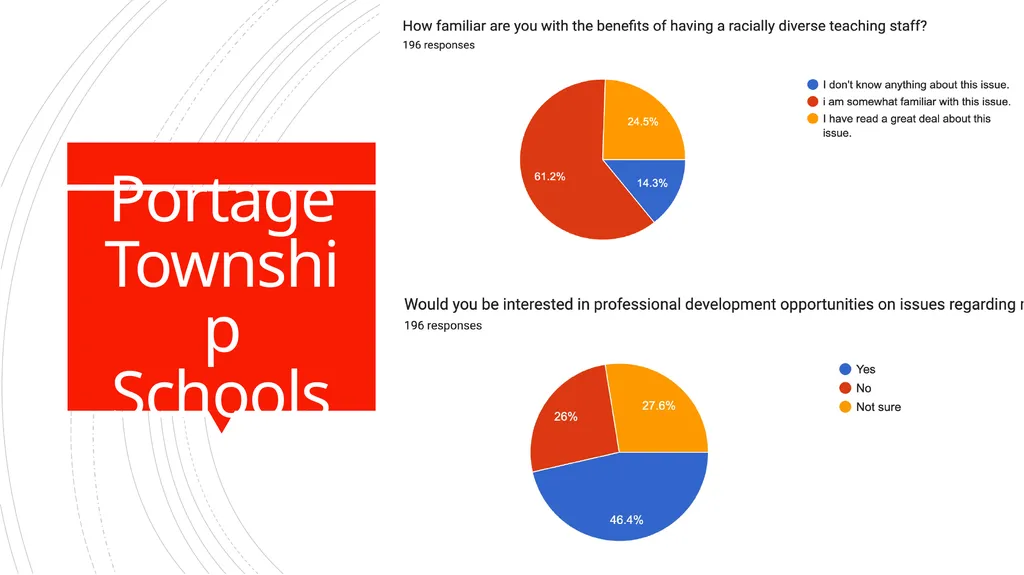
Portage Township Schools Teacher Shortage and Retention survey
196 responses out of 407 teachers<br>
196 responses out of 407 teachers<br>
04
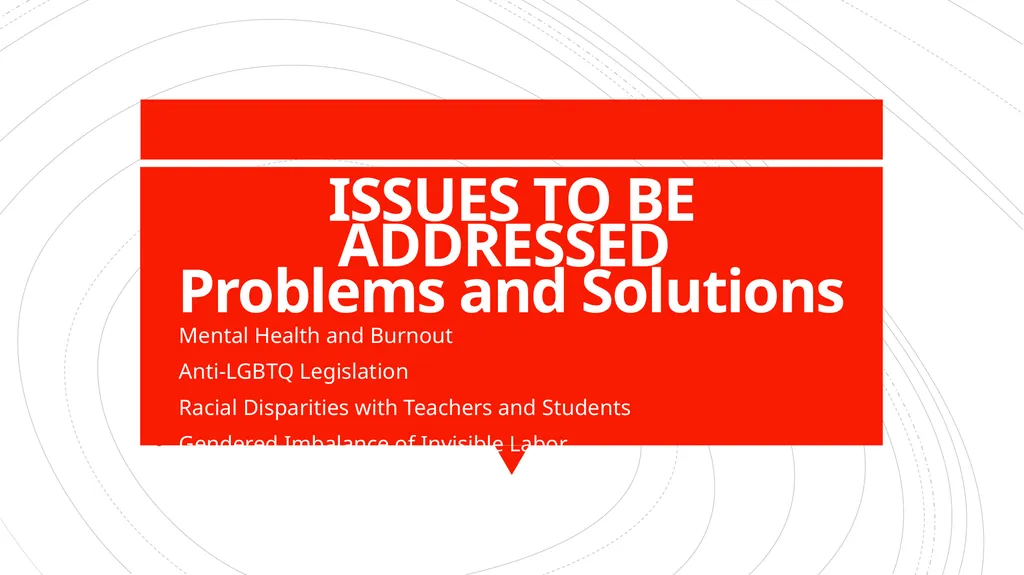
ISSUES TO BE ADDRESSED
Problems and Solutions Mental Health and Burnout
Anti-LGBTQ Legislation
Racial Disparities with Teachers and Students
Gendered Imbalance of Invisible Labor<br>
Anti-LGBTQ Legislation
Racial Disparities with Teachers and Students
Gendered Imbalance of Invisible Labor<br>
05
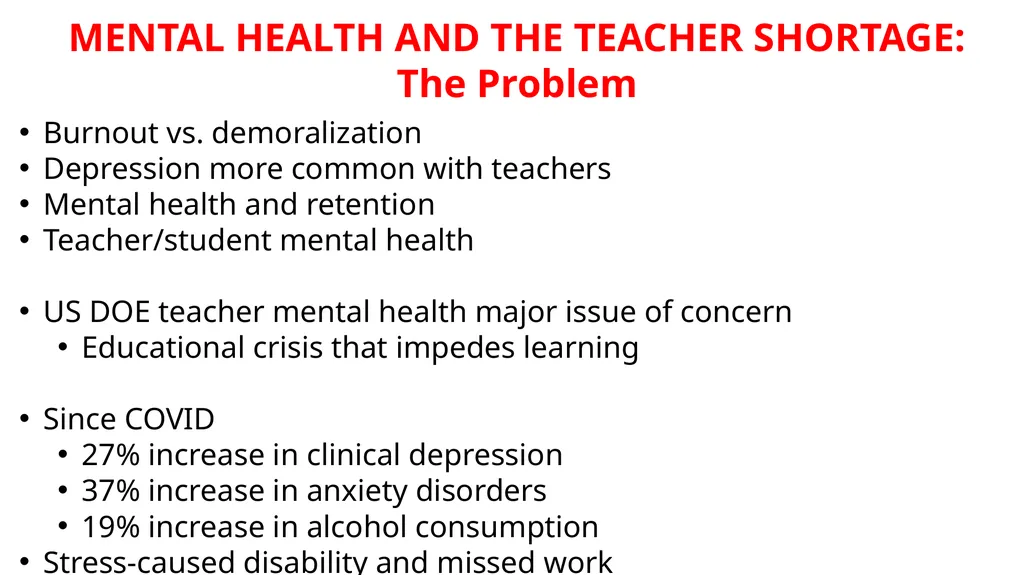
MENTAL HEALTH AND THE TEACHER SHORTAGE:
The Problem Burnout vs. demoralization
Depression more common with teachers
Mental health and retention
Teacher/student mental health
US DOE teacher mental health major issue of concern
Educational crisis that impedes learning
Since COVID
27% increase in clinical depression
37% increase in anxiety disorders
19% increase in alcohol consumption
Stress-caused disability and missed work<br>
The Problem Burnout vs. demoralization
Depression more common with teachers
Mental health and retention
Teacher/student mental health
US DOE teacher mental health major issue of concern
Educational crisis that impedes learning
Since COVID
27% increase in clinical depression
37% increase in anxiety disorders
19% increase in alcohol consumption
Stress-caused disability and missed work<br>
06
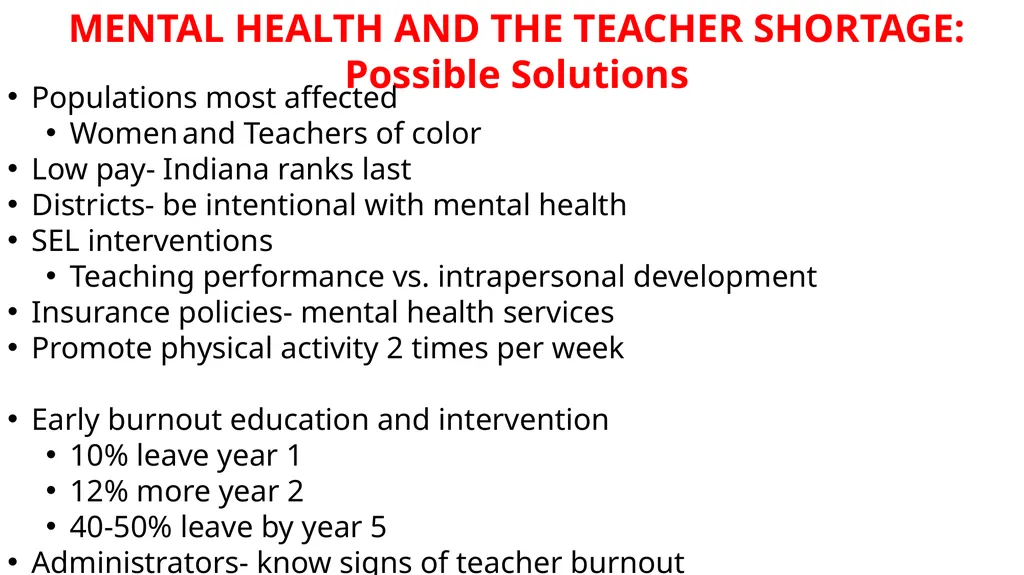
MENTAL HEALTH AND THE TEACHER SHORTAGE:
Possible Solutions Populations most affected
Women and Teachers of color
Low pay- Indiana ranks last
Districts- be intentional with mental health
SEL interventions
Teaching performance vs. intrapersonal development
Insurance policies- mental health services
Promote physical activity 2 times per week
Early burnout education and intervention
10% leave year 1
12% more year 2
40-50% leave by year 5
Administrators- know signs of teacher burnout<br>
Possible Solutions Populations most affected
Women and Teachers of color
Low pay- Indiana ranks last
Districts- be intentional with mental health
SEL interventions
Teaching performance vs. intrapersonal development
Insurance policies- mental health services
Promote physical activity 2 times per week
Early burnout education and intervention
10% leave year 1
12% more year 2
40-50% leave by year 5
Administrators- know signs of teacher burnout<br>
07
Portage Township Schools<br>
08
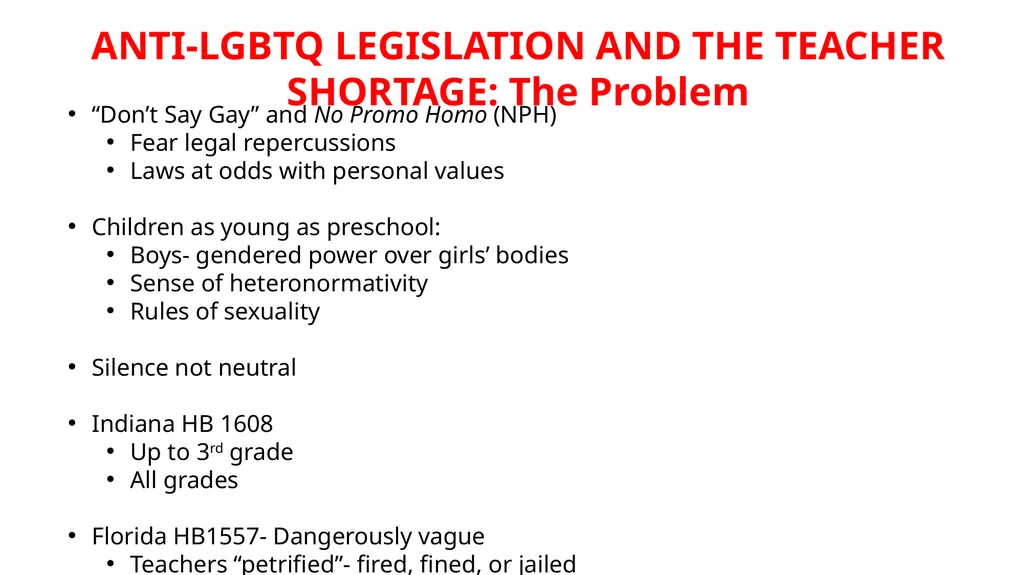
ANTI-LGBTQ LEGISLATION AND THE TEACHER SHORTAGE: The Problem “Don’t Say Gay” and No Promo Homo (NPH)
Fear legal repercussions
Laws at odds with personal values
Children as young as preschool:
Boys- gendered power over girls’ bodies
Sense of heteronormativity
Rules of sexuality
Silence not neutral
Indiana HB 1608
Up to 3rd grade
All grades
Florida HB1557- Dangerously vague
Teachers “petrified”- fired, fined, or jailed
LGBTQ teachers and allies<br>
Fear legal repercussions
Laws at odds with personal values
Children as young as preschool:
Boys- gendered power over girls’ bodies
Sense of heteronormativity
Rules of sexuality
Silence not neutral
Indiana HB 1608
Up to 3rd grade
All grades
Florida HB1557- Dangerously vague
Teachers “petrified”- fired, fined, or jailed
LGBTQ teachers and allies<br>
09
ANTI-LGBTQ LEGISLATION AND THE TEACHER SHORTAGE: Possible Solutions ACLU prepares lawsuits in many states
Tinker vs. Des Moines Independent School District
“Neutrality” teaches heterosexuality good, anything else bad
Harm of LGBTQ youth not being represented
School districts should be proactive
Establish a district stance
Establish clear-cut policies and procedures<br>
Tinker vs. Des Moines Independent School District
“Neutrality” teaches heterosexuality good, anything else bad
Harm of LGBTQ youth not being represented
School districts should be proactive
Establish a district stance
Establish clear-cut policies and procedures<br>
10
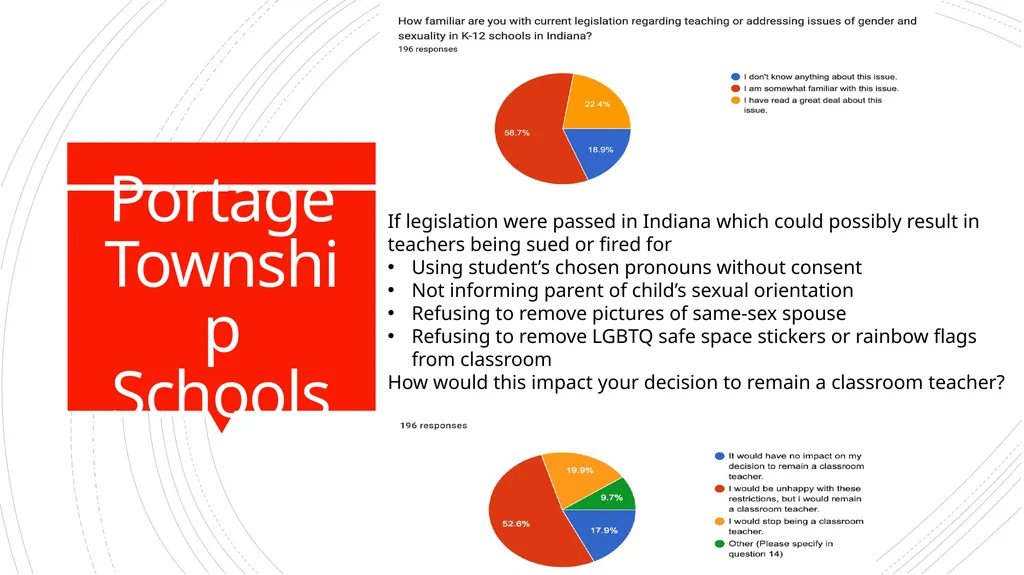
Portage Township Schools If legislation were passed in Indiana which could possibly result in teachers being sued or fired for
Using student’s chosen pronouns without consent
Not informing parent of child’s sexual orientation
Refusing to remove pictures of same-sex spouse
Refusing to remove LGBTQ safe space stickers or rainbow flags from classroom
How would this impact your decision to remain a classroom teacher?<br>
Using student’s chosen pronouns without consent
Not informing parent of child’s sexual orientation
Refusing to remove pictures of same-sex spouse
Refusing to remove LGBTQ safe space stickers or rainbow flags from classroom
How would this impact your decision to remain a classroom teacher?<br>
11
TEACHER-STUDENT RACIAL DISPARITY AND THE TEACHER SHORTAGE: The Problem All racial groups, greatest with Black population
Post-Brown vs. Board of Ed Black teachers not hired by White admins
Black teachers- $2,700 less per year than Whites
$52K college debt vs. $25K for Whites
Steered toward high minority schools
Fewer Black students choose teaching
No role models
Negative association with school
Lack of confidence in academic ability
Black applicants less likely to secure teaching position
<50% of Black teachers received job offers
77% of White teachers received job offers<br>
Post-Brown vs. Board of Ed Black teachers not hired by White admins
Black teachers- $2,700 less per year than Whites
$52K college debt vs. $25K for Whites
Steered toward high minority schools
Fewer Black students choose teaching
No role models
Negative association with school
Lack of confidence in academic ability
Black applicants less likely to secure teaching position
<50% of Black teachers received job offers
77% of White teachers received job offers<br>
12
RACIAL DISPARITY continued Black children with just 1 black teacher in grades 3-5
Boys less likely to drop out
Boys and girls more likely to go to college
Only slight difference between 1 Black teacher and 2 or more
Score higher on standardized tests
“Stereotype threat”
White teachers- lower expectations for Black students
White teachers- judge Black students more
Students of all races benefit<br>
Boys less likely to drop out
Boys and girls more likely to go to college
Only slight difference between 1 Black teacher and 2 or more
Score higher on standardized tests
“Stereotype threat”
White teachers- lower expectations for Black students
White teachers- judge Black students more
Students of all races benefit<br>
13
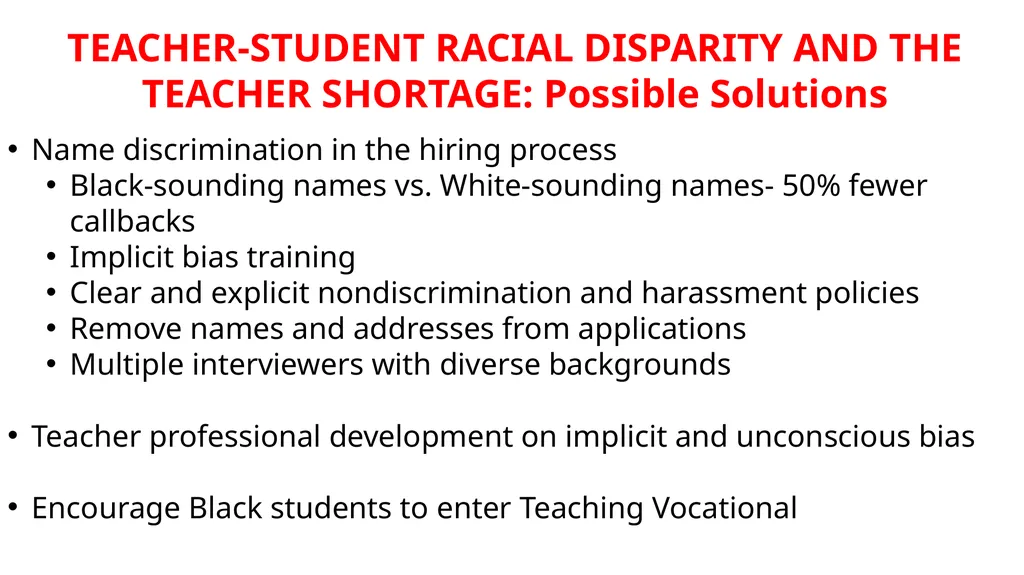
TEACHER-STUDENT RACIAL DISPARITY AND THE TEACHER SHORTAGE: Possible Solutions Name discrimination in the hiring process
Black-sounding names vs. White-sounding names- 50% fewer callbacks
Implicit bias training
Clear and explicit nondiscrimination and harassment policies
Remove names and addresses from applications
Multiple interviewers with diverse backgrounds
Teacher professional development on implicit and unconscious bias
Encourage Black students to enter Teaching Vocational<br>
Black-sounding names vs. White-sounding names- 50% fewer callbacks
Implicit bias training
Clear and explicit nondiscrimination and harassment policies
Remove names and addresses from applications
Multiple interviewers with diverse backgrounds
Teacher professional development on implicit and unconscious bias
Encourage Black students to enter Teaching Vocational<br>
14
Portage Township Schools<br>
15
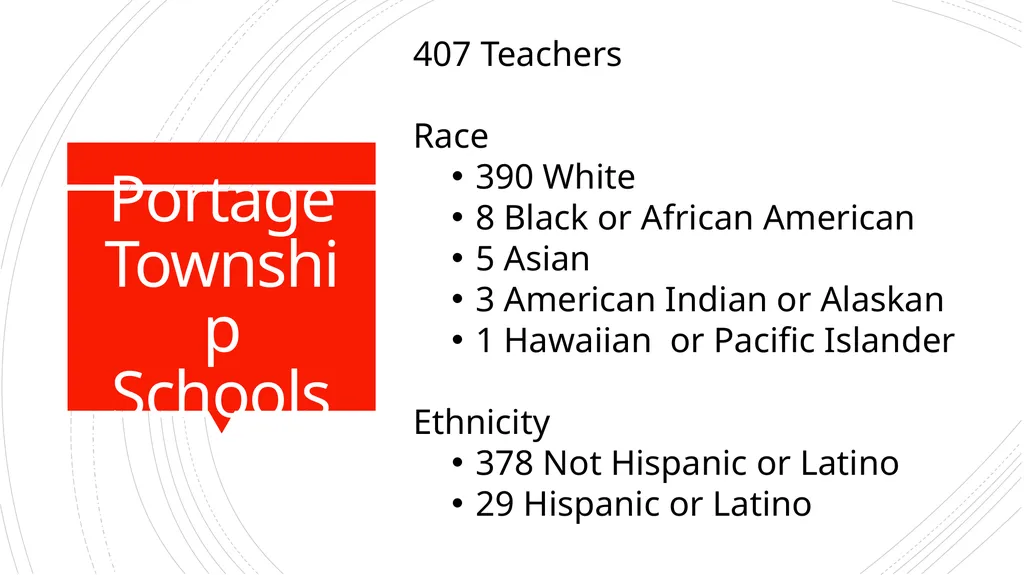
Portage Township Schools 407 Teachers
Race
390 White
8 Black or African American
5 Asian
3 American Indian or Alaskan
1 Hawaiian or Pacific Islander
Ethnicity
378 Not Hispanic or Latino
29 Hispanic or Latino<br>
Race
390 White
8 Black or African American
5 Asian
3 American Indian or Alaskan
1 Hawaiian or Pacific Islander
Ethnicity
378 Not Hispanic or Latino
29 Hispanic or Latino<br>
16
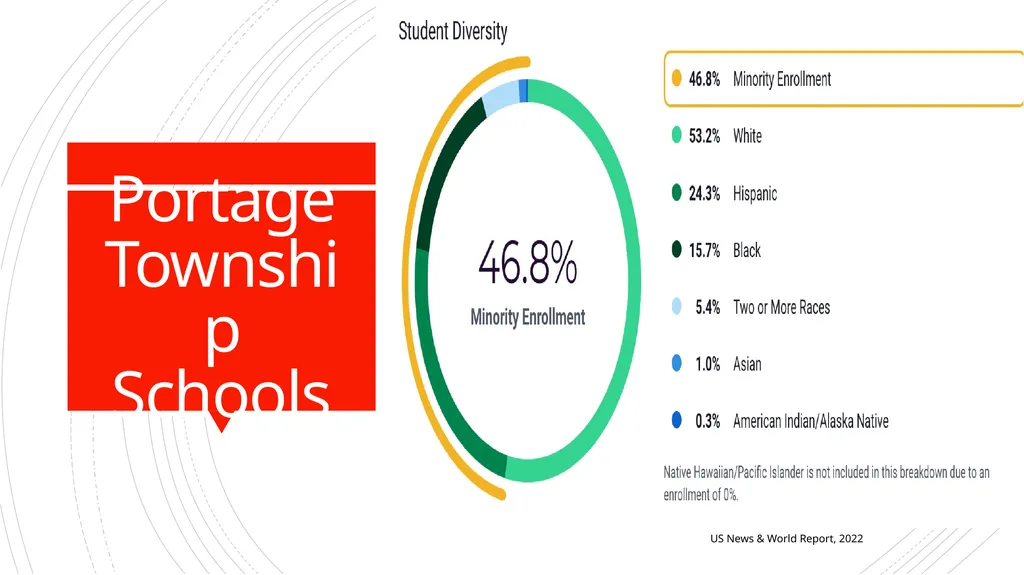
Portage Township Schools US News & World Report, 2022<br>
17
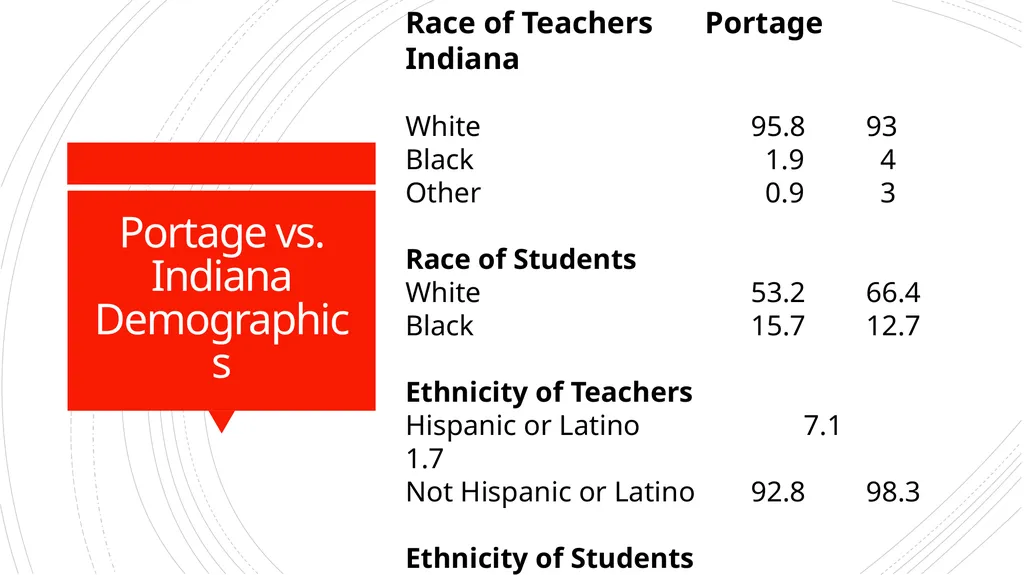
Portage vs. Indiana Demographics Race of Teachers Portage Indiana
White 95.8 93
Black 1.9 4
Other 0.9 3
Race of Students
White 53.2 66.4
Black 15.7 12.7
Ethnicity of Teachers
Hispanic or Latino 7.1 1.7
Not Hispanic or Latino 92.8 98.3
Ethnicity of Students
Hispanic or Latino 24.3 12.8
Not Hispanic or Latino 75.7 87.2<br>
White 95.8 93
Black 1.9 4
Other 0.9 3
Race of Students
White 53.2 66.4
Black 15.7 12.7
Ethnicity of Teachers
Hispanic or Latino 7.1 1.7
Not Hispanic or Latino 92.8 98.3
Ethnicity of Students
Hispanic or Latino 24.3 12.8
Not Hispanic or Latino 75.7 87.2<br>
18
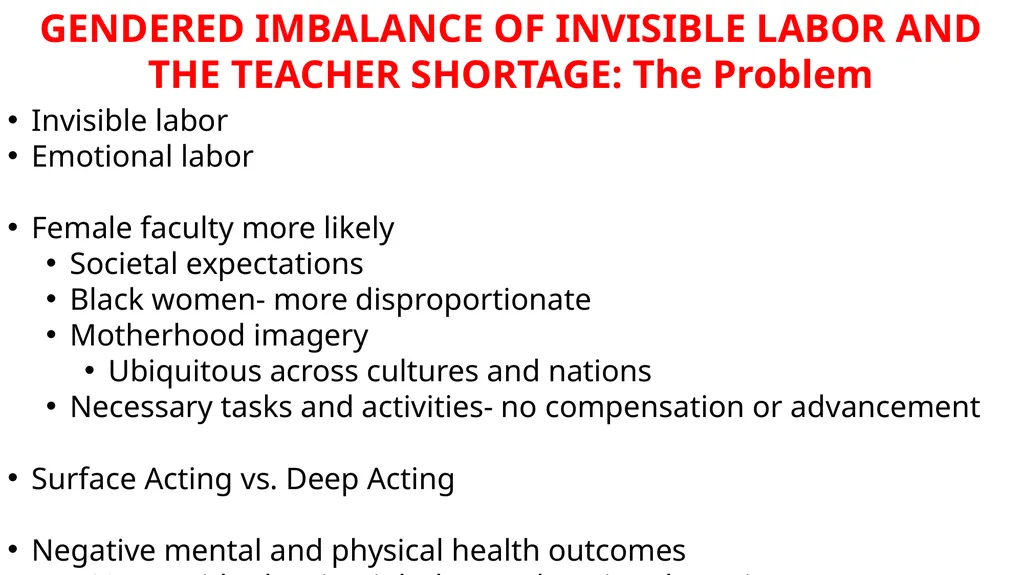
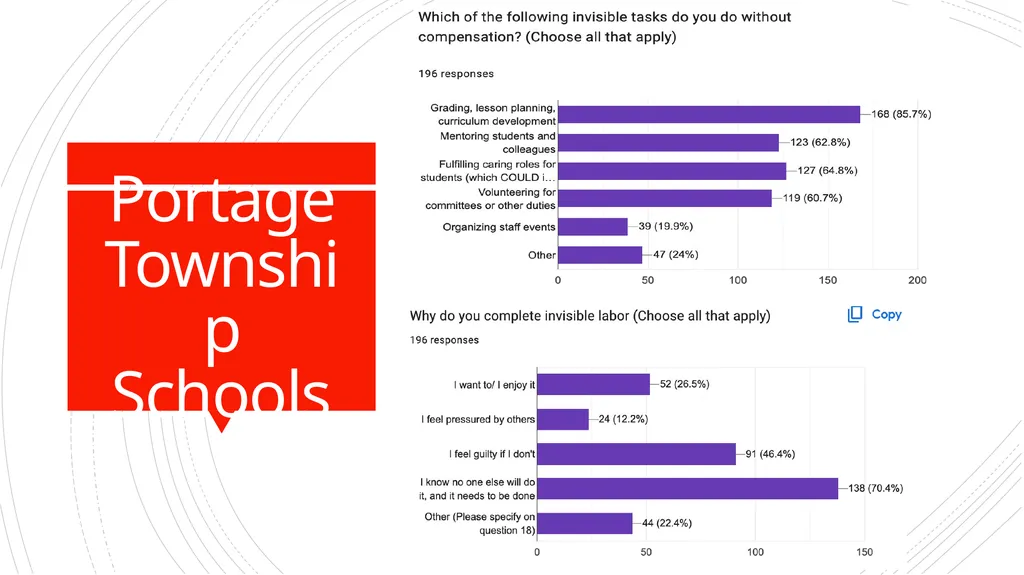
GENDERED IMBALANCE OF INVISIBLE LABOR AND THE TEACHER SHORTAGE: The Problem Invisible labor
Emotional labor
Female faculty more likely
Societal expectations
Black women- more disproportionate
Motherhood imagery
Ubiquitous across cultures and nations
Necessary tasks and activities- no compensation or advancement
Surface Acting vs. Deep Acting
Negative mental and physical health outcomes
40% consider leaving job due to chronic exhaustion or stress<br>
Emotional labor
Female faculty more likely
Societal expectations
Black women- more disproportionate
Motherhood imagery
Ubiquitous across cultures and nations
Necessary tasks and activities- no compensation or advancement
Surface Acting vs. Deep Acting
Negative mental and physical health outcomes
40% consider leaving job due to chronic exhaustion or stress<br>
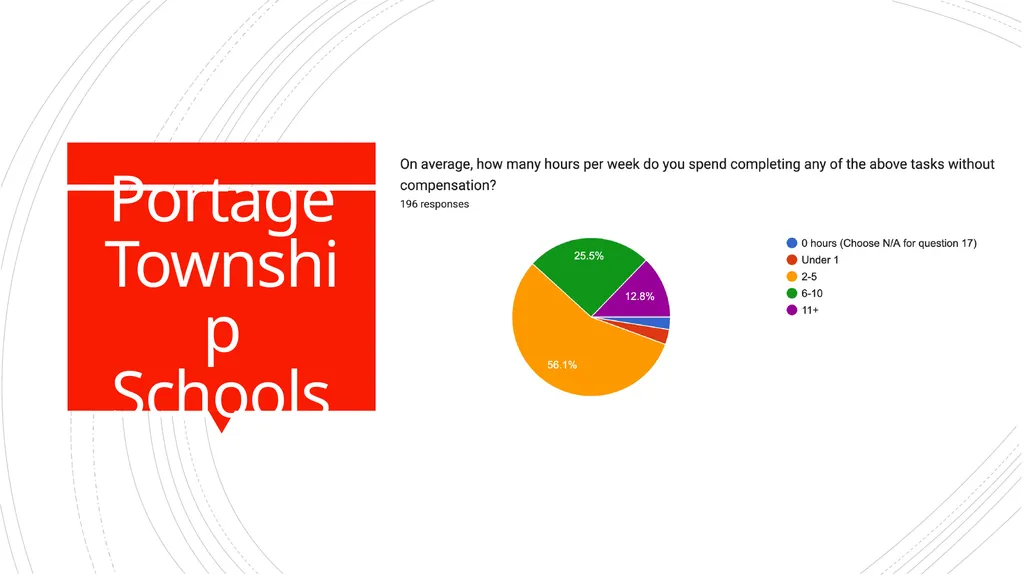
19
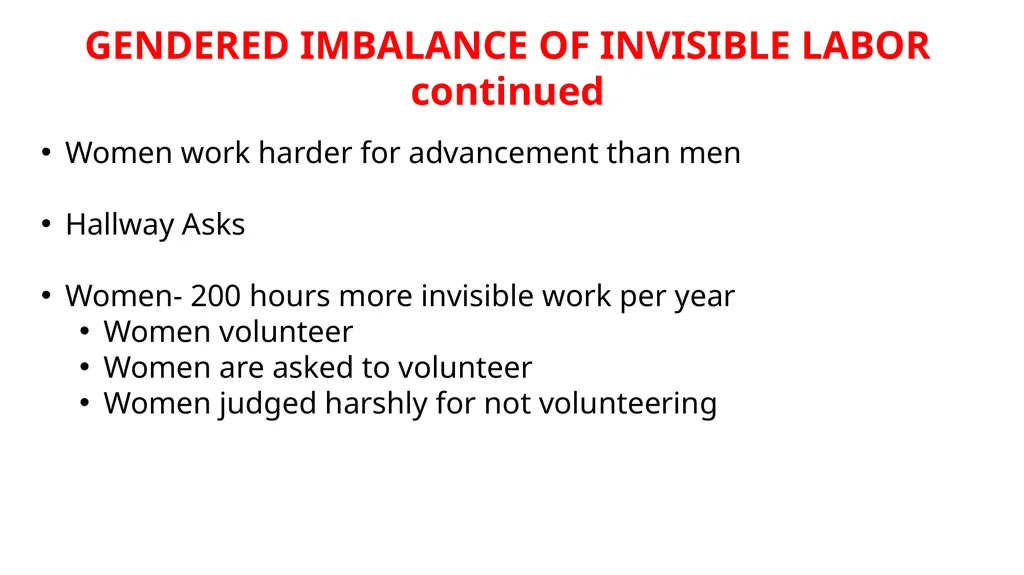
GENDERED IMBALANCE OF INVISIBLE LABOR continued Women work harder for advancement than men
Hallway Asks
Women- 200 hours more invisible work per year
Women volunteer
Women are asked to volunteer
Women judged harshly for not volunteering<br>
Hallway Asks
Women- 200 hours more invisible work per year
Women volunteer
Women are asked to volunteer
Women judged harshly for not volunteering<br>
20
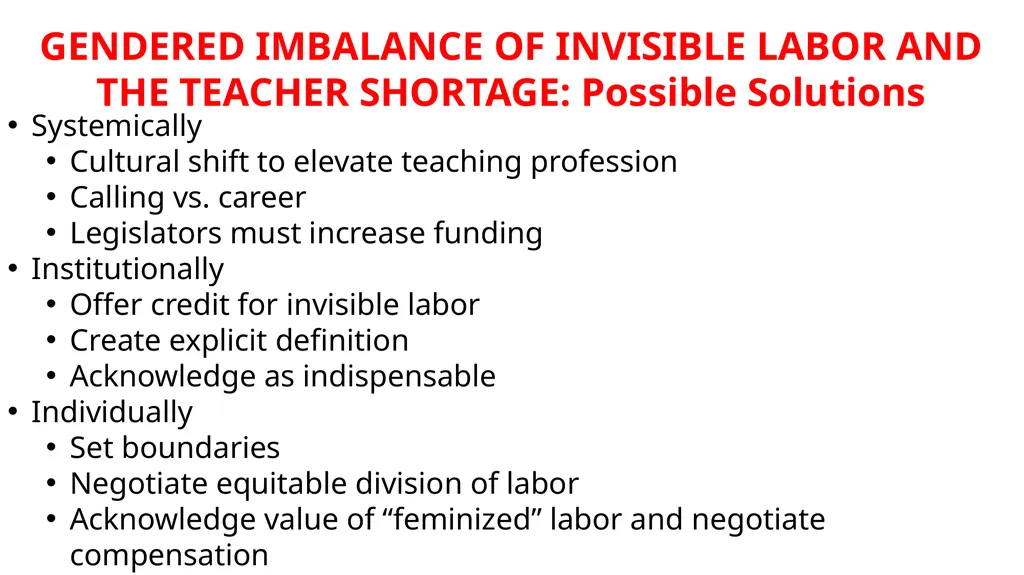
GENDERED IMBALANCE OF INVISIBLE LABOR AND THE TEACHER SHORTAGE: Possible Solutions Systemically
Cultural shift to elevate teaching profession
Calling vs. career
Legislators must increase funding
Institutionally
Offer credit for invisible labor
Create explicit definition
Acknowledge as indispensable
Individually
Set boundaries
Negotiate equitable division of labor
Acknowledge value of “feminized” labor and negotiate compensation<br>
Cultural shift to elevate teaching profession
Calling vs. career
Legislators must increase funding
Institutionally
Offer credit for invisible labor
Create explicit definition
Acknowledge as indispensable
Individually
Set boundaries
Negotiate equitable division of labor
Acknowledge value of “feminized” labor and negotiate compensation<br>
21
Portage Township Schools<br>
22
Portage Township Schools<br>
23
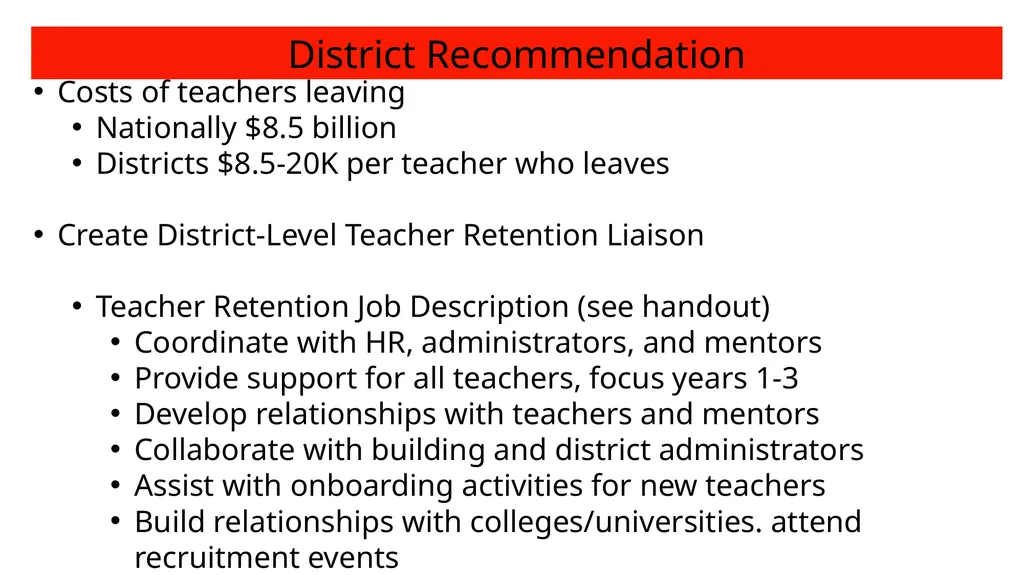
District Recommendation Costs of teachers leaving
Nationally $8.5 billion
Districts $8.5-20K per teacher who leaves
Create District-Level Teacher Retention Liaison
Teacher Retention Job Description (see handout)
Coordinate with HR, administrators, and mentors
Provide support for all teachers, focus years 1-3
Develop relationships with teachers and mentors
Collaborate with building and district administrators
Assist with onboarding activities for new teachers
Build relationships with colleges/universities. attend recruitment events<br>
Nationally $8.5 billion
Districts $8.5-20K per teacher who leaves
Create District-Level Teacher Retention Liaison
Teacher Retention Job Description (see handout)
Coordinate with HR, administrators, and mentors
Provide support for all teachers, focus years 1-3
Develop relationships with teachers and mentors
Collaborate with building and district administrators
Assist with onboarding activities for new teachers
Build relationships with colleges/universities. attend recruitment events<br>
24
References
1. Booth, J., Coldwell, M., Muller, Lisa-Marie, Perry, E., & Zuccollo, J. (2021). Mid-career teachers: A mixed methods coping study of professional development, coping progression, and retention. Education Sciences, 11(299), 1-33. https://doi.org/10.3390/educsci11060299.
2. McFeely, S. (2018, March 27). Why your best teachers are leaving and 4 ways to keep them. Gallup. https://www.gallup.com/education/237275/why-best-teachers-leaving-wayskeep.aspx 14
3. U.S. Department of Education. (n.d.). How to grow teacher wellbeing in your schools. https://ies.ed.gov/ncee/edlabs/infographics/pdf/REL_PA_How_To_Grow_Teacher_Well being_in_Your_Schools.pdf. 15
4. U.S. Bureau of Labor Statistics. (2023, January 10). Occupational Outlook Handbook: High School Teachers.https://www.bls.gov/ooh/education-training-and-library/high-schoolteachers.htm
5. Newby
6. Santoro, D. A. (2019). The problem with stories about teacher “burnout.” Phi Delta Kappan, 101(4), 26–33. https://doi.org/10.1177/0031721719892971
7. Capone, V., & Petrillo, G. (2020). Mental health in teachers: Relationships with job satisfaction, efficacy beliefs, burnout and depression. Current Psychology: A Journal for Diverse Perspectives on Diverse Psychological Issues, 39(5), 1757–1766. https://doiorg.proxysb.uits.iu.edu/10.1007/s12144-018-9878-7
8. Harding, S., Morris, R., Gunnell, D., Ford, T., Hollingworth, W., Tilling, K., Evans, R., Bell, S., Grey, J. Brockman, R., Campbell, R., Araya, R., Murphy, S., & Kidger, J. (2019). Is teachers’ mental health and wellbeing associated with students’ mental health and wellbeing? Journal of Affective Disorders, 242, 460–466. https://doi.org/10.1016/j.jad.2018.08.080
9. U.S. Department of Education. (n.d.). How to grow teacher wellbeing in your schools. https://ies.ed.gov/ncee/edlabs/infographics/pdf/REL_PA_How_To_Grow_Teacher_Well being_in_Your_Schools.pdf. 15
10. Flannery, M.E. (2020, October 20). The teacher shortage can be addressed- with key changes. National Education Association. https://www.nea.org/advocating-for-change/new-fromnea/teacher-shortage-can-be-addressed-key-changes<br>
1. Booth, J., Coldwell, M., Muller, Lisa-Marie, Perry, E., & Zuccollo, J. (2021). Mid-career teachers: A mixed methods coping study of professional development, coping progression, and retention. Education Sciences, 11(299), 1-33. https://doi.org/10.3390/educsci11060299.
2. McFeely, S. (2018, March 27). Why your best teachers are leaving and 4 ways to keep them. Gallup. https://www.gallup.com/education/237275/why-best-teachers-leaving-wayskeep.aspx 14
3. U.S. Department of Education. (n.d.). How to grow teacher wellbeing in your schools. https://ies.ed.gov/ncee/edlabs/infographics/pdf/REL_PA_How_To_Grow_Teacher_Well being_in_Your_Schools.pdf. 15
4. U.S. Bureau of Labor Statistics. (2023, January 10). Occupational Outlook Handbook: High School Teachers.https://www.bls.gov/ooh/education-training-and-library/high-schoolteachers.htm
5. Newby
6. Santoro, D. A. (2019). The problem with stories about teacher “burnout.” Phi Delta Kappan, 101(4), 26–33. https://doi.org/10.1177/0031721719892971
7. Capone, V., & Petrillo, G. (2020). Mental health in teachers: Relationships with job satisfaction, efficacy beliefs, burnout and depression. Current Psychology: A Journal for Diverse Perspectives on Diverse Psychological Issues, 39(5), 1757–1766. https://doiorg.proxysb.uits.iu.edu/10.1007/s12144-018-9878-7
8. Harding, S., Morris, R., Gunnell, D., Ford, T., Hollingworth, W., Tilling, K., Evans, R., Bell, S., Grey, J. Brockman, R., Campbell, R., Araya, R., Murphy, S., & Kidger, J. (2019). Is teachers’ mental health and wellbeing associated with students’ mental health and wellbeing? Journal of Affective Disorders, 242, 460–466. https://doi.org/10.1016/j.jad.2018.08.080
9. U.S. Department of Education. (n.d.). How to grow teacher wellbeing in your schools. https://ies.ed.gov/ncee/edlabs/infographics/pdf/REL_PA_How_To_Grow_Teacher_Well being_in_Your_Schools.pdf. 15
10. Flannery, M.E. (2020, October 20). The teacher shortage can be addressed- with key changes. National Education Association. https://www.nea.org/advocating-for-change/new-fromnea/teacher-shortage-can-be-addressed-key-changes<br>
25
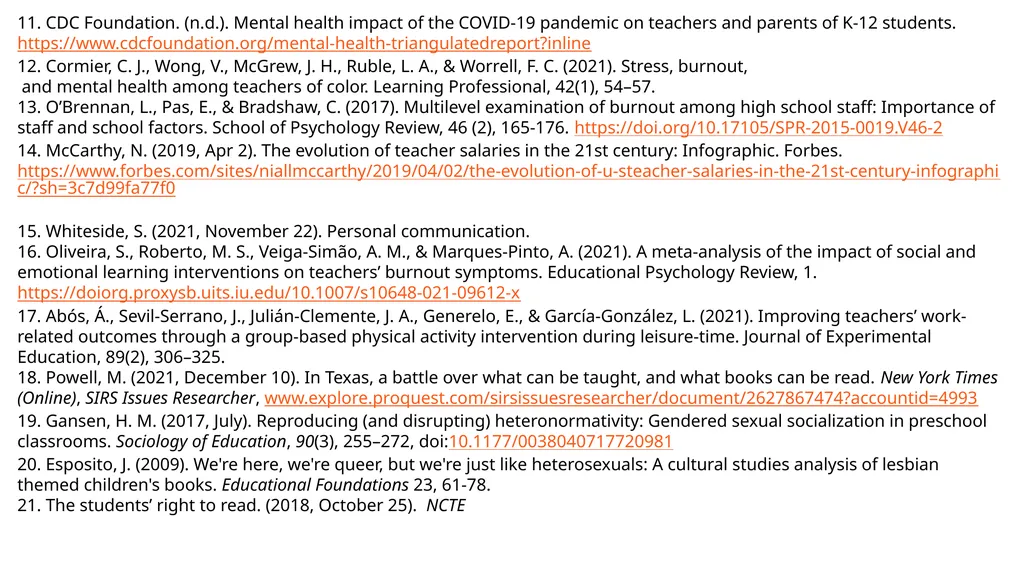
11. CDC Foundation. (n.d.). Mental health impact of the COVID-19 pandemic on teachers and parents of K-12 students. https://www.cdcfoundation.org/mental-health-triangulatedreport?inline
12. Cormier, C. J., Wong, V., McGrew, J. H., Ruble, L. A., & Worrell, F. C. (2021). Stress, burnout,
and mental health among teachers of color. Learning Professional, 42(1), 54–57.
13. O’Brennan, L., Pas, E., & Bradshaw, C. (2017). Multilevel examination of burnout among high school staff: Importance of staff and school factors. School of Psychology Review, 46 (2), 165-176. https://doi.org/10.17105/SPR-2015-0019.V46-2
14. McCarthy, N. (2019, Apr 2). The evolution of teacher salaries in the 21st century: Infographic. Forbes. https://www.forbes.com/sites/niallmccarthy/2019/04/02/the-evolution-of-u-steacher-salaries-in-the-21st-century-infographic/?sh=3c7d99fa77f0
15. Whiteside, S. (2021, November 22). Personal communication.
16. Oliveira, S., Roberto, M. S., Veiga-Simão, A. M., & Marques-Pinto, A. (2021). A meta-analysis of the impact of social and emotional learning interventions on teachers’ burnout symptoms. Educational Psychology Review, 1. https://doiorg.proxysb.uits.iu.edu/10.1007/s10648-021-09612-x
17. Abós, Á., Sevil-Serrano, J., Julián-Clemente, J. A., Generelo, E., & García-González, L. (2021). Improving teachers’ work-related outcomes through a group-based physical activity intervention during leisure-time. Journal of Experimental Education, 89(2), 306–325.
18. Powell, M. (2021, December 10). In Texas, a battle over what can be taught, and what books can be read. New York Times (Online), SIRS Issues Researcher, www.explore.proquest.com/sirsissuesresearcher/document/2627867474?accountid=4993
19. Gansen, H. M. (2017, July). Reproducing (and disrupting) heteronormativity: Gendered sexual socialization in preschool classrooms. Sociology of Education, 90(3), 255–272, doi:10.1177/0038040717720981
20. Esposito, J. (2009). We're here, we're queer, but we're just like heterosexuals: A cultural studies analysis of lesbian themed children's books. Educational Foundations 23, 61-78.
21. The students’ right to read. (2018, October 25). NCTE<br>
12. Cormier, C. J., Wong, V., McGrew, J. H., Ruble, L. A., & Worrell, F. C. (2021). Stress, burnout,
and mental health among teachers of color. Learning Professional, 42(1), 54–57.
13. O’Brennan, L., Pas, E., & Bradshaw, C. (2017). Multilevel examination of burnout among high school staff: Importance of staff and school factors. School of Psychology Review, 46 (2), 165-176. https://doi.org/10.17105/SPR-2015-0019.V46-2
14. McCarthy, N. (2019, Apr 2). The evolution of teacher salaries in the 21st century: Infographic. Forbes. https://www.forbes.com/sites/niallmccarthy/2019/04/02/the-evolution-of-u-steacher-salaries-in-the-21st-century-infographic/?sh=3c7d99fa77f0
15. Whiteside, S. (2021, November 22). Personal communication.
16. Oliveira, S., Roberto, M. S., Veiga-Simão, A. M., & Marques-Pinto, A. (2021). A meta-analysis of the impact of social and emotional learning interventions on teachers’ burnout symptoms. Educational Psychology Review, 1. https://doiorg.proxysb.uits.iu.edu/10.1007/s10648-021-09612-x
17. Abós, Á., Sevil-Serrano, J., Julián-Clemente, J. A., Generelo, E., & García-González, L. (2021). Improving teachers’ work-related outcomes through a group-based physical activity intervention during leisure-time. Journal of Experimental Education, 89(2), 306–325.
18. Powell, M. (2021, December 10). In Texas, a battle over what can be taught, and what books can be read. New York Times (Online), SIRS Issues Researcher, www.explore.proquest.com/sirsissuesresearcher/document/2627867474?accountid=4993
19. Gansen, H. M. (2017, July). Reproducing (and disrupting) heteronormativity: Gendered sexual socialization in preschool classrooms. Sociology of Education, 90(3), 255–272, doi:10.1177/0038040717720981
20. Esposito, J. (2009). We're here, we're queer, but we're just like heterosexuals: A cultural studies analysis of lesbian themed children's books. Educational Foundations 23, 61-78.
21. The students’ right to read. (2018, October 25). NCTE<br>
26
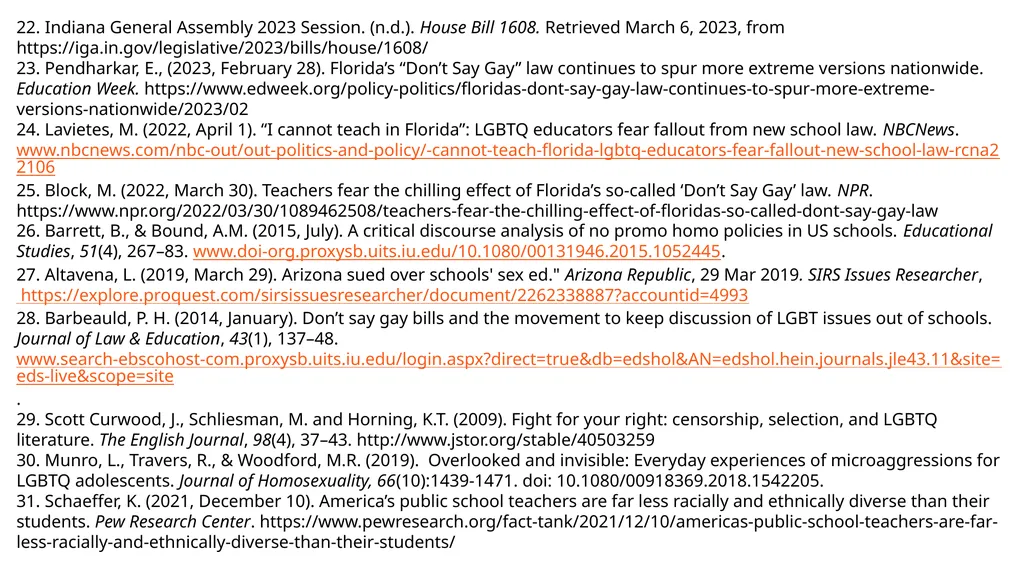
22. Indiana General Assembly 2023 Session. (n.d.). House Bill 1608. Retrieved March 6, 2023, from https://iga.in.gov/legislative/2023/bills/house/1608/
23. Pendharkar, E., (2023, February 28). Florida’s “Don’t Say Gay” law continues to spur more extreme versions nationwide. Education Week. https://www.edweek.org/policy-politics/floridas-dont-say-gay-law-continues-to-spur-more-extreme-versions-nationwide/2023/02
24. Lavietes, M. (2022, April 1). “I cannot teach in Florida”: LGBTQ educators fear fallout from new school law. NBCNews. www.nbcnews.com/nbc-out/out-politics-and-policy/-cannot-teach-florida-lgbtq-educators-fear-fallout-new-school-law-rcna22106
25. Block, M. (2022, March 30). Teachers fear the chilling effect of Florida’s so-called ‘Don’t Say Gay’ law. NPR. https://www.npr.org/2022/03/30/1089462508/teachers-fear-the-chilling-effect-of-floridas-so-called-dont-say-gay-law
26. Barrett, B., & Bound, A.M. (2015, July). A critical discourse analysis of no promo homo policies in US schools. Educational Studies, 51(4), 267–83. www.doi-org.proxysb.uits.iu.edu/10.1080/00131946.2015.1052445.
27. Altavena, L. (2019, March 29). Arizona sued over schools' sex ed." Arizona Republic, 29 Mar 2019. SIRS Issues Researcher, https://explore.proquest.com/sirsissuesresearcher/document/2262338887?accountid=4993
28. Barbeauld, P. H. (2014, January). Don’t say gay bills and the movement to keep discussion of LGBT issues out of schools. Journal of Law & Education, 43(1), 137–48. www.search-ebscohost-com.proxysb.uits.iu.edu/login.aspx?direct=true&db=edshol&AN=edshol.hein.journals.jle43.11&site=eds-live&scope=site.
29. Scott Curwood, J., Schliesman, M. and Horning, K.T. (2009). Fight for your right: censorship, selection, and LGBTQ literature. The English Journal, 98(4), 37–43. http://www.jstor.org/stable/40503259
30. Munro, L., Travers, R., & Woodford, M.R. (2019). Overlooked and invisible: Everyday experiences of microaggressions for LGBTQ adolescents. Journal of Homosexuality, 66(10):1439-1471. doi: 10.1080/00918369.2018.1542205.
31. Schaeffer, K. (2021, December 10). America’s public school teachers are far less racially and ethnically diverse than their students. Pew Research Center. https://www.pewresearch.org/fact-tank/2021/12/10/americas-public-school-teachers-are-far-less-racially-and-ethnically-diverse-than-their-students/<br>
23. Pendharkar, E., (2023, February 28). Florida’s “Don’t Say Gay” law continues to spur more extreme versions nationwide. Education Week. https://www.edweek.org/policy-politics/floridas-dont-say-gay-law-continues-to-spur-more-extreme-versions-nationwide/2023/02
24. Lavietes, M. (2022, April 1). “I cannot teach in Florida”: LGBTQ educators fear fallout from new school law. NBCNews. www.nbcnews.com/nbc-out/out-politics-and-policy/-cannot-teach-florida-lgbtq-educators-fear-fallout-new-school-law-rcna22106
25. Block, M. (2022, March 30). Teachers fear the chilling effect of Florida’s so-called ‘Don’t Say Gay’ law. NPR. https://www.npr.org/2022/03/30/1089462508/teachers-fear-the-chilling-effect-of-floridas-so-called-dont-say-gay-law
26. Barrett, B., & Bound, A.M. (2015, July). A critical discourse analysis of no promo homo policies in US schools. Educational Studies, 51(4), 267–83. www.doi-org.proxysb.uits.iu.edu/10.1080/00131946.2015.1052445.
27. Altavena, L. (2019, March 29). Arizona sued over schools' sex ed." Arizona Republic, 29 Mar 2019. SIRS Issues Researcher, https://explore.proquest.com/sirsissuesresearcher/document/2262338887?accountid=4993
28. Barbeauld, P. H. (2014, January). Don’t say gay bills and the movement to keep discussion of LGBT issues out of schools. Journal of Law & Education, 43(1), 137–48. www.search-ebscohost-com.proxysb.uits.iu.edu/login.aspx?direct=true&db=edshol&AN=edshol.hein.journals.jle43.11&site=eds-live&scope=site.
29. Scott Curwood, J., Schliesman, M. and Horning, K.T. (2009). Fight for your right: censorship, selection, and LGBTQ literature. The English Journal, 98(4), 37–43. http://www.jstor.org/stable/40503259
30. Munro, L., Travers, R., & Woodford, M.R. (2019). Overlooked and invisible: Everyday experiences of microaggressions for LGBTQ adolescents. Journal of Homosexuality, 66(10):1439-1471. doi: 10.1080/00918369.2018.1542205.
31. Schaeffer, K. (2021, December 10). America’s public school teachers are far less racially and ethnically diverse than their students. Pew Research Center. https://www.pewresearch.org/fact-tank/2021/12/10/americas-public-school-teachers-are-far-less-racially-and-ethnically-diverse-than-their-students/<br>
27
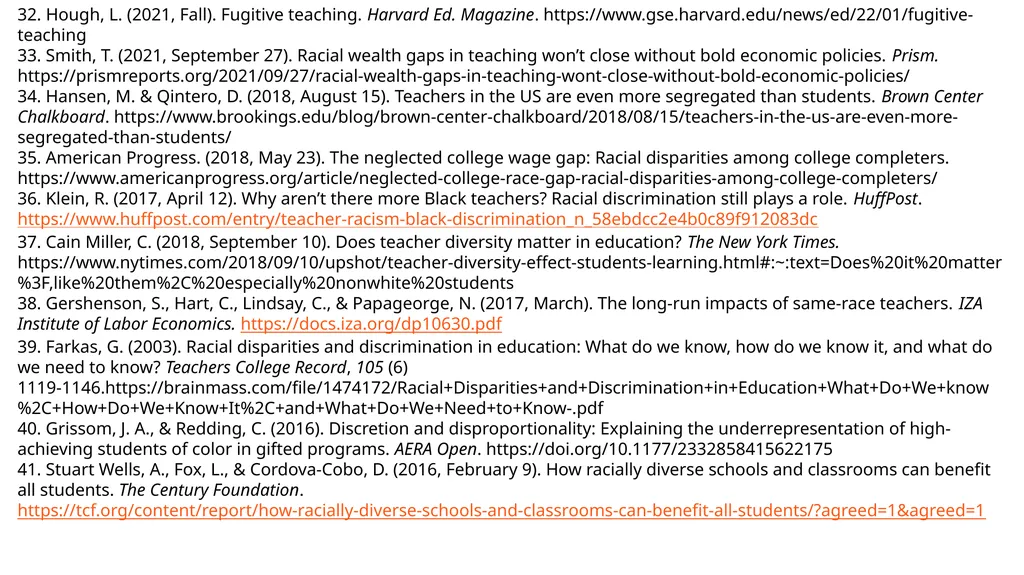
32. Hough, L. (2021, Fall). Fugitive teaching. Harvard Ed. Magazine. https://www.gse.harvard.edu/news/ed/22/01/fugitive-teaching
33. Smith, T. (2021, September 27). Racial wealth gaps in teaching won’t close without bold economic policies. Prism. https://prismreports.org/2021/09/27/racial-wealth-gaps-in-teaching-wont-close-without-bold-economic-policies/
34. Hansen, M. & Qintero, D. (2018, August 15). Teachers in the US are even more segregated than students. Brown Center Chalkboard. https://www.brookings.edu/blog/brown-center-chalkboard/2018/08/15/teachers-in-the-us-are-even-more-segregated-than-students/
35. American Progress. (2018, May 23). The neglected college wage gap: Racial disparities among college completers. https://www.americanprogress.org/article/neglected-college-race-gap-racial-disparities-among-college-completers/
36. Klein, R. (2017, April 12). Why aren’t there more Black teachers? Racial discrimination still plays a role. HuffPost. https://www.huffpost.com/entry/teacher-racism-black-discrimination_n_58ebdcc2e4b0c89f912083dc
37. Cain Miller, C. (2018, September 10). Does teacher diversity matter in education? The New York Times. https://www.nytimes.com/2018/09/10/upshot/teacher-diversity-effect-students-learning.html#:~:text=Does%20it%20matter%3F,like%20them%2C%20especially%20nonwhite%20students
38. Gershenson, S., Hart, C., Lindsay, C., & Papageorge, N. (2017, March). The long-run impacts of same-race teachers. IZA Institute of Labor Economics. https://docs.iza.org/dp10630.pdf
39. Farkas, G. (2003). Racial disparities and discrimination in education: What do we know, how do we know it, and what do we need to know? Teachers College Record, 105 (6) 1119-1146.https://brainmass.com/file/1474172/Racial+Disparities+and+Discrimination+in+Education+What+Do+We+know%2C+How+Do+We+Know+It%2C+and+What+Do+We+Need+to+Know-.pdf
40. Grissom, J. A., & Redding, C. (2016). Discretion and disproportionality: Explaining the underrepresentation of high-achieving students of color in gifted programs. AERA Open. https://doi.org/10.1177/2332858415622175
41. Stuart Wells, A., Fox, L., & Cordova-Cobo, D. (2016, February 9). How racially diverse schools and classrooms can benefit all students. The Century Foundation. https://tcf.org/content/report/how-racially-diverse-schools-and-classrooms-can-benefit-all-students/?agreed=1&agreed=1<br>
33. Smith, T. (2021, September 27). Racial wealth gaps in teaching won’t close without bold economic policies. Prism. https://prismreports.org/2021/09/27/racial-wealth-gaps-in-teaching-wont-close-without-bold-economic-policies/
34. Hansen, M. & Qintero, D. (2018, August 15). Teachers in the US are even more segregated than students. Brown Center Chalkboard. https://www.brookings.edu/blog/brown-center-chalkboard/2018/08/15/teachers-in-the-us-are-even-more-segregated-than-students/
35. American Progress. (2018, May 23). The neglected college wage gap: Racial disparities among college completers. https://www.americanprogress.org/article/neglected-college-race-gap-racial-disparities-among-college-completers/
36. Klein, R. (2017, April 12). Why aren’t there more Black teachers? Racial discrimination still plays a role. HuffPost. https://www.huffpost.com/entry/teacher-racism-black-discrimination_n_58ebdcc2e4b0c89f912083dc
37. Cain Miller, C. (2018, September 10). Does teacher diversity matter in education? The New York Times. https://www.nytimes.com/2018/09/10/upshot/teacher-diversity-effect-students-learning.html#:~:text=Does%20it%20matter%3F,like%20them%2C%20especially%20nonwhite%20students
38. Gershenson, S., Hart, C., Lindsay, C., & Papageorge, N. (2017, March). The long-run impacts of same-race teachers. IZA Institute of Labor Economics. https://docs.iza.org/dp10630.pdf
39. Farkas, G. (2003). Racial disparities and discrimination in education: What do we know, how do we know it, and what do we need to know? Teachers College Record, 105 (6) 1119-1146.https://brainmass.com/file/1474172/Racial+Disparities+and+Discrimination+in+Education+What+Do+We+know%2C+How+Do+We+Know+It%2C+and+What+Do+We+Need+to+Know-.pdf
40. Grissom, J. A., & Redding, C. (2016). Discretion and disproportionality: Explaining the underrepresentation of high-achieving students of color in gifted programs. AERA Open. https://doi.org/10.1177/2332858415622175
41. Stuart Wells, A., Fox, L., & Cordova-Cobo, D. (2016, February 9). How racially diverse schools and classrooms can benefit all students. The Century Foundation. https://tcf.org/content/report/how-racially-diverse-schools-and-classrooms-can-benefit-all-students/?agreed=1&agreed=1<br>
28
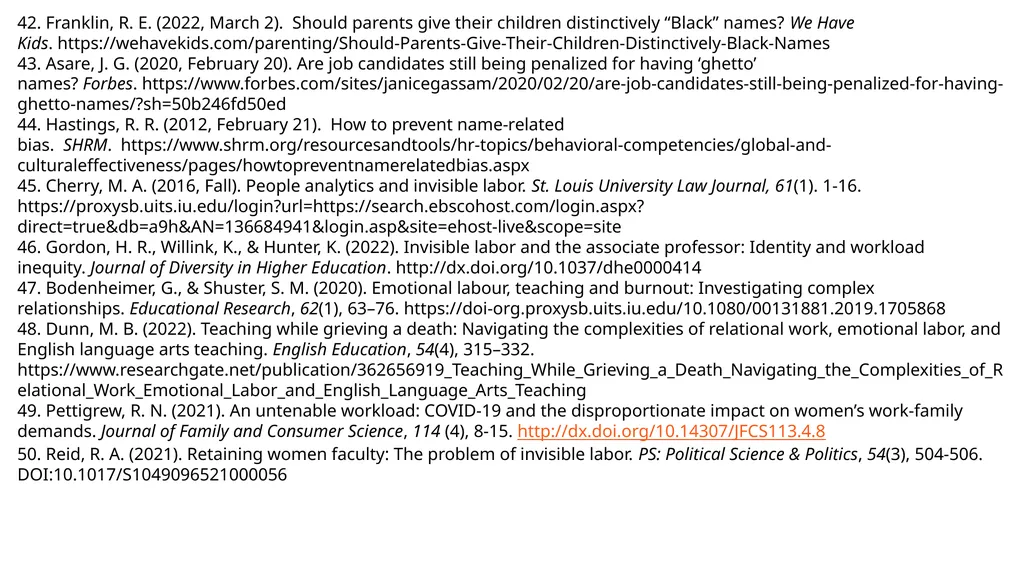
42. Franklin, R. E. (2022, March 2). Should parents give their children distinctively “Black” names? We Have Kids. https://wehavekids.com/parenting/Should-Parents-Give-Their-Children-Distinctively-Black-Names
43. Asare, J. G. (2020, February 20). Are job candidates still being penalized for having ‘ghetto’ names? Forbes. https://www.forbes.com/sites/janicegassam/2020/02/20/are-job-candidates-still-being-penalized-for-having-ghetto-names/?sh=50b246fd50ed
44. Hastings, R. R. (2012, February 21). How to prevent name-related bias. SHRM. https://www.shrm.org/resourcesandtools/hr-topics/behavioral-competencies/global-and-culturaleffectiveness/pages/howtopreventnamerelatedbias.aspx
45. Cherry, M. A. (2016, Fall). People analytics and invisible labor. St. Louis University Law Journal, 61(1). 1-16. https://proxysb.uits.iu.edu/login?url=https://search.ebscohost.com/login.aspx?direct=true&db=a9h&AN=136684941&login.asp&site=ehost-live&scope=site
46. Gordon, H. R., Willink, K., & Hunter, K. (2022). Invisible labor and the associate professor: Identity and workload inequity. Journal of Diversity in Higher Education. http://dx.doi.org/10.1037/dhe0000414
47. Bodenheimer, G., & Shuster, S. M. (2020). Emotional labour, teaching and burnout: Investigating complex relationships. Educational Research, 62(1), 63–76. https://doi-org.proxysb.uits.iu.edu/10.1080/00131881.2019.1705868
48. Dunn, M. B. (2022). Teaching while grieving a death: Navigating the complexities of relational work, emotional labor, and English language arts teaching. English Education, 54(4), 315–332. https://www.researchgate.net/publication/362656919_Teaching_While_Grieving_a_Death_Navigating_the_Complexities_of_Relational_Work_Emotional_Labor_and_English_Language_Arts_Teaching
49. Pettigrew, R. N. (2021). An untenable workload: COVID-19 and the disproportionate impact on women’s work-family demands. Journal of Family and Consumer Science, 114 (4), 8-15. http://dx.doi.org/10.14307/JFCS113.4.8
50. Reid, R. A. (2021). Retaining women faculty: The problem of invisible labor. PS: Political Science & Politics, 54(3), 504-506. DOI:10.1017/S1049096521000056<br>
43. Asare, J. G. (2020, February 20). Are job candidates still being penalized for having ‘ghetto’ names? Forbes. https://www.forbes.com/sites/janicegassam/2020/02/20/are-job-candidates-still-being-penalized-for-having-ghetto-names/?sh=50b246fd50ed
44. Hastings, R. R. (2012, February 21). How to prevent name-related bias. SHRM. https://www.shrm.org/resourcesandtools/hr-topics/behavioral-competencies/global-and-culturaleffectiveness/pages/howtopreventnamerelatedbias.aspx
45. Cherry, M. A. (2016, Fall). People analytics and invisible labor. St. Louis University Law Journal, 61(1). 1-16. https://proxysb.uits.iu.edu/login?url=https://search.ebscohost.com/login.aspx?direct=true&db=a9h&AN=136684941&login.asp&site=ehost-live&scope=site
46. Gordon, H. R., Willink, K., & Hunter, K. (2022). Invisible labor and the associate professor: Identity and workload inequity. Journal of Diversity in Higher Education. http://dx.doi.org/10.1037/dhe0000414
47. Bodenheimer, G., & Shuster, S. M. (2020). Emotional labour, teaching and burnout: Investigating complex relationships. Educational Research, 62(1), 63–76. https://doi-org.proxysb.uits.iu.edu/10.1080/00131881.2019.1705868
48. Dunn, M. B. (2022). Teaching while grieving a death: Navigating the complexities of relational work, emotional labor, and English language arts teaching. English Education, 54(4), 315–332. https://www.researchgate.net/publication/362656919_Teaching_While_Grieving_a_Death_Navigating_the_Complexities_of_Relational_Work_Emotional_Labor_and_English_Language_Arts_Teaching
49. Pettigrew, R. N. (2021). An untenable workload: COVID-19 and the disproportionate impact on women’s work-family demands. Journal of Family and Consumer Science, 114 (4), 8-15. http://dx.doi.org/10.14307/JFCS113.4.8
50. Reid, R. A. (2021). Retaining women faculty: The problem of invisible labor. PS: Political Science & Politics, 54(3), 504-506. DOI:10.1017/S1049096521000056<br>
29
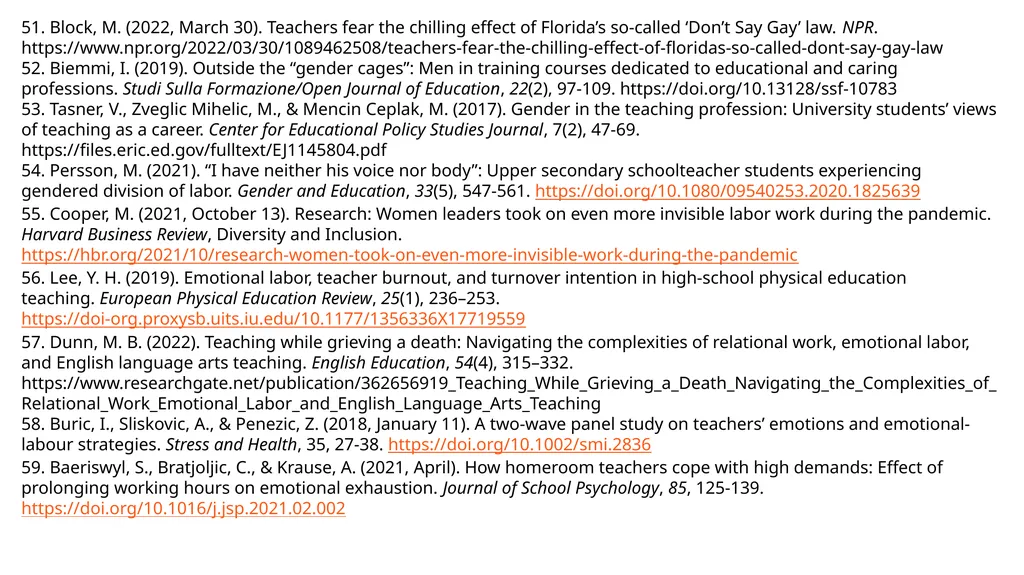
51. Block, M. (2022, March 30). Teachers fear the chilling effect of Florida’s so-called ‘Don’t Say Gay’ law. NPR. https://www.npr.org/2022/03/30/1089462508/teachers-fear-the-chilling-effect-of-floridas-so-called-dont-say-gay-law
52. Biemmi, I. (2019). Outside the “gender cages”: Men in training courses dedicated to educational and caring professions. Studi Sulla Formazione/Open Journal of Education, 22(2), 97-109. https://doi.org/10.13128/ssf-10783
53. Tasner, V., Zveglic Mihelic, M., & Mencin Ceplak, M. (2017). Gender in the teaching profession: University students’ views of teaching as a career. Center for Educational Policy Studies Journal, 7(2), 47-69. https://files.eric.ed.gov/fulltext/EJ1145804.pdf
54. Persson, M. (2021). “I have neither his voice nor body”: Upper secondary schoolteacher students experiencing gendered division of labor. Gender and Education, 33(5), 547-561. https://doi.org/10.1080/09540253.2020.1825639
55. Cooper, M. (2021, October 13). Research: Women leaders took on even more invisible labor work during the pandemic. Harvard Business Review, Diversity and Inclusion. https://hbr.org/2021/10/research-women-took-on-even-more-invisible-work-during-the-pandemic
56. Lee, Y. H. (2019). Emotional labor, teacher burnout, and turnover intention in high-school physical education teaching. European Physical Education Review, 25(1), 236–253. https://doi-org.proxysb.uits.iu.edu/10.1177/1356336X17719559
57. Dunn, M. B. (2022). Teaching while grieving a death: Navigating the complexities of relational work, emotional labor, and English language arts teaching. English Education, 54(4), 315–332. https://www.researchgate.net/publication/362656919_Teaching_While_Grieving_a_Death_Navigating_the_Complexities_of_Relational_Work_Emotional_Labor_and_English_Language_Arts_Teaching
58. Buric, I., Sliskovic, A., & Penezic, Z. (2018, January 11). A two-wave panel study on teachers’ emotions and emotional-labour strategies. Stress and Health, 35, 27-38. https://doi.org/10.1002/smi.2836
59. Baeriswyl, S., Bratjoljic, C., & Krause, A. (2021, April). How homeroom teachers cope with high demands: Effect of prolonging working hours on emotional exhaustion. Journal of School Psychology, 85, 125-139. https://doi.org/10.1016/j.jsp.2021.02.002<br>
52. Biemmi, I. (2019). Outside the “gender cages”: Men in training courses dedicated to educational and caring professions. Studi Sulla Formazione/Open Journal of Education, 22(2), 97-109. https://doi.org/10.13128/ssf-10783
53. Tasner, V., Zveglic Mihelic, M., & Mencin Ceplak, M. (2017). Gender in the teaching profession: University students’ views of teaching as a career. Center for Educational Policy Studies Journal, 7(2), 47-69. https://files.eric.ed.gov/fulltext/EJ1145804.pdf
54. Persson, M. (2021). “I have neither his voice nor body”: Upper secondary schoolteacher students experiencing gendered division of labor. Gender and Education, 33(5), 547-561. https://doi.org/10.1080/09540253.2020.1825639
55. Cooper, M. (2021, October 13). Research: Women leaders took on even more invisible labor work during the pandemic. Harvard Business Review, Diversity and Inclusion. https://hbr.org/2021/10/research-women-took-on-even-more-invisible-work-during-the-pandemic
56. Lee, Y. H. (2019). Emotional labor, teacher burnout, and turnover intention in high-school physical education teaching. European Physical Education Review, 25(1), 236–253. https://doi-org.proxysb.uits.iu.edu/10.1177/1356336X17719559
57. Dunn, M. B. (2022). Teaching while grieving a death: Navigating the complexities of relational work, emotional labor, and English language arts teaching. English Education, 54(4), 315–332. https://www.researchgate.net/publication/362656919_Teaching_While_Grieving_a_Death_Navigating_the_Complexities_of_Relational_Work_Emotional_Labor_and_English_Language_Arts_Teaching
58. Buric, I., Sliskovic, A., & Penezic, Z. (2018, January 11). A two-wave panel study on teachers’ emotions and emotional-labour strategies. Stress and Health, 35, 27-38. https://doi.org/10.1002/smi.2836
59. Baeriswyl, S., Bratjoljic, C., & Krause, A. (2021, April). How homeroom teachers cope with high demands: Effect of prolonging working hours on emotional exhaustion. Journal of School Psychology, 85, 125-139. https://doi.org/10.1016/j.jsp.2021.02.002<br>
30
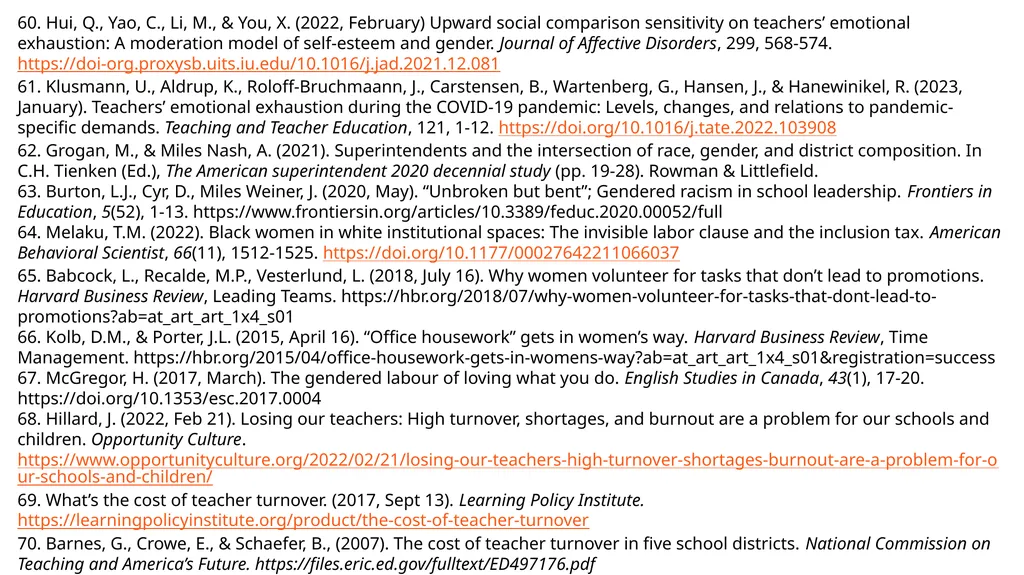
60. Hui, Q., Yao, C., Li, M., & You, X. (2022, February) Upward social comparison sensitivity on teachers’ emotional exhaustion: A moderation model of self-esteem and gender. Journal of Affective Disorders, 299, 568-574. https://doi-org.proxysb.uits.iu.edu/10.1016/j.jad.2021.12.081
61. Klusmann, U., Aldrup, K., Roloff-Bruchmaann, J., Carstensen, B., Wartenberg, G., Hansen, J., & Hanewinikel, R. (2023, January). Teachers’ emotional exhaustion during the COVID-19 pandemic: Levels, changes, and relations to pandemic-specific demands. Teaching and Teacher Education, 121, 1-12. https://doi.org/10.1016/j.tate.2022.103908
62. Grogan, M., & Miles Nash, A. (2021). Superintendents and the intersection of race, gender, and district composition. In C.H. Tienken (Ed.), The American superintendent 2020 decennial study (pp. 19-28). Rowman & Littlefield.
63. Burton, L.J., Cyr, D., Miles Weiner, J. (2020, May). “Unbroken but bent”; Gendered racism in school leadership. Frontiers in Education, 5(52), 1-13. https://www.frontiersin.org/articles/10.3389/feduc.2020.00052/full
64. Melaku, T.M. (2022). Black women in white institutional spaces: The invisible labor clause and the inclusion tax. American Behavioral Scientist, 66(11), 1512-1525. https://doi.org/10.1177/00027642211066037
65. Babcock, L., Recalde, M.P., Vesterlund, L. (2018, July 16). Why women volunteer for tasks that don’t lead to promotions. Harvard Business Review, Leading Teams. https://hbr.org/2018/07/why-women-volunteer-for-tasks-that-dont-lead-to-promotions?ab=at_art_art_1x4_s01
66. Kolb, D.M., & Porter, J.L. (2015, April 16). “Office housework” gets in women’s way. Harvard Business Review, Time Management. https://hbr.org/2015/04/office-housework-gets-in-womens-way?ab=at_art_art_1x4_s01®istration=success
67. McGregor, H. (2017, March). The gendered labour of loving what you do. English Studies in Canada, 43(1), 17-20. https://doi.org/10.1353/esc.2017.0004
68. Hillard, J. (2022, Feb 21). Losing our teachers: High turnover, shortages, and burnout are a problem for our schools and children. Opportunity Culture. https://www.opportunityculture.org/2022/02/21/losing-our-teachers-high-turnover-shortages-burnout-are-a-problem-for-our-schools-and-children/
69. What’s the cost of teacher turnover. (2017, Sept 13). Learning Policy Institute. https://learningpolicyinstitute.org/product/the-cost-of-teacher-turnover
70. Barnes, G., Crowe, E., & Schaefer, B., (2007). The cost of teacher turnover in five school districts. National Commission on Teaching and America’s Future. https://files.eric.ed.gov/fulltext/ED497176.pdf<br>
61. Klusmann, U., Aldrup, K., Roloff-Bruchmaann, J., Carstensen, B., Wartenberg, G., Hansen, J., & Hanewinikel, R. (2023, January). Teachers’ emotional exhaustion during the COVID-19 pandemic: Levels, changes, and relations to pandemic-specific demands. Teaching and Teacher Education, 121, 1-12. https://doi.org/10.1016/j.tate.2022.103908
62. Grogan, M., & Miles Nash, A. (2021). Superintendents and the intersection of race, gender, and district composition. In C.H. Tienken (Ed.), The American superintendent 2020 decennial study (pp. 19-28). Rowman & Littlefield.
63. Burton, L.J., Cyr, D., Miles Weiner, J. (2020, May). “Unbroken but bent”; Gendered racism in school leadership. Frontiers in Education, 5(52), 1-13. https://www.frontiersin.org/articles/10.3389/feduc.2020.00052/full
64. Melaku, T.M. (2022). Black women in white institutional spaces: The invisible labor clause and the inclusion tax. American Behavioral Scientist, 66(11), 1512-1525. https://doi.org/10.1177/00027642211066037
65. Babcock, L., Recalde, M.P., Vesterlund, L. (2018, July 16). Why women volunteer for tasks that don’t lead to promotions. Harvard Business Review, Leading Teams. https://hbr.org/2018/07/why-women-volunteer-for-tasks-that-dont-lead-to-promotions?ab=at_art_art_1x4_s01
66. Kolb, D.M., & Porter, J.L. (2015, April 16). “Office housework” gets in women’s way. Harvard Business Review, Time Management. https://hbr.org/2015/04/office-housework-gets-in-womens-way?ab=at_art_art_1x4_s01®istration=success
67. McGregor, H. (2017, March). The gendered labour of loving what you do. English Studies in Canada, 43(1), 17-20. https://doi.org/10.1353/esc.2017.0004
68. Hillard, J. (2022, Feb 21). Losing our teachers: High turnover, shortages, and burnout are a problem for our schools and children. Opportunity Culture. https://www.opportunityculture.org/2022/02/21/losing-our-teachers-high-turnover-shortages-burnout-are-a-problem-for-our-schools-and-children/
69. What’s the cost of teacher turnover. (2017, Sept 13). Learning Policy Institute. https://learningpolicyinstitute.org/product/the-cost-of-teacher-turnover
70. Barnes, G., Crowe, E., & Schaefer, B., (2007). The cost of teacher turnover in five school districts. National Commission on Teaching and America’s Future. https://files.eric.ed.gov/fulltext/ED497176.pdf<br>