
Social Networking for Publishers Library
CS
Published · 62 slides · 0 views
1 / 1


Description
Social Networking for Publishers Library Publishing Curriculum Impact Module, Unit 7 Social media is a conversation Remember: its not about you, its about your stakeholders and audience Definitions Social Media: websites and applications
Related Topics
Share
Embed code
Download this presentation From Below
"Social Networking for Publishers Library" is the property of its rightful owner. Permission is granted to download and print the materials on this website for personal, non-commercial use only, and to display it on your personal computer provided you do not modify the materials and that you retain all copyright notices contained in the materials. By downloading content from our website, you accept the terms of this agreement.
Presentation Transcript
01
Social Networking for Publishers Library Publishing Curriculum
Impact Module, Unit 7<br>
Impact Module, Unit 7<br>
02
Social media is a conversation Remember: it’s not about you, it’s about your stakeholders and audience<br>
03
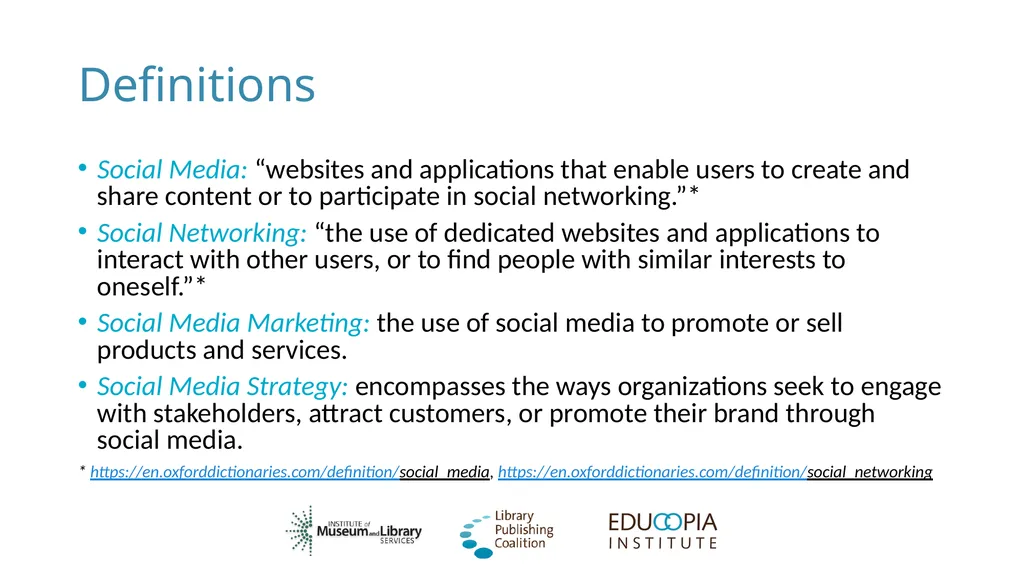
Definitions Social Media: “websites and applications that enable users to create and share content or to participate in social networking.”*
Social Networking: “the use of dedicated websites and applications to interact with other users, or to find people with similar interests to oneself.”*
Social Media Marketing: the use of social media to promote or sell products and services.
Social Media Strategy: encompasses the ways organizations seek to engage with stakeholders, attract customers, or promote their brand through social media.
* https://en.oxforddictionaries.com/definition/social_media, https://en.oxforddictionaries.com/definition/social_networking<br>
Social Networking: “the use of dedicated websites and applications to interact with other users, or to find people with similar interests to oneself.”*
Social Media Marketing: the use of social media to promote or sell products and services.
Social Media Strategy: encompasses the ways organizations seek to engage with stakeholders, attract customers, or promote their brand through social media.
* https://en.oxforddictionaries.com/definition/social_media, https://en.oxforddictionaries.com/definition/social_networking<br>
04
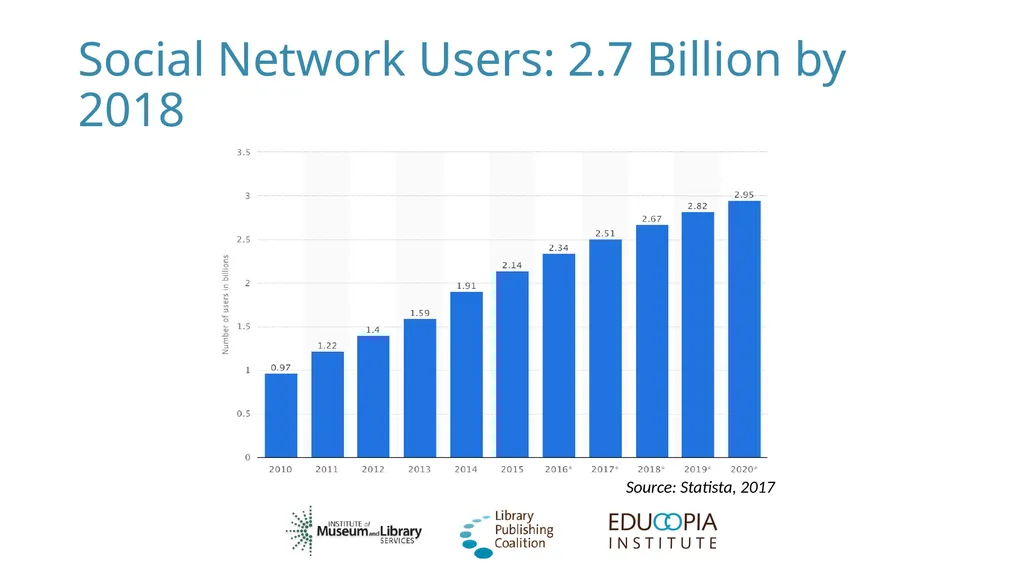
Social Network Users: 2.7 Billion by 2018 Source: Statista, 2017<br>
05
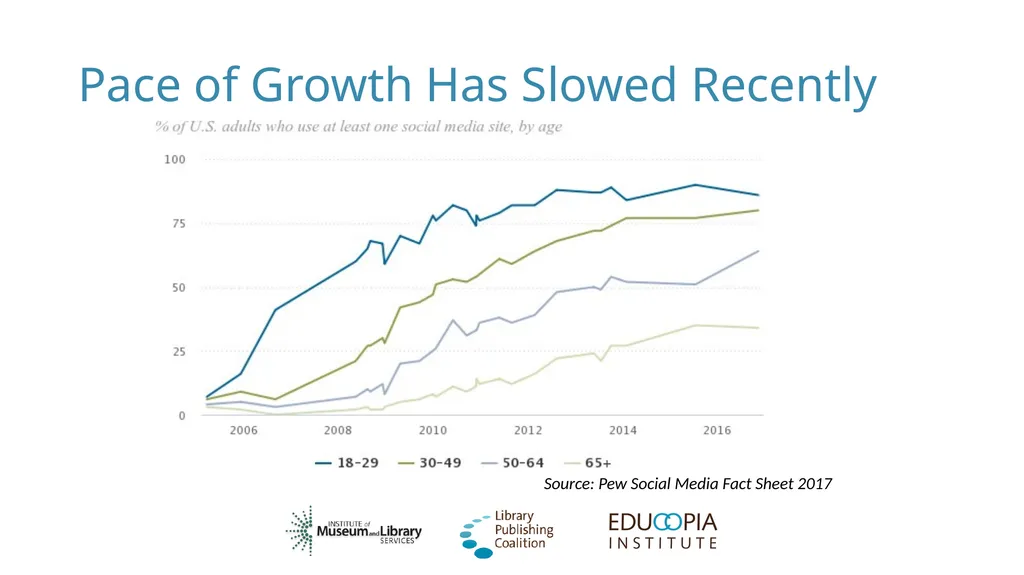
Pace of Growth Has Slowed Recently Source: Pew Social Media Fact Sheet 2017<br>
06
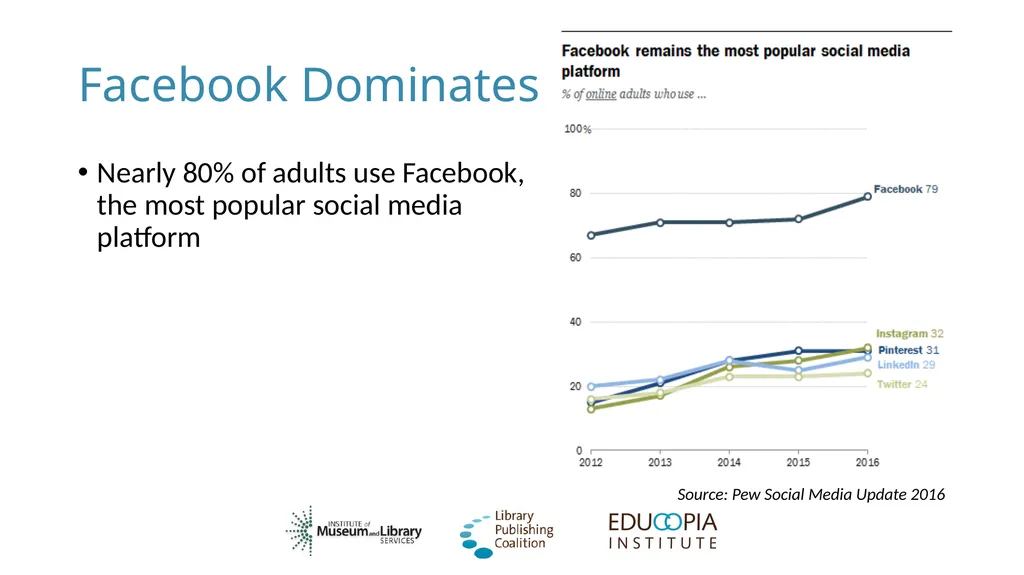
Facebook Dominates Nearly 80% of adults use Facebook, the most popular social media platform Source: Pew Social Media Update 2016<br>
07
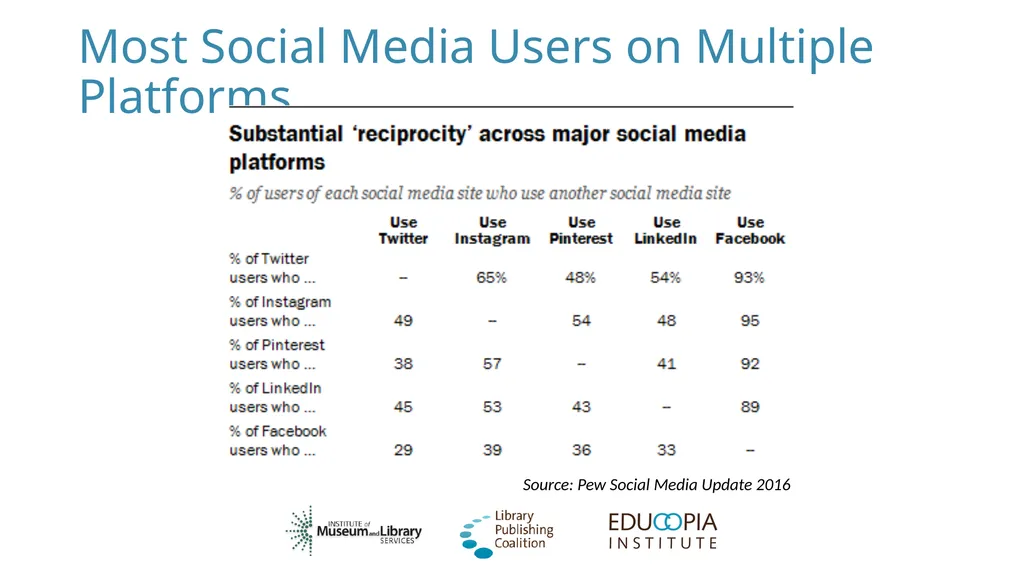
Most Social Media Users on Multiple Platforms Source: Pew Social Media Update 2016<br>
08
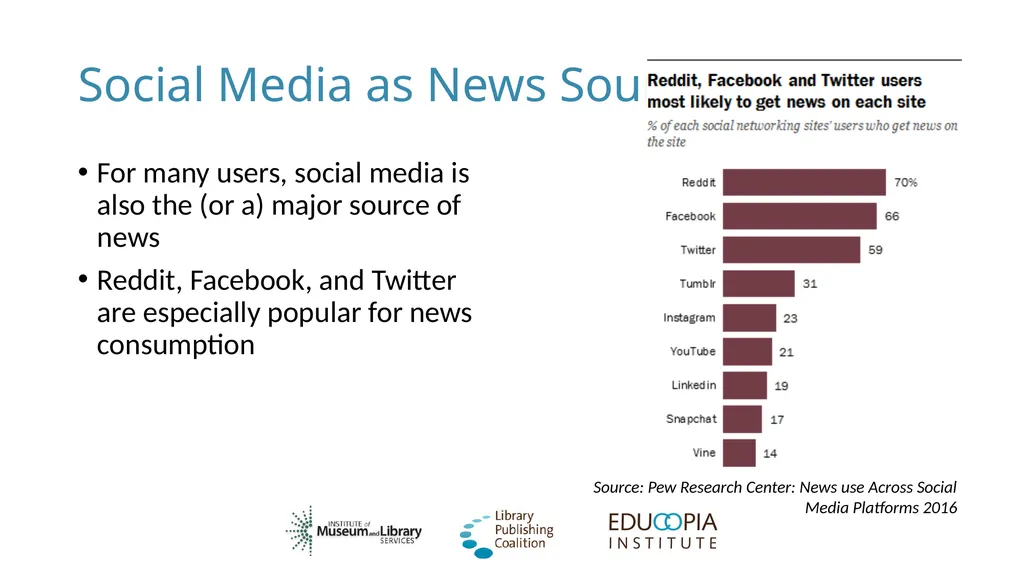
Social Media as News Source For many users, social media is also the (or a) major source of news
Reddit, Facebook, and Twitter are especially popular for news consumption Source: Pew Research Center: News use Across Social Media Platforms 2016<br>
Reddit, Facebook, and Twitter are especially popular for news consumption Source: Pew Research Center: News use Across Social Media Platforms 2016<br>
09
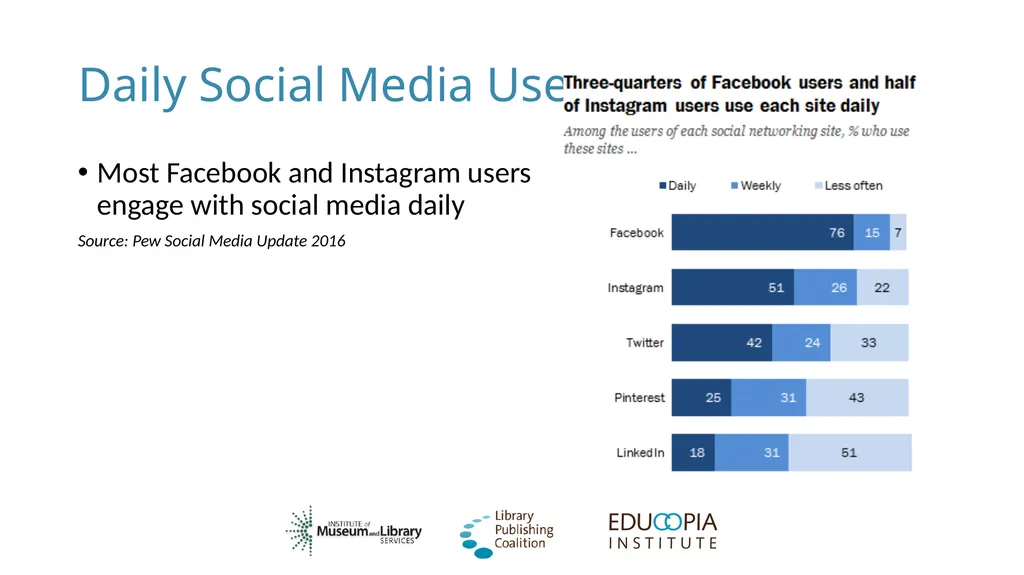
Daily Social Media Use Most Facebook and Instagram users engage with social media daily
Source: Pew Social Media Update 2016<br>
Source: Pew Social Media Update 2016<br>
10
Centering audiences and stakeholders<br>
11
A New Way to Connect Historically, publishers had little direct contact with customers, and almost never a conversation
Publishers traditionally focused on the business-to-business relationships to bring books to the market
Wholesalers
Booksellers
Online Retailers<br>
Publishers traditionally focused on the business-to-business relationships to bring books to the market
Wholesalers
Booksellers
Online Retailers<br>
12
Changing Market, Changing Conversations Transition to digital books and retail channels
Loss of shelf space in traditional venues
Increased consumer use of social media
Technology drives contact and engagement
Increased access to consumer data and feedback
Rise of spreadable media/participatory culture<br>
Loss of shelf space in traditional venues
Increased consumer use of social media
Technology drives contact and engagement
Increased access to consumer data and feedback
Rise of spreadable media/participatory culture<br>
13
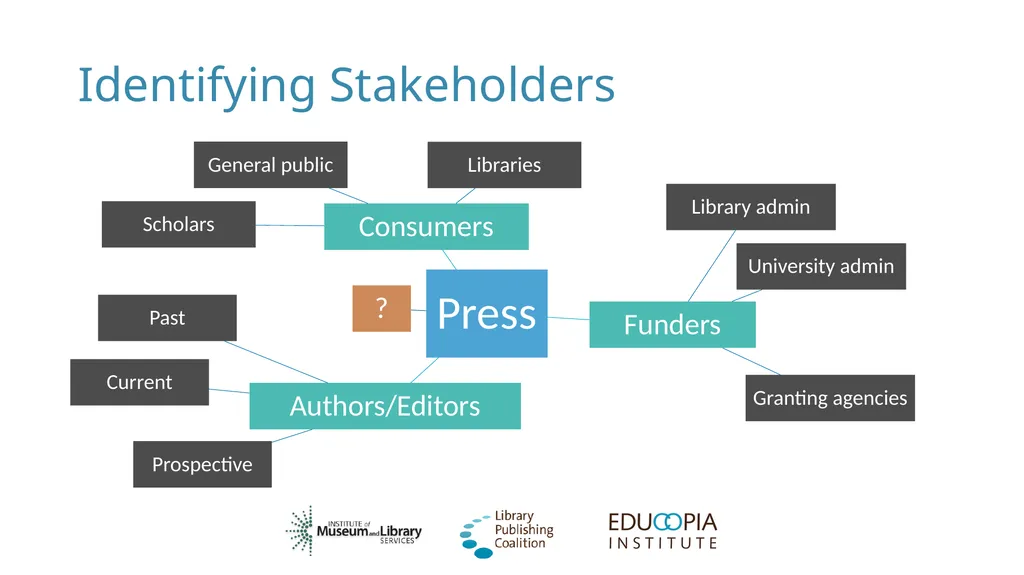
Identifying Stakeholders<br>
14
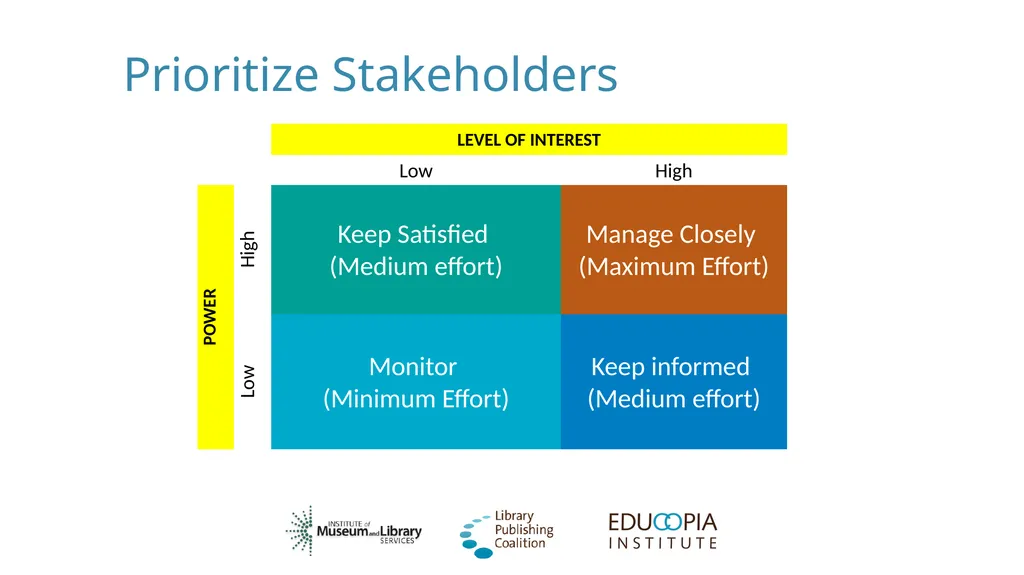
Prioritize Stakeholders<br>
15
Find Your Stakeholders Connect with audiences on the platforms they already use
If resources allow, maintaining multiple social media channels will connect you to different segments of your audience<br>
If resources allow, maintaining multiple social media channels will connect you to different segments of your audience<br>
16
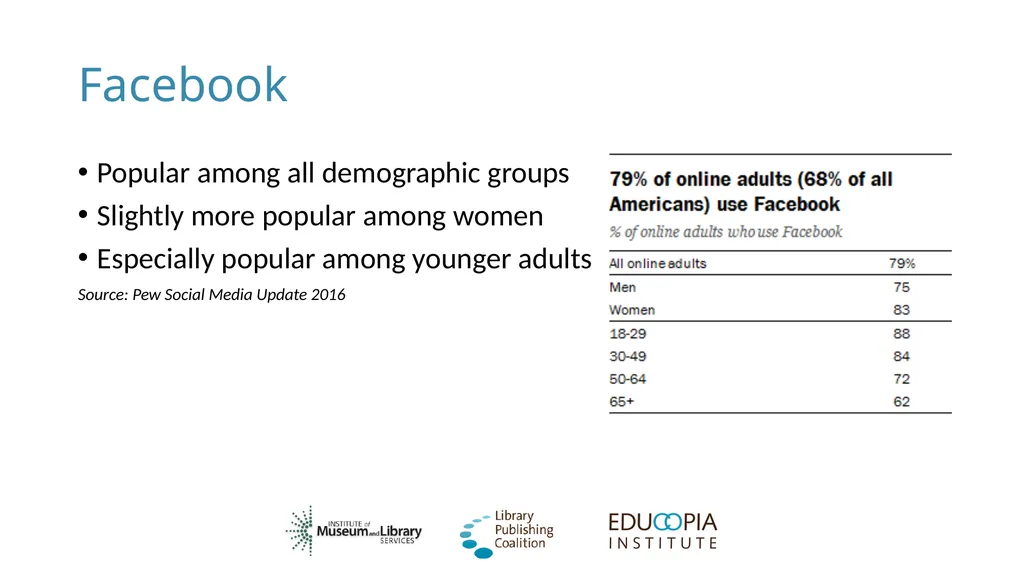
Facebook Popular among all demographic groups
Slightly more popular among women
Especially popular among younger adults
Source: Pew Social Media Update 2016<br>
Slightly more popular among women
Especially popular among younger adults
Source: Pew Social Media Update 2016<br>
17
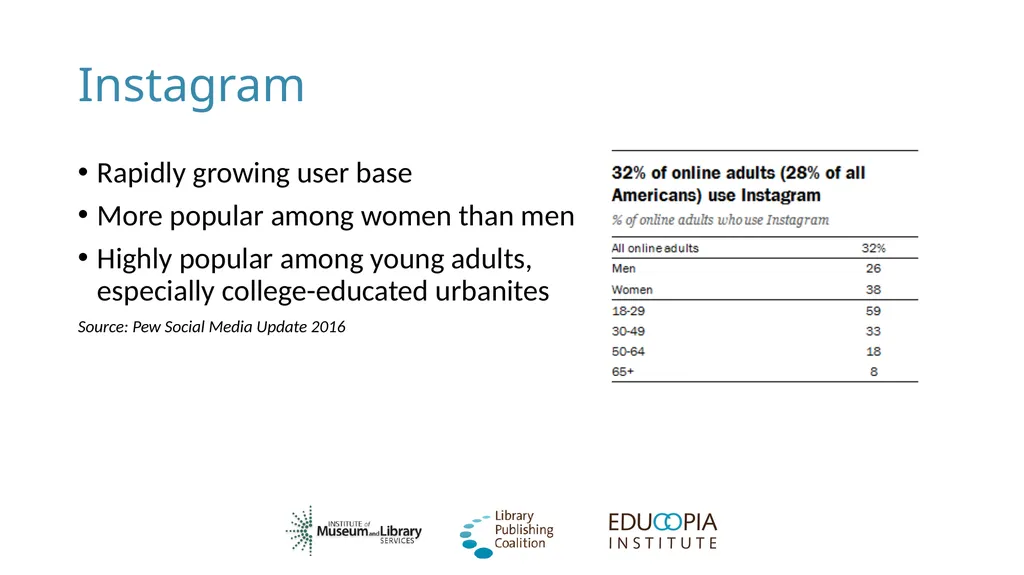
Instagram Rapidly growing user base
More popular among women than men
Highly popular among young adults, especially college-educated urbanites
Source: Pew Social Media Update 2016<br>
More popular among women than men
Highly popular among young adults, especially college-educated urbanites
Source: Pew Social Media Update 2016<br>
18
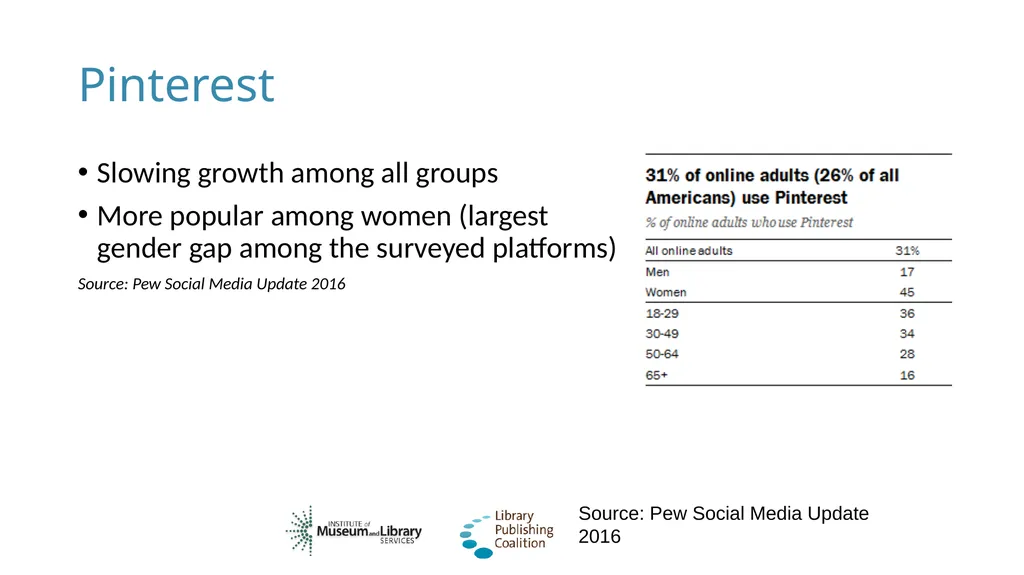
Pinterest Slowing growth among all groups
More popular among women (largest gender gap among the surveyed platforms)
Source: Pew Social Media Update 2016 Source: Pew Social Media Update 2016<br>
More popular among women (largest gender gap among the surveyed platforms)
Source: Pew Social Media Update 2016 Source: Pew Social Media Update 2016<br>
19
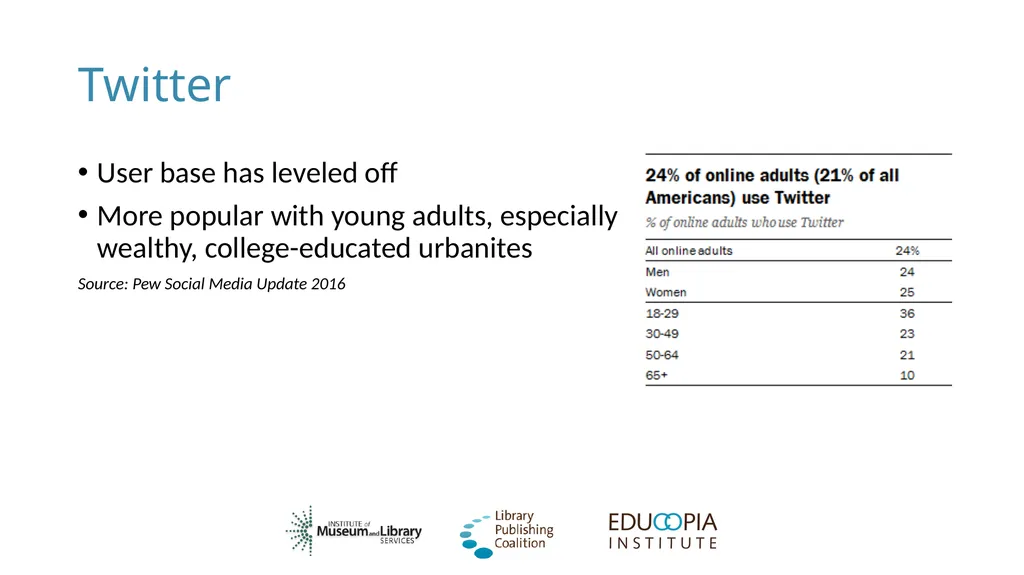
Twitter User base has leveled off
More popular with young adults, especially wealthy, college-educated urbanites
Source: Pew Social Media Update 2016<br>
More popular with young adults, especially wealthy, college-educated urbanites
Source: Pew Social Media Update 2016<br>
20
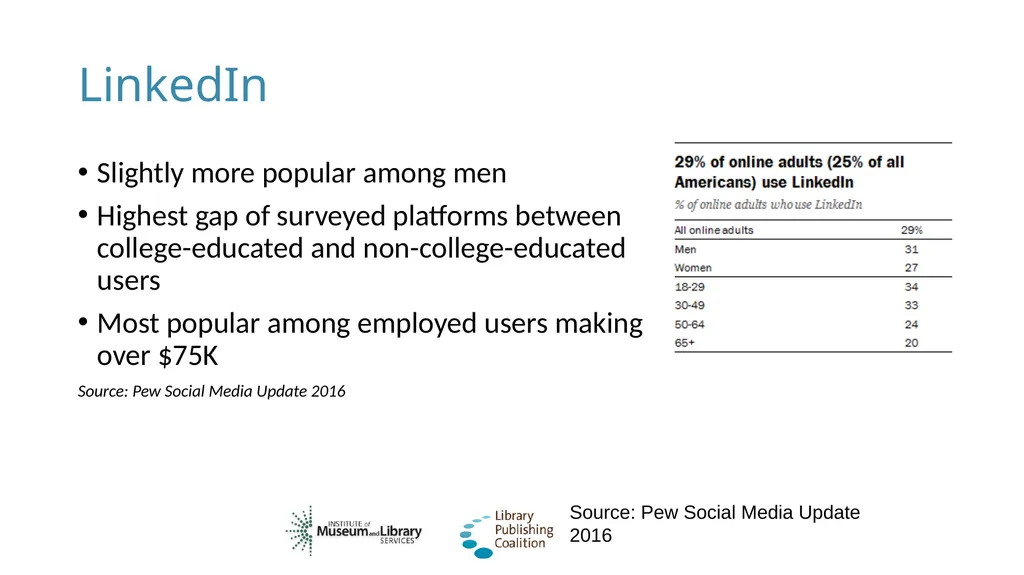
LinkedIn Slightly more popular among men
Highest gap of surveyed platforms between college-educated and non-college-educated users
Most popular among employed users making over $75K
Source: Pew Social Media Update 2016 Source: Pew Social Media Update 2016<br>
Highest gap of surveyed platforms between college-educated and non-college-educated users
Most popular among employed users making over $75K
Source: Pew Social Media Update 2016 Source: Pew Social Media Update 2016<br>
21
Understanding Your Audience Monitor and analyze engagement with your social media channels
Use a software such as Hootsuite to identify patterns, track levels of engagement, and manage your social media presence
Analyze your target audiences’ social media behavior
Where does your audience already hang out?
Who do they already follow?
What kind of content do they engage with?
What hashtags do they use?
Identify influential social media users/channels using tools like SocialMention and Klout<br>
Use a software such as Hootsuite to identify patterns, track levels of engagement, and manage your social media presence
Analyze your target audiences’ social media behavior
Where does your audience already hang out?
Who do they already follow?
What kind of content do they engage with?
What hashtags do they use?
Identify influential social media users/channels using tools like SocialMention and Klout<br>
22
Hearing vs. Listening Hearing: Analyzing the response to your brand or products
What are customers saying about your brand and products?
Listening: Engaging in conversations about your brand, products and making changes in response to customer feedback
How is your organization willing to change based on customers’ viewpoints or interests?<br>
What are customers saying about your brand and products?
Listening: Engaging in conversations about your brand, products and making changes in response to customer feedback
How is your organization willing to change based on customers’ viewpoints or interests?<br>
23
Learning from Peers Review web presence (including underlying code) and social media platforms of comparable publishers
Who follows them?
What type of content do they post? What hashtags do they use?
What can you learn from their social media strategy?<br>
Who follows them?
What type of content do they post? What hashtags do they use?
What can you learn from their social media strategy?<br>
24
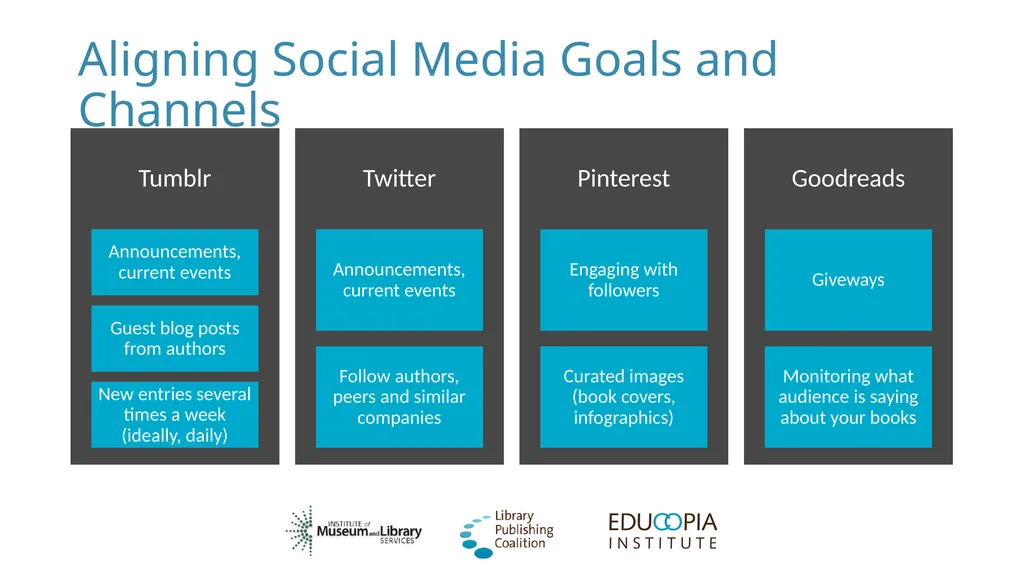
Aligning Social Media Goals and Channels<br>
25
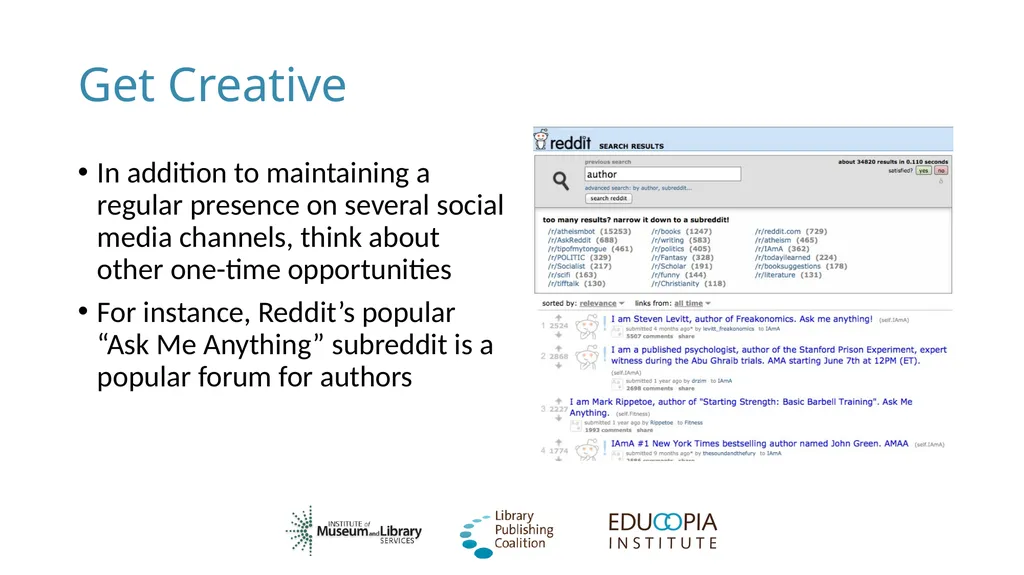
Get Creative In addition to maintaining a regular presence on several social media channels, think about other one-time opportunities
For instance, Reddit’s popular “Ask Me Anything” subreddit is a popular forum for authors<br>
For instance, Reddit’s popular “Ask Me Anything” subreddit is a popular forum for authors<br>
26
Blogging Blogs should be personal, insightful, and relevant
Every post offers an opportunity to drive traffic and generate interest through SEO, links, etc.
Blog posts can add value to a brand by solving challenges, engaging audience
Great blog posts convert readers into leads or customers
Blog posts have a longer “life span” than tweets or Facebook posts<br>
Every post offers an opportunity to drive traffic and generate interest through SEO, links, etc.
Blog posts can add value to a brand by solving challenges, engaging audience
Great blog posts convert readers into leads or customers
Blog posts have a longer “life span” than tweets or Facebook posts<br>
27
Creating engaging content<br>
28
Capturing Attention: Consistency is Key Best to have a consistent voice
It can be a different voice on each platform
Have a plan for regular, informative, and value-added updates
Be discoverable through tags, hashtags, keywords—use these wherever you can
Use SocialMention, Google Alerts, and Google Blog Search, other tools to discover what’s being said about you<br>
It can be a different voice on each platform
Have a plan for regular, informative, and value-added updates
Be discoverable through tags, hashtags, keywords—use these wherever you can
Use SocialMention, Google Alerts, and Google Blog Search, other tools to discover what’s being said about you<br>
29
Capturing Attention: Ongoing Features Develop relatable, ongoing narratives
Follow along with an employee trying to solve a professional or personal challenge
Follow a project through production to completion
Create a regular feature or series that audiences will anticipate
Post new author interview videos every Friday<br>
Follow along with an employee trying to solve a professional or personal challenge
Follow a project through production to completion
Create a regular feature or series that audiences will anticipate
Post new author interview videos every Friday<br>
30
Capturing Attention: Calls to Action Where possible, use a “call to action”: directly invite audiences to engage with your post by commenting, sharing, voting, etc.
Focus on engagement over sales pitches
Follow the 80/20 rule of thumb: 5 “engagement” messages for every 1 sales message<br>
Focus on engagement over sales pitches
Follow the 80/20 rule of thumb: 5 “engagement” messages for every 1 sales message<br>
31
Capturing Attention: Rewards Reward followers or loyal customers through contests, giveaways, raffles and direct, one-on-one engagement<br>
32
Determine Roles and Responsibilities Hire a dedicated social media manager
Find an existing staff member to “take on” social media
Spread responsibilities across a team of staff members, or everyone in the organization<br>
Find an existing staff member to “take on” social media
Spread responsibilities across a team of staff members, or everyone in the organization<br>
33
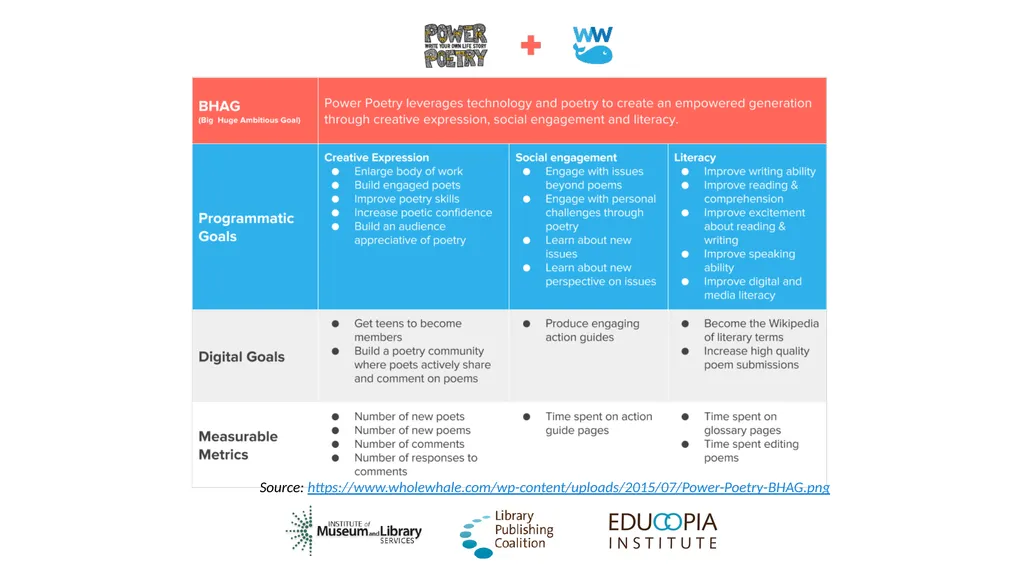
Source: https://www.wholewhale.com/wp-content/uploads/2015/07/Power-Poetry-BHAG.png<br>
34
Define Clear, Measurable Goals Increase website traffic by 25% over the fiscal year
Increase revenue from print sales by 10% over the fiscal year
Increase brand awareness among potential authors and reviewers
Gather (honest) feedback on your publications
Increase readership of a specific title/series/author<br>
Increase revenue from print sales by 10% over the fiscal year
Increase brand awareness among potential authors and reviewers
Gather (honest) feedback on your publications
Increase readership of a specific title/series/author<br>
35
Set a Schedule Develop a marketing calendar with key dates and content
Publication launch dates
Events
Conferences
Upcoming blog posts, author contributions, etc.
Develop a weekly content plan for regular features
Monday (“First lines Monday”), Tuesday (link to a relevant third party article), Weds (“Word Wednesday”), Thursday (special deal), Friday (giveaway), Saturday (post photo), etc.<br>
Publication launch dates
Events
Conferences
Upcoming blog posts, author contributions, etc.
Develop a weekly content plan for regular features
Monday (“First lines Monday”), Tuesday (link to a relevant third party article), Weds (“Word Wednesday”), Thursday (special deal), Friday (giveaway), Saturday (post photo), etc.<br>
36
Establish Policies Which channels will you maintain?
How often will you post?
Who will be responsible for posting on each platform? Does anyone need to approve content before it is posted?
What kinds of content/language/tone are acceptable?<br>
How often will you post?
Who will be responsible for posting on each platform? Does anyone need to approve content before it is posted?
What kinds of content/language/tone are acceptable?<br>
37
Train Staff (and Authors) to Help Don’t be shy about asking (or begging) colleagues for content
Create a rotating blog post schedule, worked out in advance
Provide guidance to authors on promoting their work and expertise through social media<br>
Create a rotating blog post schedule, worked out in advance
Provide guidance to authors on promoting their work and expertise through social media<br>
38
Integrate Social Media into Existing Collateral Include links to social media profiles on your website, catalog, brochures, advertisements, e-newsletters, announcements, etc.
Include “share this” buttons/widgets on all web pages, including individual title pages
Cross-promote social media sites on each platform.<br>
Include “share this” buttons/widgets on all web pages, including individual title pages
Cross-promote social media sites on each platform.<br>
39
Measure Return on Investment Establish goals: Define goals such as a percentage increase in followers or a number of posts per week. Determine in advance how you will define success.
Monitor: Use analytics tools such as Hootsuite, Google Analytics, Klout, and Altmetric to monitor progress. Keep track of which posts generate engagement.
Iterate: Incorporate findings into your social media strategy.<br>
Monitor: Use analytics tools such as Hootsuite, Google Analytics, Klout, and Altmetric to monitor progress. Keep track of which posts generate engagement.
Iterate: Incorporate findings into your social media strategy.<br>
40
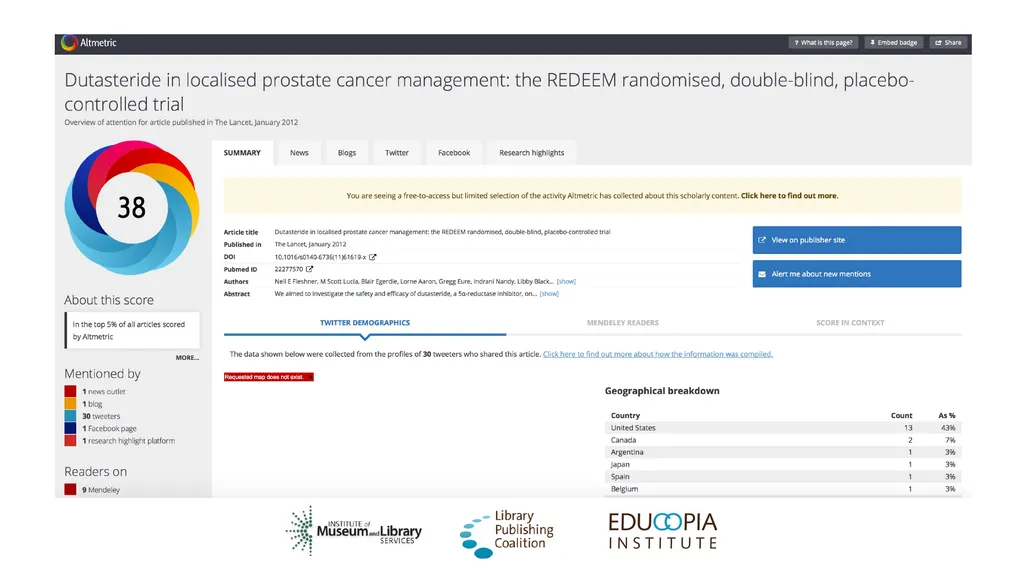
Track Engagement with Altmetric Tracks attention scholarly articles and datasets receive online from sources such as:
Social media (Twitter, Facebook, Google+, Pinterest, blogs, YouTube)
Wikipedia
Gray literature (policy documents)
Mainstream news media (The Guardian, New York Times) and discipline-specific publications (New Scientist, Scientific American)
Online reference managers (Mendeley, CiteULike)<br>
Social media (Twitter, Facebook, Google+, Pinterest, blogs, YouTube)
Wikipedia
Gray literature (policy documents)
Mainstream news media (The Guardian, New York Times) and discipline-specific publications (New Scientist, Scientific American)
Online reference managers (Mendeley, CiteULike)<br>
41
Creating Engaging Social Media Content Engaging content:
Educates
Inspires
Lets audiences inside
Tells a story<br>
Educates
Inspires
Lets audiences inside
Tells a story<br>
42
Stickiness, Spreadability, and Likeability Stickiness: How well does your content attract and hold the attention of site visitors?
We can measure stickiness by looking at the number and length of visits to our website or social media channels.
Spreadability: How well does your content motivate and facilitate the efforts of your audience to “spread” the word
Spreading content far and wide can introduce you and your products to unanticipated new markets.
Likeability: How well do audiences trust you and your brand? How positive is their impression of you?<br>
We can measure stickiness by looking at the number and length of visits to our website or social media channels.
Spreadability: How well does your content motivate and facilitate the efforts of your audience to “spread” the word
Spreading content far and wide can introduce you and your products to unanticipated new markets.
Likeability: How well do audiences trust you and your brand? How positive is their impression of you?<br>
43
“When people are sharing a BuzzFeed list or quiz, they're doing it partly for the content and partly to connect with someone else in their life. When you think about media that way, it starts to look like a form of communication. And when media becomes a form of communication, technology becomes a more important aspect.”
—Jonah Peretti, CEO, BuzzFeed<br>
—Jonah Peretti, CEO, BuzzFeed<br>
44
Social Media Pitfalls Too many profiles to manage
Infrequent updates
Shameless advertising<br>
Infrequent updates
Shameless advertising<br>
45
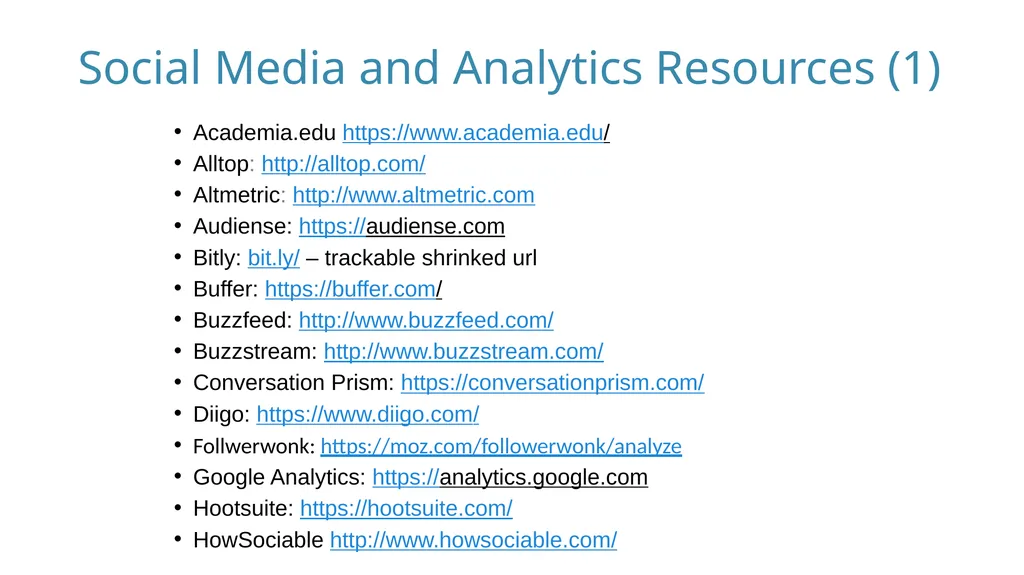
Social Media and Analytics Resources (1) Academia.edu https://www.academia.edu/
Alltop: http://alltop.com/
Altmetric: http://www.altmetric.com
Audiense: https://audiense.com
Bitly: bit.ly/ – trackable shrinked url
Buffer: https://buffer.com/
Buzzfeed: http://www.buzzfeed.com/
Buzzstream: http://www.buzzstream.com/
Conversation Prism: https://conversationprism.com/
Diigo: https://www.diigo.com/
Follwerwonk: https://moz.com/followerwonk/analyze
Google Analytics: https://analytics.google.com
Hootsuite: https://hootsuite.com/
HowSociable http://www.howsociable.com/<br>
Alltop: http://alltop.com/
Altmetric: http://www.altmetric.com
Audiense: https://audiense.com
Bitly: bit.ly/ – trackable shrinked url
Buffer: https://buffer.com/
Buzzfeed: http://www.buzzfeed.com/
Buzzstream: http://www.buzzstream.com/
Conversation Prism: https://conversationprism.com/
Diigo: https://www.diigo.com/
Follwerwonk: https://moz.com/followerwonk/analyze
Google Analytics: https://analytics.google.com
Hootsuite: https://hootsuite.com/
HowSociable http://www.howsociable.com/<br>
46
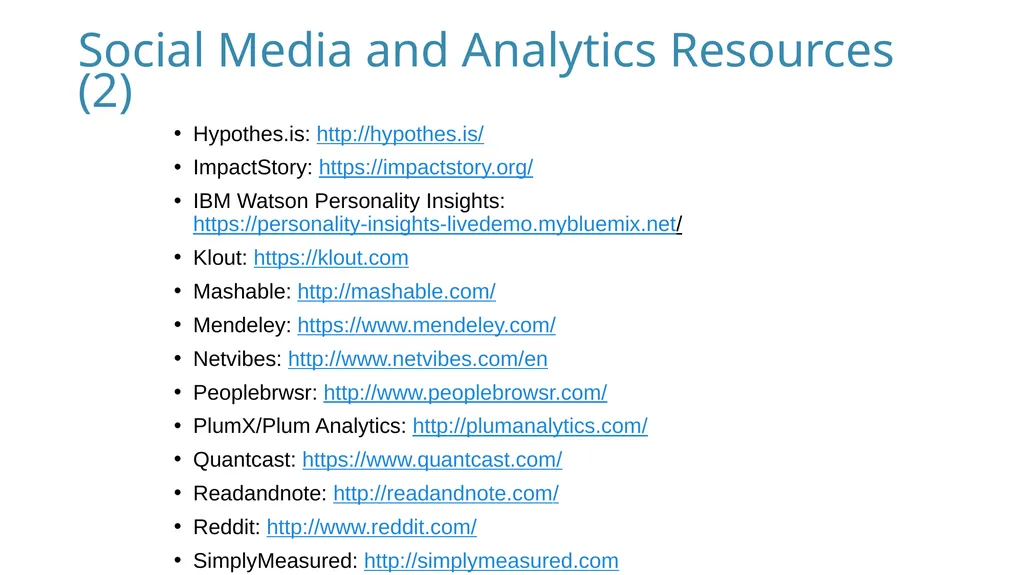
Social Media and Analytics Resources (2) Hypothes.is: http://hypothes.is/
ImpactStory: https://impactstory.org/
IBM Watson Personality Insights: https://personality-insights-livedemo.mybluemix.net/
Klout: https://klout.com
Mashable: http://mashable.com/
Mendeley: https://www.mendeley.com/
Netvibes: http://www.netvibes.com/en
Peoplebrwsr: http://www.peoplebrowsr.com/
PlumX/Plum Analytics: http://plumanalytics.com/
Quantcast: https://www.quantcast.com/
Readandnote: http://readandnote.com/
Reddit: http://www.reddit.com/
SimplyMeasured: http://simplymeasured.com<br>
ImpactStory: https://impactstory.org/
IBM Watson Personality Insights: https://personality-insights-livedemo.mybluemix.net/
Klout: https://klout.com
Mashable: http://mashable.com/
Mendeley: https://www.mendeley.com/
Netvibes: http://www.netvibes.com/en
Peoplebrwsr: http://www.peoplebrowsr.com/
PlumX/Plum Analytics: http://plumanalytics.com/
Quantcast: https://www.quantcast.com/
Readandnote: http://readandnote.com/
Reddit: http://www.reddit.com/
SimplyMeasured: http://simplymeasured.com<br>
47
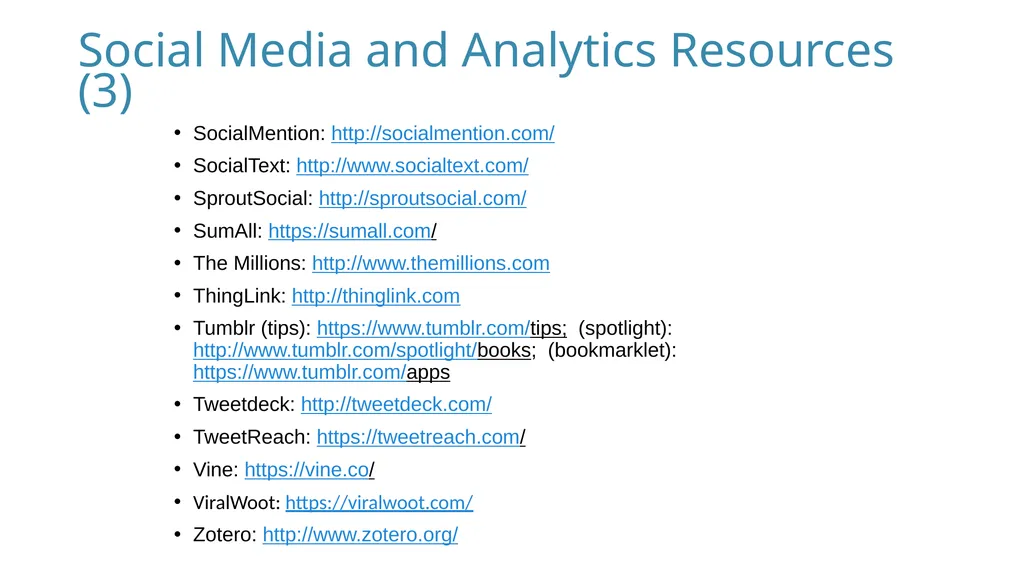
Social Media and Analytics Resources (3) SocialMention: http://socialmention.com/
SocialText: http://www.socialtext.com/
SproutSocial: http://sproutsocial.com/
SumAll: https://sumall.com/
The Millions: http://www.themillions.com
ThingLink: http://thinglink.com
Tumblr (tips): https://www.tumblr.com/tips; (spotlight): http://www.tumblr.com/spotlight/books; (bookmarklet): https://www.tumblr.com/apps
Tweetdeck: http://tweetdeck.com/
TweetReach: https://tweetreach.com/
Vine: https://vine.co/
ViralWoot: https://viralwoot.com/
Zotero: http://www.zotero.org/<br>
SocialText: http://www.socialtext.com/
SproutSocial: http://sproutsocial.com/
SumAll: https://sumall.com/
The Millions: http://www.themillions.com
ThingLink: http://thinglink.com
Tumblr (tips): https://www.tumblr.com/tips; (spotlight): http://www.tumblr.com/spotlight/books; (bookmarklet): https://www.tumblr.com/apps
Tweetdeck: http://tweetdeck.com/
TweetReach: https://tweetreach.com/
Vine: https://vine.co/
ViralWoot: https://viralwoot.com/
Zotero: http://www.zotero.org/<br>
48
Crafting Effective Social Media Content Elements of “Microstyle”<br>
49
Microstyle: Copywriting for the Digital Age Micromessage: An extremely brief communication, part of a societal trend toward shorter messaging
Examples: Tweets, headlines, slogans
Microstyle: Practices for crafting engaging, effective content on a small scale<br>
Examples: Tweets, headlines, slogans
Microstyle: Practices for crafting engaging, effective content on a small scale<br>
50
Creating Meaning in 140 Characters The micromessage is a key that opens the door, the beginning of a journey—meaning is the destination
The less meaning that is explicitly encoded in a message, the more to be discovered in the search for relevance
The human mind takes in information, and relates it to the situation, the context, what you already know and believe, in a search for relevance<br>
The less meaning that is explicitly encoded in a message, the more to be discovered in the search for relevance
The human mind takes in information, and relates it to the situation, the context, what you already know and believe, in a search for relevance<br>
51
Keys to Meaning Clarity, simplicity: Especially in headlines, informational Tweets, email subject lines
Word choice: Pay attention to nuance, take the time to select le mot juste
Imagery: Concepts with sensory and visual appeal very suited to short messages
Emotional appeal: Meaning doesn’t have to be limited to information. Think about how your message makes your audience feel.<br>
Word choice: Pay attention to nuance, take the time to select le mot juste
Imagery: Concepts with sensory and visual appeal very suited to short messages
Emotional appeal: Meaning doesn’t have to be limited to information. Think about how your message makes your audience feel.<br>
52
Tips for Creating and Playing with Meaning Evoke specific situations
Zoom in on vivid details
Tap into metaphor
Use ambiguity with intent
Defy expectations, be surprising<br>
Zoom in on vivid details
Tap into metaphor
Use ambiguity with intent
Defy expectations, be surprising<br>
53
Sound Advice Say it Out Loud: Be aware of how your messages sound when spoken
Keep it simple: Make sure the sound is easy to figure out from the spelling, easy to pronounce, and easy to understand when you hear it
Give it rhythm: Language has rhythm, go with it
Play with Poetic Patterns: Alliteration, rhyme, cadence, the music of language
Make the Sound Fit: Exploit the relationship between sound and meaning<br>
Keep it simple: Make sure the sound is easy to figure out from the spelling, easy to pronounce, and easy to understand when you hear it
Give it rhythm: Language has rhythm, go with it
Play with Poetic Patterns: Alliteration, rhyme, cadence, the music of language
Make the Sound Fit: Exploit the relationship between sound and meaning<br>
54
Structure and Word Play Break the rules: Not always essential to follow grammar, spelling conventions
Coin a new word: neologisms
Make a play on words
Combine words artfully
Use grammar expressively: Combining concepts in certain ways can lead to new insights
Repeat structures: Parallelism adds an extra dimension
Teach an old cliché new tricks: Find a unique twist on an idiom, cliché, or common expression<br>
Coin a new word: neologisms
Make a play on words
Combine words artfully
Use grammar expressively: Combining concepts in certain ways can lead to new insights
Repeat structures: Parallelism adds an extra dimension
Teach an old cliché new tricks: Find a unique twist on an idiom, cliché, or common expression<br>
55
Pay Attention to Context On the web, marketing has become conversational
Evoke conversation: Informal conversational style that people use with family and friends
Memorable enough to be repeated and interesting enough that people will want to repeat it
Establish a relationship: Properties of message set the tone for the relationship you want to establish
What is the context? Work, family, friends?
Create a microvoice: Make a personal impression based on your use of language
“On the internet, nobody knows you’re a dog”<br>
Evoke conversation: Informal conversational style that people use with family and friends
Memorable enough to be repeated and interesting enough that people will want to repeat it
Establish a relationship: Properties of message set the tone for the relationship you want to establish
What is the context? Work, family, friends?
Create a microvoice: Make a personal impression based on your use of language
“On the internet, nobody knows you’re a dog”<br>
56
Activity Applying the SMART Goals Framework to Social Media Strategy<br>
57
Instructions How can we use social networking in service of a strategic priority (“to contribute to undergraduate student success and retention”) and a programmatic goal (“to publish 1 OER by the end of the next fiscal year, focusing on providing alternative course materials for a high-enrollment course”)?
Develop 5 goals specific to social networking.
Make sure to use the SMART framework. Goals should be specific, measurable, achievable, realistic, and time-bound.
Consider different social media platforms and tools, and how to reach different target audiences.
You may make assumptions about their context, resources, etc., but make your assumptions explicit.<br>
Develop 5 goals specific to social networking.
Make sure to use the SMART framework. Goals should be specific, measurable, achievable, realistic, and time-bound.
Consider different social media platforms and tools, and how to reach different target audiences.
You may make assumptions about their context, resources, etc., but make your assumptions explicit.<br>
58
Activity Developing a Social Media Campaign for a New Book<br>
59
Instructions Select one of the scenarios provided.
Develop a short marketing plan that includes the following elements:
Roles and responsibilities (who will perform which marketing functions, including how the author will participate)
Channels (where will you promote your journal and its content)
Content types (will you simply link back to articles, or create webinars, or other original content)
Schedule (how frequently will you aim to update your channels)
Three measurable goals for your social media activities.
Write several Tweets or a short blog post for the book, making sure to apply concepts of microstyle and micromessaging discussed previously.<br>
Develop a short marketing plan that includes the following elements:
Roles and responsibilities (who will perform which marketing functions, including how the author will participate)
Channels (where will you promote your journal and its content)
Content types (will you simply link back to articles, or create webinars, or other original content)
Schedule (how frequently will you aim to update your channels)
Three measurable goals for your social media activities.
Write several Tweets or a short blog post for the book, making sure to apply concepts of microstyle and micromessaging discussed previously.<br>
60
Activity The Dark Side of Impact<br>
61
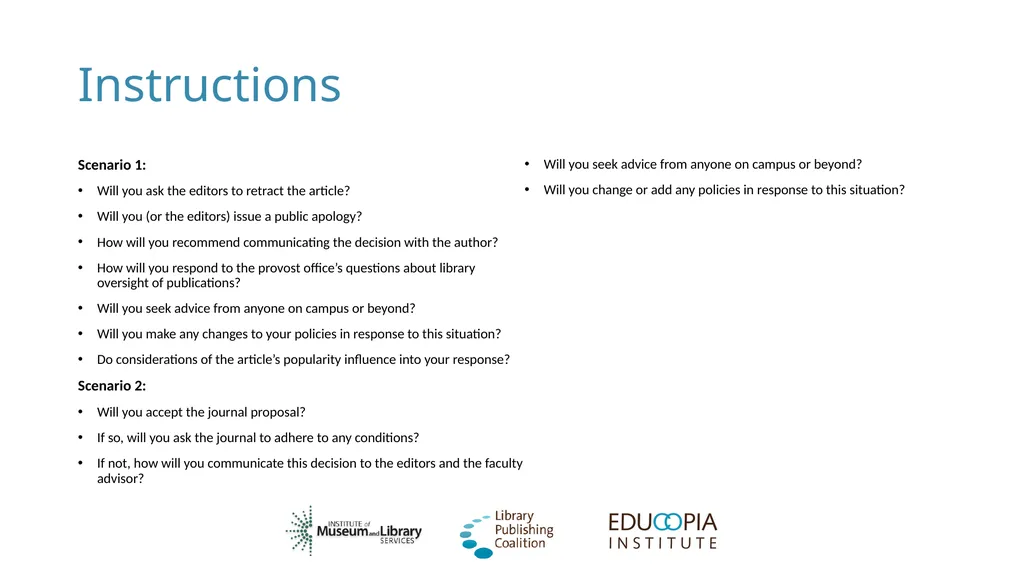
Instructions Scenario 1:
Will you ask the editors to retract the article?
Will you (or the editors) issue a public apology?
How will you recommend communicating the decision with the author?
How will you respond to the provost office’s questions about library oversight of publications?
Will you seek advice from anyone on campus or beyond?
Will you make any changes to your policies in response to this situation?
Do considerations of the article’s popularity influence into your response?
Scenario 2:
Will you accept the journal proposal?
If so, will you ask the journal to adhere to any conditions?
If not, how will you communicate this decision to the editors and the faculty advisor?
Will you seek advice from anyone on campus or beyond?
Will you change or add any policies in response to this situation?<br>
Will you ask the editors to retract the article?
Will you (or the editors) issue a public apology?
How will you recommend communicating the decision with the author?
How will you respond to the provost office’s questions about library oversight of publications?
Will you seek advice from anyone on campus or beyond?
Will you make any changes to your policies in response to this situation?
Do considerations of the article’s popularity influence into your response?
Scenario 2:
Will you accept the journal proposal?
If so, will you ask the journal to adhere to any conditions?
If not, how will you communicate this decision to the editors and the faculty advisor?
Will you seek advice from anyone on campus or beyond?
Will you change or add any policies in response to this situation?<br>