
Solid and Hazardous Waste - New Hazardous
MJ
Published · 28 slides · 0 views
1 / 1
Description
Solid and Hazardous Waste - New Hazardous Secondary Material Rule TAEP August18, 2016 Heather Woodward, CHMM, REM Technical Director WM Environmental Group, LLC 972-516-0300 Agenda Introduction Refresher on the Definition of a Solid
Related Topics
Share
Embed code
Download this presentation From Below
"Solid and Hazardous Waste - New Hazardous" is the property of its rightful owner. Permission is granted to download and print the materials on this website for personal, non-commercial use only, and to display it on your personal computer provided you do not modify the materials and that you retain all copyright notices contained in the materials. By downloading content from our website, you accept the terms of this agreement.
Presentation Transcript
01
Solid and Hazardous Waste -
New Hazardous Secondary Material Rule TAEP – August18, 2016 Heather Woodward, CHMM, REM
Technical Director
W&M Environmental Group, LLC
972-516-0300<br>
Technical Director
W&M Environmental Group, LLC
972-516-0300<br>
02
Agenda Introduction
Refresher on the Definition of a Solid Waste (DSW)
Hazardous Secondary Material (HSM) Rule
What is a HSM?
Refresher on the history of the HSM Rule
Elements of the HSM Rule
Summary
How does the HSM Rule help Generators? 2<br>
Refresher on the Definition of a Solid Waste (DSW)
Hazardous Secondary Material (HSM) Rule
What is a HSM?
Refresher on the history of the HSM Rule
Elements of the HSM Rule
Summary
How does the HSM Rule help Generators? 2<br>
03
I. Introduction
Solid Waste Definition Refresher 3<br>
04
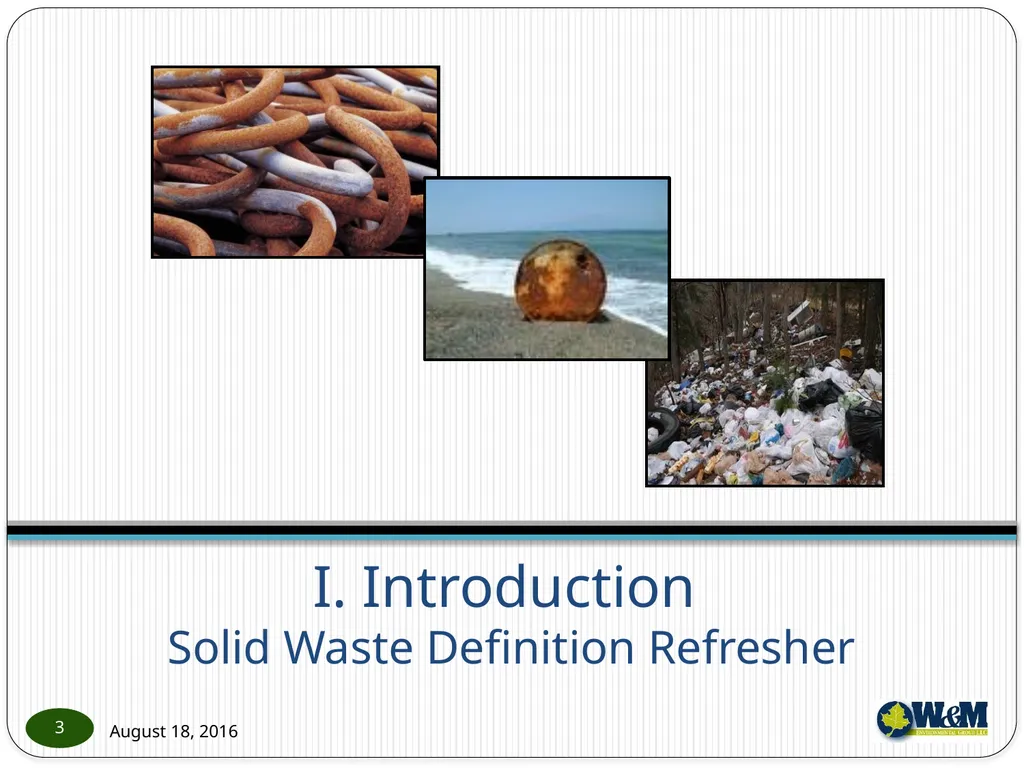
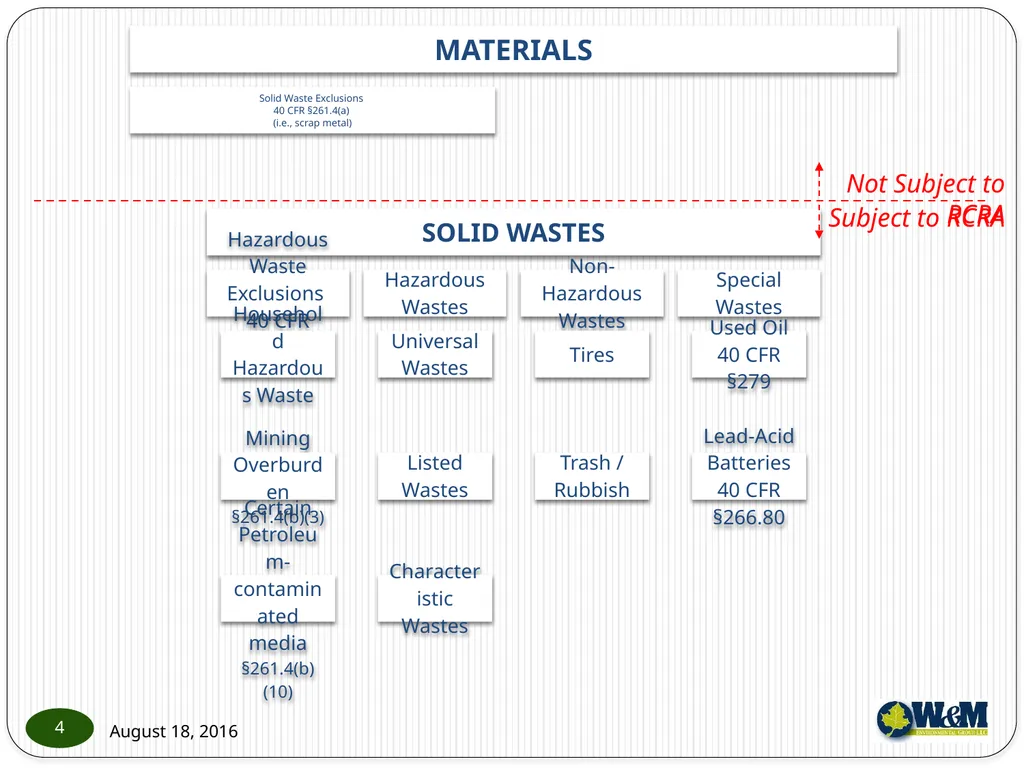
Not Subject to RCRA Subject to RCRA 4<br>
05
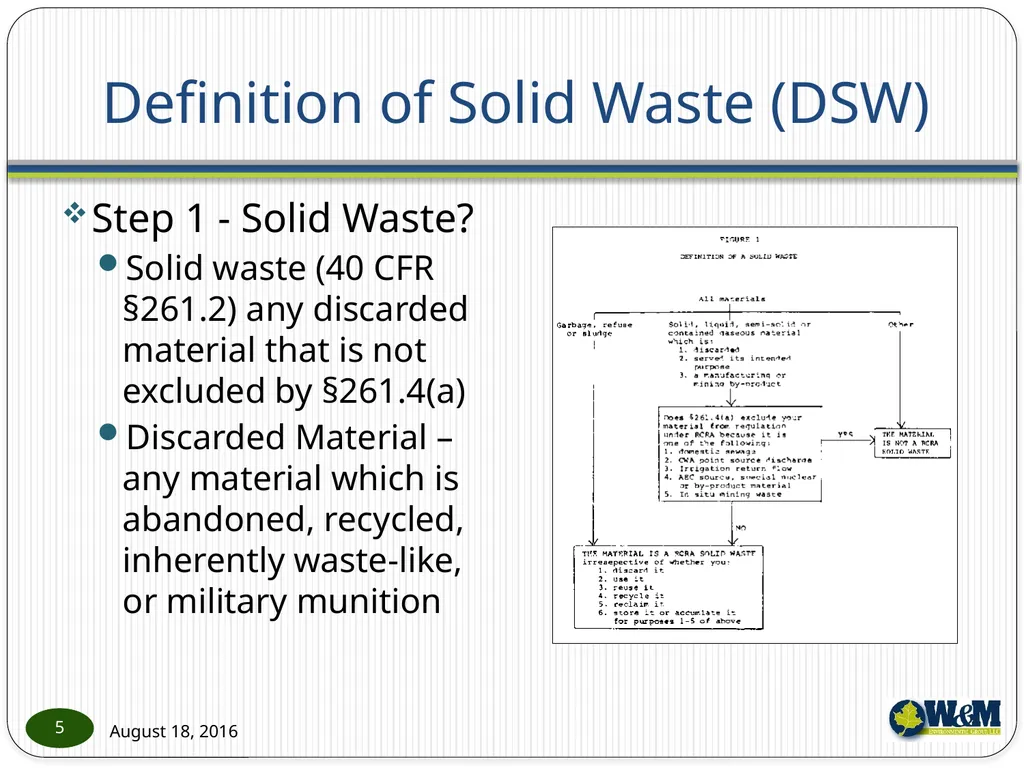
Definition of Solid Waste (DSW) Step 1 - Solid Waste?
Solid waste (40 CFR §261.2) any discarded material that is not excluded by §261.4(a)
Discarded Material – any material which is abandoned, recycled, inherently waste-like, or military munition 5<br>
Solid waste (40 CFR §261.2) any discarded material that is not excluded by §261.4(a)
Discarded Material – any material which is abandoned, recycled, inherently waste-like, or military munition 5<br>
06
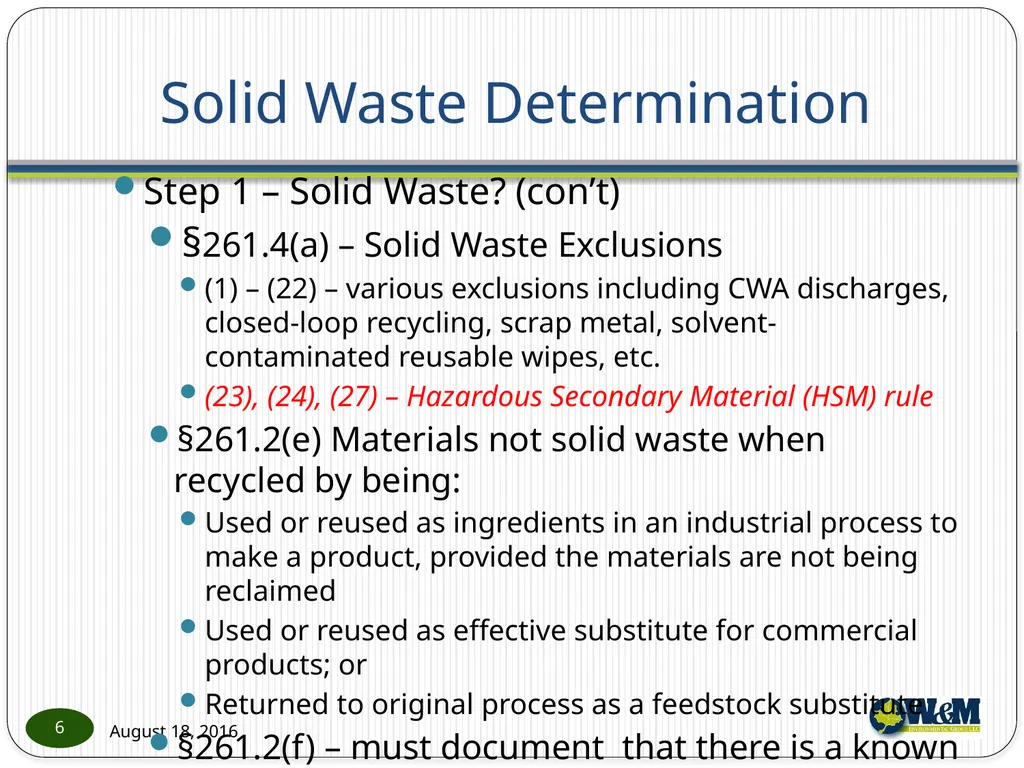
Solid Waste Determination Step 1 – Solid Waste? (con’t)
§261.4(a) – Solid Waste Exclusions
(1) – (22) – various exclusions including CWA discharges, closed-loop recycling, scrap metal, solvent-contaminated reusable wipes, etc.
(23), (24), (27) – Hazardous Secondary Material (HSM) rule
§261.2(e) Materials not solid waste when recycled by being:
Used or reused as ingredients in an industrial process to make a product, provided the materials are not being reclaimed
Used or reused as effective substitute for commercial products; or
Returned to original process as a feedstock substitute
§261.2(f) – must document that there is a known market if sold back into the market 6<br>
§261.4(a) – Solid Waste Exclusions
(1) – (22) – various exclusions including CWA discharges, closed-loop recycling, scrap metal, solvent-contaminated reusable wipes, etc.
(23), (24), (27) – Hazardous Secondary Material (HSM) rule
§261.2(e) Materials not solid waste when recycled by being:
Used or reused as ingredients in an industrial process to make a product, provided the materials are not being reclaimed
Used or reused as effective substitute for commercial products; or
Returned to original process as a feedstock substitute
§261.2(f) – must document that there is a known market if sold back into the market 6<br>
07
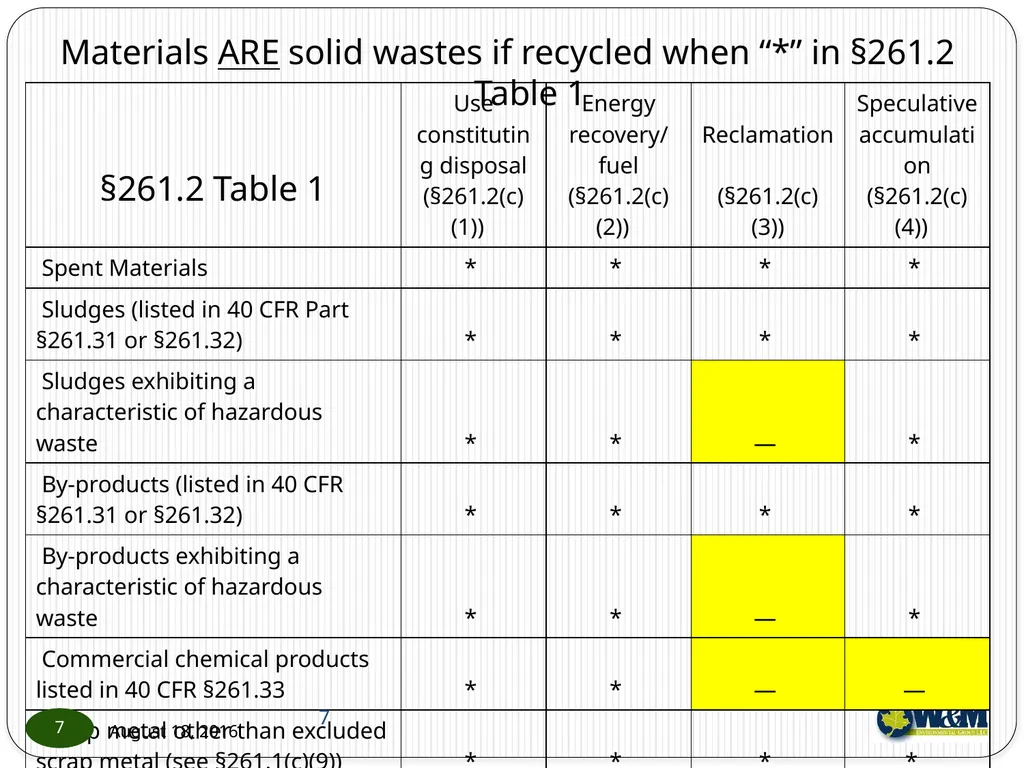
Materials ARE solid wastes if recycled when “*” in §261.2 Table 1 7 7<br>
08
II. Hazardous Secondary Material Rule 8<br>
09
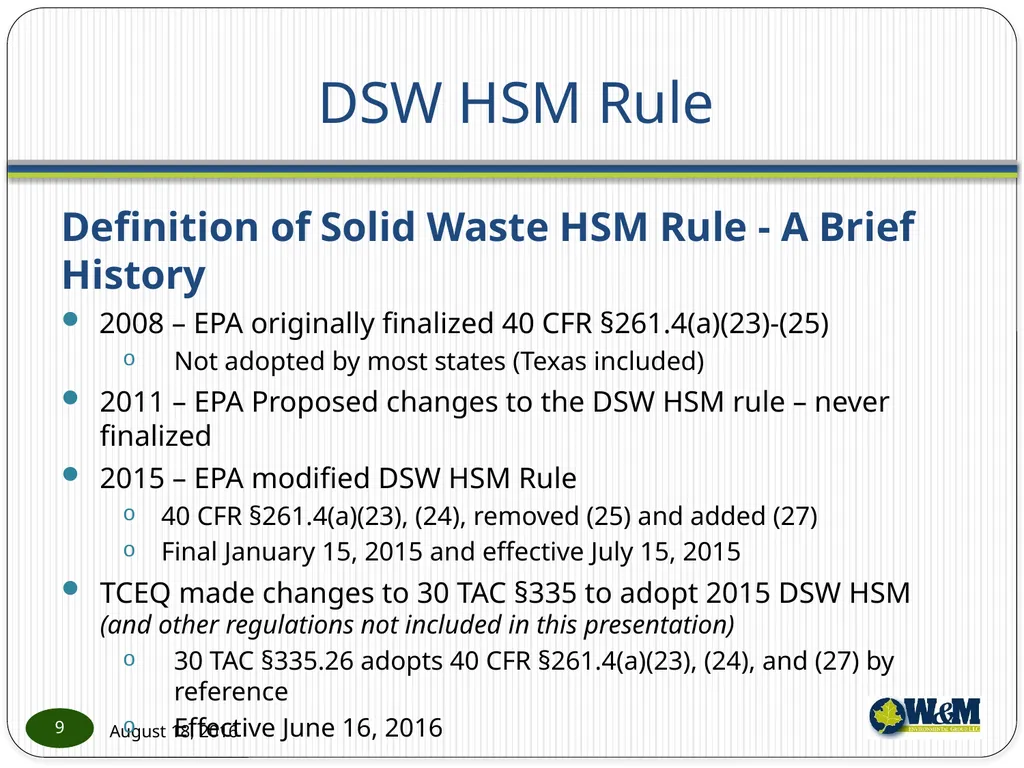
DSW HSM Rule 9 Definition of Solid Waste HSM Rule - A Brief History
2008 – EPA originally finalized 40 CFR §261.4(a)(23)-(25)
Not adopted by most states (Texas included)
2011 – EPA Proposed changes to the DSW HSM rule – never finalized
2015 – EPA modified DSW HSM Rule
40 CFR §261.4(a)(23), (24), removed (25) and added (27)
Final January 15, 2015 and effective July 15, 2015
TCEQ made changes to 30 TAC §335 to adopt 2015 DSW HSM (and other regulations not included in this presentation)
30 TAC §335.26 adopts 40 CFR §261.4(a)(23), (24), and (27) by reference
Effective June 16, 2016<br>
2008 – EPA originally finalized 40 CFR §261.4(a)(23)-(25)
Not adopted by most states (Texas included)
2011 – EPA Proposed changes to the DSW HSM rule – never finalized
2015 – EPA modified DSW HSM Rule
40 CFR §261.4(a)(23), (24), removed (25) and added (27)
Final January 15, 2015 and effective July 15, 2015
TCEQ made changes to 30 TAC §335 to adopt 2015 DSW HSM (and other regulations not included in this presentation)
30 TAC §335.26 adopts 40 CFR §261.4(a)(23), (24), and (27) by reference
Effective June 16, 2016<br>
10
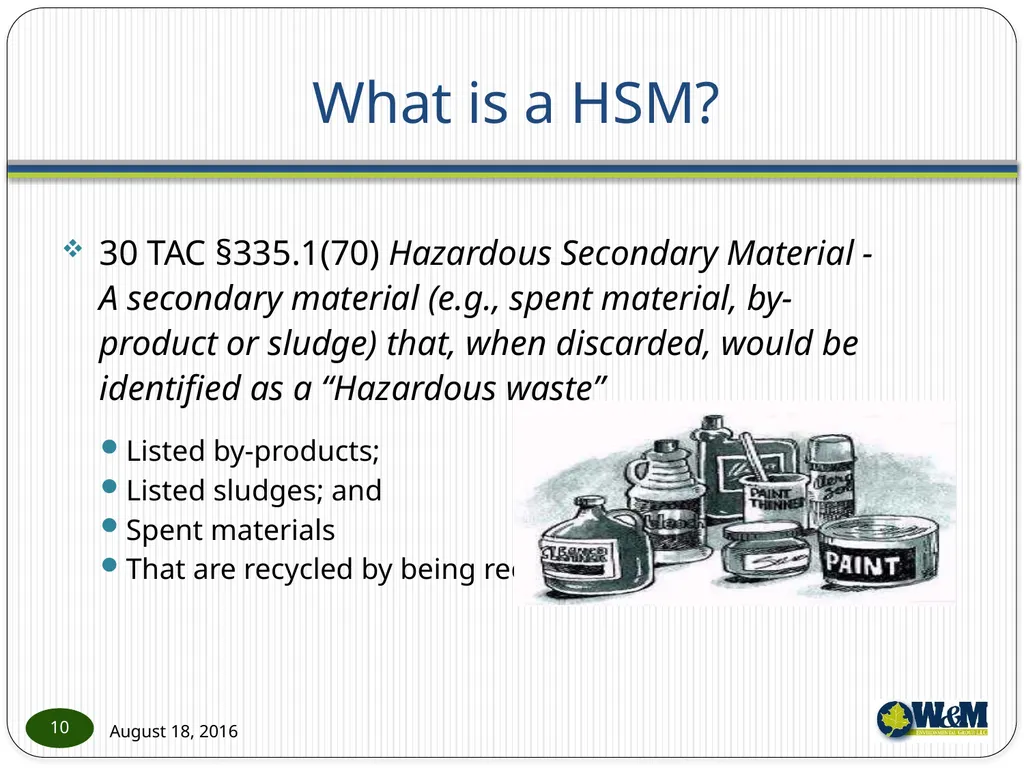
What is a HSM? 30 TAC §335.1(70) Hazardous Secondary Material - A secondary material (e.g., spent material, by-product or sludge) that, when discarded, would be identified as a “Hazardous waste”
Listed by-products;
Listed sludges; and
Spent materials
That are recycled by being reclaimed 10<br>
Listed by-products;
Listed sludges; and
Spent materials
That are recycled by being reclaimed 10<br>
11
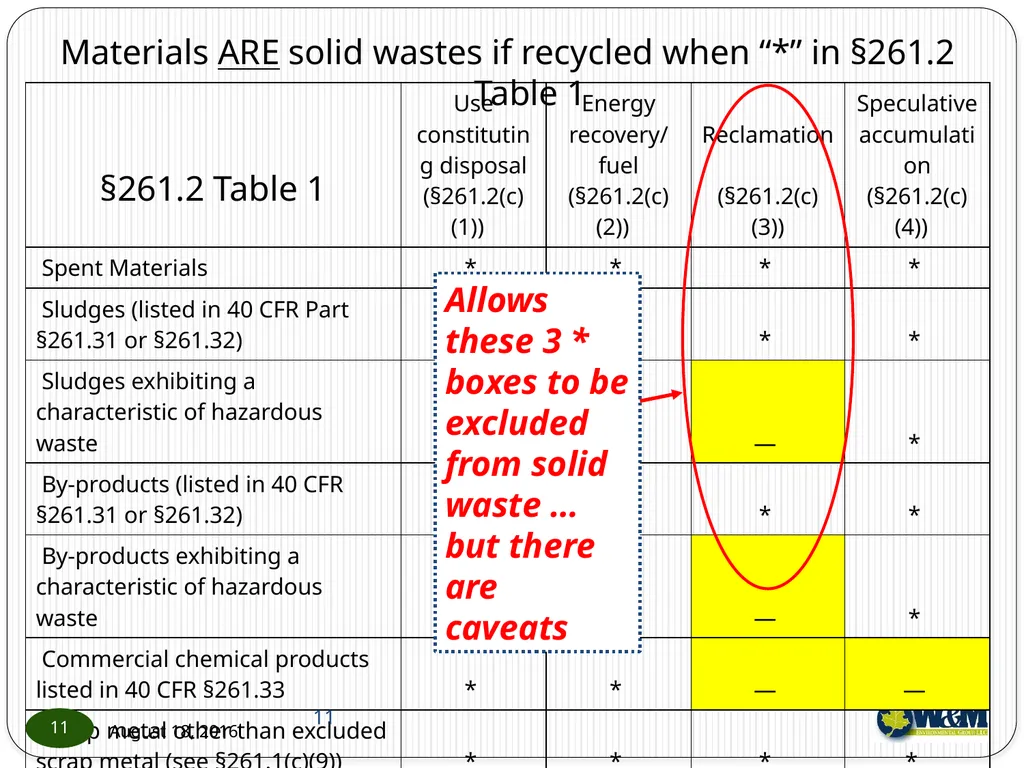
Materials ARE solid wastes if recycled when “*” in §261.2 Table 1 11 11 Allows these 3 * boxes to be excluded from solid waste … but there are caveats<br>
12
HSM - the Caveats 40 CFR §260.43 – Legitimate Recycling Provision
40 CFR §261.4(a) – HSM Solid Waste Exclusions
(23) Generator-controlled Exclusion
(24) Verified Recycler Exclusion
(25) [Reserved]
(27) Remanufacturing Exclusion 12<br>
40 CFR §261.4(a) – HSM Solid Waste Exclusions
(23) Generator-controlled Exclusion
(24) Verified Recycler Exclusion
(25) [Reserved]
(27) Remanufacturing Exclusion 12<br>
13
Legitimate Recycling Provision
40 CFR §260.43 Legitimate Recycling Provision – 4 Factors
Hazardous secondary material must provide a useful contribution to the recycling process or to a product or intermediate.
Recycling must produce a valuable product or intermediate.
Hazardous secondary material must be managed as valuable commodities
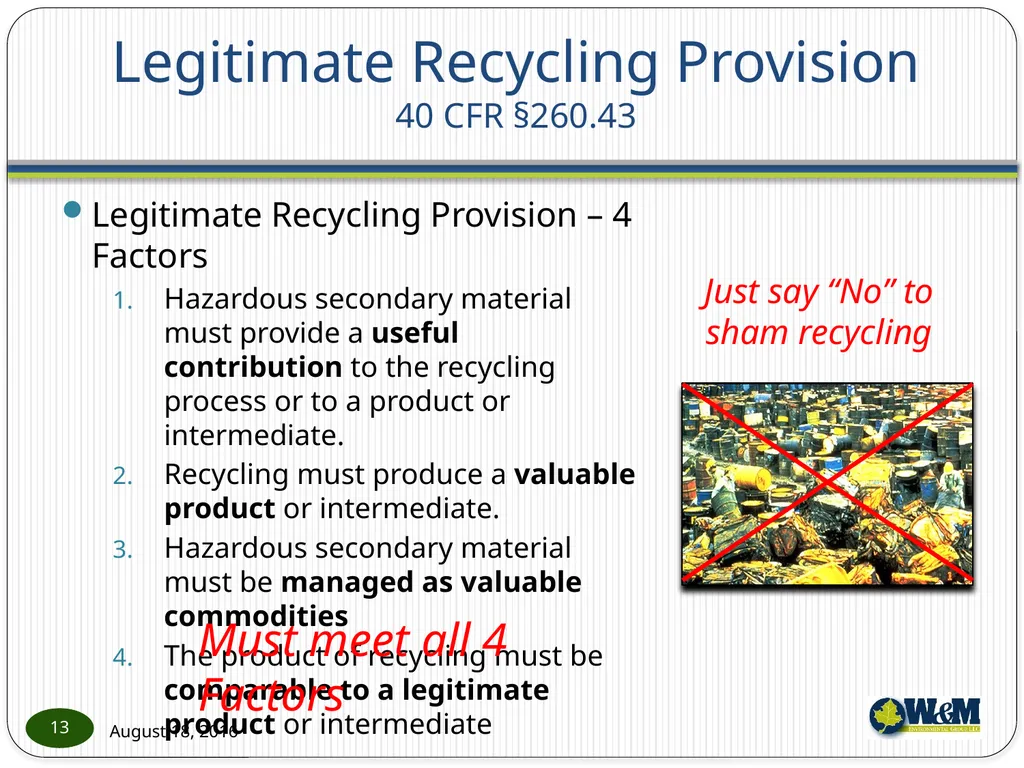
The product of recycling must be comparable to a legitimate product or intermediate 13 Just say “No” to sham recycling Must meet all 4 Factors<br>
Hazardous secondary material must provide a useful contribution to the recycling process or to a product or intermediate.
Recycling must produce a valuable product or intermediate.
Hazardous secondary material must be managed as valuable commodities
The product of recycling must be comparable to a legitimate product or intermediate 13 Just say “No” to sham recycling Must meet all 4 Factors<br>
14
Legitimate Recycling Provision
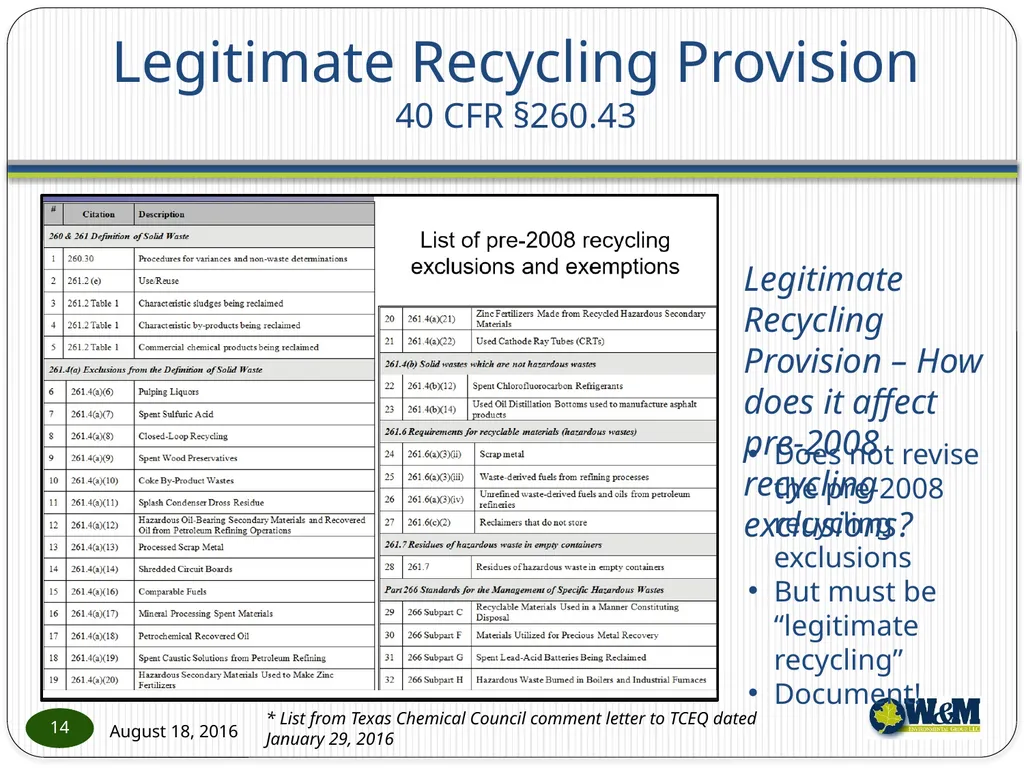
40 CFR §260.43 Legitimate Recycling Provision – How does it affect pre-2008 recycling exclusions? 14 * List from Texas Chemical Council comment letter to TCEQ dated January 29, 2016 Does not revise the pre-2008 recycling exclusions
But must be “legitimate recycling”
Document!<br>
But must be “legitimate recycling”
Document!<br>
15
Legitimate Recycling Provision
40 CFR §260.43 Legitimate Recycling Provision – How does it affect pre-2008 recycling exclusions? (cont’d)
EPA’s Position:
The final rule does not add notification to the pre-2008 recycling exclusions and instead recommends further study.
The final rule does not revise the pre-2008 recycling exclusions to include an explicit legitimacy requirement. Instead, the 2015 final rule codifies the long-standing policy of prohibiting sham recycling.
Industry Concern
Over time the “presumption” of legitimacy for the pre-2008 exclusions will deteriorate, and legitimacy requirements will creep in. 15<br>
EPA’s Position:
The final rule does not add notification to the pre-2008 recycling exclusions and instead recommends further study.
The final rule does not revise the pre-2008 recycling exclusions to include an explicit legitimacy requirement. Instead, the 2015 final rule codifies the long-standing policy of prohibiting sham recycling.
Industry Concern
Over time the “presumption” of legitimacy for the pre-2008 exclusions will deteriorate, and legitimacy requirements will creep in. 15<br>
16
Generator-Controlled Exclusion
40 CFR §261.4(a)(23) Generated and legitimately reclaimed under the control of the generator
On-Site
Off-site facility if the reclaiming facility is controlled by the generator, and the generator provides certain certification statements
Tolling contractor
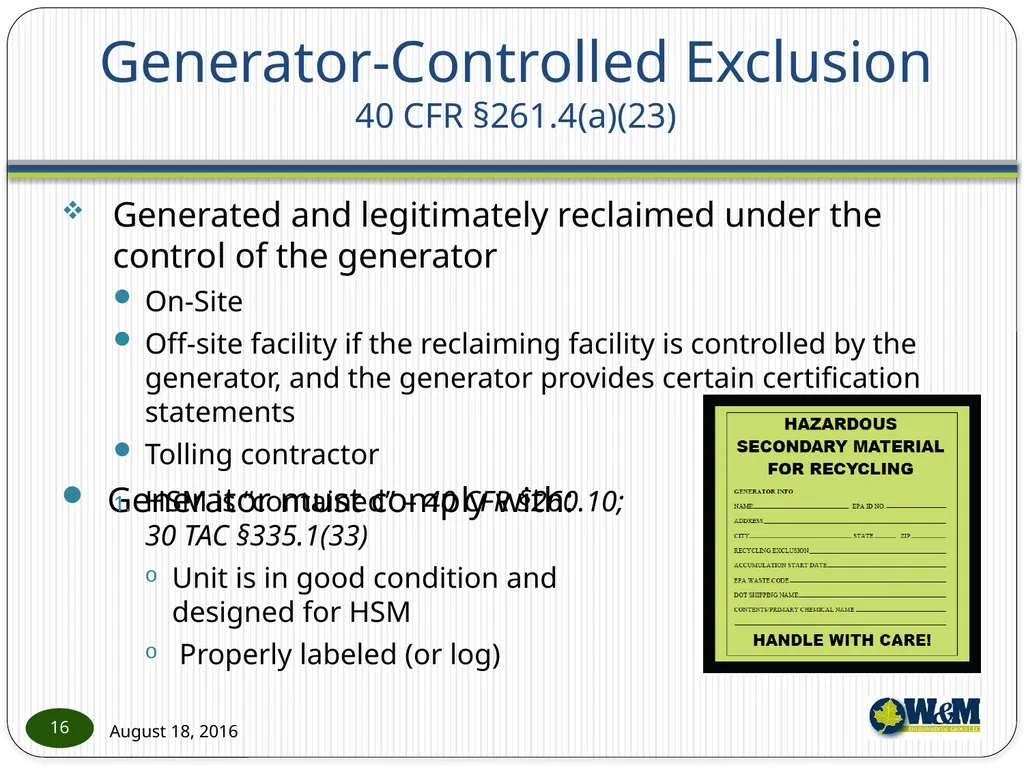
Generator must comply with: 16 HSM is “contained” – 40 CFR §260.10; 30 TAC §335.1(33)
Unit is in good condition and designed for HSM
Properly labeled (or log)<br>
On-Site
Off-site facility if the reclaiming facility is controlled by the generator, and the generator provides certain certification statements
Tolling contractor
Generator must comply with: 16 HSM is “contained” – 40 CFR §260.10; 30 TAC §335.1(33)
Unit is in good condition and designed for HSM
Properly labeled (or log)<br>
17
Generator-Controlled Exclusion
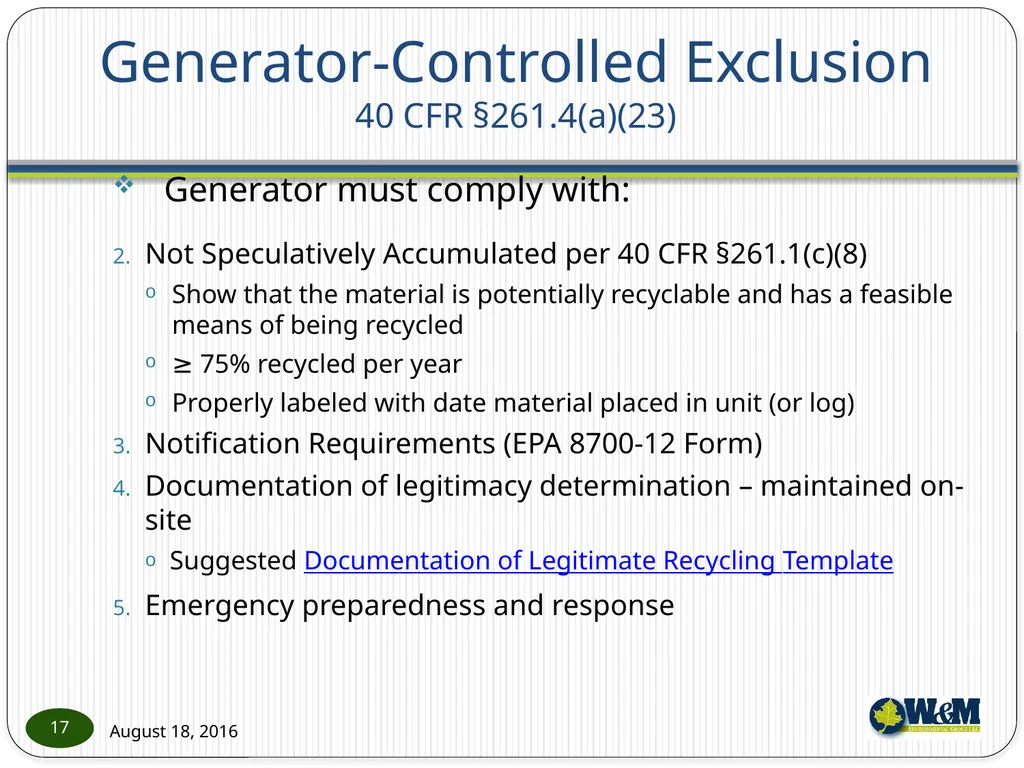
40 CFR §261.4(a)(23) Generator must comply with: 17 Not Speculatively Accumulated per 40 CFR §261.1(c)(8)
Show that the material is potentially recyclable and has a feasible means of being recycled
≥ 75% recycled per year
Properly labeled with date material placed in unit (or log)
Notification Requirements (EPA 8700-12 Form)
Documentation of legitimacy determination – maintained on-site
Suggested Documentation of Legitimate Recycling Template
Emergency preparedness and response<br>
Show that the material is potentially recyclable and has a feasible means of being recycled
≥ 75% recycled per year
Properly labeled with date material placed in unit (or log)
Notification Requirements (EPA 8700-12 Form)
Documentation of legitimacy determination – maintained on-site
Suggested Documentation of Legitimate Recycling Template
Emergency preparedness and response<br>
18
Verified Recycler Exclusion
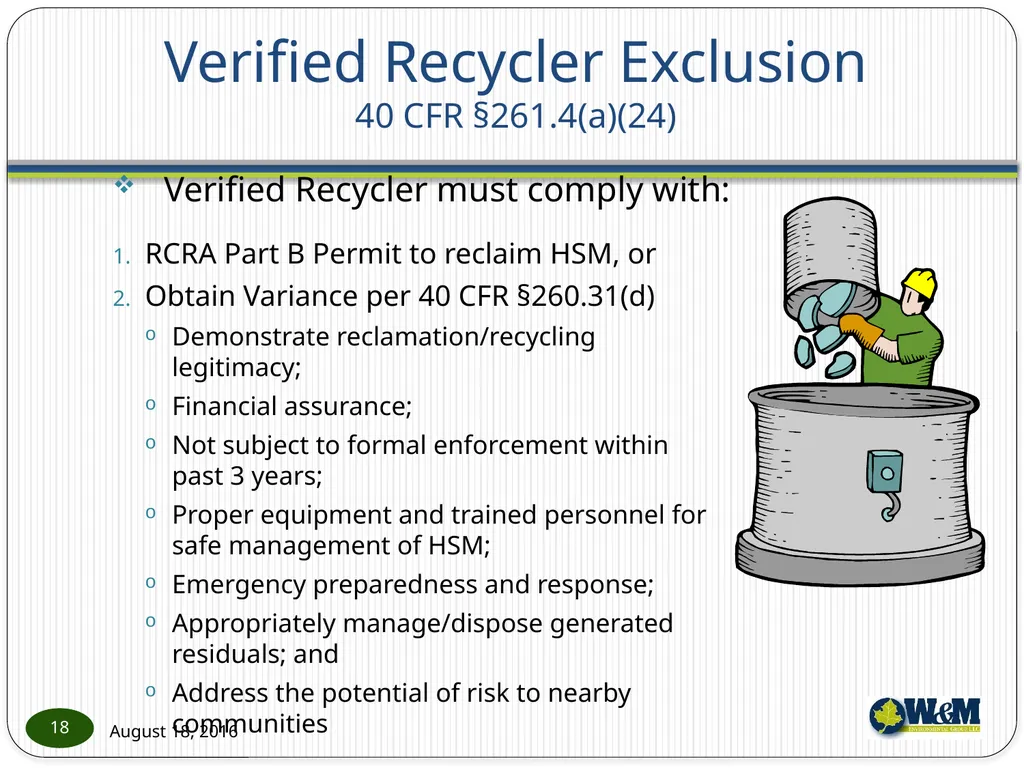
40 CFR §261.4(a)(24) Verified Recycler must comply with: 18 RCRA Part B Permit to reclaim HSM, or
Obtain Variance per 40 CFR §260.31(d)
Demonstrate reclamation/recycling legitimacy;
Financial assurance;
Not subject to formal enforcement within past 3 years;
Proper equipment and trained personnel for safe management of HSM;
Emergency preparedness and response;
Appropriately manage/dispose generated residuals; and
Address the potential of risk to nearby communities<br>
Obtain Variance per 40 CFR §260.31(d)
Demonstrate reclamation/recycling legitimacy;
Financial assurance;
Not subject to formal enforcement within past 3 years;
Proper equipment and trained personnel for safe management of HSM;
Emergency preparedness and response;
Appropriately manage/dispose generated residuals; and
Address the potential of risk to nearby communities<br>
19
Verified Recycler Exclusion
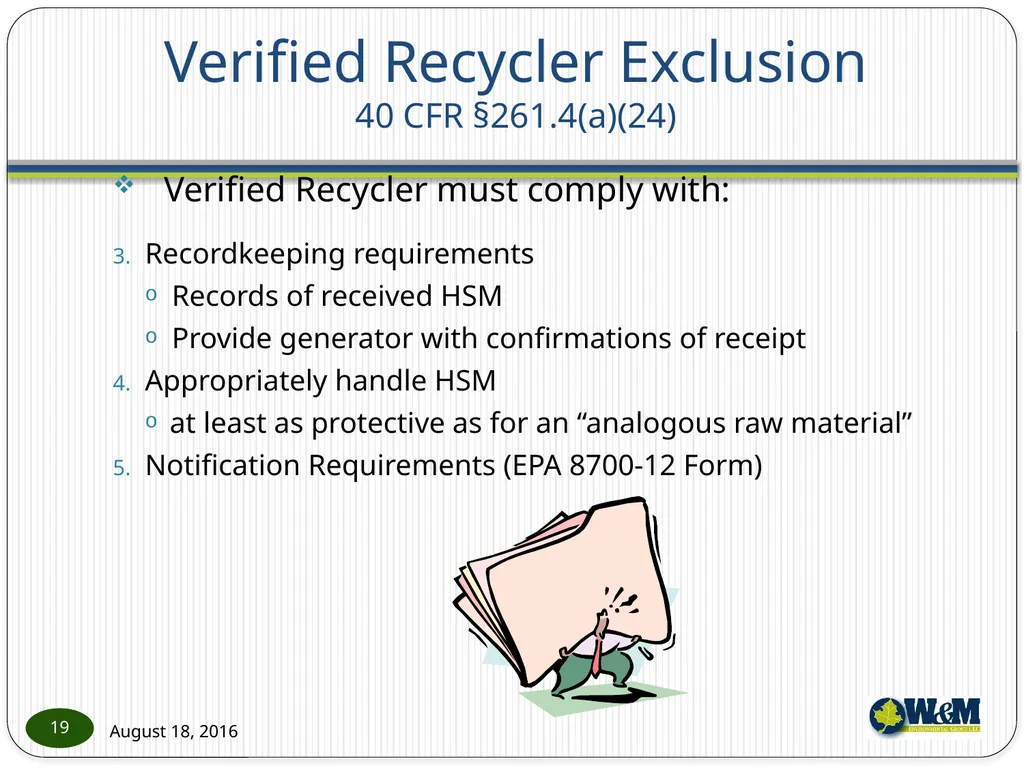
40 CFR §261.4(a)(24) Verified Recycler must comply with: 19 Recordkeeping requirements
Records of received HSM
Provide generator with confirmations of receipt
Appropriately handle HSM
at least as protective as for an “analogous raw material”
Notification Requirements (EPA 8700-12 Form)<br>
Records of received HSM
Provide generator with confirmations of receipt
Appropriately handle HSM
at least as protective as for an “analogous raw material”
Notification Requirements (EPA 8700-12 Form)<br>
20
Verified Recycler Exclusion
40 CFR §261.4(a)(24) Generator must:
“Contain” HSM and not speculatively accumulated
Notification Requirements (EPA 8700-12 Form)
HSM sent to a verified recycler or RCRA Part B permitted facility
Maintain records of all off-site shipments (transporter, reclaimer & quantity) and confirmation of receipt
Emergency preparedness and response 20<br>
“Contain” HSM and not speculatively accumulated
Notification Requirements (EPA 8700-12 Form)
HSM sent to a verified recycler or RCRA Part B permitted facility
Maintain records of all off-site shipments (transporter, reclaimer & quantity) and confirmation of receipt
Emergency preparedness and response 20<br>
21
Remanufacturing Exclusion
40 CFR §261.4(a)(27) Encourages the recycling of 18 higher-value hazardous spent solvents
Used for reacting, extracting, blending, or purifying chemicals in the pharmaceutical, organic chemical, plastics and resins, and the paint and coatings sectors
Both Generator and Remanufacturer must:
Notification Requirements (EPA 8700-12 Form)
Jointly develop a Remanufacturing Plan
Maintain records of shipments and confirmation of receipts
Spent solvents - managed in RCRA equivalent tanks or containers
Not speculatively accumulated 21<br>
Used for reacting, extracting, blending, or purifying chemicals in the pharmaceutical, organic chemical, plastics and resins, and the paint and coatings sectors
Both Generator and Remanufacturer must:
Notification Requirements (EPA 8700-12 Form)
Jointly develop a Remanufacturing Plan
Maintain records of shipments and confirmation of receipts
Spent solvents - managed in RCRA equivalent tanks or containers
Not speculatively accumulated 21<br>
22
III. Summary 22<br>
23
Summary How does the HSM rule help Generators?
Allows new avenues to recycle HSM
If HSM is excluded as a solid waste it:
Does not count toward generator status
No annual reporting requirements
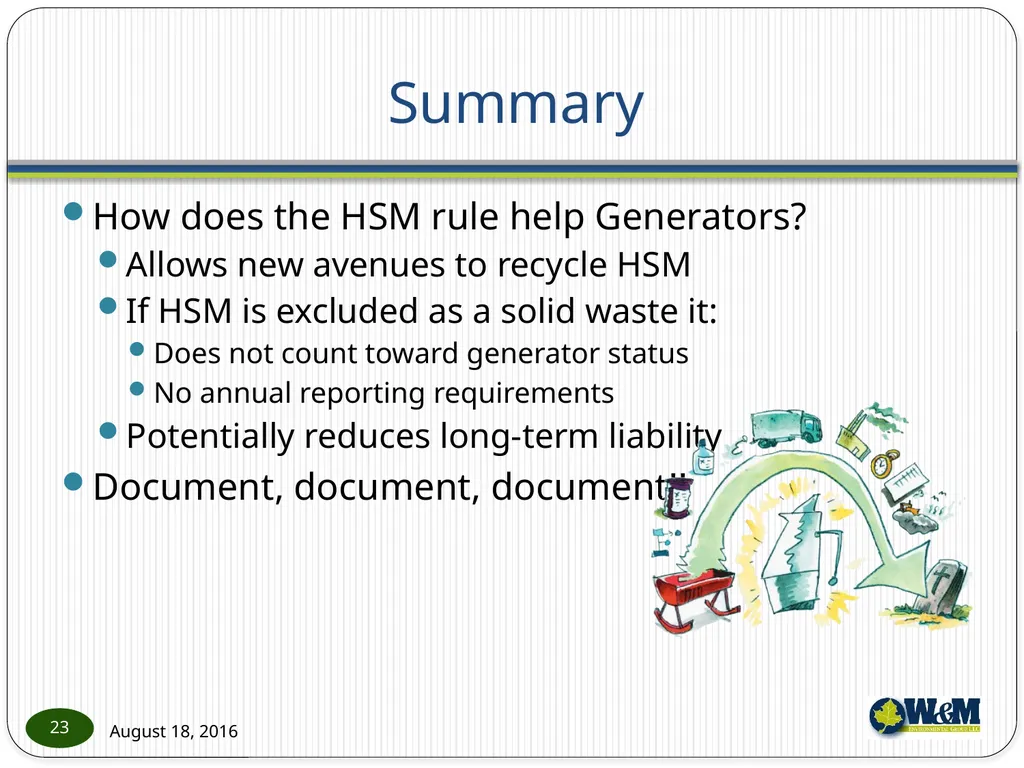
Potentially reduces long-term liability
Document, document, document!! 23<br>
Allows new avenues to recycle HSM
If HSM is excluded as a solid waste it:
Does not count toward generator status
No annual reporting requirements
Potentially reduces long-term liability
Document, document, document!! 23<br>
24
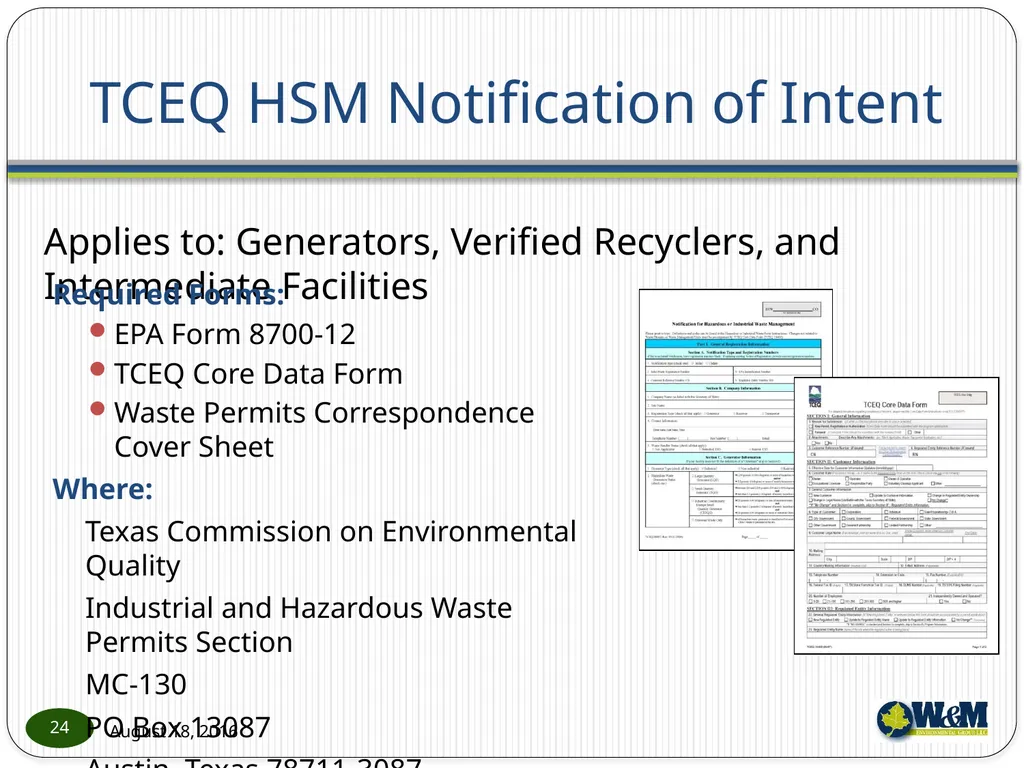
TCEQ HSM Notification of Intent 24 Applies to: Generators, Verified Recyclers, and Intermediate Facilities Required Forms:
EPA Form 8700-12
TCEQ Core Data Form
Waste Permits Correspondence Cover Sheet
Where:
Texas Commission on Environmental Quality
Industrial and Hazardous Waste Permits Section
MC-130
PO Box 13087
Austin, Texas 78711-3087<br>
EPA Form 8700-12
TCEQ Core Data Form
Waste Permits Correspondence Cover Sheet
Where:
Texas Commission on Environmental Quality
Industrial and Hazardous Waste Permits Section
MC-130
PO Box 13087
Austin, Texas 78711-3087<br>
25
Summary Resources
EPA Final Rule Summary: https://www.epa.gov/hwgenerators/final-rule-2015-definition-solid-waste-dsw
EPA 8700-12 Form: https://www.epa.gov/sites/production/files/2015-11/documents/notification_rcra_sutitle_c_activity_instructions_forms.pdf
List of Verified Recyclers: https://www.epa.gov/hwgenerators/list-facilities-have-notified-they-are-managing-under-2015-definition-solid-waste-dsw
TCEQ Final Rule allows transfer of HSM to Verified Recyclers outside Texas
TCEQ Website: https://www.tceq.texas.gov/permitting/waste_permits/ihw_permits/ihw_exemptions.html 25<br>
EPA Final Rule Summary: https://www.epa.gov/hwgenerators/final-rule-2015-definition-solid-waste-dsw
EPA 8700-12 Form: https://www.epa.gov/sites/production/files/2015-11/documents/notification_rcra_sutitle_c_activity_instructions_forms.pdf
List of Verified Recyclers: https://www.epa.gov/hwgenerators/list-facilities-have-notified-they-are-managing-under-2015-definition-solid-waste-dsw
TCEQ Final Rule allows transfer of HSM to Verified Recyclers outside Texas
TCEQ Website: https://www.tceq.texas.gov/permitting/waste_permits/ihw_permits/ihw_exemptions.html 25<br>
26
Upcoming RCRA & DOT HazMat Class 26 Where: Downtown Club in Houston
When: September 28 & 29th
Register: https://www.wh-m.com/events/ RCRA 8-Hour Course Topics
Waste identification and classification
Generator requirements
Waste container handling, management and storage requirements
Manifests and recordkeeping requirements
Pollution prevention ideas DOT HazMat 4-Hour Course
Function-Specific training to complete a hazardous waste manifest
DOT Hazard Classification
Proper shipping name and shipping papers
Labeling, marking and packaging requirements
Placarding and loading Hackberry Creek Country Club in Dallas
September 14 & 15th<br>
When: September 28 & 29th
Register: https://www.wh-m.com/events/ RCRA 8-Hour Course Topics
Waste identification and classification
Generator requirements
Waste container handling, management and storage requirements
Manifests and recordkeeping requirements
Pollution prevention ideas DOT HazMat 4-Hour Course
Function-Specific training to complete a hazardous waste manifest
DOT Hazard Classification
Proper shipping name and shipping papers
Labeling, marking and packaging requirements
Placarding and loading Hackberry Creek Country Club in Dallas
September 14 & 15th<br>
27
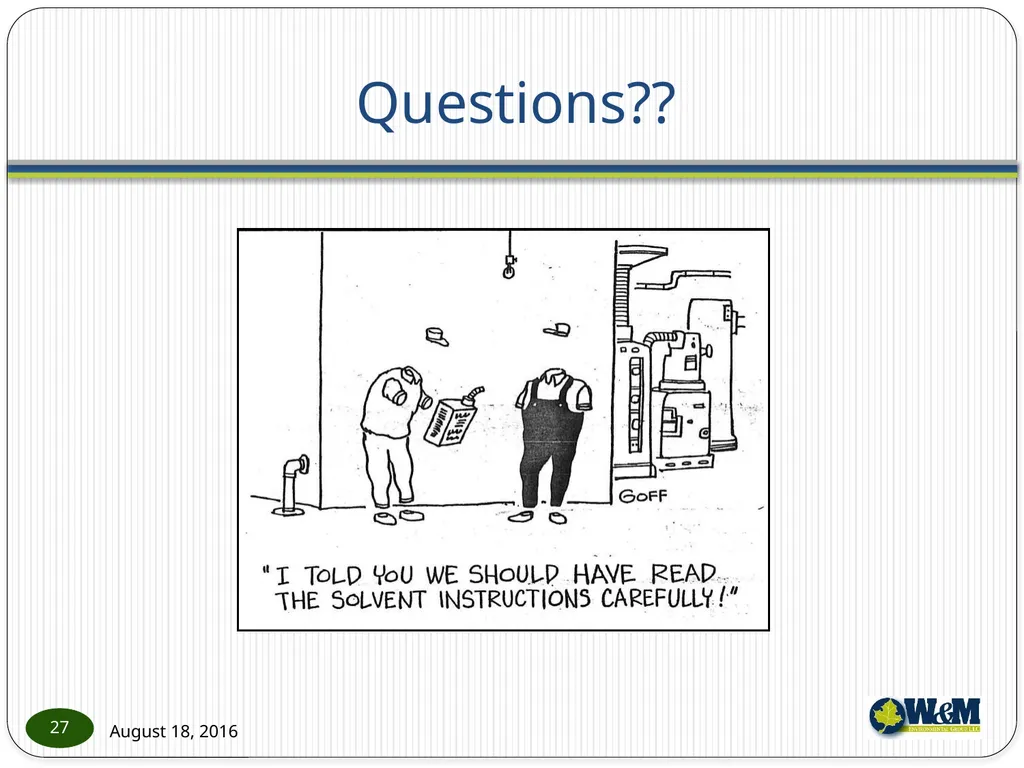
Questions?? 27<br>
28
Contact Information Heather Woodward, CHMM, REM
Technical Director
W&M Environmental Group, LLC
972-516-0300
hwoodward@wh-m.com 28<br>
Technical Director
W&M Environmental Group, LLC
972-516-0300
hwoodward@wh-m.com 28<br>