
Solving problems using the associative,
TD
Published · 32 slides · 0 views
1 / 1

Description
Solving problems using the associative, distributive and commutative laws (from 2.1 Arithmetic procedures) KS3 Mastery PD Materials: Exemplified Key Ideas Materials for use in the classroom or to support professional development discussions
Related Topics
Share
Embed code
Download this presentation From Below
"Solving problems using the associative," is the property of its rightful owner. Permission is granted to download and print the materials on this website for personal, non-commercial use only, and to display it on your personal computer provided you do not modify the materials and that you retain all copyright notices contained in the materials. By downloading content from our website, you accept the terms of this agreement.
Presentation Transcript
01
Solving problems using the associative, distributive and commutative laws (from 2.1 Arithmetic procedures) KS3 Mastery PD Materials: Exemplified Key Ideas
Materials for use in the classroom or to support professional development discussions Summer 2021<br>
Materials for use in the classroom or to support professional development discussions Summer 2021<br>
02
About this resource These slides are designed to complement the 2.1 Arithmetic procedures Core Concept document and its associated Theme Overview document 2 Operating on number, both found in the Secondary Mastery Professional Development pages.
These slides re-present the key examples from the Core Concept document so that the examples can be used either directly in the classroom or with a group of teachers. There are prompt questions alongside the examples, and further clarification in the notes.
These slides do not fully replicate the Core Concept document, so should be used alongside it. Reference to specific page numbers, and to other useful NCETM resources, can be found in the notes for each slide.
This slide deck is not designed to be a complete PD session, rather it is a selection of resources that you can adapt and use as needed when planning a session with a group of teachers.<br>
These slides re-present the key examples from the Core Concept document so that the examples can be used either directly in the classroom or with a group of teachers. There are prompt questions alongside the examples, and further clarification in the notes.
These slides do not fully replicate the Core Concept document, so should be used alongside it. Reference to specific page numbers, and to other useful NCETM resources, can be found in the notes for each slide.
This slide deck is not designed to be a complete PD session, rather it is a selection of resources that you can adapt and use as needed when planning a session with a group of teachers.<br>
03
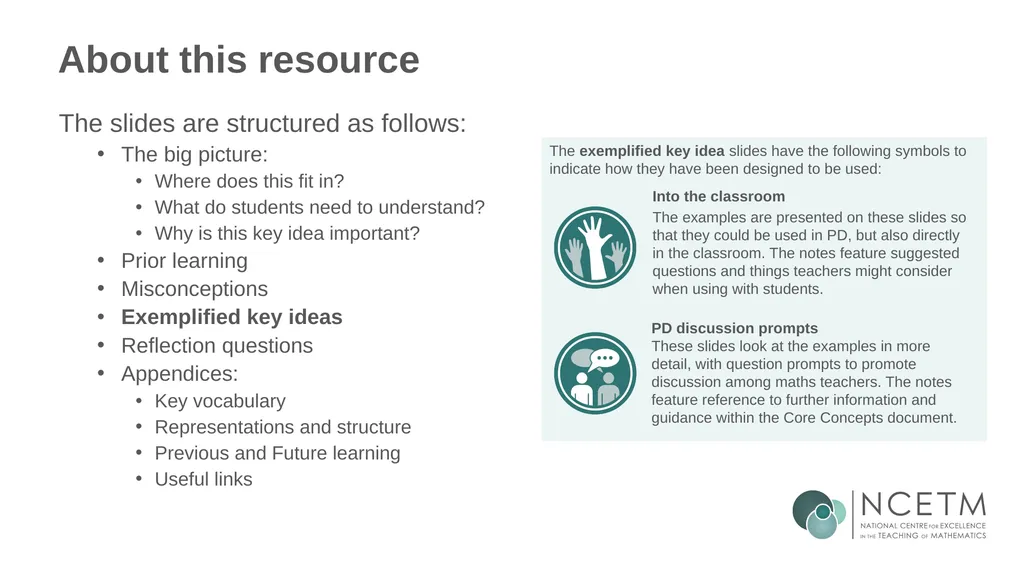
About this resource The slides are structured as follows:
The big picture:
Where does this fit in?
What do students need to understand?
Why is this key idea important?
Prior learning
Misconceptions
Exemplified key ideas
Reflection questions
Appendices:
Key vocabulary
Representations and structure
Previous and Future learning
Useful links The exemplified key idea slides have the following symbols to indicate how they have been designed to be used: Into the classroom
The examples are presented on these slides so that they could be used in PD, but also directly in the classroom. The notes feature suggested questions and things teachers might consider when using with students. PD discussion prompts
These slides look at the examples in more detail, with question prompts to promote discussion among maths teachers. The notes feature reference to further information and guidance within the Core Concepts document.<br>
The big picture:
Where does this fit in?
What do students need to understand?
Why is this key idea important?
Prior learning
Misconceptions
Exemplified key ideas
Reflection questions
Appendices:
Key vocabulary
Representations and structure
Previous and Future learning
Useful links The exemplified key idea slides have the following symbols to indicate how they have been designed to be used: Into the classroom
The examples are presented on these slides so that they could be used in PD, but also directly in the classroom. The notes feature suggested questions and things teachers might consider when using with students. PD discussion prompts
These slides look at the examples in more detail, with question prompts to promote discussion among maths teachers. The notes feature reference to further information and guidance within the Core Concepts document.<br>
04
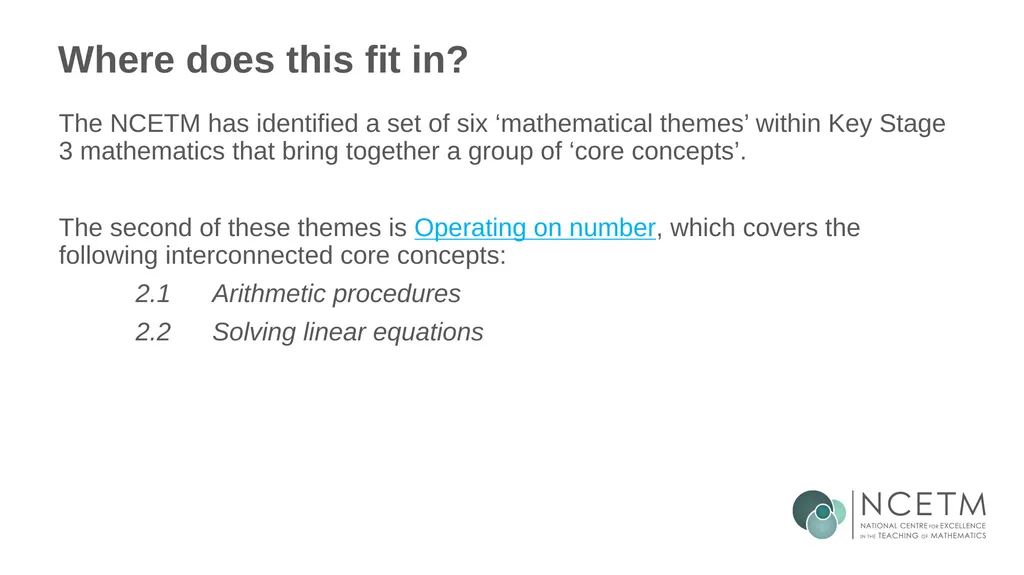
Where does this fit in? The NCETM has identified a set of six ‘mathematical themes’ within Key Stage 3 mathematics that bring together a group of ‘core concepts’.
The second of these themes is Operating on number, which covers the following interconnected core concepts:
2.1 Arithmetic procedures
2.2 Solving linear equations<br>
The second of these themes is Operating on number, which covers the following interconnected core concepts:
2.1 Arithmetic procedures
2.2 Solving linear equations<br>
05
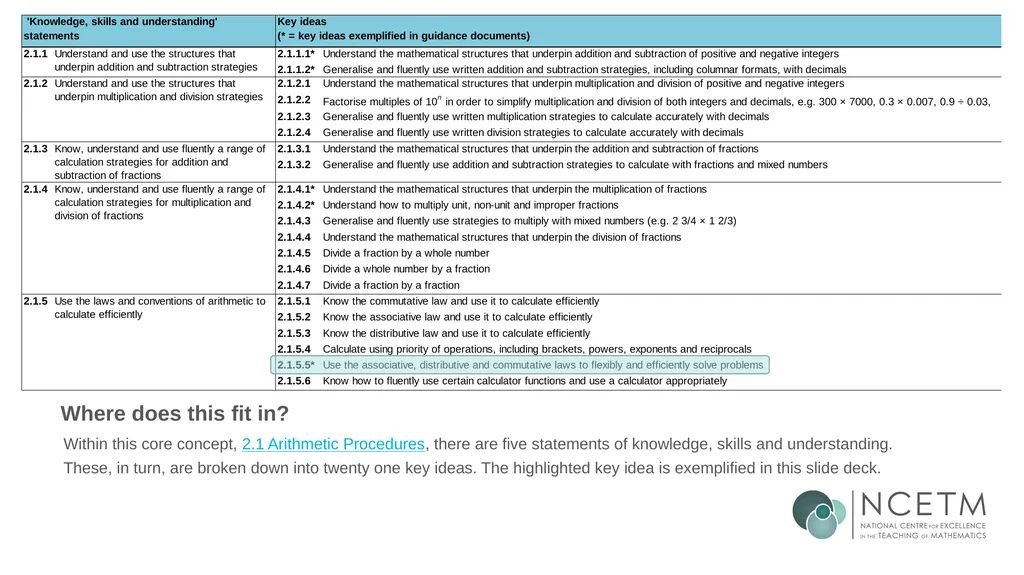
Where does this fit in? Within this core concept, 2.1 Arithmetic Procedures, there are five statements of knowledge, skills and understanding.
These, in turn, are broken down into twenty one key ideas. The highlighted key idea is exemplified in this slide deck.<br>
These, in turn, are broken down into twenty one key ideas. The highlighted key idea is exemplified in this slide deck.<br>
06
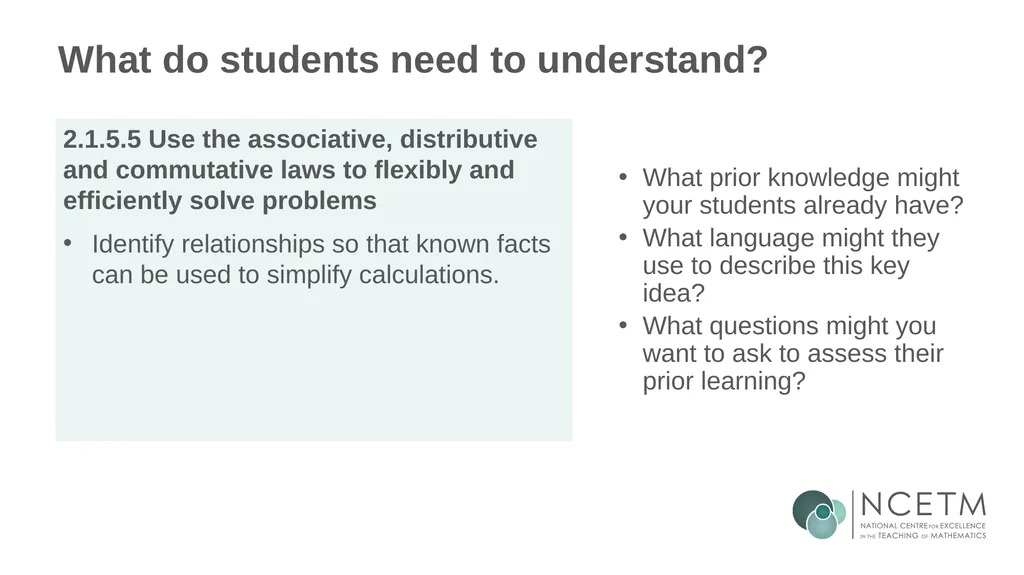
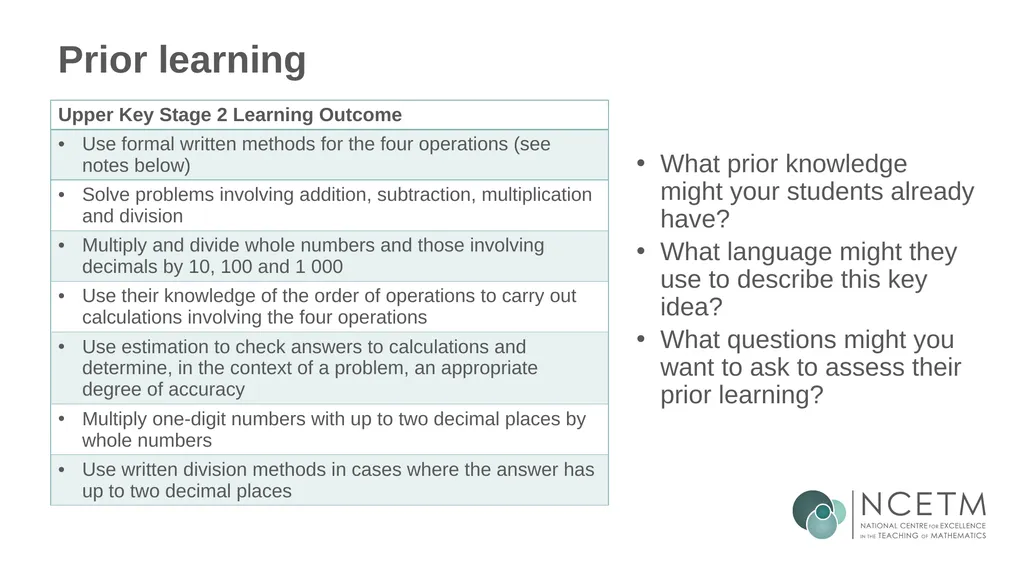
What do students need to understand? What prior knowledge might your students already have?
What language might they use to describe this key idea?
What questions might you want to ask to assess their prior learning? 2.1.5.5 Use the associative, distributive and commutative laws to flexibly and efficiently solve problems
Identify relationships so that known facts can be used to simplify calculations.<br>
What language might they use to describe this key idea?
What questions might you want to ask to assess their prior learning? 2.1.5.5 Use the associative, distributive and commutative laws to flexibly and efficiently solve problems
Identify relationships so that known facts can be used to simplify calculations.<br>
07
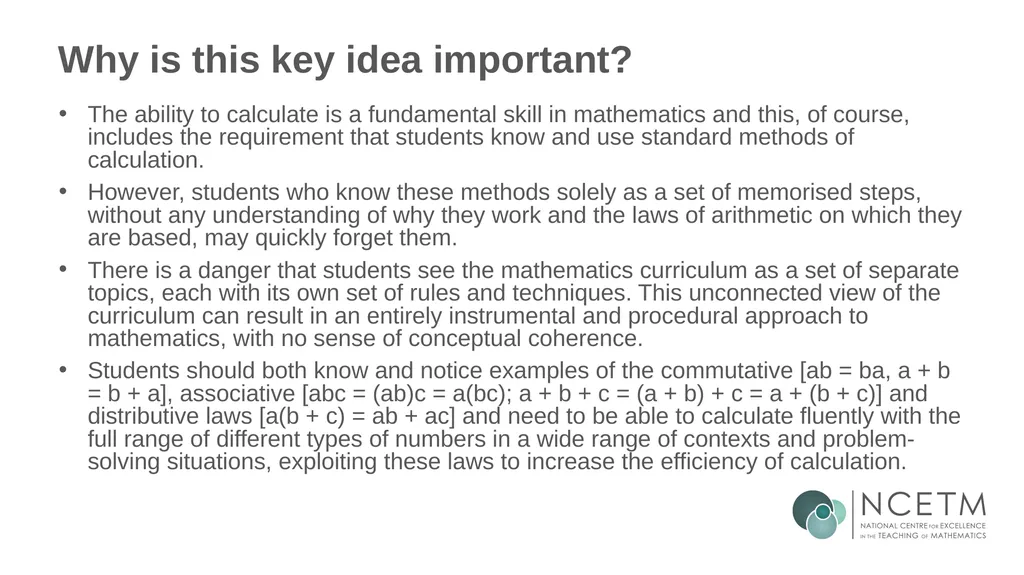
Why is this key idea important? The ability to calculate is a fundamental skill in mathematics and this, of course, includes the requirement that students know and use standard methods of calculation.
However, students who know these methods solely as a set of memorised steps, without any understanding of why they work and the laws of arithmetic on which they are based, may quickly forget them.
There is a danger that students see the mathematics curriculum as a set of separate topics, each with its own set of rules and techniques. This unconnected view of the curriculum can result in an entirely instrumental and procedural approach to mathematics, with no sense of conceptual coherence.
Students should both know and notice examples of the commutative [ab = ba, a + b = b + a], associative [abc = (ab)c = a(bc); a + b + c = (a + b) + c = a + (b + c)] and distributive laws [a(b + c) = ab + ac] and need to be able to calculate fluently with the full range of different types of numbers in a wide range of contexts and problem-solving situations, exploiting these laws to increase the efficiency of calculation.<br>
However, students who know these methods solely as a set of memorised steps, without any understanding of why they work and the laws of arithmetic on which they are based, may quickly forget them.
There is a danger that students see the mathematics curriculum as a set of separate topics, each with its own set of rules and techniques. This unconnected view of the curriculum can result in an entirely instrumental and procedural approach to mathematics, with no sense of conceptual coherence.
Students should both know and notice examples of the commutative [ab = ba, a + b = b + a], associative [abc = (ab)c = a(bc); a + b + c = (a + b) + c = a + (b + c)] and distributive laws [a(b + c) = ab + ac] and need to be able to calculate fluently with the full range of different types of numbers in a wide range of contexts and problem-solving situations, exploiting these laws to increase the efficiency of calculation.<br>
08
Prior learning What prior knowledge might your students already have?
What language might they use to describe this key idea?
What questions might you want to ask to assess their prior learning?<br>
What language might they use to describe this key idea?
What questions might you want to ask to assess their prior learning?<br>
09
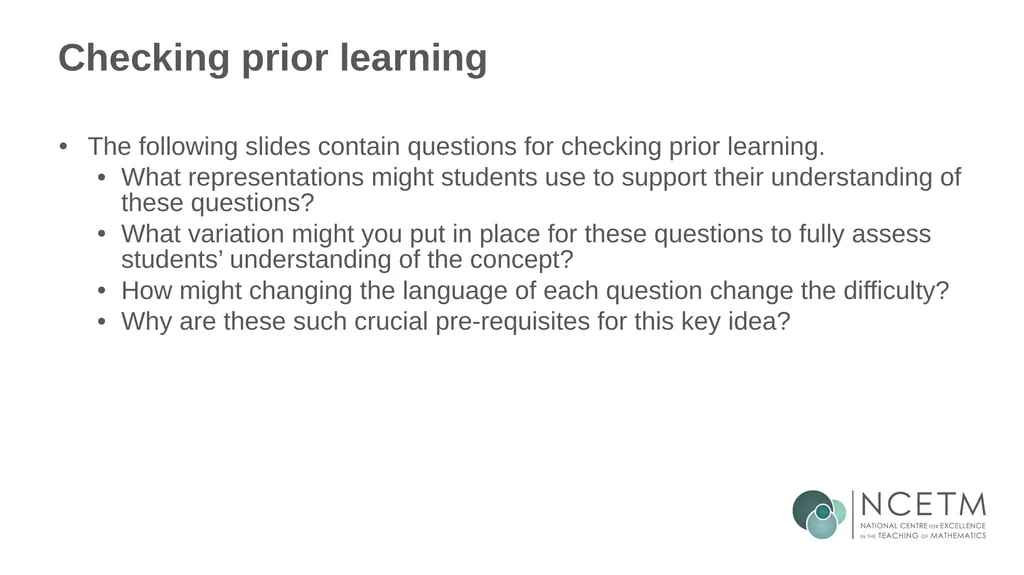
Checking prior learning The following slides contain questions for checking prior learning.
What representations might students use to support their understanding of these questions?
What variation might you put in place for these questions to fully assess students’ understanding of the concept?
How might changing the language of each question change the difficulty?
Why are these such crucial pre-requisites for this key idea?<br>
What representations might students use to support their understanding of these questions?
What variation might you put in place for these questions to fully assess students’ understanding of the concept?
How might changing the language of each question change the difficulty?
Why are these such crucial pre-requisites for this key idea?<br>
10
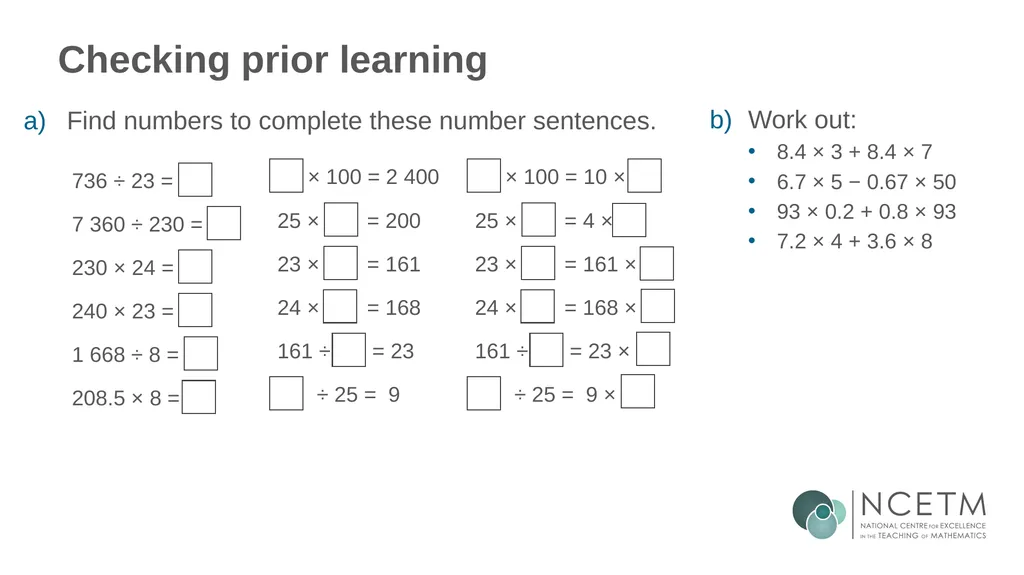
Checking prior learning Work out:
8.4 × 3 + 8.4 × 7
6.7 × 5 − 0.67 × 50
93 × 0.2 + 0.8 × 93
7.2 × 4 + 3.6 × 8 Find numbers to complete these number sentences.<br>
8.4 × 3 + 8.4 × 7
6.7 × 5 − 0.67 × 50
93 × 0.2 + 0.8 × 93
7.2 × 4 + 3.6 × 8 Find numbers to complete these number sentences.<br>
11
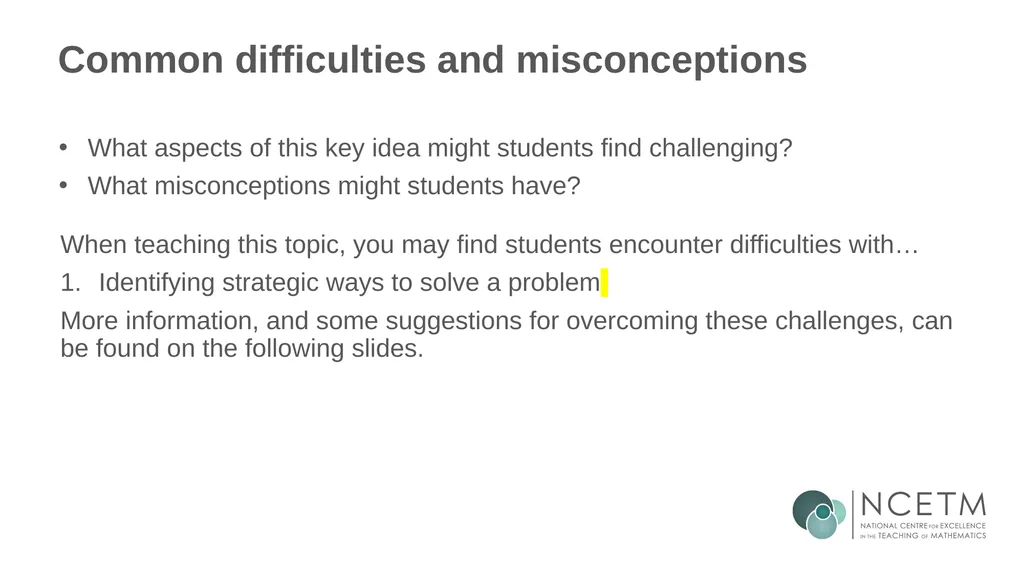
Common difficulties and misconceptions What aspects of this key idea might students find challenging?
What misconceptions might students have? When teaching this topic, you may find students encounter difficulties with…
Identifying strategic ways to solve a problem
More information, and some suggestions for overcoming these challenges, can be found on the following slides.<br>
What misconceptions might students have? When teaching this topic, you may find students encounter difficulties with…
Identifying strategic ways to solve a problem
More information, and some suggestions for overcoming these challenges, can be found on the following slides.<br>
12
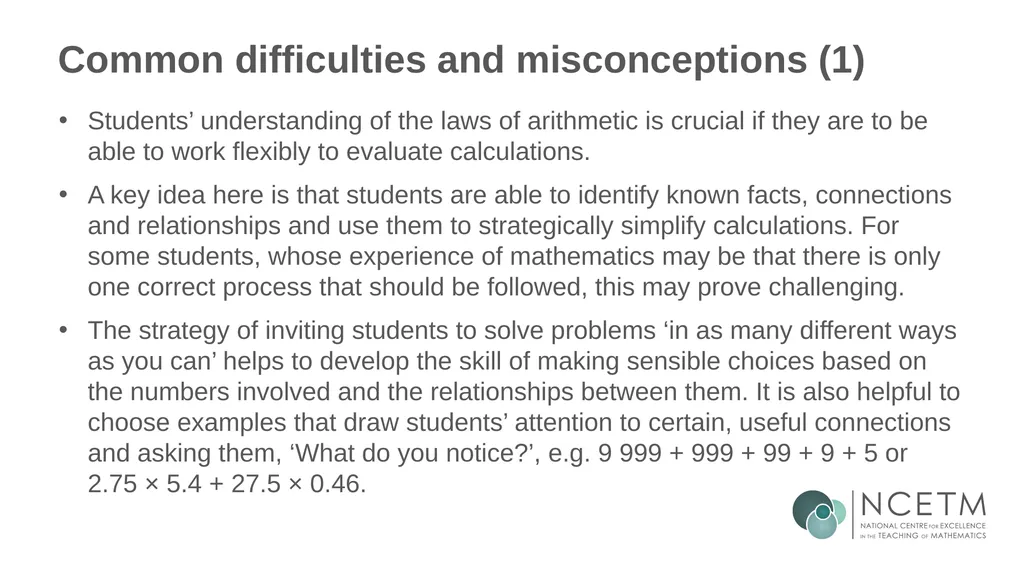
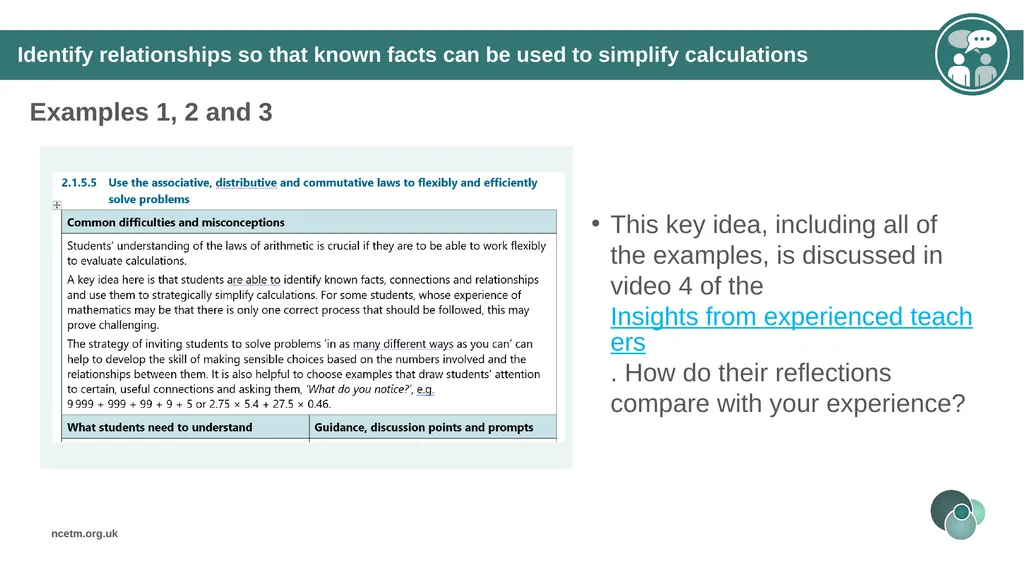
Common difficulties and misconceptions (1) Students’ understanding of the laws of arithmetic is crucial if they are to be able to work flexibly to evaluate calculations.
A key idea here is that students are able to identify known facts, connections and relationships and use them to strategically simplify calculations. For some students, whose experience of mathematics may be that there is only one correct process that should be followed, this may prove challenging.
The strategy of inviting students to solve problems ‘in as many different ways as you can’ helps to develop the skill of making sensible choices based on the numbers involved and the relationships between them. It is also helpful to choose examples that draw students’ attention to certain, useful connections and asking them, ‘What do you notice?’, e.g. 9 999 + 999 + 99 + 9 + 5 or 2.75 × 5.4 + 27.5 × 0.46.<br>
A key idea here is that students are able to identify known facts, connections and relationships and use them to strategically simplify calculations. For some students, whose experience of mathematics may be that there is only one correct process that should be followed, this may prove challenging.
The strategy of inviting students to solve problems ‘in as many different ways as you can’ helps to develop the skill of making sensible choices based on the numbers involved and the relationships between them. It is also helpful to choose examples that draw students’ attention to certain, useful connections and asking them, ‘What do you notice?’, e.g. 9 999 + 999 + 99 + 9 + 5 or 2.75 × 5.4 + 27.5 × 0.46.<br>
13
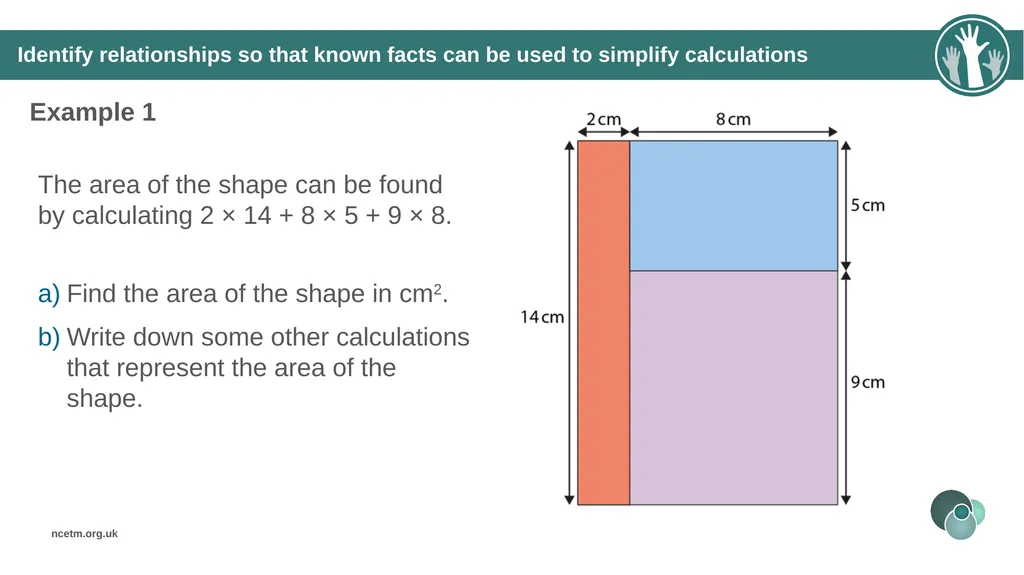
Identify relationships so that known facts can be used to simplify calculations Example 1 The area of the shape can be found by calculating 2 × 14 + 8 × 5 + 9 × 8. Find the area of the shape in cm2.
Write down some other calculations that represent the area of the shape.<br>
Write down some other calculations that represent the area of the shape.<br>
14
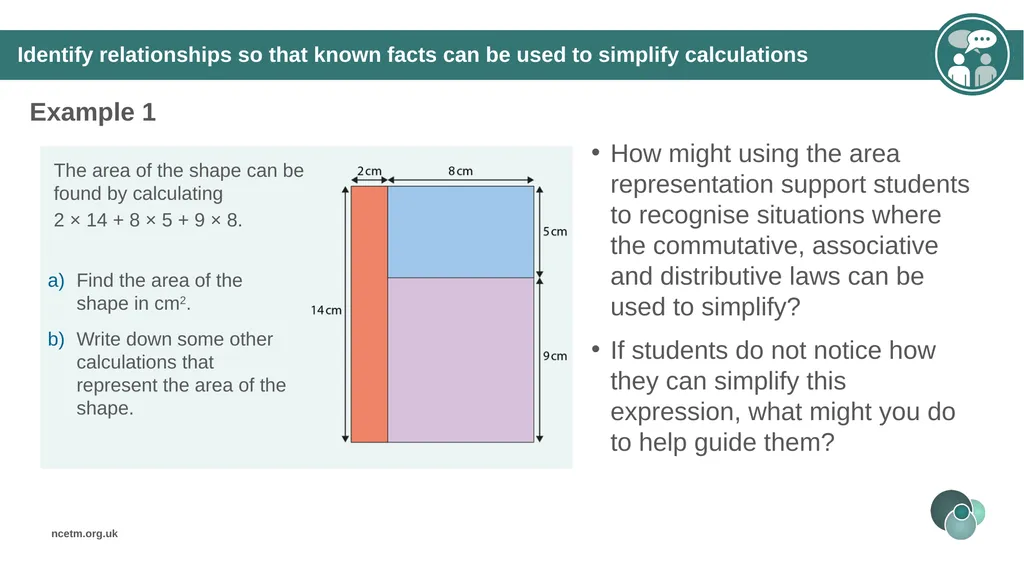
Example 1 How might using the area representation support students to recognise situations where the commutative, associative and distributive laws can be used to simplify?
If students do not notice how they can simplify this expression, what might you do to help guide them? Identify relationships so that known facts can be used to simplify calculations The area of the shape can be found by calculating
2 × 14 + 8 × 5 + 9 × 8. Find the area of the shape in cm2.
Write down some other calculations that represent the area of the shape.<br>
If students do not notice how they can simplify this expression, what might you do to help guide them? Identify relationships so that known facts can be used to simplify calculations The area of the shape can be found by calculating
2 × 14 + 8 × 5 + 9 × 8. Find the area of the shape in cm2.
Write down some other calculations that represent the area of the shape.<br>
15
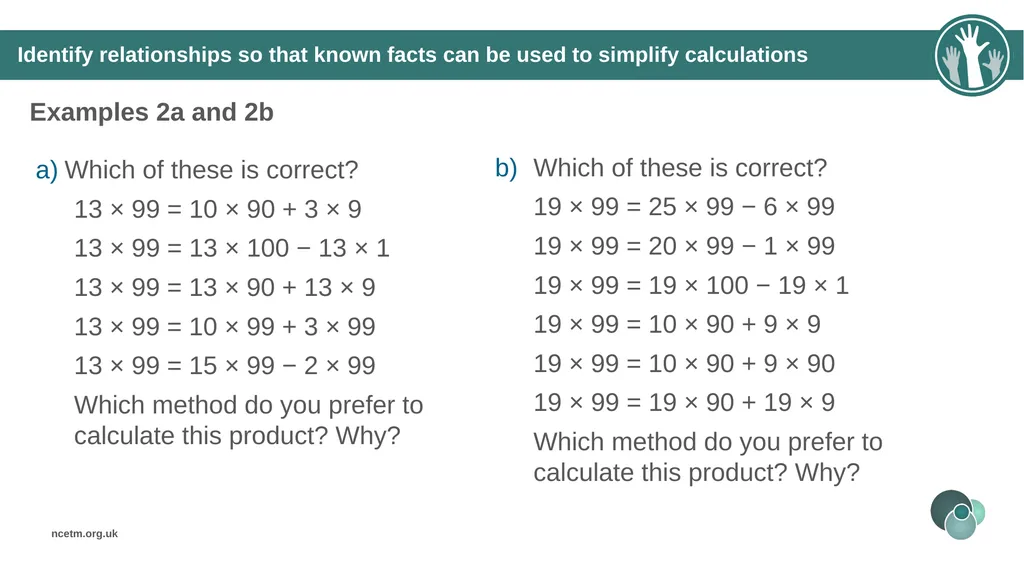
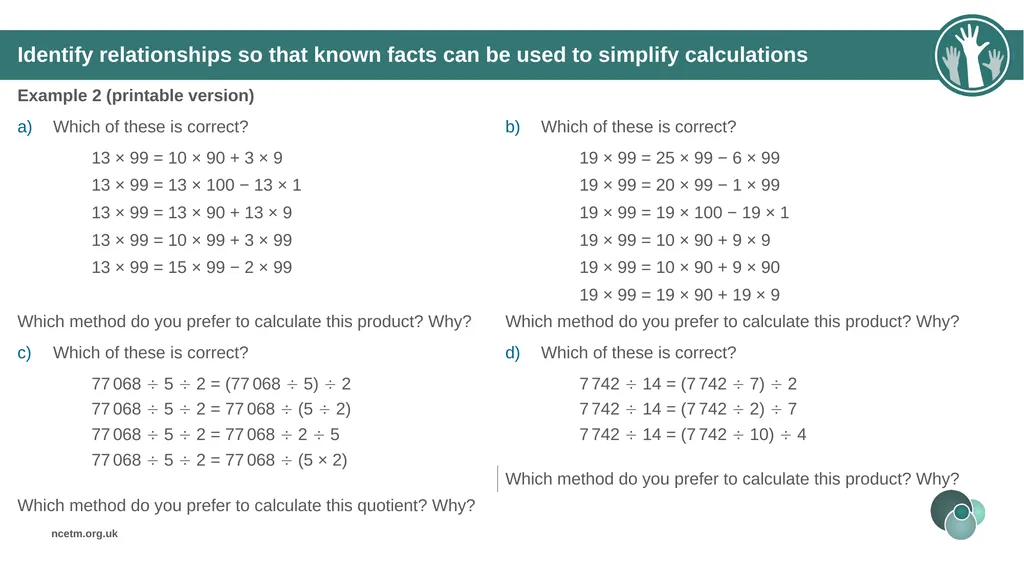
Identify relationships so that known facts can be used to simplify calculations Examples 2a and 2b Which of these is correct?
13 × 99 = 10 × 90 + 3 × 9
13 × 99 = 13 × 100 − 13 × 1
13 × 99 = 13 × 90 + 13 × 9
13 × 99 = 10 × 99 + 3 × 99
13 × 99 = 15 × 99 − 2 × 99
Which method do you prefer to calculate this product? Why? Which of these is correct?
19 × 99 = 25 × 99 − 6 × 99
19 × 99 = 20 × 99 − 1 × 99
19 × 99 = 19 × 100 − 19 × 1
19 × 99 = 10 × 90 + 9 × 9
19 × 99 = 10 × 90 + 9 × 90
19 × 99 = 19 × 90 + 19 × 9
Which method do you prefer to calculate this product? Why?<br>
13 × 99 = 10 × 90 + 3 × 9
13 × 99 = 13 × 100 − 13 × 1
13 × 99 = 13 × 90 + 13 × 9
13 × 99 = 10 × 99 + 3 × 99
13 × 99 = 15 × 99 − 2 × 99
Which method do you prefer to calculate this product? Why? Which of these is correct?
19 × 99 = 25 × 99 − 6 × 99
19 × 99 = 20 × 99 − 1 × 99
19 × 99 = 19 × 100 − 19 × 1
19 × 99 = 10 × 90 + 9 × 9
19 × 99 = 10 × 90 + 9 × 90
19 × 99 = 19 × 90 + 19 × 9
Which method do you prefer to calculate this product? Why?<br>
16
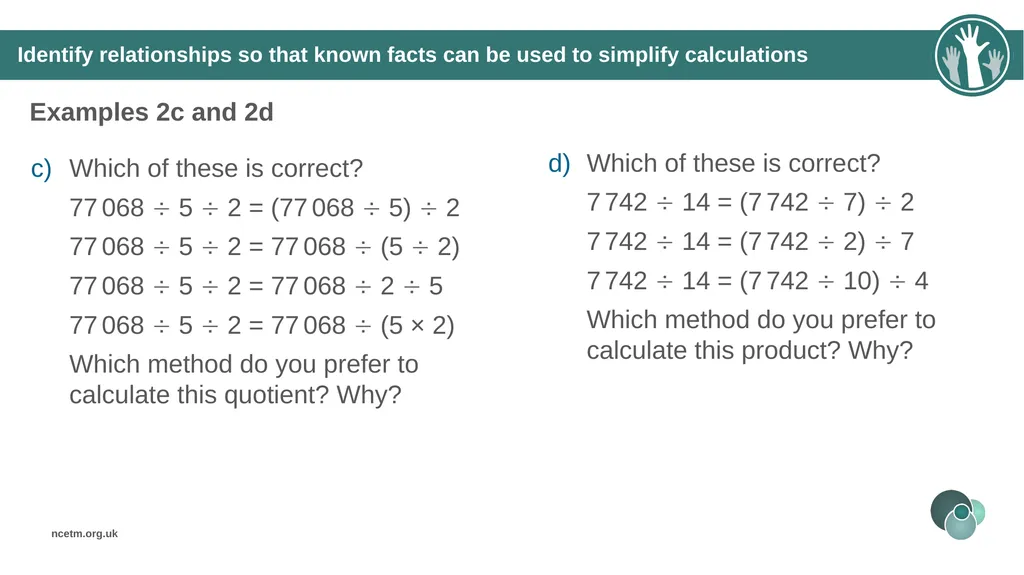
Identify relationships so that known facts can be used to simplify calculations Examples 2c and 2d Which of these is correct?
77 068 5 2 = (77 068 5) 2
77 068 5 2 = 77 068 (5 2)
77 068 5 2 = 77 068 2 5
77 068 5 2 = 77 068 (5 × 2)
Which method do you prefer to calculate this quotient? Why? Which of these is correct?
7 742 14 = (7 742 7) 2
7 742 14 = (7 742 2) 7
7 742 14 = (7 742 10) 4
Which method do you prefer to calculate this product? Why?<br>
77 068 5 2 = (77 068 5) 2
77 068 5 2 = 77 068 (5 2)
77 068 5 2 = 77 068 2 5
77 068 5 2 = 77 068 (5 × 2)
Which method do you prefer to calculate this quotient? Why? Which of these is correct?
7 742 14 = (7 742 7) 2
7 742 14 = (7 742 2) 7
7 742 14 = (7 742 10) 4
Which method do you prefer to calculate this product? Why?<br>
17
Identify relationships so that known facts can be used to simplify calculations<br>
18
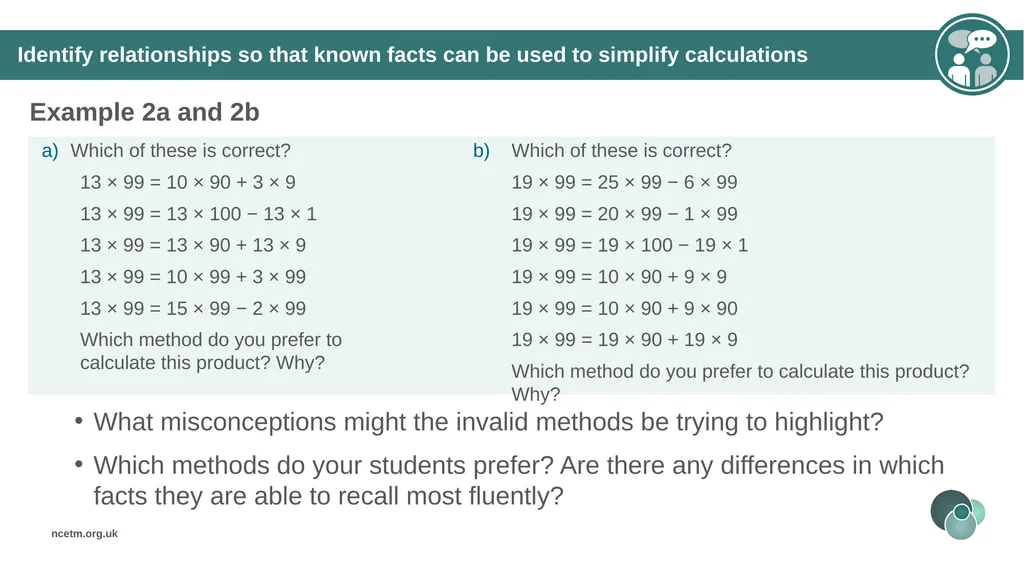
Example 2a and 2b What misconceptions might the invalid methods be trying to highlight?
Which methods do your students prefer? Are there any differences in which facts they are able to recall most fluently? Identify relationships so that known facts can be used to simplify calculations Which of these is correct?
13 × 99 = 10 × 90 + 3 × 9
13 × 99 = 13 × 100 − 13 × 1
13 × 99 = 13 × 90 + 13 × 9
13 × 99 = 10 × 99 + 3 × 99
13 × 99 = 15 × 99 − 2 × 99
Which method do you prefer to calculate this product? Why? Which of these is correct?
19 × 99 = 25 × 99 − 6 × 99
19 × 99 = 20 × 99 − 1 × 99
19 × 99 = 19 × 100 − 19 × 1
19 × 99 = 10 × 90 + 9 × 9
19 × 99 = 10 × 90 + 9 × 90
19 × 99 = 19 × 90 + 19 × 9
Which method do you prefer to calculate this product? Why?<br>
Which methods do your students prefer? Are there any differences in which facts they are able to recall most fluently? Identify relationships so that known facts can be used to simplify calculations Which of these is correct?
13 × 99 = 10 × 90 + 3 × 9
13 × 99 = 13 × 100 − 13 × 1
13 × 99 = 13 × 90 + 13 × 9
13 × 99 = 10 × 99 + 3 × 99
13 × 99 = 15 × 99 − 2 × 99
Which method do you prefer to calculate this product? Why? Which of these is correct?
19 × 99 = 25 × 99 − 6 × 99
19 × 99 = 20 × 99 − 1 × 99
19 × 99 = 19 × 100 − 19 × 1
19 × 99 = 10 × 90 + 9 × 9
19 × 99 = 10 × 90 + 9 × 90
19 × 99 = 19 × 90 + 19 × 9
Which method do you prefer to calculate this product? Why?<br>
19
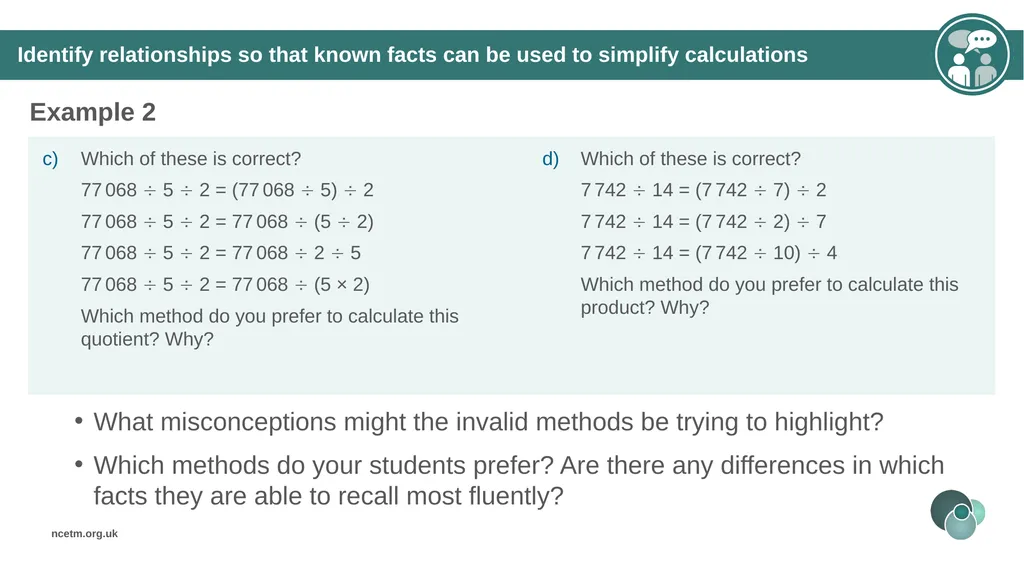
Example 2 What misconceptions might the invalid methods be trying to highlight?
Which methods do your students prefer? Are there any differences in which facts they are able to recall most fluently? Identify relationships so that known facts can be used to simplify calculations Which of these is correct?
77 068 5 2 = (77 068 5) 2
77 068 5 2 = 77 068 (5 2)
77 068 5 2 = 77 068 2 5
77 068 5 2 = 77 068 (5 × 2)
Which method do you prefer to calculate this quotient? Why? Which of these is correct?
7 742 14 = (7 742 7) 2
7 742 14 = (7 742 2) 7
7 742 14 = (7 742 10) 4
Which method do you prefer to calculate this product? Why?<br>
Which methods do your students prefer? Are there any differences in which facts they are able to recall most fluently? Identify relationships so that known facts can be used to simplify calculations Which of these is correct?
77 068 5 2 = (77 068 5) 2
77 068 5 2 = 77 068 (5 2)
77 068 5 2 = 77 068 2 5
77 068 5 2 = 77 068 (5 × 2)
Which method do you prefer to calculate this quotient? Why? Which of these is correct?
7 742 14 = (7 742 7) 2
7 742 14 = (7 742 2) 7
7 742 14 = (7 742 10) 4
Which method do you prefer to calculate this product? Why?<br>
20
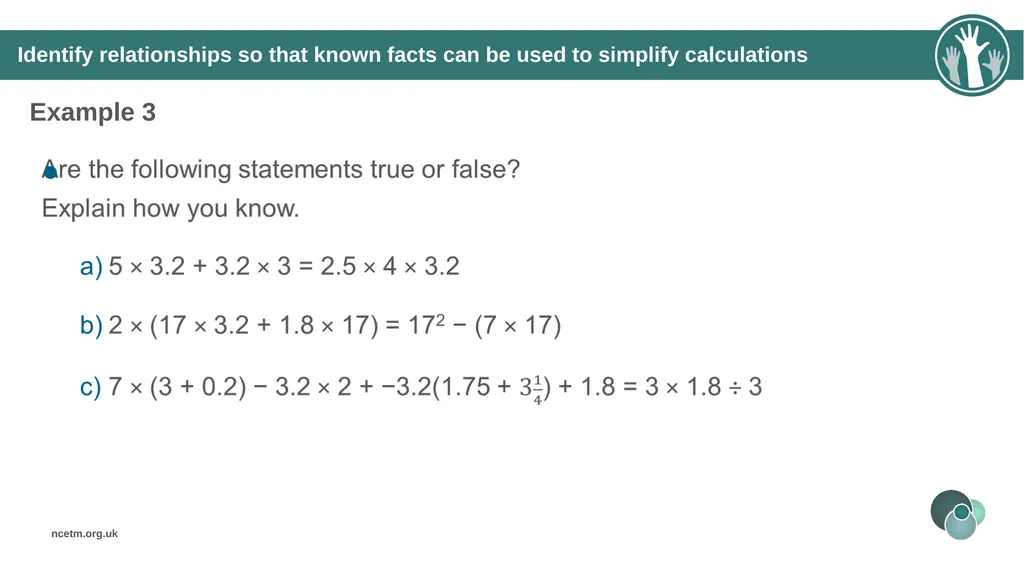
Identify relationships so that known facts can be used to simplify calculations Example 3<br>
21
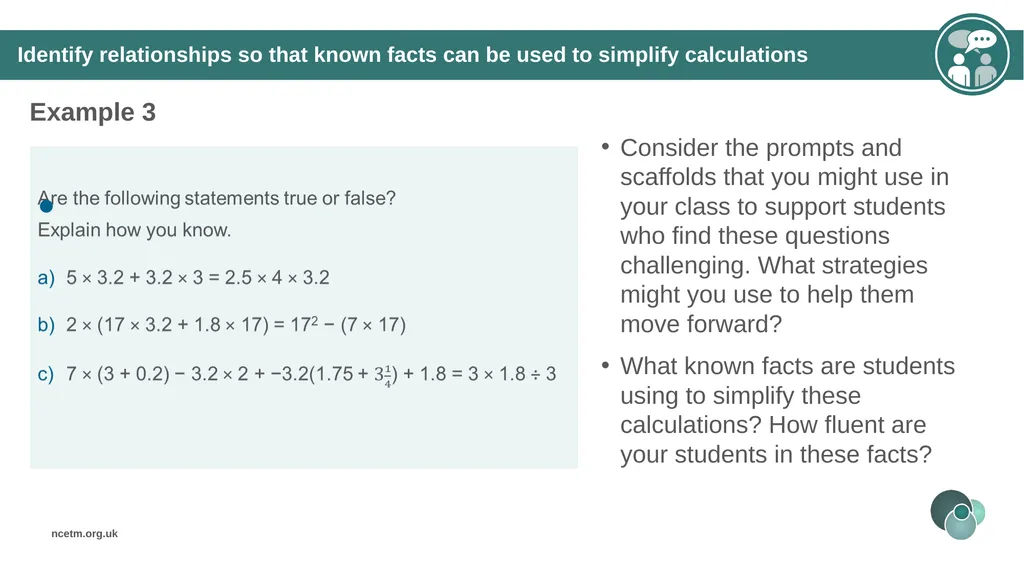
Example 3 Consider the prompts and scaffolds that you might use in your class to support students who find these questions challenging. What strategies might you use to help them move forward?
What known facts are students using to simplify these calculations? How fluent are your students in these facts? Identify relationships so that known facts can be used to simplify calculations<br>
What known facts are students using to simplify these calculations? How fluent are your students in these facts? Identify relationships so that known facts can be used to simplify calculations<br>
22
Examples 1, 2 and 3 This key idea, including all of the examples, is discussed in video 4 of the Insights from experienced teachers. How do their reflections compare with your experience? Identify relationships so that known facts can be used to simplify calculations<br>
23
Reflection questions What other mathematical concepts will be supported by students’ stronger understanding of this key idea?
What mathematical language will you continue to use to support pupils to make connections with other areas?
Which representations might you continue to use to further develop students’ understanding?<br>
What mathematical language will you continue to use to support pupils to make connections with other areas?
Which representations might you continue to use to further develop students’ understanding?<br>
24
Appendices You may choose to use the following slides when planning or delivering a PD session. They cover:
Key vocabulary
Representations and structure
Previous learning
Future learning
Library of links<br>
Key vocabulary
Representations and structure
Previous learning
Future learning
Library of links<br>
25
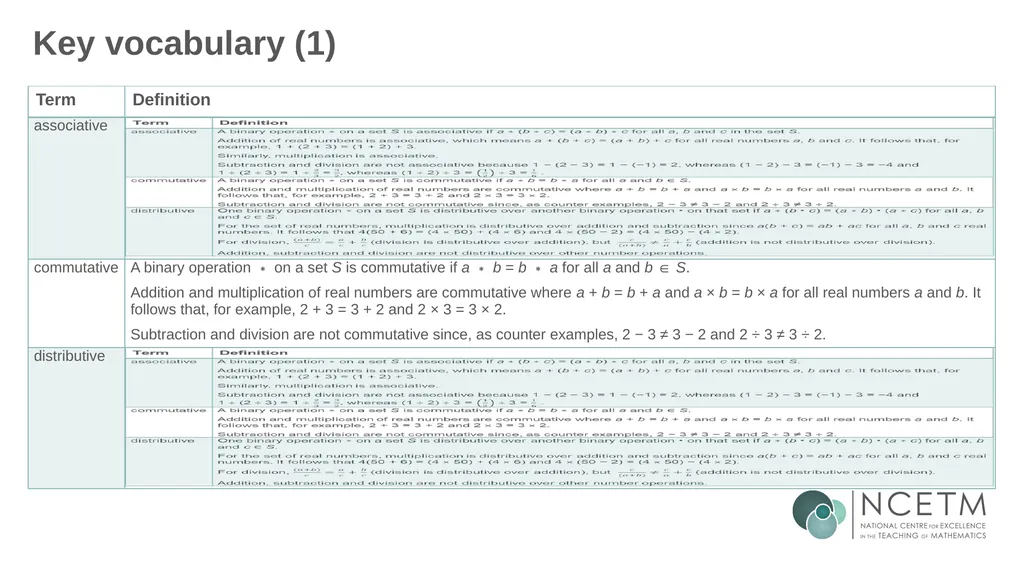
Key vocabulary (1)<br>
26
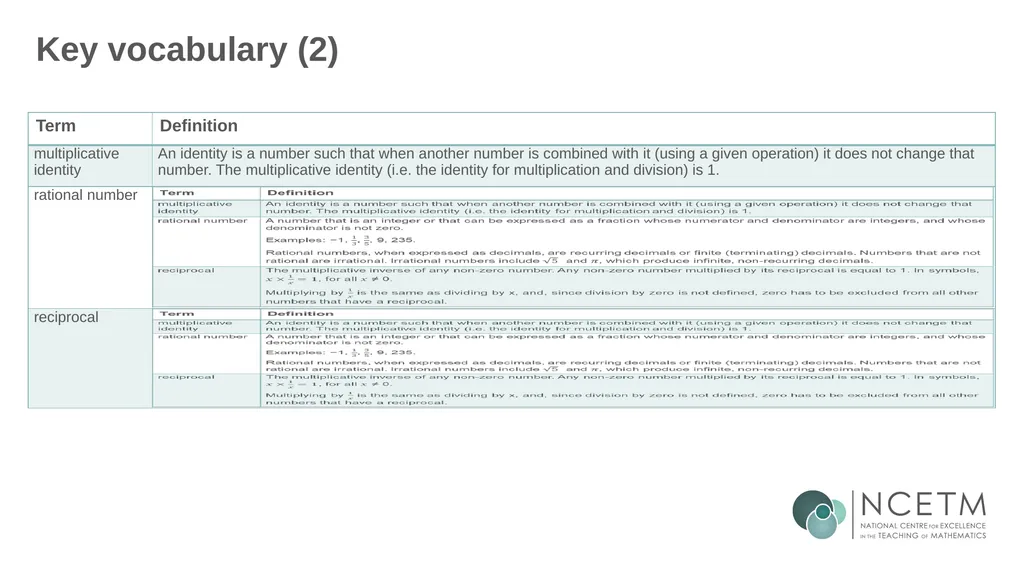
Key vocabulary (2)<br>
27
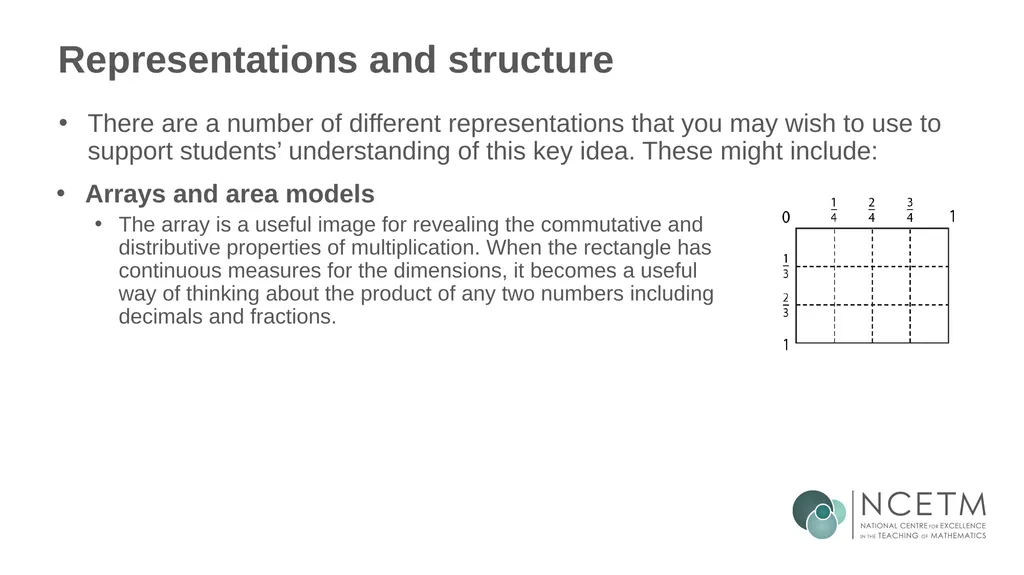
Representations and structure There are a number of different representations that you may wish to use to support students’ understanding of this key idea. These might include: Arrays and area models
The array is a useful image for revealing the commutative and distributive properties of multiplication. When the rectangle has continuous measures for the dimensions, it becomes a useful way of thinking about the product of any two numbers including decimals and fractions.<br>
The array is a useful image for revealing the commutative and distributive properties of multiplication. When the rectangle has continuous measures for the dimensions, it becomes a useful way of thinking about the product of any two numbers including decimals and fractions.<br>
28
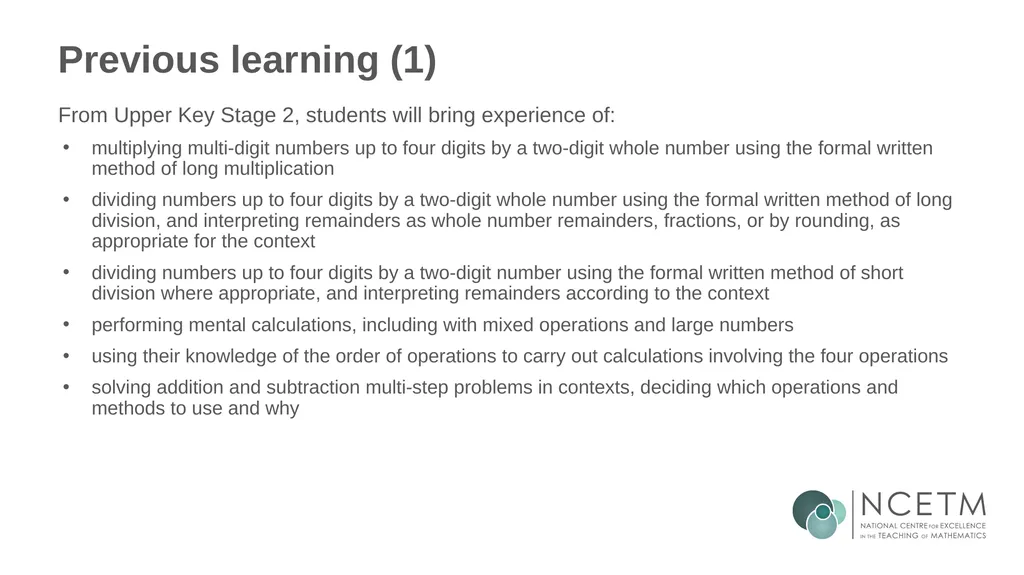
Previous learning (1) From Upper Key Stage 2, students will bring experience of:
multiplying multi-digit numbers up to four digits by a two-digit whole number using the formal written method of long multiplication
dividing numbers up to four digits by a two-digit whole number using the formal written method of long division, and interpreting remainders as whole number remainders, fractions, or by rounding, as appropriate for the context
dividing numbers up to four digits by a two-digit number using the formal written method of short division where appropriate, and interpreting remainders according to the context
performing mental calculations, including with mixed operations and large numbers
using their knowledge of the order of operations to carry out calculations involving the four operations
solving addition and subtraction multi-step problems in contexts, deciding which operations and methods to use and why<br>
multiplying multi-digit numbers up to four digits by a two-digit whole number using the formal written method of long multiplication
dividing numbers up to four digits by a two-digit whole number using the formal written method of long division, and interpreting remainders as whole number remainders, fractions, or by rounding, as appropriate for the context
dividing numbers up to four digits by a two-digit number using the formal written method of short division where appropriate, and interpreting remainders according to the context
performing mental calculations, including with mixed operations and large numbers
using their knowledge of the order of operations to carry out calculations involving the four operations
solving addition and subtraction multi-step problems in contexts, deciding which operations and methods to use and why<br>
29
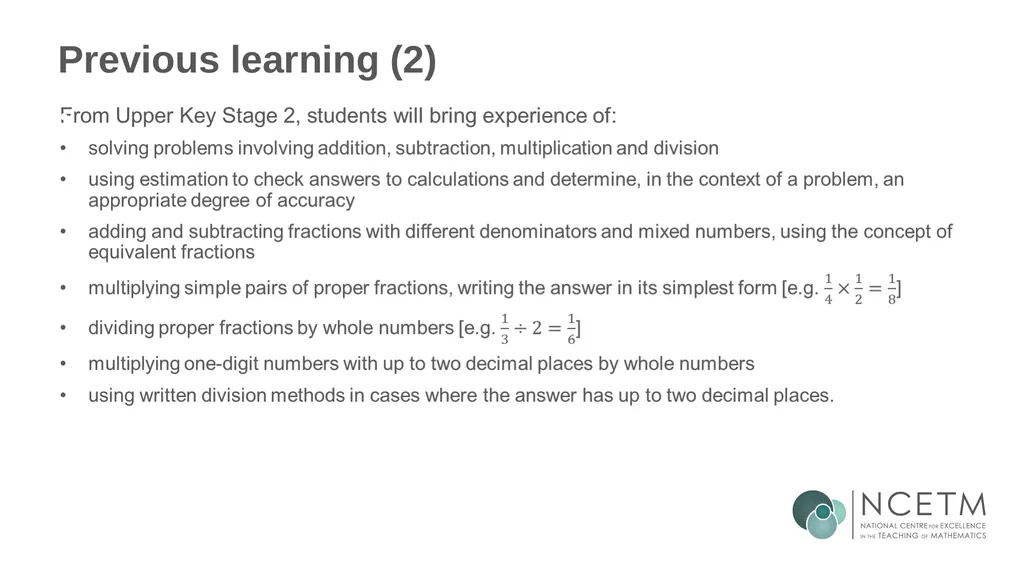
Previous learning (2)<br>
30
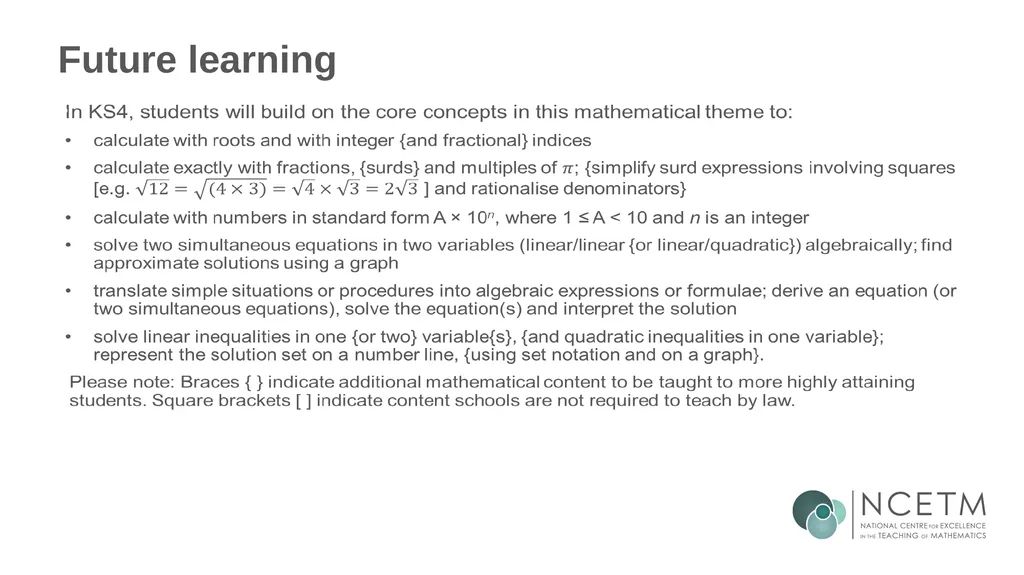
Future learning<br>
31
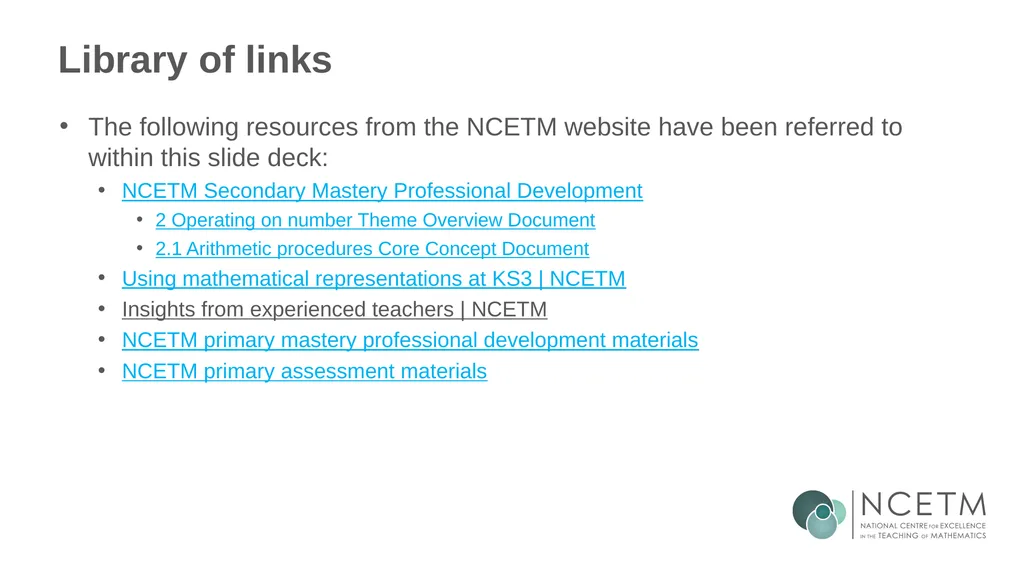
Library of links The following resources from the NCETM website have been referred to within this slide deck:
NCETM Secondary Mastery Professional Development
2 Operating on number Theme Overview Document
2.1 Arithmetic procedures Core Concept Document
Using mathematical representations at KS3 | NCETM
Insights from experienced teachers | NCETM
NCETM primary mastery professional development materials
NCETM primary assessment materials<br>
NCETM Secondary Mastery Professional Development
2 Operating on number Theme Overview Document
2.1 Arithmetic procedures Core Concept Document
Using mathematical representations at KS3 | NCETM
Insights from experienced teachers | NCETM
NCETM primary mastery professional development materials
NCETM primary assessment materials<br>