Solving Systems of Linear Equations by Graphing Concept: Solving systems of equations in two variables. EQ: How can I manipulate equations to solve a system of equations? (REI 5-6,10-11) Vocabulary: System of equations, Inconsistent,
"Solving Systems of Linear Equations by Graphing" is the property of its rightful owner. Permission is granted to
download and print the materials on this website for personal, non-commercial use only, and to display it
on your personal computer provided you do not modify the materials and that you retain all copyright
notices contained in the materials. By downloading content from our website, you accept the terms of this
agreement.
Presentation Transcript
01
Solving Systems of
Linear Equations by Graphing
Concept: Solving systems of equations in two variables.
EQ: How can I manipulate equations to solve a system of equations? (REI 5-6,10-11)
Vocabulary: System of equations, Inconsistent, Consistent (independent/dependent.)
‘In Common’ Ballad: http://youtu.be/Br7qn4yLf-I
‘All I do is solve’ Rap: http://youtu.be/1qHTmxlaZWQ 2.2.2: Solving Systems of Linear Equations 1<br>
02
Introduction
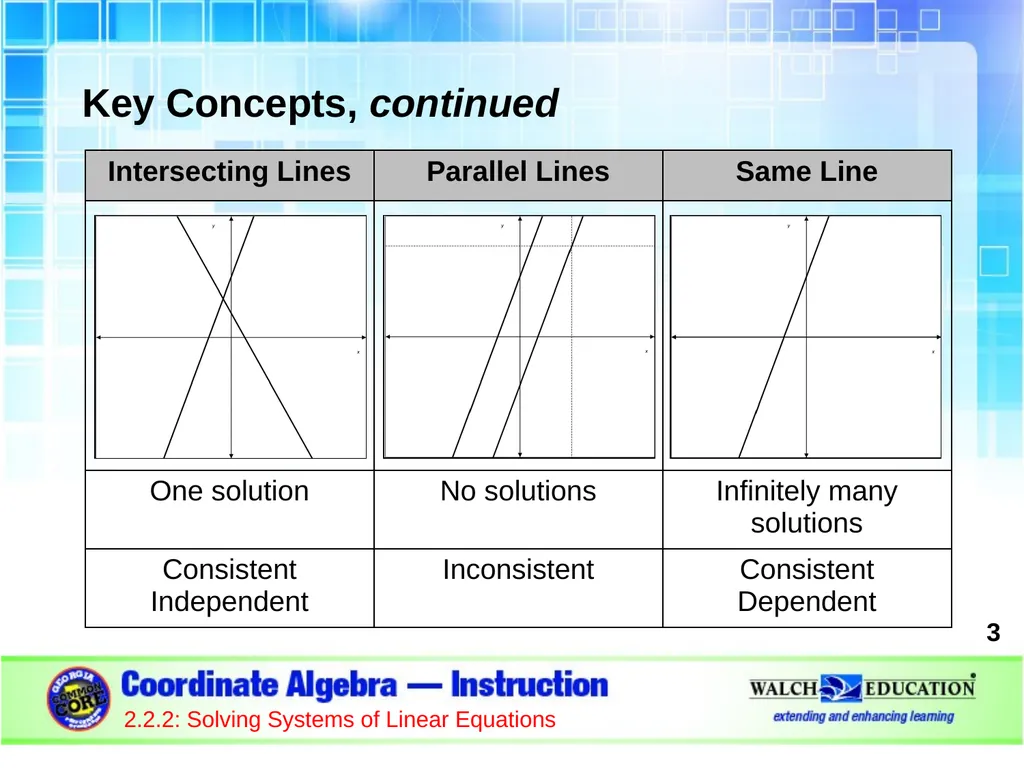
The solution to a system of equations is the point or points that make both equations true. Systems of equations can have one solution, no solutions, or an infinite number of solutions.
There are various methods to solving a system of equations. One is the graphing method.
On a graph, the solution to a system of equations can be easily seen. The solution to the system is the point of intersection, the point at which two lines cross or meet. 2.2.2: Solving Systems of Linear Equations 2<br>
03
Key Concepts, continued 3 2.2.2: Solving Systems of Linear Equations<br>
04
Guided Practice
Example 1
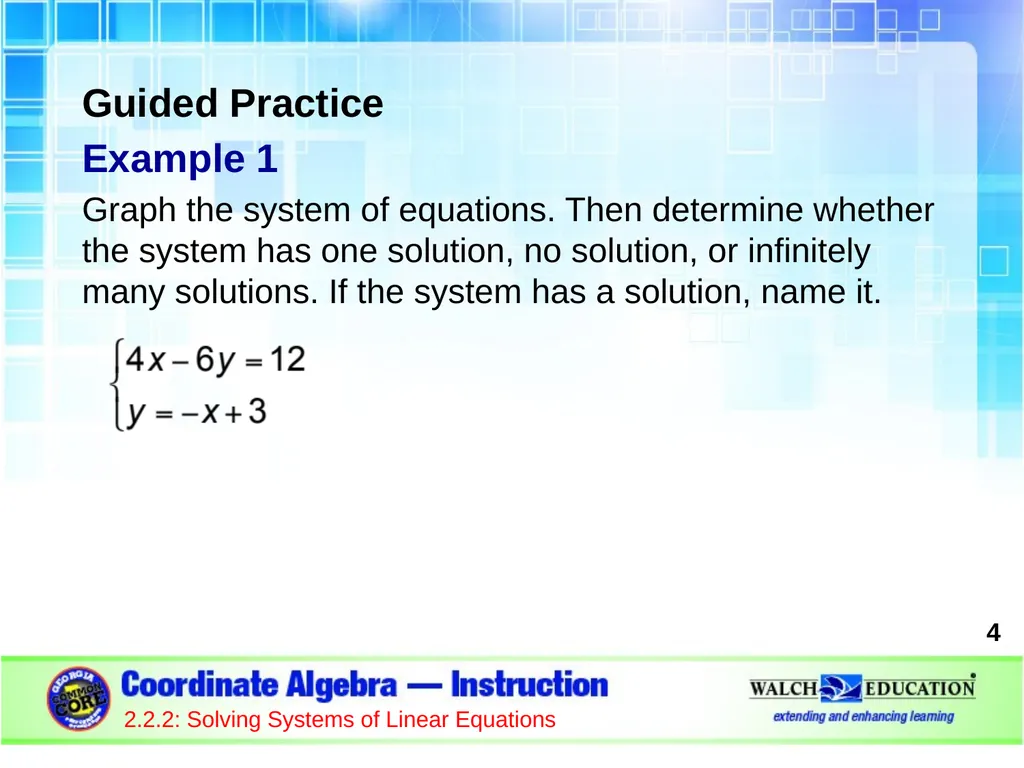
Graph the system of equations. Then determine whether the system has one solution, no solution, or infinitely many solutions. If the system has a solution, name it. 4 2.2.2: Solving Systems of Linear Equations<br>
05
Guided Practice: Example 1, continued
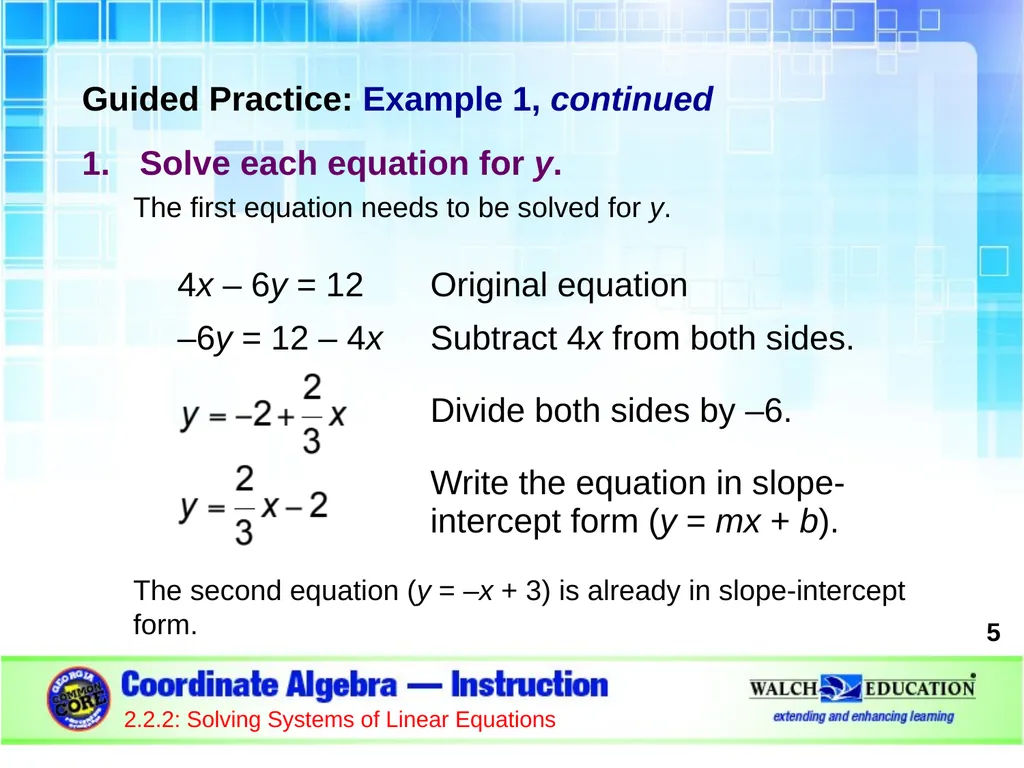
Solve each equation for y.
The first equation needs to be solved for y.
The second equation (y = –x + 3) is already in slope-intercept form. 5 2.2.2: Solving Systems of Linear Equations<br>
06
Guided Practice: Example 1, continued
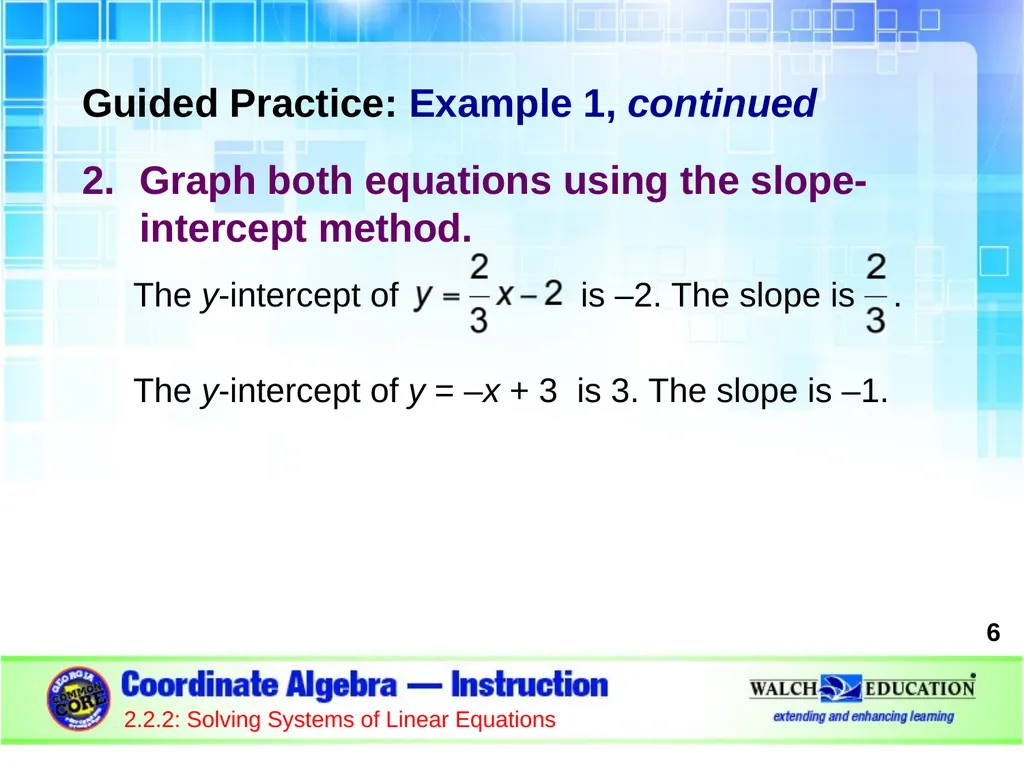
Graph both equations using the slope-intercept method.
The y-intercept of is –2. The slope is .
The y-intercept of y = –x + 3 is 3. The slope is –1. 6 2.2.2: Solving Systems of Linear Equations<br>
07
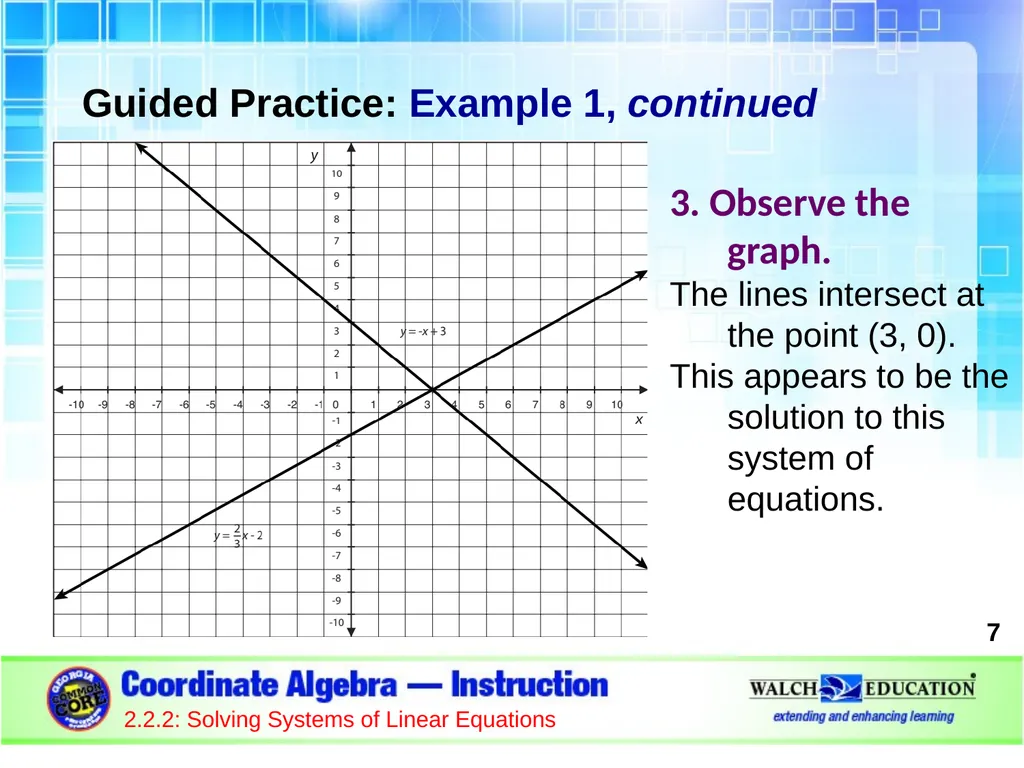
Guided Practice: Example 1, continued 7 2.2.2: Solving Systems of Linear Equations 3. Observe the graph.
The lines intersect at the point (3, 0).
This appears to be the solution to this system of equations.<br>
08
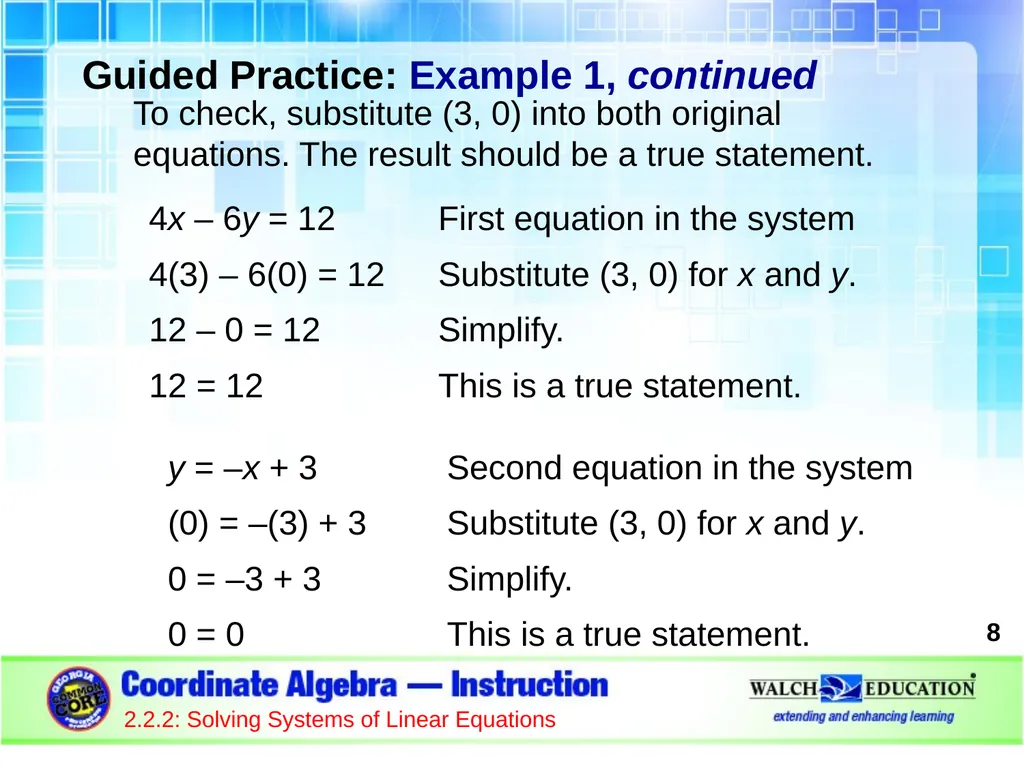
Guided Practice: Example 1, continued 8 2.2.2: Solving Systems of Linear Equations To check, substitute (3, 0) into both original equations. The result should be a true statement.<br>
09
Guided Practice: Example 1, continued
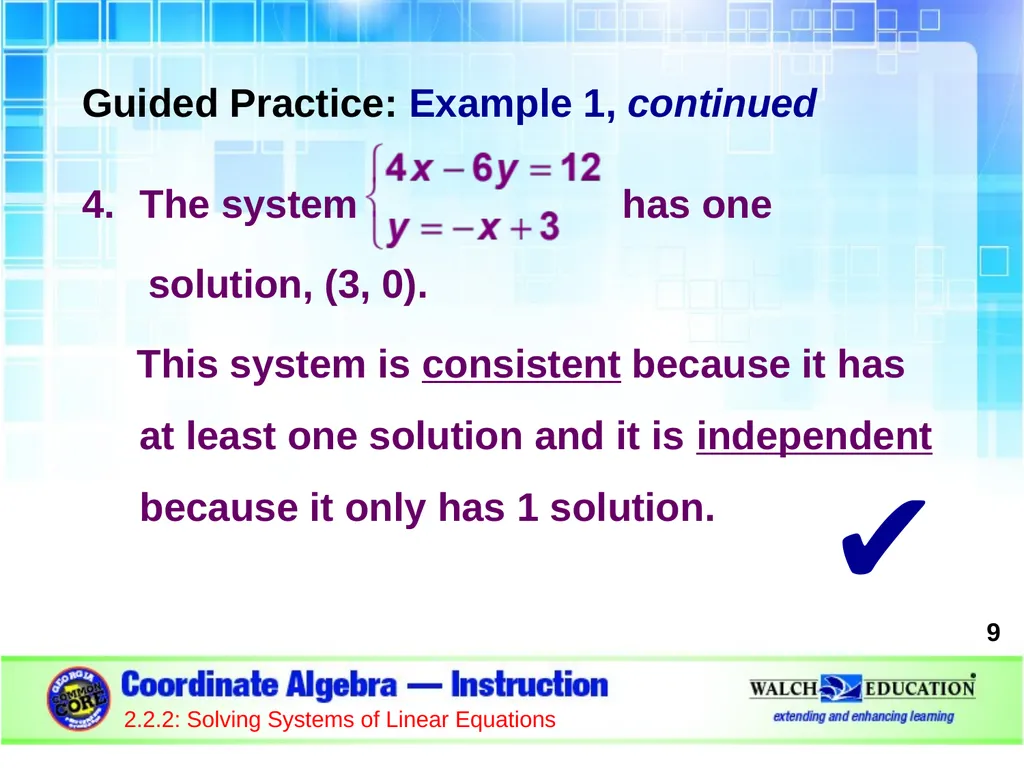
The system has one
solution, (3, 0).
This system is consistent because it has at least one solution and it is independent because it only has 1 solution. 9 2.2.2: Solving Systems of Linear Equations ✔<br>
10
Guided Practice
Example 2
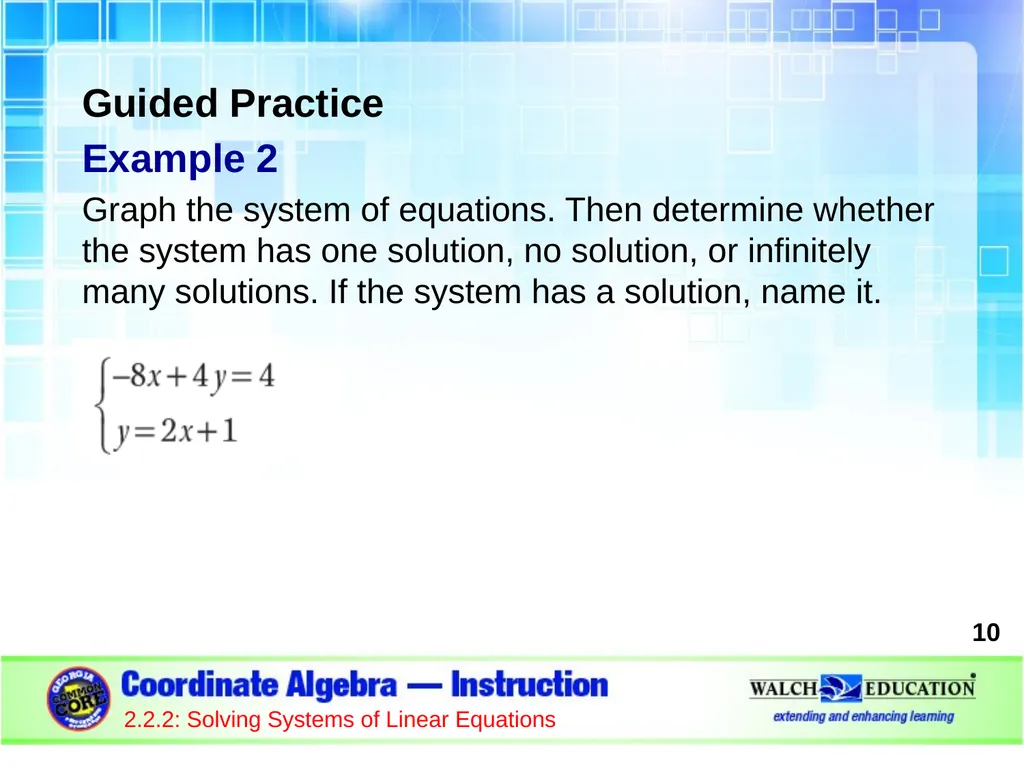
Graph the system of equations. Then determine whether the system has one solution, no solution, or infinitely many solutions. If the system has a solution, name it. 10 2.2.2: Solving Systems of Linear Equations<br>
11
Guided Practice: Example 2, continued
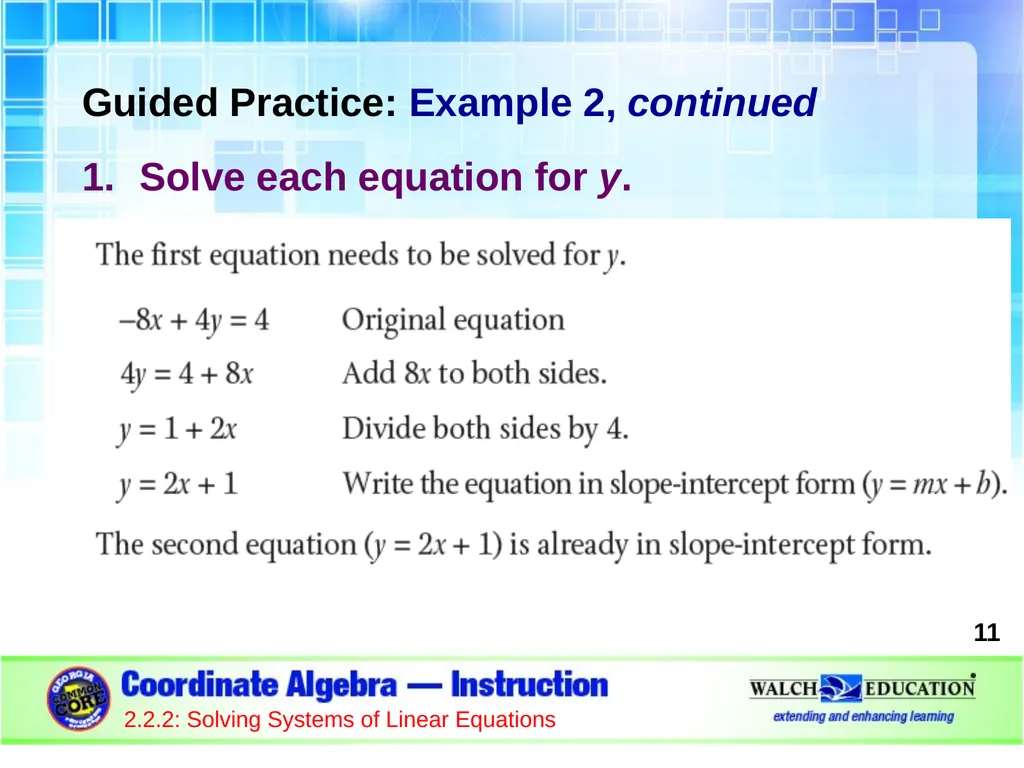
Solve each equation for y. 11 2.2.2: Solving Systems of Linear Equations<br>
12
Guided Practice: Example 2, continued
Graph both equations using the slope-intercept method.
The y-intercept of both equations is 1.
The slope of both equations is 2. 12 2.2.2: Solving Systems of Linear Equations<br>
13
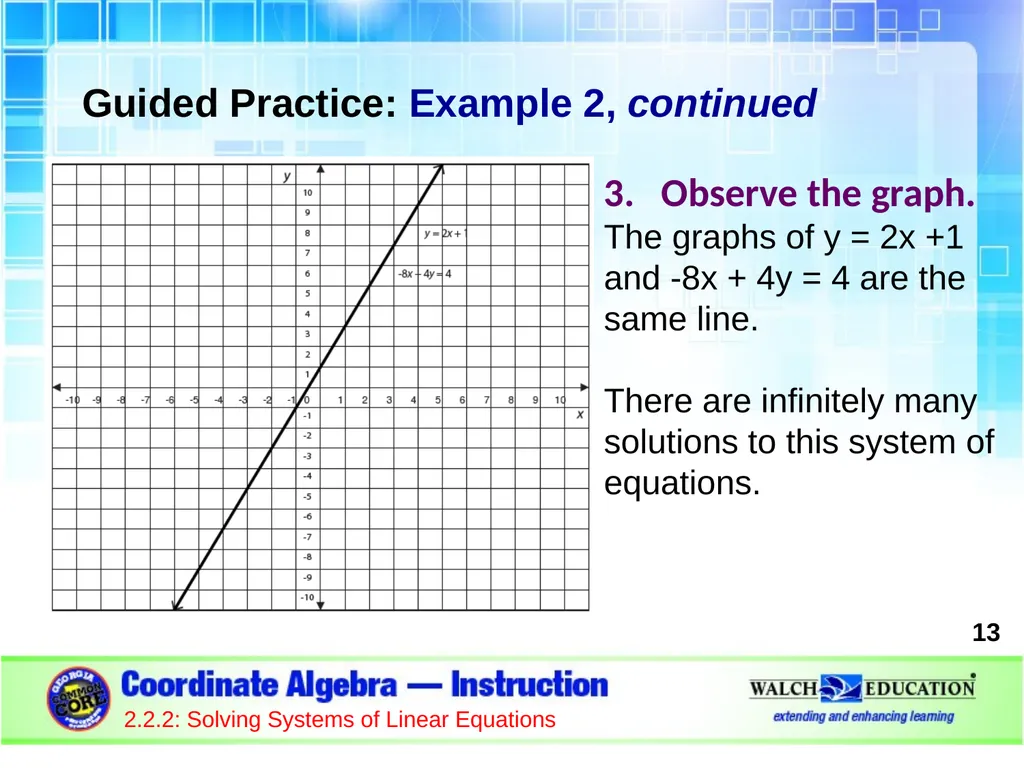
Guided Practice: Example 2, continued 13 2.2.2: Solving Systems of Linear Equations Observe the graph.
The graphs of y = 2x +1
and -8x + 4y = 4 are the
same line.
There are infinitely many
solutions to this system of
equations.<br>
14
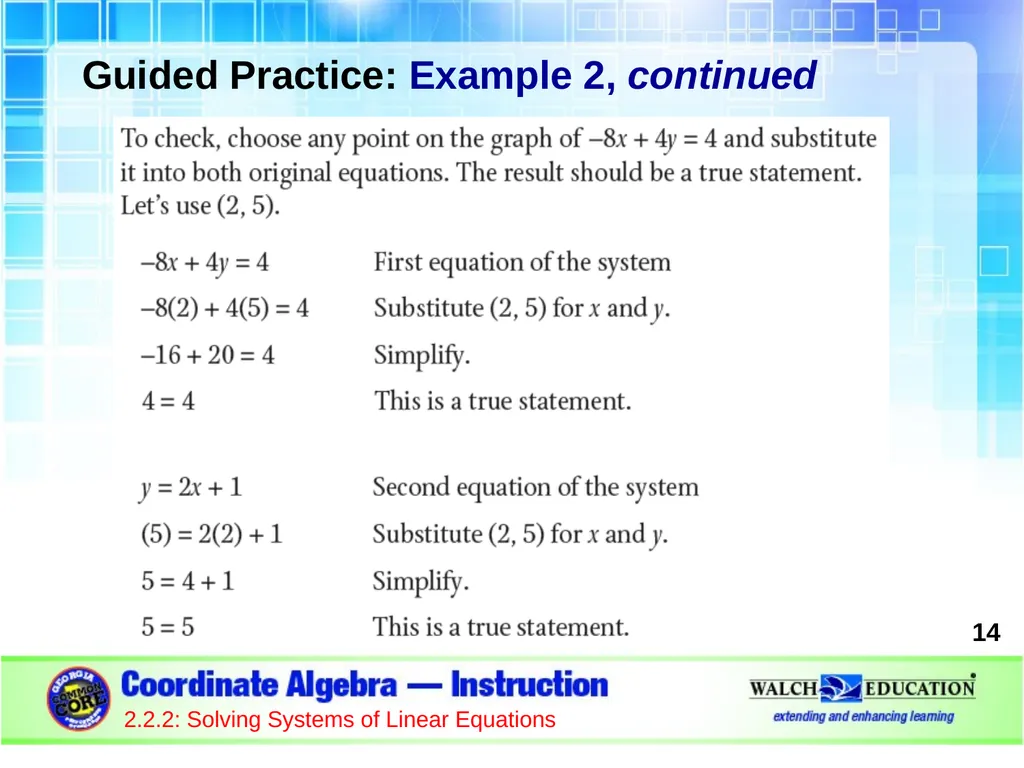
Guided Practice: Example 2, continued 14 2.2.2: Solving Systems of Linear Equations<br>
15
Guided Practice: Example 2, continued
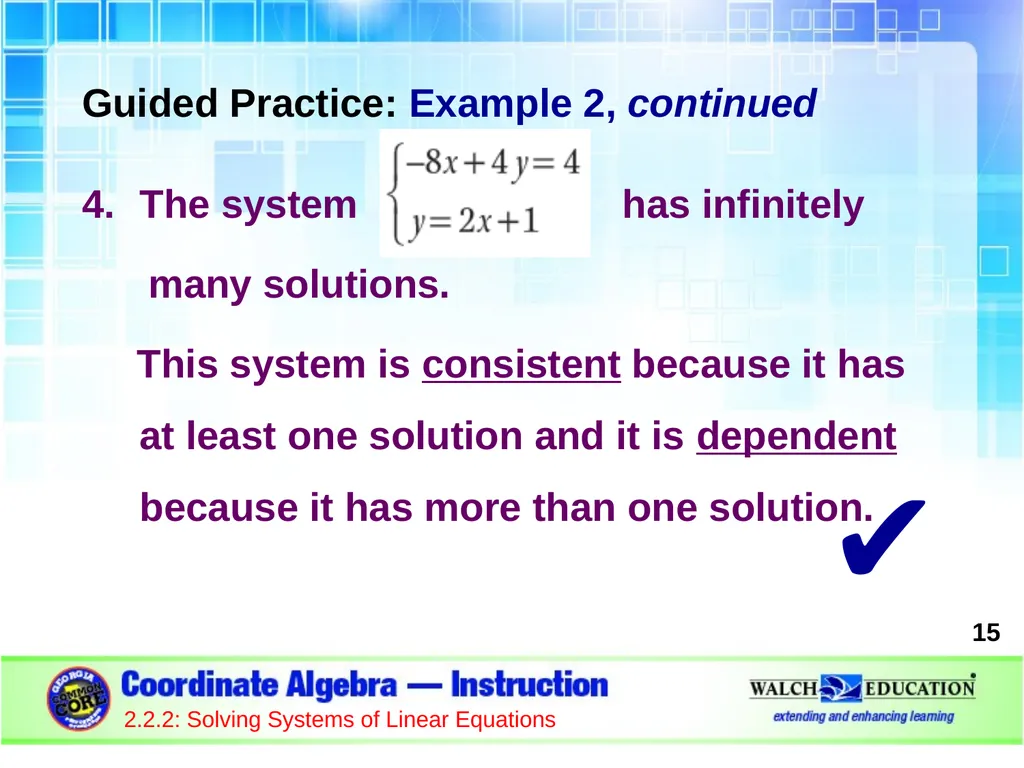
The system has infinitely
many solutions.
This system is consistent because it has at least one solution and it is dependent because it has more than one solution. 15 2.2.2: Solving Systems of Linear Equations ✔<br>
16
Guided Practice
Example 3
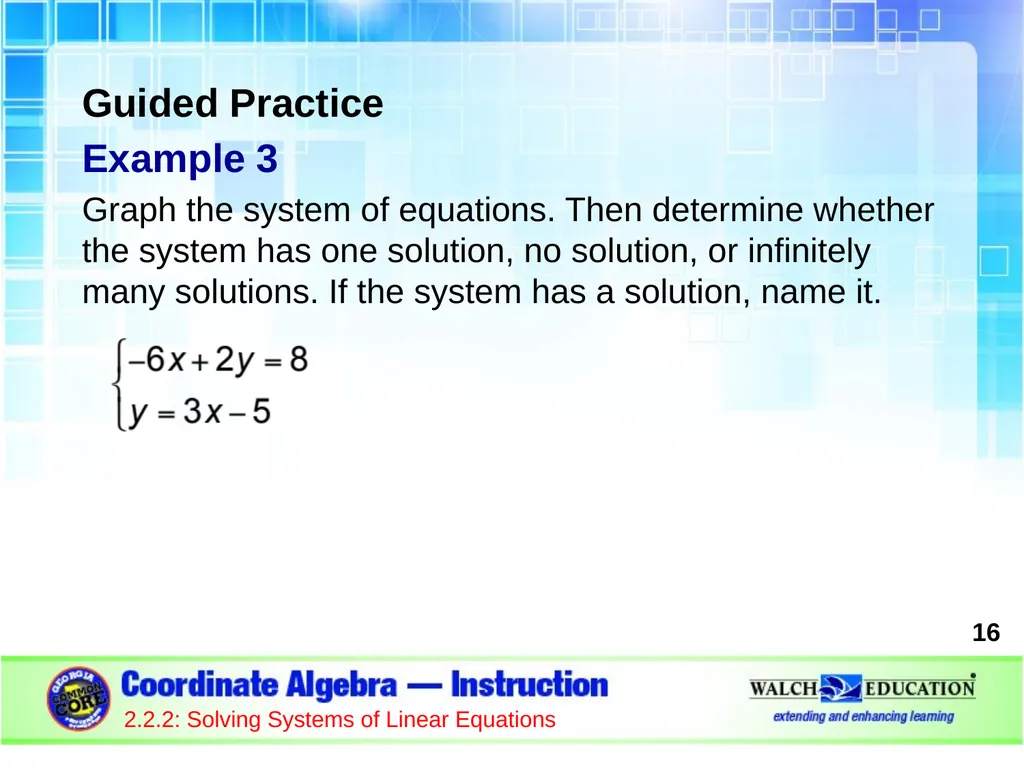
Graph the system of equations. Then determine whether the system has one solution, no solution, or infinitely many solutions. If the system has a solution, name it. 16 2.2.2: Solving Systems of Linear Equations<br>
17
Guided Practice: Example 3, continued
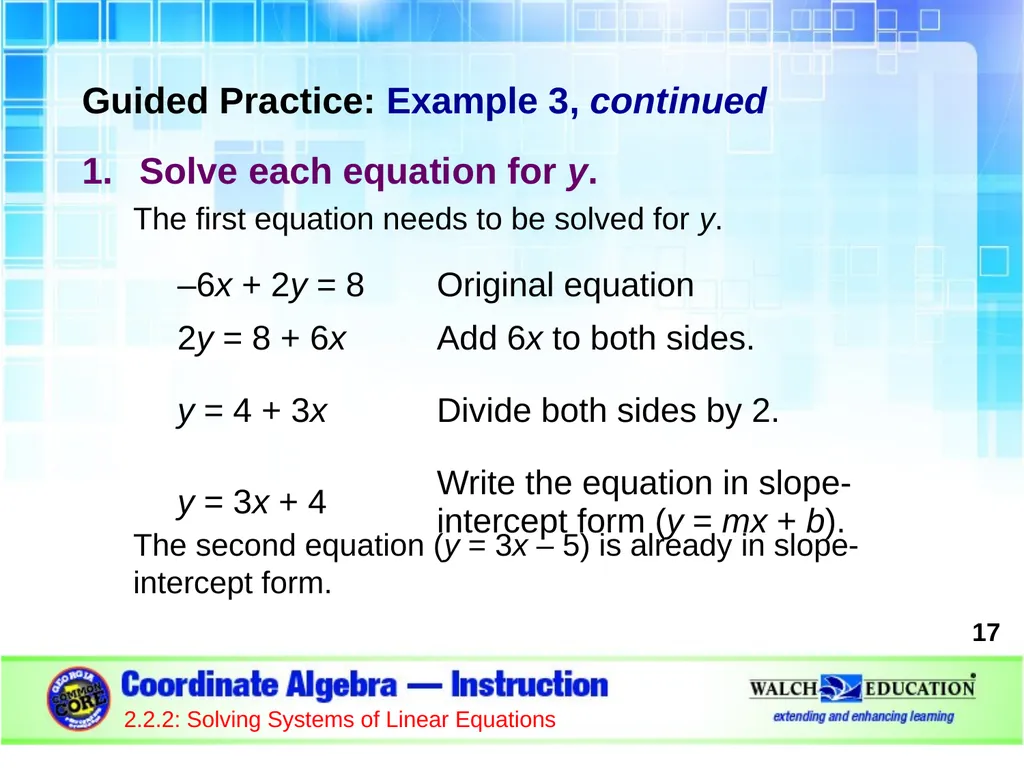
Solve each equation for y.
The first equation needs to be solved for y.
The second equation (y = 3x – 5) is already in slope-intercept form. 17 2.2.2: Solving Systems of Linear Equations<br>
18
Guided Practice: Example 3, continued
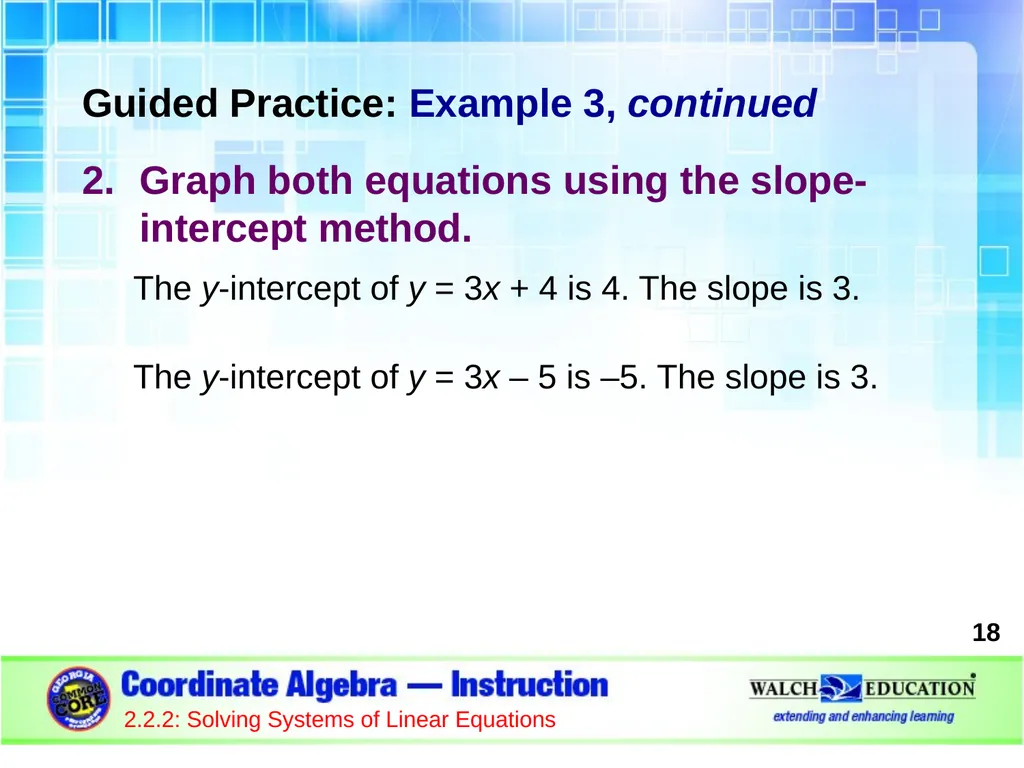
Graph both equations using the slope-intercept method.
The y-intercept of y = 3x + 4 is 4. The slope is 3.
The y-intercept of y = 3x – 5 is –5. The slope is 3. 18 2.2.2: Solving Systems of Linear Equations<br>
19
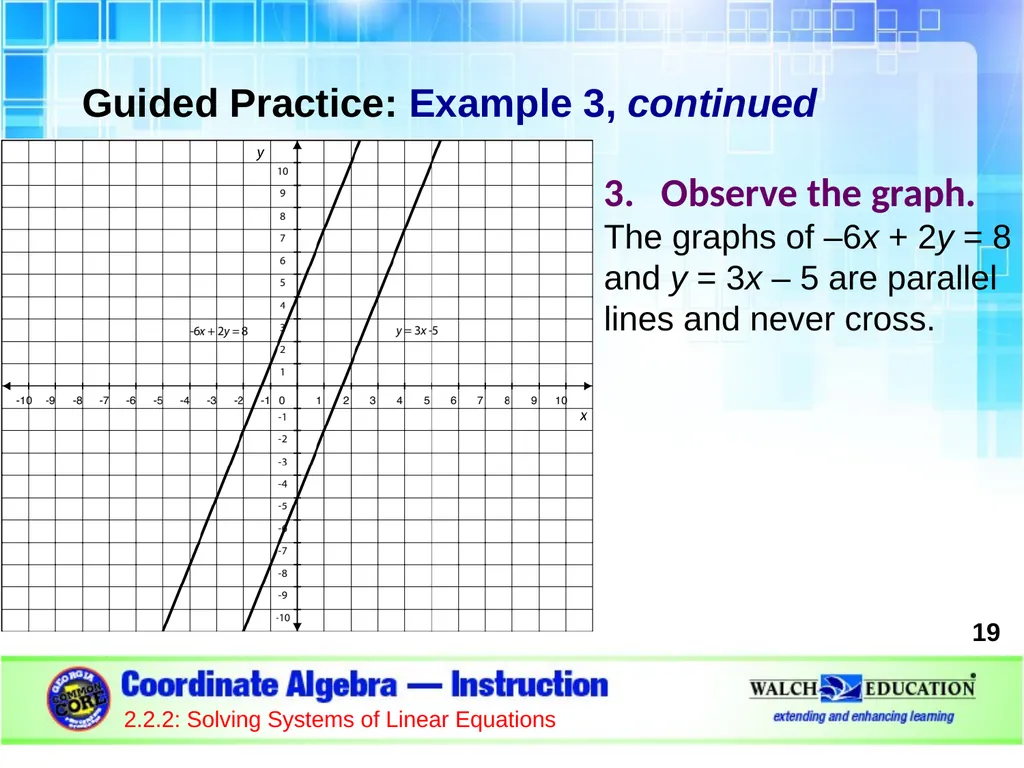
Guided Practice: Example 3, continued 19 2.2.2: Solving Systems of Linear Equations Observe the graph.
The graphs of –6x + 2y = 8
and y = 3x – 5 are parallel
lines and never cross.<br>
20
Guided Practice: Example 3, continued
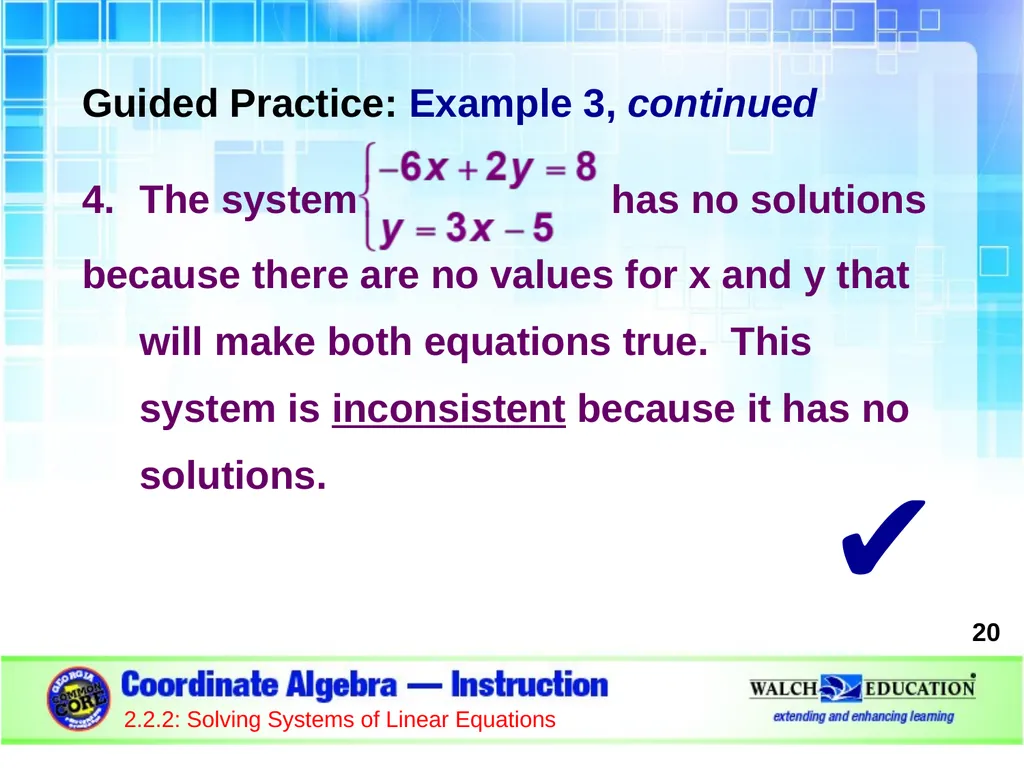
The system has no solutions
because there are no values for x and y that will make both equations true. This system is inconsistent because it has no solutions. 20 2.2.2: Solving Systems of Linear Equations ✔<br>