
Songs and Protest – History and examples Tom Cook,
LO
Published · 12 slides · 0 views

1 / 1

Description
Songs and Protest History and examples Tom Cook, community composer Songs have been a part of protest and rebellion throughout history. There is something unifying and empowering that songs can give to a movement. Songs have long been
Related Topics
Share
Embed code
Download this presentation From Below
"Songs and Protest – History and examples Tom Cook," is the property of its rightful owner. Permission is granted to download and print the materials on this website for personal, non-commercial use only, and to display it on your personal computer provided you do not modify the materials and that you retain all copyright notices contained in the materials. By downloading content from our website, you accept the terms of this agreement.
Presentation Transcript
01
Songs and Protest – History and examples
Tom Cook, community composer Songs have been a part of protest and rebellion throughout history.
There is something unifying and empowering that songs can give to a movement.
Songs have long been used as a way to pass on ideas, to pass on history and to challenge ideals.
They can make a group of individuals feel like one large voice, this is part of the beauty of songs and protest.
DO YOU SING?
WHAT DOES IT FEEL LIKE TO SING TOGETHER?
DOES IT MAKE YOU FEEL STRONG?<br>
02
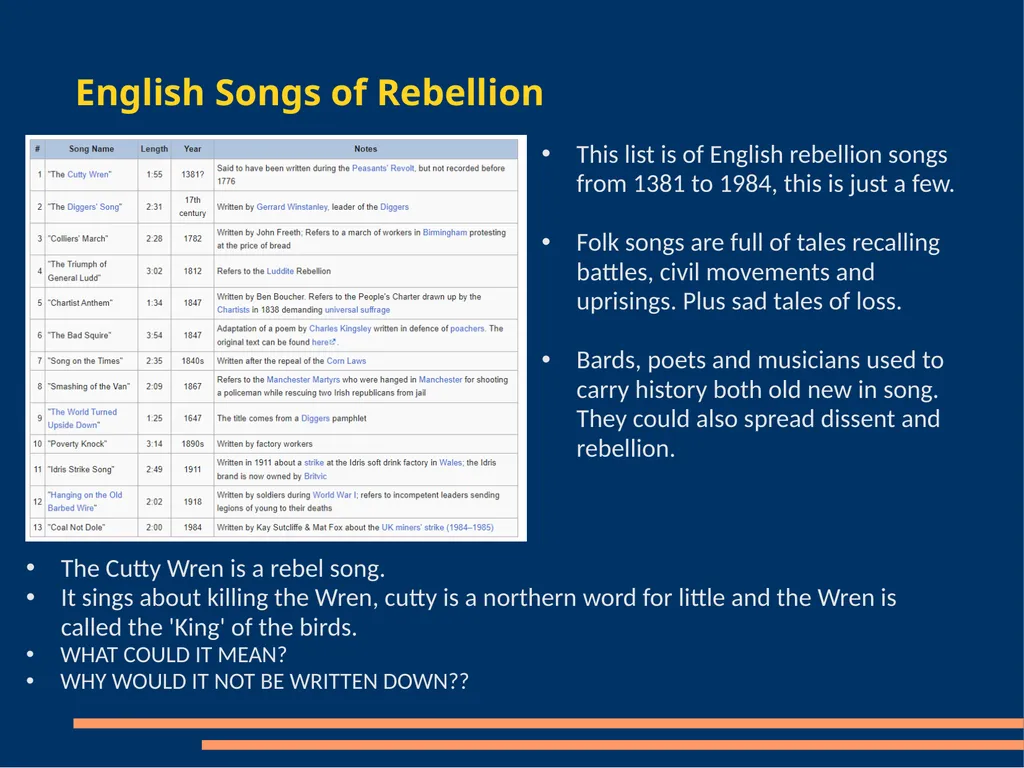
English Songs of Rebellion This list is of English rebellion songs from 1381 to 1984, this is just a few.
Folk songs are full of tales recalling battles, civil movements and uprisings. Plus sad tales of loss.
Bards, poets and musicians used to carry history both old new in song. They could also spread dissent and rebellion. The Cutty Wren is a rebel song.
It sings about killing the Wren, cutty is a northern word for little and the Wren is called the 'King' of the birds.
WHAT COULD IT MEAN?
WHY WOULD IT NOT BE WRITTEN DOWN??<br>
03
The Cutty Wren– The Peasants Revolt. Oh where are you going said Milder to Moulder
Oh we may not tell you said Festel to Fose
We're off to the woods said John the Red Nose
We're off to the woods said John the Red Nose
And what will you do there said Milder to Moulder
We'll shoot the Cutty wren said John the Red Nose
And how will you shoot us said Milder to Moulder
With bows and with arrows said John the Red Nose
Oh that will not do said Milder to Moulder
Oh what will you do then said Festel to Fose
Great guns and great cannon said John the Red Nose
And how will you fetch her said Milder to Moulder
Oh we may not tell you said Festel to Fose
On four strong men's shoulders said John the Red Nose
Ah that will not do said Milder to Moulder
Oh what will do then said Festel to Fose
Great carts and great wagons said John the Red Nose
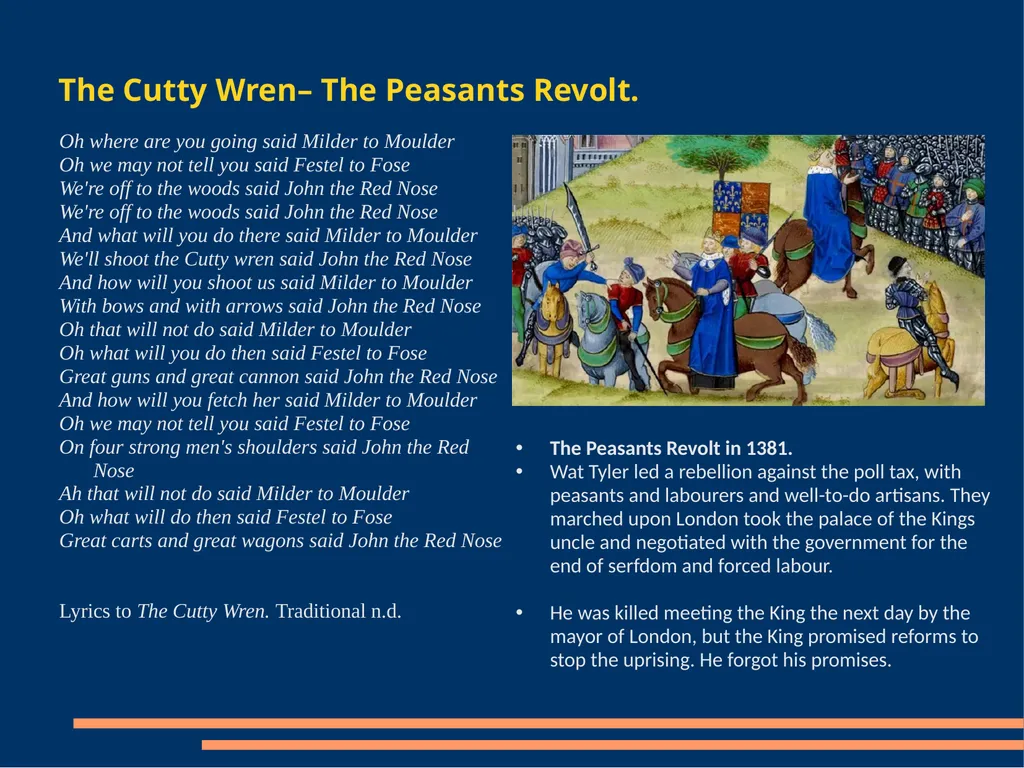
Lyrics to The Cutty Wren. Traditional n.d. The Peasants Revolt in 1381.
Wat Tyler led a rebellion against the poll tax, with peasants and labourers and well-to-do artisans. They marched upon London took the palace of the Kings uncle and negotiated with the government for the end of serfdom and forced labour.
He was killed meeting the King the next day by the mayor of London, but the King promised reforms to stop the uprising. He forgot his promises.<br>
Oh we may not tell you said Festel to Fose
We're off to the woods said John the Red Nose
We're off to the woods said John the Red Nose
And what will you do there said Milder to Moulder
We'll shoot the Cutty wren said John the Red Nose
And how will you shoot us said Milder to Moulder
With bows and with arrows said John the Red Nose
Oh that will not do said Milder to Moulder
Oh what will you do then said Festel to Fose
Great guns and great cannon said John the Red Nose
And how will you fetch her said Milder to Moulder
Oh we may not tell you said Festel to Fose
On four strong men's shoulders said John the Red Nose
Ah that will not do said Milder to Moulder
Oh what will do then said Festel to Fose
Great carts and great wagons said John the Red Nose
Lyrics to The Cutty Wren. Traditional n.d. The Peasants Revolt in 1381.
Wat Tyler led a rebellion against the poll tax, with peasants and labourers and well-to-do artisans. They marched upon London took the palace of the Kings uncle and negotiated with the government for the end of serfdom and forced labour.
He was killed meeting the King the next day by the mayor of London, but the King promised reforms to stop the uprising. He forgot his promises.<br>
04
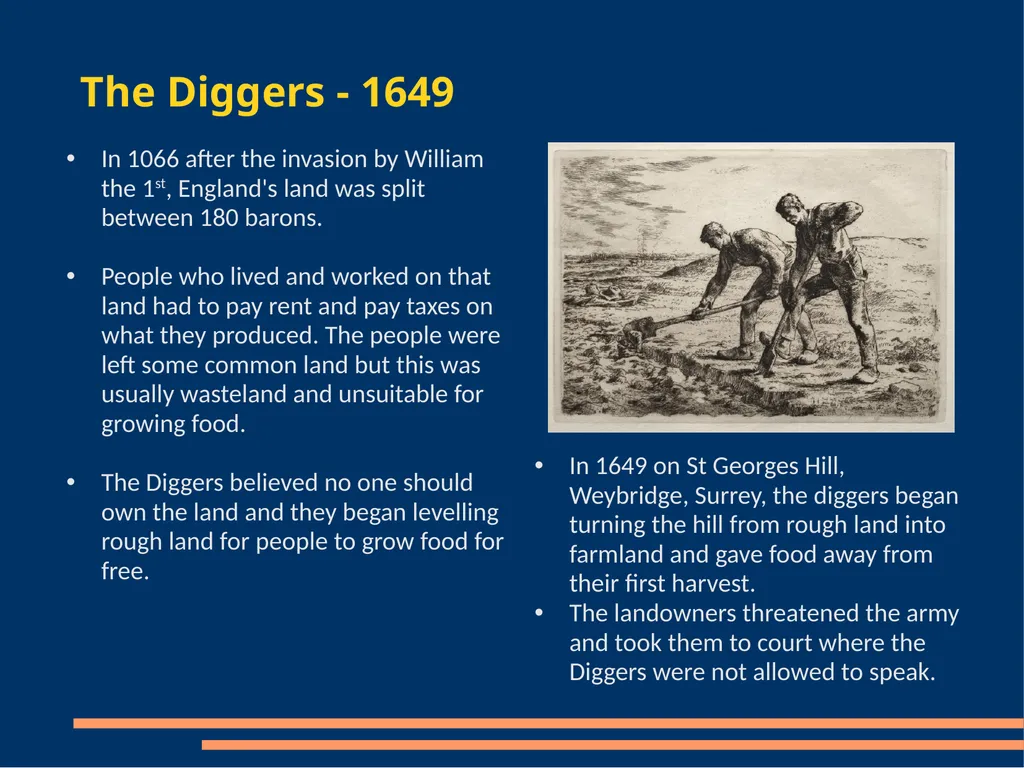
The Diggers - 1649 In 1066 after the invasion by William the 1st, England's land was split between 180 barons.
People who lived and worked on that land had to pay rent and pay taxes on what they produced. The people were left some common land but this was usually wasteland and unsuitable for growing food.
The Diggers believed no one should own the land and they began levelling rough land for people to grow food for free. In 1649 on St Georges Hill, Weybridge, Surrey, the diggers began turning the hill from rough land into farmland and gave food away from their first harvest.
The landowners threatened the army and took them to court where the Diggers were not allowed to speak.<br>
05
Folksong and Billy Bragg retelling You noble diggers all stand up now, stand up now
You noble diggers all stand up now
The wasteland to maintain sin cavaliers by name
Your digging does maintain and persons all defame
Stand up now, stand up now
Your houses they pull down stand up now, stand up now
Your houses they pull down, stand up now
Your houses they pull down to fright your men in town
But the gentry must come down and the poor shall wear the crown
Stand up now diggers all
Stand up now
From The Diggers' Song, 1649 In 1649 To St. George's Hill
A ragged band they called the Diggers
Came to show the people's will
They defied the landlords, They defied the laws
They were the dispossessed reclaiming what was theirs
We come in peace they said, To dig and sow
We come to work the lands in common
And to make the waste grounds grow
This earth divided, We will make whole
So it will be a common treasury for all
The sin of property
We do disdain
No man has any right to buy and sell
The earth for private gain
By theft and murder
They took the land
Now everywhere the walls
Spring up at their command
From The World Turned Upside Down by Leon Rosselson. 1975. Recorded by Billy Bragg.
WHICH ONE DO YOU LIKE ?
IS IT A GOOD STORY TO TELL ?<br>
06
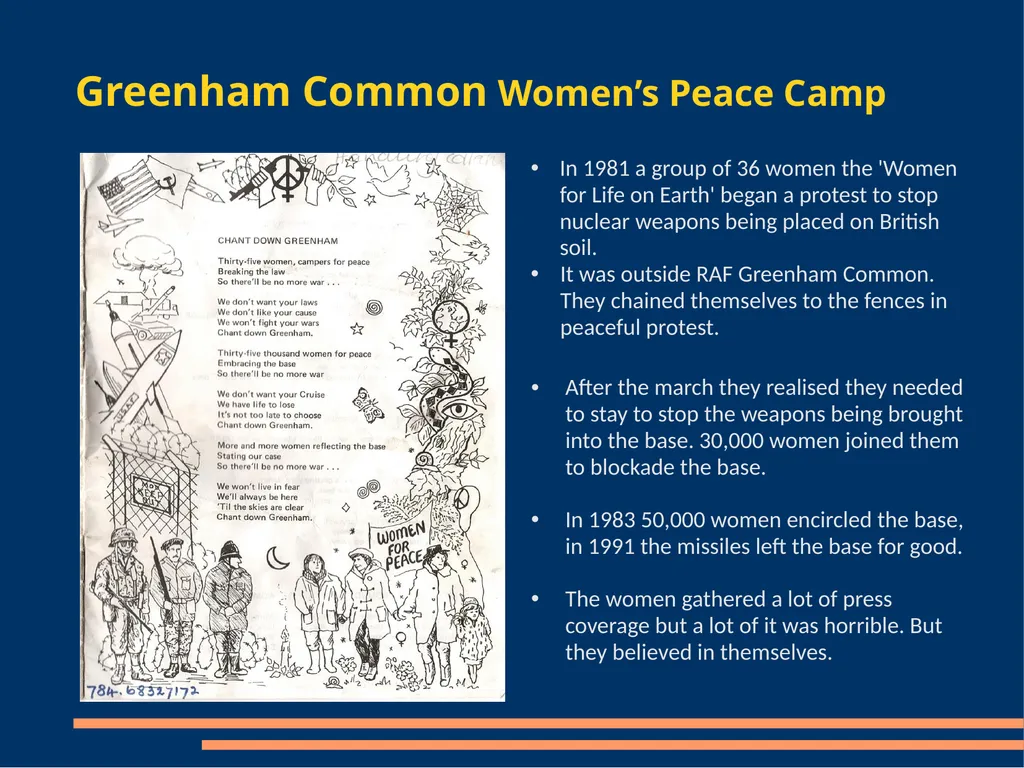
Greenham Common Women’s Peace Camp In 1981 a group of 36 women the 'Women for Life on Earth' began a protest to stop nuclear weapons being placed on British soil.
It was outside RAF Greenham Common. They chained themselves to the fences in peaceful protest. After the march they realised they needed to stay to stop the weapons being brought into the base. 30,000 women joined them to blockade the base.
In 1983 50,000 women encircled the base, in 1991 the missiles left the base for good.
The women gathered a lot of press coverage but a lot of it was horrible. But they believed in themselves.<br>
07
Chant down Greenham Thirty five women, campers for peace
Breaking the law
So there'll be no more war...
We don't want your laws
We don't like your cause
We wont fight your wars
Chant down Greenham
Thirty five thousand women for peace
Embracing the base
So there'll be no more war
We don't want your Cruise
We have life to lose
It's not too late to choose
Chant down Greenham
More and more women reflecting the base
Stating our case
So there'll be no more war We won't live in fear
We'll always be here
'Till the skies are clear
Chant down Greenham.
From Chant Down Greenham, 1983. Words by Alana O'Kelly with additional lyrics by women of Greenham. The women would lie in the roads to block lorries and police they would use their bodies to stop people entering. Embracing the base and decorating the fences with beauty.
It became a powerful movement asking for a public debate about nuclear weapons coming to the UK. Women working together was very different at the time.<br>
08
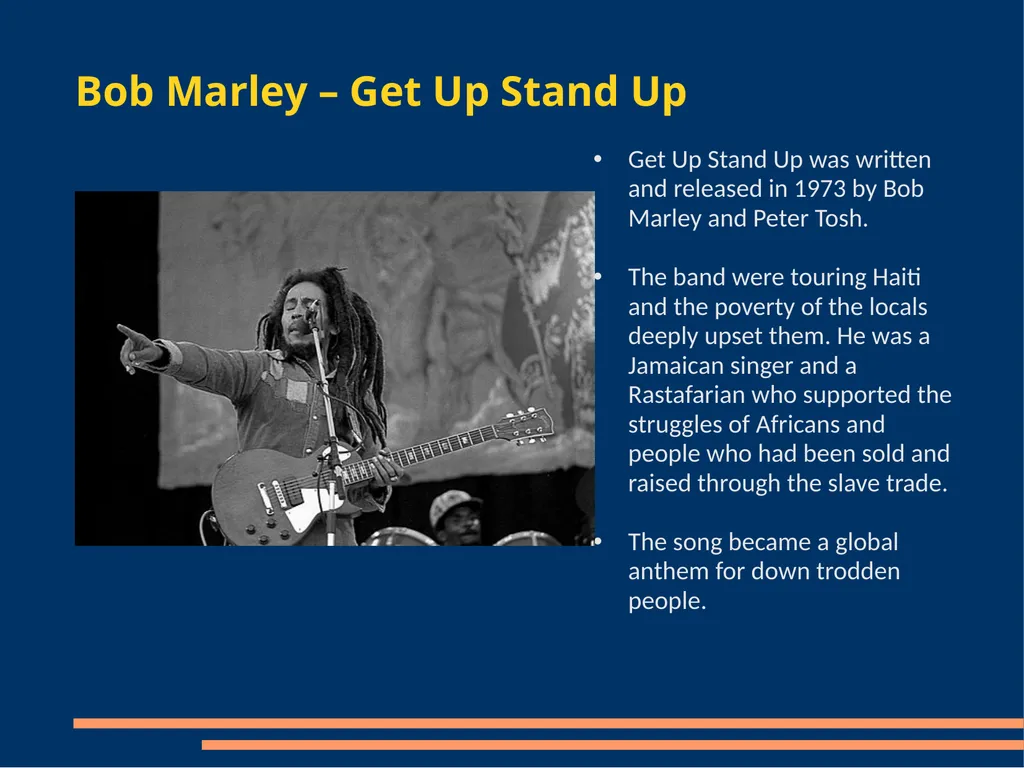
Bob Marley – Get Up Stand Up Get Up Stand Up was written and released in 1973 by Bob Marley and Peter Tosh.
The band were touring Haiti and the poverty of the locals deeply upset them. He was a Jamaican singer and a Rastafarian who supported the struggles of Africans and people who had been sold and raised through the slave trade.
The song became a global anthem for down trodden people.<br>
The band were touring Haiti and the poverty of the locals deeply upset them. He was a Jamaican singer and a Rastafarian who supported the struggles of Africans and people who had been sold and raised through the slave trade.
The song became a global anthem for down trodden people.<br>
09
Get Up Stand Up.. Get up, stand up, stand up for your right
Get up, stand up, stand up for your right
Get up, stand up, stand up for your right
Get up, stand up, don't give up the fight
Preacher man, don't tell me heaven is under the earth
I know you don't know what life is really worth
It's not all that glitters is gold and
Half the story has never been told
So now you see the light
You stand up for your rights Most people think, Great God will come from the sky
Take away everything and make everybody feel high
But if you know what life is worth
You will look for yours on earth
And now you see the light
I want you to stand up for your right. Yeah...
From Get up, Stand Up Lyrics by Bob Marley, Peter Tosh. Recorded by Bob Marley and the Wailers. 1975<br>
Get up, stand up, stand up for your right
Get up, stand up, stand up for your right
Get up, stand up, don't give up the fight
Preacher man, don't tell me heaven is under the earth
I know you don't know what life is really worth
It's not all that glitters is gold and
Half the story has never been told
So now you see the light
You stand up for your rights Most people think, Great God will come from the sky
Take away everything and make everybody feel high
But if you know what life is worth
You will look for yours on earth
And now you see the light
I want you to stand up for your right. Yeah...
From Get up, Stand Up Lyrics by Bob Marley, Peter Tosh. Recorded by Bob Marley and the Wailers. 1975<br>
10
What would you Stand Up For??? We live in a democracy, where we chose who leads us and who makes the laws.
But things can become forgotten and people can become down trodden.
What would you stand up for?
What needs to be stood up for in your area?
What needs to change in the world?
How would you make the world a kinder place?<br>
But things can become forgotten and people can become down trodden.
What would you stand up for?
What needs to be stood up for in your area?
What needs to change in the world?
How would you make the world a kinder place?<br>
11
Reference list Slide 2: English Rebel Songs 1381–1984 Wikipedia, The Free Encyclopedia. Last revised: 27 Apr 2023. https://en.wikipedia.org/w/index.php?title=English_Rebel_Songs_1381%E2%80%931984&oldid=1152040678
Slide 3: Lyrics from The Cutty Wren Traditional. N.d.
Slide 3: Image - Peasant's Revolt 1381 on British Library's Timelines: sources from history https://www.bl.uk/learning/timeline/large132518.html From a manuscript copy of the Chronicles of Jean Froissart, c.1483 at British Library, Royal MS 18 E I f.175.
Slide 4: Image - Jean-François Millet, The Diggers, 1855–56, Etching with drypoint on tan laid paper. Clark Art Institute, Acquired by the Clark, 2014.20.2 https://www.clarkart.edu/ArtPiece/Detail/The-Diggers-(1)
Slide 5: The Diggers' Song, 1649. Attributed to Gerrard Winstanley.
Slide 5: The World Turned Upside Down, 1975. Leon Rosselson. https://leonrosselson.co.uk/
Slide 6: Image of printed song sheet of Chant Down Greenham. LSE Library, Greenham Common Collection, 5GCC/B
Slide 7: Chant Down Greenham, 1981. Words by Alana O’Kelly, additional lyrics by the women of Greenham. https://www.theguardian.com/uk/2007/may/17/greenham.yourgreenham4
Slide 8: Image – Bob Marley performing at Dalymount Park, on 6 July 1980. By Eddie Mallin
https://commons.wikimedia.org/wiki/File:Bob-Marley_3.jpg
Slide 9: Get Up, Stand Up, 1973. Lyrics by Bob Marley, Peter Tosh. Recorded by Bob Marley and the Wailers.<br>
12
Songs of Protest workshop
Developed by Tom Cook, composer and musician https://www.tomcooksound.co.uk/
for LSE Library project, Change for People by People, for LSE Festival 2023
Shared under Creative Commons licence CC-BY-NC<br>