04
Three-Ounce Water Test Patient drinks 3oz of water without interruption
SLP attempts to identify aspiration by noting throat clearing, coughing, or change in vocal quality immediately and one minute after the swallow
If none of these symptoms are present a normal diet is recommended.<br>
05
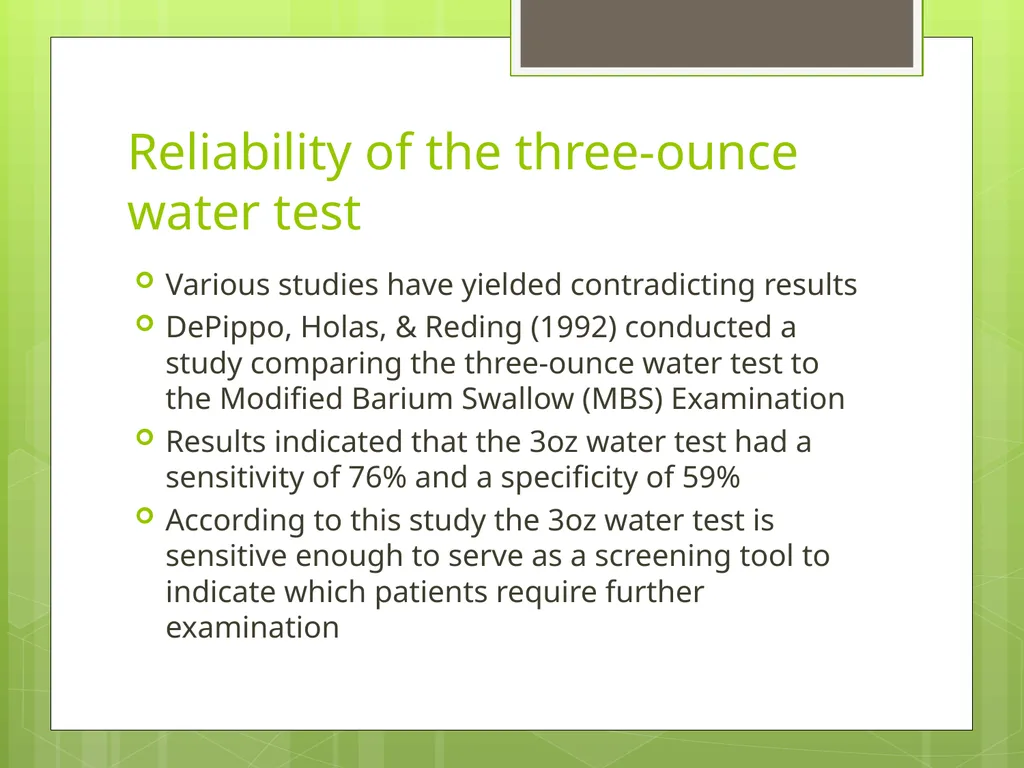
Reliability of the three-ounce water test Various studies have yielded contradicting results
DePippo, Holas, & Reding (1992) conducted a study comparing the three-ounce water test to the Modified Barium Swallow (MBS) Examination
Results indicated that the 3oz water test had a sensitivity of 76% and a specificity of 59%
According to this study the 3oz water test is sensitive enough to serve as a screening tool to indicate which patients require further examination<br>
06
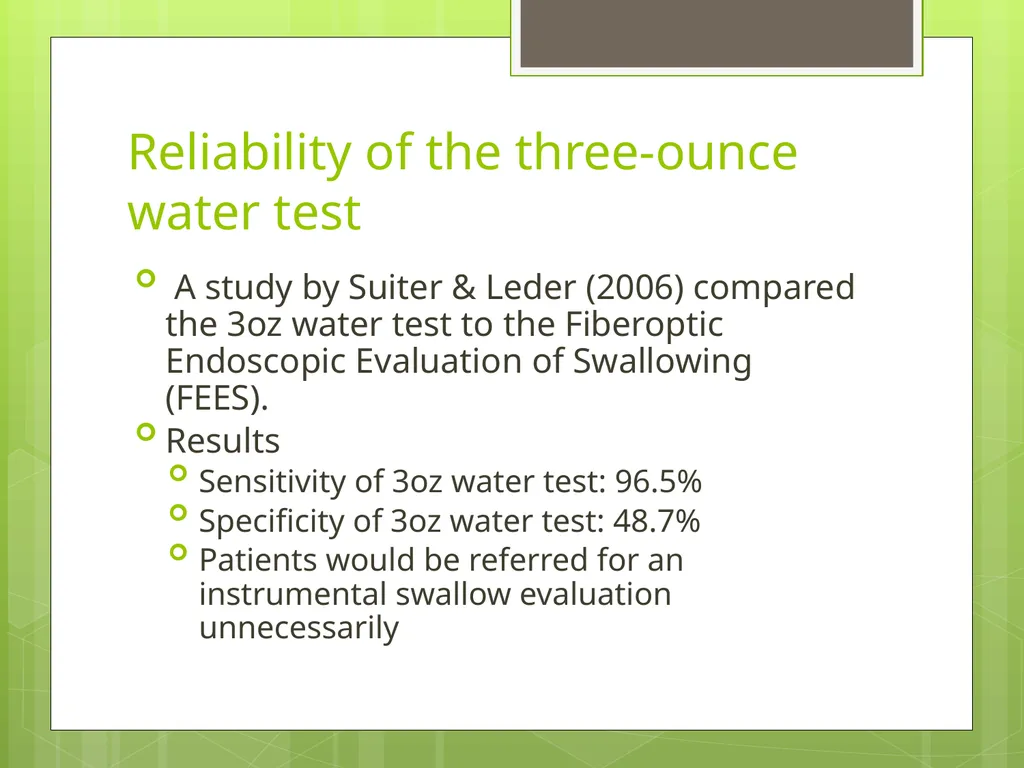
Reliability of the three-ounce water test A study by Suiter & Leder (2006) compared the 3oz water test to the Fiberoptic Endoscopic Evaluation of Swallowing (FEES).
Results
Sensitivity of 3oz water test: 96.5%
Specificity of 3oz water test: 48.7%
Patients would be referred for an instrumental swallow evaluation unnecessarily<br>
07
Reliability of three-ounce water test Both studies agree that the 3oz water test should be used alone as a diagnostic tool.
One main reason is that assessment of vocal quality is generally a criterion-based measure<br>
08
Vocal Quality Assessment The term “wet” can be described as gurgly or liquid sounding and is due to the voice being produced through moisture
Ratings are based on listener’s standards, experience, type of rating scale, and the voice sample being evaluated
When a patient has a “wet” vocal quality, they are generally referred for an instrumental swallowing examination.
Researchers have differing opinions regarding the perception of a “wet” vocal quality as a diagnostic indicator for aspiration.<br>
09
Sounding “wet” as an indicator for aspiration Weir, McMahon, Masters, & Chang (2009) conducted a study, which assessed diagnostic values of various signs and symptoms in predicting oropharyngeal aspiration in children
Results indicated that a “wet” voice was associated with aspiration on thin liquids
Overall, “wet” vocal quality yielded a 67% sensitivity and 92% specificity in predicting oropharyngeal aspiration in children<br>
10
Sounding “Wet” as an Indicator for Aspiration Irwin (2006) conducted a study, which assessed clinician’s perception of “wet” vocal quality compared to the results of the videofluoroscopic swallowing study.
She determined that clinicians are more likely to identify a voice as sounding “wet” in patients with a high amount of material on their vocal folds.<br>
11
Sounding “Wet” as an indicator for Aspiration Goves-Wright, Boyce & Kelchner (2010) compared the results of the videofluoroscopic swallow study to 5 clinician’s perceptual judgment of “wet” vocal quality in 78 patients.
High degree of interrater variability for perceptual judgments of wetness
Could be due to lack of perceptual criteria for “wet” vocal quality<br>
12
Sounding “Wet” as an Indicator of Aspiration Goves-Wright, Boyce & Kelchner (2010) continued
Authors suggest a range of perceptual consequences when material is vibrating in the larynx
Material in the larynx may disrupt periodic vocal fold vibration without affecting the phonatory airstream, which could result in the patient’s voice sounding like noise
Authors suggest that raters change their judgment from “wet” and “not wet” to “normal and “abnormal”
Further research is necessary in order to assess the reliability of this rating system<br>
13
Conclusion Noninvasive assessments of dysphagia, such as the 3oz water test are crucial in detecting aspiration
Instrumental procedures are not always readily available
It is not practical to expose patients to instrumental procedures on a regular basis due to availability and high amounts of radiation exposure<br>
14
Conclusion Data suggests that clinicians can perceive wetness when a sufficient amount of material is present in the larynx.
In those cases, instrumental evaluations are necessary.<br>
15
Conclusion Further research needs to be conducted to increase reliability of the perception of “wet” vocal quality
One suggestion: replace listener’s internal representations for “wet” vocal quality with “reference voices,” which correspond to different vocal qualities.
By training clinicians to use the same “reference voices” interrater variability will likely be reduced.<br>
16
References Beckstrom, L. & Hanson, S.K. (2008). Swallow screen [PowerPoint slides]. Retrieved from www.coloradostroke.org/documents/Swallow.Screen.ppt.
DePippo, Kathleen L., Marlene A. Holas, and Michael J. Reding. "Validation of the 3-oz water swallow test for aspiration following stroke." Archives of Neurology 49 Dec. (1992):
1259-61. Print.
González-Fernádez, M., Sein, M. T., & Palmer, J. B. (2011, November). Clinical experience using the Mann assessment of swallowing ability for identification of patients at risk for aspiration in a mixed-disease population. American Journal of Speech-Language Pathology, 20, 331-336.
Groves-Wright, K. J., Boyce, S., & Kelchner, L. (2010, June). Perception of wet vocal quality in identifying penetration/aspiration during swallowing. American Speech-Language Hearing Association, 53, 620-632.
Irwin, L. (2006). Perceptual evaluation of voice quality with dysphagia and dysphonia (Master's thesis).
Langmore, S., Schatz, K., & Olson, N. (1991). Endoscopic and videofluoroscopic evaluations of swallowing and aspiration. Annals of Otology, Rhinology, and Laryngology, 100, 678-681.
Oates, J. (2009, February 10). Auditory-perceptual evaluation of disordered voice quality. Folia Phoniatrica et Logopaedica, 61, 49-56.<br>
17
References Rosenbek, J. C., Robbins, J., Roecker, E. B., Coyle, J. L., & Wood, J. L. (1996). A penetration-aspiration scale. Dysphagia, 11, 93-98.
Suiter, D. & Leder, S. (2006, September). Can the 3 ounce water swallow test screen for aspiration?
Swigert, N. B. (2009, May 26). Hot topics in dysphagia. The ASHA Leader.
Warms, T., & Richards, J. (2000). "Wet voice" as a predictor of penetration and aspiration in oropharngeal dysphagia. Dysphagia, 15, 84-88.
Weir, K., McMahon, S., Barry, L., Masters, I. B., & Chang, A. B. (2009). Clinical signs and symptoms of oropharyngeal aspiration and dysphagia in children. European Respiratory Journal, 33(3), 604-611.<br>