
SOUTH AFRICAN HUMAN RIGHTS COMMISSION Performance
DJ
Published · 49 slides · 0 views

1 / 1




Description
SOUTH AFRICAN HUMAN RIGHTS COMMISSION Performance Overview: Cumulative Quarter 4 of 2019-20 and Quarter 1 of 2020-21 Portfolio Committee on Justice and Correctional Services 14 October 2020 Contents Overview of organisational performance
Related Topics
Share
Embed code
Download this presentation From Below
"SOUTH AFRICAN HUMAN RIGHTS COMMISSION Performance" is the property of its rightful owner. Permission is granted to download and print the materials on this website for personal, non-commercial use only, and to display it on your personal computer provided you do not modify the materials and that you retain all copyright notices contained in the materials. By downloading content from our website, you accept the terms of this agreement.
Presentation Transcript
01
SOUTH AFRICAN HUMAN RIGHTS COMMISSION Performance Overview:
Cumulative Quarter 4 of 2019-20 and
Quarter 1 of 2020-21
Portfolio Committee on Justice and Correctional Services
14 October 2020<br>
Cumulative Quarter 4 of 2019-20 and
Quarter 1 of 2020-21
Portfolio Committee on Justice and Correctional Services
14 October 2020<br>
02
Contents Overview of organisational performance environment
Cumulative 2019-20 Quarter 4 Performance
Overview of 2019-20 Financial Statements
Budget Overview 2020-21
First Quarter 2020-21 Performance
An overview of personnel related matters (2019-20 and 2020-21)
Anticipated spending pressures and forward funding needs 2021 MTEF
Adjustments to the Strategic Plan (2020 – 2025) and Annual Performance Plan (2020-21) 2<br>
Cumulative 2019-20 Quarter 4 Performance
Overview of 2019-20 Financial Statements
Budget Overview 2020-21
First Quarter 2020-21 Performance
An overview of personnel related matters (2019-20 and 2020-21)
Anticipated spending pressures and forward funding needs 2021 MTEF
Adjustments to the Strategic Plan (2020 – 2025) and Annual Performance Plan (2020-21) 2<br>
03
Overview
Organisational Performance Environment New 5 year strategic plan (2020 – 2025) was developed:
Underpinned by the need to address the key challenges facing South Africa: inequality, poverty, unemployment and violence.
Contains clearly identifiable human rights priorities and envisaged outcomes.
Ensuring effective delivery on the mandate amidst resources constraints.
Stable performance evident in having attained an unqualified audit for the 7th consecutive year.
Covid-19 challenges and interventions.
Increasing need to promote accountability of government for human rights violations and implementation of SAHRC Recommendations and Directives.
Appeal for greater Parliamentary oversight and collaboration in support of pro-human rights positions. 3<br>
Underpinned by the need to address the key challenges facing South Africa: inequality, poverty, unemployment and violence.
Contains clearly identifiable human rights priorities and envisaged outcomes.
Ensuring effective delivery on the mandate amidst resources constraints.
Stable performance evident in having attained an unqualified audit for the 7th consecutive year.
Covid-19 challenges and interventions.
Increasing need to promote accountability of government for human rights violations and implementation of SAHRC Recommendations and Directives.
Appeal for greater Parliamentary oversight and collaboration in support of pro-human rights positions. 3<br>
04
Overview of Performance:
Cumulative 2019-20 Quarter 4
(April 2019 to March 2020) 4<br>
Cumulative 2019-20 Quarter 4
(April 2019 to March 2020) 4<br>
05
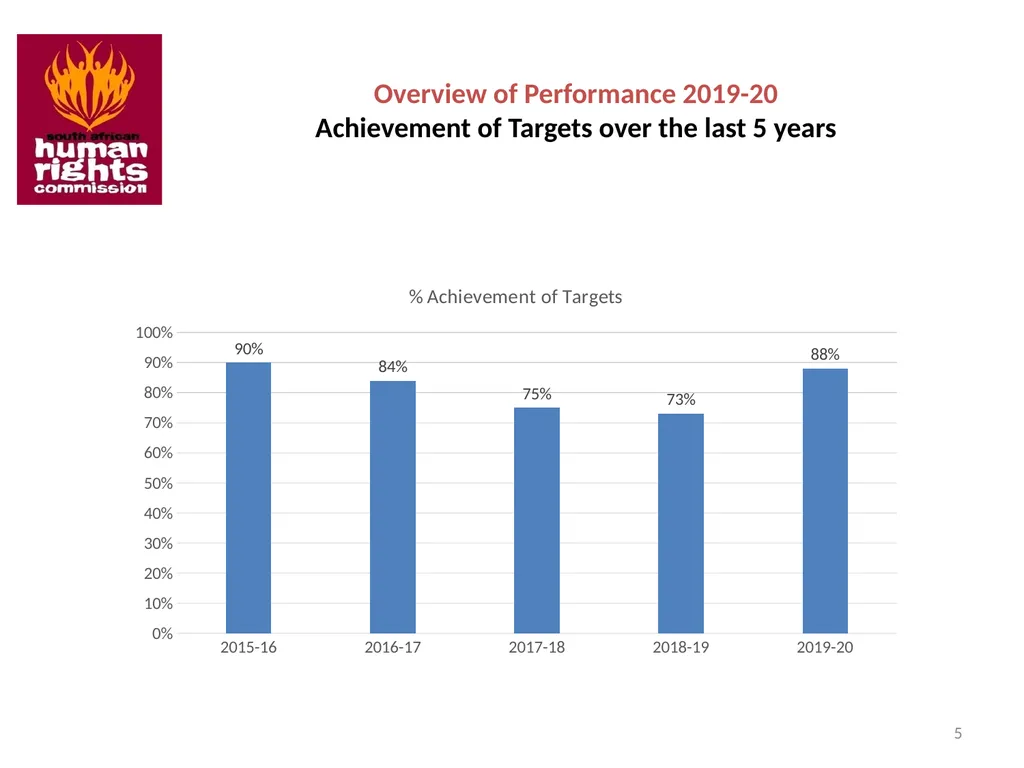
Overview of Performance 2019-20
Achievement of Targets over the last 5 years 5<br>
06
Overview of Performance 2019-20
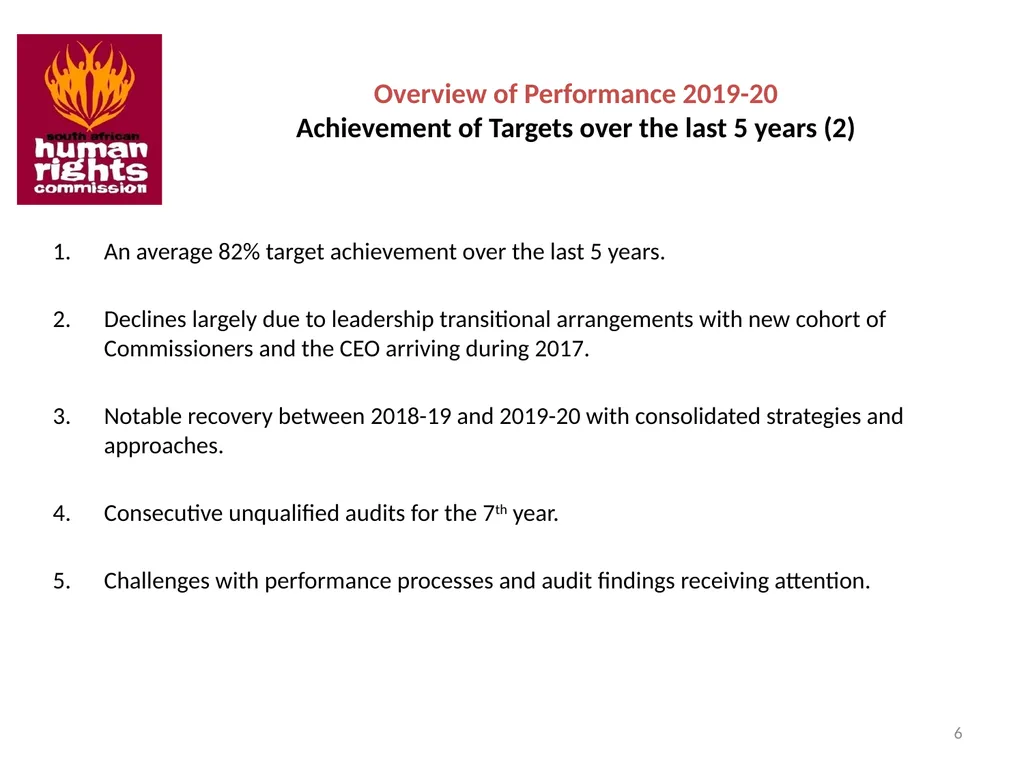
Achievement of Targets over the last 5 years (2) An average 82% target achievement over the last 5 years.
Declines largely due to leadership transitional arrangements with new cohort of Commissioners and the CEO arriving during 2017.
Notable recovery between 2018-19 and 2019-20 with consolidated strategies and approaches.
Consecutive unqualified audits for the 7th year.
Challenges with performance processes and audit findings receiving attention. 6<br>
Declines largely due to leadership transitional arrangements with new cohort of Commissioners and the CEO arriving during 2017.
Notable recovery between 2018-19 and 2019-20 with consolidated strategies and approaches.
Consecutive unqualified audits for the 7th year.
Challenges with performance processes and audit findings receiving attention. 6<br>
07
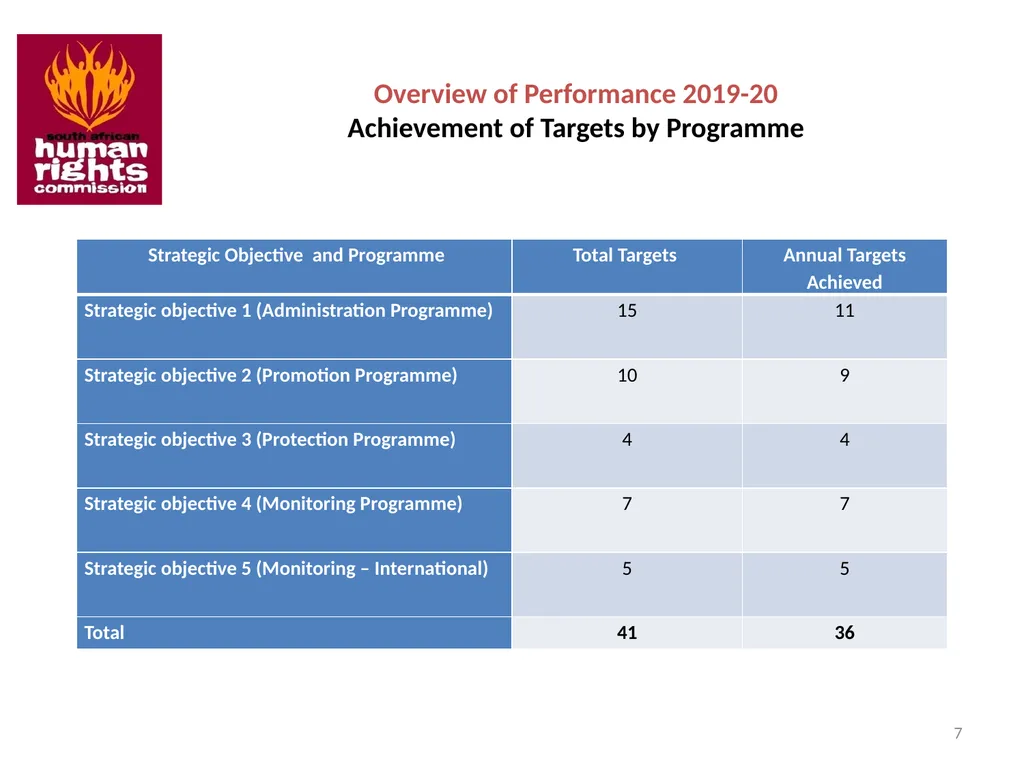
Overview of Performance 2019-20
Achievement of Targets by Programme 7<br>
08
Overview of Performance 2019-20
Promotion Programme Achievements
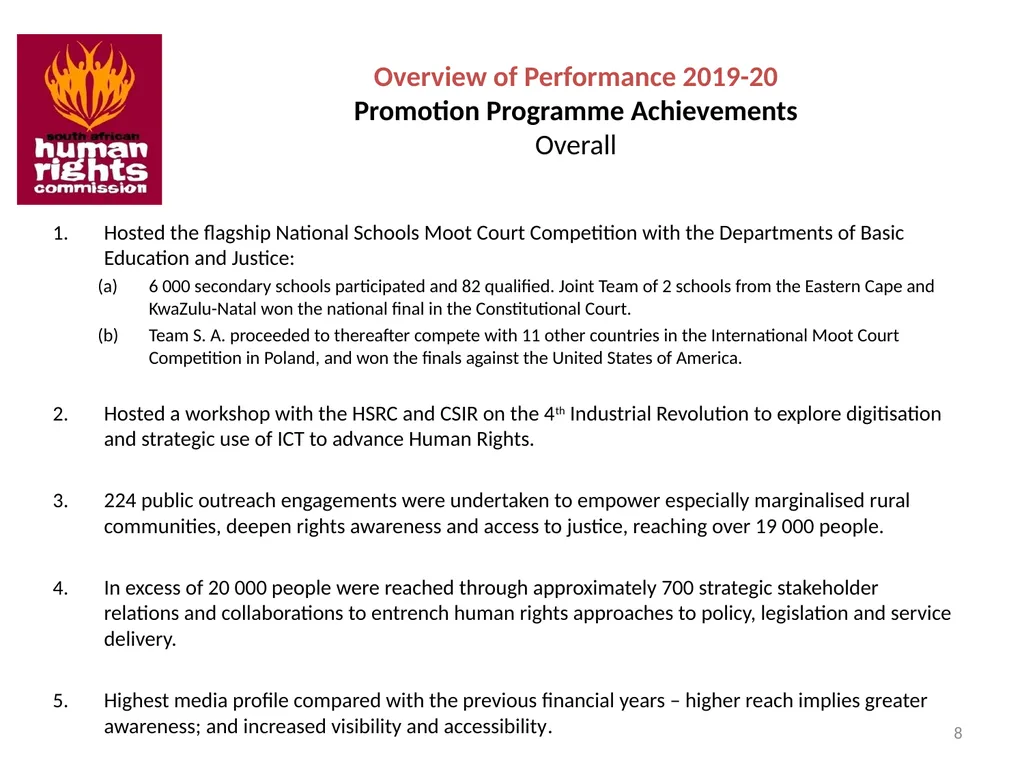
Overall Hosted the flagship National Schools Moot Court Competition with the Departments of Basic Education and Justice:
6 000 secondary schools participated and 82 qualified. Joint Team of 2 schools from the Eastern Cape and KwaZulu-Natal won the national final in the Constitutional Court.
Team S. A. proceeded to thereafter compete with 11 other countries in the International Moot Court Competition in Poland, and won the finals against the United States of America.
Hosted a workshop with the HSRC and CSIR on the 4th Industrial Revolution to explore digitisation and strategic use of ICT to advance Human Rights.
224 public outreach engagements were undertaken to empower especially marginalised rural communities, deepen rights awareness and access to justice, reaching over 19 000 people.
In excess of 20 000 people were reached through approximately 700 strategic stakeholder relations and collaborations to entrench human rights approaches to policy, legislation and service delivery.
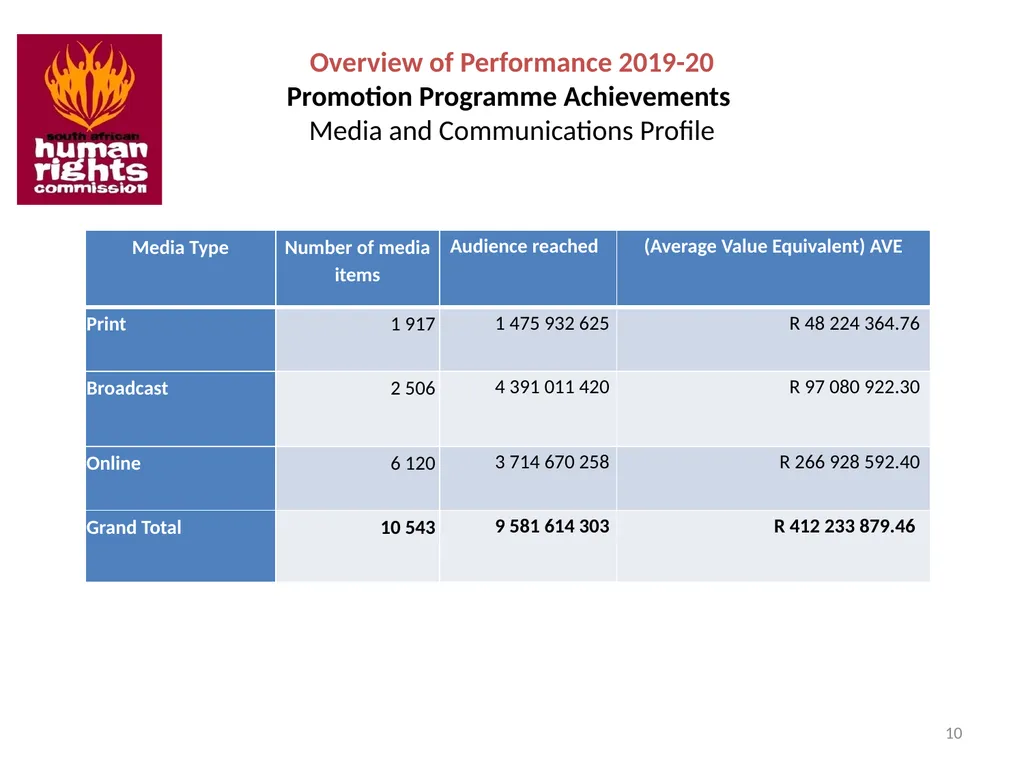
Highest media profile compared with the previous financial years – higher reach implies greater awareness; and increased visibility and accessibility. 8<br>
6 000 secondary schools participated and 82 qualified. Joint Team of 2 schools from the Eastern Cape and KwaZulu-Natal won the national final in the Constitutional Court.
Team S. A. proceeded to thereafter compete with 11 other countries in the International Moot Court Competition in Poland, and won the finals against the United States of America.
Hosted a workshop with the HSRC and CSIR on the 4th Industrial Revolution to explore digitisation and strategic use of ICT to advance Human Rights.
224 public outreach engagements were undertaken to empower especially marginalised rural communities, deepen rights awareness and access to justice, reaching over 19 000 people.
In excess of 20 000 people were reached through approximately 700 strategic stakeholder relations and collaborations to entrench human rights approaches to policy, legislation and service delivery.
Highest media profile compared with the previous financial years – higher reach implies greater awareness; and increased visibility and accessibility. 8<br>
09
Overview of Performance 2019-20
Promotion Programme Achievements 9<br>
10
Overview of Performance 2019-20
Promotion Programme Achievements
Media and Communications Profile 10<br>
11
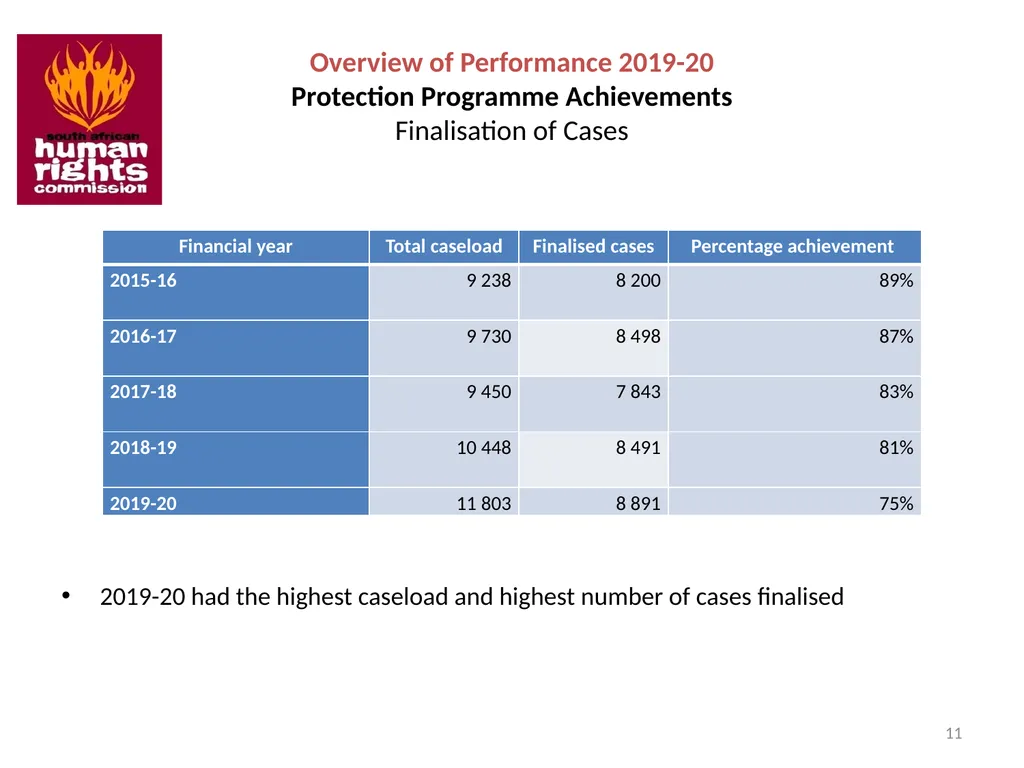
Overview of Performance 2019-20
Protection Programme Achievements
Finalisation of Cases 2019-20 had the highest caseload and highest number of cases finalised 11<br>
12
Overview of Performance 2019-20
Protection Programme Achievements
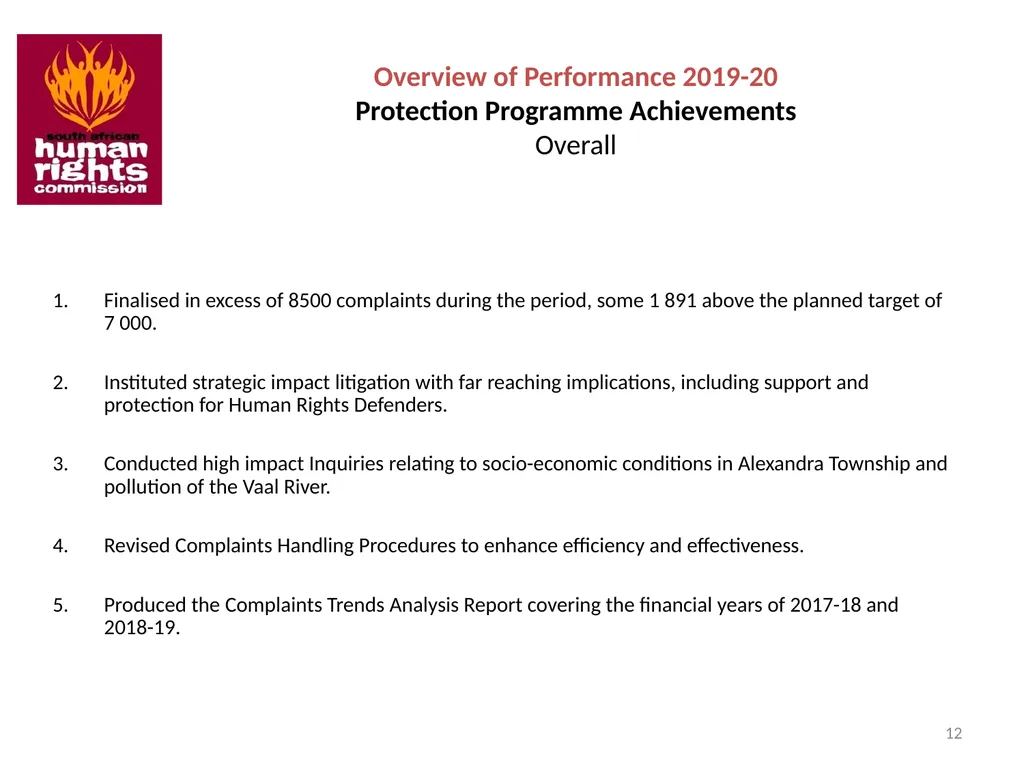
Overall Finalised in excess of 8500 complaints during the period, some 1 891 above the planned target of 7 000.
Instituted strategic impact litigation with far reaching implications, including support and protection for Human Rights Defenders.
Conducted high impact Inquiries relating to socio-economic conditions in Alexandra Township and pollution of the Vaal River.
Revised Complaints Handling Procedures to enhance efficiency and effectiveness.
Produced the Complaints Trends Analysis Report covering the financial years of 2017-18 and 2018-19. 12<br>
Instituted strategic impact litigation with far reaching implications, including support and protection for Human Rights Defenders.
Conducted high impact Inquiries relating to socio-economic conditions in Alexandra Township and pollution of the Vaal River.
Revised Complaints Handling Procedures to enhance efficiency and effectiveness.
Produced the Complaints Trends Analysis Report covering the financial years of 2017-18 and 2018-19. 12<br>
13
Overview of Performance 2019-20
Monitoring Programme Achievements
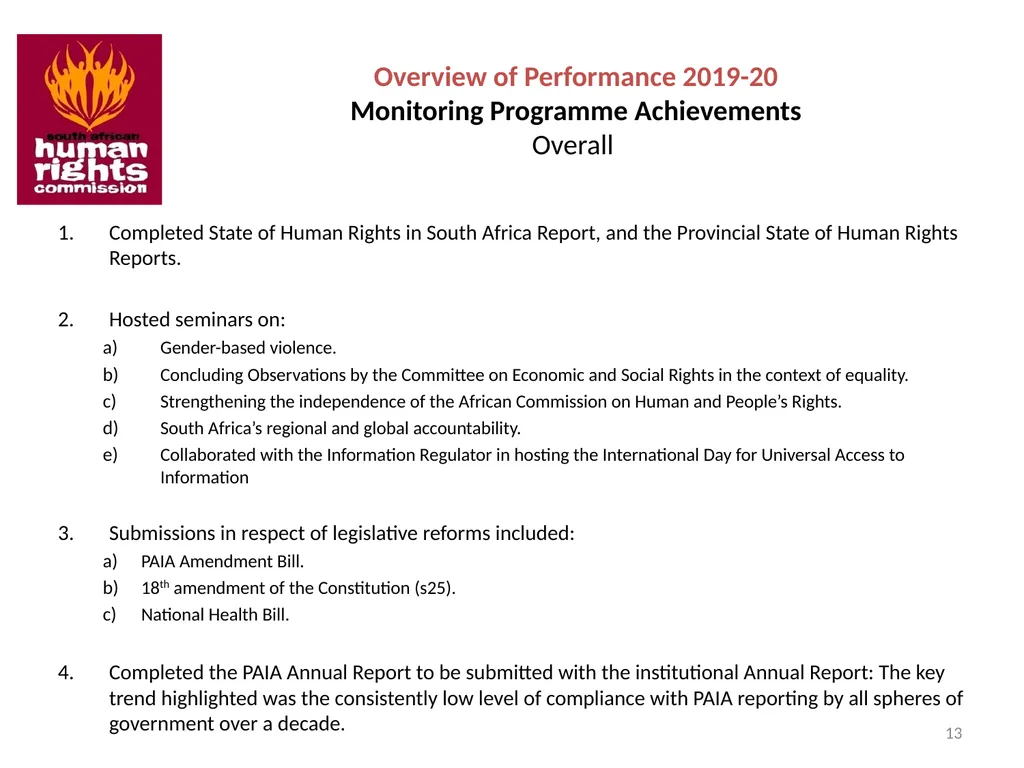
Overall Completed State of Human Rights in South Africa Report, and the Provincial State of Human Rights Reports.
Hosted seminars on:
Gender-based violence.
Concluding Observations by the Committee on Economic and Social Rights in the context of equality.
Strengthening the independence of the African Commission on Human and People’s Rights.
South Africa’s regional and global accountability.
Collaborated with the Information Regulator in hosting the International Day for Universal Access to Information
Submissions in respect of legislative reforms included:
PAIA Amendment Bill.
18th amendment of the Constitution (s25).
National Health Bill.
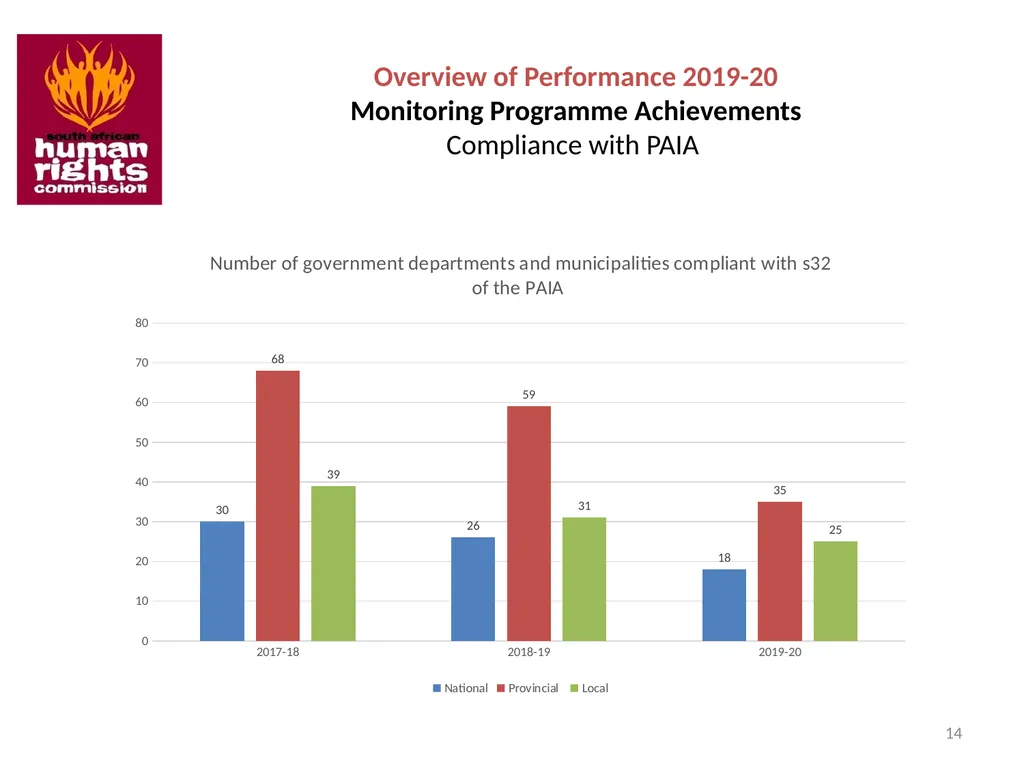
Completed the PAIA Annual Report to be submitted with the institutional Annual Report: The key trend highlighted was the consistently low level of compliance with PAIA reporting by all spheres of government over a decade. 13<br>
Hosted seminars on:
Gender-based violence.
Concluding Observations by the Committee on Economic and Social Rights in the context of equality.
Strengthening the independence of the African Commission on Human and People’s Rights.
South Africa’s regional and global accountability.
Collaborated with the Information Regulator in hosting the International Day for Universal Access to Information
Submissions in respect of legislative reforms included:
PAIA Amendment Bill.
18th amendment of the Constitution (s25).
National Health Bill.
Completed the PAIA Annual Report to be submitted with the institutional Annual Report: The key trend highlighted was the consistently low level of compliance with PAIA reporting by all spheres of government over a decade. 13<br>
14
Overview of Performance 2019-20
Monitoring Programme Achievements
Compliance with PAIA 14<br>
15
Overview of Performance 2019-20
Monitoring Programme Achievements
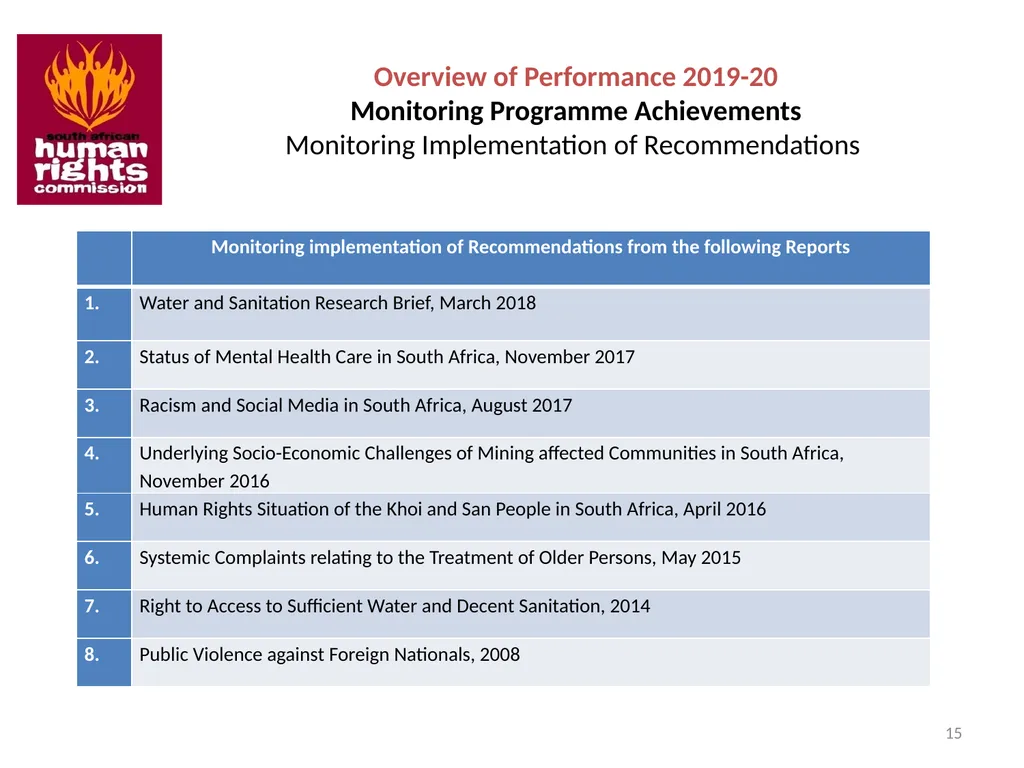
Monitoring Implementation of Recommendations 15<br>
16
Overview of Performance 2019-20
Monitoring Programme Achievements
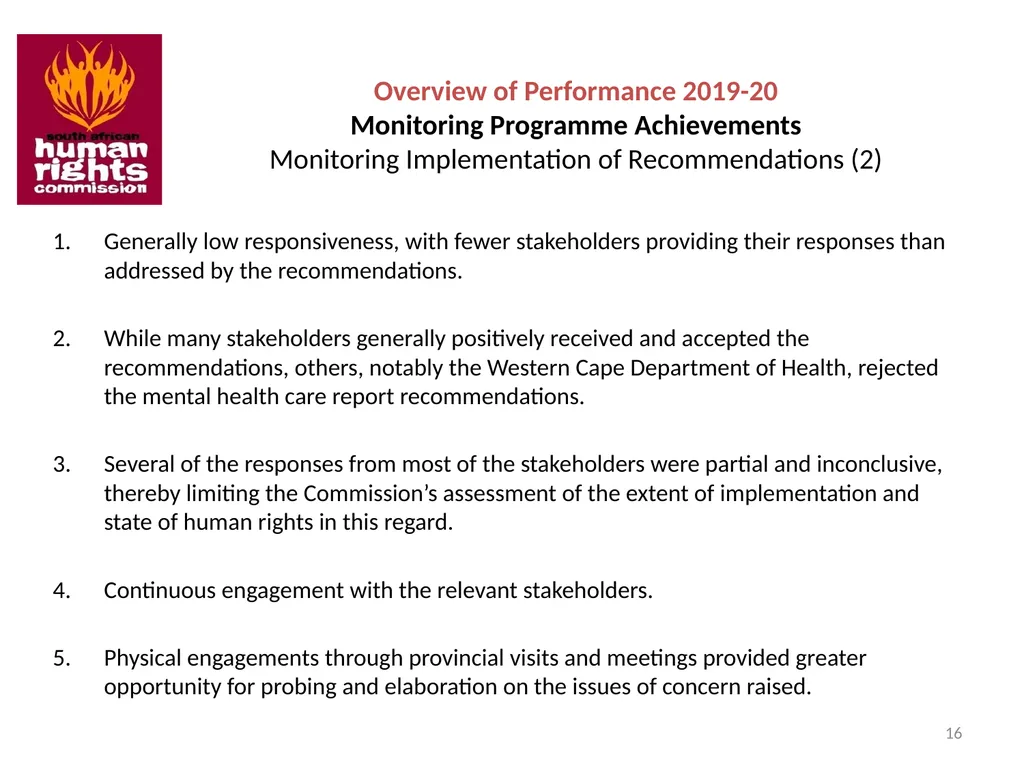
Monitoring Implementation of Recommendations (2) Generally low responsiveness, with fewer stakeholders providing their responses than addressed by the recommendations.
While many stakeholders generally positively received and accepted the recommendations, others, notably the Western Cape Department of Health, rejected the mental health care report recommendations.
Several of the responses from most of the stakeholders were partial and inconclusive, thereby limiting the Commission’s assessment of the extent of implementation and state of human rights in this regard.
Continuous engagement with the relevant stakeholders.
Physical engagements through provincial visits and meetings provided greater opportunity for probing and elaboration on the issues of concern raised. 16<br>
While many stakeholders generally positively received and accepted the recommendations, others, notably the Western Cape Department of Health, rejected the mental health care report recommendations.
Several of the responses from most of the stakeholders were partial and inconclusive, thereby limiting the Commission’s assessment of the extent of implementation and state of human rights in this regard.
Continuous engagement with the relevant stakeholders.
Physical engagements through provincial visits and meetings provided greater opportunity for probing and elaboration on the issues of concern raised. 16<br>
17
Overview of Performance 2019-20
Monitoring Programme Achievements
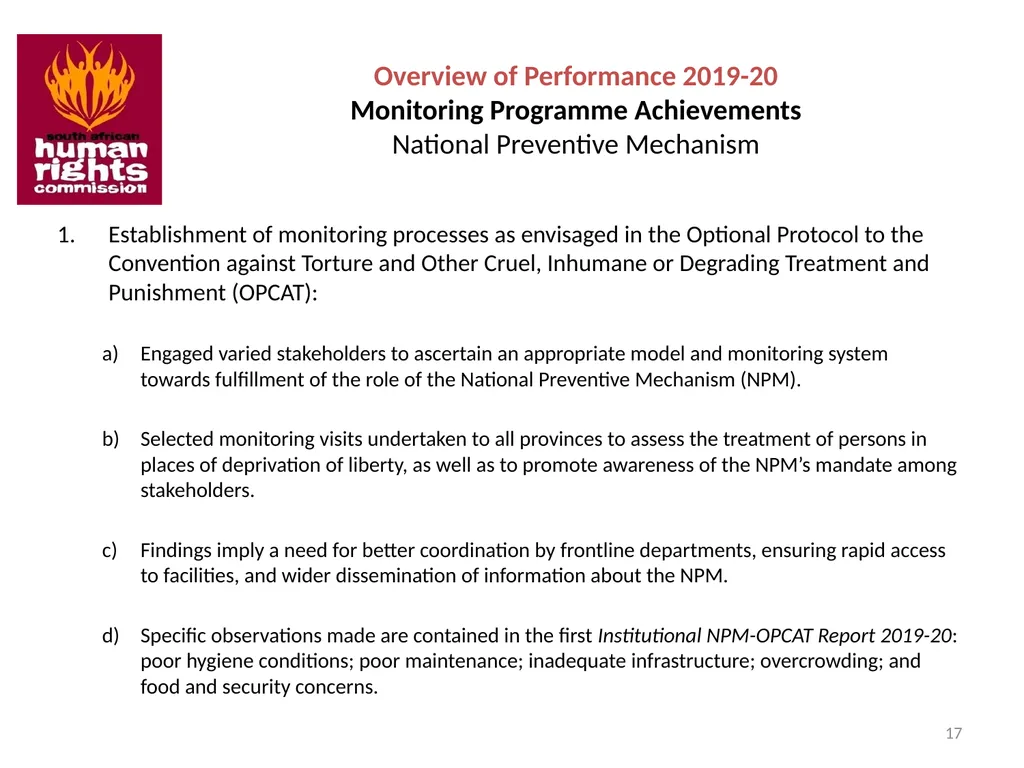
National Preventive Mechanism Establishment of monitoring processes as envisaged in the Optional Protocol to the Convention against Torture and Other Cruel, Inhumane or Degrading Treatment and Punishment (OPCAT):
Engaged varied stakeholders to ascertain an appropriate model and monitoring system towards fulfillment of the role of the National Preventive Mechanism (NPM).
Selected monitoring visits undertaken to all provinces to assess the treatment of persons in places of deprivation of liberty, as well as to promote awareness of the NPM’s mandate among stakeholders.
Findings imply a need for better coordination by frontline departments, ensuring rapid access to facilities, and wider dissemination of information about the NPM.
Specific observations made are contained in the first Institutional NPM-OPCAT Report 2019-20: poor hygiene conditions; poor maintenance; inadequate infrastructure; overcrowding; and food and security concerns. 17<br>
Engaged varied stakeholders to ascertain an appropriate model and monitoring system towards fulfillment of the role of the National Preventive Mechanism (NPM).
Selected monitoring visits undertaken to all provinces to assess the treatment of persons in places of deprivation of liberty, as well as to promote awareness of the NPM’s mandate among stakeholders.
Findings imply a need for better coordination by frontline departments, ensuring rapid access to facilities, and wider dissemination of information about the NPM.
Specific observations made are contained in the first Institutional NPM-OPCAT Report 2019-20: poor hygiene conditions; poor maintenance; inadequate infrastructure; overcrowding; and food and security concerns. 17<br>
18
Overview of Performance 2019-20
Monitoring Programme Achievements
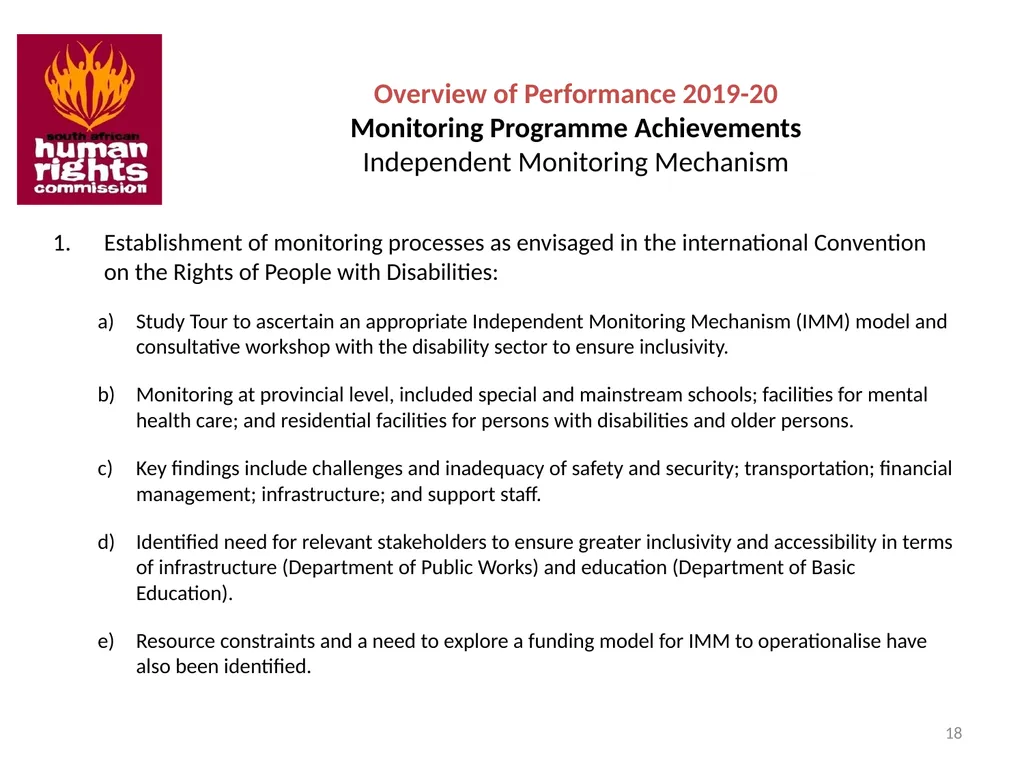
Independent Monitoring Mechanism Establishment of monitoring processes as envisaged in the international Convention on the Rights of People with Disabilities:
Study Tour to ascertain an appropriate Independent Monitoring Mechanism (IMM) model and consultative workshop with the disability sector to ensure inclusivity.
Monitoring at provincial level, included special and mainstream schools; facilities for mental health care; and residential facilities for persons with disabilities and older persons.
Key findings include challenges and inadequacy of safety and security; transportation; financial management; infrastructure; and support staff.
Identified need for relevant stakeholders to ensure greater inclusivity and accessibility in terms of infrastructure (Department of Public Works) and education (Department of Basic Education).
Resource constraints and a need to explore a funding model for IMM to operationalise have also been identified. 18<br>
Study Tour to ascertain an appropriate Independent Monitoring Mechanism (IMM) model and consultative workshop with the disability sector to ensure inclusivity.
Monitoring at provincial level, included special and mainstream schools; facilities for mental health care; and residential facilities for persons with disabilities and older persons.
Key findings include challenges and inadequacy of safety and security; transportation; financial management; infrastructure; and support staff.
Identified need for relevant stakeholders to ensure greater inclusivity and accessibility in terms of infrastructure (Department of Public Works) and education (Department of Basic Education).
Resource constraints and a need to explore a funding model for IMM to operationalise have also been identified. 18<br>
19
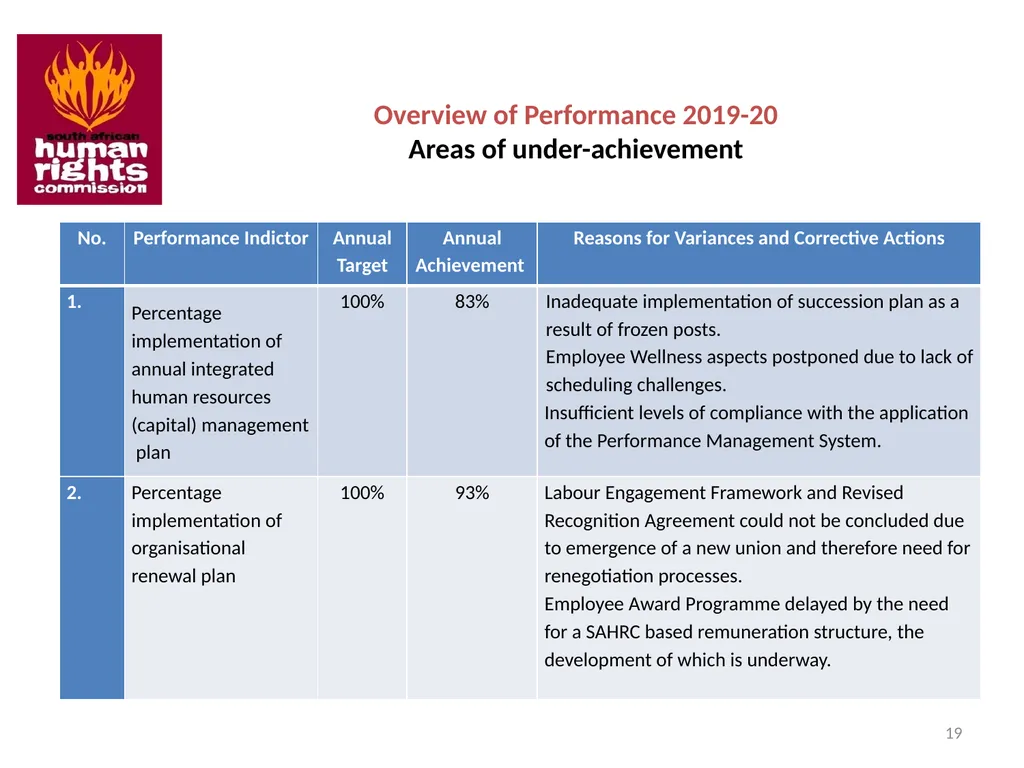
Overview of Performance 2019-20
Areas of under-achievement 19<br>
20
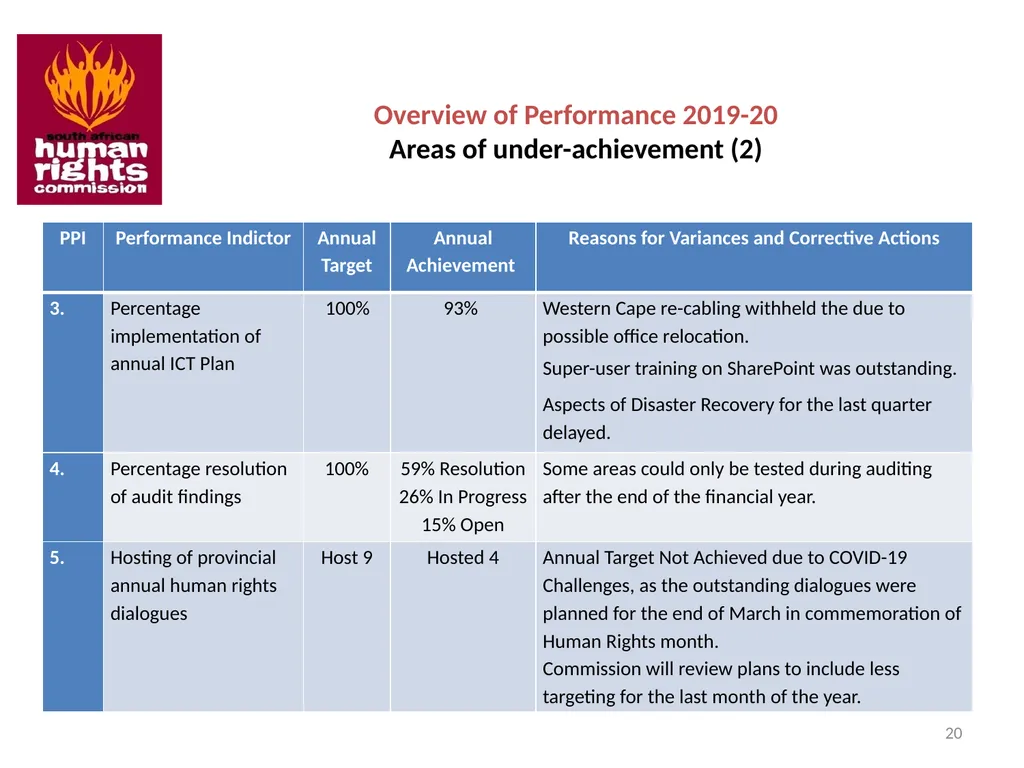
Overview of Performance 2019-20
Areas of under-achievement (2) 20<br>
21
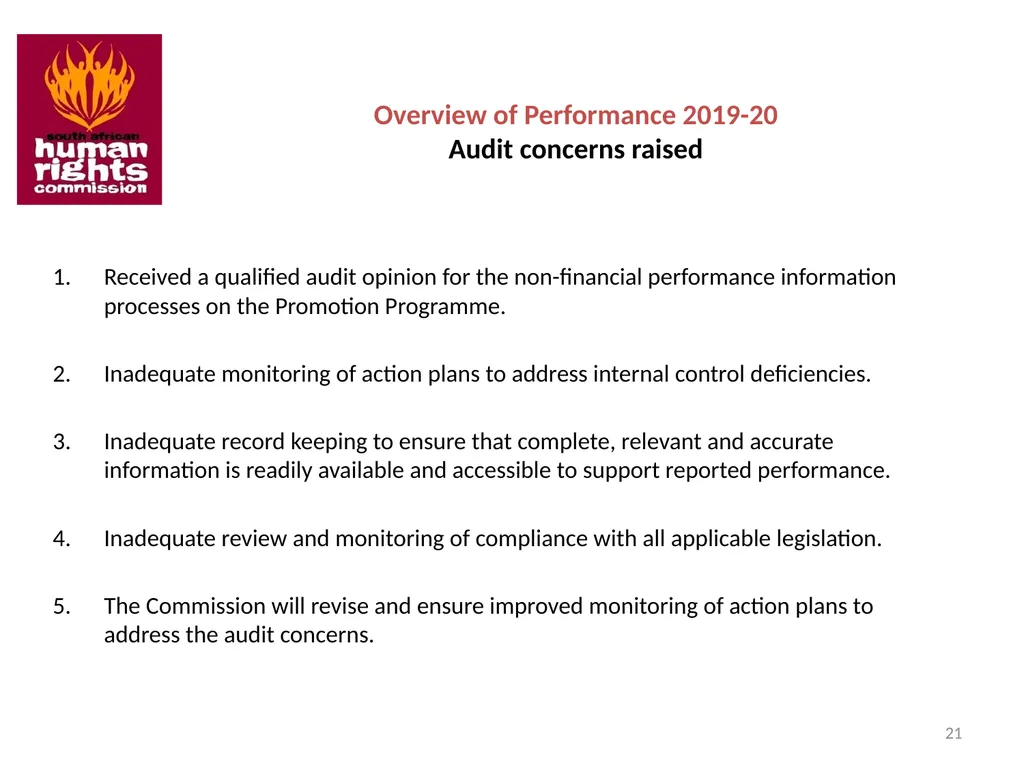
Overview of Performance 2019-20
Audit concerns raised Received a qualified audit opinion for the non-financial performance information processes on the Promotion Programme.
Inadequate monitoring of action plans to address internal control deficiencies.
Inadequate record keeping to ensure that complete, relevant and accurate information is readily available and accessible to support reported performance.
Inadequate review and monitoring of compliance with all applicable legislation.
The Commission will revise and ensure improved monitoring of action plans to address the audit concerns. 21<br>
Inadequate monitoring of action plans to address internal control deficiencies.
Inadequate record keeping to ensure that complete, relevant and accurate information is readily available and accessible to support reported performance.
Inadequate review and monitoring of compliance with all applicable legislation.
The Commission will revise and ensure improved monitoring of action plans to address the audit concerns. 21<br>
22
Overview of Performance:
2019-20 Financial Statements 22<br>
2019-20 Financial Statements 22<br>
23
Overview of 2019-20 Financial Statements
Financial Performance Review 23 SAHRC received an unqualified audit for the seventh consecutive year.
Internal Controls need to be strengthened for strict adherence to policy and regulations: Irregular expenditure had increased due to partial non-adherence.
Risk Management processes have been strengthened together with a review of the Policy and Framework.
This year again, no audit comment was raised by the AG on the 30 day payment rule. Controls implemented to manage and maintain this standard will be sustained.
Targeted policies and procedures have been reviewed and revised where required.<br>
Internal Controls need to be strengthened for strict adherence to policy and regulations: Irregular expenditure had increased due to partial non-adherence.
Risk Management processes have been strengthened together with a review of the Policy and Framework.
This year again, no audit comment was raised by the AG on the 30 day payment rule. Controls implemented to manage and maintain this standard will be sustained.
Targeted policies and procedures have been reviewed and revised where required.<br>
24
Overview of 2019-20 Financial Statements
Actual Analysis Personnel costs were allocated R 125.8mil, which accounted for 70.2% of actual expenditure.
Corporate Support Costs amounted to 24.5% or R 43.9mil of actual expenditure, and included the following:
Auditor-General Fees amounting to R 2.6mil and the remainder is to cover other audit and finance systems related costs.
Office rentals and Municipal Charges amounted to 51.7% or R 23mil of the money. The remainder of the budget covers motor vehicles, telephone, video-conferencing, inventories and other admin costs.
ICT related costs including Business Connection Email/Internet Contract, Business Continuity Contract, IT Licence Renewals and Other IT related Infrastructure.
HR costs include recruitment costs, staff training, performance management system and ICAS costs.
Personnel and Admin related committed costs amounted to 94.7% or R169.7mil of the actual expenditure. 24<br>
Corporate Support Costs amounted to 24.5% or R 43.9mil of actual expenditure, and included the following:
Auditor-General Fees amounting to R 2.6mil and the remainder is to cover other audit and finance systems related costs.
Office rentals and Municipal Charges amounted to 51.7% or R 23mil of the money. The remainder of the budget covers motor vehicles, telephone, video-conferencing, inventories and other admin costs.
ICT related costs including Business Connection Email/Internet Contract, Business Continuity Contract, IT Licence Renewals and Other IT related Infrastructure.
HR costs include recruitment costs, staff training, performance management system and ICAS costs.
Personnel and Admin related committed costs amounted to 94.7% or R169.7mil of the actual expenditure. 24<br>
25
2020-21 Budget Overview
Budget Analysis Personnel costs account for 71% or R 142.5mil of the grant as allocated (or 66.7% of the budget).
Corporate Support Committed Costs are allocated 23,9% or R51.1mil of the budget, including the following:
Auditor-General Fees amounting to R2,6mil and the remainder is to cover other audit and finance systems related costs.
Office rentals and Municipal Charges amount to 47.4% or R24.2mil of the money. The remainder of the budget covers motor vehicles, telephone, video-conferencing, inventories and other admin costs.
IT related costs including Business Connection Email/Internet Contract, Business Continuity Contract, IT Licence Renewals and Other IT related Infrastructure.
HR costs include recruitment costs, staff training, performance management system and ICAS costs.
Personnel and corporate services related committed costs amount to 90.6% or R193.6mil of the budget. 25<br>
Corporate Support Committed Costs are allocated 23,9% or R51.1mil of the budget, including the following:
Auditor-General Fees amounting to R2,6mil and the remainder is to cover other audit and finance systems related costs.
Office rentals and Municipal Charges amount to 47.4% or R24.2mil of the money. The remainder of the budget covers motor vehicles, telephone, video-conferencing, inventories and other admin costs.
IT related costs including Business Connection Email/Internet Contract, Business Continuity Contract, IT Licence Renewals and Other IT related Infrastructure.
HR costs include recruitment costs, staff training, performance management system and ICAS costs.
Personnel and corporate services related committed costs amount to 90.6% or R193.6mil of the budget. 25<br>
26
2020-21 Budget Overview
Budget Analysis (2) The total budget allocation for 2020/21 includes the approved National Treasury surplus rollover from 2018/19 of R 9.1m.
This rollover is earmarked for special projects like:
- Additional OPCAT NPM support.
- A human rights monitoring systems for the Commission.
- The 25th year anniversary commemoration.
- PAIA mandated functions for the final year.
Recent communication advised of an “in-year” budget cut of R 8.4m, to be funded from Compensation of Employees allocations. The implications to be investigated are: - no cost of living increases for the year. - no notch increases for the year. - no performance bonus budget for the year. 26<br>
Recent communication advised of an “in-year” budget cut of R 8.4m, to be funded from Compensation of Employees allocations. The implications to be investigated are: - no cost of living increases for the year. - no notch increases for the year. - no performance bonus budget for the year. 26<br>
27
2020-21 Budget Overview
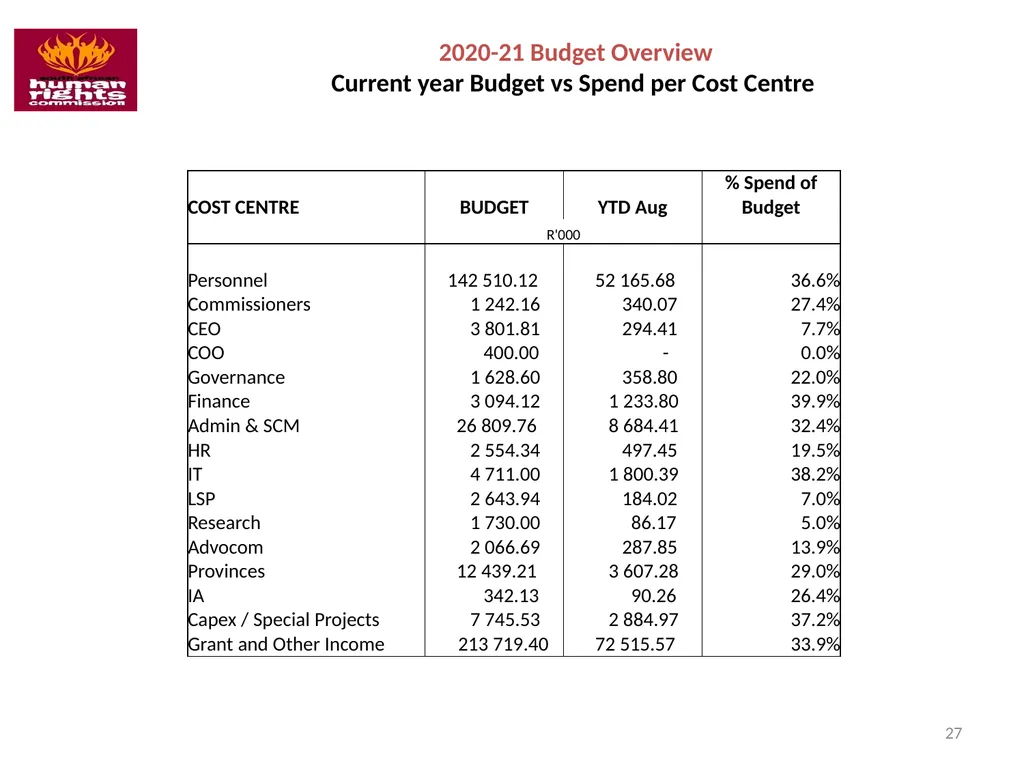
Current year Budget vs Spend per Cost Centre 27<br>
28
Overview of Performance:
First Quarter 2020-21
(April to June 2020) 28<br>
First Quarter 2020-21
(April to June 2020) 28<br>
29
Overview of Performance 2020-21
Organisational performance environment Performance planning reviews and development of Guidelines in response to the Covid-19.
Proposed budget reductions.
Increasing use of Information and Communications Technology infrastructure and services to facilitate work from home arrangements.
Governance, compliance and risk mitigation.
Audit and verification of performance information.
Human capital management planning. 29<br>
Proposed budget reductions.
Increasing use of Information and Communications Technology infrastructure and services to facilitate work from home arrangements.
Governance, compliance and risk mitigation.
Audit and verification of performance information.
Human capital management planning. 29<br>
30
Overview of Q1 Performance 2020-21
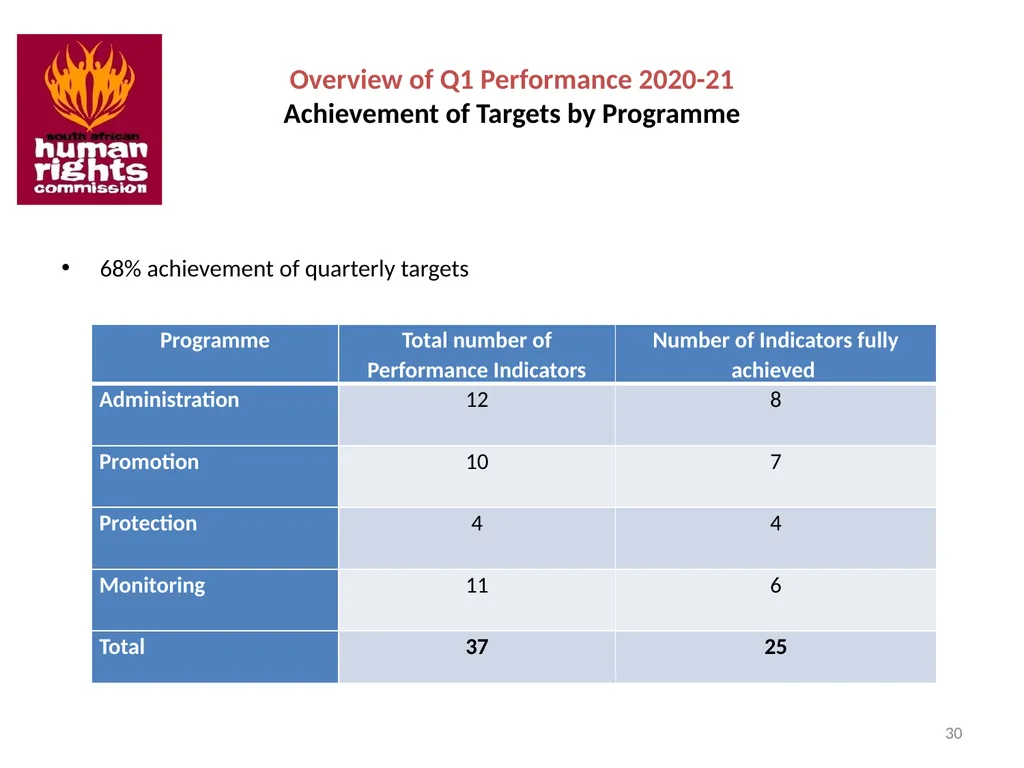
Achievement of Targets by Programme 68% achievement of quarterly targets 30<br>
31
Overview of Performance 2020-21
Promotion Programme Key interventions, largely necessitated by the Covid-19, were on health, education, and human settlements, water and sanitation across the country.
Land invasions and evictions were centred in the Western Cape and Gauteng, while in Limpopo additional focus was on food distribution and police arrests.
The Commission intervened with positive outcomes in many of the specific matters in which it was involved, with either actual improvements or commitments to improve the situation.
Strategic engagements with health sector stakeholders enhanced collaborative efforts, with focus on coordination of interventions and an assessment of the state of health facilities and readiness for Covid-19: Particular attention given to the availability of Personal Protective Equipment (PPE) and ethical considerations for frontline workers.
Engaged in various initiatives to ensure the adequacy of housing and protection of vulnerable communities against the adverse implications of the Covid-19. 31<br>
Land invasions and evictions were centred in the Western Cape and Gauteng, while in Limpopo additional focus was on food distribution and police arrests.
The Commission intervened with positive outcomes in many of the specific matters in which it was involved, with either actual improvements or commitments to improve the situation.
Strategic engagements with health sector stakeholders enhanced collaborative efforts, with focus on coordination of interventions and an assessment of the state of health facilities and readiness for Covid-19: Particular attention given to the availability of Personal Protective Equipment (PPE) and ethical considerations for frontline workers.
Engaged in various initiatives to ensure the adequacy of housing and protection of vulnerable communities against the adverse implications of the Covid-19. 31<br>
32
Overview of Performance 2020-21
Promotion Programme (2) Ensuring that ‘no child is left behind’ and promoting the rights of the child:
Establishment of a Children’s Rights Unit (CRU).
Signed Memorandum of Understanding (MoU) with the United Nations Children’s Emergency Fund (UNICEF).
Secretariat to ‘Think Tank’ on Children’s Rights.
Extensively engaged on implications of Covid-19 on the Right to Education and proactively participated in the consideration for the opening and safety of schools.
Collaborated with the SAPS to curb xenophobic attacks in the Eastern Cape, and participated in engagements to devise sustainable strategies to address the plight of migrants during the Covid-19 pandemic and beyond.
Engagements to promote the rights of persons with disability and older persons: Legislative opportunities and challenges; use of technology for wider reach; strengthening collaborative efforts - especially education, healthcare and transportation. 32<br>
Establishment of a Children’s Rights Unit (CRU).
Signed Memorandum of Understanding (MoU) with the United Nations Children’s Emergency Fund (UNICEF).
Secretariat to ‘Think Tank’ on Children’s Rights.
Extensively engaged on implications of Covid-19 on the Right to Education and proactively participated in the consideration for the opening and safety of schools.
Collaborated with the SAPS to curb xenophobic attacks in the Eastern Cape, and participated in engagements to devise sustainable strategies to address the plight of migrants during the Covid-19 pandemic and beyond.
Engagements to promote the rights of persons with disability and older persons: Legislative opportunities and challenges; use of technology for wider reach; strengthening collaborative efforts - especially education, healthcare and transportation. 32<br>
33
Overview of Performance 2020-21
Protection Programme Received more than 4 000 complaints and enquiries, and finalised a third (33%) of them.
Protection of Human Rights Defenders-: protection of Mr. Thabiso Zulu as a Whistle-blower; and Commission seeking to address the insufficiency of the legal framework around s205 of the Constitution.
Proactive investigation into the North West Department of Health found that the Department owed at least 50 companies millions of Rands for the supply of medicine, thus resulting in shortages. The Department undertook to embark on a payment catch up campaign, which would lead to increased availability of medication at clinics and hospitals.
Protection against evictions-: Gauteng; Mpumalanga; Western Cape.
Complaints of violation of the rights of persons with disability – discrimination at the workplace; access to information relating to the Covid-19 Regulations; lack of communication with persons with hearing difficulties in hospitals; access to social support funds, and South Africans requiring support to return to South Africa.
Several protective interventions in service delivery challenges and police brutality. 33<br>
Protection of Human Rights Defenders-: protection of Mr. Thabiso Zulu as a Whistle-blower; and Commission seeking to address the insufficiency of the legal framework around s205 of the Constitution.
Proactive investigation into the North West Department of Health found that the Department owed at least 50 companies millions of Rands for the supply of medicine, thus resulting in shortages. The Department undertook to embark on a payment catch up campaign, which would lead to increased availability of medication at clinics and hospitals.
Protection against evictions-: Gauteng; Mpumalanga; Western Cape.
Complaints of violation of the rights of persons with disability – discrimination at the workplace; access to information relating to the Covid-19 Regulations; lack of communication with persons with hearing difficulties in hospitals; access to social support funds, and South Africans requiring support to return to South Africa.
Several protective interventions in service delivery challenges and police brutality. 33<br>
34
Overview of Performance 2020-21
Protection Programme
Reflections from both reporting periods Complaints trends indicate persistent violations to equality and socio-economic rights.
A number of matters are resolved through Alternative Dispute Resolutions with impact to large numbers of people. Interventions frequently assist resolve disputes and restore stability including in schools affected by protest action, or with business as was the case with clothing retailer H&M.
Litigation in all provinces were based in the main on breaches of the right to equality and dignity involving business, religious and other public figures.
In the Matubatuba matter, the SANDF and Minister of Defence and Military Veterans, the right of an HIV positive member not to be discriminated against with regard to deployment was confirmed. 34<br>
A number of matters are resolved through Alternative Dispute Resolutions with impact to large numbers of people. Interventions frequently assist resolve disputes and restore stability including in schools affected by protest action, or with business as was the case with clothing retailer H&M.
Litigation in all provinces were based in the main on breaches of the right to equality and dignity involving business, religious and other public figures.
In the Matubatuba matter, the SANDF and Minister of Defence and Military Veterans, the right of an HIV positive member not to be discriminated against with regard to deployment was confirmed. 34<br>
35
Overview of Performance 2020-21
Protection Programme
Reflections from both reporting periods (2) Protection against unfair discrimination through court orders were secured in respect of the right of persons with disabilities in Limpopo where the Respondents were ordered to:
Remove a billboard that prevented persons with disabilities to access a public restroom at a taxi rank; renovate the public restrooms; facilitate a disability awareness workshop; and provide R200 000 worth of advertising space to promote the rights of people with disabilities.
More public matters involving hate speech were also addressed. Trends in violations, particularly in respect of equality rights, has caused the Commission and others to persist before the Constitutional Court so that the interpretation and constitutionality of provisions in the Equality law may be pronounced upon. Judgement in the Qwelane matter, involving hate speech, is awaited from the Constitutional Court. 35<br>
Remove a billboard that prevented persons with disabilities to access a public restroom at a taxi rank; renovate the public restrooms; facilitate a disability awareness workshop; and provide R200 000 worth of advertising space to promote the rights of people with disabilities.
More public matters involving hate speech were also addressed. Trends in violations, particularly in respect of equality rights, has caused the Commission and others to persist before the Constitutional Court so that the interpretation and constitutionality of provisions in the Equality law may be pronounced upon. Judgement in the Qwelane matter, involving hate speech, is awaited from the Constitutional Court. 35<br>
36
Overview of Performance 2020-21
Protection Programme
Reflections from both reporting periods (3) Litigation around demolitions in the City of Cape Town matter is in progress, highlighting the need for legal protections of vulnerable persons. The City of Cape Town matter arose during strict Lockdown and the image of a naked Mr Qholani being dragged out of his home made global news.
Litigation has included novel areas where human rights are vulnerable. The matter involving protection of a whistle-blower, Mr Thabiso Zulu is a case in point.
Apart from litigation, the Commission released findings of significance as was the case relating to the poor state of water and sanitation infrastructure in the Mpumalanga province through its investigations. 36<br>
Litigation has included novel areas where human rights are vulnerable. The matter involving protection of a whistle-blower, Mr Thabiso Zulu is a case in point.
Apart from litigation, the Commission released findings of significance as was the case relating to the poor state of water and sanitation infrastructure in the Mpumalanga province through its investigations. 36<br>
37
Overview of Performance 2020-21
Monitoring Programme Most severely impacted by the increased need for monitoring on account of the State of National Disaster and Covid-19. In particular the acute need to conduct widespread physical monitoring.
Developed Guidelines in response to the human rights implications arising from the Covid-19 situation: engaged the Minister of Cooperative Governance and Traditional Affairs on the Regulations, resulting in an agreement to cooperate on issues of concern and ensure the protection and promotion of human rights.
Monitoring the opening of schools.
Developing a Children’s Rights Monitoring system.
Continued efforts at fulfilling the responsibilities in respect of the NPM and IMM, with monitoring activities largely focusing on Covid-19 compliance and safety. 37<br>
Developed Guidelines in response to the human rights implications arising from the Covid-19 situation: engaged the Minister of Cooperative Governance and Traditional Affairs on the Regulations, resulting in an agreement to cooperate on issues of concern and ensure the protection and promotion of human rights.
Monitoring the opening of schools.
Developing a Children’s Rights Monitoring system.
Continued efforts at fulfilling the responsibilities in respect of the NPM and IMM, with monitoring activities largely focusing on Covid-19 compliance and safety. 37<br>
38
Personnel related matters:
An Overview 2019-20 and 2020-21 38<br>
An Overview 2019-20 and 2020-21 38<br>
39
Personnel matters
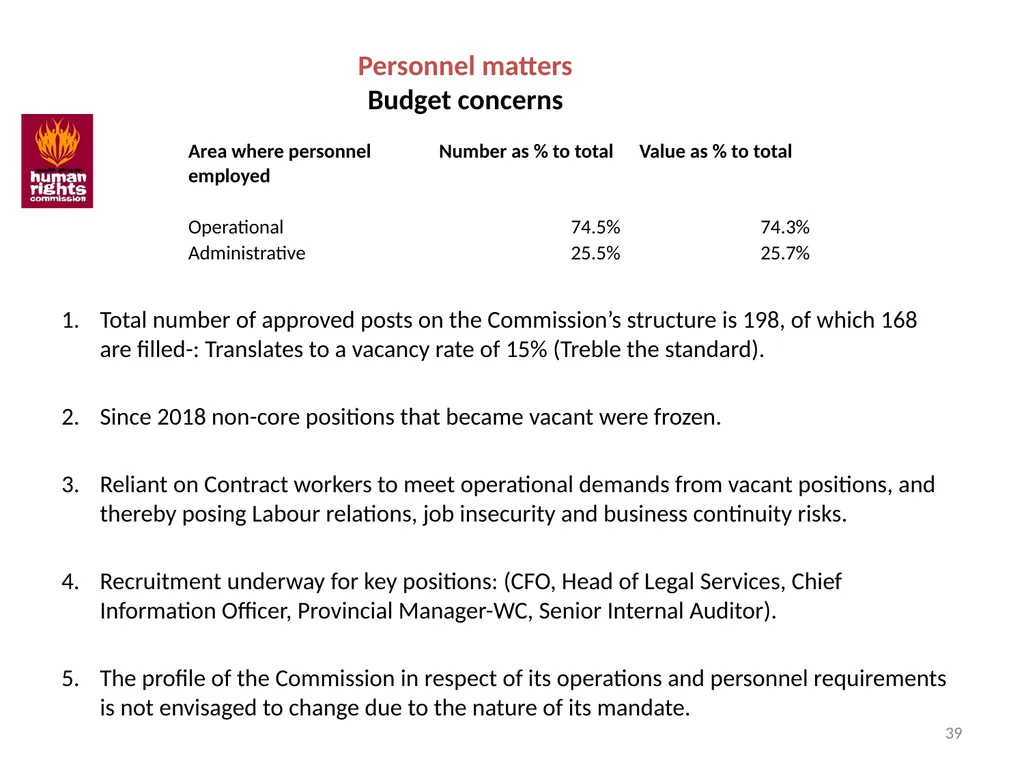
Budget concerns 39 Total number of approved posts on the Commission’s structure is 198, of which 168 are filled-: Translates to a vacancy rate of 15% (Treble the standard).
Since 2018 non-core positions that became vacant were frozen.
Reliant on Contract workers to meet operational demands from vacant positions, and thereby posing Labour relations, job insecurity and business continuity risks.
Recruitment underway for key positions: (CFO, Head of Legal Services, Chief Information Officer, Provincial Manager-WC, Senior Internal Auditor).
The profile of the Commission in respect of its operations and personnel requirements is not envisaged to change due to the nature of its mandate.<br>
Since 2018 non-core positions that became vacant were frozen.
Reliant on Contract workers to meet operational demands from vacant positions, and thereby posing Labour relations, job insecurity and business continuity risks.
Recruitment underway for key positions: (CFO, Head of Legal Services, Chief Information Officer, Provincial Manager-WC, Senior Internal Auditor).
The profile of the Commission in respect of its operations and personnel requirements is not envisaged to change due to the nature of its mandate.<br>
40
Anticipated spending pressures and forward funding needs:
2021 Medium Term Expenditure Framework 40<br>
2021 Medium Term Expenditure Framework 40<br>
41
Spending pressures and forward funding needs
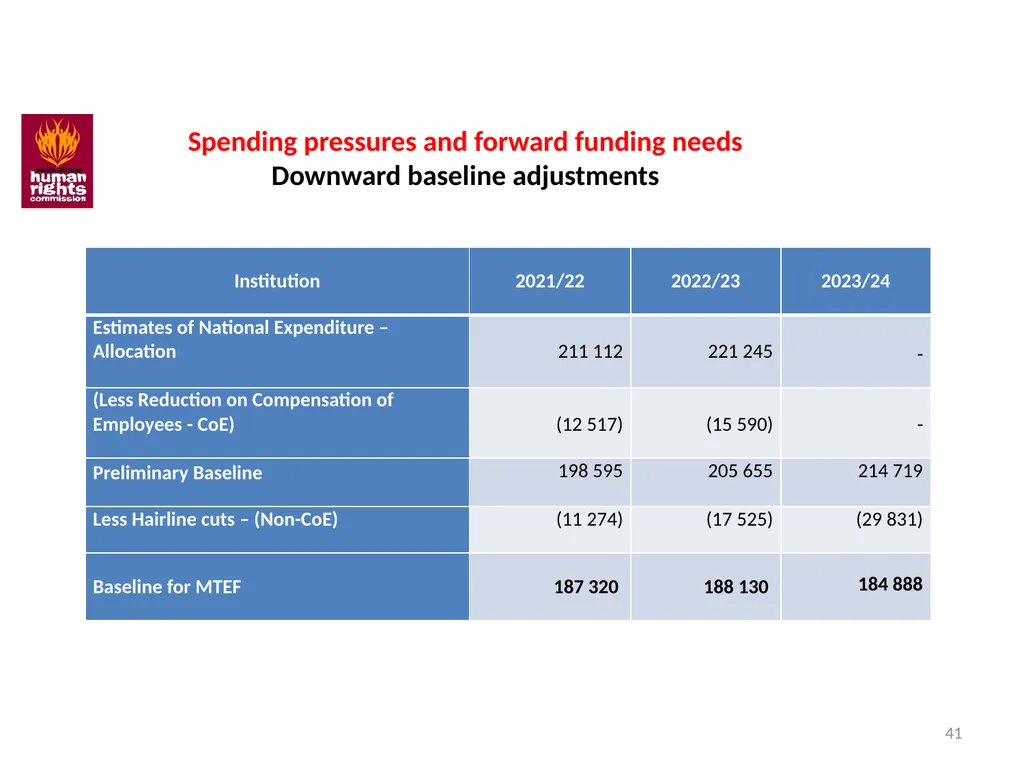
Downward baseline adjustments 41<br>
42
Spending pressures and forward funding needs
Operational consequences of baseline cuts 42 Restricted delivery on the constitutional mandate, with adverse impact on the realisation of human rights.
State of disaster imposed increased human rights vulnerabilities and therefore higher demand for our interventions and resources, especially by gender, children, migrant, persons with disabilities and older persons’ communities.
Inability to address systemic human rights violations.
Inadequate monitoring of the state of human rights in the country -: Economic and social rights; Civil and Political Rights; Equality; International and regional human rights monitoring obligations.
Inability to host the Schools Moot Court Competition.<br>
State of disaster imposed increased human rights vulnerabilities and therefore higher demand for our interventions and resources, especially by gender, children, migrant, persons with disabilities and older persons’ communities.
Inability to address systemic human rights violations.
Inadequate monitoring of the state of human rights in the country -: Economic and social rights; Civil and Political Rights; Equality; International and regional human rights monitoring obligations.
Inability to host the Schools Moot Court Competition.<br>
43
Spending pressures and forward funding needs
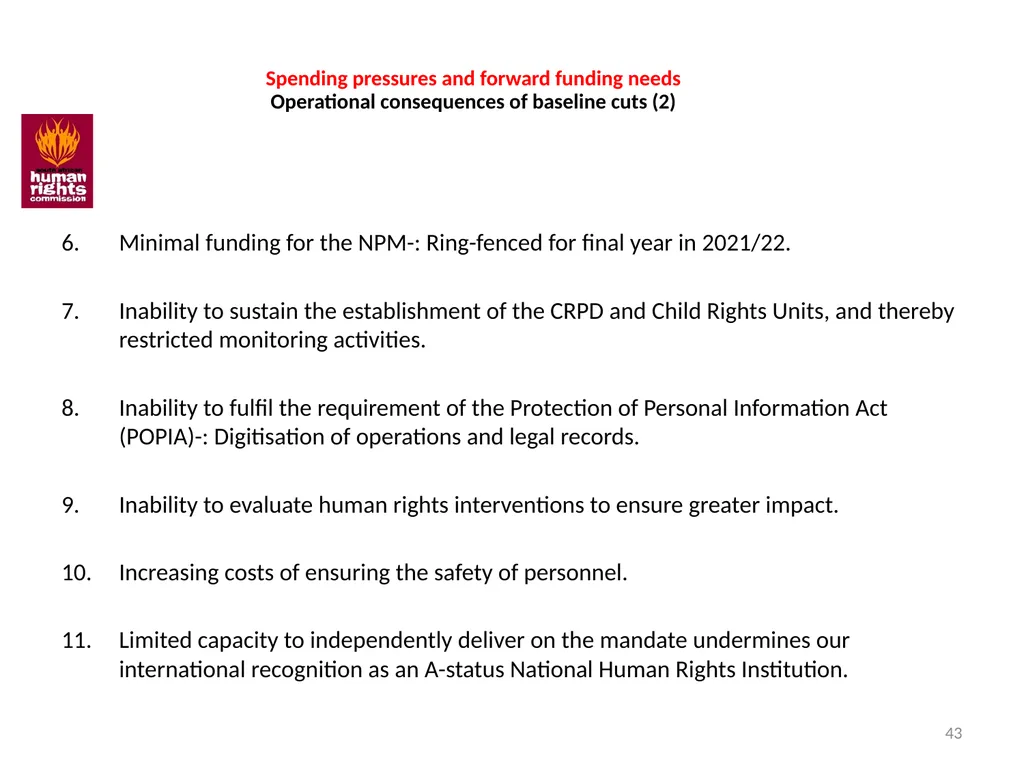
Operational consequences of baseline cuts (2) 43 Minimal funding for the NPM-: Ring-fenced for final year in 2021/22.
Inability to sustain the establishment of the CRPD and Child Rights Units, and thereby restricted monitoring activities.
Inability to fulfil the requirement of the Protection of Personal Information Act (POPIA)-: Digitisation of operations and legal records.
Inability to evaluate human rights interventions to ensure greater impact.
Increasing costs of ensuring the safety of personnel.
Limited capacity to independently deliver on the mandate undermines our international recognition as an A-status National Human Rights Institution.<br>
Inability to sustain the establishment of the CRPD and Child Rights Units, and thereby restricted monitoring activities.
Inability to fulfil the requirement of the Protection of Personal Information Act (POPIA)-: Digitisation of operations and legal records.
Inability to evaluate human rights interventions to ensure greater impact.
Increasing costs of ensuring the safety of personnel.
Limited capacity to independently deliver on the mandate undermines our international recognition as an A-status National Human Rights Institution.<br>
44
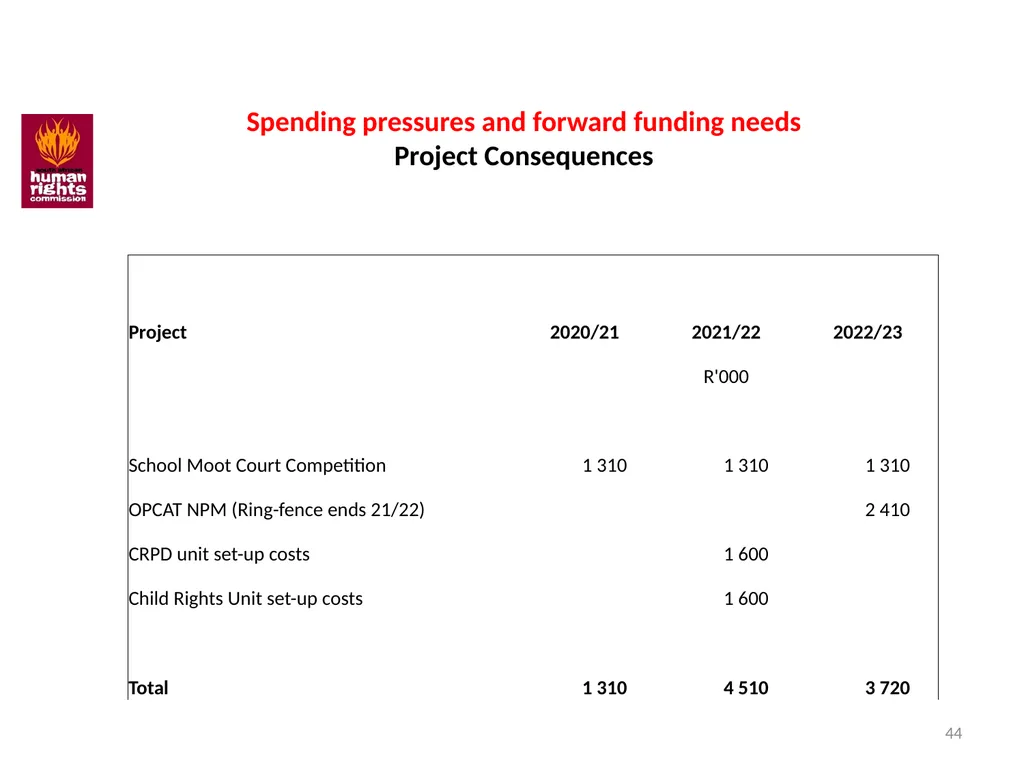
Spending pressures and forward funding needs
Project Consequences 44<br>
45
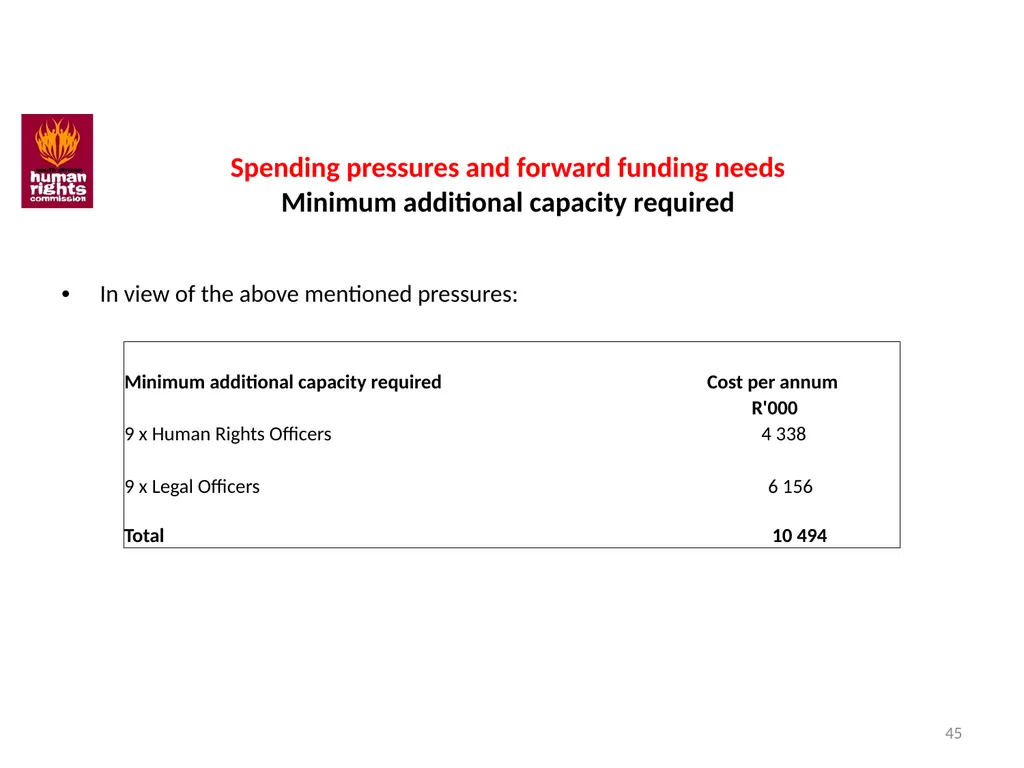
Spending pressures and forward funding needs
Minimum additional capacity required 45 In view of the above mentioned pressures:<br>
46
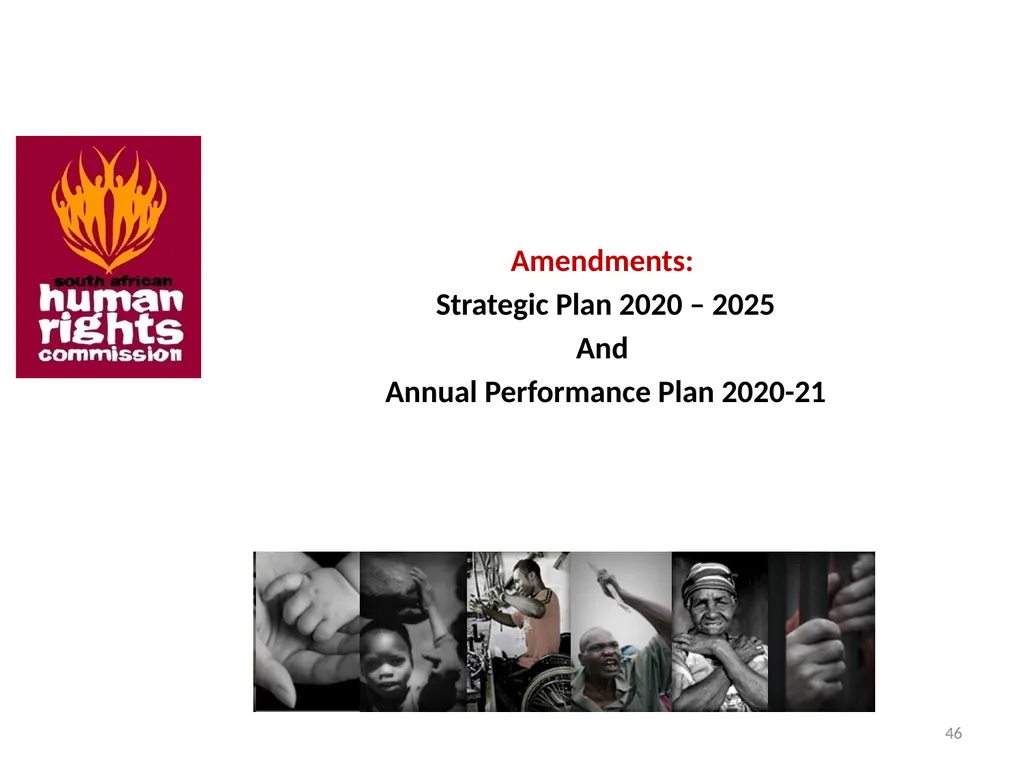
Amendments:
Strategic Plan 2020 – 2025
And
Annual Performance Plan 2020-21 46<br>
Strategic Plan 2020 – 2025
And
Annual Performance Plan 2020-21 46<br>
47
Strategic Plan 2020-25 and Annual Performance Plan 2020-21
Amendments The amendments were largely necessitated by the Covid-19 challenges.
Strategic plan priorities further include food security-: incorporated within the Land and Environment priority areas.
In terms of the Annual Performance Plan, the following amendments were effected:
Admin Programme: Includes the development of a revised 3-year Human Capital Management Strategy.
Protection Programme: The timelines for the completion of the Trends Analysis Report adjusted from end September to December 2020.
Promotion Programme: Cancellation of the National Schools Moot Court Competition due to the implications of Covid-19 on the school calendar.
Monitoring Programme: Development of a comprehensive M&E system to focus specifically on children’s rights as opposed to the other broader rights areas (which will be considered in the latter years of the strategic plan).
Monitoring Programme: Submission timeline of the PAIA Annual Report to Parliament adjusted from end September 2020 to end November 2020, as informed by the extensions on the Annual Report submissions. 47<br>
Strategic plan priorities further include food security-: incorporated within the Land and Environment priority areas.
In terms of the Annual Performance Plan, the following amendments were effected:
Admin Programme: Includes the development of a revised 3-year Human Capital Management Strategy.
Protection Programme: The timelines for the completion of the Trends Analysis Report adjusted from end September to December 2020.
Promotion Programme: Cancellation of the National Schools Moot Court Competition due to the implications of Covid-19 on the school calendar.
Monitoring Programme: Development of a comprehensive M&E system to focus specifically on children’s rights as opposed to the other broader rights areas (which will be considered in the latter years of the strategic plan).
Monitoring Programme: Submission timeline of the PAIA Annual Report to Parliament adjusted from end September 2020 to end November 2020, as informed by the extensions on the Annual Report submissions. 47<br>
48
Strategic Plan 2020-25 and Annual Performance Plan 2020-21
Amendments (2) The amendments (except for the PAIA related amendment, which is informed by the extension granted for the Annual Report) were approved by the Commission (Executive Authority) on 24 August 2020.
The actual revised documents will be tabled for noting by the Executive Authority on 27 – 28 October 2020, after-which they will be submitted to Parliament.
The resultant budget adjustment, of approximately R1 million, from the cancellation of the National Schools Moot Court Competition will be utilised to offset other spending pressures, including:
Development of the Human Capital Management Strategy.
Enhancing community radio engagements to promote human rights awareness and reach.
Empowering and reaching out to communities through Human Rights Champions.
Production of human rights education material at local level.
Webinar fees for alternative human rights promotional events. 48<br>
The actual revised documents will be tabled for noting by the Executive Authority on 27 – 28 October 2020, after-which they will be submitted to Parliament.
The resultant budget adjustment, of approximately R1 million, from the cancellation of the National Schools Moot Court Competition will be utilised to offset other spending pressures, including:
Development of the Human Capital Management Strategy.
Enhancing community radio engagements to promote human rights awareness and reach.
Empowering and reaching out to communities through Human Rights Champions.
Production of human rights education material at local level.
Webinar fees for alternative human rights promotional events. 48<br>
49
END
THANK YOU www.sahrc.org.za
@sahrcommission 49<br>
@sahrcommission 49<br>