
South Unity, South Progress. Mainstreaming
EM
Published · 14 slides · 0 views
1 / 1
Description
South Unity, South Progress. Mainstreaming Inclusive and Sustainable Industrial Development into National Policies and Programs Manuel F Montes LDC Ministerial Conference 2015: Operationalizing ISID for LDCs: the path to graduation and
Related Topics
Share
Embed code
Download this presentation From Below
"South Unity, South Progress. Mainstreaming" is the property of its rightful owner. Permission is granted to download and print the materials on this website for personal, non-commercial use only, and to display it on your personal computer provided you do not modify the materials and that you retain all copyright notices contained in the materials. By downloading content from our website, you accept the terms of this agreement.
Presentation Transcript
01
South Unity, South Progress. Mainstreaming Inclusive and Sustainable Industrial Development into National Policies and Programs Manuel F Montes
LDC Ministerial Conference 2015: Operationalizing ISID for LDCs: “the path to graduation and beyond”
Vienna, 26-27 November 2014<br>
LDC Ministerial Conference 2015: Operationalizing ISID for LDCs: “the path to graduation and beyond”
Vienna, 26-27 November 2014<br>
02
South Unity, South Progress. 2 Sustainable Development and Industrial Development The second paragraph of the Preamble and Paragraph 4 of Agenda 2030 have the following sentence:
Preamble: As we embark on this collective journey, we pledge that no one will be left behind.
Paragraph 4. As we embark on this great collective journey, we pledge that no one will be left behind.
What does the pledge NO ONE LEFT BEHIND MEAN? There are two kinds of countries –
Those that are already industrialized or are succeeding to industrialize
Those that are not yet industrialized<br>
Preamble: As we embark on this collective journey, we pledge that no one will be left behind.
Paragraph 4. As we embark on this great collective journey, we pledge that no one will be left behind.
What does the pledge NO ONE LEFT BEHIND MEAN? There are two kinds of countries –
Those that are already industrialized or are succeeding to industrialize
Those that are not yet industrialized<br>
03
South Unity, South Progress. 3 Sustainable Development and Industrial Development If one is serious about this pledge, “No one left behind” should mean that by 2030 all countries must be either be industrialized or succeeding at industrializing.
In MDG9, this indicator is now part of the meaning of sustainable development
The community of nations has agreed that to overcome poverty, and achieve sustainable development, industrial development is necessary
The concept of sustainable development with three dimensions was decided in 1992, and before that in the 1987 Brundtland Report.<br>
In MDG9, this indicator is now part of the meaning of sustainable development
The community of nations has agreed that to overcome poverty, and achieve sustainable development, industrial development is necessary
The concept of sustainable development with three dimensions was decided in 1992, and before that in the 1987 Brundtland Report.<br>
04
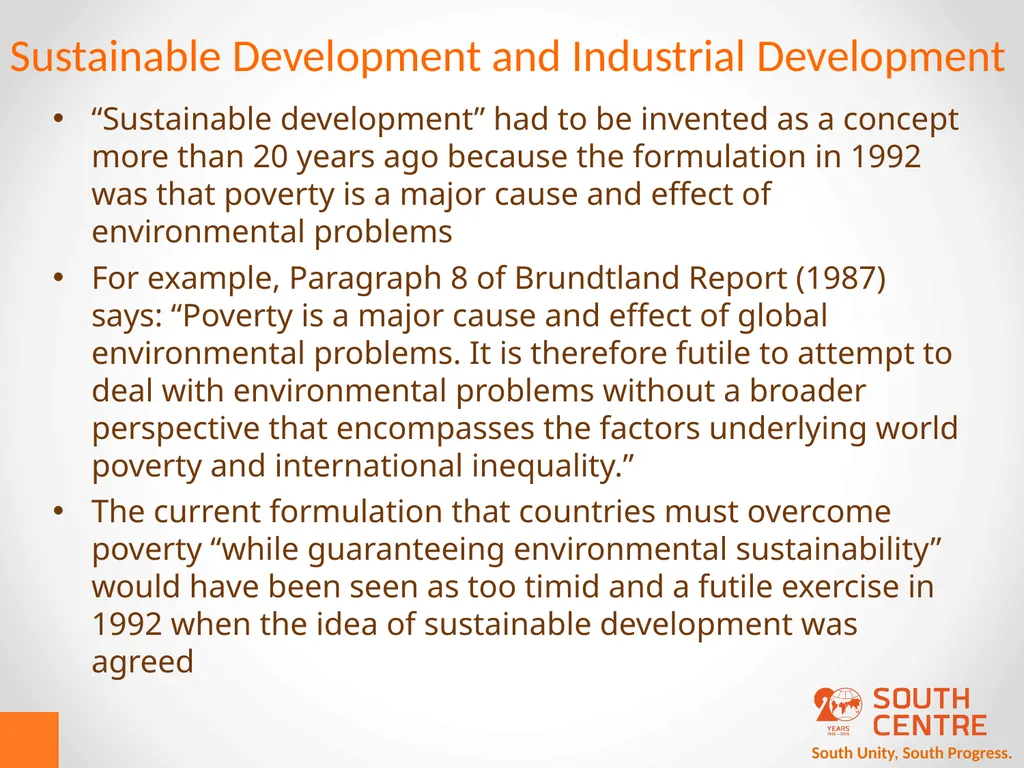
South Unity, South Progress. 4 Sustainable Development and Industrial Development “Sustainable development” had to be invented as a concept more than 20 years ago because the formulation in 1992 was that poverty is a major cause and effect of environmental problems
For example, Paragraph 8 of Brundtland Report (1987) says: “Poverty is a major cause and effect of global environmental problems. It is therefore futile to attempt to deal with environmental problems without a broader perspective that encompasses the factors underlying world poverty and international inequality.”
The current formulation that countries must overcome poverty “while guaranteeing environmental sustainability” would have been seen as too timid and a futile exercise in 1992 when the idea of sustainable development was agreed<br>
For example, Paragraph 8 of Brundtland Report (1987) says: “Poverty is a major cause and effect of global environmental problems. It is therefore futile to attempt to deal with environmental problems without a broader perspective that encompasses the factors underlying world poverty and international inequality.”
The current formulation that countries must overcome poverty “while guaranteeing environmental sustainability” would have been seen as too timid and a futile exercise in 1992 when the idea of sustainable development was agreed<br>
05
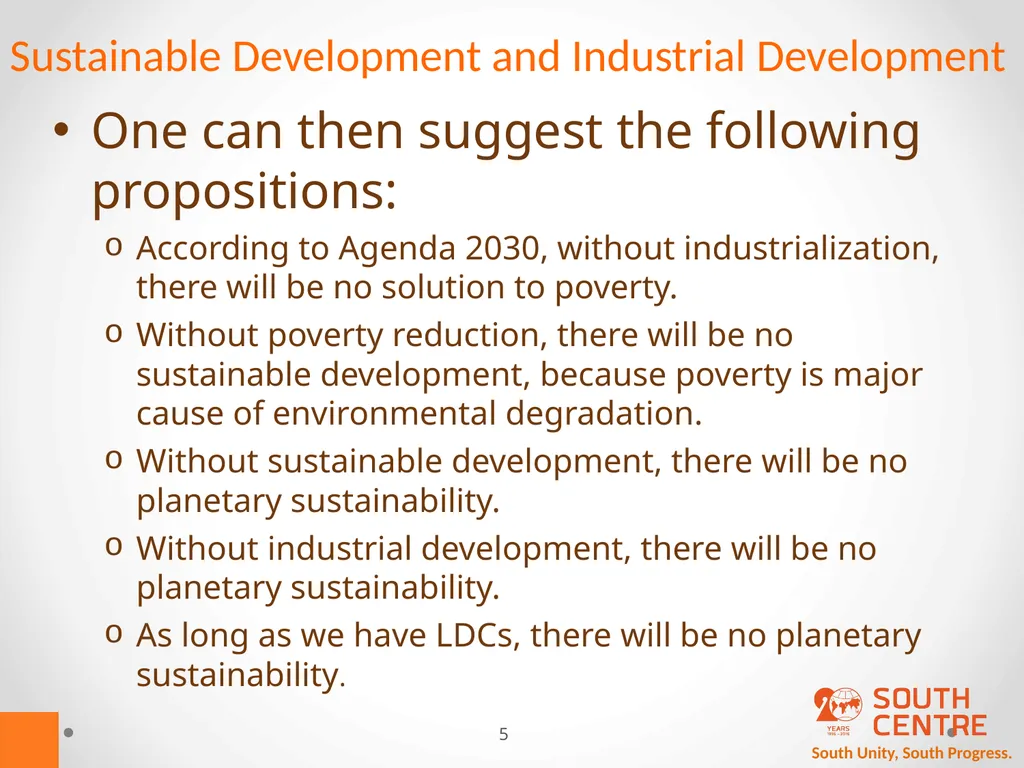
South Unity, South Progress. 5 Sustainable Development and Industrial Development One can then suggest the following propositions:
According to Agenda 2030, without industrialization, there will be no solution to poverty.
Without poverty reduction, there will be no sustainable development, because poverty is major cause of environmental degradation.
Without sustainable development, there will be no planetary sustainability.
Without industrial development, there will be no planetary sustainability.
As long as we have LDCs, there will be no planetary sustainability.<br>
According to Agenda 2030, without industrialization, there will be no solution to poverty.
Without poverty reduction, there will be no sustainable development, because poverty is major cause of environmental degradation.
Without sustainable development, there will be no planetary sustainability.
Without industrial development, there will be no planetary sustainability.
As long as we have LDCs, there will be no planetary sustainability.<br>
06
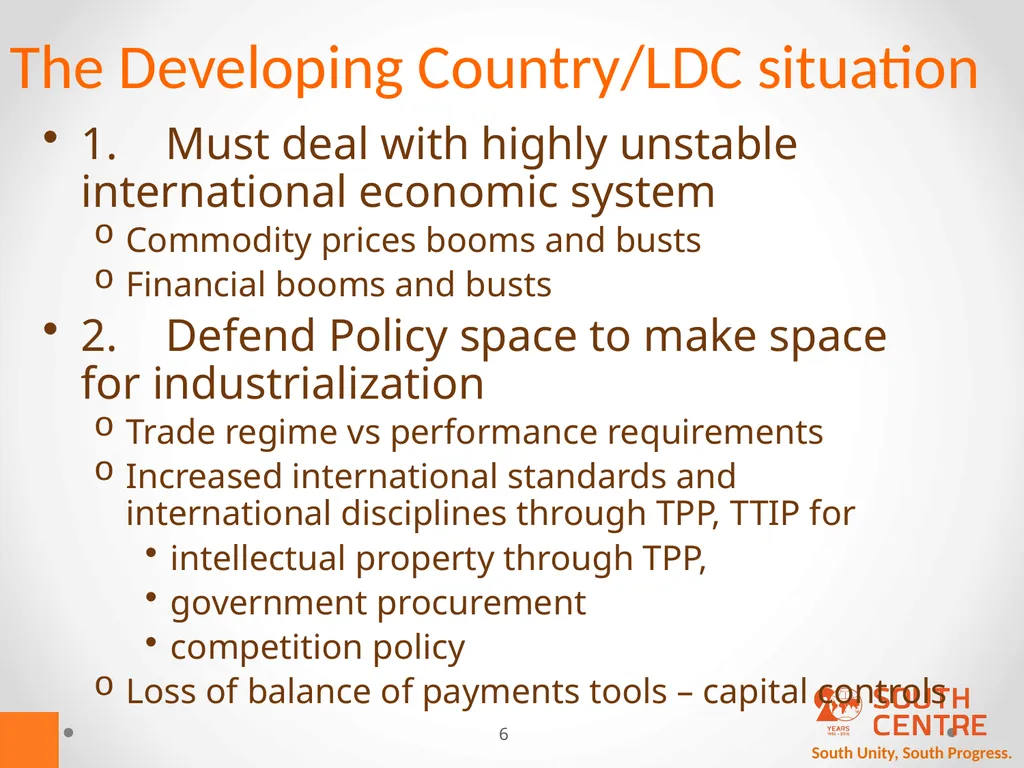
South Unity, South Progress. 6 The Developing Country/LDC situation 1. Must deal with highly unstable international economic system
Commodity prices booms and busts
Financial booms and busts
2. Defend Policy space to make space for industrialization
Trade regime vs performance requirements
Increased international standards and international disciplines through TPP, TTIP for
intellectual property through TPP,
government procurement
competition policy
Loss of balance of payments tools – capital controls<br>
Commodity prices booms and busts
Financial booms and busts
2. Defend Policy space to make space for industrialization
Trade regime vs performance requirements
Increased international standards and international disciplines through TPP, TTIP for
intellectual property through TPP,
government procurement
competition policy
Loss of balance of payments tools – capital controls<br>
07
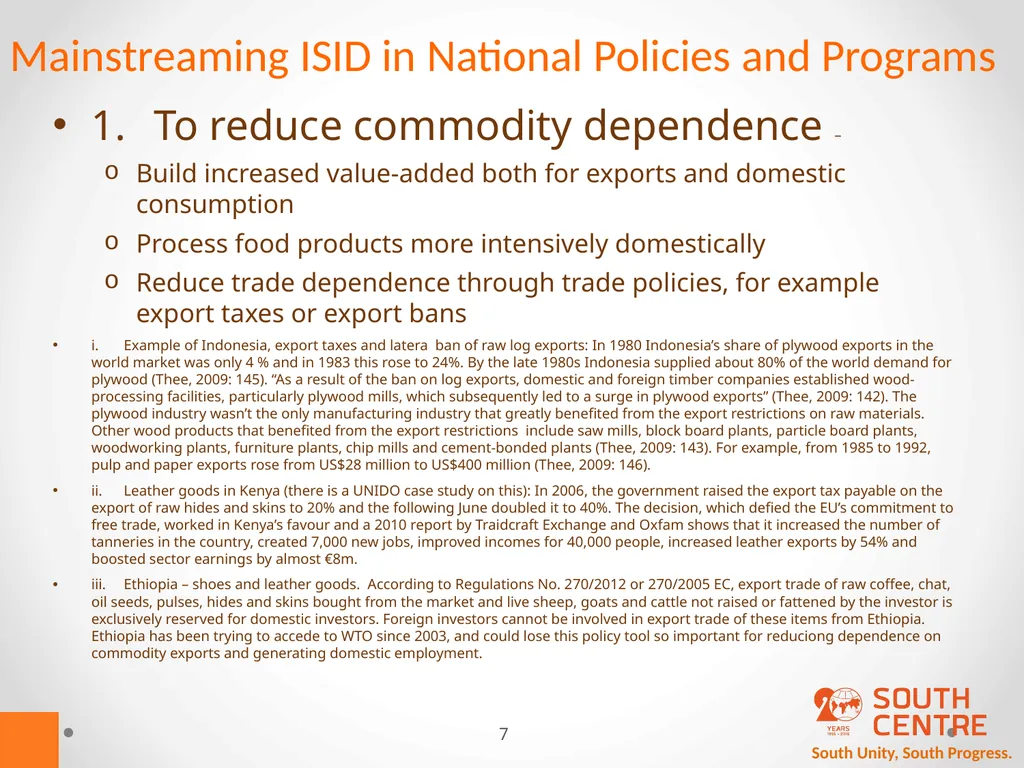
South Unity, South Progress. 7 Mainstreaming ISID in National Policies and Programs 1. To reduce commodity dependence –
Build increased value-added both for exports and domestic consumption
Process food products more intensively domestically
Reduce trade dependence through trade policies, for example export taxes or export bans
i. Example of Indonesia, export taxes and latera ban of raw log exports: In 1980 Indonesia’s share of plywood exports in the world market was only 4 % and in 1983 this rose to 24%. By the late 1980s Indonesia supplied about 80% of the world demand for plywood (Thee, 2009: 145). “As a result of the ban on log exports, domestic and foreign timber companies established wood-processing facilities, particularly plywood mills, which subsequently led to a surge in plywood exports” (Thee, 2009: 142). The plywood industry wasn’t the only manufacturing industry that greatly benefited from the export restrictions on raw materials. Other wood products that benefited from the export restrictions include saw mills, block board plants, particle board plants, woodworking plants, furniture plants, chip mills and cement-bonded plants (Thee, 2009: 143). For example, from 1985 to 1992, pulp and paper exports rose from US$28 million to US$400 million (Thee, 2009: 146).
ii. Leather goods in Kenya (there is a UNIDO case study on this): In 2006, the government raised the export tax payable on the export of raw hides and skins to 20% and the following June doubled it to 40%. The decision, which defied the EU’s commitment to free trade, worked in Kenya’s favour and a 2010 report by Traidcraft Exchange and Oxfam shows that it increased the number of tanneries in the country, created 7,000 new jobs, improved incomes for 40,000 people, increased leather exports by 54% and boosted sector earnings by almost €8m.
iii. Ethiopia – shoes and leather goods. According to Regulations No. 270/2012 or 270/2005 EC, export trade of raw coffee, chat, oil seeds, pulses, hides and skins bought from the market and live sheep, goats and cattle not raised or fattened by the investor is exclusively reserved for domestic investors. Foreign investors cannot be involved in export trade of these items from Ethiopia. Ethiopia has been trying to accede to WTO since 2003, and could lose this policy tool so important for reduciong dependence on commodity exports and generating domestic employment.<br>
Build increased value-added both for exports and domestic consumption
Process food products more intensively domestically
Reduce trade dependence through trade policies, for example export taxes or export bans
i. Example of Indonesia, export taxes and latera ban of raw log exports: In 1980 Indonesia’s share of plywood exports in the world market was only 4 % and in 1983 this rose to 24%. By the late 1980s Indonesia supplied about 80% of the world demand for plywood (Thee, 2009: 145). “As a result of the ban on log exports, domestic and foreign timber companies established wood-processing facilities, particularly plywood mills, which subsequently led to a surge in plywood exports” (Thee, 2009: 142). The plywood industry wasn’t the only manufacturing industry that greatly benefited from the export restrictions on raw materials. Other wood products that benefited from the export restrictions include saw mills, block board plants, particle board plants, woodworking plants, furniture plants, chip mills and cement-bonded plants (Thee, 2009: 143). For example, from 1985 to 1992, pulp and paper exports rose from US$28 million to US$400 million (Thee, 2009: 146).
ii. Leather goods in Kenya (there is a UNIDO case study on this): In 2006, the government raised the export tax payable on the export of raw hides and skins to 20% and the following June doubled it to 40%. The decision, which defied the EU’s commitment to free trade, worked in Kenya’s favour and a 2010 report by Traidcraft Exchange and Oxfam shows that it increased the number of tanneries in the country, created 7,000 new jobs, improved incomes for 40,000 people, increased leather exports by 54% and boosted sector earnings by almost €8m.
iii. Ethiopia – shoes and leather goods. According to Regulations No. 270/2012 or 270/2005 EC, export trade of raw coffee, chat, oil seeds, pulses, hides and skins bought from the market and live sheep, goats and cattle not raised or fattened by the investor is exclusively reserved for domestic investors. Foreign investors cannot be involved in export trade of these items from Ethiopia. Ethiopia has been trying to accede to WTO since 2003, and could lose this policy tool so important for reduciong dependence on commodity exports and generating domestic employment.<br>
08
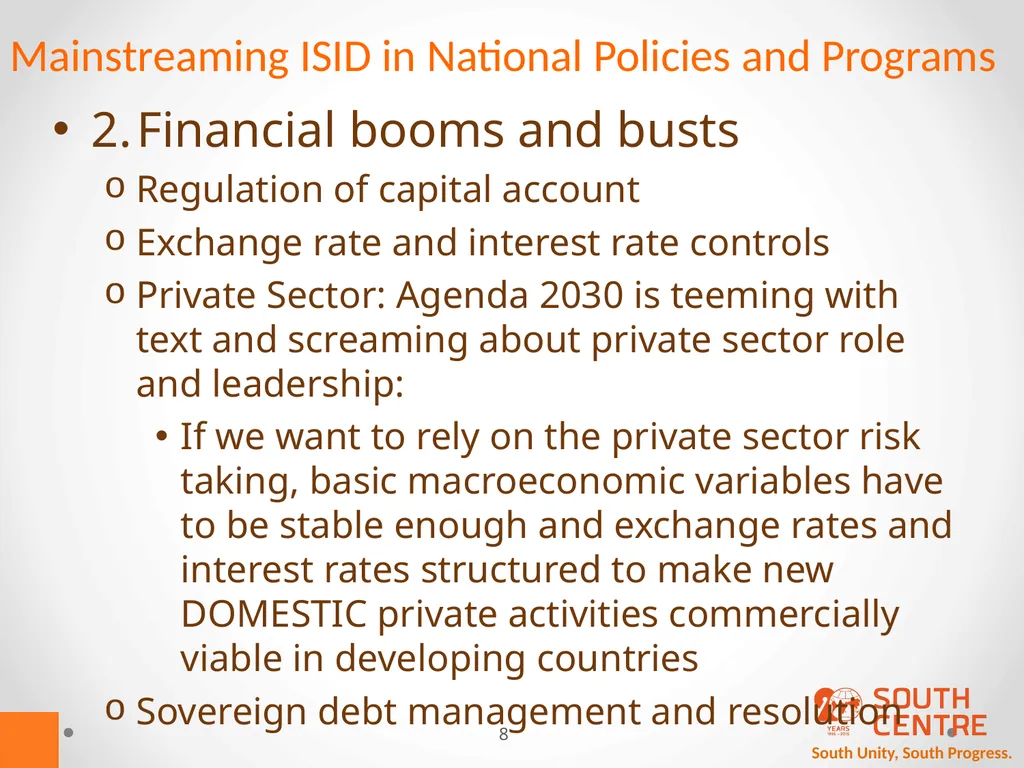
South Unity, South Progress. 8 Mainstreaming ISID in National Policies and Programs 2. Financial booms and busts
Regulation of capital account
Exchange rate and interest rate controls
Private Sector: Agenda 2030 is teeming with text and screaming about private sector role and leadership:
If we want to rely on the private sector risk taking, basic macroeconomic variables have to be stable enough and exchange rates and interest rates structured to make new DOMESTIC private activities commercially viable in developing countries
Sovereign debt management and resolution<br>
Regulation of capital account
Exchange rate and interest rate controls
Private Sector: Agenda 2030 is teeming with text and screaming about private sector role and leadership:
If we want to rely on the private sector risk taking, basic macroeconomic variables have to be stable enough and exchange rates and interest rates structured to make new DOMESTIC private activities commercially viable in developing countries
Sovereign debt management and resolution<br>
09
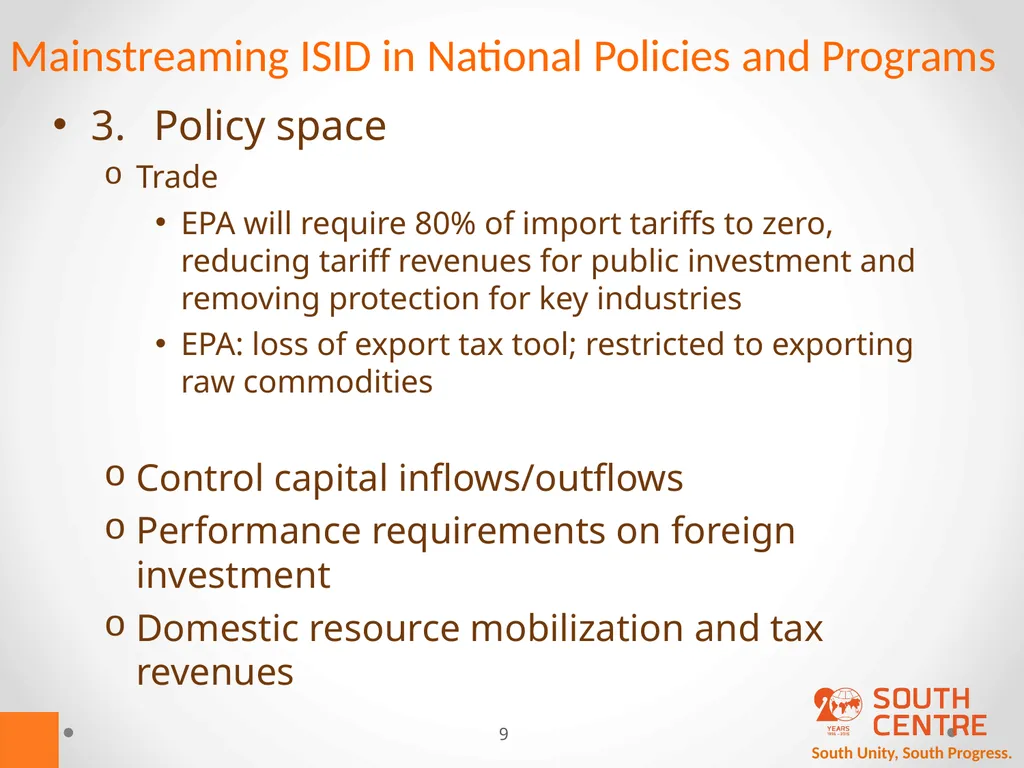
South Unity, South Progress. 9 Mainstreaming ISID in National Policies and Programs 3. Policy space
Trade
EPA will require 80% of import tariffs to zero, reducing tariff revenues for public investment and removing protection for key industries
EPA: loss of export tax tool; restricted to exporting raw commodities
Control capital inflows/outflows
Performance requirements on foreign investment
Domestic resource mobilization and tax revenues<br>
Trade
EPA will require 80% of import tariffs to zero, reducing tariff revenues for public investment and removing protection for key industries
EPA: loss of export tax tool; restricted to exporting raw commodities
Control capital inflows/outflows
Performance requirements on foreign investment
Domestic resource mobilization and tax revenues<br>
10
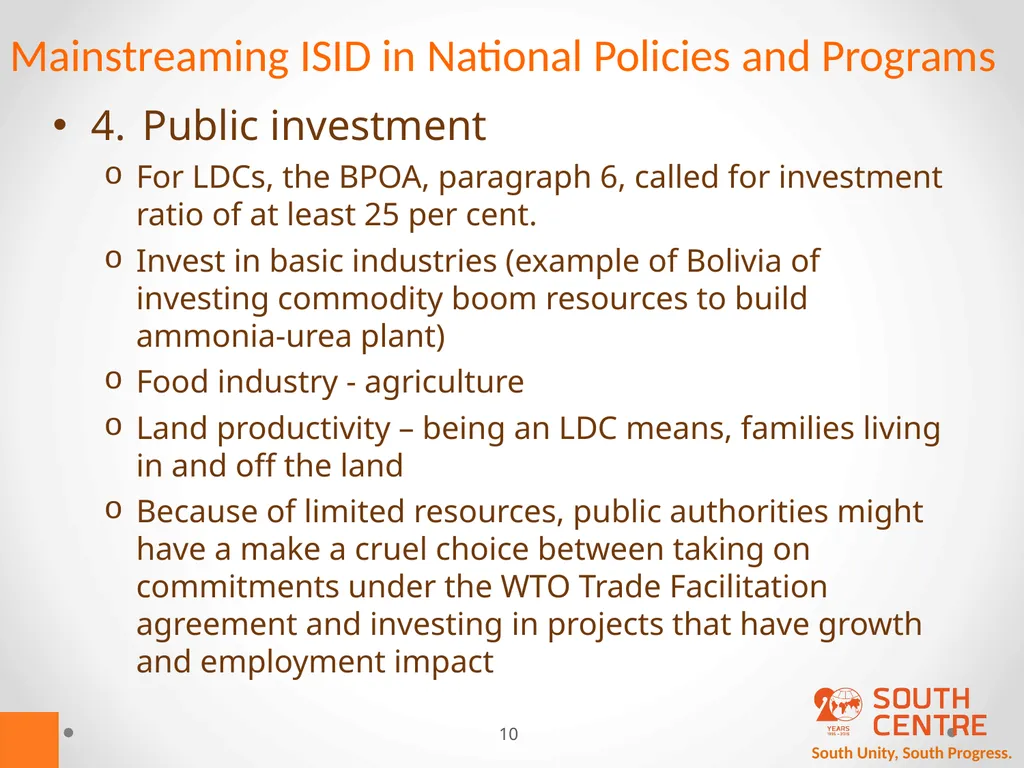
South Unity, South Progress. 10 Mainstreaming ISID in National Policies and Programs 4. Public investment
For LDCs, the BPOA, paragraph 6, called for investment ratio of at least 25 per cent.
Invest in basic industries (example of Bolivia of investing commodity boom resources to build ammonia-urea plant)
Food industry - agriculture
Land productivity – being an LDC means, families living in and off the land
Because of limited resources, public authorities might have a make a cruel choice between taking on commitments under the WTO Trade Facilitation agreement and investing in projects that have growth and employment impact<br>
For LDCs, the BPOA, paragraph 6, called for investment ratio of at least 25 per cent.
Invest in basic industries (example of Bolivia of investing commodity boom resources to build ammonia-urea plant)
Food industry - agriculture
Land productivity – being an LDC means, families living in and off the land
Because of limited resources, public authorities might have a make a cruel choice between taking on commitments under the WTO Trade Facilitation agreement and investing in projects that have growth and employment impact<br>
11
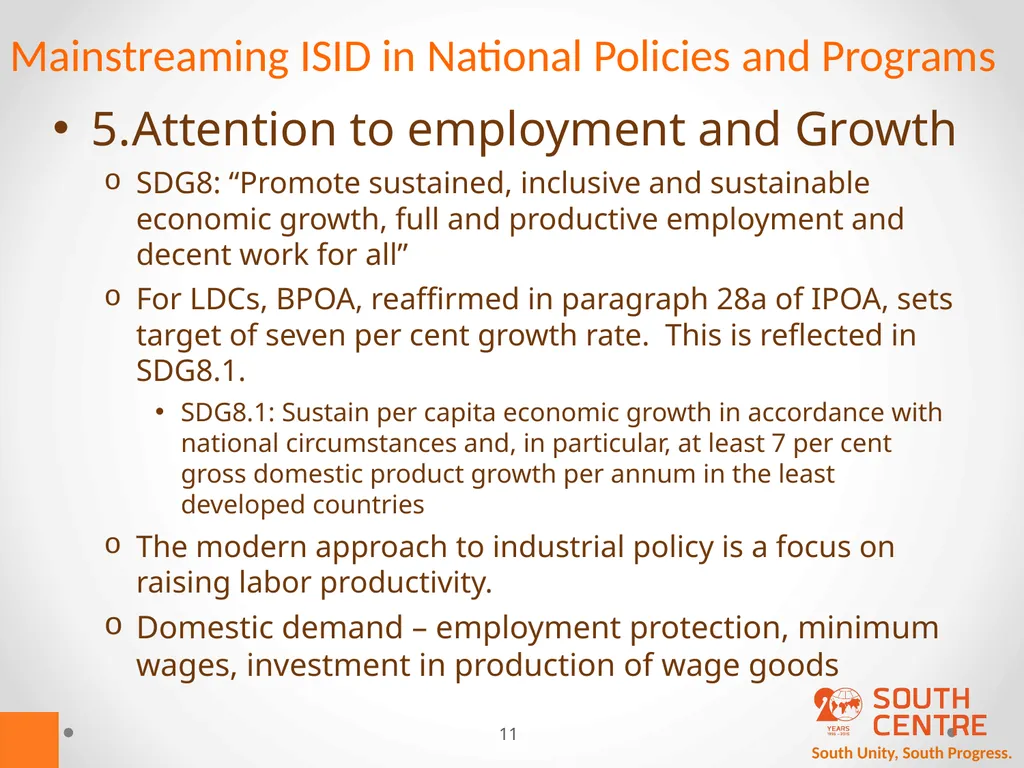
South Unity, South Progress. 11 Mainstreaming ISID in National Policies and Programs 5. Attention to employment and Growth
SDG8: “Promote sustained, inclusive and sustainable economic growth, full and productive employment and decent work for all”
For LDCs, BPOA, reaffirmed in paragraph 28a of IPOA, sets target of seven per cent growth rate. This is reflected in SDG8.1.
SDG8.1: Sustain per capita economic growth in accordance with national circumstances and, in particular, at least 7 per cent gross domestic product growth per annum in the least developed countries
The modern approach to industrial policy is a focus on raising labor productivity.
Domestic demand – employment protection, minimum wages, investment in production of wage goods<br>
SDG8: “Promote sustained, inclusive and sustainable economic growth, full and productive employment and decent work for all”
For LDCs, BPOA, reaffirmed in paragraph 28a of IPOA, sets target of seven per cent growth rate. This is reflected in SDG8.1.
SDG8.1: Sustain per capita economic growth in accordance with national circumstances and, in particular, at least 7 per cent gross domestic product growth per annum in the least developed countries
The modern approach to industrial policy is a focus on raising labor productivity.
Domestic demand – employment protection, minimum wages, investment in production of wage goods<br>
12
South Unity, South Progress. 12 Mainstreaming ISID in National Policies and Programs 6. Attention to technology
Not in the first place about transfer of technology but about solving local problems and eliminating domestic bottlenecks. UNIDO should help in identification of technical solutions to local technology bottlenecks.
If international private intellectual property is an obstacle, then this must be reformed to achieve sustainable development and planetary sustainability<br>
Not in the first place about transfer of technology but about solving local problems and eliminating domestic bottlenecks. UNIDO should help in identification of technical solutions to local technology bottlenecks.
If international private intellectual property is an obstacle, then this must be reformed to achieve sustainable development and planetary sustainability<br>
13
South Unity, South Progress. 13 Mainstreaming ISID in National Policies and Programs 7. Attention to trade policy
Not all trade creates significant employment. It is increasing value added that creates employment significantly and raises incomes. Industrial development is needed to increase domestic value-added.
We should avoid unduly emphasizing the divide between LDCs and Middle income countries (MICs). MICs serve as anchors to regional economies and key markets for LDCs. If MICs unable to growth and serve as markets, special accommodations to LDCS can be futile.<br>
Not all trade creates significant employment. It is increasing value added that creates employment significantly and raises incomes. Industrial development is needed to increase domestic value-added.
We should avoid unduly emphasizing the divide between LDCs and Middle income countries (MICs). MICs serve as anchors to regional economies and key markets for LDCs. If MICs unable to growth and serve as markets, special accommodations to LDCS can be futile.<br>
14
South Unity, South Progress. 14 Thank you montes@southcentre.int
www.southcentre.int
Tel: +41 22 791 80 50
Fax: +41 22 798 85 31
South Centre
Chemin du Champ d'Anier 17 C.P. 228 1211 Geneva 19 Switzerland<br>
www.southcentre.int
Tel: +41 22 791 80 50
Fax: +41 22 798 85 31
South Centre
Chemin du Champ d'Anier 17 C.P. 228 1211 Geneva 19 Switzerland<br>