
SPEAR Workshop Presented by: Angie Rowe & Cathi



Description: SPEAR Workshop Presented by: Angie Rowe Cathi Bass Uniform Guidance: administrative Requirements, Cost Principles and audit Requirements Topics Definition of Uniform Guidance Basic Layout Provide new andor updated information for
Related Topics
Download Presentation
"SPEAR Workshop Presented by: Angie Rowe & Cathi" is the property of its rightful owner. Permission is granted to download and print the materials on this website for personal, non-commercial use only, and to display it on your personal computer provided you do not modify the materials and that you retain all copyright notices contained in the materials. By downloading content from our website, you accept the terms of this agreement.
Presentation Transcript
slide1. SPEAR
Workshop
Presented by:
Angie Rowe & Cathi Bass Uniform Guidance: administrative Requirements, Cost Principles and audit Requirements<br>
slide2. Topics Definition of Uniform Guidance
Basic Layout
Provide new and/or updated information for
Administrative Requirements (formerly A-110)
Cost Principles (formerly A-21)
Audit Requirements (formerly A-133) 2<br>
slide3. What is the Uniform Guidance? Uniform Administrative Requirements, Cost Principles, and Audit Requirements for Federal Awards - 2 CFR 200
It is the Office of Management and Budget’s (OMB) consolidation of their circulars for costing, administration and audit of Federal awards
It replaces 8 circulars and applies to universities, state and local governments, nonprofits, native tribes
It was issued on December 26, 2013
It was effective on December 26, 2014 3<br>
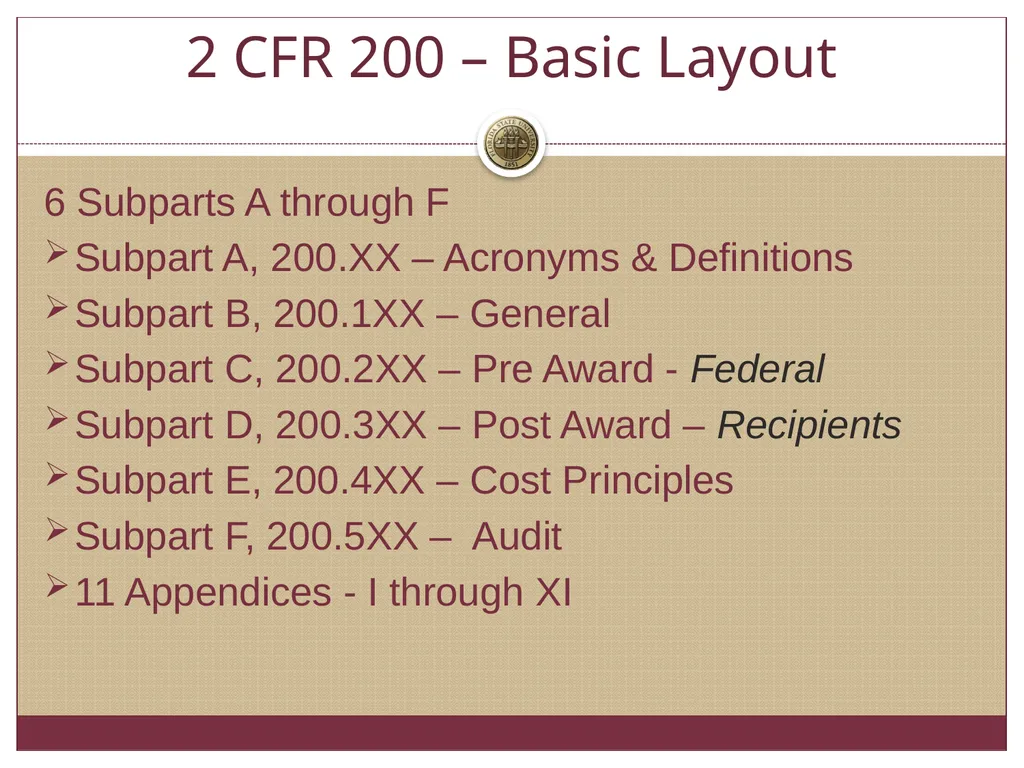
slide4. 2 CFR 200 – Basic Layout 6 Subparts A through F
Subpart A, 200.XX – Acronyms & Definitions
Subpart B, 200.1XX – General
Subpart C, 200.2XX – Pre Award - Federal
Subpart D, 200.3XX – Post Award – Recipients
Subpart E, 200.4XX – Cost Principles
Subpart F, 200.5XX – Audit
11 Appendices - I through XI 4<br>
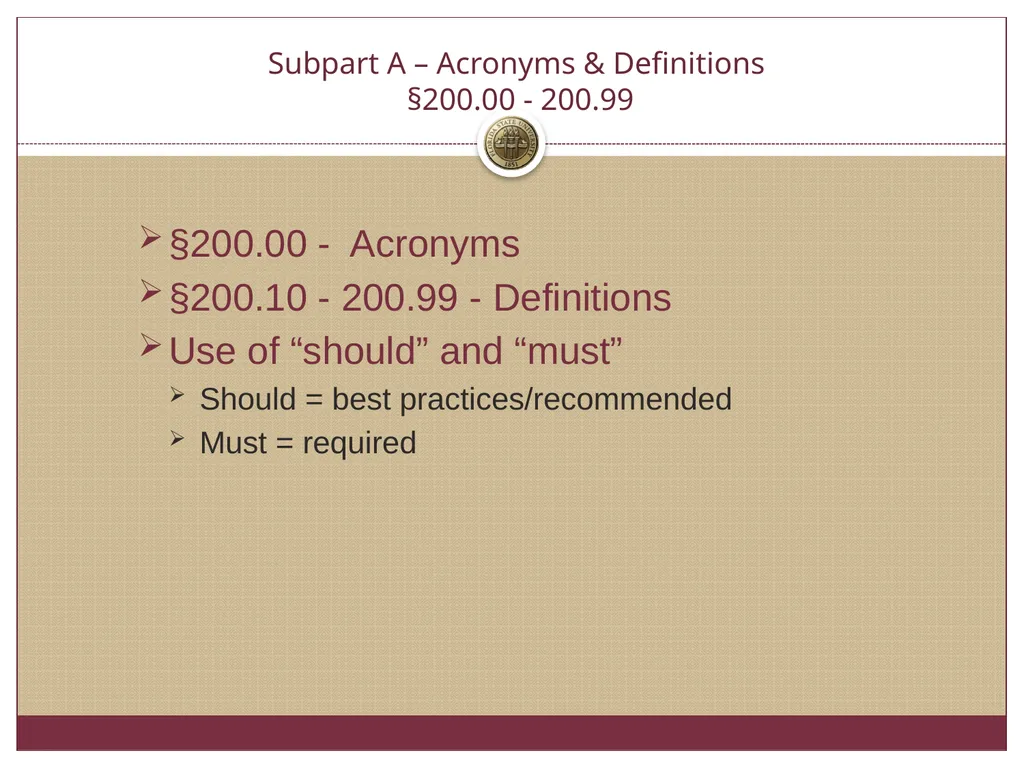
slide5. Subpart A – Acronyms & Definitions §200.00 - 200.99 §200.00 - Acronyms
§200.10 - 200.99 - Definitions
Use of “should” and “must”
Should = best practices/recommended
Must = required 5<br>
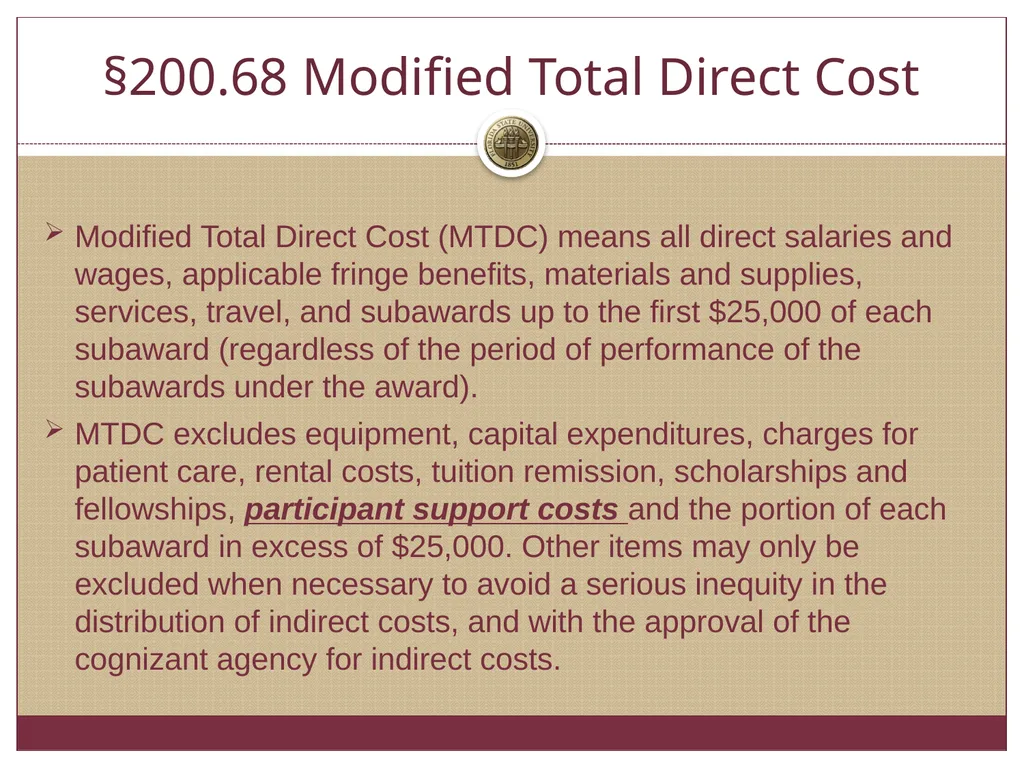
slide6. §200.68 Modified Total Direct Cost Modified Total Direct Cost (MTDC) means all direct salaries and wages, applicable fringe benefits, materials and supplies, services, travel, and subawards up to the first $25,000 of each subaward (regardless of the period of performance of the subawards under the award).
MTDC excludes equipment, capital expenditures, charges for patient care, rental costs, tuition remission, scholarships and fellowships, participant support costs and the portion of each subaward in excess of $25,000. Other items may only be excluded when necessary to avoid a serious inequity in the distribution of indirect costs, and with the approval of the cognizant agency for indirect costs. 6<br>
slide7. §200.74 Pass-through entity Pass-through entity means a non-Federal entity that provides a subaward to a subrecipient to carry out part of a Federal program. 7<br>
slide8. §200.75 Participant support costs Participant support costs means direct costs for items such as stipends or subsistence allowances, travel allowances, and registration fees paid to or on behalf of participants or trainees (but not employees) in connection with conferences, or training projects. 8<br>
slide9. Subpart B – General Provisions §200. 100-113 §200.100 Purpose
This part establishes uniform administrative requirements, cost principles, and audit requirements for Federal awards to non-Federal entities
Federal awarding agencies must not impose additional or inconsistent requirements 9<br>
slide10. §200.101 Applicability NEW table for applicability by types of award
T&C flow down to subrecipients
Subparts C-D are not applicable to
Cost-reimbursement contracts and subcontracts awarded under the Federal Acquisition Regulations (FAR)
Fixed price contracts and subcontracts awarded under the FAR whenever cost analysis is performed
The FAR serves as the administrative requirements 10<br>
slide11. §200.110 Effective Date Agency implementation effective 12/26/14
Applies to awards issued after 12/26/14
COFAR FAQs .110-7 and .110-12 specify that funding increments on existing awards, issued post 12/26/14, may be subject to the UG at the agency’s discretion; if the amendment is subject to the UG, it will be issued with modified terms and conditions
Applies to audits for FY beginning after 12/26/14 11<br>
slide12. §200.112 Conflict of interest NEW! Applies to procurement activities
Federal agencies must establish COI policies
NSF and NIH already meet the new standard;
no changes
EPA’s COI is problematic for IHEs
Grantees must disclose in writing any potential COI according to the agency’s requirements 12<br>
slide13. Subpart C – Pre-Federal Award Requirements §200.200 – 200.213 §200.201, Grant agreements
Fixed amount awards are allowed -NEW
§200.202/203, Notice of funding opportunities –NEW
Provides standards for information needed in each funding opportunity
Agencies must generally post opportunities at least 60 calendar days prior to due date, but… No less than 30 calendar days 13<br>
slide14. §200.205 Agency review of risk posed by applicants Must have framework for evaluating risks
Review may include:
financial stability;
quality of management systems and ability to meet the management standards prescribed;
performance history;
audit findings and reports; and/or
ability to implement statutory, regulatory, or other requirements 14<br>
slide15. §200.210 Information contained in a Federal award General Federal Award Information
No more DUNS # - replaced by Unique Entity Identifier
Unique Federal Award Identification Number (FAIN)
Indication if award is R&D
Indirect cost rate
General Terms & Conditions
May be incorporated by reference
Specific Terms & Conditions, if applicable
Federal Award Performance Goals
Any other information required by the Federal agency 15<br>
slide16. Subpart D – Post Federal Award Requirements §200.300-345 Grantee Requirements – (former A-110 requirements)
Ensure FSU’s compliance at award level
Ensure SRA procedures incorporate rules regarding
Rebudgeting
Prior approvals
Ensure compliance in areas outside of SRA
Financial reporting Purchasing – Procurement standards (delayed implementation until fiscal year ending in 2017 )
Controller’s Office – Financial and Property standards
Human Resources – Personnel standards 16<br>
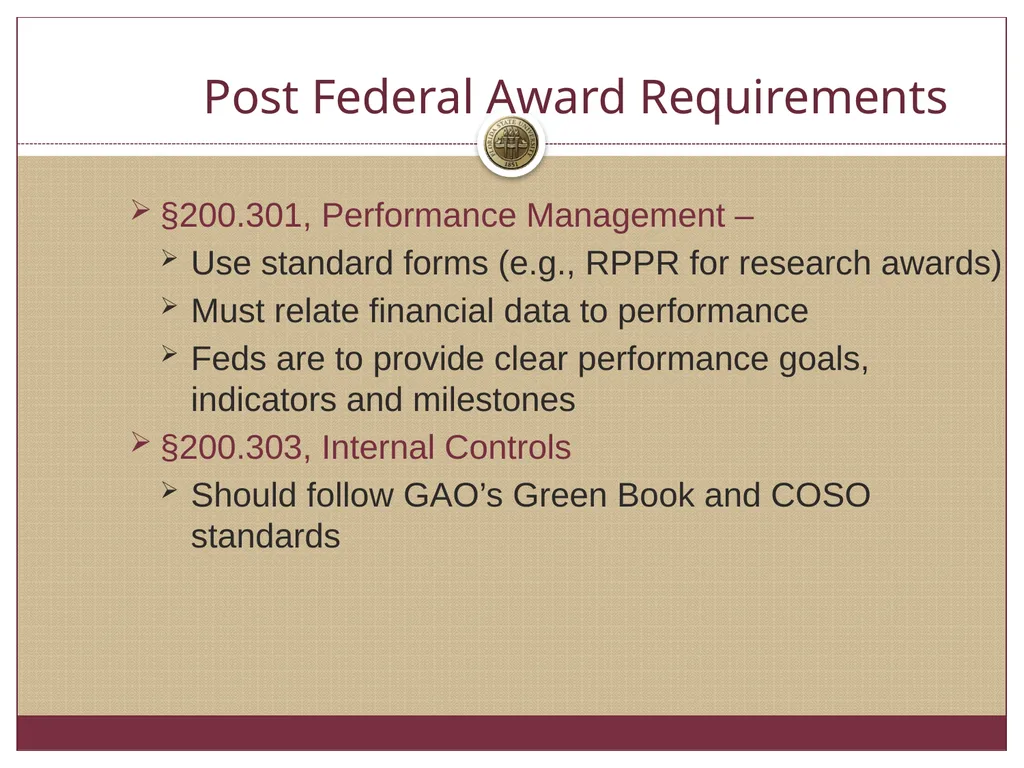
slide17. Post Federal Award Requirements §200.301, Performance Management –
Use standard forms (e.g., RPPR for research awards)
Must relate financial data to performance
Feds are to provide clear performance goals, indicators and milestones
§200.303, Internal Controls
Should follow GAO’s Green Book and COSO standards 17<br>
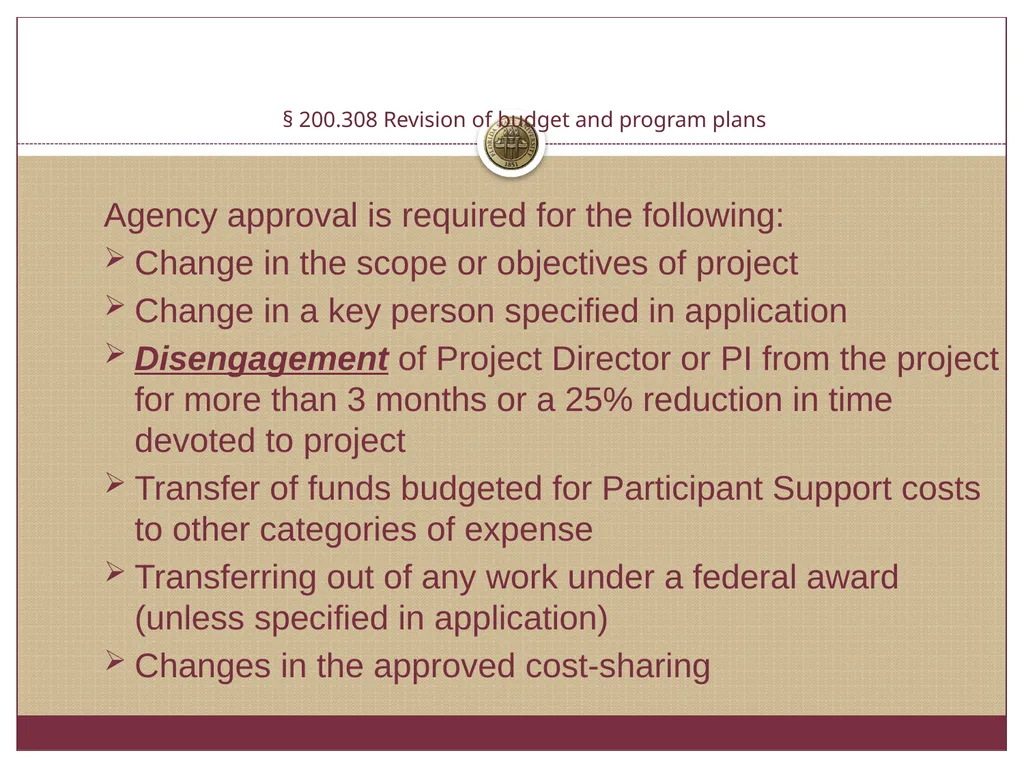
slide18. § 200.308 Revision of budget and program plans Agency approval is required for the following:
Change in the scope or objectives of project
Change in a key person specified in application
Disengagement of Project Director or PI from the project for more than 3 months or a 25% reduction in time devoted to project
Transfer of funds budgeted for Participant Support costs to other categories of expense
Transferring out of any work under a federal award (unless specified in application)
Changes in the approved cost-sharing 18<br>
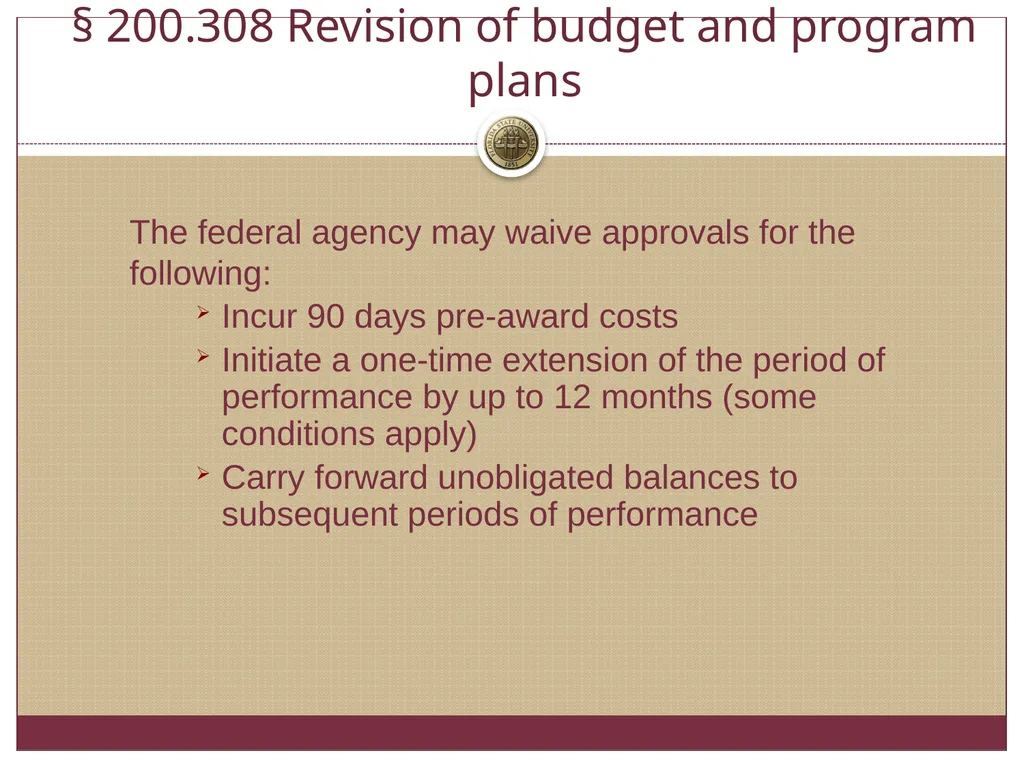
slide19. § 200.308 Revision of budget and program plans The federal agency may waive approvals for the following:
Incur 90 days pre-award costs
Initiate a one-time extension of the period of performance by up to 12 months (some conditions apply)
Carry forward unobligated balances to subsequent periods of performance 19<br>
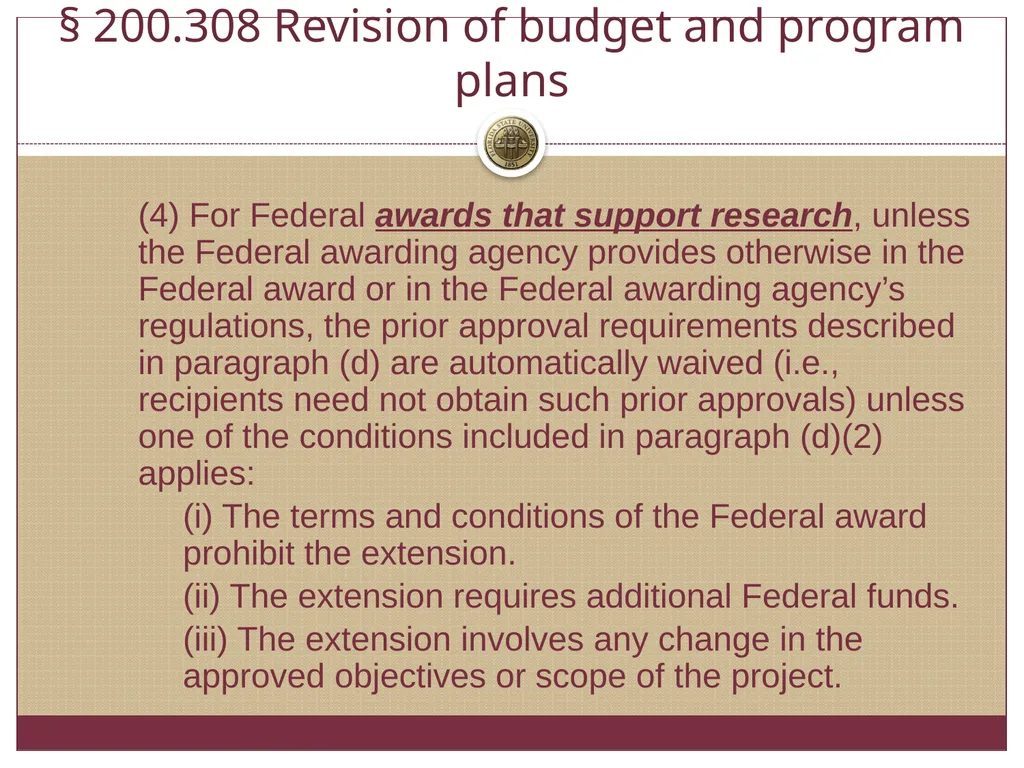
slide20. § 200.308 Revision of budget and program plans (4) For Federal awards that support research, unless the Federal awarding agency provides otherwise in the Federal award or in the Federal awarding agency’s regulations, the prior approval requirements described in paragraph (d) are automatically waived (i.e., recipients need not obtain such prior approvals) unless one of the conditions included in paragraph (d)(2) applies:
(i) The terms and conditions of the Federal award prohibit the extension.
(ii) The extension requires additional Federal funds.
(iii) The extension involves any change in the approved objectives or scope of the project. 20<br>
slide21. Post Federal Award Requirements §200.313 Equipment
Property standards (States versus other grantees)
§200.314 Supplies
Computing devices (<$5K) are included as “supplies”-NEW
§200.320 Procurement Standards –NEW for universities and Non Profits (delayed implementation until fiscal year ending in 2017)
Modeled after A-102: State uses own policies
Others uses procurement standards in sections §200.317 -326 21<br>
slide22. Subrecipient Monitoring & Management More prescriptive requirements
Perform a risk assessment of the subrecipient
List of required elements in the subaward terms
Establish a monitoring plan for the subrecipient
Financial review
Programmatic review
Must use subrecipient’s negotiated F&A rate, negotiate with subrecipient, or provide a 10% “de minimis” rate
Possibility of delays in issuing subawards 22<br>
slide23. §200.330 Subrecipient and contractor determinations The pass-through entity must make case-by-case determinations whether each agreement it makes for the disbursement of Federal program funds casts the party receiving the funds in the role of a subrecipient or a contractor.
The agency may supply and require recipients to comply with additional guidance to support these determinations 23<br>
slide24. Subrecipients A subaward is for the purpose of carrying out a portion of a Federal award and creates a Federal assistance relationship with the subrecipient.
Characteristics of a subrecipient:
(1) Determines who is eligible to receive what Federal assistance;
(2) Has its performance measured in relation to whether objectives of a Federal program were met;
(3) Has responsibility for programmatic decision making;
(4) Is responsible for adherence to applicable Federal program requirements specified in the Federal award; and
(5) In accordance with its agreement, uses the Federal funds to carry out a program for a public purpose specified in authorizing statute. 24<br>
slide25. Contractors A contract is for the purpose of obtaining goods and services for the non-Federal entity's own use and creates a procurement relationship with the contractor.
Characteristics of a contractor:
(1) Provides the goods and services within normal business operations;
(2) Provides similar goods or services to many different purchasers;
(3) Normally operates in a competitive environment;
(4) Provides goods or services that are ancillary to the operation of the Federal program; and
(5) Is not subject to compliance requirements of the Federal program as a result of the agreement, though similar requirements may apply for other reasons. 25<br>
slide26. §200.331 Requirements for pass-through entities Evaluate each subrecipient's risk of noncompliance with Federal statutes, regulations, and the terms and conditions of the subaward for purposes of determining the appropriate subrecipient monitoring, looking at:
The subrecipient’s prior experience with the same or similar subawards
The results of previous audits
Whether the subrecipient has new personnel or new/changed systems
The extent and results of Federal awarding agency monitoring 26<br>
slide27. §200.331 Requirements for pass-through entities Monitor the activities of the subrecipient to ensure that the subaward is used for authorized purposes, and that subaward performance goals are achieved.
Monitoring must include:
Reviewing financial and performance reports
Following-up and ensuring that the subrecipient takes timely and appropriate action on all deficiencies detected through audits, on-site reviews, and other means 27<br>
slide28. Subrecipient Monitoring Depending upon the assessed risk posed by the subrecipient, the following monitoring tools may be used to ensure proper accountability and compliance:
Providing subrecipients with training and technical assistance on program-related matters; and
Performing on-site reviews of the subrecipient's program operations 28<br>
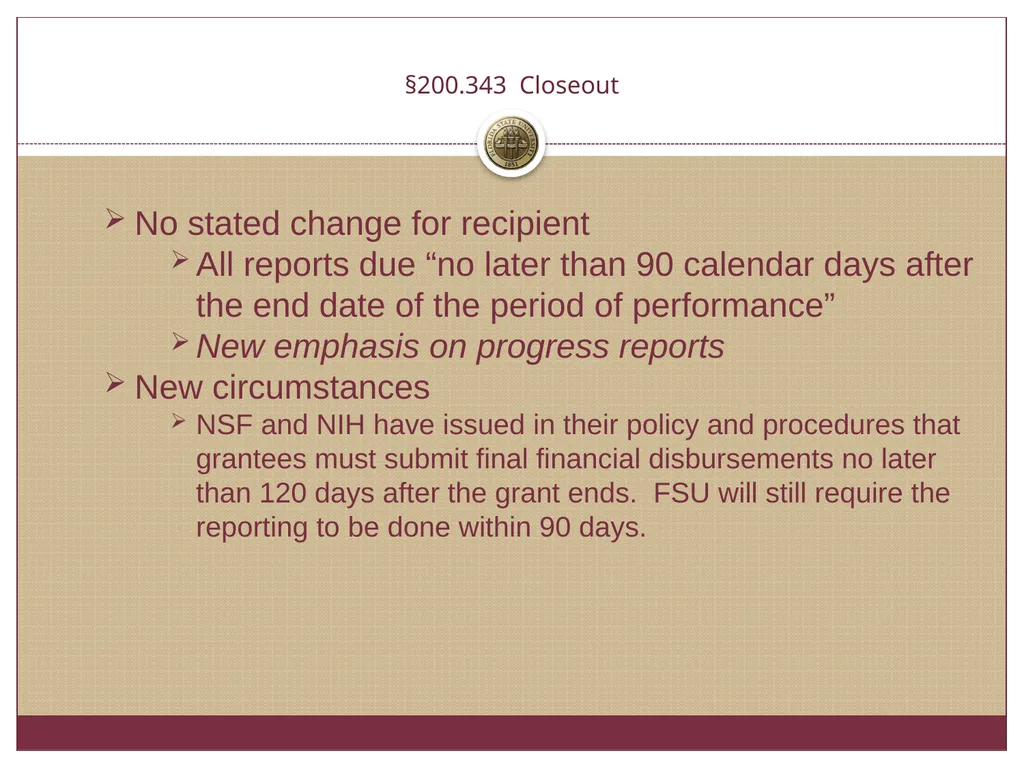
slide29. §200.343 Closeout No stated change for recipient
All reports due “no later than 90 calendar days after the end date of the period of performance”
New emphasis on progress reports
New circumstances
NSF and NIH have issued in their policy and procedures that grantees must submit final financial disbursements no later than 120 days after the grant ends. FSU will still require the reporting to be done within 90 days. 29<br>
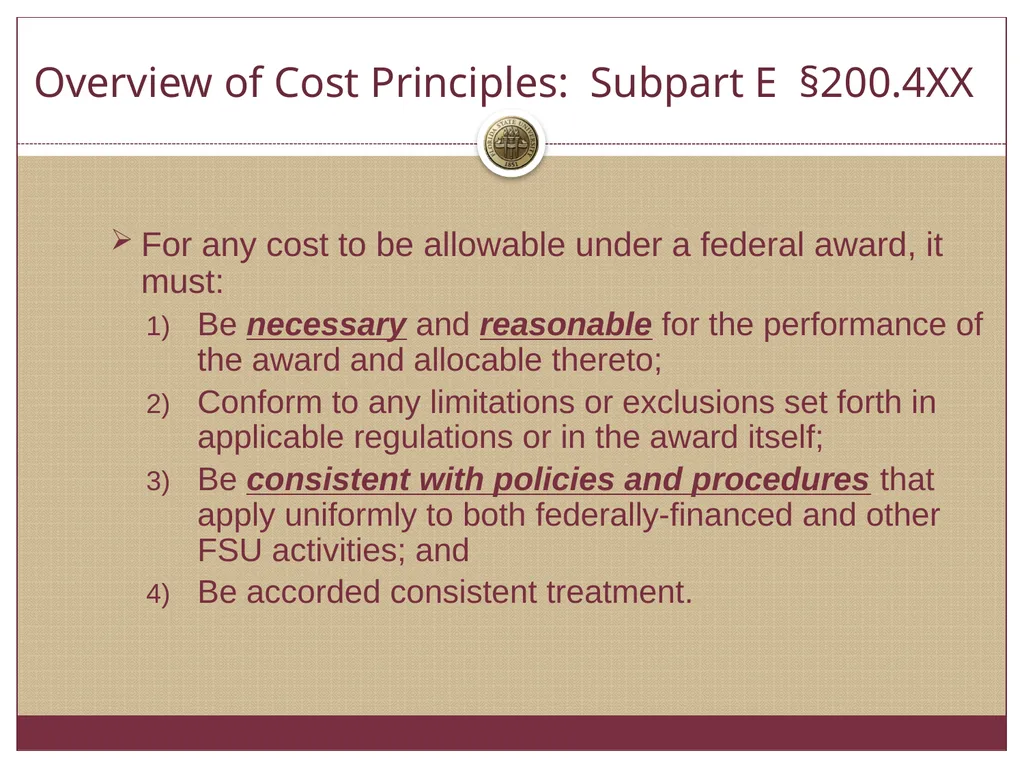
slide30. Overview of Cost Principles: Subpart E §200.4XX For any cost to be allowable under a federal award, it must:
Be necessary and reasonable for the performance of the award and allocable thereto;
Conform to any limitations or exclusions set forth in applicable regulations or in the award itself;
Be consistent with policies and procedures that apply uniformly to both federally-financed and other FSU activities; and
Be accorded consistent treatment. 30<br>
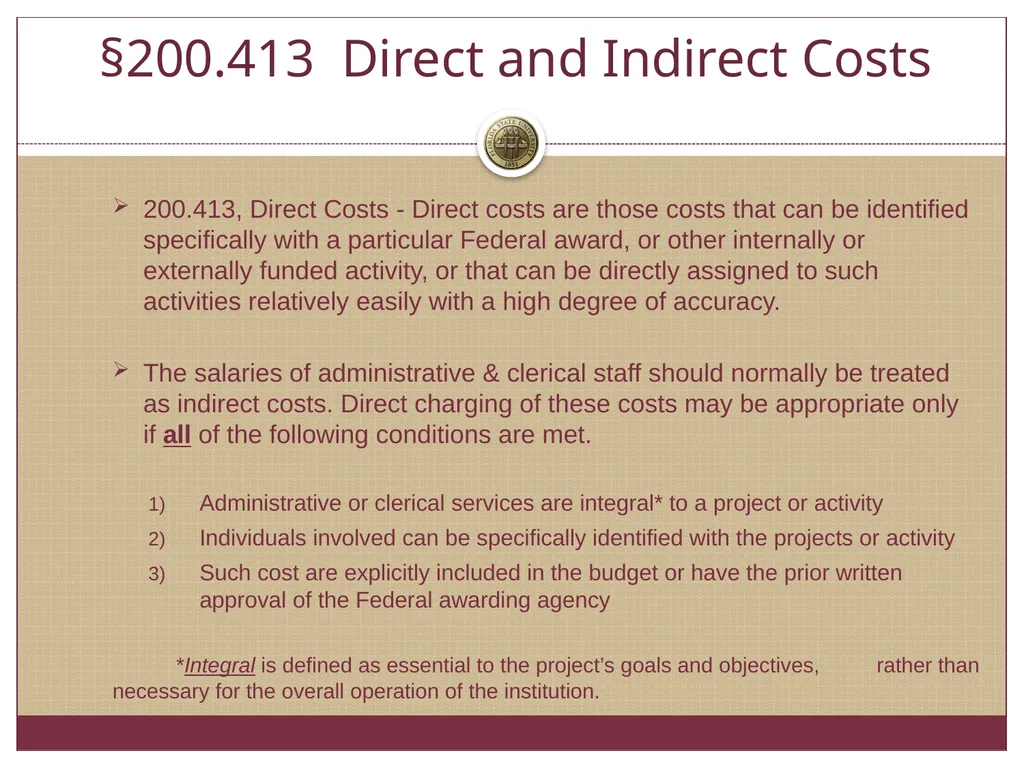
slide31. §200.413 Direct and Indirect Costs 200.413, Direct Costs - Direct costs are those costs that can be identified specifically with a particular Federal award, or other internally or externally funded activity, or that can be directly assigned to such activities relatively easily with a high degree of accuracy.
The salaries of administrative & clerical staff should normally be treated as indirect costs. Direct charging of these costs may be appropriate only if all of the following conditions are met.
Administrative or clerical services are integral* to a project or activity
Individuals involved can be specifically identified with the projects or activity
Such cost are explicitly included in the budget or have the prior written approval of the Federal awarding agency
*Integral is defined as essential to the project’s goals and objectives, rather than necessary for the overall operation of the institution. 31<br>
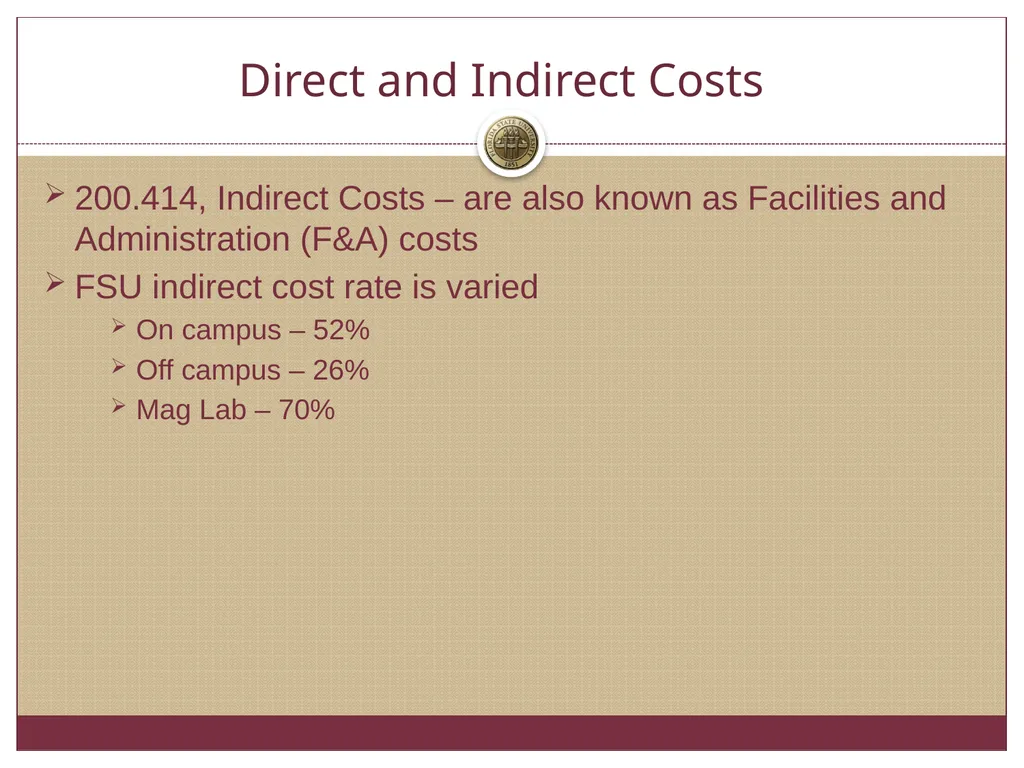
slide32. Direct and Indirect Costs 200.414, Indirect Costs – are also known as Facilities and Administration (F&A) costs
FSU indirect cost rate is varied
On campus – 52%
Off campus – 26%
Mag Lab – 70% 32<br>
slide33. §200.420-475 General Provisions for Selected Items of Cost Considerations for selected items of cost
200.421 Advertising and public relations –Recruitment of Personnel allowable
200.422 Advisory Councils – unallowable
200.423 Alcoholic Beverages - unallowable
200.424 Alumni activities – unallowable
200.429 Commencement and convocation costs - unallowable 33<br>
slide34. §200.420-475 General Provisions for Selected Items of Cost 200.430, Compensation –personal services
Internal controls are KEY
200.430(i) –9 standards for documenting personnel
Salaries and wages must be based on records that accurately reflect the work performed
Records must be supported by a system of internal controls
UG has strengthened the documentation requirement for institutional policy. They should/must be:
Available and easily accessible
Be up to date and consistent
Document internal controls and roles/responsibilities for all parties
Address specific payroll/compensation issues
Be supported by monitoring to confirm compliance 34<br>
slide35. §200.420-475 General Provisions for Selected Items of Cost 200.431, Compensation –Fringe Benefits
200.432, Conferences
Allowable Costs are: rental of facilities, speakers’ fees, costs of meals and refreshments (specifically approved in award budget), local transportation
200.438 Entertainment Costs – unallowable
200.439 Equipment and other capital expenditures – special purpose equipment are allowable as direct cost 35<br>
slide36. §200.453 Materials & Supplies; Computing Devices Computing devices costing less than $5,000 that are essential and allocable may be direct charged
They may be charged 100% (in rare circumstances) to an award or may be allocated to several awards
While no prior agency approval is required, computing devices should be itemized in the proposal budget
If the computing device is not in the budget, an IT Approval Form will have to be submitted (DSR form 20)
In addition, the project must not have reasonable access to other devices or equipment that can achieve the same purpose
Devices may not be purchased for reasons of convenience or preference 36<br>
slide37. §200.75 / 200.456 Participant Support Costs Participant support costs are direct costs for items such as stipends or subsistence allowances, travel allowances, and registration fees paid to, or on behalf of, participants or trainees (but not employees) in connection with conferences or training projects.
These costs must now be accepted by agencies as allowable costs, but still require prior agency approval.
These costs are excluded when calculating the Modified Total Direct Costs (MTDC) to determine the overall project’s F&A costs. 37<br>
slide38. §200.461 Publication & Printing Costs Publication costs for electronic and print media, including distribution, promotion, and general handling are allowable
Costs of publication or sharing of research results that are incurred outside the period of award performance are allowable and may be charged before project closeout, even if the project has ended
These costs should be included in the budget 38<br>
slide39. §200.463 Visas, Short-term Short-term visas (as opposed to longer-term immigration visas) are issued for a specific period and purpose, and therefore can be clearly identified as directly connected to recruitment of personnel for a federal award
These costs may be directly charged to a federal award, if they are critical and necessary for the completion of the project 39<br>
slide40. General Provisions for Selected Items of Cost 200.469 - Student Activity costs – Unallowable
200.472 - Training and education costs – Allowable
200.473 - Transportation costs – Allowable
200.474 - Travel costs – Allowable
Temporary dependent care costs above and beyond regular dependent care that directly results form travel to conferences is allowable provided that:
The costs are consistent with the non-federal entity's documented travel policy for all entity travel.
FSU’s travel policy doesn’t include dependent care therefore it is unallowable on Federal grants. 40<br>
slide41. Subpart F - Audit Requirements §200.5XX Strengthens oversight and focuses audits on areas of greatest risk of waste, fraud, and abuse of taxpayer dollars
It improves transparency and accountability by making audit reports available to the public online, and
Encourages Federal agencies to take a more cooperative approach to audit resolution 41<br>
slide42. Subpart F - Audit Requirements §200.5XX Basic Structure of Single Audit Process Unchanged
Audit threshold (200.501)
Subrecipient vs. Contractor (200.501(f) & 200.330)
Biennial (200.504) & Program-specific (200.507) audits.
Non-Federal entity selects auditor (200.509)
Auditee prepares financial statements & SEFA(200.510)
Audit follow-up & corrective action(200.511 & 200.521)
9 month due date (set in law) (200.512(a))
Reporting to Federal Audit Clearinghouse (200.512)
Major programs determined based on risk (200.518)
Compliance Supplement overall format (Appendix XI) 42<br>
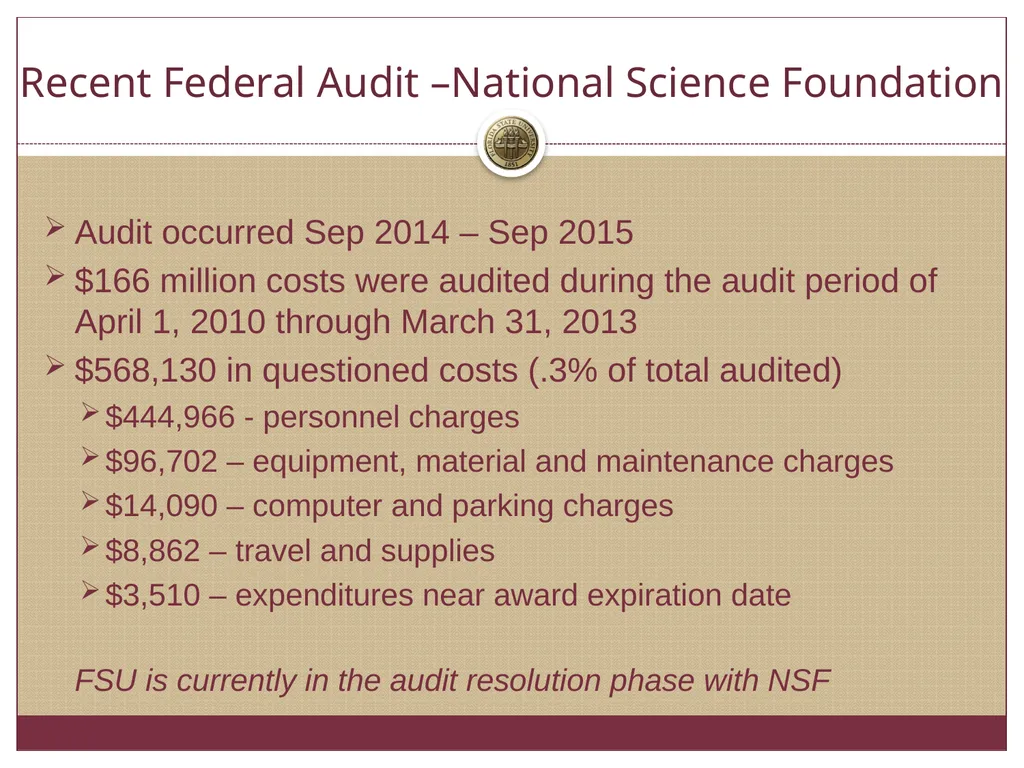
slide43. Recent Federal Audit –National Science Foundation Audit occurred Sep 2014 – Sep 2015
$166 million costs were audited during the audit period of April 1, 2010 through March 31, 2013
$568,130 in questioned costs (.3% of total audited)
$444,966 - personnel charges
$96,702 – equipment, material and maintenance charges
$14,090 – computer and parking charges
$8,862 – travel and supplies
$3,510 – expenditures near award expiration date
FSU is currently in the audit resolution phase with NSF<br>
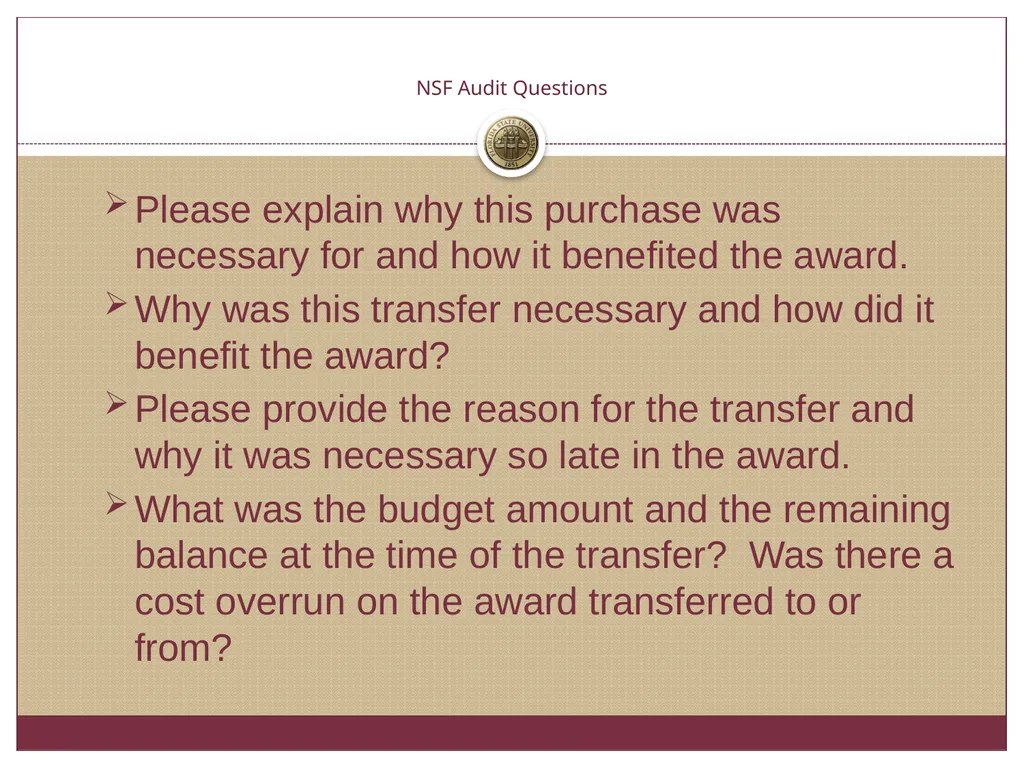
slide44. NSF Audit Questions Please explain why this purchase was necessary for and how it benefited the award.
Why was this transfer necessary and how did it benefit the award?
Please provide the reason for the transfer and why it was necessary so late in the award.
What was the budget amount and the remaining balance at the time of the transfer? Was there a cost overrun on the award transferred to or from? 44<br>
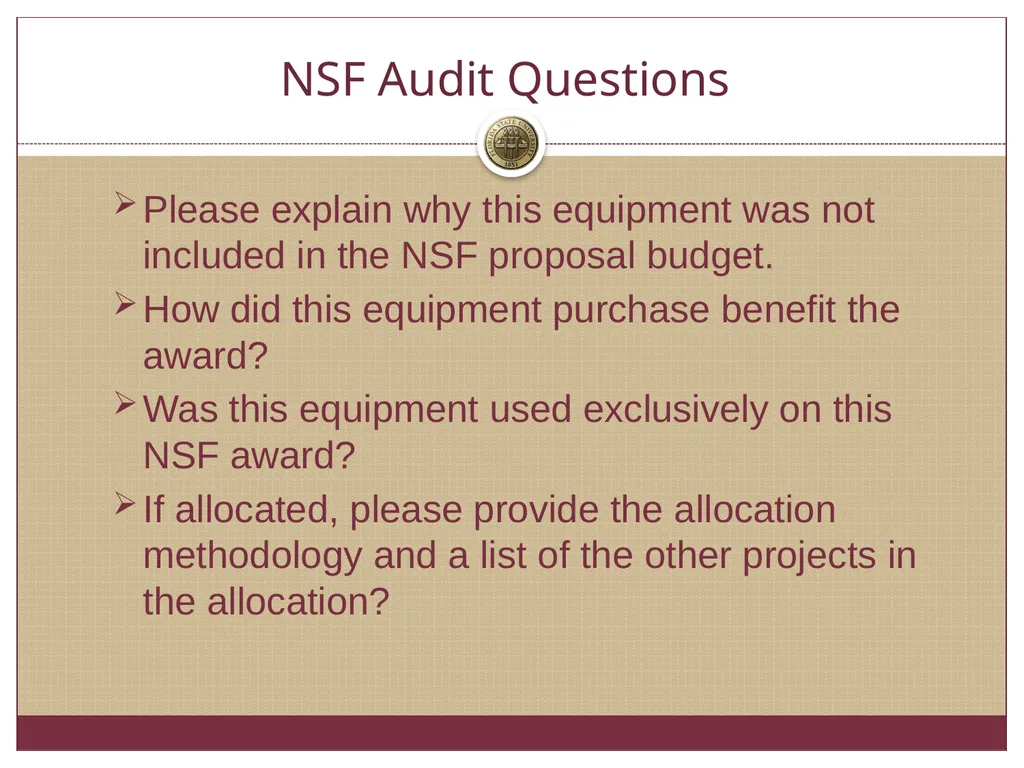
slide45. NSF Audit Questions Please explain why this equipment was not included in the NSF proposal budget.
How did this equipment purchase benefit the award?
Was this equipment used exclusively on this NSF award?
If allocated, please provide the allocation methodology and a list of the other projects in the allocation? 45<br>
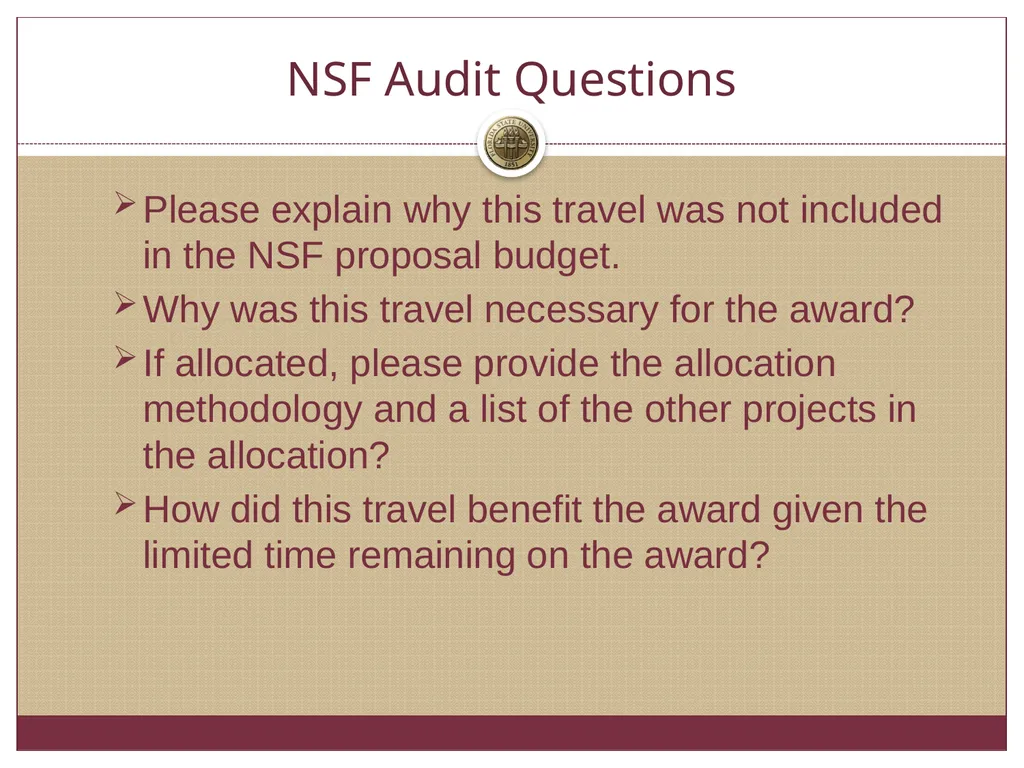
slide46. NSF Audit Questions Please explain why this travel was not included in the NSF proposal budget.
Why was this travel necessary for the award?
If allocated, please provide the allocation methodology and a list of the other projects in the allocation?
How did this travel benefit the award given the limited time remaining on the award? 46<br>
slide47. QUESTIONS 47<br>
Workshop
Presented by:
Angie Rowe & Cathi Bass Uniform Guidance: administrative Requirements, Cost Principles and audit Requirements<br>
slide2. Topics Definition of Uniform Guidance
Basic Layout
Provide new and/or updated information for
Administrative Requirements (formerly A-110)
Cost Principles (formerly A-21)
Audit Requirements (formerly A-133) 2<br>
slide3. What is the Uniform Guidance? Uniform Administrative Requirements, Cost Principles, and Audit Requirements for Federal Awards - 2 CFR 200
It is the Office of Management and Budget’s (OMB) consolidation of their circulars for costing, administration and audit of Federal awards
It replaces 8 circulars and applies to universities, state and local governments, nonprofits, native tribes
It was issued on December 26, 2013
It was effective on December 26, 2014 3<br>
slide4. 2 CFR 200 – Basic Layout 6 Subparts A through F
Subpart A, 200.XX – Acronyms & Definitions
Subpart B, 200.1XX – General
Subpart C, 200.2XX – Pre Award - Federal
Subpart D, 200.3XX – Post Award – Recipients
Subpart E, 200.4XX – Cost Principles
Subpart F, 200.5XX – Audit
11 Appendices - I through XI 4<br>
slide5. Subpart A – Acronyms & Definitions §200.00 - 200.99 §200.00 - Acronyms
§200.10 - 200.99 - Definitions
Use of “should” and “must”
Should = best practices/recommended
Must = required 5<br>
slide6. §200.68 Modified Total Direct Cost Modified Total Direct Cost (MTDC) means all direct salaries and wages, applicable fringe benefits, materials and supplies, services, travel, and subawards up to the first $25,000 of each subaward (regardless of the period of performance of the subawards under the award).
MTDC excludes equipment, capital expenditures, charges for patient care, rental costs, tuition remission, scholarships and fellowships, participant support costs and the portion of each subaward in excess of $25,000. Other items may only be excluded when necessary to avoid a serious inequity in the distribution of indirect costs, and with the approval of the cognizant agency for indirect costs. 6<br>
slide7. §200.74 Pass-through entity Pass-through entity means a non-Federal entity that provides a subaward to a subrecipient to carry out part of a Federal program. 7<br>
slide8. §200.75 Participant support costs Participant support costs means direct costs for items such as stipends or subsistence allowances, travel allowances, and registration fees paid to or on behalf of participants or trainees (but not employees) in connection with conferences, or training projects. 8<br>
slide9. Subpart B – General Provisions §200. 100-113 §200.100 Purpose
This part establishes uniform administrative requirements, cost principles, and audit requirements for Federal awards to non-Federal entities
Federal awarding agencies must not impose additional or inconsistent requirements 9<br>
slide10. §200.101 Applicability NEW table for applicability by types of award
T&C flow down to subrecipients
Subparts C-D are not applicable to
Cost-reimbursement contracts and subcontracts awarded under the Federal Acquisition Regulations (FAR)
Fixed price contracts and subcontracts awarded under the FAR whenever cost analysis is performed
The FAR serves as the administrative requirements 10<br>
slide11. §200.110 Effective Date Agency implementation effective 12/26/14
Applies to awards issued after 12/26/14
COFAR FAQs .110-7 and .110-12 specify that funding increments on existing awards, issued post 12/26/14, may be subject to the UG at the agency’s discretion; if the amendment is subject to the UG, it will be issued with modified terms and conditions
Applies to audits for FY beginning after 12/26/14 11<br>
slide12. §200.112 Conflict of interest NEW! Applies to procurement activities
Federal agencies must establish COI policies
NSF and NIH already meet the new standard;
no changes
EPA’s COI is problematic for IHEs
Grantees must disclose in writing any potential COI according to the agency’s requirements 12<br>
slide13. Subpart C – Pre-Federal Award Requirements §200.200 – 200.213 §200.201, Grant agreements
Fixed amount awards are allowed -NEW
§200.202/203, Notice of funding opportunities –NEW
Provides standards for information needed in each funding opportunity
Agencies must generally post opportunities at least 60 calendar days prior to due date, but… No less than 30 calendar days 13<br>
slide14. §200.205 Agency review of risk posed by applicants Must have framework for evaluating risks
Review may include:
financial stability;
quality of management systems and ability to meet the management standards prescribed;
performance history;
audit findings and reports; and/or
ability to implement statutory, regulatory, or other requirements 14<br>
slide15. §200.210 Information contained in a Federal award General Federal Award Information
No more DUNS # - replaced by Unique Entity Identifier
Unique Federal Award Identification Number (FAIN)
Indication if award is R&D
Indirect cost rate
General Terms & Conditions
May be incorporated by reference
Specific Terms & Conditions, if applicable
Federal Award Performance Goals
Any other information required by the Federal agency 15<br>
slide16. Subpart D – Post Federal Award Requirements §200.300-345 Grantee Requirements – (former A-110 requirements)
Ensure FSU’s compliance at award level
Ensure SRA procedures incorporate rules regarding
Rebudgeting
Prior approvals
Ensure compliance in areas outside of SRA
Financial reporting Purchasing – Procurement standards (delayed implementation until fiscal year ending in 2017 )
Controller’s Office – Financial and Property standards
Human Resources – Personnel standards 16<br>
slide17. Post Federal Award Requirements §200.301, Performance Management –
Use standard forms (e.g., RPPR for research awards)
Must relate financial data to performance
Feds are to provide clear performance goals, indicators and milestones
§200.303, Internal Controls
Should follow GAO’s Green Book and COSO standards 17<br>
slide18. § 200.308 Revision of budget and program plans Agency approval is required for the following:
Change in the scope or objectives of project
Change in a key person specified in application
Disengagement of Project Director or PI from the project for more than 3 months or a 25% reduction in time devoted to project
Transfer of funds budgeted for Participant Support costs to other categories of expense
Transferring out of any work under a federal award (unless specified in application)
Changes in the approved cost-sharing 18<br>
slide19. § 200.308 Revision of budget and program plans The federal agency may waive approvals for the following:
Incur 90 days pre-award costs
Initiate a one-time extension of the period of performance by up to 12 months (some conditions apply)
Carry forward unobligated balances to subsequent periods of performance 19<br>
slide20. § 200.308 Revision of budget and program plans (4) For Federal awards that support research, unless the Federal awarding agency provides otherwise in the Federal award or in the Federal awarding agency’s regulations, the prior approval requirements described in paragraph (d) are automatically waived (i.e., recipients need not obtain such prior approvals) unless one of the conditions included in paragraph (d)(2) applies:
(i) The terms and conditions of the Federal award prohibit the extension.
(ii) The extension requires additional Federal funds.
(iii) The extension involves any change in the approved objectives or scope of the project. 20<br>
slide21. Post Federal Award Requirements §200.313 Equipment
Property standards (States versus other grantees)
§200.314 Supplies
Computing devices (<$5K) are included as “supplies”-NEW
§200.320 Procurement Standards –NEW for universities and Non Profits (delayed implementation until fiscal year ending in 2017)
Modeled after A-102: State uses own policies
Others uses procurement standards in sections §200.317 -326 21<br>
slide22. Subrecipient Monitoring & Management More prescriptive requirements
Perform a risk assessment of the subrecipient
List of required elements in the subaward terms
Establish a monitoring plan for the subrecipient
Financial review
Programmatic review
Must use subrecipient’s negotiated F&A rate, negotiate with subrecipient, or provide a 10% “de minimis” rate
Possibility of delays in issuing subawards 22<br>
slide23. §200.330 Subrecipient and contractor determinations The pass-through entity must make case-by-case determinations whether each agreement it makes for the disbursement of Federal program funds casts the party receiving the funds in the role of a subrecipient or a contractor.
The agency may supply and require recipients to comply with additional guidance to support these determinations 23<br>
slide24. Subrecipients A subaward is for the purpose of carrying out a portion of a Federal award and creates a Federal assistance relationship with the subrecipient.
Characteristics of a subrecipient:
(1) Determines who is eligible to receive what Federal assistance;
(2) Has its performance measured in relation to whether objectives of a Federal program were met;
(3) Has responsibility for programmatic decision making;
(4) Is responsible for adherence to applicable Federal program requirements specified in the Federal award; and
(5) In accordance with its agreement, uses the Federal funds to carry out a program for a public purpose specified in authorizing statute. 24<br>
slide25. Contractors A contract is for the purpose of obtaining goods and services for the non-Federal entity's own use and creates a procurement relationship with the contractor.
Characteristics of a contractor:
(1) Provides the goods and services within normal business operations;
(2) Provides similar goods or services to many different purchasers;
(3) Normally operates in a competitive environment;
(4) Provides goods or services that are ancillary to the operation of the Federal program; and
(5) Is not subject to compliance requirements of the Federal program as a result of the agreement, though similar requirements may apply for other reasons. 25<br>
slide26. §200.331 Requirements for pass-through entities Evaluate each subrecipient's risk of noncompliance with Federal statutes, regulations, and the terms and conditions of the subaward for purposes of determining the appropriate subrecipient monitoring, looking at:
The subrecipient’s prior experience with the same or similar subawards
The results of previous audits
Whether the subrecipient has new personnel or new/changed systems
The extent and results of Federal awarding agency monitoring 26<br>
slide27. §200.331 Requirements for pass-through entities Monitor the activities of the subrecipient to ensure that the subaward is used for authorized purposes, and that subaward performance goals are achieved.
Monitoring must include:
Reviewing financial and performance reports
Following-up and ensuring that the subrecipient takes timely and appropriate action on all deficiencies detected through audits, on-site reviews, and other means 27<br>
slide28. Subrecipient Monitoring Depending upon the assessed risk posed by the subrecipient, the following monitoring tools may be used to ensure proper accountability and compliance:
Providing subrecipients with training and technical assistance on program-related matters; and
Performing on-site reviews of the subrecipient's program operations 28<br>
slide29. §200.343 Closeout No stated change for recipient
All reports due “no later than 90 calendar days after the end date of the period of performance”
New emphasis on progress reports
New circumstances
NSF and NIH have issued in their policy and procedures that grantees must submit final financial disbursements no later than 120 days after the grant ends. FSU will still require the reporting to be done within 90 days. 29<br>
slide30. Overview of Cost Principles: Subpart E §200.4XX For any cost to be allowable under a federal award, it must:
Be necessary and reasonable for the performance of the award and allocable thereto;
Conform to any limitations or exclusions set forth in applicable regulations or in the award itself;
Be consistent with policies and procedures that apply uniformly to both federally-financed and other FSU activities; and
Be accorded consistent treatment. 30<br>
slide31. §200.413 Direct and Indirect Costs 200.413, Direct Costs - Direct costs are those costs that can be identified specifically with a particular Federal award, or other internally or externally funded activity, or that can be directly assigned to such activities relatively easily with a high degree of accuracy.
The salaries of administrative & clerical staff should normally be treated as indirect costs. Direct charging of these costs may be appropriate only if all of the following conditions are met.
Administrative or clerical services are integral* to a project or activity
Individuals involved can be specifically identified with the projects or activity
Such cost are explicitly included in the budget or have the prior written approval of the Federal awarding agency
*Integral is defined as essential to the project’s goals and objectives, rather than necessary for the overall operation of the institution. 31<br>
slide32. Direct and Indirect Costs 200.414, Indirect Costs – are also known as Facilities and Administration (F&A) costs
FSU indirect cost rate is varied
On campus – 52%
Off campus – 26%
Mag Lab – 70% 32<br>
slide33. §200.420-475 General Provisions for Selected Items of Cost Considerations for selected items of cost
200.421 Advertising and public relations –Recruitment of Personnel allowable
200.422 Advisory Councils – unallowable
200.423 Alcoholic Beverages - unallowable
200.424 Alumni activities – unallowable
200.429 Commencement and convocation costs - unallowable 33<br>
slide34. §200.420-475 General Provisions for Selected Items of Cost 200.430, Compensation –personal services
Internal controls are KEY
200.430(i) –9 standards for documenting personnel
Salaries and wages must be based on records that accurately reflect the work performed
Records must be supported by a system of internal controls
UG has strengthened the documentation requirement for institutional policy. They should/must be:
Available and easily accessible
Be up to date and consistent
Document internal controls and roles/responsibilities for all parties
Address specific payroll/compensation issues
Be supported by monitoring to confirm compliance 34<br>
slide35. §200.420-475 General Provisions for Selected Items of Cost 200.431, Compensation –Fringe Benefits
200.432, Conferences
Allowable Costs are: rental of facilities, speakers’ fees, costs of meals and refreshments (specifically approved in award budget), local transportation
200.438 Entertainment Costs – unallowable
200.439 Equipment and other capital expenditures – special purpose equipment are allowable as direct cost 35<br>
slide36. §200.453 Materials & Supplies; Computing Devices Computing devices costing less than $5,000 that are essential and allocable may be direct charged
They may be charged 100% (in rare circumstances) to an award or may be allocated to several awards
While no prior agency approval is required, computing devices should be itemized in the proposal budget
If the computing device is not in the budget, an IT Approval Form will have to be submitted (DSR form 20)
In addition, the project must not have reasonable access to other devices or equipment that can achieve the same purpose
Devices may not be purchased for reasons of convenience or preference 36<br>
slide37. §200.75 / 200.456 Participant Support Costs Participant support costs are direct costs for items such as stipends or subsistence allowances, travel allowances, and registration fees paid to, or on behalf of, participants or trainees (but not employees) in connection with conferences or training projects.
These costs must now be accepted by agencies as allowable costs, but still require prior agency approval.
These costs are excluded when calculating the Modified Total Direct Costs (MTDC) to determine the overall project’s F&A costs. 37<br>
slide38. §200.461 Publication & Printing Costs Publication costs for electronic and print media, including distribution, promotion, and general handling are allowable
Costs of publication or sharing of research results that are incurred outside the period of award performance are allowable and may be charged before project closeout, even if the project has ended
These costs should be included in the budget 38<br>
slide39. §200.463 Visas, Short-term Short-term visas (as opposed to longer-term immigration visas) are issued for a specific period and purpose, and therefore can be clearly identified as directly connected to recruitment of personnel for a federal award
These costs may be directly charged to a federal award, if they are critical and necessary for the completion of the project 39<br>
slide40. General Provisions for Selected Items of Cost 200.469 - Student Activity costs – Unallowable
200.472 - Training and education costs – Allowable
200.473 - Transportation costs – Allowable
200.474 - Travel costs – Allowable
Temporary dependent care costs above and beyond regular dependent care that directly results form travel to conferences is allowable provided that:
The costs are consistent with the non-federal entity's documented travel policy for all entity travel.
FSU’s travel policy doesn’t include dependent care therefore it is unallowable on Federal grants. 40<br>
slide41. Subpart F - Audit Requirements §200.5XX Strengthens oversight and focuses audits on areas of greatest risk of waste, fraud, and abuse of taxpayer dollars
It improves transparency and accountability by making audit reports available to the public online, and
Encourages Federal agencies to take a more cooperative approach to audit resolution 41<br>
slide42. Subpart F - Audit Requirements §200.5XX Basic Structure of Single Audit Process Unchanged
Audit threshold (200.501)
Subrecipient vs. Contractor (200.501(f) & 200.330)
Biennial (200.504) & Program-specific (200.507) audits.
Non-Federal entity selects auditor (200.509)
Auditee prepares financial statements & SEFA(200.510)
Audit follow-up & corrective action(200.511 & 200.521)
9 month due date (set in law) (200.512(a))
Reporting to Federal Audit Clearinghouse (200.512)
Major programs determined based on risk (200.518)
Compliance Supplement overall format (Appendix XI) 42<br>
slide43. Recent Federal Audit –National Science Foundation Audit occurred Sep 2014 – Sep 2015
$166 million costs were audited during the audit period of April 1, 2010 through March 31, 2013
$568,130 in questioned costs (.3% of total audited)
$444,966 - personnel charges
$96,702 – equipment, material and maintenance charges
$14,090 – computer and parking charges
$8,862 – travel and supplies
$3,510 – expenditures near award expiration date
FSU is currently in the audit resolution phase with NSF<br>
slide44. NSF Audit Questions Please explain why this purchase was necessary for and how it benefited the award.
Why was this transfer necessary and how did it benefit the award?
Please provide the reason for the transfer and why it was necessary so late in the award.
What was the budget amount and the remaining balance at the time of the transfer? Was there a cost overrun on the award transferred to or from? 44<br>
slide45. NSF Audit Questions Please explain why this equipment was not included in the NSF proposal budget.
How did this equipment purchase benefit the award?
Was this equipment used exclusively on this NSF award?
If allocated, please provide the allocation methodology and a list of the other projects in the allocation? 45<br>
slide46. NSF Audit Questions Please explain why this travel was not included in the NSF proposal budget.
Why was this travel necessary for the award?
If allocated, please provide the allocation methodology and a list of the other projects in the allocation?
How did this travel benefit the award given the limited time remaining on the award? 46<br>
slide47. QUESTIONS 47<br>