
Split-Brain Patients and Hemispheric
TG
Published · 34 slides · 0 views
1 / 1




Description
Split-Brain Patients and Hemispheric Specialization Module 16 Experimental psychology guided-inquiry learning 1 Module ? Split Brain Patients and Hemispheric Specialization 2014, Dr. A. Geliebter Dr. B. Rumain, Touro College
Related Topics
Share
Embed code
Download this presentation From Below
"Split-Brain Patients and Hemispheric" is the property of its rightful owner. Permission is granted to download and print the materials on this website for personal, non-commercial use only, and to display it on your personal computer provided you do not modify the materials and that you retain all copyright notices contained in the materials. By downloading content from our website, you accept the terms of this agreement.
Presentation Transcript
01
Split-Brain Patients and Hemispheric Specialization Module 16| Experimental psychology guided-inquiry learning 1 Module ? | Split Brain Patients and Hemispheric Specialization | ©2014, Dr. A. Geliebter & Dr. B. Rumain, Touro College & University System<br>
02
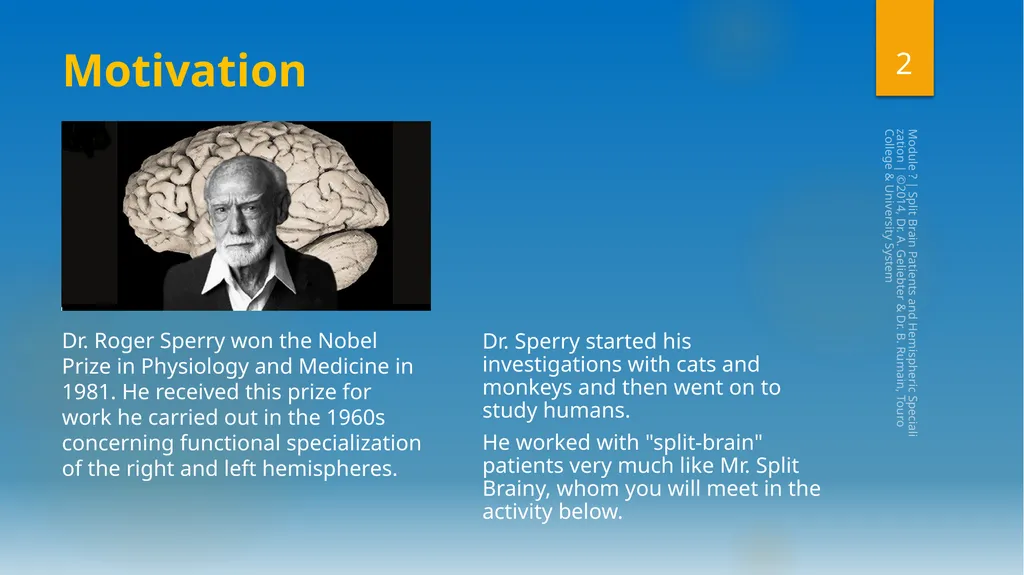
Motivation Dr. Sperry started his investigations with cats and monkeys and then went on to study humans.
He worked with "split-brain" patients very much like Mr. Split Brainy, whom you will meet in the activity below. Module ? | Split Brain Patients and Hemispheric Specialization | ©2014, Dr. A. Geliebter & Dr. B. Rumain, Touro College & University System 2 Dr. Roger Sperry won the Nobel Prize in Physiology and Medicine in 1981. He received this prize for work he carried out in the 1960s concerning functional specialization of the right and left hemispheres.<br>
He worked with "split-brain" patients very much like Mr. Split Brainy, whom you will meet in the activity below. Module ? | Split Brain Patients and Hemispheric Specialization | ©2014, Dr. A. Geliebter & Dr. B. Rumain, Touro College & University System 2 Dr. Roger Sperry won the Nobel Prize in Physiology and Medicine in 1981. He received this prize for work he carried out in the 1960s concerning functional specialization of the right and left hemispheres.<br>
03
In the 1960s, some people who suffered from a severe special form of epilepsy underwent an operation whereby
their corpus callosum was severed.
When a person has epilepsy, there is excessive neuronal (nerve cell) activity in the brain. With an intact corpus callosum, this excessive activity of the neurons (nerve cells) can spread from one hemisphere to the other, producing an extensive epileptic seizure.
When the corpus callosum is cut, this limits the spread of the electrical activity and confines it to only one hemisphere, thereby reducing the severity of the person's epileptic seizure. Module ? | Split Brain Patients and Hemispheric Specialization | ©2014, Dr. A. Geliebter & Dr. B. Rumain, Touro College & University System 3 Motivation The right and left cerebral hemispheres are connected by neuronal bridges called commissures. The largest of these is the corpus callosum.<br>
04
Vocabulary Split-brain patient
Cerebral hemispheres: right and left
Commissures
Neuron
Corpus callosum
Contralateral
Right and left visual field
Hemispheric specialization
Hemispheric lateralization Module ? | Split Brain Patients and Hemispheric Specialization | ©2014, Dr. A. Geliebter & Dr. B. Rumain, Touro College & University System 4<br>
05
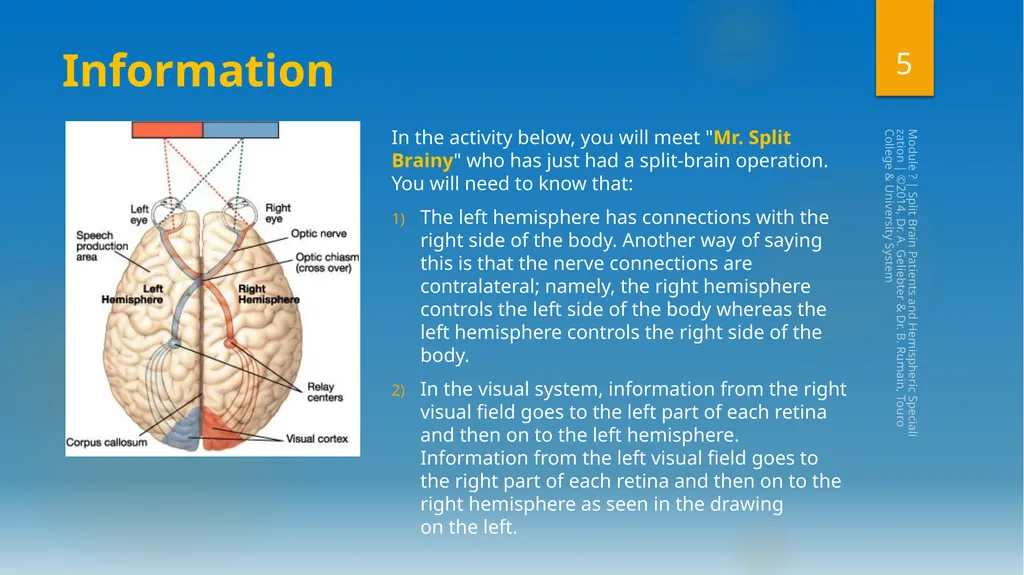
Information In the activity below, you will meet "Mr. Split Brainy" who has just had a split-brain operation. You will need to know that:
The left hemisphere has connections with the right side of the body. Another way of saying this is that the nerve connections are contralateral; namely, the right hemisphere controls the left side of the body whereas the left hemisphere controls the right side of the body.
In the visual system, information from the right visual field goes to the left part of each retina and then on to the left hemisphere. Information from the left visual field goes to the right part of each retina and then on to the right hemisphere as seen in the drawing on the left. Module ? | Split Brain Patients and Hemispheric Specialization | ©2014, Dr. A. Geliebter & Dr. B. Rumain, Touro College & University System 5<br>
06
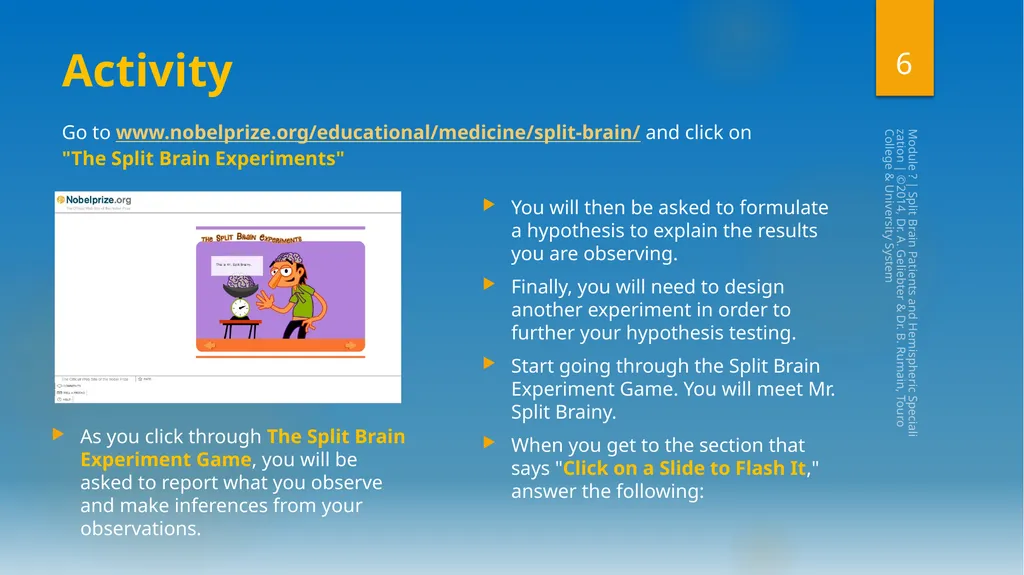
Activity You will then be asked to formulate a hypothesis to explain the results you are observing.
Finally, you will need to design another experiment in order to further your hypothesis testing.
Start going through the Split Brain Experiment Game. You will meet Mr. Split Brainy.
When you get to the section that says "Click on a Slide to Flash It," answer the following: Module ? | Split Brain Patients and Hemispheric Specialization | ©2014, Dr. A. Geliebter & Dr. B. Rumain, Touro College & University System 6 Go to www.nobelprize.org/educational/medicine/split-brain/ and click on "The Split Brain Experiments" As you click through The Split Brain Experiment Game, you will be asked to report what you observe and make inferences from your observations.<br>
07
Question 1:
Based on what you see, when an object is flashed in the right visual
field, which hemisphere does it go to, the right hemisphere (R.H.) or the left hemisphere (L.H.)? How does Mr. Split Brainy (SB) respond? Module ? | Split Brain Patients and Hemispheric Specialization | ©2014, Dr. A. Geliebter & Dr. B. Rumain, Touro College & University System 7<br>
08
Correct answer:
When a picture is flashed in the right visual field, it goes to the left
hemisphere. (This is in accordance with the diagram above.) Mr. SB is able to say its name. Module ? | Split Brain Patients and Hemispheric Specialization | ©2014, Dr. A. Geliebter & Dr. B. Rumain, Touro College & University System 8<br>
09
Question 2:
Based on what you see, when an object is flashed in the left visual field, which hemisphere does it go to, the right hemisphere (R.H.) or the left hemisphere(L.H.)? How does Mr. SB respond? Module ? | Split Brain Patients and Hemispheric Specialization | ©2014, Dr. A. Geliebter & Dr. B. Rumain, Touro College & University System 9<br>
10
Correct answer:
When an object is flashed in the left visual field, it goes to the right
hemisphere. Mr. SB reports that he doesn't see anything. Module ? | Split Brain Patients and Hemispheric Specialization | ©2014, Dr. A. Geliebter & Dr. B. Rumain, Touro College & University System 10<br>
11
Go to the place in the Game where it says, "Have a Coffee Break" and then answer
Question#3. Module ? | Split Brain Patients and Hemispheric Specialization | ©2014, Dr. A. Geliebter & Dr. B. Rumain, Touro College & University System 11<br>
12
Question 3:
Formulate a hypothesis to explain these results, namely, why doesn't the right hemisphere report what it sees when an object is flashed in the left visual field? Module ? | Split Brain Patients and Hemispheric Specialization | ©2014, Dr. A. Geliebter & Dr. B. Rumain, Touro College & University System 12 Remember Mr. SR's corpus callosum has been severed, so the two hemispheres can't communicate anymore: the right hemisphere doesn't know what the left hemisphere sees and the felt hemisphere doesn't know what the right hemisphere sees.
Each learning team should take its time to share its thoughts and generate some hypotheses.<br>
Each learning team should take its time to share its thoughts and generate some hypotheses.<br>
13
What hypotheses have you formulated? Basically, you should come up with the following two possibilities:
Something is wrong with Mr. SB's right hemisphere, perhaps as a result of the surgery. He has suffered some injury to his right hemisphere during the split brain operation and doesn't know what is in the left visual field.
Mr. SB knows what he saw but he just can't name it because the left hemisphere is the language center, not the right hemisphere. Module ? | Split Brain Patients and Hemispheric Specialization | ©2014, Dr. A. Geliebter & Dr. B. Rumain, Touro College & University System 13<br>
14
Do the scientists obtain the grant? Now, go back in the Game to where it says "Have a Coffee Break" and note how the two scientists talk about the results. Correct any mistakes in the scientists' report before they submit their grant proposal to further study Mr. SB.
After you finish correcting the report, continue with the Game to see if the scientists obtain the grant. Module ? | Split Brain Patients and Hemispheric Specialization | ©2014, Dr. A. Geliebter & Dr. B. Rumain, Touro College & University System 14<br>
After you finish correcting the report, continue with the Game to see if the scientists obtain the grant. Module ? | Split Brain Patients and Hemispheric Specialization | ©2014, Dr. A. Geliebter & Dr. B. Rumain, Touro College & University System 14<br>
15
They do obtain the grant! Now go up to the point where it says "Continue Experimenting"
Then have them do Question #4 (on the next slide) which asks them to design the experiment. Module ? | Split Brain Patients and Hemispheric Specialization | ©2014, Dr. A. Geliebter & Dr. B. Rumain, Touro College & University System 15<br>
Then have them do Question #4 (on the next slide) which asks them to design the experiment. Module ? | Split Brain Patients and Hemispheric Specialization | ©2014, Dr. A. Geliebter & Dr. B. Rumain, Touro College & University System 15<br>
16
Question 4:
Design an experiment that would distinguish between these two possibilities. Module ? | Split Brain Patients and Hemispheric Specialization | ©2014, Dr. A. Geliebter & Dr. B. Rumain, Touro College & University System 16<br>
17
Correct answer:
Give the Right Hemisphere (R.H.) a non-language task to do and see if it can do it. If the R.H. can, that demonstrates it knows what picture is being flashed in the left visual field; it just can't name it. Module ? | Split Brain Patients and Hemispheric Specialization | ©2014, Dr. A. Geliebter & Dr. B. Rumain, Touro College & University System 17<br>
18
Question 5:
What sort of non-language task can you think of? Module ? | Split Brain Patients and Hemispheric Specialization | ©2014, Dr. A. Geliebter & Dr. B. Rumain, Touro College & University System 18<br>
19
Correct answer:
Perhaps give Mr. SB an array of objects in front of him and ask him to point to the object that he sees flashed in his left visual field. Module ? | Split Brain Patients and Hemispheric Specialization | ©2014, Dr. A. Geliebter & Dr. B. Rumain, Touro College & University System 19<br>
20
Question 6:
In such a pointing task, which hand would you expect to point to an object flashed in the left visual field and seen by the R.H.? Module ? | Split Brain Patients and Hemispheric Specialization | ©2014, Dr. A. Geliebter & Dr. B. Rumain, Touro College & University System 20<br>
21
Correct answer:
The left hand, because the nerve connections are contralateral; the R.H. is connected to the left side of the body. Module ? | Split Brain Patients and Hemispheric Specialization | ©2014, Dr. A. Geliebter & Dr. B. Rumain, Touro College & University System 21 Now go on with the Game and see the results when Mr. SB is given the pointing task to do.
Stop after you do the experiment, where it says "Have a Coffee Break.“<br>
Stop after you do the experiment, where it says "Have a Coffee Break.“<br>
22
Question 7:
Write down your observations on what Mr. SB does during the
pointing task. Module ? | Split Brain Patients and Hemispheric Specialization | ©2014, Dr. A. Geliebter & Dr. B. Rumain, Touro College & University System 22<br>
23
Correct answer: Module ? | Split Brain Patients and Hemispheric Specialization | ©2014, Dr. A. Geliebter & Dr. B. Rumain, Touro College & University System 23 When an object is flashed in the right visual field, it goes to the L.H. Mr. SB names the object and picks it up with his right hand. When an object is flashed in the left visual field, it goes to the R.H. Mr. SB reports that he sees nothing but he picks up the correct object with his left hand. He then says he is surprised that he is picking up an object.<br>
24
Question 8:
Referring to the diagram in the "Information" section above, explain what is going on with Mr. SB when an object is presented in each visual field. Module ? | Split Brain Patients and Hemispheric Specialization | ©2014, Dr. A. Geliebter & Dr. B. Rumain, Touro College & University System 24<br>
25
Correct Answer:
From the results, we see that Mr. SB has two intact hemispheres. Module ? | Split Brain Patients and Hemispheric Specialization | ©2014, Dr. A. Geliebter & Dr. B. Rumain, Touro College & University System 25 When an object is flashed to the left visual field, the R.H. correctly communicates to the left hand which object to select. When an object is flashed to the right visual field, the L.H. correctly indicates to the right hand which object to select. Since only the left hemisphere has language, only the left hemisphere can name the object. (This occurs only when the object is flashed in the right visual field.)<br>
26
Question 9:
Why does Mr. SB say he is surprised that he is picking up an object? Module ? | Split Brain Patients and Hemispheric Specialization | ©2014, Dr. A. Geliebter & Dr. B. Rumain, Touro College & University System 26<br>
27
Correct Answer:
Whenever he talks, it is his L.H. that is talking. Since the L.H. didn't see the object being flashed, it is surprised that Mr. SB is picking
up the object. Module ? | Split Brain Patients and Hemispheric Specialization | ©2014, Dr. A. Geliebter & Dr. B. Rumain, Touro College & University System 27<br>
28
Continue with the two scientists on their "Coffee Break" and decide which version of the two abstracts they have written is the correct one that should go with the article they are sending in to The Very Scientific Journal. Module ? | Split Brain Patients and Hemispheric Specialization | ©2014, Dr. A. Geliebter & Dr. B. Rumain, Touro College & University System 28<br>
29
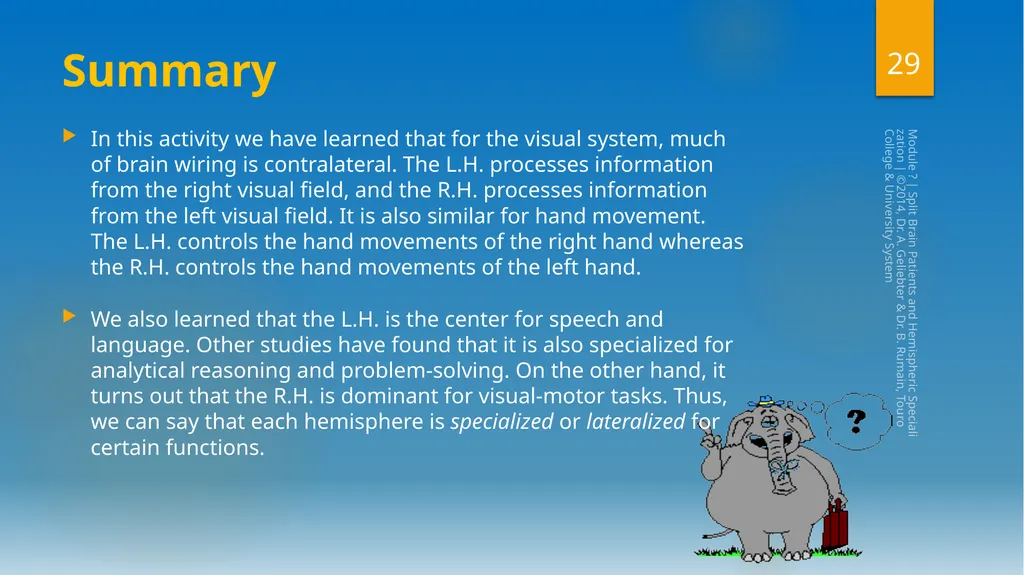
Summary In this activity we have learned that for the visual system, much of brain wiring is contralateral. The L.H. processes information from the right visual field, and the R.H. processes information from the left visual field. It is also similar for hand movement. The L.H. controls the hand movements of the right hand whereas the R.H. controls the hand movements of the left hand. Module ? | Split Brain Patients and Hemispheric Specialization | ©2014, Dr. A. Geliebter & Dr. B. Rumain, Touro College & University System 29 We also learned that the L.H. is the center for speech and language. Other studies have found that it is also specialized for analytical reasoning and problem-solving. On the other hand, it turns out that the R.H. is dominant for visual-motor tasks. Thus, we can say that each hemisphere is specialized or lateralized for certain functions.<br>
30
Problem We have been talking about only the visual system. Instead of the visual system, suppose we want to investigate whether our findings also hold true for smell, touch, and sound. Design an experiment to investigate this.
Remember in our experiment above, the left hemisphere expresses surprise at the object that the left hand (i.e., R.H.) selected. Suppose you wanted to know the answer to the following question: "If asked, how will the L.H. interpret behaviors produced by the silent R.H.?" Design an experiment that addresses this question. Module ? | Split Brain Patients and Hemispheric Specialization | ©2014, Dr. A. Geliebter & Dr. B. Rumain, Touro College & University System 30<br>
Remember in our experiment above, the left hemisphere expresses surprise at the object that the left hand (i.e., R.H.) selected. Suppose you wanted to know the answer to the following question: "If asked, how will the L.H. interpret behaviors produced by the silent R.H.?" Design an experiment that addresses this question. Module ? | Split Brain Patients and Hemispheric Specialization | ©2014, Dr. A. Geliebter & Dr. B. Rumain, Touro College & University System 30<br>
31
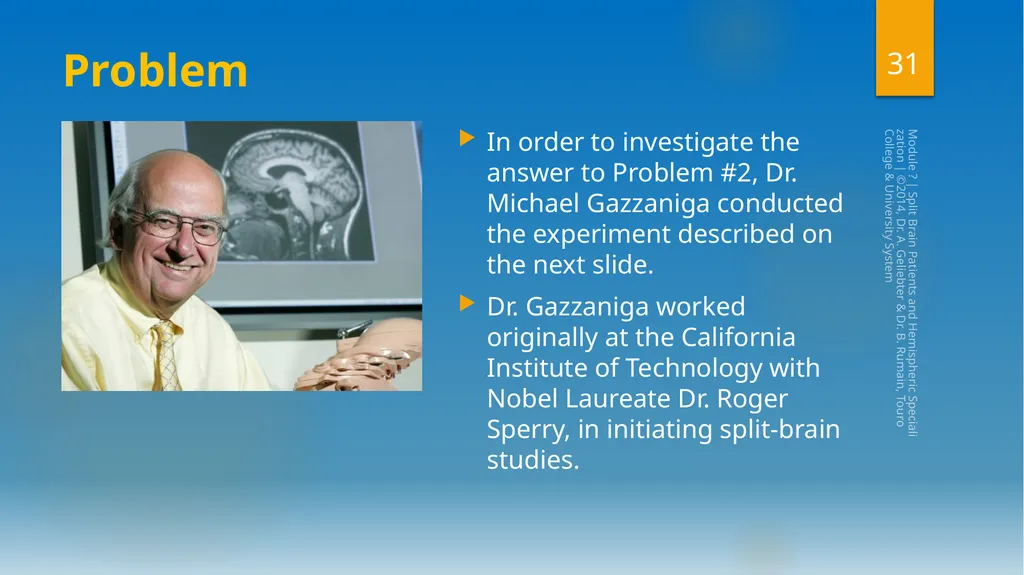
Problem Module ? | Split Brain Patients and Hemispheric Specialization | ©2014, Dr. A. Geliebter & Dr. B. Rumain, Touro College & University System 31 In order to investigate the answer to Problem #2, Dr. Michael Gazzaniga conducted the experiment described on the next slide.
Dr. Gazzaniga worked originally at the California Institute of Technology with Nobel Laureate Dr. Roger Sperry, in initiating split-brain studies.<br>
Dr. Gazzaniga worked originally at the California Institute of Technology with Nobel Laureate Dr. Roger Sperry, in initiating split-brain studies.<br>
32
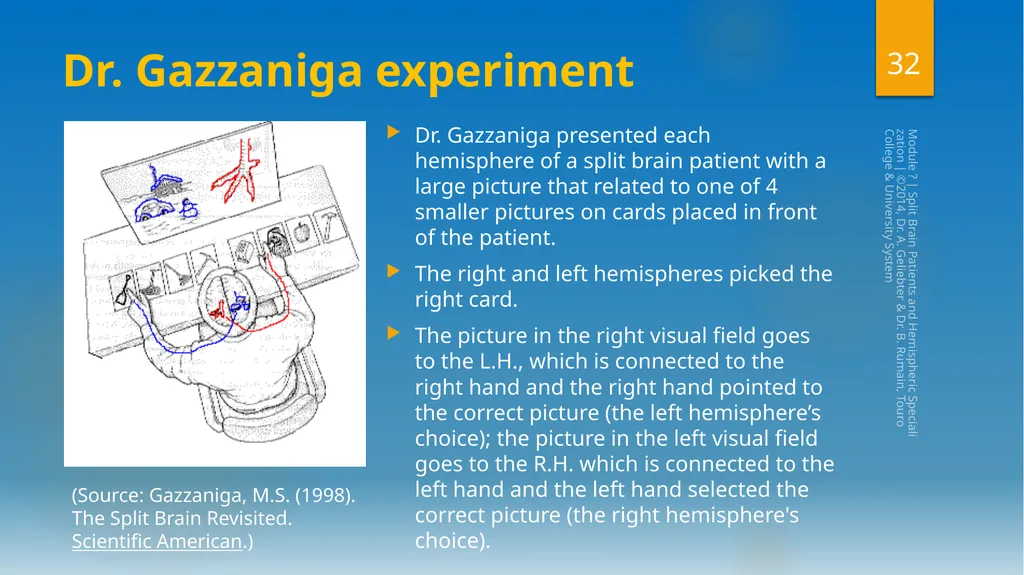
Dr. Gazzaniga experiment Dr. Gazzaniga presented each hemisphere of a split brain patient with a large picture that related to one of 4 smaller pictures on cards placed in front of the patient.
The right and left hemispheres picked the right card.
The picture in the right visual field goes to the L.H., which is connected to the right hand and the right hand pointed to the correct picture (the left hemisphere’s choice); the picture in the left visual field goes to the R.H. which is connected to the left hand and the left hand selected the correct picture (the right hemisphere's choice). Module ? | Split Brain Patients and Hemispheric Specialization | ©2014, Dr. A. Geliebter & Dr. B. Rumain, Touro College & University System 32 (Source: Gazzaniga, M.S. (1998). The Split Brain Revisited. Scientific American.)<br>
33
Dr. Gazzaniga experiment He then asked the patient why the left hand pointed to the shovel.
Only the left hemisphere can talk but the left hemisphere didn't know because the choice was made by the right hemisphere.
Although the left hemisphere didn't know, it made up an explanation: It said the right hemisphere chose a shovel to clean out a chicken shed.
What inference can you draw from Gazzaniga's findings? Module ? | Split Brain Patients and Hemispheric Specialization | ©2014, Dr. A. Geliebter & Dr. B. Rumain, Touro College & University System 33<br>
34
Module ? | Split Brain Patients and Hemispheric Specialization | ©2014, Dr. A. Geliebter & Dr. B. Rumain, Touro College & University System 34<br>