Sponsored Programs Accounting Basics for Beginners Seasoned Research Administrators Grant vs. Cooperative Agreement vs. Contract Grant: A type of financial assistance awarded for the conduct of research or other program as specified in an
"Sponsored Programs Accounting Basics for Beginners" is the property of its rightful owner. Permission is granted to
download and print the materials on this website for personal, non-commercial use only, and to display it
on your personal computer provided you do not modify the materials and that you retain all copyright
notices contained in the materials. By downloading content from our website, you accept the terms of this
agreement.
Presentation Transcript
01
Sponsored Programs Accounting Basics for Beginners & Seasoned Research Administrators<br>
02
Grant vs. Cooperative Agreement vs. Contract Grant: A type of financial assistance awarded for the conduct of research or other program as specified in an approved proposal. A grant is used whenever the awarding office anticipates no substantial programmatic involvement with the recipient during the performance of the activities.
Cooperative Agreement: An award similar to a grant, but in which the sponsor anticipates having substantial involvement in research activities once the award has been made.
Contract: A procurement mechanism for procurement of a product or service with specific obligations for both sponsor and recipient. Typically, a research topic and the methods for conducting the research are specified in detail by the sponsor, often in the Request for Proposal (RFP) which announces the funding opportunity. In general, there are greater performance expectations associated with contracts, including project milestones and detailed deliverables (e.g., reports). The federal government uses contracts for the purpose of acquiring goods and services for the direct benefit of or use by the U.S. government. In other words, the government has decided what it needs, and then looks for an entity that can provide that service or commodity for the best price.<br>
03
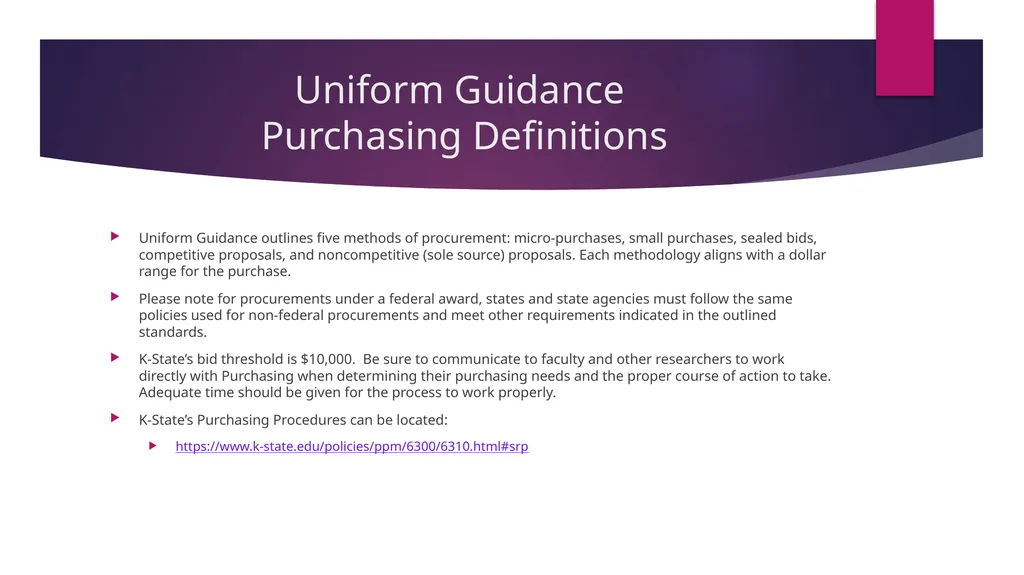
Uniform Guidance Purchasing Definitions Uniform Guidance outlines five methods of procurement: micro-purchases, small purchases, sealed bids, competitive proposals, and noncompetitive (sole source) proposals. Each methodology aligns with a dollar range for the purchase.
Please note for procurements under a federal award, states and state agencies must follow the same policies used for non-federal procurements and meet other requirements indicated in the outlined standards.
K-State’s bid threshold is $10,000. Be sure to communicate to faculty and other researchers to work directly with Purchasing when determining their purchasing needs and the proper course of action to take. Adequate time should be given for the process to work properly.
K-State’s Purchasing Procedures can be located:
https://www.k-state.edu/policies/ppm/6300/6310.html#srp<br>
04
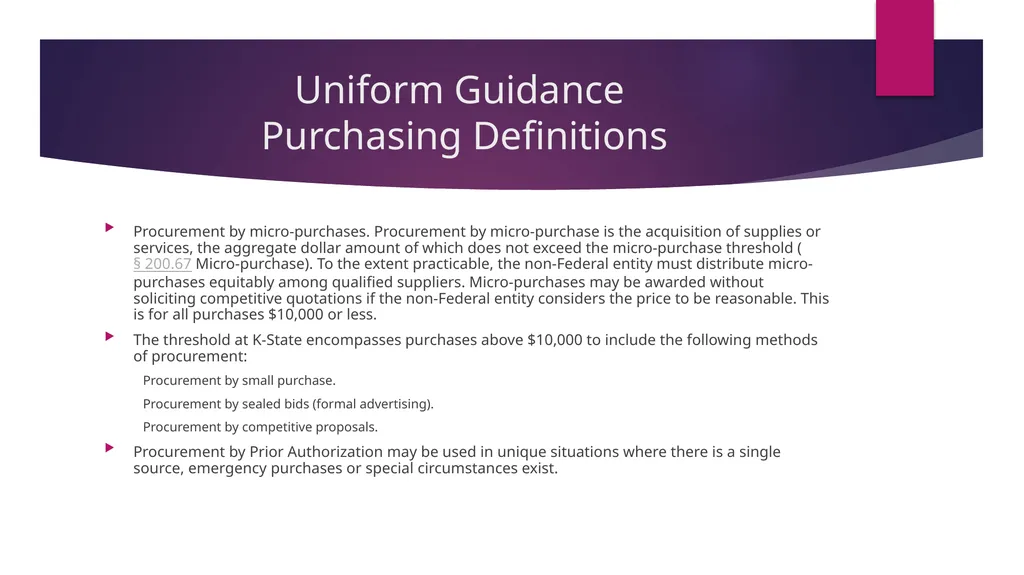
Uniform Guidance Purchasing Definitions Procurement by micro-purchases. Procurement by micro-purchase is the acquisition of supplies or services, the aggregate dollar amount of which does not exceed the micro-purchase threshold (§ 200.67 Micro-purchase). To the extent practicable, the non-Federal entity must distribute micro-purchases equitably among qualified suppliers. Micro-purchases may be awarded without soliciting competitive quotations if the non-Federal entity considers the price to be reasonable. This is for all purchases $10,000 or less.
The threshold at K-State encompasses purchases above $10,000 to include the following methods of procurement:
Procurement by small purchase.
Procurement by sealed bids (formal advertising).
Procurement by competitive proposals.
Procurement by Prior Authorization may be used in unique situations where there is a single source, emergency purchases or special circumstances exist.<br>
05
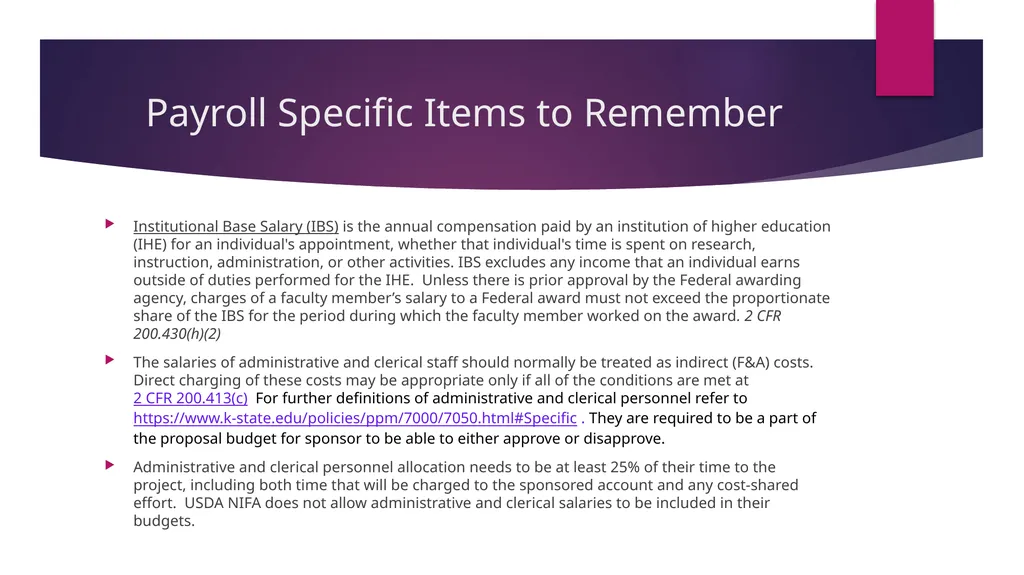
Payroll Specific Items to Remember Institutional Base Salary (IBS) is the annual compensation paid by an institution of higher education (IHE) for an individual's appointment, whether that individual's time is spent on research, instruction, administration, or other activities. IBS excludes any income that an individual earns outside of duties performed for the IHE. Unless there is prior approval by the Federal awarding agency, charges of a faculty member’s salary to a Federal award must not exceed the proportionate share of the IBS for the period during which the faculty member worked on the award. 2 CFR 200.430(h)(2)
The salaries of administrative and clerical staff should normally be treated as indirect (F&A) costs. Direct charging of these costs may be appropriate only if all of the conditions are met at 2 CFR 200.413(c) For further definitions of administrative and clerical personnel refer to https://www.k-state.edu/policies/ppm/7000/7050.html#Specific . They are required to be a part of the proposal budget for sponsor to be able to either approve or disapprove.
Administrative and clerical personnel allocation needs to be at least 25% of their time to the project, including both time that will be charged to the sponsored account and any cost-shared effort. USDA NIFA does not allow administrative and clerical salaries to be included in their budgets.<br>
06
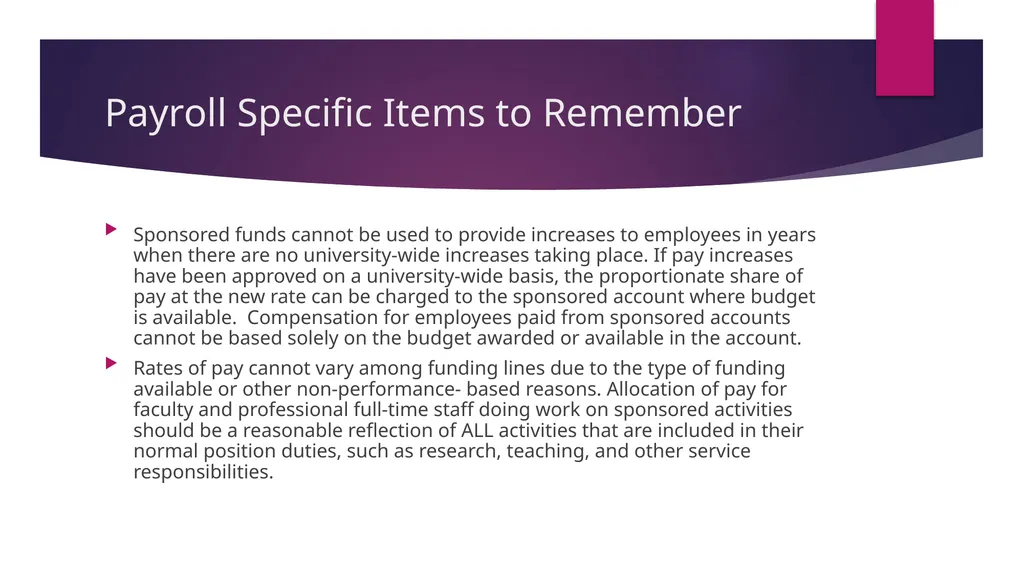
Payroll Specific Items to Remember Sponsored funds cannot be used to provide increases to employees in years when there are no university-wide increases taking place. If pay increases have been approved on a university-wide basis, the proportionate share of pay at the new rate can be charged to the sponsored account where budget is available. Compensation for employees paid from sponsored accounts cannot be based solely on the budget awarded or available in the account.
Rates of pay cannot vary among funding lines due to the type of funding available or other non-performance- based reasons. Allocation of pay for faculty and professional full-time staff doing work on sponsored activities should be a reasonable reflection of ALL activities that are included in their normal position duties, such as research, teaching, and other service responsibilities.<br>
07
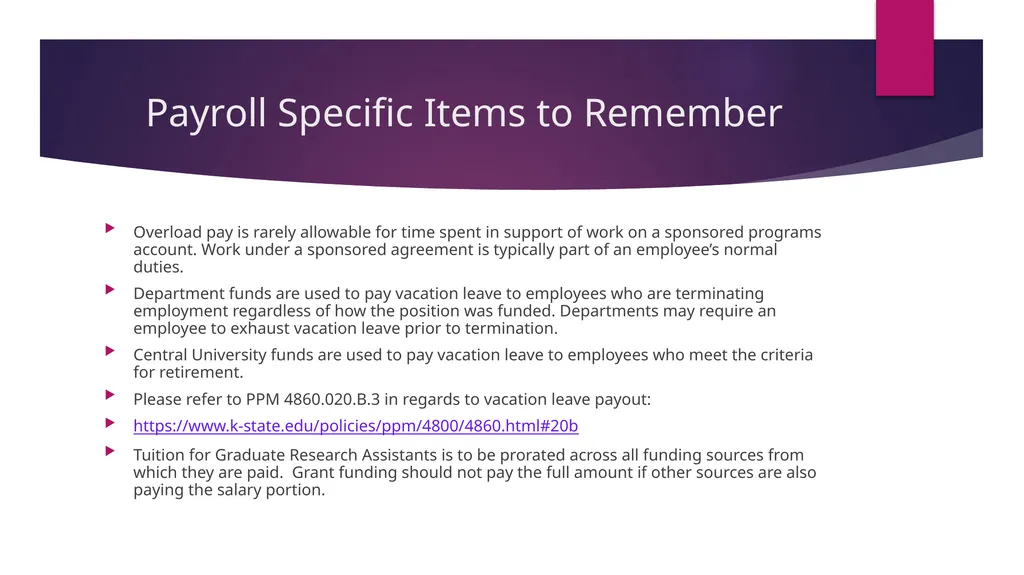
Payroll Specific Items to Remember Overload pay is rarely allowable for time spent in support of work on a sponsored programs account. Work under a sponsored agreement is typically part of an employee’s normal duties.
Department funds are used to pay vacation leave to employees who are terminating employment regardless of how the position was funded. Departments may require an employee to exhaust vacation leave prior to termination.
Central University funds are used to pay vacation leave to employees who meet the criteria for retirement.
Please refer to PPM 4860.020.B.3 in regards to vacation leave payout:
https://www.k-state.edu/policies/ppm/4800/4860.html#20b
Tuition for Graduate Research Assistants is to be prorated across all funding sources from which they are paid. Grant funding should not pay the full amount if other sources are also paying the salary portion.<br>
08
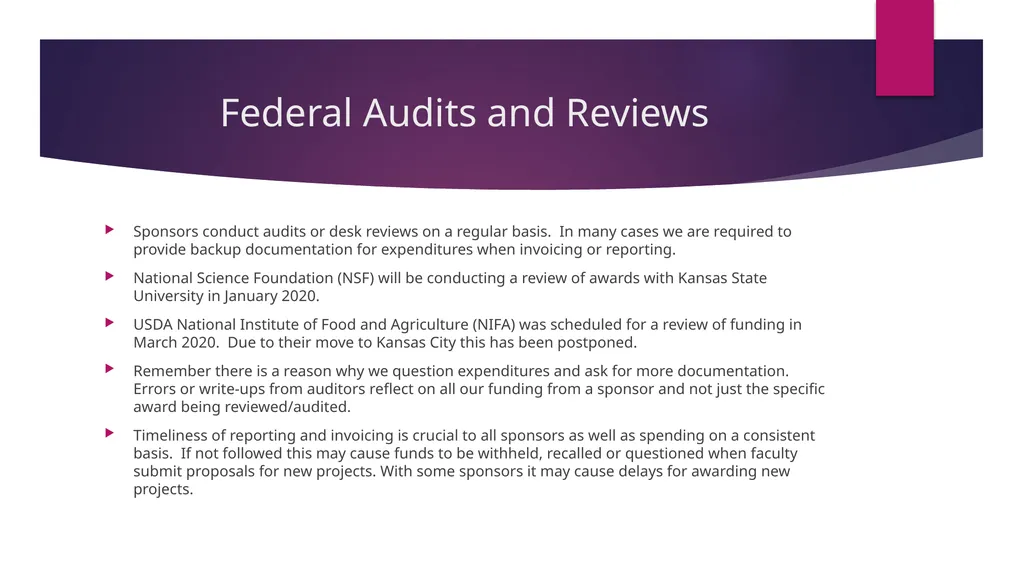
Federal Audits and Reviews Sponsors conduct audits or desk reviews on a regular basis. In many cases we are required to provide backup documentation for expenditures when invoicing or reporting.
National Science Foundation (NSF) will be conducting a review of awards with Kansas State University in January 2020.
USDA National Institute of Food and Agriculture (NIFA) was scheduled for a review of funding in March 2020. Due to their move to Kansas City this has been postponed.
Remember there is a reason why we question expenditures and ask for more documentation. Errors or write-ups from auditors reflect on all our funding from a sponsor and not just the specific award being reviewed/audited.
Timeliness of reporting and invoicing is crucial to all sponsors as well as spending on a consistent basis. If not followed this may cause funds to be withheld, recalled or questioned when faculty submit proposals for new projects. With some sponsors it may cause delays for awarding new projects.<br>
09
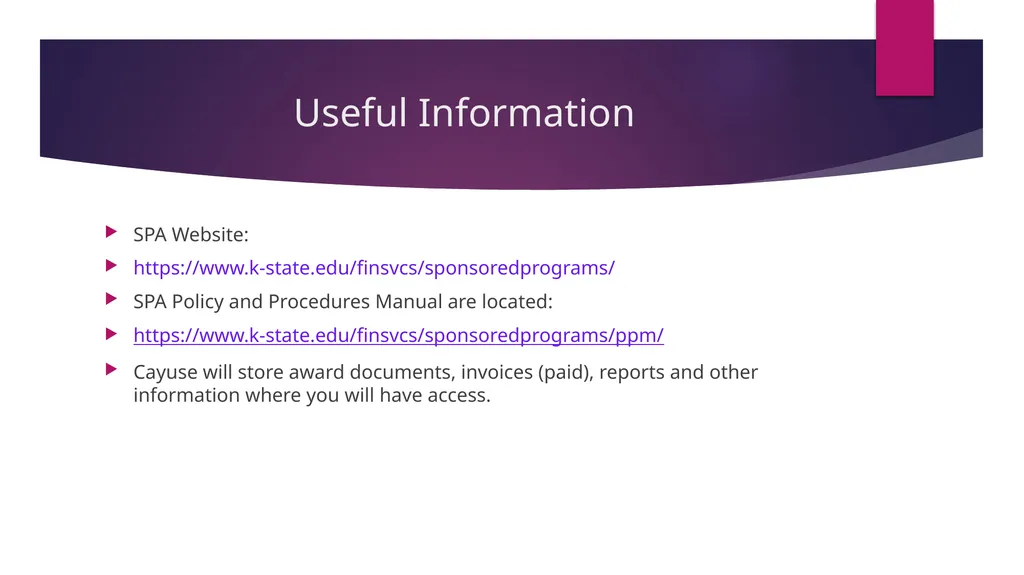
Useful Information SPA Website:
https://www.k-state.edu/finsvcs/sponsoredprograms/
SPA Policy and Procedures Manual are located:
https://www.k-state.edu/finsvcs/sponsoredprograms/ppm/
Cayuse will store award documents, invoices (paid), reports and other information where you will have access.<br>