
Sponsored projects office Quick Guide to
Description: Sponsored projects office Quick Guide to Understanding contracts Click Record To initiate the contract review process, you must entersubmit your Click record. Your Specialist will be notified of the review. What is a contract? It is a
Related Topics
Download Presentation
"Sponsored projects office Quick Guide to" is the property of its rightful owner. Permission is granted to download and print the materials on this website for personal, non-commercial use only, and to display it on your personal computer provided you do not modify the materials and that you retain all copyright notices contained in the materials. By downloading content from our website, you accept the terms of this agreement.
Presentation Transcript
slide1. Sponsored projects office
Quick Guide to Understanding contracts<br>
slide2. Click Record To initiate the contract review process, you must enter/submit your Click record. Your Specialist will be notified of the review.<br>
slide3. What is a contract? It is a written agreement that is intended to be enforceable by law that enables businesses (outside sponsors and UNM) to collaborate towards their specific desires and needs.
It creates, defines and governs mutual rights and obligations between the parties.
A Contract generally provides some type of service for the sponsor.<br>
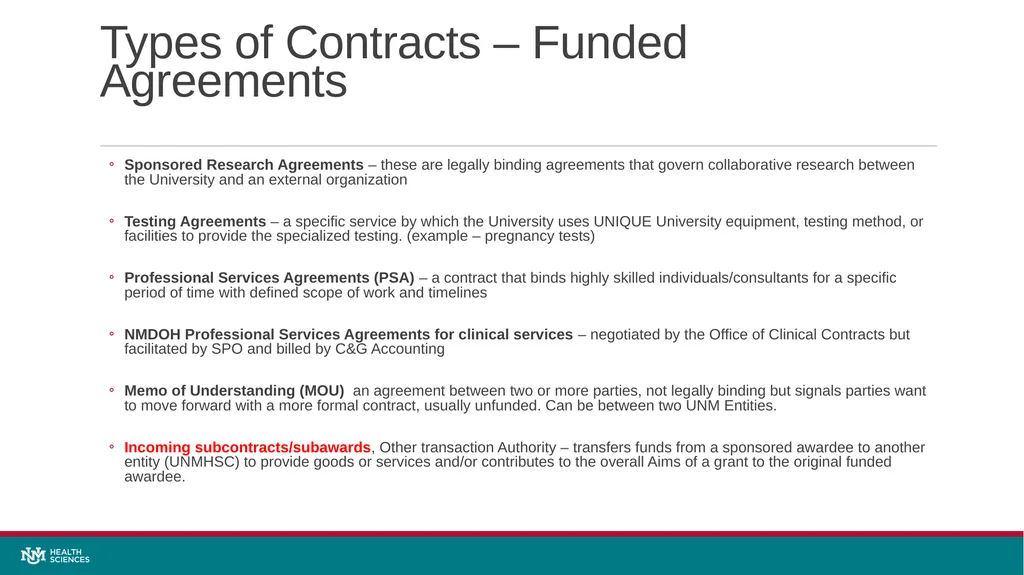
slide4. Types of Contracts – Funded Agreements Sponsored Research Agreements – these are legally binding agreements that govern collaborative research between the University and an external organization
Testing Agreements – a specific service by which the University uses UNIQUE University equipment, testing method, or facilities to provide the specialized testing. (example – pregnancy tests)
Professional Services Agreements (PSA) – a contract that binds highly skilled individuals/consultants for a specific period of time with defined scope of work and timelines
NMDOH Professional Services Agreements for clinical services – negotiated by the Office of Clinical Contracts but facilitated by SPO and billed by C&G Accounting
Memo of Understanding (MOU) an agreement between two or more parties, not legally binding but signals parties want to move forward with a more formal contract, usually unfunded. Can be between two UNM Entities.
Incoming subcontracts/subawards, Other transaction Authority – transfers funds from a sponsored awardee to another entity (UNMHSC) to provide goods or services and/or contributes to the overall Aims of a grant to the original funded awardee.<br>
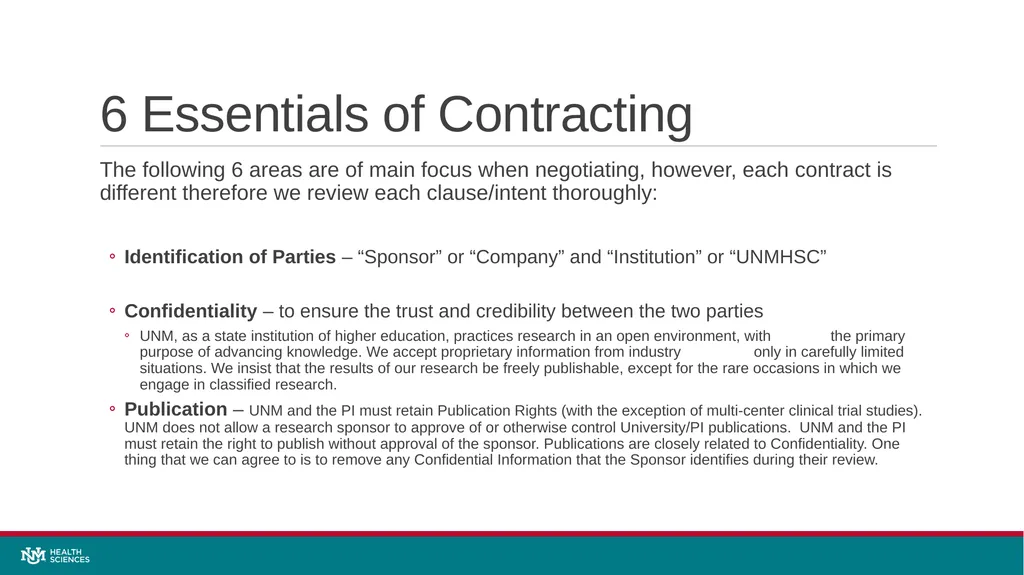
slide5. 6 Essentials of Contracting The following 6 areas are of main focus when negotiating, however, each contract is different therefore we review each clause/intent thoroughly:
Identification of Parties – “Sponsor” or “Company” and “Institution” or “UNMHSC”
Confidentiality – to ensure the trust and credibility between the two parties
UNM, as a state institution of higher education, practices research in an open environment, with the primary purpose of advancing knowledge. We accept proprietary information from industry only in carefully limited situations. We insist that the results of our research be freely publishable, except for the rare occasions in which we engage in classified research.
Publication – UNM and the PI must retain Publication Rights (with the exception of multi-center clinical trial studies). UNM does not allow a research sponsor to approve of or otherwise control University/PI publications. UNM and the PI must retain the right to publish without approval of the sponsor. Publications are closely related to Confidentiality. One thing that we can agree to is to remove any Confidential Information that the Sponsor identifies during their review.<br>
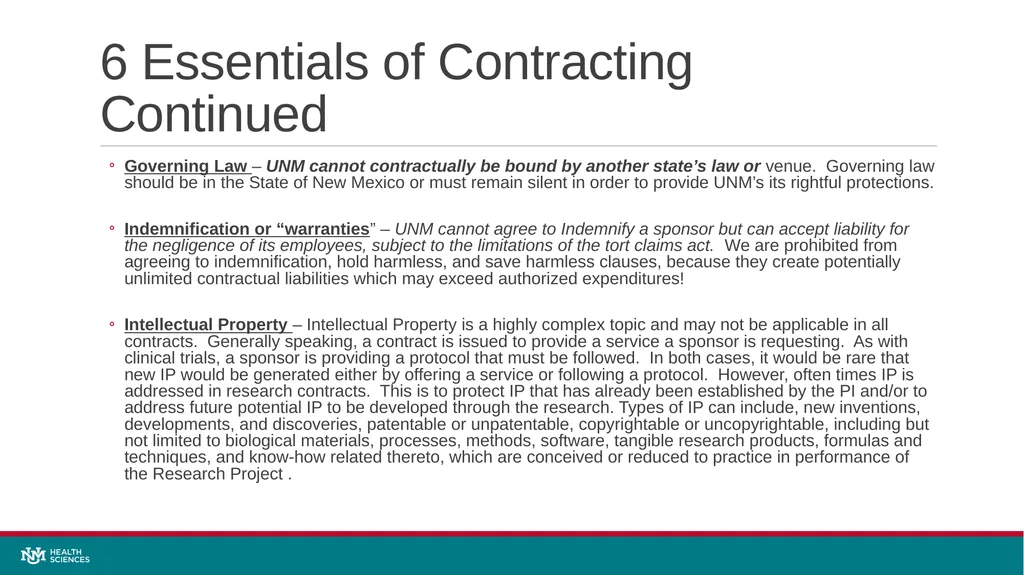
slide6. 6 Essentials of Contracting Continued Governing Law – UNM cannot contractually be bound by another state’s law or venue. Governing law should be in the State of New Mexico or must remain silent in order to provide UNM’s its rightful protections.
Indemnification or “warranties” – UNM cannot agree to Indemnify a sponsor but can accept liability for the negligence of its employees, subject to the limitations of the tort claims act. We are prohibited from agreeing to indemnification, hold harmless, and save harmless clauses, because they create potentially unlimited contractual liabilities which may exceed authorized expenditures!
Intellectual Property – Intellectual Property is a highly complex topic and may not be applicable in all contracts. Generally speaking, a contract is issued to provide a service a sponsor is requesting. As with clinical trials, a sponsor is providing a protocol that must be followed. In both cases, it would be rare that new IP would be generated either by offering a service or following a protocol. However, often times IP is addressed in research contracts. This is to protect IP that has already been established by the PI and/or to address future potential IP to be developed through the research. Types of IP can include, new inventions, developments, and discoveries, patentable or unpatentable, copyrightable or uncopyrightable, including but not limited to biological materials, processes, methods, software, tangible research products, formulas and techniques, and know-how related thereto, which are conceived or reduced to practice in performance of the Research Project .<br>
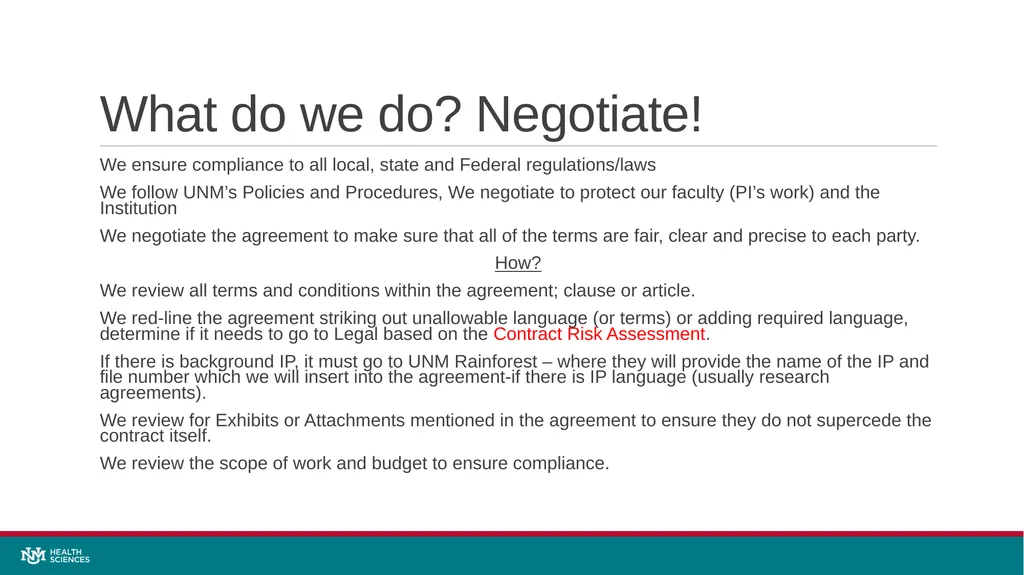
slide7. What do we do? Negotiate! We ensure compliance to all local, state and Federal regulations/laws
We follow UNM’s Policies and Procedures, We negotiate to protect our faculty (PI’s work) and the Institution
We negotiate the agreement to make sure that all of the terms are fair, clear and precise to each party.
How?
We review all terms and conditions within the agreement; clause or article.
We red-line the agreement striking out unallowable language (or terms) or adding required language, determine if it needs to go to Legal based on the Contract Risk Assessment.
If there is background IP, it must go to UNM Rainforest – where they will provide the name of the IP and file number which we will insert into the agreement-if there is IP language (usually research agreements).
We review for Exhibits or Attachments mentioned in the agreement to ensure they do not supercede the contract itself.
We review the scope of work and budget to ensure compliance.<br>
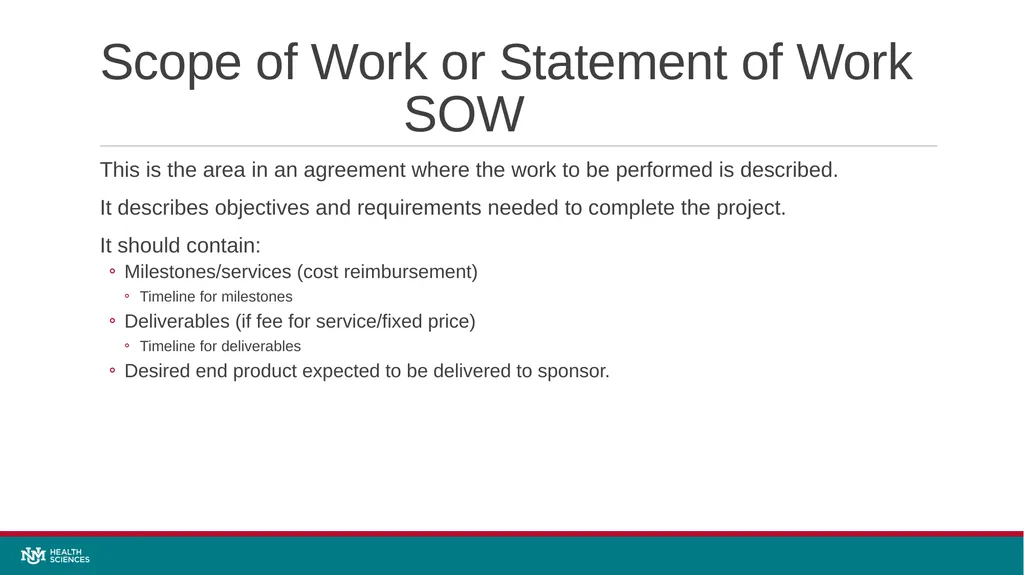
slide8. Scope of Work or Statement of Work SOW This is the area in an agreement where the work to be performed is described.
It describes objectives and requirements needed to complete the project.
It should contain:
Milestones/services (cost reimbursement)
Timeline for milestones
Deliverables (if fee for service/fixed price)
Timeline for deliverables
Desired end product expected to be delivered to sponsor.<br>
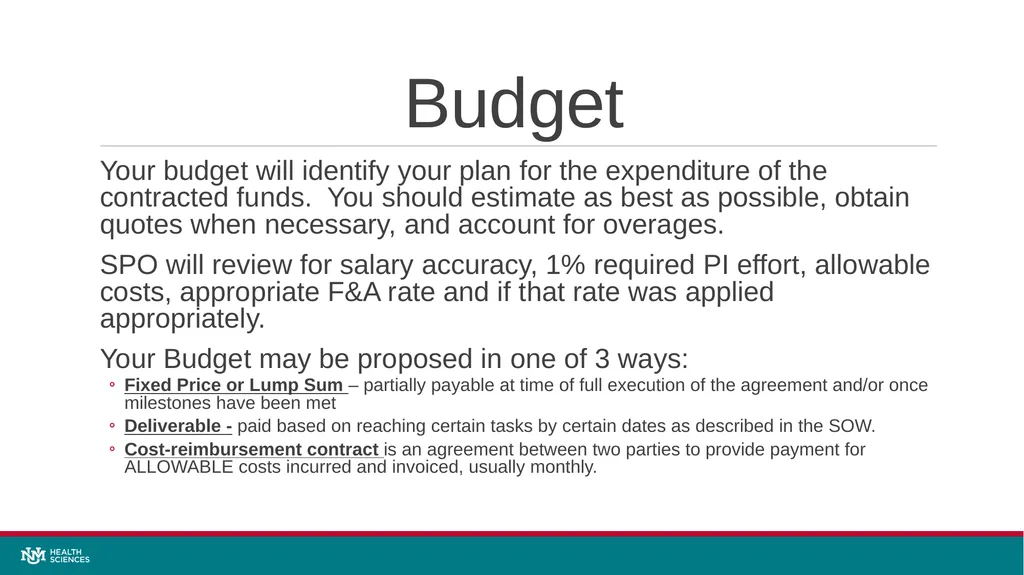
slide9. Budget Your budget will identify your plan for the expenditure of the contracted funds. You should estimate as best as possible, obtain quotes when necessary, and account for overages.
SPO will review for salary accuracy, 1% required PI effort, allowable costs, appropriate F&A rate and if that rate was applied appropriately.
Your Budget may be proposed in one of 3 ways:
Fixed Price or Lump Sum – partially payable at time of full execution of the agreement and/or once milestones have been met
Deliverable - paid based on reaching certain tasks by certain dates as described in the SOW.
Cost-reimbursement contract is an agreement between two parties to provide payment for ALLOWABLE costs incurred and invoiced, usually monthly.<br>
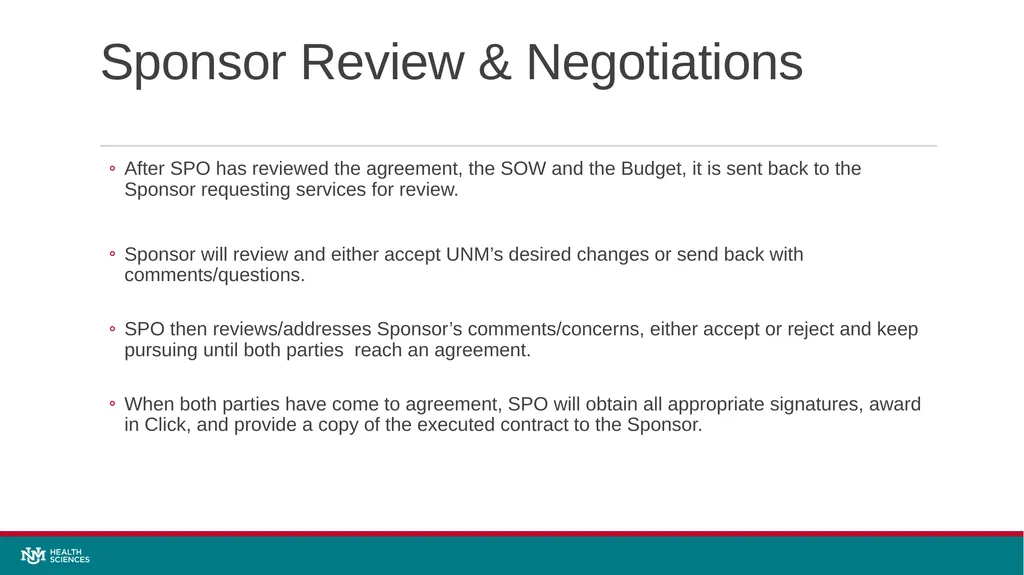
slide10. Sponsor Review & Negotiations After SPO has reviewed the agreement, the SOW and the Budget, it is sent back to the Sponsor requesting services for review.
Sponsor will review and either accept UNM’s desired changes or send back with comments/questions.
SPO then reviews/addresses Sponsor’s comments/concerns, either accept or reject and keep pursuing until both parties reach an agreement.
When both parties have come to agreement, SPO will obtain all appropriate signatures, award in Click, and provide a copy of the executed contract to the Sponsor.<br>
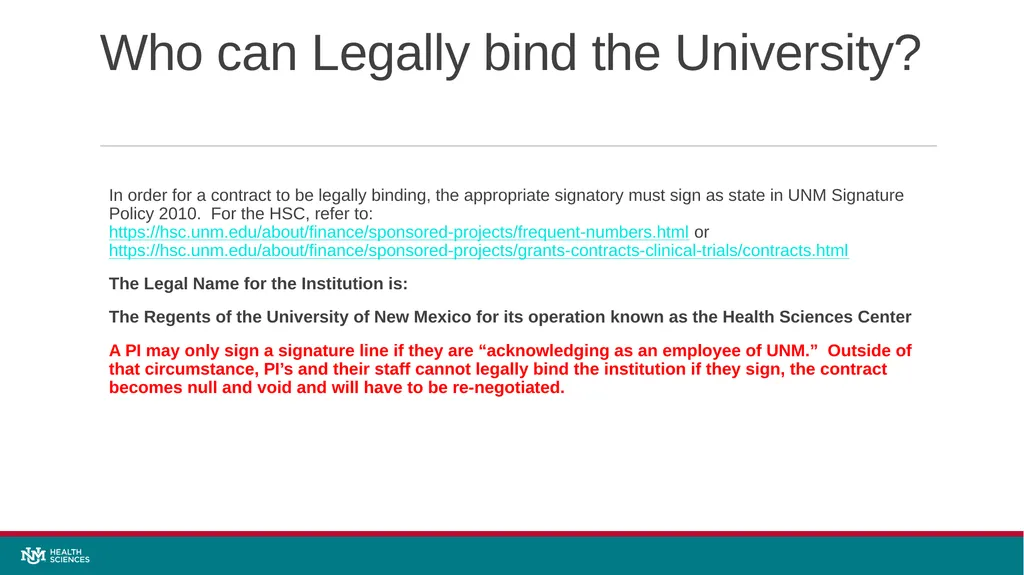
slide11. Who can Legally bind the University? In order for a contract to be legally binding, the appropriate signatory must sign as state in UNM Signature Policy 2010. For the HSC, refer to: https://hsc.unm.edu/about/finance/sponsored-projects/frequent-numbers.html or https://hsc.unm.edu/about/finance/sponsored-projects/grants-contracts-clinical-trials/contracts.html
The Legal Name for the Institution is:
The Regents of the University of New Mexico for its operation known as the Health Sciences Center
A PI may only sign a signature line if they are “acknowledging as an employee of UNM.” Outside of that circumstance, PI’s and their staff cannot legally bind the institution if they sign, the contract becomes null and void and will have to be re-negotiated.<br>
Quick Guide to Understanding contracts<br>
slide2. Click Record To initiate the contract review process, you must enter/submit your Click record. Your Specialist will be notified of the review.<br>
slide3. What is a contract? It is a written agreement that is intended to be enforceable by law that enables businesses (outside sponsors and UNM) to collaborate towards their specific desires and needs.
It creates, defines and governs mutual rights and obligations between the parties.
A Contract generally provides some type of service for the sponsor.<br>
slide4. Types of Contracts – Funded Agreements Sponsored Research Agreements – these are legally binding agreements that govern collaborative research between the University and an external organization
Testing Agreements – a specific service by which the University uses UNIQUE University equipment, testing method, or facilities to provide the specialized testing. (example – pregnancy tests)
Professional Services Agreements (PSA) – a contract that binds highly skilled individuals/consultants for a specific period of time with defined scope of work and timelines
NMDOH Professional Services Agreements for clinical services – negotiated by the Office of Clinical Contracts but facilitated by SPO and billed by C&G Accounting
Memo of Understanding (MOU) an agreement between two or more parties, not legally binding but signals parties want to move forward with a more formal contract, usually unfunded. Can be between two UNM Entities.
Incoming subcontracts/subawards, Other transaction Authority – transfers funds from a sponsored awardee to another entity (UNMHSC) to provide goods or services and/or contributes to the overall Aims of a grant to the original funded awardee.<br>
slide5. 6 Essentials of Contracting The following 6 areas are of main focus when negotiating, however, each contract is different therefore we review each clause/intent thoroughly:
Identification of Parties – “Sponsor” or “Company” and “Institution” or “UNMHSC”
Confidentiality – to ensure the trust and credibility between the two parties
UNM, as a state institution of higher education, practices research in an open environment, with the primary purpose of advancing knowledge. We accept proprietary information from industry only in carefully limited situations. We insist that the results of our research be freely publishable, except for the rare occasions in which we engage in classified research.
Publication – UNM and the PI must retain Publication Rights (with the exception of multi-center clinical trial studies). UNM does not allow a research sponsor to approve of or otherwise control University/PI publications. UNM and the PI must retain the right to publish without approval of the sponsor. Publications are closely related to Confidentiality. One thing that we can agree to is to remove any Confidential Information that the Sponsor identifies during their review.<br>
slide6. 6 Essentials of Contracting Continued Governing Law – UNM cannot contractually be bound by another state’s law or venue. Governing law should be in the State of New Mexico or must remain silent in order to provide UNM’s its rightful protections.
Indemnification or “warranties” – UNM cannot agree to Indemnify a sponsor but can accept liability for the negligence of its employees, subject to the limitations of the tort claims act. We are prohibited from agreeing to indemnification, hold harmless, and save harmless clauses, because they create potentially unlimited contractual liabilities which may exceed authorized expenditures!
Intellectual Property – Intellectual Property is a highly complex topic and may not be applicable in all contracts. Generally speaking, a contract is issued to provide a service a sponsor is requesting. As with clinical trials, a sponsor is providing a protocol that must be followed. In both cases, it would be rare that new IP would be generated either by offering a service or following a protocol. However, often times IP is addressed in research contracts. This is to protect IP that has already been established by the PI and/or to address future potential IP to be developed through the research. Types of IP can include, new inventions, developments, and discoveries, patentable or unpatentable, copyrightable or uncopyrightable, including but not limited to biological materials, processes, methods, software, tangible research products, formulas and techniques, and know-how related thereto, which are conceived or reduced to practice in performance of the Research Project .<br>
slide7. What do we do? Negotiate! We ensure compliance to all local, state and Federal regulations/laws
We follow UNM’s Policies and Procedures, We negotiate to protect our faculty (PI’s work) and the Institution
We negotiate the agreement to make sure that all of the terms are fair, clear and precise to each party.
How?
We review all terms and conditions within the agreement; clause or article.
We red-line the agreement striking out unallowable language (or terms) or adding required language, determine if it needs to go to Legal based on the Contract Risk Assessment.
If there is background IP, it must go to UNM Rainforest – where they will provide the name of the IP and file number which we will insert into the agreement-if there is IP language (usually research agreements).
We review for Exhibits or Attachments mentioned in the agreement to ensure they do not supercede the contract itself.
We review the scope of work and budget to ensure compliance.<br>
slide8. Scope of Work or Statement of Work SOW This is the area in an agreement where the work to be performed is described.
It describes objectives and requirements needed to complete the project.
It should contain:
Milestones/services (cost reimbursement)
Timeline for milestones
Deliverables (if fee for service/fixed price)
Timeline for deliverables
Desired end product expected to be delivered to sponsor.<br>
slide9. Budget Your budget will identify your plan for the expenditure of the contracted funds. You should estimate as best as possible, obtain quotes when necessary, and account for overages.
SPO will review for salary accuracy, 1% required PI effort, allowable costs, appropriate F&A rate and if that rate was applied appropriately.
Your Budget may be proposed in one of 3 ways:
Fixed Price or Lump Sum – partially payable at time of full execution of the agreement and/or once milestones have been met
Deliverable - paid based on reaching certain tasks by certain dates as described in the SOW.
Cost-reimbursement contract is an agreement between two parties to provide payment for ALLOWABLE costs incurred and invoiced, usually monthly.<br>
slide10. Sponsor Review & Negotiations After SPO has reviewed the agreement, the SOW and the Budget, it is sent back to the Sponsor requesting services for review.
Sponsor will review and either accept UNM’s desired changes or send back with comments/questions.
SPO then reviews/addresses Sponsor’s comments/concerns, either accept or reject and keep pursuing until both parties reach an agreement.
When both parties have come to agreement, SPO will obtain all appropriate signatures, award in Click, and provide a copy of the executed contract to the Sponsor.<br>
slide11. Who can Legally bind the University? In order for a contract to be legally binding, the appropriate signatory must sign as state in UNM Signature Policy 2010. For the HSC, refer to: https://hsc.unm.edu/about/finance/sponsored-projects/frequent-numbers.html or https://hsc.unm.edu/about/finance/sponsored-projects/grants-contracts-clinical-trials/contracts.html
The Legal Name for the Institution is:
The Regents of the University of New Mexico for its operation known as the Health Sciences Center
A PI may only sign a signature line if they are “acknowledging as an employee of UNM.” Outside of that circumstance, PI’s and their staff cannot legally bind the institution if they sign, the contract becomes null and void and will have to be re-negotiated.<br>