
Squad Tactics and Artificial Intelligence Matt
YM
Published · 52 slides · 0 views
1 / 1
Description
Squad Tactics and Artificial Intelligence Matt Mitchell David Pennenga John Formica Correct Movement Topics to cover Levels of threat Straying from the team Use of caution Team context Speed of movement Levels of Threat The more targets,
Related Topics
Share
Embed code
Download this presentation From Below
"Squad Tactics and Artificial Intelligence Matt" is the property of its rightful owner. Permission is granted to download and print the materials on this website for personal, non-commercial use only, and to display it on your personal computer provided you do not modify the materials and that you retain all copyright notices contained in the materials. By downloading content from our website, you accept the terms of this agreement.
Presentation Transcript
01
Squad Tactics and Artificial Intelligence Matt Mitchell
David Pennenga
John Formica<br>
David Pennenga
John Formica<br>
02
Correct Movement Topics to cover
Levels of threat
Straying from the team
Use of caution
Team context
Speed of movement<br>
Levels of threat
Straying from the team
Use of caution
Team context
Speed of movement<br>
03
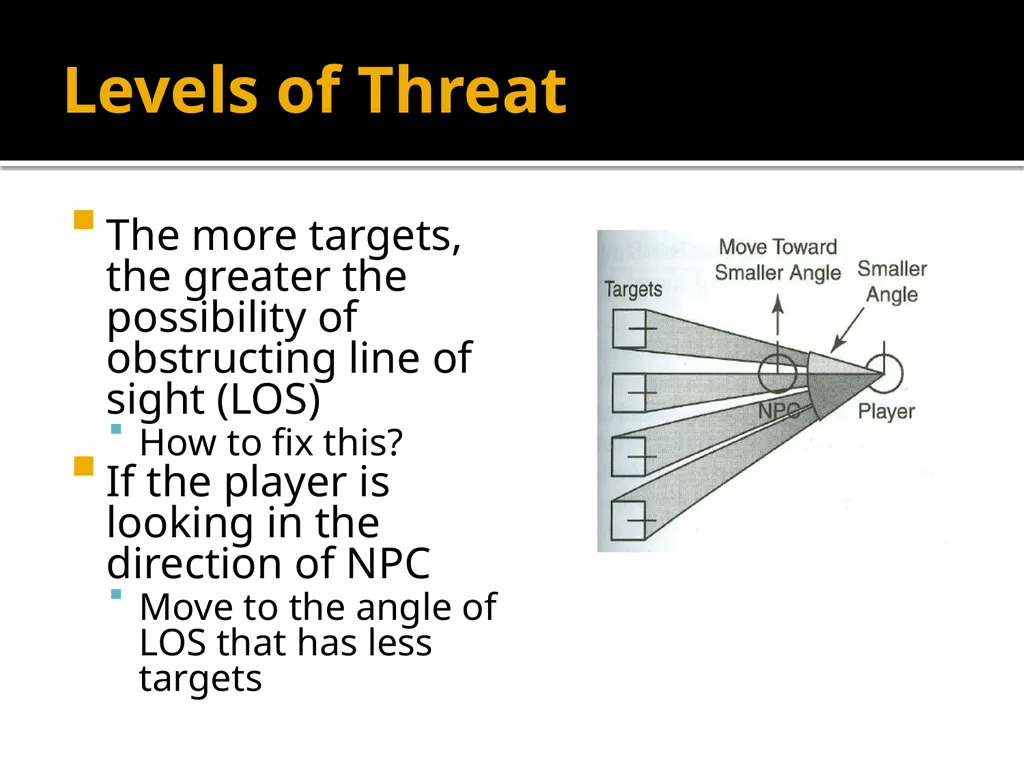
Levels of Threat The more targets, the greater the possibility of obstructing line of sight (LOS)
How to fix this?
If the player is looking in the direction of NPC
Move to the angle of LOS that has less targets<br>
How to fix this?
If the player is looking in the direction of NPC
Move to the angle of LOS that has less targets<br>
04
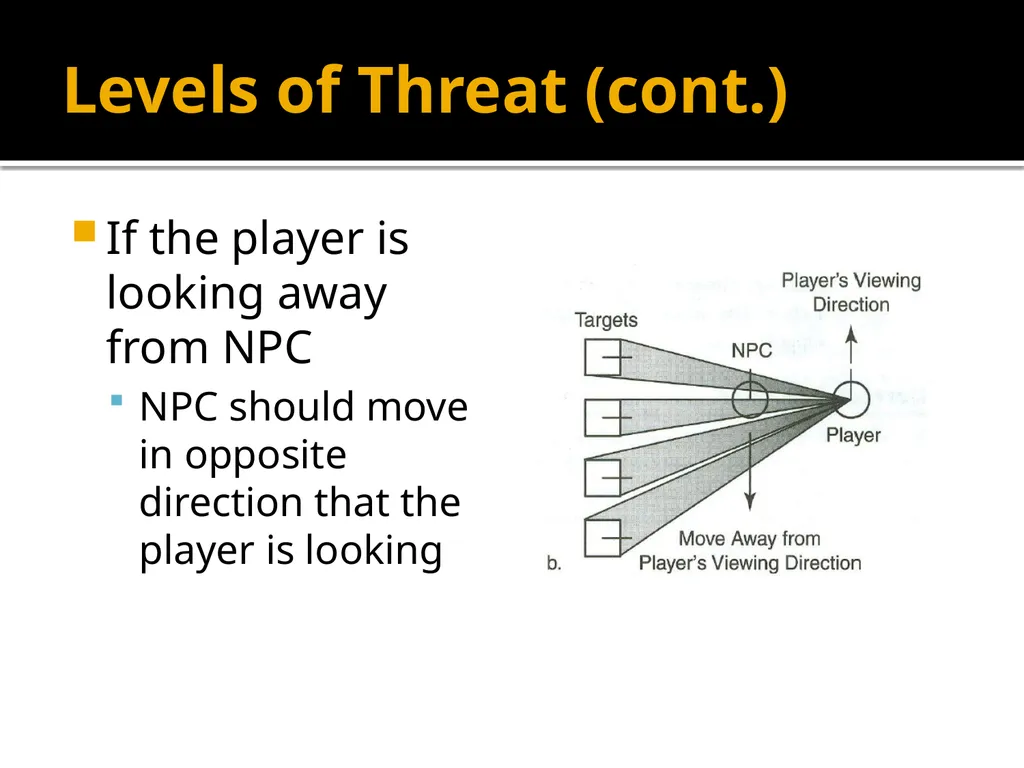
Levels of Threat (cont.) If the player is looking away from NPC
NPC should move in opposite direction that the player is looking<br>
NPC should move in opposite direction that the player is looking<br>
05
Levels of Threat (Cont.) If above heuristics fail, prioritize obstruction
Threat level of enemy
A player is more likely to target:
enemies with greater threat levels
Obstruct view of enemies with lesser threat levels
Groups of enemies over individuals
Opt for obstructing view of smaller groups or individuals
Threat level also should be considered<br>
Threat level of enemy
A player is more likely to target:
enemies with greater threat levels
Obstruct view of enemies with lesser threat levels
Groups of enemies over individuals
Opt for obstructing view of smaller groups or individuals
Threat level also should be considered<br>
06
Straying from the team NPCs should stay close to the team
Set maximum radius from team
Why?
Straying from the team could:
Alert enemy combatants
Distract player from game
Trying to find lost teammates
Cause failure to assist player<br>
Set maximum radius from team
Why?
Straying from the team could:
Alert enemy combatants
Distract player from game
Trying to find lost teammates
Cause failure to assist player<br>
07
Use of Caution Teammates should avoid risking the welfare of the team
NPCs should not be the first to engage an enemy
Explore a room
Move over a hill or around a corner
This could undermine the player’s play style<br>
NPCs should not be the first to engage an enemy
Explore a room
Move over a hill or around a corner
This could undermine the player’s play style<br>
08
Team Context Take different play styles of the player into consideration
Some games allow player to set play styles
Aggressive vs passive
E.G. Republic Commando
“search and destroy”
“form up”
“hold position”
Move at the same pace as player
But not obstructing LOS
Consider tactically sound behavior
We will cover more about this shortly<br>
Some games allow player to set play styles
Aggressive vs passive
E.G. Republic Commando
“search and destroy”
“form up”
“hold position”
Move at the same pace as player
But not obstructing LOS
Consider tactically sound behavior
We will cover more about this shortly<br>
09
Correct Behavior Types of behavior
Use of cover
Selective firing
reloading<br>
Use of cover
Selective firing
reloading<br>
10
Use of Cover Path-finding algorithm
Prefer cover and the shadows
Causes player to believe in tactical prowess of NPCs
Adds to realism of game play
Prevents accidentally alerting NPCs
Take player cues If NPC behavior does not match player behavior
E.G. Speed of player movement could cancel priority for cover in path-finding algorithm if player appears to be in a rush<br>
Prefer cover and the shadows
Causes player to believe in tactical prowess of NPCs
Adds to realism of game play
Prevents accidentally alerting NPCs
Take player cues If NPC behavior does not match player behavior
E.G. Speed of player movement could cancel priority for cover in path-finding algorithm if player appears to be in a rush<br>
11
Selective Firing Only fire when within range and in view
Controlled bursts
Maintain accuracy
Conserve ammunition
Reaction times
Should be manipulated if individual combat-related AI is too powerful
Balance high accuracy with low reaction times
Certain manipulations also make contextual sense: Rainbow Six style squad games
Team reaction time should not be lower than enemy team’s reaction time<br>
Controlled bursts
Maintain accuracy
Conserve ammunition
Reaction times
Should be manipulated if individual combat-related AI is too powerful
Balance high accuracy with low reaction times
Certain manipulations also make contextual sense: Rainbow Six style squad games
Team reaction time should not be lower than enemy team’s reaction time<br>
12
Reloading Cycling aggressive NPCs
Reloading NPCs fall back or take cover
Return when finished
Stagger fire of NPCs
So NPCs do not run out of ammunition at the same time
“taking turns” at attacking ensures that player will most likely always have supporting fire<br>
Reloading NPCs fall back or take cover
Return when finished
Stagger fire of NPCs
So NPCs do not run out of ammunition at the same time
“taking turns” at attacking ensures that player will most likely always have supporting fire<br>
13
Supporting the Player Close support of the player
Protecting the rear
Reporting to the player
Selecting a target
Responding to orders<br>
Protecting the rear
Reporting to the player
Selecting a target
Responding to orders<br>
14
Reporting to the Player Protect player’s sides
Report threats via audio or visual cues
Messages are a staple of squad game play
Do not overwhelm player
Reporting threats while in combat is not usually necessary
Pick appropriate engagement times
Not in a fire fight
Do not aggravate more enemies than already fighting<br>
Report threats via audio or visual cues
Messages are a staple of squad game play
Do not overwhelm player
Reporting threats while in combat is not usually necessary
Pick appropriate engagement times
Not in a fire fight
Do not aggravate more enemies than already fighting<br>
15
Selecting a target Chose targets other than the player’s
Chose targets farthest from the player’s LOS
NPCs are there to complement game play not hinder it
Also should take threat level into account
Player might need assistance
Health of player’s target versus player’s own health
Consider higher concentration of targets<br>
Chose targets farthest from the player’s LOS
NPCs are there to complement game play not hinder it
Also should take threat level into account
Player might need assistance
Health of player’s target versus player’s own health
Consider higher concentration of targets<br>
16
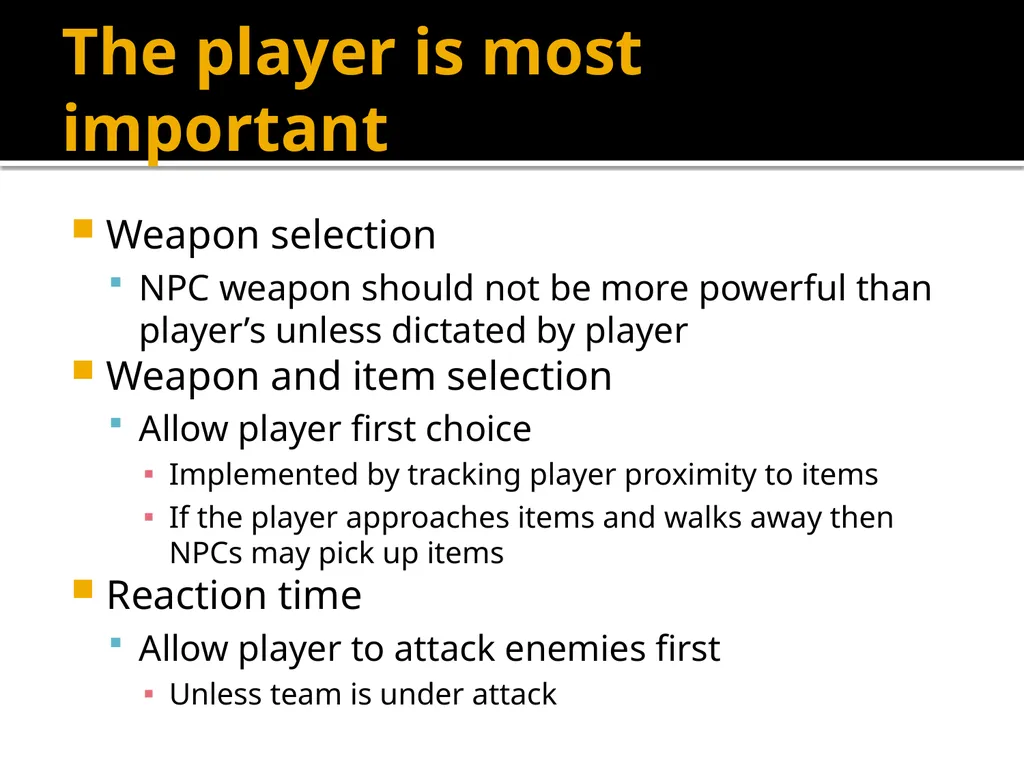
The player is most important Weapon selection
NPC weapon should not be more powerful than player’s unless dictated by player
Weapon and item selection
Allow player first choice
Implemented by tracking player proximity to items
If the player approaches items and walks away then NPCs may pick up items
Reaction time
Allow player to attack enemies first
Unless team is under attack<br>
NPC weapon should not be more powerful than player’s unless dictated by player
Weapon and item selection
Allow player first choice
Implemented by tracking player proximity to items
If the player approaches items and walks away then NPCs may pick up items
Reaction time
Allow player to attack enemies first
Unless team is under attack<br>
17
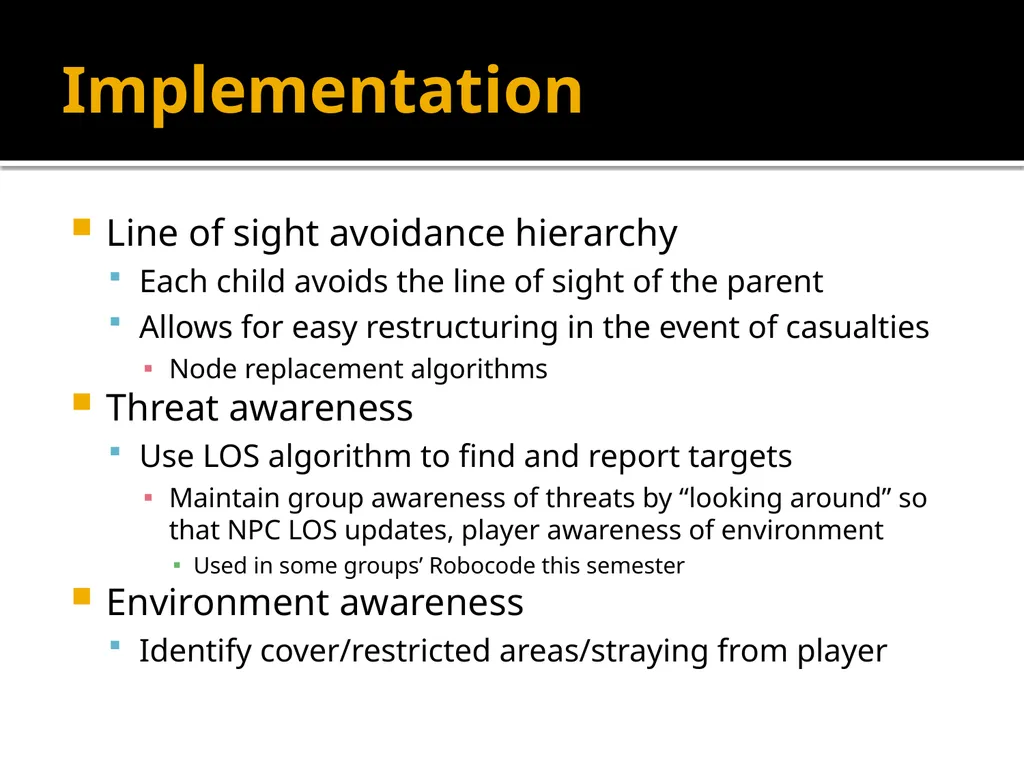
Implementation Line of sight avoidance hierarchy
Each child avoids the line of sight of the parent
Allows for easy restructuring in the event of casualties
Node replacement algorithms
Threat awareness
Use LOS algorithm to find and report targets
Maintain group awareness of threats by “looking around” so that NPC LOS updates, player awareness of environment
Used in some groups’ Robocode this semester
Environment awareness
Identify cover/restricted areas/straying from player<br>
Each child avoids the line of sight of the parent
Allows for easy restructuring in the event of casualties
Node replacement algorithms
Threat awareness
Use LOS algorithm to find and report targets
Maintain group awareness of threats by “looking around” so that NPC LOS updates, player awareness of environment
Used in some groups’ Robocode this semester
Environment awareness
Identify cover/restricted areas/straying from player<br>
18
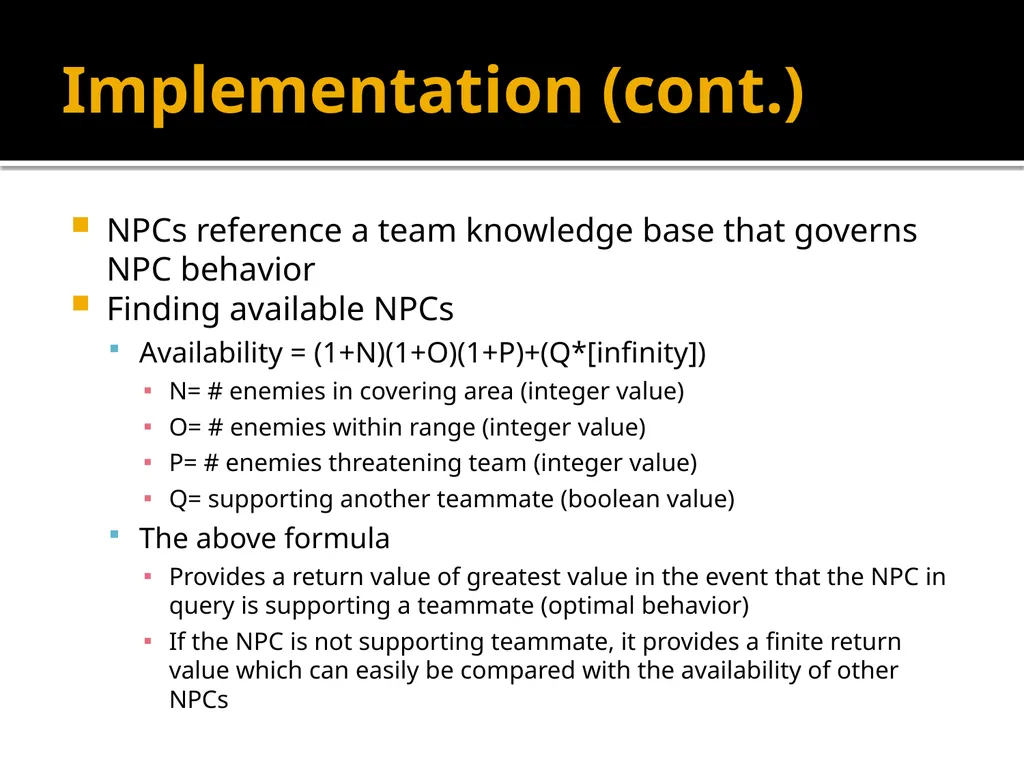
Implementation (cont.) NPCs reference a team knowledge base that governs NPC behavior
Finding available NPCs
Availability = (1+N)(1+O)(1+P)+(Q*[infinity])
N= # enemies in covering area (integer value)
O= # enemies within range (integer value)
P= # enemies threatening team (integer value)
Q= supporting another teammate (boolean value)
The above formula
Provides a return value of greatest value in the event that the NPC in query is supporting a teammate (optimal behavior)
If the NPC is not supporting teammate, it provides a finite return value which can easily be compared with the availability of other NPCs<br>
Finding available NPCs
Availability = (1+N)(1+O)(1+P)+(Q*[infinity])
N= # enemies in covering area (integer value)
O= # enemies within range (integer value)
P= # enemies threatening team (integer value)
Q= supporting another teammate (boolean value)
The above formula
Provides a return value of greatest value in the event that the NPC in query is supporting a teammate (optimal behavior)
If the NPC is not supporting teammate, it provides a finite return value which can easily be compared with the availability of other NPCs<br>
19
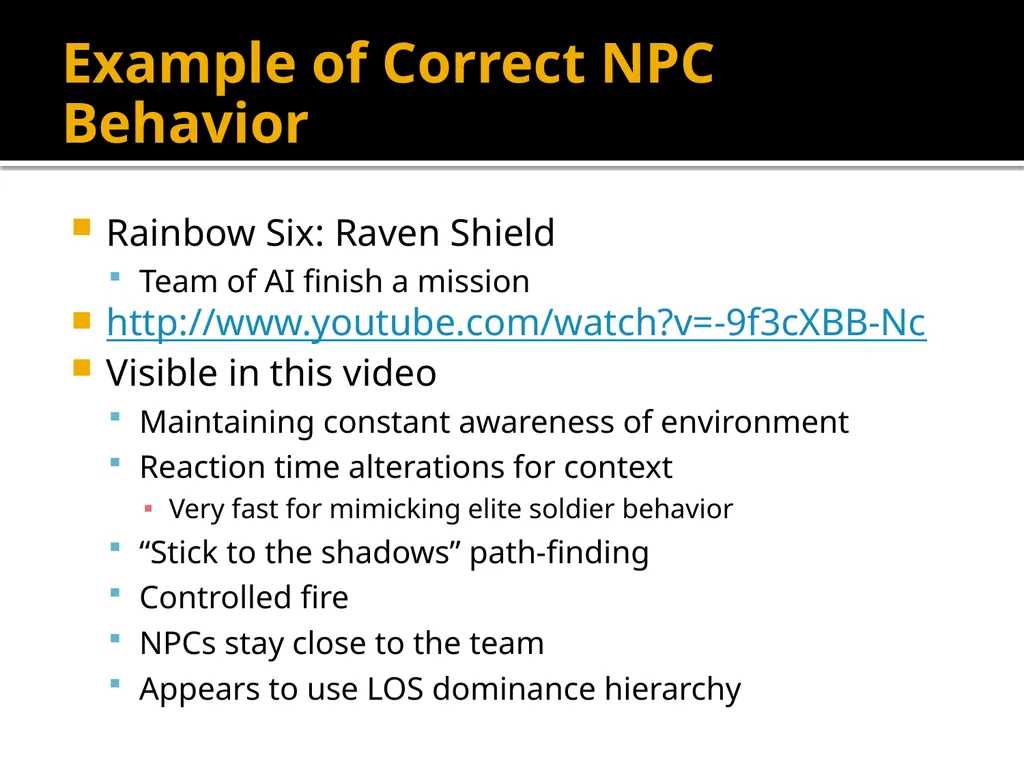
Example of Correct NPC Behavior Rainbow Six: Raven Shield
Team of AI finish a mission
http://www.youtube.com/watch?v=-9f3cXBB-Nc
Visible in this video
Maintaining constant awareness of environment
Reaction time alterations for context
Very fast for mimicking elite soldier behavior
“Stick to the shadows” path-finding
Controlled fire
NPCs stay close to the team
Appears to use LOS dominance hierarchy<br>
Team of AI finish a mission
http://www.youtube.com/watch?v=-9f3cXBB-Nc
Visible in this video
Maintaining constant awareness of environment
Reaction time alterations for context
Very fast for mimicking elite soldier behavior
“Stick to the shadows” path-finding
Controlled fire
NPCs stay close to the team
Appears to use LOS dominance hierarchy<br>
20
Team AI and Emergent Maneuvers Decentralized approach
Squad members exchange info equally
Messages!
No commanding force
Instead, equally shared knowledge bases for reference of each member
Squad behavior is an extension of individual AI
Centralized approach
Leader receives and interprets info from soldiers
Orders soldier behavior
Differing strength of orders
This will be covered shortly<br>
Squad members exchange info equally
Messages!
No commanding force
Instead, equally shared knowledge bases for reference of each member
Squad behavior is an extension of individual AI
Centralized approach
Leader receives and interprets info from soldiers
Orders soldier behavior
Differing strength of orders
This will be covered shortly<br>
21
The Decentralized Approach Pros
Extension of individual AI (easier to implement)
All AI simply must communicate with each other either directly (messages) or indirectly (communicating with an abstract knowledge base)
Robustly handles situations
Emergent behavior facilitates problem solving without having to specifically code for given tasks
Deals well with variations in capabilities of teammates
Individual AI is permitted to interpret or act upon supplied info differently
hence this approach being an extension of individual AI
Easily combined with scripted AI
Same reason as above
Cons
Weak at autonomy or tight coordination
Lack of specific plans for problems hinders team cohesion
Cannot deal with individual strengths/weaknesses<br>
Extension of individual AI (easier to implement)
All AI simply must communicate with each other either directly (messages) or indirectly (communicating with an abstract knowledge base)
Robustly handles situations
Emergent behavior facilitates problem solving without having to specifically code for given tasks
Deals well with variations in capabilities of teammates
Individual AI is permitted to interpret or act upon supplied info differently
hence this approach being an extension of individual AI
Easily combined with scripted AI
Same reason as above
Cons
Weak at autonomy or tight coordination
Lack of specific plans for problems hinders team cohesion
Cannot deal with individual strengths/weaknesses<br>
22
Squad Maneuvers Tightly coordinated
Members rely on detailed, repeatedly rehearsed drills, and continuous flow of info
In CSE terms, events are anticipated and coded specifically to be solved
Loosely coordinated
Does not rely on planned maneuvers
Relies more on verbal communications<br>
Members rely on detailed, repeatedly rehearsed drills, and continuous flow of info
In CSE terms, events are anticipated and coded specifically to be solved
Loosely coordinated
Does not rely on planned maneuvers
Relies more on verbal communications<br>
23
Emergent Behavior Fire and maneuver behavior
individual behavior of either firing or moving
Communicate this within the squad
Emergent behavior of position cycling
Goal behavior achieved via communication
Stay close to cover
Communicate info of cover whereabouts
Prevent blocking LOS of others
Communicate direction of LOS
Take weapon capabilities into account
Damage, area of effect, etc.
Maintain group cohesion
NPC location and intentions
Spread out
Communicate distance from other NPCs
Keep LOS on targets
Target locations, if the target is moving in the direction of another NPC<br>
individual behavior of either firing or moving
Communicate this within the squad
Emergent behavior of position cycling
Goal behavior achieved via communication
Stay close to cover
Communicate info of cover whereabouts
Prevent blocking LOS of others
Communicate direction of LOS
Take weapon capabilities into account
Damage, area of effect, etc.
Maintain group cohesion
NPC location and intentions
Spread out
Communicate distance from other NPCs
Keep LOS on targets
Target locations, if the target is moving in the direction of another NPC<br>
24
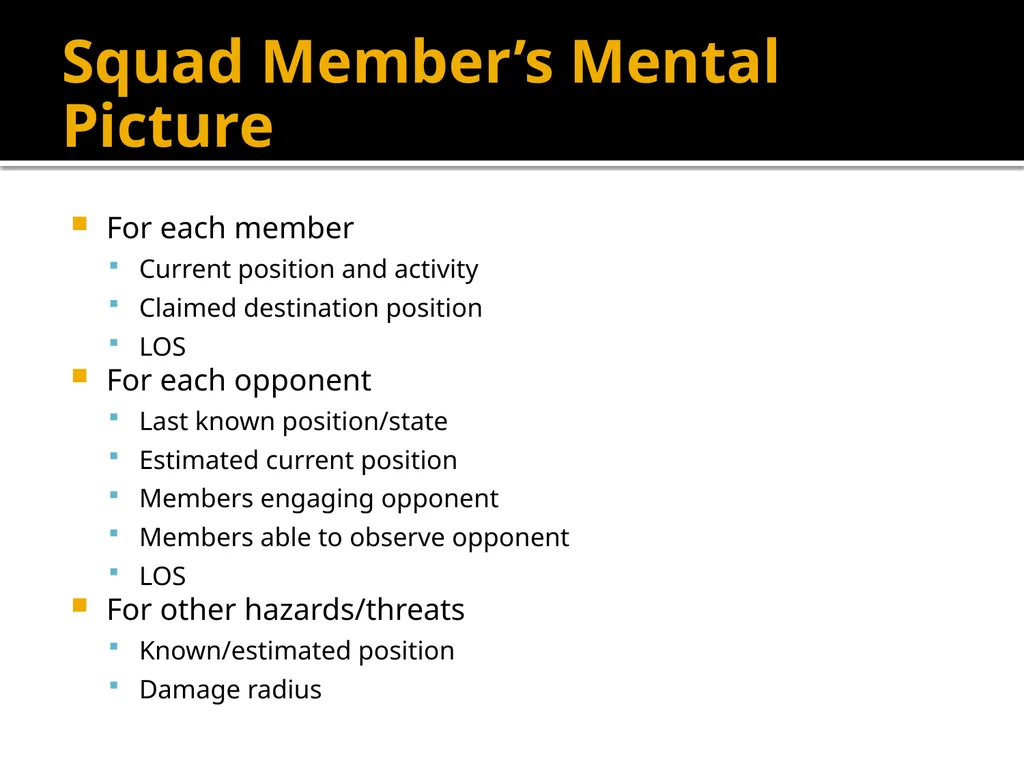
Squad Member’s Mental Picture For each member
Current position and activity
Claimed destination position
LOS
For each opponent
Last known position/state
Estimated current position
Members engaging opponent
Members able to observe opponent
LOS
For other hazards/threats
Known/estimated position
Damage radius<br>
Current position and activity
Claimed destination position
LOS
For each opponent
Last known position/state
Estimated current position
Members engaging opponent
Members able to observe opponent
LOS
For other hazards/threats
Known/estimated position
Damage radius<br>
25
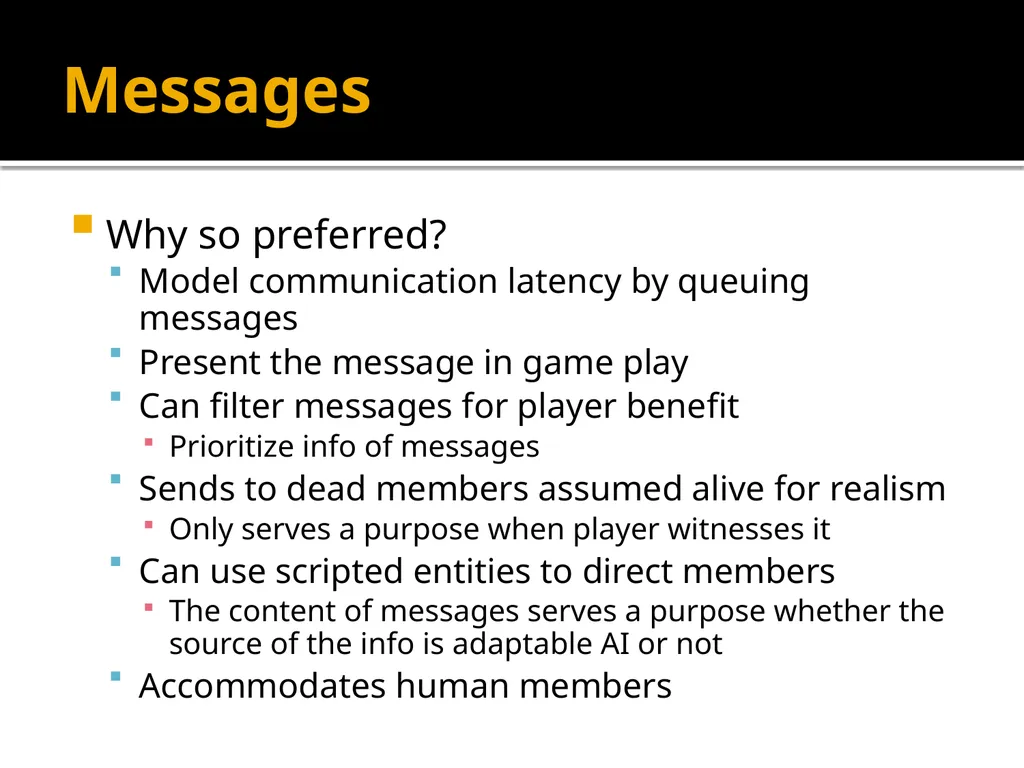
Messages Why so preferred?
Model communication latency by queuing messages
Present the message in game play
Can filter messages for player benefit
Prioritize info of messages
Sends to dead members assumed alive for realism
Only serves a purpose when player witnesses it
Can use scripted entities to direct members
The content of messages serves a purpose whether the source of the info is adaptable AI or not
Accommodates human members<br>
Model communication latency by queuing messages
Present the message in game play
Can filter messages for player benefit
Prioritize info of messages
Sends to dead members assumed alive for realism
Only serves a purpose when player witnesses it
Can use scripted entities to direct members
The content of messages serves a purpose whether the source of the info is adaptable AI or not
Accommodates human members<br>
26
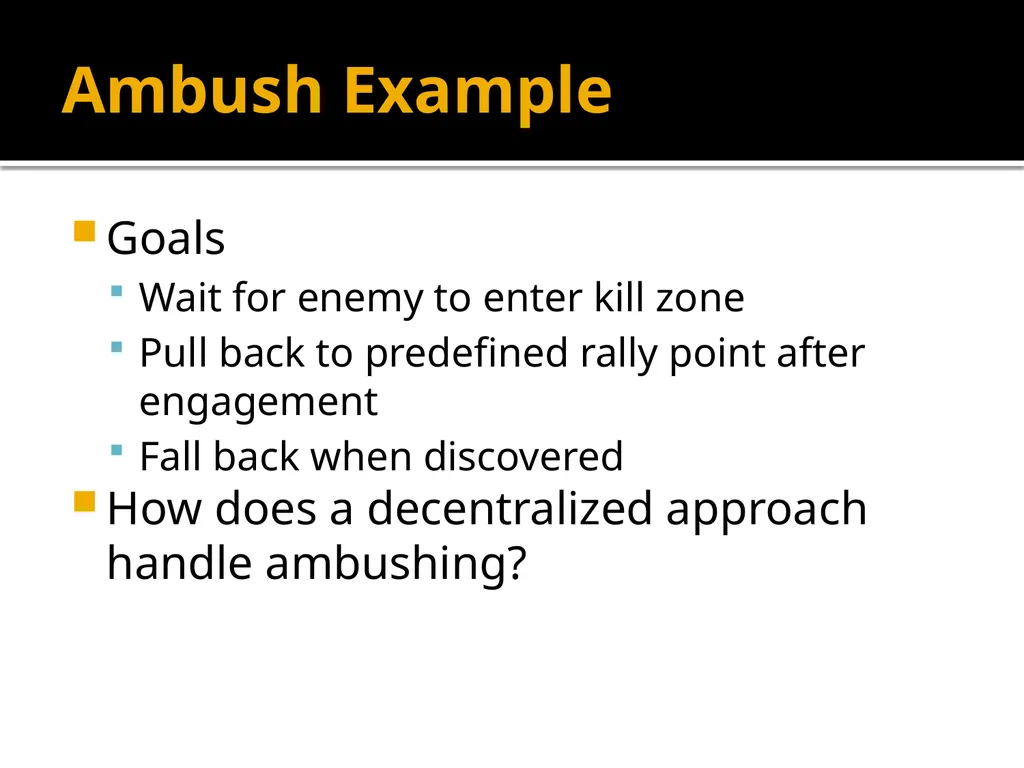
Ambush Example Goals
Wait for enemy to enter kill zone
Pull back to predefined rally point after engagement
Fall back when discovered
How does a decentralized approach handle ambushing?<br>
Wait for enemy to enter kill zone
Pull back to predefined rally point after engagement
Fall back when discovered
How does a decentralized approach handle ambushing?<br>
27
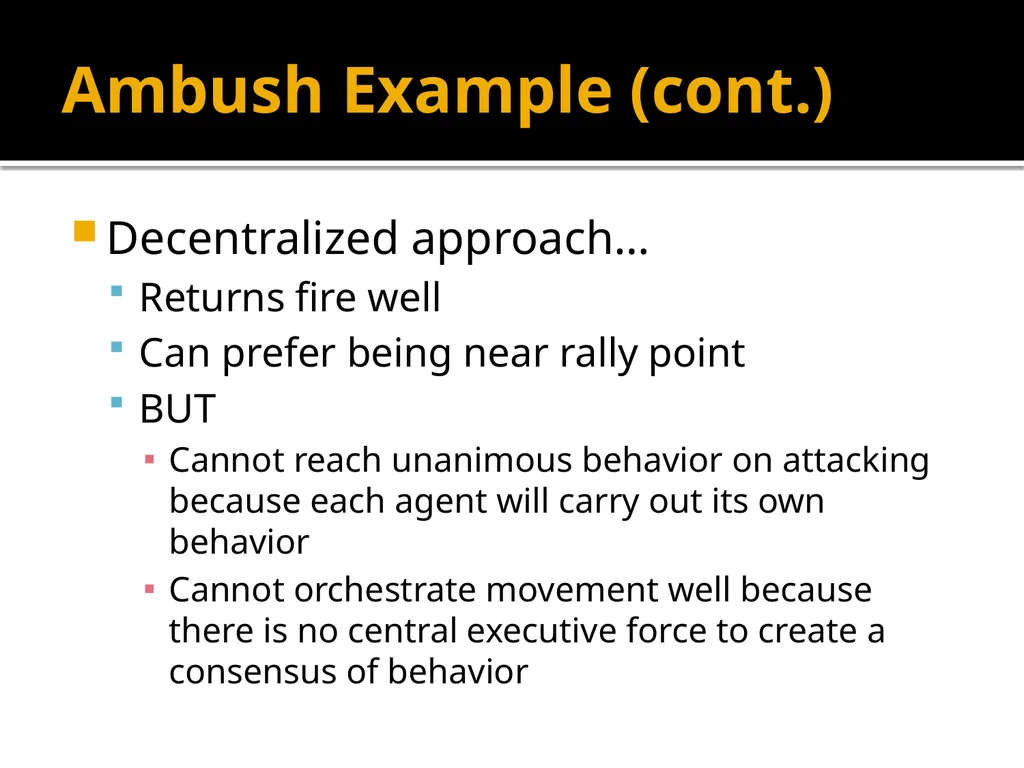
Ambush Example (cont.) Decentralized approach…
Returns fire well
Can prefer being near rally point
BUT
Cannot reach unanimous behavior on attacking because each agent will carry out its own behavior
Cannot orchestrate movement well because there is no central executive force to create a consensus of behavior<br>
Returns fire well
Can prefer being near rally point
BUT
Cannot reach unanimous behavior on attacking because each agent will carry out its own behavior
Cannot orchestrate movement well because there is no central executive force to create a consensus of behavior<br>
28
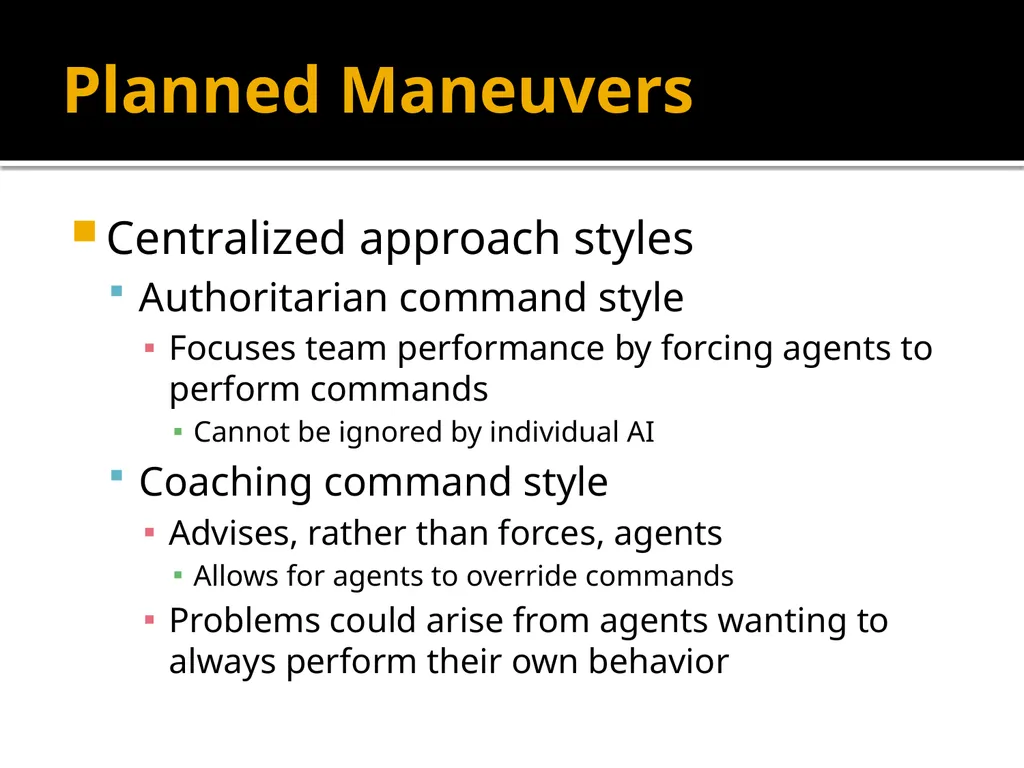
Planned Maneuvers Centralized approach styles
Authoritarian command style
Focuses team performance by forcing agents to perform commands
Cannot be ignored by individual AI
Coaching command style
Advises, rather than forces, agents
Allows for agents to override commands
Problems could arise from agents wanting to always perform their own behavior<br>
Authoritarian command style
Focuses team performance by forcing agents to perform commands
Cannot be ignored by individual AI
Coaching command style
Advises, rather than forces, agents
Allows for agents to override commands
Problems could arise from agents wanting to always perform their own behavior<br>
29
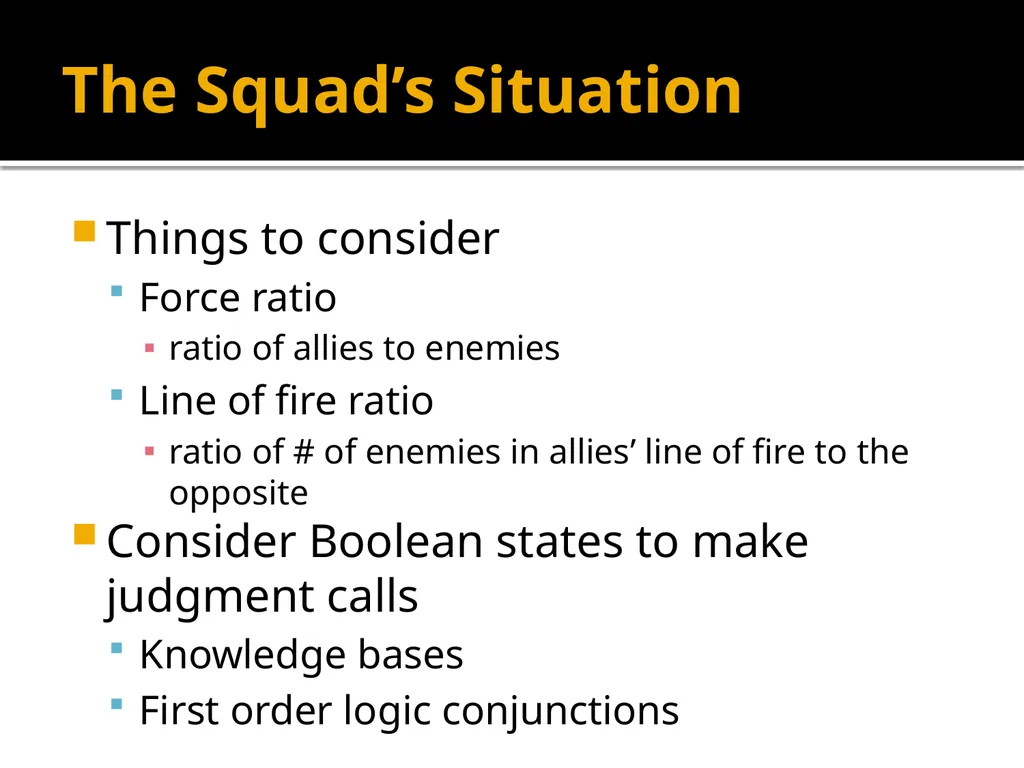
The Squad’s Situation Things to consider
Force ratio
ratio of allies to enemies
Line of fire ratio
ratio of # of enemies in allies’ line of fire to the opposite
Consider Boolean states to make judgment calls
Knowledge bases
First order logic conjunctions<br>
Force ratio
ratio of allies to enemies
Line of fire ratio
ratio of # of enemies in allies’ line of fire to the opposite
Consider Boolean states to make judgment calls
Knowledge bases
First order logic conjunctions<br>
30
A Good Maneuver Chosen path is a good combination of
Short travel time
Concealment from pursuing enemies
Sufficient space to maneuver<br>
Short travel time
Concealment from pursuing enemies
Sufficient space to maneuver<br>
31
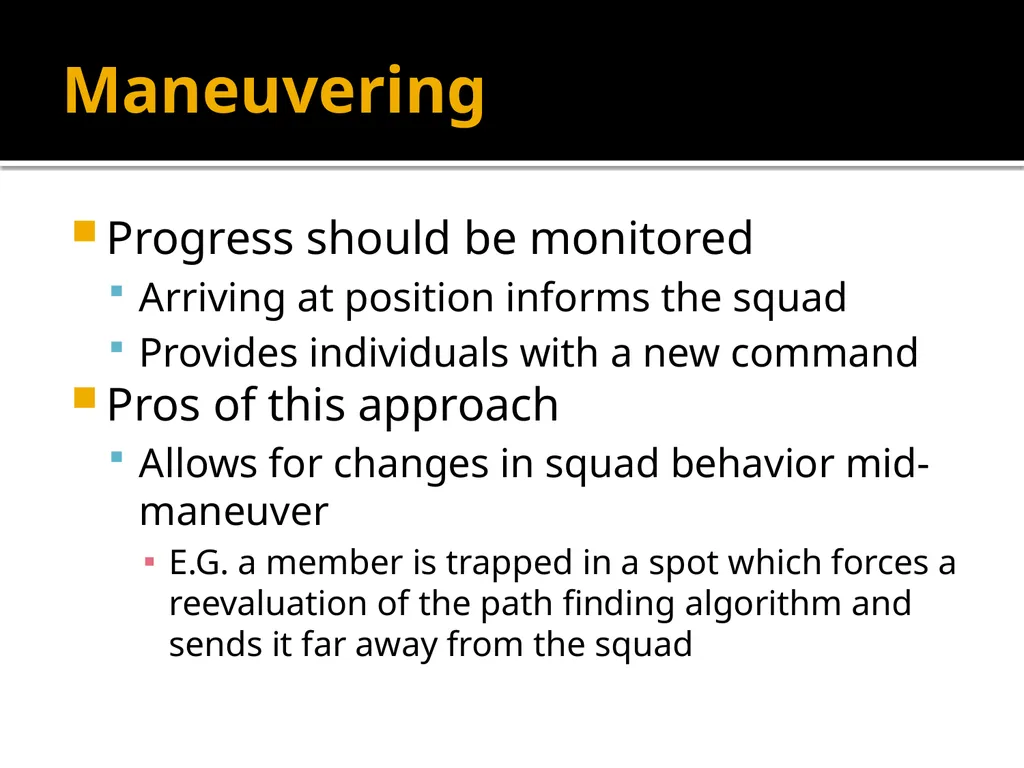
Maneuvering Progress should be monitored
Arriving at position informs the squad
Provides individuals with a new command
Pros of this approach
Allows for changes in squad behavior mid-maneuver
E.G. a member is trapped in a spot which forces a reevaluation of the path finding algorithm and sends it far away from the squad<br>
Arriving at position informs the squad
Provides individuals with a new command
Pros of this approach
Allows for changes in squad behavior mid-maneuver
E.G. a member is trapped in a spot which forces a reevaluation of the path finding algorithm and sends it far away from the squad<br>
32
Pulling Back Use maps or an alteration of the A* function
New cost function considers
Nodes that can be fired at from preceding nodes
Nodes that provide insufficient space to bypass
Nodes that are a bad position from which to fight
The time and spatial complexity of this new function force it to be applied to the squad aggregate for practicality<br>
New cost function considers
Nodes that can be fired at from preceding nodes
Nodes that provide insufficient space to bypass
Nodes that are a bad position from which to fight
The time and spatial complexity of this new function force it to be applied to the squad aggregate for practicality<br>
33
Pulling Back (cont.) To properly pull back
Mark each position just before a bend in the path that blocks the LOS of many preceding positions on the path
Features sufficient room for members to bypass it
If first choice of bypass is obstructed some how, a second choice should be available
Is a good position from which to fire
Pulling back across an open field versus a rocky hillside<br>
Mark each position just before a bend in the path that blocks the LOS of many preceding positions on the path
Features sufficient room for members to bypass it
If first choice of bypass is obstructed some how, a second choice should be available
Is a good position from which to fire
Pulling back across an open field versus a rocky hillside<br>
34
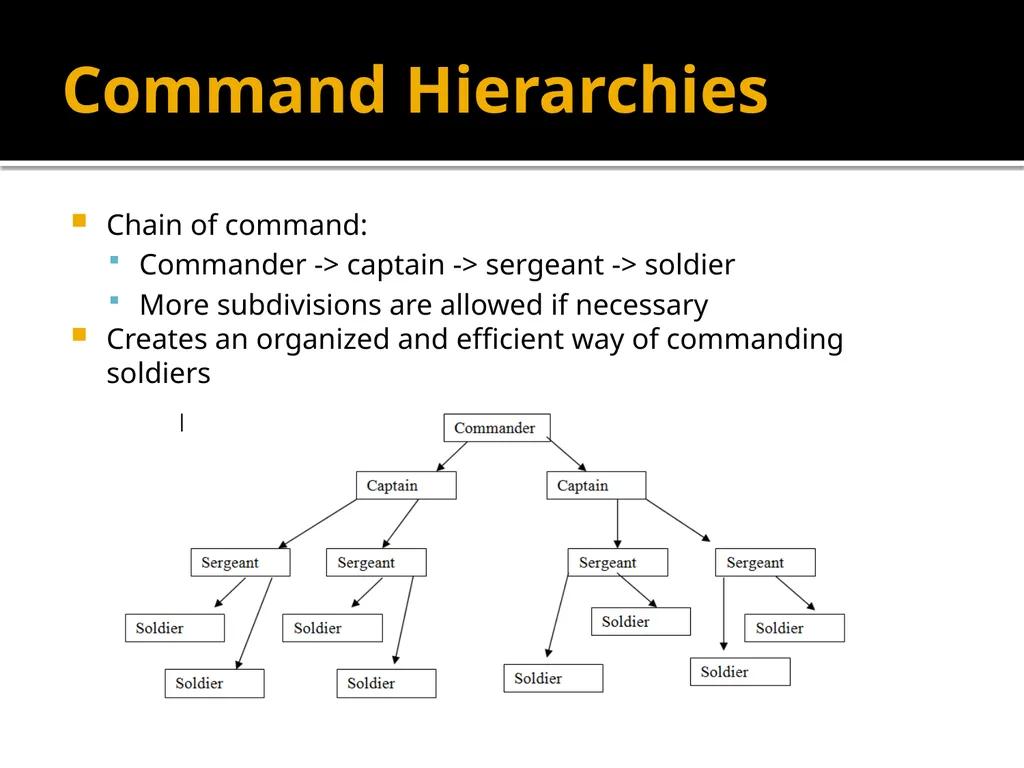
Command Hierarchies Chain of command:
Commander -> captain -> sergeant -> soldier
More subdivisions are allowed if necessary
Creates an organized and efficient way of commanding soldiers<br>
Commander -> captain -> sergeant -> soldier
More subdivisions are allowed if necessary
Creates an organized and efficient way of commanding soldiers<br>
35
Example: Outflanking Maneuvers Strategic Decision Process
Check if maneuver is possible/appropriate
Doors are accessible (referencing door IDs so there are no duplicate actions)
Compare
Distance between opponent and door with distance between soldier and door
Maneuver organization
Consider distance to closest door so maneuver is as fast as possible<br>
Check if maneuver is possible/appropriate
Doors are accessible (referencing door IDs so there are no duplicate actions)
Compare
Distance between opponent and door with distance between soldier and door
Maneuver organization
Consider distance to closest door so maneuver is as fast as possible<br>
36
Example: Covering Exits Maneuver Strategic decision process
Try to determine whether the maneuver is possible/advantageous
Check if ally must cross a specific room in order to get from their room to a target<br>
Try to determine whether the maneuver is possible/advantageous
Check if ally must cross a specific room in order to get from their room to a target<br>
37
Example (cont.) Maneuver organization
Find how many soldiers are needed to cover exits
Order soldiers to cover designated positions
Decide on a room to search
Order soldiers to move to reachable doors of the first room
When all of the above have been completed, a search command is sent to squad<br>
Find how many soldiers are needed to cover exits
Order soldiers to cover designated positions
Decide on a room to search
Order soldiers to move to reachable doors of the first room
When all of the above have been completed, a search command is sent to squad<br>
38
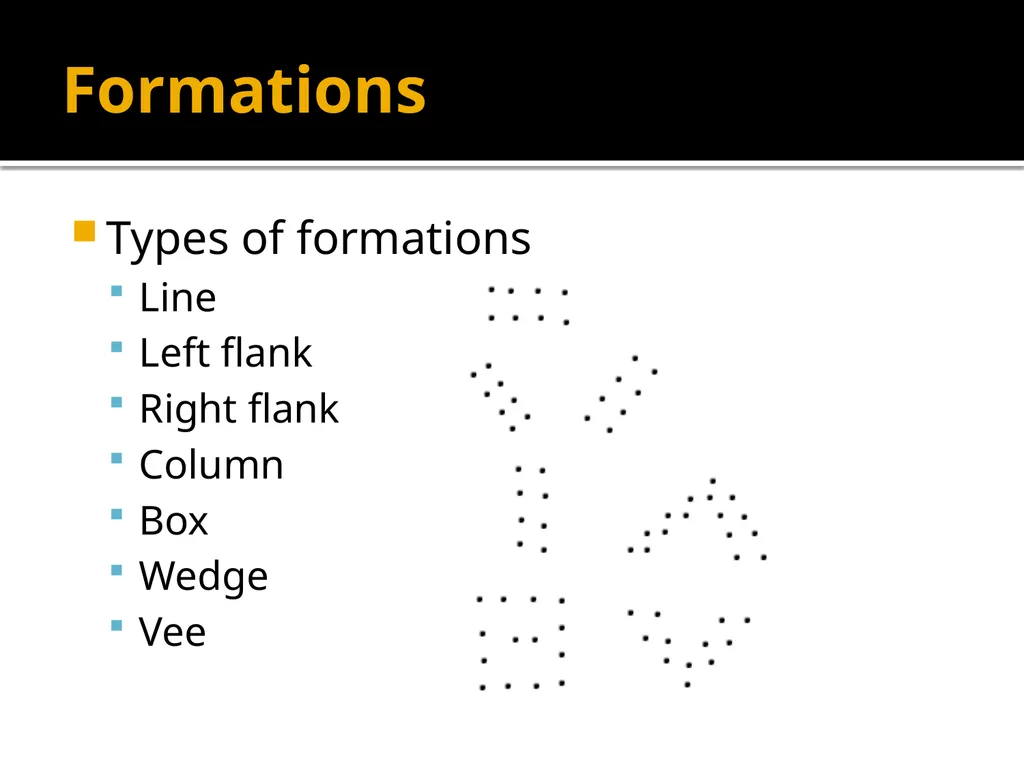
Formations Types of formations
Line
Left flank
Right flank
Column
Box
Wedge
Vee<br>
Line
Left flank
Right flank
Column
Box
Wedge
Vee<br>
39
Facing in Formations Different facing applies to different tactics
Defense vs offense
LOS
Friendly fire
Project more firepower
Staggered line
Outward facing vs inward facing<br>
Defense vs offense
LOS
Friendly fire
Project more firepower
Staggered line
Outward facing vs inward facing<br>
40
Ordering Mixed unit type ordering
Weaker/longer-ranged units in the back of the line or center of a box
Faster units placed at flanks
Closest position
Calculating the best match of unites to positions
Sort units based on their minimum distance to the closest position
Iterate through the sorted list
Assign each unit the closest unused position<br>
Weaker/longer-ranged units in the back of the line or center of a box
Faster units placed at flanks
Closest position
Calculating the best match of unites to positions
Sort units based on their minimum distance to the closest position
Iterate through the sorted list
Assign each unit the closest unused position<br>
41
Unit mobility Direction may play a role if turning is difficult
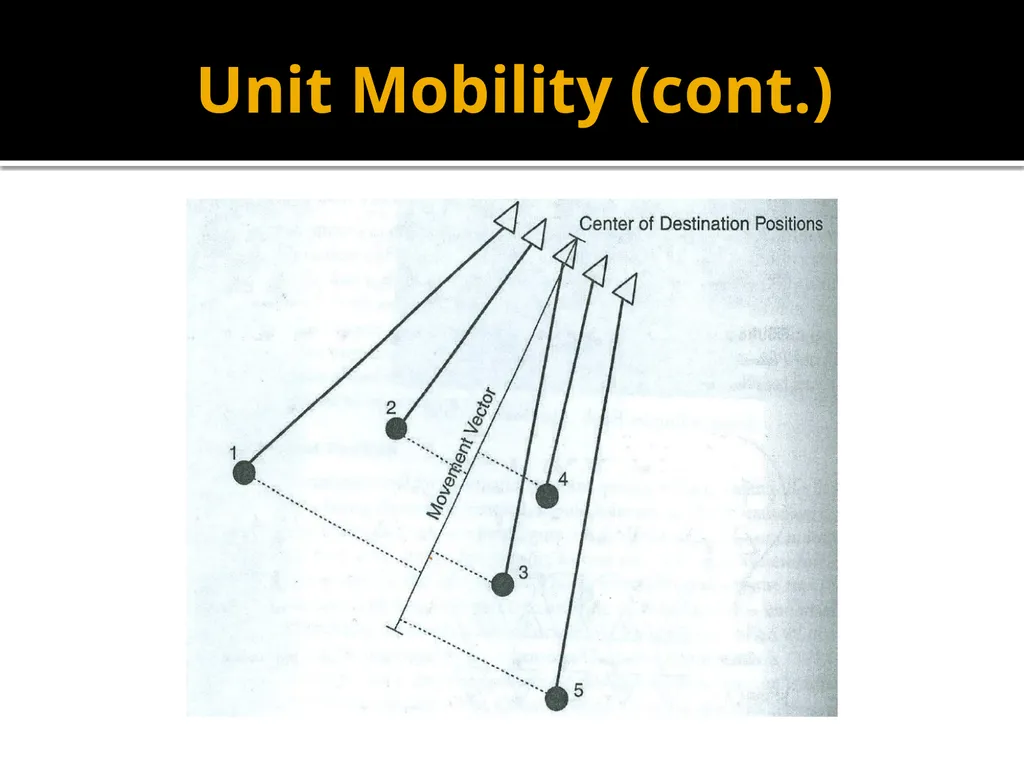
Create formation positions that avoid crossing paths of units
Use movement vector and parallel paths
Arriving time
Fix variations in arrival time by making all units’ paths lead to the center of the formation and order is determined by arrival time (illustration on next slide)<br>
Create formation positions that avoid crossing paths of units
Use movement vector and parallel paths
Arriving time
Fix variations in arrival time by making all units’ paths lead to the center of the formation and order is determined by arrival time (illustration on next slide)<br>
42
Unit Mobility (cont.)<br>
43
Unit Mobility (cont.) Spacing distance
Must be scaled so that the size difference in units is considered
Ranks
Each formation has a maximum occupant limit
Start new formation once reached
Playbook
If certain places are reserved for specific units restrictions must be coded
If no match found for a position, slot may be skipped (hole is made)<br>
Must be scaled so that the size difference in units is considered
Ranks
Each formation has a maximum occupant limit
Start new formation once reached
Playbook
If certain places are reserved for specific units restrictions must be coded
If no match found for a position, slot may be skipped (hole is made)<br>
44
Moving Out When do the units fall into formation?
Upon initial movement
Might delay movement
Might cause unit backtracking
Just before destination
Might give player impression that nothing is happening
Might be best choice for coordinated attack<br>
Upon initial movement
Might delay movement
Might cause unit backtracking
Just before destination
Might give player impression that nothing is happening
Might be best choice for coordinated attack<br>
45
Moving out (cont.) do formation at destination
Faster movement/no delays
Formations made as distance to destination decreases
Not as effective while en route
Not as organized upon arrival<br>
Faster movement/no delays
Formations made as distance to destination decreases
Not as effective while en route
Not as organized upon arrival<br>
46
Moving out (cont.) Group path finding and movement
Calculate path for lead, others apply formation offsets to path
Flocking style where group follows slightly behind lead in rough formation
When mixed units move as a group, differences in locomotion can break formation integrity
Solution: all units move like the slowest unit
Problem -> faster units might appear to move in slow motion<br>
Calculate path for lead, others apply formation offsets to path
Flocking style where group follows slightly behind lead in rough formation
When mixed units move as a group, differences in locomotion can break formation integrity
Solution: all units move like the slowest unit
Problem -> faster units might appear to move in slow motion<br>
47
Moving out (cont.) React to ambush
Spread out to avoid area of effect or converge to chase down an enemy
After passing obstacle or attack regroup in the same fashion that the group was originally formed
Reassign positions to make up for lost units if necessary<br>
Spread out to avoid area of effect or converge to chase down an enemy
After passing obstacle or attack regroup in the same fashion that the group was originally formed
Reassign positions to make up for lost units if necessary<br>
48
Influence vectors Algorithms capable of tactical assessments in a dynamic environment
Modification of influence mapping
Cells of influence are calculated from unit positions outward
Total influence: a factor which assesses bot tactical situation in the engagement area
Each “cell” superimposed on the influence map has a calculated value associated with agent and environmental qualities<br>
Modification of influence mapping
Cells of influence are calculated from unit positions outward
Total influence: a factor which assesses bot tactical situation in the engagement area
Each “cell” superimposed on the influence map has a calculated value associated with agent and environmental qualities<br>
49
Genetic Programming Learning algorithms that give an NPC the ability to adapt to opponents’ playing styles in real time
Pros
Provide more challenge as opponents because they are unpredictable
Facilitate the discovery of new strategies
Cons
Developers cannot test what behaviors the NPCs will exhibit<br>
Pros
Provide more challenge as opponents because they are unpredictable
Facilitate the discovery of new strategies
Cons
Developers cannot test what behaviors the NPCs will exhibit<br>
50
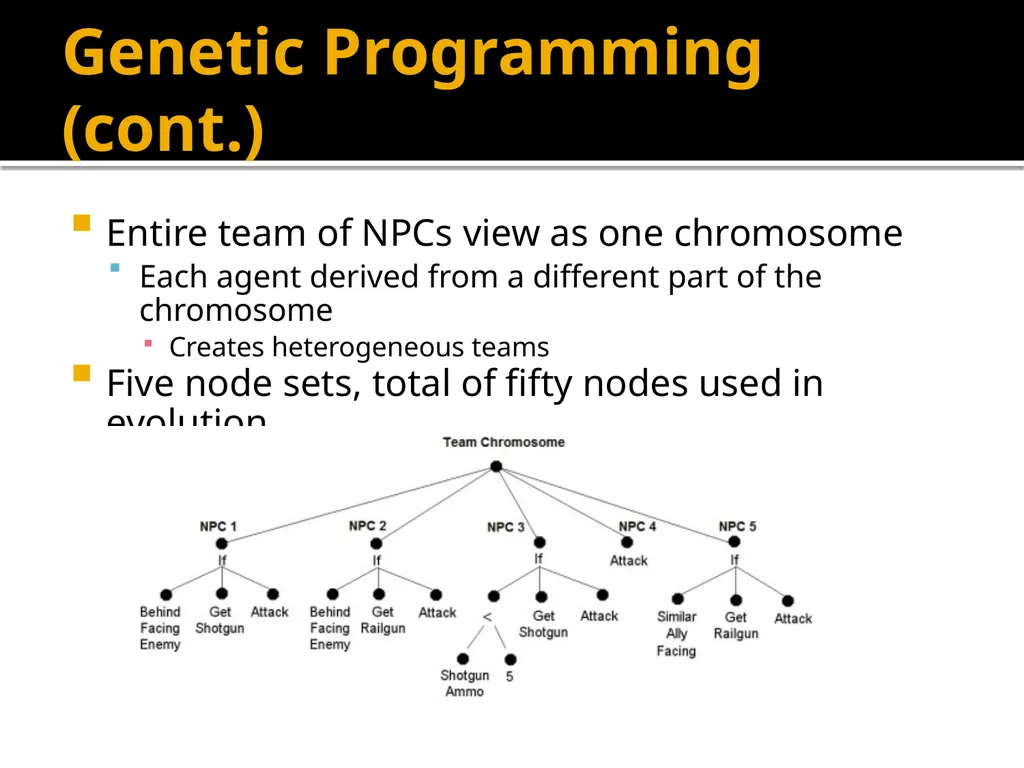
Genetic Programming (cont.) Entire team of NPCs view as one chromosome
Each agent derived from a different part of the chromosome
Creates heterogeneous teams
Five node sets, total of fifty nodes used in evolution<br>
Each agent derived from a different part of the chromosome
Creates heterogeneous teams
Five node sets, total of fifty nodes used in evolution<br>
51
Genetic Programming (cont.) Fitness calculation
Takes into consideration the game’s duration and remaining health of team and enemy agents
Selection
Elitism: m copies of the best n chromosomes from each generation are copied directly into the next generation
Roulette wheel selection
Any chromosomes selected are subject to randomness<br>
Takes into consideration the game’s duration and remaining health of team and enemy agents
Selection
Elitism: m copies of the best n chromosomes from each generation are copied directly into the next generation
Roulette wheel selection
Any chromosomes selected are subject to randomness<br>
52
Example of capabilities http://www.youtube.com/watch?feature=player_embedded&v=4ErEBkj_3PY<br>