
Stall & Spin Training in Gliders Stall & Spin
YM
Published · 20 slides · 0 views
1 / 1
Description
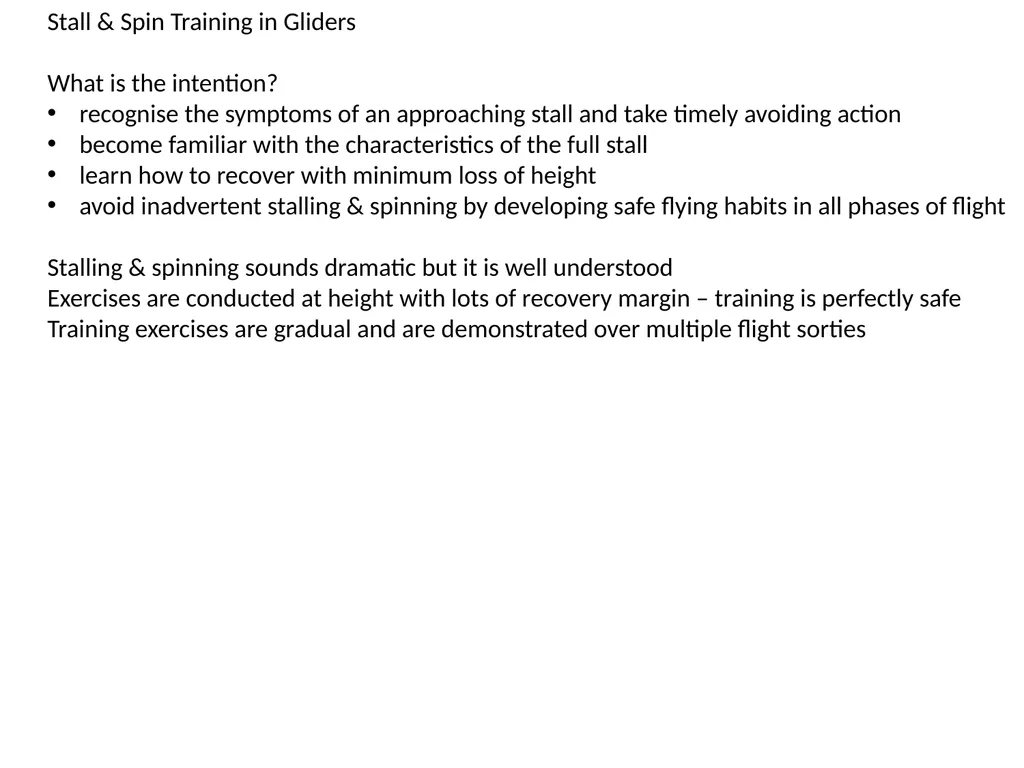
Stall Spin Training in Gliders Stall Spin Training in Gliders What is the intention? recognise the symptoms of an approaching stall and take timely avoiding action become familiar with the characteristics of the full stall learn how to
Related Topics
Share
Embed code
Download this presentation From Below
"Stall & Spin Training in Gliders Stall & Spin" is the property of its rightful owner. Permission is granted to download and print the materials on this website for personal, non-commercial use only, and to display it on your personal computer provided you do not modify the materials and that you retain all copyright notices contained in the materials. By downloading content from our website, you accept the terms of this agreement.
Presentation Transcript
01
Stall & Spin Training in Gliders<br>
02
Stall & Spin Training in Gliders
What is the intention?
recognise the symptoms of an approaching stall and take timely avoiding action
become familiar with the characteristics of the full stall
learn how to recover with minimum loss of height
avoid inadvertent stalling & spinning by developing safe flying habits in all phases of flight
Stalling & spinning sounds dramatic but it is well understood
Exercises are conducted at height with lots of recovery margin – training is perfectly safe
Training exercises are gradual and are demonstrated over multiple flight sorties<br>
What is the intention?
recognise the symptoms of an approaching stall and take timely avoiding action
become familiar with the characteristics of the full stall
learn how to recover with minimum loss of height
avoid inadvertent stalling & spinning by developing safe flying habits in all phases of flight
Stalling & spinning sounds dramatic but it is well understood
Exercises are conducted at height with lots of recovery margin – training is perfectly safe
Training exercises are gradual and are demonstrated over multiple flight sorties<br>
03
Stall & Spin Training in Gliders
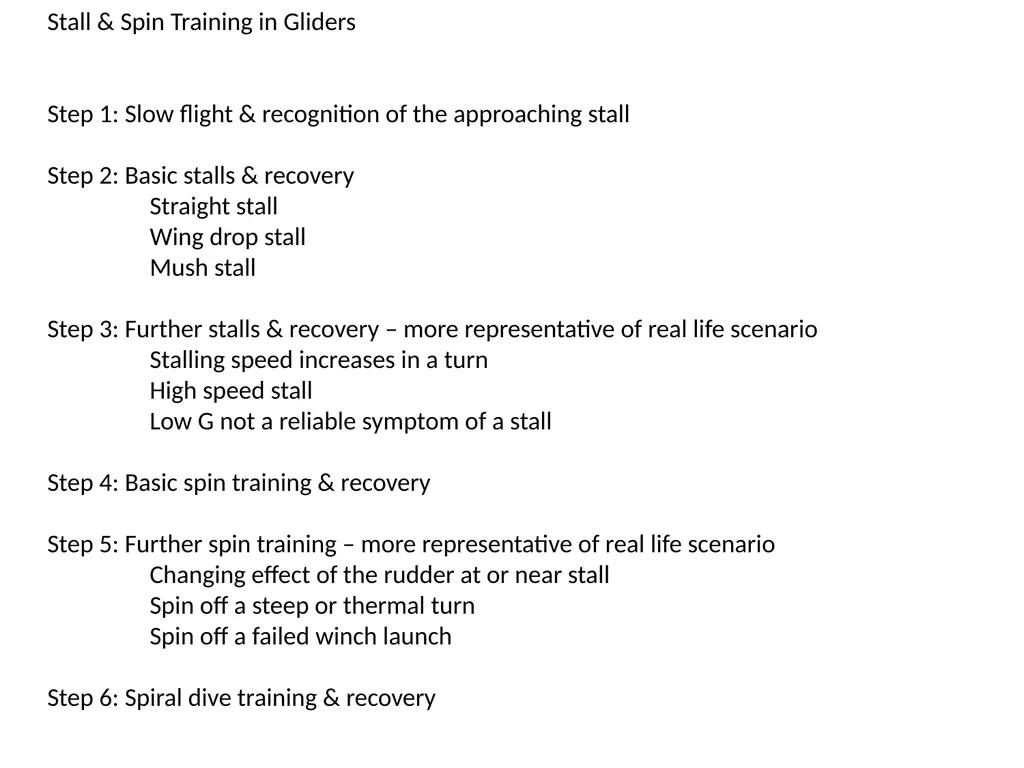
Step 1: Slow flight & recognition of the approaching stall
Step 2: Basic stalls & recovery
Straight stall
Wing drop stall
Mush stall
Step 3: Further stalls & recovery – more representative of real life scenario
Stalling speed increases in a turn
High speed stall
Low G not a reliable symptom of a stall
Step 4: Basic spin training & recovery
Step 5: Further spin training – more representative of real life scenario
Changing effect of the rudder at or near stall
Spin off a steep or thermal turn
Spin off a failed winch launch
Step 6: Spiral dive training & recovery<br>
Step 1: Slow flight & recognition of the approaching stall
Step 2: Basic stalls & recovery
Straight stall
Wing drop stall
Mush stall
Step 3: Further stalls & recovery – more representative of real life scenario
Stalling speed increases in a turn
High speed stall
Low G not a reliable symptom of a stall
Step 4: Basic spin training & recovery
Step 5: Further spin training – more representative of real life scenario
Changing effect of the rudder at or near stall
Spin off a steep or thermal turn
Spin off a failed winch launch
Step 6: Spiral dive training & recovery<br>
04
Stall & Spin Training in Gliders
Initial Stalls
What is a stall?
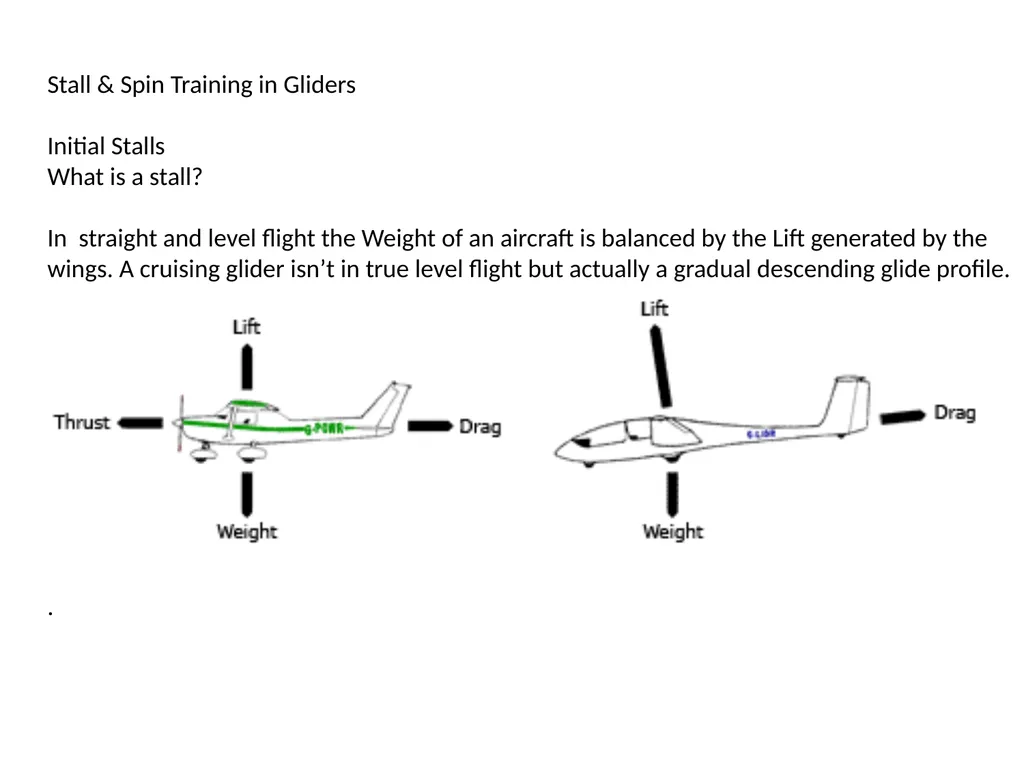
In straight and level flight the Weight of an aircraft is balanced by the Lift generated by the wings. A cruising glider isn’t in true level flight but actually a gradual descending glide profile.
Insert weight balance L/D diagram
Insert wing diagram with attached airflow
.<br>
Initial Stalls
What is a stall?
In straight and level flight the Weight of an aircraft is balanced by the Lift generated by the wings. A cruising glider isn’t in true level flight but actually a gradual descending glide profile.
Insert weight balance L/D diagram
Insert wing diagram with attached airflow
.<br>
05
Stall & Spin Training in Gliders
The total Lift generated by a wing is dependent on a number of factors and most are outside the pilot’s control e.g.
Air density
Wing area
Wing shape (planform)
Wing shape (camber – although some gliders have camber changing flaps)
The factors affecting the Lift that are in a pilot’s direct control are:
Airspeed
Angle of Attack
Angle of Attack is what we are interested in regarding stalls & spins.
.<br>
The total Lift generated by a wing is dependent on a number of factors and most are outside the pilot’s control e.g.
Air density
Wing area
Wing shape (planform)
Wing shape (camber – although some gliders have camber changing flaps)
The factors affecting the Lift that are in a pilot’s direct control are:
Airspeed
Angle of Attack
Angle of Attack is what we are interested in regarding stalls & spins.
.<br>
06
Stall & Spin Training in Gliders
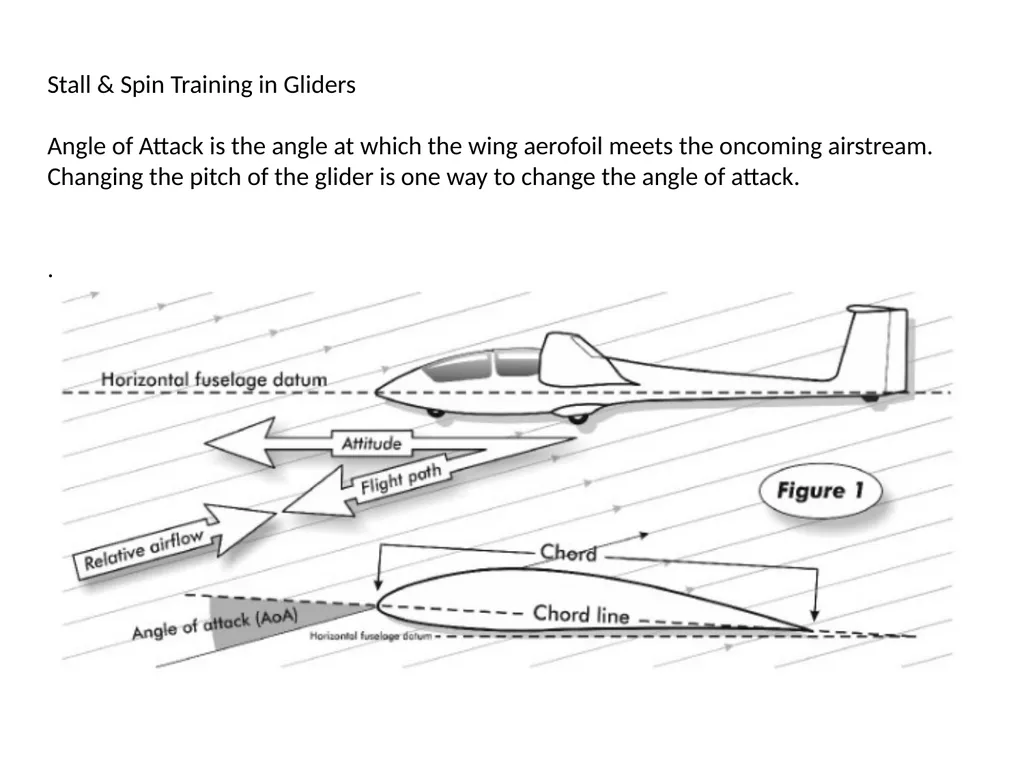
Angle of Attack is the angle at which the wing aerofoil meets the oncoming airstream.
Changing the pitch of the glider is one way to change the angle of attack.
.<br>
Angle of Attack is the angle at which the wing aerofoil meets the oncoming airstream.
Changing the pitch of the glider is one way to change the angle of attack.
.<br>
07
Stall & Spin Training in Gliders
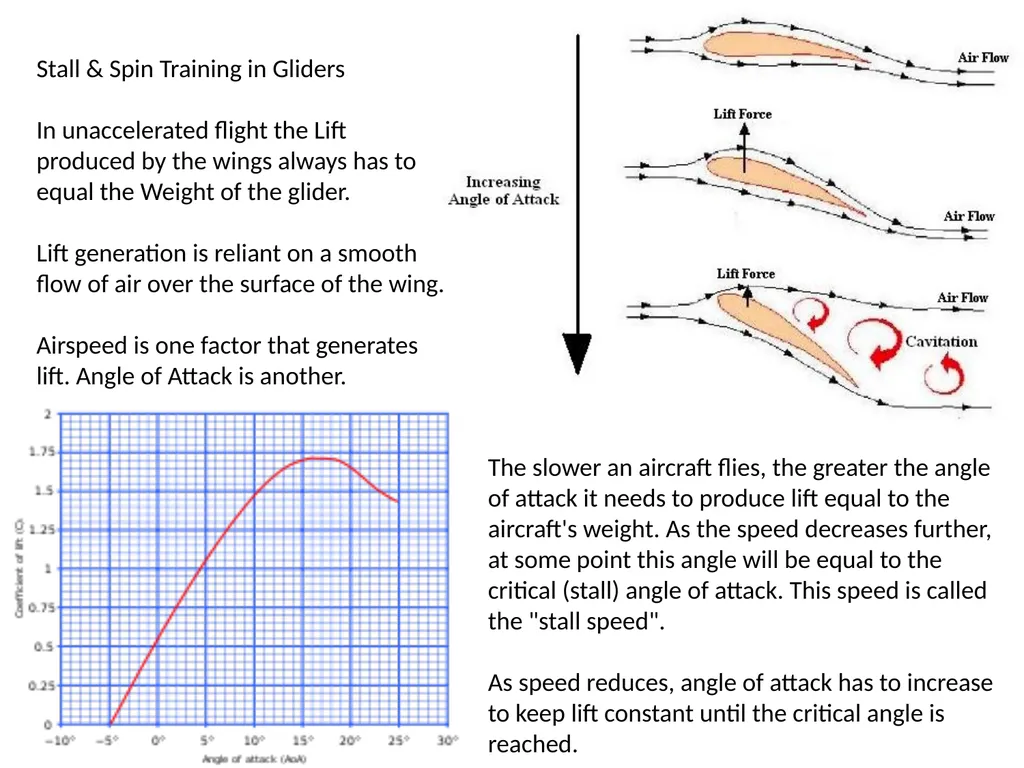
In unaccelerated flight the Lift produced by the wings always has to equal the Weight of the glider.
Lift generation is reliant on a smooth flow of air over the surface of the wing.
Airspeed is one factor that generates lift. Angle of Attack is another. The slower an aircraft flies, the greater the angle of attack it needs to produce lift equal to the aircraft's weight. As the speed decreases further, at some point this angle will be equal to the critical (stall) angle of attack. This speed is called the "stall speed".
As speed reduces, angle of attack has to increase to keep lift constant until the critical angle is reached.<br>
In unaccelerated flight the Lift produced by the wings always has to equal the Weight of the glider.
Lift generation is reliant on a smooth flow of air over the surface of the wing.
Airspeed is one factor that generates lift. Angle of Attack is another. The slower an aircraft flies, the greater the angle of attack it needs to produce lift equal to the aircraft's weight. As the speed decreases further, at some point this angle will be equal to the critical (stall) angle of attack. This speed is called the "stall speed".
As speed reduces, angle of attack has to increase to keep lift constant until the critical angle is reached.<br>
08
Stall & Spin Training in Gliders
Initial Stalls
What is a stall?
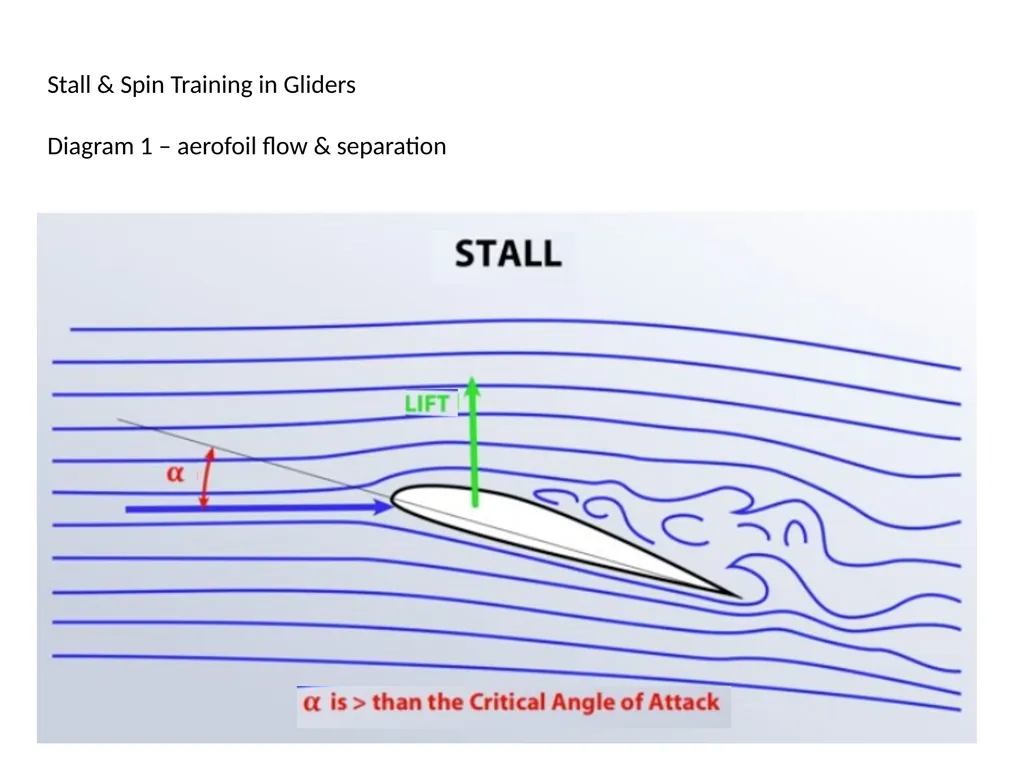
Stalling is the loss of Lift caused by flow separation from the wing surfaces.
Stalls depend only on angle of attack, not airspeed.
Reducing your airspeed is one way to increase the Angle of Attack.
Stalls are still possible at higher speeds in scenarios that create a higher angle of attack.
Stall recovery training = spin avoidance training!
.<br>
Initial Stalls
What is a stall?
Stalling is the loss of Lift caused by flow separation from the wing surfaces.
Stalls depend only on angle of attack, not airspeed.
Reducing your airspeed is one way to increase the Angle of Attack.
Stalls are still possible at higher speeds in scenarios that create a higher angle of attack.
Stall recovery training = spin avoidance training!
.<br>
09
Stall & Spin Training in Gliders
Diagram 1 – aerofoil flow & separation<br>
Diagram 1 – aerofoil flow & separation<br>
10
Stall & Spin Training in Gliders
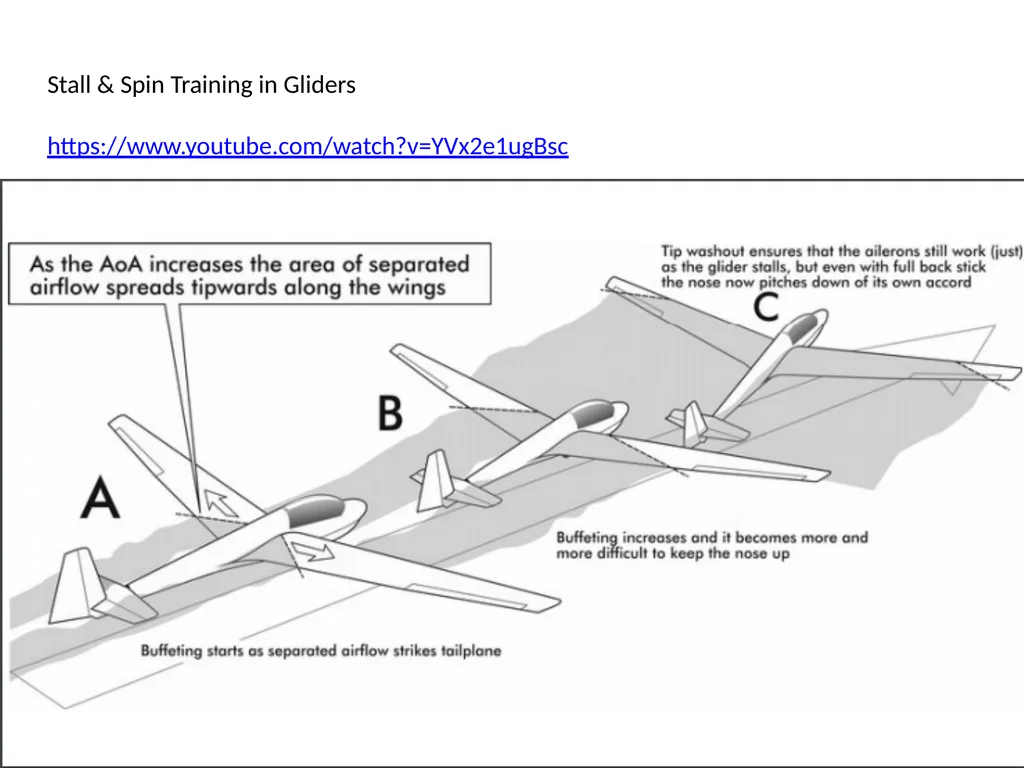
https://www.youtube.com/watch?v=YVx2e1ugBsc<br>
https://www.youtube.com/watch?v=YVx2e1ugBsc<br>
11
Stall & Spin Training in Gliders
Initial Stalls
How to recognise a stall from the cockpit
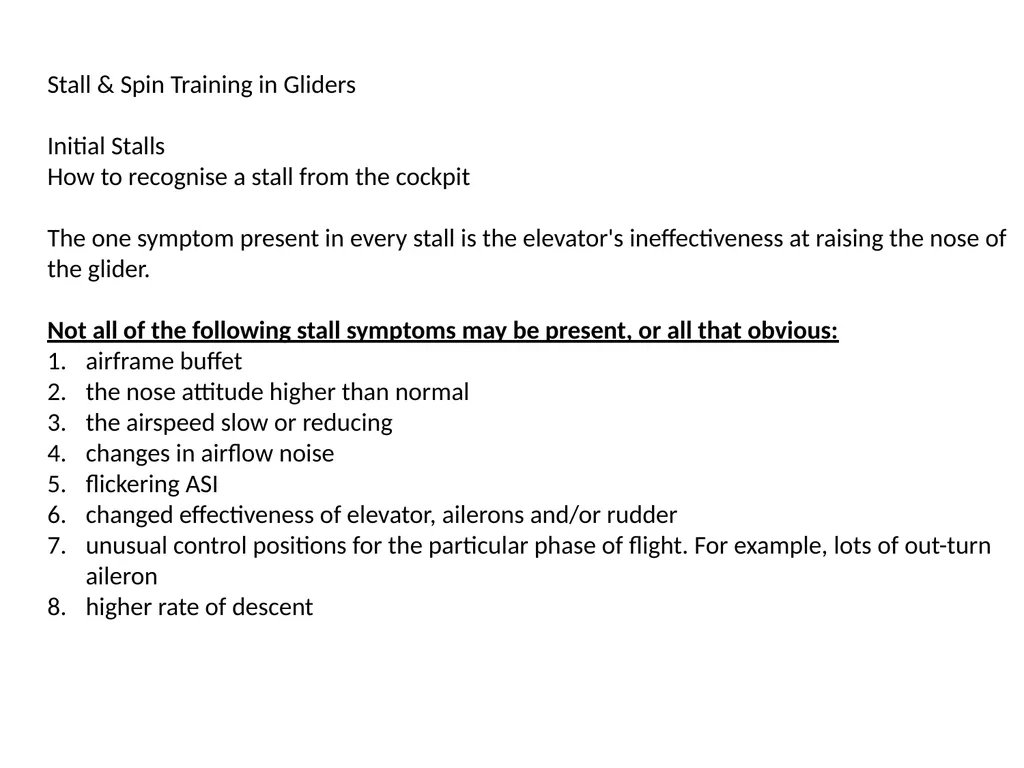
The one symptom present in every stall is the elevator's ineffectiveness at raising the nose of the glider.
Not all of the following stall symptoms may be present, or all that obvious:
airframe buffet
the nose attitude higher than normal
the airspeed slow or reducing
changes in airflow noise
flickering ASI
changed effectiveness of elevator, ailerons and/or rudder
unusual control positions for the particular phase of flight. For example, lots of out-turn aileron
higher rate of descent<br>
Initial Stalls
How to recognise a stall from the cockpit
The one symptom present in every stall is the elevator's ineffectiveness at raising the nose of the glider.
Not all of the following stall symptoms may be present, or all that obvious:
airframe buffet
the nose attitude higher than normal
the airspeed slow or reducing
changes in airflow noise
flickering ASI
changed effectiveness of elevator, ailerons and/or rudder
unusual control positions for the particular phase of flight. For example, lots of out-turn aileron
higher rate of descent<br>
12
Stall & Spin Training in Gliders
How to recover from a stall:
Ease forwards on the stick
regain flying speed
return to the required gliding attitude (for that phase of flight)
How/why does this work?
Reduces the Angle of Attack
Reduces the G loading on the wings
Increases airspeed
Unstalls the glider<br>
How to recover from a stall:
Ease forwards on the stick
regain flying speed
return to the required gliding attitude (for that phase of flight)
How/why does this work?
Reduces the Angle of Attack
Reduces the G loading on the wings
Increases airspeed
Unstalls the glider<br>
13
Stall & Spin Training in Gliders
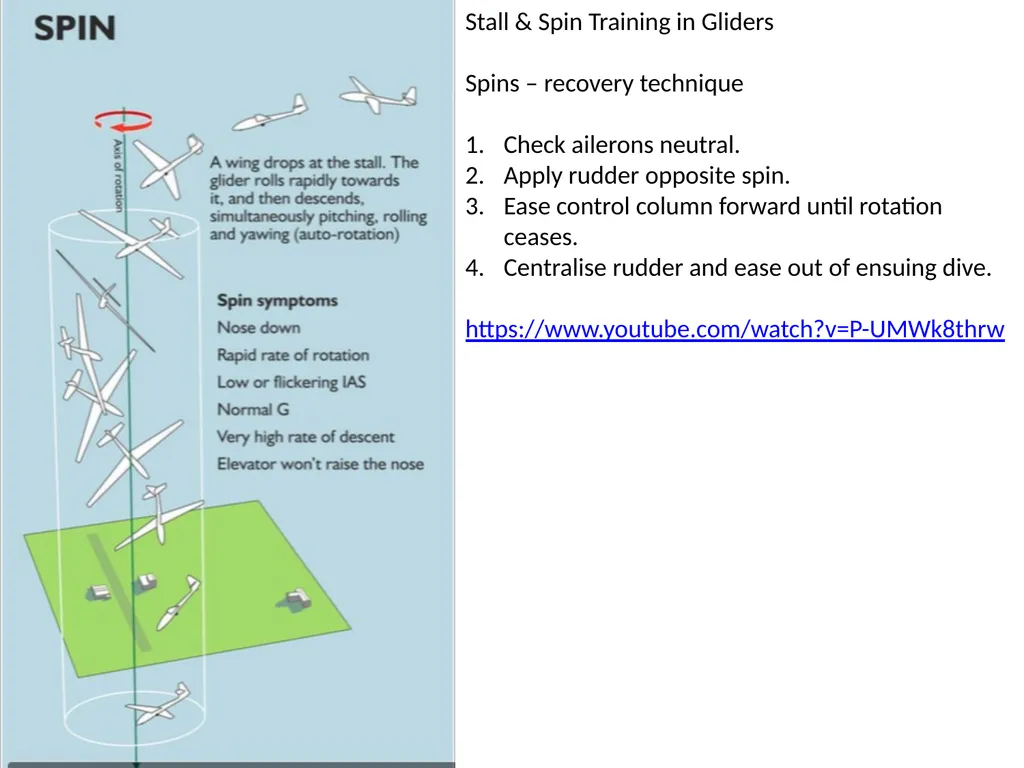
Spins
Spinning has been around since the dawn of aviation.
Stall recovery was understood relatively early but spin recovery took several more years.
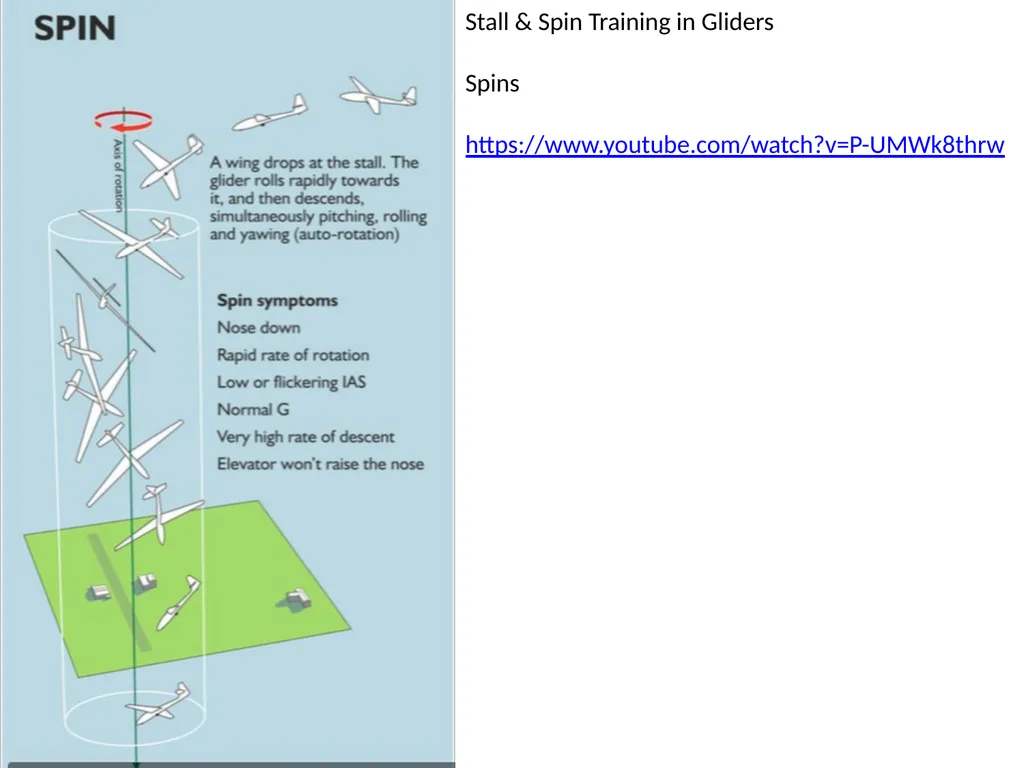
A spin is an auto rotation caused by one or both wings being stalled.
At it’s simplest, a spin is caused by a stall with yaw present
The characteristics of the spin itself are a coupling between aerodynamic & inertial forces
The spin and associated recovery incur a relatively large height loss & high rate of descent
Not a problem at altitude but definitely problematic at lower heights
Spinning characteristics and recovery techniques are driven by the aircraft design
Circa WW1, spin characteristics and recovery techniques were different for every new aircraft model
Spin recovery characteristics are now a part of aircraft certification standards
CS22 (Sailplanes) says the glider needs to recover within one complete turn.
(1.5 turns if glider not in configuration for “intentional spinning”.)
It must be impossible to obtain uncontrollable spins with any use of the controls.
The standardised spin recovery technique will work for all gliders designed to CS22 and being flown within their weight & CG limits – hence the ‘B’ for Ballast in pre-flight checks<br>
Spins
Spinning has been around since the dawn of aviation.
Stall recovery was understood relatively early but spin recovery took several more years.
A spin is an auto rotation caused by one or both wings being stalled.
At it’s simplest, a spin is caused by a stall with yaw present
The characteristics of the spin itself are a coupling between aerodynamic & inertial forces
The spin and associated recovery incur a relatively large height loss & high rate of descent
Not a problem at altitude but definitely problematic at lower heights
Spinning characteristics and recovery techniques are driven by the aircraft design
Circa WW1, spin characteristics and recovery techniques were different for every new aircraft model
Spin recovery characteristics are now a part of aircraft certification standards
CS22 (Sailplanes) says the glider needs to recover within one complete turn.
(1.5 turns if glider not in configuration for “intentional spinning”.)
It must be impossible to obtain uncontrollable spins with any use of the controls.
The standardised spin recovery technique will work for all gliders designed to CS22 and being flown within their weight & CG limits – hence the ‘B’ for Ballast in pre-flight checks<br>
14
Stall & Spin Training in Gliders
Spins
https://www.youtube.com/watch?v=P-UMWk8thrw<br>
Spins
https://www.youtube.com/watch?v=P-UMWk8thrw<br>
15
Stall & Spin Training in Gliders
Spins – some factors are determined in the design office
Areas of the flying and control surfaces
Lever arm distances to the control surfaces
Mass distribution & wingspan – gliders spin less dramatically than power aircraft (swing analogy)
Wing design – washout
Why do we still train glider pilots for stalling and spinning?
Glider designs mean that stalls/spins are standardised, benign and recoverable
Eliminating stalling is not possible
Gliders will spin when stalled with yaw present
Situational awareness is a key element in avoiding stalled flight<br>
Spins – some factors are determined in the design office
Areas of the flying and control surfaces
Lever arm distances to the control surfaces
Mass distribution & wingspan – gliders spin less dramatically than power aircraft (swing analogy)
Wing design – washout
Why do we still train glider pilots for stalling and spinning?
Glider designs mean that stalls/spins are standardised, benign and recoverable
Eliminating stalling is not possible
Gliders will spin when stalled with yaw present
Situational awareness is a key element in avoiding stalled flight<br>
16
Stall & Spin Training in Gliders
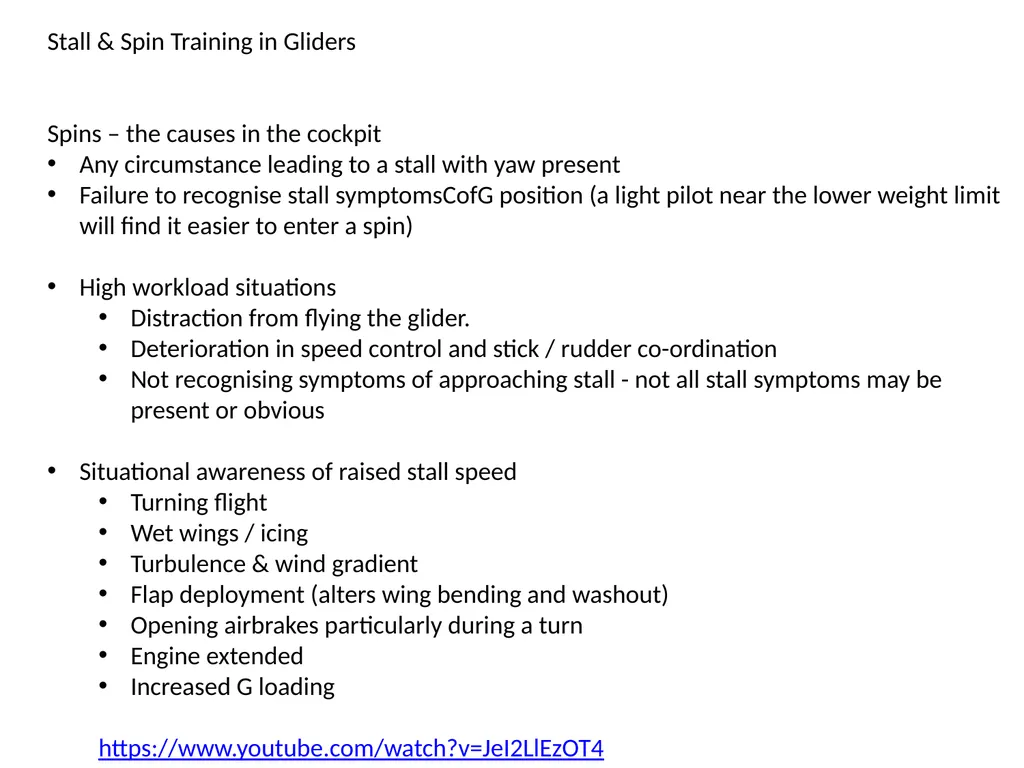
Spins – the causes in the cockpit
Any circumstance leading to a stall with yaw present
Failure to recognise stall symptomsCofG position (a light pilot near the lower weight limit will find it easier to enter a spin)
High workload situations
Distraction from flying the glider.
Deterioration in speed control and stick / rudder co-ordination
Not recognising symptoms of approaching stall - not all stall symptoms may be present or obvious
Situational awareness of raised stall speed
Turning flight
Wet wings / icing
Turbulence & wind gradient
Flap deployment (alters wing bending and washout)
Opening airbrakes particularly during a turn
Engine extended
Increased G loading
https://www.youtube.com/watch?v=JeI2LlEzOT4<br>
Spins – the causes in the cockpit
Any circumstance leading to a stall with yaw present
Failure to recognise stall symptomsCofG position (a light pilot near the lower weight limit will find it easier to enter a spin)
High workload situations
Distraction from flying the glider.
Deterioration in speed control and stick / rudder co-ordination
Not recognising symptoms of approaching stall - not all stall symptoms may be present or obvious
Situational awareness of raised stall speed
Turning flight
Wet wings / icing
Turbulence & wind gradient
Flap deployment (alters wing bending and washout)
Opening airbrakes particularly during a turn
Engine extended
Increased G loading
https://www.youtube.com/watch?v=JeI2LlEzOT4<br>
17
Stall & Spin Training in Gliders
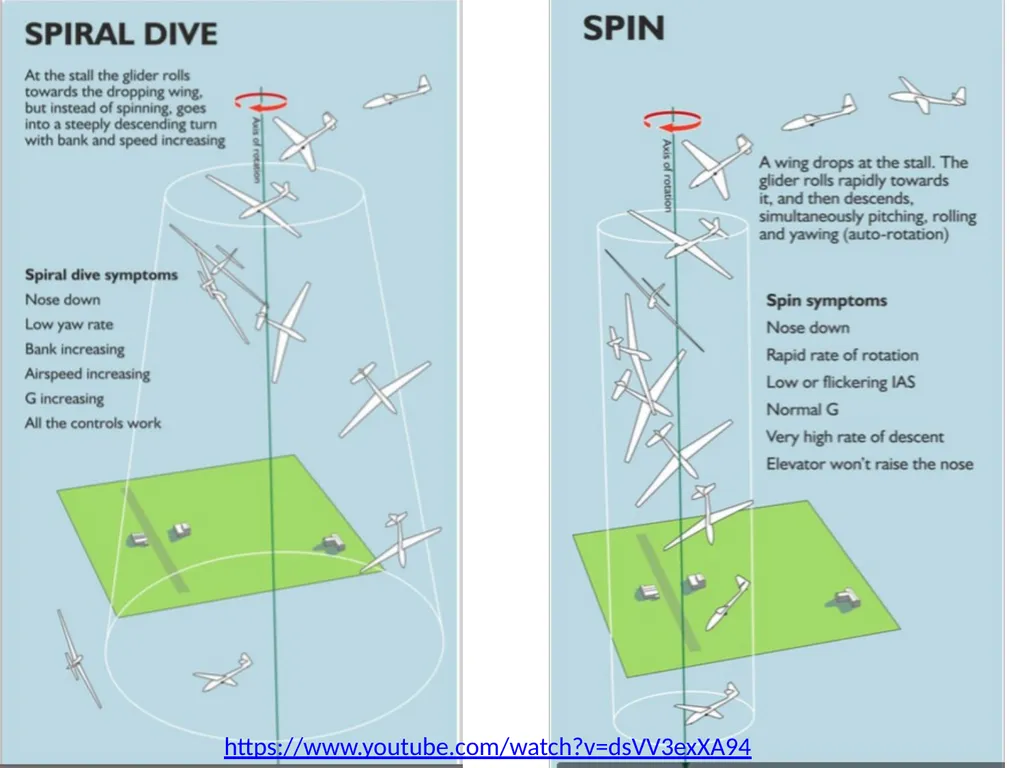
Spins – recovery technique
Check ailerons neutral.
Apply rudder opposite spin.
Ease control column forward until rotation ceases.
Centralise rudder and ease out of ensuing dive.
https://www.youtube.com/watch?v=P-UMWk8thrw<br>
Spins – recovery technique
Check ailerons neutral.
Apply rudder opposite spin.
Ease control column forward until rotation ceases.
Centralise rudder and ease out of ensuing dive.
https://www.youtube.com/watch?v=P-UMWk8thrw<br>
18
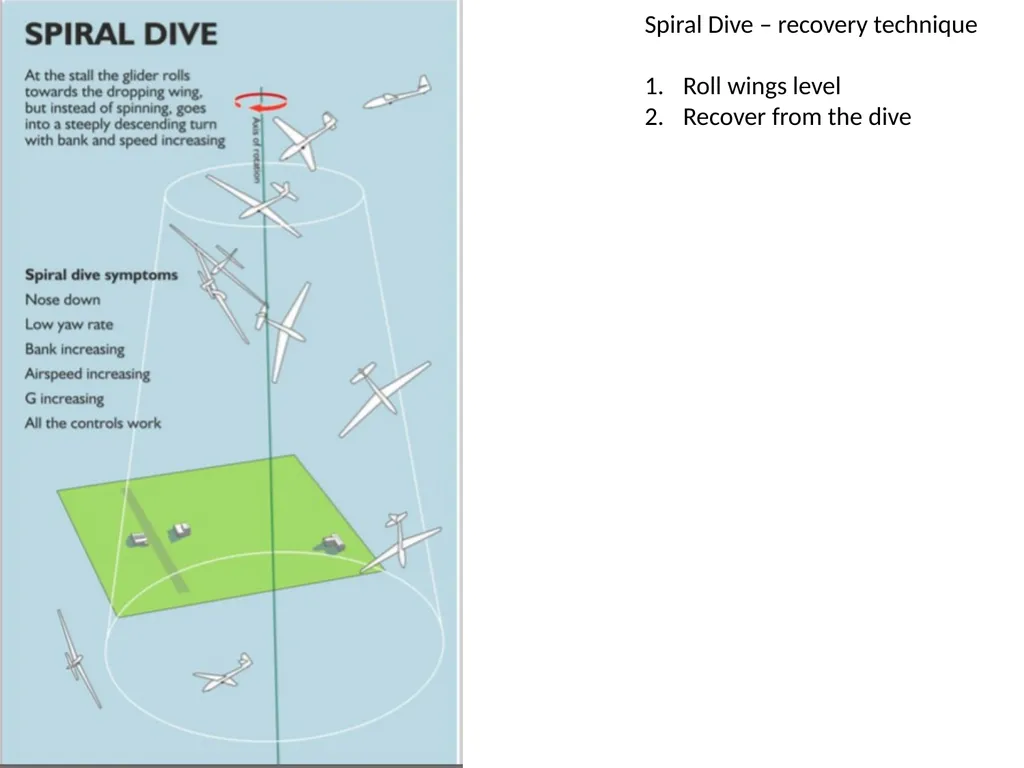
Spiral Dive – recovery technique
Roll wings level
Recover from the dive<br>
Roll wings level
Recover from the dive<br>
19
https://www.youtube.com/watch?v=dsVV3exXA94<br>
20
Stall & Spin Training in Gliders
Summary
Training is intended to teach you to:
recognise the symptoms of an approaching stall and take timely avoiding action
become familiar with the characteristics of the full stall
learn how to recover with minimum loss of height
avoid inadvertent stalling & spinning by developing safe flying habits in all phases of flight
Stalling & spinning sounds dramatic but it is well understood
Exercises are conducted at height with lots of recovery margin – training is perfectly safe
Training exercises are gradual and are demonstrated over multiple flight sorties
Recovery from a Stall is simple – ease the stick forwards
Standard recoveries for Spins & Spiral Dives<br>
Summary
Training is intended to teach you to:
recognise the symptoms of an approaching stall and take timely avoiding action
become familiar with the characteristics of the full stall
learn how to recover with minimum loss of height
avoid inadvertent stalling & spinning by developing safe flying habits in all phases of flight
Stalling & spinning sounds dramatic but it is well understood
Exercises are conducted at height with lots of recovery margin – training is perfectly safe
Training exercises are gradual and are demonstrated over multiple flight sorties
Recovery from a Stall is simple – ease the stick forwards
Standard recoveries for Spins & Spiral Dives<br>