
STANAG 6001 Testing Workshop Distractor Analysis






Description: STANAG 6001 Testing Workshop Distractor Analysis of Selected Response Test Items David Oglesby Partner Language Training Center Europe A B C D Welcome, Language Testers Why should we do distractor analysis? Distractors are difficult to
Related Topics
Download Presentation
"STANAG 6001 Testing Workshop Distractor Analysis" is the property of its rightful owner. Permission is granted to download and print the materials on this website for personal, non-commercial use only, and to display it on your personal computer provided you do not modify the materials and that you retain all copyright notices contained in the materials. By downloading content from our website, you accept the terms of this agreement.
Presentation Transcript
slide1. STANAG 6001 Testing Workshop Distractor Analysis of Selected Response Test Items David Oglesby
Partner Language Training Center Europe A B C D<br>
slide2. Welcome, Language Testers Why should we do distractor analysis? Distractors are difficult to create
Making them equally plausible yet incorrect is hard
Sometimes they don’t work as intended
Accurate scoring keys are a must
Maximum item discrimination depends on our best efforts Poor distractors allow test takers to guess more strategically, which affects item difficulty, discrimination, and overall test difficulty.<br>
slide3. Anatomy of a Selected Response Test Item What does the speaker suggest about the government’s position?
a) It recognizes the need for change but concedes to special interest groups.
b) It has the resources but is unwilling to compromise with the opposing side.
c) It responds to domestic emergencies but steers clear of overseas conflicts.
d) It has willing international partners but has little popular support at home. Each multiple-choice item should have one and only one correct answer. “All of the above” and “None of the above” options encourage test takers to take a problem-solving approach, vice using language skills. Options STEM Key Distractor Distractor Distractor<br>
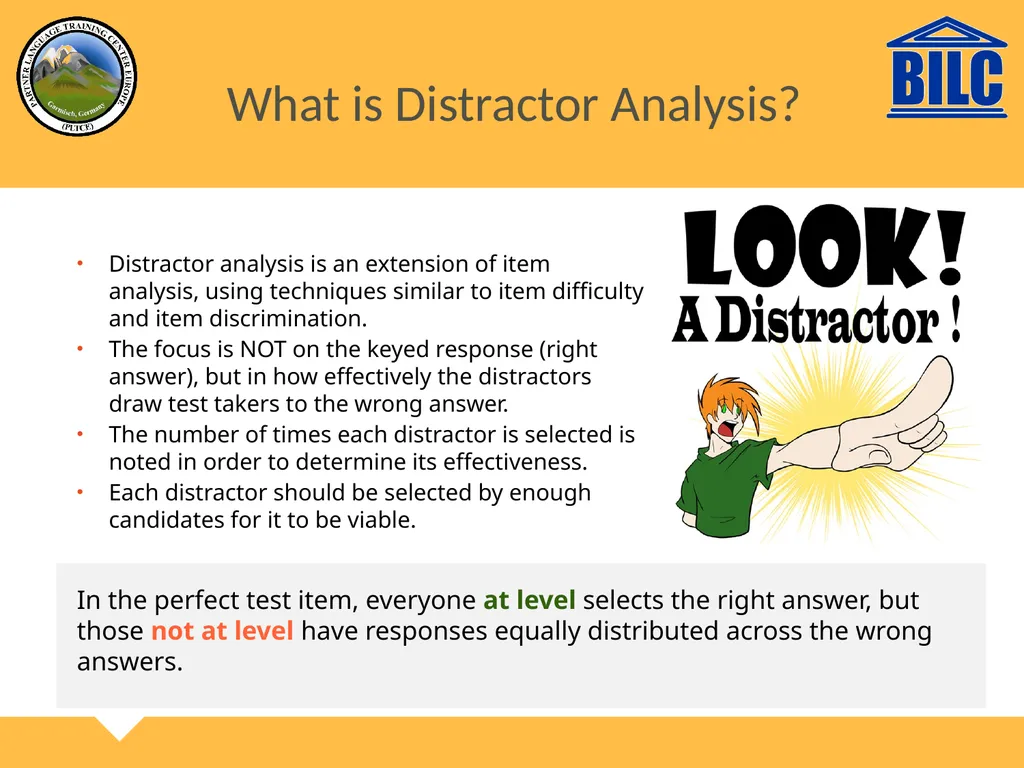
slide4. What is Distractor Analysis? Distractor analysis is an extension of item analysis, using techniques similar to item difficulty and item discrimination.
The focus is NOT on the keyed response (right answer), but in how effectively the distractors draw test takers to the wrong answer.
The number of times each distractor is selected is noted in order to determine its effectiveness.
Each distractor should be selected by enough candidates for it to be viable. In the perfect test item, everyone at level selects the right answer, but those not at level have responses equally distributed across the wrong answers.<br>
slide5. The Test A ten-item, multiple-choice test of Reading proficiency
Items ostensibly at STANAG 6001 Levels 2 and 3
Administered to 49 candidates, mostly Levels 1 to 3
Score range = 2 to 10; mean = 6.5; mode = 8; SD 1.71
Cronbach’s alpha = .42<br>
slide6. Item Analysis: Difficulty & Discrimination Knowing an item’s difficulty and discriminating ability helps us decide which items will be retained for testing and which need revision.<br>
slide7. Distractor Analysis: Option Counts Easy items (high Facility Value) often have ineffective distractors.
Hard items (low Facility Value) often have one attractive distractor, but the others are not as effective. =countif(B3:B51,”A”) Sample formula for option count<br>
slide8. Distractor Analysis: Percentages When a keyed response is less attractive than one (or more) of the distractors, you should check the correctness of the key and/or look for double keying. Divide by number of test takers (n) & multiply x 100 for percentage<br>
slide9. Distractor Analysis: Point Biserial for each Option The Point Biserial for each keyed response should be > .2, and each distractor should be < 0.<br>
slide10. The Exercise Break into groups
Moderate 2-3 items: retain, revise or reject
Develop new options, focusing on balanced distractors
Present recommendations in plenary<br>
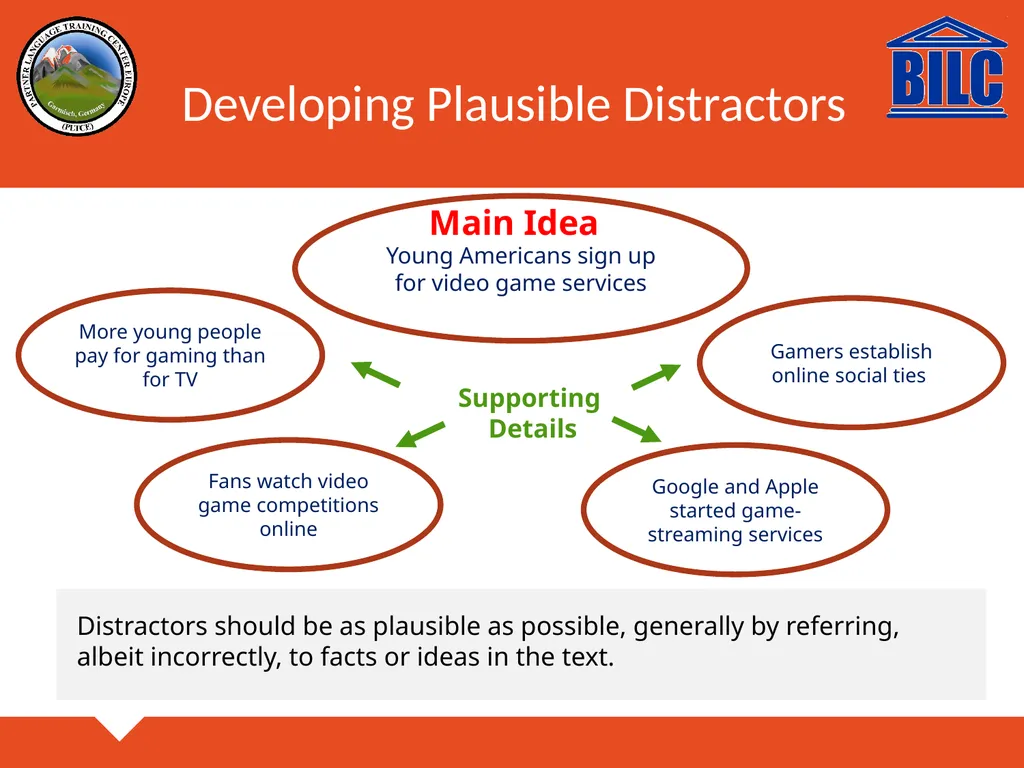
slide11. Developing Plausible Distractors Distractors should be as plausible as possible, generally by referring, albeit incorrectly, to facts or ideas in the text. Young Americans sign up for video game services Fans watch video game competitions online Google and Apple started game-streaming services Gamers establish online social ties More young people pay for gaming than for TV Supporting
Details Main Idea<br>
slide12. Rules of Thumb Keep the options parallel in grammar, length and complexity.
Ensure all options are plausible – no gimmes.
Present options in logical order – by date, order of appearance in text, etc.
Balance the placement of the keyed response.
Avoid the use of specific determiners (always, never, only, etc.) Avoid overlapping choices. Make the alternatives mutually exclusive. It should never be the case that if one of the distractors is true, another distractor must be true as well.<br>
slide13. More information Carr, N. (2011). Designing and Analyzing Language Tests (pp. 289-292). Oxford: Oxford University Press.
Fulcher, G. & Davidson, F. (2007). Language testing and assessment: An advanced resource book (pp. 326-329). New York, NY: Routledge.
Haladyna, Thomas M. (2016). In Haladyna et al (Eds.) Handbook of Test Development (pp. 401-404). New York, NY: Routledge. Check out Gerard’s paper on the number of options in selected-response items at https://www.natobilc.org/documents/Projects/MChoicesreadingtestSTUDY.pdf<br>
Partner Language Training Center Europe A B C D<br>
slide2. Welcome, Language Testers Why should we do distractor analysis? Distractors are difficult to create
Making them equally plausible yet incorrect is hard
Sometimes they don’t work as intended
Accurate scoring keys are a must
Maximum item discrimination depends on our best efforts Poor distractors allow test takers to guess more strategically, which affects item difficulty, discrimination, and overall test difficulty.<br>
slide3. Anatomy of a Selected Response Test Item What does the speaker suggest about the government’s position?
a) It recognizes the need for change but concedes to special interest groups.
b) It has the resources but is unwilling to compromise with the opposing side.
c) It responds to domestic emergencies but steers clear of overseas conflicts.
d) It has willing international partners but has little popular support at home. Each multiple-choice item should have one and only one correct answer. “All of the above” and “None of the above” options encourage test takers to take a problem-solving approach, vice using language skills. Options STEM Key Distractor Distractor Distractor<br>
slide4. What is Distractor Analysis? Distractor analysis is an extension of item analysis, using techniques similar to item difficulty and item discrimination.
The focus is NOT on the keyed response (right answer), but in how effectively the distractors draw test takers to the wrong answer.
The number of times each distractor is selected is noted in order to determine its effectiveness.
Each distractor should be selected by enough candidates for it to be viable. In the perfect test item, everyone at level selects the right answer, but those not at level have responses equally distributed across the wrong answers.<br>
slide5. The Test A ten-item, multiple-choice test of Reading proficiency
Items ostensibly at STANAG 6001 Levels 2 and 3
Administered to 49 candidates, mostly Levels 1 to 3
Score range = 2 to 10; mean = 6.5; mode = 8; SD 1.71
Cronbach’s alpha = .42<br>
slide6. Item Analysis: Difficulty & Discrimination Knowing an item’s difficulty and discriminating ability helps us decide which items will be retained for testing and which need revision.<br>
slide7. Distractor Analysis: Option Counts Easy items (high Facility Value) often have ineffective distractors.
Hard items (low Facility Value) often have one attractive distractor, but the others are not as effective. =countif(B3:B51,”A”) Sample formula for option count<br>
slide8. Distractor Analysis: Percentages When a keyed response is less attractive than one (or more) of the distractors, you should check the correctness of the key and/or look for double keying. Divide by number of test takers (n) & multiply x 100 for percentage<br>
slide9. Distractor Analysis: Point Biserial for each Option The Point Biserial for each keyed response should be > .2, and each distractor should be < 0.<br>
slide10. The Exercise Break into groups
Moderate 2-3 items: retain, revise or reject
Develop new options, focusing on balanced distractors
Present recommendations in plenary<br>
slide11. Developing Plausible Distractors Distractors should be as plausible as possible, generally by referring, albeit incorrectly, to facts or ideas in the text. Young Americans sign up for video game services Fans watch video game competitions online Google and Apple started game-streaming services Gamers establish online social ties More young people pay for gaming than for TV Supporting
Details Main Idea<br>
slide12. Rules of Thumb Keep the options parallel in grammar, length and complexity.
Ensure all options are plausible – no gimmes.
Present options in logical order – by date, order of appearance in text, etc.
Balance the placement of the keyed response.
Avoid the use of specific determiners (always, never, only, etc.) Avoid overlapping choices. Make the alternatives mutually exclusive. It should never be the case that if one of the distractors is true, another distractor must be true as well.<br>
slide13. More information Carr, N. (2011). Designing and Analyzing Language Tests (pp. 289-292). Oxford: Oxford University Press.
Fulcher, G. & Davidson, F. (2007). Language testing and assessment: An advanced resource book (pp. 326-329). New York, NY: Routledge.
Haladyna, Thomas M. (2016). In Haladyna et al (Eds.) Handbook of Test Development (pp. 401-404). New York, NY: Routledge. Check out Gerard’s paper on the number of options in selected-response items at https://www.natobilc.org/documents/Projects/MChoicesreadingtestSTUDY.pdf<br>