Standardizing Zones Across the Storage Ecosystem Sponsored by NVM Express organization, the owner of NVMe, NVMe-oF and NVMe-MI standards Speaker Dave Landsman Director of Industry Standards Beyond Random IO New Use Cases for NVMe Over
"Standardizing Zones Across the Storage Ecosystem" is the property of its rightful owner. Permission is granted to
download and print the materials on this website for personal, non-commercial use only, and to display it
on your personal computer provided you do not modify the materials and that you retain all copyright
notices contained in the materials. By downloading content from our website, you accept the terms of this
agreement.
Presentation Transcript
01
Standardizing Zones Across the Storage Ecosystem Sponsored by NVM Express™ organization, the owner of NVMe™, NVMe-oF™ and NVMe-MI™ standards<br>
02
Speaker Dave Landsman
Director of Industry Standards<br>
03
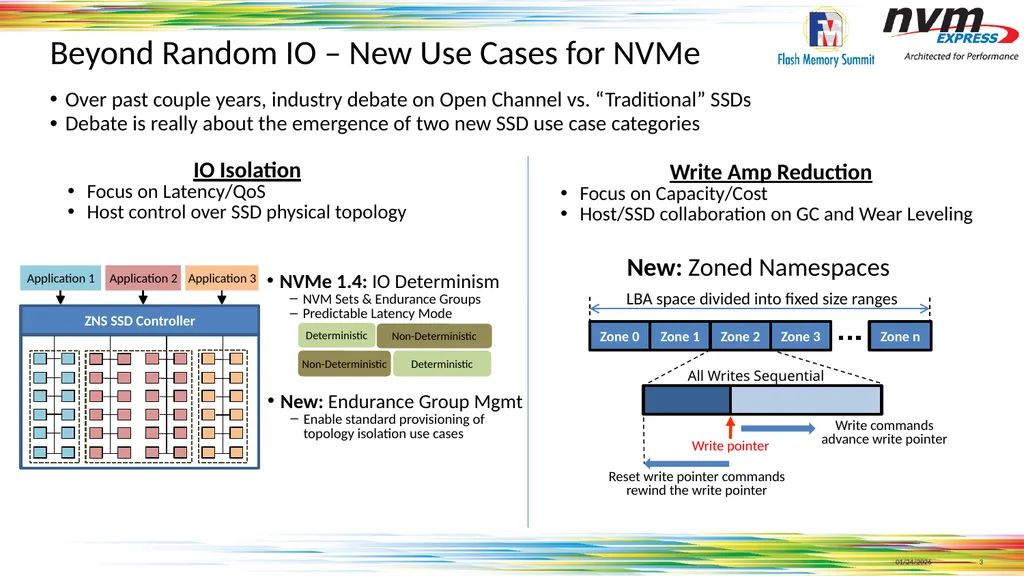
Beyond Random IO – New Use Cases for NVMe Over past couple years, industry debate on Open Channel vs. “Traditional” SSDs
Debate is really about the emergence of two new SSD use case categories 8/5/2019 3 Write Amp Reduction
Focus on Capacity/Cost
Host/SSD collaboration on GC and Wear Leveling IO Isolation
Focus on Latency/QoS
Host control over SSD physical topology New: Zoned Namespaces New: Endurance Group Mgmt
Enable standard provisioning of topology isolation use cases NVMe 1.4: IO Determinism
NVM Sets & Endurance Groups
Predictable Latency Mode LBA space divided into fixed size ranges<br>
04
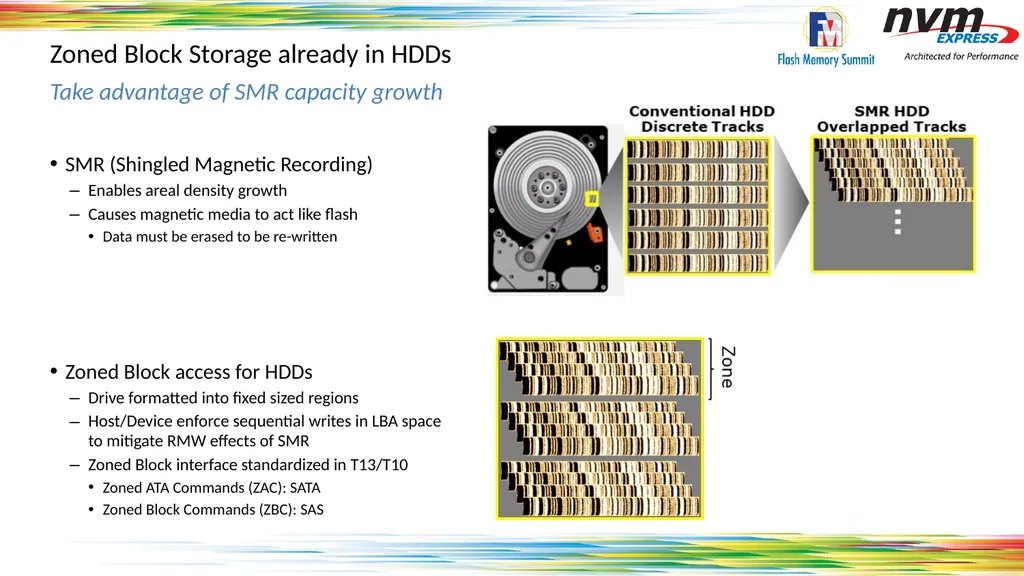
Zoned Block Storage already in HDDs SMR (Shingled Magnetic Recording)
Enables areal density growth
Causes magnetic media to act like flash
Data must be erased to be re-written
Zoned Block access for HDDs
Drive formatted into fixed sized regions
Host/Device enforce sequential writes in LBA space to mitigate RMW effects of SMR
Zoned Block interface standardized in T13/T10
Zoned ATA Commands (ZAC): SATA
Zoned Block Commands (ZBC): SAS Take advantage of SMR capacity growth<br>
05
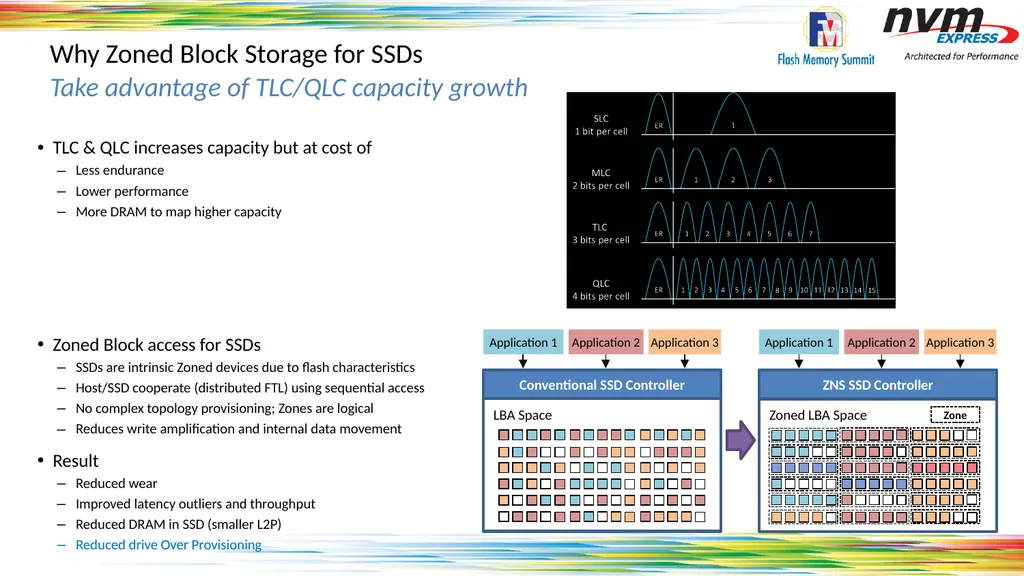
Why Zoned Block Storage for SSDs TLC & QLC increases capacity but at cost of
Less endurance
Lower performance
More DRAM to map higher capacity
Zoned Block access for SSDs
SSDs are intrinsic Zoned devices due to flash characteristics
Host/SSD cooperate (distributed FTL) using sequential access
No complex topology provisioning; Zones are logical
Reduces write amplification and internal data movement
Result
Reduced wear
Improved latency outliers and throughput
Reduced DRAM in SSD (smaller L2P)
Reduced drive Over Provisioning Take advantage of TLC/QLC capacity growth<br>
06
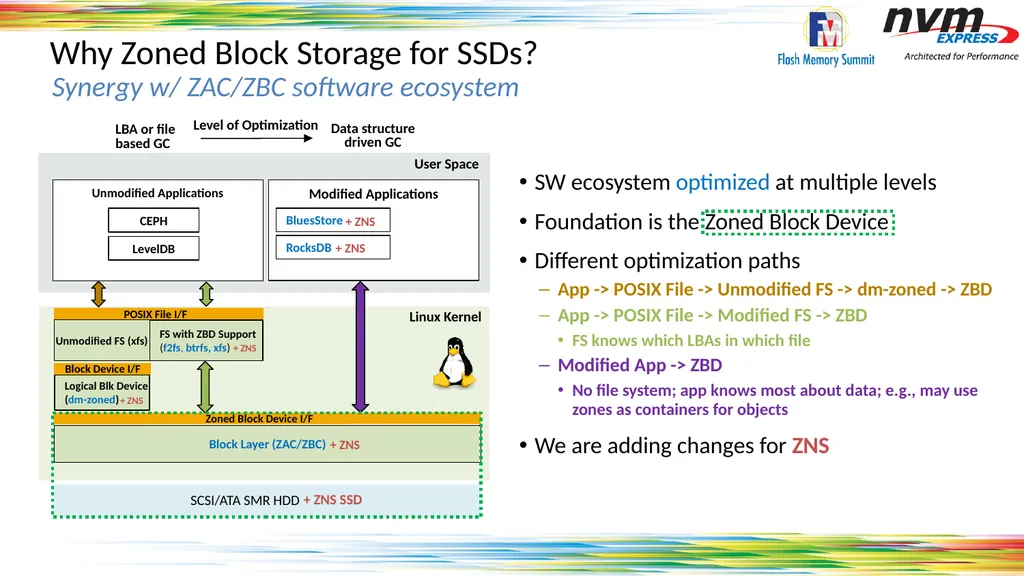
Modified Applications Why Zoned Block Storage for SSDs? SW ecosystem optimized at multiple levels
Foundation is the Zoned Block Device
Different optimization paths
App -> POSIX File -> Unmodified FS -> dm-zoned -> ZBD
App -> POSIX File -> Modified FS -> ZBD
FS knows which LBAs in which file
Modified App -> ZBD
No file system; app knows most about data; e.g., may use zones as containers for objects
We are adding changes for ZNS Synergy w/ ZAC/ZBC software ecosystem SCSI/ATA SMR HDD Unmodified Applications Logical Blk Device
(dm-zoned) FS with ZBD Support
(f2fs, btrfs, xfs) Unmodified FS (xfs) User Space Linux Kernel Block Layer (ZAC/ZBC) Block Device I/F POSIX File I/F Zoned Block Device I/F RocksDB LevelDB CEPH BluesStore + ZNS + ZNS + ZNS + ZNS + ZNS + ZNS SSD<br>
07
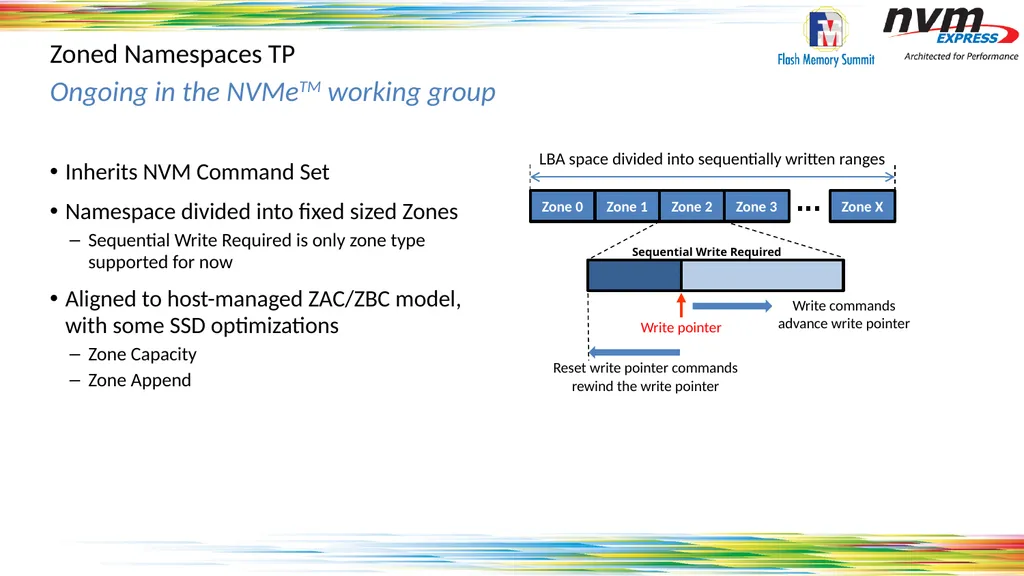
Zoned Namespaces TP Inherits NVM Command Set
Namespace divided into fixed sized Zones
Sequential Write Required is only zone type supported for now
Aligned to host-managed ZAC/ZBC model, with some SSD optimizations
Zone Capacity
Zone Append Ongoing in the NVMeTM working group Sequential Write Required<br>
08
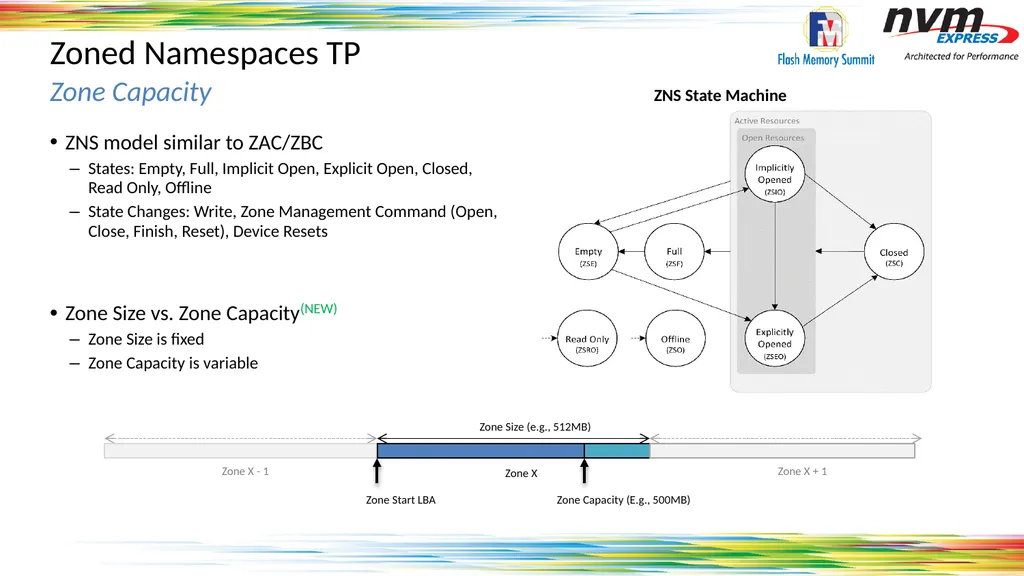
Zoned Namespaces TP ZNS model similar to ZAC/ZBC
States: Empty, Full, Implicit Open, Explicit Open, Closed, Read Only, Offline
State Changes: Write, Zone Management Command (Open, Close, Finish, Reset), Device Resets
Zone Size vs. Zone Capacity(NEW)
Zone Size is fixed
Zone Capacity is variable Zone Capacity ZNS State Machine<br>
09
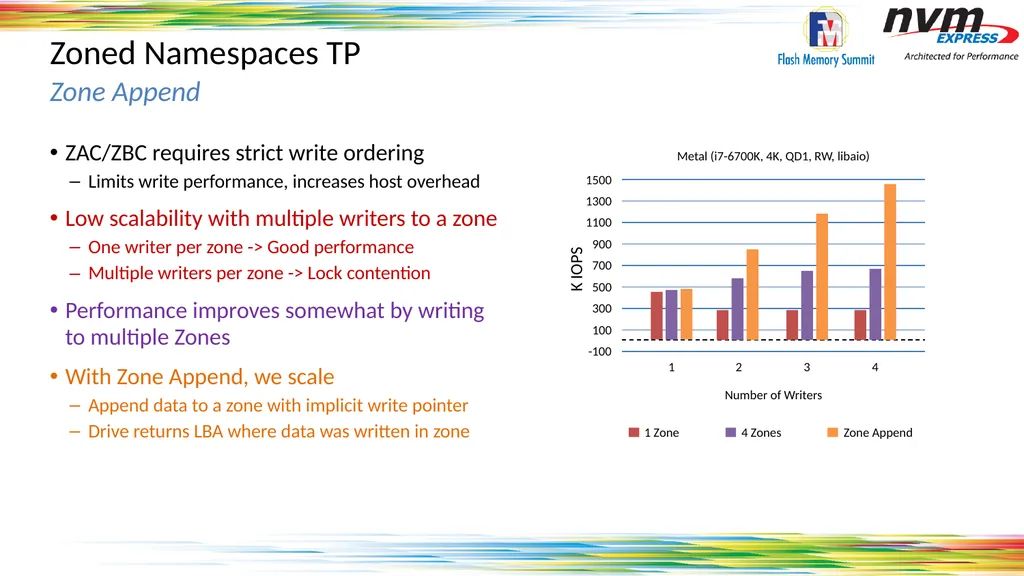
Zoned Namespaces TP ZAC/ZBC requires strict write ordering
Limits write performance, increases host overhead
Low scalability with multiple writers to a zone
One writer per zone -> Good performance
Multiple writers per zone -> Lock contention
Performance improves somewhat by writing to multiple Zones
With Zone Append, we scale
Append data to a zone with implicit write pointer
Drive returns LBA where data was written in zone Zone Append 1500 1300 1100 900 700 500 100 -100 300 1 2 3 4 Number of Writers Metal (i7-6700K, 4K, QD1, RW, libaio) 1 Zone 4 Zones Zone Append K IOPS<br>
10
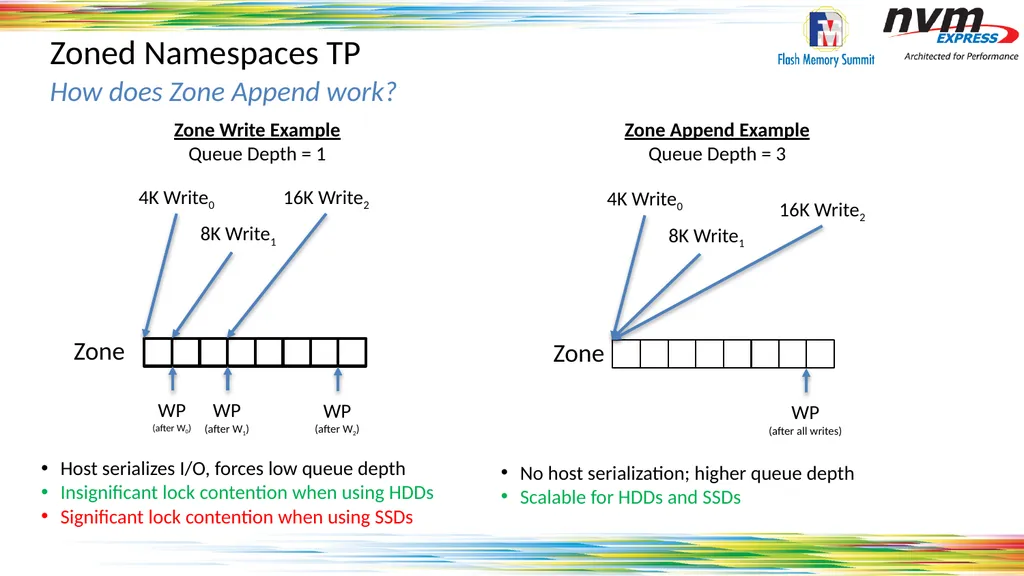
Zoned Namespaces TP How does Zone Append work? No host serialization; higher queue depth
Scalable for HDDs and SSDs Host serializes I/O, forces low queue depth
Insignificant lock contention when using HDDs
Significant lock contention when using SSDs<br>
11
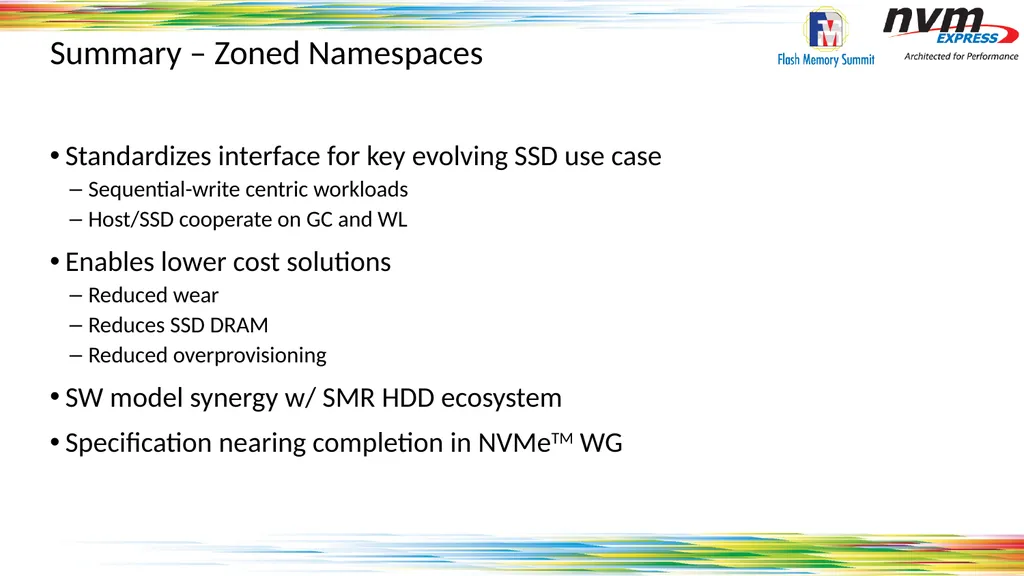
Summary – Zoned Namespaces Standardizes interface for key evolving SSD use case
Sequential-write centric workloads
Host/SSD cooperate on GC and WL
Enables lower cost solutions
Reduced wear
Reduces SSD DRAM
Reduced overprovisioning
SW model synergy w/ SMR HDD ecosystem
Specification nearing completion in NVMeTM WG<br>
12
Questions?<br>
13
BACKUP 8/5/2019 13<br>
14
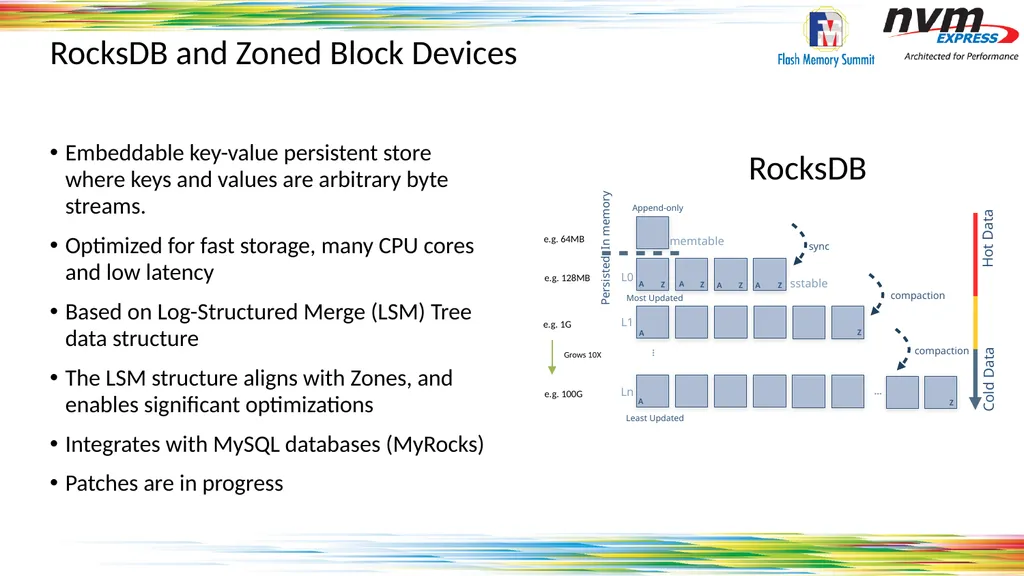
RocksDB and Zoned Block Devices Embeddable key-value persistent store where keys and values are arbitrary byte streams.
Optimized for fast storage, many CPU cores and low latency
Based on Log-Structured Merge (LSM) Tree data structure
The LSM structure aligns with Zones, and enables significant optimizations
Integrates with MySQL databases (MyRocks)
Patches are in progress RocksDB<br>
15
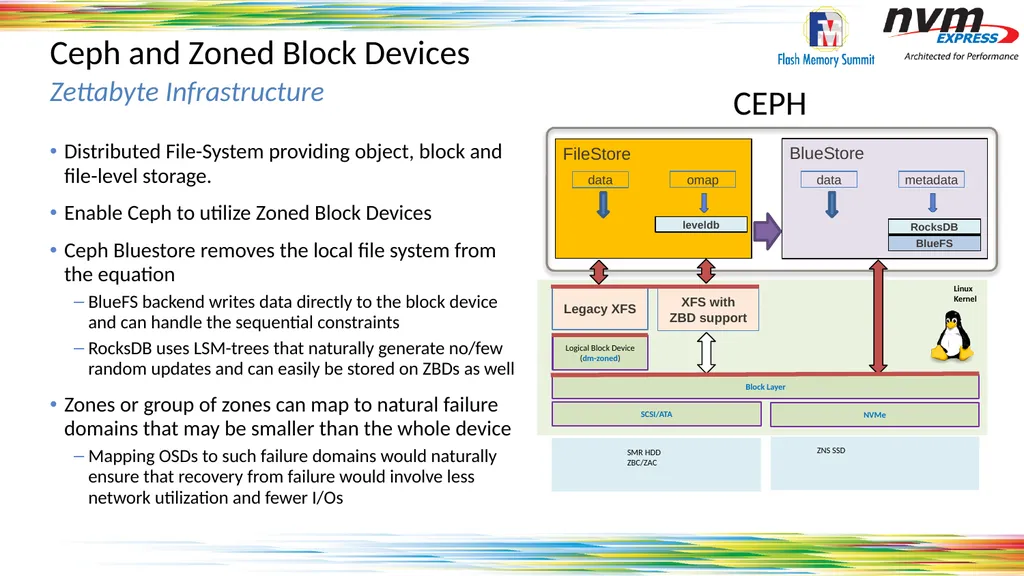
Ceph and Zoned Block Devices Distributed File-System providing object, block and file-level storage.
Enable Ceph to utilize Zoned Block Devices
Ceph Bluestore removes the local file system from the equation
BlueFS backend writes data directly to the block device and can handle the sequential constraints
RocksDB uses LSM-trees that naturally generate no/few random updates and can easily be stored on ZBDs as well
Zones or group of zones can map to natural failure domains that may be smaller than the whole device
Mapping OSDs to such failure domains would naturally ensure that recovery from failure would involve less network utilization and fewer I/Os Zettabyte Infrastructure CEPH BlueStore data metadata BlueFS RocksDB FileStore leveldb data omap SMR HDD
ZBC/ZAC ZNS SSD Logical Block Device
(dm-zoned) XFS with
ZBD support SCSI/ATA Legacy XFS Linux
Kernel Block Layer NVMe<br>
16
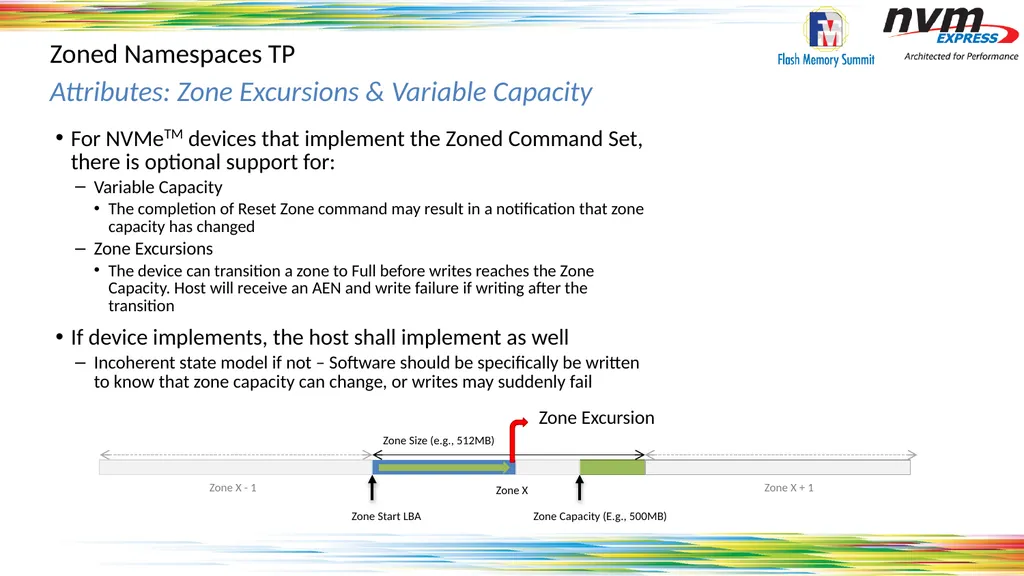
Zoned Namespaces TP For NVMeTM devices that implement the Zoned Command Set, there is optional support for:
Variable Capacity
The completion of Reset Zone command may result in a notification that zone capacity has changed
Zone Excursions
The device can transition a zone to Full before writes reaches the Zone Capacity. Host will receive an AEN and write failure if writing after the transition
If device implements, the host shall implement as well
Incoherent state model if not – Software should be specifically be written to know that zone capacity can change, or writes may suddenly fail Attributes: Zone Excursions & Variable Capacity Zone Capacity (E.g., 500MB) Zone Size (e.g., 512MB) Zone Start LBA Zone X Zone X - 1 Zone X + 1 Zone Excursion<br>