
Standards for QUality Improvement Reporting
CB
Published · 24 slides · 0 views
1 / 1

Description
Standards for QUality Improvement Reporting Excellence (SQUIRE) 2.0 Part 2 Description of Components Presented by: Debra Bingham, DrPH, RN, FAAN Associate Professor for Healthcare Quality and Safety Department of Partnerships,
Related Topics
Share
Embed code
Download this presentation From Below
"Standards for QUality Improvement Reporting" is the property of its rightful owner. Permission is granted to download and print the materials on this website for personal, non-commercial use only, and to display it on your personal computer provided you do not modify the materials and that you retain all copyright notices contained in the materials. By downloading content from our website, you accept the terms of this agreement.
Presentation Transcript
01
Standards for QUality Improvement Reporting Excellence (SQUIRE) 2.0
Part 2 – Description of Components
Presented by:
Debra Bingham, DrPH, RN, FAAN
Associate Professor for
Healthcare Quality and Safety
Department of Partnerships, Professional Education, and Practice
dbingham@umaryland.edu QI Brief QI Brief 5.1b: Released Summer 2017<br>
02
Objectives Describe the 18 SQUIRE 2.0 components.
Discuss how the SQUIRE Guidelines related to the DNP Projects
Planning
Write-up
Poster
Presentation(s) dbingham@umaryland.edu 2 QI Brief 5.1b: Released Summer 2017 This presentation is based on the work of:
Ogrinc, G., Davies, L., Goodman, D., Batalden, Pl, and Davidoff, F. (2015). SQUIRE 2.0 (Standards for Quality Improvement Reporting Excellence) Revised publication guidelines from a detailed concensus process. Journal of Nursing Care Quality. 31(1), pp.1-8.<br>
Discuss how the SQUIRE Guidelines related to the DNP Projects
Planning
Write-up
Poster
Presentation(s) dbingham@umaryland.edu 2 QI Brief 5.1b: Released Summer 2017 This presentation is based on the work of:
Ogrinc, G., Davies, L., Goodman, D., Batalden, Pl, and Davidoff, F. (2015). SQUIRE 2.0 (Standards for Quality Improvement Reporting Excellence) Revised publication guidelines from a detailed concensus process. Journal of Nursing Care Quality. 31(1), pp.1-8.<br>
03
Please review the SQUIRE Guidelines Part 1 presentation before viewing Part 2.
Part 1 provides an introduction to the SQUIRE 2.0 Guidelines. This introduction describes why they were developed and when to use them. dbingham@umaryland.edu 3 QI Brief 5.1b: Released Summer 2017<br>
Part 1 provides an introduction to the SQUIRE 2.0 Guidelines. This introduction describes why they were developed and when to use them. dbingham@umaryland.edu 3 QI Brief 5.1b: Released Summer 2017<br>
04
SQUIRE Retains IMRaD Format Introduction
Methods
Results
Discussion
Also Includes sub-components within
the IMRaD Format dbingham@umaryland.edu 4 QI Brief 5.1b: Released Summer 2017<br>
Methods
Results
Discussion
Also Includes sub-components within
the IMRaD Format dbingham@umaryland.edu 4 QI Brief 5.1b: Released Summer 2017<br>
05
1. Title The title should include in the type of QI Healthcare Improvement Project that was Implemented:
Quality
Safety
Effectiveness
Patient-centeredness
Timeliness
Cost
Efficiency, and/or
Equity of healthcare dbingham@umaryland.edu 5 QI Brief 5.1b: Released Summer 2017<br>
Quality
Safety
Effectiveness
Patient-centeredness
Timeliness
Cost
Efficiency, and/or
Equity of healthcare dbingham@umaryland.edu 5 QI Brief 5.1b: Released Summer 2017<br>
06
2. Abstract Include adequate information to aid in searching and indexing
“Summarize all key information”
For those who are submitting their DNP project to a peer review journal they should also follow the journal abstract format dbingham@umaryland.edu 6 QI Brief 5.1b: Released Summer 2017<br>
“Summarize all key information”
For those who are submitting their DNP project to a peer review journal they should also follow the journal abstract format dbingham@umaryland.edu 6 QI Brief 5.1b: Released Summer 2017<br>
07
3. Introduction –Why did you start the project?
Problem Description Describe the problem
Describe the significance of the problem dbingham@umaryland.edu 7 QI Brief 5.1b: Released Summer 2017<br>
Describe the significance of the problem dbingham@umaryland.edu 7 QI Brief 5.1b: Released Summer 2017<br>
08
4. Introduction –Why did you start the project?
Available Knowledge Summarize the research findings that are relevant to the problem or the evidence-based practice gap
For DNP projects they need to make the case that the intervention they are implementing is the standard of care dbingham@umaryland.edu 8 QI Brief 5.1b: Released Summer 2017<br>
For DNP projects they need to make the case that the intervention they are implementing is the standard of care dbingham@umaryland.edu 8 QI Brief 5.1b: Released Summer 2017<br>
09
5. Introduction – Why did you start the project?
Rationale Informal or formal frameworks, models, concepts, and/or theories you used to explain the problem
Outline any reasons or assumptions that were used to determine the intervention
Outline the reasons why you expected the interventions to work dbingham@umaryland.edu 9 QI Brief 5.1b: Released Summer 2017<br>
Outline any reasons or assumptions that were used to determine the intervention
Outline the reasons why you expected the interventions to work dbingham@umaryland.edu 9 QI Brief 5.1b: Released Summer 2017<br>
10
6. Introduction – Why did you start the project?
Specific Aims Purpose of the project
Purpose of this report (if the manuscript is being prepared for publication)
Note: AIMS statements should be sated as a SMART Objective:
Specific
Measurable
Agreed upon
Realistic
Time-based dbingham@umaryland.edu 10 QI Brief 5.1b: Released Summer 2017<br>
Purpose of this report (if the manuscript is being prepared for publication)
Note: AIMS statements should be sated as a SMART Objective:
Specific
Measurable
Agreed upon
Realistic
Time-based dbingham@umaryland.edu 10 QI Brief 5.1b: Released Summer 2017<br>
11
7. Methods –What did you do?
Context Describe the contextual elements considered important when the project was started. Note: Context is difficult to measure. Measurements of context (context elements that can be quantified) are within the scope of the DNP project.
Examples of context components that are within the scope of the DNP Project are to describe:
Number of different types of health professionals affected by the change
Number of units within an organization affected by the change
Statements by team members about their past implementation experiences – have they struggled in the past or had great success?
Types of conversations the DNP student heard when introducing the project aims.
Note: There are tools being validated that will help measure context. dbingham@umaryland.edu 11 QI Brief 5.1b: Released Summer 2017<br>
Examples of context components that are within the scope of the DNP Project are to describe:
Number of different types of health professionals affected by the change
Number of units within an organization affected by the change
Statements by team members about their past implementation experiences – have they struggled in the past or had great success?
Types of conversations the DNP student heard when introducing the project aims.
Note: There are tools being validated that will help measure context. dbingham@umaryland.edu 11 QI Brief 5.1b: Released Summer 2017<br>
12
8. Methods – What did you do?
Intervention(s) Clear description of the intervention(s)
Include enough detail that others could reproduce the intervention
Include specific information about the team involved in the work
For example
Who were the change champions and how were the change champions selected?
Who participated in the planning and execution of the QI project?
What were the types of strategies and tactics that were utilized when implementing the project?
How did you measure progress? dbingham@umaryland.edu 12 QI Brief 5.1b: Released Summer 2017<br>
Include enough detail that others could reproduce the intervention
Include specific information about the team involved in the work
For example
Who were the change champions and how were the change champions selected?
Who participated in the planning and execution of the QI project?
What were the types of strategies and tactics that were utilized when implementing the project?
How did you measure progress? dbingham@umaryland.edu 12 QI Brief 5.1b: Released Summer 2017<br>
13
9. Methods – What did you do?
Study of the Intervention(s) Approach chosen for assessing the impact of the intervention(s)
Approach used to establish whether the observed outcomes were due to the intervention(s). Note: It is beyond the scope of the DNP Project to study the intervention(s). dbingham@umaryland.edu 13 QI Brief 5.1b: Released Summer 2017<br>
Approach used to establish whether the observed outcomes were due to the intervention(s). Note: It is beyond the scope of the DNP Project to study the intervention(s). dbingham@umaryland.edu 13 QI Brief 5.1b: Released Summer 2017<br>
14
10. Methods –What did you do?
Measures Structure, process, and outcome measures
Balancing measures (if applicable)
Rational for selecting these measures along with operational definitions and whether the measures have been found to be valid and reliable
Describe how you measured the contextual elements that contributed to the success, failure, efficiency, and cost of the project
Methods for measuring the completeness and accuracy of data dbingham@umaryland.edu 14 QI Brief 5.1b: Released Summer 2017<br>
Balancing measures (if applicable)
Rational for selecting these measures along with operational definitions and whether the measures have been found to be valid and reliable
Describe how you measured the contextual elements that contributed to the success, failure, efficiency, and cost of the project
Methods for measuring the completeness and accuracy of data dbingham@umaryland.edu 14 QI Brief 5.1b: Released Summer 2017<br>
15
11. Methods – What did you do?
Analysis Qualitative and Quantitative methods used for measuring and interpreting variation with the data
Descriptive statistics
Qualitative methods and quantitative data used to draw inferences from their data dbingham@umaryland.edu 15 QI Brief 5.1b: Released Summer 2017<br>
Descriptive statistics
Qualitative methods and quantitative data used to draw inferences from their data dbingham@umaryland.edu 15 QI Brief 5.1b: Released Summer 2017<br>
16
12. Methods - What did you do?
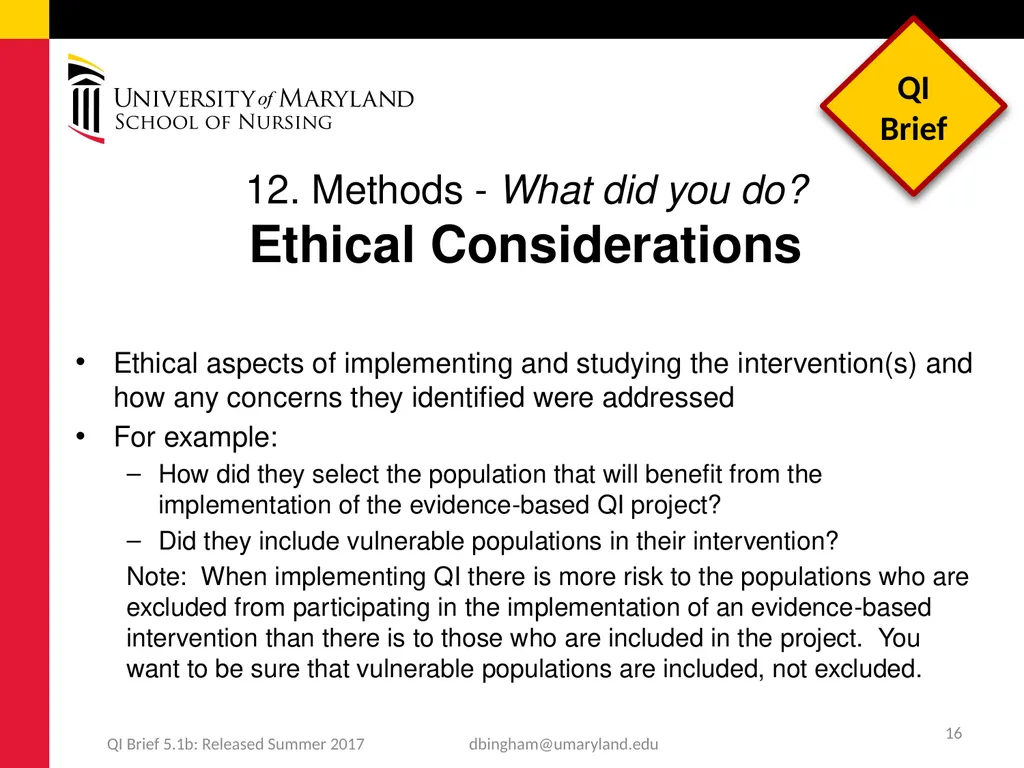
Ethical Considerations Ethical aspects of implementing and studying the intervention(s) and how any concerns they identified were addressed
For example:
How did they select the population that will benefit from the implementation of the evidence-based QI project?
Did they include vulnerable populations in their intervention?
Note: When implementing QI there is more risk to the populations who are excluded from participating in the implementation of an evidence-based intervention than there is to those who are included in the project. You want to be sure that vulnerable populations are included, not excluded. dbingham@umaryland.edu 16 QI Brief 5.1b: Released Summer 2017<br>
For example:
How did they select the population that will benefit from the implementation of the evidence-based QI project?
Did they include vulnerable populations in their intervention?
Note: When implementing QI there is more risk to the populations who are excluded from participating in the implementation of an evidence-based intervention than there is to those who are included in the project. You want to be sure that vulnerable populations are included, not excluded. dbingham@umaryland.edu 16 QI Brief 5.1b: Released Summer 2017<br>
17
13. Results - What did you find? Initial steps of the intervention(s) and their evolution over time (eg, time line diagram, flowchart, or table), including modifications made to the intervention during the project
Details of the structure, process, outcome, and balancing measures
Contextual elements that interacted with the intervention(s)
Observed associations between outcomes, interventions, and relevant contextual elements. Note: Students need to consult with their advisor to make sure that their inferences are not beyond the scope of the project or data collected.
Unintended consequences such as unexpected benefits, problems, failures, or costs associated with the intervention(s) dbingham@umaryland.edu 17 QI Brief 5.1b: Released Summer 2017<br>
Details of the structure, process, outcome, and balancing measures
Contextual elements that interacted with the intervention(s)
Observed associations between outcomes, interventions, and relevant contextual elements. Note: Students need to consult with their advisor to make sure that their inferences are not beyond the scope of the project or data collected.
Unintended consequences such as unexpected benefits, problems, failures, or costs associated with the intervention(s) dbingham@umaryland.edu 17 QI Brief 5.1b: Released Summer 2017<br>
18
14. Discussion – What does it mean?
Summary Key findings, including relevance to the rationale and specific aims
Particular strengths and weaknesses of the project dbingham@umaryland.edu 18 QI Brief 5.1b: Released Summer 2017<br>
Particular strengths and weaknesses of the project dbingham@umaryland.edu 18 QI Brief 5.1b: Released Summer 2017<br>
19
15. Discussion – What does it mean?
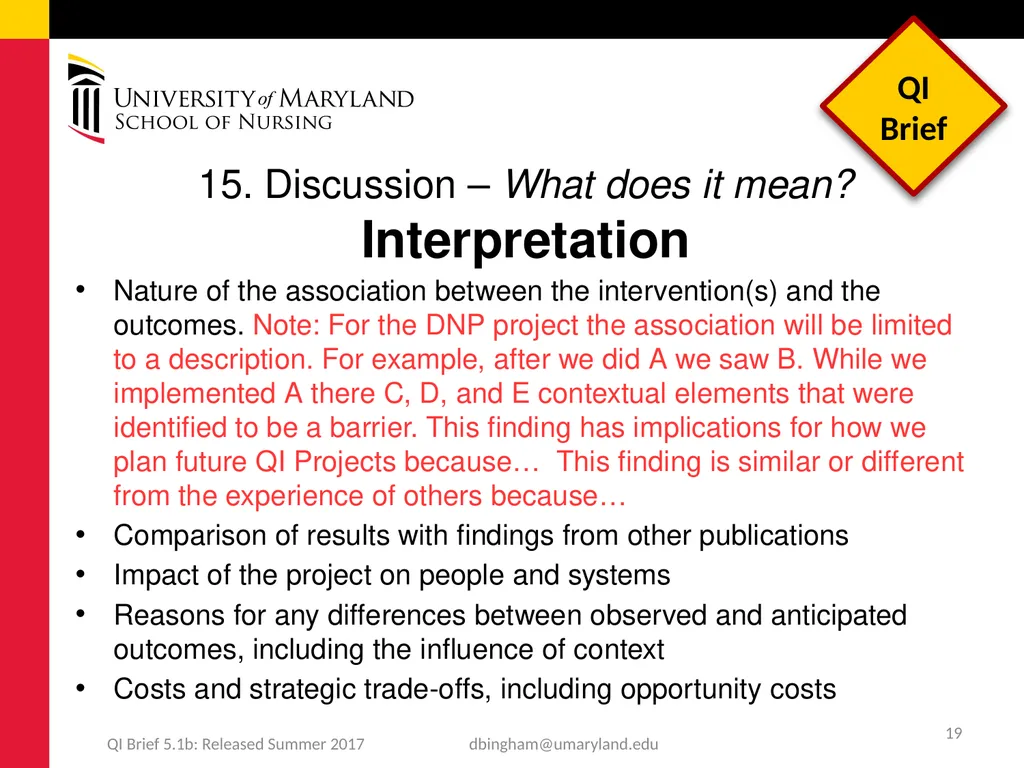
Interpretation Nature of the association between the intervention(s) and the outcomes. Note: For the DNP project the association will be limited to a description. For example, after we did A we saw B. While we implemented A there C, D, and E contextual elements that were identified to be a barrier. This finding has implications for how we plan future QI Projects because… This finding is similar or different from the experience of others because…
Comparison of results with findings from other publications
Impact of the project on people and systems
Reasons for any differences between observed and anticipated outcomes, including the influence of context
Costs and strategic trade-offs, including opportunity costs dbingham@umaryland.edu 19 QI Brief 5.1b: Released Summer 2017<br>
Comparison of results with findings from other publications
Impact of the project on people and systems
Reasons for any differences between observed and anticipated outcomes, including the influence of context
Costs and strategic trade-offs, including opportunity costs dbingham@umaryland.edu 19 QI Brief 5.1b: Released Summer 2017<br>
20
16. Discussion – What does it mean?
Limitations Limits of the generalizability of the work
Factors that might have limited internal validity such as confounding, bias, or imprecision in the design, methods, measurement, or analysis
Efforts made to minimize and adjust for limitations dbingham@umaryland.edu 20 QI Brief 5.1b: Released Summer 2017<br>
Factors that might have limited internal validity such as confounding, bias, or imprecision in the design, methods, measurement, or analysis
Efforts made to minimize and adjust for limitations dbingham@umaryland.edu 20 QI Brief 5.1b: Released Summer 2017<br>
21
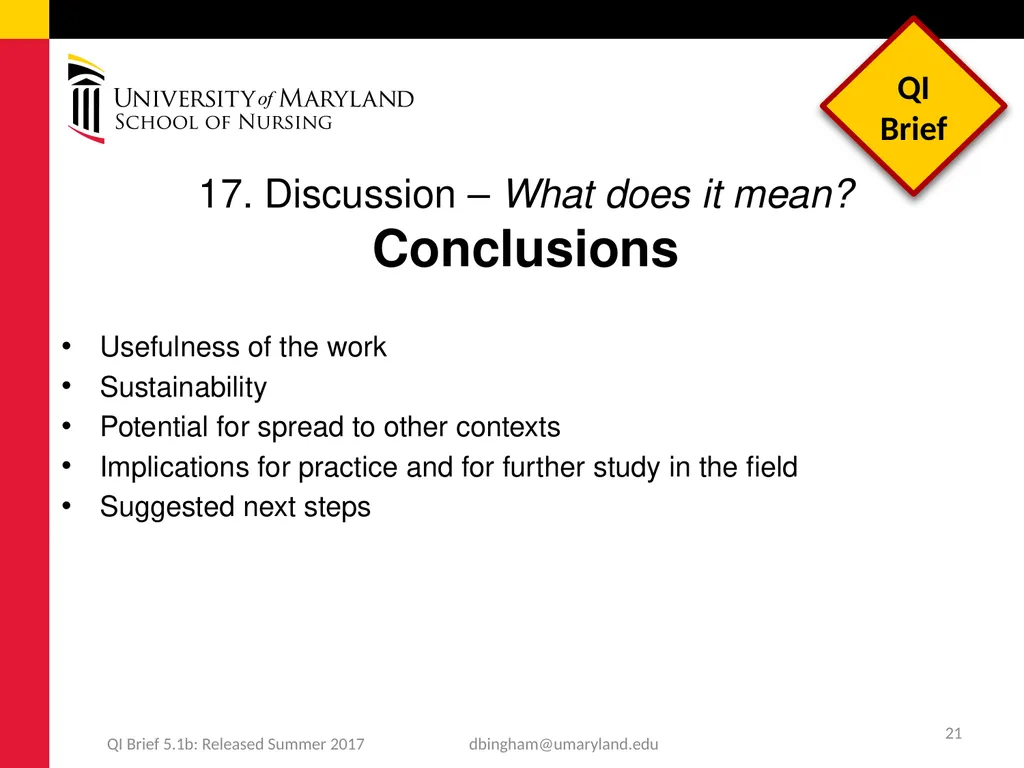
17. Discussion – What does it mean? Conclusions Usefulness of the work
Sustainability
Potential for spread to other contexts
Implications for practice and for further study in the field
Suggested next steps dbingham@umaryland.edu 21 QI Brief 5.1b: Released Summer 2017<br>
Sustainability
Potential for spread to other contexts
Implications for practice and for further study in the field
Suggested next steps dbingham@umaryland.edu 21 QI Brief 5.1b: Released Summer 2017<br>
22
18. Other Information
Funding Sources of funding that supported this work. Role, if any, of the funding organization in the design, implementation, interpretation, and reporting. dbingham@umaryland.edu 22 QI Brief 5.1b: Released Summer 2017<br>
23
Reminders:
Not all of the sub-components need to be included in the DNP Project write-up.
We are working on identifying which of these sub-components are mandatory for all students. dbingham@umaryland.edu 23 QI Brief 5.1b: Released Summer 2017<br>
Not all of the sub-components need to be included in the DNP Project write-up.
We are working on identifying which of these sub-components are mandatory for all students. dbingham@umaryland.edu 23 QI Brief 5.1b: Released Summer 2017<br>
24
Questions? Comments? Email: dbingham@son.umaryland.edu dbingham@umaryland.edu 24 QI Brief QI Brief 5.1b: Released Summer 2017 This presentation is based on the work of:
Ogrinc, G., Davies, L., Goodman, D., Batalden, Pl, and Davidoff, F. (2015). SQUIRE 2.0 (Standards for Quality Improvement Reporting Excellence) Revised publication guidelines from a detailed concensus process. Journal of Nursing Care Quality. 31(1), pp.1-8.<br>
Ogrinc, G., Davies, L., Goodman, D., Batalden, Pl, and Davidoff, F. (2015). SQUIRE 2.0 (Standards for Quality Improvement Reporting Excellence) Revised publication guidelines from a detailed concensus process. Journal of Nursing Care Quality. 31(1), pp.1-8.<br>