
STATE ENTERPRISES RISK MANAGEMENT FRAMEWORK 1
Description: STATE ENTERPRISES RISK MANAGEMENT FRAMEWORK 1 INTERNAL USE PRESENTATION April 14th, 2014 Philip Marshall CA FCA The Institute of Risk Management 2 INTERNAL USE The Institute of Risk Management 3 INTERNAL USE The Institute of Risk Management
Related Topics
Download Presentation
"STATE ENTERPRISES RISK MANAGEMENT FRAMEWORK 1" is the property of its rightful owner. Permission is granted to download and print the materials on this website for personal, non-commercial use only, and to display it on your personal computer provided you do not modify the materials and that you retain all copyright notices contained in the materials. By downloading content from our website, you accept the terms of this agreement.
Presentation Transcript
slide1. STATE ENTERPRISES
RISK MANAGEMENT FRAMEWORK 1 INTERNAL USE PRESENTATION
April 14th, 2014 Philip Marshall CA FCA<br>
slide2. The Institute of Risk Management 2 INTERNAL USE<br>
slide3. The Institute of Risk Management 3 INTERNAL USE<br>
slide4. The Institute of Risk Management 4 INTERNAL USE<br>
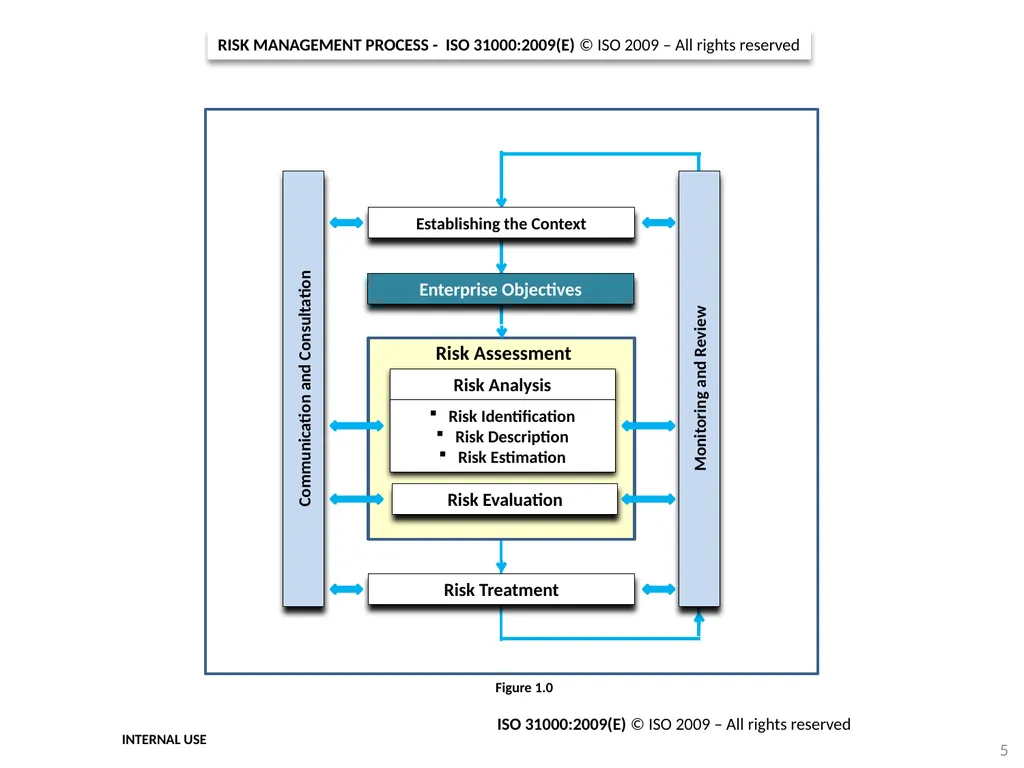
slide5. RISK MANAGEMENT PROCESS - ISO 31000:2009(E) © ISO 2009 – All rights reserved ISO 31000:2009(E) © ISO 2009 – All rights reserved 5 INTERNAL USE Figure 1.0<br>
slide6. The Institute of Risk Management 6 INTERNAL USE<br>
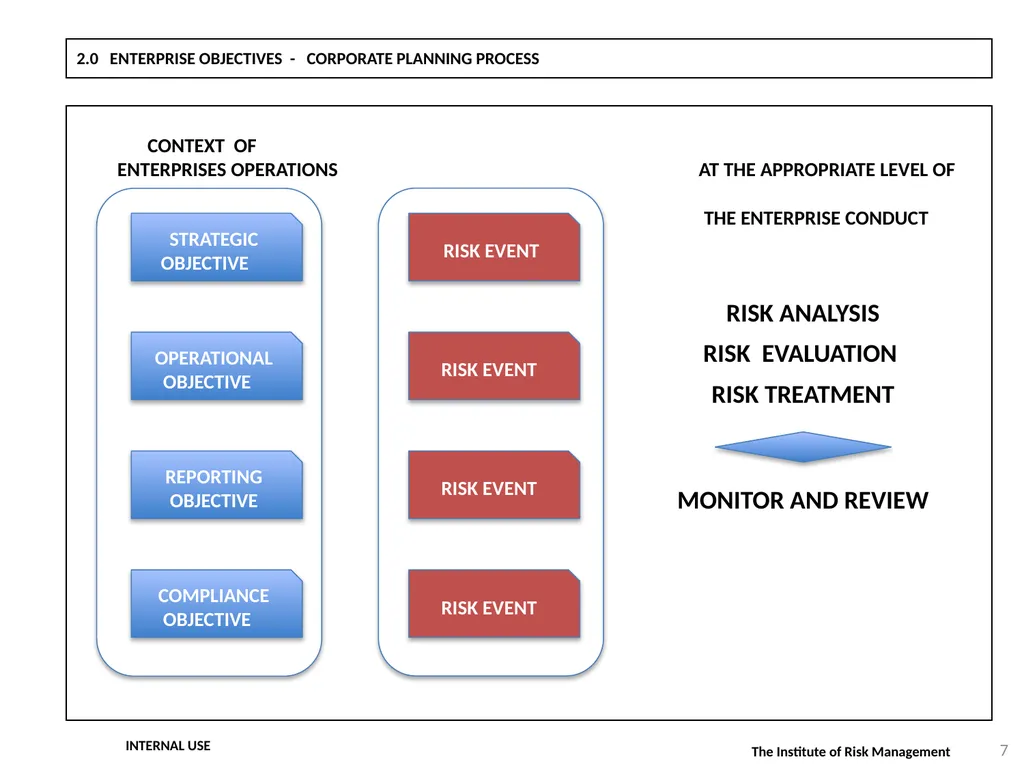
slide7. The Institute of Risk Management 7 INTERNAL USE<br>
slide8. The Institute of Risk Management 8 INTERNAL USE<br>
slide9. The Institute of Risk Management 9 INTERNAL USE<br>
slide10. The Institute of Risk Management 10 INTERNAL USE<br>
slide11. The Institute of Risk Management 11 INTERNAL USE<br>
slide12. 12 The COSO committee describes ERM as one that deals with risk and opportunities, and defines ERM as follows:
“Enterprise risk management is a process, affected by an entity‟s board of directors and other personal, applied in strategy setting and across the enterprise, designed to identify potential events that may affect the entity, and manage risk to be within its risk appetite, to provide reasonable assurance regarding the achievement of entity objectives.”2 Is risk is the same as uncertainty? COSO (The Committee of Sponsoring Organisations of the Treadway Commission (2004) defines uncertainty as that which presents both risk and opportunities, with potentials to erode or enhance value. Risk is the possibility that the occurrence of an event will adversely affect the achievement of objectives, and opportunity is the possibility that an event will occur and positively affect the achievement of objective. Uncertainty in business and life in general is said to exist due to the futuristic nature of outcomes. The outcomes of business operations are to be reached at sometime in the future after the tasks have been performed.<br>
slide13. 13 As before, the COSO committee also breaks the definition in to simple bits, it seems to be the most elaborate definition of the concept;
1. ERM is a process; it is ongoing and following through an entity.
2. ERM is affected by people at every level of an organization.
3. ERM is applied in strategy setting. 4. ERM is applied across the enterprise, at every level and every unit, and includes entity-
level portfolio view of risk.
5. ERM is designed to identify potential events that, in the event of their occurrence, will
affect the entity and to manage the risk within its risk appetite.
6. ERM is able to provide reasonable assurance to the management and board of
directors of an entity.
7. ERM is general towards the achievement of objectives in one or more separate but
overlapping categories.<br>
slide14. 14 The Business Value of Enterprise Risk Management
The strategic implications of ERM refer to the effects of the ERM process on setting strategic objectives and on strategy. As ERM is a process whose mechanisms should be/are built into the infrastructure of the entity with the goal of ensuring, with reasonable assurance, that the entity’s objectives, all four categories – strategic, operations, reporting and compliance, are achieved, the strategic implication may be described as follows:
1. That the board of directors and management have reasonable assurance that they
understand to what extent the entity‟s strategic objectives are being met or affected
2. The same as above goes for their operations objectives
3. That the entity‟s reporting is reliable
4. That all applicable laws and regulations are being complied with The points 1 and 2 simply imply that with risk information (i.e. risk intelligence) the board of directors and management at various levels have an understanding of their decision options and their strategic and operational effects on the organisation.<br>
slide15. 15 The following are achieved by the integration of ERM in an organisation that adequately supports its implementation in its day-to-day activities :
Increased transparency – through accountability, responsibility and performance management from Top-down
Increased traceability – for the purpose of compliance, audit and analysis
Improved responsiveness and flexibility – through monitoring, anticipation of events and
definition of responses
Continuous business optimization – through clear understanding of strategic options
Improved strategic alignment – through de-risking of business processes
Improved business IT alignment – through de-risking the links between Business and IT
Accelerated identification and effective management of risk – through assessment of
risk relationships and interdependence, and as a predictive tool
Improved ability to perform M&A or diversification – through clear understanding of the
risks and opportunities associated with such events
Cost reduction/savings – through the reduction in business disruption and facilitating both
the business rules and business continuity measures, shedding non-core activities (especially
those with high risks), improve confidence and assure productivity leading to increase pace.<br>
slide16. 16 Implementing ERM: Developing an ERM Program
Enterprise Risk Management requires a systematic and disciplined approach for implementation. To establish the correct operational framework, the answers to four key questions are required:
“What is the firm‟s objective for ERM?” These may include – strategic, compliance, operations and reporting. However prioritized, the objectives should be measurable and aligned toward the organisation (or pay- off).
2. “What will be the scope of the firm‟s ERM?” (scope of risks and processes) Scope should cover all risks faced by the entity in whatever categories are used, such as financial, hazard, strategic risks, and so on. The second dimension to this relates to the management processes aimed at influencing decision-making, such as strategic planning, internal audit, performance measurement, and so on
3. “What kind of organisation structure around ERM will work for the firm?” The structure describes the role and responsibilities of the players involved
4. And “What specific tools will be needed to implement it? Such tools include risk audit guides, risk monitoring reports, stochastic risk models, and so on Jerry Micolis of Brinton Eaton Associates, Inc. says companies need to have a clear and company-specific “operational framework” in place first, and then use it to develop a company-specific ERM implementation plan.<br>
slide17. 17 Implementing ERM: Developing an ERM Program
Enterprise Risk Management requires a systematic and disciplined approach for implementation. On the industry-level, RIMMS executive report outlines the next step to be taken to achieve effective enterprise management. These steps are:
1. To truly adopt an ERM culture (which is emphasized to be the key)
2. To embrace and demonstrate appropriate ERM behaviours (or attributes 3. To develop and reward internal risk management competencies, so as to motivate
employees while showing management concerns
4. To use ERM to inform management decision-making (both in risk and opportunity taking)<br>
slide18. 18 Implementing ERM: Developing an ERM Program
Enterprise Risk Management requires a systematic and disciplined approach for implementation. De-risking the strategic business goals provides outcome/solutions which are necessary for repositioning the entire business, therefore re-evaluating the core processes that are key to creating value for the business. This will ultimately lead to the re-evaluation of supporting processes down to itemised tasks. As various processes cuts across functions, the utilization of multi-disciplinary teams effectively and efficiently improves performance by reducing extra resources, time taken, and forward/backward information flow, as well as increasing the concentration of needed resources. It thus, makes performance management easier and more effective by improving traceability, clear accountability and responsibility definition. The internal control mechanisms are therefore easily monitored and controlled<br>
RISK MANAGEMENT FRAMEWORK 1 INTERNAL USE PRESENTATION
April 14th, 2014 Philip Marshall CA FCA<br>
slide2. The Institute of Risk Management 2 INTERNAL USE<br>
slide3. The Institute of Risk Management 3 INTERNAL USE<br>
slide4. The Institute of Risk Management 4 INTERNAL USE<br>
slide5. RISK MANAGEMENT PROCESS - ISO 31000:2009(E) © ISO 2009 – All rights reserved ISO 31000:2009(E) © ISO 2009 – All rights reserved 5 INTERNAL USE Figure 1.0<br>
slide6. The Institute of Risk Management 6 INTERNAL USE<br>
slide7. The Institute of Risk Management 7 INTERNAL USE<br>
slide8. The Institute of Risk Management 8 INTERNAL USE<br>
slide9. The Institute of Risk Management 9 INTERNAL USE<br>
slide10. The Institute of Risk Management 10 INTERNAL USE<br>
slide11. The Institute of Risk Management 11 INTERNAL USE<br>
slide12. 12 The COSO committee describes ERM as one that deals with risk and opportunities, and defines ERM as follows:
“Enterprise risk management is a process, affected by an entity‟s board of directors and other personal, applied in strategy setting and across the enterprise, designed to identify potential events that may affect the entity, and manage risk to be within its risk appetite, to provide reasonable assurance regarding the achievement of entity objectives.”2 Is risk is the same as uncertainty? COSO (The Committee of Sponsoring Organisations of the Treadway Commission (2004) defines uncertainty as that which presents both risk and opportunities, with potentials to erode or enhance value. Risk is the possibility that the occurrence of an event will adversely affect the achievement of objectives, and opportunity is the possibility that an event will occur and positively affect the achievement of objective. Uncertainty in business and life in general is said to exist due to the futuristic nature of outcomes. The outcomes of business operations are to be reached at sometime in the future after the tasks have been performed.<br>
slide13. 13 As before, the COSO committee also breaks the definition in to simple bits, it seems to be the most elaborate definition of the concept;
1. ERM is a process; it is ongoing and following through an entity.
2. ERM is affected by people at every level of an organization.
3. ERM is applied in strategy setting. 4. ERM is applied across the enterprise, at every level and every unit, and includes entity-
level portfolio view of risk.
5. ERM is designed to identify potential events that, in the event of their occurrence, will
affect the entity and to manage the risk within its risk appetite.
6. ERM is able to provide reasonable assurance to the management and board of
directors of an entity.
7. ERM is general towards the achievement of objectives in one or more separate but
overlapping categories.<br>
slide14. 14 The Business Value of Enterprise Risk Management
The strategic implications of ERM refer to the effects of the ERM process on setting strategic objectives and on strategy. As ERM is a process whose mechanisms should be/are built into the infrastructure of the entity with the goal of ensuring, with reasonable assurance, that the entity’s objectives, all four categories – strategic, operations, reporting and compliance, are achieved, the strategic implication may be described as follows:
1. That the board of directors and management have reasonable assurance that they
understand to what extent the entity‟s strategic objectives are being met or affected
2. The same as above goes for their operations objectives
3. That the entity‟s reporting is reliable
4. That all applicable laws and regulations are being complied with The points 1 and 2 simply imply that with risk information (i.e. risk intelligence) the board of directors and management at various levels have an understanding of their decision options and their strategic and operational effects on the organisation.<br>
slide15. 15 The following are achieved by the integration of ERM in an organisation that adequately supports its implementation in its day-to-day activities :
Increased transparency – through accountability, responsibility and performance management from Top-down
Increased traceability – for the purpose of compliance, audit and analysis
Improved responsiveness and flexibility – through monitoring, anticipation of events and
definition of responses
Continuous business optimization – through clear understanding of strategic options
Improved strategic alignment – through de-risking of business processes
Improved business IT alignment – through de-risking the links between Business and IT
Accelerated identification and effective management of risk – through assessment of
risk relationships and interdependence, and as a predictive tool
Improved ability to perform M&A or diversification – through clear understanding of the
risks and opportunities associated with such events
Cost reduction/savings – through the reduction in business disruption and facilitating both
the business rules and business continuity measures, shedding non-core activities (especially
those with high risks), improve confidence and assure productivity leading to increase pace.<br>
slide16. 16 Implementing ERM: Developing an ERM Program
Enterprise Risk Management requires a systematic and disciplined approach for implementation. To establish the correct operational framework, the answers to four key questions are required:
“What is the firm‟s objective for ERM?” These may include – strategic, compliance, operations and reporting. However prioritized, the objectives should be measurable and aligned toward the organisation (or pay- off).
2. “What will be the scope of the firm‟s ERM?” (scope of risks and processes) Scope should cover all risks faced by the entity in whatever categories are used, such as financial, hazard, strategic risks, and so on. The second dimension to this relates to the management processes aimed at influencing decision-making, such as strategic planning, internal audit, performance measurement, and so on
3. “What kind of organisation structure around ERM will work for the firm?” The structure describes the role and responsibilities of the players involved
4. And “What specific tools will be needed to implement it? Such tools include risk audit guides, risk monitoring reports, stochastic risk models, and so on Jerry Micolis of Brinton Eaton Associates, Inc. says companies need to have a clear and company-specific “operational framework” in place first, and then use it to develop a company-specific ERM implementation plan.<br>
slide17. 17 Implementing ERM: Developing an ERM Program
Enterprise Risk Management requires a systematic and disciplined approach for implementation. On the industry-level, RIMMS executive report outlines the next step to be taken to achieve effective enterprise management. These steps are:
1. To truly adopt an ERM culture (which is emphasized to be the key)
2. To embrace and demonstrate appropriate ERM behaviours (or attributes 3. To develop and reward internal risk management competencies, so as to motivate
employees while showing management concerns
4. To use ERM to inform management decision-making (both in risk and opportunity taking)<br>
slide18. 18 Implementing ERM: Developing an ERM Program
Enterprise Risk Management requires a systematic and disciplined approach for implementation. De-risking the strategic business goals provides outcome/solutions which are necessary for repositioning the entire business, therefore re-evaluating the core processes that are key to creating value for the business. This will ultimately lead to the re-evaluation of supporting processes down to itemised tasks. As various processes cuts across functions, the utilization of multi-disciplinary teams effectively and efficiently improves performance by reducing extra resources, time taken, and forward/backward information flow, as well as increasing the concentration of needed resources. It thus, makes performance management easier and more effective by improving traceability, clear accountability and responsibility definition. The internal control mechanisms are therefore easily monitored and controlled<br>