State Space Search Heuristic search Piyali Chatterjee Traveling Salesman Problem Heuristic Search With the uninformed search algorithms we have explored entire search space for all possible solutions of the problem without having any
"State Space Search Heuristic search Piyali" is the property of its rightful owner. Permission is granted to
download and print the materials on this website for personal, non-commercial use only, and to display it
on your personal computer provided you do not modify the materials and that you retain all copyright
notices contained in the materials. By downloading content from our website, you accept the terms of this
agreement.
Presentation Transcript
01
State Space Search Heuristic search Piyali Chatterjee<br>
02
Traveling Salesman Problem<br>
03
Heuristic Search With the uninformed search algorithms we have explored entire search space for all possible solutions of the problem without having any additional knowledge about search space. But informed search algorithm contains an array of knowledge such as how far we are from the goal, path cost, how to reach to goal node, etc. This knowledge help agents to explore less to the search space and find more efficiently the goal node.
The informed search algorithm is more useful for large search space. Informed search algorithm uses the idea of heuristic, so it is also called Heuristic search/ Informed Search.<br>
04
Heuristic Function Heuristic is a function which is used in Informed Search, and it finds the most promising path.
It takes the current state of the agent as its input and produces the estimation of how close agent is from the goal.
The heuristic method, however, might not always give the best solution, but it guaranteed to find a good solution in reasonable time.
Heuristic function estimates how close a state is to the goal. It is represented by h(n).
The value of the heuristic function is always positive.<br>
05
Heuristic Function<br>
06
Heuristic Function for TSP<br>
07
Hill Climbing Algorithm in Artificial Intelligence Hill climbing algorithm is a local search algorithm which continuously moves in the direction of increasing elevation/value to find the peak of the mountain or best solution to the problem. It terminates when it reaches a peak value where no neighbor has a higher value.
Hill climbing algorithm is a technique which is used for optimizing the mathematical problems. One of the widely discussed examples of Hill climbing algorithm is Traveling-salesman Problem in which we need to minimize the distance traveled by the salesman.
It is also called greedy local search as it only looks to its good immediate neighbor state and not beyond that.
A node of hill climbing algorithm has two components which are state and value.<br>
08
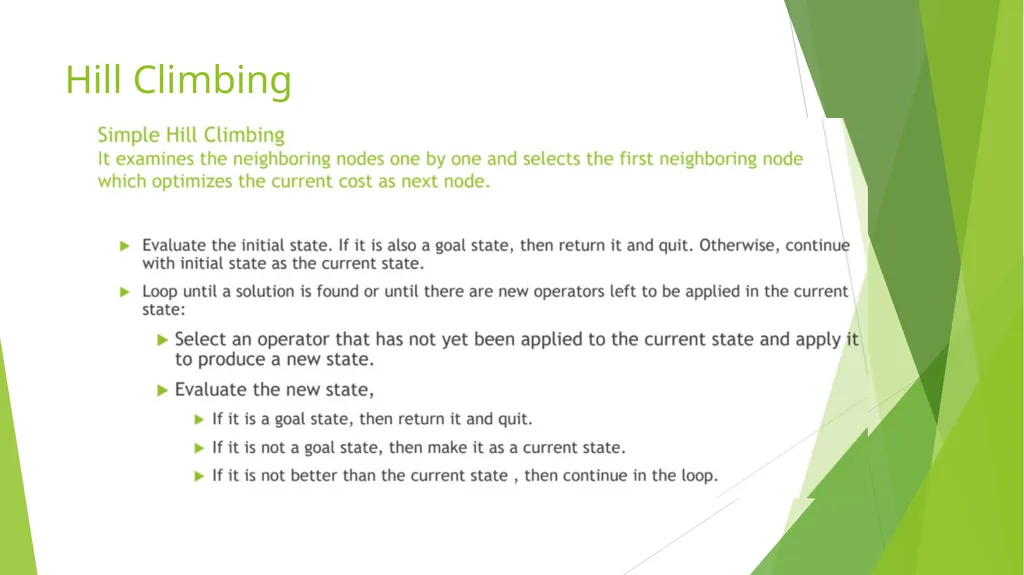
Simple Hill Climbing Simple hill climbing is the simplest way to implement a hill climbing algorithm. It only evaluates the neighbor node state at a time and selects the first one which optimizes current cost and set it as a current state. It only checks it's one successor state, and if it finds better than the current state, then move else be in the same state.
Less time consuming
Less optimal solution and the solution is not guaranteed<br>
09
Hill Climbing<br>
10
The Steepest-Ascent Hill Climbing algorithm The steepest-Ascent algorithm is a variation of simple hill climbing algorithm. This algorithm examines all the neighboring nodes of the current state and selects one neighbor node which is closest to the goal state. This algorithm consumes more time as it searches for multiple neighbors.<br>
11
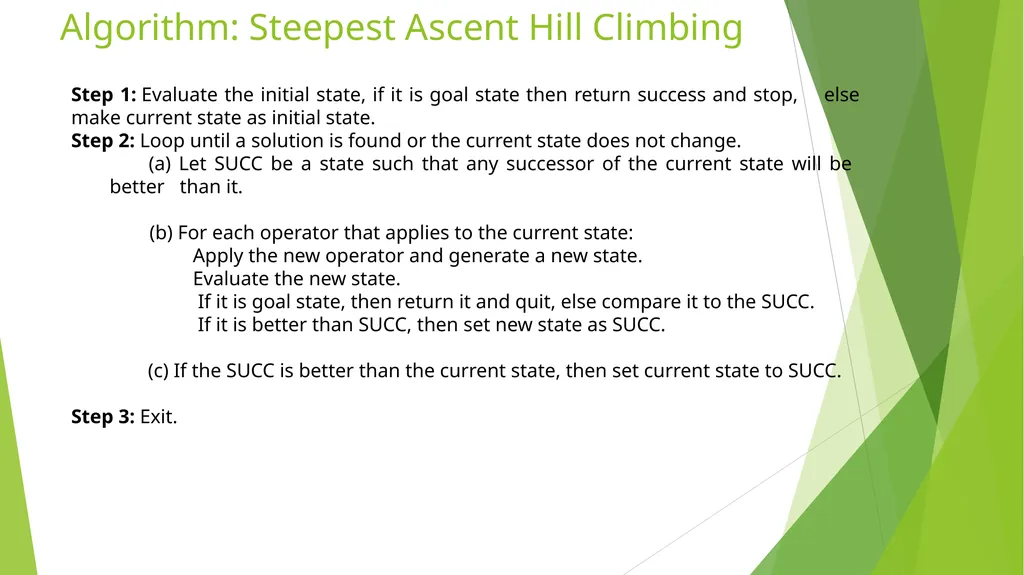
Algorithm: Steepest Ascent Hill Climbing Step 1: Evaluate the initial state, if it is goal state then return success and stop, else make current state as initial state.
Step 2: Loop until a solution is found or the current state does not change.
(a) Let SUCC be a state such that any successor of the current state will be better than it.
(b) For each operator that applies to the current state:
Apply the new operator and generate a new state.
Evaluate the new state.
If it is goal state, then return it and quit, else compare it to the SUCC.
If it is better than SUCC, then set new state as SUCC.
(c) If the SUCC is better than the current state, then set current state to SUCC.
Step 3: Exit.<br>
12
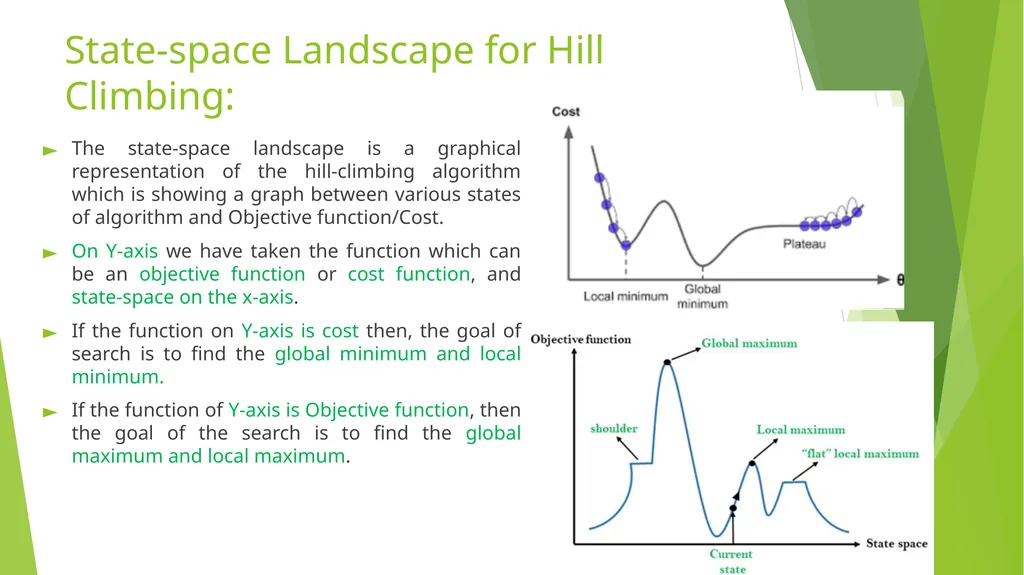
State-space Landscape for Hill Climbing: The state-space landscape is a graphical representation of the hill-climbing algorithm which is showing a graph between various states of algorithm and Objective function/Cost.
On Y-axis we have taken the function which can be an objective function or cost function, and state-space on the x-axis.
If the function on Y-axis is cost then, the goal of search is to find the global minimum and local minimum.
If the function of Y-axis is Objective function, then the goal of the search is to find the global maximum and local maximum.<br>
13
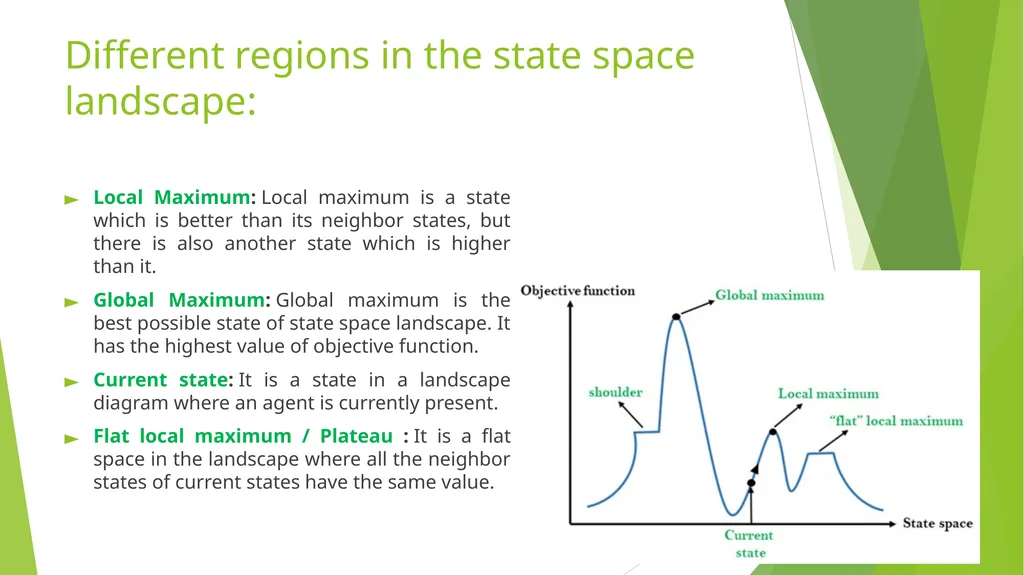
Different regions in the state space landscape: Local Maximum: Local maximum is a state which is better than its neighbor states, but there is also another state which is higher than it.
Global Maximum: Global maximum is the best possible state of state space landscape. It has the highest value of objective function.
Current state: It is a state in a landscape diagram where an agent is currently present.
Flat local maximum / Plateau : It is a flat space in the landscape where all the neighbor states of current states have the same value.<br>
14
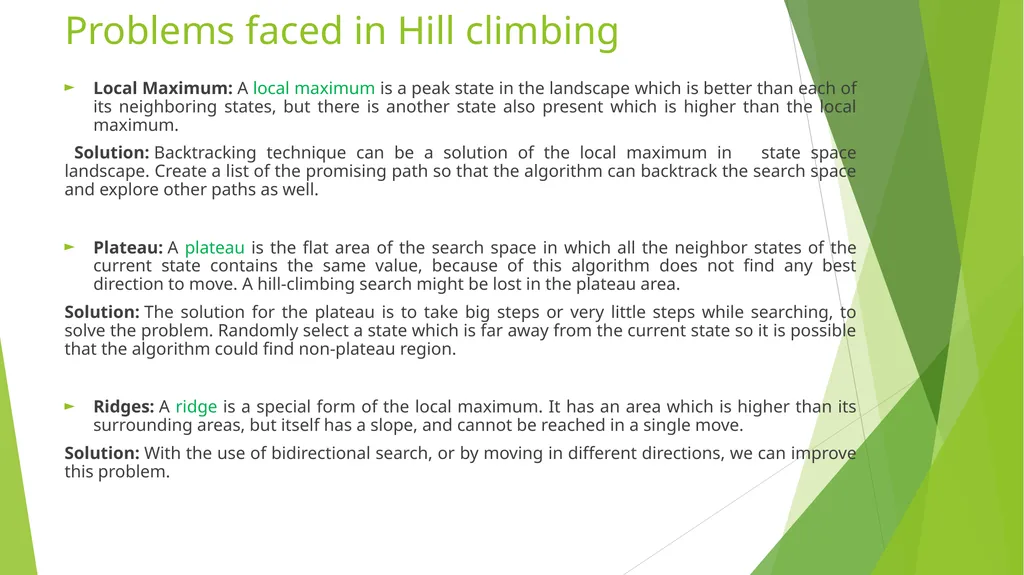
Problems faced in Hill climbing Local Maximum: A local maximum is a peak state in the landscape which is better than each of its neighboring states, but there is another state also present which is higher than the local maximum.
Solution: Backtracking technique can be a solution of the local maximum in state space landscape. Create a list of the promising path so that the algorithm can backtrack the search space and explore other paths as well.
Plateau: A plateau is the flat area of the search space in which all the neighbor states of the current state contains the same value, because of this algorithm does not find any best direction to move. A hill-climbing search might be lost in the plateau area.
Solution: The solution for the plateau is to take big steps or very little steps while searching, to solve the problem. Randomly select a state which is far away from the current state so it is possible that the algorithm could find non-plateau region.
Ridges: A ridge is a special form of the local maximum. It has an area which is higher than its surrounding areas, but itself has a slope, and cannot be reached in a single move.
Solution: With the use of bidirectional search, or by moving in different directions, we can improve this problem.<br>