State Technical Advisory Committee Meeting November 2023 FY 24 Climate Smart Practices Climate Smart Ag and Forestry Producers can respond to climate change by reducing or removing GHG (mitigation and building resilience (adaptation) while
"State Technical Advisory Committee Meeting" is the property of its rightful owner. Permission is granted to
download and print the materials on this website for personal, non-commercial use only, and to display it
on your personal computer provided you do not modify the materials and that you retain all copyright
notices contained in the materials. By downloading content from our website, you accept the terms of this
agreement.
Presentation Transcript
01
State Technical Advisory Committee Meeting November 2023<br>
02
FY 24 Climate Smart Practices<br>
03
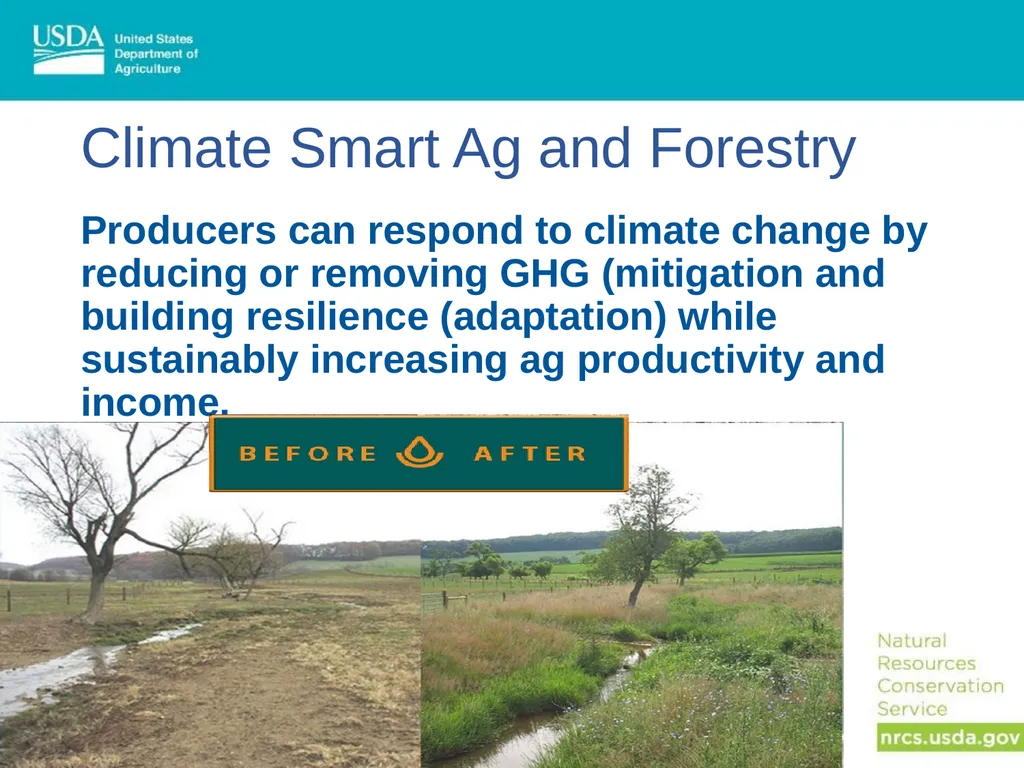
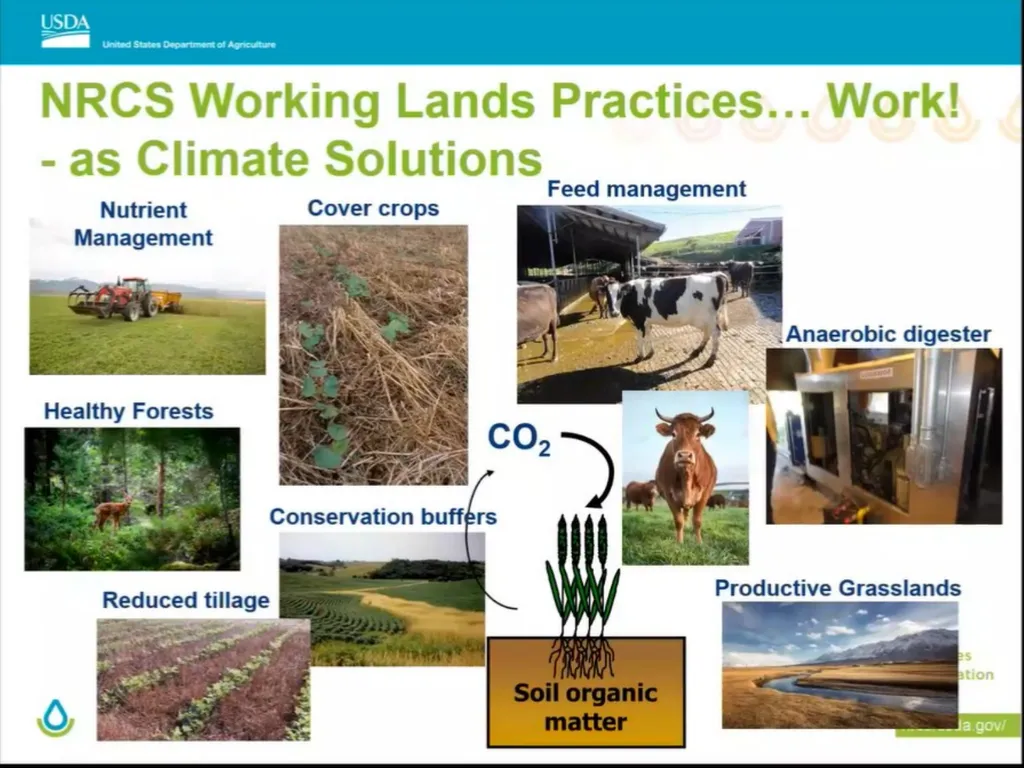
Climate Smart Ag and Forestry Producers can respond to climate change by reducing or removing GHG (mitigation and building resilience (adaptation) while sustainably increasing ag productivity and income.<br>
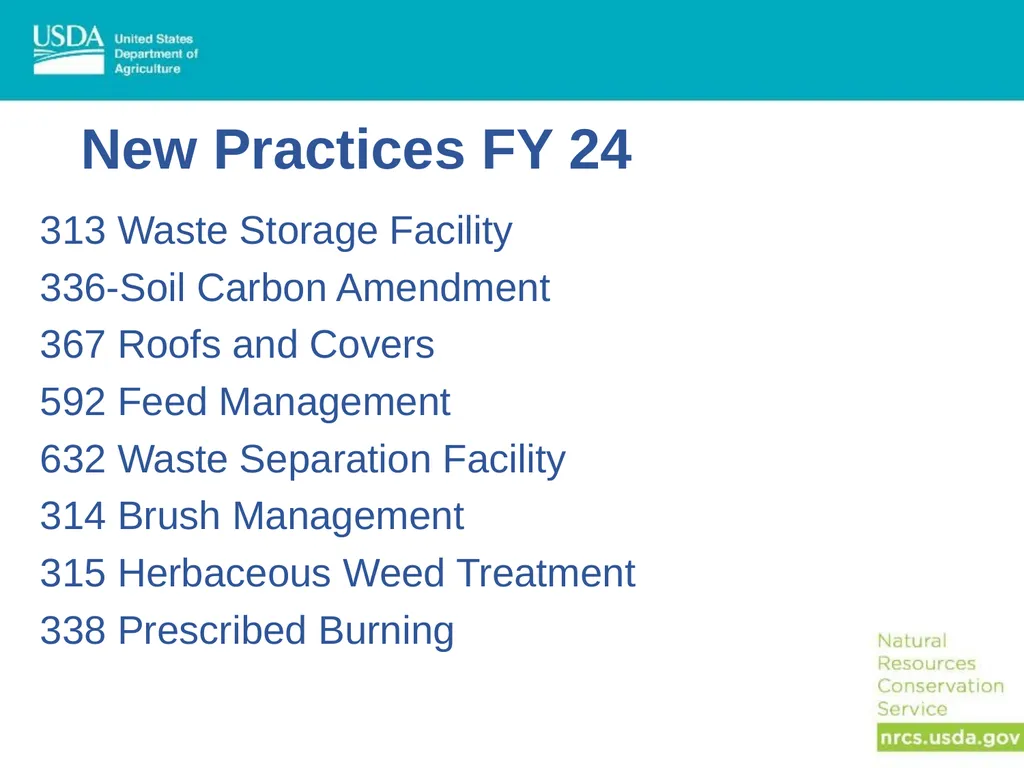
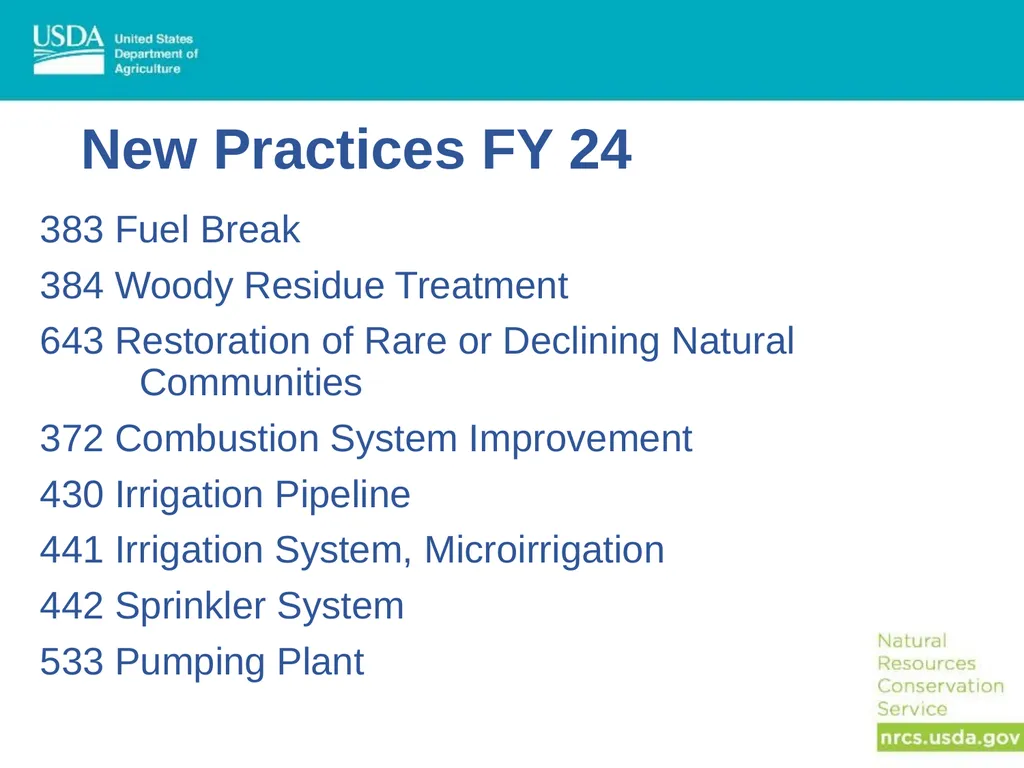
New Practices FY 24 383 Fuel Break
384 Woody Residue Treatment
643 Restoration of Rare or Declining Natural Communities
372 Combustion System Improvement
430 Irrigation Pipeline
441 Irrigation System, Microirrigation
442 Sprinkler System
533 Pumping Plant 5<br>
06
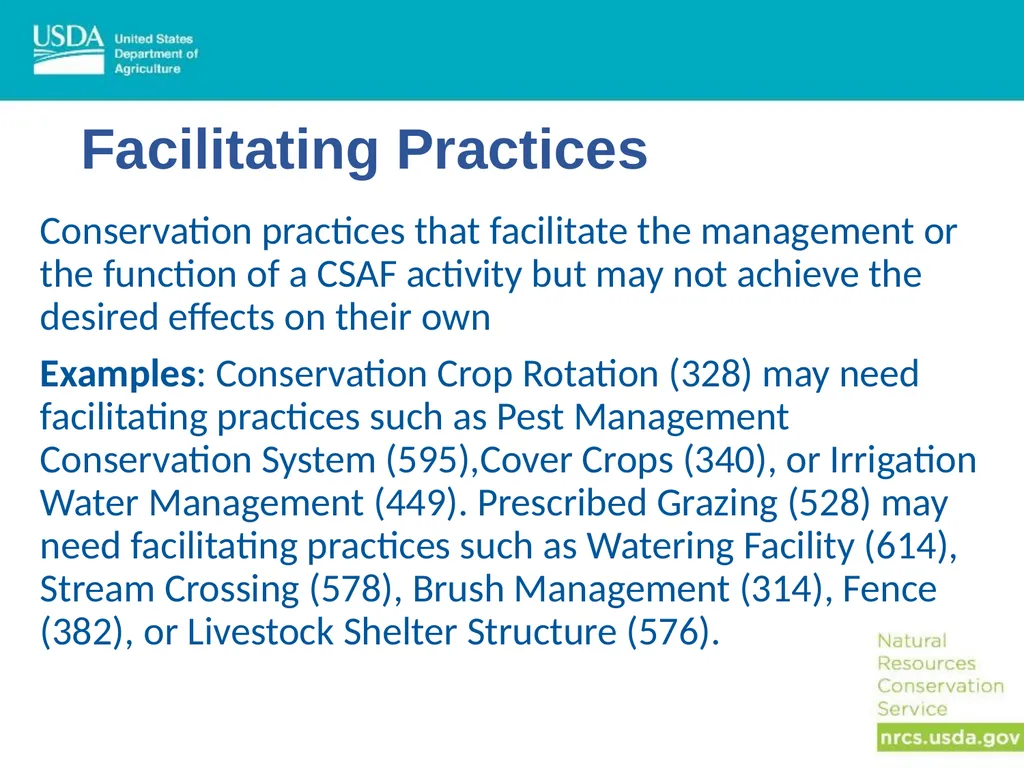
Facilitating Practices Conservation practices that facilitate the management or the function of a CSAF activity but may not achieve the desired effects on their own
Examples: Conservation Crop Rotation (328) may need facilitating practices such as Pest Management Conservation System (595),Cover Crops (340), or Irrigation Water Management (449). Prescribed Grazing (528) may need facilitating practices such as Watering Facility (614), Stream Crossing (578), Brush Management (314), Fence (382), or Livestock Shelter Structure (576). 6<br>
07
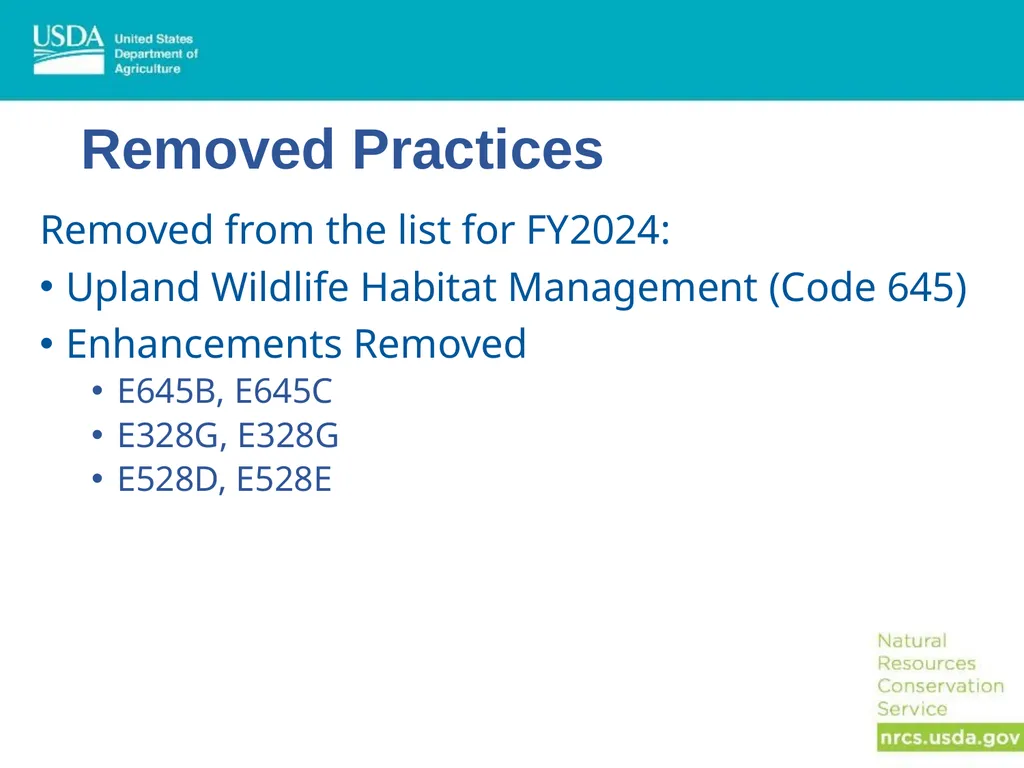
Removed Practices Removed from the list for FY2024:
Upland Wildlife Habitat Management (Code 645)
Enhancements Removed
E645B, E645C
E328G, E328G
E528D, E528E 7<br>
08
TOOLS COMET-Planner™ is an evaluation tool designed to provide estimates of greenhouse gas reductions expected by adopting NRCS conservation practices. Use of this tool is intended for conservation planning purposes and does not provide site-specific calculations. Please visit COMET-Farm for an estimate tailored to site specific conditions of your farm.
COMET-Farm™ is an interactive online tool to estimate whole-farm, ranch, and forestry emissions and mitigation options.<br>
09
Additional Resources Programs - FY2024 IRA Documents - All Documents (sharepoint.com)
Climate-Smart Agriculture and Forestry Mitigation Activity List (usda.gov)
NRCS Climate - Home (sharepoint.com)
Southwest Climate Hub | USDA Climate Hubs
Climate Smart Agriculture and Forestry Mitigation Activities FAQ’s
NRCS Climate Smart Mitigation Activities
NRCS Inflation Reduction Act 9<br>
10
EQIP CIC Priority Practice List<br>
11
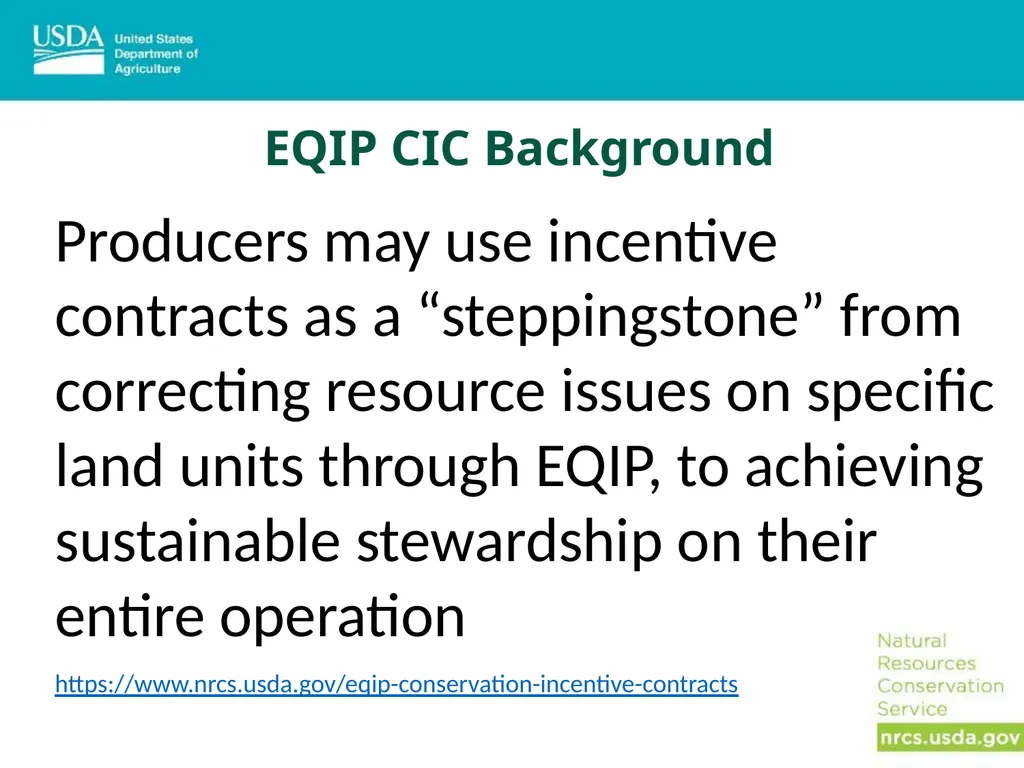
EQIP CIC Background Producers may use incentive contracts as a “steppingstone” from correcting resource issues on specific land units through EQIP, to achieving sustainable stewardship on their entire operation https://www.nrcs.usda.gov/eqip-conservation-incentive-contracts<br>
12
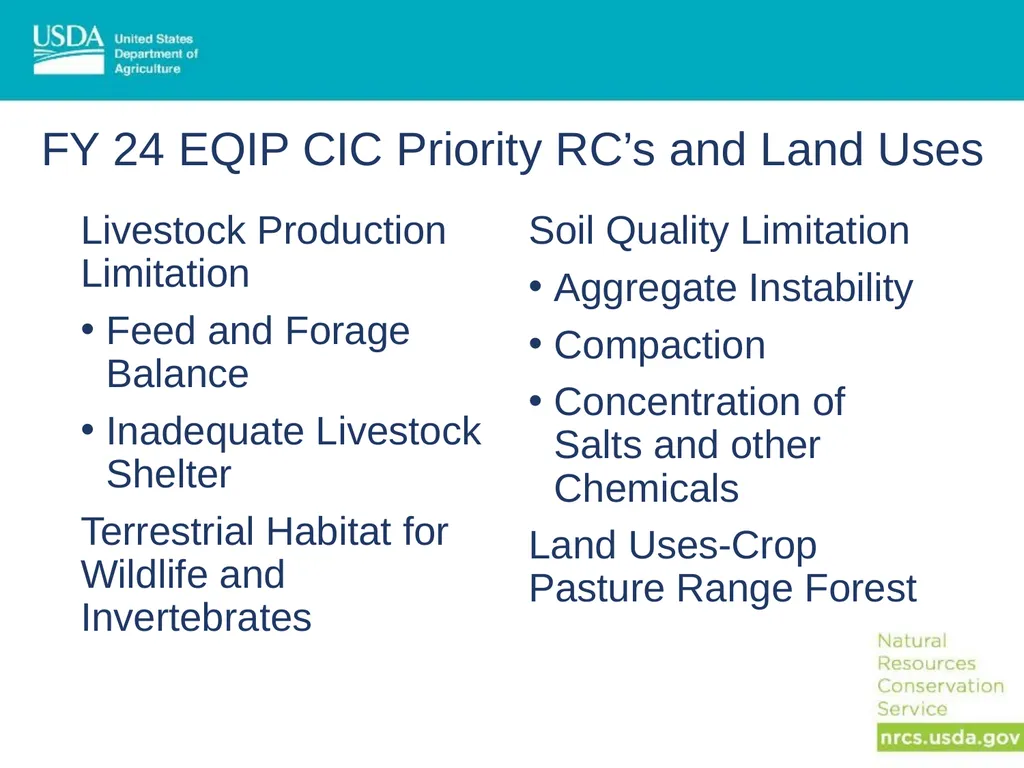
FY 24 EQIP CIC Priority RC’s and Land Uses Soil Quality Limitation
Aggregate Instability
Compaction
Concentration of Salts and other Chemicals
Land Uses-Crop Pasture Range Forest Livestock Production Limitation
Feed and Forage Balance
Inadequate Livestock Shelter
Terrestrial Habitat for Wildlife and Invertebrates<br>
13
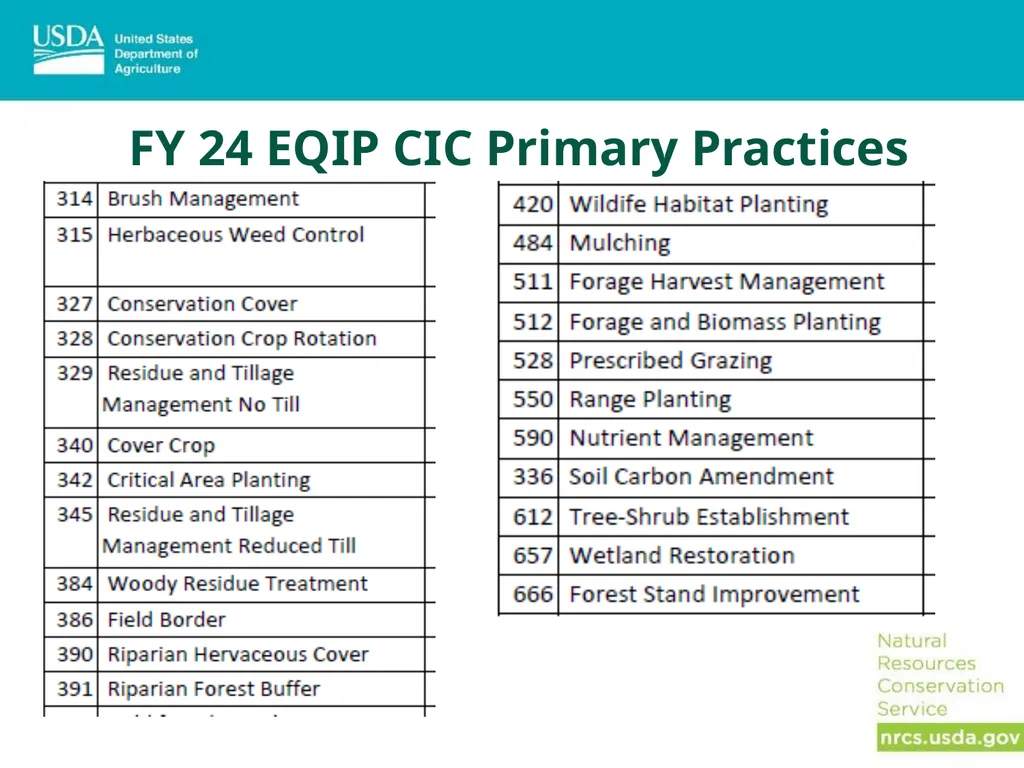
FY 24 EQIP CIC Primary Practices<br>
14
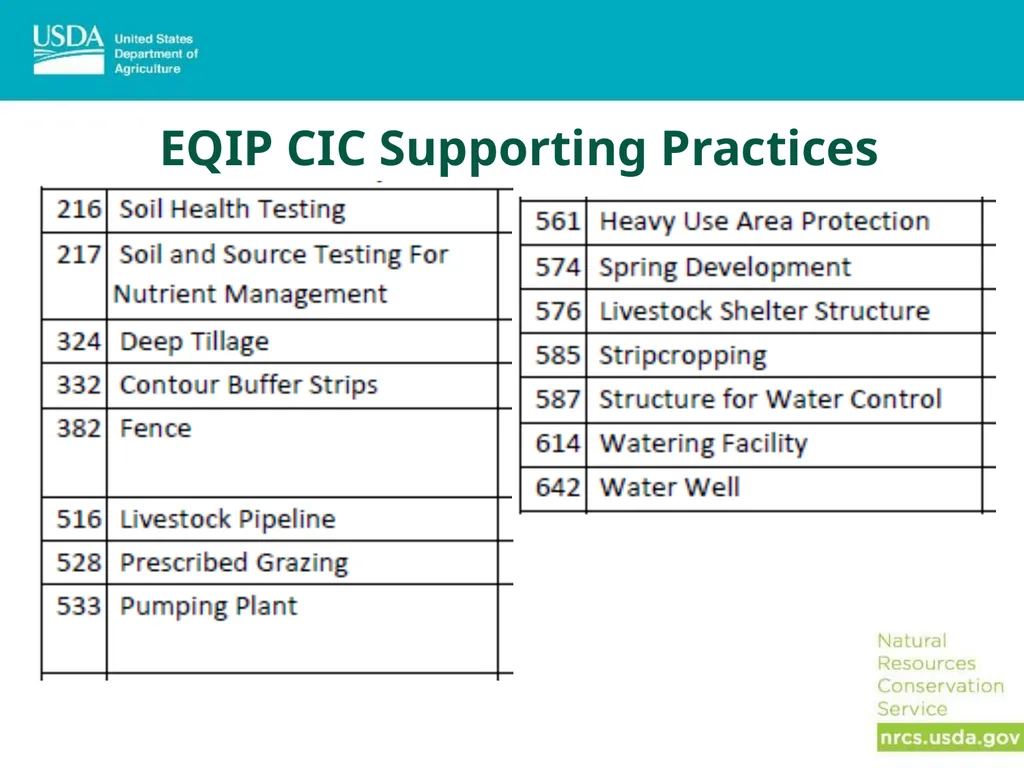
EQIP CIC Supporting Practices<br>
15
Utah Minimal Effects Worksheet<br>
16
Background The 1985 National Food Security Act requires producers participating in USDA programs to comply with the Wetland Conservation (WC) Compliance<br>
17
Background To remain eligible to receive benefits, they must certify that:
• they have not produced crops on a converted wetland after December 23, 1985
• they did not convert a wetland after November 28, 1990, in order to make agricultural production possible.
• An AD 1026 form was filed with FSA<br>
18
Background NRCS assists producers with meeting participants wetland compliance responsibilities by issuing certified wetland determinations.
Certified wetland determinations identify the location of all wetlands on the participants land and the scope of protection that must be provided in order for a producer to maintain eligibility for USDA program benefits.<br>
19
Minimal Effects Definition The purpose of a minimal effects exemption is to allow for treatments that will have no or minimal impact to the functional capacity in the wetland<br>
20
Minimal Effects Worksheet Objective The purpose of the minimal effects worksheet is to expedite non-native, invasive tree and shrub removal within or near wetlands
The document walks a planner through a decision tree to determine whether the site meets the criteria to remove invasive woody vegetation without a Certified Wetland Determination<br>