
Statistical Thermodynamics Dr. Sayantani

Description: Statistical Thermodynamics Dr. Sayantani Chatterjee Assistant Professor Vijaygarh Jyotish Ray College 8,2 Jadavpur Central Rd Bijoygarh, Jadavpur Kolkata-700032 B.Sc Chem (H) 5 th Semester Physical Chemistry What is Statistical
Related Topics
Download Presentation
"Statistical Thermodynamics Dr. Sayantani" is the property of its rightful owner. Permission is granted to download and print the materials on this website for personal, non-commercial use only, and to display it on your personal computer provided you do not modify the materials and that you retain all copyright notices contained in the materials. By downloading content from our website, you accept the terms of this agreement.
Presentation Transcript
slide1. Statistical Thermodynamics Dr. Sayantani Chatterjee
Assistant Professor
Vijaygarh Jyotish Ray College
8,2 Jadavpur Central Rd
Bijoygarh, Jadavpur
Kolkata-700032 B.Sc Chem (H) 5 th Semester
Physical Chemistry<br>
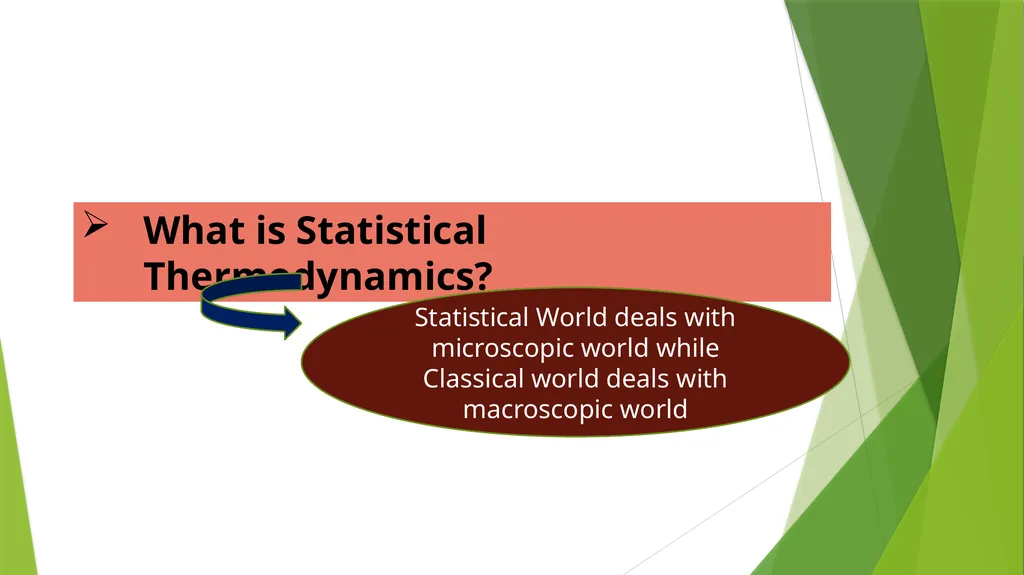
slide2. What is Statistical Thermodynamics? Statistical World deals with microscopic world while Classical world deals with macroscopic world<br>
slide3. Difference between Classical and Statistical Thermodynamics<br>
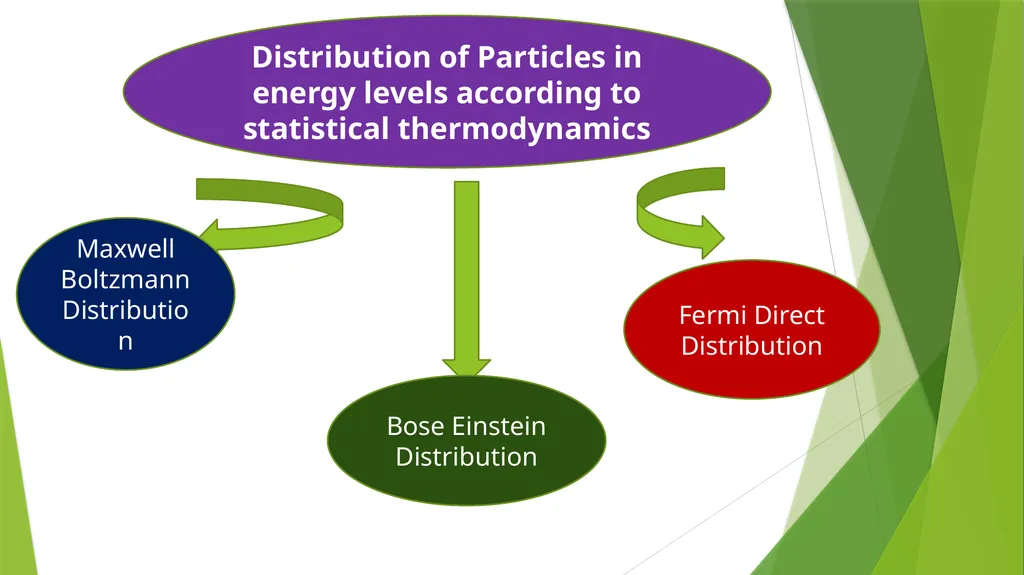
slide4. Distribution of Particles in energy levels according to statistical thermodynamics Maxwell Boltzmann Distribution Bose Einstein Distribution Fermi Direct Distribution<br>
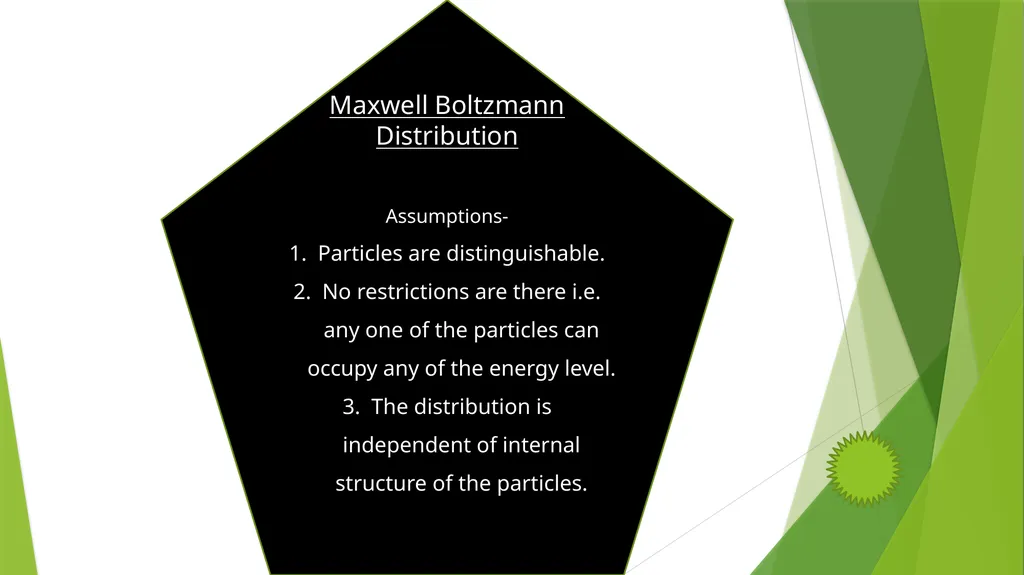
slide5. Maxwell Boltzmann Distribution
Assumptions-
Particles are distinguishable.
No restrictions are there i.e. any one of the particles can occupy any of the energy level.
The distribution is independent of internal structure of the particles.<br>
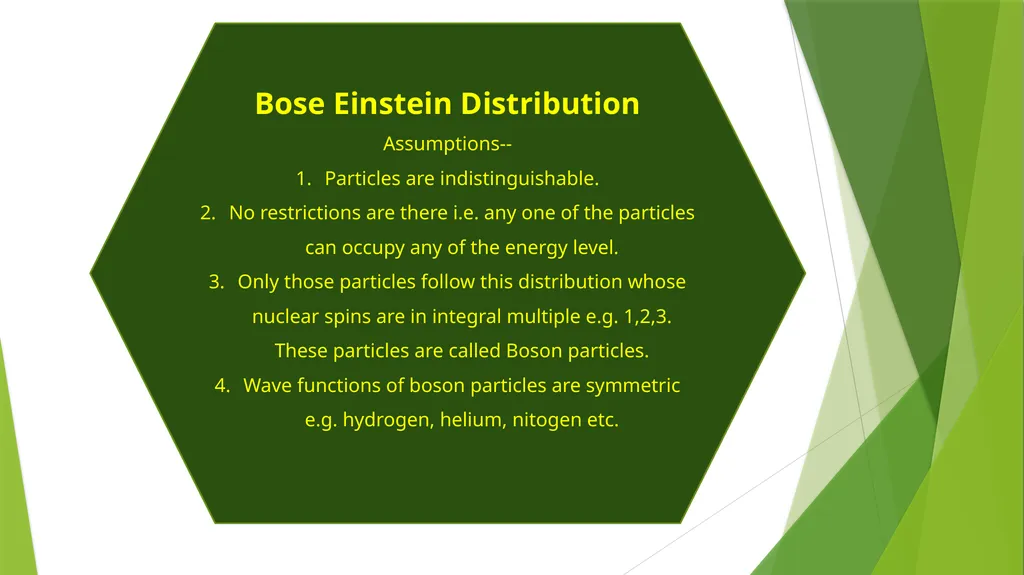
slide6. Bose Einstein Distribution
Assumptions-
Bose Einstein Distribution
Assumptions--
Particles are indistinguishable.
No restrictions are there i.e. any one of the particles can occupy any of the energy level.
Only those particles follow this distribution whose nuclear spins are in integral multiple e.g. 1,2,3. These particles are called Boson particles.
Wave functions of boson particles are symmetric e.g. hydrogen, helium, nitogen etc.<br>
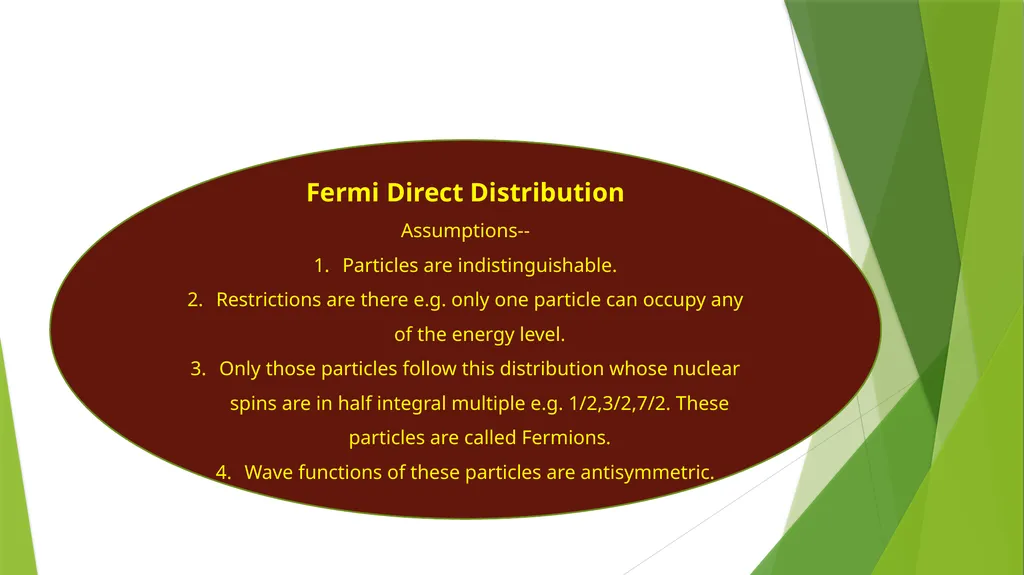
slide7. Fermi Direct Distribution
Assumptions--
Particles are indistinguishable.
Restrictions are there e.g. only one particle can occupy any of the energy level.
Only those particles follow this distribution whose nuclear spins are in half integral multiple e.g. 1/2,3/2,7/2. These particles are called Fermions.
Wave functions of these particles are antisymmetric.<br>
slide8. Ensembles
Large collection of identical units i.e, molecules , particles and atoms<br>
slide9. Probability densities in phase space cannot be computed by considering only a single system at a single instant in time. Such a system will be in some random microstate, but what we need is the statistics of such microstates. This problem was solved by Gibbs, who considered ensembles that consist of a very large number of identical systems in possibly different microstates. The microstates for a system with M molecules with f degrees of freedom each are points in 2fMdimensional phase space. If we have information on the probability density assigned to such points, we can use probability theory to compute thermodynamical state function. Ensembles<br>
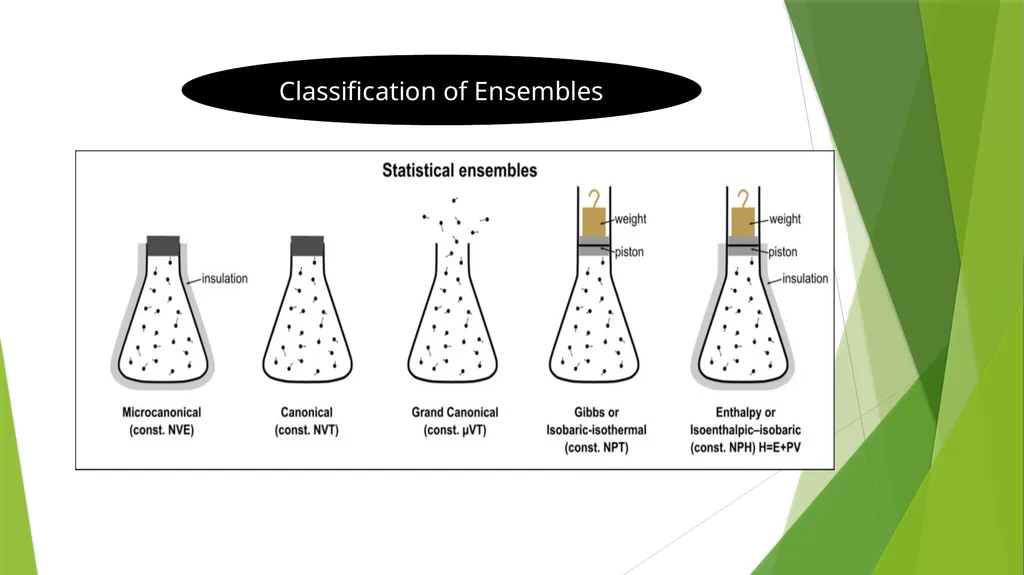
slide10. Classification of Ensembles<br>
slide11. Discussions of problems on fermions and Bosons<br>
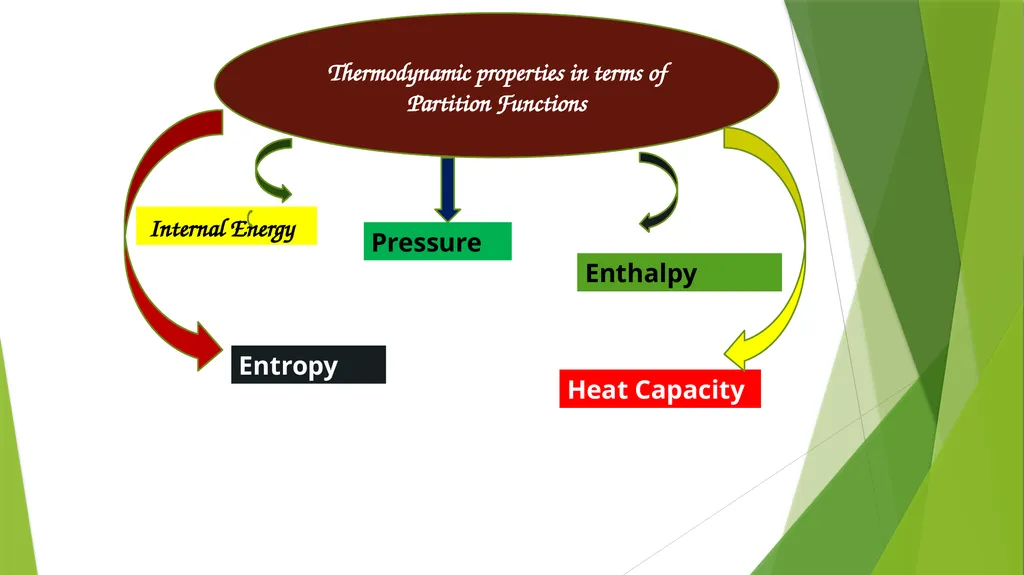
slide12. Thermodynamic properties in terms of Partition Functions Internal Energy Pressure Enthalpy Entropy Heat Capacity<br>
slide13. Partition Function Concept Properties<br>
slide14. Numerical Problems<br>
Assistant Professor
Vijaygarh Jyotish Ray College
8,2 Jadavpur Central Rd
Bijoygarh, Jadavpur
Kolkata-700032 B.Sc Chem (H) 5 th Semester
Physical Chemistry<br>
slide2. What is Statistical Thermodynamics? Statistical World deals with microscopic world while Classical world deals with macroscopic world<br>
slide3. Difference between Classical and Statistical Thermodynamics<br>
slide4. Distribution of Particles in energy levels according to statistical thermodynamics Maxwell Boltzmann Distribution Bose Einstein Distribution Fermi Direct Distribution<br>
slide5. Maxwell Boltzmann Distribution
Assumptions-
Particles are distinguishable.
No restrictions are there i.e. any one of the particles can occupy any of the energy level.
The distribution is independent of internal structure of the particles.<br>
slide6. Bose Einstein Distribution
Assumptions-
Bose Einstein Distribution
Assumptions--
Particles are indistinguishable.
No restrictions are there i.e. any one of the particles can occupy any of the energy level.
Only those particles follow this distribution whose nuclear spins are in integral multiple e.g. 1,2,3. These particles are called Boson particles.
Wave functions of boson particles are symmetric e.g. hydrogen, helium, nitogen etc.<br>
slide7. Fermi Direct Distribution
Assumptions--
Particles are indistinguishable.
Restrictions are there e.g. only one particle can occupy any of the energy level.
Only those particles follow this distribution whose nuclear spins are in half integral multiple e.g. 1/2,3/2,7/2. These particles are called Fermions.
Wave functions of these particles are antisymmetric.<br>
slide8. Ensembles
Large collection of identical units i.e, molecules , particles and atoms<br>
slide9. Probability densities in phase space cannot be computed by considering only a single system at a single instant in time. Such a system will be in some random microstate, but what we need is the statistics of such microstates. This problem was solved by Gibbs, who considered ensembles that consist of a very large number of identical systems in possibly different microstates. The microstates for a system with M molecules with f degrees of freedom each are points in 2fMdimensional phase space. If we have information on the probability density assigned to such points, we can use probability theory to compute thermodynamical state function. Ensembles<br>
slide10. Classification of Ensembles<br>
slide11. Discussions of problems on fermions and Bosons<br>
slide12. Thermodynamic properties in terms of Partition Functions Internal Energy Pressure Enthalpy Entropy Heat Capacity<br>
slide13. Partition Function Concept Properties<br>
slide14. Numerical Problems<br>