
Step 1 Value chain selection Objectives This step


Description: Step 1 Value chain selection Objectives This step is the starting point of the project. The value chains assessment and selection will serve to further research drivers and bottlenecks for OSH improvement in the selected value chain. The
Related Topics
Download Presentation
"Step 1 Value chain selection Objectives This step" is the property of its rightful owner. Permission is granted to download and print the materials on this website for personal, non-commercial use only, and to display it on your personal computer provided you do not modify the materials and that you retain all copyright notices contained in the materials. By downloading content from our website, you accept the terms of this agreement.
Presentation Transcript
slide1. Step 1
Value chain selection<br>
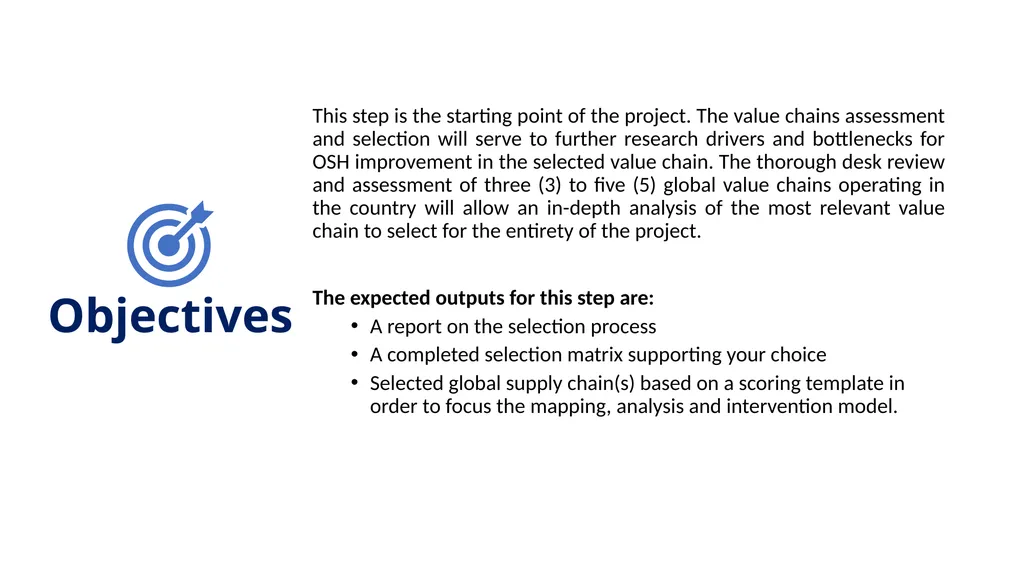
slide2. Objectives This step is the starting point of the project. The value chains assessment and selection will serve to further research drivers and bottlenecks for OSH improvement in the selected value chain. The thorough desk review and assessment of three (3) to five (5) global value chains operating in the country will allow an in-depth analysis of the most relevant value chain to select for the entirety of the project.
The expected outputs for this step are:
A report on the selection process
A completed selection matrix supporting your choice
Selected global supply chain(s) based on a scoring template in order to focus the mapping, analysis and intervention model.<br>
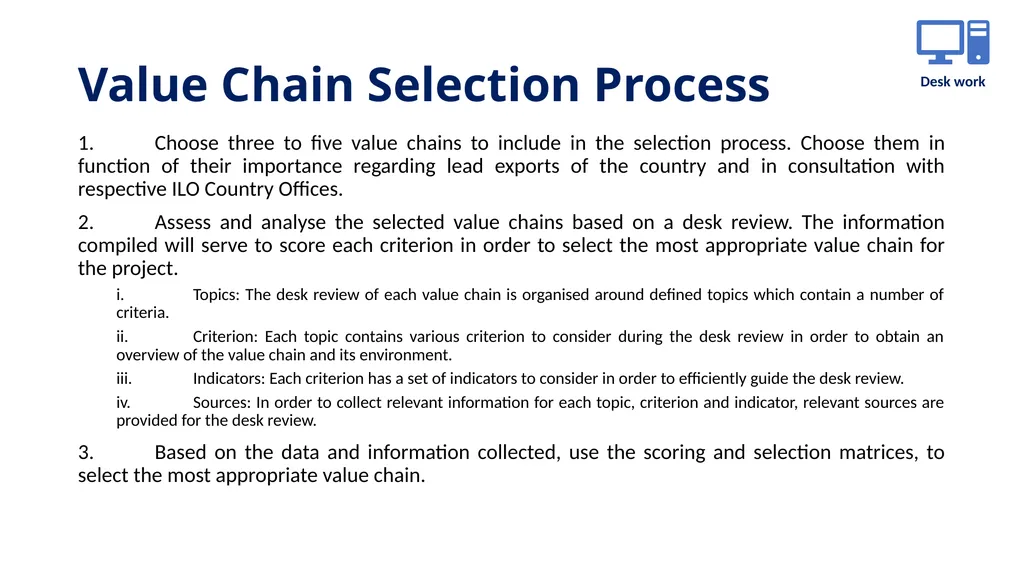
slide3. Value Chain Selection Process 1. Choose three to five value chains to include in the selection process. Choose them in function of their importance regarding lead exports of the country and in consultation with respective ILO Country Offices.
2. Assess and analyse the selected value chains based on a desk review. The information compiled will serve to score each criterion in order to select the most appropriate value chain for the project.
i. Topics: The desk review of each value chain is organised around defined topics which contain a number of criteria.
ii. Criterion: Each topic contains various criterion to consider during the desk review in order to obtain an overview of the value chain and its environment.
iii. Indicators: Each criterion has a set of indicators to consider in order to efficiently guide the desk review.
iv. Sources: In order to collect relevant information for each topic, criterion and indicator, relevant sources are provided for the desk review.
3. Based on the data and information collected, use the scoring and selection matrices, to select the most appropriate value chain. Desk work<br>
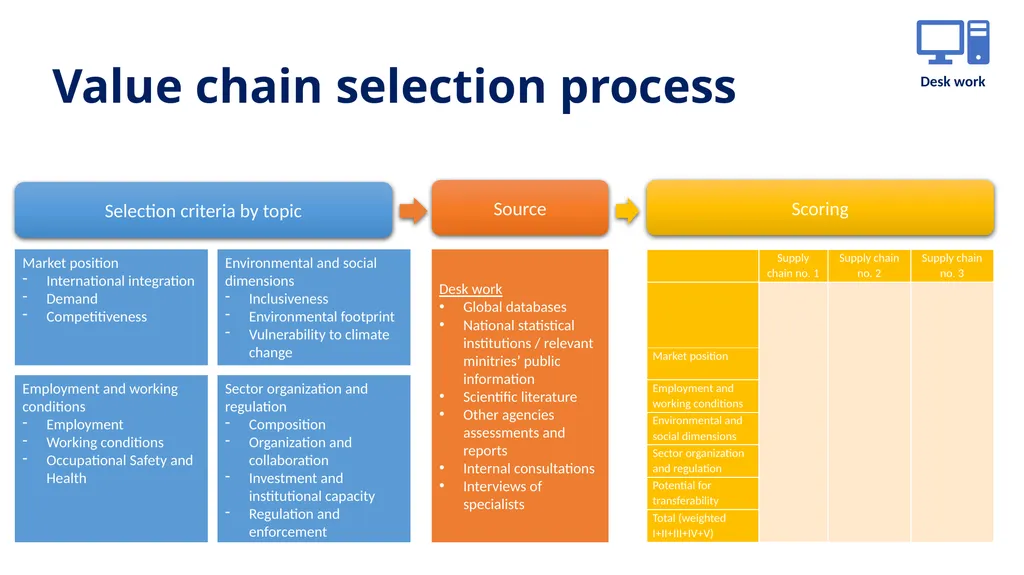
slide4. Value chain selection process Selection criteria by topic Source Scoring Market position
International integration
Demand
Competitiveness Employment and working conditions
Employment
Working conditions
Occupational Safety and Health Environmental and social dimensions
Inclusiveness
Environmental footprint
Vulnerability to climate change Sector organization and regulation
Composition
Organization and collaboration
Investment and institutional capacity
Regulation and enforcement Desk work
Global databases
National statistical institutions / relevant minitries’ public information
Scientific literature
Other agencies assessments and reports
Internal consultations
Interviews of specialists Desk work<br>
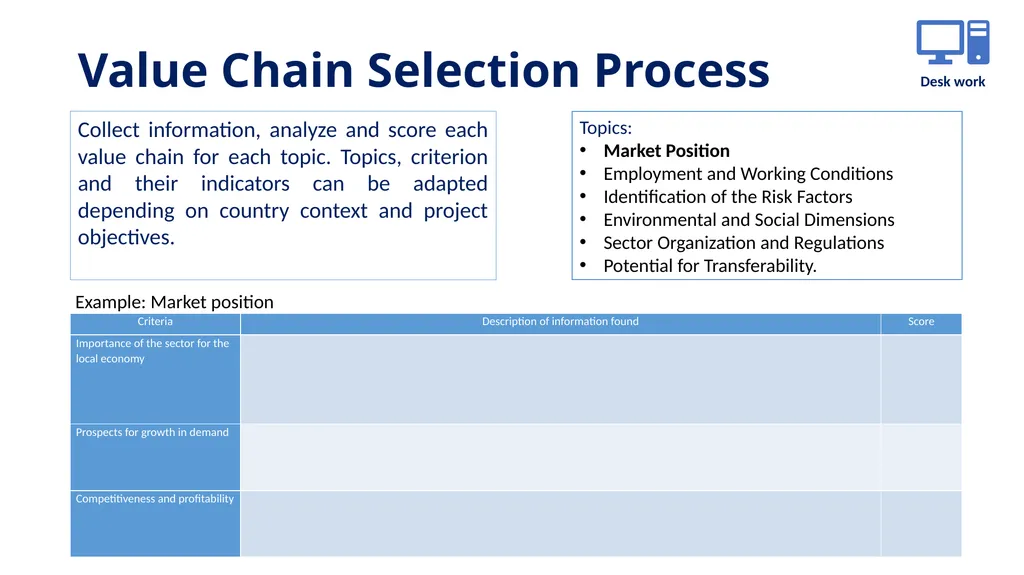
slide5. Value Chain Selection Process Collect information, analyze and score each value chain for each topic. Topics, criterion and their indicators can be adapted depending on country context and project objectives. Topics:
Market Position
Employment and Working Conditions
Identification of the Risk Factors
Environmental and Social Dimensions
Sector Organization and Regulations
Potential for Transferability. Desk work Example: Market position<br>
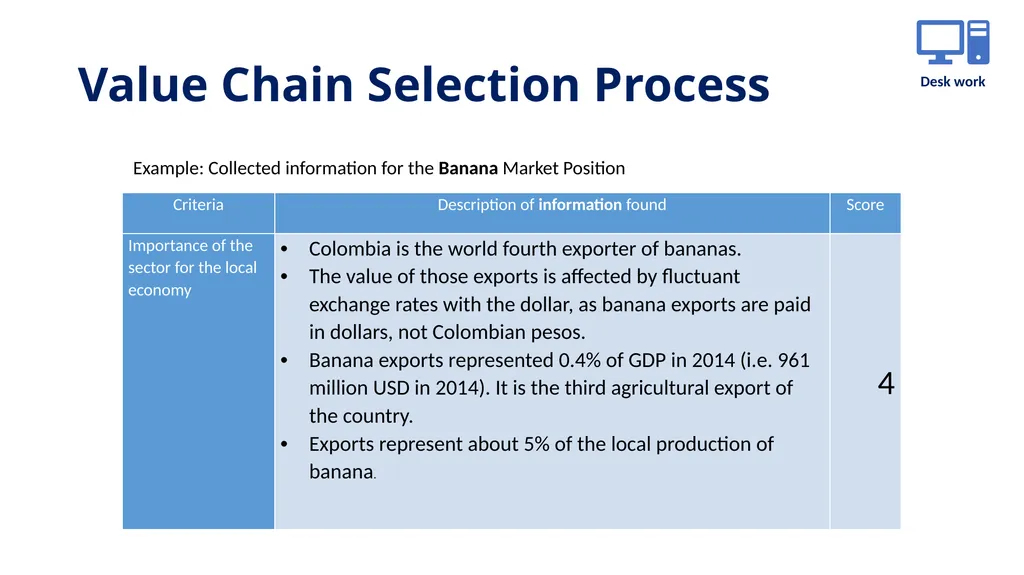
slide6. Value Chain Selection Process Example: Collected information for the Banana Market Position Desk work<br>
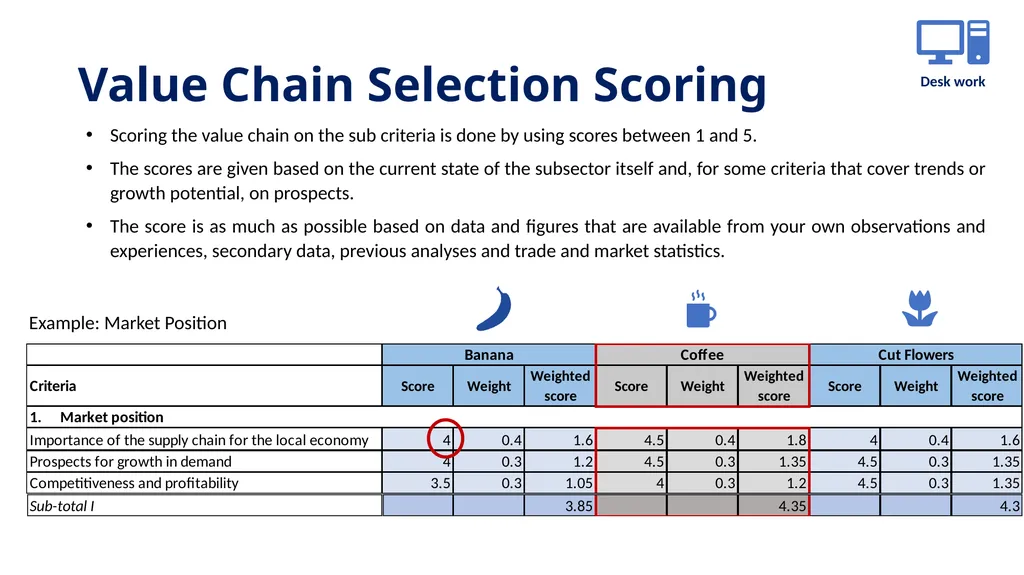
slide7. Value Chain Selection Scoring Scoring the value chain on the sub criteria is done by using scores between 1 and 5.
The scores are given based on the current state of the subsector itself and, for some criteria that cover trends or growth potential, on prospects.
The score is as much as possible based on data and figures that are available from your own observations and experiences, secondary data, previous analyses and trade and market statistics. Example: Market Position Desk work<br>
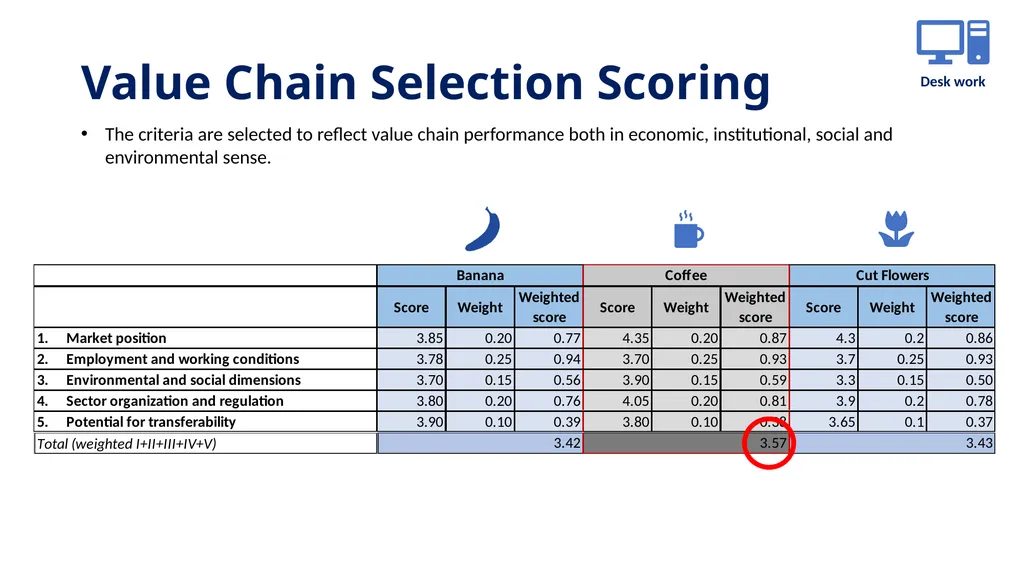
slide8. Value Chain Selection Scoring The criteria are selected to reflect value chain performance both in economic, institutional, social and environmental sense. Desk work<br>
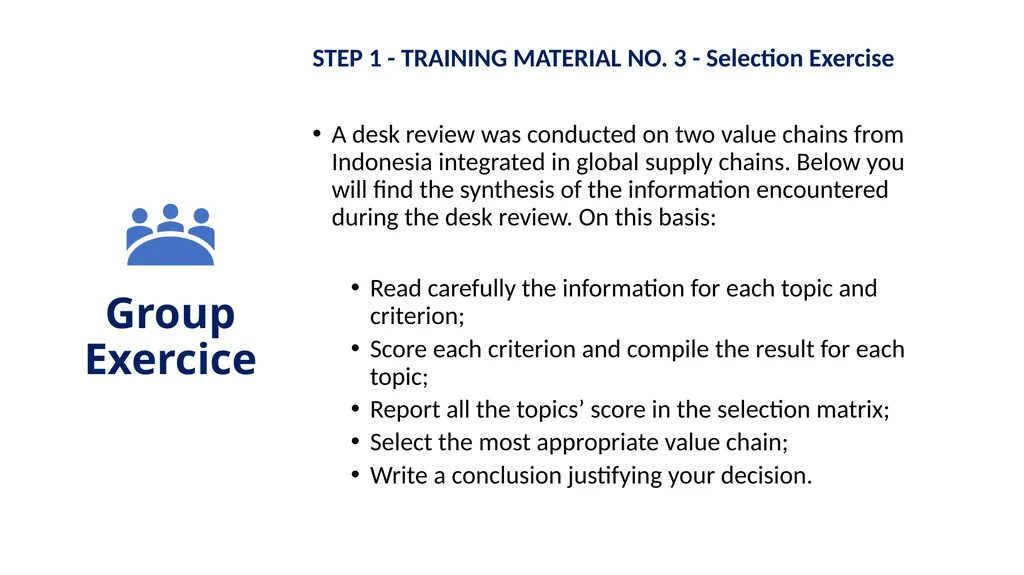
slide9. Group Exercice STEP 1 - TRAINING MATERIAL NO. 3 - Selection Exercise
A desk review was conducted on two value chains from Indonesia integrated in global supply chains. Below you will find the synthesis of the information encountered during the desk review. On this basis:
Read carefully the information for each topic and criterion;
Score each criterion and compile the result for each topic;
Report all the topics’ score in the selection matrix;
Select the most appropriate value chain;
Write a conclusion justifying your decision.<br>
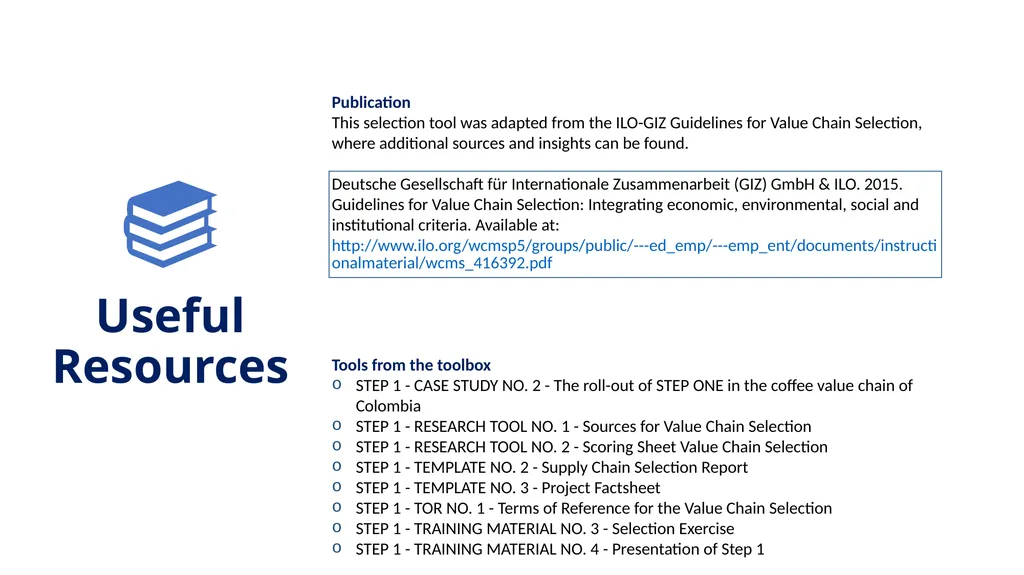
slide10. Useful Resources Publication
This selection tool was adapted from the ILO-GIZ Guidelines for Value Chain Selection, where additional sources and insights can be found.
Deutsche Gesellschaft für Internationale Zusammenarbeit (GIZ) GmbH & ILO. 2015. Guidelines for Value Chain Selection: Integrating economic, environmental, social and institutional criteria. Available at: http://www.ilo.org/wcmsp5/groups/public/---ed_emp/---emp_ent/documents/instructionalmaterial/wcms_416392.pdf
Tools from the toolbox
STEP 1 - CASE STUDY NO. 2 - The roll-out of STEP ONE in the coffee value chain of Colombia
STEP 1 - RESEARCH TOOL NO. 1 - Sources for Value Chain Selection
STEP 1 - RESEARCH TOOL NO. 2 - Scoring Sheet Value Chain Selection
STEP 1 - TEMPLATE NO. 2 - Supply Chain Selection Report
STEP 1 - TEMPLATE NO. 3 - Project Factsheet
STEP 1 - TOR NO. 1 - Terms of Reference for the Value Chain Selection
STEP 1 - TRAINING MATERIAL NO. 3 - Selection Exercise
STEP 1 - TRAINING MATERIAL NO. 4 - Presentation of Step 1<br>
slide2. Objectives This step is the starting point of the project. The value chains assessment and selection will serve to further research drivers and bottlenecks for OSH improvement in the selected value chain. The thorough desk review and assessment of three (3) to five (5) global value chains operating in the country will allow an in-depth analysis of the most relevant value chain to select for the entirety of the project.
The expected outputs for this step are:
A report on the selection process
A completed selection matrix supporting your choice
Selected global supply chain(s) based on a scoring template in order to focus the mapping, analysis and intervention model.<br>
slide3. Value Chain Selection Process 1. Choose three to five value chains to include in the selection process. Choose them in function of their importance regarding lead exports of the country and in consultation with respective ILO Country Offices.
2. Assess and analyse the selected value chains based on a desk review. The information compiled will serve to score each criterion in order to select the most appropriate value chain for the project.
i. Topics: The desk review of each value chain is organised around defined topics which contain a number of criteria.
ii. Criterion: Each topic contains various criterion to consider during the desk review in order to obtain an overview of the value chain and its environment.
iii. Indicators: Each criterion has a set of indicators to consider in order to efficiently guide the desk review.
iv. Sources: In order to collect relevant information for each topic, criterion and indicator, relevant sources are provided for the desk review.
3. Based on the data and information collected, use the scoring and selection matrices, to select the most appropriate value chain. Desk work<br>
slide4. Value chain selection process Selection criteria by topic Source Scoring Market position
International integration
Demand
Competitiveness Employment and working conditions
Employment
Working conditions
Occupational Safety and Health Environmental and social dimensions
Inclusiveness
Environmental footprint
Vulnerability to climate change Sector organization and regulation
Composition
Organization and collaboration
Investment and institutional capacity
Regulation and enforcement Desk work
Global databases
National statistical institutions / relevant minitries’ public information
Scientific literature
Other agencies assessments and reports
Internal consultations
Interviews of specialists Desk work<br>
slide5. Value Chain Selection Process Collect information, analyze and score each value chain for each topic. Topics, criterion and their indicators can be adapted depending on country context and project objectives. Topics:
Market Position
Employment and Working Conditions
Identification of the Risk Factors
Environmental and Social Dimensions
Sector Organization and Regulations
Potential for Transferability. Desk work Example: Market position<br>
slide6. Value Chain Selection Process Example: Collected information for the Banana Market Position Desk work<br>
slide7. Value Chain Selection Scoring Scoring the value chain on the sub criteria is done by using scores between 1 and 5.
The scores are given based on the current state of the subsector itself and, for some criteria that cover trends or growth potential, on prospects.
The score is as much as possible based on data and figures that are available from your own observations and experiences, secondary data, previous analyses and trade and market statistics. Example: Market Position Desk work<br>
slide8. Value Chain Selection Scoring The criteria are selected to reflect value chain performance both in economic, institutional, social and environmental sense. Desk work<br>
slide9. Group Exercice STEP 1 - TRAINING MATERIAL NO. 3 - Selection Exercise
A desk review was conducted on two value chains from Indonesia integrated in global supply chains. Below you will find the synthesis of the information encountered during the desk review. On this basis:
Read carefully the information for each topic and criterion;
Score each criterion and compile the result for each topic;
Report all the topics’ score in the selection matrix;
Select the most appropriate value chain;
Write a conclusion justifying your decision.<br>
slide10. Useful Resources Publication
This selection tool was adapted from the ILO-GIZ Guidelines for Value Chain Selection, where additional sources and insights can be found.
Deutsche Gesellschaft für Internationale Zusammenarbeit (GIZ) GmbH & ILO. 2015. Guidelines for Value Chain Selection: Integrating economic, environmental, social and institutional criteria. Available at: http://www.ilo.org/wcmsp5/groups/public/---ed_emp/---emp_ent/documents/instructionalmaterial/wcms_416392.pdf
Tools from the toolbox
STEP 1 - CASE STUDY NO. 2 - The roll-out of STEP ONE in the coffee value chain of Colombia
STEP 1 - RESEARCH TOOL NO. 1 - Sources for Value Chain Selection
STEP 1 - RESEARCH TOOL NO. 2 - Scoring Sheet Value Chain Selection
STEP 1 - TEMPLATE NO. 2 - Supply Chain Selection Report
STEP 1 - TEMPLATE NO. 3 - Project Factsheet
STEP 1 - TOR NO. 1 - Terms of Reference for the Value Chain Selection
STEP 1 - TRAINING MATERIAL NO. 3 - Selection Exercise
STEP 1 - TRAINING MATERIAL NO. 4 - Presentation of Step 1<br>