Strategies for managing the tropical rainforest sustainably LO: understand that strategies are both global and local. Those that are involved in the process are International governments, HICs, NGOs, and local governments. Sustainable
"Strategies for managing the tropical rainforest" is the property of its rightful owner. Permission is granted to
download and print the materials on this website for personal, non-commercial use only, and to display it
on your personal computer provided you do not modify the materials and that you retain all copyright
notices contained in the materials. By downloading content from our website, you accept the terms of this
agreement.
Presentation Transcript
01
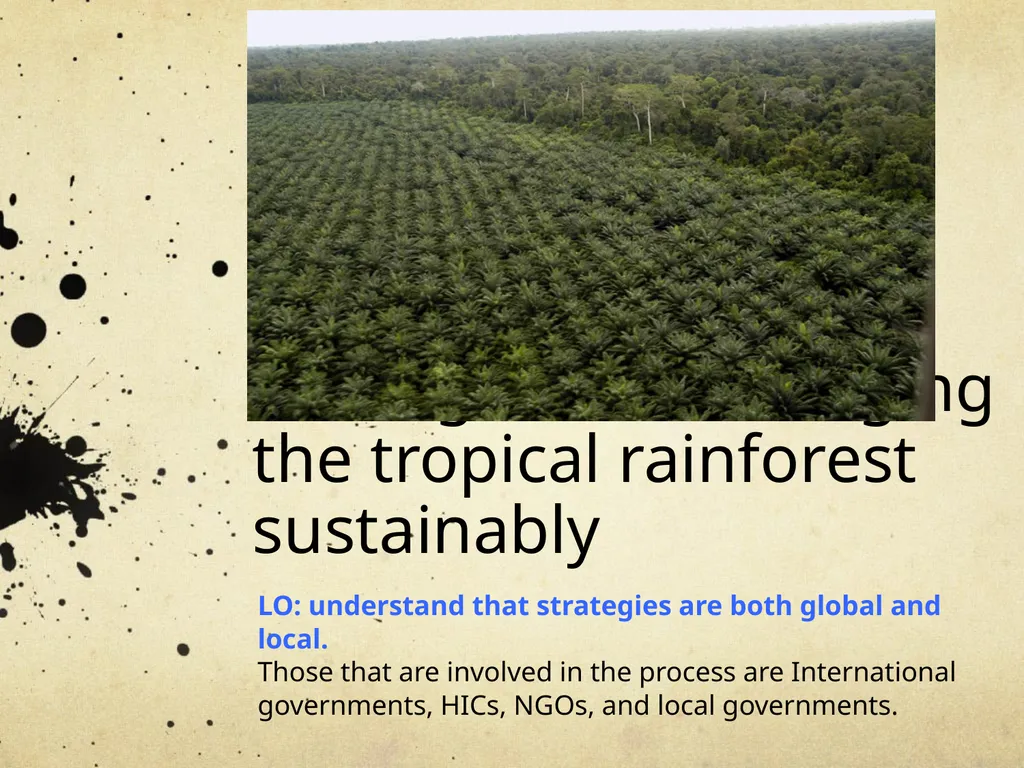
Strategies for managing the tropical rainforest sustainably LO: understand that strategies are both global and local.
Those that are involved in the process are International governments, HICs, NGOs, and local governments.<br>
02
Sustainable management of the forest Brazil needs to exploit the Amazon's resources to develop, so leaving it untouched is not an option.
Uncontrolled and unchecked exploitation can cause irreversible damage such as loss of biodiversity, soil erosion, flooding and climate change.
So, sustainable use of the forest is essential. Sustainable development will meet the needs of Brazil's population without compromising the needs of future generations. Possible strategies include:
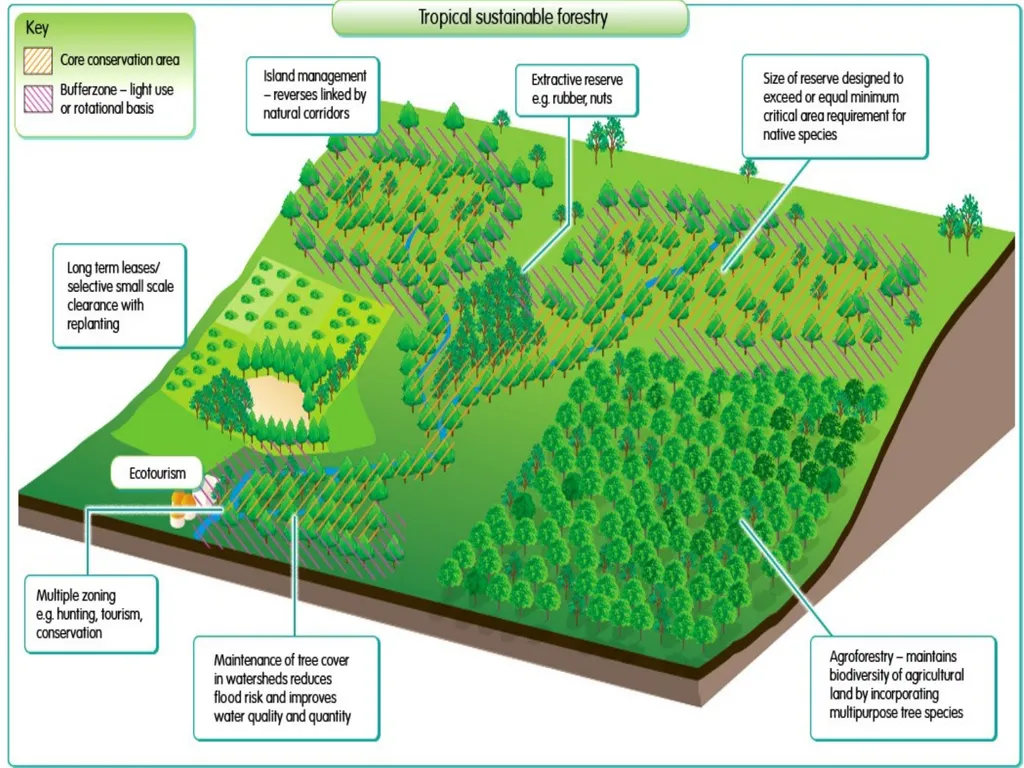
Agro-forestry - growing trees and crops at the same time. It prevents soil erosion and the crops benefit from the nutrients from the dead organic matter.
Selective logging - trees are only felled when they reach a particular height. This allows young trees a guaranteed life span and the forest will regain full maturity after around 30-50 years.
Education - ensuring those involved in exploitation and management of the forest understand the consequences behind their actions.
Afforestation - the opposite of deforestation.
Forest reserves - areas protected from exploitation.
Monitoring - use of satellite technology and photography to check that any activities taking place are legal and follow guidelines for sustainability.<br>
03
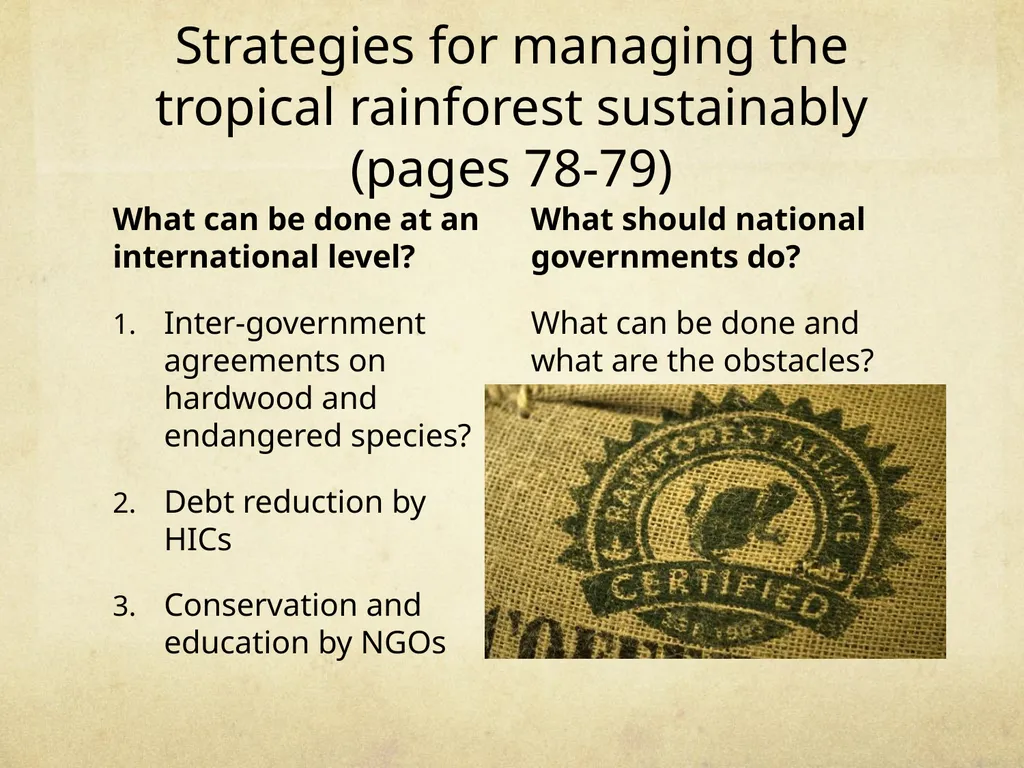
Strategies for managing the tropical rainforest sustainably (pages 78-79) What can be done at an international level?
Inter-government agreements on hardwood and endangered species?
Debt reduction by HICs
Conservation and education by NGOs What should national governments do?
What can be done and what are the obstacles?<br>
04
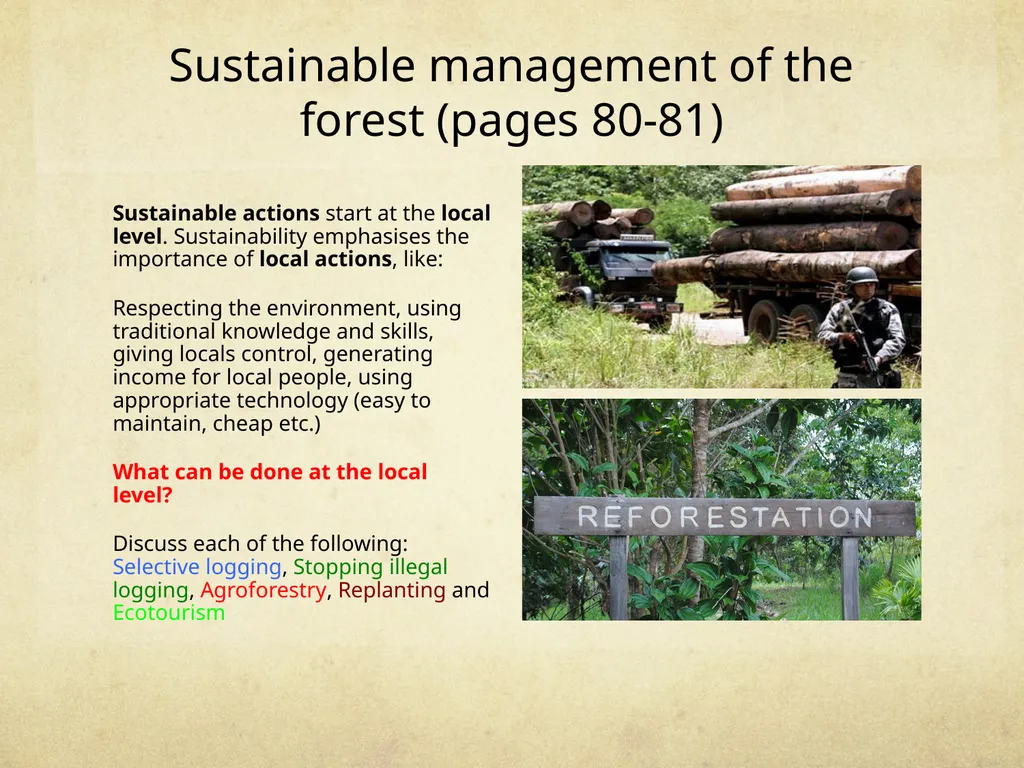
Sustainable management of the forest (pages 80-81) Sustainable actions start at the local level. Sustainability emphasises the importance of local actions, like:
Respecting the environment, using traditional knowledge and skills, giving locals control, generating income for local people, using appropriate technology (easy to maintain, cheap etc.)
What can be done at the local level?
Discuss each of the following: Selective logging, Stopping illegal logging, Agroforestry, Replanting and Ecotourism<br>
05
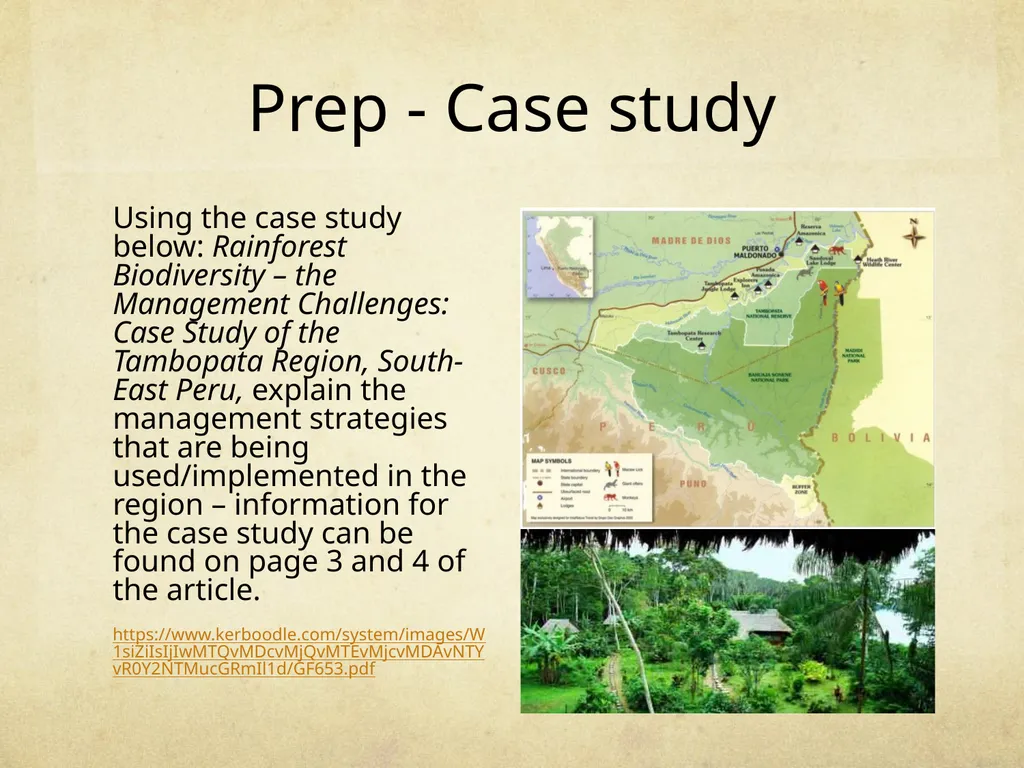
Prep - Case study Using the case study below: Rainforest Biodiversity – the Management Challenges: Case Study of the Tambopata Region, South-East Peru, explain the management strategies that are being used/implemented in the region – information for the case study can be found on page 3 and 4 of the article.
https://www.kerboodle.com/system/images/W1siZiIsIjIwMTQvMDcvMjQvMTEvMjcvMDAvNTYvR0Y2NTMucGRmIl1d/GF653.pdf<br>