
Strengthening health systems: Lessons learned on



Description: Strengthening health systems: Lessons learned on the potential of ICT for UHC. Dr. Inge Baumgarten, Head of Health Section Deutsche Gesellschaft für Internationale Zusammenarbeit (GIZ) GmbH Health and Social Protection in GIZ Our profile
Related Topics
Download Presentation
"Strengthening health systems: Lessons learned on" is the property of its rightful owner. Permission is granted to download and print the materials on this website for personal, non-commercial use only, and to display it on your personal computer provided you do not modify the materials and that you retain all copyright notices contained in the materials. By downloading content from our website, you accept the terms of this agreement.
Presentation Transcript
slide1. Strengthening health systems:
Lessons learned on the potential of ICT for UHC. Dr. Inge Baumgarten, Head of Health Section
Deutsche Gesellschaft für Internationale Zusammenarbeit (GIZ) GmbH<br>
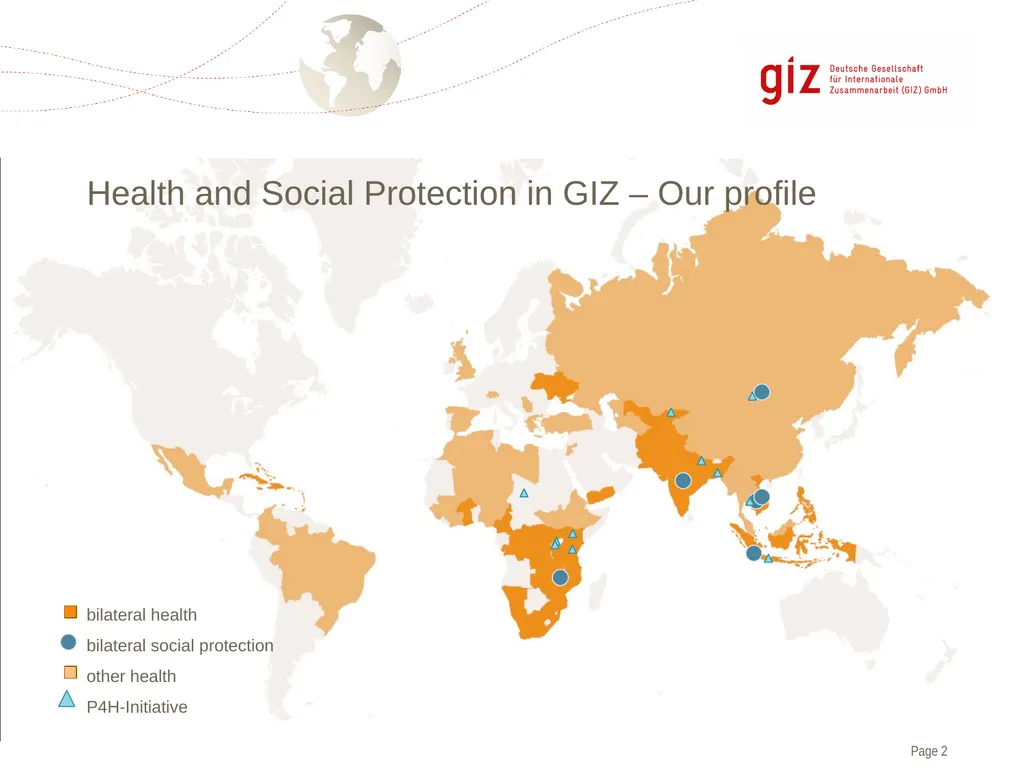
slide2. Health and Social Protection in GIZ – Our profile bilateral health
bilateral social protection
other health
P4H-Initiative<br>
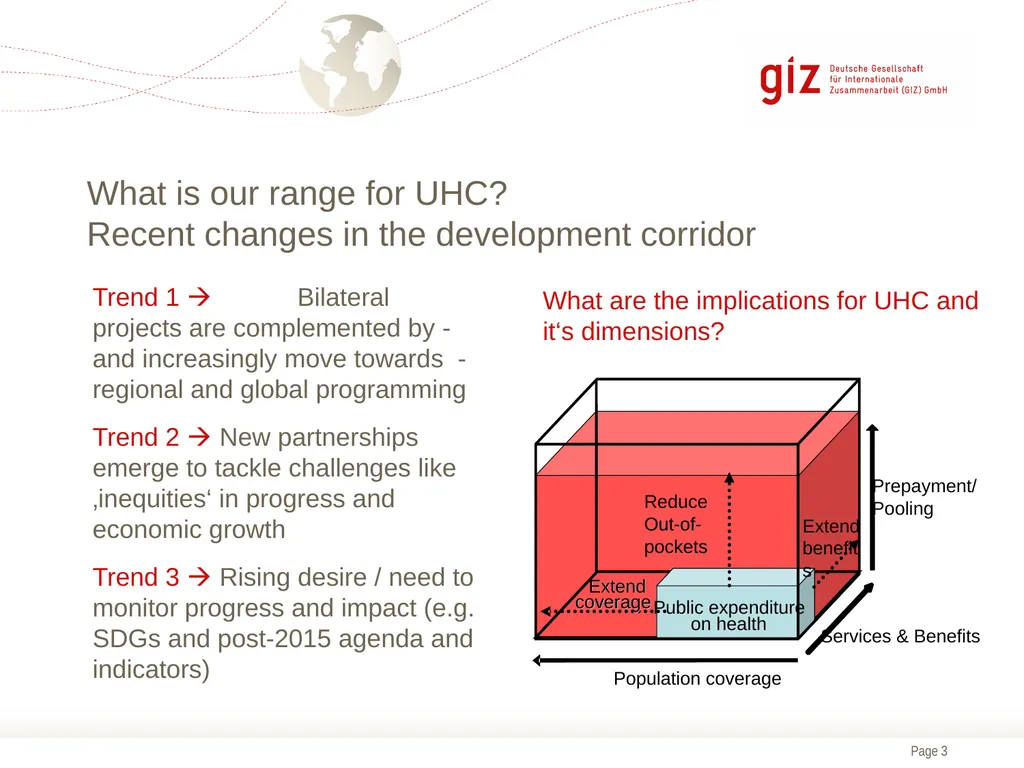
slide3. Trend 1 Bilateral projects are complemented by - and increasingly move towards - regional and global programming
Trend 2 New partnerships emerge to tackle challenges like ‚inequities‘ in progress and economic growth
Trend 3 Rising desire / need to monitor progress and impact (e.g. SDGs and post-2015 agenda and indicators) What is our range for UHC? Recent changes in the development corridor What are the implications for UHC and it‘s dimensions?<br>
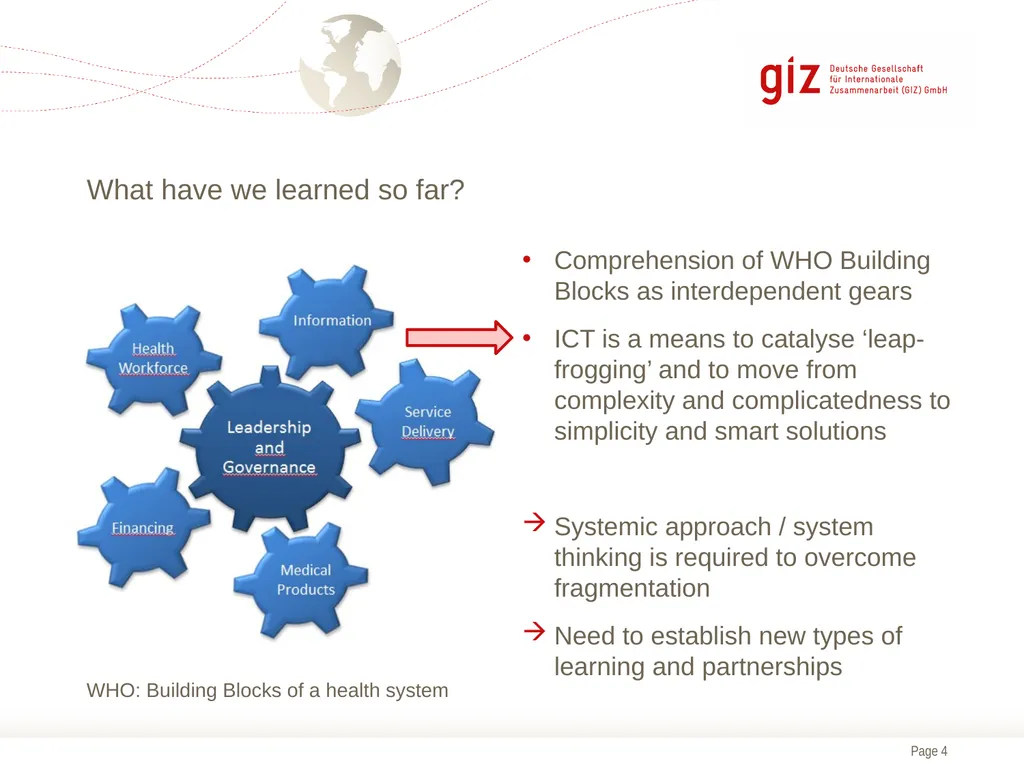
slide4. Comprehension of WHO Building Blocks as interdependent gears
ICT is a means to catalyse ‘leap-frogging’ and to move from complexity and complicatedness to simplicity and smart solutions
Systemic approach / system thinking is required to overcome fragmentation
Need to establish new types of learning and partnerships What have we learned so far? WHO: Building Blocks of a health system<br>
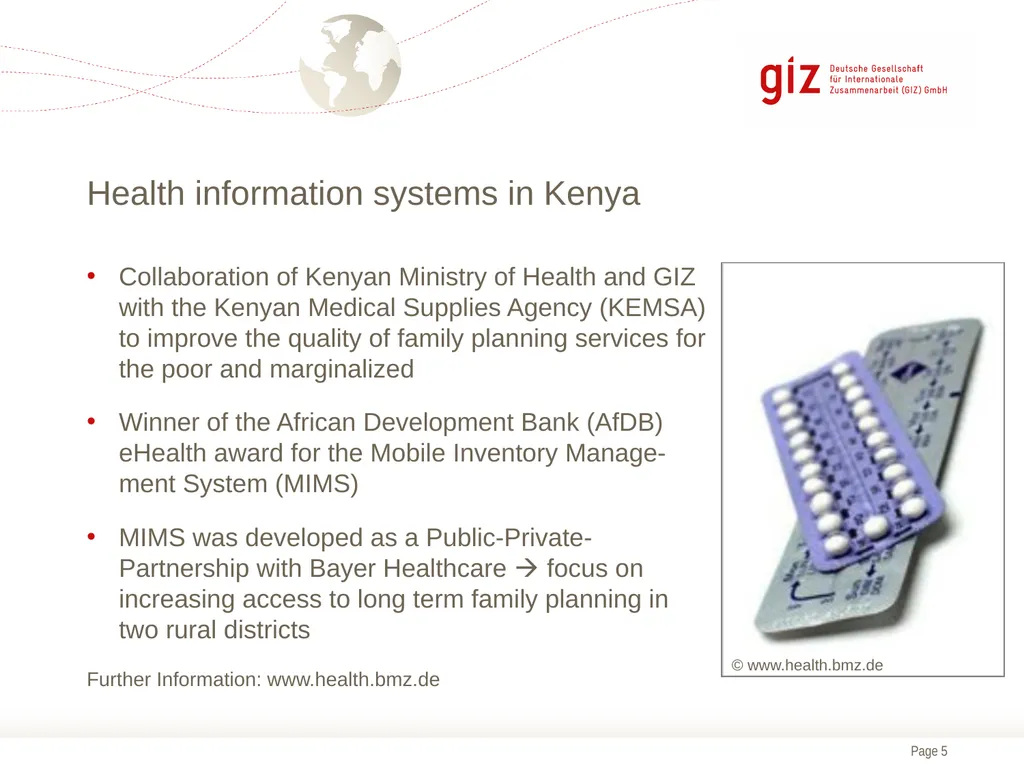
slide5. Health information systems in Kenya © www.health.bmz.de Collaboration of Kenyan Ministry of Health and GIZ with the Kenyan Medical Supplies Agency (KEMSA) to improve the quality of family planning services for the poor and marginalized
Winner of the African Development Bank (AfDB) eHealth award for the Mobile Inventory Manage-ment System (MIMS)
MIMS was developed as a Public-Private-Partnership with Bayer Healthcare focus on increasing access to long term family planning in two rural districts
Further Information: www.health.bmz.de<br>
slide6. Innovation Coalition of the Global Fund Example of an innovative, multisectoral partnership, which engages with private sector, academia and civil society to help solve some of the recurring challenges encountered by grant recipients with ICT approaches
The German companies Munich RE and SAP SE are founder members – e.g. SAP SE did not only donate US$ 4 million but also analytical software
The Partnership aims at the exchange of expertise, know-how and technologies, in between private enterprises and the Global Fund, to develop and implement innovative solutions and concepts jointly
Goal of the Coalitions is to identify opportunities to strengthen grant performance, determine how private sector collaboration can unlock effective solutions, and implement these approaches<br>
slide7. Best Practice: A quiet revolution or „Bringing order to chaos: HIS strengthening in Bangladesh“ htp://health.bmz.de/good-practices/GHPC/A_Quiet_Revolution/HIS_Bangladesh_short_EN.pdf Results:
Reduced administrative burdens – and more time for patients – through digitization of routine reporting
A national electronic data repository signals the end of information silos
Use of individual health records improves patient care
Lessons learned:
It is possible to bring about a more orderly, harmonized information environment – even without an overarching HIS-strategy!<br>
slide8. What are the challenges ahead of us? Multiple partnerships, which compete for limited ODA-resources
Fragmentation of data and information landscape / information overload
Need of an overarching umbrella, which covers all approaches
Need to demonstrate impact and efficiency of approaches
Investments that make a difference!
The right things work!<br>
slide9. Thank you for your attention. If you have any questions or inquiries,
please get in touch with us:
Health@giz.de<br>
Deutsche Gesellschaft für Internationale Zusammenarbeit (GIZ) GmbH<br>
slide2. Health and Social Protection in GIZ – Our profile bilateral health
bilateral social protection
other health
P4H-Initiative<br>
slide3. Trend 1 Bilateral projects are complemented by - and increasingly move towards - regional and global programming
Trend 2 New partnerships emerge to tackle challenges like ‚inequities‘ in progress and economic growth
Trend 3 Rising desire / need to monitor progress and impact (e.g. SDGs and post-2015 agenda and indicators) What is our range for UHC? Recent changes in the development corridor What are the implications for UHC and it‘s dimensions?<br>
slide4. Comprehension of WHO Building Blocks as interdependent gears
ICT is a means to catalyse ‘leap-frogging’ and to move from complexity and complicatedness to simplicity and smart solutions
Systemic approach / system thinking is required to overcome fragmentation
Need to establish new types of learning and partnerships What have we learned so far? WHO: Building Blocks of a health system<br>
slide5. Health information systems in Kenya © www.health.bmz.de Collaboration of Kenyan Ministry of Health and GIZ with the Kenyan Medical Supplies Agency (KEMSA) to improve the quality of family planning services for the poor and marginalized
Winner of the African Development Bank (AfDB) eHealth award for the Mobile Inventory Manage-ment System (MIMS)
MIMS was developed as a Public-Private-Partnership with Bayer Healthcare focus on increasing access to long term family planning in two rural districts
Further Information: www.health.bmz.de<br>
slide6. Innovation Coalition of the Global Fund Example of an innovative, multisectoral partnership, which engages with private sector, academia and civil society to help solve some of the recurring challenges encountered by grant recipients with ICT approaches
The German companies Munich RE and SAP SE are founder members – e.g. SAP SE did not only donate US$ 4 million but also analytical software
The Partnership aims at the exchange of expertise, know-how and technologies, in between private enterprises and the Global Fund, to develop and implement innovative solutions and concepts jointly
Goal of the Coalitions is to identify opportunities to strengthen grant performance, determine how private sector collaboration can unlock effective solutions, and implement these approaches<br>
slide7. Best Practice: A quiet revolution or „Bringing order to chaos: HIS strengthening in Bangladesh“ htp://health.bmz.de/good-practices/GHPC/A_Quiet_Revolution/HIS_Bangladesh_short_EN.pdf Results:
Reduced administrative burdens – and more time for patients – through digitization of routine reporting
A national electronic data repository signals the end of information silos
Use of individual health records improves patient care
Lessons learned:
It is possible to bring about a more orderly, harmonized information environment – even without an overarching HIS-strategy!<br>
slide8. What are the challenges ahead of us? Multiple partnerships, which compete for limited ODA-resources
Fragmentation of data and information landscape / information overload
Need of an overarching umbrella, which covers all approaches
Need to demonstrate impact and efficiency of approaches
Investments that make a difference!
The right things work!<br>
slide9. Thank you for your attention. If you have any questions or inquiries,
please get in touch with us:
Health@giz.de<br>