
Strengthening Nuclear Security in R&D Facilities
SN
Published · 23 slides · 0 views
1 / 1

Description
Strengthening Nuclear Security in RD Facilities Integrating National and Local Accounting Systems to Counter Insider Threats Carin YOTA KETCHIEKMEN The French alternative Energies and Atomic Energy Commission (CEA) 01072024 2
Related Topics
Share
Embed code
Download this presentation From Below
"Strengthening Nuclear Security in R&D Facilities" is the property of its rightful owner. Permission is granted to download and print the materials on this website for personal, non-commercial use only, and to display it on your personal computer provided you do not modify the materials and that you retain all copyright notices contained in the materials. By downloading content from our website, you accept the terms of this agreement.
Presentation Transcript
01
Strengthening Nuclear Security in R&D Facilities Integrating National and Local Accounting Systems to Counter Insider Threats
Carin YOTA KETCHIEKMEN
The French alternative Energies and Atomic Energy Commission (CEA) 01/07/2024<br>
02
2 Introduction Context and Importance of Nuclear Energy
Nuclear energy is a key contender for sustainable and powerful energy sources in the 21st century.
Its almost carbon-neutral profile is attractive for reducing carbon emissions and combating climate change.
Advances in nuclear research have led to cutting-edge facilities and infrastructure.
Challenges of Insider Threats
Threat to nuclear facilities and nuclear material may comes from within.
Insider threats involve individuals with legitimate access who may misuse this for malicious purposes.
Threats can stem from disgruntled employees, financially motivated staff, or those coerced by external actors.
Prevention Strategies
A comprehensive approach is needed to address insider threats, combining technological, procedural, and cultural measures.
Understanding the context and motivations behind these threats is essential for effective detection and deterrence.<br>
Nuclear energy is a key contender for sustainable and powerful energy sources in the 21st century.
Its almost carbon-neutral profile is attractive for reducing carbon emissions and combating climate change.
Advances in nuclear research have led to cutting-edge facilities and infrastructure.
Challenges of Insider Threats
Threat to nuclear facilities and nuclear material may comes from within.
Insider threats involve individuals with legitimate access who may misuse this for malicious purposes.
Threats can stem from disgruntled employees, financially motivated staff, or those coerced by external actors.
Prevention Strategies
A comprehensive approach is needed to address insider threats, combining technological, procedural, and cultural measures.
Understanding the context and motivations behind these threats is essential for effective detection and deterrence.<br>
03
3 Objectives and Scope Evaluate the effectiveness of the NMAC system in France, particularly at the CEA.
Examine the complementary role of national and local accounting to detect and deter insider threats.<br>
Examine the complementary role of national and local accounting to detect and deter insider threats.<br>
04
4 Background of the Research Advancements in nuclear research have led to cutting-edge facilities and infrastructure.
The existence of possible threat highlight the necessity for robust security measures.
Global warming and the need for sustainable energy solutions have driven diversification in nuclear research and development.
Advanced nuclear reactors, including small modular reactors (SMRs) and Generation IV reactors, offer significant benefits and new opportunities.
Insider threats involve individuals with knowledge, legitimate access and authority to nuclear materials.<br>
The existence of possible threat highlight the necessity for robust security measures.
Global warming and the need for sustainable energy solutions have driven diversification in nuclear research and development.
Advanced nuclear reactors, including small modular reactors (SMRs) and Generation IV reactors, offer significant benefits and new opportunities.
Insider threats involve individuals with knowledge, legitimate access and authority to nuclear materials.<br>
05
5 Methods The study involved a detailed analysis of operational procedures, data management practices, and integration techniques used in the French nuclear material management and control (NMAC) system.
Analyze operational procedures, data management practices, and integration techniques in the French nuclear material management and control system.
Use case studies and hypothetical scenarios to evaluate the system's robustness.<br>
Analyze operational procedures, data management practices, and integration techniques in the French nuclear material management and control system.
Use case studies and hypothetical scenarios to evaluate the system's robustness.<br>
06
6 Unmasking the Insider Threat Perceived Security:
Nuclear facilities appear as fortresses with robust external security, but insider threats have to be considered.
Nature of Threats:
Insider threats involve trusted individuals misusing legitimate access to divert nuclear materials, posing a security risks.
Motivations:
Motivations may include financial gain, ideological beliefs, coercion, or dissatisfaction with the employer.
Detection and Prevention:
Procedural measures: Recruitment, access authorization, weak signal reporting chain, alert chain, clear security policies, regular audits, background checks…
Technological solutions: Physical protection, access control, surveillance, monitoring systems.
Cultural measures: Fostering security awareness and responsibility among personnel.
Organizational Shift:
Educate staff to recognize and report weak signals without creating mistrust.<br>
Nuclear facilities appear as fortresses with robust external security, but insider threats have to be considered.
Nature of Threats:
Insider threats involve trusted individuals misusing legitimate access to divert nuclear materials, posing a security risks.
Motivations:
Motivations may include financial gain, ideological beliefs, coercion, or dissatisfaction with the employer.
Detection and Prevention:
Procedural measures: Recruitment, access authorization, weak signal reporting chain, alert chain, clear security policies, regular audits, background checks…
Technological solutions: Physical protection, access control, surveillance, monitoring systems.
Cultural measures: Fostering security awareness and responsibility among personnel.
Organizational Shift:
Educate staff to recognize and report weak signals without creating mistrust.<br>
07
7 The Integral Role of NMAC NMAC ensures accurate tracking and prevents diversion of nuclear materials through rigorous documentation, audits, and monitoring.
Combines national accounting for a consolidated view and local accounting for detailed oversight.
The French NMAC system operates on national and local levels.
An important aspect of the NMAC system is the division of the facility in single or multiple Material Balance Area (MBA).<br>
Combines national accounting for a consolidated view and local accounting for detailed oversight.
The French NMAC system operates on national and local levels.
An important aspect of the NMAC system is the division of the facility in single or multiple Material Balance Area (MBA).<br>
08
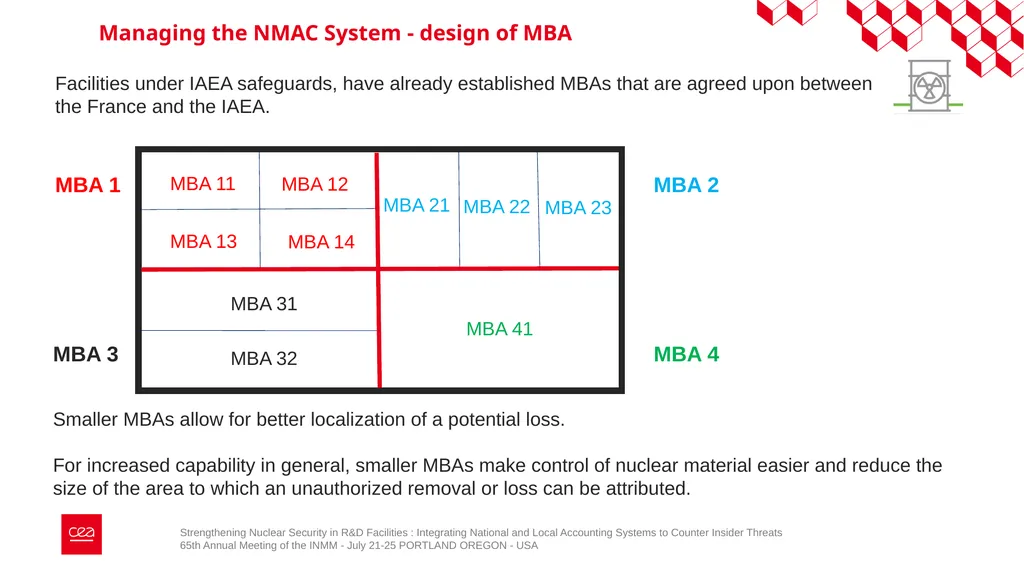
Managing the NMAC System - design of MBA 8 Smaller MBAs allow for better localization of a potential loss.
For increased capability in general, smaller MBAs make control of nuclear material easier and reduce the size of the area to which an unauthorized removal or loss can be attributed. MBA 1 MBA 2 MBA 4 MBA 11 MBA 12 MBA 13 MBA 14 MBA 21 MBA 31 MBA 32 MBA 41 MBA 22 MBA 23 MBA 3 Facilities under IAEA safeguards, have already established MBAs that are agreed upon between the France and the IAEA.<br>
For increased capability in general, smaller MBAs make control of nuclear material easier and reduce the size of the area to which an unauthorized removal or loss can be attributed. MBA 1 MBA 2 MBA 4 MBA 11 MBA 12 MBA 13 MBA 14 MBA 21 MBA 31 MBA 32 MBA 41 MBA 22 MBA 23 MBA 3 Facilities under IAEA safeguards, have already established MBAs that are agreed upon between the France and the IAEA.<br>
09
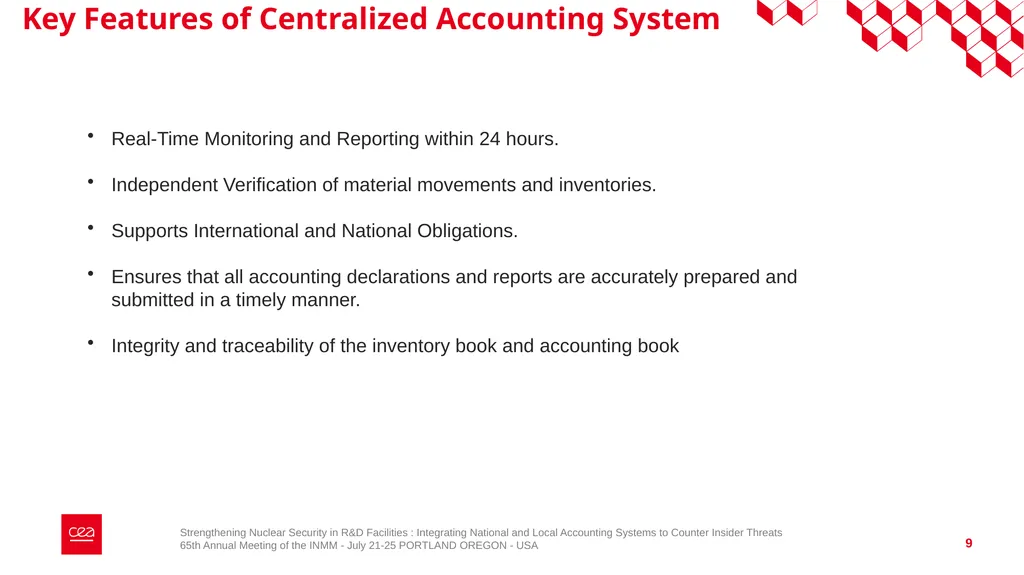
9 Key Features of Centralized Accounting System Real-Time Monitoring and Reporting within 24 hours.
Independent Verification of material movements and inventories.
Supports International and National Obligations.
Ensures that all accounting declarations and reports are accurately prepared and submitted in a timely manner.
Integrity and traceability of the inventory book and accounting book<br>
Independent Verification of material movements and inventories.
Supports International and National Obligations.
Ensures that all accounting declarations and reports are accurately prepared and submitted in a timely manner.
Integrity and traceability of the inventory book and accounting book<br>
10
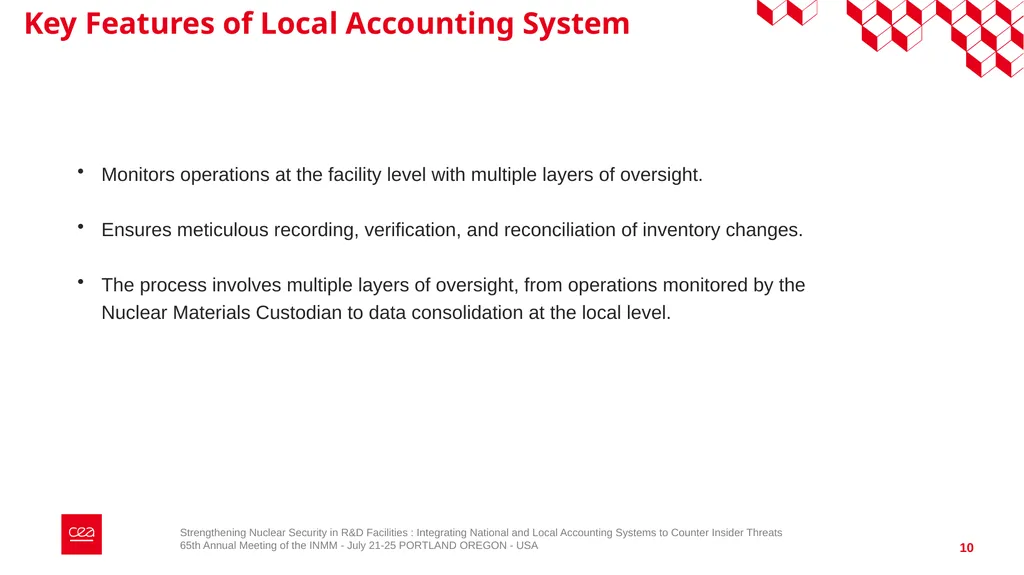
10 Key Features of Local Accounting System Monitors operations at the facility level with multiple layers of oversight.
Ensures meticulous recording, verification, and reconciliation of inventory changes.
The process involves multiple layers of oversight, from operations monitored by the Nuclear Materials Custodian to data consolidation at the local level.<br>
Ensures meticulous recording, verification, and reconciliation of inventory changes.
The process involves multiple layers of oversight, from operations monitored by the Nuclear Materials Custodian to data consolidation at the local level.<br>
11
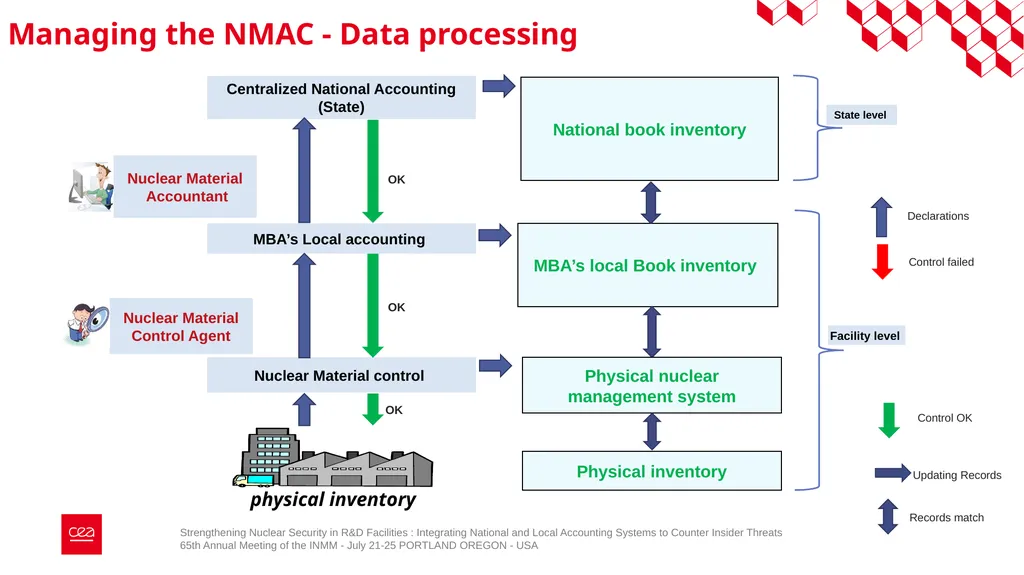
Physical inventory Managing the NMAC - Data processing 11 Nuclear Material control MBA’s Local accounting physical inventory MBA’s local Book inventory National book inventory Nuclear Material
Control Agent Nuclear Material
Accountant Facility level Centralized National Accounting (State) State level Physical nuclear management system Updating Records Records match OK OK OK<br>
Control Agent Nuclear Material
Accountant Facility level Centralized National Accounting (State) State level Physical nuclear management system Updating Records Records match OK OK OK<br>
12
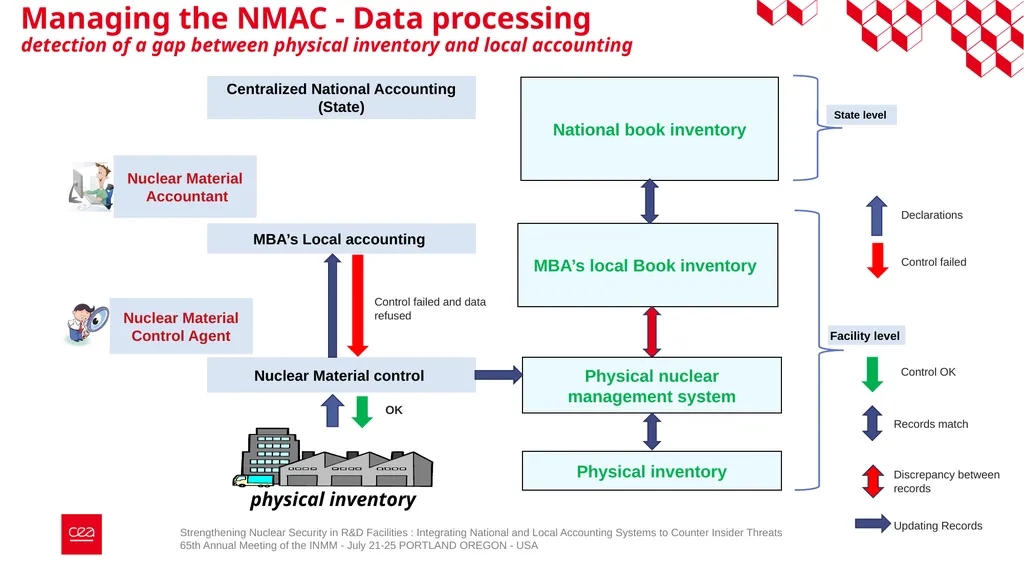
Physical inventory Managing the NMAC - Data processing
detection of a gap between physical inventory and local accounting 12 Nuclear Material control MBA’s Local accounting physical inventory MBA’s local Book inventory National book inventory Nuclear Material
Control Agent Nuclear Material
Accountant Centralized National Accounting (State) Physical nuclear management system Records match Control failed and data refused Discrepancy between records Facility level State level Updating Records OK<br>
Control Agent Nuclear Material
Accountant Centralized National Accounting (State) Physical nuclear management system Records match Control failed and data refused Discrepancy between records Facility level State level Updating Records OK<br>
13
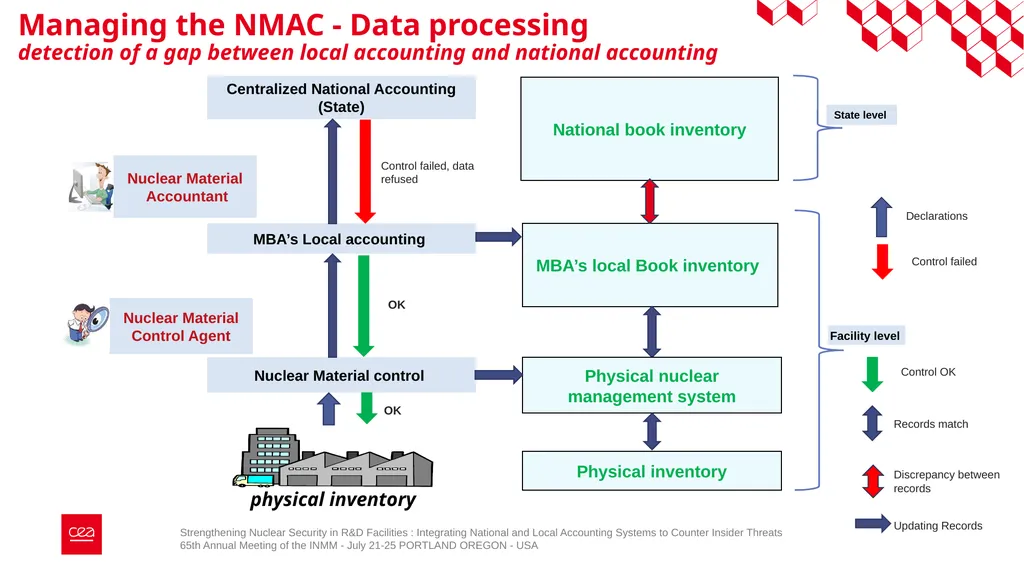
Physical inventory Managing the NMAC - Data processing
detection of a gap between local accounting and national accounting 13 Nuclear Material control MBA’s Local accounting physical inventory MBA’s local Book inventory National book inventory Nuclear Material
Control Agent Nuclear Material
Accountant Centralized National Accounting (State) Physical nuclear management system Records match Control failed, data refused Discrepancy between records Facility level State level Updating Records OK OK<br>
Control Agent Nuclear Material
Accountant Centralized National Accounting (State) Physical nuclear management system Records match Control failed, data refused Discrepancy between records Facility level State level Updating Records OK OK<br>
14
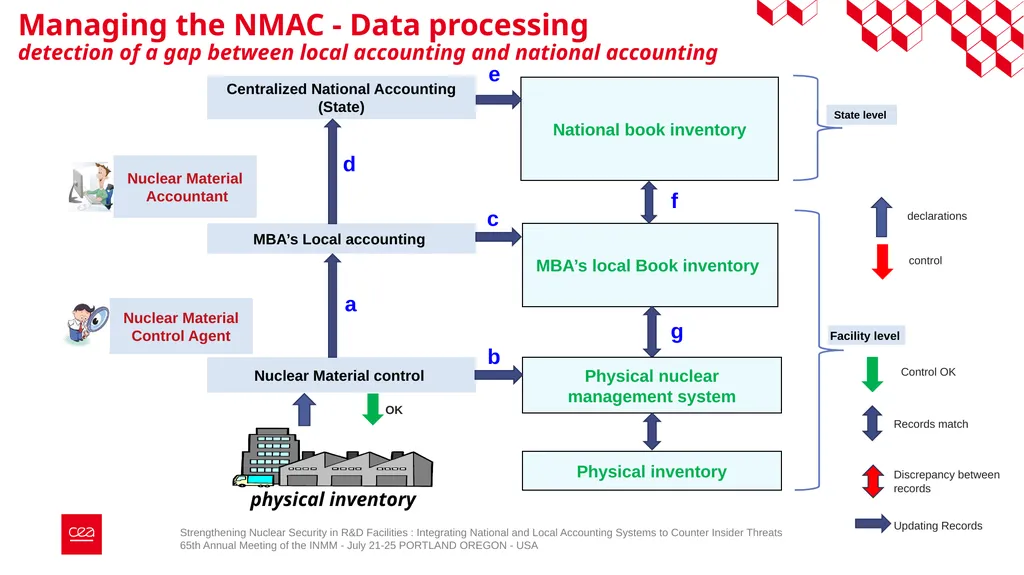
Physical inventory Managing the NMAC - Data processing
detection of a gap between local accounting and national accounting 14 Nuclear Material control MBA’s Local accounting physical inventory MBA’s local Book inventory National book inventory Nuclear Material
Control Agent Nuclear Material
Accountant Centralized National Accounting (State) Physical nuclear management system Records match Discrepancy between records Facility level State level Updating Records a b c d e f g OK<br>
Control Agent Nuclear Material
Accountant Centralized National Accounting (State) Physical nuclear management system Records match Discrepancy between records Facility level State level Updating Records a b c d e f g OK<br>
15
15 Hypothetical Case Study: A Potential Diversion Thwarted Background
A Research & Development facility, focused on advanced nuclear research, operates under strict protocols to handle small amounts of nuclear material A used for experimental purposes.
The facility is under both national and local accounting systems to ensure comprehensive oversight of nuclear materials.
Incident example
During a scheduled cross-checking verification performed by the Nuclear Material Custodian and the MBA’s local accounting team, a discrepancy is identified in the reported inventory of nuclear material A.
By comparing the data of the local book inventory to those of the physical inventory, a shortfall of a few grams of material A is found. The shortfall can not be reconciled with the facility’s reported usage, transfers, or documented losses.<br>
A Research & Development facility, focused on advanced nuclear research, operates under strict protocols to handle small amounts of nuclear material A used for experimental purposes.
The facility is under both national and local accounting systems to ensure comprehensive oversight of nuclear materials.
Incident example
During a scheduled cross-checking verification performed by the Nuclear Material Custodian and the MBA’s local accounting team, a discrepancy is identified in the reported inventory of nuclear material A.
By comparing the data of the local book inventory to those of the physical inventory, a shortfall of a few grams of material A is found. The shortfall can not be reconciled with the facility’s reported usage, transfers, or documented losses.<br>
16
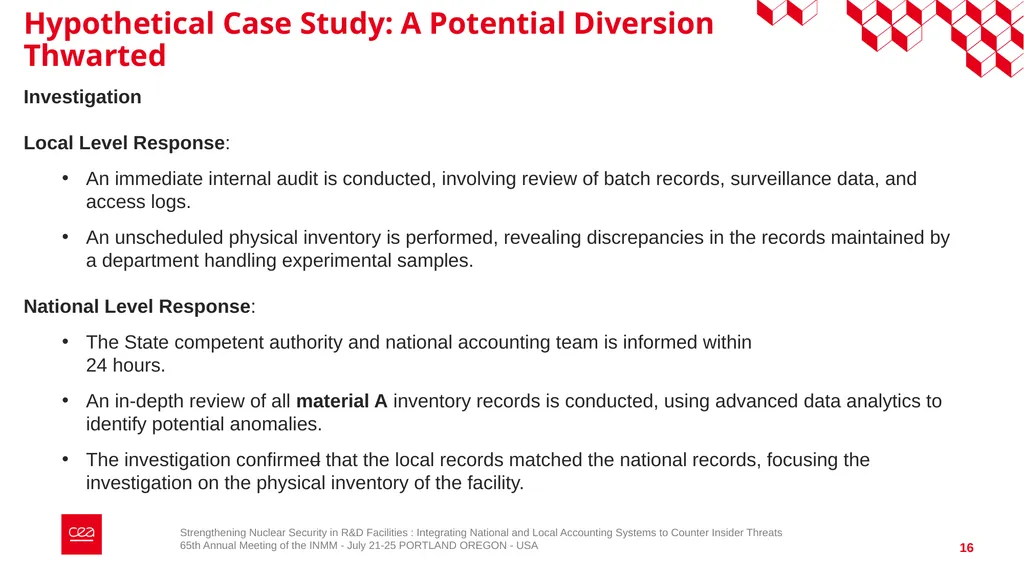
16 Hypothetical Case Study: A Potential Diversion Thwarted Investigation
Local Level Response:
An immediate internal audit is conducted, involving review of batch records, surveillance data, and access logs.
An unscheduled physical inventory is performed, revealing discrepancies in the records maintained by a department handling experimental samples.
National Level Response:
The State competent authority and national accounting team is informed within 24 hours.
An in-depth review of all material A inventory records is conducted, using advanced data analytics to identify potential anomalies.
The investigation confirmed that the local records matched the national records, focusing the investigation on the physical inventory of the facility.<br>
Local Level Response:
An immediate internal audit is conducted, involving review of batch records, surveillance data, and access logs.
An unscheduled physical inventory is performed, revealing discrepancies in the records maintained by a department handling experimental samples.
National Level Response:
The State competent authority and national accounting team is informed within 24 hours.
An in-depth review of all material A inventory records is conducted, using advanced data analytics to identify potential anomalies.
The investigation confirmed that the local records matched the national records, focusing the investigation on the physical inventory of the facility.<br>
17
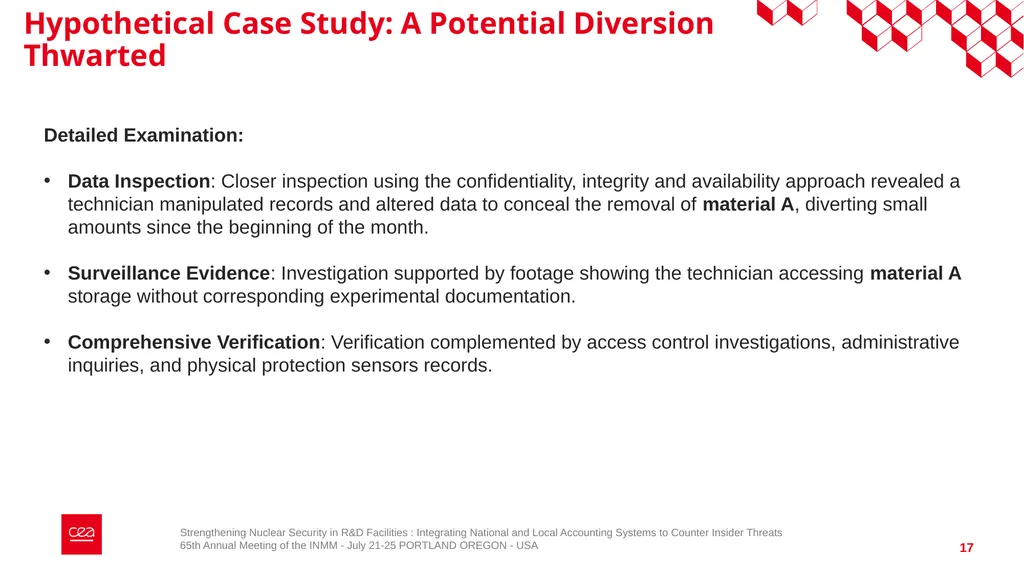
17 Hypothetical Case Study: A Potential Diversion Thwarted Detailed Examination:
Data Inspection: Closer inspection using the confidentiality, integrity and availability approach revealed a technician manipulated records and altered data to conceal the removal of material A, diverting small amounts since the beginning of the month.
Surveillance Evidence: Investigation supported by footage showing the technician accessing material A storage without corresponding experimental documentation.
Comprehensive Verification: Verification complemented by access control investigations, administrative inquiries, and physical protection sensors records.<br>
Data Inspection: Closer inspection using the confidentiality, integrity and availability approach revealed a technician manipulated records and altered data to conceal the removal of material A, diverting small amounts since the beginning of the month.
Surveillance Evidence: Investigation supported by footage showing the technician accessing material A storage without corresponding experimental documentation.
Comprehensive Verification: Verification complemented by access control investigations, administrative inquiries, and physical protection sensors records.<br>
18
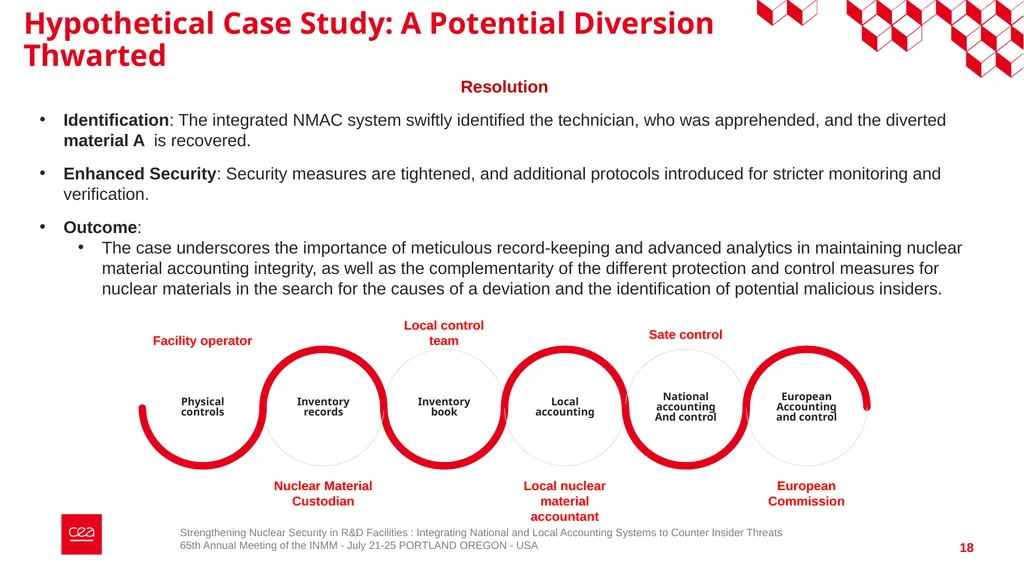
18 Hypothetical Case Study: A Potential Diversion Thwarted Resolution
Identification: The integrated NMAC system swiftly identified the technician, who was apprehended, and the diverted material A is recovered.
Enhanced Security: Security measures are tightened, and additional protocols introduced for stricter monitoring and verification.
Outcome:
The case underscores the importance of meticulous record-keeping and advanced analytics in maintaining nuclear material accounting integrity, as well as the complementarity of the different protection and control measures for nuclear materials in the search for the causes of a deviation and the identification of potential malicious insiders.<br>
Identification: The integrated NMAC system swiftly identified the technician, who was apprehended, and the diverted material A is recovered.
Enhanced Security: Security measures are tightened, and additional protocols introduced for stricter monitoring and verification.
Outcome:
The case underscores the importance of meticulous record-keeping and advanced analytics in maintaining nuclear material accounting integrity, as well as the complementarity of the different protection and control measures for nuclear materials in the search for the causes of a deviation and the identification of potential malicious insiders.<br>
19
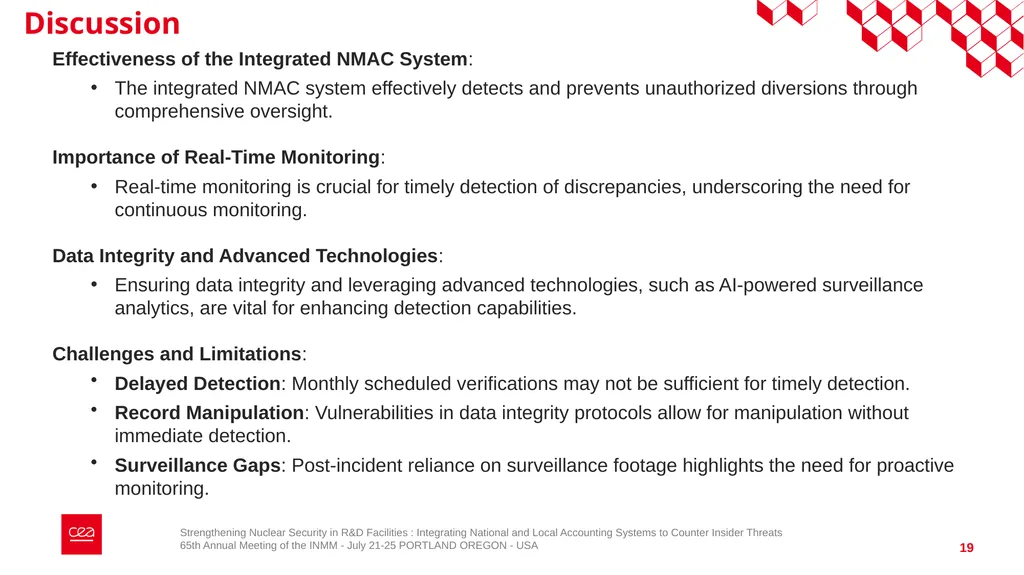
19 Discussion Effectiveness of the Integrated NMAC System:
The integrated NMAC system effectively detects and prevents unauthorized diversions through comprehensive oversight.
Importance of Real-Time Monitoring:
Real-time monitoring is crucial for timely detection of discrepancies, underscoring the need for continuous monitoring.
Data Integrity and Advanced Technologies:
Ensuring data integrity and leveraging advanced technologies, such as AI-powered surveillance analytics, are vital for enhancing detection capabilities.
Challenges and Limitations:
Delayed Detection: Monthly scheduled verifications may not be sufficient for timely detection.
Record Manipulation: Vulnerabilities in data integrity protocols allow for manipulation without immediate detection.
Surveillance Gaps: Post-incident reliance on surveillance footage highlights the need for proactive monitoring.<br>
The integrated NMAC system effectively detects and prevents unauthorized diversions through comprehensive oversight.
Importance of Real-Time Monitoring:
Real-time monitoring is crucial for timely detection of discrepancies, underscoring the need for continuous monitoring.
Data Integrity and Advanced Technologies:
Ensuring data integrity and leveraging advanced technologies, such as AI-powered surveillance analytics, are vital for enhancing detection capabilities.
Challenges and Limitations:
Delayed Detection: Monthly scheduled verifications may not be sufficient for timely detection.
Record Manipulation: Vulnerabilities in data integrity protocols allow for manipulation without immediate detection.
Surveillance Gaps: Post-incident reliance on surveillance footage highlights the need for proactive monitoring.<br>
20
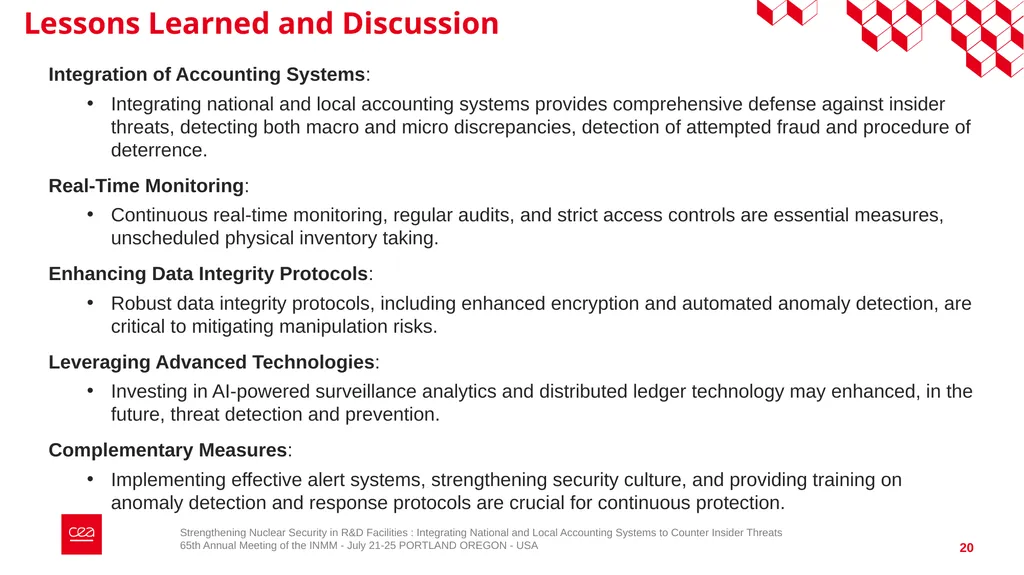
20 Lessons Learned and Discussion Integration of Accounting Systems:
Integrating national and local accounting systems provides comprehensive defense against insider threats, detecting both macro and micro discrepancies, detection of attempted fraud and procedure of deterrence.
Real-Time Monitoring:
Continuous real-time monitoring, regular audits, and strict access controls are essential measures, unscheduled physical inventory taking.
Enhancing Data Integrity Protocols:
Robust data integrity protocols, including enhanced encryption and automated anomaly detection, are critical to mitigating manipulation risks.
Leveraging Advanced Technologies:
Investing in AI-powered surveillance analytics and distributed ledger technology may enhanced, in the future, threat detection and prevention.
Complementary Measures:
Implementing effective alert systems, strengthening security culture, and providing training on anomaly detection and response protocols are crucial for continuous protection.<br>
Integrating national and local accounting systems provides comprehensive defense against insider threats, detecting both macro and micro discrepancies, detection of attempted fraud and procedure of deterrence.
Real-Time Monitoring:
Continuous real-time monitoring, regular audits, and strict access controls are essential measures, unscheduled physical inventory taking.
Enhancing Data Integrity Protocols:
Robust data integrity protocols, including enhanced encryption and automated anomaly detection, are critical to mitigating manipulation risks.
Leveraging Advanced Technologies:
Investing in AI-powered surveillance analytics and distributed ledger technology may enhanced, in the future, threat detection and prevention.
Complementary Measures:
Implementing effective alert systems, strengthening security culture, and providing training on anomaly detection and response protocols are crucial for continuous protection.<br>
21
21 References [1] IAEA, Use of Nuclear Material Accounting and Control for Nuclear Security Purposes at
Facilities, IAEA Nuclear Security Series N.25-G.
[2] IAEA, Preventive and Protective Measures against Insider Threats, IAEA Nuclear Security
Series N.08-G (REV 1).
[3] Eric GOSSET & al, Development and evaluation of security culture in a research and development
organization - Brief overview development method at French CEA, assessment/test process,
observations and lessons learned , International Conference on Nuclear Security: Shaping
the Future 20-24 May 2024, Vienna, Austria
[4] Marina Koren, Top Ten Cases of Nuclear Thefts Gone Wrong, Smithsonian
Magazine, 2013. https://www.smithsonianmag.com/science-nature/
top-ten-cases-of-nuclear-thefts-gone-wrong-10854803/.
[5] Romuald BON NGUYEN, French centralized nuclear material accounting: a tool at the heart
of national security and safeguards implementation, Proceedings of the INMM & ESARDA
Joint Annual Meeting Vienna, Austria from May 22-26, 2023.<br>
Facilities, IAEA Nuclear Security Series N.25-G.
[2] IAEA, Preventive and Protective Measures against Insider Threats, IAEA Nuclear Security
Series N.08-G (REV 1).
[3] Eric GOSSET & al, Development and evaluation of security culture in a research and development
organization - Brief overview development method at French CEA, assessment/test process,
observations and lessons learned , International Conference on Nuclear Security: Shaping
the Future 20-24 May 2024, Vienna, Austria
[4] Marina Koren, Top Ten Cases of Nuclear Thefts Gone Wrong, Smithsonian
Magazine, 2013. https://www.smithsonianmag.com/science-nature/
top-ten-cases-of-nuclear-thefts-gone-wrong-10854803/.
[5] Romuald BON NGUYEN, French centralized nuclear material accounting: a tool at the heart
of national security and safeguards implementation, Proceedings of the INMM & ESARDA
Joint Annual Meeting Vienna, Austria from May 22-26, 2023.<br>
22
Thank you for your attention ! CEA FONTENAY-AUX-ROSES
DSSN/SPPS
carin.yota@cea.fr
+ 33 1 46 54 73 85<br>
DSSN/SPPS
carin.yota@cea.fr
+ 33 1 46 54 73 85<br>
23
CEA/DSSN/SPPS<br>