
Strong rules help us thrive - creating a new
MY
Published · 26 slides · 0 views
1 / 1
Description
Strong rules help us thrive - creating a new narrative around regulation and enforcement Findings from six focus groups a. Our sample is pro regulation p.5 - 9 a. Protect Me p.12 - 15 b. Stop other people doing something (I dont like)
Related Topics
Share
Embed code
Download this presentation From Below
"Strong rules help us thrive - creating a new" is the property of its rightful owner. Permission is granted to download and print the materials on this website for personal, non-commercial use only, and to display it on your personal computer provided you do not modify the materials and that you retain all copyright notices contained in the materials. By downloading content from our website, you accept the terms of this agreement.
Presentation Transcript
01
Strong rules help us thrive - creating a new narrative around regulation and enforcement Findings from six focus groups<br>
02
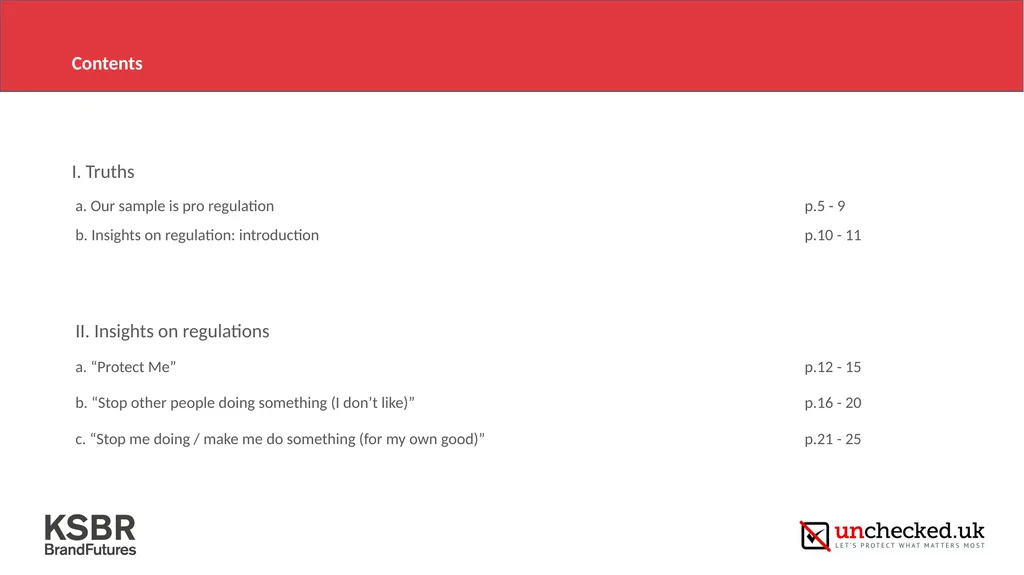
a. Our sample is pro regulation p.5 - 9 a. “Protect Me” p.12 - 15 b. “Stop other people doing something (I don’t like)” p.16 - 20 c. “Stop me doing / make me do something (for my own good)” p.21 - 25 Contents b. Insights on regulation: introduction p.10 - 11 I. Truths II. Insights on regulations<br>
03
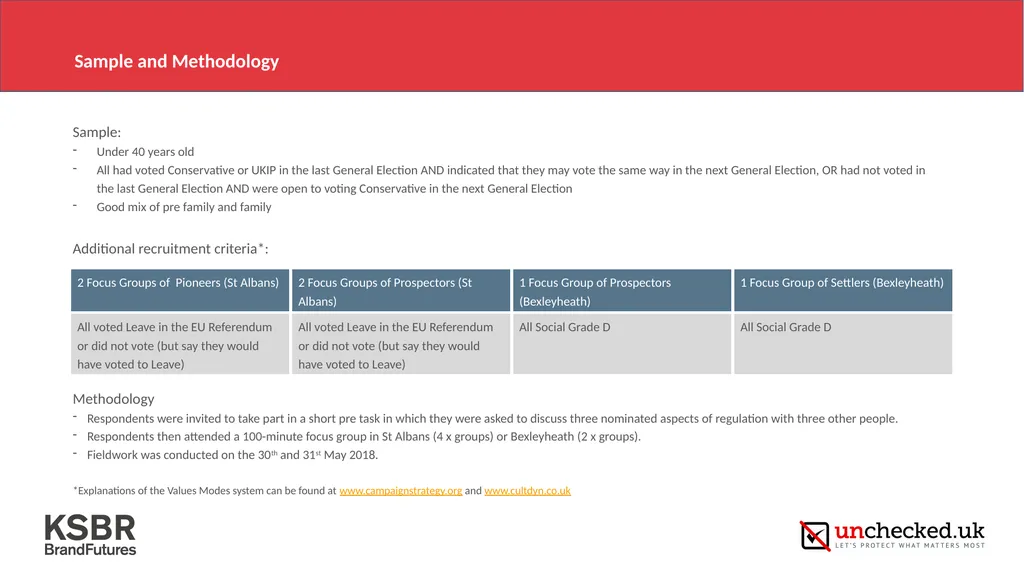
Sample and Methodology Sample:
Under 40 years old
All had voted Conservative or UKIP in the last General Election AND indicated that they may vote the same way in the next General Election, OR had not voted in the last General Election AND were open to voting Conservative in the next General Election
Good mix of pre family and family
Additional recruitment criteria*:
Methodology
Respondents were invited to take part in a short pre task in which they were asked to discuss three nominated aspects of regulation with three other people.
Respondents then attended a 100-minute focus group in St Albans (4 x groups) or Bexleyheath (2 x groups).
Fieldwork was conducted on the 30th and 31st May 2018.
*Explanations of the Values Modes system can be found at www.campaignstrategy.org and www.cultdyn.co.uk<br>
Under 40 years old
All had voted Conservative or UKIP in the last General Election AND indicated that they may vote the same way in the next General Election, OR had not voted in the last General Election AND were open to voting Conservative in the next General Election
Good mix of pre family and family
Additional recruitment criteria*:
Methodology
Respondents were invited to take part in a short pre task in which they were asked to discuss three nominated aspects of regulation with three other people.
Respondents then attended a 100-minute focus group in St Albans (4 x groups) or Bexleyheath (2 x groups).
Fieldwork was conducted on the 30th and 31st May 2018.
*Explanations of the Values Modes system can be found at www.campaignstrategy.org and www.cultdyn.co.uk<br>
04
I. Truths<br>
05
a. Our sample is pro regulation<br>
06
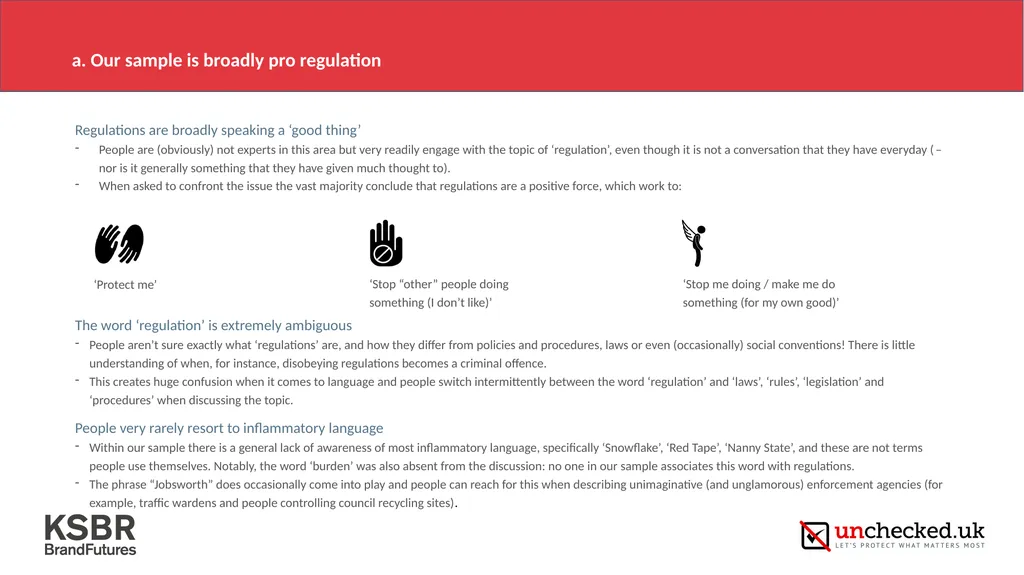
a. Our sample is broadly pro regulation Regulations are broadly speaking a ‘good thing’
People are (obviously) not experts in this area but very readily engage with the topic of ‘regulation’, even though it is not a conversation that they have everyday (– nor is it generally something that they have given much thought to).
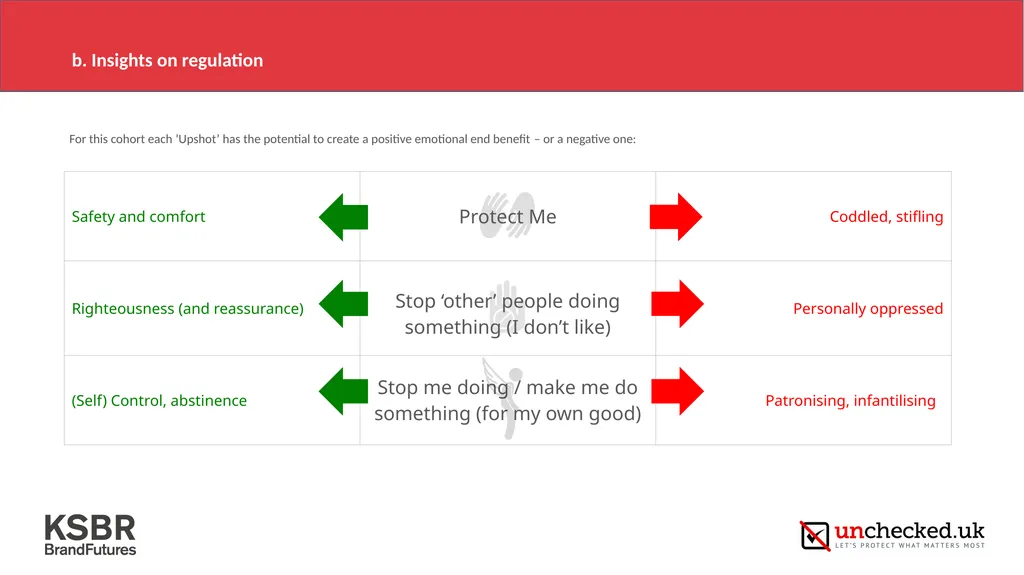
When asked to confront the issue the vast majority conclude that regulations are a positive force, which work to: ‘Protect me’ ‘Stop “other” people doing something (I don’t like)’ ‘Stop me doing / make me do something (for my own good)’ The word ‘regulation’ is extremely ambiguous
People aren’t sure exactly what ‘regulations’ are, and how they differ from policies and procedures, laws or even (occasionally) social conventions! There is little understanding of when, for instance, disobeying regulations becomes a criminal offence.
This creates huge confusion when it comes to language and people switch intermittently between the word ‘regulation’ and ‘laws’, ‘rules’, ‘legislation’ and ‘procedures’ when discussing the topic.
People very rarely resort to inflammatory language
Within our sample there is a general lack of awareness of most inflammatory language, specifically ‘Snowflake’, ‘Red Tape’, ‘Nanny State’, and these are not terms people use themselves. Notably, the word ‘burden’ was also absent from the discussion: no one in our sample associates this word with regulations.
The phrase “Jobsworth” does occasionally come into play and people can reach for this when describing unimaginative (and unglamorous) enforcement agencies (for example, traffic wardens and people controlling council recycling sites).<br>
People are (obviously) not experts in this area but very readily engage with the topic of ‘regulation’, even though it is not a conversation that they have everyday (– nor is it generally something that they have given much thought to).
When asked to confront the issue the vast majority conclude that regulations are a positive force, which work to: ‘Protect me’ ‘Stop “other” people doing something (I don’t like)’ ‘Stop me doing / make me do something (for my own good)’ The word ‘regulation’ is extremely ambiguous
People aren’t sure exactly what ‘regulations’ are, and how they differ from policies and procedures, laws or even (occasionally) social conventions! There is little understanding of when, for instance, disobeying regulations becomes a criminal offence.
This creates huge confusion when it comes to language and people switch intermittently between the word ‘regulation’ and ‘laws’, ‘rules’, ‘legislation’ and ‘procedures’ when discussing the topic.
People very rarely resort to inflammatory language
Within our sample there is a general lack of awareness of most inflammatory language, specifically ‘Snowflake’, ‘Red Tape’, ‘Nanny State’, and these are not terms people use themselves. Notably, the word ‘burden’ was also absent from the discussion: no one in our sample associates this word with regulations.
The phrase “Jobsworth” does occasionally come into play and people can reach for this when describing unimaginative (and unglamorous) enforcement agencies (for example, traffic wardens and people controlling council recycling sites).<br>
07
a. Our sample is broadly pro regulation (cont.) Overall people are more likely to speak positively about regulations than they are to speak negatively. When they do express frustration, they tend to refer to certain regulations as being ‘ridiculous’ and ‘lacking in common sense’ (generally this is when regulations threaten to constrain their own, immediate liberty). More positively, the word ‘safeguarding’ is used but specifically in relation to the type of regulation that ‘protects me’ (and normally ‘protect me from big business’).
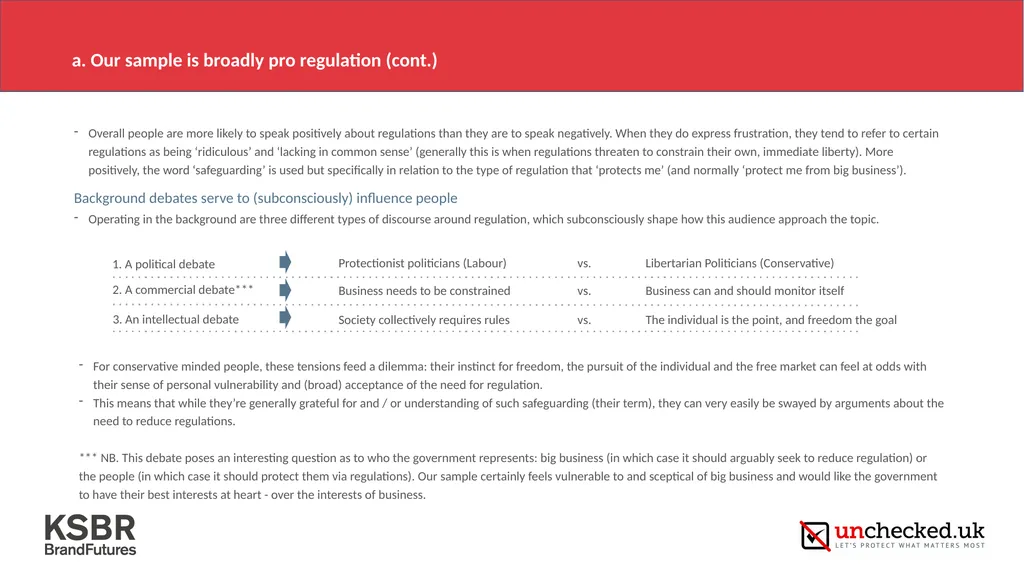
Background debates serve to (subconsciously) influence people
Operating in the background are three different types of discourse around regulation, which subconsciously shape how this audience approach the topic. For conservative minded people, these tensions feed a dilemma: their instinct for freedom, the pursuit of the individual and the free market can feel at odds with their sense of personal vulnerability and (broad) acceptance of the need for regulation.
This means that while they’re generally grateful for and / or understanding of such safeguarding (their term), they can very easily be swayed by arguments about the need to reduce regulations.
*** NB. This debate poses an interesting question as to who the government represents: big business (in which case it should arguably seek to reduce regulation) or the people (in which case it should protect them via regulations). Our sample certainly feels vulnerable to and sceptical of big business and would like the government to have their best interests at heart - over the interests of business.<br>
Background debates serve to (subconsciously) influence people
Operating in the background are three different types of discourse around regulation, which subconsciously shape how this audience approach the topic. For conservative minded people, these tensions feed a dilemma: their instinct for freedom, the pursuit of the individual and the free market can feel at odds with their sense of personal vulnerability and (broad) acceptance of the need for regulation.
This means that while they’re generally grateful for and / or understanding of such safeguarding (their term), they can very easily be swayed by arguments about the need to reduce regulations.
*** NB. This debate poses an interesting question as to who the government represents: big business (in which case it should arguably seek to reduce regulation) or the people (in which case it should protect them via regulations). Our sample certainly feels vulnerable to and sceptical of big business and would like the government to have their best interests at heart - over the interests of business.<br>
08
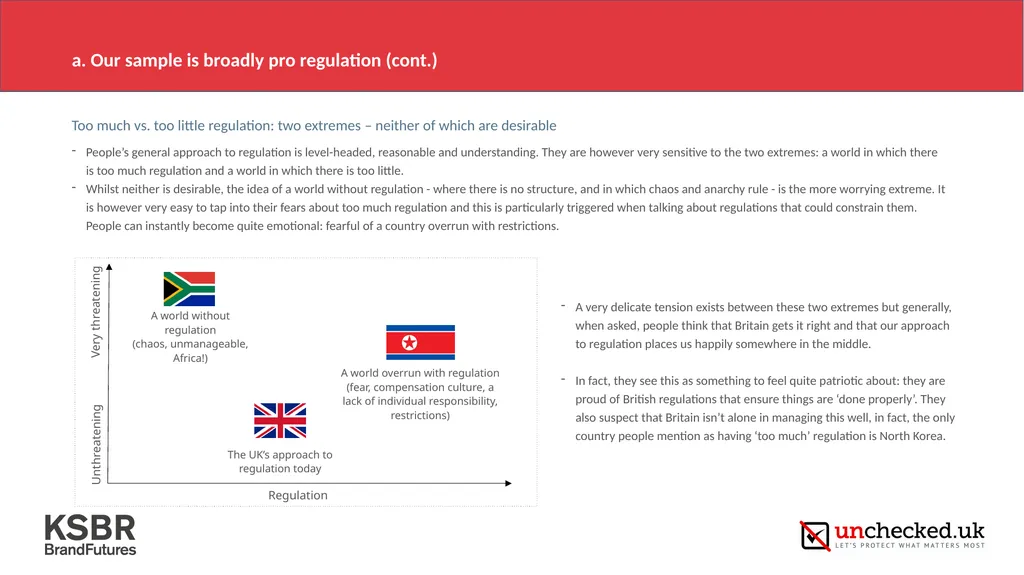
Too much vs. too little regulation: two extremes – neither of which are desirable
People’s general approach to regulation is level-headed, reasonable and understanding. They are however very sensitive to the two extremes: a world in which there is too much regulation and a world in which there is too little.
Whilst neither is desirable, the idea of a world without regulation - where there is no structure, and in which chaos and anarchy rule - is the more worrying extreme. It is however very easy to tap into their fears about too much regulation and this is particularly triggered when talking about regulations that could constrain them. People can instantly become quite emotional: fearful of a country overrun with restrictions. a. Our sample is broadly pro regulation (cont.) A world without regulation
(chaos, unmanageable, Africa!) A world overrun with regulation
(fear, compensation culture, a lack of individual responsibility, restrictions) Very threatening Unthreatening The UK’s approach to regulation today A very delicate tension exists between these two extremes but generally, when asked, people think that Britain gets it right and that our approach to regulation places us happily somewhere in the middle.
In fact, they see this as something to feel quite patriotic about: they are proud of British regulations that ensure things are ‘done properly’. They also suspect that Britain isn’t alone in managing this well, in fact, the only country people mention as having ‘too much’ regulation is North Korea. Regulation<br>
People’s general approach to regulation is level-headed, reasonable and understanding. They are however very sensitive to the two extremes: a world in which there is too much regulation and a world in which there is too little.
Whilst neither is desirable, the idea of a world without regulation - where there is no structure, and in which chaos and anarchy rule - is the more worrying extreme. It is however very easy to tap into their fears about too much regulation and this is particularly triggered when talking about regulations that could constrain them. People can instantly become quite emotional: fearful of a country overrun with restrictions. a. Our sample is broadly pro regulation (cont.) A world without regulation
(chaos, unmanageable, Africa!) A world overrun with regulation
(fear, compensation culture, a lack of individual responsibility, restrictions) Very threatening Unthreatening The UK’s approach to regulation today A very delicate tension exists between these two extremes but generally, when asked, people think that Britain gets it right and that our approach to regulation places us happily somewhere in the middle.
In fact, they see this as something to feel quite patriotic about: they are proud of British regulations that ensure things are ‘done properly’. They also suspect that Britain isn’t alone in managing this well, in fact, the only country people mention as having ‘too much’ regulation is North Korea. Regulation<br>
09
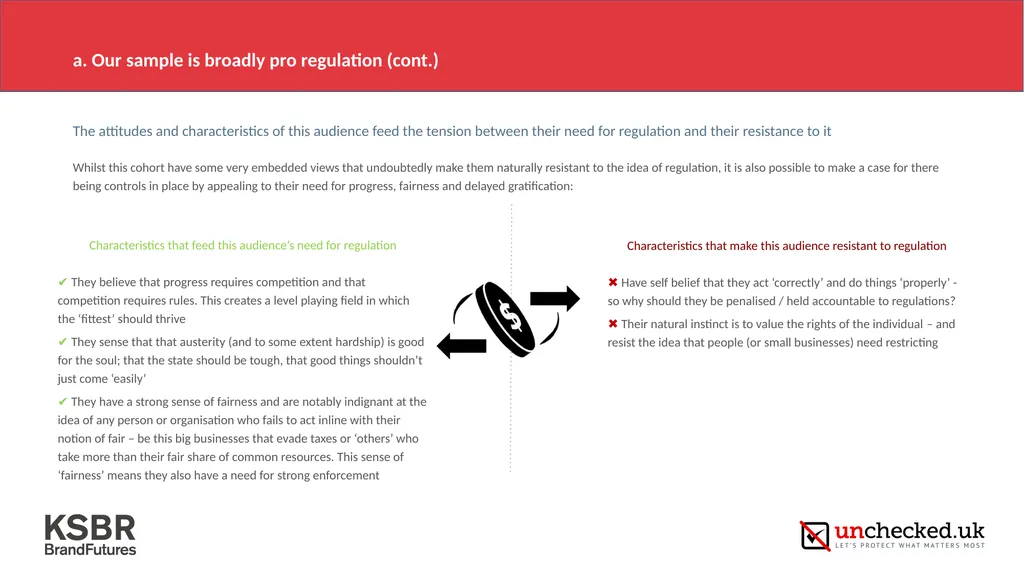
The attitudes and characteristics of this audience feed the tension between their need for regulation and their resistance to it
Whilst this cohort have some very embedded views that undoubtedly make them naturally resistant to the idea of regulation, it is also possible to make a case for there being controls in place by appealing to their need for progress, fairness and delayed gratification: Characteristics that make this audience resistant to regulation
✖ Have self belief that they act ‘correctly’ and do things ‘properly’ - so why should they be penalised / held accountable to regulations?
✖ Their natural instinct is to value the rights of the individual – and resist the idea that people (or small businesses) need restricting Characteristics that feed this audience’s need for regulation
✔ They believe that progress requires competition and that competition requires rules. This creates a level playing field in which the ‘fittest’ should thrive
✔ They sense that that austerity (and to some extent hardship) is good for the soul; that the state should be tough, that good things shouldn’t just come ‘easily’
✔ They have a strong sense of fairness and are notably indignant at the idea of any person or organisation who fails to act inline with their notion of fair – be this big businesses that evade taxes or ‘others’ who take more than their fair share of common resources. This sense of ‘fairness’ means they also have a need for strong enforcement a. Our sample is broadly pro regulation (cont.)<br>
Whilst this cohort have some very embedded views that undoubtedly make them naturally resistant to the idea of regulation, it is also possible to make a case for there being controls in place by appealing to their need for progress, fairness and delayed gratification: Characteristics that make this audience resistant to regulation
✖ Have self belief that they act ‘correctly’ and do things ‘properly’ - so why should they be penalised / held accountable to regulations?
✖ Their natural instinct is to value the rights of the individual – and resist the idea that people (or small businesses) need restricting Characteristics that feed this audience’s need for regulation
✔ They believe that progress requires competition and that competition requires rules. This creates a level playing field in which the ‘fittest’ should thrive
✔ They sense that that austerity (and to some extent hardship) is good for the soul; that the state should be tough, that good things shouldn’t just come ‘easily’
✔ They have a strong sense of fairness and are notably indignant at the idea of any person or organisation who fails to act inline with their notion of fair – be this big businesses that evade taxes or ‘others’ who take more than their fair share of common resources. This sense of ‘fairness’ means they also have a need for strong enforcement a. Our sample is broadly pro regulation (cont.)<br>
10
II. Insights on regulation<br>
11
b. Insights on regulation For this cohort each ’Upshot’ has the potential to create a positive emotional end benefit – or a negative one:<br>
12
a. Protect Me<br>
13
a. Protect Me: Our cohort are ‘most likely to say’… ‘Protect Me’ ‘The state should have my back. I shouldn’t have to worry about things like clean water, food contamination or unsafe road conditions – this is the state’s responsibility. I pay my taxes and that creates a binding contract: the state should protect me from the things I don’t know about, without keeping me involved (or making me change my behaviour).’<br>
14
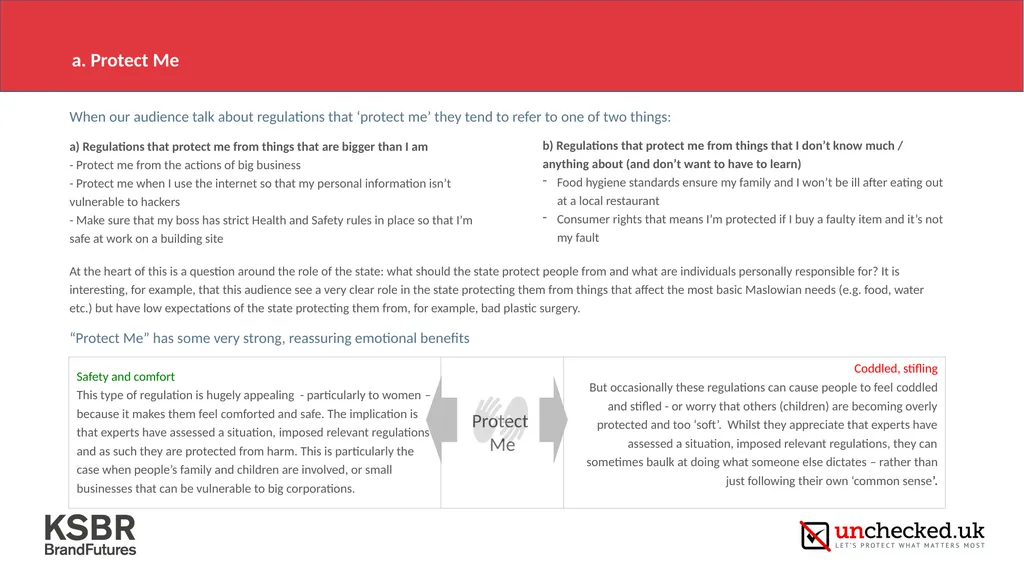
a. Protect Me When our audience talk about regulations that ‘protect me’ they tend to refer to one of two things: “Protect Me” has some very strong, reassuring emotional benefits a) Regulations that protect me from things that are bigger than I am
- Protect me from the actions of big business
- Protect me when I use the internet so that my personal information isn’t vulnerable to hackers
- Make sure that my boss has strict Health and Safety rules in place so that I’m safe at work on a building site b) Regulations that protect me from things that I don’t know much / anything about (and don’t want to have to learn)
Food hygiene standards ensure my family and I won’t be ill after eating out at a local restaurant
Consumer rights that means I’m protected if I buy a faulty item and it’s not my fault At the heart of this is a question around the role of the state: what should the state protect people from and what are individuals personally responsible for? It is interesting, for example, that this audience see a very clear role in the state protecting them from things that affect the most basic Maslowian needs (e.g. food, water etc.) but have low expectations of the state protecting them from, for example, bad plastic surgery.<br>
- Protect me from the actions of big business
- Protect me when I use the internet so that my personal information isn’t vulnerable to hackers
- Make sure that my boss has strict Health and Safety rules in place so that I’m safe at work on a building site b) Regulations that protect me from things that I don’t know much / anything about (and don’t want to have to learn)
Food hygiene standards ensure my family and I won’t be ill after eating out at a local restaurant
Consumer rights that means I’m protected if I buy a faulty item and it’s not my fault At the heart of this is a question around the role of the state: what should the state protect people from and what are individuals personally responsible for? It is interesting, for example, that this audience see a very clear role in the state protecting them from things that affect the most basic Maslowian needs (e.g. food, water etc.) but have low expectations of the state protecting them from, for example, bad plastic surgery.<br>
15
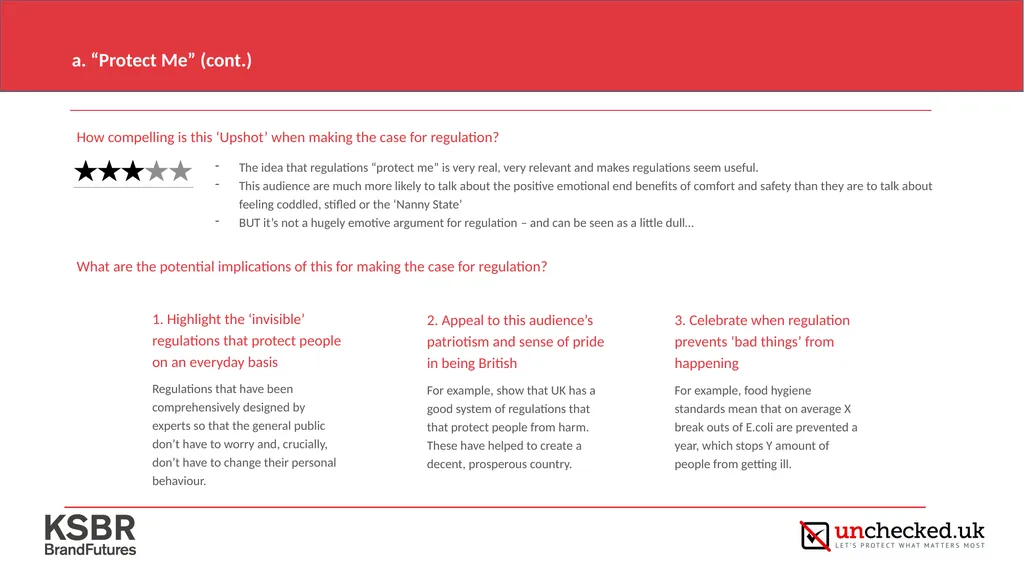
a. “Protect Me” (cont.) What are the potential implications of this for making the case for regulation? 1. Highlight the ‘invisible’ regulations that protect people on an everyday basis
Regulations that have been comprehensively designed by experts so that the general public don’t have to worry and, crucially, don’t have to change their personal behaviour. 2. Appeal to this audience’s patriotism and sense of pride in being British
For example, show that UK has a good system of regulations that that protect people from harm. These have helped to create a decent, prosperous country. 3. Celebrate when regulation prevents ‘bad things’ from happening
For example, food hygiene standards mean that on average X break outs of E.coli are prevented a year, which stops Y amount of people from getting ill. How compelling is this ‘Upshot’ when making the case for regulation? The idea that regulations “protect me” is very real, very relevant and makes regulations seem useful.
This audience are much more likely to talk about the positive emotional end benefits of comfort and safety than they are to talk about feeling coddled, stifled or the ‘Nanny State’
BUT it’s not a hugely emotive argument for regulation – and can be seen as a little dull…<br>
Regulations that have been comprehensively designed by experts so that the general public don’t have to worry and, crucially, don’t have to change their personal behaviour. 2. Appeal to this audience’s patriotism and sense of pride in being British
For example, show that UK has a good system of regulations that that protect people from harm. These have helped to create a decent, prosperous country. 3. Celebrate when regulation prevents ‘bad things’ from happening
For example, food hygiene standards mean that on average X break outs of E.coli are prevented a year, which stops Y amount of people from getting ill. How compelling is this ‘Upshot’ when making the case for regulation? The idea that regulations “protect me” is very real, very relevant and makes regulations seem useful.
This audience are much more likely to talk about the positive emotional end benefits of comfort and safety than they are to talk about feeling coddled, stifled or the ‘Nanny State’
BUT it’s not a hugely emotive argument for regulation – and can be seen as a little dull…<br>
16
b. “Stop other people doing something (I don’t like)”<br>
17
b. “Stop other people doing something (I don’t like): Our cohort are ‘most likely to say’… ‘Stop other people doing something I don’t like’ ‘I always make sure that my family and I adhere to very high standards and do ‘the right thing’. Unfortunately, you can’t trust everyone else to do the same and so I think it’s important to have rigid controls in place to keep others in check. Otherwise I may fall victim to their bad behaviour…’<br>
18
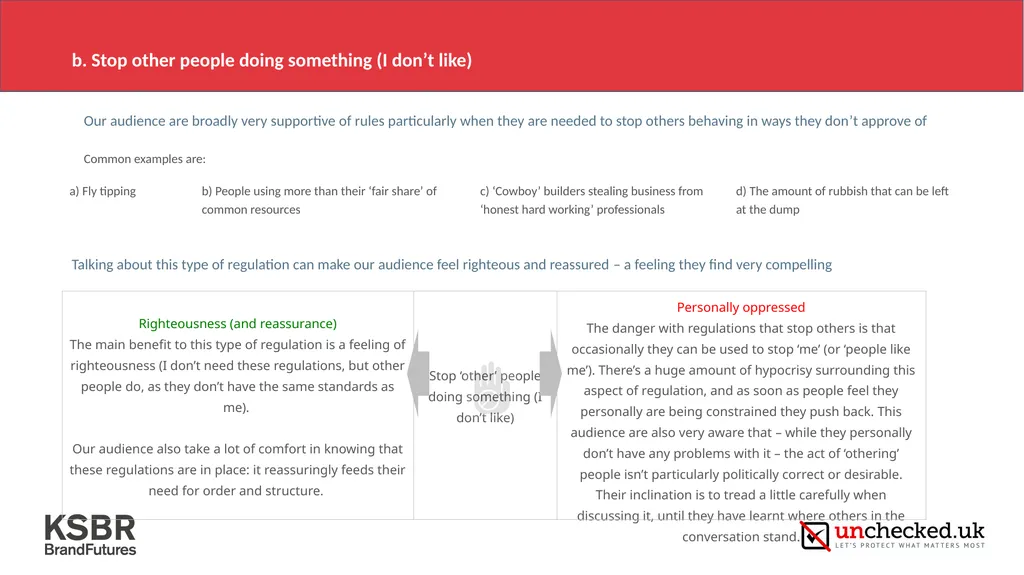
b. Stop other people doing something (I don’t like) Our audience are broadly very supportive of rules particularly when they are needed to stop others behaving in ways they don’t approve of
Common examples are: a) Fly tipping b) People using more than their ‘fair share’ of common resources c) ‘Cowboy’ builders stealing business from ‘honest hard working’ professionals d) The amount of rubbish that can be left at the dump Talking about this type of regulation can make our audience feel righteous and reassured – a feeling they find very compelling<br>
Common examples are: a) Fly tipping b) People using more than their ‘fair share’ of common resources c) ‘Cowboy’ builders stealing business from ‘honest hard working’ professionals d) The amount of rubbish that can be left at the dump Talking about this type of regulation can make our audience feel righteous and reassured – a feeling they find very compelling<br>
19
b. Stop other people doing something (I don’t like) Enforcement is key
For this audience it is not enough just to have regulations: strict and demonstrable enforcement of the rules is important too. Without this, it is easy for them to doubt the efficacy of regulations.
Overtly they consider this to be a shame and a disappointment: they protest that they would rather live in a country where rules and the accompanying enforcement weren’t required and position enforcement as a necessary evil.
Enforcement is a very powerful topic to talk to this audience about because it plays directly to their desire for fairness. Dodgy businesses, people fly tipping, neighbours dumping rubbish makes them incredibly irate because the ‘rules of the game’ are not being adhered to by everyone – and as a result there’s a potential for them to suffer, unless something is done…
Having a clear target for regulations and enforcement is also important
People can feel a flash of irrational guilt when exposed to a regulation (“have I done something wrong?”) which quickly turns into indignation (“that’s not for me!”). This can ultimately leave people feeling more irked than righteous or reassured.
For example, telling parents that they can’t take photos of a school play makes them wonder what they have done to cause that to be the case.
Making the ‘target’ clear for specific regulations and enforcements is therefore important.<br>
For this audience it is not enough just to have regulations: strict and demonstrable enforcement of the rules is important too. Without this, it is easy for them to doubt the efficacy of regulations.
Overtly they consider this to be a shame and a disappointment: they protest that they would rather live in a country where rules and the accompanying enforcement weren’t required and position enforcement as a necessary evil.
Enforcement is a very powerful topic to talk to this audience about because it plays directly to their desire for fairness. Dodgy businesses, people fly tipping, neighbours dumping rubbish makes them incredibly irate because the ‘rules of the game’ are not being adhered to by everyone – and as a result there’s a potential for them to suffer, unless something is done…
Having a clear target for regulations and enforcement is also important
People can feel a flash of irrational guilt when exposed to a regulation (“have I done something wrong?”) which quickly turns into indignation (“that’s not for me!”). This can ultimately leave people feeling more irked than righteous or reassured.
For example, telling parents that they can’t take photos of a school play makes them wonder what they have done to cause that to be the case.
Making the ‘target’ clear for specific regulations and enforcements is therefore important.<br>
20
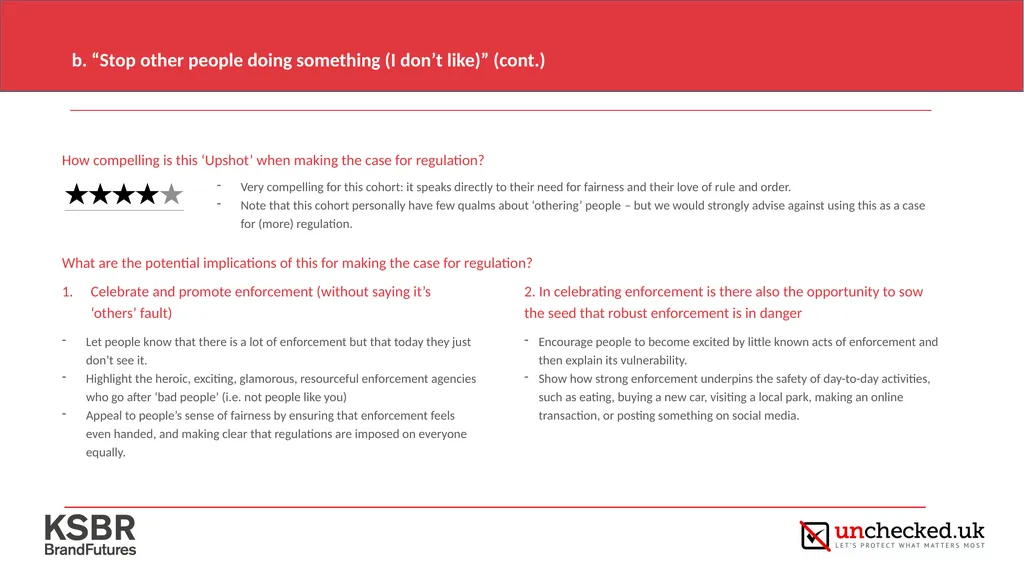
b. “Stop other people doing something (I don’t like)” (cont.) Celebrate and promote enforcement (without saying it’s ‘others’ fault)
Let people know that there is a lot of enforcement but that today they just don’t see it.
Highlight the heroic, exciting, glamorous, resourceful enforcement agencies who go after ‘bad people’ (i.e. not people like you)
Appeal to people’s sense of fairness by ensuring that enforcement feels even handed, and making clear that regulations are imposed on everyone equally. What are the potential implications of this for making the case for regulation? How compelling is this ‘Upshot’ when making the case for regulation? Very compelling for this cohort: it speaks directly to their need for fairness and their love of rule and order.
Note that this cohort personally have few qualms about ‘othering’ people – but we would strongly advise against using this as a case for (more) regulation. 2. In celebrating enforcement is there also the opportunity to sow the seed that robust enforcement is in danger
Encourage people to become excited by little known acts of enforcement and then explain its vulnerability.
Show how strong enforcement underpins the safety of day-to-day activities, such as eating, buying a new car, visiting a local park, making an online transaction, or posting something on social media.<br>
Let people know that there is a lot of enforcement but that today they just don’t see it.
Highlight the heroic, exciting, glamorous, resourceful enforcement agencies who go after ‘bad people’ (i.e. not people like you)
Appeal to people’s sense of fairness by ensuring that enforcement feels even handed, and making clear that regulations are imposed on everyone equally. What are the potential implications of this for making the case for regulation? How compelling is this ‘Upshot’ when making the case for regulation? Very compelling for this cohort: it speaks directly to their need for fairness and their love of rule and order.
Note that this cohort personally have few qualms about ‘othering’ people – but we would strongly advise against using this as a case for (more) regulation. 2. In celebrating enforcement is there also the opportunity to sow the seed that robust enforcement is in danger
Encourage people to become excited by little known acts of enforcement and then explain its vulnerability.
Show how strong enforcement underpins the safety of day-to-day activities, such as eating, buying a new car, visiting a local park, making an online transaction, or posting something on social media.<br>
21
c. “Stop me doing / make me do something for my own good”<br>
22
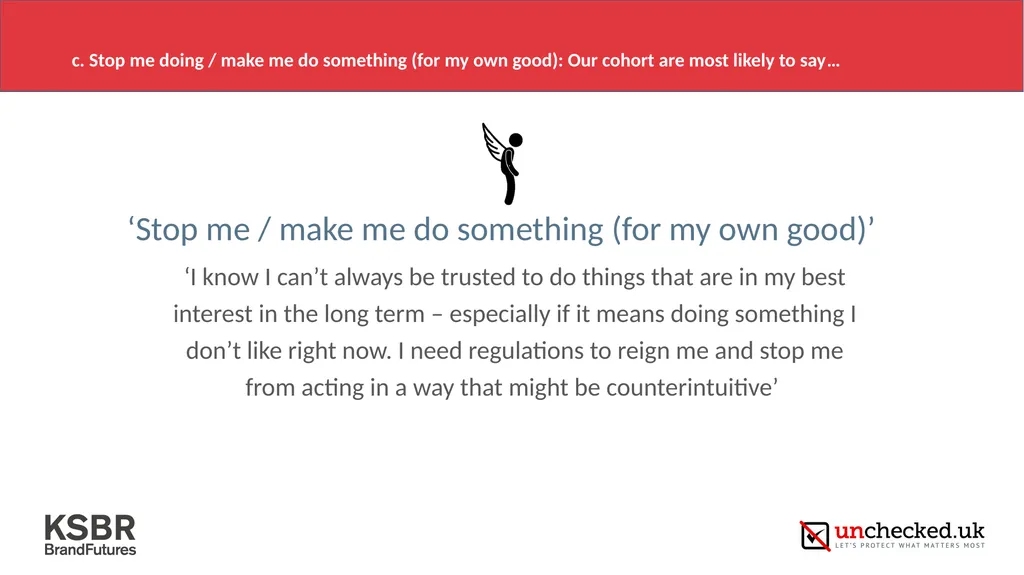
‘Stop me / make me do something (for my own good)’ ‘I know I can’t always be trusted to do things that are in my best interest in the long term – especially if it means doing something I don’t like right now. I need regulations to reign me and stop me from acting in a way that might be counterintuitive’ c. Stop me doing / make me do something (for my own good): Our cohort are most likely to say…<br>
23
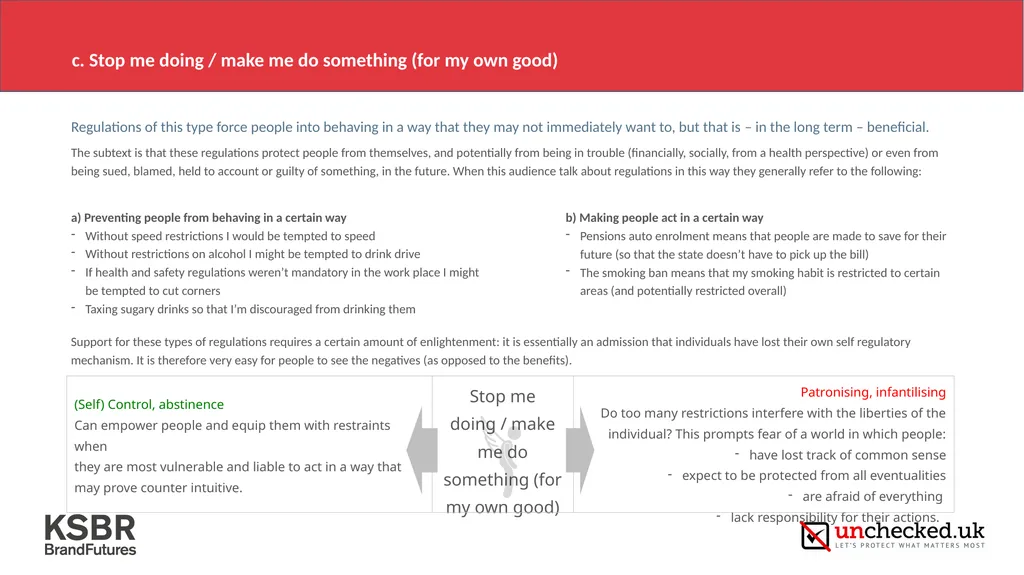
c. Stop me doing / make me do something (for my own good) Regulations of this type force people into behaving in a way that they may not immediately want to, but that is – in the long term – beneficial.
The subtext is that these regulations protect people from themselves, and potentially from being in trouble (financially, socially, from a health perspective) or even from being sued, blamed, held to account or guilty of something, in the future. When this audience talk about regulations in this way they generally refer to the following: a) Preventing people from behaving in a certain way
Without speed restrictions I would be tempted to speed
Without restrictions on alcohol I might be tempted to drink drive
If health and safety regulations weren’t mandatory in the work place I might be tempted to cut corners
Taxing sugary drinks so that I’m discouraged from drinking them b) Making people act in a certain way
Pensions auto enrolment means that people are made to save for their future (so that the state doesn’t have to pick up the bill)
The smoking ban means that my smoking habit is restricted to certain areas (and potentially restricted overall) Support for these types of regulations requires a certain amount of enlightenment: it is essentially an admission that individuals have lost their own self regulatory mechanism. It is therefore very easy for people to see the negatives (as opposed to the benefits).<br>
The subtext is that these regulations protect people from themselves, and potentially from being in trouble (financially, socially, from a health perspective) or even from being sued, blamed, held to account or guilty of something, in the future. When this audience talk about regulations in this way they generally refer to the following: a) Preventing people from behaving in a certain way
Without speed restrictions I would be tempted to speed
Without restrictions on alcohol I might be tempted to drink drive
If health and safety regulations weren’t mandatory in the work place I might be tempted to cut corners
Taxing sugary drinks so that I’m discouraged from drinking them b) Making people act in a certain way
Pensions auto enrolment means that people are made to save for their future (so that the state doesn’t have to pick up the bill)
The smoking ban means that my smoking habit is restricted to certain areas (and potentially restricted overall) Support for these types of regulations requires a certain amount of enlightenment: it is essentially an admission that individuals have lost their own self regulatory mechanism. It is therefore very easy for people to see the negatives (as opposed to the benefits).<br>
24
c. Stop me doing / make me do something (for my own good) Weighing up the consequences
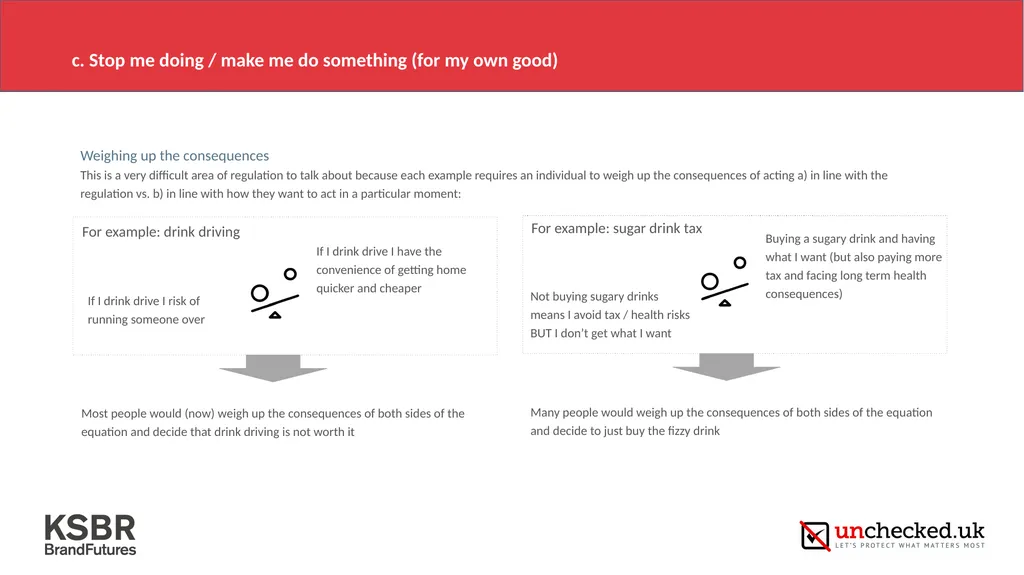
This is a very difficult area of regulation to talk about because each example requires an individual to weigh up the consequences of acting a) in line with the regulation vs. b) in line with how they want to act in a particular moment: If I drink drive I risk of running someone over If I drink drive I have the convenience of getting home quicker and cheaper Buying a sugary drink and having what I want (but also paying more tax and facing long term health consequences) Not buying sugary drinks
means I avoid tax / health risks BUT I don’t get what I want For example: drink driving For example: sugar drink tax Most people would (now) weigh up the consequences of both sides of the equation and decide that drink driving is not worth it Many people would weigh up the consequences of both sides of the equation and decide to just buy the fizzy drink<br>
This is a very difficult area of regulation to talk about because each example requires an individual to weigh up the consequences of acting a) in line with the regulation vs. b) in line with how they want to act in a particular moment: If I drink drive I risk of running someone over If I drink drive I have the convenience of getting home quicker and cheaper Buying a sugary drink and having what I want (but also paying more tax and facing long term health consequences) Not buying sugary drinks
means I avoid tax / health risks BUT I don’t get what I want For example: drink driving For example: sugar drink tax Most people would (now) weigh up the consequences of both sides of the equation and decide that drink driving is not worth it Many people would weigh up the consequences of both sides of the equation and decide to just buy the fizzy drink<br>
25
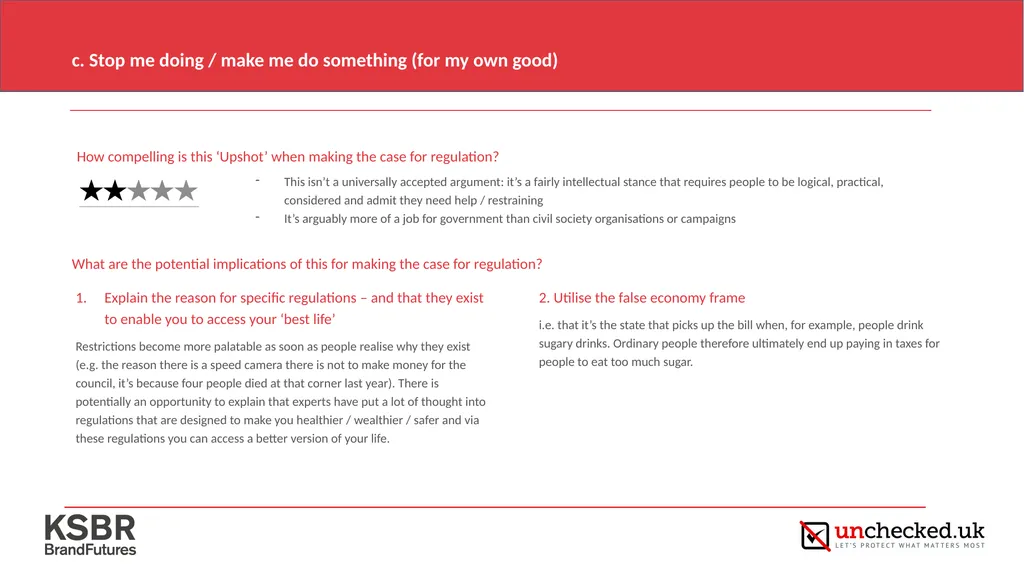
What are the potential implications of this for making the case for regulation? How compelling is this ‘Upshot’ when making the case for regulation? This isn’t a universally accepted argument: it’s a fairly intellectual stance that requires people to be logical, practical, considered and admit they need help / restraining
It’s arguably more of a job for government than civil society organisations or campaigns Explain the reason for specific regulations – and that they exist to enable you to access your ‘best life’
Restrictions become more palatable as soon as people realise why they exist (e.g. the reason there is a speed camera there is not to make money for the council, it’s because four people died at that corner last year). There is potentially an opportunity to explain that experts have put a lot of thought into regulations that are designed to make you healthier / wealthier / safer and via these regulations you can access a better version of your life. c. Stop me doing / make me do something (for my own good) 2. Utilise the false economy frame
i.e. that it’s the state that picks up the bill when, for example, people drink sugary drinks. Ordinary people therefore ultimately end up paying in taxes for people to eat too much sugar.<br>
It’s arguably more of a job for government than civil society organisations or campaigns Explain the reason for specific regulations – and that they exist to enable you to access your ‘best life’
Restrictions become more palatable as soon as people realise why they exist (e.g. the reason there is a speed camera there is not to make money for the council, it’s because four people died at that corner last year). There is potentially an opportunity to explain that experts have put a lot of thought into regulations that are designed to make you healthier / wealthier / safer and via these regulations you can access a better version of your life. c. Stop me doing / make me do something (for my own good) 2. Utilise the false economy frame
i.e. that it’s the state that picks up the bill when, for example, people drink sugary drinks. Ordinary people therefore ultimately end up paying in taxes for people to eat too much sugar.<br>
26
Find out more about our work: www.unchecked.uk
Contact us: emma@unchecked.uk<br>
Contact us: emma@unchecked.uk<br>