Struck By/Caught Between Presented by: Objectives
Description: Struck ByCaught Between Presented by: Objectives After this course, students will be able to: Recognize potential struck-bycaught-in or between situations Identify struck-bycaught-in or between hazards Evaluate control measures for
Related Topics
Download Presentation
"Struck By/Caught Between Presented by: Objectives" is the property of its rightful owner. Permission is granted to download and print the materials on this website for personal, non-commercial use only, and to display it on your personal computer provided you do not modify the materials and that you retain all copyright notices contained in the materials. By downloading content from our website, you accept the terms of this agreement.
Presentation Transcript
slide1. Struck By/Caught Between Presented by:<br>
slide2. Objectives After this course, students will be able to:
Recognize potential struck-by/caught-in or between situations
Identify struck-by/caught-in or between hazards
Evaluate control measures for struck-by/caught-in or between hazards NCDOL Photo Library<br>
slide3. Goal to reduce occupational exposures to amputations
Struck by and caught between injuries
Lockout/tagout
Machine guarding
Increase outreach to employers and employees
Training events (Internal and external)
Compliance inspections
Consultation visits
Publications
Amputations must be reported within 24 hours Amputations Special Emphasis Program<br>
slide4. Definitions Competent person
“One who is capable of identifying existing and predictable hazards in the surroundings or working conditions which are unsanitary, hazardous, or dangerous to employees, and who has authorization to take prompt corrective measures to eliminate them.” 1926.32(f)<br>
slide5. Struck-By Hazards Struck-by injuries are produced by forcible contact or impact between the injured person and an object or piece of equipment.
Struck-by hazards are categorized as follows:
Struck-by flying object
Struck-by falling object
Struck-by swinging object
Struck-by rolling object<br>
slide6. Struck-By Hazards Struck-by examples:
Tractor trailer, truck or vehicle
A counterweight from piece of equipment
Falling tree, tree-top or limbs/branches
Precast walls
Building materials
Motor graders
Fly wheels
Man-lifts
Forklifts NCDOL Photo Library<br>
slide7. Caught-In or Between Hazards Hazards causing a person to be squeezed, caught, crushed, pinched, or compressed between two or more objects, or between parts of an object.<br>
slide8. Caught-In or Between Hazards Caught-in or between examples:
Between a wall and tractor trailer
Caught in/between truck tire and pavement
Caught in/between dock leveler
Caught in woodchipper NCDOL Photo Library<br>
slide9. Struck By/Caught Between Causes Most of these are a direct result of:
Materials handling, storage, use, and disposal
Construction equipment
Motor vehicles
Tools and equipment
Falling trees
Woodchipper<br>
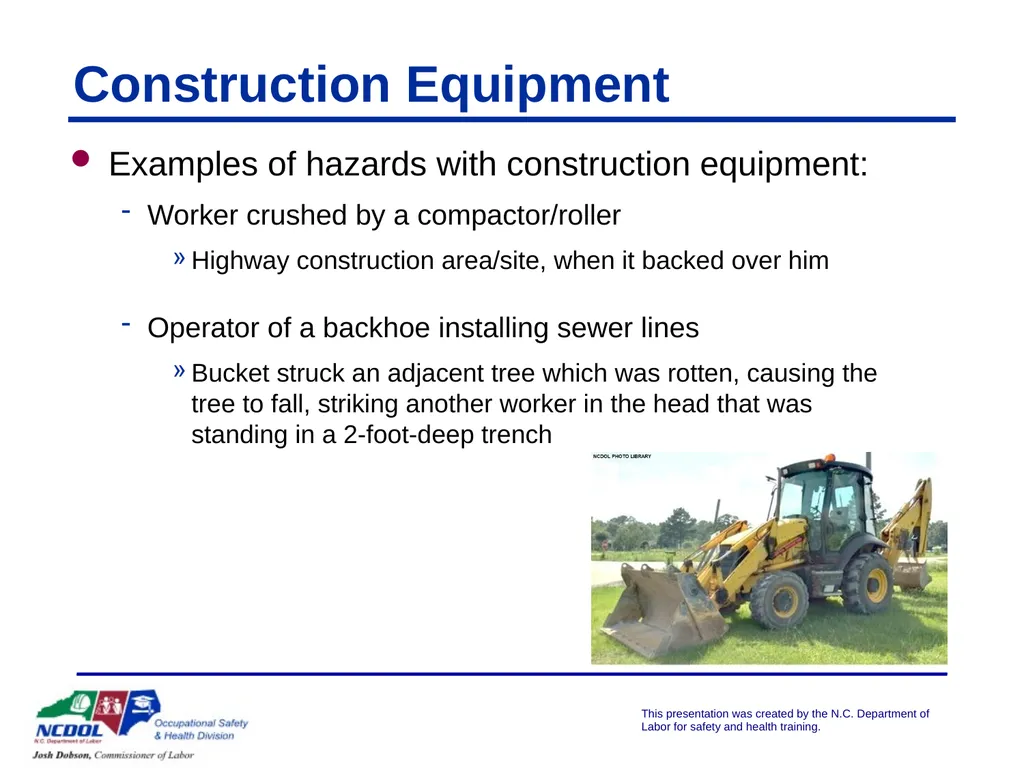
slide10. Construction Equipment Examples of hazards with construction equipment:
Worker crushed by a compactor/roller
Highway construction area/site, when it backed over him
Operator of a backhoe installing sewer lines
Bucket struck an adjacent tree which was rotten, causing the tree to fall, striking another worker in the head that was standing in a 2-foot-deep trench<br>
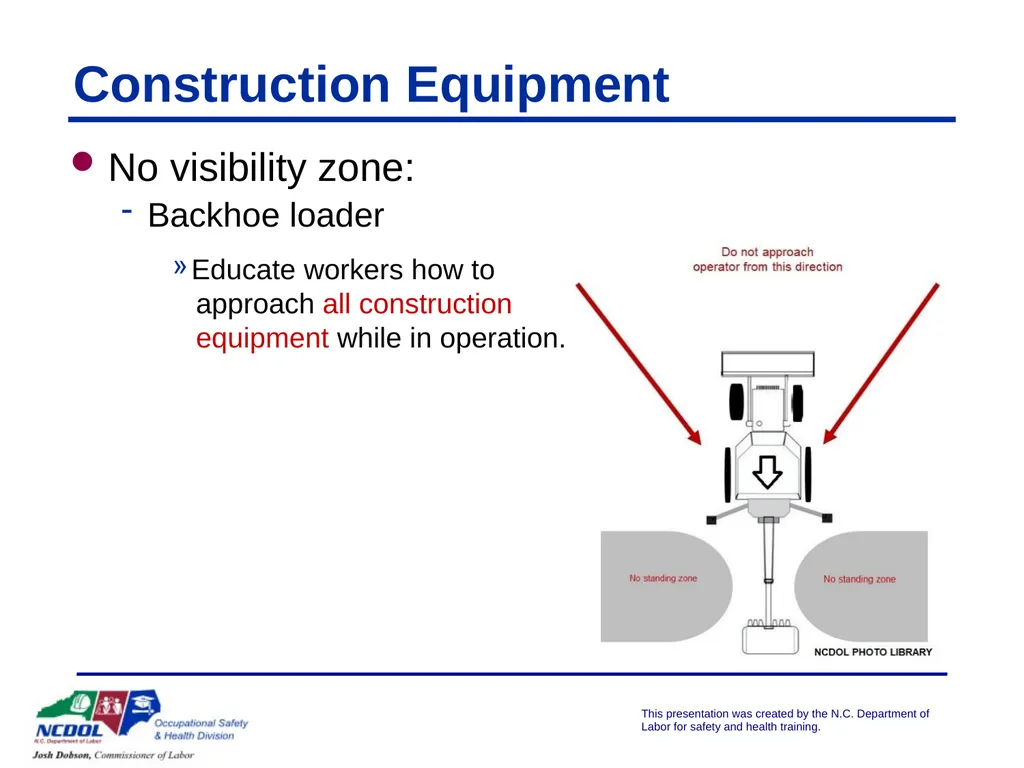
slide11. Construction Equipment No visibility zone:
Backhoe loader
Educate workers how to
approach all construction
equipment while in operation.<br>
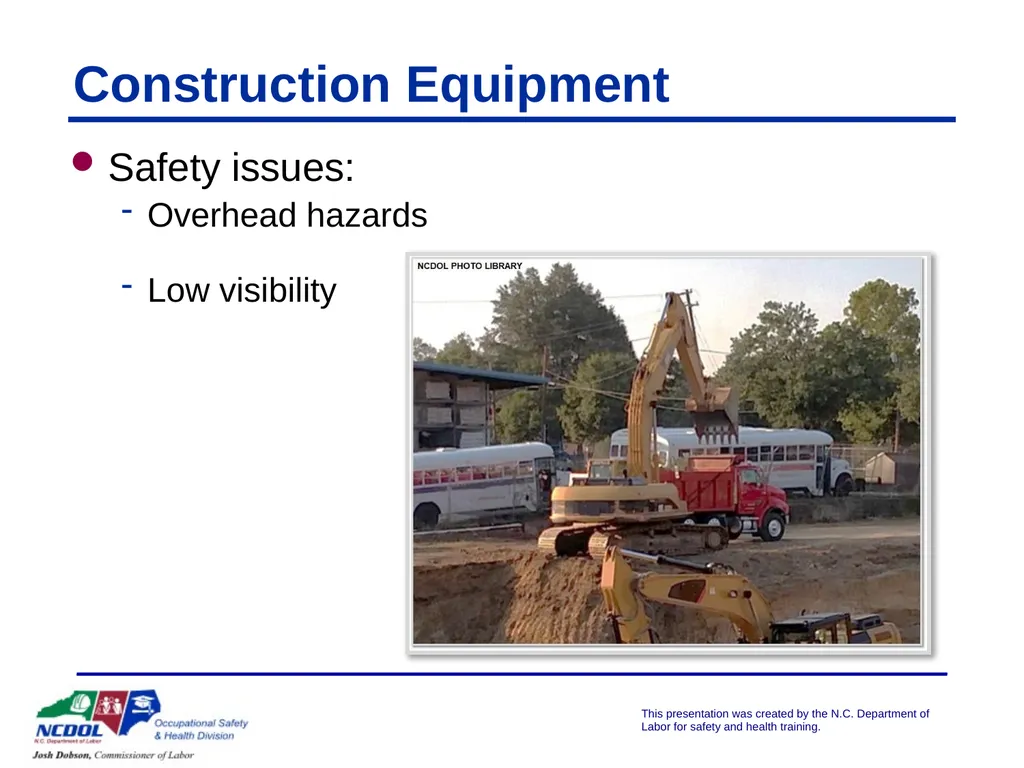
slide12. Construction Equipment Safety issues:
Overhead hazards
Low visibility<br>
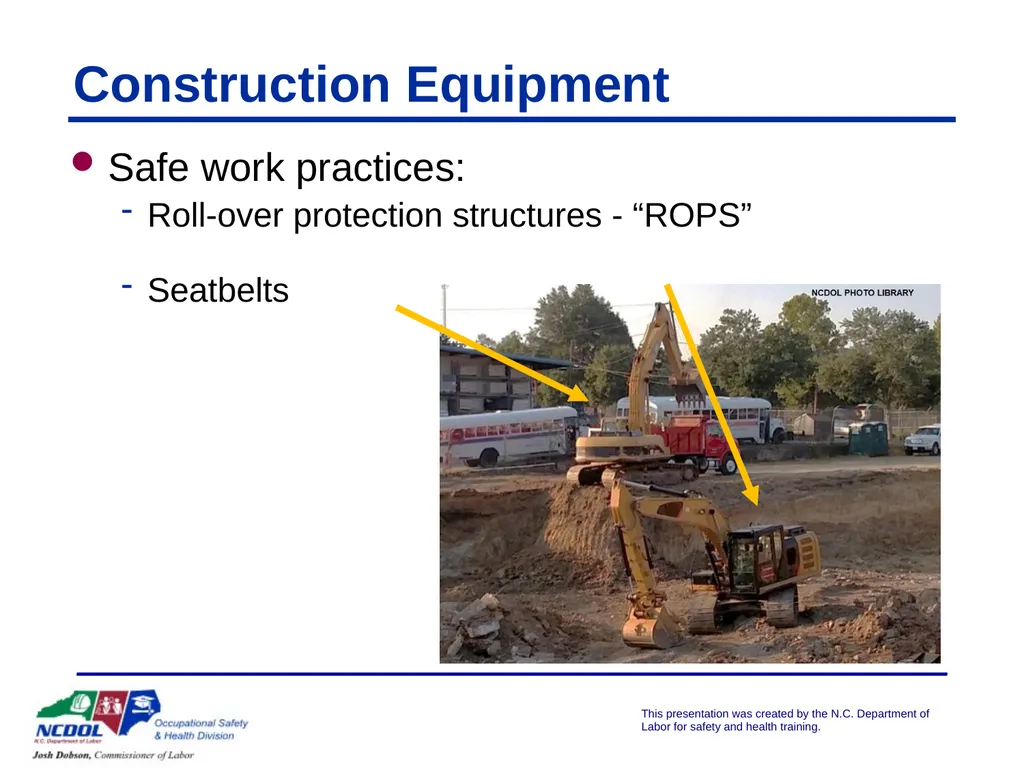
slide13. Construction Equipment Safe work practices:
Roll-over protection structures - “ROPS”
Seatbelts<br>
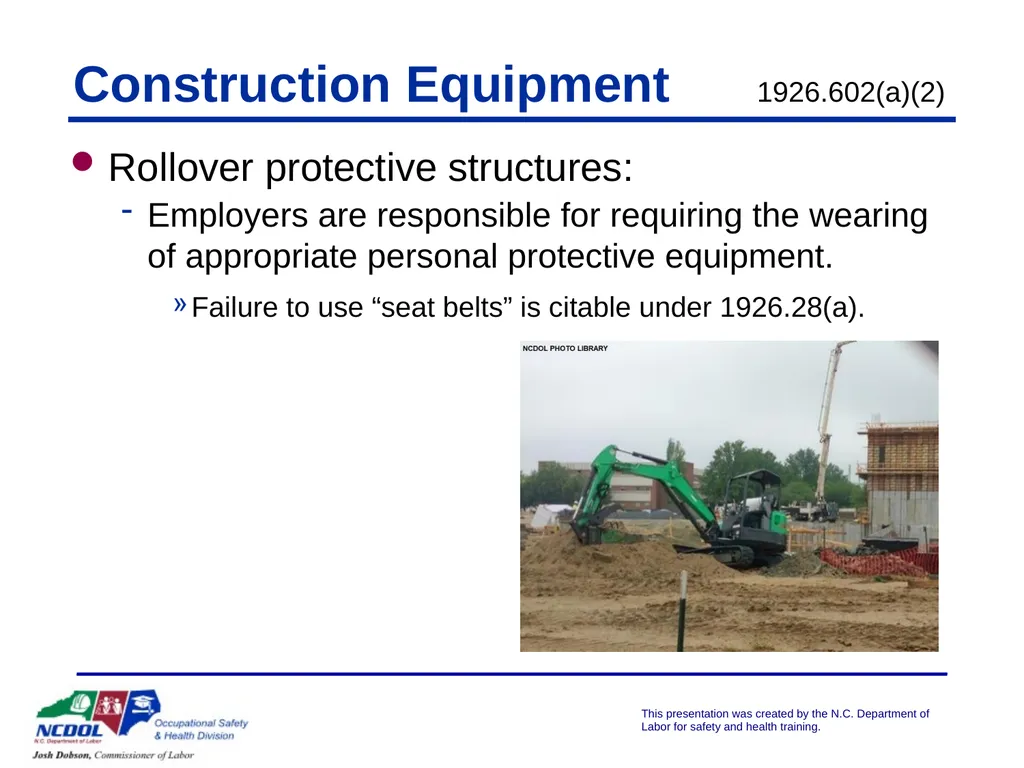
slide14. Construction Equipment Rollover protective structures:
Employers are responsible for requiring the wearing of appropriate personal protective equipment.
Failure to use “seat belts” is citable under 1926.28(a). 1926.602(a)(2)<br>
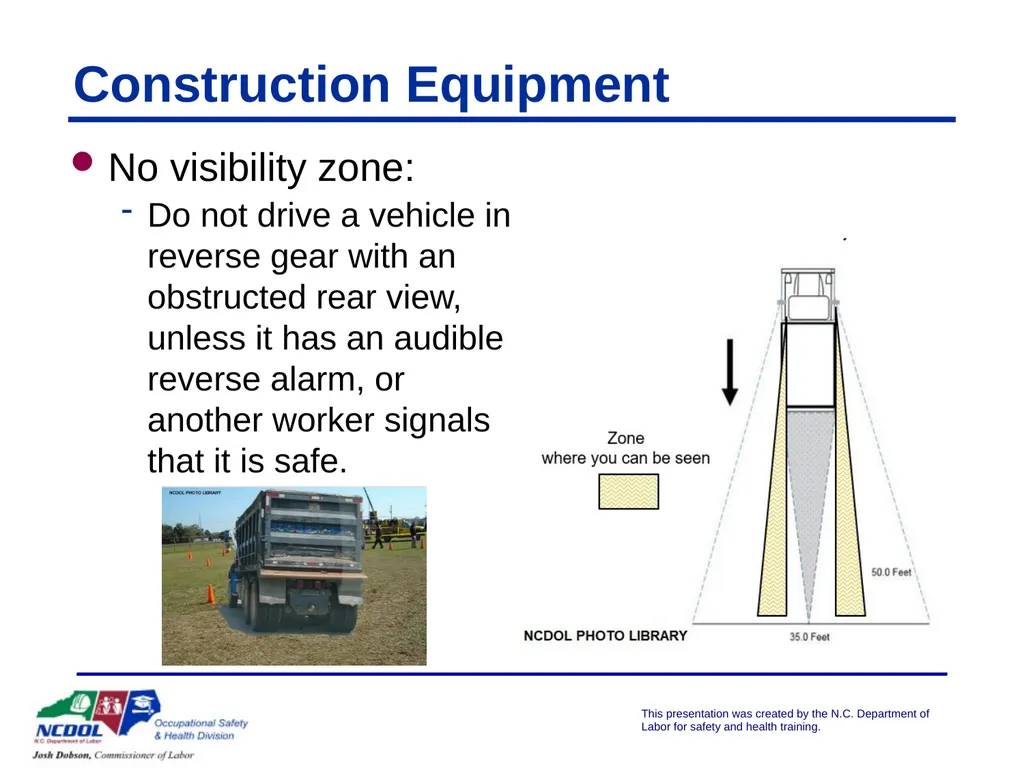
slide15. Construction Equipment No visibility zone:
Do not drive a vehicle in reverse gear with an obstructed rear view, unless it has an audible reverse alarm, or another worker signals that it is safe.<br>
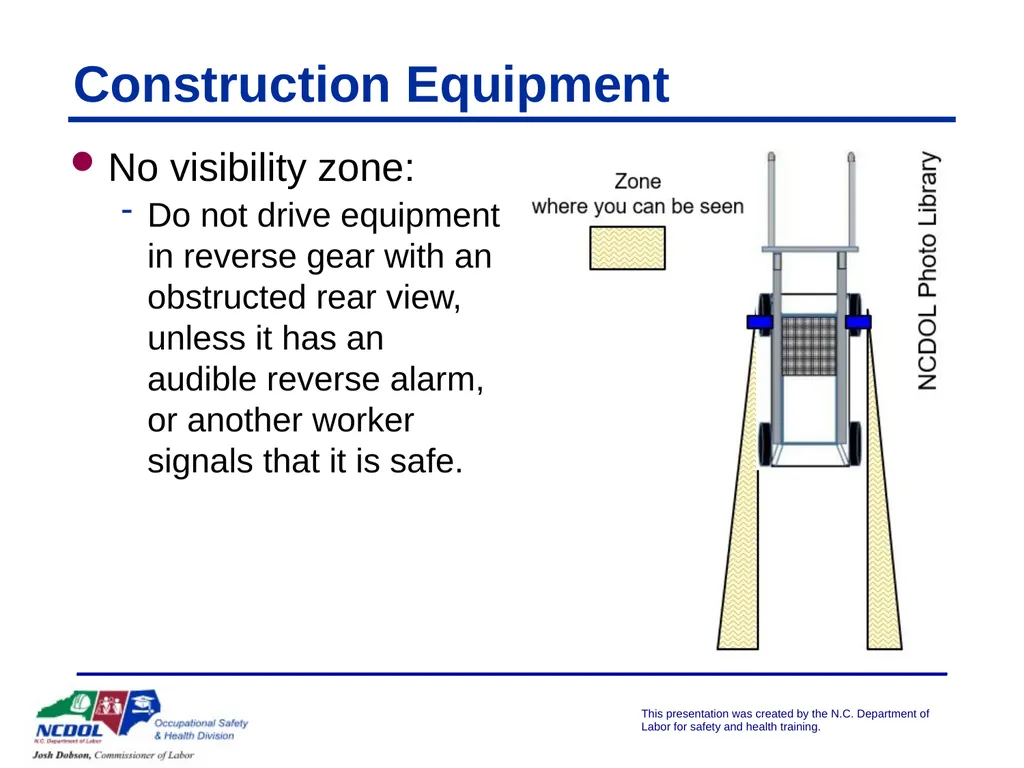
slide16. Construction Equipment No visibility zone:
Do not drive equipment in reverse gear with an obstructed rear view, unless it has an audible reverse alarm, or another worker signals that it is safe.<br>
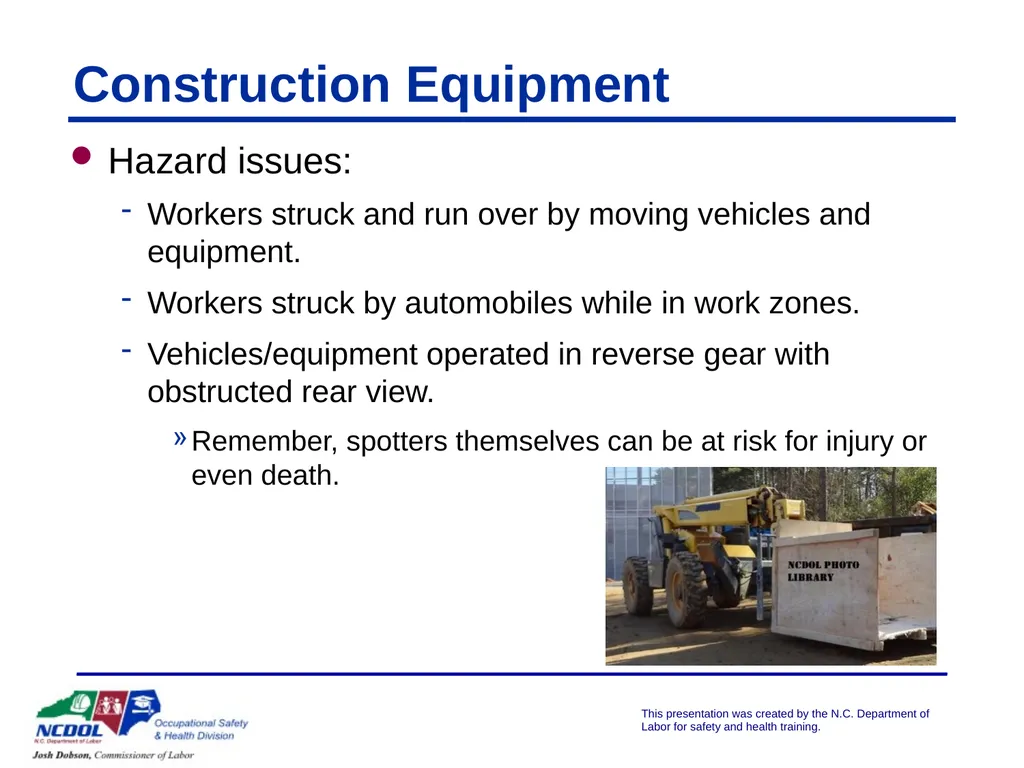
slide17. Construction Equipment Hazard issues:
Workers struck and run over by moving vehicles and equipment.
Workers struck by automobiles while in work zones.
Vehicles/equipment operated in reverse gear with obstructed rear view.
Remember, spotters themselves can be at risk for injury or even death. NCDOL Photo Library NCDOL Photo Library<br>
slide18. Motor Vehicles Safe work practices:
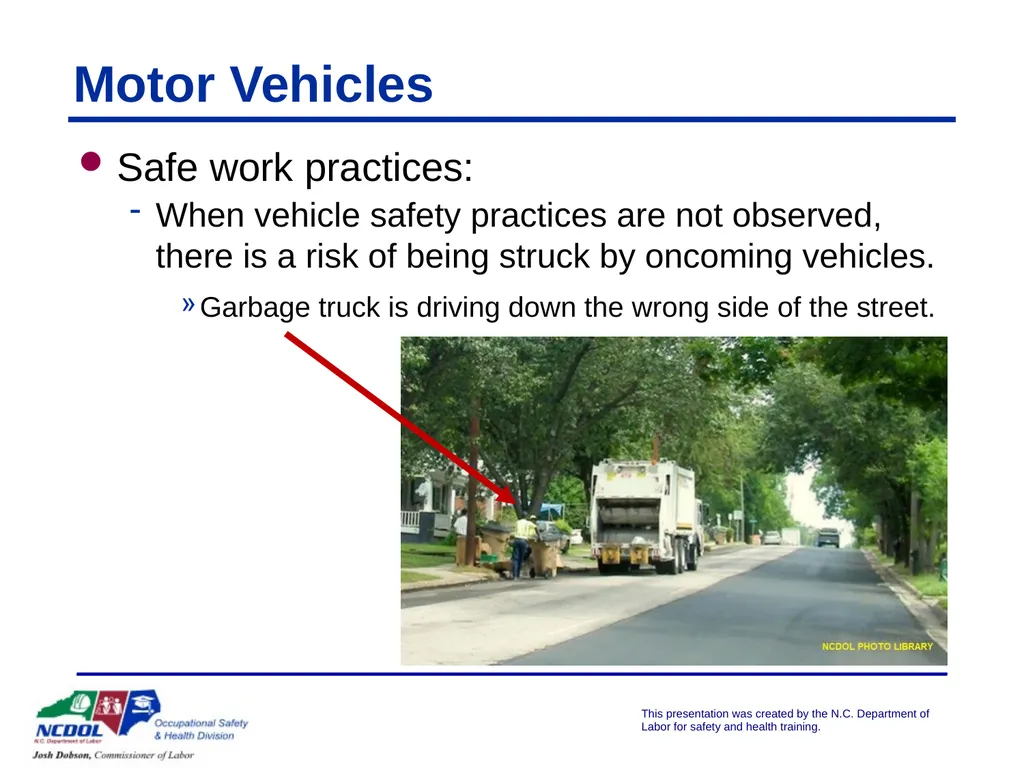
When vehicle safety practices are not observed, there is a risk of being struck by oncoming vehicles.
Garbage truck is driving down the wrong side of the street.<br>
slide19. Motor Vehicles Hazard issues:
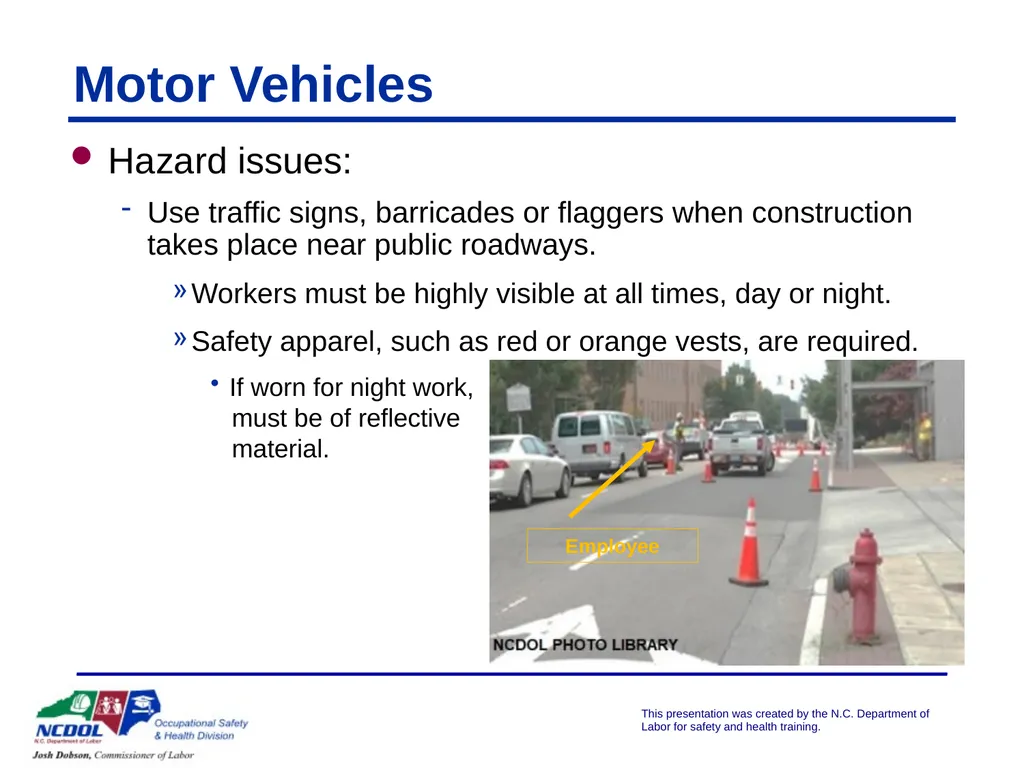
Use traffic signs, barricades or flaggers when construction takes place near public roadways.
Workers must be highly visible at all times, day or night.
Safety apparel, such as red or orange vests, are required.
If worn for night work,
must be of reflective
material. Employee<br>
slide20. Motor Vehicles Safe work practices:
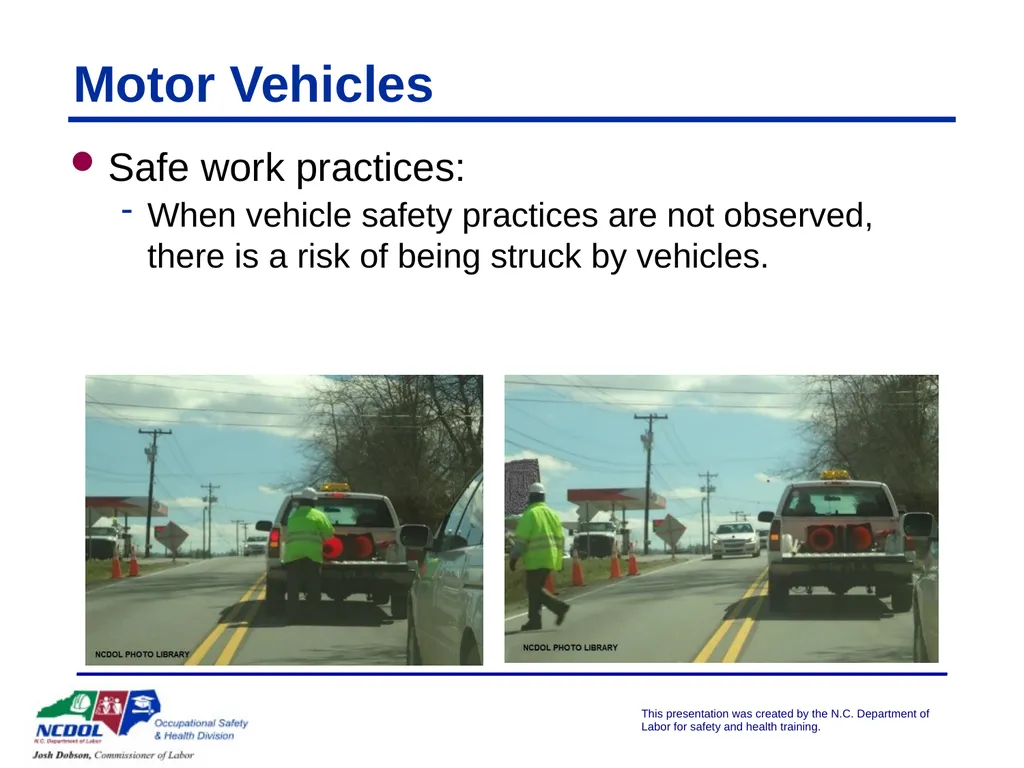
When vehicle safety practices are not observed, there is a risk of being struck by vehicles. NCDOL Photo Library<br>
slide21. Motor Vehicles Safe work practices:
Provide an area of separation between traffic flow and work area.<br>
slide22. Motor Vehicles Safe work practices:
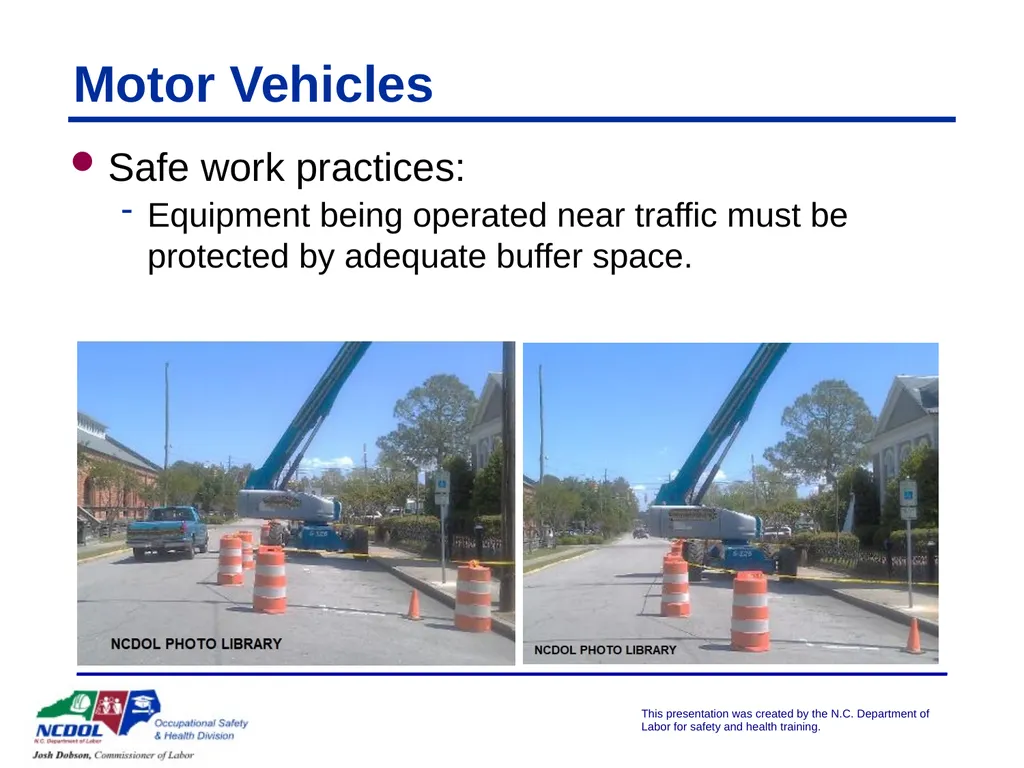
Equipment being operated near traffic must be protected by adequate buffer space. NCDOL Photo Library NCDOL Photo Library<br>
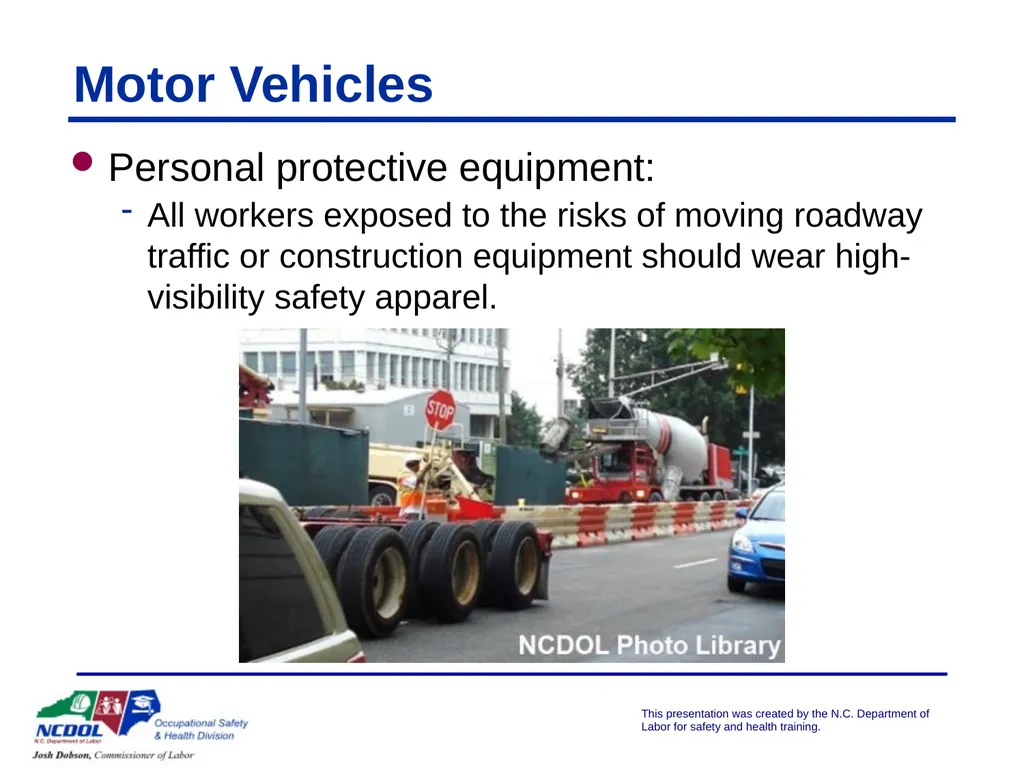
slide23. Motor Vehicles Personal protective equipment:
All workers exposed to the risks of moving roadway traffic or construction equipment should wear high-visibility safety apparel. NCDOL Photo Library<br>
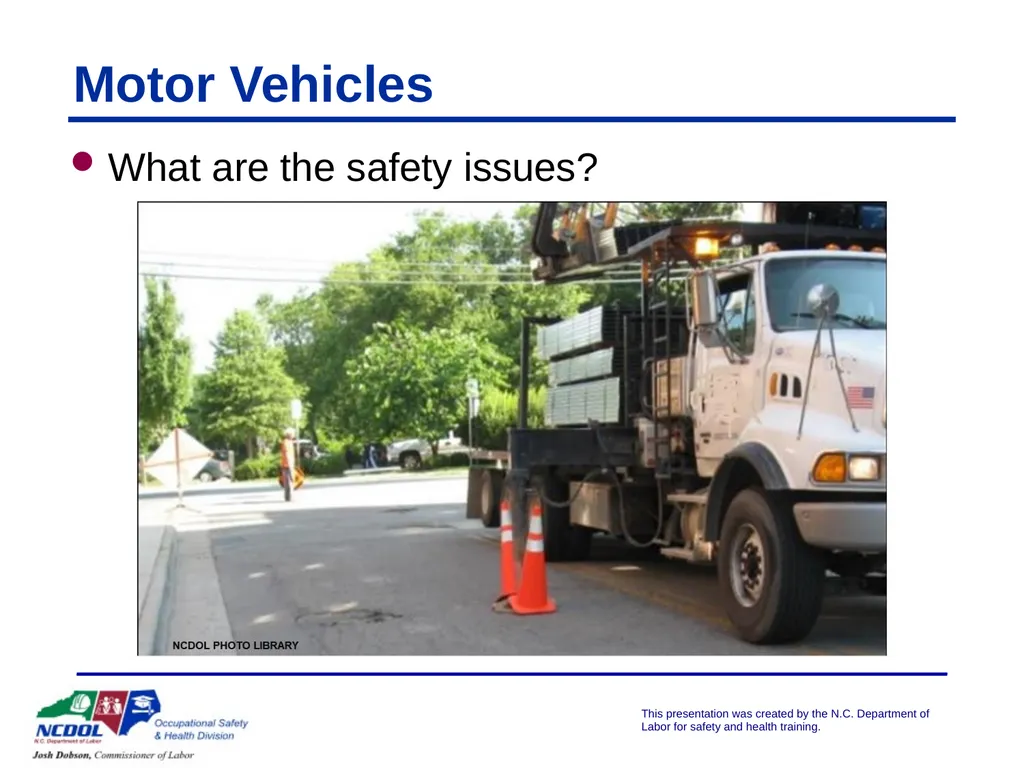
slide24. Motor Vehicles What are the safety issues?<br>
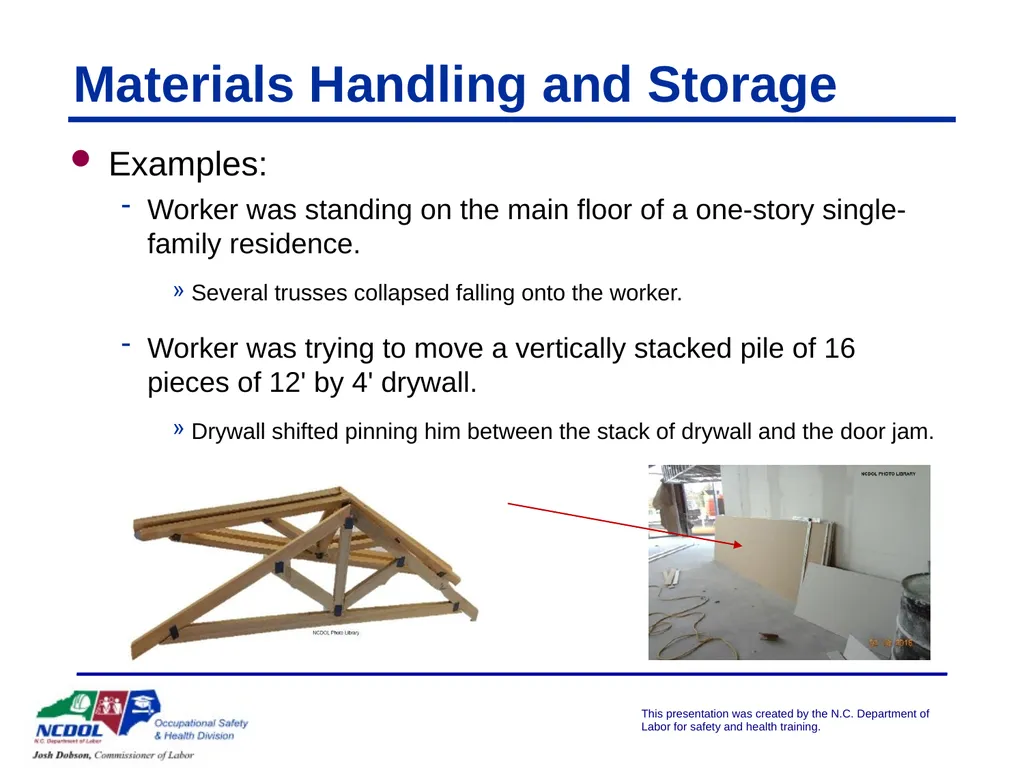
slide25. Materials Handling and Storage Examples:
Worker was standing on the main floor of a one-story single-family residence.
Several trusses collapsed falling onto the worker.
Worker was trying to move a vertically stacked pile of 16 pieces of 12' by 4' drywall.
Drywall shifted pinning him between the stack of drywall and the door jam.<br>
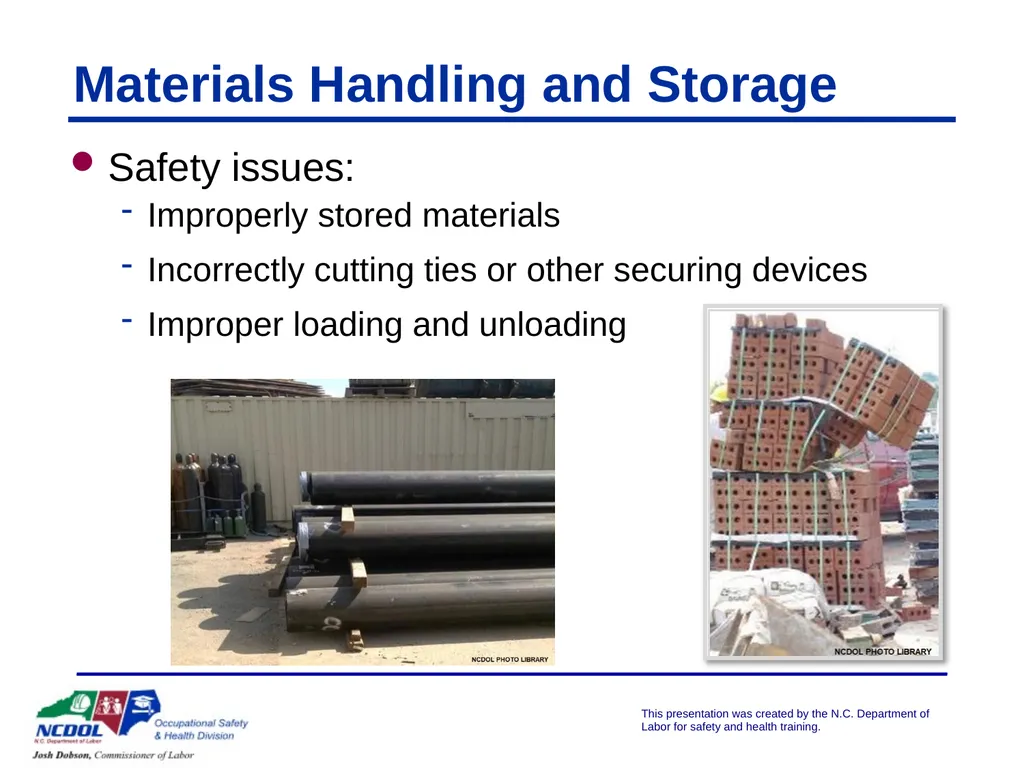
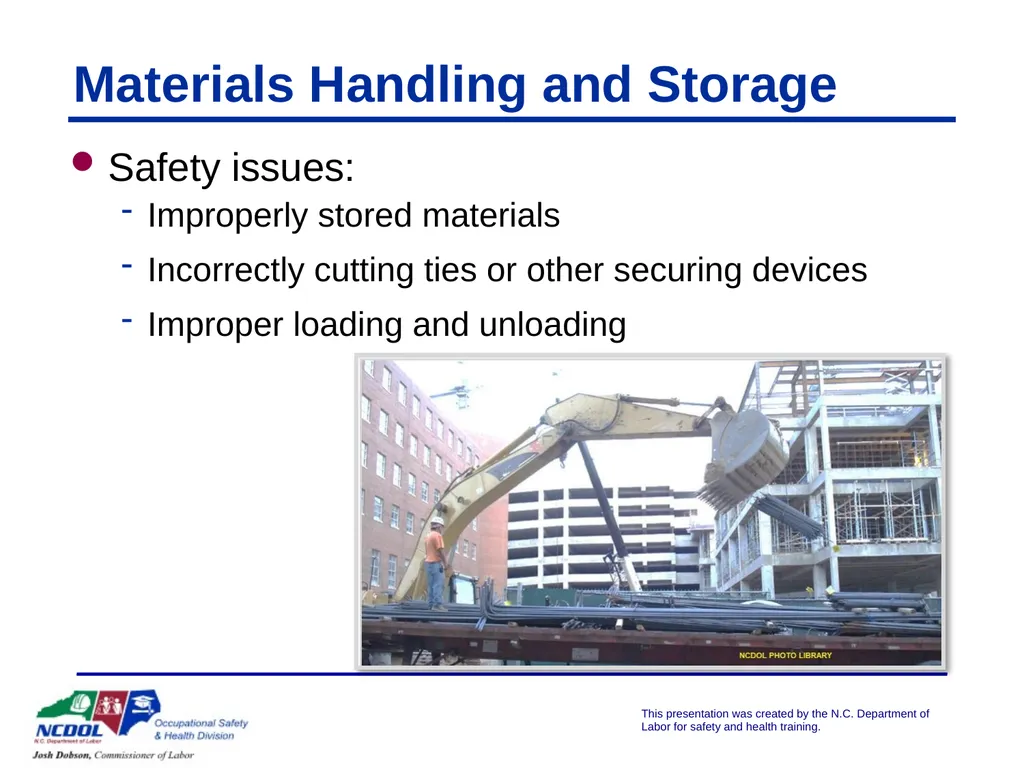
slide26. Materials Handling and Storage Safety issues:
Improperly stored materials
Incorrectly cutting ties or other securing devices
Improper loading and unloading<br>
slide27. Materials Handling and Storage Safety issues:
Improperly stored materials
Incorrectly cutting ties or other securing devices
Improper loading and unloading<br>
slide28. Materials Handling and Storage What safety issues do you see?
Electrical safety
Falling object protection<br>
slide29. Materials Handling and Storage What are the safety issues?
Housekeeping<br>
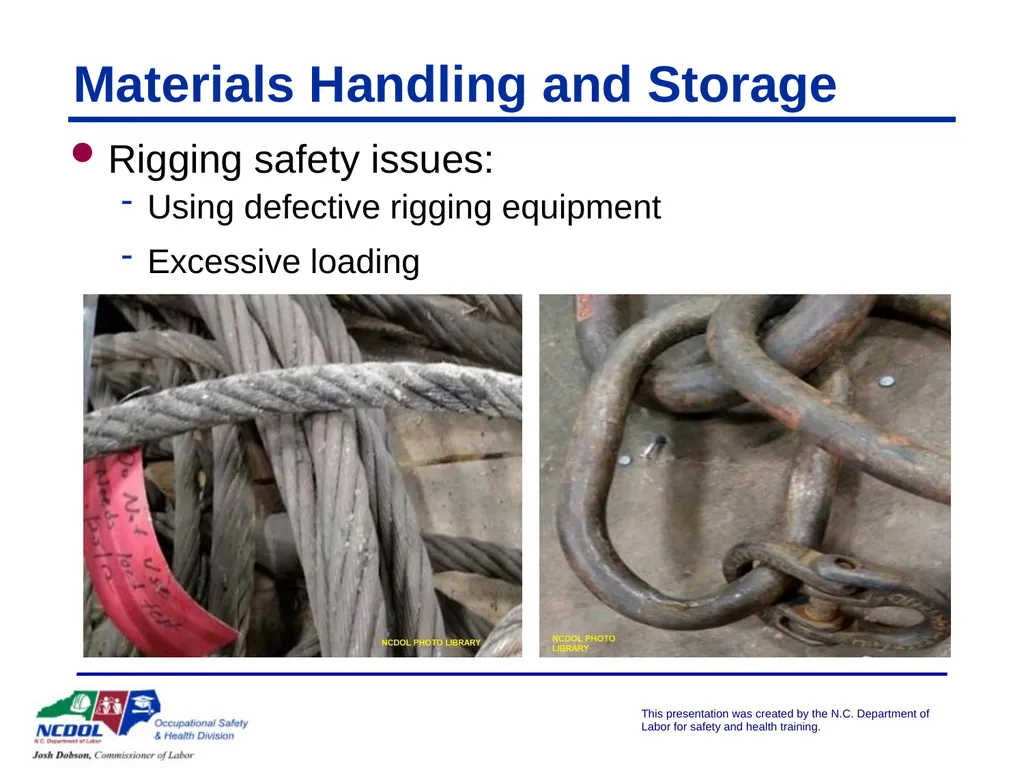
slide30. Materials Handling and Storage Rigging safety issues:
Using defective rigging equipment
Excessive loading<br>
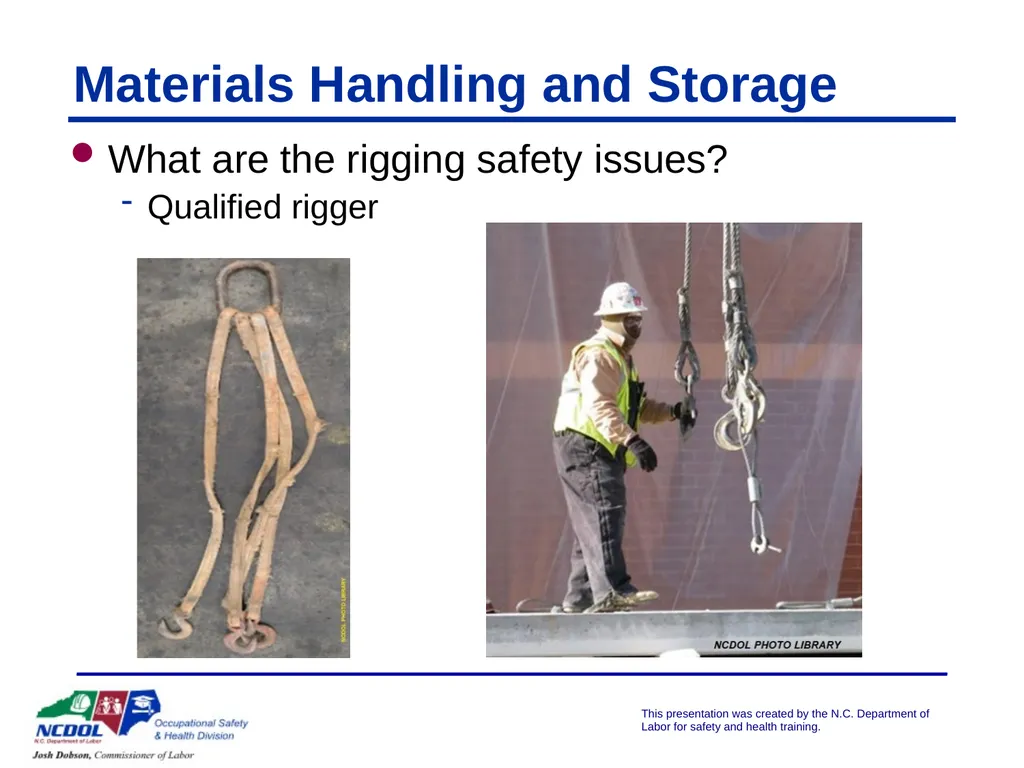
slide31. Materials Handling and Storage What are the rigging safety issues?
Qualified rigger<br>
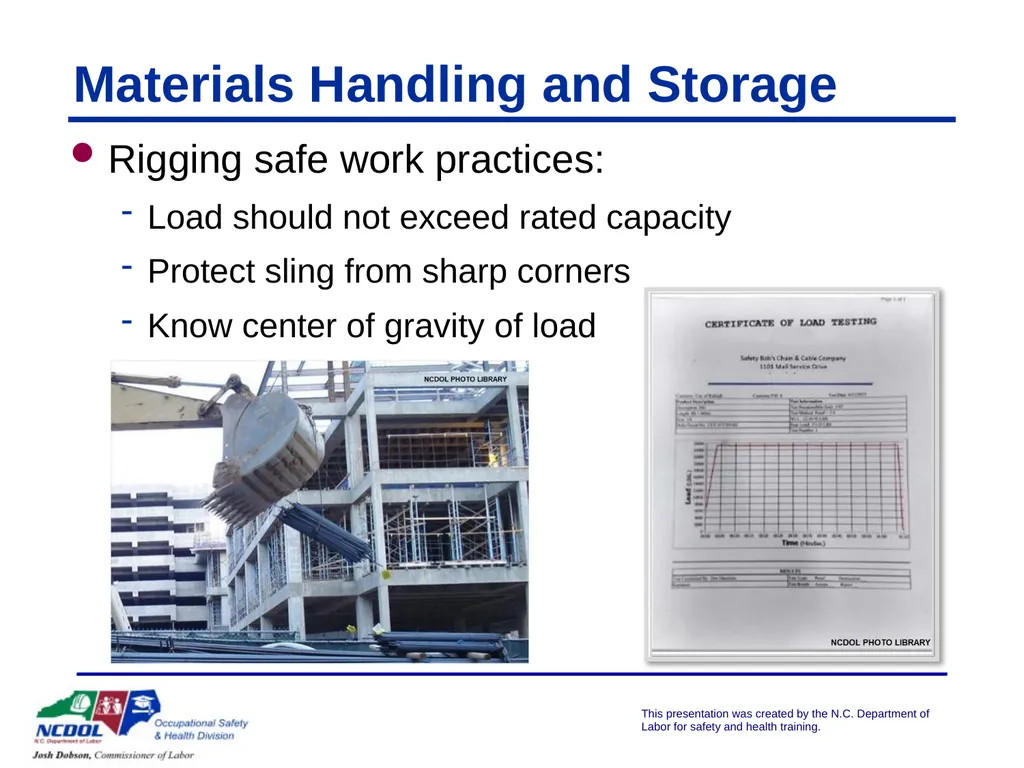
slide32. Materials Handling and Storage Rigging safe work practices:
Load should not exceed rated capacity
Protect sling from sharp corners
Know center of gravity of load<br>
slide33. Materials Handling and Storage Rigging safe work practices:
Inspect the rigging
Keep personnel clear
Never leave load unattended
Wear hardhats when lifting<br>
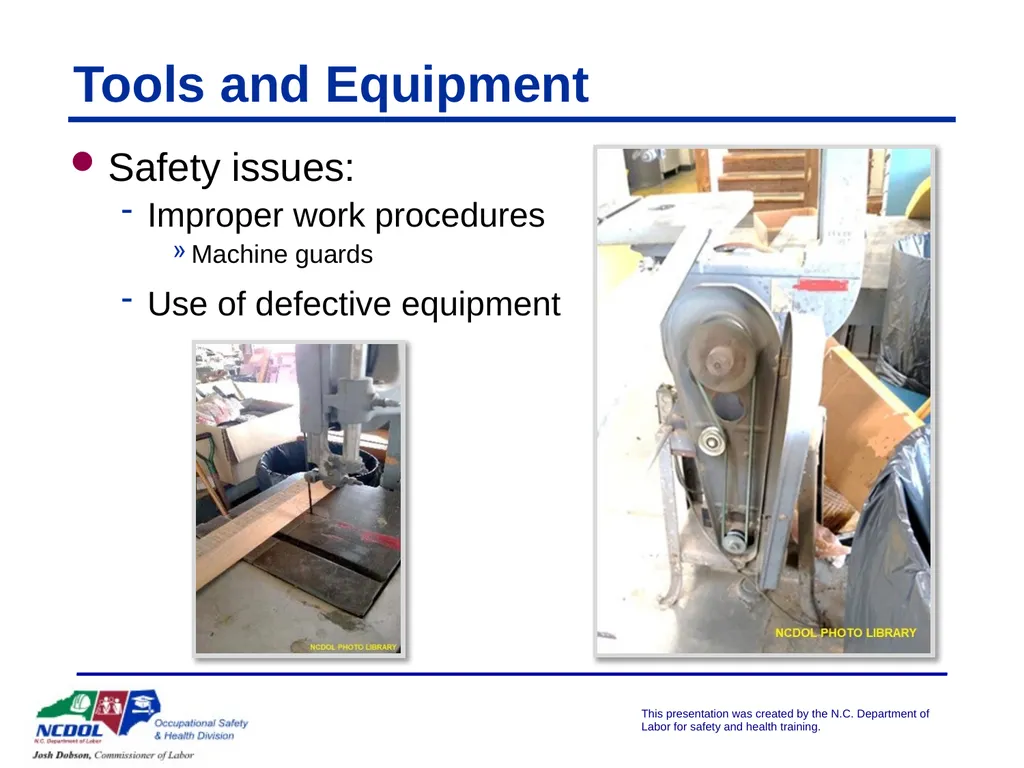
slide34. Tools and Equipment Safety issues:
Improper work procedures
Machine guards
Use of defective equipment<br>
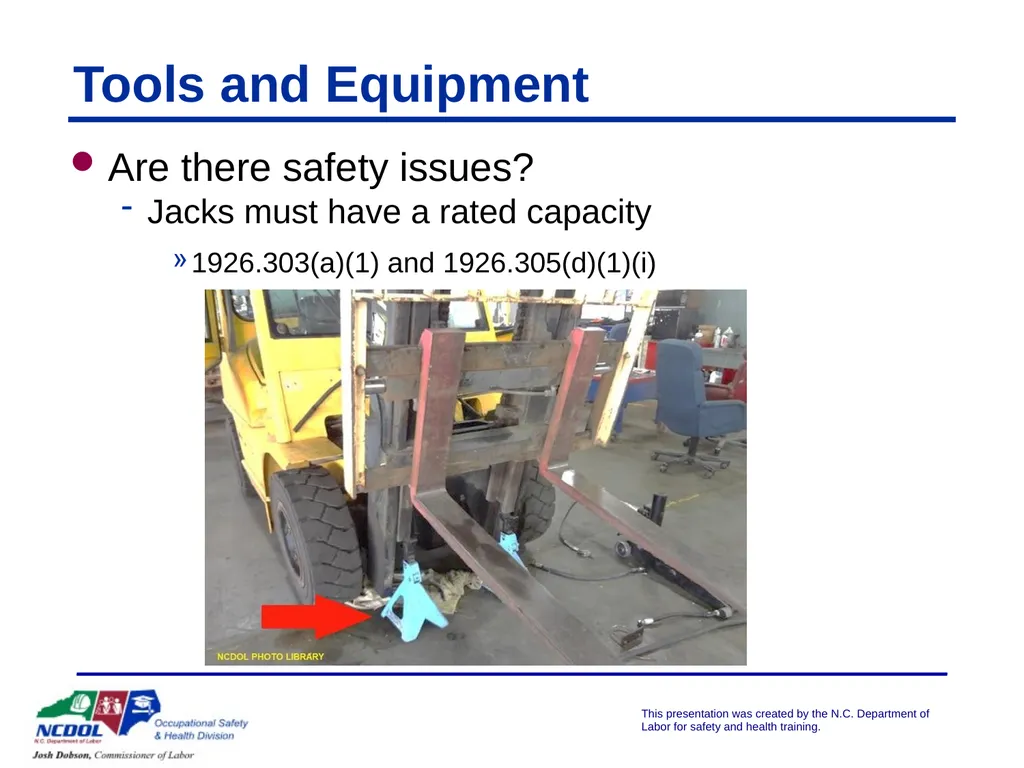
slide35. Tools and Equipment Are there safety issues?
Jacks must have a rated capacity
1926.303(a)(1) and 1926.305(d)(1)(i)<br>
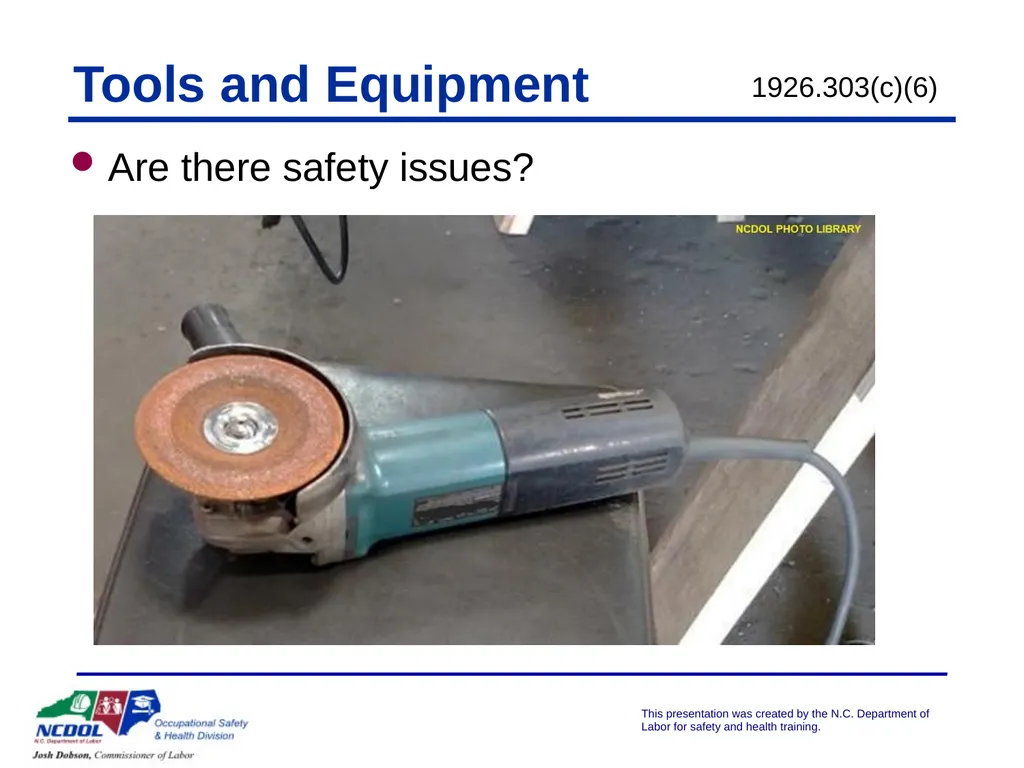
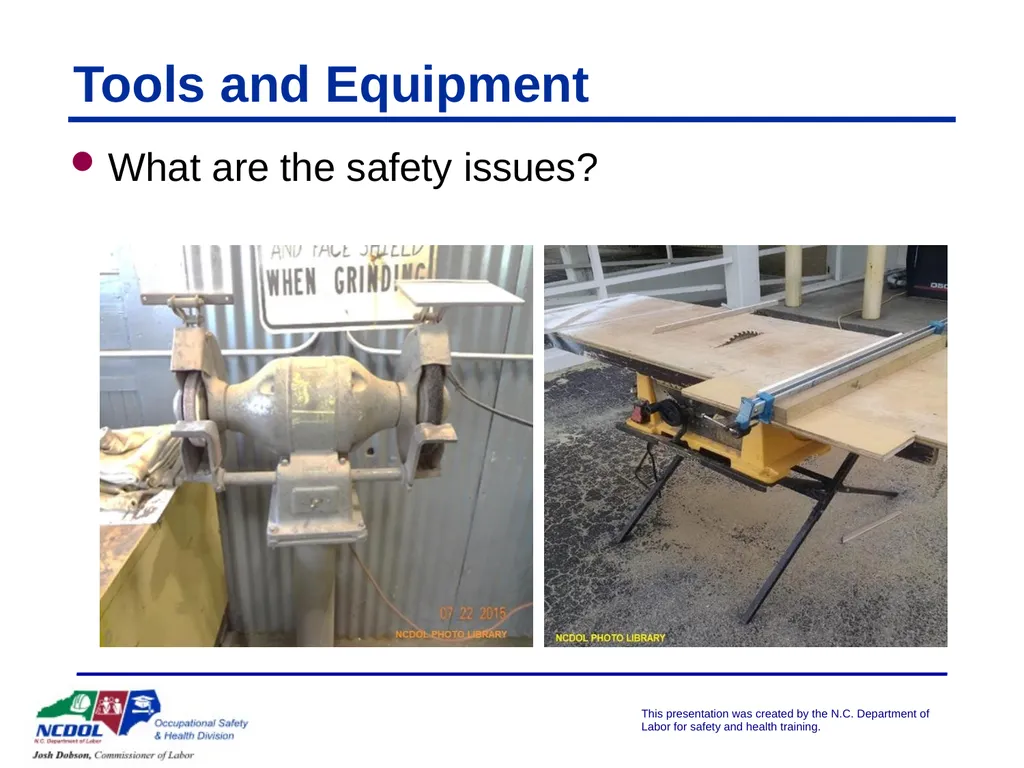
slide36. Tools and Equipment Are there safety issues? 1926.303(c)(6)<br>
slide37. Tools and Equipment What are the safety issues?<br>
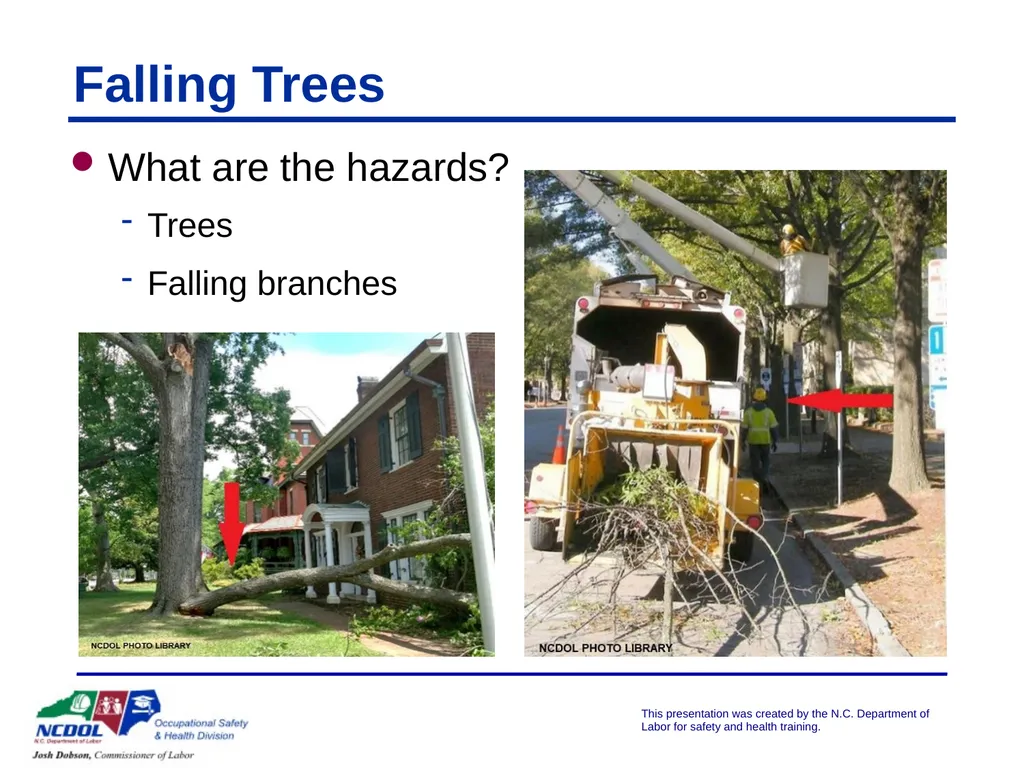
slide38. Falling Trees What are the hazards?
Trees
Falling branches<br>
slide39. Woodchippers What are the hazards? NCDOL Photo Library<br>
slide40. Preventing Struck By/Caught Between Injuries Comprehensive Safety Program
Development, implementation, and enforcement of program for workers
Includes training in the recognition and avoidance of unsafe work conditions and instruction in safe work practices
If a multilingual workforce, instruction should be in the language understood by the worker
Ensures appropriate PPE and usage<br>
slide41. Summary In this course, we covered:
Recognizing potential struck-by/caught-in or between situations
Identifying struck-by/caught-in or between hazards
Evaluating control measures for struck-by/caught-in or between hazards NCDOL Photo Library<br>
slide42. Thank You For Attending! Final Questions?<br>

slide2. Objectives After this course, students will be able to:
Recognize potential struck-by/caught-in or between situations
Identify struck-by/caught-in or between hazards
Evaluate control measures for struck-by/caught-in or between hazards NCDOL Photo Library<br>
slide3. Goal to reduce occupational exposures to amputations
Struck by and caught between injuries
Lockout/tagout
Machine guarding
Increase outreach to employers and employees
Training events (Internal and external)
Compliance inspections
Consultation visits
Publications
Amputations must be reported within 24 hours Amputations Special Emphasis Program<br>
slide4. Definitions Competent person
“One who is capable of identifying existing and predictable hazards in the surroundings or working conditions which are unsanitary, hazardous, or dangerous to employees, and who has authorization to take prompt corrective measures to eliminate them.” 1926.32(f)<br>
slide5. Struck-By Hazards Struck-by injuries are produced by forcible contact or impact between the injured person and an object or piece of equipment.
Struck-by hazards are categorized as follows:
Struck-by flying object
Struck-by falling object
Struck-by swinging object
Struck-by rolling object<br>
slide6. Struck-By Hazards Struck-by examples:
Tractor trailer, truck or vehicle
A counterweight from piece of equipment
Falling tree, tree-top or limbs/branches
Precast walls
Building materials
Motor graders
Fly wheels
Man-lifts
Forklifts NCDOL Photo Library<br>
slide7. Caught-In or Between Hazards Hazards causing a person to be squeezed, caught, crushed, pinched, or compressed between two or more objects, or between parts of an object.<br>
slide8. Caught-In or Between Hazards Caught-in or between examples:
Between a wall and tractor trailer
Caught in/between truck tire and pavement
Caught in/between dock leveler
Caught in woodchipper NCDOL Photo Library<br>
slide9. Struck By/Caught Between Causes Most of these are a direct result of:
Materials handling, storage, use, and disposal
Construction equipment
Motor vehicles
Tools and equipment
Falling trees
Woodchipper<br>
slide10. Construction Equipment Examples of hazards with construction equipment:
Worker crushed by a compactor/roller
Highway construction area/site, when it backed over him
Operator of a backhoe installing sewer lines
Bucket struck an adjacent tree which was rotten, causing the tree to fall, striking another worker in the head that was standing in a 2-foot-deep trench<br>
slide11. Construction Equipment No visibility zone:
Backhoe loader
Educate workers how to
approach all construction
equipment while in operation.<br>
slide12. Construction Equipment Safety issues:
Overhead hazards
Low visibility<br>
slide13. Construction Equipment Safe work practices:
Roll-over protection structures - “ROPS”
Seatbelts<br>
slide14. Construction Equipment Rollover protective structures:
Employers are responsible for requiring the wearing of appropriate personal protective equipment.
Failure to use “seat belts” is citable under 1926.28(a). 1926.602(a)(2)<br>
slide15. Construction Equipment No visibility zone:
Do not drive a vehicle in reverse gear with an obstructed rear view, unless it has an audible reverse alarm, or another worker signals that it is safe.<br>
slide16. Construction Equipment No visibility zone:
Do not drive equipment in reverse gear with an obstructed rear view, unless it has an audible reverse alarm, or another worker signals that it is safe.<br>
slide17. Construction Equipment Hazard issues:
Workers struck and run over by moving vehicles and equipment.
Workers struck by automobiles while in work zones.
Vehicles/equipment operated in reverse gear with obstructed rear view.
Remember, spotters themselves can be at risk for injury or even death. NCDOL Photo Library NCDOL Photo Library<br>
slide18. Motor Vehicles Safe work practices:
When vehicle safety practices are not observed, there is a risk of being struck by oncoming vehicles.
Garbage truck is driving down the wrong side of the street.<br>
slide19. Motor Vehicles Hazard issues:
Use traffic signs, barricades or flaggers when construction takes place near public roadways.
Workers must be highly visible at all times, day or night.
Safety apparel, such as red or orange vests, are required.
If worn for night work,
must be of reflective
material. Employee<br>
slide20. Motor Vehicles Safe work practices:
When vehicle safety practices are not observed, there is a risk of being struck by vehicles. NCDOL Photo Library<br>
slide21. Motor Vehicles Safe work practices:
Provide an area of separation between traffic flow and work area.<br>
slide22. Motor Vehicles Safe work practices:
Equipment being operated near traffic must be protected by adequate buffer space. NCDOL Photo Library NCDOL Photo Library<br>
slide23. Motor Vehicles Personal protective equipment:
All workers exposed to the risks of moving roadway traffic or construction equipment should wear high-visibility safety apparel. NCDOL Photo Library<br>
slide24. Motor Vehicles What are the safety issues?<br>
slide25. Materials Handling and Storage Examples:
Worker was standing on the main floor of a one-story single-family residence.
Several trusses collapsed falling onto the worker.
Worker was trying to move a vertically stacked pile of 16 pieces of 12' by 4' drywall.
Drywall shifted pinning him between the stack of drywall and the door jam.<br>
slide26. Materials Handling and Storage Safety issues:
Improperly stored materials
Incorrectly cutting ties or other securing devices
Improper loading and unloading<br>
slide27. Materials Handling and Storage Safety issues:
Improperly stored materials
Incorrectly cutting ties or other securing devices
Improper loading and unloading<br>
slide28. Materials Handling and Storage What safety issues do you see?
Electrical safety
Falling object protection<br>
slide29. Materials Handling and Storage What are the safety issues?
Housekeeping<br>
slide30. Materials Handling and Storage Rigging safety issues:
Using defective rigging equipment
Excessive loading<br>
slide31. Materials Handling and Storage What are the rigging safety issues?
Qualified rigger<br>
slide32. Materials Handling and Storage Rigging safe work practices:
Load should not exceed rated capacity
Protect sling from sharp corners
Know center of gravity of load<br>
slide33. Materials Handling and Storage Rigging safe work practices:
Inspect the rigging
Keep personnel clear
Never leave load unattended
Wear hardhats when lifting<br>
slide34. Tools and Equipment Safety issues:
Improper work procedures
Machine guards
Use of defective equipment<br>
slide35. Tools and Equipment Are there safety issues?
Jacks must have a rated capacity
1926.303(a)(1) and 1926.305(d)(1)(i)<br>
slide36. Tools and Equipment Are there safety issues? 1926.303(c)(6)<br>
slide37. Tools and Equipment What are the safety issues?<br>
slide38. Falling Trees What are the hazards?
Trees
Falling branches<br>
slide39. Woodchippers What are the hazards? NCDOL Photo Library<br>
slide40. Preventing Struck By/Caught Between Injuries Comprehensive Safety Program
Development, implementation, and enforcement of program for workers
Includes training in the recognition and avoidance of unsafe work conditions and instruction in safe work practices
If a multilingual workforce, instruction should be in the language understood by the worker
Ensures appropriate PPE and usage<br>
slide41. Summary In this course, we covered:
Recognizing potential struck-by/caught-in or between situations
Identifying struck-by/caught-in or between hazards
Evaluating control measures for struck-by/caught-in or between hazards NCDOL Photo Library<br>
slide42. Thank You For Attending! Final Questions?<br>