
Structured Digital Database under PIT Regulations
LD
Published · 32 slides · 0 views
1 / 1


Description
Structured Digital Database under PIT Regulations Preparing for the Compliance Certificate INSIDER TRADING 1 Copyright Disclaimer This presentation is only for academic purposes; this is not intended to be a professional advice or
Related Topics
Share
Embed code
Download this presentation From Below
"Structured Digital Database under PIT Regulations" is the property of its rightful owner. Permission is granted to download and print the materials on this website for personal, non-commercial use only, and to display it on your personal computer provided you do not modify the materials and that you retain all copyright notices contained in the materials. By downloading content from our website, you accept the terms of this agreement.
Presentation Transcript
01
Structured Digital Database under PIT Regulations Preparing for the Compliance Certificate INSIDER TRADING 1<br>
02
Copyright & Disclaimer This presentation is only for academic purposes; this is not intended to be a professional advice or opinion. Anyone relying on this does so at one’s own discretion. Please do consult your professional consultant for any matter covered by this presentation.
No circulation, publication, or unauthorised use of the presentation in any form is allowed, except with our prior written permission.
No part of this presentation is intended to be solicitation of professional assignment. 2<br>
No circulation, publication, or unauthorised use of the presentation in any form is allowed, except with our prior written permission.
No part of this presentation is intended to be solicitation of professional assignment. 2<br>
03
About Us Vinod Kothari and Company, company secretaries, is a firm with over 30 years of vintage
Based out of Kolkata, New Delhi & Mumbai
We are a team of qualified company secretaries, chartered accountants, lawyers and managers. Our Organization’s Credo:
Focus on capabilities; opportunities follow 3<br>
Based out of Kolkata, New Delhi & Mumbai
We are a team of qualified company secretaries, chartered accountants, lawyers and managers. Our Organization’s Credo:
Focus on capabilities; opportunities follow 3<br>
04
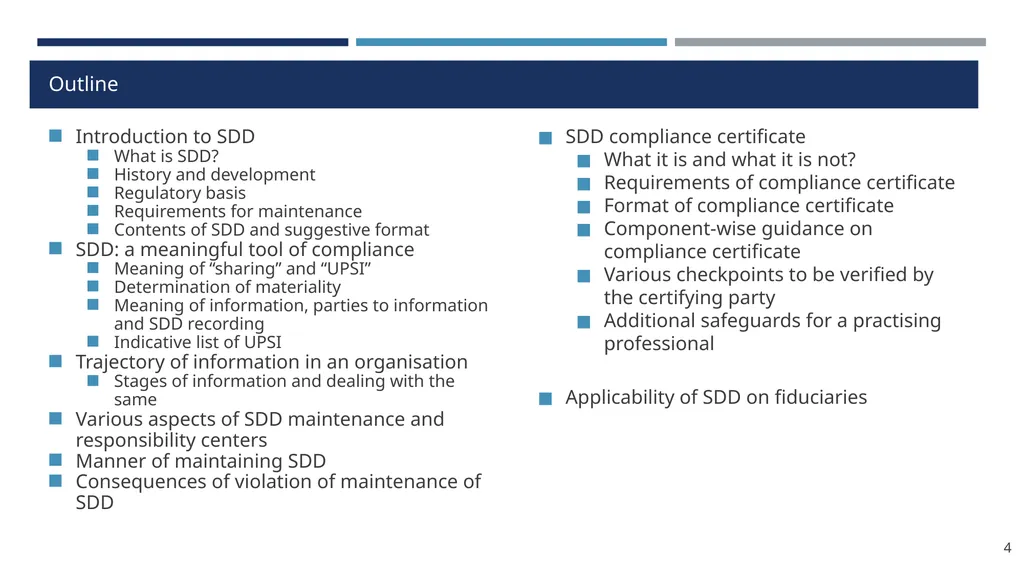
Outline Introduction to SDD
What is SDD?
History and development
Regulatory basis
Requirements for maintenance
Contents of SDD and suggestive format
SDD: a meaningful tool of compliance
Meaning of “sharing” and “UPSI”
Determination of materiality
Meaning of information, parties to information and SDD recording
Indicative list of UPSI
Trajectory of information in an organisation
Stages of information and dealing with the same
Various aspects of SDD maintenance and responsibility centers
Manner of maintaining SDD
Consequences of violation of maintenance of SDD SDD compliance certificate
What it is and what it is not?
Requirements of compliance certificate
Format of compliance certificate
Component-wise guidance on compliance certificate
Various checkpoints to be verified by the certifying party
Additional safeguards for a practising professional
Applicability of SDD on fiduciaries 4<br>
What is SDD?
History and development
Regulatory basis
Requirements for maintenance
Contents of SDD and suggestive format
SDD: a meaningful tool of compliance
Meaning of “sharing” and “UPSI”
Determination of materiality
Meaning of information, parties to information and SDD recording
Indicative list of UPSI
Trajectory of information in an organisation
Stages of information and dealing with the same
Various aspects of SDD maintenance and responsibility centers
Manner of maintaining SDD
Consequences of violation of maintenance of SDD SDD compliance certificate
What it is and what it is not?
Requirements of compliance certificate
Format of compliance certificate
Component-wise guidance on compliance certificate
Various checkpoints to be verified by the certifying party
Additional safeguards for a practising professional
Applicability of SDD on fiduciaries 4<br>
05
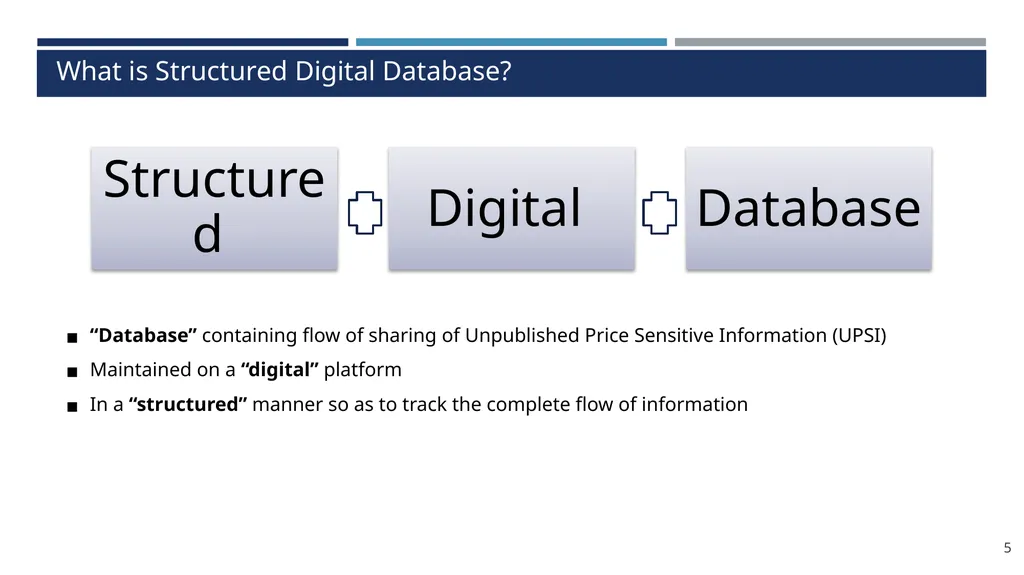
What is Structured Digital Database? “Database” containing flow of sharing of Unpublished Price Sensitive Information (UPSI)
Maintained on a “digital” platform
In a “structured” manner so as to track the complete flow of information 5<br>
Maintained on a “digital” platform
In a “structured” manner so as to track the complete flow of information 5<br>
06
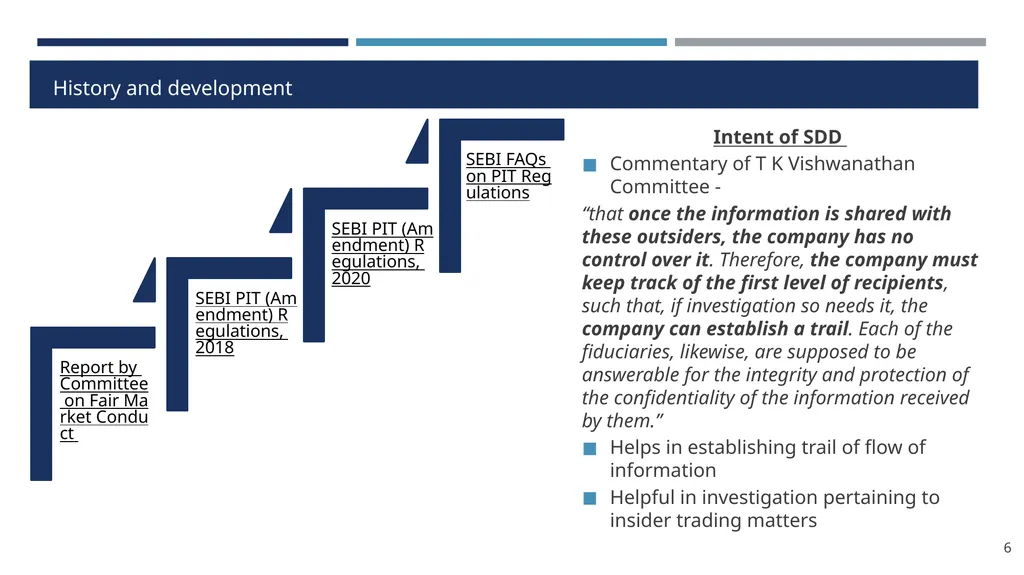
History and development Intent of SDD
Commentary of T K Vishwanathan Committee -
“that once the information is shared with these outsiders, the company has no control over it. Therefore, the company must keep track of the first level of recipients, such that, if investigation so needs it, the company can establish a trail. Each of the fiduciaries, likewise, are supposed to be answerable for the integrity and protection of the confidentiality of the information received by them.”
Helps in establishing trail of flow of information
Helpful in investigation pertaining to insider trading matters 6<br>
Commentary of T K Vishwanathan Committee -
“that once the information is shared with these outsiders, the company has no control over it. Therefore, the company must keep track of the first level of recipients, such that, if investigation so needs it, the company can establish a trail. Each of the fiduciaries, likewise, are supposed to be answerable for the integrity and protection of the confidentiality of the information received by them.”
Helps in establishing trail of flow of information
Helpful in investigation pertaining to insider trading matters 6<br>
07
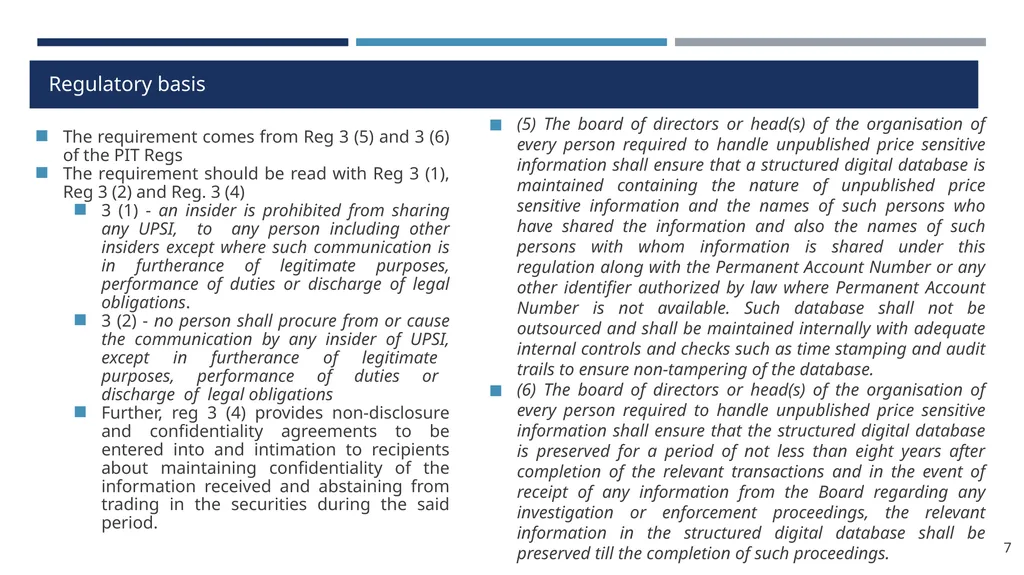
Regulatory basis The requirement comes from Reg 3 (5) and 3 (6) of the PIT Regs
The requirement should be read with Reg 3 (1), Reg 3 (2) and Reg. 3 (4)
3 (1) - an insider is prohibited from sharing any UPSI, to any person including other insiders except where such communication is in furtherance of legitimate purposes, performance of duties or discharge of legal obligations.
3 (2) - no person shall procure from or cause the communication by any insider of UPSI, except in furtherance of legitimate purposes, performance of duties or discharge of legal obligations
Further, reg 3 (4) provides non-disclosure and confidentiality agreements to be entered into and intimation to recipients about maintaining confidentiality of the information received and abstaining from trading in the securities during the said period. (5) The board of directors or head(s) of the organisation of every person required to handle unpublished price sensitive information shall ensure that a structured digital database is maintained containing the nature of unpublished price sensitive information and the names of such persons who have shared the information and also the names of such persons with whom information is shared under this regulation along with the Permanent Account Number or any other identifier authorized by law where Permanent Account Number is not available. Such database shall not be outsourced and shall be maintained internally with adequate internal controls and checks such as time stamping and audit trails to ensure non-tampering of the database.
(6) The board of directors or head(s) of the organisation of every person required to handle unpublished price sensitive information shall ensure that the structured digital database is preserved for a period of not less than eight years after completion of the relevant transactions and in the event of receipt of any information from the Board regarding any investigation or enforcement proceedings, the relevant information in the structured digital database shall be preserved till the completion of such proceedings. 7<br>
The requirement should be read with Reg 3 (1), Reg 3 (2) and Reg. 3 (4)
3 (1) - an insider is prohibited from sharing any UPSI, to any person including other insiders except where such communication is in furtherance of legitimate purposes, performance of duties or discharge of legal obligations.
3 (2) - no person shall procure from or cause the communication by any insider of UPSI, except in furtherance of legitimate purposes, performance of duties or discharge of legal obligations
Further, reg 3 (4) provides non-disclosure and confidentiality agreements to be entered into and intimation to recipients about maintaining confidentiality of the information received and abstaining from trading in the securities during the said period. (5) The board of directors or head(s) of the organisation of every person required to handle unpublished price sensitive information shall ensure that a structured digital database is maintained containing the nature of unpublished price sensitive information and the names of such persons who have shared the information and also the names of such persons with whom information is shared under this regulation along with the Permanent Account Number or any other identifier authorized by law where Permanent Account Number is not available. Such database shall not be outsourced and shall be maintained internally with adequate internal controls and checks such as time stamping and audit trails to ensure non-tampering of the database.
(6) The board of directors or head(s) of the organisation of every person required to handle unpublished price sensitive information shall ensure that the structured digital database is preserved for a period of not less than eight years after completion of the relevant transactions and in the event of receipt of any information from the Board regarding any investigation or enforcement proceedings, the relevant information in the structured digital database shall be preserved till the completion of such proceedings. 7<br>
08
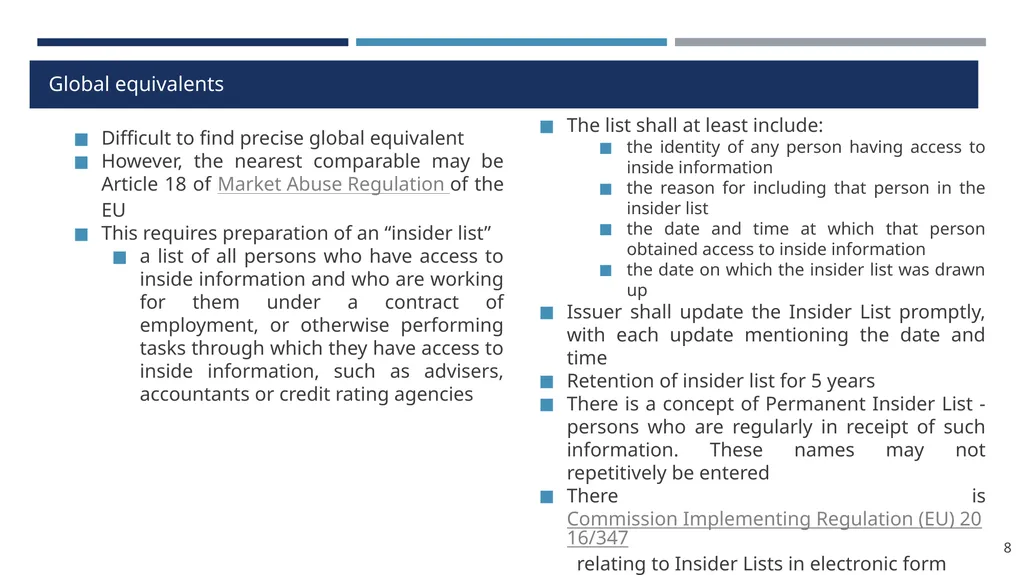
Global equivalents Difficult to find precise global equivalent
However, the nearest comparable may be Article 18 of Market Abuse Regulation of the EU
This requires preparation of an “insider list”
a list of all persons who have access to inside information and who are working for them under a contract of employment, or otherwise performing tasks through which they have access to inside information, such as advisers, accountants or credit rating agencies The list shall at least include:
the identity of any person having access to inside information
the reason for including that person in the insider list
the date and time at which that person obtained access to inside information
the date on which the insider list was drawn up
Issuer shall update the Insider List promptly, with each update mentioning the date and time
Retention of insider list for 5 years
There is a concept of Permanent Insider List - persons who are regularly in receipt of such information. These names may not repetitively be entered
There is Commission Implementing Regulation (EU) 2016/347 relating to Insider Lists in electronic form 8<br>
However, the nearest comparable may be Article 18 of Market Abuse Regulation of the EU
This requires preparation of an “insider list”
a list of all persons who have access to inside information and who are working for them under a contract of employment, or otherwise performing tasks through which they have access to inside information, such as advisers, accountants or credit rating agencies The list shall at least include:
the identity of any person having access to inside information
the reason for including that person in the insider list
the date and time at which that person obtained access to inside information
the date on which the insider list was drawn up
Issuer shall update the Insider List promptly, with each update mentioning the date and time
Retention of insider list for 5 years
There is a concept of Permanent Insider List - persons who are regularly in receipt of such information. These names may not repetitively be entered
There is Commission Implementing Regulation (EU) 2016/347 relating to Insider Lists in electronic form 8<br>
09
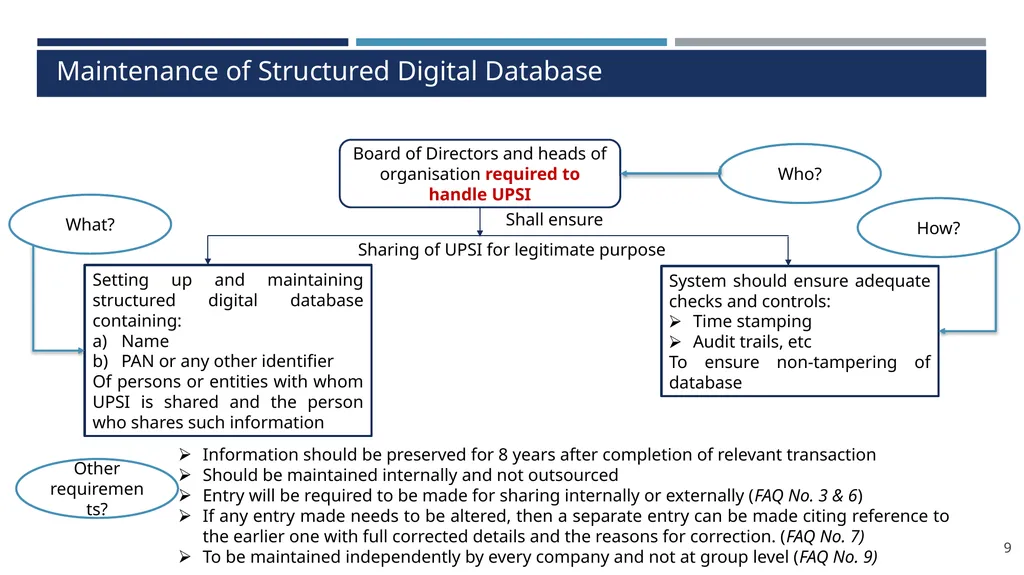
Maintenance of Structured Digital Database Board of Directors and heads of organisation required to handle UPSI Shall ensure Setting up and maintaining structured digital database containing:
Name
PAN or any other identifier
Of persons or entities with whom UPSI is shared and the person who shares such information System should ensure adequate checks and controls:
Time stamping
Audit trails, etc
To ensure non-tampering of database Information should be preserved for 8 years after completion of relevant transaction
Should be maintained internally and not outsourced
Entry will be required to be made for sharing internally or externally (FAQ No. 3 & 6)
If any entry made needs to be altered, then a separate entry can be made citing reference to the earlier one with full corrected details and the reasons for correction. (FAQ No. 7)
To be maintained independently by every company and not at group level (FAQ No. 9) Sharing of UPSI for legitimate purpose Who? What? How? Other requirements? 9<br>
Name
PAN or any other identifier
Of persons or entities with whom UPSI is shared and the person who shares such information System should ensure adequate checks and controls:
Time stamping
Audit trails, etc
To ensure non-tampering of database Information should be preserved for 8 years after completion of relevant transaction
Should be maintained internally and not outsourced
Entry will be required to be made for sharing internally or externally (FAQ No. 3 & 6)
If any entry made needs to be altered, then a separate entry can be made citing reference to the earlier one with full corrected details and the reasons for correction. (FAQ No. 7)
To be maintained independently by every company and not at group level (FAQ No. 9) Sharing of UPSI for legitimate purpose Who? What? How? Other requirements? 9<br>
10
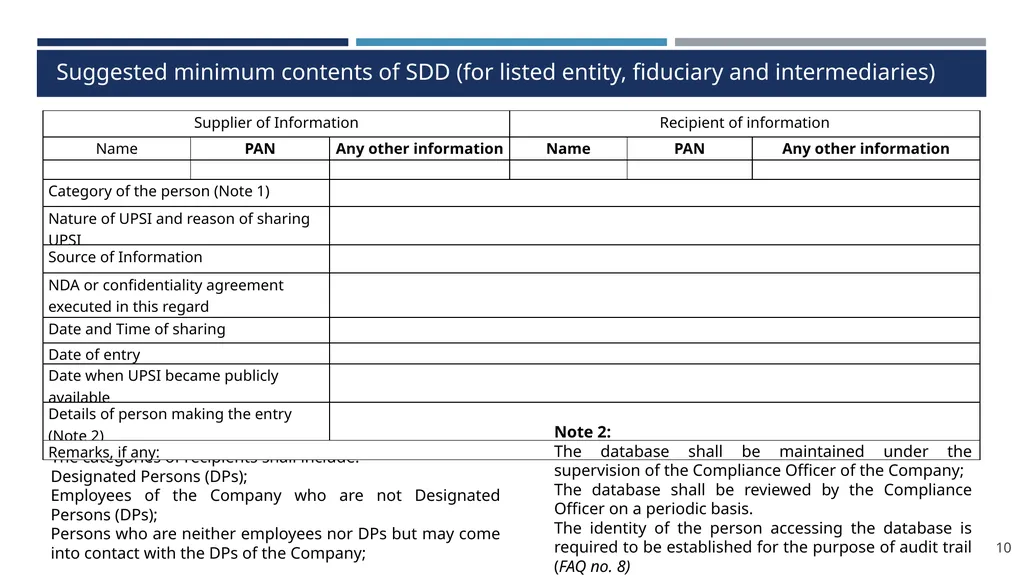
Suggested minimum contents of SDD (for listed entity, fiduciary and intermediaries) Note 1:
The categories of recipients shall include:
Designated Persons (DPs);
Employees of the Company who are not Designated Persons (DPs);
Persons who are neither employees nor DPs but may come into contact with the DPs of the Company; Note 2:
The database shall be maintained under the supervision of the Compliance Officer of the Company;
The database shall be reviewed by the Compliance Officer on a periodic basis.
The identity of the person accessing the database is required to be established for the purpose of audit trail (FAQ no. 8) 10<br>
The categories of recipients shall include:
Designated Persons (DPs);
Employees of the Company who are not Designated Persons (DPs);
Persons who are neither employees nor DPs but may come into contact with the DPs of the Company; Note 2:
The database shall be maintained under the supervision of the Compliance Officer of the Company;
The database shall be reviewed by the Compliance Officer on a periodic basis.
The identity of the person accessing the database is required to be established for the purpose of audit trail (FAQ no. 8) 10<br>
11
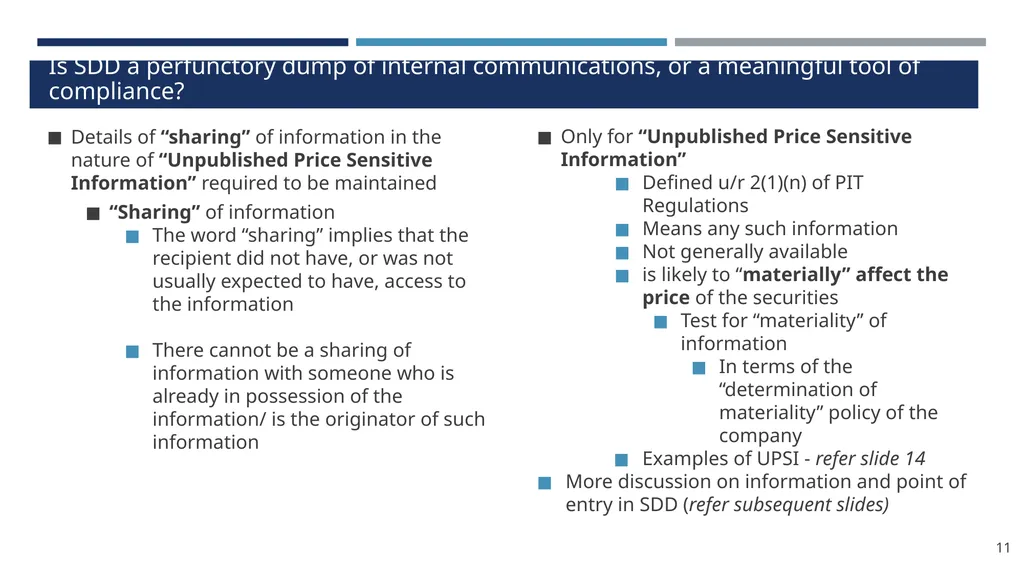
Is SDD a perfunctory dump of internal communications, or a meaningful tool of compliance? Details of “sharing” of information in the nature of “Unpublished Price Sensitive Information” required to be maintained
“Sharing” of information
The word “sharing” implies that the recipient did not have, or was not usually expected to have, access to the information
There cannot be a sharing of information with someone who is already in possession of the information/ is the originator of such information Only for “Unpublished Price Sensitive Information”
Defined u/r 2(1)(n) of PIT Regulations
Means any such information
Not generally available
is likely to “materially” affect the price of the securities
Test for “materiality” of information
In terms of the “determination of materiality” policy of the company
Examples of UPSI - refer slide 14
More discussion on information and point of entry in SDD (refer subsequent slides) 11<br>
“Sharing” of information
The word “sharing” implies that the recipient did not have, or was not usually expected to have, access to the information
There cannot be a sharing of information with someone who is already in possession of the information/ is the originator of such information Only for “Unpublished Price Sensitive Information”
Defined u/r 2(1)(n) of PIT Regulations
Means any such information
Not generally available
is likely to “materially” affect the price of the securities
Test for “materiality” of information
In terms of the “determination of materiality” policy of the company
Examples of UPSI - refer slide 14
More discussion on information and point of entry in SDD (refer subsequent slides) 11<br>
12
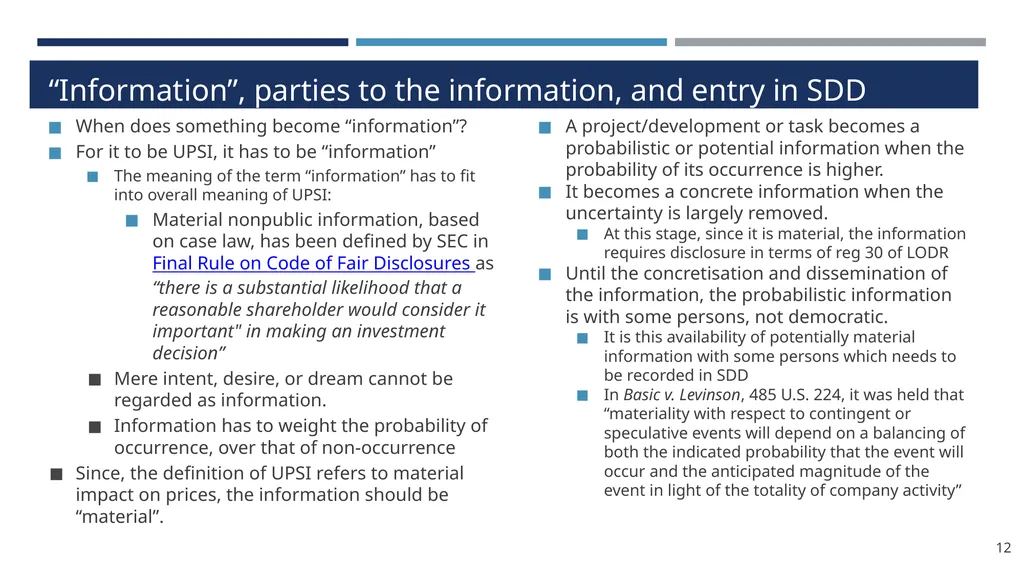
“Information”, parties to the information, and entry in SDD When does something become “information”?
For it to be UPSI, it has to be “information”
The meaning of the term “information” has to fit into overall meaning of UPSI:
Material nonpublic information, based on case law, has been defined by SEC in Final Rule on Code of Fair Disclosures as “there is a substantial likelihood that a reasonable shareholder would consider it important" in making an investment decision”
Mere intent, desire, or dream cannot be regarded as information.
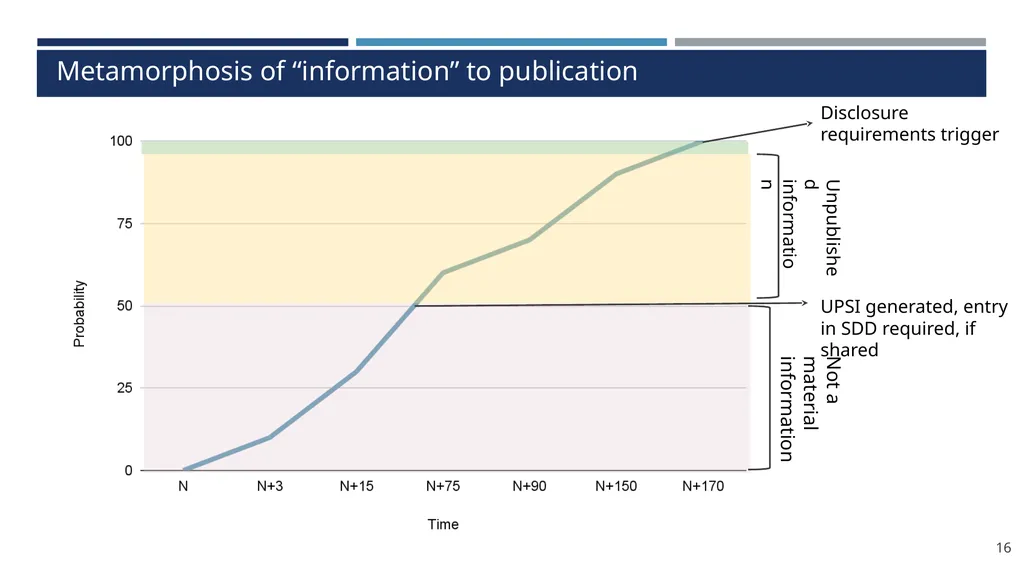
Information has to weight the probability of occurrence, over that of non-occurrence
Since, the definition of UPSI refers to material impact on prices, the information should be “material”. A project/development or task becomes a probabilistic or potential information when the probability of its occurrence is higher.
It becomes a concrete information when the uncertainty is largely removed.
At this stage, since it is material, the information requires disclosure in terms of reg 30 of LODR
Until the concretisation and dissemination of the information, the probabilistic information is with some persons, not democratic.
It is this availability of potentially material information with some persons which needs to be recorded in SDD
In Basic v. Levinson, 485 U.S. 224, it was held that “materiality with respect to contingent or speculative events will depend on a balancing of both the indicated probability that the event will occur and the anticipated magnitude of the event in light of the totality of company activity” 12<br>
For it to be UPSI, it has to be “information”
The meaning of the term “information” has to fit into overall meaning of UPSI:
Material nonpublic information, based on case law, has been defined by SEC in Final Rule on Code of Fair Disclosures as “there is a substantial likelihood that a reasonable shareholder would consider it important" in making an investment decision”
Mere intent, desire, or dream cannot be regarded as information.
Information has to weight the probability of occurrence, over that of non-occurrence
Since, the definition of UPSI refers to material impact on prices, the information should be “material”. A project/development or task becomes a probabilistic or potential information when the probability of its occurrence is higher.
It becomes a concrete information when the uncertainty is largely removed.
At this stage, since it is material, the information requires disclosure in terms of reg 30 of LODR
Until the concretisation and dissemination of the information, the probabilistic information is with some persons, not democratic.
It is this availability of potentially material information with some persons which needs to be recorded in SDD
In Basic v. Levinson, 485 U.S. 224, it was held that “materiality with respect to contingent or speculative events will depend on a balancing of both the indicated probability that the event will occur and the anticipated magnitude of the event in light of the totality of company activity” 12<br>
13
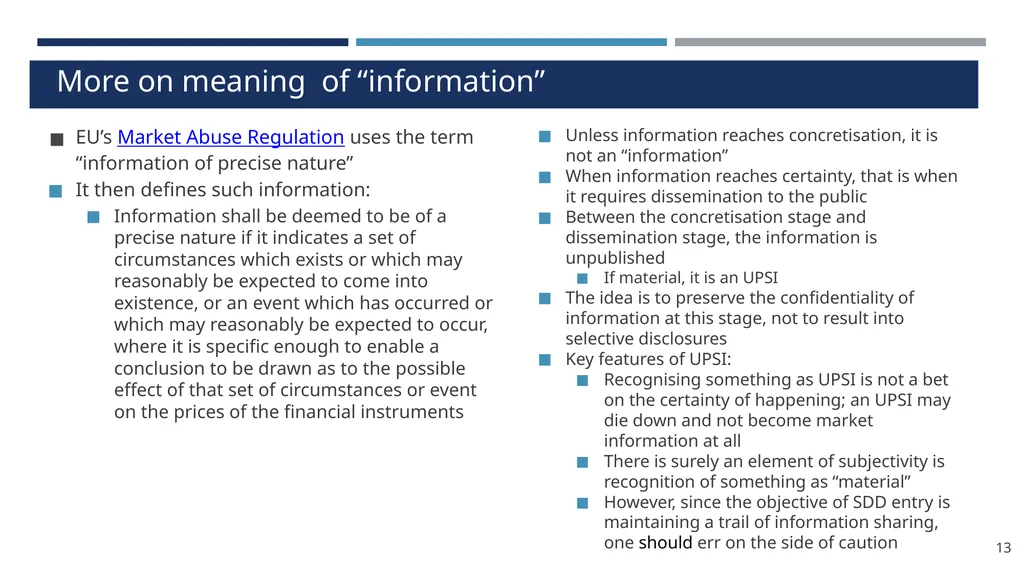
More on meaning of “information” EU’s Market Abuse Regulation uses the term “information of precise nature”
It then defines such information:
Information shall be deemed to be of a precise nature if it indicates a set of circumstances which exists or which may reasonably be expected to come into existence, or an event which has occurred or which may reasonably be expected to occur, where it is specific enough to enable a conclusion to be drawn as to the possible effect of that set of circumstances or event on the prices of the financial instruments Unless information reaches concretisation, it is not an “information”
When information reaches certainty, that is when it requires dissemination to the public
Between the concretisation stage and dissemination stage, the information is unpublished
If material, it is an UPSI
The idea is to preserve the confidentiality of information at this stage, not to result into selective disclosures
Key features of UPSI:
Recognising something as UPSI is not a bet on the certainty of happening; an UPSI may die down and not become market information at all
There is surely an element of subjectivity is recognition of something as “material”
However, since the objective of SDD entry is maintaining a trail of information sharing, one should err on the side of caution 13<br>
It then defines such information:
Information shall be deemed to be of a precise nature if it indicates a set of circumstances which exists or which may reasonably be expected to come into existence, or an event which has occurred or which may reasonably be expected to occur, where it is specific enough to enable a conclusion to be drawn as to the possible effect of that set of circumstances or event on the prices of the financial instruments Unless information reaches concretisation, it is not an “information”
When information reaches certainty, that is when it requires dissemination to the public
Between the concretisation stage and dissemination stage, the information is unpublished
If material, it is an UPSI
The idea is to preserve the confidentiality of information at this stage, not to result into selective disclosures
Key features of UPSI:
Recognising something as UPSI is not a bet on the certainty of happening; an UPSI may die down and not become market information at all
There is surely an element of subjectivity is recognition of something as “material”
However, since the objective of SDD entry is maintaining a trail of information sharing, one should err on the side of caution 13<br>
14
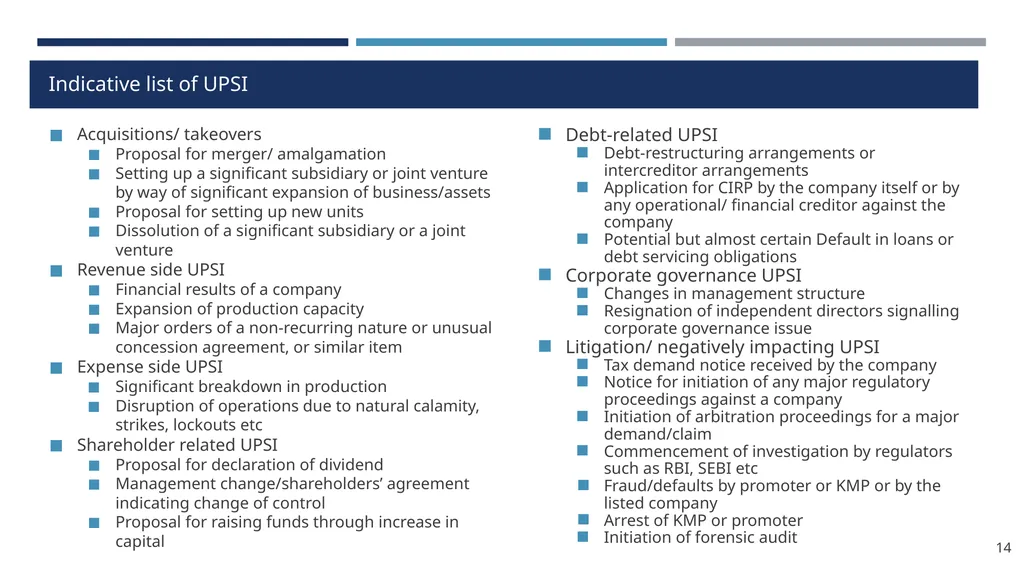
Indicative list of UPSI Acquisitions/ takeovers
Proposal for merger/ amalgamation
Setting up a significant subsidiary or joint venture by way of significant expansion of business/assets
Proposal for setting up new units
Dissolution of a significant subsidiary or a joint venture
Revenue side UPSI
Financial results of a company
Expansion of production capacity
Major orders of a non-recurring nature or unusual concession agreement, or similar item
Expense side UPSI
Significant breakdown in production
Disruption of operations due to natural calamity, strikes, lockouts etc
Shareholder related UPSI
Proposal for declaration of dividend
Management change/shareholders’ agreement indicating change of control
Proposal for raising funds through increase in capital Debt-related UPSI
Debt-restructuring arrangements or intercreditor arrangements
Application for CIRP by the company itself or by any operational/ financial creditor against the company
Potential but almost certain Default in loans or debt servicing obligations
Corporate governance UPSI
Changes in management structure
Resignation of independent directors signalling corporate governance issue
Litigation/ negatively impacting UPSI
Tax demand notice received by the company
Notice for initiation of any major regulatory proceedings against a company
Initiation of arbitration proceedings for a major demand/claim
Commencement of investigation by regulators such as RBI, SEBI etc
Fraud/defaults by promoter or KMP or by the listed company
Arrest of KMP or promoter
Initiation of forensic audit 14<br>
Proposal for merger/ amalgamation
Setting up a significant subsidiary or joint venture by way of significant expansion of business/assets
Proposal for setting up new units
Dissolution of a significant subsidiary or a joint venture
Revenue side UPSI
Financial results of a company
Expansion of production capacity
Major orders of a non-recurring nature or unusual concession agreement, or similar item
Expense side UPSI
Significant breakdown in production
Disruption of operations due to natural calamity, strikes, lockouts etc
Shareholder related UPSI
Proposal for declaration of dividend
Management change/shareholders’ agreement indicating change of control
Proposal for raising funds through increase in capital Debt-related UPSI
Debt-restructuring arrangements or intercreditor arrangements
Application for CIRP by the company itself or by any operational/ financial creditor against the company
Potential but almost certain Default in loans or debt servicing obligations
Corporate governance UPSI
Changes in management structure
Resignation of independent directors signalling corporate governance issue
Litigation/ negatively impacting UPSI
Tax demand notice received by the company
Notice for initiation of any major regulatory proceedings against a company
Initiation of arbitration proceedings for a major demand/claim
Commencement of investigation by regulators such as RBI, SEBI etc
Fraud/defaults by promoter or KMP or by the listed company
Arrest of KMP or promoter
Initiation of forensic audit 14<br>
15
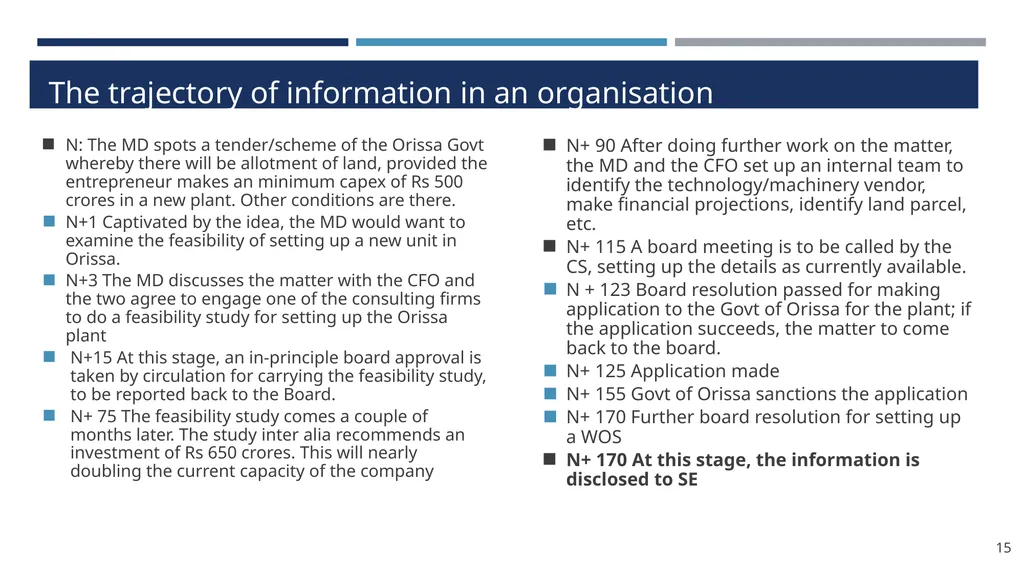
The trajectory of information in an organisation N: The MD spots a tender/scheme of the Orissa Govt whereby there will be allotment of land, provided the entrepreneur makes an minimum capex of Rs 500 crores in a new plant. Other conditions are there.
N+1 Captivated by the idea, the MD would want to examine the feasibility of setting up a new unit in Orissa.
N+3 The MD discusses the matter with the CFO and the two agree to engage one of the consulting firms to do a feasibility study for setting up the Orissa plant
N+15 At this stage, an in-principle board approval is taken by circulation for carrying the feasibility study, to be reported back to the Board.
N+ 75 The feasibility study comes a couple of months later. The study inter alia recommends an investment of Rs 650 crores. This will nearly doubling the current capacity of the company N+ 90 After doing further work on the matter, the MD and the CFO set up an internal team to identify the technology/machinery vendor, make financial projections, identify land parcel, etc.
N+ 115 A board meeting is to be called by the CS, setting up the details as currently available.
N + 123 Board resolution passed for making application to the Govt of Orissa for the plant; if the application succeeds, the matter to come back to the board.
N+ 125 Application made
N+ 155 Govt of Orissa sanctions the application
N+ 170 Further board resolution for setting up a WOS
N+ 170 At this stage, the information is disclosed to SE 15<br>
N+1 Captivated by the idea, the MD would want to examine the feasibility of setting up a new unit in Orissa.
N+3 The MD discusses the matter with the CFO and the two agree to engage one of the consulting firms to do a feasibility study for setting up the Orissa plant
N+15 At this stage, an in-principle board approval is taken by circulation for carrying the feasibility study, to be reported back to the Board.
N+ 75 The feasibility study comes a couple of months later. The study inter alia recommends an investment of Rs 650 crores. This will nearly doubling the current capacity of the company N+ 90 After doing further work on the matter, the MD and the CFO set up an internal team to identify the technology/machinery vendor, make financial projections, identify land parcel, etc.
N+ 115 A board meeting is to be called by the CS, setting up the details as currently available.
N + 123 Board resolution passed for making application to the Govt of Orissa for the plant; if the application succeeds, the matter to come back to the board.
N+ 125 Application made
N+ 155 Govt of Orissa sanctions the application
N+ 170 Further board resolution for setting up a WOS
N+ 170 At this stage, the information is disclosed to SE 15<br>
16
Metamorphosis of “information” to publication Disclosure requirements trigger Unpublished information UPSI generated, entry in SDD required, if shared Not a material information 16<br>
17
Stages of information and dealing with the same Information tends towards concretization as UPSI when the probability of it being materialised is higher than that of not going ahead with the same (FAQ no. 5).
Example – A company is evaluating various proposals for growth by way of making investments in small companies with similar objectives. The company proceeds to shortlist 3-4 companies and further initiates due diligence for one of them. Here the information has concretised and therefore, seems to be the point for recognition as an UPSI. 17<br>
Example – A company is evaluating various proposals for growth by way of making investments in small companies with similar objectives. The company proceeds to shortlist 3-4 companies and further initiates due diligence for one of them. Here the information has concretised and therefore, seems to be the point for recognition as an UPSI. 17<br>
18
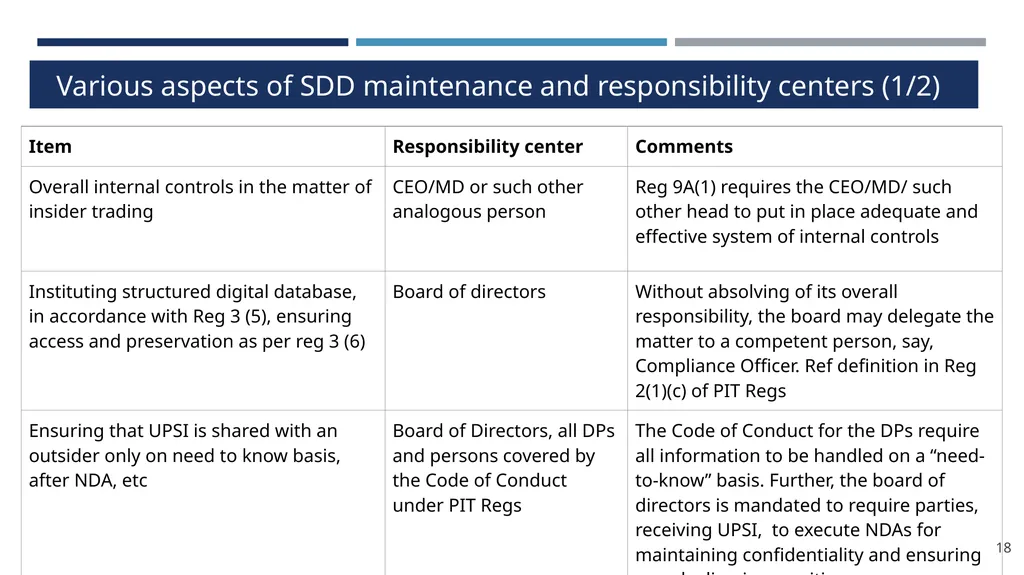
Various aspects of SDD maintenance and responsibility centers (1/2) 18<br>
19
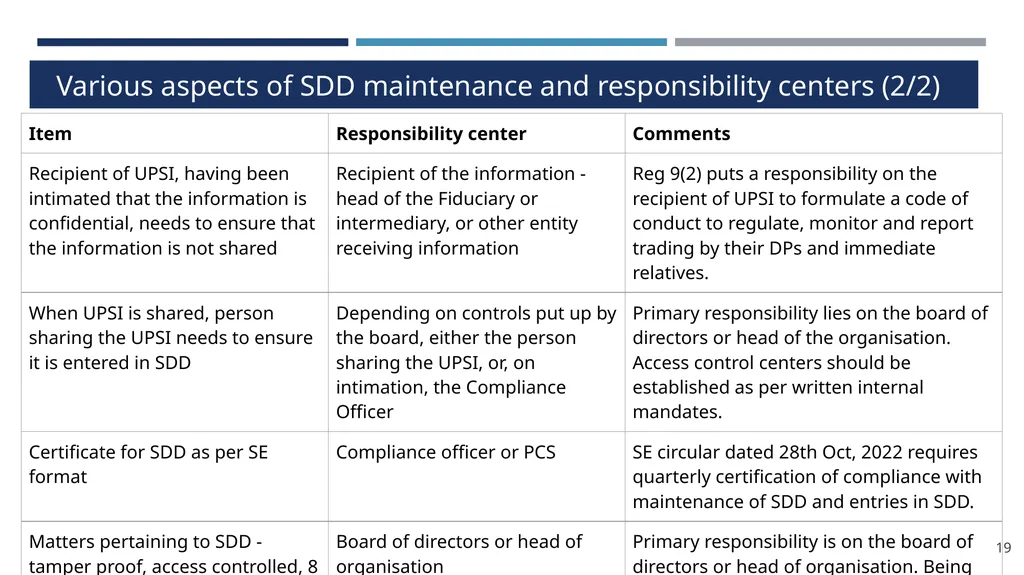
Various aspects of SDD maintenance and responsibility centers (2/2) 19<br>
20
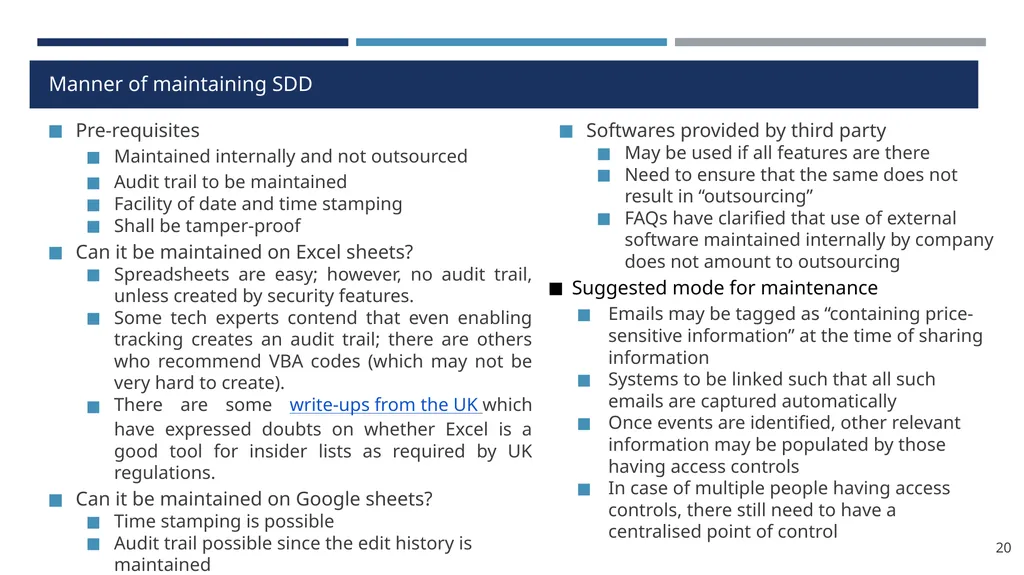
Manner of maintaining SDD Pre-requisites
Maintained internally and not outsourced
Audit trail to be maintained
Facility of date and time stamping
Shall be tamper-proof
Can it be maintained on Excel sheets?
Spreadsheets are easy; however, no audit trail, unless created by security features.
Some tech experts contend that even enabling tracking creates an audit trail; there are others who recommend VBA codes (which may not be very hard to create).
There are some write-ups from the UK which have expressed doubts on whether Excel is a good tool for insider lists as required by UK regulations.
Can it be maintained on Google sheets?
Time stamping is possible
Audit trail possible since the edit history is maintained
Maintained on google cloud, so may amount to outsourcing Softwares provided by third party
May be used if all features are there
Need to ensure that the same does not result in “outsourcing”
FAQs have clarified that use of external software maintained internally by company does not amount to outsourcing
Suggested mode for maintenance
Emails may be tagged as “containing price-sensitive information” at the time of sharing information
Systems to be linked such that all such emails are captured automatically
Once events are identified, other relevant information may be populated by those having access controls
In case of multiple people having access controls, there still need to have a centralised point of control 20<br>
Maintained internally and not outsourced
Audit trail to be maintained
Facility of date and time stamping
Shall be tamper-proof
Can it be maintained on Excel sheets?
Spreadsheets are easy; however, no audit trail, unless created by security features.
Some tech experts contend that even enabling tracking creates an audit trail; there are others who recommend VBA codes (which may not be very hard to create).
There are some write-ups from the UK which have expressed doubts on whether Excel is a good tool for insider lists as required by UK regulations.
Can it be maintained on Google sheets?
Time stamping is possible
Audit trail possible since the edit history is maintained
Maintained on google cloud, so may amount to outsourcing Softwares provided by third party
May be used if all features are there
Need to ensure that the same does not result in “outsourcing”
FAQs have clarified that use of external software maintained internally by company does not amount to outsourcing
Suggested mode for maintenance
Emails may be tagged as “containing price-sensitive information” at the time of sharing information
Systems to be linked such that all such emails are captured automatically
Once events are identified, other relevant information may be populated by those having access controls
In case of multiple people having access controls, there still need to have a centralised point of control 20<br>
21
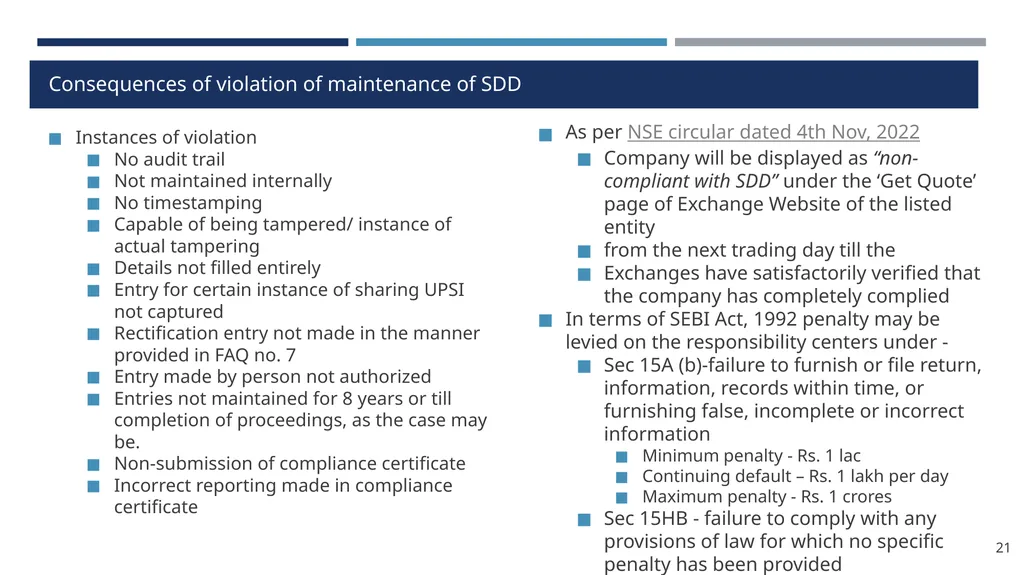
Consequences of violation of maintenance of SDD Instances of violation
No audit trail
Not maintained internally
No timestamping
Capable of being tampered/ instance of actual tampering
Details not filled entirely
Entry for certain instance of sharing UPSI not captured
Rectification entry not made in the manner provided in FAQ no. 7
Entry made by person not authorized
Entries not maintained for 8 years or till completion of proceedings, as the case may be.
Non-submission of compliance certificate
Incorrect reporting made in compliance certificate As per NSE circular dated 4th Nov, 2022
Company will be displayed as “non-compliant with SDD” under the ‘Get Quote’ page of Exchange Website of the listed entity
from the next trading day till the
Exchanges have satisfactorily verified that the company has completely complied
In terms of SEBI Act, 1992 penalty may be levied on the responsibility centers under -
Sec 15A (b)-failure to furnish or file return, information, records within time, or furnishing false, incomplete or incorrect information
Minimum penalty - Rs. 1 lac
Continuing default – Rs. 1 lakh per day
Maximum penalty - Rs. 1 crores
Sec 15HB - failure to comply with any provisions of law for which no specific penalty has been provided
Minimum penalty - Rs. 1 lac
Maximum penalty - Rs. 1 crores 21<br>
No audit trail
Not maintained internally
No timestamping
Capable of being tampered/ instance of actual tampering
Details not filled entirely
Entry for certain instance of sharing UPSI not captured
Rectification entry not made in the manner provided in FAQ no. 7
Entry made by person not authorized
Entries not maintained for 8 years or till completion of proceedings, as the case may be.
Non-submission of compliance certificate
Incorrect reporting made in compliance certificate As per NSE circular dated 4th Nov, 2022
Company will be displayed as “non-compliant with SDD” under the ‘Get Quote’ page of Exchange Website of the listed entity
from the next trading day till the
Exchanges have satisfactorily verified that the company has completely complied
In terms of SEBI Act, 1992 penalty may be levied on the responsibility centers under -
Sec 15A (b)-failure to furnish or file return, information, records within time, or furnishing false, incomplete or incorrect information
Minimum penalty - Rs. 1 lac
Continuing default – Rs. 1 lakh per day
Maximum penalty - Rs. 1 crores
Sec 15HB - failure to comply with any provisions of law for which no specific penalty has been provided
Minimum penalty - Rs. 1 lac
Maximum penalty - Rs. 1 crores 21<br>
22
SDD COMPLIANCE CERTIFICATE 22<br>
23
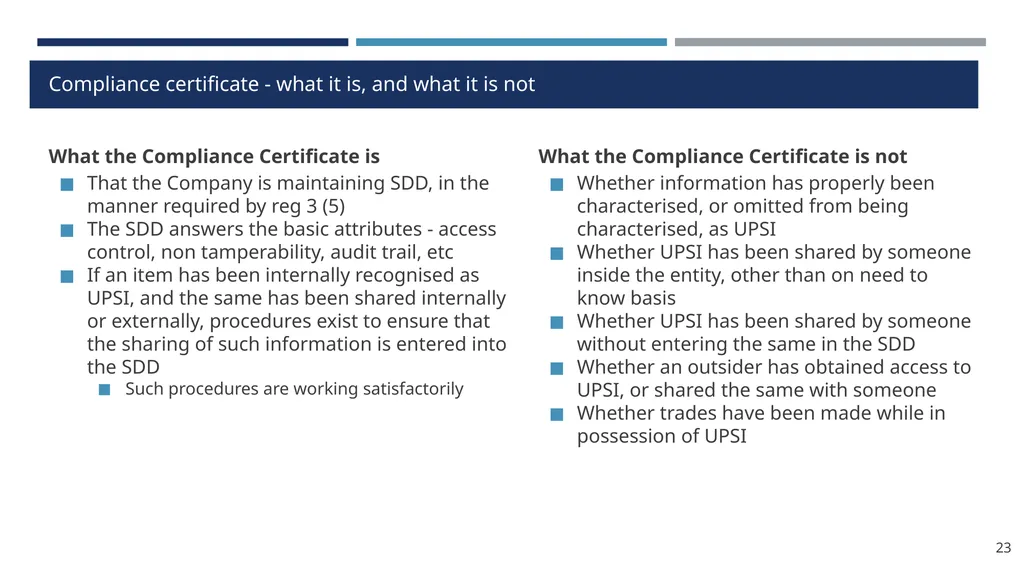
Compliance certificate - what it is, and what it is not What the Compliance Certificate is
That the Company is maintaining SDD, in the manner required by reg 3 (5)
The SDD answers the basic attributes - access control, non tamperability, audit trail, etc
If an item has been internally recognised as UPSI, and the same has been shared internally or externally, procedures exist to ensure that the sharing of such information is entered into the SDD
Such procedures are working satisfactorily What the Compliance Certificate is not
Whether information has properly been characterised, or omitted from being characterised, as UPSI
Whether UPSI has been shared by someone inside the entity, other than on need to know basis
Whether UPSI has been shared by someone without entering the same in the SDD
Whether an outsider has obtained access to UPSI, or shared the same with someone
Whether trades have been made while in possession of UPSI 23<br>
That the Company is maintaining SDD, in the manner required by reg 3 (5)
The SDD answers the basic attributes - access control, non tamperability, audit trail, etc
If an item has been internally recognised as UPSI, and the same has been shared internally or externally, procedures exist to ensure that the sharing of such information is entered into the SDD
Such procedures are working satisfactorily What the Compliance Certificate is not
Whether information has properly been characterised, or omitted from being characterised, as UPSI
Whether UPSI has been shared by someone inside the entity, other than on need to know basis
Whether UPSI has been shared by someone without entering the same in the SDD
Whether an outsider has obtained access to UPSI, or shared the same with someone
Whether trades have been made while in possession of UPSI 23<br>
24
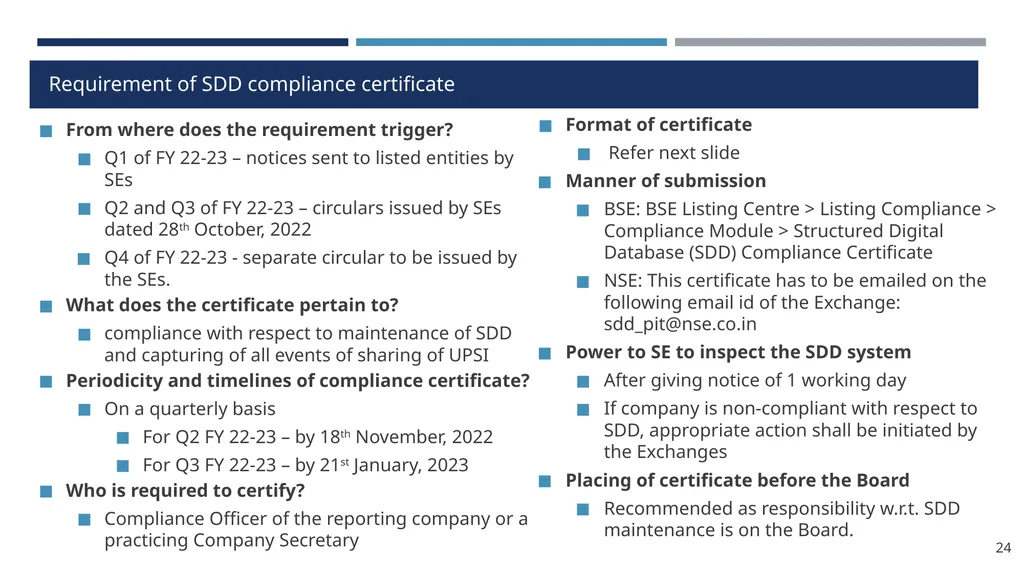
Requirement of SDD compliance certificate From where does the requirement trigger?
Q1 of FY 22-23 – notices sent to listed entities by SEs
Q2 and Q3 of FY 22-23 – circulars issued by SEs dated 28th October, 2022
Q4 of FY 22-23 - separate circular to be issued by the SEs.
What does the certificate pertain to?
compliance with respect to maintenance of SDD and capturing of all events of sharing of UPSI
Periodicity and timelines of compliance certificate?
On a quarterly basis
For Q2 FY 22-23 – by 18th November, 2022
For Q3 FY 22-23 – by 21st January, 2023
Who is required to certify?
Compliance Officer of the reporting company or a practicing Company Secretary Format of certificate
Refer next slide
Manner of submission
BSE: BSE Listing Centre > Listing Compliance > Compliance Module > Structured Digital Database (SDD) Compliance Certificate
NSE: This certificate has to be emailed on the following email id of the Exchange: sdd_pit@nse.co.in
Power to SE to inspect the SDD system
After giving notice of 1 working day
If company is non-compliant with respect to SDD, appropriate action shall be initiated by the Exchanges
Placing of certificate before the Board
Recommended as responsibility w.r.t. SDD maintenance is on the Board. 24<br>
Q1 of FY 22-23 – notices sent to listed entities by SEs
Q2 and Q3 of FY 22-23 – circulars issued by SEs dated 28th October, 2022
Q4 of FY 22-23 - separate circular to be issued by the SEs.
What does the certificate pertain to?
compliance with respect to maintenance of SDD and capturing of all events of sharing of UPSI
Periodicity and timelines of compliance certificate?
On a quarterly basis
For Q2 FY 22-23 – by 18th November, 2022
For Q3 FY 22-23 – by 21st January, 2023
Who is required to certify?
Compliance Officer of the reporting company or a practicing Company Secretary Format of certificate
Refer next slide
Manner of submission
BSE: BSE Listing Centre > Listing Compliance > Compliance Module > Structured Digital Database (SDD) Compliance Certificate
NSE: This certificate has to be emailed on the following email id of the Exchange: sdd_pit@nse.co.in
Power to SE to inspect the SDD system
After giving notice of 1 working day
If company is non-compliant with respect to SDD, appropriate action shall be initiated by the Exchanges
Placing of certificate before the Board
Recommended as responsibility w.r.t. SDD maintenance is on the Board. 24<br>
25
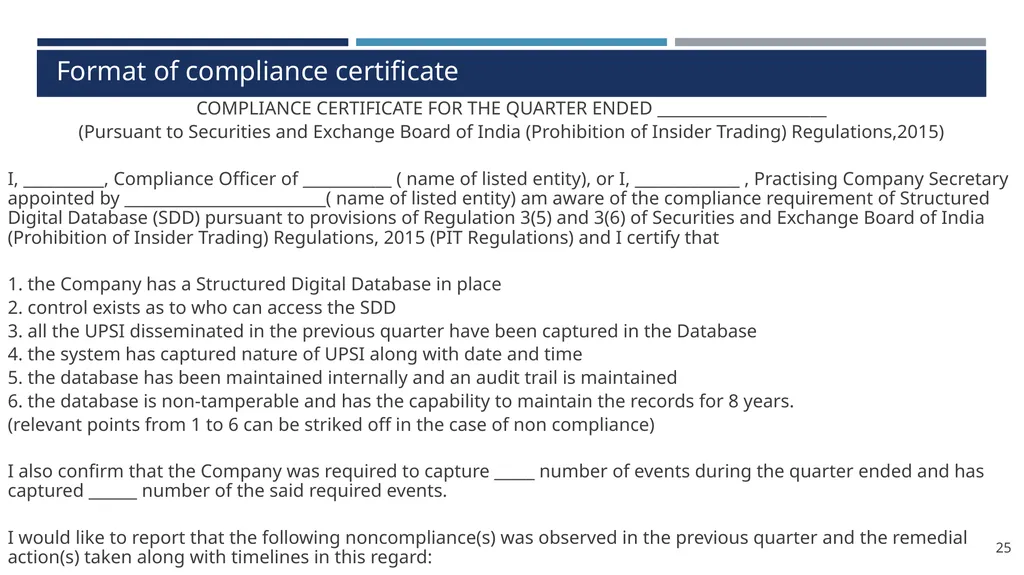
Format of compliance certificate COMPLIANCE CERTIFICATE FOR THE QUARTER ENDED _____________________
(Pursuant to Securities and Exchange Board of India (Prohibition of Insider Trading) Regulations,2015)
I, __________, Compliance Officer of ___________ ( name of listed entity), or I, _____________ , Practising Company Secretary appointed by _________________________( name of listed entity) am aware of the compliance requirement of Structured Digital Database (SDD) pursuant to provisions of Regulation 3(5) and 3(6) of Securities and Exchange Board of India (Prohibition of Insider Trading) Regulations, 2015 (PIT Regulations) and I certify that
1. the Company has a Structured Digital Database in place
2. control exists as to who can access the SDD
3. all the UPSI disseminated in the previous quarter have been captured in the Database
4. the system has captured nature of UPSI along with date and time
5. the database has been maintained internally and an audit trail is maintained
6. the database is non-tamperable and has the capability to maintain the records for 8 years.
(relevant points from 1 to 6 can be striked off in the case of non compliance)
I also confirm that the Company was required to capture _____ number of events during the quarter ended and has captured ______ number of the said required events.
I would like to report that the following noncompliance(s) was observed in the previous quarter and the remedial action(s) taken along with timelines in this regard: 25<br>
(Pursuant to Securities and Exchange Board of India (Prohibition of Insider Trading) Regulations,2015)
I, __________, Compliance Officer of ___________ ( name of listed entity), or I, _____________ , Practising Company Secretary appointed by _________________________( name of listed entity) am aware of the compliance requirement of Structured Digital Database (SDD) pursuant to provisions of Regulation 3(5) and 3(6) of Securities and Exchange Board of India (Prohibition of Insider Trading) Regulations, 2015 (PIT Regulations) and I certify that
1. the Company has a Structured Digital Database in place
2. control exists as to who can access the SDD
3. all the UPSI disseminated in the previous quarter have been captured in the Database
4. the system has captured nature of UPSI along with date and time
5. the database has been maintained internally and an audit trail is maintained
6. the database is non-tamperable and has the capability to maintain the records for 8 years.
(relevant points from 1 to 6 can be striked off in the case of non compliance)
I also confirm that the Company was required to capture _____ number of events during the quarter ended and has captured ______ number of the said required events.
I would like to report that the following noncompliance(s) was observed in the previous quarter and the remedial action(s) taken along with timelines in this regard: 25<br>
26
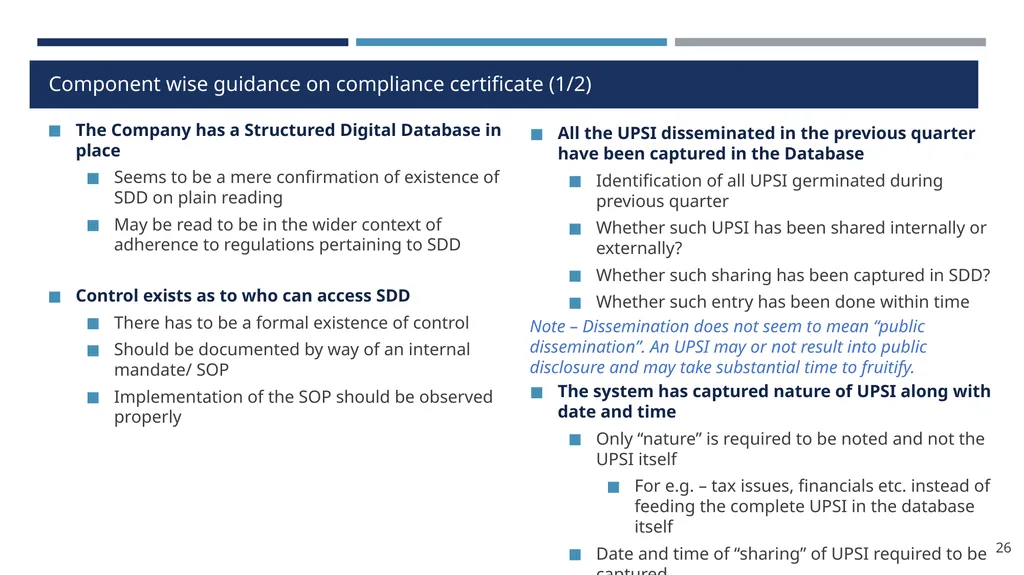
Component wise guidance on compliance certificate (1/2) The Company has a Structured Digital Database in place
Seems to be a mere confirmation of existence of SDD on plain reading
May be read to be in the wider context of adherence to regulations pertaining to SDD
Control exists as to who can access SDD
There has to be a formal existence of control
Should be documented by way of an internal mandate/ SOP
Implementation of the SOP should be observed properly All the UPSI disseminated in the previous quarter have been captured in the Database
Identification of all UPSI germinated during previous quarter
Whether such UPSI has been shared internally or externally?
Whether such sharing has been captured in SDD?
Whether such entry has been done within time
Note – Dissemination does not seem to mean “public dissemination”. An UPSI may or not result into public disclosure and may take substantial time to fruitify.
The system has captured nature of UPSI along with date and time
Only “nature” is required to be noted and not the UPSI itself
For e.g. – tax issues, financials etc. instead of feeding the complete UPSI in the database itself
Date and time of “sharing” of UPSI required to be captured. 26<br>
Seems to be a mere confirmation of existence of SDD on plain reading
May be read to be in the wider context of adherence to regulations pertaining to SDD
Control exists as to who can access SDD
There has to be a formal existence of control
Should be documented by way of an internal mandate/ SOP
Implementation of the SOP should be observed properly All the UPSI disseminated in the previous quarter have been captured in the Database
Identification of all UPSI germinated during previous quarter
Whether such UPSI has been shared internally or externally?
Whether such sharing has been captured in SDD?
Whether such entry has been done within time
Note – Dissemination does not seem to mean “public dissemination”. An UPSI may or not result into public disclosure and may take substantial time to fruitify.
The system has captured nature of UPSI along with date and time
Only “nature” is required to be noted and not the UPSI itself
For e.g. – tax issues, financials etc. instead of feeding the complete UPSI in the database itself
Date and time of “sharing” of UPSI required to be captured. 26<br>
27
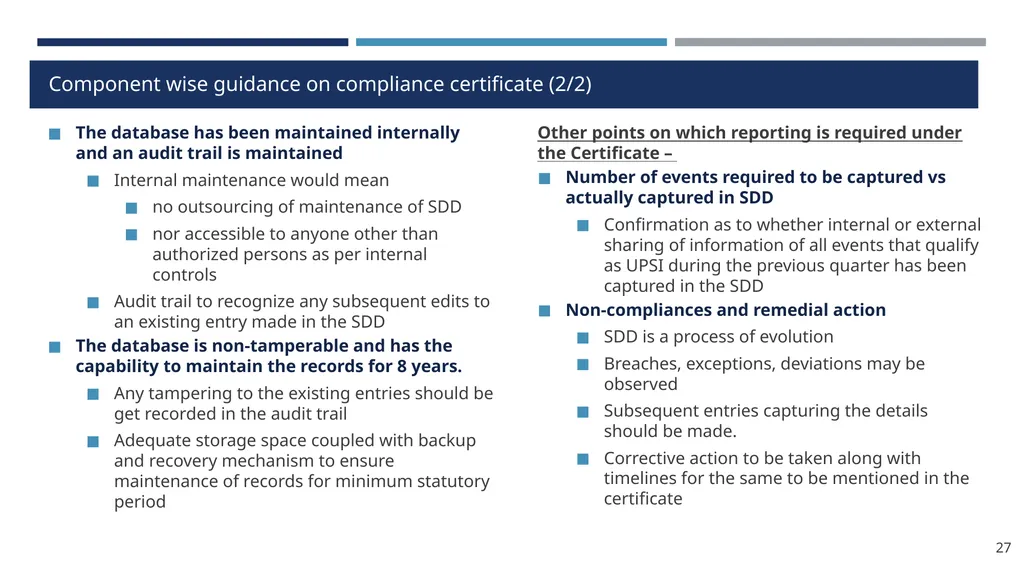
Component wise guidance on compliance certificate (2/2) The database has been maintained internally and an audit trail is maintained
Internal maintenance would mean
no outsourcing of maintenance of SDD
nor accessible to anyone other than authorized persons as per internal controls
Audit trail to recognize any subsequent edits to an existing entry made in the SDD
The database is non-tamperable and has the capability to maintain the records for 8 years.
Any tampering to the existing entries should be get recorded in the audit trail
Adequate storage space coupled with backup and recovery mechanism to ensure maintenance of records for minimum statutory period Other points on which reporting is required under the Certificate –
Number of events required to be captured vs actually captured in SDD
Confirmation as to whether internal or external sharing of information of all events that qualify as UPSI during the previous quarter has been captured in the SDD
Non-compliances and remedial action
SDD is a process of evolution
Breaches, exceptions, deviations may be observed
Subsequent entries capturing the details should be made.
Corrective action to be taken along with timelines for the same to be mentioned in the certificate 27<br>
Internal maintenance would mean
no outsourcing of maintenance of SDD
nor accessible to anyone other than authorized persons as per internal controls
Audit trail to recognize any subsequent edits to an existing entry made in the SDD
The database is non-tamperable and has the capability to maintain the records for 8 years.
Any tampering to the existing entries should be get recorded in the audit trail
Adequate storage space coupled with backup and recovery mechanism to ensure maintenance of records for minimum statutory period Other points on which reporting is required under the Certificate –
Number of events required to be captured vs actually captured in SDD
Confirmation as to whether internal or external sharing of information of all events that qualify as UPSI during the previous quarter has been captured in the SDD
Non-compliances and remedial action
SDD is a process of evolution
Breaches, exceptions, deviations may be observed
Subsequent entries capturing the details should be made.
Corrective action to be taken along with timelines for the same to be mentioned in the certificate 27<br>
28
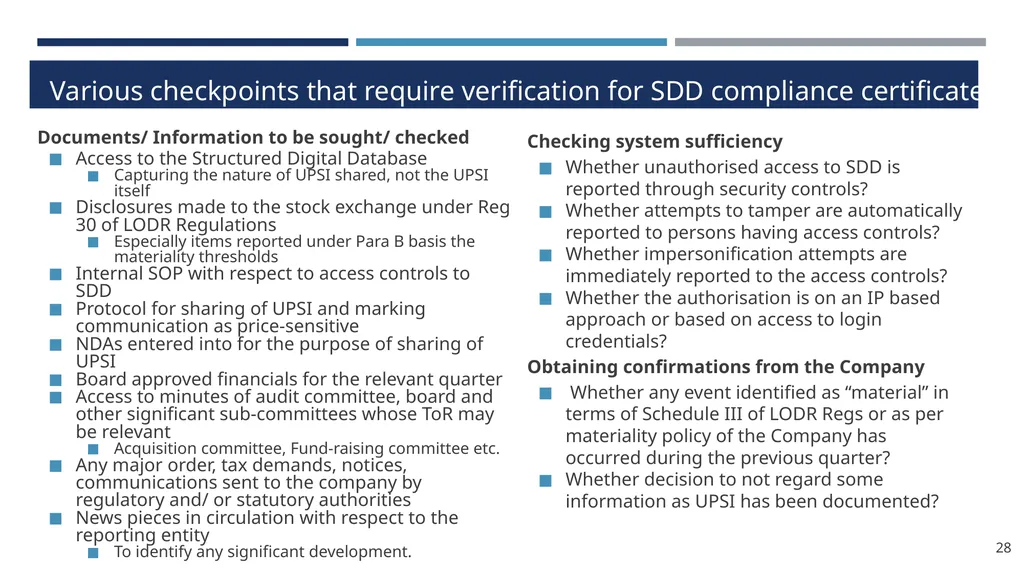
Various checkpoints that require verification for SDD compliance certificate Documents/ Information to be sought/ checked
Access to the Structured Digital Database
Capturing the nature of UPSI shared, not the UPSI itself
Disclosures made to the stock exchange under Reg 30 of LODR Regulations
Especially items reported under Para B basis the materiality thresholds
Internal SOP with respect to access controls to SDD
Protocol for sharing of UPSI and marking communication as price-sensitive
NDAs entered into for the purpose of sharing of UPSI
Board approved financials for the relevant quarter
Access to minutes of audit committee, board and other significant sub-committees whose ToR may be relevant
Acquisition committee, Fund-raising committee etc.
Any major order, tax demands, notices, communications sent to the company by regulatory and/ or statutory authorities
News pieces in circulation with respect to the reporting entity
To identify any significant development. Checking system sufficiency
Whether unauthorised access to SDD is reported through security controls?
Whether attempts to tamper are automatically reported to persons having access controls?
Whether impersonification attempts are immediately reported to the access controls?
Whether the authorisation is on an IP based approach or based on access to login credentials?
Obtaining confirmations from the Company
Whether any event identified as “material” in terms of Schedule III of LODR Regs or as per materiality policy of the Company has occurred during the previous quarter?
Whether decision to not regard some information as UPSI has been documented? 28<br>
Access to the Structured Digital Database
Capturing the nature of UPSI shared, not the UPSI itself
Disclosures made to the stock exchange under Reg 30 of LODR Regulations
Especially items reported under Para B basis the materiality thresholds
Internal SOP with respect to access controls to SDD
Protocol for sharing of UPSI and marking communication as price-sensitive
NDAs entered into for the purpose of sharing of UPSI
Board approved financials for the relevant quarter
Access to minutes of audit committee, board and other significant sub-committees whose ToR may be relevant
Acquisition committee, Fund-raising committee etc.
Any major order, tax demands, notices, communications sent to the company by regulatory and/ or statutory authorities
News pieces in circulation with respect to the reporting entity
To identify any significant development. Checking system sufficiency
Whether unauthorised access to SDD is reported through security controls?
Whether attempts to tamper are automatically reported to persons having access controls?
Whether impersonification attempts are immediately reported to the access controls?
Whether the authorisation is on an IP based approach or based on access to login credentials?
Obtaining confirmations from the Company
Whether any event identified as “material” in terms of Schedule III of LODR Regs or as per materiality policy of the Company has occurred during the previous quarter?
Whether decision to not regard some information as UPSI has been documented? 28<br>
29
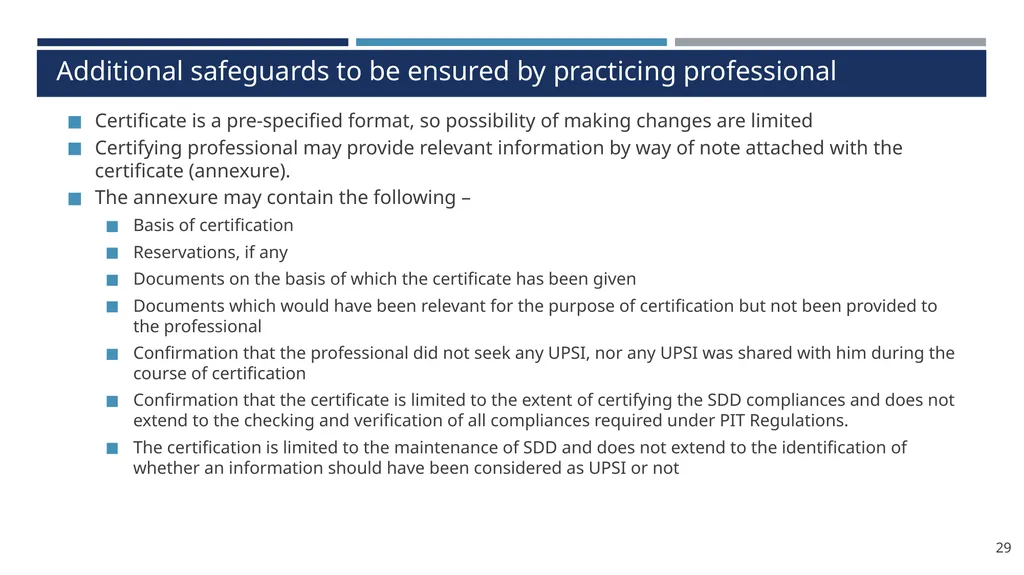
Additional safeguards to be ensured by practicing professional Certificate is a pre-specified format, so possibility of making changes are limited
Certifying professional may provide relevant information by way of note attached with the certificate (annexure).
The annexure may contain the following –
Basis of certification
Reservations, if any
Documents on the basis of which the certificate has been given
Documents which would have been relevant for the purpose of certification but not been provided to the professional
Confirmation that the professional did not seek any UPSI, nor any UPSI was shared with him during the course of certification
Confirmation that the certificate is limited to the extent of certifying the SDD compliances and does not extend to the checking and verification of all compliances required under PIT Regulations.
The certification is limited to the maintenance of SDD and does not extend to the identification of whether an information should have been considered as UPSI or not 29<br>
Certifying professional may provide relevant information by way of note attached with the certificate (annexure).
The annexure may contain the following –
Basis of certification
Reservations, if any
Documents on the basis of which the certificate has been given
Documents which would have been relevant for the purpose of certification but not been provided to the professional
Confirmation that the professional did not seek any UPSI, nor any UPSI was shared with him during the course of certification
Confirmation that the certificate is limited to the extent of certifying the SDD compliances and does not extend to the checking and verification of all compliances required under PIT Regulations.
The certification is limited to the maintenance of SDD and does not extend to the identification of whether an information should have been considered as UPSI or not 29<br>
30
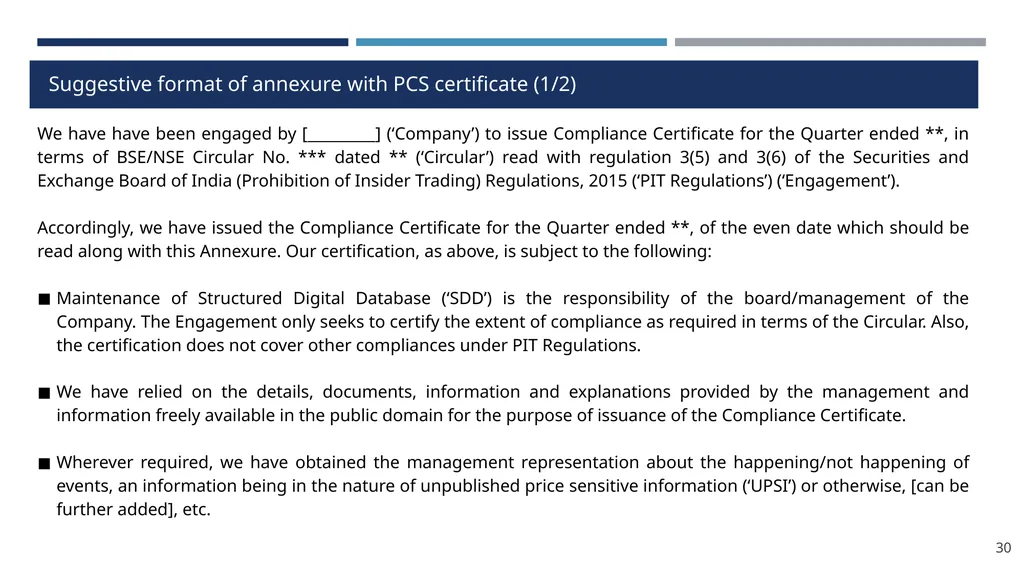
Suggestive format of annexure with PCS certificate (1/2) We have have been engaged by [_________] (‘Company’) to issue Compliance Certificate for the Quarter ended **, in terms of BSE/NSE Circular No. *** dated ** (‘Circular’) read with regulation 3(5) and 3(6) of the Securities and Exchange Board of India (Prohibition of Insider Trading) Regulations, 2015 (‘PIT Regulations’) (‘Engagement’).
Accordingly, we have issued the Compliance Certificate for the Quarter ended **, of the even date which should be read along with this Annexure. Our certification, as above, is subject to the following:
Maintenance of Structured Digital Database (‘SDD’) is the responsibility of the board/management of the Company. The Engagement only seeks to certify the extent of compliance as required in terms of the Circular. Also, the certification does not cover other compliances under PIT Regulations.
We have relied on the details, documents, information and explanations provided by the management and information freely available in the public domain for the purpose of issuance of the Compliance Certificate.
Wherever required, we have obtained the management representation about the happening/not happening of events, an information being in the nature of unpublished price sensitive information (‘UPSI’) or otherwise, [can be further added], etc. 30<br>
Accordingly, we have issued the Compliance Certificate for the Quarter ended **, of the even date which should be read along with this Annexure. Our certification, as above, is subject to the following:
Maintenance of Structured Digital Database (‘SDD’) is the responsibility of the board/management of the Company. The Engagement only seeks to certify the extent of compliance as required in terms of the Circular. Also, the certification does not cover other compliances under PIT Regulations.
We have relied on the details, documents, information and explanations provided by the management and information freely available in the public domain for the purpose of issuance of the Compliance Certificate.
Wherever required, we have obtained the management representation about the happening/not happening of events, an information being in the nature of unpublished price sensitive information (‘UPSI’) or otherwise, [can be further added], etc. 30<br>
31
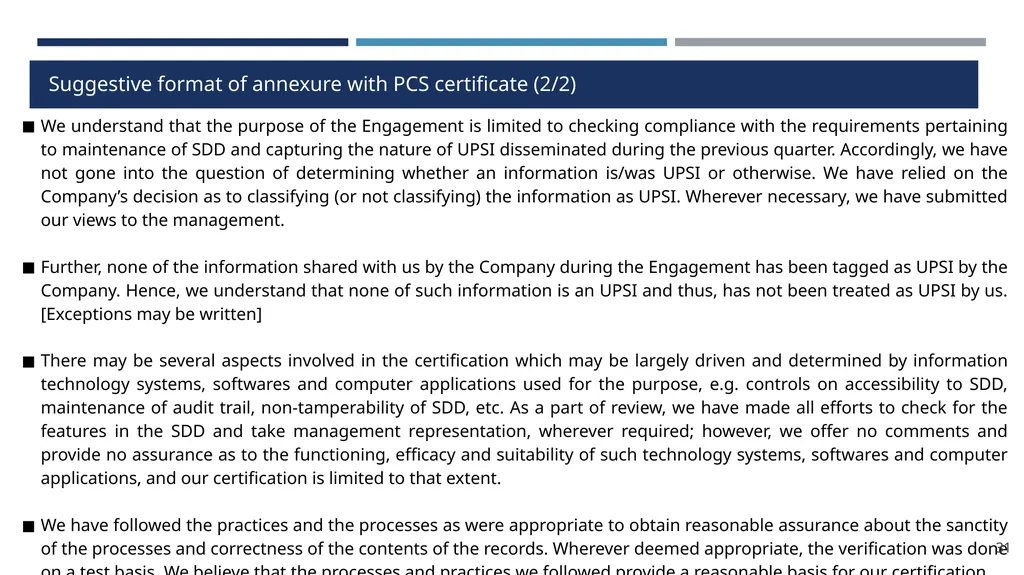
Suggestive format of annexure with PCS certificate (2/2) We understand that the purpose of the Engagement is limited to checking compliance with the requirements pertaining to maintenance of SDD and capturing the nature of UPSI disseminated during the previous quarter. Accordingly, we have not gone into the question of determining whether an information is/was UPSI or otherwise. We have relied on the Company’s decision as to classifying (or not classifying) the information as UPSI. Wherever necessary, we have submitted our views to the management.
Further, none of the information shared with us by the Company during the Engagement has been tagged as UPSI by the Company. Hence, we understand that none of such information is an UPSI and thus, has not been treated as UPSI by us. [Exceptions may be written]
There may be several aspects involved in the certification which may be largely driven and determined by information technology systems, softwares and computer applications used for the purpose, e.g. controls on accessibility to SDD, maintenance of audit trail, non-tamperability of SDD, etc. As a part of review, we have made all efforts to check for the features in the SDD and take management representation, wherever required; however, we offer no comments and provide no assurance as to the functioning, efficacy and suitability of such technology systems, softwares and computer applications, and our certification is limited to that extent.
We have followed the practices and the processes as were appropriate to obtain reasonable assurance about the sanctity of the processes and correctness of the contents of the records. Wherever deemed appropriate, the verification was done on a test basis. We believe that the processes and practices we followed provide a reasonable basis for our certification.
The Engagement has been conducted online, as facilitated by the Company, for the purpose of issuing this Compliance Certificate. In doing so, we have followed the guidance as issued by the Institute. 31<br>
Further, none of the information shared with us by the Company during the Engagement has been tagged as UPSI by the Company. Hence, we understand that none of such information is an UPSI and thus, has not been treated as UPSI by us. [Exceptions may be written]
There may be several aspects involved in the certification which may be largely driven and determined by information technology systems, softwares and computer applications used for the purpose, e.g. controls on accessibility to SDD, maintenance of audit trail, non-tamperability of SDD, etc. As a part of review, we have made all efforts to check for the features in the SDD and take management representation, wherever required; however, we offer no comments and provide no assurance as to the functioning, efficacy and suitability of such technology systems, softwares and computer applications, and our certification is limited to that extent.
We have followed the practices and the processes as were appropriate to obtain reasonable assurance about the sanctity of the processes and correctness of the contents of the records. Wherever deemed appropriate, the verification was done on a test basis. We believe that the processes and practices we followed provide a reasonable basis for our certification.
The Engagement has been conducted online, as facilitated by the Company, for the purpose of issuing this Compliance Certificate. In doing so, we have followed the guidance as issued by the Institute. 31<br>
32
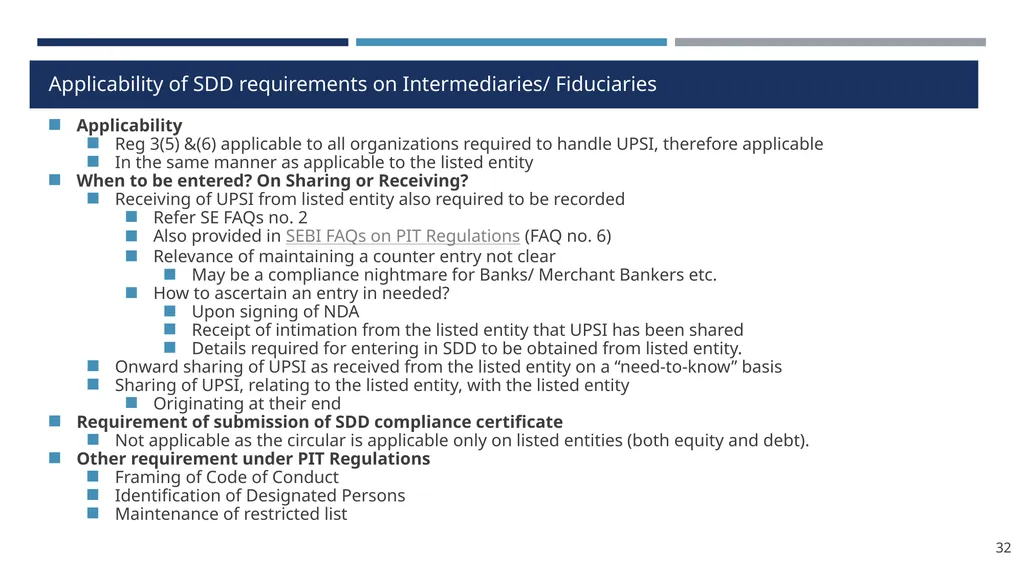
Applicability of SDD requirements on Intermediaries/ Fiduciaries Applicability
Reg 3(5) &(6) applicable to all organizations required to handle UPSI, therefore applicable
In the same manner as applicable to the listed entity
When to be entered? On Sharing or Receiving?
Receiving of UPSI from listed entity also required to be recorded
Refer SE FAQs no. 2
Also provided in SEBI FAQs on PIT Regulations (FAQ no. 6)
Relevance of maintaining a counter entry not clear
May be a compliance nightmare for Banks/ Merchant Bankers etc.
How to ascertain an entry in needed?
Upon signing of NDA
Receipt of intimation from the listed entity that UPSI has been shared
Details required for entering in SDD to be obtained from listed entity.
Onward sharing of UPSI as received from the listed entity on a “need-to-know” basis
Sharing of UPSI, relating to the listed entity, with the listed entity
Originating at their end
Requirement of submission of SDD compliance certificate
Not applicable as the circular is applicable only on listed entities (both equity and debt).
Other requirement under PIT Regulations
Framing of Code of Conduct
Identification of Designated Persons
Maintenance of restricted list 32<br>
Reg 3(5) &(6) applicable to all organizations required to handle UPSI, therefore applicable
In the same manner as applicable to the listed entity
When to be entered? On Sharing or Receiving?
Receiving of UPSI from listed entity also required to be recorded
Refer SE FAQs no. 2
Also provided in SEBI FAQs on PIT Regulations (FAQ no. 6)
Relevance of maintaining a counter entry not clear
May be a compliance nightmare for Banks/ Merchant Bankers etc.
How to ascertain an entry in needed?
Upon signing of NDA
Receipt of intimation from the listed entity that UPSI has been shared
Details required for entering in SDD to be obtained from listed entity.
Onward sharing of UPSI as received from the listed entity on a “need-to-know” basis
Sharing of UPSI, relating to the listed entity, with the listed entity
Originating at their end
Requirement of submission of SDD compliance certificate
Not applicable as the circular is applicable only on listed entities (both equity and debt).
Other requirement under PIT Regulations
Framing of Code of Conduct
Identification of Designated Persons
Maintenance of restricted list 32<br>