
Student Attendance Accounting and Reporting and
TA
Published · 49 slides · 0 views

1 / 1
Description
Student Attendance Accounting and Reporting and the New Standardized Attendance Accounting Method Presented by: Natalie Wagner, CCC Chancellors Office Rafael Artiga Meza, CCC Chancellors Office CACCRAO 2025 Annual Conference 1 Update on
Related Topics
Share
Embed code
Download this presentation From Below
"Student Attendance Accounting and Reporting and" is the property of its rightful owner. Permission is granted to download and print the materials on this website for personal, non-commercial use only, and to display it on your personal computer provided you do not modify the materials and that you retain all copyright notices contained in the materials. By downloading content from our website, you accept the terms of this agreement.
Presentation Transcript
01
Student Attendance Accounting and Reporting and the New Standardized Attendance Accounting Method
Presented by:
Natalie Wagner, CCC Chancellor’s Office
Rafael Artiga Meza, CCC Chancellor’s Office CACCRAO 2025 Annual Conference 1<br>
02
Update on Student Attendance
Accounting and Reporting AGENDA
New Standardized Attendance Accounting Method
Overview
Sample Calculations
Frequently Asked Questions
Implementation Timeline
CCFS-320 Updates
Questions/comments<br>
New Standardized Attendance Accounting Method
Overview
Sample Calculations
Frequently Asked Questions
Implementation Timeline
CCFS-320 Updates
Questions/comments<br>
03
New Standardized Attendance Accounting Method for Credit Courses<br>
04
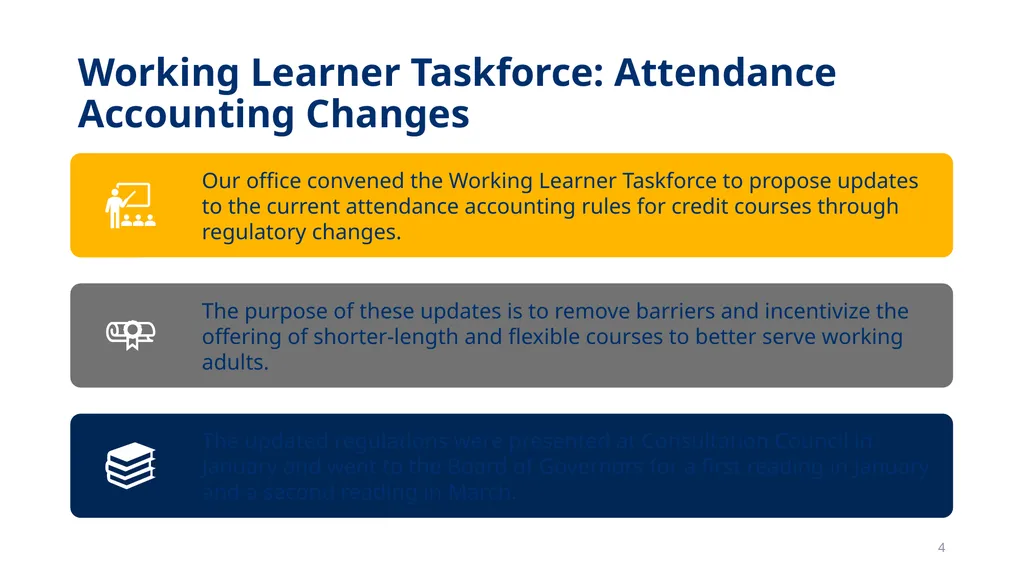
Working Learner Taskforce: Attendance Accounting Changes 4<br>
05
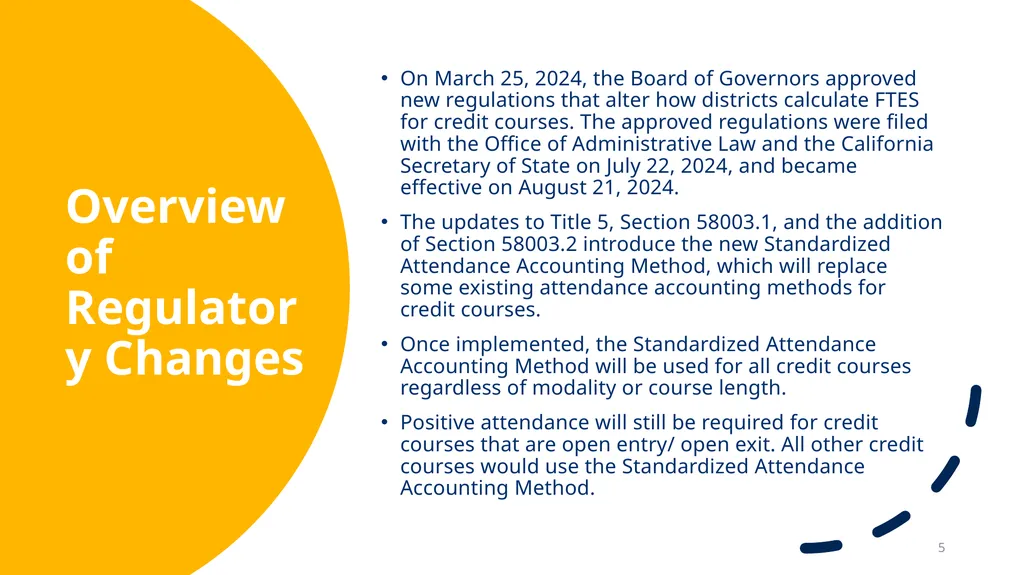
Overview of Regulatory Changes On March 25, 2024, the Board of Governors approved new regulations that alter how districts calculate FTES for credit courses. The approved regulations were filed with the Office of Administrative Law and the California Secretary of State on July 22, 2024, and became effective on August 21, 2024.
The updates to Title 5, Section 58003.1, and the addition of Section 58003.2 introduce the new Standardized Attendance Accounting Method, which will replace some existing attendance accounting methods for credit courses.
Once implemented, the Standardized Attendance Accounting Method will be used for all credit courses regardless of modality or course length.
Positive attendance will still be required for credit courses that are open entry/ open exit. All other credit courses would use the Standardized Attendance Accounting Method. 5<br>
06
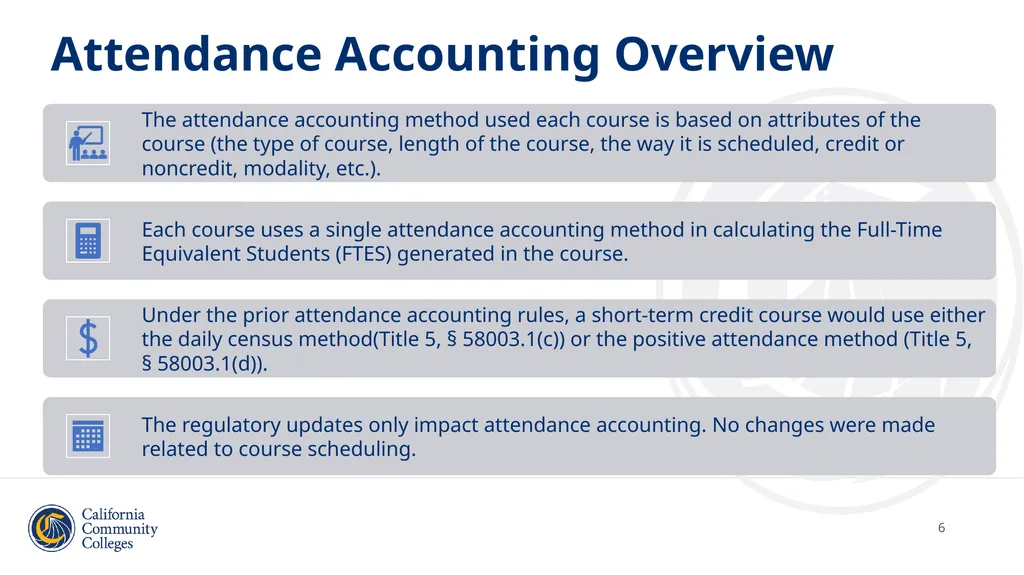
Attendance Accounting Overview 6<br>
07
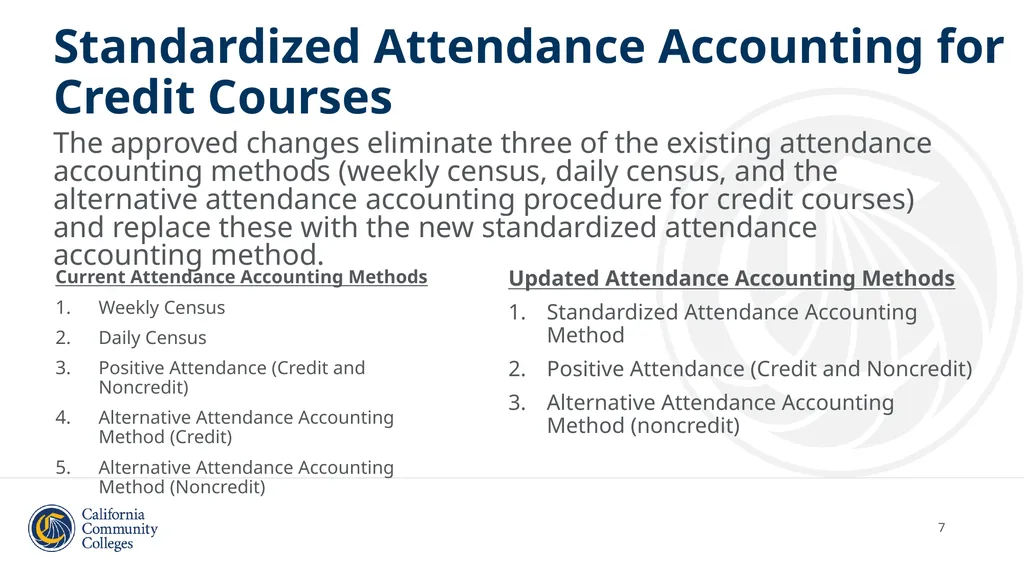
Standardized Attendance Accounting for Credit Courses The approved changes eliminate three of the existing attendance accounting methods (weekly census, daily census, and the alternative attendance accounting procedure for credit courses) and replace these with the new standardized attendance accounting method. Current Attendance Accounting Methods
Weekly Census
Daily Census
Positive Attendance (Credit and Noncredit)
Alternative Attendance Accounting Method (Credit)
Alternative Attendance Accounting Method (Noncredit) Updated Attendance Accounting Methods
Standardized Attendance Accounting Method
Positive Attendance (Credit and Noncredit)
Alternative Attendance Accounting Method (noncredit) 7<br>
08
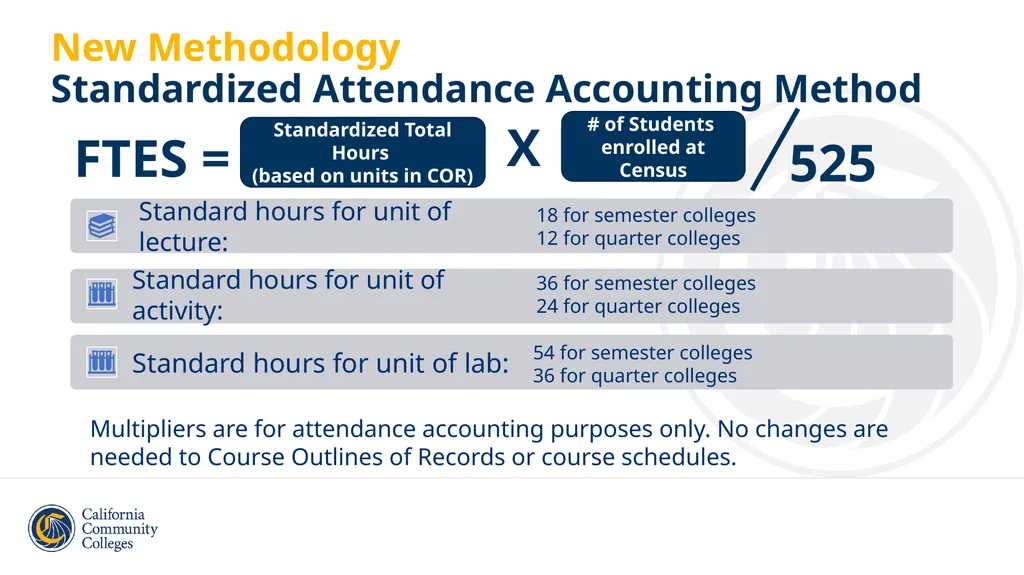
New Methodology
Standardized Attendance Accounting Method FTES = X Standardized Total Hours
(based on units in COR) # of Students
enrolled at Census 525 Multipliers are for attendance accounting purposes only. No changes are needed to Course Outlines of Records or course schedules. 54 for semester colleges
36 for quarter colleges<br>
36 for quarter colleges<br>
09
Standardized Attendance Accounting for Credit Courses
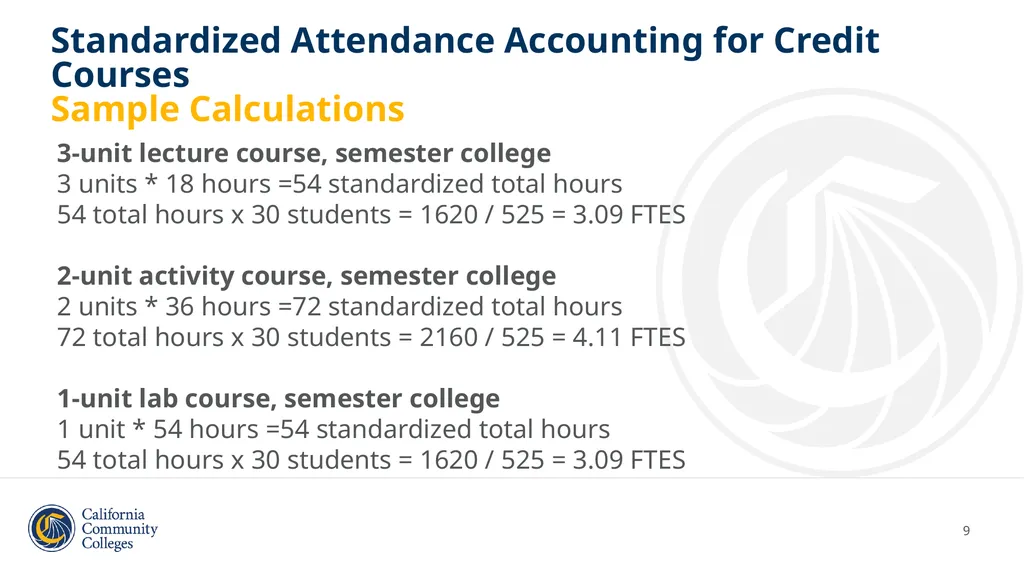
Sample Calculations 9 3-unit lecture course, semester college
3 units * 18 hours =54 standardized total hours
54 total hours x 30 students = 1620 / 525 = 3.09 FTES
2-unit activity course, semester college
2 units * 36 hours =72 standardized total hours
72 total hours x 30 students = 2160 / 525 = 4.11 FTES
1-unit lab course, semester college
1 unit * 54 hours =54 standardized total hours
54 total hours x 30 students = 1620 / 525 = 3.09 FTES<br>
10
Standardized Attendance Accounting for Credit Courses
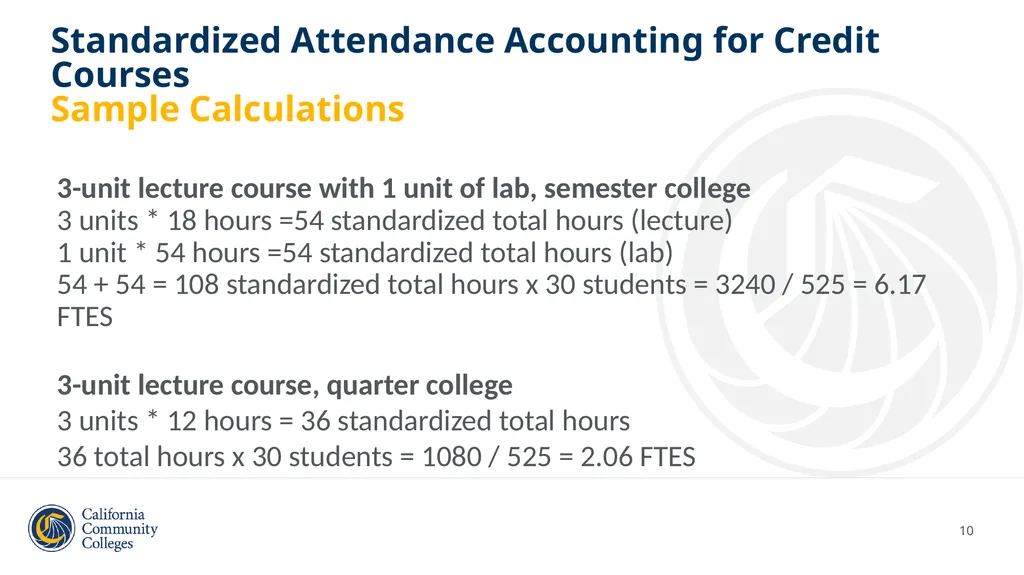
Sample Calculations 10 3-unit lecture course with 1 unit of lab, semester college
3 units * 18 hours =54 standardized total hours (lecture)
1 unit * 54 hours =54 standardized total hours (lab)
54 + 54 = 108 standardized total hours x 30 students = 3240 / 525 = 6.17 FTES
3-unit lecture course, quarter college
3 units * 12 hours = 36 standardized total hours
36 total hours x 30 students = 1080 / 525 = 2.06 FTES<br>
11
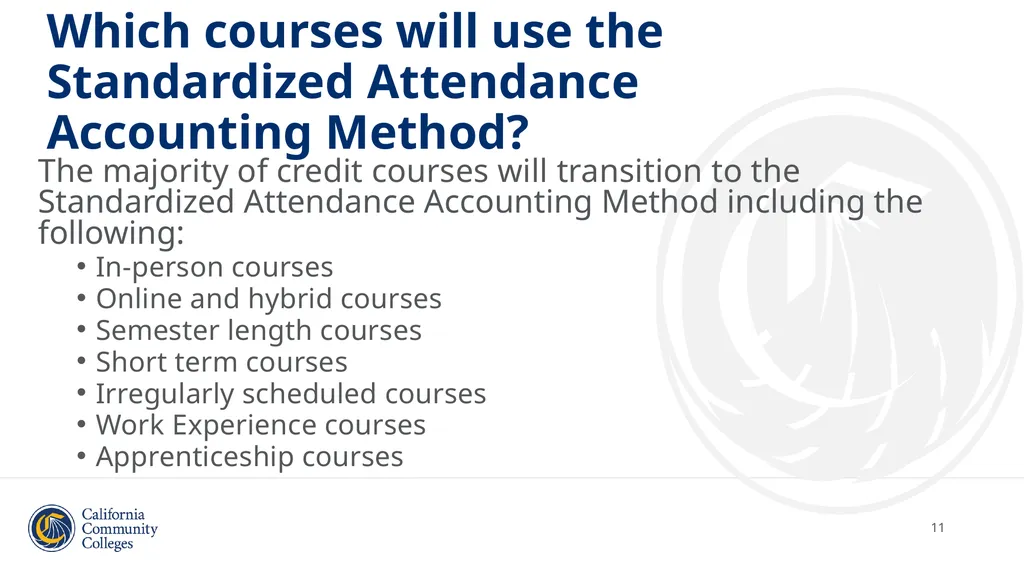
Which courses will use the Standardized Attendance Accounting Method? 11 The majority of credit courses will transition to the Standardized Attendance Accounting Method including the following:
In-person courses
Online and hybrid courses
Semester length courses
Short term courses
Irregularly scheduled courses
Work Experience courses
Apprenticeship courses<br>
In-person courses
Online and hybrid courses
Semester length courses
Short term courses
Irregularly scheduled courses
Work Experience courses
Apprenticeship courses<br>
12
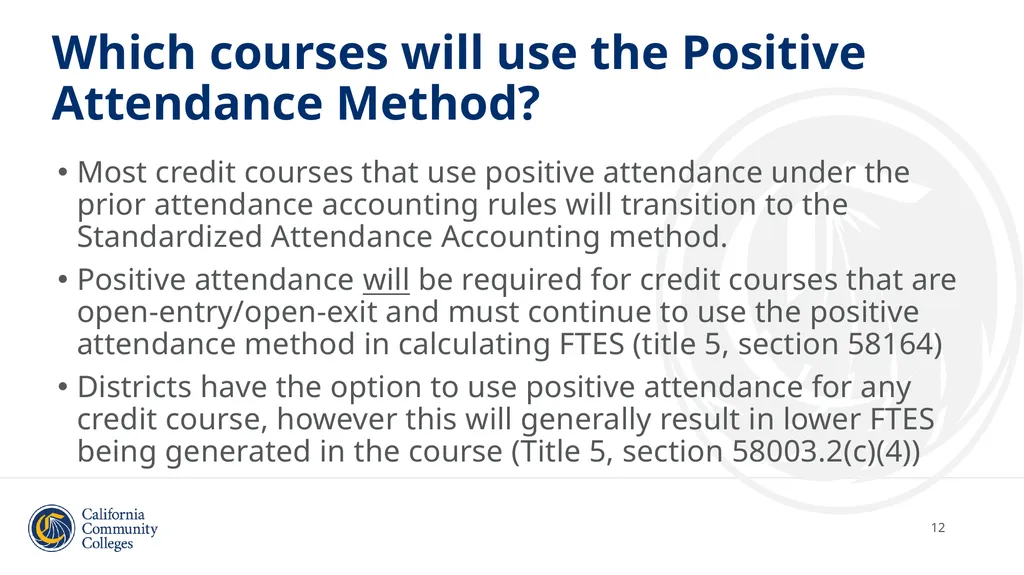
Which courses will use the Positive Attendance Method? 12 Most credit courses that use positive attendance under the prior attendance accounting rules will transition to the Standardized Attendance Accounting method.
Positive attendance will be required for credit courses that are open-entry/open-exit and must continue to use the positive attendance method in calculating FTES (title 5, section 58164)
Districts have the option to use positive attendance for any credit course, however this will generally result in lower FTES being generated in the course (Title 5, section 58003.2(c)(4))<br>
13
College Term Length Multipliers (TLM) 13 College Term Length Multipliers (TLM) are not used in the calculation of FTES under the Standardized Attendance Accounting Method
Once the district transitions to the Standardized Attendance Accounting Method, they will use the standard multipliers outlined in the regulation, rather than the TLM in the calculation of FTES
Colleges will maintain their current TLM which should be used in determining appropriate scheduling patterns based on their term length and flexible calendar configuration<br>
14
Flexible Time Adjustment (F-Factor) 14 The F-factor is a multiplier used in the CCFS-320 to adjust the units of FTES so that districts do not lose FTES as a result of faculty participating in flexible calendar activities.
The FTES adjustment is based on the type of course
Districts will still have the option to apply an F-factor to courses using positive attendance (credit and noncredit) and the alternative attendance accounting method for noncredit.
There will be no option to apply an F-factor for courses using the new Standardized Attendance Accounting Method. Since the Standardized Attendance Accounting Method uses standard multipliers, districts will not experience a loss in FTES as a result of flex days, and therefore will not need an F-factor adjustment to these FTES.<br>
15
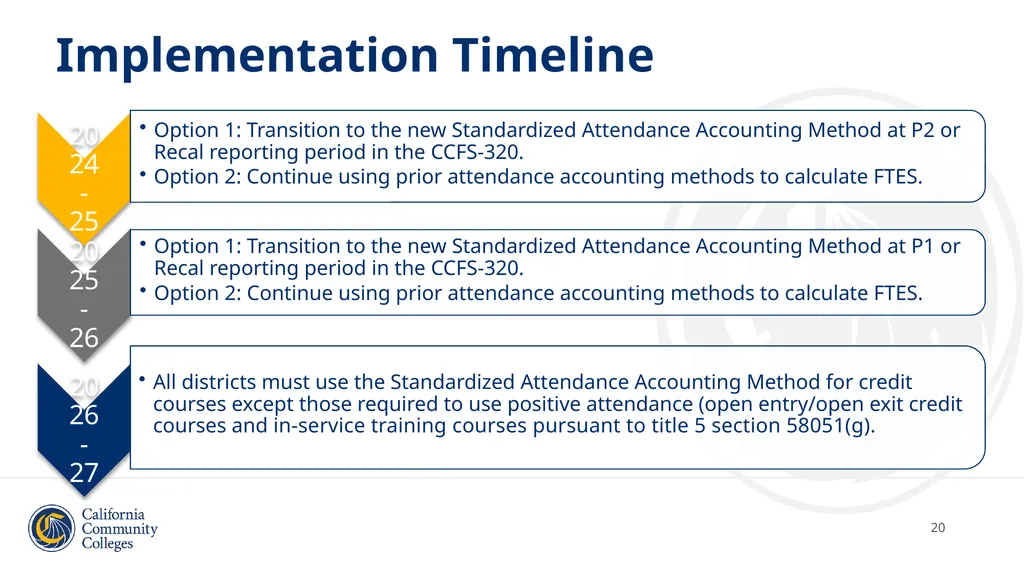
Implementation Timeline 15 In 2024-25 and 2025-26, districts have the option of using the prior attendance accounting methodologies or transitioning to the new Standardized Attendance Accounting Method.
Beginning in the 2026-27 fiscal year, all credit courses (except for courses required to use positive attendance) must use the Standardized Attendance Accounting Method to calculate FTES
Title 5, Sections 58003.1(b)(c) and (f)(1), which correspond to weekly census, daily census, and the alternative attendance accounting method for credit courses, will become inoperative on June 30, 2026.
Once a district transitions to the standardized attendance accounting method, they cannot change back to the old attendance accounting methods.<br>
16
FAQ: Were any changes made to the rules for course scheduling? 16 There were no regulatory changes made related to course scheduling
The recent regulatory changes only impact attendance accounting, meaning the formula used to calculate FTES, they make no changes to course scheduling or the minimum hours to award a unit of credit
Districts should continue to follow current regulation §55002.5 Credit Hour Definition (3-unit lecture course must have 48-54 scheduled student contact hours)<br>
17
FAQ: Will the new standardized attendance accounting method be used for distance education courses? 17 Yes. All credit courses with the exception of open entry/open exit courses credit courses may use the new Standardized Attendance Accounting Method.<br>
18
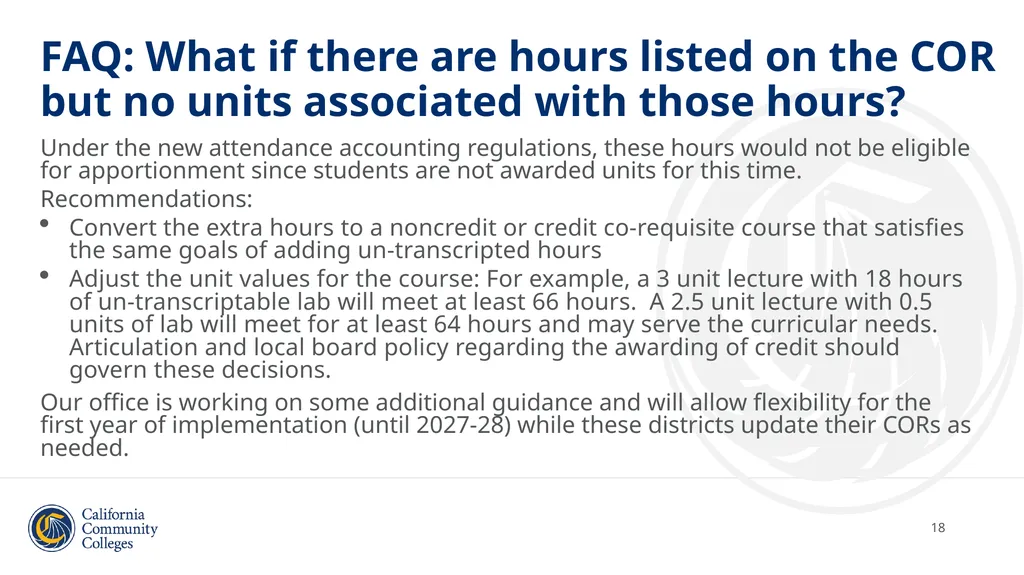
FAQ: What if there are hours listed on the COR but no units associated with those hours? 18 Under the new attendance accounting regulations, these hours would not be eligible for apportionment since students are not awarded units for this time.
Recommendations:
Convert the extra hours to a noncredit or credit co-requisite course that satisfies the same goals of adding un-transcripted hours
Adjust the unit values for the course: For example, a 3 unit lecture with 18 hours of un-transcriptable lab will meet at least 66 hours. A 2.5 unit lecture with 0.5 units of lab will meet for at least 64 hours and may serve the curricular needs. Articulation and local board policy regarding the awarding of credit should govern these decisions.
Our office is working on some additional guidance and will allow flexibility for the first year of implementation (until 2027-28) while these districts update their CORs as needed.<br>
19
FAQ: What records need to be maintained by the district for audit purposes? 19 Districts should maintain the same records that are kept currently for courses using positive attendance and the alternative attendance accounting method.
Courses that previously applied the actual hours of attendance method (positive attendance) and change to the standardized attendance accounting method do not need to continue to maintain daily attendance records for audit purposes (unless required for a for public safety in-service training courses)
No additional documentation is required if using the new standardized attendance accounting method.<br>
20
Implementation Timeline 20<br>
21
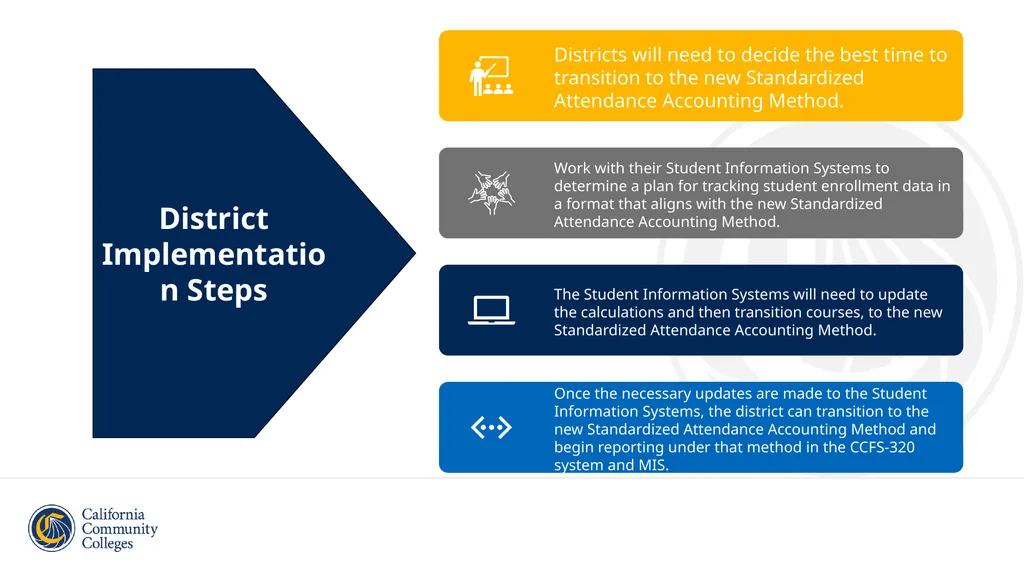
Next Steps for Implementation District Implementation Steps<br>
22
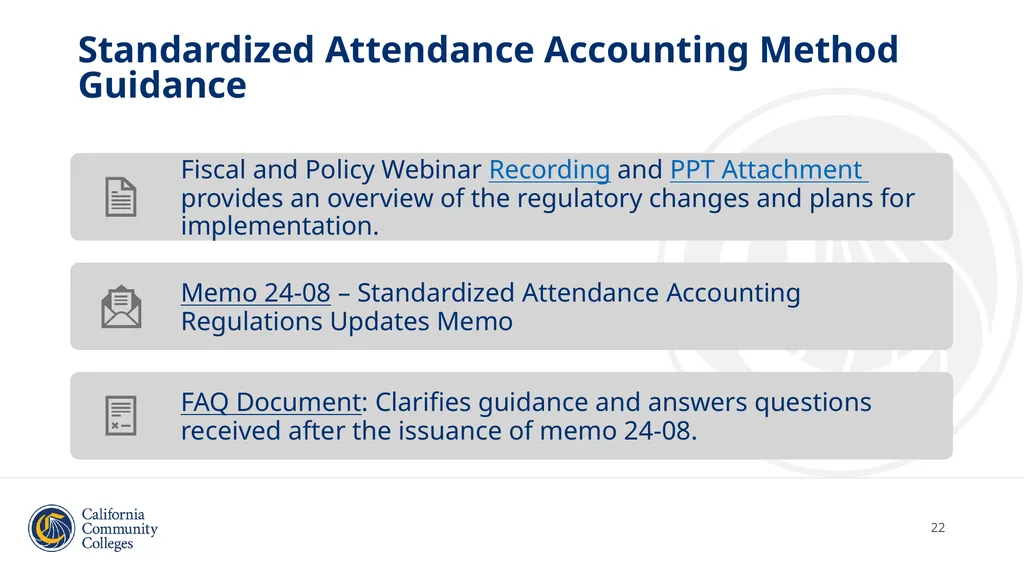
Standardized Attendance Accounting Method
Guidance 22<br>
23
CCFS-320 Updates: Standardized Attendance Accounting Method
Presented by Rafael Artiga Meza<br>
Presented by Rafael Artiga Meza<br>
24
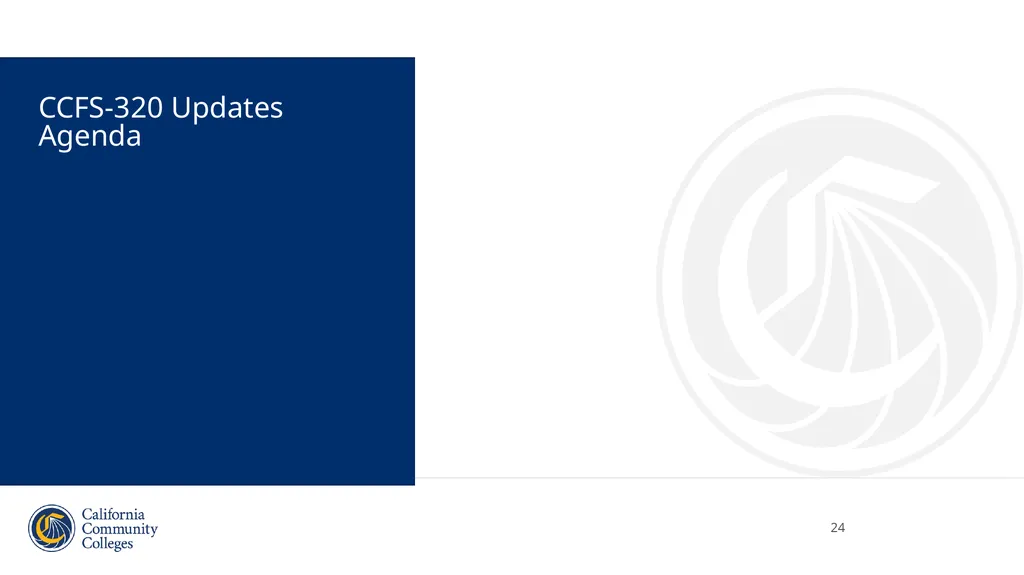
CCFS-320 Updates Agenda Timeline
Transition Administrator
Key Changes
College Parts
District Parts
College/District Reports
Other Minor Updates 24<br>
Transition Administrator
Key Changes
College Parts
District Parts
College/District Reports
Other Minor Updates 24<br>
25
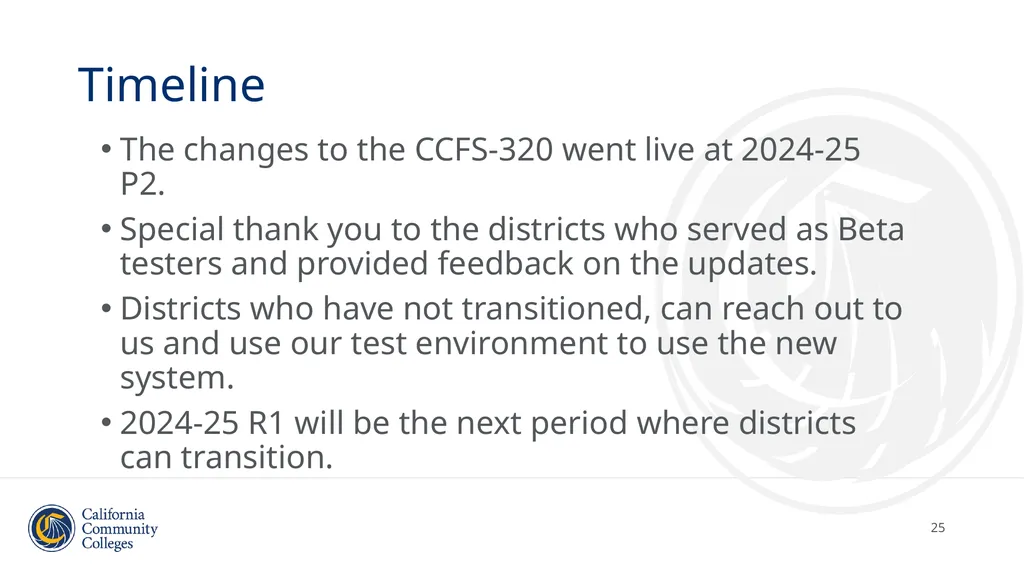
Timeline 25 The changes to the CCFS-320 went live at 2024-25 P2.
Special thank you to the districts who served as Beta testers and provided feedback on the updates.
Districts who have not transitioned, can reach out to us and use our test environment to use the new system.
2024-25 R1 will be the next period where districts can transition.<br>
Special thank you to the districts who served as Beta testers and provided feedback on the updates.
Districts who have not transitioned, can reach out to us and use our test environment to use the new system.
2024-25 R1 will be the next period where districts can transition.<br>
26
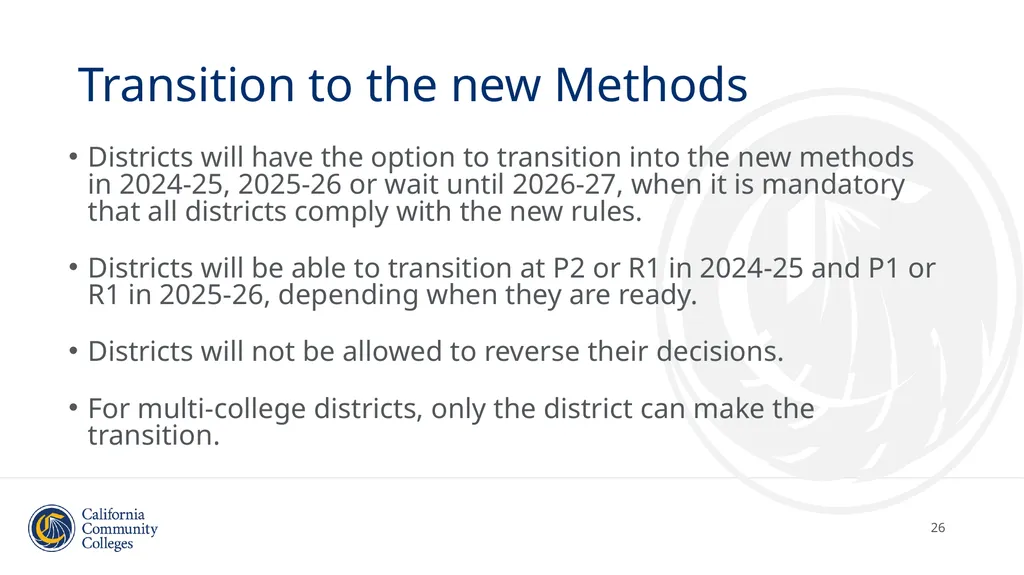
Transition to the new Methods 26 Districts will have the option to transition into the new methods in 2024-25, 2025-26 or wait until 2026-27, when it is mandatory that all districts comply with the new rules.
Districts will be able to transition at P2 or R1 in 2024-25 and P1 or R1 in 2025-26, depending when they are ready.
Districts will not be allowed to reverse their decisions.
For multi-college districts, only the district can make the transition.<br>
Districts will be able to transition at P2 or R1 in 2024-25 and P1 or R1 in 2025-26, depending when they are ready.
Districts will not be allowed to reverse their decisions.
For multi-college districts, only the district can make the transition.<br>
27
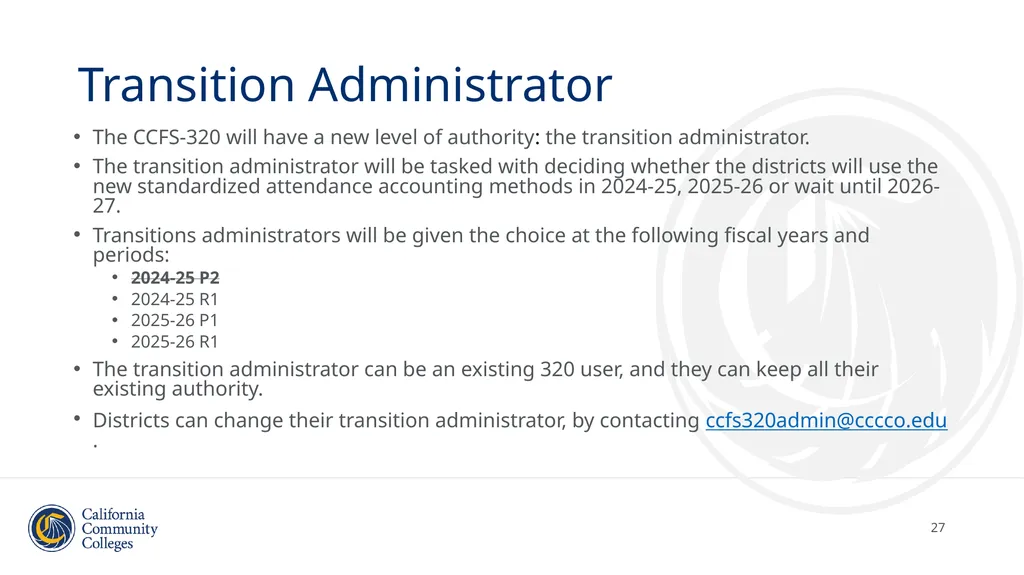
Transition Administrator 27 The CCFS-320 will have a new level of authority: the transition administrator.
The transition administrator will be tasked with deciding whether the districts will use the new standardized attendance accounting methods in 2024-25, 2025-26 or wait until 2026-27.
Transitions administrators will be given the choice at the following fiscal years and periods:
2024-25 P2
2024-25 R1
2025-26 P1
2025-26 R1
The transition administrator can be an existing 320 user, and they can keep all their existing authority.
Districts can change their transition administrator, by contacting ccfs320admin@cccco.edu.<br>
28
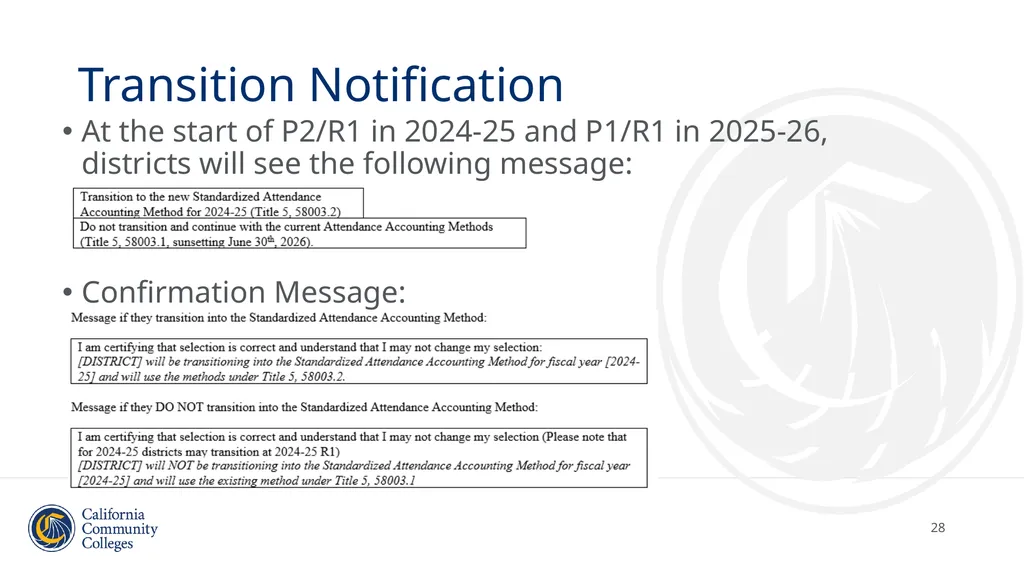
Transition Notification 28 At the start of P2/R1 in 2024-25 and P1/R1 in 2025-26, districts will see the following message:
Confirmation Message:<br>
Confirmation Message:<br>
29
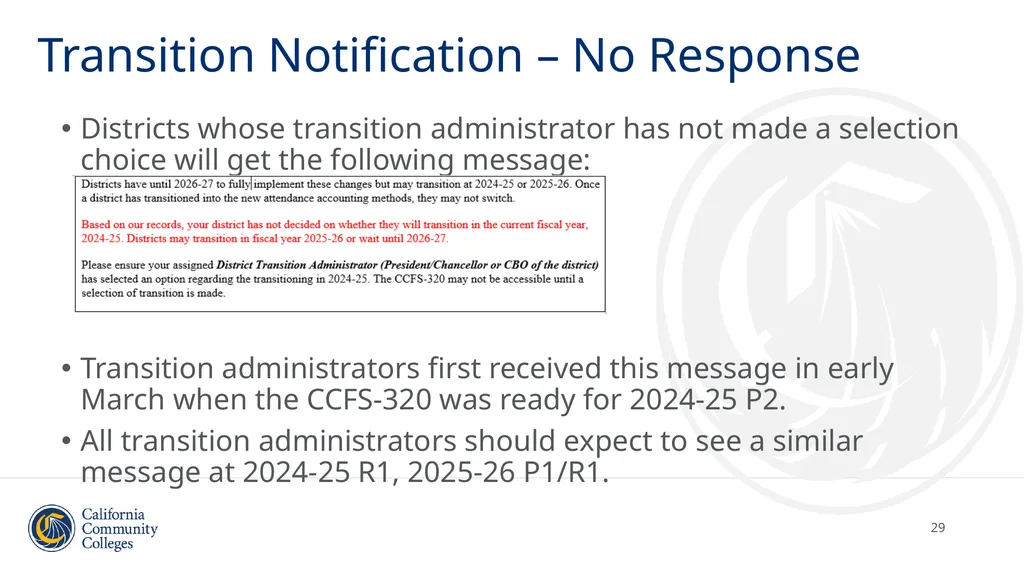
Transition Notification – No Response 29 Districts whose transition administrator has not made a selection choice will get the following message:
Transition administrators first received this message in early March when the CCFS-320 was ready for 2024-25 P2.
All transition administrators should expect to see a similar message at 2024-25 R1, 2025-26 P1/R1.<br>
Transition administrators first received this message in early March when the CCFS-320 was ready for 2024-25 P2.
All transition administrators should expect to see a similar message at 2024-25 R1, 2025-26 P1/R1.<br>
30
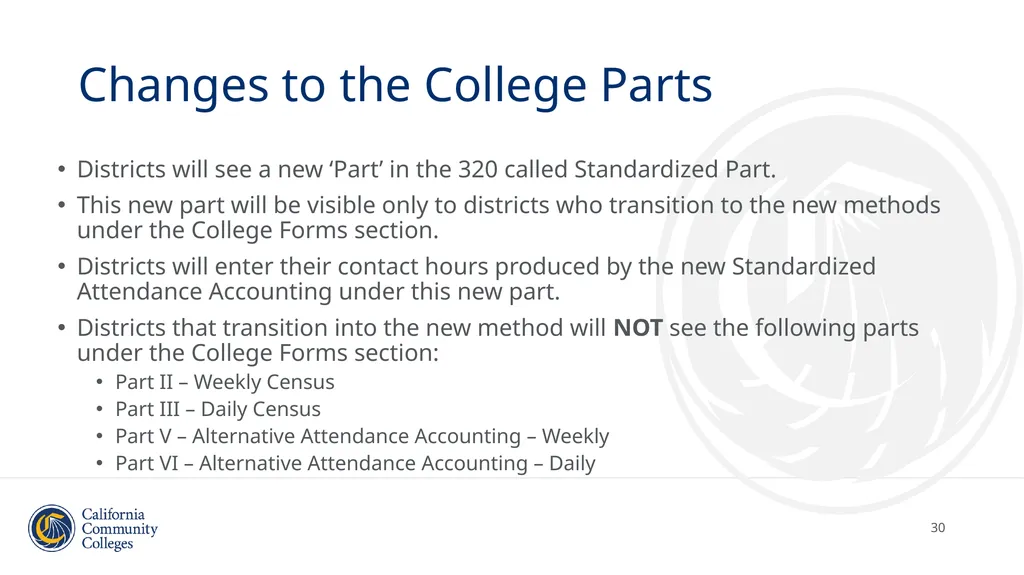
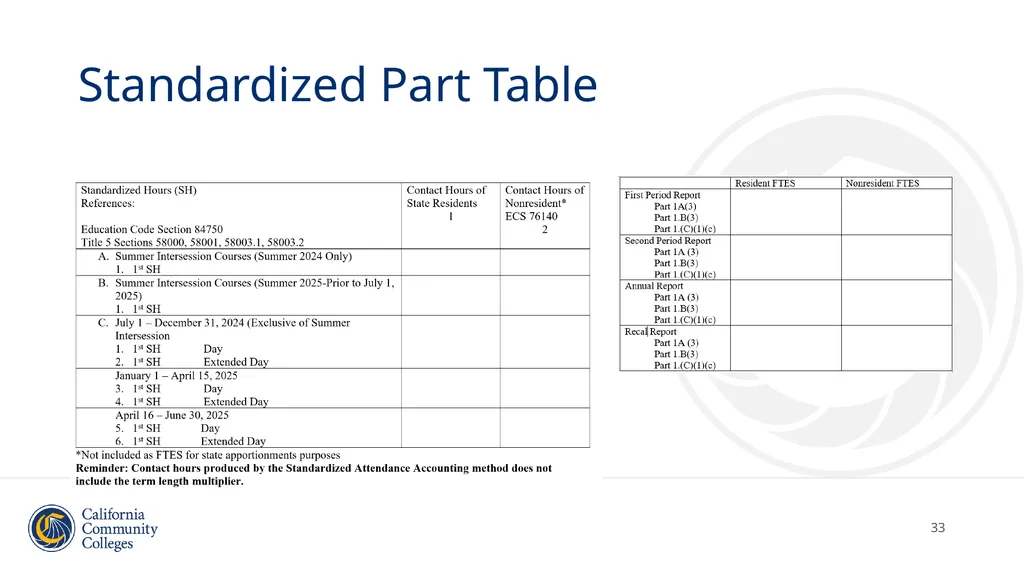
Changes to the College Parts 30 Districts will see a new ‘Part’ in the 320 called Standardized Part.
This new part will be visible only to districts who transition to the new methods under the College Forms section.
Districts will enter their contact hours produced by the new Standardized Attendance Accounting under this new part.
Districts that transition into the new method will NOT see the following parts under the College Forms section:
Part II – Weekly Census
Part III – Daily Census
Part V – Alternative Attendance Accounting – Weekly
Part VI – Alternative Attendance Accounting – Daily<br>
31
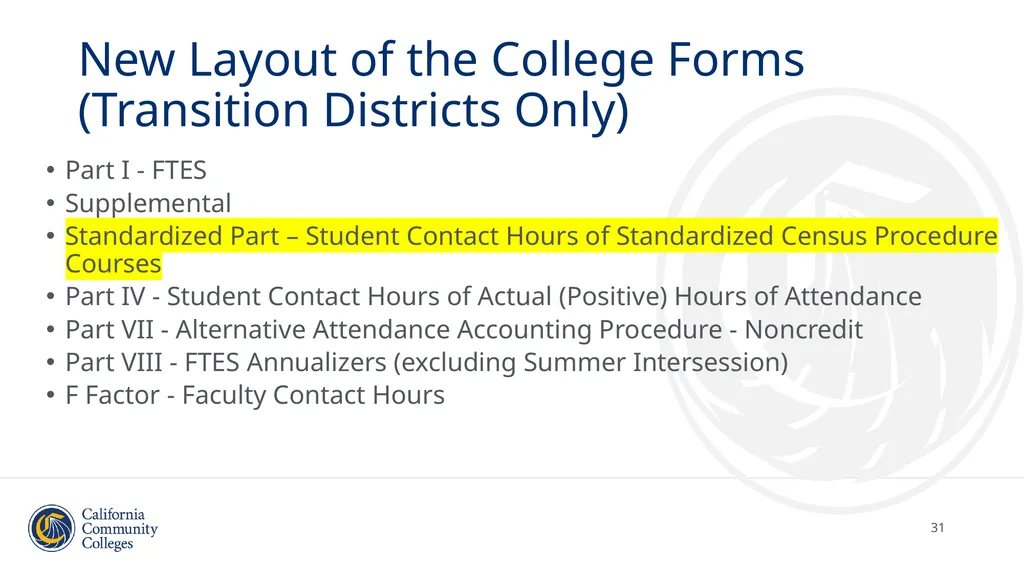
New Layout of the College Forms (Transition Districts Only) 31 Part I - FTES
Supplemental
Standardized Part – Student Contact Hours of Standardized Census Procedure Courses
Part IV - Student Contact Hours of Actual (Positive) Hours of Attendance
Part VII - Alternative Attendance Accounting Procedure - Noncredit
Part VIII - FTES Annualizers (excluding Summer Intersession)
F Factor - Faculty Contact Hours<br>
32
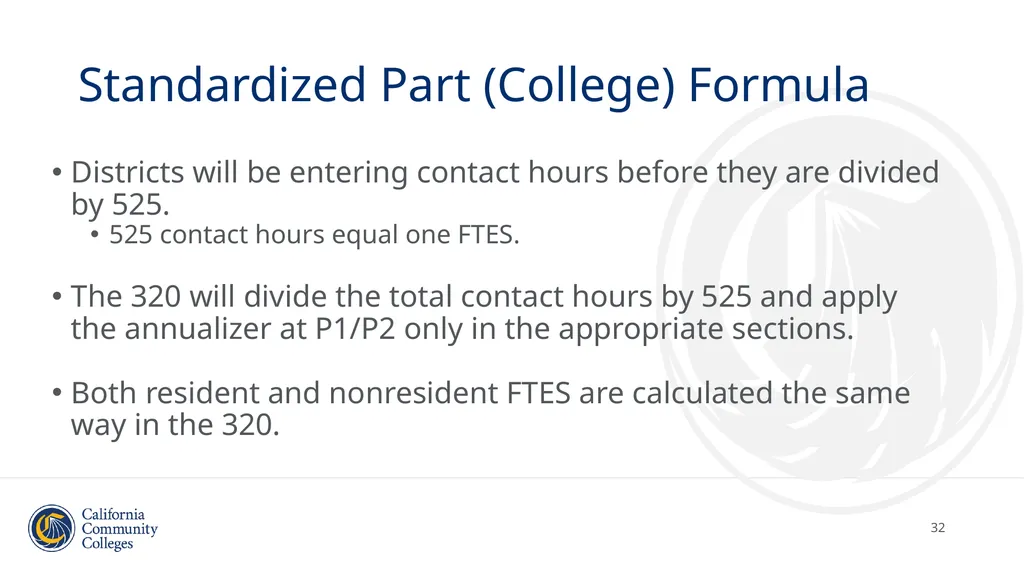
Standardized Part (College) Formula 32 Districts will be entering contact hours before they are divided by 525.
525 contact hours equal one FTES.
The 320 will divide the total contact hours by 525 and apply the annualizer at P1/P2 only in the appropriate sections.
Both resident and nonresident FTES are calculated the same way in the 320.<br>
525 contact hours equal one FTES.
The 320 will divide the total contact hours by 525 and apply the annualizer at P1/P2 only in the appropriate sections.
Both resident and nonresident FTES are calculated the same way in the 320.<br>
33
Standardized Part Table 33<br>
34
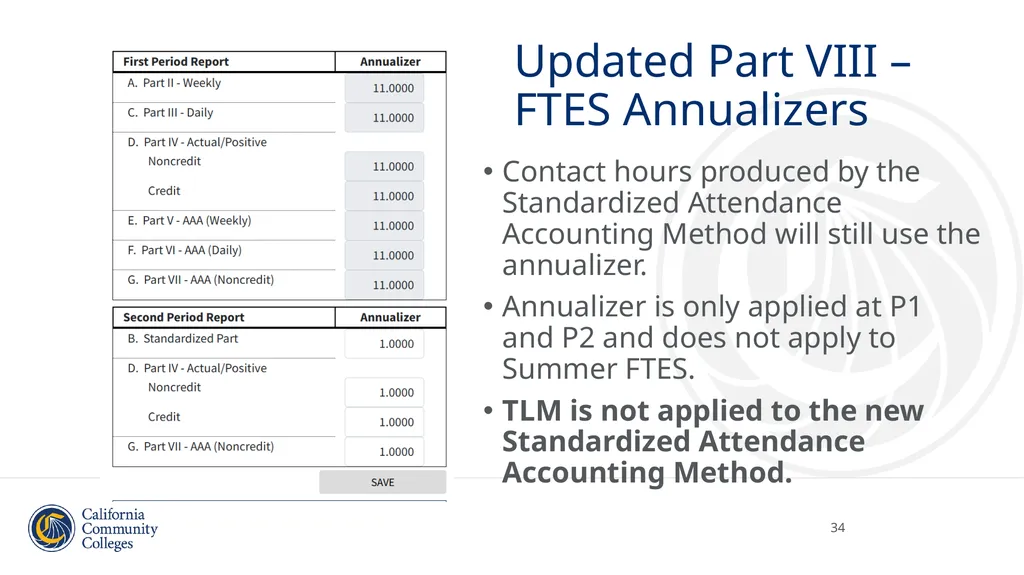
Updated Part VIII – FTES Annualizers Contact hours produced by the Standardized Attendance Accounting Method will still use the annualizer.
Annualizer is only applied at P1 and P2 and does not apply to Summer FTES.
TLM is not applied to the new Standardized Attendance Accounting Method. 34<br>
Annualizer is only applied at P1 and P2 and does not apply to Summer FTES.
TLM is not applied to the new Standardized Attendance Accounting Method. 34<br>
35
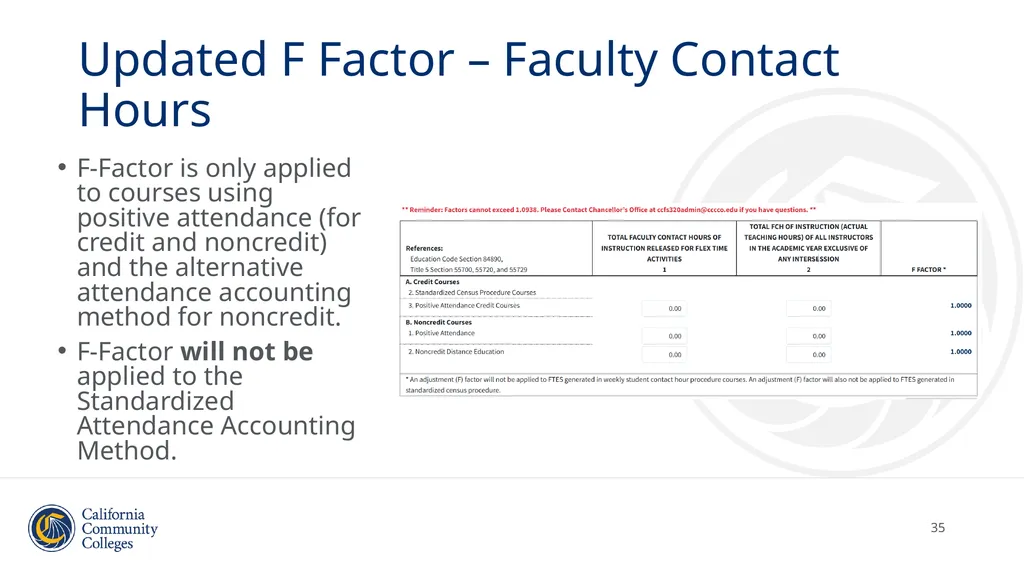
Updated F Factor – Faculty Contact Hours F-Factor is only applied to courses using positive attendance (for credit and noncredit) and the alternative attendance accounting method for noncredit.
F-Factor will not be applied to the Standardized Attendance Accounting Method. 35<br>
F-Factor will not be applied to the Standardized Attendance Accounting Method. 35<br>
36
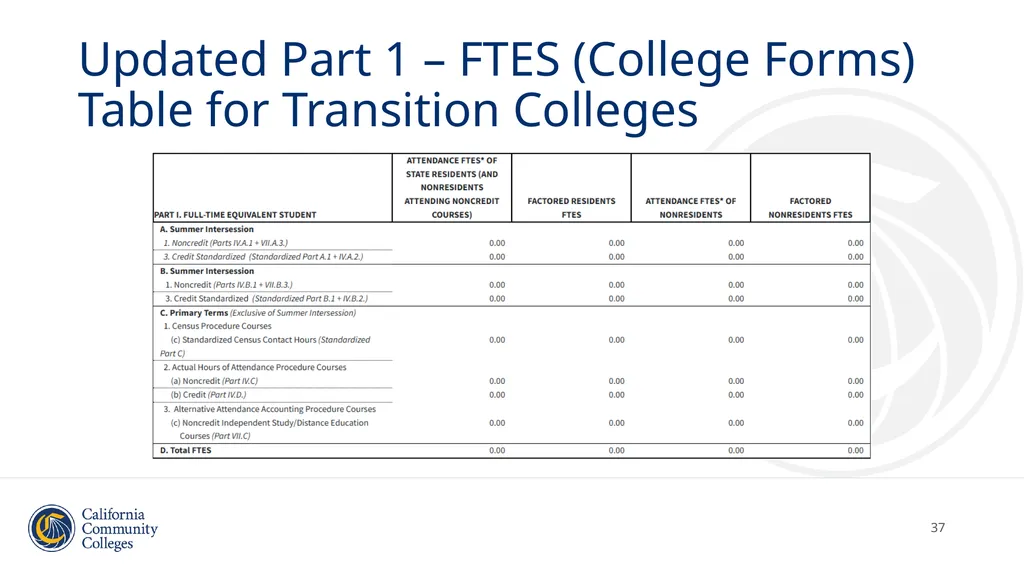
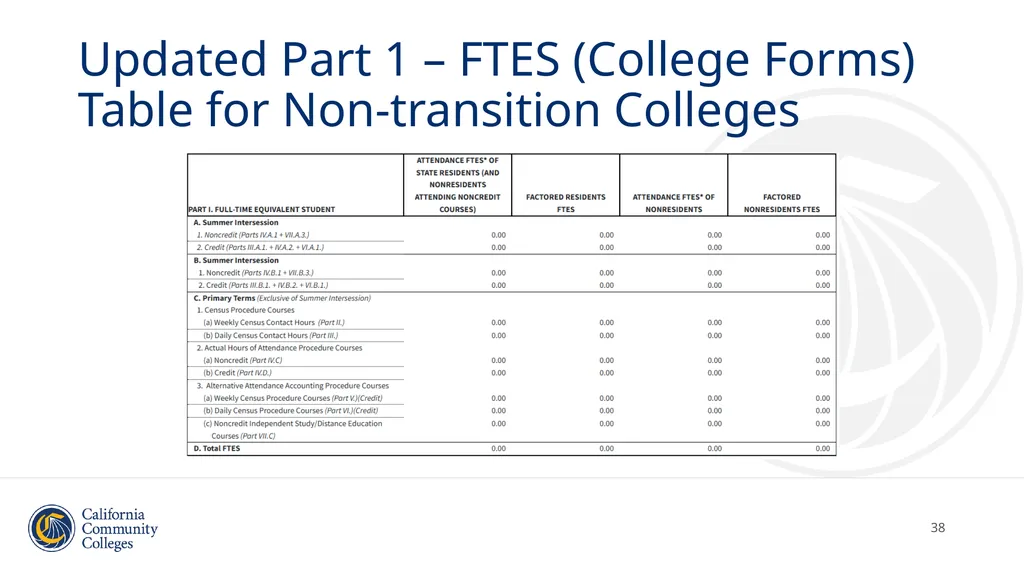
Updated Part 1 – FTES (College Forms) 36 All districts, whether they have transitioned or not, will see the updated table in Part 1 – FTES under College Forms.
Depending on the transition status of a district, certain sections will be grayed out and display no data.
The “factored” columns apply the F-Factor.<br>
Depending on the transition status of a district, certain sections will be grayed out and display no data.
The “factored” columns apply the F-Factor.<br>
37
Updated Part 1 – FTES (College Forms) Table for Transition Colleges 37<br>
38
Updated Part 1 – FTES (College Forms) Table for Non-transition Colleges 38<br>
39
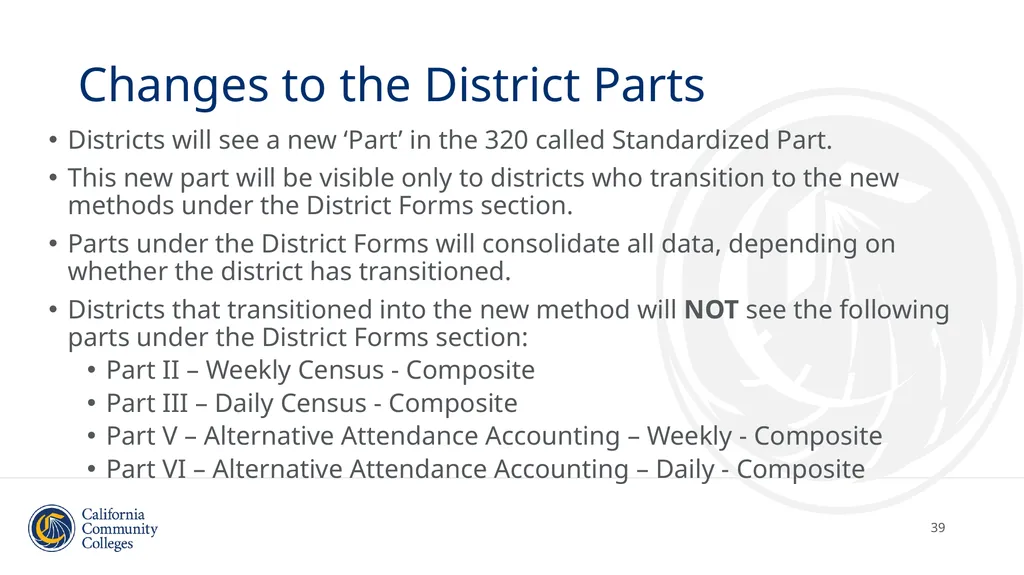
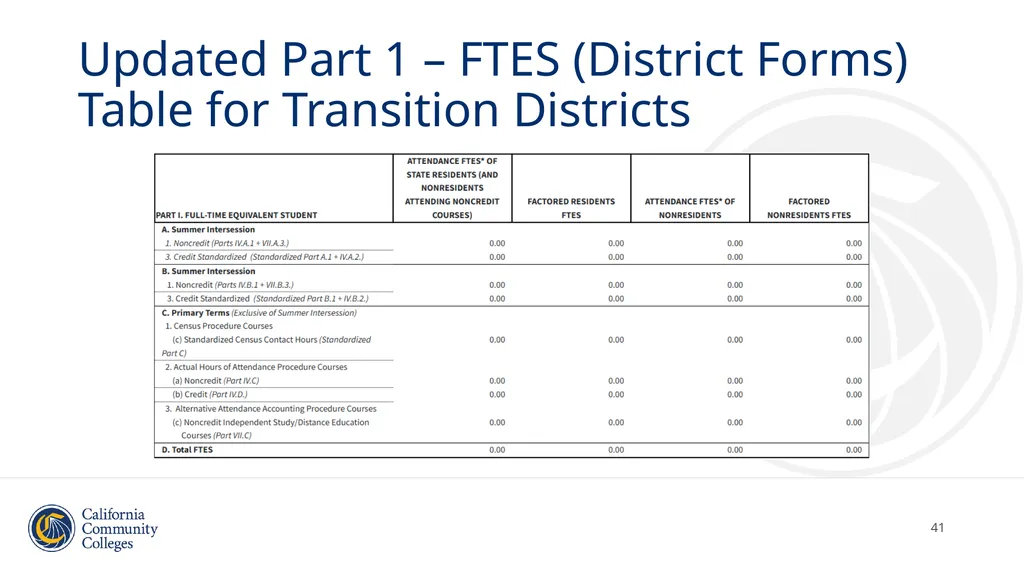
Changes to the District Parts 39 Districts will see a new ‘Part’ in the 320 called Standardized Part.
This new part will be visible only to districts who transition to the new methods under the District Forms section.
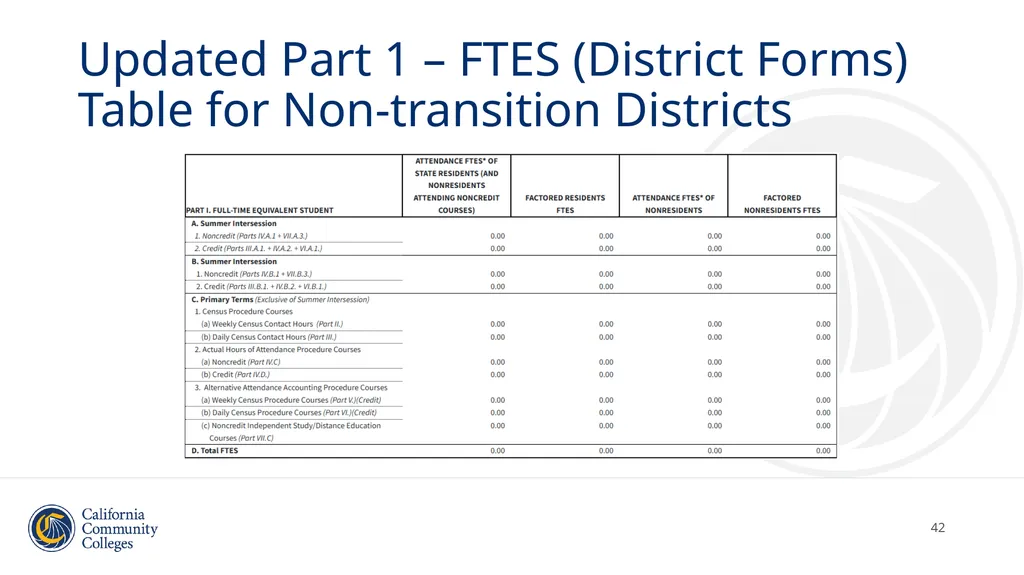
Parts under the District Forms will consolidate all data, depending on whether the district has transitioned.
Districts that transitioned into the new method will NOT see the following parts under the District Forms section:
Part II – Weekly Census - Composite
Part III – Daily Census - Composite
Part V – Alternative Attendance Accounting – Weekly - Composite
Part VI – Alternative Attendance Accounting – Daily - Composite<br>
40
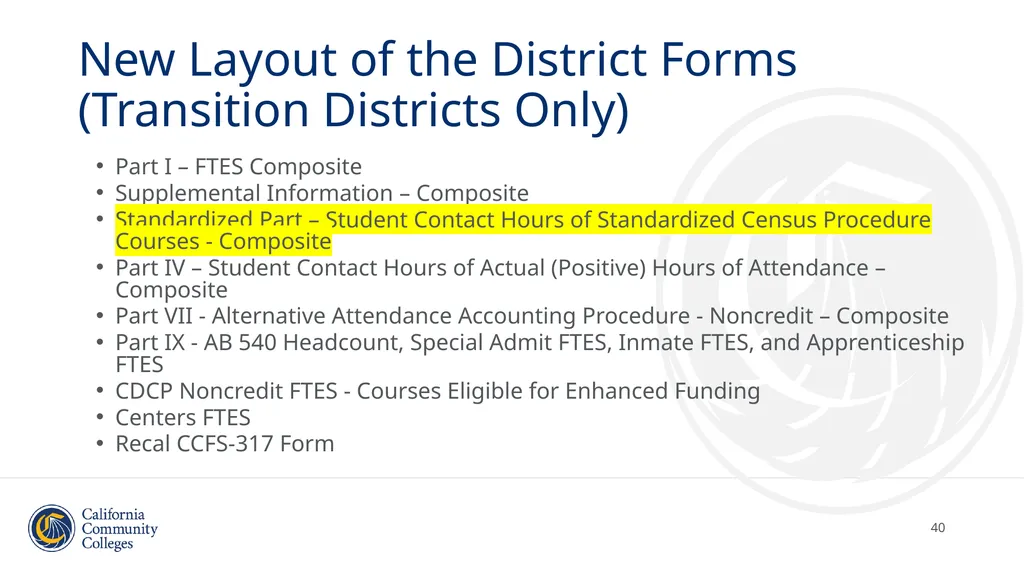
New Layout of the District Forms (Transition Districts Only) 40 Part I – FTES Composite
Supplemental Information – Composite
Standardized Part – Student Contact Hours of Standardized Census Procedure Courses - Composite
Part IV – Student Contact Hours of Actual (Positive) Hours of Attendance – Composite
Part VII - Alternative Attendance Accounting Procedure - Noncredit – Composite
Part IX - AB 540 Headcount, Special Admit FTES, Inmate FTES, and Apprenticeship FTES
CDCP Noncredit FTES - Courses Eligible for Enhanced Funding
Centers FTES
Recal CCFS-317 Form<br>
41
Updated Part 1 – FTES (District Forms) Table for Transition Districts 41<br>
42
Updated Part 1 – FTES (District Forms) Table for Non-transition Districts 42<br>
43
Updates to the College/District Reports 43 The process of printing district or college reports will only slightly change to make room for the new Standardized Part.
For districts that have not transitioned, no changes will be seen.
Districts are no longer required to send PDFs of these reports to the Chancellor’s Office.<br>
For districts that have not transitioned, no changes will be seen.
Districts are no longer required to send PDFs of these reports to the Chancellor’s Office.<br>
44
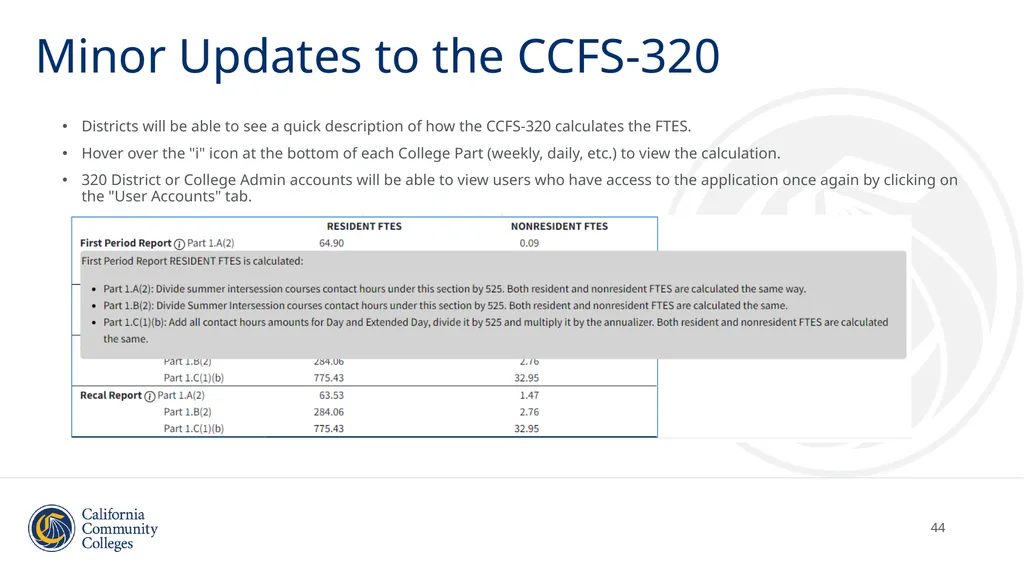
Minor Updates to the CCFS-320 Districts will be able to see a quick description of how the CCFS-320 calculates the FTES.
Hover over the "i" icon at the bottom of each College Part (weekly, daily, etc.) to view the calculation.
320 District or College Admin accounts will be able to view users who have access to the application once again by clicking on the "User Accounts" tab. 44<br>
Hover over the "i" icon at the bottom of each College Part (weekly, daily, etc.) to view the calculation.
320 District or College Admin accounts will be able to view users who have access to the application once again by clicking on the "User Accounts" tab. 44<br>
45
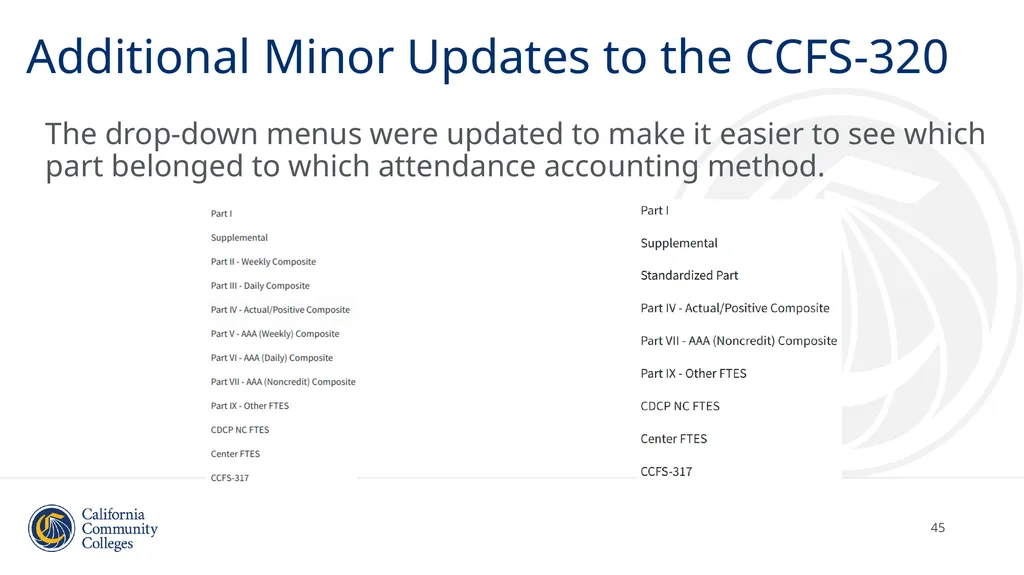
Additional Minor Updates to the CCFS-320 The drop-down menus were updated to make it easier to see which part belonged to which attendance accounting method. 45<br>
46
CDCP Courses within the 320 Reminder: Districts should take the necessary time to verify whether the list of CDCP courses is correct weeks before the 320 due date.
Our division does not oversee the approval process CDCP courses, so we cannot verify them. Rather we rely on our Ed Services division to verify the CDCP courses, before having our DII team add them to the 320.
Process to add or remove courses from the 320:
Ensure CDCP course is attached to a CCCCO approved CDCP program through COCI. Any issues regarding approved or denied courses should be directed to our Ed Services Division.
After verifying that the courses are approved and attached to a CCCCO approved CDCP program, reach out to ccfs320admin@cccco.edu to add those courses within the 320.
Districts can reach out to the ccfs320admin@cccco.edu if you simply want to remove courses. 46<br>
47
Final Thoughts 47 Our 320 instructions have been updated, so please reach out if you need a copy.
We have a test environment for districts to use the 320.
Feel free to reach out at ccfs320admin@cccco.edu with any questions or concerns.<br>
We have a test environment for districts to use the 320.
Feel free to reach out at ccfs320admin@cccco.edu with any questions or concerns.<br>
48
Questions/Comments<br>
49
Contact Information Natalie Wagner
nwagner@cccco.edu
Rafael Artiga Meza (CCFS-320)
rartiga@cccco.edu
Lorena Romero (Director, Fiscal Standards and Accountability)
lromero@cccco.edu<br>
nwagner@cccco.edu
Rafael Artiga Meza (CCFS-320)
rartiga@cccco.edu
Lorena Romero (Director, Fiscal Standards and Accountability)
lromero@cccco.edu<br>