
STUDYING Things you should know Prepared by Sally
PC
Published · 31 slides · 0 views
1 / 1



Description
STUDYING Things you should know Prepared by Sally Waltho, Psychometrist - Claremont Practice What is Psychology? Psychology is the science of the mind and behaviour. The word psychology comes from the Greek word psyche meaning breath,
Related Topics
Share
Embed code
Download this presentation From Below
"STUDYING Things you should know Prepared by Sally" is the property of its rightful owner. Permission is granted to download and print the materials on this website for personal, non-commercial use only, and to display it on your personal computer provided you do not modify the materials and that you retain all copyright notices contained in the materials. By downloading content from our website, you accept the terms of this agreement.
Presentation Transcript
01
STUDYING Things you should know Prepared by Sally Waltho, Psychometrist - Claremont Practice<br>
02
What is Psychology?
Psychology is the science of the mind and behaviour. The word "psychology" comes from the Greek word psyche meaning "breath, spirit, soul", and the Greek word logia meaning “the study of something”. According to Medilexicon's medical dictionary, psychology is "The profession concerned with the behaviour of humans and animals, and related mental and physiologic processes." Although psychology may also include the study of the mind and behaviour of animals, psychology refers mainly to humans. Prepared by Sally Waltho, Psychometrist - Claremont Practice<br>
Psychology is the science of the mind and behaviour. The word "psychology" comes from the Greek word psyche meaning "breath, spirit, soul", and the Greek word logia meaning “the study of something”. According to Medilexicon's medical dictionary, psychology is "The profession concerned with the behaviour of humans and animals, and related mental and physiologic processes." Although psychology may also include the study of the mind and behaviour of animals, psychology refers mainly to humans. Prepared by Sally Waltho, Psychometrist - Claremont Practice<br>
03
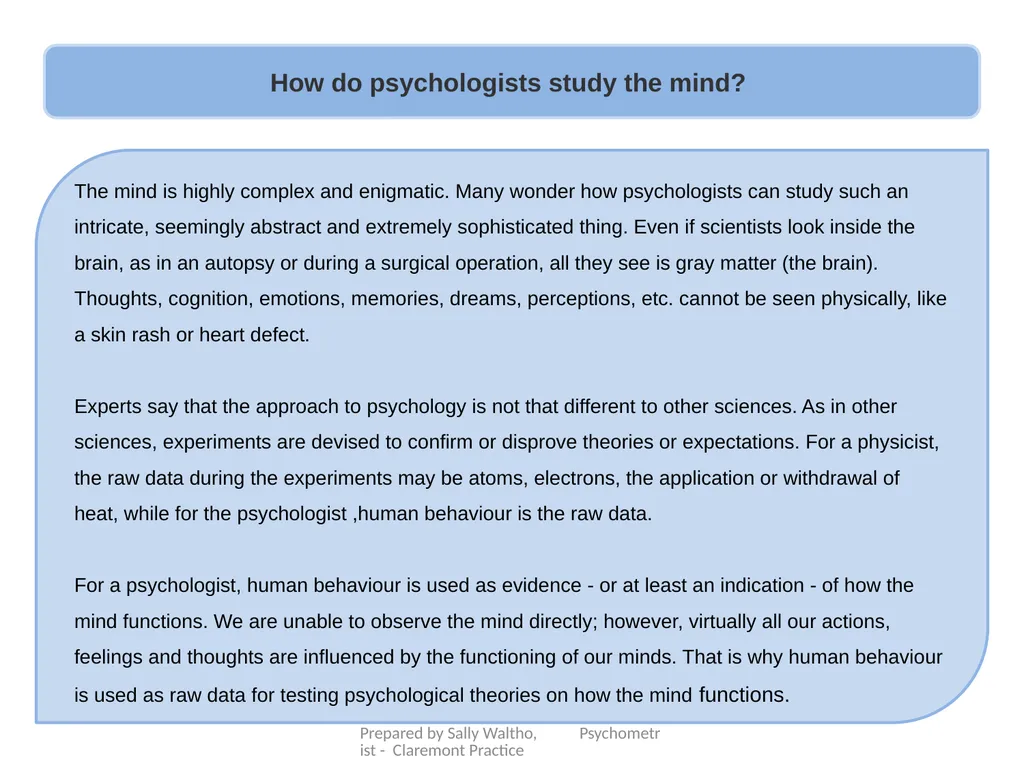
How do psychologists study the mind? The mind is highly complex and enigmatic. Many wonder how psychologists can study such an intricate, seemingly abstract and extremely sophisticated thing. Even if scientists look inside the brain, as in an autopsy or during a surgical operation, all they see is gray matter (the brain). Thoughts, cognition, emotions, memories, dreams, perceptions, etc. cannot be seen physically, like a skin rash or heart defect.
Experts say that the approach to psychology is not that different to other sciences. As in other sciences, experiments are devised to confirm or disprove theories or expectations. For a physicist, the raw data during the experiments may be atoms, electrons, the application or withdrawal of heat, while for the psychologist ,human behaviour is the raw data.
For a psychologist, human behaviour is used as evidence - or at least an indication - of how the mind functions. We are unable to observe the mind directly; however, virtually all our actions, feelings and thoughts are influenced by the functioning of our minds. That is why human behaviour is used as raw data for testing psychological theories on how the mind functions. Prepared by Sally Waltho, Psychometrist - Claremont Practice<br>
04
A brief History of Psychology
When psychology was first established as a science separate from biology and philosophy, the debate over how to describe and explain the human mind and behaviour began. The different schools of psychology represent the major theories within psychology.
The first school of thought, structuralism, was advocated by the founder of the first psychology lab, Wilhelm Wundt. Almost immediately, other theories began to emerge and vie for dominance in psychology.
In the past, psychologists often identified themselves exclusively with one single school of thought. Today, most psychologists have an eclectic outlook on psychology. They often draw on ideas and theories from different schools rather than holding to any singular outlook. Prepared by Sally Waltho, Psychometrist - Claremont Practice<br>
When psychology was first established as a science separate from biology and philosophy, the debate over how to describe and explain the human mind and behaviour began. The different schools of psychology represent the major theories within psychology.
The first school of thought, structuralism, was advocated by the founder of the first psychology lab, Wilhelm Wundt. Almost immediately, other theories began to emerge and vie for dominance in psychology.
In the past, psychologists often identified themselves exclusively with one single school of thought. Today, most psychologists have an eclectic outlook on psychology. They often draw on ideas and theories from different schools rather than holding to any singular outlook. Prepared by Sally Waltho, Psychometrist - Claremont Practice<br>
05
Schools of Thought
Structuralism & Functionalism
Structuralism was the first school of psychology, and focused on breaking down mental processes into the most basic components. Major structuralist thinkers include Wilhelm Wundt and Edward Titchener. The focus of structuralism was on reducing mental processes down into their most basic elements. Structuralists used techniques such as introspection to analyze the inner processes of the human mind.
Functionalism formed as a reaction to the theories of the structuralist school of thought and was heavily influenced by the work of William James. Major functionalist thinkers included John Dewey and Harvey Carr. Instead of focusing on the mental processes themselves, functionalist thinkers were instead interested in the role that these processes play. Prepared by Sally Waltho, Psychometrist - Claremont Practice<br>
Structuralism & Functionalism
Structuralism was the first school of psychology, and focused on breaking down mental processes into the most basic components. Major structuralist thinkers include Wilhelm Wundt and Edward Titchener. The focus of structuralism was on reducing mental processes down into their most basic elements. Structuralists used techniques such as introspection to analyze the inner processes of the human mind.
Functionalism formed as a reaction to the theories of the structuralist school of thought and was heavily influenced by the work of William James. Major functionalist thinkers included John Dewey and Harvey Carr. Instead of focusing on the mental processes themselves, functionalist thinkers were instead interested in the role that these processes play. Prepared by Sally Waltho, Psychometrist - Claremont Practice<br>
06
Behaviourism
Behaviourism became a dominant school of thought during the 1950s. It was based upon the work of thinkers such as:
John B. Watson
Ivan Pavlov
B. F. Skinner
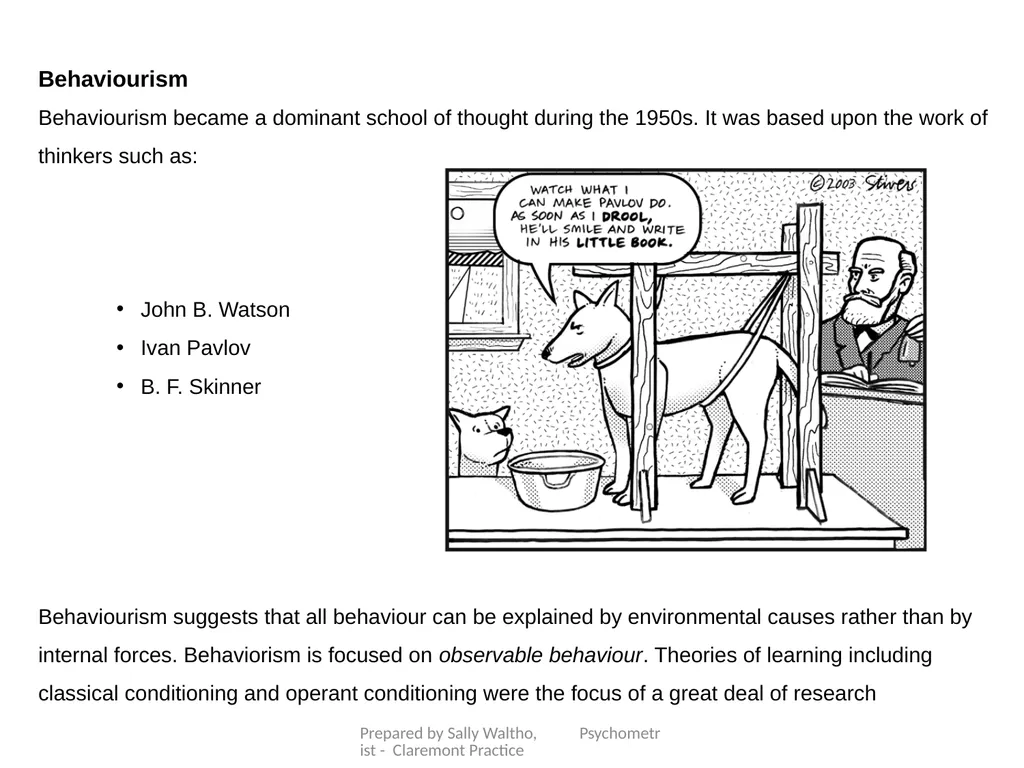
Behaviourism suggests that all behaviour can be explained by environmental causes rather than by internal forces. Behaviorism is focused on observable behaviour. Theories of learning including classical conditioning and operant conditioning were the focus of a great deal of research Prepared by Sally Waltho, Psychometrist - Claremont Practice<br>
Behaviourism became a dominant school of thought during the 1950s. It was based upon the work of thinkers such as:
John B. Watson
Ivan Pavlov
B. F. Skinner
Behaviourism suggests that all behaviour can be explained by environmental causes rather than by internal forces. Behaviorism is focused on observable behaviour. Theories of learning including classical conditioning and operant conditioning were the focus of a great deal of research Prepared by Sally Waltho, Psychometrist - Claremont Practice<br>
07
Psychoanalysis
Psychoanalysis is a school of psychology founded by Sigmund Freud. This school of thought emphasizes the influence of the unconscious mind on behaviour.
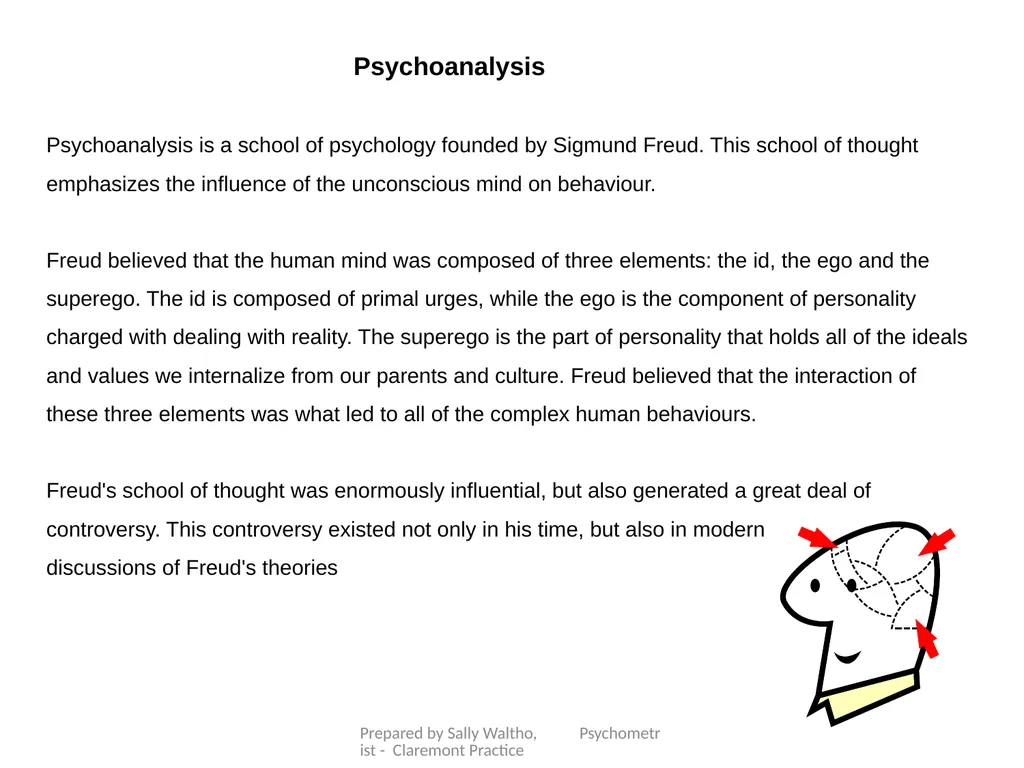
Freud believed that the human mind was composed of three elements: the id, the ego and the superego. The id is composed of primal urges, while the ego is the component of personality charged with dealing with reality. The superego is the part of personality that holds all of the ideals and values we internalize from our parents and culture. Freud believed that the interaction of these three elements was what led to all of the complex human behaviours.
Freud's school of thought was enormously influential, but also generated a great deal of controversy. This controversy existed not only in his time, but also in modern
discussions of Freud's theories Prepared by Sally Waltho, Psychometrist - Claremont Practice<br>
Psychoanalysis is a school of psychology founded by Sigmund Freud. This school of thought emphasizes the influence of the unconscious mind on behaviour.
Freud believed that the human mind was composed of three elements: the id, the ego and the superego. The id is composed of primal urges, while the ego is the component of personality charged with dealing with reality. The superego is the part of personality that holds all of the ideals and values we internalize from our parents and culture. Freud believed that the interaction of these three elements was what led to all of the complex human behaviours.
Freud's school of thought was enormously influential, but also generated a great deal of controversy. This controversy existed not only in his time, but also in modern
discussions of Freud's theories Prepared by Sally Waltho, Psychometrist - Claremont Practice<br>
08
Humanistic Psychology
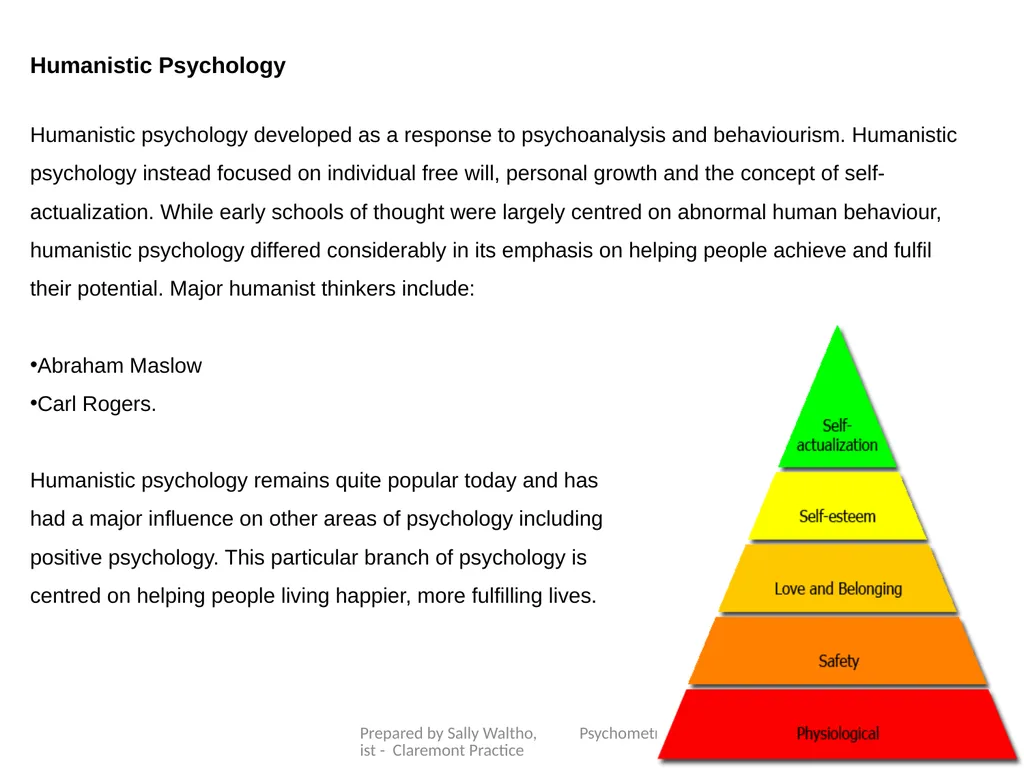
Humanistic psychology developed as a response to psychoanalysis and behaviourism. Humanistic psychology instead focused on individual free will, personal growth and the concept of self-actualization. While early schools of thought were largely centred on abnormal human behaviour, humanistic psychology differed considerably in its emphasis on helping people achieve and fulfil their potential. Major humanist thinkers include:
Abraham Maslow
Carl Rogers.
Humanistic psychology remains quite popular today and has
had a major influence on other areas of psychology including
positive psychology. This particular branch of psychology is
centred on helping people living happier, more fulfilling lives. Prepared by Sally Waltho, Psychometrist - Claremont Practice<br>
Humanistic psychology developed as a response to psychoanalysis and behaviourism. Humanistic psychology instead focused on individual free will, personal growth and the concept of self-actualization. While early schools of thought were largely centred on abnormal human behaviour, humanistic psychology differed considerably in its emphasis on helping people achieve and fulfil their potential. Major humanist thinkers include:
Abraham Maslow
Carl Rogers.
Humanistic psychology remains quite popular today and has
had a major influence on other areas of psychology including
positive psychology. This particular branch of psychology is
centred on helping people living happier, more fulfilling lives. Prepared by Sally Waltho, Psychometrist - Claremont Practice<br>
09
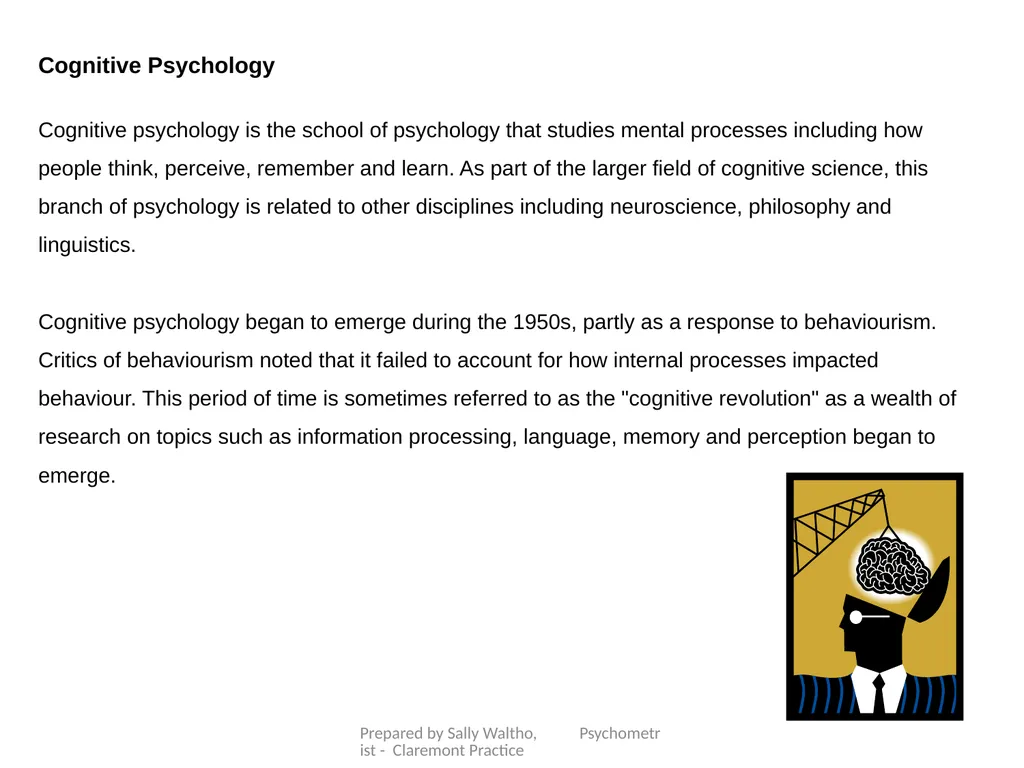
Cognitive Psychology
Cognitive psychology is the school of psychology that studies mental processes including how people think, perceive, remember and learn. As part of the larger field of cognitive science, this branch of psychology is related to other disciplines including neuroscience, philosophy and linguistics.
Cognitive psychology began to emerge during the 1950s, partly as a response to behaviourism. Critics of behaviourism noted that it failed to account for how internal processes impacted behaviour. This period of time is sometimes referred to as the "cognitive revolution" as a wealth of research on topics such as information processing, language, memory and perception began to emerge. Prepared by Sally Waltho, Psychometrist - Claremont Practice<br>
Cognitive psychology is the school of psychology that studies mental processes including how people think, perceive, remember and learn. As part of the larger field of cognitive science, this branch of psychology is related to other disciplines including neuroscience, philosophy and linguistics.
Cognitive psychology began to emerge during the 1950s, partly as a response to behaviourism. Critics of behaviourism noted that it failed to account for how internal processes impacted behaviour. This period of time is sometimes referred to as the "cognitive revolution" as a wealth of research on topics such as information processing, language, memory and perception began to emerge. Prepared by Sally Waltho, Psychometrist - Claremont Practice<br>
10
What are the Admission Requirements for an undergraduate degree in psychology?
*Please note these requirements are based on UCT’s brochure for 2013 and therefore other institutions may differ.
The minimum admissions requirement for the Bachelors degree is a National Senior Certificate (NSC) with an achievement rating of 4 (Adequate Achievement, 50-59%) or better in four subjects chosen from a designated list of subjects. These subjects are: Accounting, Agricultural Sciences, Business Studies, Dramatic Arts, Economics, Engineering Graphics and design, Geography, History, Consumer Studies, Information Technology, Languages, Life Sciences, Mathematics, Mathematical Literacy, Music, Physical Sciences, Religion Studies, Visual Arts. Prepared by Sally Waltho, Psychometrist - Claremont Practice<br>
*Please note these requirements are based on UCT’s brochure for 2013 and therefore other institutions may differ.
The minimum admissions requirement for the Bachelors degree is a National Senior Certificate (NSC) with an achievement rating of 4 (Adequate Achievement, 50-59%) or better in four subjects chosen from a designated list of subjects. These subjects are: Accounting, Agricultural Sciences, Business Studies, Dramatic Arts, Economics, Engineering Graphics and design, Geography, History, Consumer Studies, Information Technology, Languages, Life Sciences, Mathematics, Mathematical Literacy, Music, Physical Sciences, Religion Studies, Visual Arts. Prepared by Sally Waltho, Psychometrist - Claremont Practice<br>
11
Calculation of the Admissions Points Score (APS)
The percentages achieved in National Senior Certificate
(preliminary and final examinations) will be allocated an
admissions score equal to that percentage. The sum of six
subject scores, excluding Life Orientation, but English and any
other required subject(s) for the relevant programme is considered
when deciding on admission. (In other words, for a given programme where Maths
and Physical Sciences are required, the scores for English, Maths Physical Sciences and the next three best subjects other than Life Orientation will be taken to compute the NSC score toward the APS). Prepared by Sally Waltho, Psychometrist - Claremont Practice<br>
The percentages achieved in National Senior Certificate
(preliminary and final examinations) will be allocated an
admissions score equal to that percentage. The sum of six
subject scores, excluding Life Orientation, but English and any
other required subject(s) for the relevant programme is considered
when deciding on admission. (In other words, for a given programme where Maths
and Physical Sciences are required, the scores for English, Maths Physical Sciences and the next three best subjects other than Life Orientation will be taken to compute the NSC score toward the APS). Prepared by Sally Waltho, Psychometrist - Claremont Practice<br>
12
Examples of APS Calculations:
Faculty of Humanities:
English Home Language 70% = 70 pts
Mathematics 84% = 84 pts
Life Sciences 86% = 86 pts
Geography 79% = 79 pts
Accounting 69% = 69 pts
Life Orientation 80% = 0 pts
Mathematics P3 70% = 70 pts
Total = 463 / 600
APS = 463 Prepared by Sally Waltho, Psychometrist - Claremont Practice<br>
Faculty of Humanities:
English Home Language 70% = 70 pts
Mathematics 84% = 84 pts
Life Sciences 86% = 86 pts
Geography 79% = 79 pts
Accounting 69% = 69 pts
Life Orientation 80% = 0 pts
Mathematics P3 70% = 70 pts
Total = 463 / 600
APS = 463 Prepared by Sally Waltho, Psychometrist - Claremont Practice<br>
13
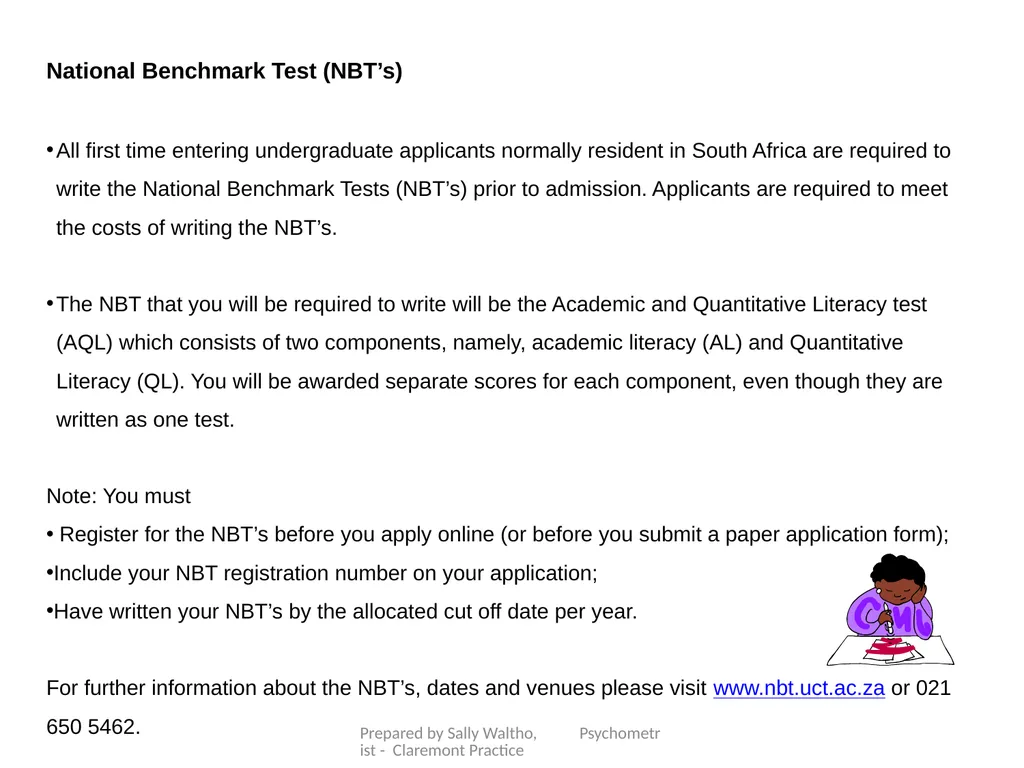
National Benchmark Test (NBT’s)
All first time entering undergraduate applicants normally resident in South Africa are required to write the National Benchmark Tests (NBT’s) prior to admission. Applicants are required to meet the costs of writing the NBT’s.
The NBT that you will be required to write will be the Academic and Quantitative Literacy test (AQL) which consists of two components, namely, academic literacy (AL) and Quantitative Literacy (QL). You will be awarded separate scores for each component, even though they are written as one test.
Note: You must
Register for the NBT’s before you apply online (or before you submit a paper application form);
Include your NBT registration number on your application;
Have written your NBT’s by the allocated cut off date per year.
For further information about the NBT’s, dates and venues please visit www.nbt.uct.ac.za or 021 650 5462. Prepared by Sally Waltho, Psychometrist - Claremont Practice<br>
All first time entering undergraduate applicants normally resident in South Africa are required to write the National Benchmark Tests (NBT’s) prior to admission. Applicants are required to meet the costs of writing the NBT’s.
The NBT that you will be required to write will be the Academic and Quantitative Literacy test (AQL) which consists of two components, namely, academic literacy (AL) and Quantitative Literacy (QL). You will be awarded separate scores for each component, even though they are written as one test.
Note: You must
Register for the NBT’s before you apply online (or before you submit a paper application form);
Include your NBT registration number on your application;
Have written your NBT’s by the allocated cut off date per year.
For further information about the NBT’s, dates and venues please visit www.nbt.uct.ac.za or 021 650 5462. Prepared by Sally Waltho, Psychometrist - Claremont Practice<br>
14
The Minimum Requirements for a BA and BSocSc (majoring in psychology)
English 50%
APS of 380 (63%)
AL Upper Intermediate
QL of 69% or NSC Maths 50% Prepared by Sally Waltho, Psychometrist - Claremont Practice<br>
English 50%
APS of 380 (63%)
AL Upper Intermediate
QL of 69% or NSC Maths 50% Prepared by Sally Waltho, Psychometrist - Claremont Practice<br>
15
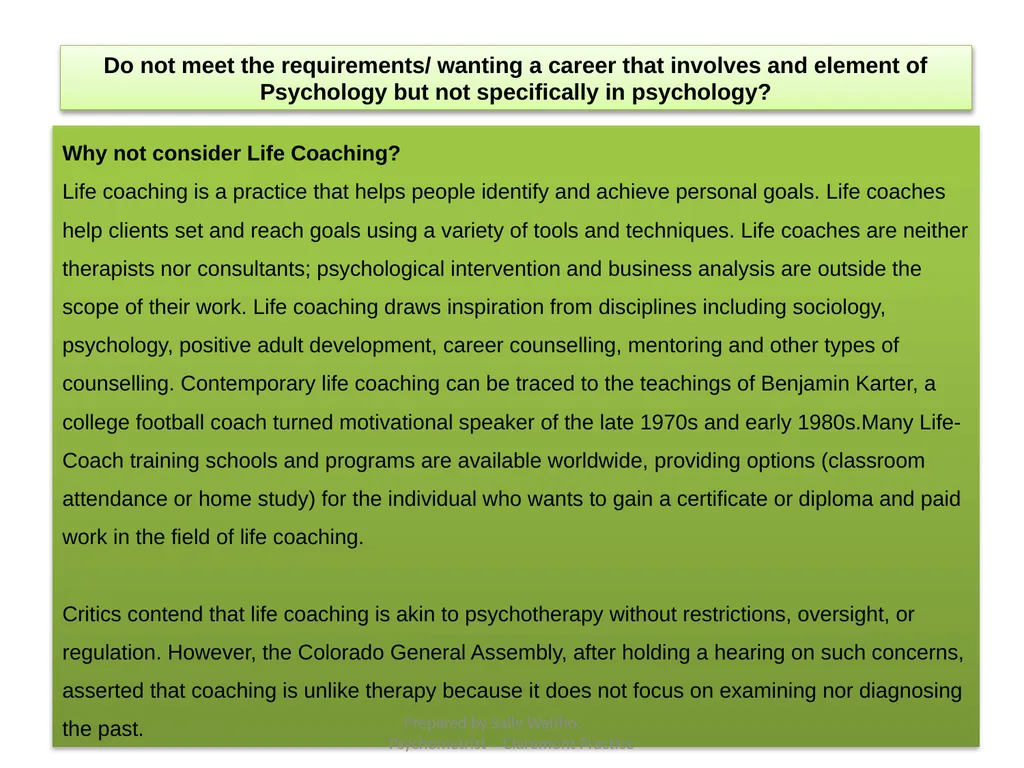
Do not meet the requirements/ wanting a career that involves and element of Psychology but not specifically in psychology? Why not consider Life Coaching?
Life coaching is a practice that helps people identify and achieve personal goals. Life coaches help clients set and reach goals using a variety of tools and techniques. Life coaches are neither therapists nor consultants; psychological intervention and business analysis are outside the scope of their work. Life coaching draws inspiration from disciplines including sociology, psychology, positive adult development, career counselling, mentoring and other types of counselling. Contemporary life coaching can be traced to the teachings of Benjamin Karter, a college football coach turned motivational speaker of the late 1970s and early 1980s.Many Life-Coach training schools and programs are available worldwide, providing options (classroom attendance or home study) for the individual who wants to gain a certificate or diploma and paid work in the field of life coaching.
Critics contend that life coaching is akin to psychotherapy without restrictions, oversight, or regulation. However, the Colorado General Assembly, after holding a hearing on such concerns, asserted that coaching is unlike therapy because it does not focus on examining nor diagnosing the past. Prepared by Sally Waltho, Psychometrist - Claremont Practice<br>
Life coaching is a practice that helps people identify and achieve personal goals. Life coaches help clients set and reach goals using a variety of tools and techniques. Life coaches are neither therapists nor consultants; psychological intervention and business analysis are outside the scope of their work. Life coaching draws inspiration from disciplines including sociology, psychology, positive adult development, career counselling, mentoring and other types of counselling. Contemporary life coaching can be traced to the teachings of Benjamin Karter, a college football coach turned motivational speaker of the late 1970s and early 1980s.Many Life-Coach training schools and programs are available worldwide, providing options (classroom attendance or home study) for the individual who wants to gain a certificate or diploma and paid work in the field of life coaching.
Critics contend that life coaching is akin to psychotherapy without restrictions, oversight, or regulation. However, the Colorado General Assembly, after holding a hearing on such concerns, asserted that coaching is unlike therapy because it does not focus on examining nor diagnosing the past. Prepared by Sally Waltho, Psychometrist - Claremont Practice<br>
16
Prepared by Sally Waltho, Psychometrist - Claremont Practice<br>
17
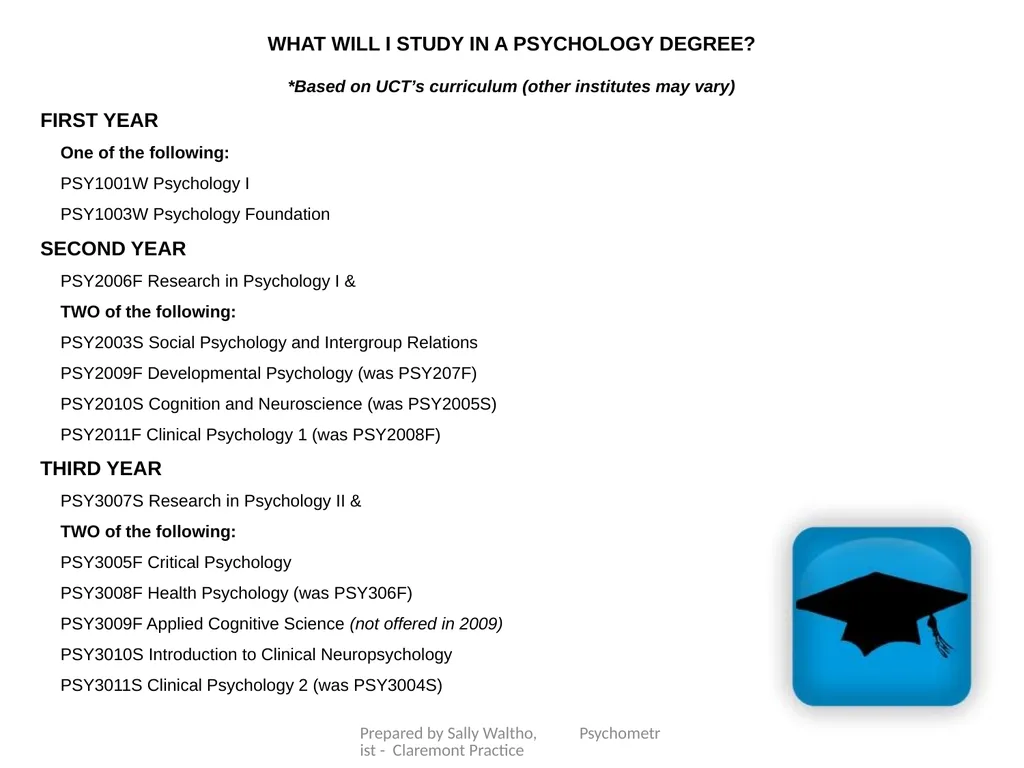
WHAT WILL I STUDY IN A PSYCHOLOGY DEGREE?
*Based on UCT’s curriculum (other institutes may vary)
FIRST YEAR
One of the following:
PSY1001W Psychology I
PSY1003W Psychology Foundation
SECOND YEAR
PSY2006F Research in Psychology I &
TWO of the following:
PSY2003S Social Psychology and Intergroup Relations
PSY2009F Developmental Psychology (was PSY207F)
PSY2010S Cognition and Neuroscience (was PSY2005S)
PSY2011F Clinical Psychology 1 (was PSY2008F)
THIRD YEAR
PSY3007S Research in Psychology II &
TWO of the following:
PSY3005F Critical Psychology
PSY3008F Health Psychology (was PSY306F)
PSY3009F Applied Cognitive Science (not offered in 2009)
PSY3010S Introduction to Clinical Neuropsychology
PSY3011S Clinical Psychology 2 (was PSY3004S) Prepared by Sally Waltho, Psychometrist - Claremont Practice<br>
*Based on UCT’s curriculum (other institutes may vary)
FIRST YEAR
One of the following:
PSY1001W Psychology I
PSY1003W Psychology Foundation
SECOND YEAR
PSY2006F Research in Psychology I &
TWO of the following:
PSY2003S Social Psychology and Intergroup Relations
PSY2009F Developmental Psychology (was PSY207F)
PSY2010S Cognition and Neuroscience (was PSY2005S)
PSY2011F Clinical Psychology 1 (was PSY2008F)
THIRD YEAR
PSY3007S Research in Psychology II &
TWO of the following:
PSY3005F Critical Psychology
PSY3008F Health Psychology (was PSY306F)
PSY3009F Applied Cognitive Science (not offered in 2009)
PSY3010S Introduction to Clinical Neuropsychology
PSY3011S Clinical Psychology 2 (was PSY3004S) Prepared by Sally Waltho, Psychometrist - Claremont Practice<br>
18
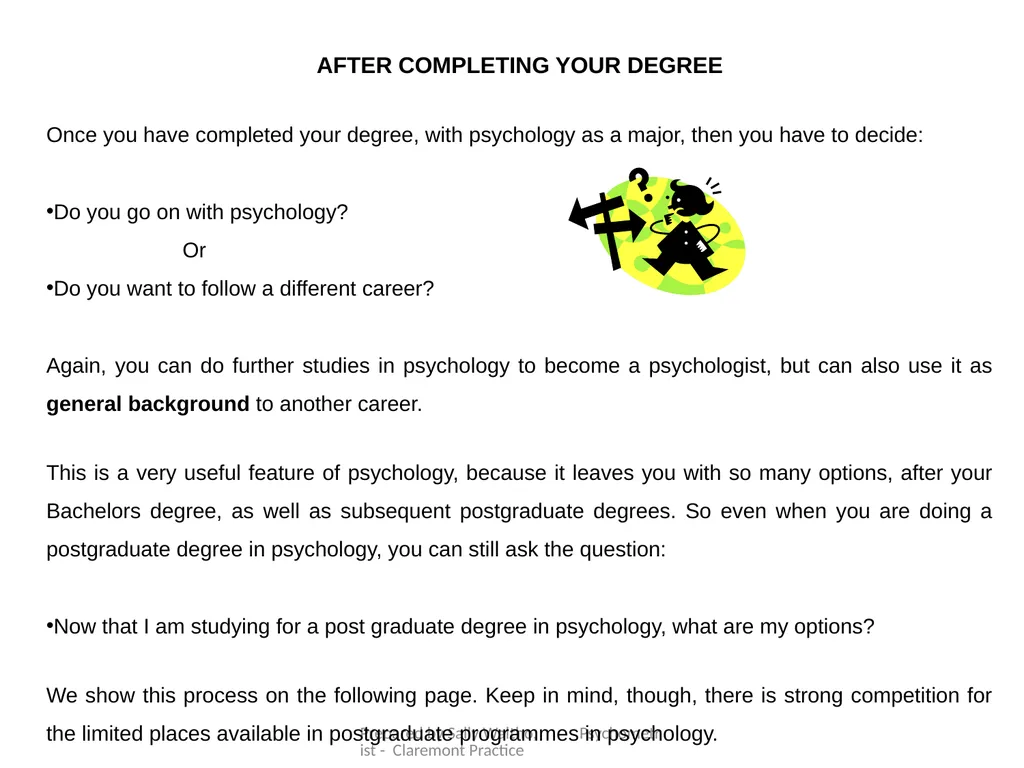
AFTER COMPLETING YOUR DEGREE
Once you have completed your degree, with psychology as a major, then you have to decide:
Do you go on with psychology?
Or
Do you want to follow a different career?
Again, you can do further studies in psychology to become a psychologist, but can also use it as general background to another career.
This is a very useful feature of psychology, because it leaves you with so many options, after your Bachelors degree, as well as subsequent postgraduate degrees. So even when you are doing a postgraduate degree in psychology, you can still ask the question:
Now that I am studying for a post graduate degree in psychology, what are my options?
We show this process on the following page. Keep in mind, though, there is strong competition for the limited places available in postgraduate programmes in psychology. Prepared by Sally Waltho, Psychometrist - Claremont Practice<br>
Once you have completed your degree, with psychology as a major, then you have to decide:
Do you go on with psychology?
Or
Do you want to follow a different career?
Again, you can do further studies in psychology to become a psychologist, but can also use it as general background to another career.
This is a very useful feature of psychology, because it leaves you with so many options, after your Bachelors degree, as well as subsequent postgraduate degrees. So even when you are doing a postgraduate degree in psychology, you can still ask the question:
Now that I am studying for a post graduate degree in psychology, what are my options?
We show this process on the following page. Keep in mind, though, there is strong competition for the limited places available in postgraduate programmes in psychology. Prepared by Sally Waltho, Psychometrist - Claremont Practice<br>
19
NOW I HAVE MY DEGREE WHAT NEXT? B.A. OR BSOC.SCI DEGREE
With a major Psych Look for Employment
Career Options:
Advertising & Marketing
Personnel Work
Facilitator
Researcher Study Further
1. Honours
2 Masters
3. PhD SPECIALIST CAREER IN PSYCHOLOGY!! Prepared by Sally Waltho, Psychometrist - Claremont Practice<br>
With a major Psych Look for Employment
Career Options:
Advertising & Marketing
Personnel Work
Facilitator
Researcher Study Further
1. Honours
2 Masters
3. PhD SPECIALIST CAREER IN PSYCHOLOGY!! Prepared by Sally Waltho, Psychometrist - Claremont Practice<br>
20
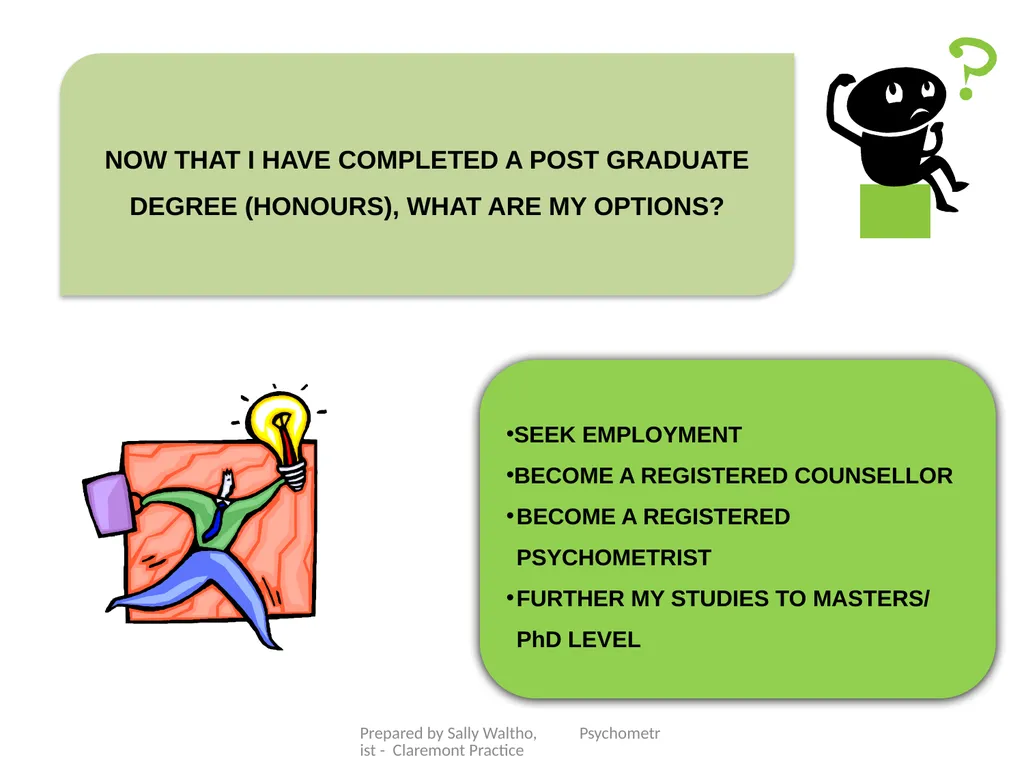
NOW THAT I HAVE COMPLETED A POST GRADUATE DEGREE (HONOURS), WHAT ARE MY OPTIONS? SEEK EMPLOYMENT
BECOME A REGISTERED COUNSELLOR
BECOME A REGISTERED PSYCHOMETRIST
FURTHER MY STUDIES TO MASTERS/ PhD LEVEL Prepared by Sally Waltho, Psychometrist - Claremont Practice<br>
BECOME A REGISTERED COUNSELLOR
BECOME A REGISTERED PSYCHOMETRIST
FURTHER MY STUDIES TO MASTERS/ PhD LEVEL Prepared by Sally Waltho, Psychometrist - Claremont Practice<br>
21
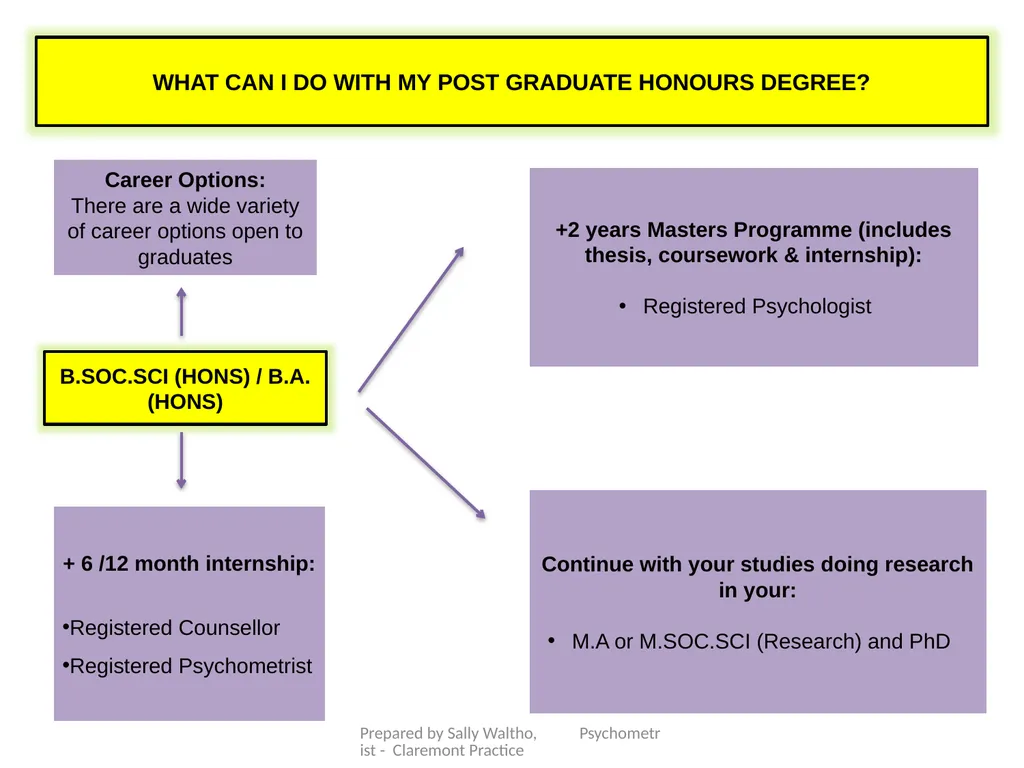
WHAT CAN I DO WITH MY POST GRADUATE HONOURS DEGREE? B.SOC.SCI (HONS) / B.A. (HONS) + 6 /12 month internship:
Registered Counsellor
Registered Psychometrist Career Options:
There are a wide variety of career options open to graduates +2 years Masters Programme (includes thesis, coursework & internship):
Registered Psychologist Continue with your studies doing research in your:
M.A or M.SOC.SCI (Research) and PhD Prepared by Sally Waltho, Psychometrist - Claremont Practice<br>
Registered Counsellor
Registered Psychometrist Career Options:
There are a wide variety of career options open to graduates +2 years Masters Programme (includes thesis, coursework & internship):
Registered Psychologist Continue with your studies doing research in your:
M.A or M.SOC.SCI (Research) and PhD Prepared by Sally Waltho, Psychometrist - Claremont Practice<br>
22
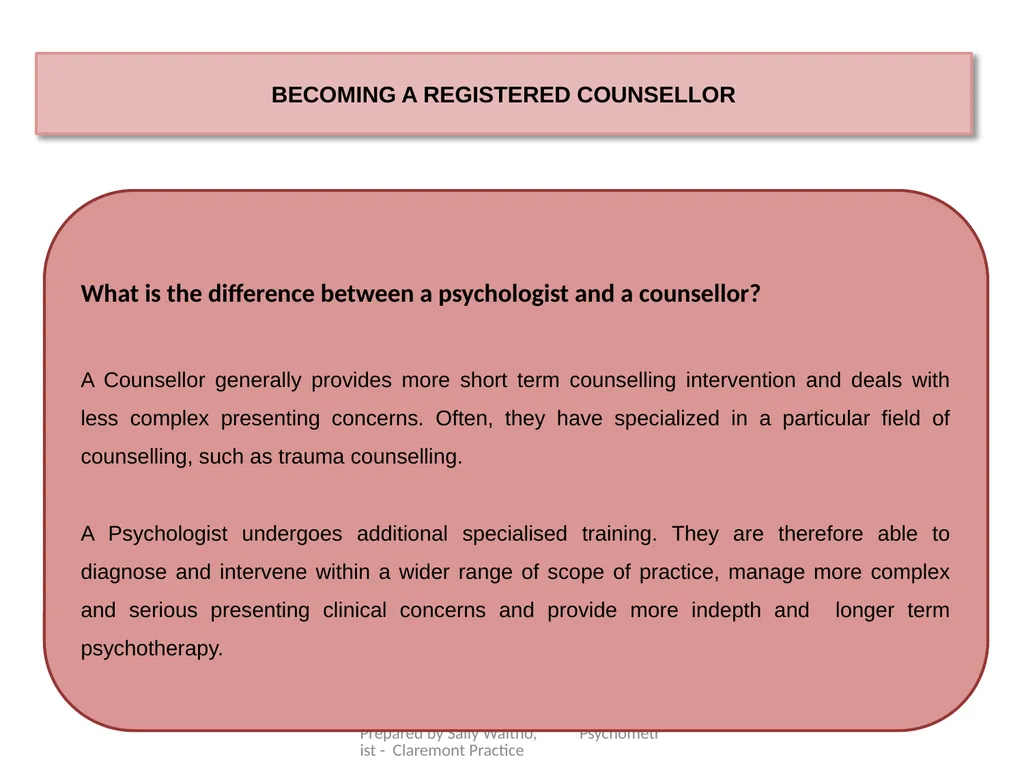
BECOMING A REGISTERED COUNSELLOR What is the difference between a psychologist and a counsellor?
A Counsellor generally provides more short term counselling intervention and deals with less complex presenting concerns. Often, they have specialized in a particular field of counselling, such as trauma counselling.
A Psychologist undergoes additional specialised training. They are therefore able to diagnose and intervene within a wider range of scope of practice, manage more complex and serious presenting clinical concerns and provide more indepth and longer term psychotherapy. Prepared by Sally Waltho, Psychometrist - Claremont Practice<br>
A Counsellor generally provides more short term counselling intervention and deals with less complex presenting concerns. Often, they have specialized in a particular field of counselling, such as trauma counselling.
A Psychologist undergoes additional specialised training. They are therefore able to diagnose and intervene within a wider range of scope of practice, manage more complex and serious presenting clinical concerns and provide more indepth and longer term psychotherapy. Prepared by Sally Waltho, Psychometrist - Claremont Practice<br>
23
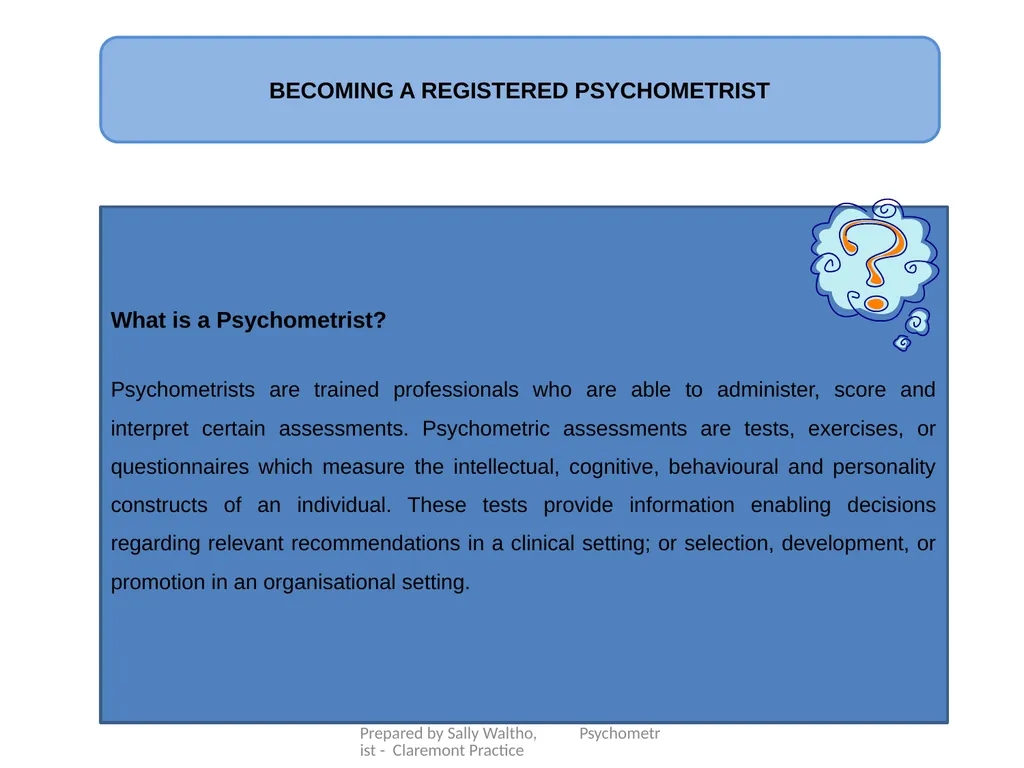
BECOMING A REGISTERED PSYCHOMETRIST What is a Psychometrist?
Psychometrists are trained professionals who are able to administer, score and interpret certain assessments. Psychometric assessments are tests, exercises, or questionnaires which measure the intellectual, cognitive, behavioural and personality constructs of an individual. These tests provide information enabling decisions regarding relevant recommendations in a clinical setting; or selection, development, or promotion in an organisational setting. Prepared by Sally Waltho, Psychometrist - Claremont Practice<br>
Psychometrists are trained professionals who are able to administer, score and interpret certain assessments. Psychometric assessments are tests, exercises, or questionnaires which measure the intellectual, cognitive, behavioural and personality constructs of an individual. These tests provide information enabling decisions regarding relevant recommendations in a clinical setting; or selection, development, or promotion in an organisational setting. Prepared by Sally Waltho, Psychometrist - Claremont Practice<br>
24
Why would I want to become a registered Psychometrist or Counsellor rather than going directly into the Masters Programme to become a registered Psychologist? Masters programmes are exceptionally difficult to get into. The selection process does not only take a student’s grades into account but their age, relevant psychological experience, life experience etc. A lot of students then choose to gain the relevant psychological and life experience through these channels before applying for their Masters. Other students who have applied for their Masters, and were not selected also choose this path to gain experience before applying again.
Lastly, students may realise that they prefer the assessment of different constructs of behaviour rather than the treatment thereof. In such instances, a student may choose the psychometry route where they can work either in their own independent practice or under the supervision of a registered psychologist. Prepared by Sally Waltho, Psychometrist - Claremont Practice<br>
Lastly, students may realise that they prefer the assessment of different constructs of behaviour rather than the treatment thereof. In such instances, a student may choose the psychometry route where they can work either in their own independent practice or under the supervision of a registered psychologist. Prepared by Sally Waltho, Psychometrist - Claremont Practice<br>
25
Counselling Psychologist
Counseling psychologists participate in a range of activities including teaching, research, psychotherapeutic and counselling practice, career development, assessment, supervision, and consultation. They employ a variety of methods closely tied to theory and research to help individuals, groups and organizations function optimally as well as to mediate dysfunction. Interventions may be either brief or long-term; they are often problem-specific and goal-directed. These activities are guided by a philosophy that values individual differences and diversity and a focus on prevention, development, and adjustment across the life-span which includes vocational concerns. CAREERS AS A REGISTERED PSYCHOLOGIST CONT... Prepared by Sally Waltho, Psychometrist - Claremont Practice<br>
Counseling psychologists participate in a range of activities including teaching, research, psychotherapeutic and counselling practice, career development, assessment, supervision, and consultation. They employ a variety of methods closely tied to theory and research to help individuals, groups and organizations function optimally as well as to mediate dysfunction. Interventions may be either brief or long-term; they are often problem-specific and goal-directed. These activities are guided by a philosophy that values individual differences and diversity and a focus on prevention, development, and adjustment across the life-span which includes vocational concerns. CAREERS AS A REGISTERED PSYCHOLOGIST CONT... Prepared by Sally Waltho, Psychometrist - Claremont Practice<br>
26
CAREERS AS A REGISTERED PSYCHOLOGIST...CONT Clinical Psychologists
Like Counselling psychologists, Clinical psychologists aim to reduce psychological distress and to enhance and promote psychological well-being. They deal with a number of mental and physical problems including anxiety, depression, addiction and relationship problems. To assess clients, they use a variety of methods including psychometric tests, interview and observation and work primarily in health and social care settings including hospitals and community mental health teams. Due to their role as a scientist-practitioner they are also involved heavily with research and in evaluation of current services to provide a strong evidence base for practice. Prepared by Sally Waltho, Psychometrist - Claremont Practice<br>
Like Counselling psychologists, Clinical psychologists aim to reduce psychological distress and to enhance and promote psychological well-being. They deal with a number of mental and physical problems including anxiety, depression, addiction and relationship problems. To assess clients, they use a variety of methods including psychometric tests, interview and observation and work primarily in health and social care settings including hospitals and community mental health teams. Due to their role as a scientist-practitioner they are also involved heavily with research and in evaluation of current services to provide a strong evidence base for practice. Prepared by Sally Waltho, Psychometrist - Claremont Practice<br>
27
The Difference between a Clinical and Counselling Psychologist?
There is considerable overlap between counselling and clinical psychology. Traditionally however, the main difference between counselling and clinical psychology is their perspective and training. Counselling psychologists, in general, focus more on healthier, less pathological populations whereas Clinical psychologists focus on individuals with more serious mental health issues such as personality disorders and psychosis.. CAREERS AS A REGISTERED PSYCHOLOGIST CONT... Prepared by Sally Waltho, Psychometrist - Claremont Practice<br>
There is considerable overlap between counselling and clinical psychology. Traditionally however, the main difference between counselling and clinical psychology is their perspective and training. Counselling psychologists, in general, focus more on healthier, less pathological populations whereas Clinical psychologists focus on individuals with more serious mental health issues such as personality disorders and psychosis.. CAREERS AS A REGISTERED PSYCHOLOGIST CONT... Prepared by Sally Waltho, Psychometrist - Claremont Practice<br>
28
Educational Psychologist
This is an exciting field of work in which the focus is on the optimal emotional, cognitive and educational development of the child/adult in his or her environment. The work of an Educational psychologist includes psychological and scholastic assessment of children/adults who are experiencing emotional and /or academic problems or barriers to learning and development. Such work may include play therapy or counselling, and parent education and counselling. Also, work with teachers, parents / caregivers and communities plays an important role since all levels of the child’s environment are considered too. CAREERS AS A REGISTERED PSYCHOLOGIST... CONT Prepared by Sally Waltho, Psychometrist - Claremont Practice<br>
This is an exciting field of work in which the focus is on the optimal emotional, cognitive and educational development of the child/adult in his or her environment. The work of an Educational psychologist includes psychological and scholastic assessment of children/adults who are experiencing emotional and /or academic problems or barriers to learning and development. Such work may include play therapy or counselling, and parent education and counselling. Also, work with teachers, parents / caregivers and communities plays an important role since all levels of the child’s environment are considered too. CAREERS AS A REGISTERED PSYCHOLOGIST... CONT Prepared by Sally Waltho, Psychometrist - Claremont Practice<br>
29
CAREERS AS A REGISTERED PSYCHOLOGIST CONT... Research Psychologist
For persons who are interested in psychology as the scientific study of human behaviour, rather than in the applied field of therapy, there is the possibility of a directed MA degree in Research Psychology. The aim here is to train social scientists as researchers and as consultants in the general area of psychological and social science research. This will enable them to pursue a career in industry, commerce, universities or public institutions in various research-related fields.
It is of relevance to persons contemplating a career in, for example,
marketing, management, or information technology. There is a selection
process for a limited number of places Prepared by Sally Waltho, Psychometrist - Claremont Practice<br>
For persons who are interested in psychology as the scientific study of human behaviour, rather than in the applied field of therapy, there is the possibility of a directed MA degree in Research Psychology. The aim here is to train social scientists as researchers and as consultants in the general area of psychological and social science research. This will enable them to pursue a career in industry, commerce, universities or public institutions in various research-related fields.
It is of relevance to persons contemplating a career in, for example,
marketing, management, or information technology. There is a selection
process for a limited number of places Prepared by Sally Waltho, Psychometrist - Claremont Practice<br>
30
FOR THOSE OF YOU WHO HAVE CHOSEN YOUR FIELD OF PSYCHOLOGY AS YOUR FUTURE FIELD GOOD LUCK AND ENJOY EVERY MINUTE OF IT!! Prepared by Sally Waltho, Psychometrist - Claremont Practice<br>
31
Prepared by Sally Waltho, Psychometrist - Claremont Practice References:
http://www.medicalnewstoday.com/articles/154874.php
http://en.wikipedia.org/wiki/Life_coach#Life_coaching
http://psychology.about.com/od/historyofpsychology/a/schoolsthought.htm
http://www.uct.ac.za/apply/student/undergradpros/
http://web.uct.ac.za/depts/psychology/starting.pdf
http://www.jobs.co.za/job-seekers/career-advice/article/98/understanding-psychometric-assessments
http://www.harleytherapy.co.uk/counselling/counselling-psychologist-clinical-psychologist.htm
http://www.unisa.ac.za/Default.asp?Cmd=ViewContent&ContentID=13555<br>
http://www.medicalnewstoday.com/articles/154874.php
http://en.wikipedia.org/wiki/Life_coach#Life_coaching
http://psychology.about.com/od/historyofpsychology/a/schoolsthought.htm
http://www.uct.ac.za/apply/student/undergradpros/
http://web.uct.ac.za/depts/psychology/starting.pdf
http://www.jobs.co.za/job-seekers/career-advice/article/98/understanding-psychometric-assessments
http://www.harleytherapy.co.uk/counselling/counselling-psychologist-clinical-psychologist.htm
http://www.unisa.ac.za/Default.asp?Cmd=ViewContent&ContentID=13555<br>