SUBJECT- BUSINESS COMMUNICATION CHAPTER NAME- TYPES OF COMMUNICATION SEMESTER-II SECTION- 2A TEACHERS NAME- PUJA GUPTA TYPES OF COMMUNICATION On the basis of organizational relationship Formal communication Informal communication On the
Related Topics
Share
Embed code
Download this presentation From Below
"SUBJECT- BUSINESS COMMUNICATION CHAPTER NAME-" is the property of its rightful owner. Permission is granted to
download and print the materials on this website for personal, non-commercial use only, and to display it
on your personal computer provided you do not modify the materials and that you retain all copyright
notices contained in the materials. By downloading content from our website, you accept the terms of this
agreement.
Presentation Transcript
01
SUBJECT- BUSINESS COMMUNICATION CHAPTER NAME- TYPES OF COMMUNICATION
SEMESTER-II
SECTION- 2A
TEACHER’S NAME- PUJA GUPTA<br>
02
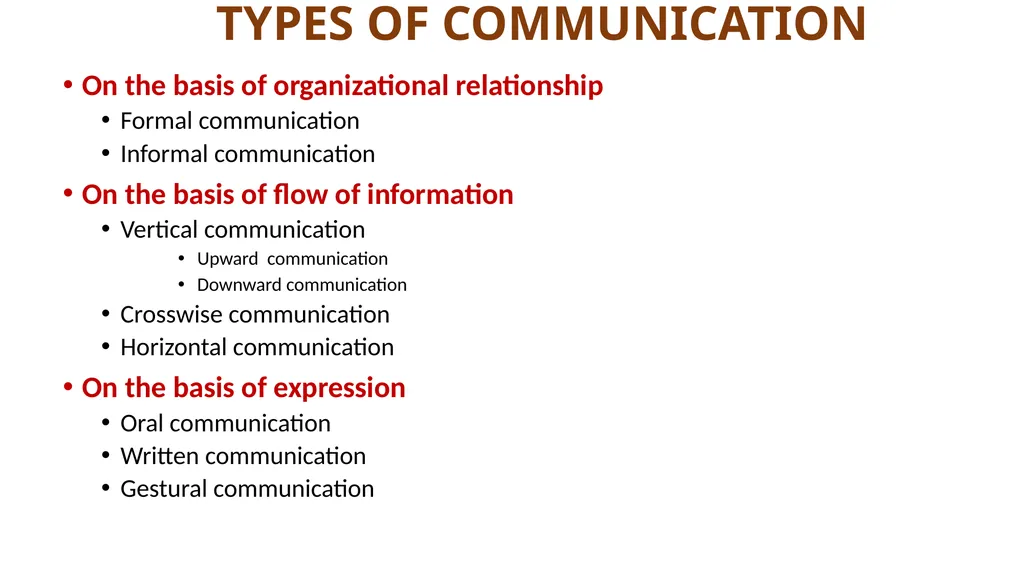
TYPES OF COMMUNICATION On the basis of organizational relationship
Formal communication
Informal communication
On the basis of flow of information
Vertical communication
Upward communication
Downward communication
Crosswise communication
Horizontal communication
On the basis of expression
Oral communication
Written communication
Gestural communication<br>
03
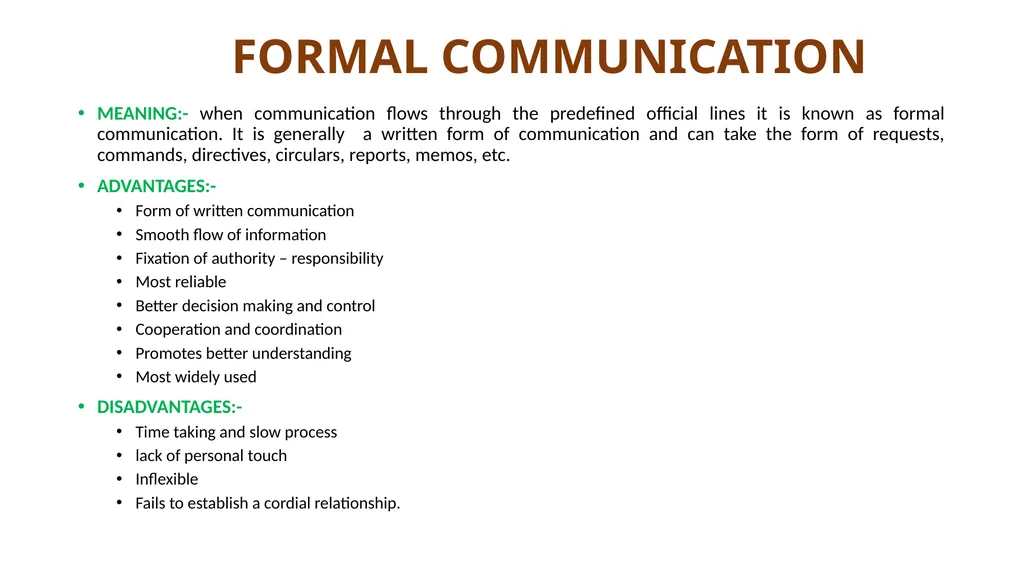
FORMAL COMMUNICATION MEANING:- when communication flows through the predefined official lines it is known as formal communication. It is generally a written form of communication and can take the form of requests, commands, directives, circulars, reports, memos, etc.
ADVANTAGES:-
Form of written communication
Smooth flow of information
Fixation of authority – responsibility
Most reliable
Better decision making and control
Cooperation and coordination
Promotes better understanding
Most widely used
DISADVANTAGES:-
Time taking and slow process
lack of personal touch
Inflexible
Fails to establish a cordial relationship.<br>
04
INFORMAL COMMUNICATION MEANING:- informal communication is free from official rules and regulations and takes place due to personal needs of the sender and receiver of the message. It is also known as Grapevine communication.
ADVANTAGES:-
Increase employee satisfaction
Increase efficiency
Reducing employees’ stress
Satisfies the social and psychological needs
Get a clear understanding about the attitude and response of the employees
Bridges the gap in the formal communication network
Greater flexibility
DISADVANTAGES:-
Spread of distorted messages
Leads to rumours
Fixation of responsibility is not possible
Leads to misunderstanding and misrepresentation of information.<br>
05
VERTICAL COMMUNICATION( DOWNWARD) MEANING:- downward communication refers to the flow of messages from a supervisor to subordinates. In downward communication information flows in the form of orders, instructions, decisions, etc. from individuals in higher hierarchical levels to individuals in lower level following the line of authority.
ADVANTAGES:-
Informing and explaining policies and organizational procedures
Scalar principle
Message is continuous
Delegation of authority and responsibility
Establishing official discipline
increase employee efficiency
DISADVANTAGES:-
Delay the timely functioning of an organization
Distortion of message
Over communication or under communication
Contains subject matter without adequate explanation
Labour management relationship may be hampered.<br>
06
UPWARD COMMUNICATION MEANING:- Upward communication implies the flow of information from the individual in a lower hierarchical level to individual in a higher hierarchical level that is from subordinates to superiors in the organization.
ADVANTAGES:-
Greater feedback
Constructive suggestions for the progress on the organization
Industrial peace
Loyalty and commitment
Helps the management in decision making process
Change in organizational rules, regulations and policies
DISADVANTAGES:-
Message may get distorted
Strained relationship
Employees fear that their suggestion treated as their weakness.<br>
07
HORIZONTAL COMMUNICATION MEANING:- Horizontal communication refers to flow of information between individual and groups belonging to the same or different department but belong to the same hierarchical level of an organization.
ADVANTAGES:-
Reduce misunderstanding between individuals
Resolving conflicts
Increase efficiency and productivity
Helps in building cooperation and a friendly work environment
DISADVANTAGES:-
Minimise the control and power of the management of an organization
Rise to conflicts, intergroup rivalry and gossips
Leads to disorder in the organization.<br>
08
DIAGONAL OR CROSSWISE COMMUNICATION MEANING:-Diagonal communication refers to the flow of information between individuals of an organization who do not belong to the same department or same hierarchical level.
ADVANTAGES:-
faster transmission of message
Increase coordination
Improving mutual understanding between superiors and subordinates
Increase in the morale
DISADVANTAGES:-
Time consuming
Rise to create misunderstandings and conflicts
Subordinates may hesitate to make commitment beyond their authority.<br>
09
ORAL COMMUNICATION MEANING:- oral communication means transmission of message from the communicator to the communicate through spoken words , which may be through face to face contact or by the use of some mechanical devices.
ADVANTAGES:-
Faster transmission of message
Greater understanding
Personal contact
Create a healthy working environment
Flexible
Helps in building inter personal relationship between superior to the subordinates
Communicating confidential information
DISADVANTAGES:-
Not suitable for communicating lengthy messages
Not suitable for communicating to a large number of receivers at a time
Absence of active listening
Message being filtered or getting distorted.<br>
10
WRITTEN COMMUNICATION MEANING:- written communication refers to transmission of information through written letters, circulars, memos, orders, reports, bulletins etc.. Thus in the case if written words are the basis of sending messages , orders, instructions etc.
ADVANTAGES:-
Provide documentary evidence
Communicator can reach simultaneously to many receivers of a message
Communicating lengthy message
More effective
Precise and very accurate
Using statistical data and pictorial presentations
Uniformly applicable
DISADVANTAGES:-
Time consuming and costly
Lack of personal touch
It make the communication process clumsy.<br>
11
GESTURAL COMMUNICATION MEANING:- It is communication through body language like facial expression, movements of the head, tone of voice or even smile. It is a combination of oral and written communication.
ADVANTAGES:-
Faster and more effective
Substitute if verbal communication that is where silence speaks better than words
DISADVANTAGES:-
Communication tends to be unclear
Not applicable for transmission of official information.<br>
12
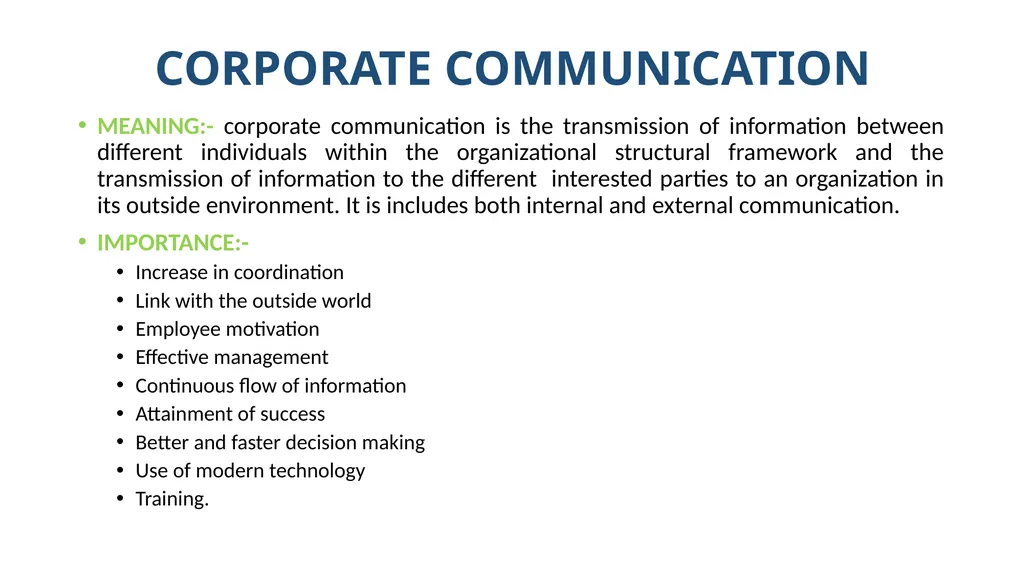
CORPORATE COMMUNICATION MEANING:- corporate communication is the transmission of information between different individuals within the organizational structural framework and the transmission of information to the different interested parties to an organization in its outside environment. It is includes both internal and external communication.
IMPORTANCE:-
Increase in coordination
Link with the outside world
Employee motivation
Effective management
Continuous flow of information
Attainment of success
Better and faster decision making
Use of modern technology
Training.<br>
13
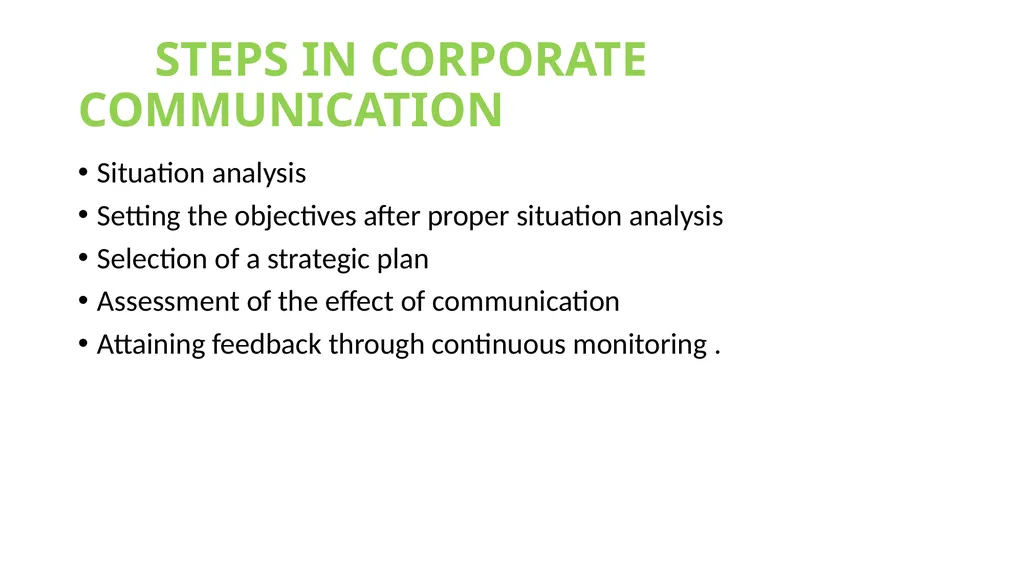
STEPS IN CORPORATE COMMUNICATION Situation analysis
Setting the objectives after proper situation analysis
Selection of a strategic plan
Assessment of the effect of communication
Attaining feedback through continuous monitoring .<br>