Submarine Powering and Seakeeping Sections 10.4-10.7 Submarine Curve of Intact Stability Submarine Curve of Intact Stability Since B does not move submerged, G must be below B to maintain positive stability Submarine Intact Stability Since
"Submarine Powering and Seakeeping Sections" is the property of its rightful owner. Permission is granted to
download and print the materials on this website for personal, non-commercial use only, and to display it
on your personal computer provided you do not modify the materials and that you retain all copyright
notices contained in the materials. By downloading content from our website, you accept the terms of this
agreement.
Presentation Transcript
01
Submarine Powering and Seakeeping Sections 10.4-10.7<br>
02
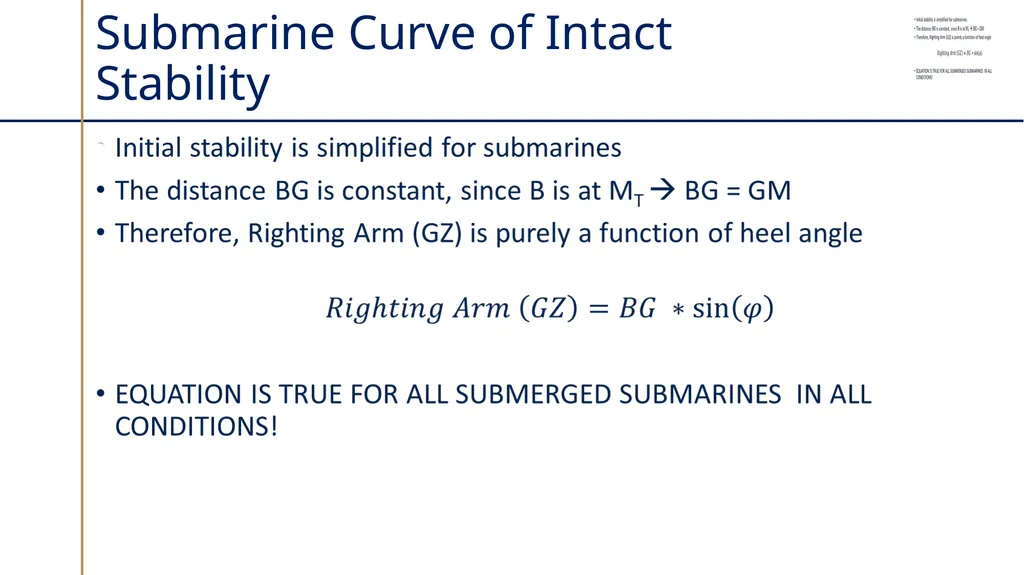
Submarine Curve of Intact Stability<br>
03
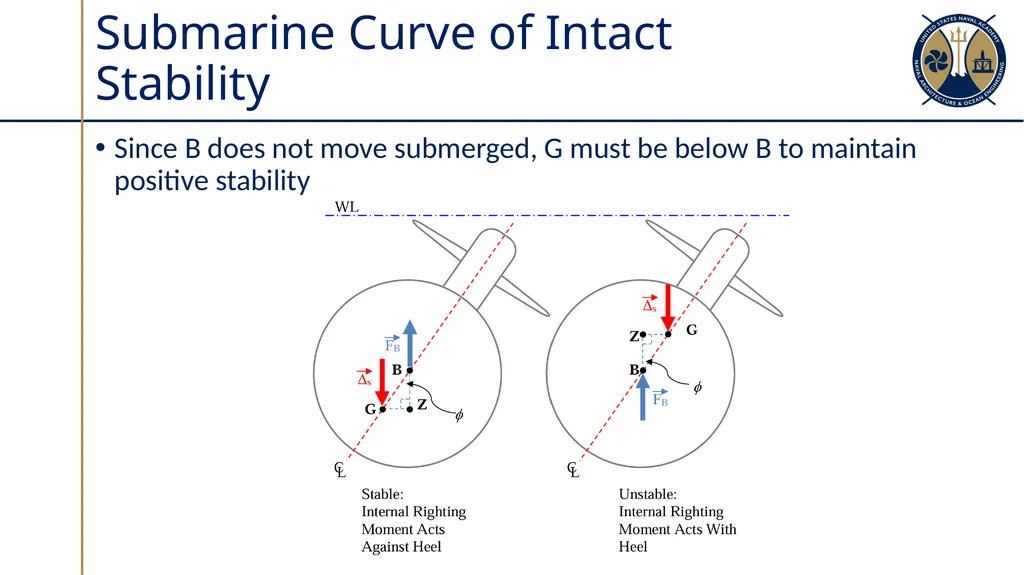
Submarine Curve of Intact Stability Since B does not move submerged, G must be below B to maintain positive stability<br>
04
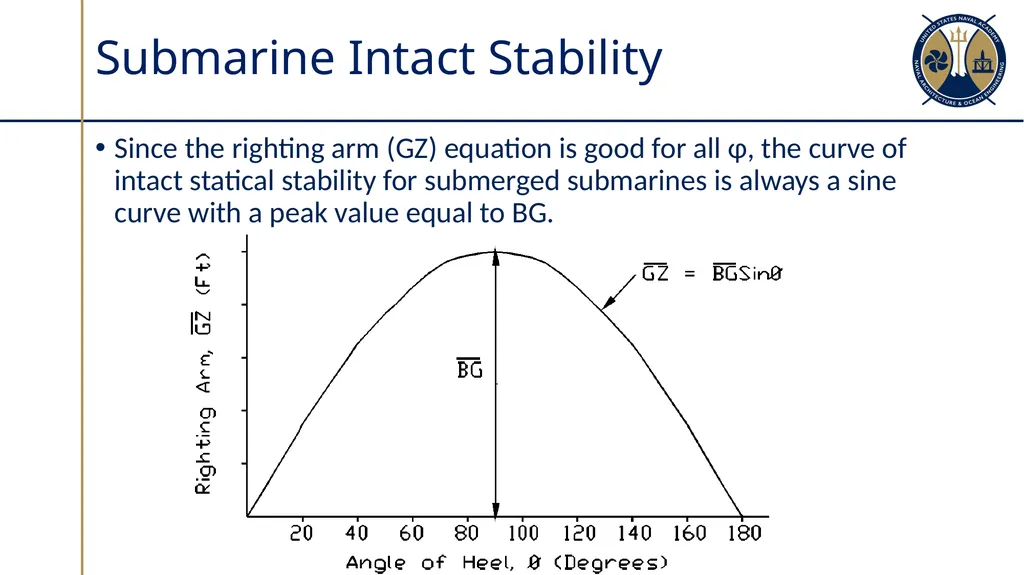
Submarine Intact Stability Since the righting arm (GZ) equation is good for all φ, the curve of intact statical stability for submerged submarines is always a sine curve with a peak value equal to BG.<br>
05
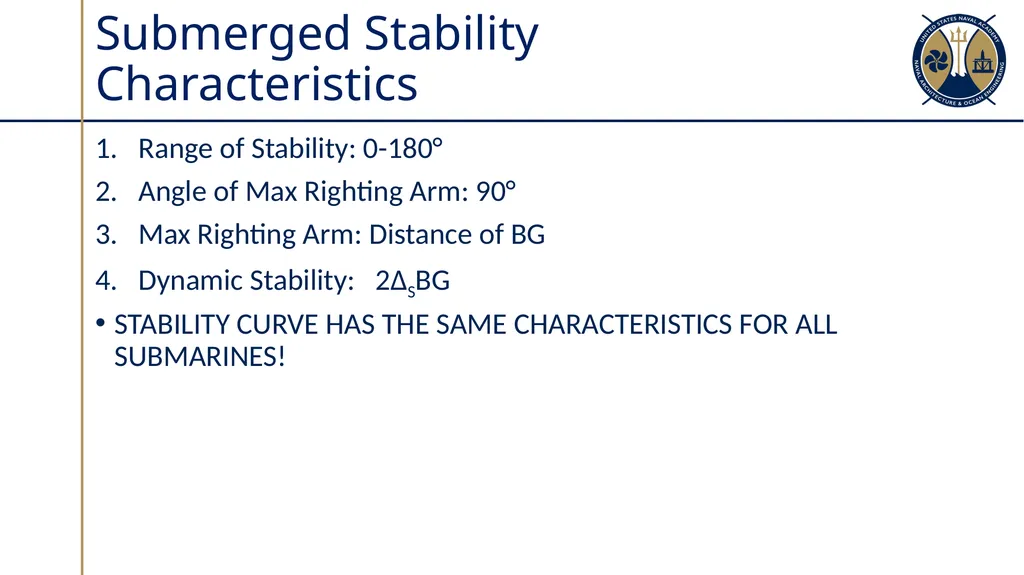
Submerged Stability Characteristics Range of Stability: 0-180°
Angle of Max Righting Arm: 90°
Max Righting Arm: Distance of BG
Dynamic Stability: 2ΔSBG
STABILITY CURVE HAS THE SAME CHARACTERISTICS FOR ALL SUBMARINES!<br>
06
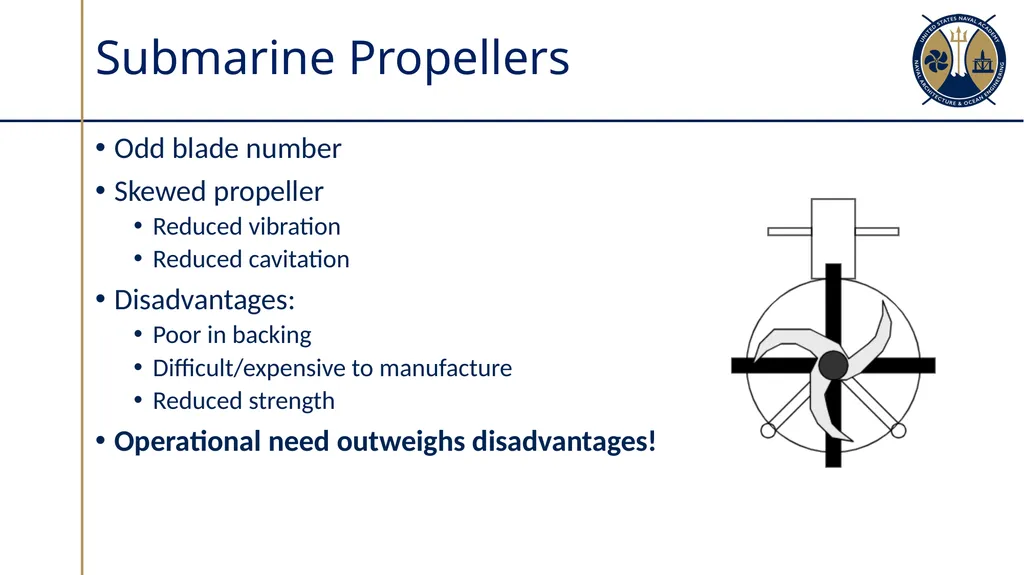
Submarine Propellers Odd blade number
Skewed propeller
Reduced vibration
Reduced cavitation
Disadvantages:
Poor in backing
Difficult/expensive to manufacture
Reduced strength
Operational need outweighs disadvantages!<br>
07
Submarine Seakeeping Subjected to same forces and moments as surface ships:
3 translational - surge, sway, and heave
3 rotational - roll, pitch, and yaw
Recall (from Chapter 8) heave, pitch, and roll are simple harmonic motions because of the linear restoring force
If ωe = Natural Frequency Resonance
Amplitudes maximized (particularly roll which is sharply tuned)
Surface wave action diminishes exponentially with increasing depth, but can still be an issue in big storms<br>
08
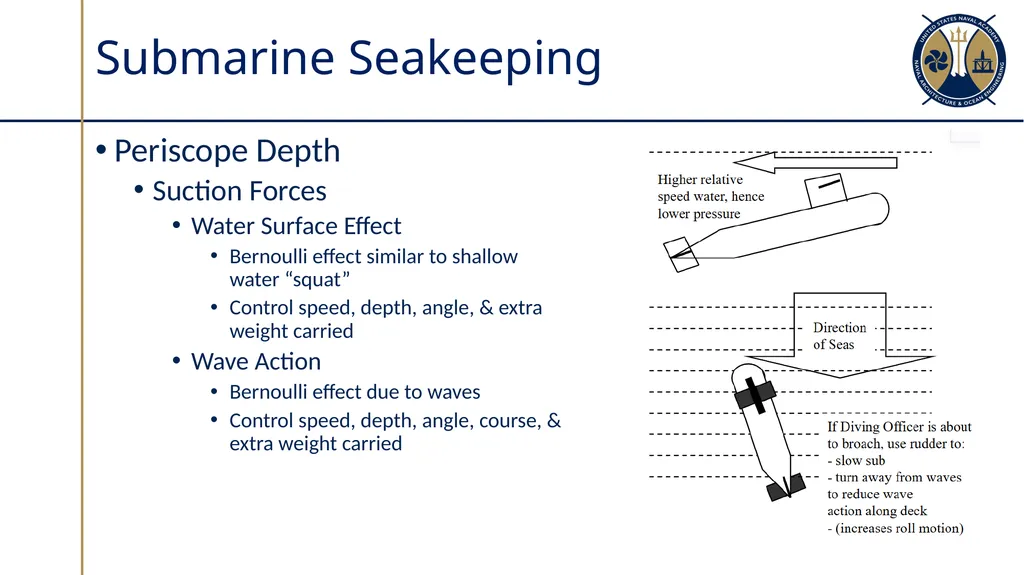
Submarine Seakeeping Periscope Depth
Suction Forces
Water Surface Effect
Bernoulli effect similar to shallow water “squat”
Control speed, depth, angle, & extra weight carried
Wave Action
Bernoulli effect due to waves
Control speed, depth, angle, course, & extra weight carried<br>
09
Submarine Maneuvering and Control Goal:
Achieve Neutral Buoyancy Hydrostatically
Drive the Boat Hydrodynamically
Lateral motion controlled with rudder, engines, and propeller
Depth control accomplished by:
Making the buoyant force equal the submarine displacement as in previous section
Finer and more positive control achieved by planes, angle, and speed<br>
10
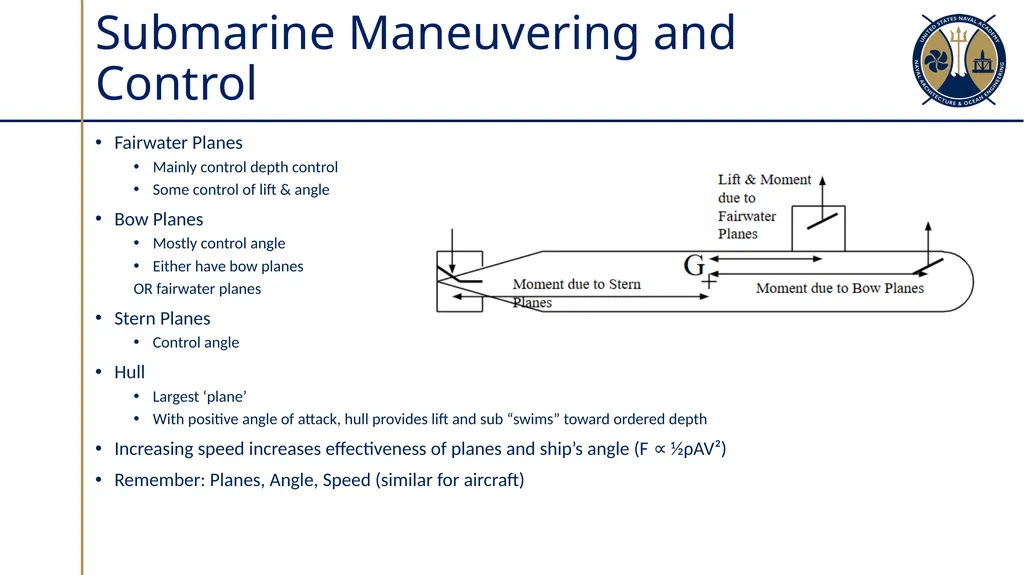
Submarine Maneuvering and Control Fairwater Planes
Mainly control depth control
Some control of lift & angle
Bow Planes
Mostly control angle
Either have bow planes
OR fairwater planes
Stern Planes
Control angle
Hull
Largest ‘plane’
With positive angle of attack, hull provides lift and sub “swims” toward ordered depth
Increasing speed increases effectiveness of planes and ship’s angle (F ∝ ½ρAV²)
Remember: Planes, Angle, Speed (similar for aircraft)<br>
11
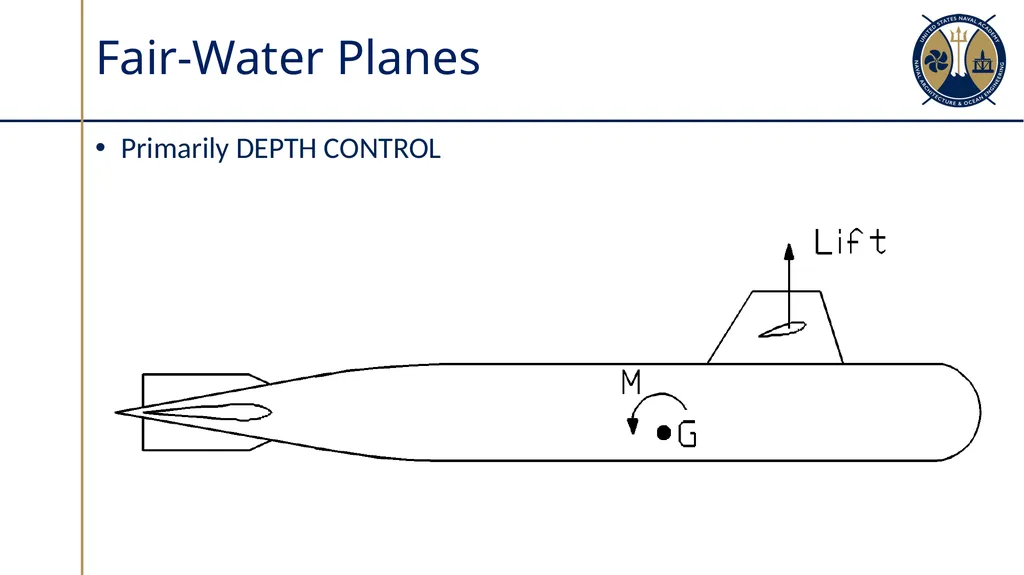
Fair-Water Planes Primarily DEPTH CONTROL<br>
12
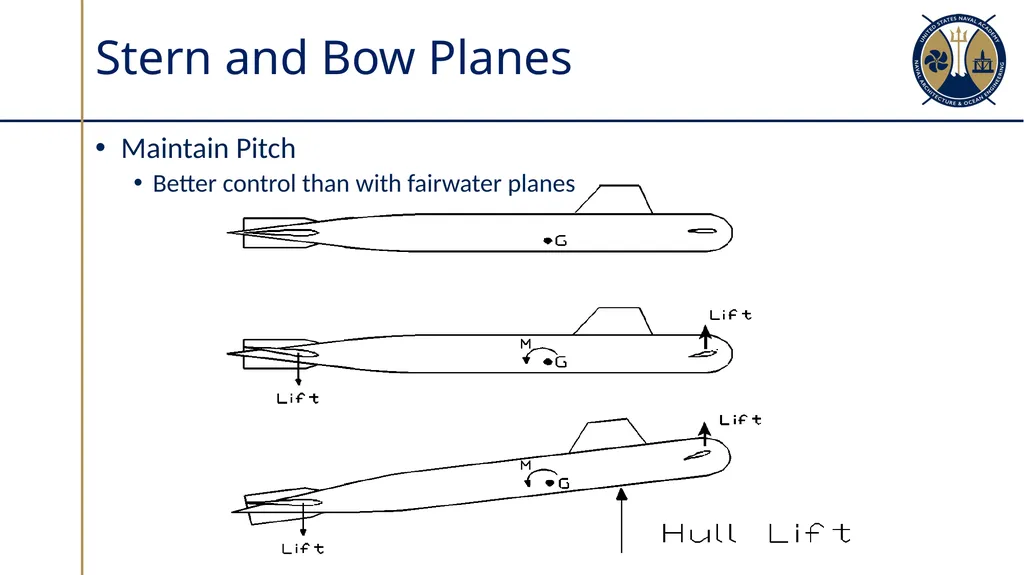
Stern and Bow Planes Maintain Pitch
Better control than with fairwater planes<br>
13
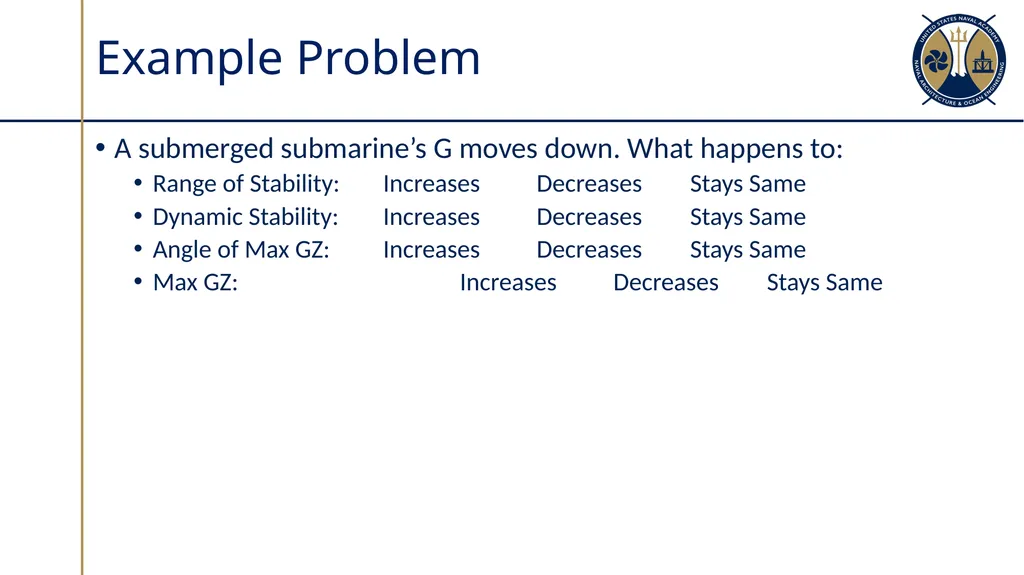
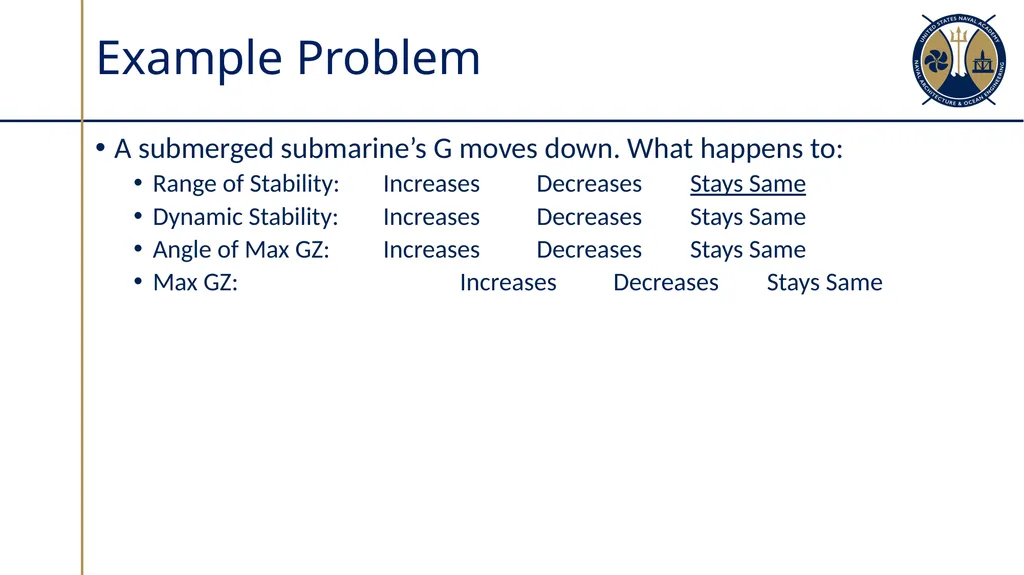
Example Problem A submerged submarine’s G moves down. What happens to:
Range of Stability: Increases Decreases Stays Same
Dynamic Stability: Increases Decreases Stays Same
Angle of Max GZ: Increases Decreases Stays Same
Max GZ: Increases Decreases Stays Same<br>
14
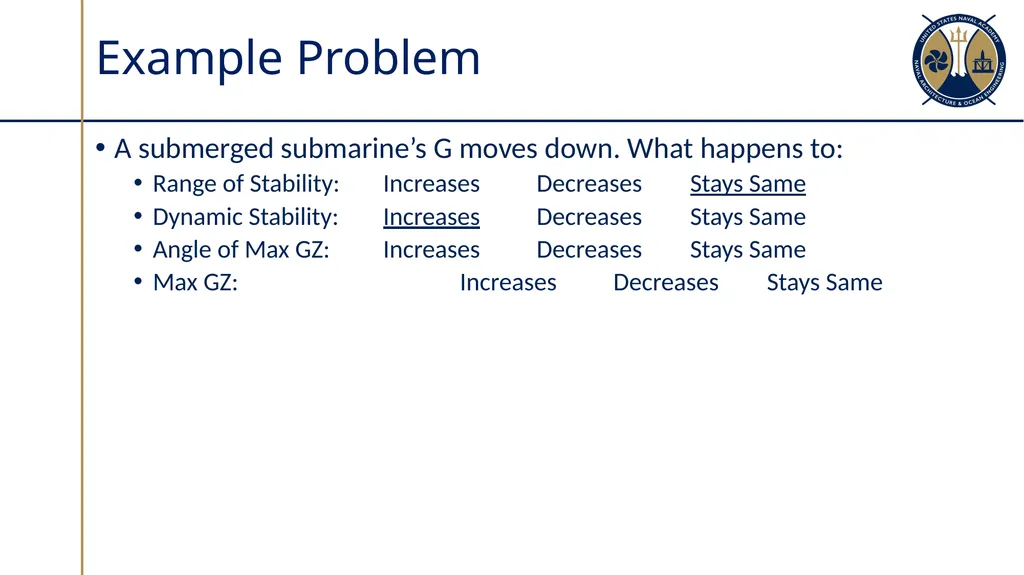
Example Problem A submerged submarine’s G moves down. What happens to:
Range of Stability: Increases Decreases Stays Same
Dynamic Stability: Increases Decreases Stays Same
Angle of Max GZ: Increases Decreases Stays Same
Max GZ: Increases Decreases Stays Same<br>
15
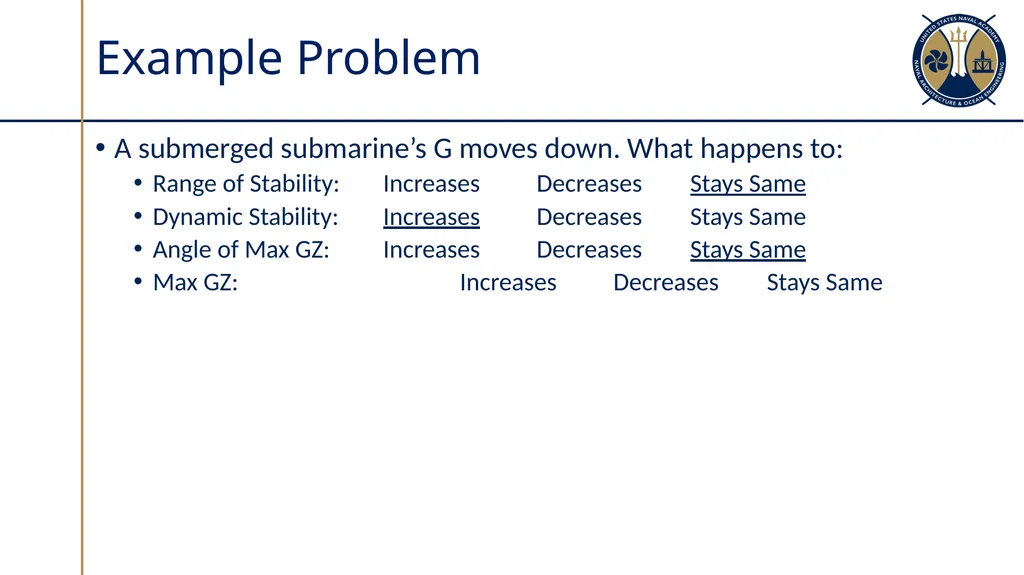
Example Problem A submerged submarine’s G moves down. What happens to:
Range of Stability: Increases Decreases Stays Same
Dynamic Stability: Increases Decreases Stays Same
Angle of Max GZ: Increases Decreases Stays Same
Max GZ: Increases Decreases Stays Same<br>
16
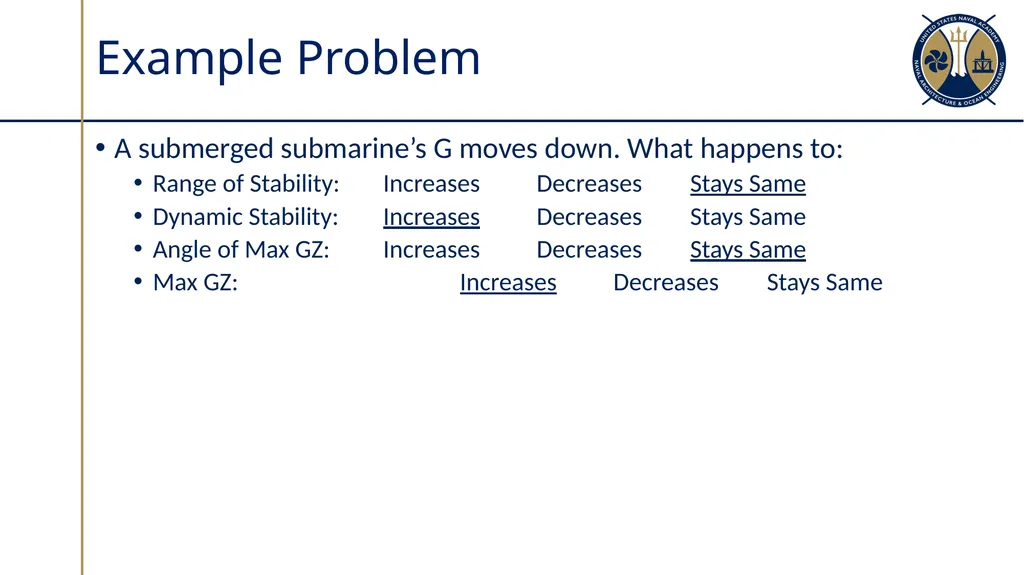
Example Problem A submerged submarine’s G moves down. What happens to:
Range of Stability: Increases Decreases Stays Same
Dynamic Stability: Increases Decreases Stays Same
Angle of Max GZ: Increases Decreases Stays Same
Max GZ: Increases Decreases Stays Same<br>
17
Example Problem A submerged submarine’s G moves down. What happens to:
Range of Stability: Increases Decreases Stays Same
Dynamic Stability: Increases Decreases Stays Same
Angle of Max GZ: Increases Decreases Stays Same
Max GZ: Increases Decreases Stays Same<br>