
Submitted by Ms. SARITA GULATI ICT Concepts &
KB
Published · 28 slides · 0 views

1 / 1


Description
Submitted by Ms. SARITA GULATI ICT Concepts Characteristics, Importance Information and Communication Technology ICT is an acronym that stands for Information and Communication Technology. (to communicate the information using the
Related Topics
Share
Embed code
Download this presentation From Below
"Submitted by Ms. SARITA GULATI ICT Concepts &" is the property of its rightful owner. Permission is granted to download and print the materials on this website for personal, non-commercial use only, and to display it on your personal computer provided you do not modify the materials and that you retain all copyright notices contained in the materials. By downloading content from our website, you accept the terms of this agreement.
Presentation Transcript
01
Submitted by
Ms. SARITA GULATI ICT Concepts & Characteristics, Importance<br>
Ms. SARITA GULATI ICT Concepts & Characteristics, Importance<br>
02
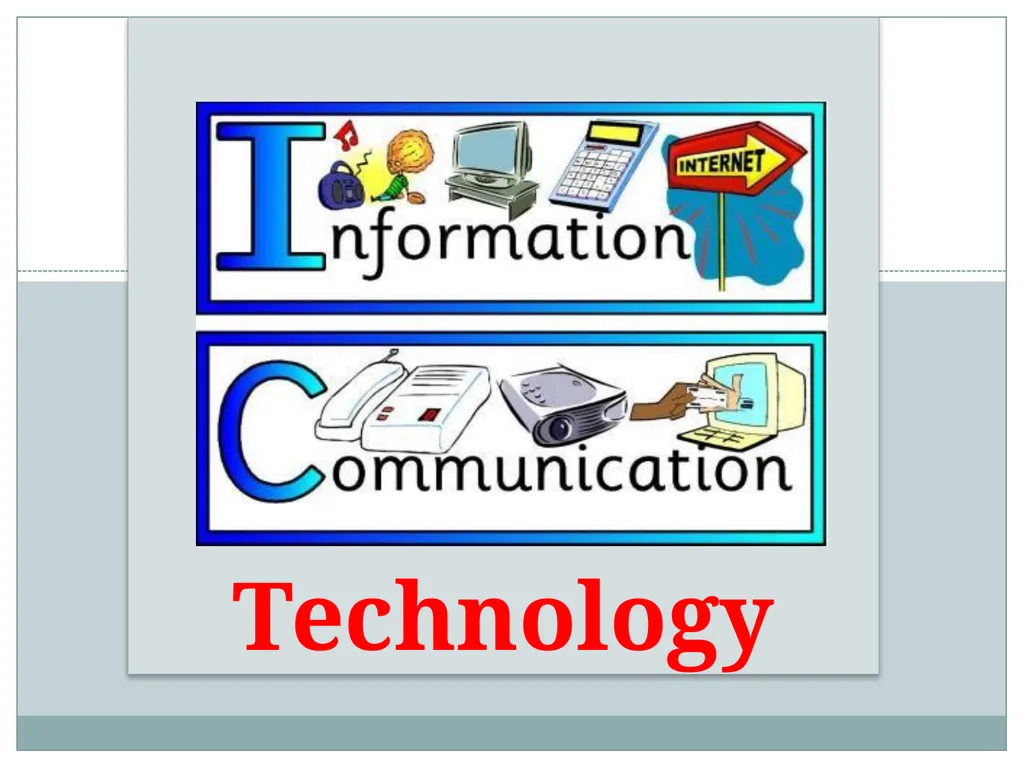
Information
and
Communication
Technology<br>
03
ICT is an acronym that stands for Information and Communication Technology.
(to communicate the information using the technology )<br>
(to communicate the information using the technology )<br>
04
INFORMATION<br>
05
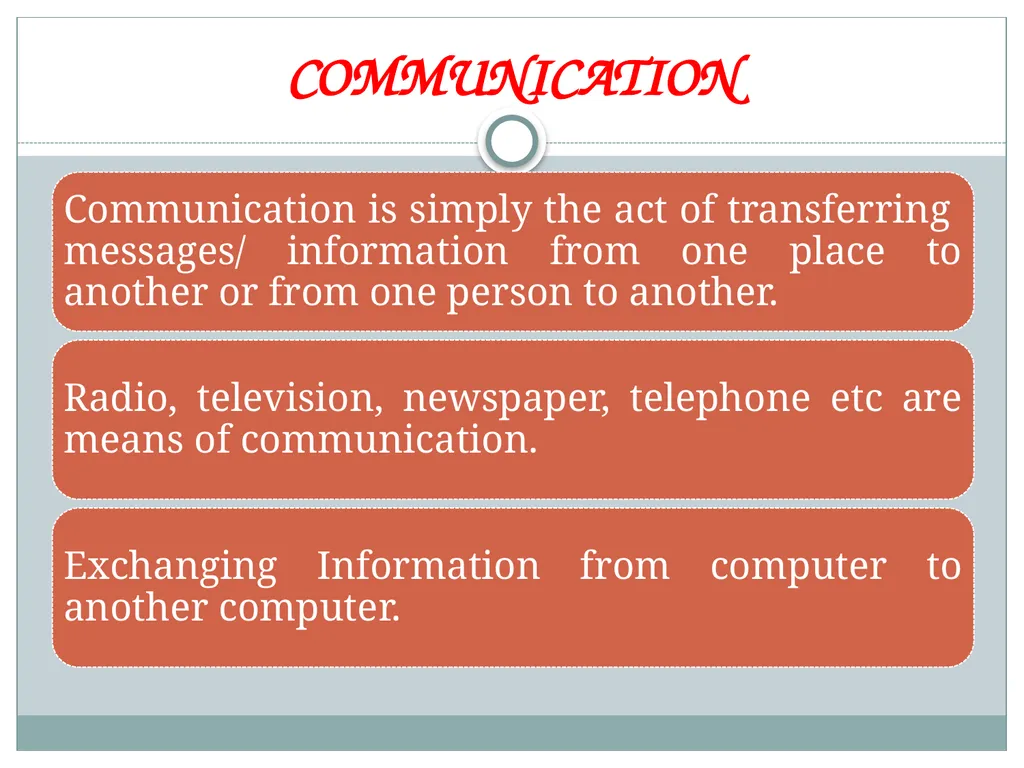
COMMUNICATION<br>
06
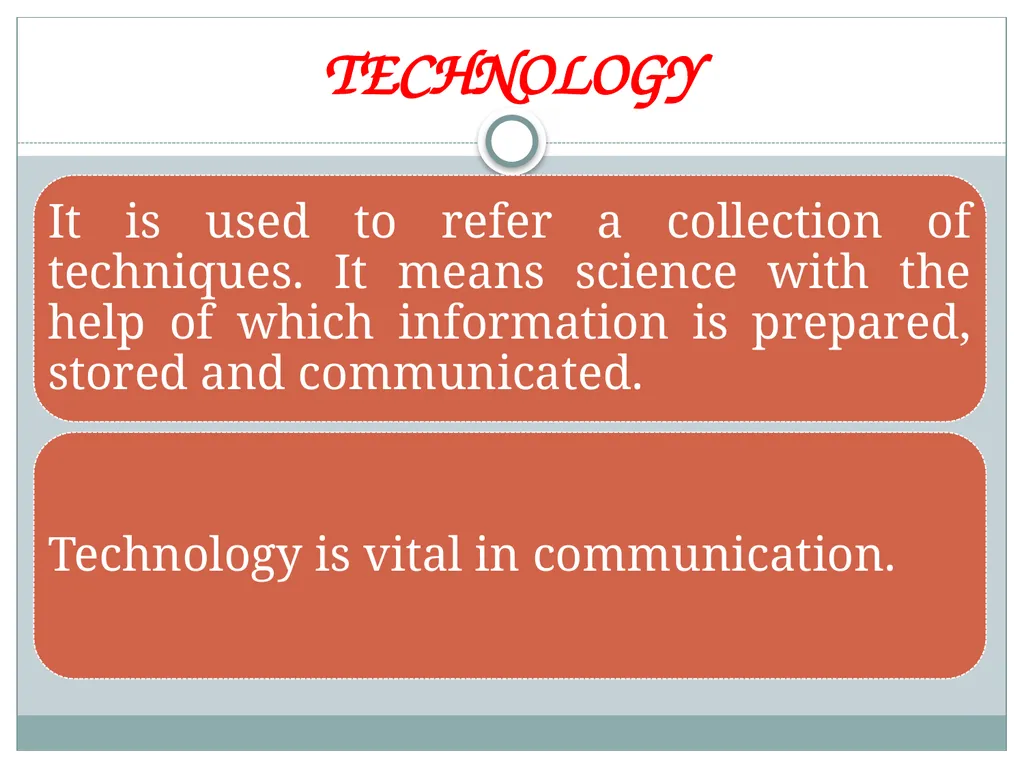
TECHNOLOGY<br>
07
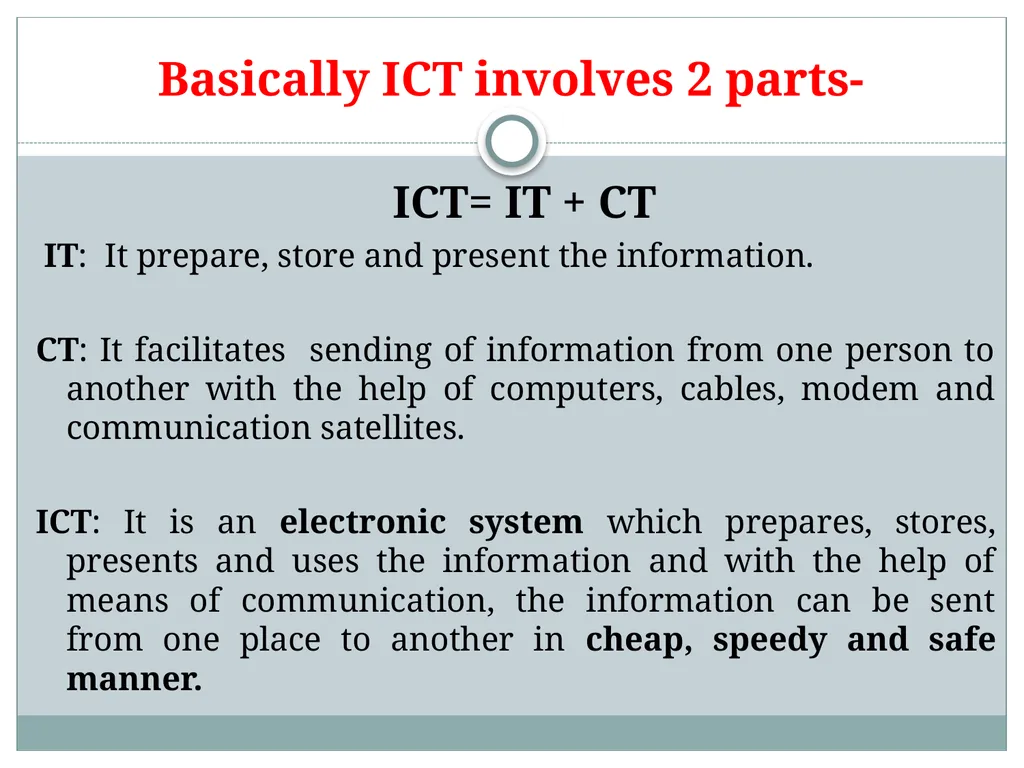
Basically ICT involves 2 parts- ICT= IT + CT
IT: It prepare, store and present the information.
CT: It facilitates sending of information from one person to another with the help of computers, cables, modem and communication satellites.
ICT: It is an electronic system which prepares, stores, presents and uses the information and with the help of means of communication, the information can be sent from one place to another in cheap, speedy and safe manner.<br>
IT: It prepare, store and present the information.
CT: It facilitates sending of information from one person to another with the help of computers, cables, modem and communication satellites.
ICT: It is an electronic system which prepares, stores, presents and uses the information and with the help of means of communication, the information can be sent from one place to another in cheap, speedy and safe manner.<br>
08
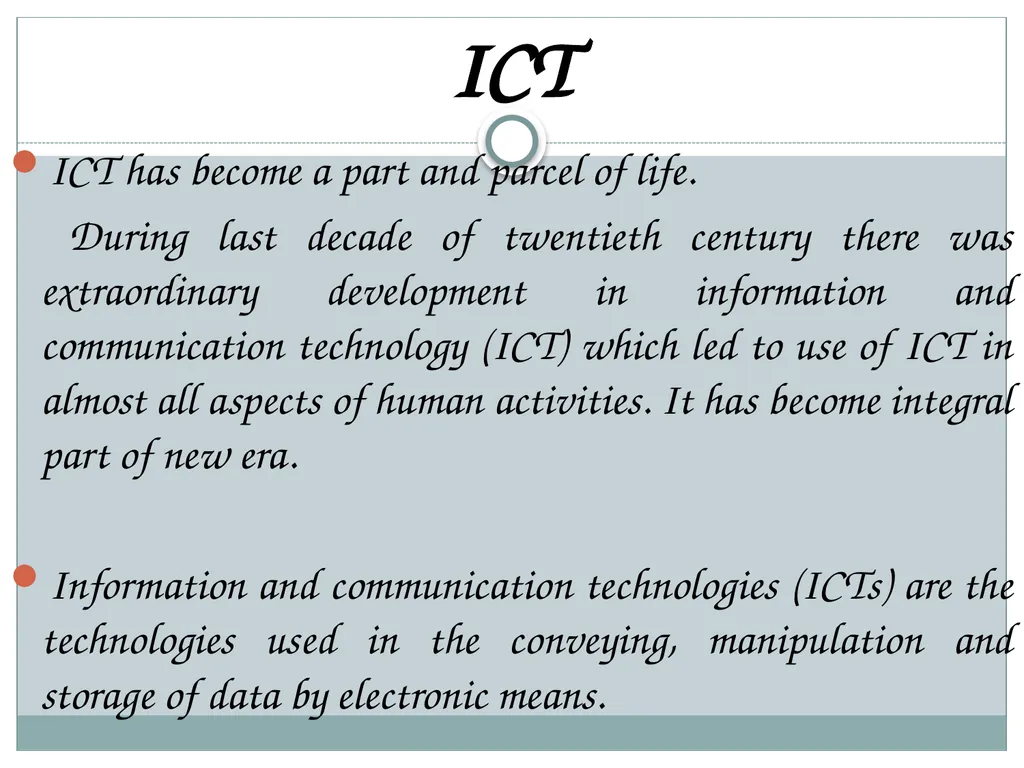
ICT ICT has become a part and parcel of life.
During last decade of twentieth century there was extraordinary development in information and communication technology (ICT) which led to use of ICT in almost all aspects of human activities. It has become integral part of new era.
Information and communication technologies (ICTs) are the technologies used in the conveying, manipulation and storage of data by electronic means.<br>
During last decade of twentieth century there was extraordinary development in information and communication technology (ICT) which led to use of ICT in almost all aspects of human activities. It has become integral part of new era.
Information and communication technologies (ICTs) are the technologies used in the conveying, manipulation and storage of data by electronic means.<br>
09
•Today from the time we awaken in the morning to the time before we sleep, we are surrounded by media like Radio, Television, Computer, Mobile etc. All these media come under overall umbrella of what is known as ICT.
ICT is involved in so many tasks of our daily life like internet use, chatting, emailing, shopping, online ticket booking, payment of bills, marketing, social networking and so on.<br>
ICT is involved in so many tasks of our daily life like internet use, chatting, emailing, shopping, online ticket booking, payment of bills, marketing, social networking and so on.<br>
10
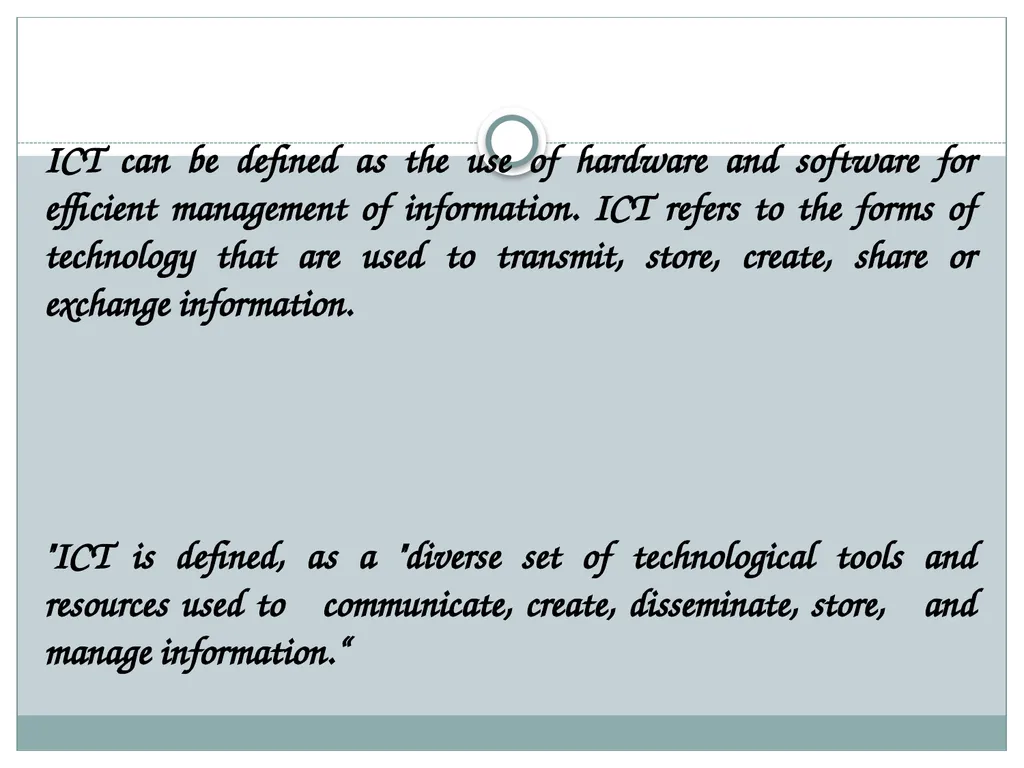
ICT can be defined as the use of hardware and software for efficient management of information. ICT refers to the forms of technology that are used to transmit, store, create, share or exchange information.
"ICT is defined, as a "diverse set of technological tools and resources used to communicate, create, disseminate, store, and manage information.“<br>
"ICT is defined, as a "diverse set of technological tools and resources used to communicate, create, disseminate, store, and manage information.“<br>
11
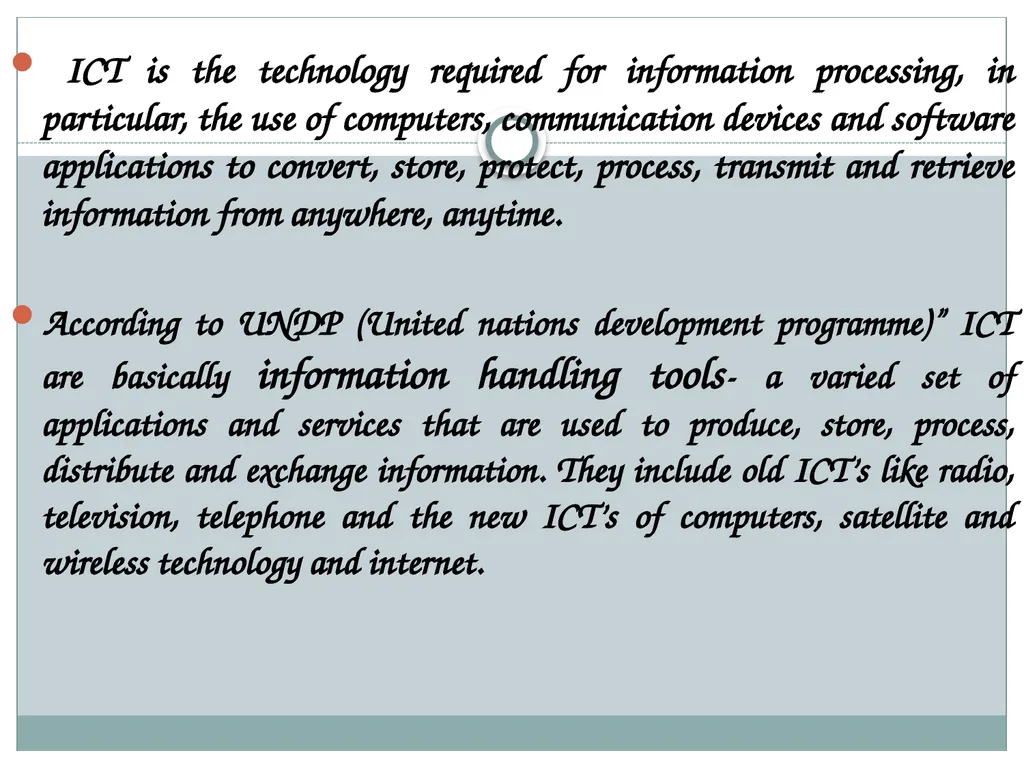
ICT is the technology required for information processing, in particular, the use of computers, communication devices and software applications to convert, store, protect, process, transmit and retrieve information from anywhere, anytime.
According to UNDP (United nations development programme)” ICT are basically information handling tools- a varied set of applications and services that are used to produce, store, process, distribute and exchange information. They include old ICT’s like radio, television, telephone and the new ICT’s of computers, satellite and wireless technology and internet.<br>
According to UNDP (United nations development programme)” ICT are basically information handling tools- a varied set of applications and services that are used to produce, store, process, distribute and exchange information. They include old ICT’s like radio, television, telephone and the new ICT’s of computers, satellite and wireless technology and internet.<br>
12
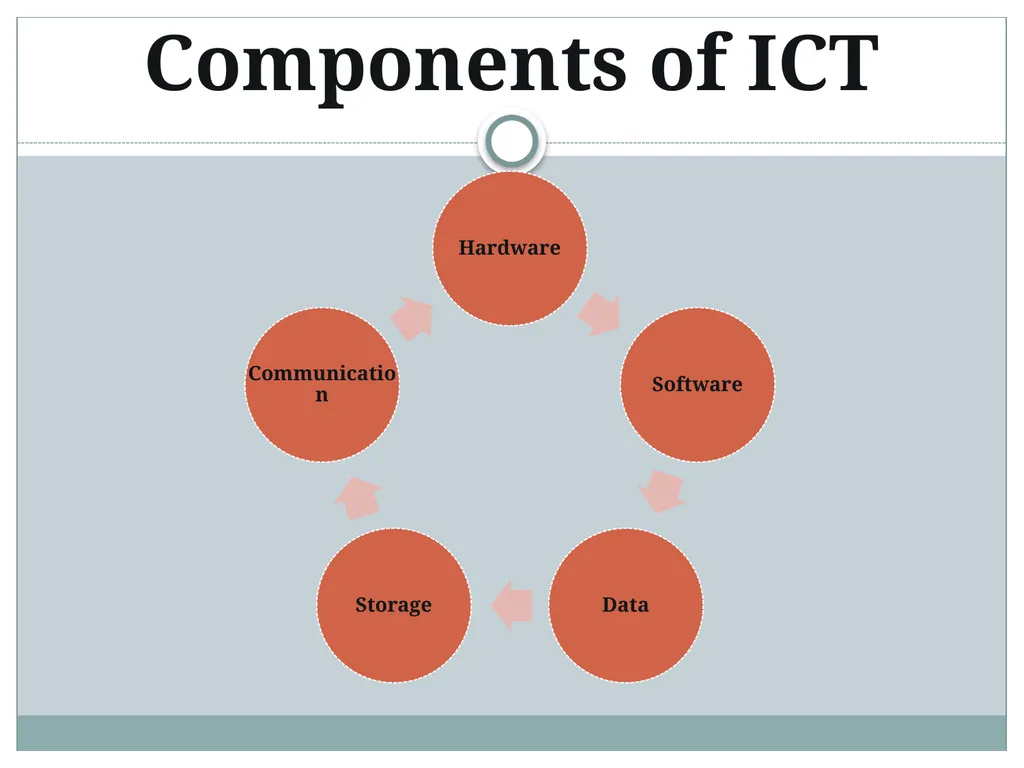
Components of ICT<br>
13
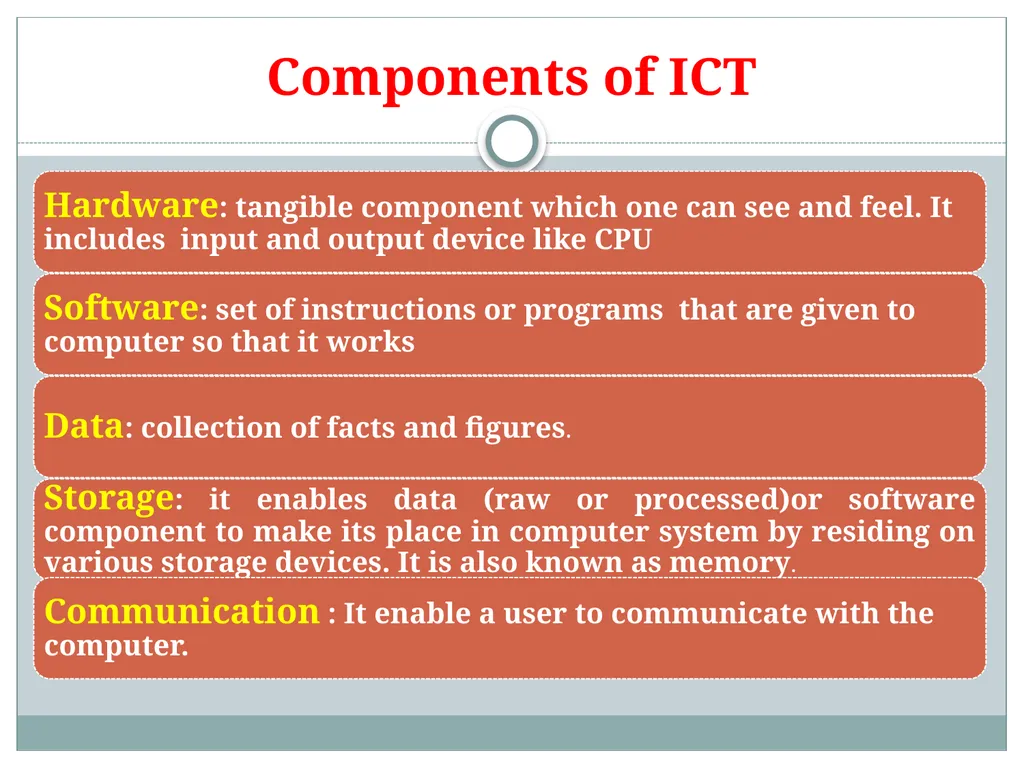
Components of ICT<br>
14
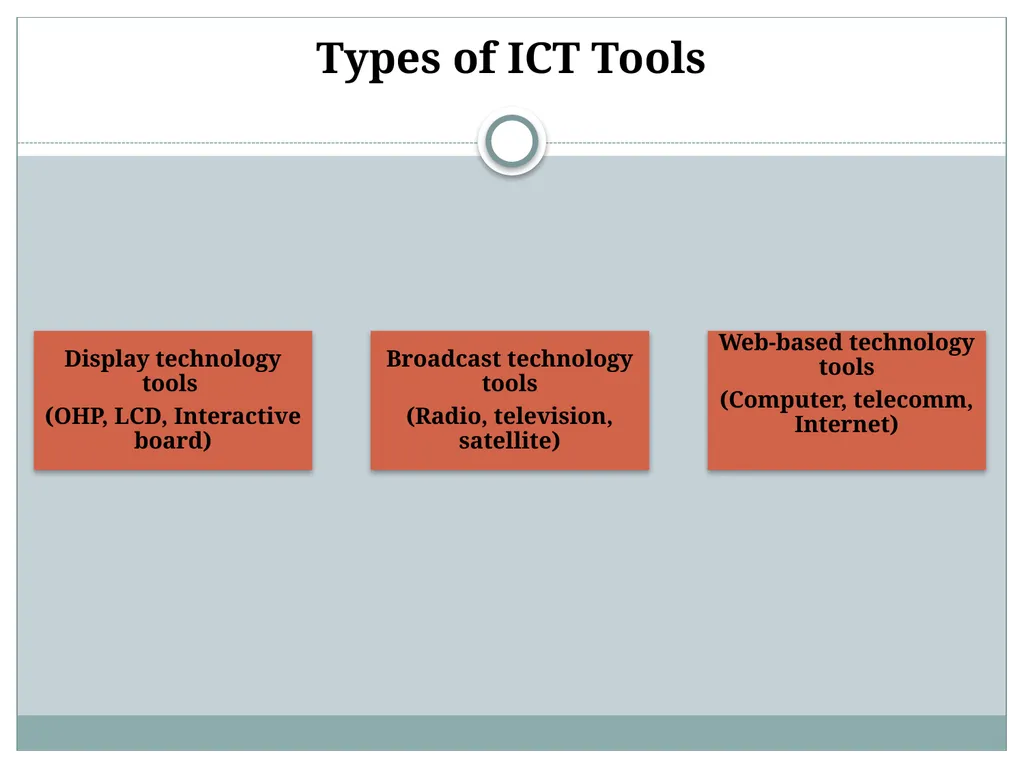
Types of ICT Tools<br>
15
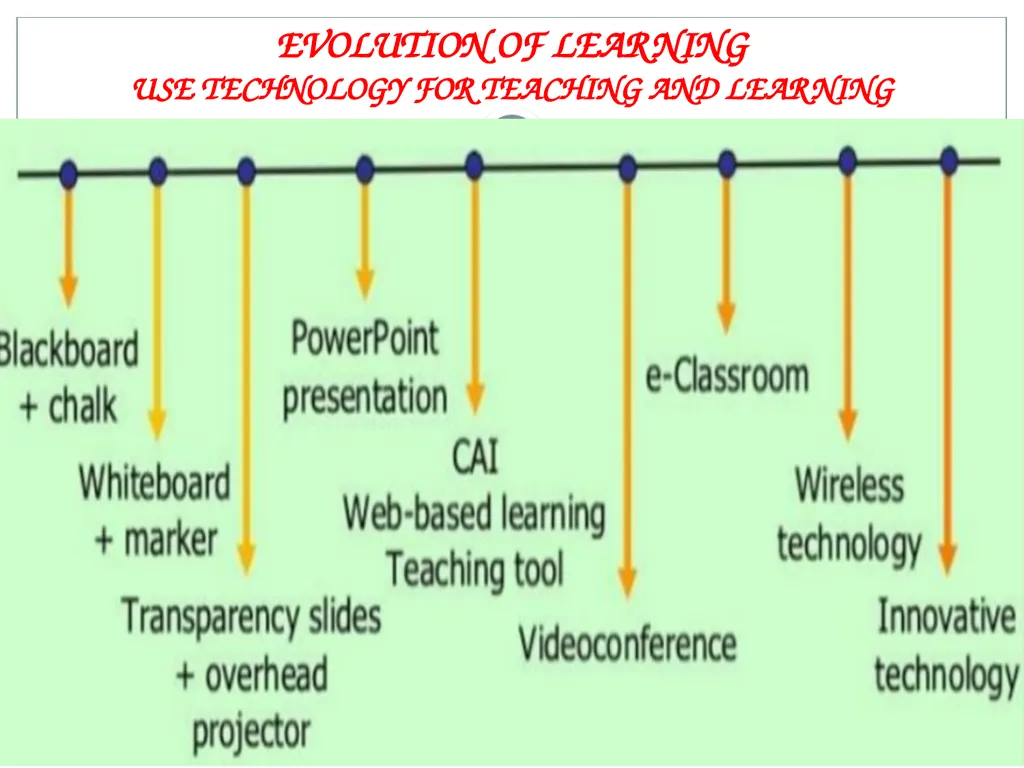
EVOLUTION OF LEARNING
USE TECHNOLOGY FOR TEACHING AND LEARNING Whiteboard and marker<br>
16
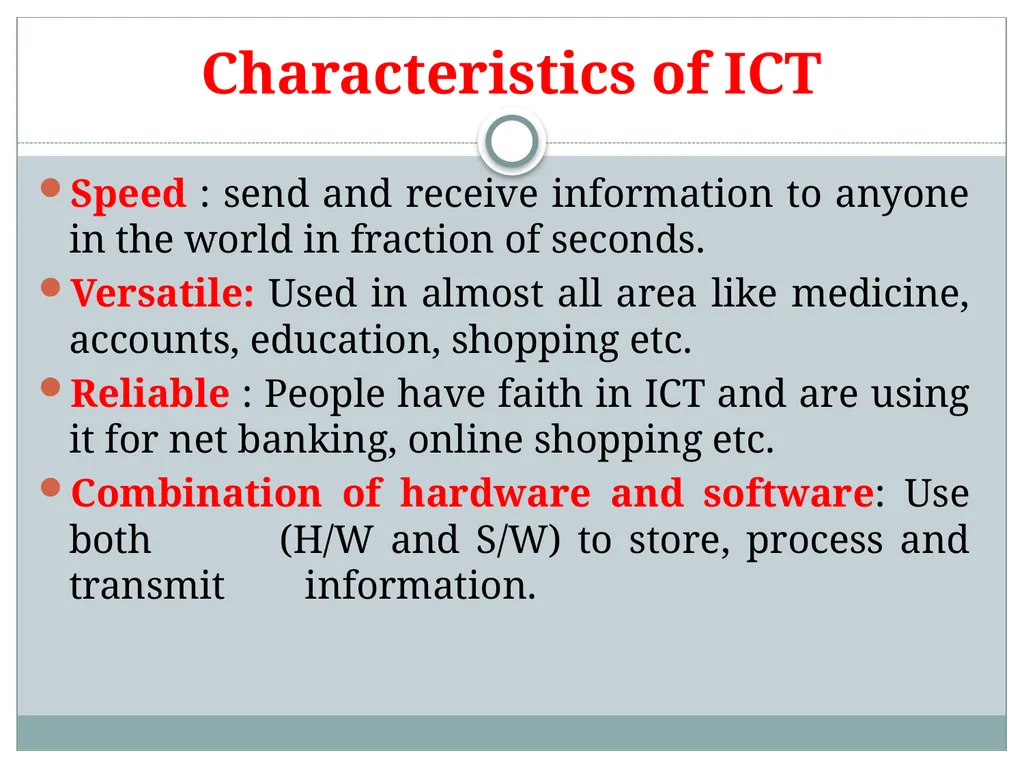
Characteristics of ICT Speed : send and receive information to anyone in the world in fraction of seconds.
Versatile: Used in almost all area like medicine, accounts, education, shopping etc.
Reliable : People have faith in ICT and are using it for net banking, online shopping etc.
Combination of hardware and software: Use both (H/W and S/W) to store, process and transmit information.<br>
Versatile: Used in almost all area like medicine, accounts, education, shopping etc.
Reliable : People have faith in ICT and are using it for net banking, online shopping etc.
Combination of hardware and software: Use both (H/W and S/W) to store, process and transmit information.<br>
17
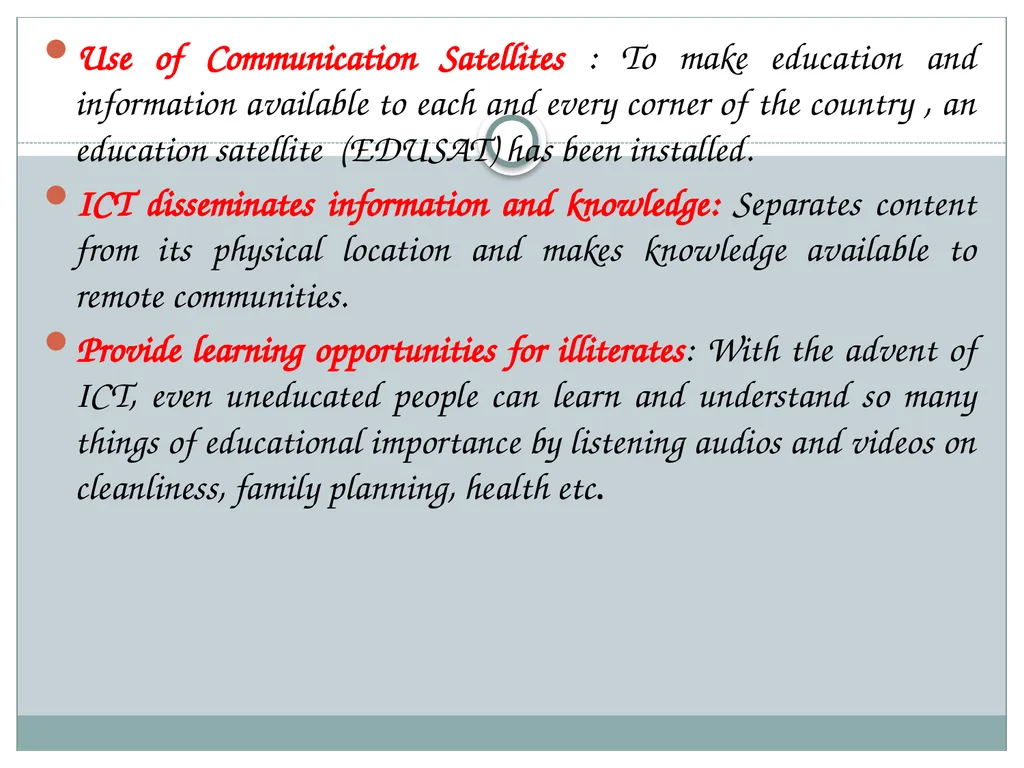
Use of Communication Satellites : To make education and information available to each and every corner of the country , an education satellite (EDUSAT) has been installed.
ICT disseminates information and knowledge: Separates content from its physical location and makes knowledge available to remote communities.
Provide learning opportunities for illiterates: With the advent of ICT, even uneducated people can learn and understand so many things of educational importance by listening audios and videos on cleanliness, family planning, health etc.<br>
ICT disseminates information and knowledge: Separates content from its physical location and makes knowledge available to remote communities.
Provide learning opportunities for illiterates: With the advent of ICT, even uneducated people can learn and understand so many things of educational importance by listening audios and videos on cleanliness, family planning, health etc.<br>
18
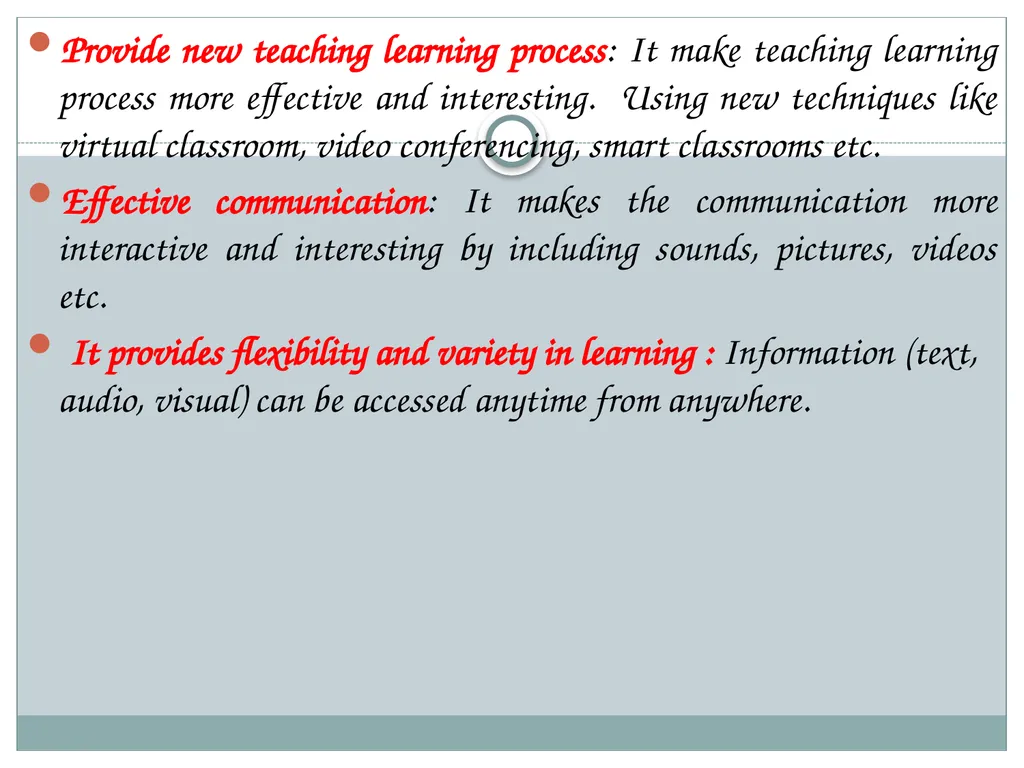
Provide new teaching learning process: It make teaching learning process more effective and interesting. Using new techniques like virtual classroom, video conferencing, smart classrooms etc.
Effective communication: It makes the communication more interactive and interesting by including sounds, pictures, videos etc.
It provides flexibility and variety in learning : Information (text, audio, visual) can be accessed anytime from anywhere.<br>
Effective communication: It makes the communication more interactive and interesting by including sounds, pictures, videos etc.
It provides flexibility and variety in learning : Information (text, audio, visual) can be accessed anytime from anywhere.<br>
19
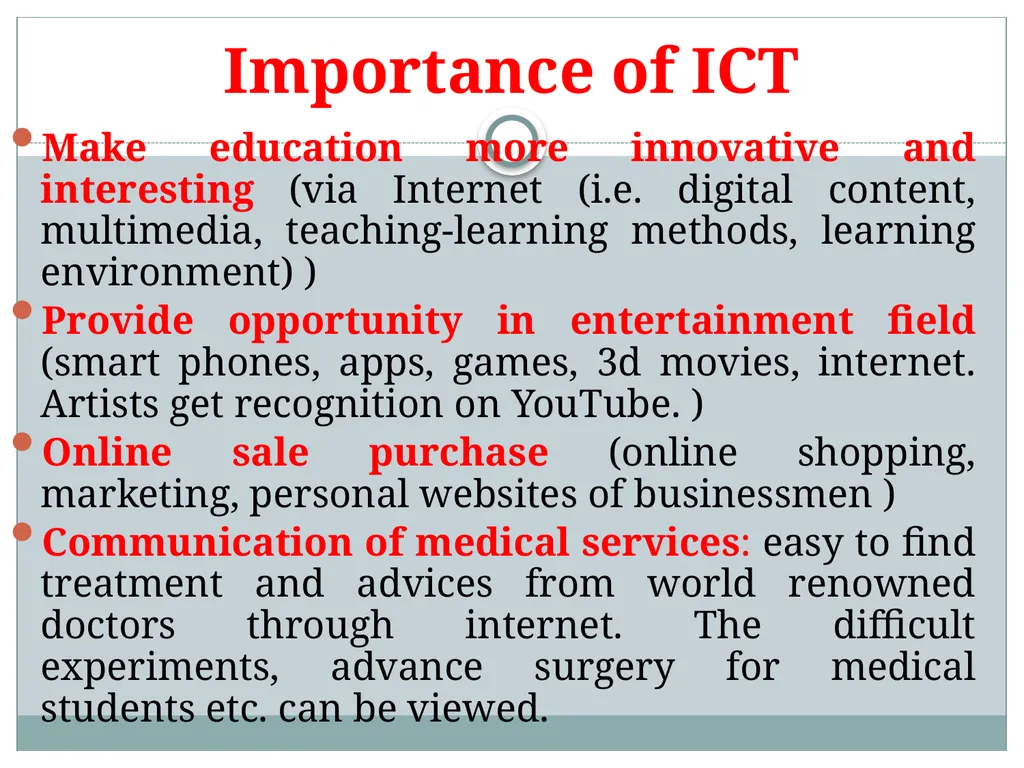
Importance of ICT Make education more innovative and interesting (via Internet (i.e. digital content, multimedia, teaching-learning methods, learning environment) )
Provide opportunity in entertainment field (smart phones, apps, games, 3d movies, internet. Artists get recognition on YouTube. )
Online sale purchase (online shopping, marketing, personal websites of businessmen )
Communication of medical services: easy to find treatment and advices from world renowned doctors through internet. The difficult experiments, advance surgery for medical students etc. can be viewed.<br>
Provide opportunity in entertainment field (smart phones, apps, games, 3d movies, internet. Artists get recognition on YouTube. )
Online sale purchase (online shopping, marketing, personal websites of businessmen )
Communication of medical services: easy to find treatment and advices from world renowned doctors through internet. The difficult experiments, advance surgery for medical students etc. can be viewed.<br>
20
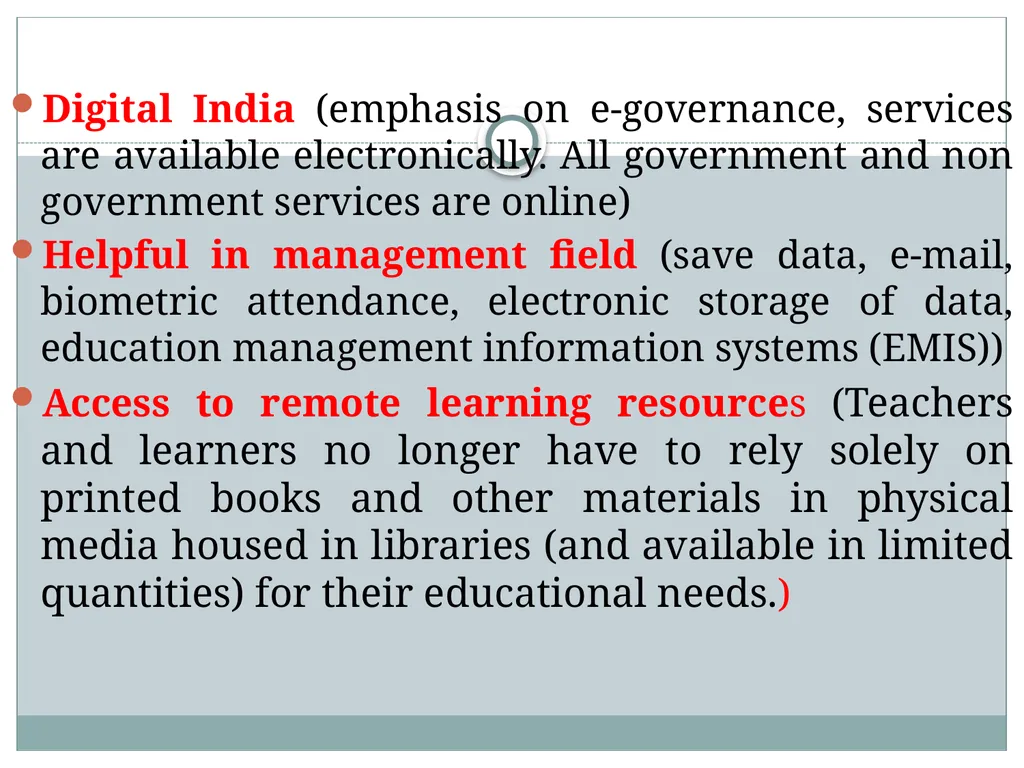
Digital India (emphasis on e-governance, services are available electronically. All government and non government services are online)
Helpful in management field (save data, e-mail, biometric attendance, electronic storage of data, education management information systems (EMIS))
Access to remote learning resources (Teachers and learners no longer have to rely solely on printed books and other materials in physical media housed in libraries (and available in limited quantities) for their educational needs.)<br>
Helpful in management field (save data, e-mail, biometric attendance, electronic storage of data, education management information systems (EMIS))
Access to remote learning resources (Teachers and learners no longer have to rely solely on printed books and other materials in physical media housed in libraries (and available in limited quantities) for their educational needs.)<br>
21
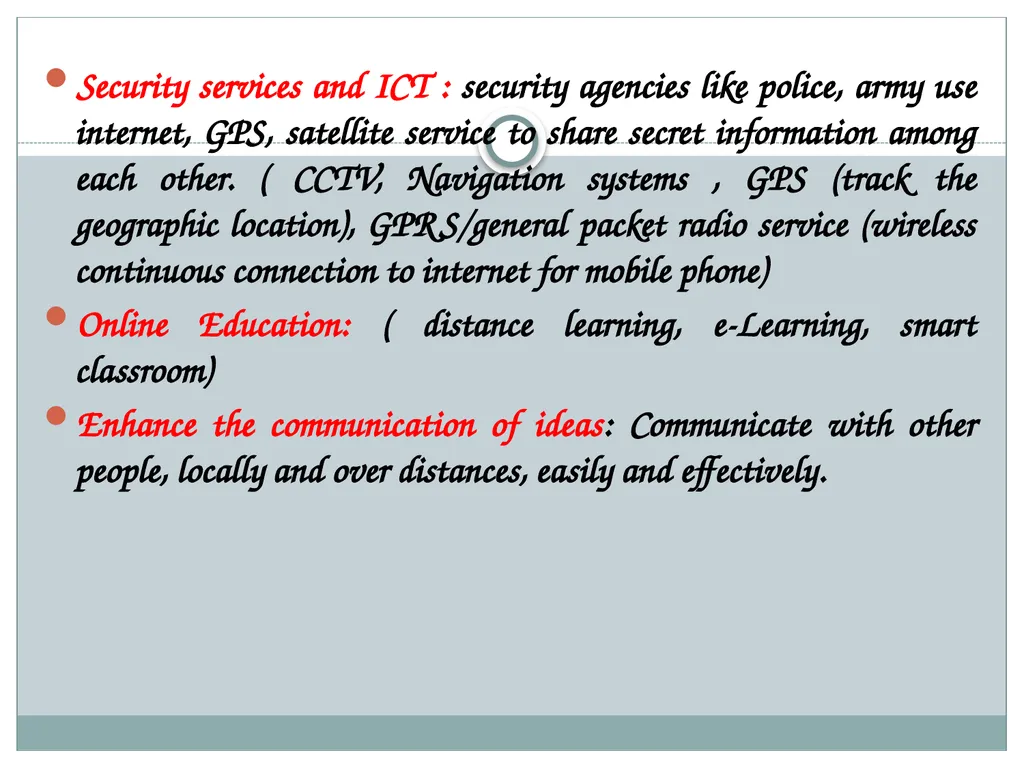
Security services and ICT : security agencies like police, army use internet, GPS, satellite service to share secret information among each other. ( CCTV, Navigation systems , GPS (track the geographic location), GPRS/general packet radio service (wireless continuous connection to internet for mobile phone)
Online Education: ( distance learning, e-Learning, smart classroom)
Enhance the communication of ideas: Communicate with other people, locally and over distances, easily and effectively.<br>
Online Education: ( distance learning, e-Learning, smart classroom)
Enhance the communication of ideas: Communicate with other people, locally and over distances, easily and effectively.<br>
22
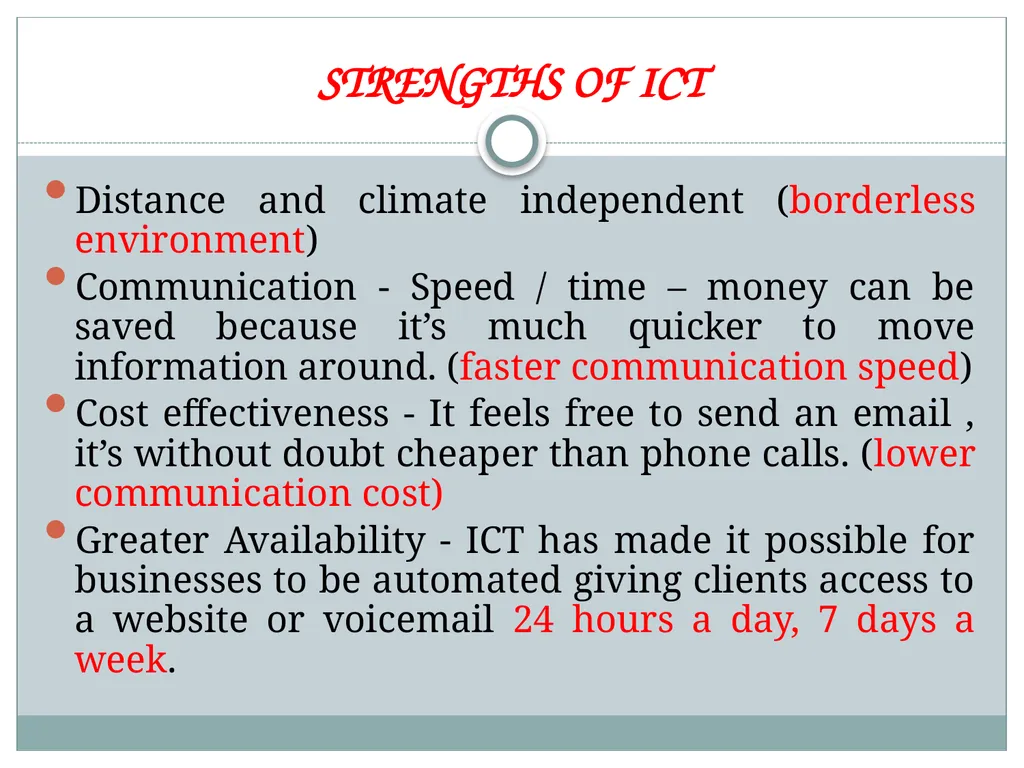
STRENGTHS OF ICT Distance and climate independent (borderless environment)
Communication - Speed / time – money can be saved because it’s much quicker to move information around. (faster communication speed)
Cost effectiveness - It feels free to send an email , it’s without doubt cheaper than phone calls. (lower communication cost)
Greater Availability - ICT has made it possible for businesses to be automated giving clients access to a website or voicemail 24 hours a day, 7 days a week.<br>
Communication - Speed / time – money can be saved because it’s much quicker to move information around. (faster communication speed)
Cost effectiveness - It feels free to send an email , it’s without doubt cheaper than phone calls. (lower communication cost)
Greater Availability - ICT has made it possible for businesses to be automated giving clients access to a website or voicemail 24 hours a day, 7 days a week.<br>
23
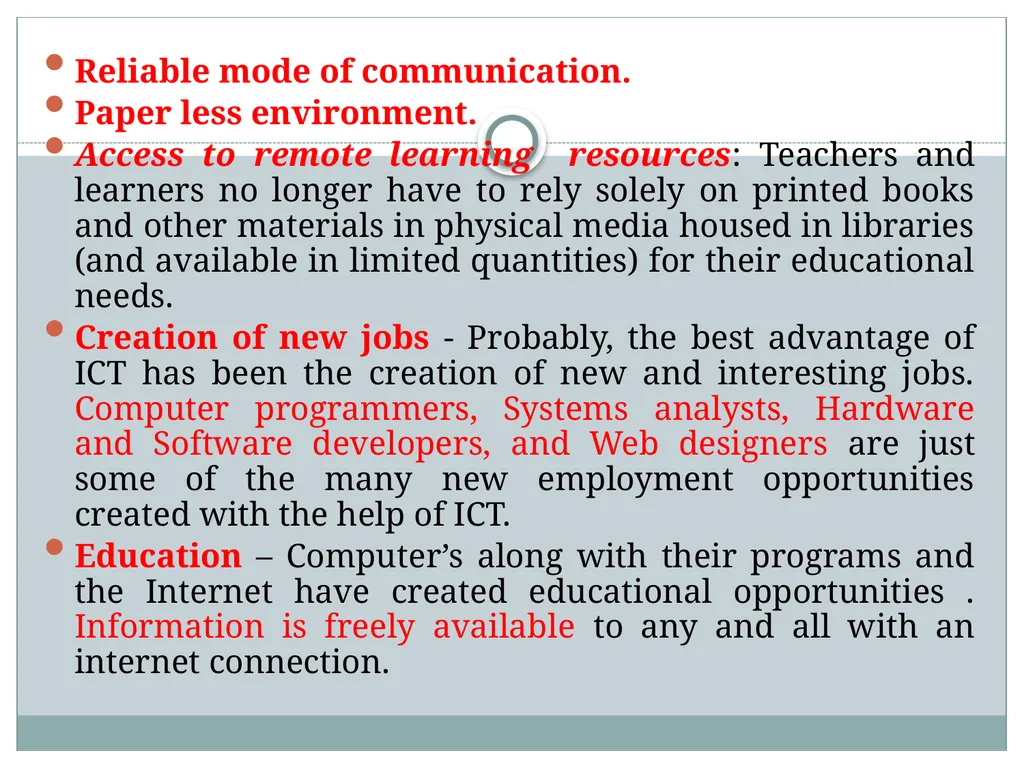
Reliable mode of communication.
Paper less environment.
Access to remote learning resources: Teachers and learners no longer have to rely solely on printed books and other materials in physical media housed in libraries (and available in limited quantities) for their educational needs.
Creation of new jobs - Probably, the best advantage of ICT has been the creation of new and interesting jobs. Computer programmers, Systems analysts, Hardware and Software developers, and Web designers are just some of the many new employment opportunities created with the help of ICT.
Education – Computer’s along with their programs and the Internet have created educational opportunities . Information is freely available to any and all with an internet connection.<br>
Paper less environment.
Access to remote learning resources: Teachers and learners no longer have to rely solely on printed books and other materials in physical media housed in libraries (and available in limited quantities) for their educational needs.
Creation of new jobs - Probably, the best advantage of ICT has been the creation of new and interesting jobs. Computer programmers, Systems analysts, Hardware and Software developers, and Web designers are just some of the many new employment opportunities created with the help of ICT.
Education – Computer’s along with their programs and the Internet have created educational opportunities . Information is freely available to any and all with an internet connection.<br>
24
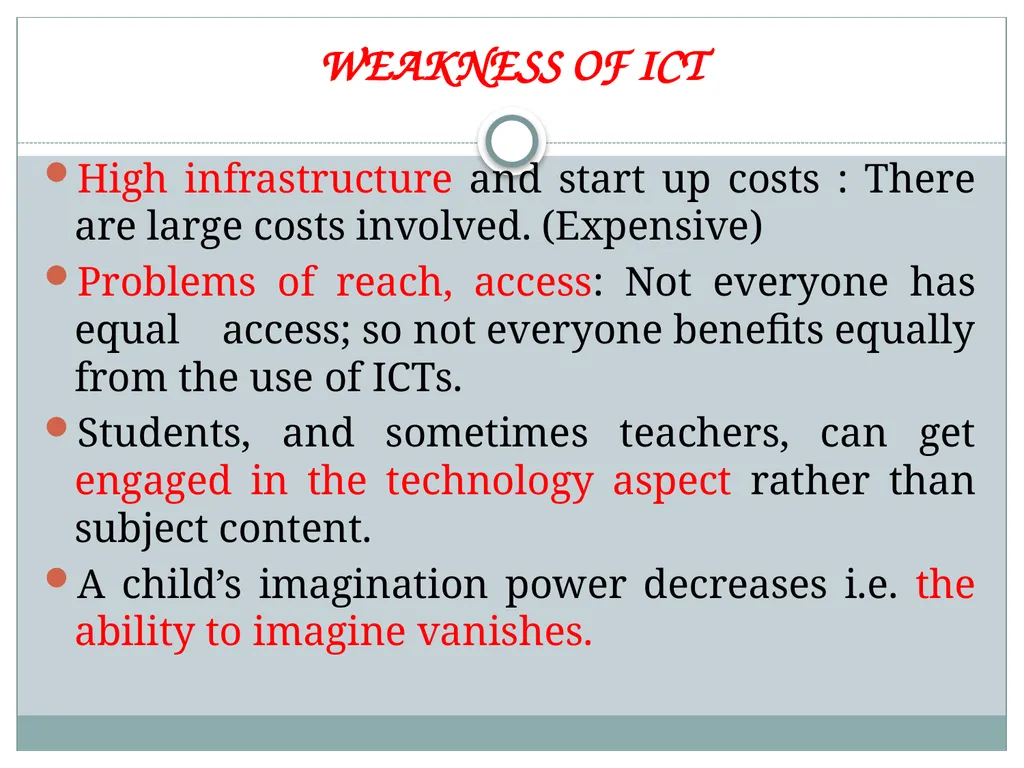
WEAKNESS OF ICT High infrastructure and start up costs : There are large costs involved. (Expensive)
Problems of reach, access: Not everyone has equal access; so not everyone benefits equally from the use of ICTs.
Students, and sometimes teachers, can get engaged in the technology aspect rather than subject content.
A child’s imagination power decreases i.e. the ability to imagine vanishes.<br>
Problems of reach, access: Not everyone has equal access; so not everyone benefits equally from the use of ICTs.
Students, and sometimes teachers, can get engaged in the technology aspect rather than subject content.
A child’s imagination power decreases i.e. the ability to imagine vanishes.<br>
25
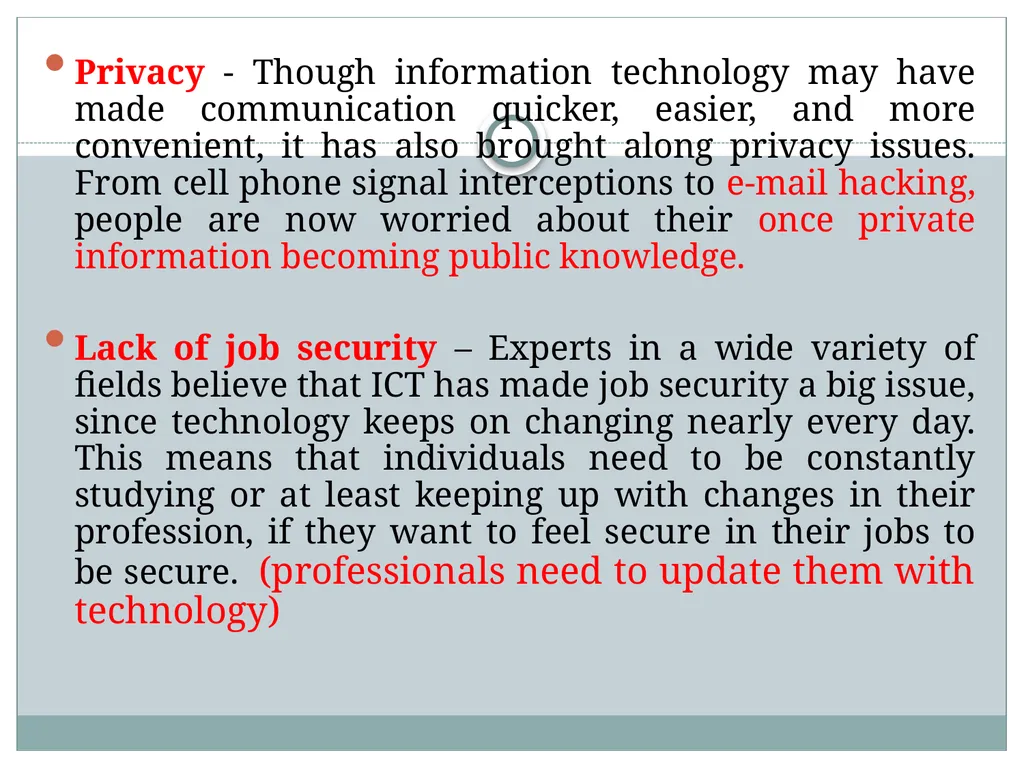
Privacy - Though information technology may have made communication quicker, easier, and more convenient, it has also brought along privacy issues. From cell phone signal interceptions to e-mail hacking, people are now worried about their once private information becoming public knowledge.
Lack of job security – Experts in a wide variety of fields believe that ICT has made job security a big issue, since technology keeps on changing nearly every day. This means that individuals need to be constantly studying or at least keeping up with changes in their profession, if they want to feel secure in their jobs to be secure. (professionals need to update them with technology)<br>
Lack of job security – Experts in a wide variety of fields believe that ICT has made job security a big issue, since technology keeps on changing nearly every day. This means that individuals need to be constantly studying or at least keeping up with changes in their profession, if they want to feel secure in their jobs to be secure. (professionals need to update them with technology)<br>
26
Reliance on Technology – “People have more to remember these days, and they are relying on technology for their memory but the less you use of your memory, the poorer it becomes.
Reliability of Information – Anyone with access to a computer and an internet connection internet can start a blog or post something up on a website, so just because something’s on the web doesn't mean it’s reliable. A prime example of this is the open source encyclopaedia i.e Wikipedia, although considered a good source of information it is not recognized by academic institutions as a trustworthy reference.<br>
Reliability of Information – Anyone with access to a computer and an internet connection internet can start a blog or post something up on a website, so just because something’s on the web doesn't mean it’s reliable. A prime example of this is the open source encyclopaedia i.e Wikipedia, although considered a good source of information it is not recognized by academic institutions as a trustworthy reference.<br>
27
Computer viruses, worms- any or all can cause chaos and disrupt our daily lives .
Hard to assess impact: Learning from ICT delivered
content is difficult to assess rather than from immediate learning assessment as in a classroom test.
Poor substitute for face-to-face Communication
Since employees are using machines to communicate,
they get less time to talk to each other and know each
other better.<br>
Hard to assess impact: Learning from ICT delivered
content is difficult to assess rather than from immediate learning assessment as in a classroom test.
Poor substitute for face-to-face Communication
Since employees are using machines to communicate,
they get less time to talk to each other and know each
other better.<br>
28
Thank You<br>