
Substance Use Screening, Risk Assessment, and Use
LD
Published · 19 slides · 0 views

1 / 1


Description
Substance Use Screening, Risk Assessment, and Use Disorder Diagnosis in Adults www.suguidelinesnys.org MAY 2024 NYSDOH AIDS Institute Clinical Guidelines Program Purpose of This Guideline Increase the identification of unhealthy substance
Related Topics
Share
Embed code
Download this presentation From Below
"Substance Use Screening, Risk Assessment, and Use" is the property of its rightful owner. Permission is granted to download and print the materials on this website for personal, non-commercial use only, and to display it on your personal computer provided you do not modify the materials and that you retain all copyright notices contained in the materials. By downloading content from our website, you accept the terms of this agreement.
Presentation Transcript
01
Substance Use Screening,
Risk Assessment, and Use Disorder Diagnosis in Adults
www.suguidelinesnys.org MAY 2024 NYSDOH AIDS Institute Clinical Guidelines Program<br>
www.suguidelinesnys.org MAY 2024 NYSDOH AIDS Institute Clinical Guidelines Program<br>
02
Purpose of This Guideline Increase the identification of unhealthy substance use among NYS residents and increase access to evidence-based interventions for appropriate patients. “Unhealthy substance use” refers to a spectrum of use that increases the risk of health consequences and ranges from hazardous or risky patterns of use to severe SUD.
Increase the number of clinicians in NYS who perform substance use screening and risk assessment as an integral part of primary care.
Provide clinicians with guidance on selecting validated substance use screening and risk assessment tools and on providing or referring for evidence-based interventions.
Promote a harm reduction approach to the identification and treatment of substance use and SUDs, which involves practical strategies and ideas aimed at reducing the negative consequences associated with substance use. NYSDOH AIDS Institute Clinical Guidelines Program www.suguidelinesnys.org MAY 2024<br>
Increase the number of clinicians in NYS who perform substance use screening and risk assessment as an integral part of primary care.
Provide clinicians with guidance on selecting validated substance use screening and risk assessment tools and on providing or referring for evidence-based interventions.
Promote a harm reduction approach to the identification and treatment of substance use and SUDs, which involves practical strategies and ideas aimed at reducing the negative consequences associated with substance use. NYSDOH AIDS Institute Clinical Guidelines Program www.suguidelinesnys.org MAY 2024<br>
03
Unhealthy Substance Use “Unhealthy substance use” refers to a spectrum of use that increases the risk of health consequences and ranges from hazardous or risky patterns of use to severe SUD.
As defined here, unhealthy alcohol use is use that exceeds guideline-recommended levels; for illicitly manufactured drugs, any use is considered potentially unhealthy. For prescription medications with potential for misuse, any nonmedical use (use of prescribed medication at increased dose or frequency or for reasons other than prescribed) or use of medications that were not prescribed is considered unhealthy.
Brief screening tools can identify potentially unhealthy use and can be followed by a risk assessment to determine the clinical significance and severity of use. NYSDOH AIDS Institute Clinical Guidelines Program www.suguidelinesnys.org MAY 2024<br>
As defined here, unhealthy alcohol use is use that exceeds guideline-recommended levels; for illicitly manufactured drugs, any use is considered potentially unhealthy. For prescription medications with potential for misuse, any nonmedical use (use of prescribed medication at increased dose or frequency or for reasons other than prescribed) or use of medications that were not prescribed is considered unhealthy.
Brief screening tools can identify potentially unhealthy use and can be followed by a risk assessment to determine the clinical significance and severity of use. NYSDOH AIDS Institute Clinical Guidelines Program www.suguidelinesnys.org MAY 2024<br>
04
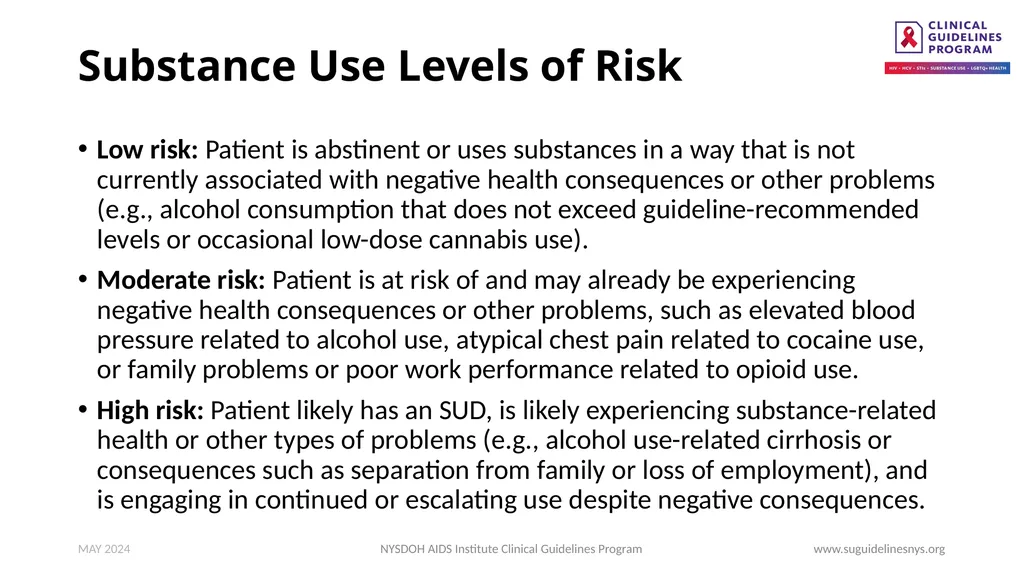
Substance Use Levels of Risk Low risk: Patient is abstinent or uses substances in a way that is not currently associated with negative health consequences or other problems (e.g., alcohol consumption that does not exceed guideline-recommended levels or occasional low-dose cannabis use).
Moderate risk: Patient is at risk of and may already be experiencing negative health consequences or other problems, such as elevated blood pressure related to alcohol use, atypical chest pain related to cocaine use, or family problems or poor work performance related to opioid use.
High risk: Patient likely has an SUD, is likely experiencing substance-related health or other types of problems (e.g., alcohol use-related cirrhosis or consequences such as separation from family or loss of employment), and is engaging in continued or escalating use despite negative consequences. NYSDOH AIDS Institute Clinical Guidelines Program www.suguidelinesnys.org MAY 2024<br>
Moderate risk: Patient is at risk of and may already be experiencing negative health consequences or other problems, such as elevated blood pressure related to alcohol use, atypical chest pain related to cocaine use, or family problems or poor work performance related to opioid use.
High risk: Patient likely has an SUD, is likely experiencing substance-related health or other types of problems (e.g., alcohol use-related cirrhosis or consequences such as separation from family or loss of employment), and is engaging in continued or escalating use despite negative consequences. NYSDOH AIDS Institute Clinical Guidelines Program www.suguidelinesnys.org MAY 2024<br>
05
Recommendations:
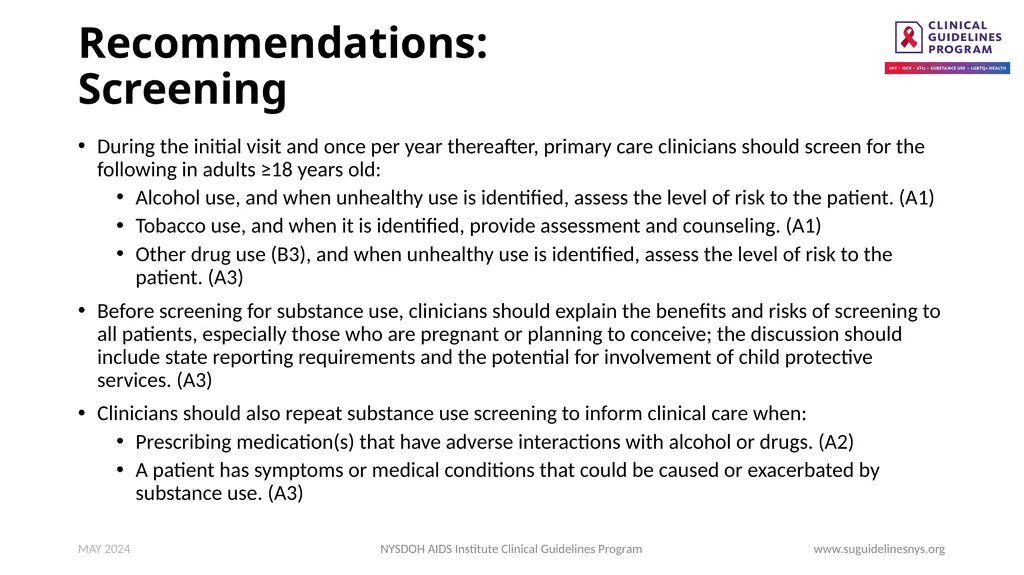
Screening During the initial visit and once per year thereafter, primary care clinicians should screen for the following in adults ≥18 years old:
Alcohol use, and when unhealthy use is identified, assess the level of risk to the patient. (A1)
Tobacco use, and when it is identified, provide assessment and counseling. (A1)
Other drug use (B3), and when unhealthy use is identified, assess the level of risk to the patient. (A3)
Before screening for substance use, clinicians should explain the benefits and risks of screening to all patients, especially those who are pregnant or planning to conceive; the discussion should include state reporting requirements and the potential for involvement of child protective services. (A3)
Clinicians should also repeat substance use screening to inform clinical care when:
Prescribing medication(s) that have adverse interactions with alcohol or drugs. (A2)
A patient has symptoms or medical conditions that could be caused or exacerbated by substance use. (A3) NYSDOH AIDS Institute Clinical Guidelines Program www.suguidelinesnys.org MAY 2024<br>
Alcohol use, and when unhealthy use is identified, assess the level of risk to the patient. (A1)
Tobacco use, and when it is identified, provide assessment and counseling. (A1)
Other drug use (B3), and when unhealthy use is identified, assess the level of risk to the patient. (A3)
Before screening for substance use, clinicians should explain the benefits and risks of screening to all patients, especially those who are pregnant or planning to conceive; the discussion should include state reporting requirements and the potential for involvement of child protective services. (A3)
Clinicians should also repeat substance use screening to inform clinical care when:
Prescribing medication(s) that have adverse interactions with alcohol or drugs. (A2)
A patient has symptoms or medical conditions that could be caused or exacerbated by substance use. (A3) NYSDOH AIDS Institute Clinical Guidelines Program www.suguidelinesnys.org MAY 2024<br>
06
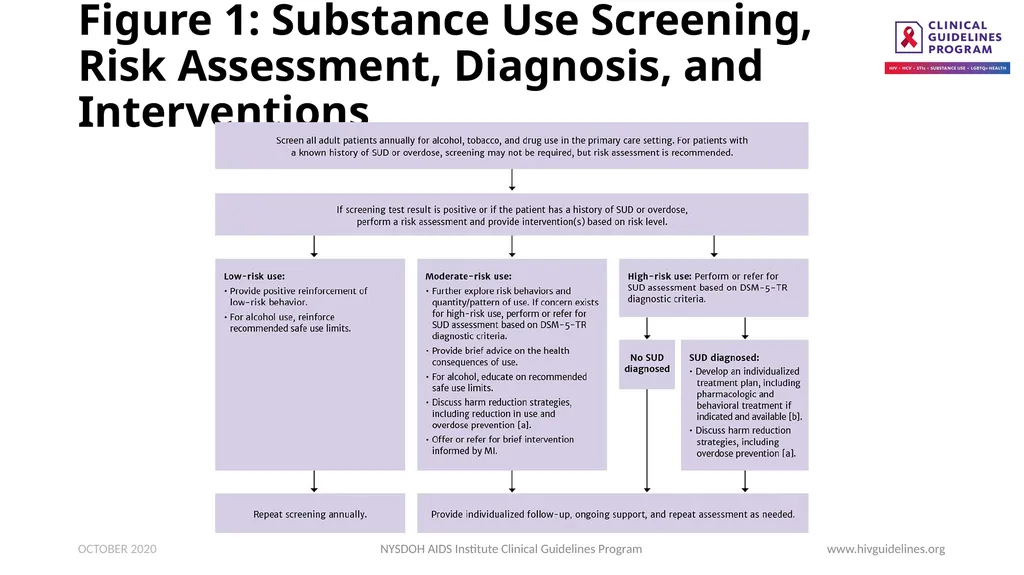
Figure 1: Substance Use Screening, Risk Assessment, Diagnosis, and Interventions NYSDOH AIDS Institute Clinical Guidelines Program www.hivguidelines.org OCTOBER 2020<br>
07
Key Points:
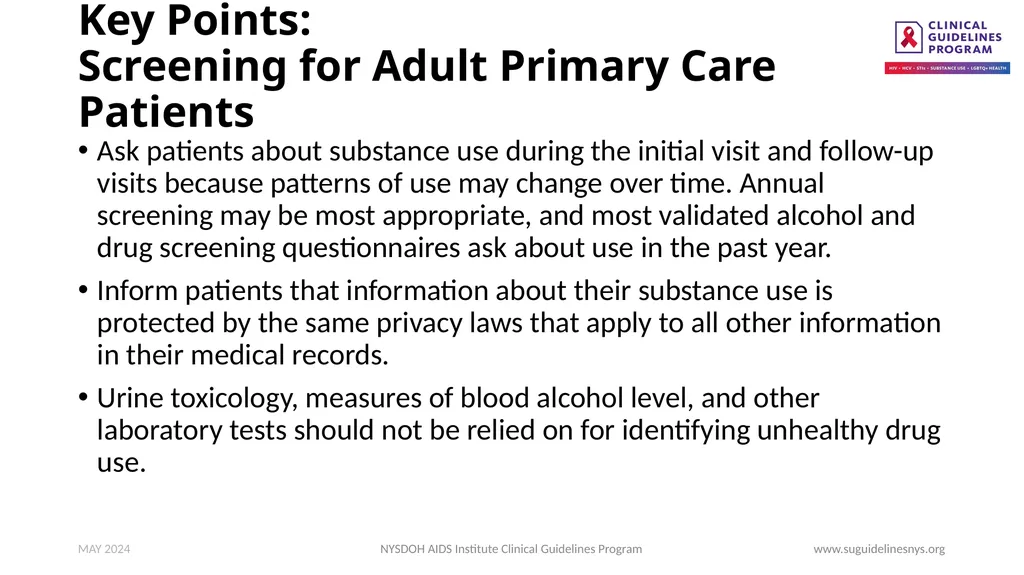
Screening for Adult Primary Care Patients Ask patients about substance use during the initial visit and follow-up visits because patterns of use may change over time. Annual screening may be most appropriate, and most validated alcohol and drug screening questionnaires ask about use in the past year.
Inform patients that information about their substance use is protected by the same privacy laws that apply to all other information in their medical records.
Urine toxicology, measures of blood alcohol level, and other laboratory tests should not be relied on for identifying unhealthy drug use. NYSDOH AIDS Institute Clinical Guidelines Program www.suguidelinesnys.org MAY 2024<br>
Inform patients that information about their substance use is protected by the same privacy laws that apply to all other information in their medical records.
Urine toxicology, measures of blood alcohol level, and other laboratory tests should not be relied on for identifying unhealthy drug use. NYSDOH AIDS Institute Clinical Guidelines Program www.suguidelinesnys.org MAY 2024<br>
08
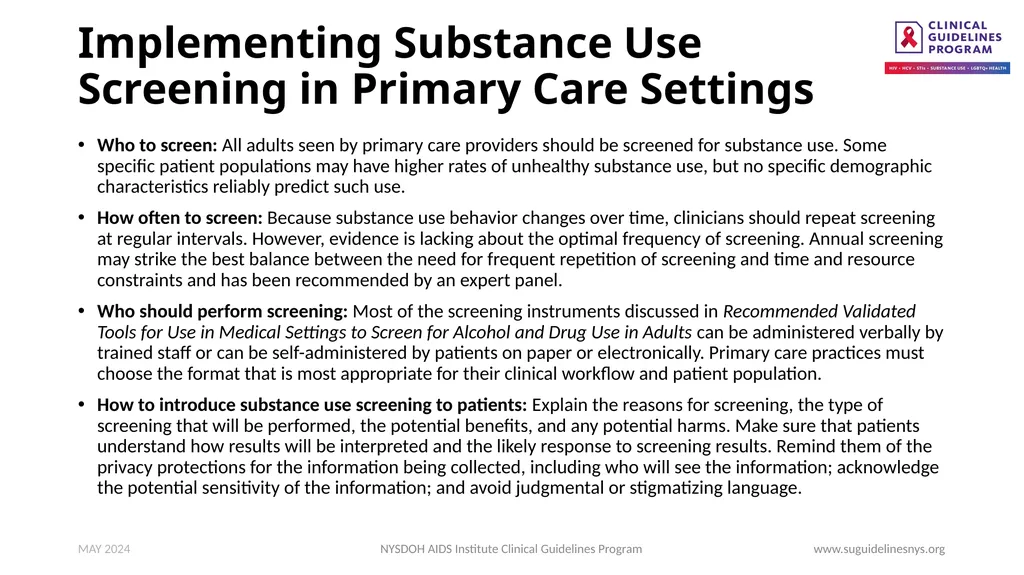
Implementing Substance Use Screening in Primary Care Settings Who to screen: All adults seen by primary care providers should be screened for substance use. Some specific patient populations may have higher rates of unhealthy substance use, but no specific demographic characteristics reliably predict such use.
How often to screen: Because substance use behavior changes over time, clinicians should repeat screening at regular intervals. However, evidence is lacking about the optimal frequency of screening. Annual screening may strike the best balance between the need for frequent repetition of screening and time and resource constraints and has been recommended by an expert panel.
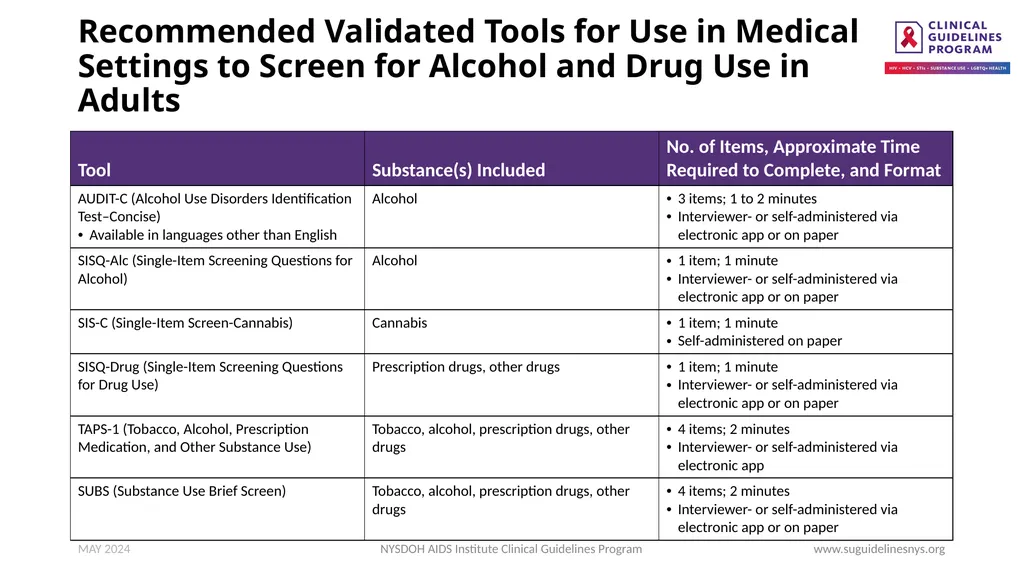
Who should perform screening: Most of the screening instruments discussed in Recommended Validated Tools for Use in Medical Settings to Screen for Alcohol and Drug Use in Adults can be administered verbally by trained staff or can be self-administered by patients on paper or electronically. Primary care practices must choose the format that is most appropriate for their clinical workflow and patient population.
How to introduce substance use screening to patients: Explain the reasons for screening, the type of screening that will be performed, the potential benefits, and any potential harms. Make sure that patients understand how results will be interpreted and the likely response to screening results. Remind them of the privacy protections for the information being collected, including who will see the information; acknowledge the potential sensitivity of the information; and avoid judgmental or stigmatizing language. NYSDOH AIDS Institute Clinical Guidelines Program www.suguidelinesnys.org MAY 2024<br>
How often to screen: Because substance use behavior changes over time, clinicians should repeat screening at regular intervals. However, evidence is lacking about the optimal frequency of screening. Annual screening may strike the best balance between the need for frequent repetition of screening and time and resource constraints and has been recommended by an expert panel.
Who should perform screening: Most of the screening instruments discussed in Recommended Validated Tools for Use in Medical Settings to Screen for Alcohol and Drug Use in Adults can be administered verbally by trained staff or can be self-administered by patients on paper or electronically. Primary care practices must choose the format that is most appropriate for their clinical workflow and patient population.
How to introduce substance use screening to patients: Explain the reasons for screening, the type of screening that will be performed, the potential benefits, and any potential harms. Make sure that patients understand how results will be interpreted and the likely response to screening results. Remind them of the privacy protections for the information being collected, including who will see the information; acknowledge the potential sensitivity of the information; and avoid judgmental or stigmatizing language. NYSDOH AIDS Institute Clinical Guidelines Program www.suguidelinesnys.org MAY 2024<br>
09
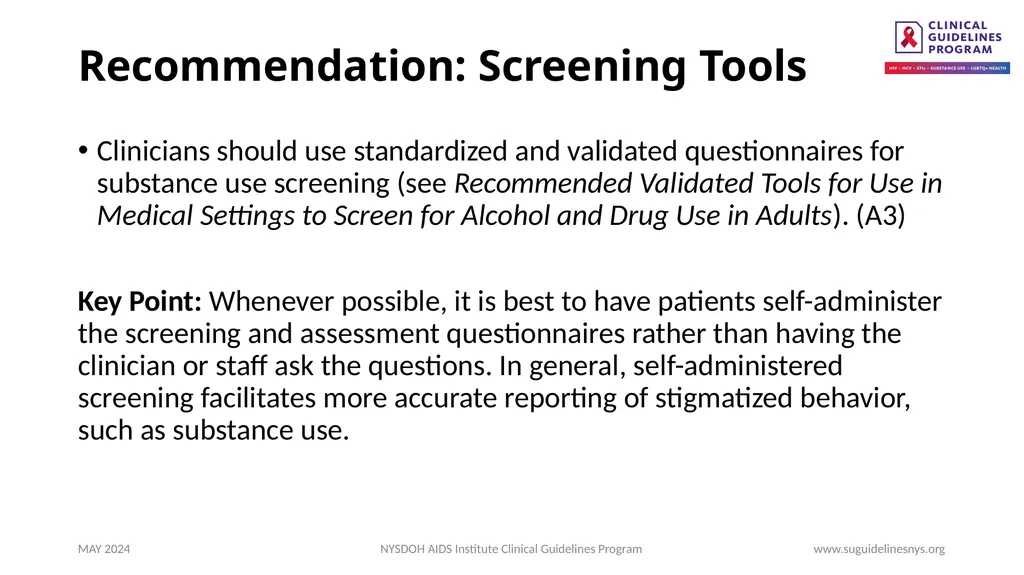
Recommendation: Screening Tools Clinicians should use standardized and validated questionnaires for substance use screening (see Recommended Validated Tools for Use in Medical Settings to Screen for Alcohol and Drug Use in Adults). (A3)
Key Point: Whenever possible, it is best to have patients self-administer the screening and assessment questionnaires rather than having the clinician or staff ask the questions. In general, self-administered screening facilitates more accurate reporting of stigmatized behavior, such as substance use. NYSDOH AIDS Institute Clinical Guidelines Program www.suguidelinesnys.org MAY 2024<br>
Key Point: Whenever possible, it is best to have patients self-administer the screening and assessment questionnaires rather than having the clinician or staff ask the questions. In general, self-administered screening facilitates more accurate reporting of stigmatized behavior, such as substance use. NYSDOH AIDS Institute Clinical Guidelines Program www.suguidelinesnys.org MAY 2024<br>
10
Recommended Validated Tools for Use in Medical Settings to Screen for Alcohol and Drug Use in Adults NYSDOH AIDS Institute Clinical Guidelines Program www.suguidelinesnys.org MAY 2024<br>
11
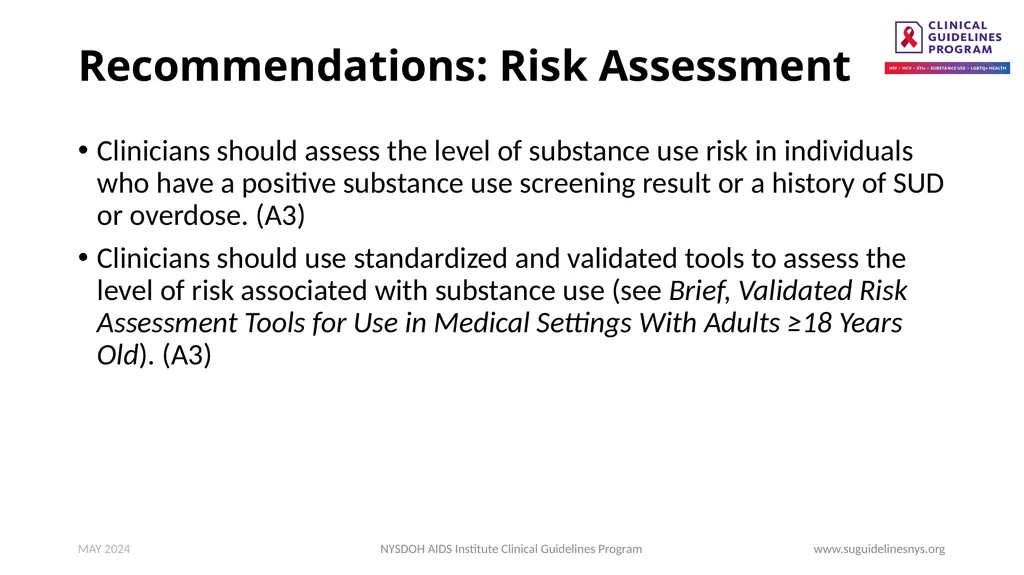
Recommendations: Risk Assessment Clinicians should assess the level of substance use risk in individuals who have a positive substance use screening result or a history of SUD or overdose. (A3)
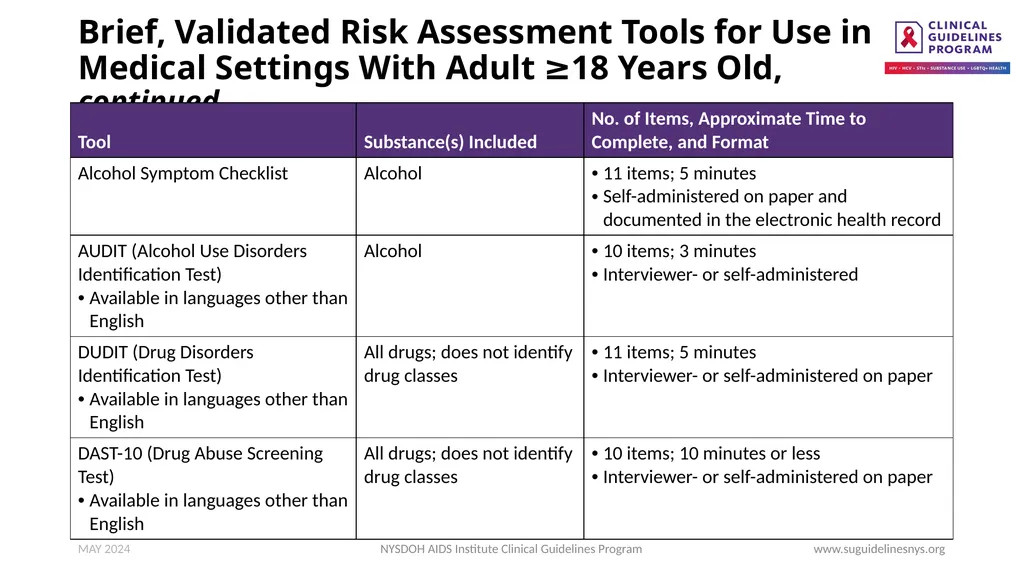
Clinicians should use standardized and validated tools to assess the level of risk associated with substance use (see Brief, Validated Risk Assessment Tools for Use in Medical Settings With Adults ≥18 Years Old). (A3) NYSDOH AIDS Institute Clinical Guidelines Program www.suguidelinesnys.org MAY 2024<br>
Clinicians should use standardized and validated tools to assess the level of risk associated with substance use (see Brief, Validated Risk Assessment Tools for Use in Medical Settings With Adults ≥18 Years Old). (A3) NYSDOH AIDS Institute Clinical Guidelines Program www.suguidelinesnys.org MAY 2024<br>
12
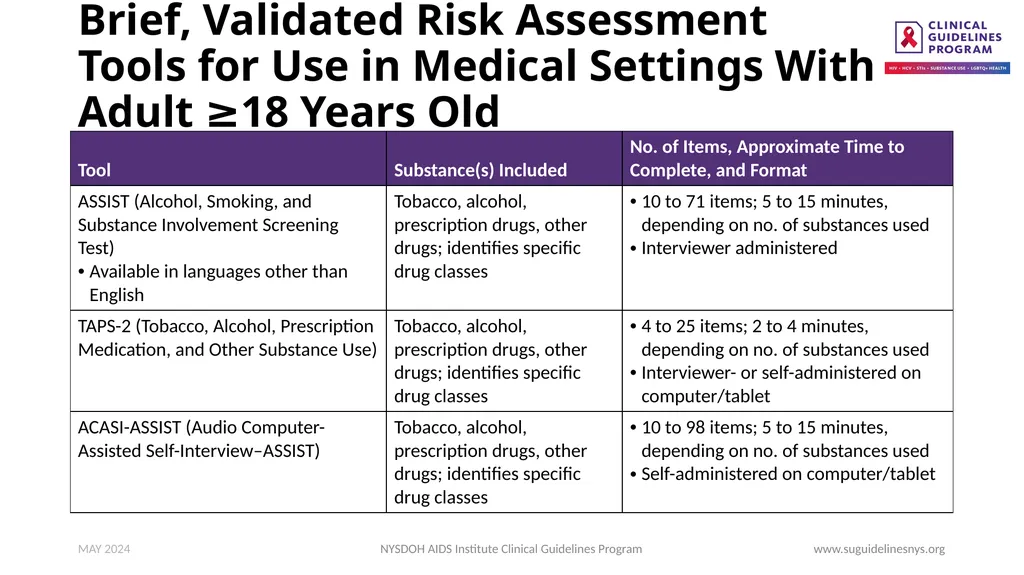
Brief, Validated Risk Assessment Tools for Use in Medical Settings With Adult ≥18 Years Old NYSDOH AIDS Institute Clinical Guidelines Program www.suguidelinesnys.org MAY 2024<br>
13
Brief, Validated Risk Assessment Tools for Use in Medical Settings With Adult ≥18 Years Old, continued NYSDOH AIDS Institute Clinical Guidelines Program www.suguidelinesnys.org MAY 2024<br>
14
Recommendations:
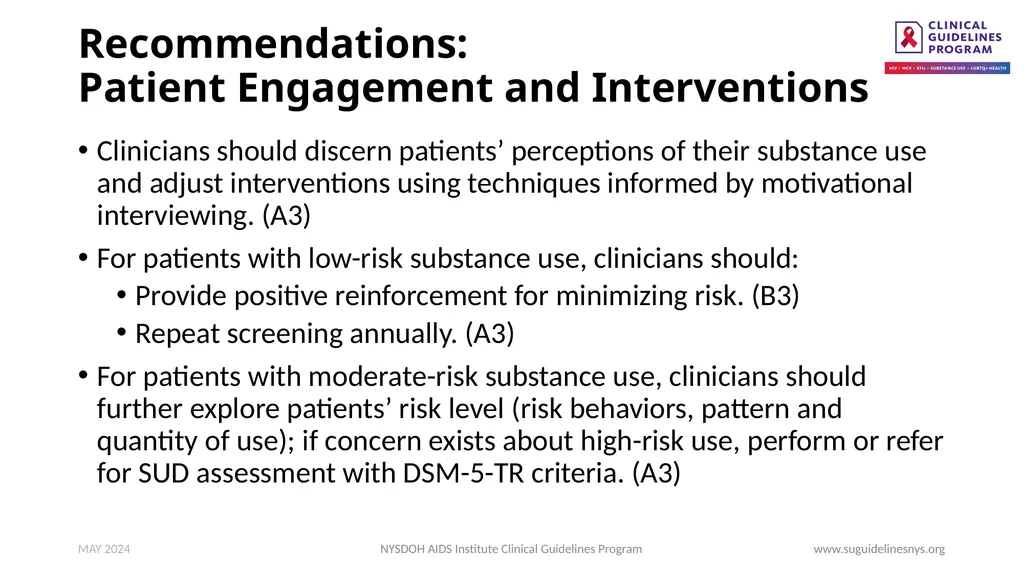
Patient Engagement and Interventions Clinicians should discern patients’ perceptions of their substance use and adjust interventions using techniques informed by motivational interviewing. (A3)
For patients with low-risk substance use, clinicians should:
Provide positive reinforcement for minimizing risk. (B3)
Repeat screening annually. (A3)
For patients with moderate-risk substance use, clinicians should further explore patients’ risk level (risk behaviors, pattern and quantity of use); if concern exists about high-risk use, perform or refer for SUD assessment with DSM-5-TR criteria. (A3) NYSDOH AIDS Institute Clinical Guidelines Program www.suguidelinesnys.org MAY 2024<br>
For patients with low-risk substance use, clinicians should:
Provide positive reinforcement for minimizing risk. (B3)
Repeat screening annually. (A3)
For patients with moderate-risk substance use, clinicians should further explore patients’ risk level (risk behaviors, pattern and quantity of use); if concern exists about high-risk use, perform or refer for SUD assessment with DSM-5-TR criteria. (A3) NYSDOH AIDS Institute Clinical Guidelines Program www.suguidelinesnys.org MAY 2024<br>
15
Recommendations:
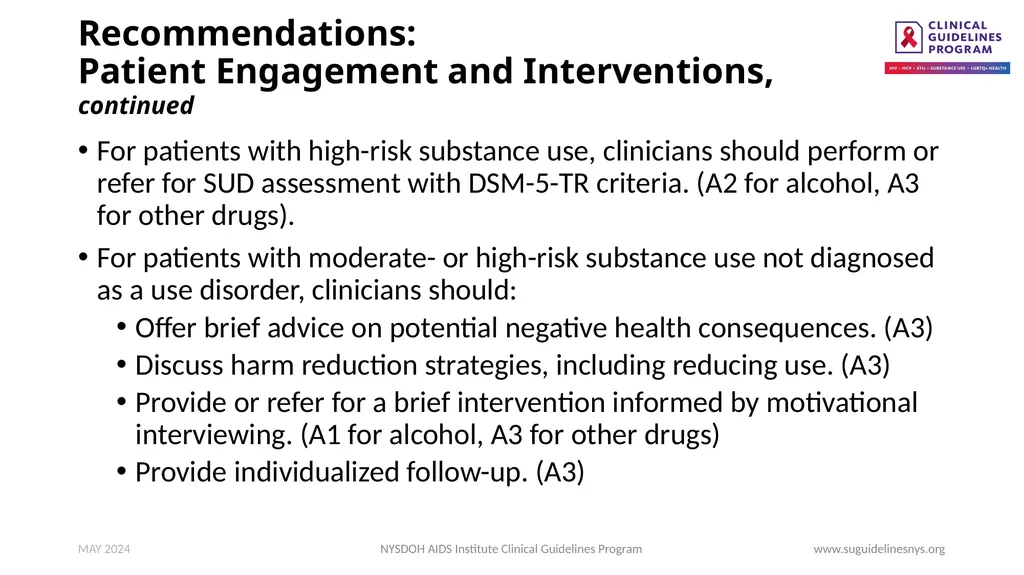
Patient Engagement and Interventions, continued For patients with high-risk substance use, clinicians should perform or refer for SUD assessment with DSM-5-TR criteria. (A2 for alcohol, A3 for other drugs).
For patients with moderate- or high-risk substance use not diagnosed as a use disorder, clinicians should:
Offer brief advice on potential negative health consequences. (A3)
Discuss harm reduction strategies, including reducing use. (A3)
Provide or refer for a brief intervention informed by motivational interviewing. (A1 for alcohol, A3 for other drugs)
Provide individualized follow-up. (A3) NYSDOH AIDS Institute Clinical Guidelines Program www.suguidelinesnys.org MAY 2024<br>
For patients with moderate- or high-risk substance use not diagnosed as a use disorder, clinicians should:
Offer brief advice on potential negative health consequences. (A3)
Discuss harm reduction strategies, including reducing use. (A3)
Provide or refer for a brief intervention informed by motivational interviewing. (A1 for alcohol, A3 for other drugs)
Provide individualized follow-up. (A3) NYSDOH AIDS Institute Clinical Guidelines Program www.suguidelinesnys.org MAY 2024<br>
16
Recommendations:
Diagnosis of Substance Use Disorder Clinicians should use the DSM-5-TR criteria to diagnose an SUD and determine its severity. (A3)
If patients present with symptoms consistent with both an SUD and a mental health disorder, clinicians should assess for both types of disorder and refer for specialty behavioral healthcare when indicated. (A3)
Clinicians should engage in shared decision-making with patients diagnosed with an SUD to develop an individualized treatment plan that includes pharmacologic and behavioral treatment as indicated and available. (A3) NYSDOH AIDS Institute Clinical Guidelines Program www.suguidelinesnys.org MAY 2024<br>
If patients present with symptoms consistent with both an SUD and a mental health disorder, clinicians should assess for both types of disorder and refer for specialty behavioral healthcare when indicated. (A3)
Clinicians should engage in shared decision-making with patients diagnosed with an SUD to develop an individualized treatment plan that includes pharmacologic and behavioral treatment as indicated and available. (A3) NYSDOH AIDS Institute Clinical Guidelines Program www.suguidelinesnys.org MAY 2024<br>
17
DSM-5-TR Diagnostic Criteria for Diagnosing and Classifying Substance Use Disorders NYSDOH AIDS Institute Clinical Guidelines Program www.suguidelinesnys.org MAY 2024<br>
18
NYSDOH AIDS Institute Clinical Guidelines Program www.suguidelinesnys.org Need Help?<br>
19
NYSDOH AIDS Institute Clinical Guidelines Program www.suguidelinesnys.org Access the Guideline www.suguidelinesnys.org > Substance Use Screening, Risk Assessment, and Use Disorder Diagnosis in Adults
Also available: Printable pocket guide and PDF Podcast: Viremic—Cases in HIV
Find all episodes at viremic.org<br>
Also available: Printable pocket guide and PDF Podcast: Viremic—Cases in HIV
Find all episodes at viremic.org<br>