
Suicide Intervention Workshop Sure, suicide is
SN
Published · 18 slides · 0 views
1 / 1



Description
Suicide Intervention Workshop Sure, suicide is probably another important thing to learn about but, really, is suicide that big a problem? I think I should just walk on by. -AN INQUIRING MIND Dont do that. Suicide is one of the most
Related Topics
Share
Embed code
Download this presentation From Below
"Suicide Intervention Workshop Sure, suicide is" is the property of its rightful owner. Permission is granted to download and print the materials on this website for personal, non-commercial use only, and to display it on your personal computer provided you do not modify the materials and that you retain all copyright notices contained in the materials. By downloading content from our website, you accept the terms of this agreement.
Presentation Transcript
01
Suicide Intervention Workshop<br>
02
Sure, suicide is probably another important thing to learn about but, really, is suicide that big a problem?
I think I should just walk on by.
-AN INQUIRING MIND<br>
I think I should just walk on by.
-AN INQUIRING MIND<br>
03
Don’t do that. Suicide is one of the most underestimated community health problems in the world. More people are dying from suicide than in all of the armed conflicts around the world and about the same or more than those dying from traffic accidents. For every person who dies by suicide, there are as many as 100 times more people who injure themselves from non fatal suicidal behaviours. In any year , approximately 6% of the entire population has serious thoughts of suicide. Four to five percent of all people attempt suicide in their lifetime; one in nine have seriously considered suicide. Since suicide affects people at all ages, the loss in potential productivity is staggering. The emotional costs of any suicidal behaviour, although not as measurable, are even more staggering. The legacy of suicide is often a lifetime of grief, sadness, anger and confusion.<br>
04
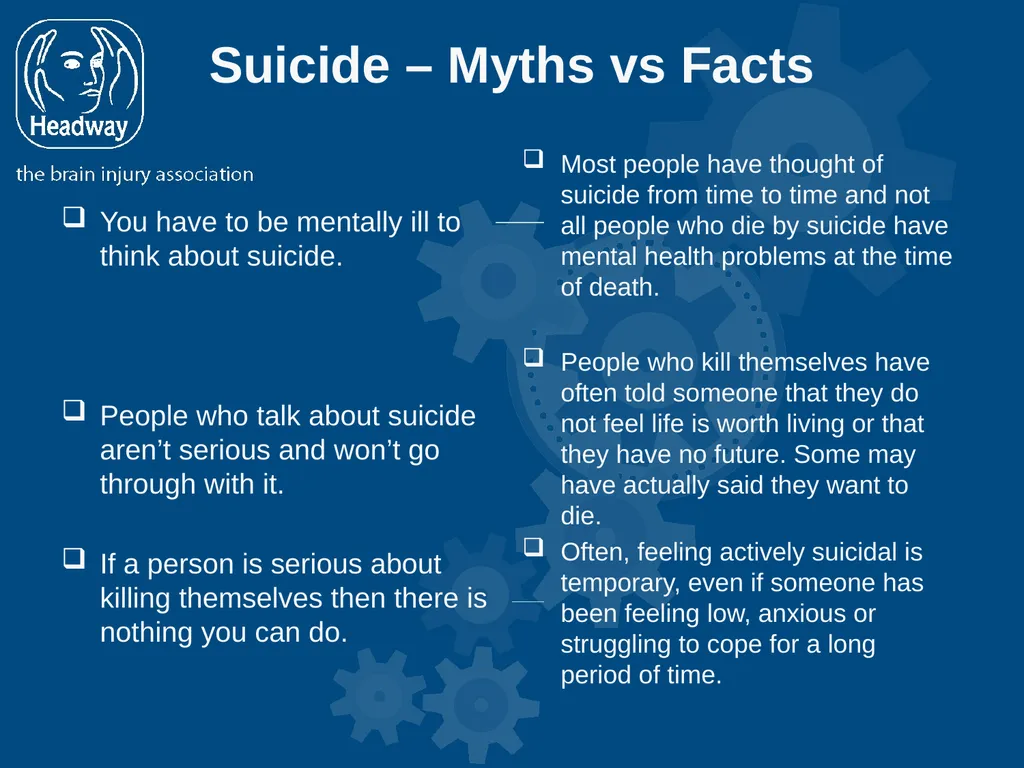
Suicide – Myths vs Facts You have to be mentally ill to think about suicide.
People who talk about suicide aren’t serious and won’t go through with it.
If a person is serious about killing themselves then there is nothing you can do. Most people have thought of suicide from time to time and not all people who die by suicide have mental health problems at the time of death.
People who kill themselves have often told someone that they do not feel life is worth living or that they have no future. Some may have actually said they want to die.
Often, feeling actively suicidal is temporary, even if someone has been feeling low, anxious or struggling to cope for a long period of time.<br>
People who talk about suicide aren’t serious and won’t go through with it.
If a person is serious about killing themselves then there is nothing you can do. Most people have thought of suicide from time to time and not all people who die by suicide have mental health problems at the time of death.
People who kill themselves have often told someone that they do not feel life is worth living or that they have no future. Some may have actually said they want to die.
Often, feeling actively suicidal is temporary, even if someone has been feeling low, anxious or struggling to cope for a long period of time.<br>
05
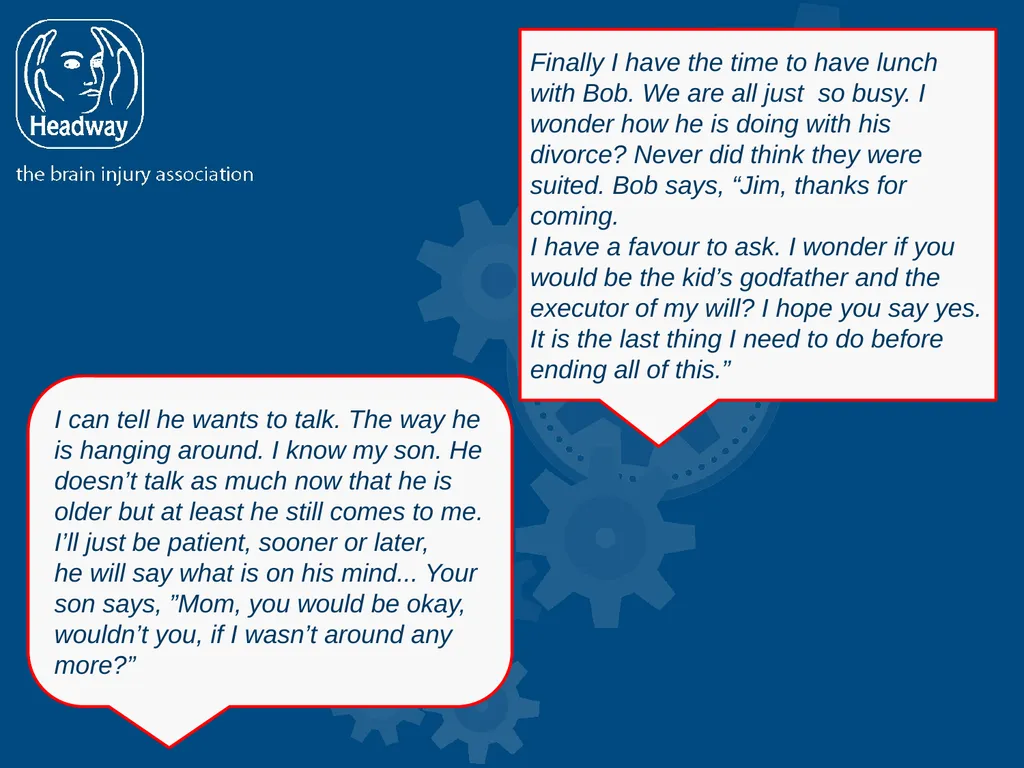
Finally I have the time to have lunch with Bob. We are all just so busy. I wonder how he is doing with his divorce? Never did think they were suited. Bob says, “Jim, thanks for coming.
I have a favour to ask. I wonder if you would be the kid’s godfather and the executor of my will? I hope you say yes. It is the last thing I need to do before ending all of this.” I can tell he wants to talk. The way he is hanging around. I know my son. He doesn’t talk as much now that he is older but at least he still comes to me. I’ll just be patient, sooner or later,
he will say what is on his mind... Your son says, ”Mom, you would be okay, wouldn’t you, if I wasn’t around any more?”<br>
I have a favour to ask. I wonder if you would be the kid’s godfather and the executor of my will? I hope you say yes. It is the last thing I need to do before ending all of this.” I can tell he wants to talk. The way he is hanging around. I know my son. He doesn’t talk as much now that he is older but at least he still comes to me. I’ll just be patient, sooner or later,
he will say what is on his mind... Your son says, ”Mom, you would be okay, wouldn’t you, if I wasn’t around any more?”<br>
06
It might seem frightening, but you can help.
Suicidal individuals seek out those whom they trust and feel connected to in some way. One of the most important factors in preventing a suicide is the presence of a supportive resource. Many suicidal periods are short-lived.
By talking and listening, you may draw
the person into a supportive relationship with you and away from self-destructive thoughts.
You are also providing a safe period of time
in which other forms of assistance can be
mobilized. PANIC
I feel helpless
and inadequate in
this situation. I’m just a friend (a teacher, a
parent, etc.); I’m not a trained crisis
worker.<br>
Suicidal individuals seek out those whom they trust and feel connected to in some way. One of the most important factors in preventing a suicide is the presence of a supportive resource. Many suicidal periods are short-lived.
By talking and listening, you may draw
the person into a supportive relationship with you and away from self-destructive thoughts.
You are also providing a safe period of time
in which other forms of assistance can be
mobilized. PANIC
I feel helpless
and inadequate in
this situation. I’m just a friend (a teacher, a
parent, etc.); I’m not a trained crisis
worker.<br>
07
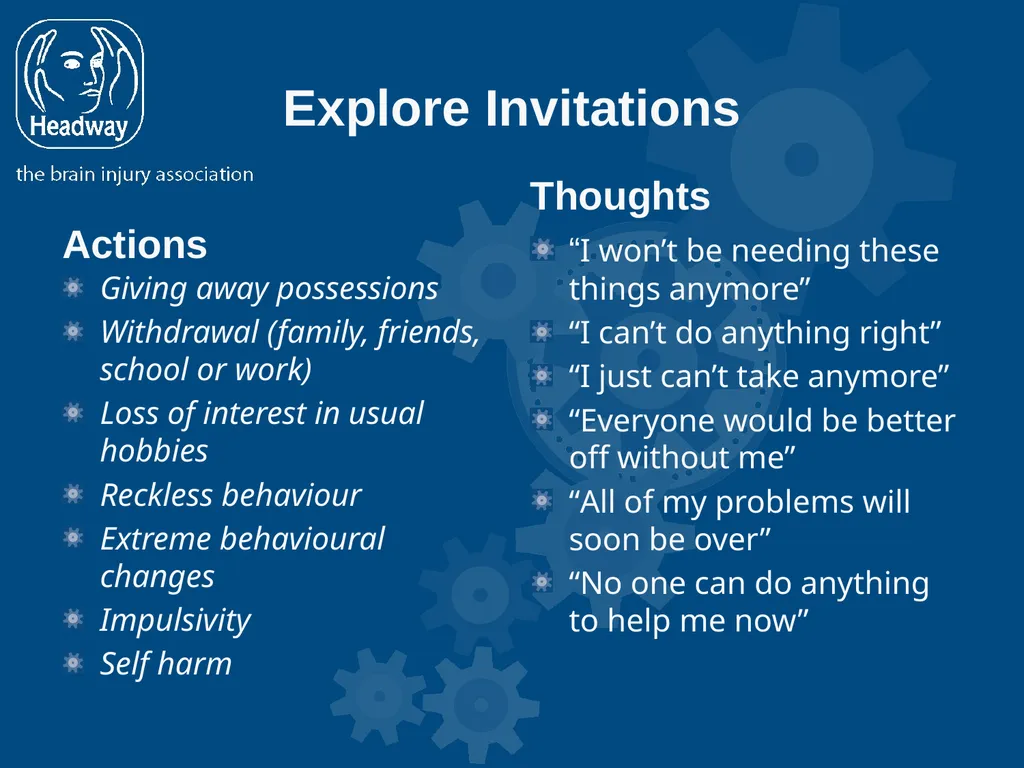
Explore Invitations Actions Giving away possessions
Withdrawal (family, friends, school or work)
Loss of interest in usual hobbies
Reckless behaviour
Extreme behavioural changes
Impulsivity
Self harm Thoughts “I won’t be needing these things anymore”
“I can’t do anything right”
“I just can’t take anymore”
“Everyone would be better off without me”
“All of my problems will soon be over”
“No one can do anything to help me now”<br>
Withdrawal (family, friends, school or work)
Loss of interest in usual hobbies
Reckless behaviour
Extreme behavioural changes
Impulsivity
Self harm Thoughts “I won’t be needing these things anymore”
“I can’t do anything right”
“I just can’t take anymore”
“Everyone would be better off without me”
“All of my problems will soon be over”
“No one can do anything to help me now”<br>
08
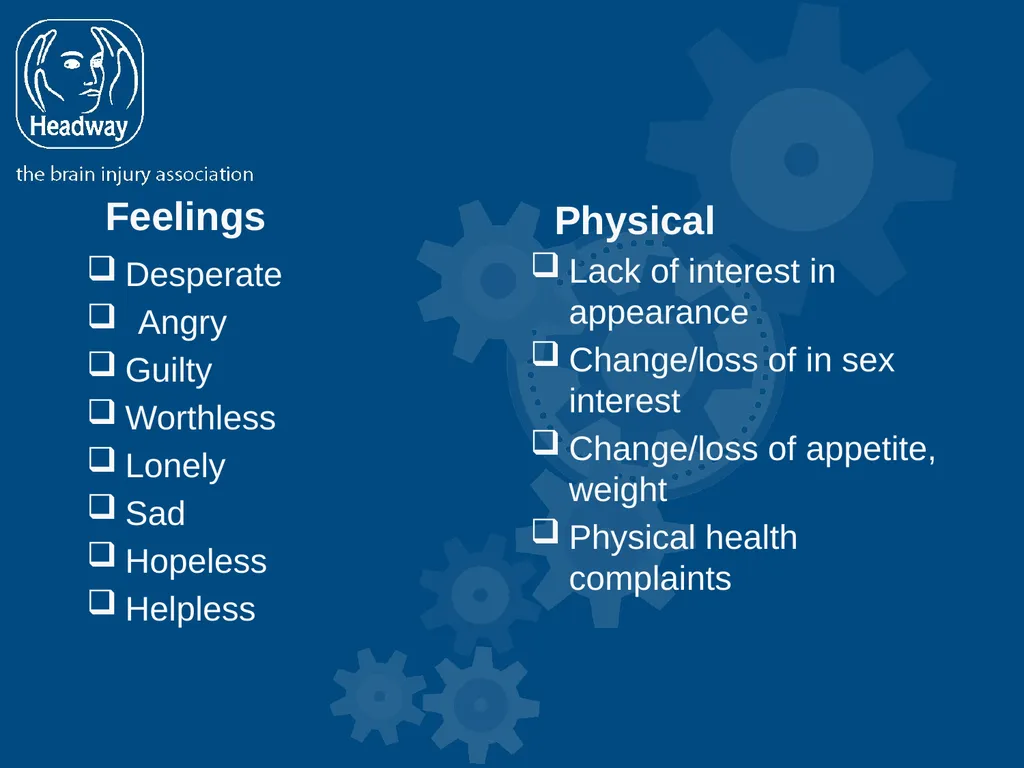
Feelings Desperate
Angry
Guilty
Worthless
Lonely
Sad
Hopeless
Helpless Physical Lack of interest in appearance
Change/loss of in sex interest
Change/loss of appetite, weight
Physical health complaints<br>
Angry
Guilty
Worthless
Lonely
Sad
Hopeless
Helpless Physical Lack of interest in appearance
Change/loss of in sex interest
Change/loss of appetite, weight
Physical health complaints<br>
09
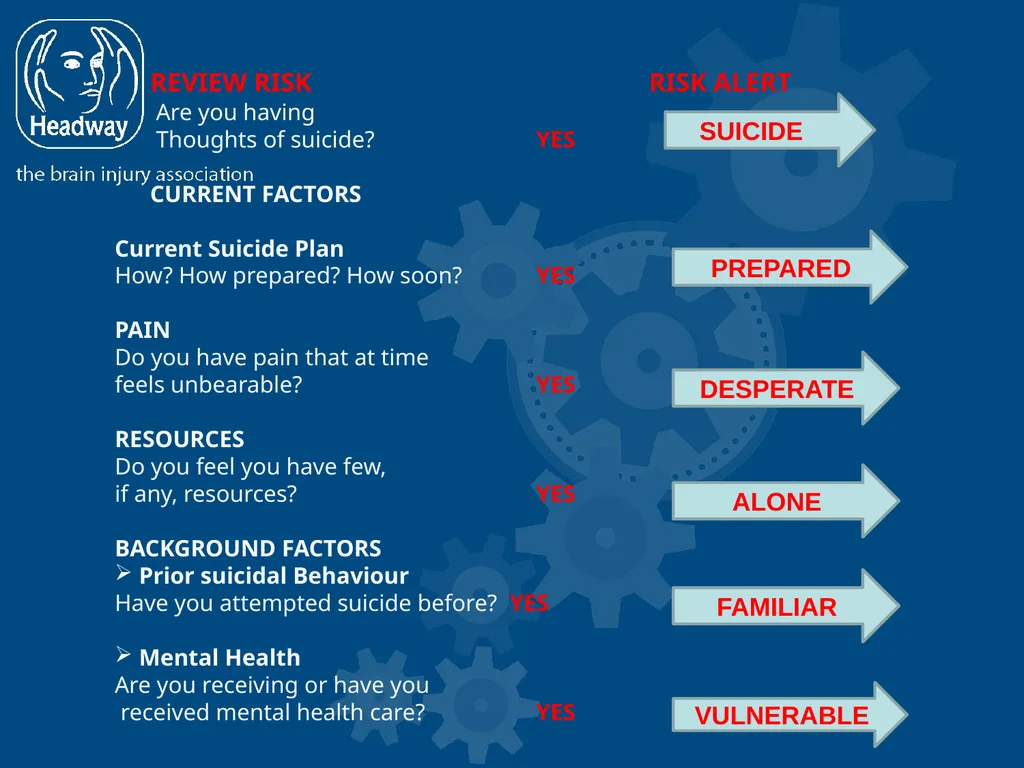
REVIEW RISK RISK ALERT Are you having
Thoughts of suicide? YES
CURRENT FACTORS
Current Suicide Plan
How? How prepared? How soon? YES
PAIN
Do you have pain that at time
feels unbearable? YES
RESOURCES
Do you feel you have few,
if any, resources? YES
BACKGROUND FACTORS
Prior suicidal Behaviour
Have you attempted suicide before? YES
Mental Health
Are you receiving or have you
received mental health care? YES PREPARED DESPERATE ALONE FAMILIAR SUICIDE VULNERABLE<br>
Thoughts of suicide? YES
CURRENT FACTORS
Current Suicide Plan
How? How prepared? How soon? YES
PAIN
Do you have pain that at time
feels unbearable? YES
RESOURCES
Do you feel you have few,
if any, resources? YES
BACKGROUND FACTORS
Prior suicidal Behaviour
Have you attempted suicide before? YES
Mental Health
Are you receiving or have you
received mental health care? YES PREPARED DESPERATE ALONE FAMILIAR SUICIDE VULNERABLE<br>
10
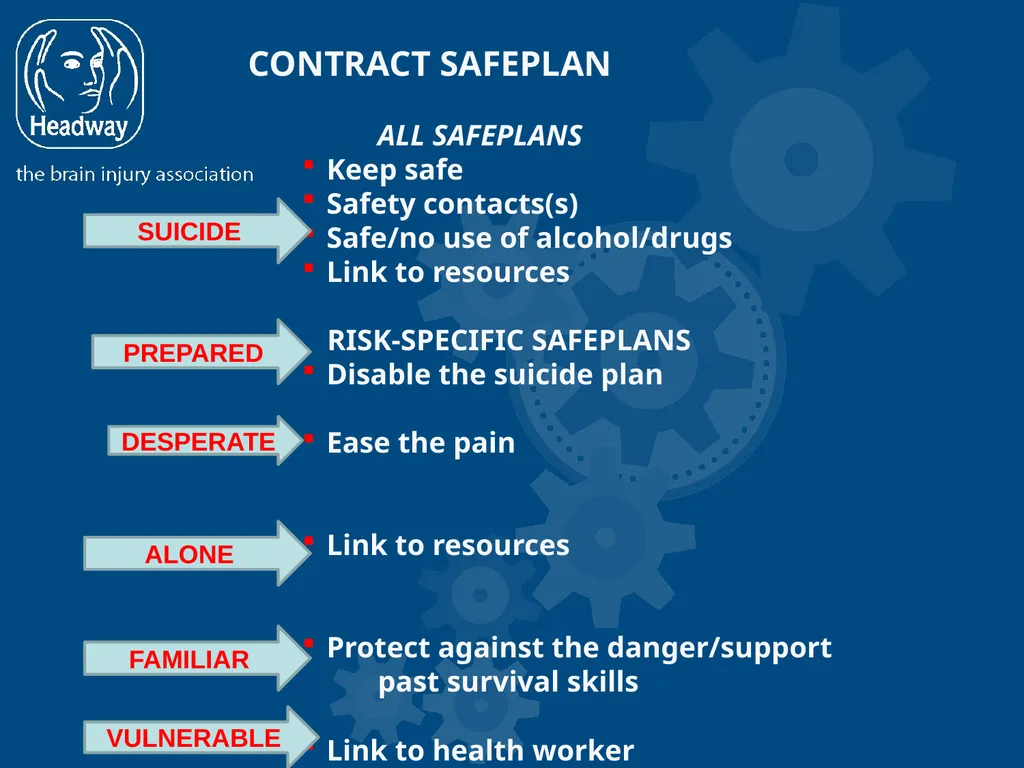
CONTRACT SAFEPLAN
ALL SAFEPLANS
Keep safe
Safety contacts(s)
Safe/no use of alcohol/drugs
Link to resources
RISK-SPECIFIC SAFEPLANS
Disable the suicide plan
Ease the pain
Link to resources
Protect against the danger/support
past survival skills
Link to health worker SUICIDE PREPARED DESPERATE ALONE FAMILIAR VULNERABLE<br>
ALL SAFEPLANS
Keep safe
Safety contacts(s)
Safe/no use of alcohol/drugs
Link to resources
RISK-SPECIFIC SAFEPLANS
Disable the suicide plan
Ease the pain
Link to resources
Protect against the danger/support
past survival skills
Link to health worker SUICIDE PREPARED DESPERATE ALONE FAMILIAR VULNERABLE<br>
11
Protection for anyone with thoughts of suicide – contracting safe plan.
There are four elements that need to be put into place for every
person with thoughts of suicide.<br>
There are four elements that need to be put into place for every
person with thoughts of suicide.<br>
12
Risk Alert 1: Has thoughts of suicide A promise to keep safe
Have the person at risk agree not to act upon thoughts of suicide
for a specific period of time. The person at risk may think about
suicide. To ask the person at risk not to think about suicide would
be virtually impossible and, therefore, dangerous to request. In
finding the correct time period, it is usually best to start by asking
the person at risk how long they might be able to keep themselves safe. Contracting a keep safe commitment usually sounds something like: “I agree to keep myself safe until after I meet with X. I can think about suicide but I must not act on those thoughts.”<br>
Have the person at risk agree not to act upon thoughts of suicide
for a specific period of time. The person at risk may think about
suicide. To ask the person at risk not to think about suicide would
be virtually impossible and, therefore, dangerous to request. In
finding the correct time period, it is usually best to start by asking
the person at risk how long they might be able to keep themselves safe. Contracting a keep safe commitment usually sounds something like: “I agree to keep myself safe until after I meet with X. I can think about suicide but I must not act on those thoughts.”<br>
13
2. Provide continuously-available safety contact(s)
Safety contact(s) are backups to other resources in case the person
at risk is unable to keep safe and cannot access other parts of the
safety plan. The safety contact is either someone who knows that
the person at risk might phone or, more usually, it is an agency that
regularly deals with suicide situations like a crisis line or a hospital
emergency room. You may need more than one resource to ensure
7-days a week, 24-hour coverage. Contracting this element usually
takes a form like: “If anything goes wrong and I can’t reach anyone
else, I will contact X. I will not act on thoughts of suicide, I will
contact X.”<br>
Safety contact(s) are backups to other resources in case the person
at risk is unable to keep safe and cannot access other parts of the
safety plan. The safety contact is either someone who knows that
the person at risk might phone or, more usually, it is an agency that
regularly deals with suicide situations like a crisis line or a hospital
emergency room. You may need more than one resource to ensure
7-days a week, 24-hour coverage. Contracting this element usually
takes a form like: “If anything goes wrong and I can’t reach anyone
else, I will contact X. I will not act on thoughts of suicide, I will
contact X.”<br>
14
3. A promise of safe/no use of alcohol/drugs
Alcohol and/or recreational drug misuse or abuse can make suicide
much more likely. Access to correct doses of prescription medications
must be maintained but protection against overdose should be
included. Apart from essential medications, if you can get agreement
that all use of alcohol and/or recreational drugs will be avoided, do
so. In some situations, such a request might be impossible to follow
and, therefore, dangerous to request. In this type of situation, add
extra resources to monitor the use or to dispense proper doses of
prescription medication. Contracting this element usually takes a
form like: “Yes I know that alcohol and/or drugs can be dangerous in
my situation. I will follow our plan to avoid them.”<br>
Alcohol and/or recreational drug misuse or abuse can make suicide
much more likely. Access to correct doses of prescription medications
must be maintained but protection against overdose should be
included. Apart from essential medications, if you can get agreement
that all use of alcohol and/or recreational drugs will be avoided, do
so. In some situations, such a request might be impossible to follow
and, therefore, dangerous to request. In this type of situation, add
extra resources to monitor the use or to dispense proper doses of
prescription medication. Contracting this element usually takes a
form like: “Yes I know that alcohol and/or drugs can be dangerous in
my situation. I will follow our plan to avoid them.”<br>
15
4. Link to other resources
Every person with thoughts of suicide should be connected to others who are aware that they are having thoughts of suicide. Usually, more links are better. The type of risk alerts and the availability of resources will determine which links are needed. The more risk alerts, the more likely that formal resources should be included but do not forget to consider informal resources. In these days, quick access to many formal supports is more myth than reality. A caregiver should always think about informal alternatives or supplements. Contracting this element usually takes a form something like: “Yes I agree that I/we/you tell X about me having thoughts of suicide so that they can help if I need it.”<br>
Every person with thoughts of suicide should be connected to others who are aware that they are having thoughts of suicide. Usually, more links are better. The type of risk alerts and the availability of resources will determine which links are needed. The more risk alerts, the more likely that formal resources should be included but do not forget to consider informal resources. In these days, quick access to many formal supports is more myth than reality. A caregiver should always think about informal alternatives or supplements. Contracting this element usually takes a form something like: “Yes I agree that I/we/you tell X about me having thoughts of suicide so that they can help if I need it.”<br>
16
The immediate suicide danger is over, at least for now. But how do I help this person to deal with the problems that brought him/her to consider suicide in the first place?
Who else needs to be involved in the helping process? How do we go about working together?<br>
Who else needs to be involved in the helping process? How do we go about working together?<br>
17
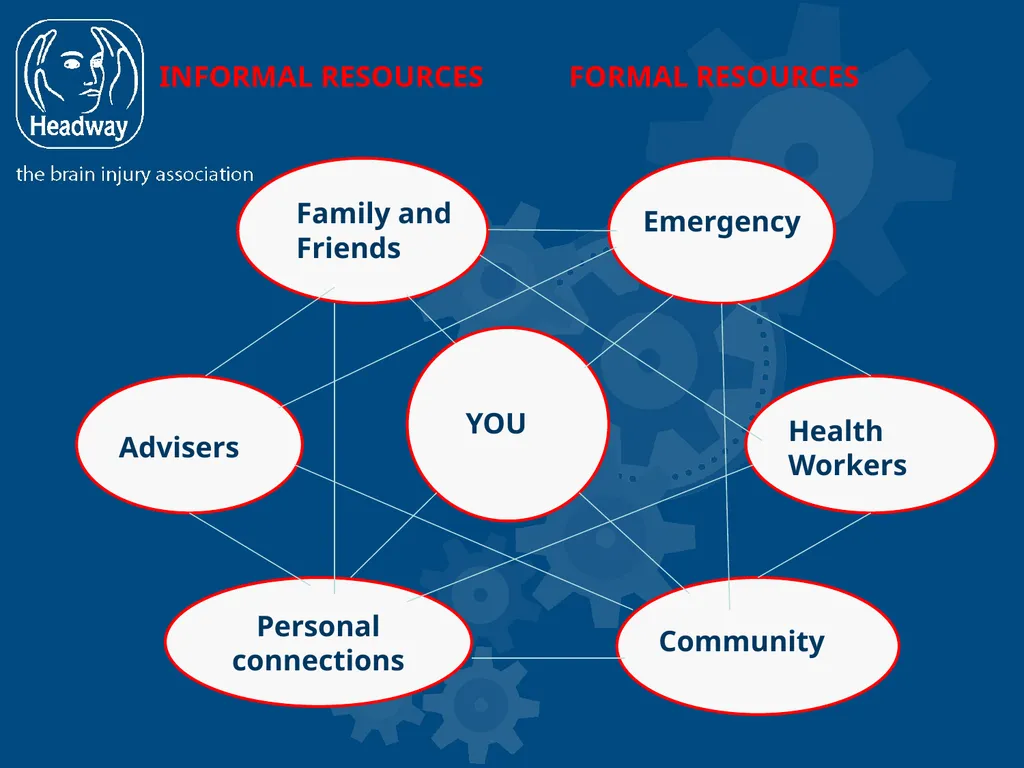
YOU Personal
connections Family and
Friends Emergency Advisers Health
Workers Community INFORMAL RESOURCES FORMAL RESOURCES<br>
connections Family and
Friends Emergency Advisers Health
Workers Community INFORMAL RESOURCES FORMAL RESOURCES<br>
18
Likely, you have already realised that having thoughts of suicide is a serious matter. Being alone with thoughts of suicide is one thing that is known to Increase the risk of harm or death. Find someone who is comfortable talking about suicide— someone who will work with you to prevent the risk of these thoughts leading to suicidal actions. One of the quickest and best ways to find out if your helper has these abilities is to tell them that you are having thought of suicide and watch their reaction. They may not be comfortable immediately, but expect them to show more concern for you than themselves. If they don’t measure up to this standard, there are others who will. Keep trying. Once you have found someone, don’t expect that the helper is going to keep the danger secret or not want extra help. You want a helper who is honest about how much they can do. Lastly, be honest. Don’t say anything just to please the helper and never promise anything you won’t or can’t do.
Everyone needs to take the time to find what will really help.
Suicide is not the only way out.<br>
Everyone needs to take the time to find what will really help.
Suicide is not the only way out.<br>