
Summer Programs Boot Camp January 2023








Description: Summer Programs Boot Camp January 2023 Housekeeping One conversation at a time Ask your questions! There are no silly questions or ideas Objectives Explain the Enrichment Program registration and approval process Outline the Enrichment
Related Topics
Download Presentation
"Summer Programs Boot Camp January 2023" is the property of its rightful owner. Permission is granted to download and print the materials on this website for personal, non-commercial use only, and to display it on your personal computer provided you do not modify the materials and that you retain all copyright notices contained in the materials. By downloading content from our website, you accept the terms of this agreement.
Presentation Transcript
slide1. Summer Programs Boot Camp January 2023<br>
slide2. Housekeeping One conversation at a time
Ask your questions!
There are no silly questions or ideas<br>
slide3. Objectives Explain the Enrichment Program registration and approval process
Outline the Enrichment Program regulatory framework (Non-student Minor Policy, Fair Labor Standards Act, etc.)
Define Program Director roles and responsibilities for Enrichment Programs
Discuss funding protocols for Enrichment Programs (Title III, Board of Regents, etc.)
Review hiring and approving time for Enrichment Program employees<br>
slide4. Setting the Groundwork<br>
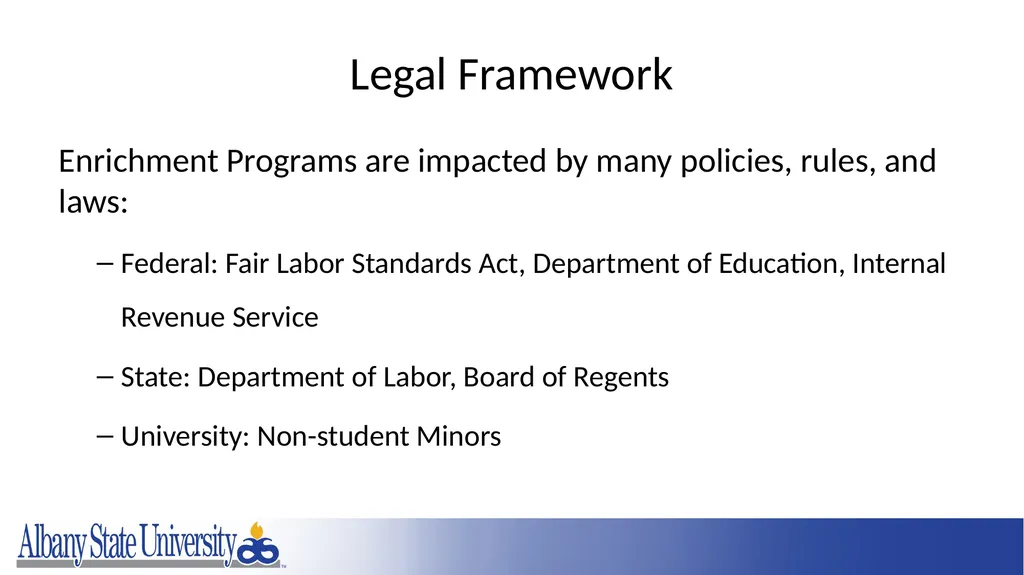
slide5. Legal Framework Enrichment Programs are impacted by many policies, rules, and laws:
Federal: Fair Labor Standards Act, Department of Education, Internal Revenue Service
State: Department of Labor, Board of Regents
University: Non-student Minors<br>
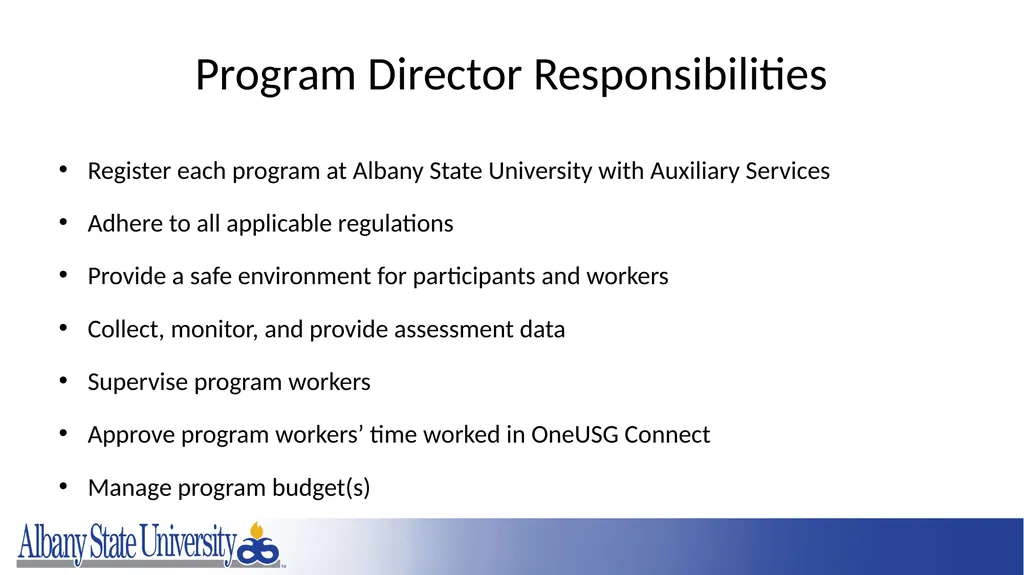
slide6. Program Director Responsibilities Register each program at Albany State University with Auxiliary Services
Adhere to all applicable regulations
Provide a safe environment for participants and workers
Collect, monitor, and provide assessment data
Supervise program workers
Approve program workers’ time worked in OneUSG Connect
Manage program budget(s)<br>
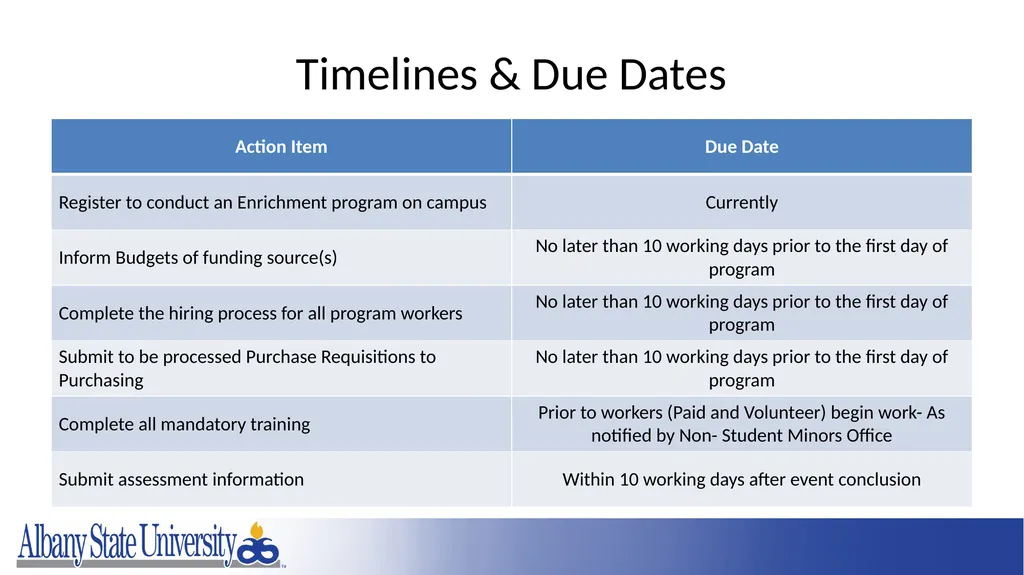
slide7. Timelines & Due Dates<br>
slide8. Protection of Non-Student Minors
Policies and Procedures
for
Programs Serving Minors<br>
slide9. Auxiliary Services Purpose of the Protection of Non-Student Minors Policy
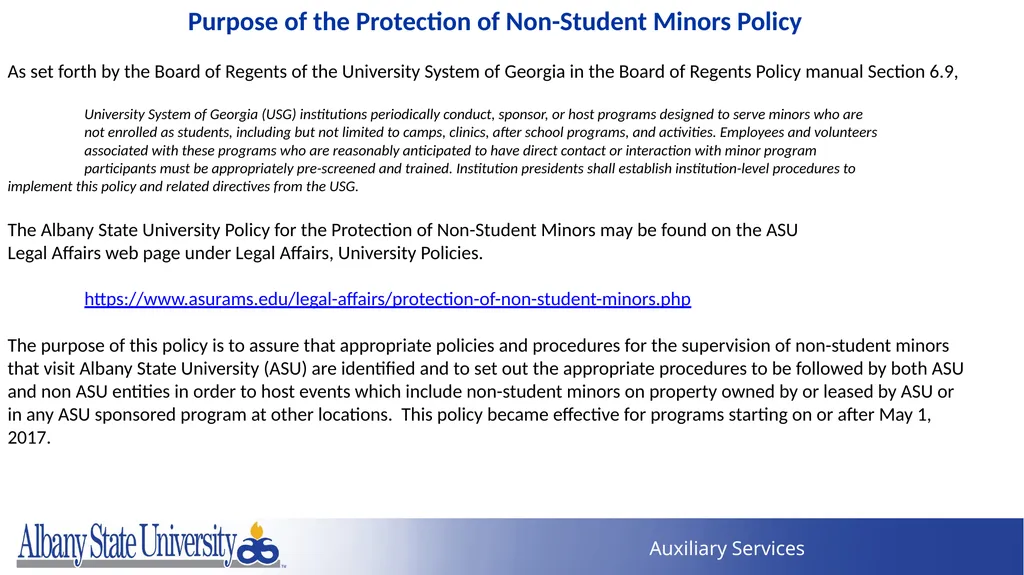
As set forth by the Board of Regents of the University System of Georgia in the Board of Regents Policy manual Section 6.9,
University System of Georgia (USG) institutions periodically conduct, sponsor, or host programs designed to serve minors who are
not enrolled as students, including but not limited to camps, clinics, after school programs, and activities. Employees and volunteers
associated with these programs who are reasonably anticipated to have direct contact or interaction with minor program
participants must be appropriately pre-screened and trained. Institution presidents shall establish institution-level procedures to implement this policy and related directives from the USG.
The Albany State University Policy for the Protection of Non-Student Minors may be found on the ASU
Legal Affairs web page under Legal Affairs, University Policies.
https://www.asurams.edu/legal-affairs/protection-of-non-student-minors.php
The purpose of this policy is to assure that appropriate policies and procedures for the supervision of non-student minors that visit Albany State University (ASU) are identified and to set out the appropriate procedures to be followed by both ASU and non ASU entities in order to host events which include non-student minors on property owned by or leased by ASU or in any ASU sponsored program at other locations. This policy became effective for programs starting on or after May 1, 2017.<br>
slide10. Auxiliary Services What is the definition of a minor as it relates to this policy and what types of activities does the policy cover?
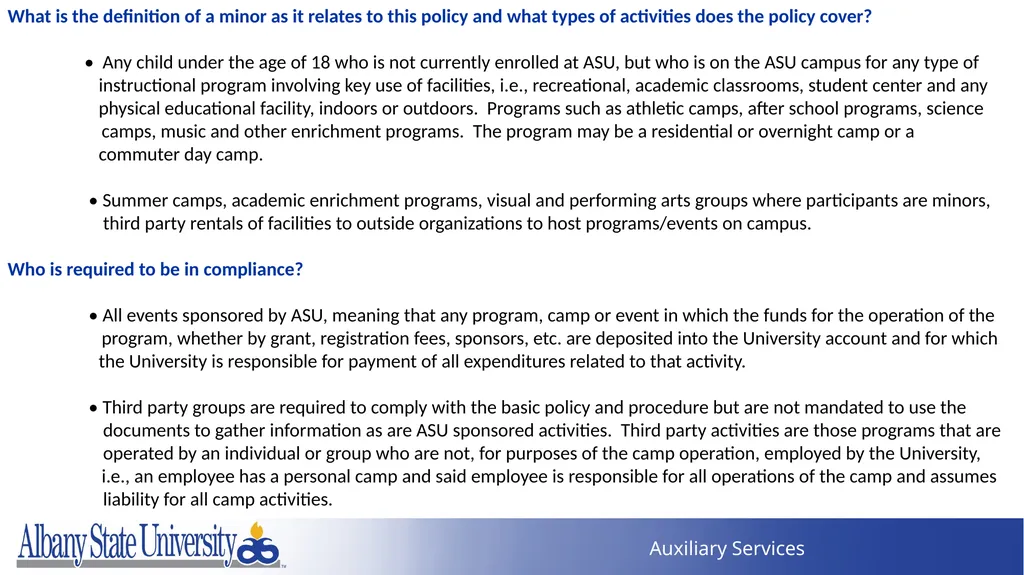
• Any child under the age of 18 who is not currently enrolled at ASU, but who is on the ASU campus for any type of
instructional program involving key use of facilities, i.e., recreational, academic classrooms, student center and any
physical educational facility, indoors or outdoors. Programs such as athletic camps, after school programs, science
camps, music and other enrichment programs. The program may be a residential or overnight camp or a
commuter day camp.
• Summer camps, academic enrichment programs, visual and performing arts groups where participants are minors,
third party rentals of facilities to outside organizations to host programs/events on campus.
Who is required to be in compliance?
• All events sponsored by ASU, meaning that any program, camp or event in which the funds for the operation of the
program, whether by grant, registration fees, sponsors, etc. are deposited into the University account and for which
the University is responsible for payment of all expenditures related to that activity.
• Third party groups are required to comply with the basic policy and procedure but are not mandated to use the
documents to gather information as are ASU sponsored activities. Third party activities are those programs that are
operated by an individual or group who are not, for purposes of the camp operation, employed by the University, i.e., an employee has a personal camp and said employee is responsible for all operations of the camp and assumes
liability for all camp activities.<br>
slide11. Auxiliary Services Are there any exemptions to this policy?
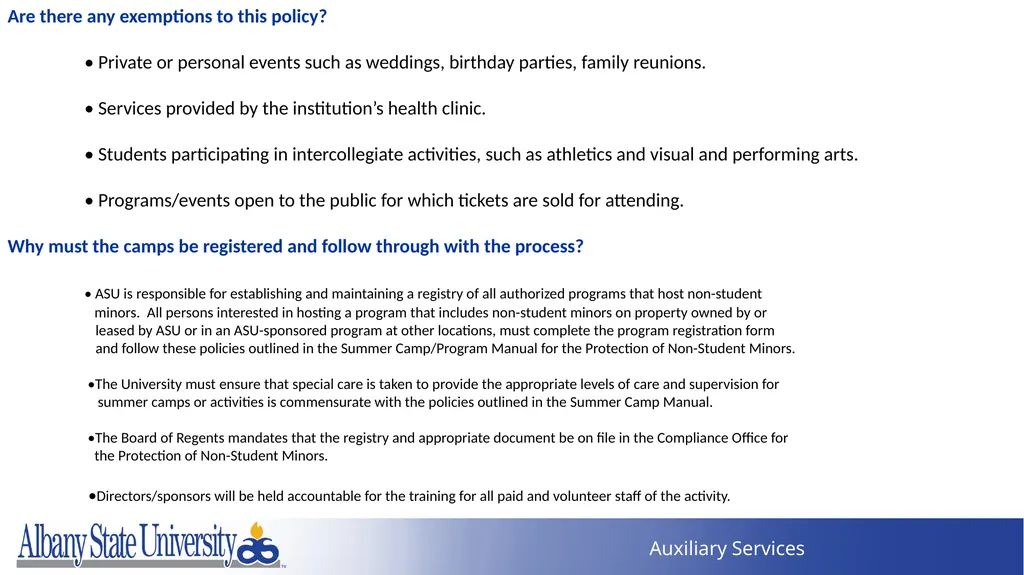
• Private or personal events such as weddings, birthday parties, family reunions.
• Services provided by the institution’s health clinic.
• Students participating in intercollegiate activities, such as athletics and visual and performing arts.
• Programs/events open to the public for which tickets are sold for attending.
Why must the camps be registered and follow through with the process?
• ASU is responsible for establishing and maintaining a registry of all authorized programs that host non-student
minors. All persons interested in hosting a program that includes non-student minors on property owned by or
leased by ASU or in an ASU-sponsored program at other locations, must complete the program registration form
and follow these policies outlined in the Summer Camp/Program Manual for the Protection of Non-Student Minors.
•The University must ensure that special care is taken to provide the appropriate levels of care and supervision for
summer camps or activities is commensurate with the policies outlined in the Summer Camp Manual.
•The Board of Regents mandates that the registry and appropriate document be on file in the Compliance Office for
the Protection of Non-Student Minors.
•Directors/sponsors will be held accountable for the training for all paid and volunteer staff of the activity.<br>
slide12. Auxiliary Services How do I register my camp/activity?
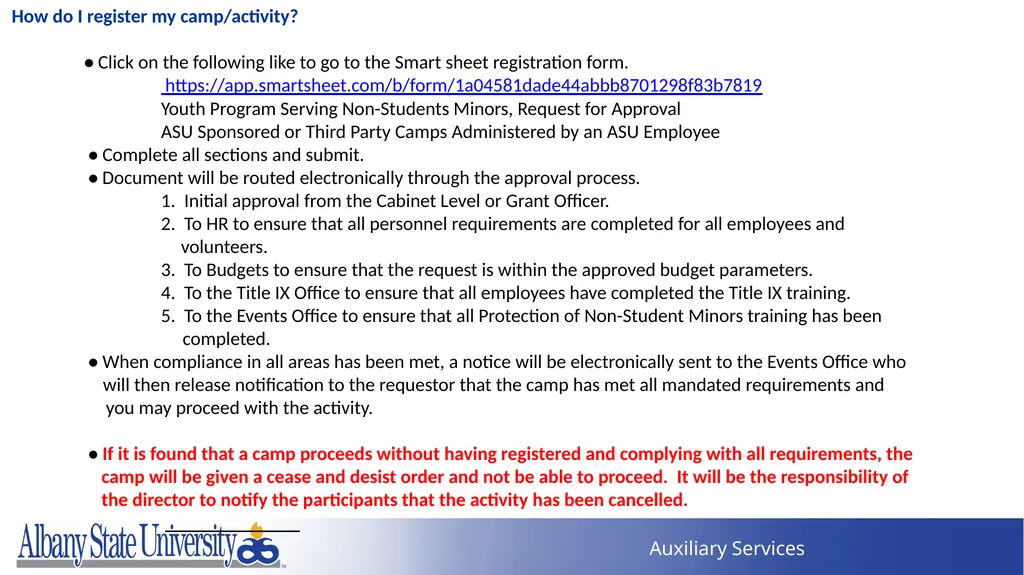
• Click on the following like to go to the Smart sheet registration form.
https://app.smartsheet.com/b/form/1a04581dade44abbb8701298f83b7819
Youth Program Serving Non-Students Minors, Request for Approval
ASU Sponsored or Third Party Camps Administered by an ASU Employee
• Complete all sections and submit.
• Document will be routed electronically through the approval process.
1. Initial approval from the Cabinet Level or Grant Officer.
2. To HR to ensure that all personnel requirements are completed for all employees and
volunteers.
3. To Budgets to ensure that the request is within the approved budget parameters.
4. To the Title IX Office to ensure that all employees have completed the Title IX training.
5. To the Events Office to ensure that all Protection of Non-Student Minors training has been
completed.
• When compliance in all areas has been met, a notice will be electronically sent to the Events Office who
will then release notification to the requestor that the camp has met all mandated requirements and
you may proceed with the activity.
• If it is found that a camp proceeds without having registered and complying with all requirements, the
camp will be given a cease and desist order and not be able to proceed. It will be the responsibility of
the director to notify the participants that the activity has been cancelled.<br>
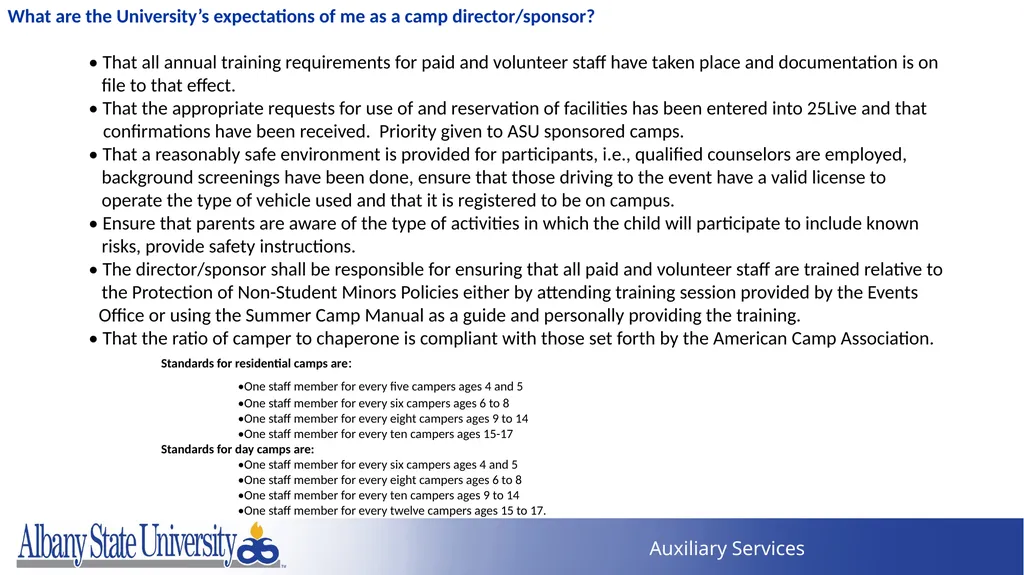
slide13. Auxiliary Services What are the University’s expectations of me as a camp director/sponsor?
• That all annual training requirements for paid and volunteer staff have taken place and documentation is on
file to that effect.
• That the appropriate requests for use of and reservation of facilities has been entered into 25Live and that
confirmations have been received. Priority given to ASU sponsored camps.
• That a reasonably safe environment is provided for participants, i.e., qualified counselors are employed,
background screenings have been done, ensure that those driving to the event have a valid license to operate the type of vehicle used and that it is registered to be on campus.
• Ensure that parents are aware of the type of activities in which the child will participate to include known
risks, provide safety instructions.
• The director/sponsor shall be responsible for ensuring that all paid and volunteer staff are trained relative to
the Protection of Non-Student Minors Policies either by attending training session provided by the Events
Office or using the Summer Camp Manual as a guide and personally providing the training.
• That the ratio of camper to chaperone is compliant with those set forth by the American Camp Association.
Standards for residential camps are:
•One staff member for every five campers ages 4 and 5
•One staff member for every six campers ages 6 to 8
•One staff member for every eight campers ages 9 to 14
•One staff member for every ten campers ages 15-17
Standards for day camps are:
•One staff member for every six campers ages 4 and 5
•One staff member for every eight campers ages 6 to 8
•One staff member for every ten campers ages 9 to 14
•One staff member for every twelve campers ages 15 to 17.<br>
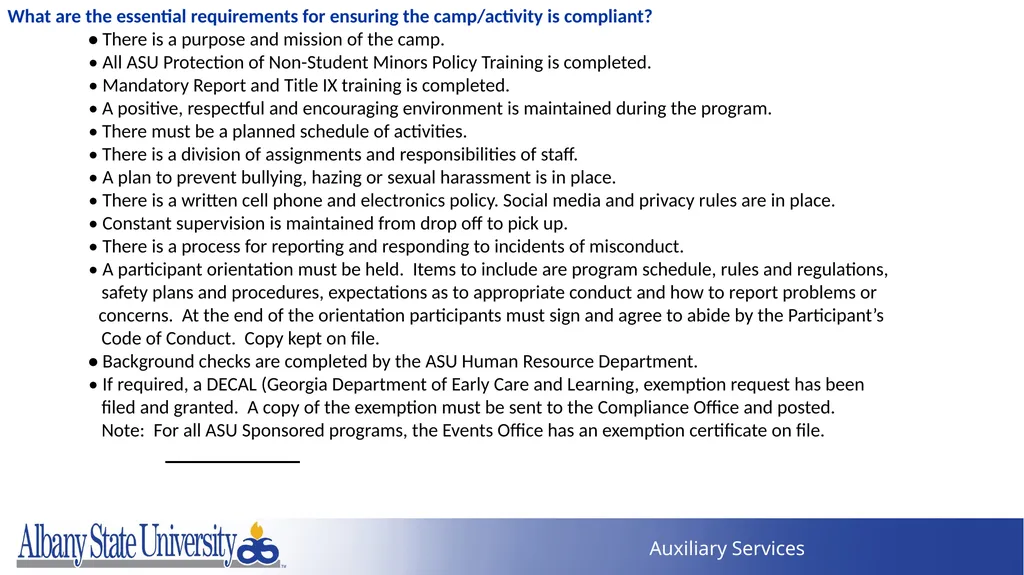
slide14. Auxiliary Services What are the essential requirements for ensuring the camp/activity is compliant?
• There is a purpose and mission of the camp.
• All ASU Protection of Non-Student Minors Policy Training is completed.
• Mandatory Report and Title IX training is completed.
• A positive, respectful and encouraging environment is maintained during the program.
• There must be a planned schedule of activities.
• There is a division of assignments and responsibilities of staff.
• A plan to prevent bullying, hazing or sexual harassment is in place.
• There is a written cell phone and electronics policy. Social media and privacy rules are in place.
• Constant supervision is maintained from drop off to pick up.
• There is a process for reporting and responding to incidents of misconduct.
• A participant orientation must be held. Items to include are program schedule, rules and regulations,
safety plans and procedures, expectations as to appropriate conduct and how to report problems or
concerns. At the end of the orientation participants must sign and agree to abide by the Participant’s Code of Conduct. Copy kept on file.
• Background checks are completed by the ASU Human Resource Department.
• If required, a DECAL (Georgia Department of Early Care and Learning, exemption request has been
filed and granted. A copy of the exemption must be sent to the Compliance Office and posted.
Note: For all ASU Sponsored programs, the Events Office has an exemption certificate on file.<br>
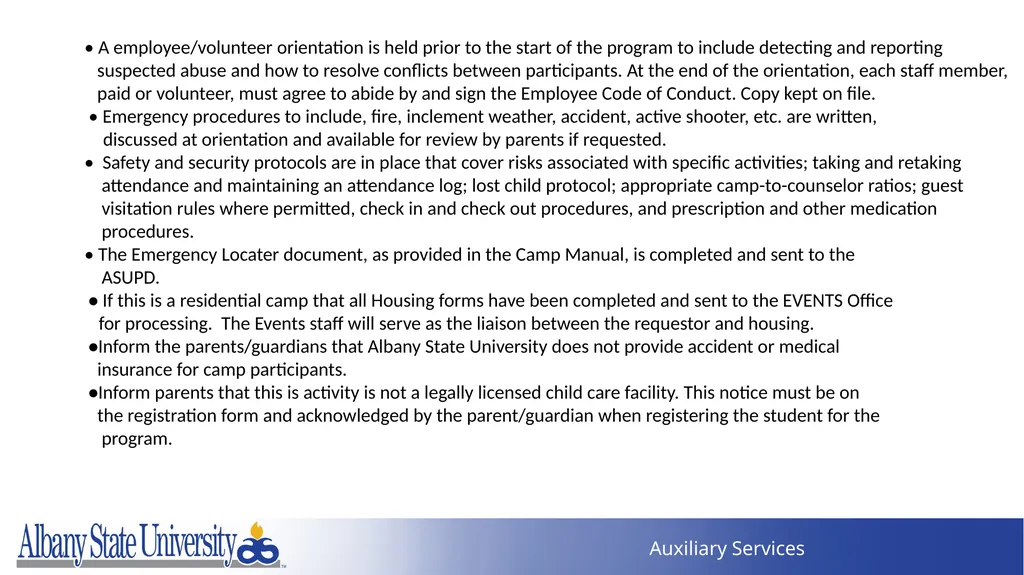
slide15. Auxiliary Services • A employee/volunteer orientation is held prior to the start of the program to include detecting and reporting suspected abuse and how to resolve conflicts between participants. At the end of the orientation, each staff member, paid or volunteer, must agree to abide by and sign the Employee Code of Conduct. Copy kept on file.
• Emergency procedures to include, fire, inclement weather, accident, active shooter, etc. are written,
discussed at orientation and available for review by parents if requested.
• Safety and security protocols are in place that cover risks associated with specific activities; taking and retaking
attendance and maintaining an attendance log; lost child protocol; appropriate camp-to-counselor ratios; guest
visitation rules where permitted, check in and check out procedures, and prescription and other medication
procedures.
• The Emergency Locater document, as provided in the Camp Manual, is completed and sent to the
ASUPD.
• If this is a residential camp that all Housing forms have been completed and sent to the EVENTS Office
for processing. The Events staff will serve as the liaison between the requestor and housing.
•Inform the parents/guardians that Albany State University does not provide accident or medical
insurance for camp participants.
•Inform parents that this is activity is not a legally licensed child care facility. This notice must be on
the registration form and acknowledged by the parent/guardian when registering the student for the
program.<br>
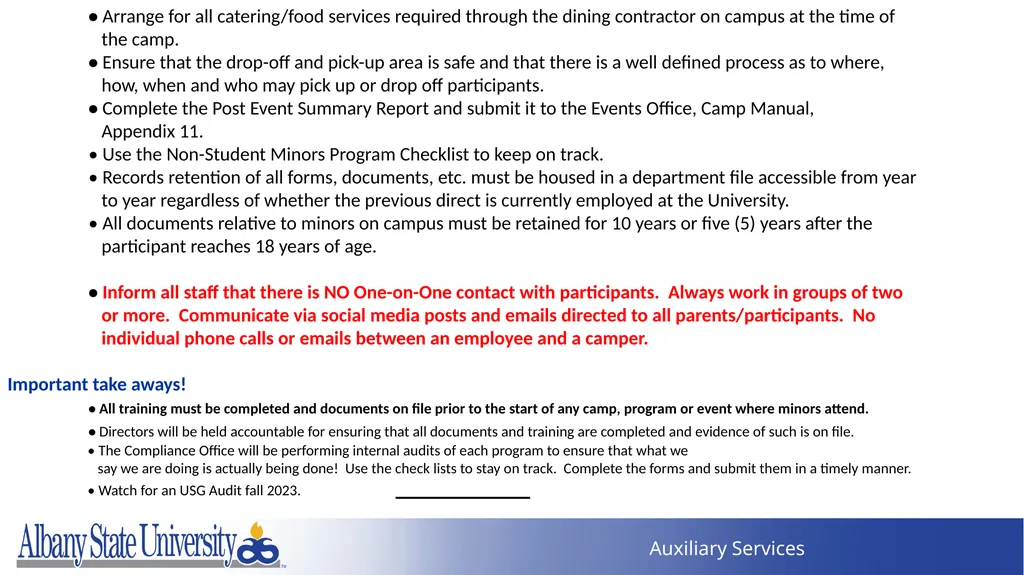
slide16. Auxiliary Services • Arrange for all catering/food services required through the dining contractor on campus at the time of
the camp.
• Ensure that the drop-off and pick-up area is safe and that there is a well defined process as to where, how, when and who may pick up or drop off participants.
• Complete the Post Event Summary Report and submit it to the Events Office, Camp Manual,
Appendix 11.
• Use the Non-Student Minors Program Checklist to keep on track.
• Records retention of all forms, documents, etc. must be housed in a department file accessible from year to year regardless of whether the previous direct is currently employed at the University.
• All documents relative to minors on campus must be retained for 10 years or five (5) years after the participant reaches 18 years of age.
• Inform all staff that there is NO One-on-One contact with participants. Always work in groups of two
or more. Communicate via social media posts and emails directed to all parents/participants. No
individual phone calls or emails between an employee and a camper.
Important take aways!
• All training must be completed and documents on file prior to the start of any camp, program or event where minors attend.
• Directors will be held accountable for ensuring that all documents and training are completed and evidence of such is on file.
• The Compliance Office will be performing internal audits of each program to ensure that what we
say we are doing is actually being done! Use the check lists to stay on track. Complete the forms and submit them in a timely manner.
• Watch for an USG Audit fall 2023.<br>
slide17. Auxiliary Services What are my resources to ensure that as a director I am training staff appropriately?
• The Auxiliary Services Events Office is the Compliance Office for Albany State University. Any questions may be
directed to that office—Martha Snow, 229-500-2884; martha.snow@asurams.edu.
• A Summer Camp/Program Manual for the Protection of Non-Student Minors may be found on the Auxiliary Services web page https://www.asurams.edu/fiscal-affairs/auxiliary-services/events/index.php.
• Templates for all approved forms to be used to conduct a camp/activity at ASU are included in the Summer Camp Manual and may be duplicated as needed.
• The Albany State University Employee Handbook, the Human Resources Department, Budget Office, affiliated grants office and Title IX office.
• Board of Regents Policy 6.9 – Programs Serving Minors
• USG Programs Serving Minors Resource Page
• USG Background Check Requirements
• State Licensing Requirements
• National Sex Offender Registry
Who should I contact if additional information is needed?
Martha Snow Ms. Shanice Howard
Auxiliary Services Events Coordinator
Compliance Office Auxiliary Services
229-500-2884 200-500-2885
martha.snow@asurams.edu shanice.howard@asurams.edu<br>
slide18. Title III Summer Programs ENGAGING THE COMMUNITY
2023<br>
slide19. Division of University Advancement PURPOSE:
To provide outreach to local agencies, local school systems, and community-based organizations to support ASU Strategic Plan and the following initiatives:
K-12 educational/enrichment programs
United Way Service Learning
Healthcare service-learning
Literacy service-learning
Career and professional development for students,
Other social and educational discipline-focus learning opportunities<br>
slide20. Division of University Advancement Application Process
Submit a mini-proposal by February 3, 2023 using the following Smartsheet link: https://app.smartsheet.com/b/publish?EQBCT=f38e7f21007b41ceb12173a3cea0c41a.
Register for the Summer Program using the following link: here.
The components of proposal includes:
Identification of the project director and co-projector.
Total budget amount requested.
Identify what ASU strategic goals are supported by the project.
Identify what ASU initiative will be supported by the project.
Provide a brief summary of the project.<br>
slide21. Division of University Advancement Next steps after mini-proposal submission:
Review and approval of proposals.
Once approved:
The activity directors/co-activity directors of the approved projects will be contacted to complete a full-proposal that includes objectives, an implementation plan and detailed budget.
The activity directors will participate and complete BOR required training for Summer Programs involving minors.
The activity directors/co-activity directors/administrative assistant will be required to attend a Title III Orientation meeting.
Implement plan immediately.<br>
slide22. Division of University Advancement Monitor Your Project
Ensure the safety of the participants and provide quality service as required by the BOR/Institutional Policy.
Monitor and approve the work of your employees. Ensure that you can verify work hours and submit time to HR for appropriate pay. Ensure that the payment of hours worked is within the budget.
Keep track of the status of your orders and requests for supplies and materials.
Keep track of the status of your requests for consultants for payment.
Make sure that any consultant that has direct contact with minors also adhere to BOR/Institutional policy for summer camps
Ensure that you have required coverage for minors from the beginning to the end of summer camp each day
Ensure that all employees of the camp is knowledgeable of the emergency plan and is capable of implementing the plan.<br>
slide23. Division of University Advancement Monitor Your Project
Periodically review your project to determine if you are on track with the approved objectives
Evaluate the effectiveness of the project with surveys. Make sure you have contact Institutional Effectiveness to develop a survey tool prior to the camp dates.
Evaluate and determine if adjustments are needed such as the number or participants or the number of employees required for the program.
Evaluate and determine if you need more resources to complete the project
CONTACT THE OFFICE OF TITLE III BEFORE ADJUSTING ANY PROGRAM ITEMS OR ADDING ANY ADDITIONAL EXPENSE FOR APPROVAL.<br>
slide24. Division of University Advancement Assess Your Project
All Title III Sponsored Summer Camp Projects are required to submit a final report within 30 days after last date of the program. A reporting format will be provided.
Provide a detailed report demonstrating the outcomes of your project objectives
Include milestones, success stories, challenges, future opportunities, etc. in your report.
Include data to support your outcomes<br>
slide25. Office of Sponsored Research (ORSP)<br>
slide26. Summer Programs Sponsored by Federal Funding The Office of Research and Sponsored Programs (ORSP) must be informed if you have received sponsored funding to support your summer program (except for Title III funded Projects)
ORSP routes the new grant information to Budgets for Account set-up
Pre-plan for the summer program, several months in advance (in the Spring Semester or earlier) so that hiring paperwork and ordering of necessary supplies are completed when your program begins
Plan accordingly for outgoing subrecipient agreements and contracted services agreements ORSP<br>
slide27. Summer Programs Sponsored by Federal Funding Make a habit of following up on paperwork, to be informed of status and to make adjustments as needed for the timely and successful implementation of your program
If in-kind support was approved for your program, meet with the appropriate institutional personnel to discuss
Make sure the project has IRB approval if the summer program activities will be part of a research study and/or be disseminated at conferences or through publications
Keep clear records of summer project activities for required reports to the sponsoring organization ORSP<br>
slide28. Summer Programs<br>
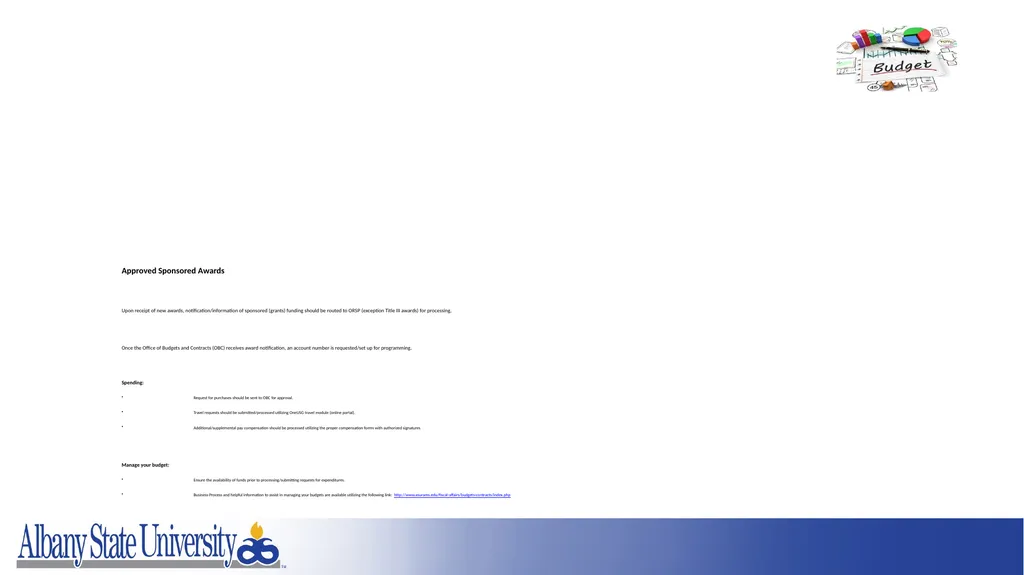
slide29. Approved Sponsored Awards
Upon receipt of new awards, notification/information of sponsored (grants) funding should be routed to ORSP (exception Title III awards) for processing.
Once the Office of Budgets and Contracts (OBC) receives award notification, an account number is requested/set up for programming.
Spending:
Request for purchases should be sent to OBC for approval.
Travel requests should be submitted/processed utilizing OneUSG travel module (online portal).
Additional/supplemental pay compensation should be processed utilizing the proper compensation forms with authorized signatures
Manage your budget:
Ensure the availability of funds prior to processing/submitting requests for expenditures.
Business Process and helpful information to assist in managing your budgets are available utilizing the following link: http://www.asurams.edu/fiscal-affairs/budgets-contracts/index.php<br>
slide30. Contacts Sharon Smith
sharon.smith@asurams.edu
229-500-3057
Corlissa Polite, Budgets and Contracts
corlissa.polite@asurams.edu
229-500-3025<br>
slide31. HR Practices for Summer Programs<br>
slide32. What We Will Cover How to Hire Summer Program Workers
Process
Funding Source (i.e. FWS or SA)
Documentation
Employee Classifications
Who should be a classified as a contractor and why Office of Human Resources<br>
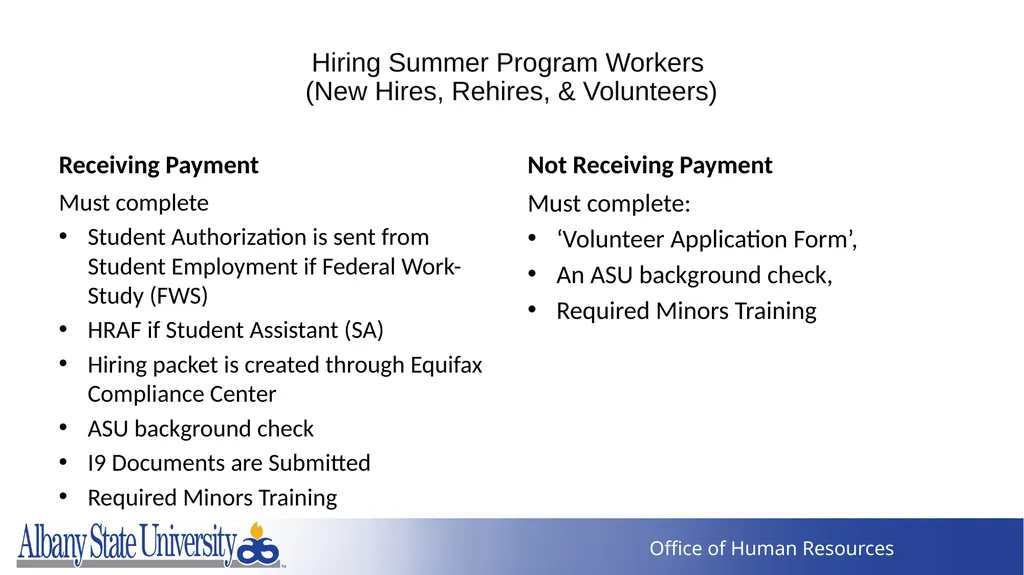
slide33. Hiring Summer Program Workers (New Hires, Rehires, & Volunteers) Receiving Payment Must complete
Student Authorization is sent from Student Employment if Federal Work- Study (FWS)
HRAF if Student Assistant (SA)
Hiring packet is created through Equifax Compliance Center
ASU background check
I9 Documents are Submitted
Required Minors Training Not Receiving Payment Must complete:
‘Volunteer Application Form’,
An ASU background check,
Required Minors Training Office of Human Resources<br>
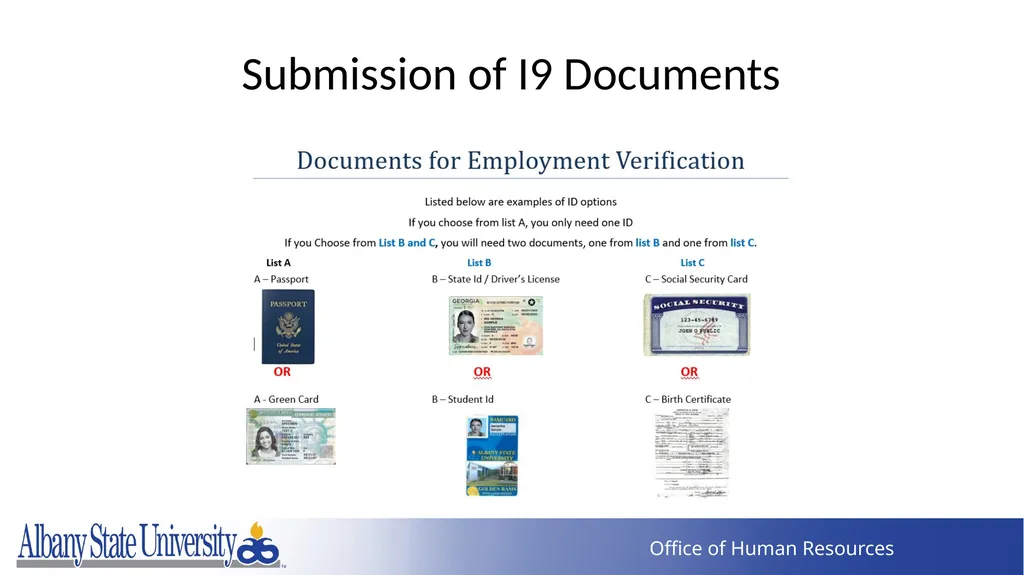
slide34. Submission of I9 Documents Office of Human Resources<br>
slide35. Rehired Retirees If the individual retired through Teachers Retirement System (TRS), then the university and the individual will have to apply to TRS seeking permission for the person to work prior to the beginning of the program
If the individual is a regular rehire, an HRAF or Student Authorization form is completed and submitted to the hiring manager approval and signature.
HRAFs are sent to Budgets and Budgets sends to HR. Office of Human Resources<br>
slide36. Volunteers Individuals who have registered with HR, completed the required Minors Training w/ Auxiliary Services, and have a satisfactory university background check are eligible to volunteer with university summer programs.
Individuals who are currently employed by the university must take annual leave in order to volunteer with summer programs. Office of Human Resources<br>
slide37. Student Workers Students can be paid from summer programs on an hourly rate that equates to budgeted allocations. These wages are subject to taxation.
Students must be employed by the university and paid through the regular payroll process when working with summer programs for pay.
Students who are not enrolled in summer classes can work for summer programs as long as they are classified as ‘Casual Labor’ and not ‘Student Assistants’ Office of Human Resources<br>
slide38. Federal Work Study Students Assigned through Student Employment/ Financial Aid
Contact Ms. Snead in Student Employment to learn if there are Federal Work Study (FWS) jobs available during summer months
FWS workers must be treated and paid as any other worker who is performing the same or similar work Office of Human Resources<br>
slide39. Hiring ASU Faculty for Summer Programs Ten-month faculty members can be paid for working with summer programs
Twelve-month faculty members can be paid for working with summer programs
if the work is outside of the scope of the employees’ job duties
and the employee takes leave during the time services are being provided to program activities Office of Human Resources<br>
slide40. Hiring Current ASU Staff for Summer Programs Hourly employees, such as Administrative Assistants, could be paid for working with a summer program through additional hours worked.
The additional work time must be recorded and approved in the payroll system.
Monthly staff members can be paid for working with summer programs
if the work is outside of the scope of the employees’ job duties
and the employee takes leave during the time services are being provided to program activities Human Resources<br>
slide41. USG Background Check Policy It shall be a condition of employment with any institution of the University System of Georgia to submit to a background investigation. Offers of employment shall be conditional pending the result of the background investigation, which shall include, at a minimum, the following:
A state and federal criminal history check covering a minimum of seven (7) years. Institutions may require state and federal criminal history check covering more than the minimum of seven (7) years for specified positions of trust;
A nationwide sex offender search;
A social security number check;
For all professional, faculty and academic positions, an academic credentials check; and
For all positions with access to or responsibility for money and/or a Purchase Card, a credit check. Human Resources<br>
slide42. A background investigation shall also be performed on:
Any existing employee being transferred, reassigned, reclassified or promoted to a position of trust unless a background investigation conforming to this procedure has been performed within the past year.
All part-time, student or temporary employees and volunteers with primary responsibilities involving the direct interaction or care of children under the age of 18.
Any existing employee that is transferred, reassigned, reclassified or promoted into a position requiring a Purchase Card, when they have not been assigned a Purchase Card previously, must submit to a credit check. Existing cardholders are subject to a background check before next renewal of card. USG Background Check Policy Human Resources<br>
slide43. Paying Workers as Contractors Must meet regulatory guidelines
Internal Revenue Service
Department of Labor
Most workers cannot be classified as Contractors per regulatory guidelines
Misclassifying workers as Contractors could have serious consequences Human Resources<br>
slide44. Human Resources Ramifications for Misclassifications Tax consequences
Employee benefit obligations
Workers’ compensation
Unemployment compensation
Wage and hour liability
Vicarious liability<br>
slide45. Human Resources What is an Independent Contractor Independent Contractor:
An individual who performs personal services for the Institution where the Institution has the right to specify the result to be accomplished by the work, but not the means and methods by which the result is to be accomplished.<br>
slide46. Human Resources What is an Employee Employee:
An individual who performs personal services for the Institution where the Institution has the right to control and direct the individual who performs the services, not only as to the result to be accomplished, but also as to the details and means by which that result is to be accomplished. It is not necessary that the Institution actually direct or control the manner in which the services are performed; it is sufficient to establish an employee-employer relationship that the Institution has the right to do so.<br>
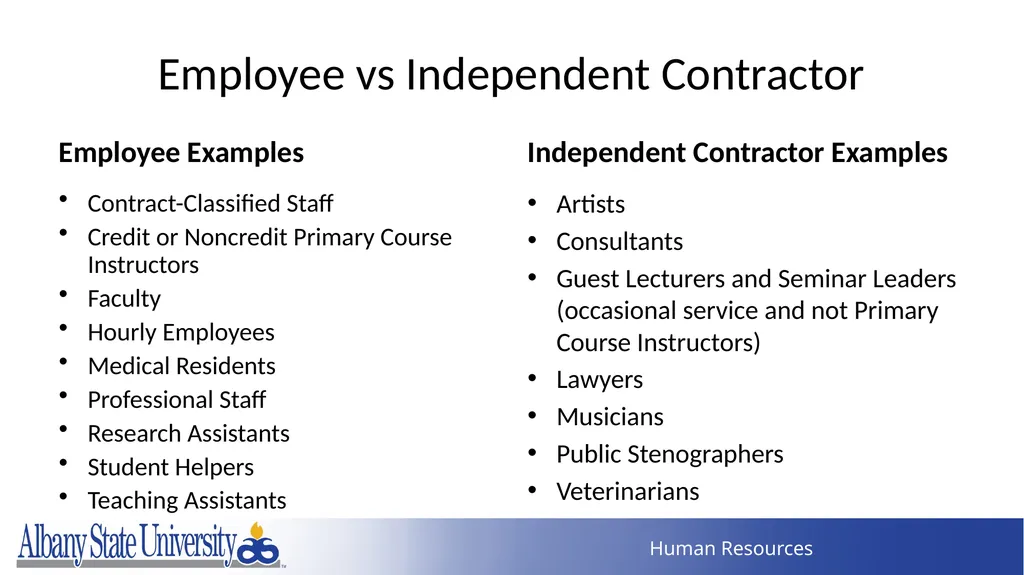
slide47. Human Resources Employee vs Independent Contractor Employee Examples Independent Contractor Examples Contract-Classified Staff
Credit or Noncredit Primary Course Instructors
Faculty
Hourly Employees
Medical Residents
Professional Staff
Research Assistants
Student Helpers
Teaching Assistants Artists
Consultants
Guest Lecturers and Seminar Leaders (occasional service and not Primary Course Instructors)
Lawyers
Musicians
Public Stenographers
Veterinarians<br>
slide48. Payroll & Summer Programs<br>
slide49. Payroll Managers/Supervisors
Managers are responsible for approving students time in OneUSG Connect
All workers, including students, should be entering their own time into OneUSG Connect/timesheets
No one, including students, should begin work until approved by Human Resources
Hire date in job data is the first “active” day students can enter in time
Any hours/days worked prior to their hire date cannot be processed
List all Time Approvers on the HR Action Form
Make sure you can view your student worker in “team time”<br>
slide50. Managers/Supervisors Payroll How do I approve time for my employees https://www.youtube.com/watch?v=Xuc9-lTvcD0<br>
slide51. Payroll Make sure students have access to OneUSG Connect and access to self-service portal
Verify your banking information and tax forms through the self-service portal
When entering time, click drop down menu and select “REGULAR” as the time reporter code
Students must enter all time worked into your timesheet via OneUSG Connect
Emergency paychecks cannot be cut due to not entering time into OneUSG Connect
Time sheets are locked by the close of business on Fridays before payroll processing begins Students<br>
slide52. Students Payroll How Do I Report My Time Using the Weekly Punch Timesheet (Hourly Employees)?
https://www.youtube.com/watch?v=A2BT2A8Y6qU<br>
slide53. Is All of this Necessary?<br>
slide54. YES… And Here’s Why Children are our most precious resource
Require strictest of regulation
Highest positive Return on Investment
Government funded programs and activities are also highly regulated
The People’s money requires high levels of
Transparency
Internal Control
Documentation<br>
slide56. Conclusion Conducting Summer Programs is encouraged
Program Directors are expected to adhere to all applicable regulations
Plan accordingly
Ask questions
Work hard; Be safe; Have fun!<br>
slide57. Contacts Martha Snow, Auxiliary Services
229.500.2884
Martha.snow@asurams.edu
Saundrette Moody, Title III Programs
229.500.3452
Saundrette.moody@asurams.edu
Maria Allan, Title III Programs
229.500.3315
Maria.allan@asurams.edu
Domeka Wallace-Butler, Title III Programs
229.500.3318
Domeka.wallacebutler@asurams.edu Louise Wrensford, ORSP
229.500.34923
louise.wrensford@asurams.edu
Marion Ryant, Office of Budgets
229.500.3027
marion.ryant@asurams.ede
Ola Terrell-Jordan, Human Resources
229.500.2026
hrasu@asurams.edu
Karen Clay, Payroll
229.500.3050
karen.clay@asurams.edu<br>
slide2. Housekeeping One conversation at a time
Ask your questions!
There are no silly questions or ideas<br>
slide3. Objectives Explain the Enrichment Program registration and approval process
Outline the Enrichment Program regulatory framework (Non-student Minor Policy, Fair Labor Standards Act, etc.)
Define Program Director roles and responsibilities for Enrichment Programs
Discuss funding protocols for Enrichment Programs (Title III, Board of Regents, etc.)
Review hiring and approving time for Enrichment Program employees<br>
slide4. Setting the Groundwork<br>
slide5. Legal Framework Enrichment Programs are impacted by many policies, rules, and laws:
Federal: Fair Labor Standards Act, Department of Education, Internal Revenue Service
State: Department of Labor, Board of Regents
University: Non-student Minors<br>
slide6. Program Director Responsibilities Register each program at Albany State University with Auxiliary Services
Adhere to all applicable regulations
Provide a safe environment for participants and workers
Collect, monitor, and provide assessment data
Supervise program workers
Approve program workers’ time worked in OneUSG Connect
Manage program budget(s)<br>
slide7. Timelines & Due Dates<br>
slide8. Protection of Non-Student Minors
Policies and Procedures
for
Programs Serving Minors<br>
slide9. Auxiliary Services Purpose of the Protection of Non-Student Minors Policy
As set forth by the Board of Regents of the University System of Georgia in the Board of Regents Policy manual Section 6.9,
University System of Georgia (USG) institutions periodically conduct, sponsor, or host programs designed to serve minors who are
not enrolled as students, including but not limited to camps, clinics, after school programs, and activities. Employees and volunteers
associated with these programs who are reasonably anticipated to have direct contact or interaction with minor program
participants must be appropriately pre-screened and trained. Institution presidents shall establish institution-level procedures to implement this policy and related directives from the USG.
The Albany State University Policy for the Protection of Non-Student Minors may be found on the ASU
Legal Affairs web page under Legal Affairs, University Policies.
https://www.asurams.edu/legal-affairs/protection-of-non-student-minors.php
The purpose of this policy is to assure that appropriate policies and procedures for the supervision of non-student minors that visit Albany State University (ASU) are identified and to set out the appropriate procedures to be followed by both ASU and non ASU entities in order to host events which include non-student minors on property owned by or leased by ASU or in any ASU sponsored program at other locations. This policy became effective for programs starting on or after May 1, 2017.<br>
slide10. Auxiliary Services What is the definition of a minor as it relates to this policy and what types of activities does the policy cover?
• Any child under the age of 18 who is not currently enrolled at ASU, but who is on the ASU campus for any type of
instructional program involving key use of facilities, i.e., recreational, academic classrooms, student center and any
physical educational facility, indoors or outdoors. Programs such as athletic camps, after school programs, science
camps, music and other enrichment programs. The program may be a residential or overnight camp or a
commuter day camp.
• Summer camps, academic enrichment programs, visual and performing arts groups where participants are minors,
third party rentals of facilities to outside organizations to host programs/events on campus.
Who is required to be in compliance?
• All events sponsored by ASU, meaning that any program, camp or event in which the funds for the operation of the
program, whether by grant, registration fees, sponsors, etc. are deposited into the University account and for which
the University is responsible for payment of all expenditures related to that activity.
• Third party groups are required to comply with the basic policy and procedure but are not mandated to use the
documents to gather information as are ASU sponsored activities. Third party activities are those programs that are
operated by an individual or group who are not, for purposes of the camp operation, employed by the University, i.e., an employee has a personal camp and said employee is responsible for all operations of the camp and assumes
liability for all camp activities.<br>
slide11. Auxiliary Services Are there any exemptions to this policy?
• Private or personal events such as weddings, birthday parties, family reunions.
• Services provided by the institution’s health clinic.
• Students participating in intercollegiate activities, such as athletics and visual and performing arts.
• Programs/events open to the public for which tickets are sold for attending.
Why must the camps be registered and follow through with the process?
• ASU is responsible for establishing and maintaining a registry of all authorized programs that host non-student
minors. All persons interested in hosting a program that includes non-student minors on property owned by or
leased by ASU or in an ASU-sponsored program at other locations, must complete the program registration form
and follow these policies outlined in the Summer Camp/Program Manual for the Protection of Non-Student Minors.
•The University must ensure that special care is taken to provide the appropriate levels of care and supervision for
summer camps or activities is commensurate with the policies outlined in the Summer Camp Manual.
•The Board of Regents mandates that the registry and appropriate document be on file in the Compliance Office for
the Protection of Non-Student Minors.
•Directors/sponsors will be held accountable for the training for all paid and volunteer staff of the activity.<br>
slide12. Auxiliary Services How do I register my camp/activity?
• Click on the following like to go to the Smart sheet registration form.
https://app.smartsheet.com/b/form/1a04581dade44abbb8701298f83b7819
Youth Program Serving Non-Students Minors, Request for Approval
ASU Sponsored or Third Party Camps Administered by an ASU Employee
• Complete all sections and submit.
• Document will be routed electronically through the approval process.
1. Initial approval from the Cabinet Level or Grant Officer.
2. To HR to ensure that all personnel requirements are completed for all employees and
volunteers.
3. To Budgets to ensure that the request is within the approved budget parameters.
4. To the Title IX Office to ensure that all employees have completed the Title IX training.
5. To the Events Office to ensure that all Protection of Non-Student Minors training has been
completed.
• When compliance in all areas has been met, a notice will be electronically sent to the Events Office who
will then release notification to the requestor that the camp has met all mandated requirements and
you may proceed with the activity.
• If it is found that a camp proceeds without having registered and complying with all requirements, the
camp will be given a cease and desist order and not be able to proceed. It will be the responsibility of
the director to notify the participants that the activity has been cancelled.<br>
slide13. Auxiliary Services What are the University’s expectations of me as a camp director/sponsor?
• That all annual training requirements for paid and volunteer staff have taken place and documentation is on
file to that effect.
• That the appropriate requests for use of and reservation of facilities has been entered into 25Live and that
confirmations have been received. Priority given to ASU sponsored camps.
• That a reasonably safe environment is provided for participants, i.e., qualified counselors are employed,
background screenings have been done, ensure that those driving to the event have a valid license to operate the type of vehicle used and that it is registered to be on campus.
• Ensure that parents are aware of the type of activities in which the child will participate to include known
risks, provide safety instructions.
• The director/sponsor shall be responsible for ensuring that all paid and volunteer staff are trained relative to
the Protection of Non-Student Minors Policies either by attending training session provided by the Events
Office or using the Summer Camp Manual as a guide and personally providing the training.
• That the ratio of camper to chaperone is compliant with those set forth by the American Camp Association.
Standards for residential camps are:
•One staff member for every five campers ages 4 and 5
•One staff member for every six campers ages 6 to 8
•One staff member for every eight campers ages 9 to 14
•One staff member for every ten campers ages 15-17
Standards for day camps are:
•One staff member for every six campers ages 4 and 5
•One staff member for every eight campers ages 6 to 8
•One staff member for every ten campers ages 9 to 14
•One staff member for every twelve campers ages 15 to 17.<br>
slide14. Auxiliary Services What are the essential requirements for ensuring the camp/activity is compliant?
• There is a purpose and mission of the camp.
• All ASU Protection of Non-Student Minors Policy Training is completed.
• Mandatory Report and Title IX training is completed.
• A positive, respectful and encouraging environment is maintained during the program.
• There must be a planned schedule of activities.
• There is a division of assignments and responsibilities of staff.
• A plan to prevent bullying, hazing or sexual harassment is in place.
• There is a written cell phone and electronics policy. Social media and privacy rules are in place.
• Constant supervision is maintained from drop off to pick up.
• There is a process for reporting and responding to incidents of misconduct.
• A participant orientation must be held. Items to include are program schedule, rules and regulations,
safety plans and procedures, expectations as to appropriate conduct and how to report problems or
concerns. At the end of the orientation participants must sign and agree to abide by the Participant’s Code of Conduct. Copy kept on file.
• Background checks are completed by the ASU Human Resource Department.
• If required, a DECAL (Georgia Department of Early Care and Learning, exemption request has been
filed and granted. A copy of the exemption must be sent to the Compliance Office and posted.
Note: For all ASU Sponsored programs, the Events Office has an exemption certificate on file.<br>
slide15. Auxiliary Services • A employee/volunteer orientation is held prior to the start of the program to include detecting and reporting suspected abuse and how to resolve conflicts between participants. At the end of the orientation, each staff member, paid or volunteer, must agree to abide by and sign the Employee Code of Conduct. Copy kept on file.
• Emergency procedures to include, fire, inclement weather, accident, active shooter, etc. are written,
discussed at orientation and available for review by parents if requested.
• Safety and security protocols are in place that cover risks associated with specific activities; taking and retaking
attendance and maintaining an attendance log; lost child protocol; appropriate camp-to-counselor ratios; guest
visitation rules where permitted, check in and check out procedures, and prescription and other medication
procedures.
• The Emergency Locater document, as provided in the Camp Manual, is completed and sent to the
ASUPD.
• If this is a residential camp that all Housing forms have been completed and sent to the EVENTS Office
for processing. The Events staff will serve as the liaison between the requestor and housing.
•Inform the parents/guardians that Albany State University does not provide accident or medical
insurance for camp participants.
•Inform parents that this is activity is not a legally licensed child care facility. This notice must be on
the registration form and acknowledged by the parent/guardian when registering the student for the
program.<br>
slide16. Auxiliary Services • Arrange for all catering/food services required through the dining contractor on campus at the time of
the camp.
• Ensure that the drop-off and pick-up area is safe and that there is a well defined process as to where, how, when and who may pick up or drop off participants.
• Complete the Post Event Summary Report and submit it to the Events Office, Camp Manual,
Appendix 11.
• Use the Non-Student Minors Program Checklist to keep on track.
• Records retention of all forms, documents, etc. must be housed in a department file accessible from year to year regardless of whether the previous direct is currently employed at the University.
• All documents relative to minors on campus must be retained for 10 years or five (5) years after the participant reaches 18 years of age.
• Inform all staff that there is NO One-on-One contact with participants. Always work in groups of two
or more. Communicate via social media posts and emails directed to all parents/participants. No
individual phone calls or emails between an employee and a camper.
Important take aways!
• All training must be completed and documents on file prior to the start of any camp, program or event where minors attend.
• Directors will be held accountable for ensuring that all documents and training are completed and evidence of such is on file.
• The Compliance Office will be performing internal audits of each program to ensure that what we
say we are doing is actually being done! Use the check lists to stay on track. Complete the forms and submit them in a timely manner.
• Watch for an USG Audit fall 2023.<br>
slide17. Auxiliary Services What are my resources to ensure that as a director I am training staff appropriately?
• The Auxiliary Services Events Office is the Compliance Office for Albany State University. Any questions may be
directed to that office—Martha Snow, 229-500-2884; martha.snow@asurams.edu.
• A Summer Camp/Program Manual for the Protection of Non-Student Minors may be found on the Auxiliary Services web page https://www.asurams.edu/fiscal-affairs/auxiliary-services/events/index.php.
• Templates for all approved forms to be used to conduct a camp/activity at ASU are included in the Summer Camp Manual and may be duplicated as needed.
• The Albany State University Employee Handbook, the Human Resources Department, Budget Office, affiliated grants office and Title IX office.
• Board of Regents Policy 6.9 – Programs Serving Minors
• USG Programs Serving Minors Resource Page
• USG Background Check Requirements
• State Licensing Requirements
• National Sex Offender Registry
Who should I contact if additional information is needed?
Martha Snow Ms. Shanice Howard
Auxiliary Services Events Coordinator
Compliance Office Auxiliary Services
229-500-2884 200-500-2885
martha.snow@asurams.edu shanice.howard@asurams.edu<br>
slide18. Title III Summer Programs ENGAGING THE COMMUNITY
2023<br>
slide19. Division of University Advancement PURPOSE:
To provide outreach to local agencies, local school systems, and community-based organizations to support ASU Strategic Plan and the following initiatives:
K-12 educational/enrichment programs
United Way Service Learning
Healthcare service-learning
Literacy service-learning
Career and professional development for students,
Other social and educational discipline-focus learning opportunities<br>
slide20. Division of University Advancement Application Process
Submit a mini-proposal by February 3, 2023 using the following Smartsheet link: https://app.smartsheet.com/b/publish?EQBCT=f38e7f21007b41ceb12173a3cea0c41a.
Register for the Summer Program using the following link: here.
The components of proposal includes:
Identification of the project director and co-projector.
Total budget amount requested.
Identify what ASU strategic goals are supported by the project.
Identify what ASU initiative will be supported by the project.
Provide a brief summary of the project.<br>
slide21. Division of University Advancement Next steps after mini-proposal submission:
Review and approval of proposals.
Once approved:
The activity directors/co-activity directors of the approved projects will be contacted to complete a full-proposal that includes objectives, an implementation plan and detailed budget.
The activity directors will participate and complete BOR required training for Summer Programs involving minors.
The activity directors/co-activity directors/administrative assistant will be required to attend a Title III Orientation meeting.
Implement plan immediately.<br>
slide22. Division of University Advancement Monitor Your Project
Ensure the safety of the participants and provide quality service as required by the BOR/Institutional Policy.
Monitor and approve the work of your employees. Ensure that you can verify work hours and submit time to HR for appropriate pay. Ensure that the payment of hours worked is within the budget.
Keep track of the status of your orders and requests for supplies and materials.
Keep track of the status of your requests for consultants for payment.
Make sure that any consultant that has direct contact with minors also adhere to BOR/Institutional policy for summer camps
Ensure that you have required coverage for minors from the beginning to the end of summer camp each day
Ensure that all employees of the camp is knowledgeable of the emergency plan and is capable of implementing the plan.<br>
slide23. Division of University Advancement Monitor Your Project
Periodically review your project to determine if you are on track with the approved objectives
Evaluate the effectiveness of the project with surveys. Make sure you have contact Institutional Effectiveness to develop a survey tool prior to the camp dates.
Evaluate and determine if adjustments are needed such as the number or participants or the number of employees required for the program.
Evaluate and determine if you need more resources to complete the project
CONTACT THE OFFICE OF TITLE III BEFORE ADJUSTING ANY PROGRAM ITEMS OR ADDING ANY ADDITIONAL EXPENSE FOR APPROVAL.<br>
slide24. Division of University Advancement Assess Your Project
All Title III Sponsored Summer Camp Projects are required to submit a final report within 30 days after last date of the program. A reporting format will be provided.
Provide a detailed report demonstrating the outcomes of your project objectives
Include milestones, success stories, challenges, future opportunities, etc. in your report.
Include data to support your outcomes<br>
slide25. Office of Sponsored Research (ORSP)<br>
slide26. Summer Programs Sponsored by Federal Funding The Office of Research and Sponsored Programs (ORSP) must be informed if you have received sponsored funding to support your summer program (except for Title III funded Projects)
ORSP routes the new grant information to Budgets for Account set-up
Pre-plan for the summer program, several months in advance (in the Spring Semester or earlier) so that hiring paperwork and ordering of necessary supplies are completed when your program begins
Plan accordingly for outgoing subrecipient agreements and contracted services agreements ORSP<br>
slide27. Summer Programs Sponsored by Federal Funding Make a habit of following up on paperwork, to be informed of status and to make adjustments as needed for the timely and successful implementation of your program
If in-kind support was approved for your program, meet with the appropriate institutional personnel to discuss
Make sure the project has IRB approval if the summer program activities will be part of a research study and/or be disseminated at conferences or through publications
Keep clear records of summer project activities for required reports to the sponsoring organization ORSP<br>
slide28. Summer Programs<br>
slide29. Approved Sponsored Awards
Upon receipt of new awards, notification/information of sponsored (grants) funding should be routed to ORSP (exception Title III awards) for processing.
Once the Office of Budgets and Contracts (OBC) receives award notification, an account number is requested/set up for programming.
Spending:
Request for purchases should be sent to OBC for approval.
Travel requests should be submitted/processed utilizing OneUSG travel module (online portal).
Additional/supplemental pay compensation should be processed utilizing the proper compensation forms with authorized signatures
Manage your budget:
Ensure the availability of funds prior to processing/submitting requests for expenditures.
Business Process and helpful information to assist in managing your budgets are available utilizing the following link: http://www.asurams.edu/fiscal-affairs/budgets-contracts/index.php<br>
slide30. Contacts Sharon Smith
sharon.smith@asurams.edu
229-500-3057
Corlissa Polite, Budgets and Contracts
corlissa.polite@asurams.edu
229-500-3025<br>
slide31. HR Practices for Summer Programs<br>
slide32. What We Will Cover How to Hire Summer Program Workers
Process
Funding Source (i.e. FWS or SA)
Documentation
Employee Classifications
Who should be a classified as a contractor and why Office of Human Resources<br>
slide33. Hiring Summer Program Workers (New Hires, Rehires, & Volunteers) Receiving Payment Must complete
Student Authorization is sent from Student Employment if Federal Work- Study (FWS)
HRAF if Student Assistant (SA)
Hiring packet is created through Equifax Compliance Center
ASU background check
I9 Documents are Submitted
Required Minors Training Not Receiving Payment Must complete:
‘Volunteer Application Form’,
An ASU background check,
Required Minors Training Office of Human Resources<br>
slide34. Submission of I9 Documents Office of Human Resources<br>
slide35. Rehired Retirees If the individual retired through Teachers Retirement System (TRS), then the university and the individual will have to apply to TRS seeking permission for the person to work prior to the beginning of the program
If the individual is a regular rehire, an HRAF or Student Authorization form is completed and submitted to the hiring manager approval and signature.
HRAFs are sent to Budgets and Budgets sends to HR. Office of Human Resources<br>
slide36. Volunteers Individuals who have registered with HR, completed the required Minors Training w/ Auxiliary Services, and have a satisfactory university background check are eligible to volunteer with university summer programs.
Individuals who are currently employed by the university must take annual leave in order to volunteer with summer programs. Office of Human Resources<br>
slide37. Student Workers Students can be paid from summer programs on an hourly rate that equates to budgeted allocations. These wages are subject to taxation.
Students must be employed by the university and paid through the regular payroll process when working with summer programs for pay.
Students who are not enrolled in summer classes can work for summer programs as long as they are classified as ‘Casual Labor’ and not ‘Student Assistants’ Office of Human Resources<br>
slide38. Federal Work Study Students Assigned through Student Employment/ Financial Aid
Contact Ms. Snead in Student Employment to learn if there are Federal Work Study (FWS) jobs available during summer months
FWS workers must be treated and paid as any other worker who is performing the same or similar work Office of Human Resources<br>
slide39. Hiring ASU Faculty for Summer Programs Ten-month faculty members can be paid for working with summer programs
Twelve-month faculty members can be paid for working with summer programs
if the work is outside of the scope of the employees’ job duties
and the employee takes leave during the time services are being provided to program activities Office of Human Resources<br>
slide40. Hiring Current ASU Staff for Summer Programs Hourly employees, such as Administrative Assistants, could be paid for working with a summer program through additional hours worked.
The additional work time must be recorded and approved in the payroll system.
Monthly staff members can be paid for working with summer programs
if the work is outside of the scope of the employees’ job duties
and the employee takes leave during the time services are being provided to program activities Human Resources<br>
slide41. USG Background Check Policy It shall be a condition of employment with any institution of the University System of Georgia to submit to a background investigation. Offers of employment shall be conditional pending the result of the background investigation, which shall include, at a minimum, the following:
A state and federal criminal history check covering a minimum of seven (7) years. Institutions may require state and federal criminal history check covering more than the minimum of seven (7) years for specified positions of trust;
A nationwide sex offender search;
A social security number check;
For all professional, faculty and academic positions, an academic credentials check; and
For all positions with access to or responsibility for money and/or a Purchase Card, a credit check. Human Resources<br>
slide42. A background investigation shall also be performed on:
Any existing employee being transferred, reassigned, reclassified or promoted to a position of trust unless a background investigation conforming to this procedure has been performed within the past year.
All part-time, student or temporary employees and volunteers with primary responsibilities involving the direct interaction or care of children under the age of 18.
Any existing employee that is transferred, reassigned, reclassified or promoted into a position requiring a Purchase Card, when they have not been assigned a Purchase Card previously, must submit to a credit check. Existing cardholders are subject to a background check before next renewal of card. USG Background Check Policy Human Resources<br>
slide43. Paying Workers as Contractors Must meet regulatory guidelines
Internal Revenue Service
Department of Labor
Most workers cannot be classified as Contractors per regulatory guidelines
Misclassifying workers as Contractors could have serious consequences Human Resources<br>
slide44. Human Resources Ramifications for Misclassifications Tax consequences
Employee benefit obligations
Workers’ compensation
Unemployment compensation
Wage and hour liability
Vicarious liability<br>
slide45. Human Resources What is an Independent Contractor Independent Contractor:
An individual who performs personal services for the Institution where the Institution has the right to specify the result to be accomplished by the work, but not the means and methods by which the result is to be accomplished.<br>
slide46. Human Resources What is an Employee Employee:
An individual who performs personal services for the Institution where the Institution has the right to control and direct the individual who performs the services, not only as to the result to be accomplished, but also as to the details and means by which that result is to be accomplished. It is not necessary that the Institution actually direct or control the manner in which the services are performed; it is sufficient to establish an employee-employer relationship that the Institution has the right to do so.<br>
slide47. Human Resources Employee vs Independent Contractor Employee Examples Independent Contractor Examples Contract-Classified Staff
Credit or Noncredit Primary Course Instructors
Faculty
Hourly Employees
Medical Residents
Professional Staff
Research Assistants
Student Helpers
Teaching Assistants Artists
Consultants
Guest Lecturers and Seminar Leaders (occasional service and not Primary Course Instructors)
Lawyers
Musicians
Public Stenographers
Veterinarians<br>
slide48. Payroll & Summer Programs<br>
slide49. Payroll Managers/Supervisors
Managers are responsible for approving students time in OneUSG Connect
All workers, including students, should be entering their own time into OneUSG Connect/timesheets
No one, including students, should begin work until approved by Human Resources
Hire date in job data is the first “active” day students can enter in time
Any hours/days worked prior to their hire date cannot be processed
List all Time Approvers on the HR Action Form
Make sure you can view your student worker in “team time”<br>
slide50. Managers/Supervisors Payroll How do I approve time for my employees https://www.youtube.com/watch?v=Xuc9-lTvcD0<br>
slide51. Payroll Make sure students have access to OneUSG Connect and access to self-service portal
Verify your banking information and tax forms through the self-service portal
When entering time, click drop down menu and select “REGULAR” as the time reporter code
Students must enter all time worked into your timesheet via OneUSG Connect
Emergency paychecks cannot be cut due to not entering time into OneUSG Connect
Time sheets are locked by the close of business on Fridays before payroll processing begins Students<br>
slide52. Students Payroll How Do I Report My Time Using the Weekly Punch Timesheet (Hourly Employees)?
https://www.youtube.com/watch?v=A2BT2A8Y6qU<br>
slide53. Is All of this Necessary?<br>
slide54. YES… And Here’s Why Children are our most precious resource
Require strictest of regulation
Highest positive Return on Investment
Government funded programs and activities are also highly regulated
The People’s money requires high levels of
Transparency
Internal Control
Documentation<br>
slide56. Conclusion Conducting Summer Programs is encouraged
Program Directors are expected to adhere to all applicable regulations
Plan accordingly
Ask questions
Work hard; Be safe; Have fun!<br>
slide57. Contacts Martha Snow, Auxiliary Services
229.500.2884
Martha.snow@asurams.edu
Saundrette Moody, Title III Programs
229.500.3452
Saundrette.moody@asurams.edu
Maria Allan, Title III Programs
229.500.3315
Maria.allan@asurams.edu
Domeka Wallace-Butler, Title III Programs
229.500.3318
Domeka.wallacebutler@asurams.edu Louise Wrensford, ORSP
229.500.34923
louise.wrensford@asurams.edu
Marion Ryant, Office of Budgets
229.500.3027
marion.ryant@asurams.ede
Ola Terrell-Jordan, Human Resources
229.500.2026
hrasu@asurams.edu
Karen Clay, Payroll
229.500.3050
karen.clay@asurams.edu<br>