
SUN Business Network Tanzania Strategy 2016 – 2018
LD
Published · 54 slides · 0 views

1 / 1

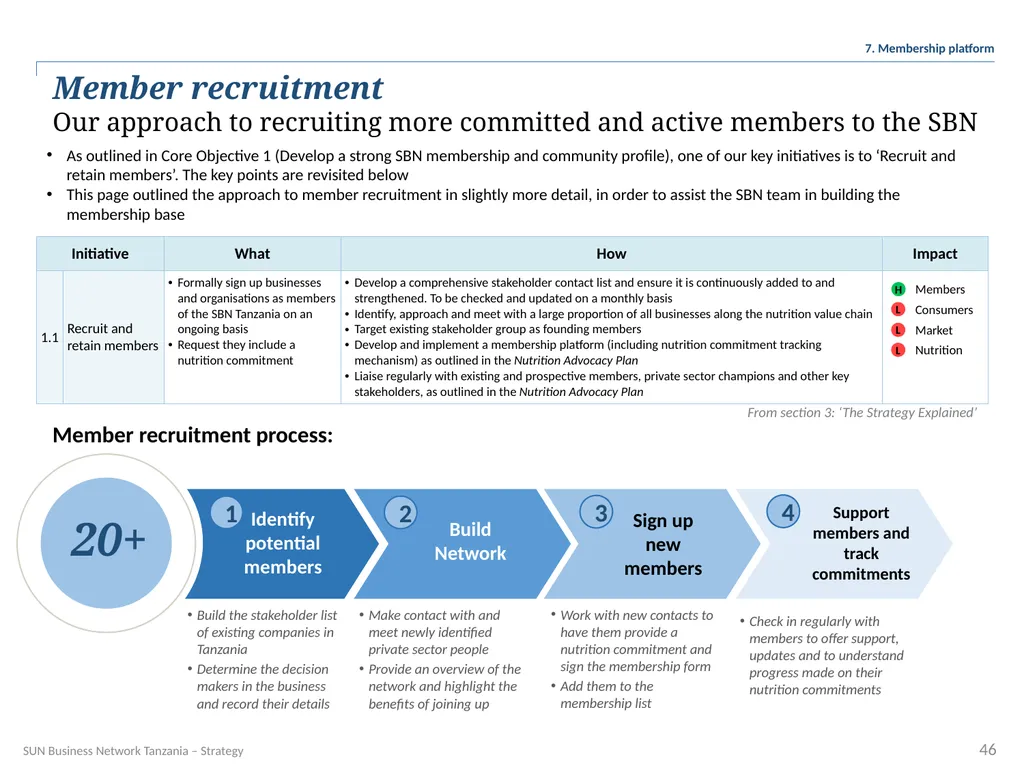
Description
SUN Business Network Tanzania Strategy 2016 2018 Housekeeping To be updated as changes to this document and the SBN team occur Version Control Summary of changes made by team members to this strategy document Contact details SBN Team
Related Topics
Share
Embed code
Download this presentation From Below
"SUN Business Network Tanzania Strategy 2016 – 2018" is the property of its rightful owner. Permission is granted to download and print the materials on this website for personal, non-commercial use only, and to display it on your personal computer provided you do not modify the materials and that you retain all copyright notices contained in the materials. By downloading content from our website, you accept the terms of this agreement.
Presentation Transcript
01
SUN Business Network Tanzania
Strategy
2016 – 2018<br>
Strategy
2016 – 2018<br>
02
Housekeeping
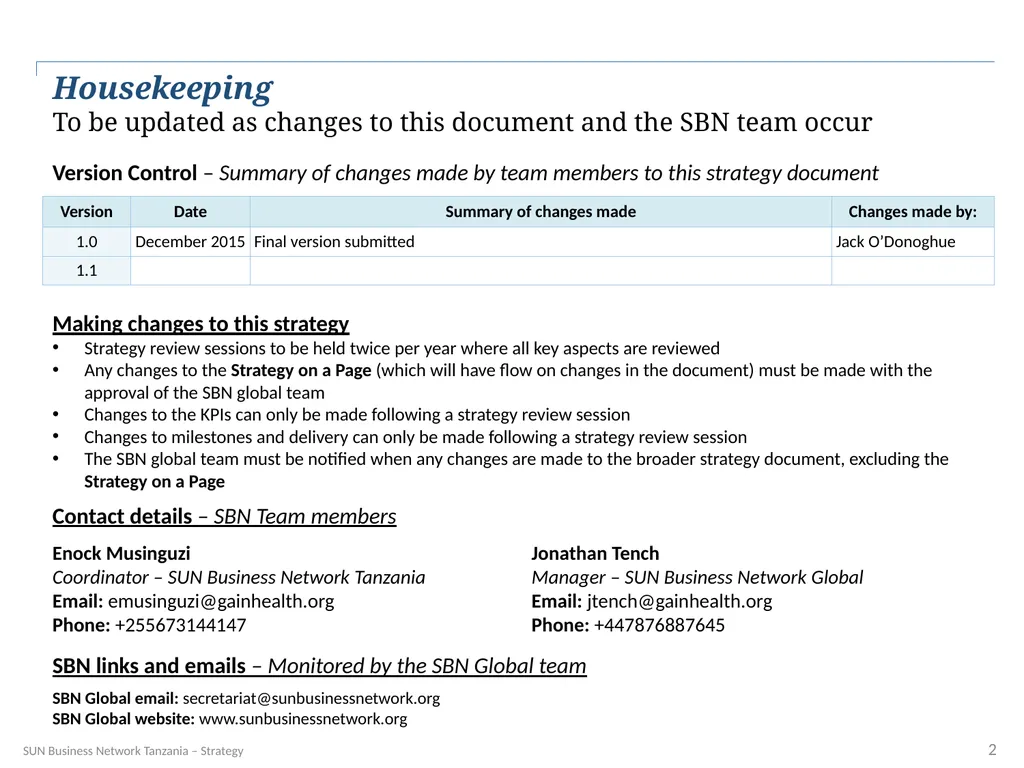
To be updated as changes to this document and the SBN team occur Version Control – Summary of changes made by team members to this strategy document Contact details – SBN Team members SBN links and emails – Monitored by the SBN Global team Enock Musinguzi
Coordinator – SUN Business Network Tanzania
Email: emusinguzi@gainhealth.org
Phone: +255673144147 Jonathan Tench
Manager – SUN Business Network Global
Email: jtench@gainhealth.org
Phone: +447876887645 SBN Global email: secretariat@sunbusinessnetwork.org
SBN Global website: www.sunbusinessnetwork.org Making changes to this strategy
Strategy review sessions to be held twice per year where all key aspects are reviewed
Any changes to the Strategy on a Page (which will have flow on changes in the document) must be made with the approval of the SBN global team
Changes to the KPIs can only be made following a strategy review session
Changes to milestones and delivery can only be made following a strategy review session
The SBN global team must be notified when any changes are made to the broader strategy document, excluding the Strategy on a Page<br>
To be updated as changes to this document and the SBN team occur Version Control – Summary of changes made by team members to this strategy document Contact details – SBN Team members SBN links and emails – Monitored by the SBN Global team Enock Musinguzi
Coordinator – SUN Business Network Tanzania
Email: emusinguzi@gainhealth.org
Phone: +255673144147 Jonathan Tench
Manager – SUN Business Network Global
Email: jtench@gainhealth.org
Phone: +447876887645 SBN Global email: secretariat@sunbusinessnetwork.org
SBN Global website: www.sunbusinessnetwork.org Making changes to this strategy
Strategy review sessions to be held twice per year where all key aspects are reviewed
Any changes to the Strategy on a Page (which will have flow on changes in the document) must be made with the approval of the SBN global team
Changes to the KPIs can only be made following a strategy review session
Changes to milestones and delivery can only be made following a strategy review session
The SBN global team must be notified when any changes are made to the broader strategy document, excluding the Strategy on a Page<br>
03
Approval and endorsement
The SBN Tanzania Strategy for 2016 – 2018 has been approved and endorsed December 2015
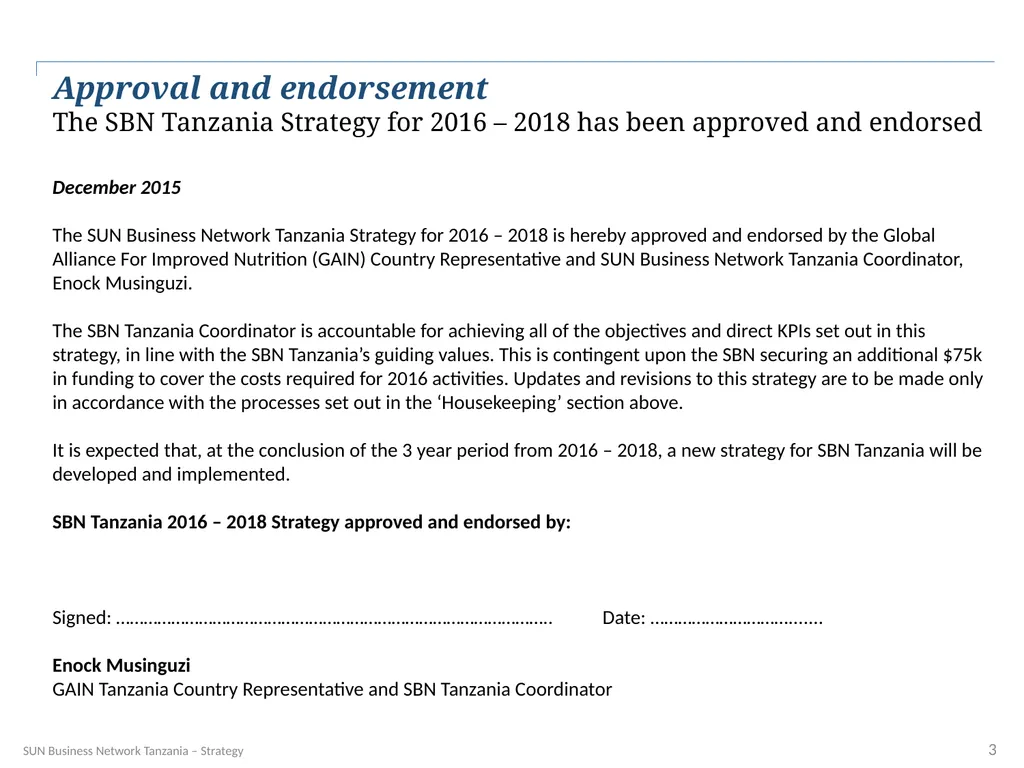
The SUN Business Network Tanzania Strategy for 2016 – 2018 is hereby approved and endorsed by the Global Alliance For Improved Nutrition (GAIN) Country Representative and SUN Business Network Tanzania Coordinator, Enock Musinguzi.
The SBN Tanzania Coordinator is accountable for achieving all of the objectives and direct KPIs set out in this strategy, in line with the SBN Tanzania’s guiding values. This is contingent upon the SBN securing an additional $75k in funding to cover the costs required for 2016 activities. Updates and revisions to this strategy are to be made only in accordance with the processes set out in the ‘Housekeeping’ section above.
It is expected that, at the conclusion of the 3 year period from 2016 – 2018, a new strategy for SBN Tanzania will be developed and implemented.
SBN Tanzania 2016 – 2018 Strategy approved and endorsed by:
Signed: ………………………………………………………………………………….. Date: ………………………….......
Enock Musinguzi
GAIN Tanzania Country Representative and SBN Tanzania Coordinator<br>
The SBN Tanzania Strategy for 2016 – 2018 has been approved and endorsed December 2015
The SUN Business Network Tanzania Strategy for 2016 – 2018 is hereby approved and endorsed by the Global Alliance For Improved Nutrition (GAIN) Country Representative and SUN Business Network Tanzania Coordinator, Enock Musinguzi.
The SBN Tanzania Coordinator is accountable for achieving all of the objectives and direct KPIs set out in this strategy, in line with the SBN Tanzania’s guiding values. This is contingent upon the SBN securing an additional $75k in funding to cover the costs required for 2016 activities. Updates and revisions to this strategy are to be made only in accordance with the processes set out in the ‘Housekeeping’ section above.
It is expected that, at the conclusion of the 3 year period from 2016 – 2018, a new strategy for SBN Tanzania will be developed and implemented.
SBN Tanzania 2016 – 2018 Strategy approved and endorsed by:
Signed: ………………………………………………………………………………….. Date: ………………………….......
Enock Musinguzi
GAIN Tanzania Country Representative and SBN Tanzania Coordinator<br>
04
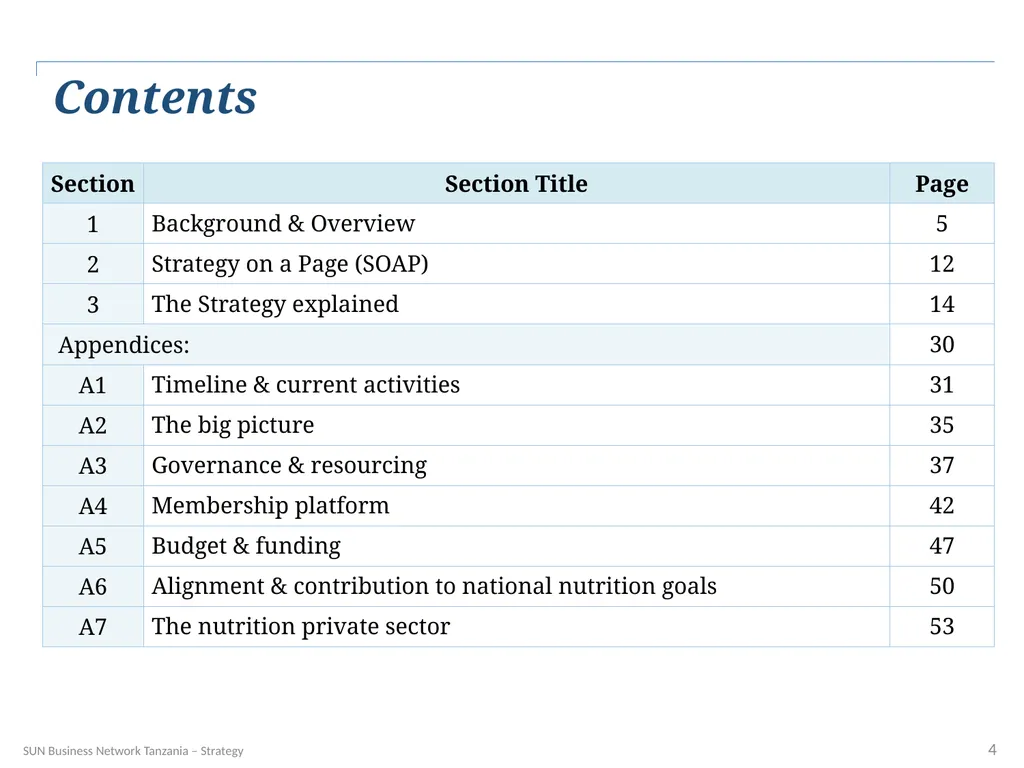
Contents<br>
05
1 Background & Overview
Putting the SUN Business Network into context within the broader nutrition private sector<br>
Putting the SUN Business Network into context within the broader nutrition private sector<br>
06
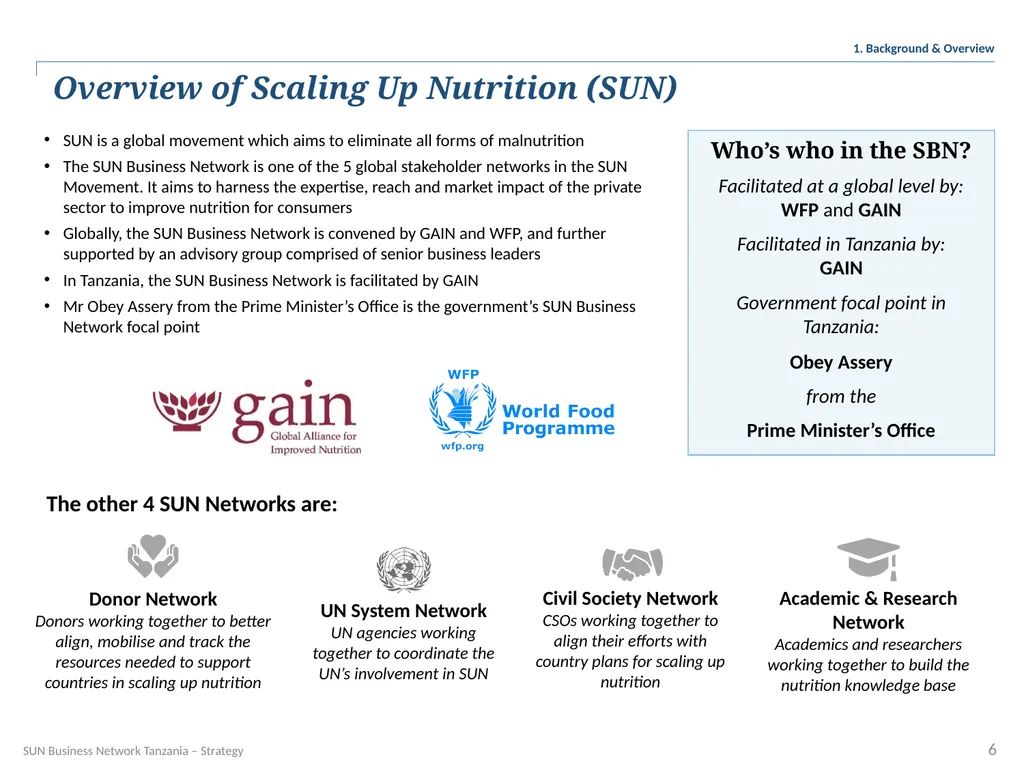
Overview of Scaling Up Nutrition (SUN) SUN is a global movement which aims to eliminate all forms of malnutrition
The SUN Business Network is one of the 5 global stakeholder networks in the SUN Movement. It aims to harness the expertise, reach and market impact of the private sector to improve nutrition for consumers
Globally, the SUN Business Network is convened by GAIN and WFP, and further supported by an advisory group comprised of senior business leaders
In Tanzania, the SUN Business Network is facilitated by GAIN
Mr Obey Assery from the Prime Minister’s Office is the government’s SUN Business Network focal point Who’s who in the SBN?
Facilitated at a global level by:
WFP and GAIN
Facilitated in Tanzania by:
GAIN
Government focal point in Tanzania:
Obey Assery
from the
Prime Minister’s Office The other 4 SUN Networks are: 1. Background & Overview<br>
The SUN Business Network is one of the 5 global stakeholder networks in the SUN Movement. It aims to harness the expertise, reach and market impact of the private sector to improve nutrition for consumers
Globally, the SUN Business Network is convened by GAIN and WFP, and further supported by an advisory group comprised of senior business leaders
In Tanzania, the SUN Business Network is facilitated by GAIN
Mr Obey Assery from the Prime Minister’s Office is the government’s SUN Business Network focal point Who’s who in the SBN?
Facilitated at a global level by:
WFP and GAIN
Facilitated in Tanzania by:
GAIN
Government focal point in Tanzania:
Obey Assery
from the
Prime Minister’s Office The other 4 SUN Networks are: 1. Background & Overview<br>
07
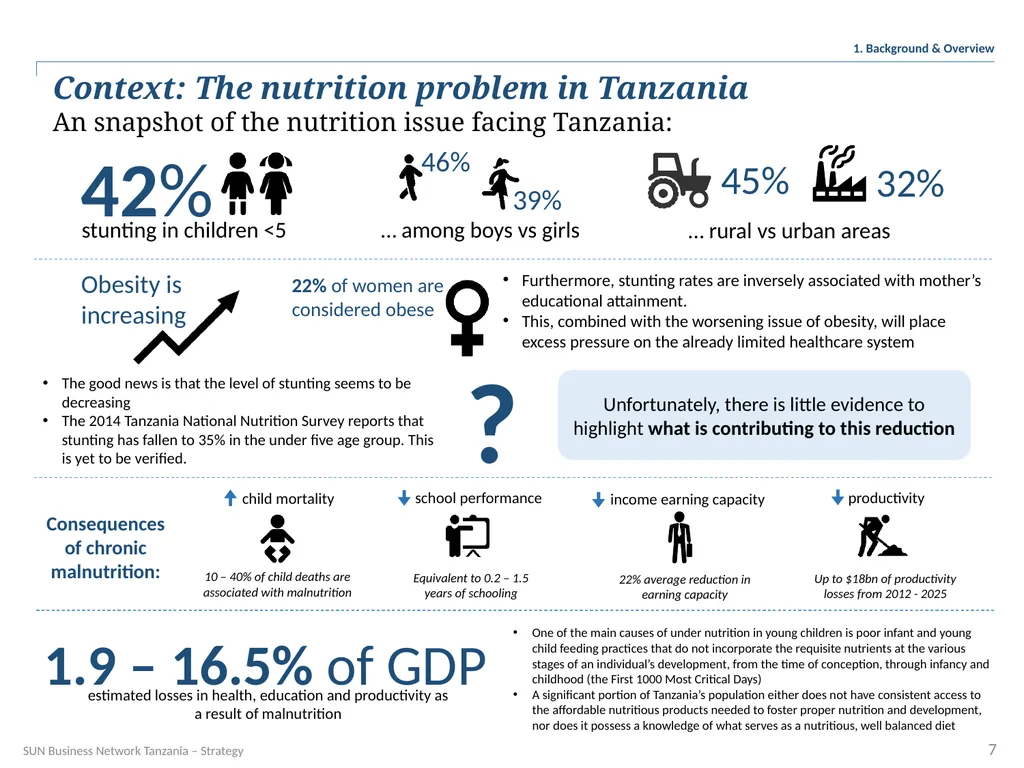
One of the main causes of under nutrition in young children is poor infant and young child feeding practices that do not incorporate the requisite nutrients at the various stages of an individual’s development, from the time of conception, through infancy and childhood (the First 1000 Most Critical Days)
A significant portion of Tanzania’s population either does not have consistent access to the affordable nutritious products needed to foster proper nutrition and development, nor does it possess a knowledge of what serves as a nutritious, well balanced diet Context: The nutrition problem in Tanzania
An snapshot of the nutrition issue facing Tanzania: Furthermore, stunting rates are inversely associated with mother’s educational attainment.
This, combined with the worsening issue of obesity, will place excess pressure on the already limited healthcare system 42% ? stunting in children <5 46% 39% … among boys vs girls 45% 32% … rural vs urban areas Obesity is increasing 22% of women are considered obese The good news is that the level of stunting seems to be decreasing
The 2014 Tanzania National Nutrition Survey reports that stunting has fallen to 35% in the under five age group. This is yet to be verified. Unfortunately, there is little evidence to highlight what is contributing to this reduction Consequences of chronic malnutrition: child mortality school performance income earning capacity productivity 10 – 40% of child deaths are associated with malnutrition Equivalent to 0.2 – 1.5 years of schooling 22% average reduction in earning capacity Up to $18bn of productivity losses from 2012 - 2025 1.9 – 16.5% of GDP estimated losses in health, education and productivity as a result of malnutrition 1. Background & Overview<br>
A significant portion of Tanzania’s population either does not have consistent access to the affordable nutritious products needed to foster proper nutrition and development, nor does it possess a knowledge of what serves as a nutritious, well balanced diet Context: The nutrition problem in Tanzania
An snapshot of the nutrition issue facing Tanzania: Furthermore, stunting rates are inversely associated with mother’s educational attainment.
This, combined with the worsening issue of obesity, will place excess pressure on the already limited healthcare system 42% ? stunting in children <5 46% 39% … among boys vs girls 45% 32% … rural vs urban areas Obesity is increasing 22% of women are considered obese The good news is that the level of stunting seems to be decreasing
The 2014 Tanzania National Nutrition Survey reports that stunting has fallen to 35% in the under five age group. This is yet to be verified. Unfortunately, there is little evidence to highlight what is contributing to this reduction Consequences of chronic malnutrition: child mortality school performance income earning capacity productivity 10 – 40% of child deaths are associated with malnutrition Equivalent to 0.2 – 1.5 years of schooling 22% average reduction in earning capacity Up to $18bn of productivity losses from 2012 - 2025 1.9 – 16.5% of GDP estimated losses in health, education and productivity as a result of malnutrition 1. Background & Overview<br>
08
The importance of engaging with Business on nutrition
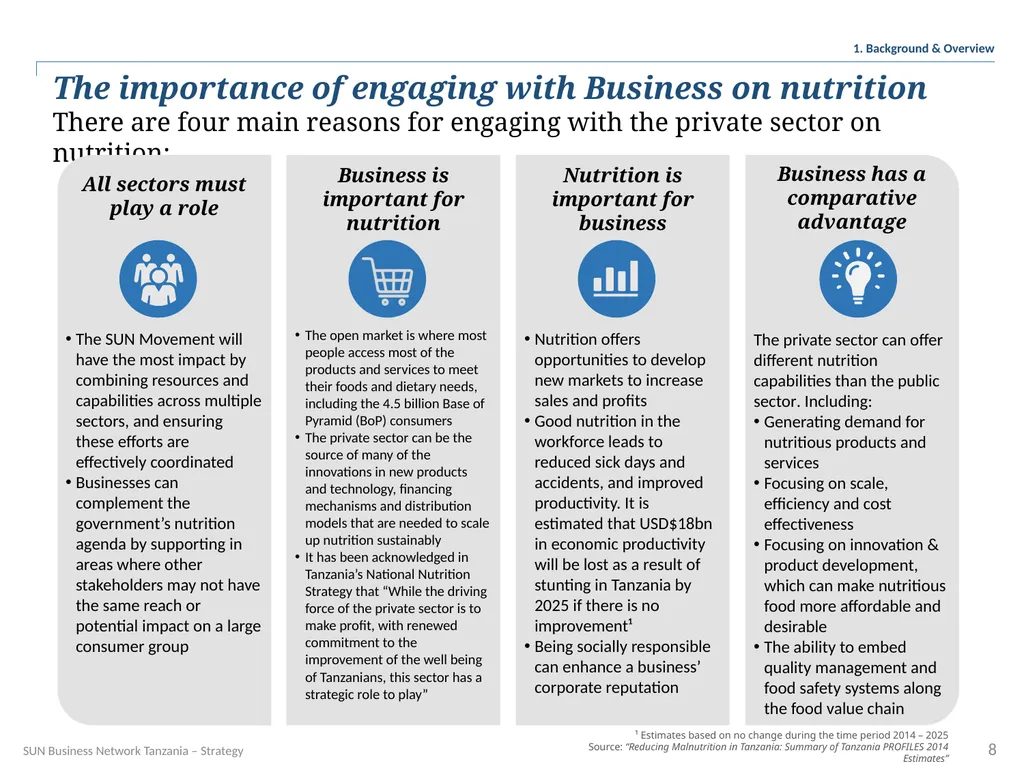
There are four main reasons for engaging with the private sector on nutrition: The SUN Movement will have the most impact by combining resources and capabilities across multiple sectors, and ensuring these efforts are effectively coordinated
Businesses can complement the government’s nutrition agenda by supporting in areas where other stakeholders may not have the same reach or potential impact on a large consumer group All sectors must play a role The open market is where most people access most of the products and services to meet their foods and dietary needs, including the 4.5 billion Base of Pyramid (BoP) consumers
The private sector can be the source of many of the innovations in new products and technology, financing mechanisms and distribution models that are needed to scale up nutrition sustainably
It has been acknowledged in Tanzania’s National Nutrition Strategy that “While the driving force of the private sector is to make profit, with renewed commitment to the improvement of the well being of Tanzanians, this sector has a strategic role to play” Business is important for nutrition Nutrition is important for business Business has a comparative advantage Nutrition offers opportunities to develop new markets to increase sales and profits
Good nutrition in the workforce leads to reduced sick days and accidents, and improved productivity. It is estimated that USD$18bn in economic productivity will be lost as a result of stunting in Tanzania by 2025 if there is no improvement¹
Being socially responsible can enhance a business’ corporate reputation The private sector can offer different nutrition capabilities than the public sector. Including:
Generating demand for nutritious products and services
Focusing on scale, efficiency and cost effectiveness
Focusing on innovation & product development, which can make nutritious food more affordable and desirable
The ability to embed quality management and food safety systems along the food value chain 1. Background & Overview ¹ Estimates based on no change during the time period 2014 – 2025
Source: “Reducing Malnutrition in Tanzania: Summary of Tanzania PROFILES 2014 Estimates”<br>
There are four main reasons for engaging with the private sector on nutrition: The SUN Movement will have the most impact by combining resources and capabilities across multiple sectors, and ensuring these efforts are effectively coordinated
Businesses can complement the government’s nutrition agenda by supporting in areas where other stakeholders may not have the same reach or potential impact on a large consumer group All sectors must play a role The open market is where most people access most of the products and services to meet their foods and dietary needs, including the 4.5 billion Base of Pyramid (BoP) consumers
The private sector can be the source of many of the innovations in new products and technology, financing mechanisms and distribution models that are needed to scale up nutrition sustainably
It has been acknowledged in Tanzania’s National Nutrition Strategy that “While the driving force of the private sector is to make profit, with renewed commitment to the improvement of the well being of Tanzanians, this sector has a strategic role to play” Business is important for nutrition Nutrition is important for business Business has a comparative advantage Nutrition offers opportunities to develop new markets to increase sales and profits
Good nutrition in the workforce leads to reduced sick days and accidents, and improved productivity. It is estimated that USD$18bn in economic productivity will be lost as a result of stunting in Tanzania by 2025 if there is no improvement¹
Being socially responsible can enhance a business’ corporate reputation The private sector can offer different nutrition capabilities than the public sector. Including:
Generating demand for nutritious products and services
Focusing on scale, efficiency and cost effectiveness
Focusing on innovation & product development, which can make nutritious food more affordable and desirable
The ability to embed quality management and food safety systems along the food value chain 1. Background & Overview ¹ Estimates based on no change during the time period 2014 – 2025
Source: “Reducing Malnutrition in Tanzania: Summary of Tanzania PROFILES 2014 Estimates”<br>
09
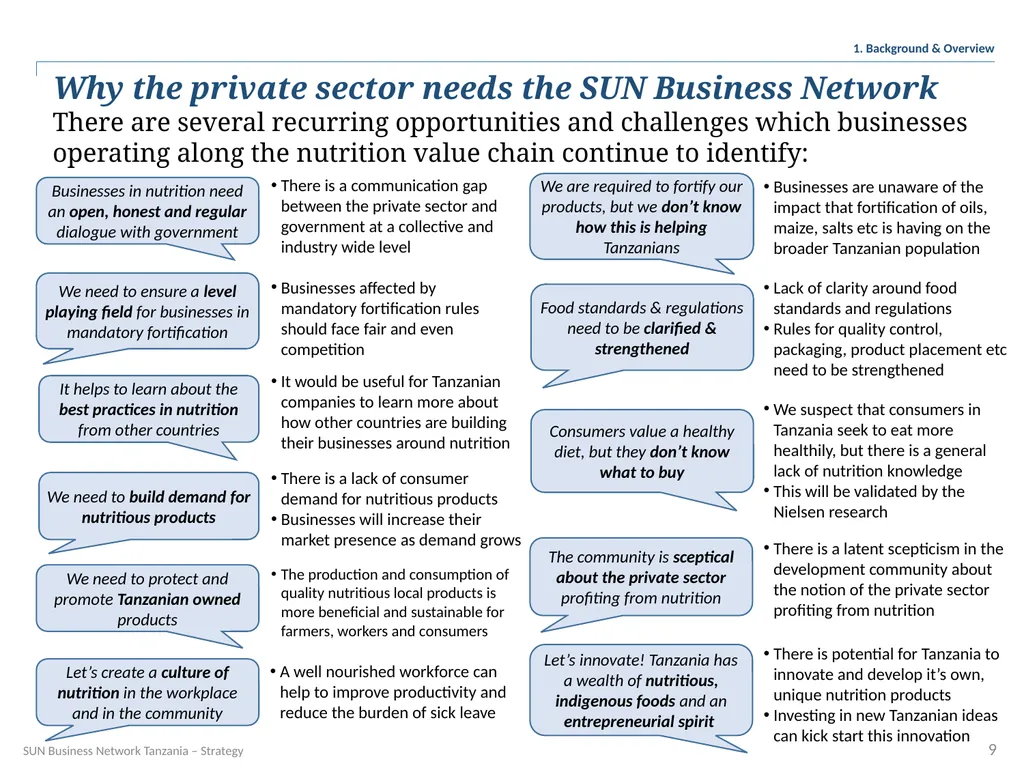
Food standards & regulations need to be clarified & strengthened Businesses in nutrition need an open, honest and regular dialogue with government It helps to learn about the best practices in nutrition from other countries We need to protect and promote Tanzanian owned products Consumers value a healthy diet, but they don’t know what to buy Let’s innovate! Tanzania has a wealth of nutritious, indigenous foods and an entrepreneurial spirit Let’s create a culture of nutrition in the workplace and in the community There is a communication gap between the private sector and government at a collective and industry wide level Businesses affected by mandatory fortification rules should face fair and even competition It would be useful for Tanzanian companies to learn more about how other countries are building their businesses around nutrition There is a lack of consumer demand for nutritious products
Businesses will increase their market presence as demand grows Businesses are unaware of the impact that fortification of oils, maize, salts etc is having on the broader Tanzanian population The production and consumption of quality nutritious local products is more beneficial and sustainable for farmers, workers and consumers Lack of clarity around food standards and regulations
Rules for quality control, packaging, product placement etc need to be strengthened We suspect that consumers in Tanzania seek to eat more healthily, but there is a general lack of nutrition knowledge
This will be validated by the Nielsen research A well nourished workforce can help to improve productivity and reduce the burden of sick leave There is potential for Tanzania to innovate and develop it’s own, unique nutrition products
Investing in new Tanzanian ideas can kick start this innovation 1. Background & Overview The community is sceptical about the private sector profiting from nutrition We need to build demand for nutritious products We need to ensure a level playing field for businesses in mandatory fortification We are required to fortify our products, but we don’t know how this is helping Tanzanians There is a latent scepticism in the development community about the notion of the private sector profiting from nutrition Why the private sector needs the SUN Business Network
There are several recurring opportunities and challenges which businesses operating along the nutrition value chain continue to identify:<br>
Businesses will increase their market presence as demand grows Businesses are unaware of the impact that fortification of oils, maize, salts etc is having on the broader Tanzanian population The production and consumption of quality nutritious local products is more beneficial and sustainable for farmers, workers and consumers Lack of clarity around food standards and regulations
Rules for quality control, packaging, product placement etc need to be strengthened We suspect that consumers in Tanzania seek to eat more healthily, but there is a general lack of nutrition knowledge
This will be validated by the Nielsen research A well nourished workforce can help to improve productivity and reduce the burden of sick leave There is potential for Tanzania to innovate and develop it’s own, unique nutrition products
Investing in new Tanzanian ideas can kick start this innovation 1. Background & Overview The community is sceptical about the private sector profiting from nutrition We need to build demand for nutritious products We need to ensure a level playing field for businesses in mandatory fortification We are required to fortify our products, but we don’t know how this is helping Tanzanians There is a latent scepticism in the development community about the notion of the private sector profiting from nutrition Why the private sector needs the SUN Business Network
There are several recurring opportunities and challenges which businesses operating along the nutrition value chain continue to identify:<br>
10
Introduction of the SBN Tanzania Strategy Overview of the Strategy:
The strategy lays out the vision and key objectives of the SUN Business Network Tanzania for the next 3 years, 2016 – 2018
It then looks into how we plan to achieve this vision and these objectives
Our role, as the SUN Business Network team is to coordinate the activities of the Network in order to improve nutrition among Tanzanian consumers as we support our members to grow their business How the strategy was developed:
Based on initial research and stakeholder interviews, the major recurring opportunities and challenges along the nutrition value chain in Tanzania were identified. These are outlined on the previous slide
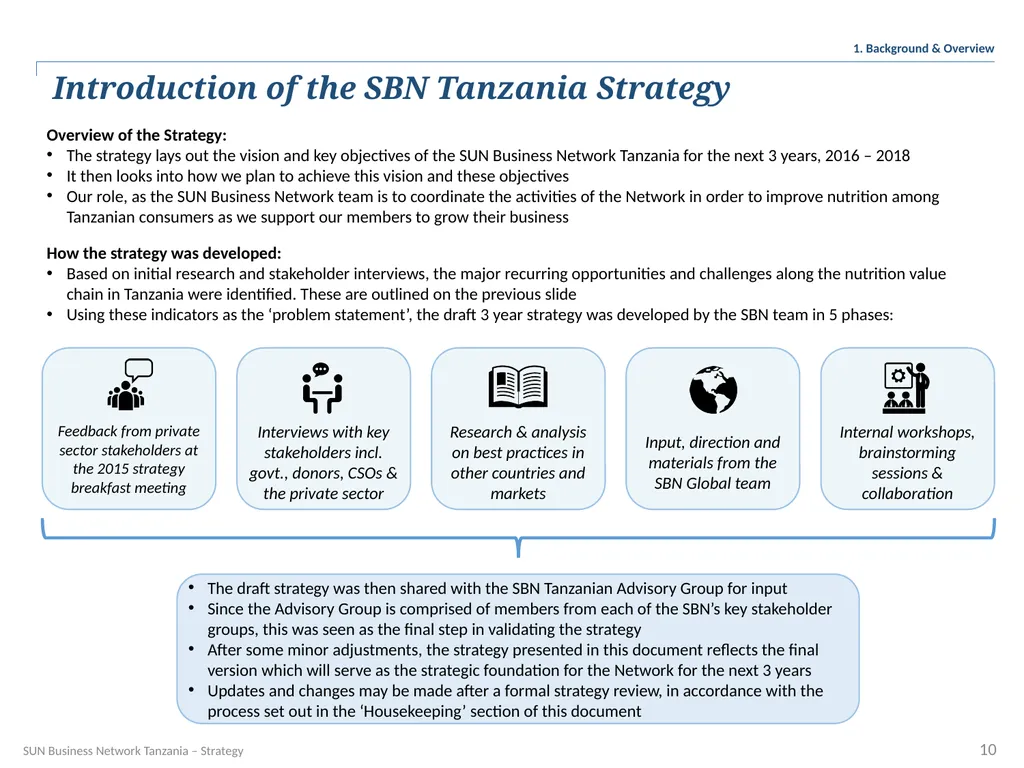
Using these indicators as the ‘problem statement’, the draft 3 year strategy was developed by the SBN team in 5 phases: Feedback from private sector stakeholders at the 2015 strategy breakfast meeting Interviews with key stakeholders incl. govt., donors, CSOs & the private sector Research & analysis on best practices in other countries and markets Internal workshops, brainstorming sessions & collaboration The draft strategy was then shared with the SBN Tanzanian Advisory Group for input
Since the Advisory Group is comprised of members from each of the SBN’s key stakeholder groups, this was seen as the final step in validating the strategy
After some minor adjustments, the strategy presented in this document reflects the final version which will serve as the strategic foundation for the Network for the next 3 years
Updates and changes may be made after a formal strategy review, in accordance with the process set out in the ‘Housekeeping’ section of this document Input, direction and materials from the SBN Global team 1. Background & Overview<br>
The strategy lays out the vision and key objectives of the SUN Business Network Tanzania for the next 3 years, 2016 – 2018
It then looks into how we plan to achieve this vision and these objectives
Our role, as the SUN Business Network team is to coordinate the activities of the Network in order to improve nutrition among Tanzanian consumers as we support our members to grow their business How the strategy was developed:
Based on initial research and stakeholder interviews, the major recurring opportunities and challenges along the nutrition value chain in Tanzania were identified. These are outlined on the previous slide
Using these indicators as the ‘problem statement’, the draft 3 year strategy was developed by the SBN team in 5 phases: Feedback from private sector stakeholders at the 2015 strategy breakfast meeting Interviews with key stakeholders incl. govt., donors, CSOs & the private sector Research & analysis on best practices in other countries and markets Internal workshops, brainstorming sessions & collaboration The draft strategy was then shared with the SBN Tanzanian Advisory Group for input
Since the Advisory Group is comprised of members from each of the SBN’s key stakeholder groups, this was seen as the final step in validating the strategy
After some minor adjustments, the strategy presented in this document reflects the final version which will serve as the strategic foundation for the Network for the next 3 years
Updates and changes may be made after a formal strategy review, in accordance with the process set out in the ‘Housekeeping’ section of this document Input, direction and materials from the SBN Global team 1. Background & Overview<br>
11
SBN Values
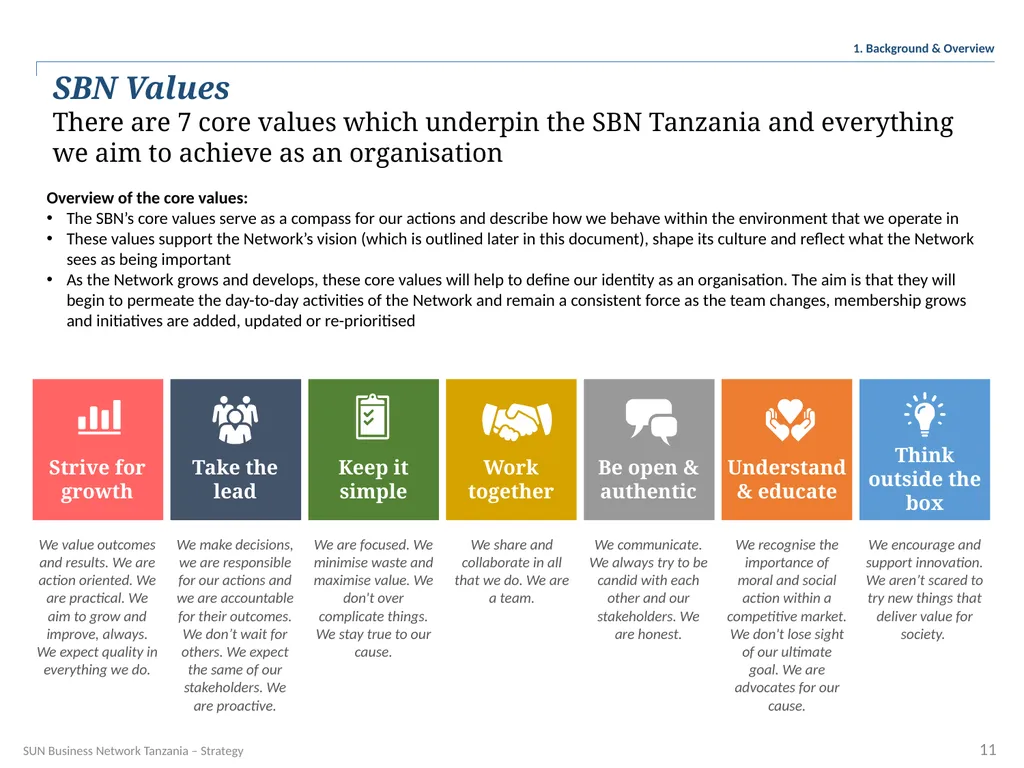
There are 7 core values which underpin the SBN Tanzania and everything we aim to achieve as an organisation Overview of the core values:
The SBN’s core values serve as a compass for our actions and describe how we behave within the environment that we operate in
These values support the Network’s vision (which is outlined later in this document), shape its culture and reflect what the Network sees as being important
As the Network grows and develops, these core values will help to define our identity as an organisation. The aim is that they will begin to permeate the day-to-day activities of the Network and remain a consistent force as the team changes, membership grows and initiatives are added, updated or re-prioritised We value outcomes and results. We are action oriented. We are practical. We aim to grow and improve, always. We expect quality in everything we do. Strive for growth Take the lead Keep it simple Work together Be open & authentic Understand & educate Think outside the box We make decisions, we are responsible for our actions and we are accountable for their outcomes. We don’t wait for others. We expect the same of our stakeholders. We are proactive. We are focused. We minimise waste and maximise value. We don't over complicate things. We stay true to our cause. We share and collaborate in all that we do. We are a team. We communicate. We always try to be candid with each other and our stakeholders. We are honest. We recognise the importance of moral and social action within a competitive market. We don't lose sight of our ultimate goal. We are advocates for our cause. We encourage and support innovation. We aren’t scared to try new things that deliver value for society. 1. Background & Overview<br>
There are 7 core values which underpin the SBN Tanzania and everything we aim to achieve as an organisation Overview of the core values:
The SBN’s core values serve as a compass for our actions and describe how we behave within the environment that we operate in
These values support the Network’s vision (which is outlined later in this document), shape its culture and reflect what the Network sees as being important
As the Network grows and develops, these core values will help to define our identity as an organisation. The aim is that they will begin to permeate the day-to-day activities of the Network and remain a consistent force as the team changes, membership grows and initiatives are added, updated or re-prioritised We value outcomes and results. We are action oriented. We are practical. We aim to grow and improve, always. We expect quality in everything we do. Strive for growth Take the lead Keep it simple Work together Be open & authentic Understand & educate Think outside the box We make decisions, we are responsible for our actions and we are accountable for their outcomes. We don’t wait for others. We expect the same of our stakeholders. We are proactive. We are focused. We minimise waste and maximise value. We don't over complicate things. We stay true to our cause. We share and collaborate in all that we do. We are a team. We communicate. We always try to be candid with each other and our stakeholders. We are honest. We recognise the importance of moral and social action within a competitive market. We don't lose sight of our ultimate goal. We are advocates for our cause. We encourage and support innovation. We aren’t scared to try new things that deliver value for society. 1. Background & Overview<br>
12
2 Strategy on a Page
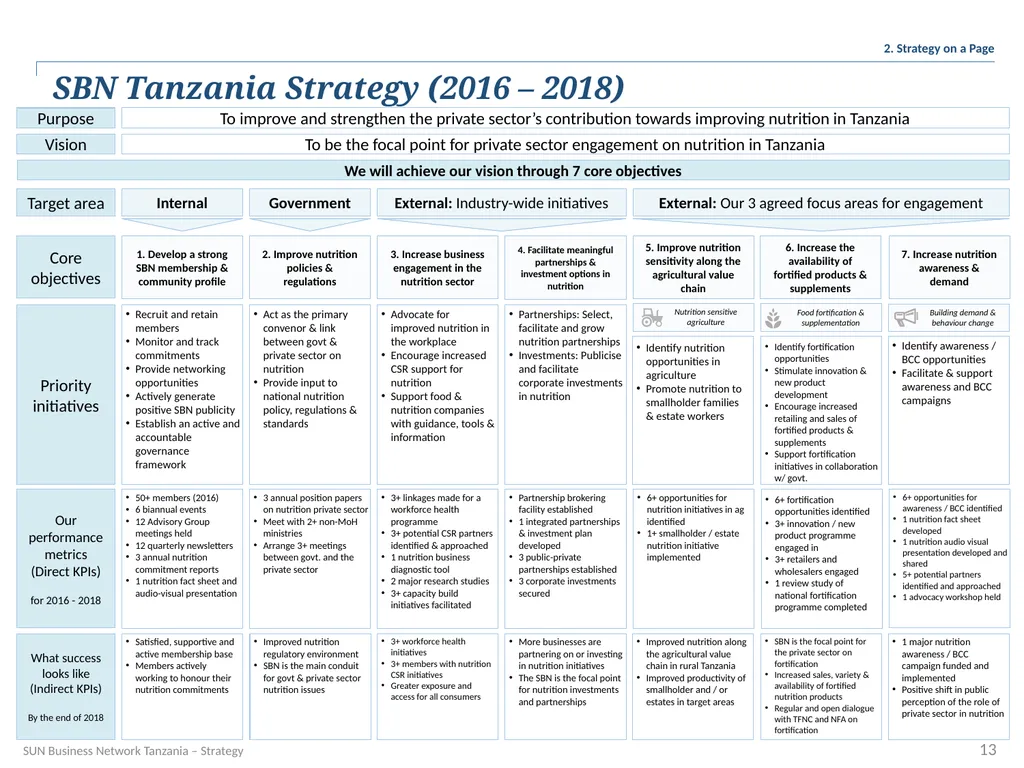
This is our 3 year strategy summarised on one page. After this section, we’ll go into more detail by explaining each of the objectives and priority initiatives<br>
This is our 3 year strategy summarised on one page. After this section, we’ll go into more detail by explaining each of the objectives and priority initiatives<br>
13
SBN Tanzania Strategy (2016 – 2018) 1. Develop a strong SBN membership & community profile 2. Strategy on a Page Recruit and retain members
Monitor and track commitments
Provide networking opportunities
Actively generate positive SBN publicity
Establish an active and accountable governance framework 5. Improve nutrition sensitivity along the agricultural value chain 2. Improve nutrition policies & regulations External: Our 3 agreed focus areas for engagement Act as the primary convenor & link between govt & private sector on nutrition
Provide input to national nutrition policy, regulations & standards External: Industry-wide initiatives Internal Core objectives Priority initiatives Target area We will achieve our vision through 7 core objectives To improve and strengthen the private sector’s contribution towards improving nutrition in Tanzania To be the focal point for private sector engagement on nutrition in Tanzania Vision Government Our performance metrics (Direct KPIs)
for 2016 - 2018 What success looks like (Indirect KPIs)
By the end of 2018 50+ members (2016)
6 biannual events
12 Advisory Group meetings held
12 quarterly newsletters
3 annual nutrition commitment reports
1 nutrition fact sheet and audio-visual presentation Satisfied, supportive and active membership base
Members actively working to honour their nutrition commitments 3 annual position papers on nutrition private sector
Meet with 2+ non-MoH ministries
Arrange 3+ meetings between govt. and the private sector 3. Increase business engagement in the nutrition sector Advocate for improved nutrition in the workplace
Encourage increased CSR support for nutrition
Support food & nutrition companies with guidance, tools & information 3+ linkages made for a workforce health programme
3+ potential CSR partners identified & approached
1 nutrition business diagnostic tool
2 major research studies
3+ capacity build initiatives facilitated 3+ workforce health initiatives
3+ members with nutrition CSR initiatives
Greater exposure and access for all consumers 4. Facilitate meaningful partnerships & investment options in nutrition Partnerships: Select, facilitate and grow nutrition partnerships
Investments: Publicise and facilitate corporate investments in nutrition Partnership brokering facility established
1 integrated partnerships & investment plan developed
3 public-private partnerships established
3 corporate investments secured More businesses are partnering on or investing in nutrition initiatives
The SBN is the focal point for nutrition investments and partnerships Identify nutrition opportunities in agriculture
Promote nutrition to smallholder families & estate workers 6+ opportunities for nutrition initiatives in ag identified
1+ smallholder / estate nutrition initiative implemented Improved nutrition along the agricultural value chain in rural Tanzania
Improved productivity of smallholder and / or estates in target areas Purpose Identify fortification opportunities
Stimulate innovation & new product development
Encourage increased retailing and sales of fortified products & supplements
Support fortification initiatives in collaboration w/ govt. 6+ fortification opportunities identified
3+ innovation / new product programme engaged in
3+ retailers and wholesalers engaged
1 review study of national fortification programme completed SBN is the focal point for the private sector on fortification
Increased sales, variety & availability of fortified nutrition products
Regular and open dialogue with TFNC and NFA on fortification 6. Increase the availability of fortified products & supplements Identify awareness / BCC opportunities
Facilitate & support awareness and BCC campaigns 6+ opportunities for awareness / BCC identified
1 nutrition fact sheet developed
1 nutrition audio visual presentation developed and shared
5+ potential partners identified and approached
1 advocacy workshop held 1 major nutrition awareness / BCC campaign funded and implemented
Positive shift in public perception of the role of private sector in nutrition Nutrition sensitive agriculture Food fortification & supplementation Building demand & behaviour change 7. Increase nutrition awareness & demand Improved nutrition regulatory environment
SBN is the main conduit for govt & private sector nutrition issues<br>
Monitor and track commitments
Provide networking opportunities
Actively generate positive SBN publicity
Establish an active and accountable governance framework 5. Improve nutrition sensitivity along the agricultural value chain 2. Improve nutrition policies & regulations External: Our 3 agreed focus areas for engagement Act as the primary convenor & link between govt & private sector on nutrition
Provide input to national nutrition policy, regulations & standards External: Industry-wide initiatives Internal Core objectives Priority initiatives Target area We will achieve our vision through 7 core objectives To improve and strengthen the private sector’s contribution towards improving nutrition in Tanzania To be the focal point for private sector engagement on nutrition in Tanzania Vision Government Our performance metrics (Direct KPIs)
for 2016 - 2018 What success looks like (Indirect KPIs)
By the end of 2018 50+ members (2016)
6 biannual events
12 Advisory Group meetings held
12 quarterly newsletters
3 annual nutrition commitment reports
1 nutrition fact sheet and audio-visual presentation Satisfied, supportive and active membership base
Members actively working to honour their nutrition commitments 3 annual position papers on nutrition private sector
Meet with 2+ non-MoH ministries
Arrange 3+ meetings between govt. and the private sector 3. Increase business engagement in the nutrition sector Advocate for improved nutrition in the workplace
Encourage increased CSR support for nutrition
Support food & nutrition companies with guidance, tools & information 3+ linkages made for a workforce health programme
3+ potential CSR partners identified & approached
1 nutrition business diagnostic tool
2 major research studies
3+ capacity build initiatives facilitated 3+ workforce health initiatives
3+ members with nutrition CSR initiatives
Greater exposure and access for all consumers 4. Facilitate meaningful partnerships & investment options in nutrition Partnerships: Select, facilitate and grow nutrition partnerships
Investments: Publicise and facilitate corporate investments in nutrition Partnership brokering facility established
1 integrated partnerships & investment plan developed
3 public-private partnerships established
3 corporate investments secured More businesses are partnering on or investing in nutrition initiatives
The SBN is the focal point for nutrition investments and partnerships Identify nutrition opportunities in agriculture
Promote nutrition to smallholder families & estate workers 6+ opportunities for nutrition initiatives in ag identified
1+ smallholder / estate nutrition initiative implemented Improved nutrition along the agricultural value chain in rural Tanzania
Improved productivity of smallholder and / or estates in target areas Purpose Identify fortification opportunities
Stimulate innovation & new product development
Encourage increased retailing and sales of fortified products & supplements
Support fortification initiatives in collaboration w/ govt. 6+ fortification opportunities identified
3+ innovation / new product programme engaged in
3+ retailers and wholesalers engaged
1 review study of national fortification programme completed SBN is the focal point for the private sector on fortification
Increased sales, variety & availability of fortified nutrition products
Regular and open dialogue with TFNC and NFA on fortification 6. Increase the availability of fortified products & supplements Identify awareness / BCC opportunities
Facilitate & support awareness and BCC campaigns 6+ opportunities for awareness / BCC identified
1 nutrition fact sheet developed
1 nutrition audio visual presentation developed and shared
5+ potential partners identified and approached
1 advocacy workshop held 1 major nutrition awareness / BCC campaign funded and implemented
Positive shift in public perception of the role of private sector in nutrition Nutrition sensitive agriculture Food fortification & supplementation Building demand & behaviour change 7. Increase nutrition awareness & demand Improved nutrition regulatory environment
SBN is the main conduit for govt & private sector nutrition issues<br>
14
The Strategy explained
Objectives and priority initiatives in detail 3 H M L Overview – What’s in this section?
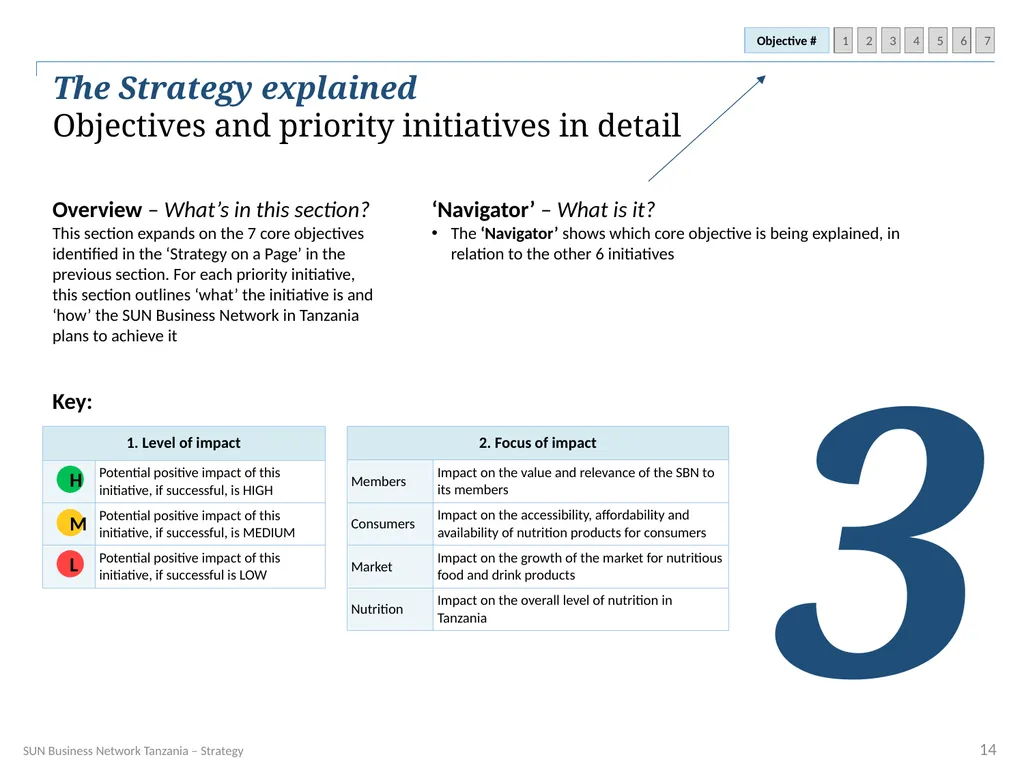
This section expands on the 7 core objectives identified in the ‘Strategy on a Page’ in the previous section. For each priority initiative, this section outlines ‘what’ the initiative is and ‘how’ the SUN Business Network in Tanzania plans to achieve it ‘Navigator’ – What is it?
The ‘Navigator’ shows which core objective is being explained, in relation to the other 6 initiatives Key: 1 2 3 4 5 6 Objective # 7<br>
Objectives and priority initiatives in detail 3 H M L Overview – What’s in this section?
This section expands on the 7 core objectives identified in the ‘Strategy on a Page’ in the previous section. For each priority initiative, this section outlines ‘what’ the initiative is and ‘how’ the SUN Business Network in Tanzania plans to achieve it ‘Navigator’ – What is it?
The ‘Navigator’ shows which core objective is being explained, in relation to the other 6 initiatives Key: 1 2 3 4 5 6 Objective # 7<br>
15
Overview of the core objectives
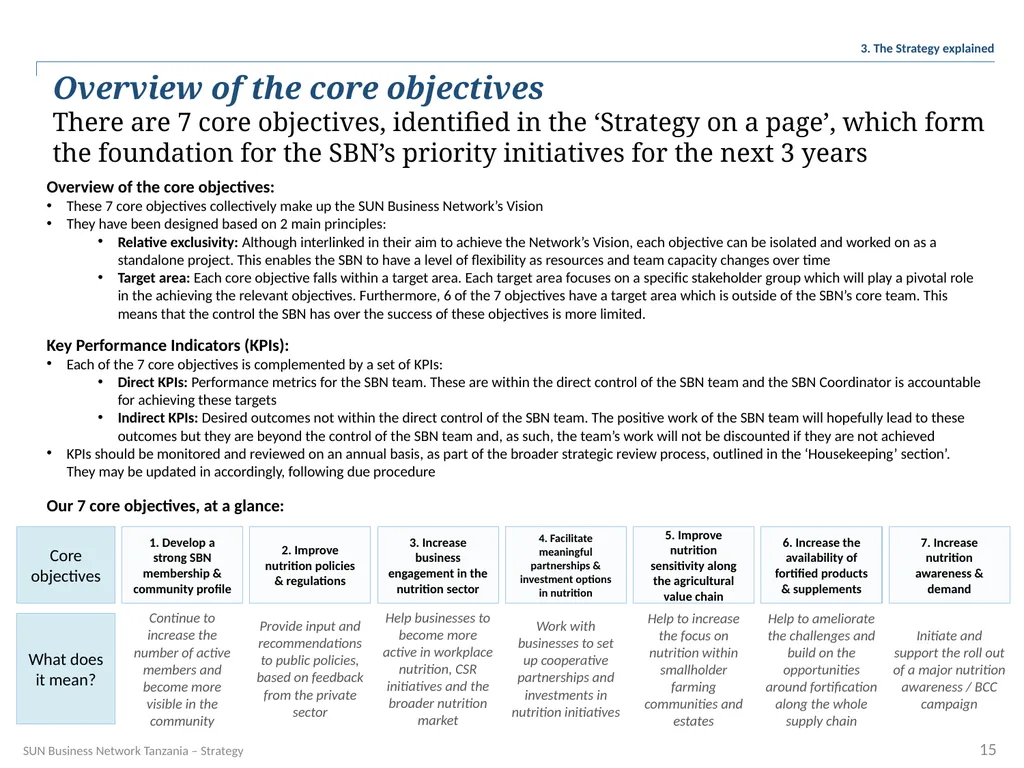
There are 7 core objectives, identified in the ‘Strategy on a page’, which form the foundation for the SBN’s priority initiatives for the next 3 years Overview of the core objectives:
These 7 core objectives collectively make up the SUN Business Network’s Vision
They have been designed based on 2 main principles:
Relative exclusivity: Although interlinked in their aim to achieve the Network’s Vision, each objective can be isolated and worked on as a standalone project. This enables the SBN to have a level of flexibility as resources and team capacity changes over time
Target area: Each core objective falls within a target area. Each target area focuses on a specific stakeholder group which will play a pivotal role in the achieving the relevant objectives. Furthermore, 6 of the 7 objectives have a target area which is outside of the SBN’s core team. This means that the control the SBN has over the success of these objectives is more limited. Our 7 core objectives, at a glance: Key Performance Indicators (KPIs):
Each of the 7 core objectives is complemented by a set of KPIs:
Direct KPIs: Performance metrics for the SBN team. These are within the direct control of the SBN team and the SBN Coordinator is accountable for achieving these targets
Indirect KPIs: Desired outcomes not within the direct control of the SBN team. The positive work of the SBN team will hopefully lead to these outcomes but they are beyond the control of the SBN team and, as such, the team’s work will not be discounted if they are not achieved
KPIs should be monitored and reviewed on an annual basis, as part of the broader strategic review process, outlined in the ‘Housekeeping’ section’. They may be updated in accordingly, following due procedure 3. The Strategy explained 1. Develop a strong SBN membership & community profile 5. Improve nutrition sensitivity along the agricultural value chain 2. Improve nutrition policies & regulations Core objectives 3. Increase business engagement in the nutrition sector 4. Facilitate meaningful partnerships & investment options in nutrition 6. Increase the availability of fortified products & supplements 7. Increase nutrition awareness & demand What does it mean? Continue to increase the number of active members and become more visible in the community Provide input and recommendations to public policies, based on feedback from the private sector Help businesses to become more active in workplace nutrition, CSR initiatives and the broader nutrition market Work with businesses to set up cooperative partnerships and investments in nutrition initiatives Help to increase the focus on nutrition within smallholder farming communities and estates Help to ameliorate the challenges and build on the opportunities around fortification along the whole supply chain Initiate and support the roll out of a major nutrition awareness / BCC campaign<br>
There are 7 core objectives, identified in the ‘Strategy on a page’, which form the foundation for the SBN’s priority initiatives for the next 3 years Overview of the core objectives:
These 7 core objectives collectively make up the SUN Business Network’s Vision
They have been designed based on 2 main principles:
Relative exclusivity: Although interlinked in their aim to achieve the Network’s Vision, each objective can be isolated and worked on as a standalone project. This enables the SBN to have a level of flexibility as resources and team capacity changes over time
Target area: Each core objective falls within a target area. Each target area focuses on a specific stakeholder group which will play a pivotal role in the achieving the relevant objectives. Furthermore, 6 of the 7 objectives have a target area which is outside of the SBN’s core team. This means that the control the SBN has over the success of these objectives is more limited. Our 7 core objectives, at a glance: Key Performance Indicators (KPIs):
Each of the 7 core objectives is complemented by a set of KPIs:
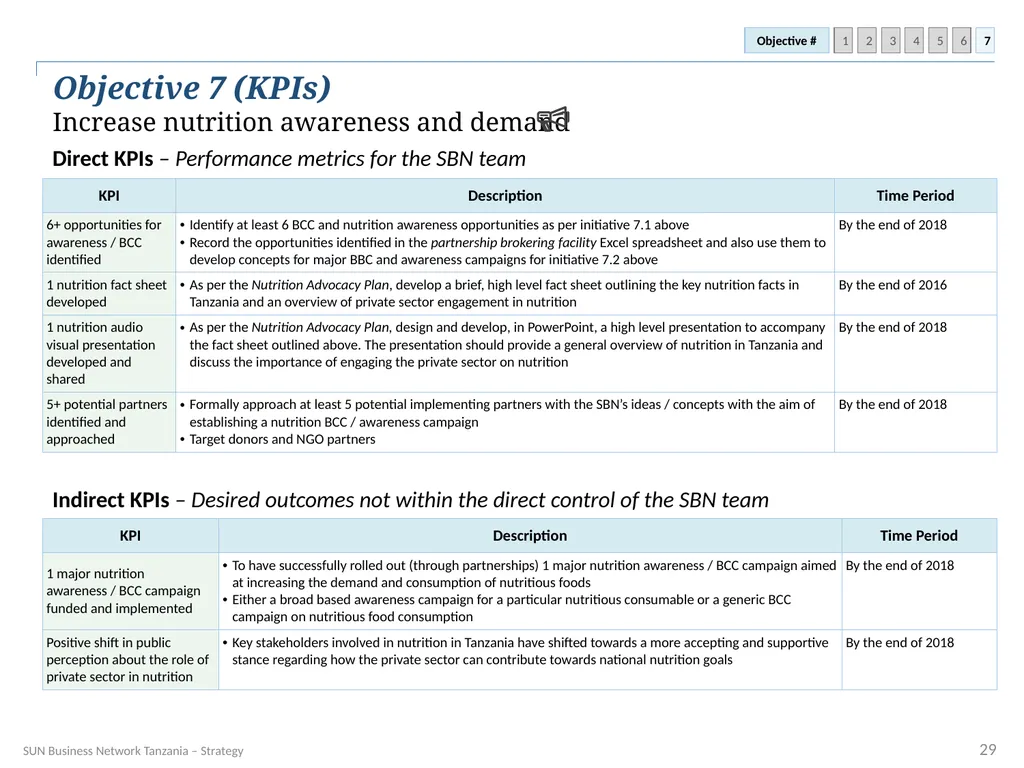
Direct KPIs: Performance metrics for the SBN team. These are within the direct control of the SBN team and the SBN Coordinator is accountable for achieving these targets
Indirect KPIs: Desired outcomes not within the direct control of the SBN team. The positive work of the SBN team will hopefully lead to these outcomes but they are beyond the control of the SBN team and, as such, the team’s work will not be discounted if they are not achieved
KPIs should be monitored and reviewed on an annual basis, as part of the broader strategic review process, outlined in the ‘Housekeeping’ section’. They may be updated in accordingly, following due procedure 3. The Strategy explained 1. Develop a strong SBN membership & community profile 5. Improve nutrition sensitivity along the agricultural value chain 2. Improve nutrition policies & regulations Core objectives 3. Increase business engagement in the nutrition sector 4. Facilitate meaningful partnerships & investment options in nutrition 6. Increase the availability of fortified products & supplements 7. Increase nutrition awareness & demand What does it mean? Continue to increase the number of active members and become more visible in the community Provide input and recommendations to public policies, based on feedback from the private sector Help businesses to become more active in workplace nutrition, CSR initiatives and the broader nutrition market Work with businesses to set up cooperative partnerships and investments in nutrition initiatives Help to increase the focus on nutrition within smallholder farming communities and estates Help to ameliorate the challenges and build on the opportunities around fortification along the whole supply chain Initiate and support the roll out of a major nutrition awareness / BCC campaign<br>
16
Objective 1 (Initiatives)
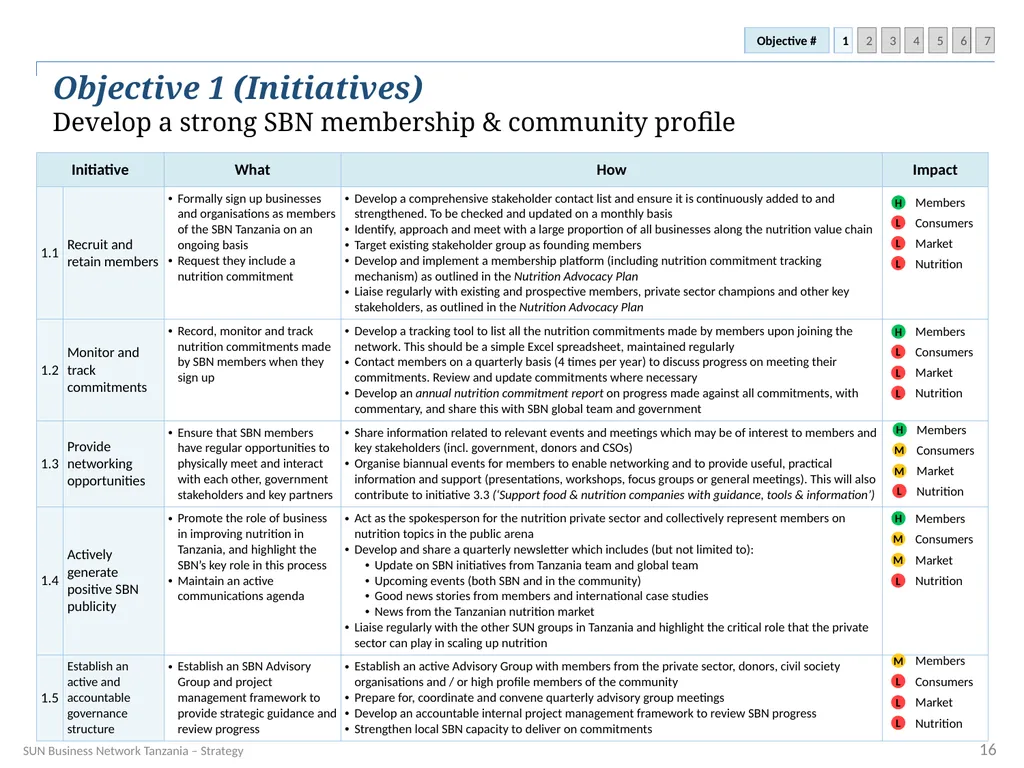
Develop a strong SBN membership & community profile 1 2 3 4 5 6 Objective # 7 Members H Consumers L Nutrition L Market L<br>
Develop a strong SBN membership & community profile 1 2 3 4 5 6 Objective # 7 Members H Consumers L Nutrition L Market L<br>
17
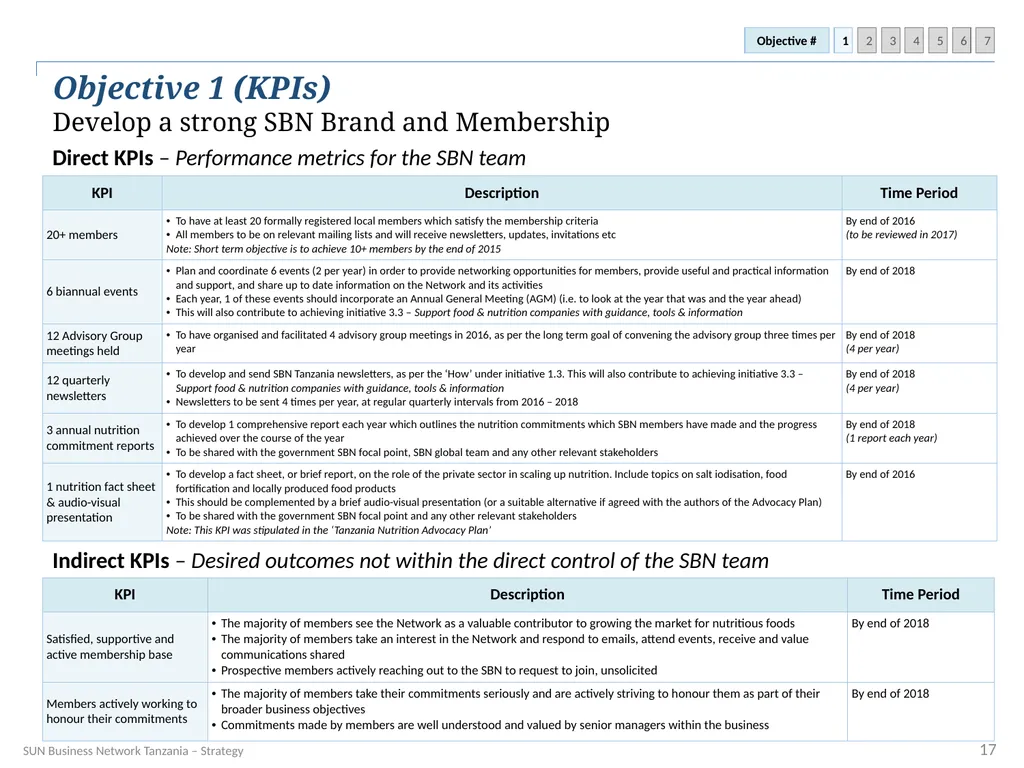
Objective 1 (KPIs)
Develop a strong SBN Brand and Membership Indirect KPIs – Desired outcomes not within the direct control of the SBN team Direct KPIs – Performance metrics for the SBN team 1 2 3 4 5 6 Objective # 7<br>
Develop a strong SBN Brand and Membership Indirect KPIs – Desired outcomes not within the direct control of the SBN team Direct KPIs – Performance metrics for the SBN team 1 2 3 4 5 6 Objective # 7<br>
18
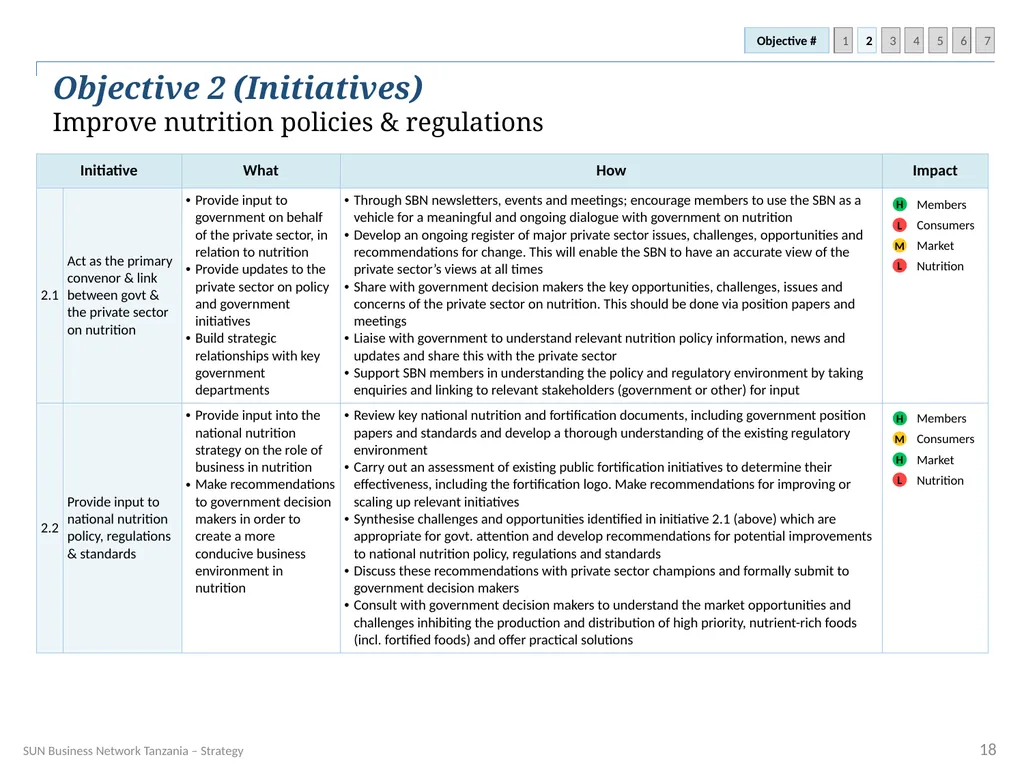
Objective 2 (Initiatives)
Improve nutrition policies & regulations Consumers L 1 2 3 4 5 6 Objective # 7<br>
Improve nutrition policies & regulations Consumers L 1 2 3 4 5 6 Objective # 7<br>
19
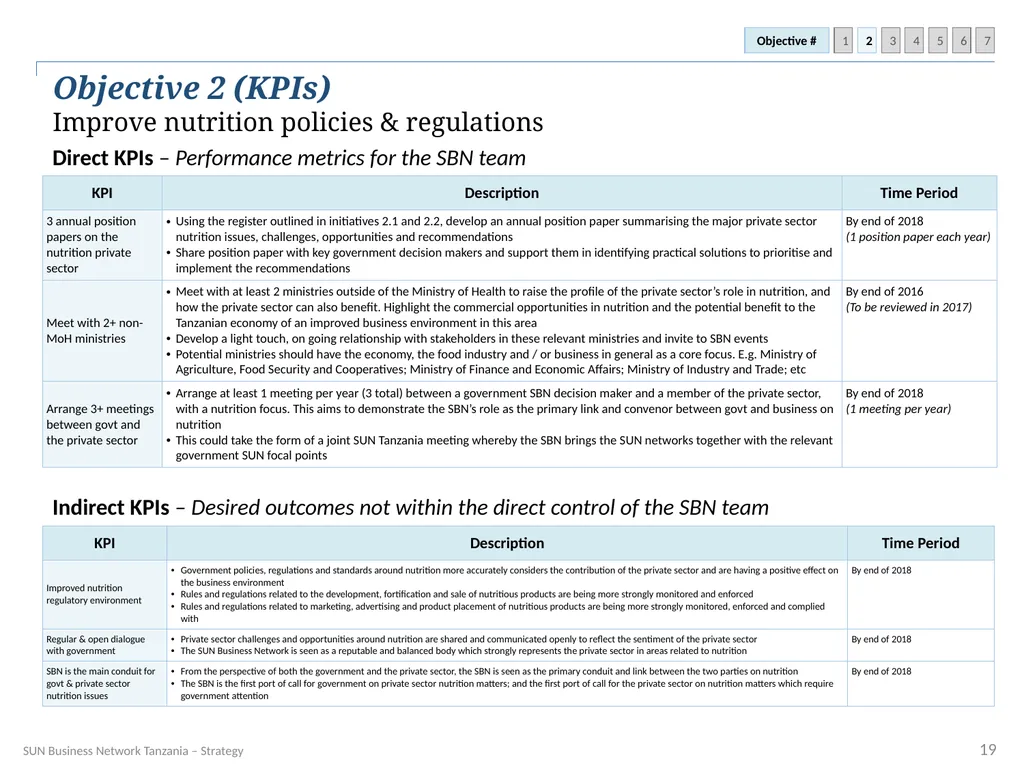
Objective 2 (KPIs)
Improve nutrition policies & regulations Indirect KPIs – Desired outcomes not within the direct control of the SBN team Direct KPIs – Performance metrics for the SBN team 1 2 3 4 5 6 Objective # 7<br>
Improve nutrition policies & regulations Indirect KPIs – Desired outcomes not within the direct control of the SBN team Direct KPIs – Performance metrics for the SBN team 1 2 3 4 5 6 Objective # 7<br>
20
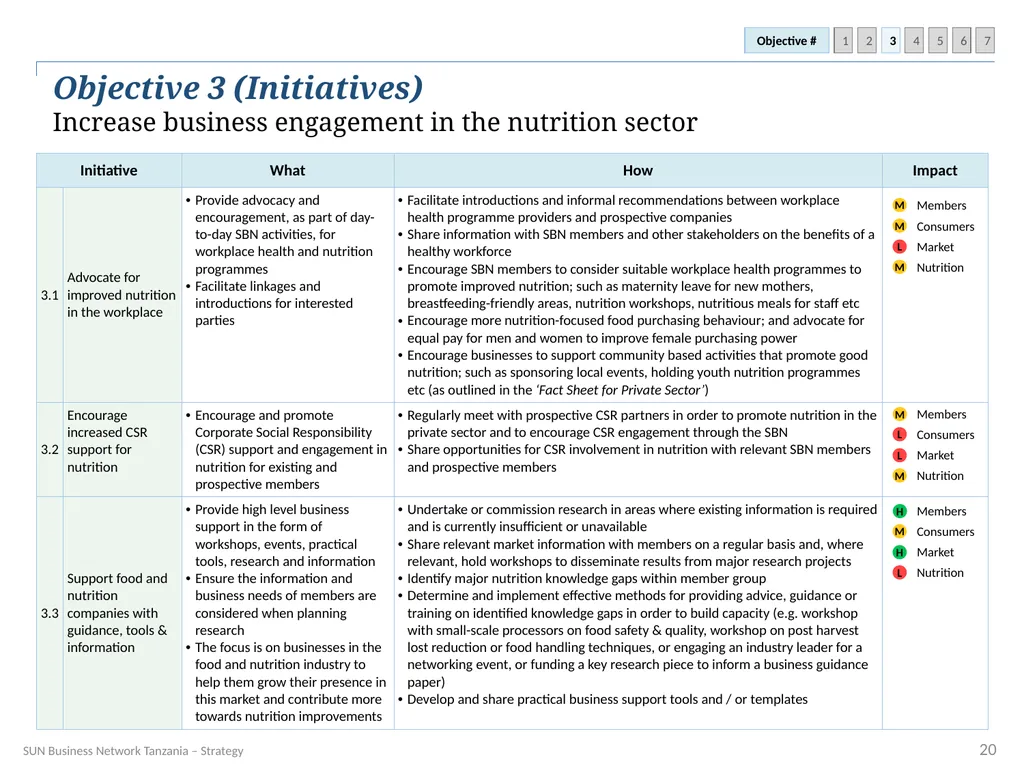
Objective 3 (Initiatives)
Increase business engagement in the nutrition sector Members Consumers M Nutrition M Market L Members M Consumers L Nutrition M Market L M 1 2 3 4 5 6 Objective # 7<br>
Increase business engagement in the nutrition sector Members Consumers M Nutrition M Market L Members M Consumers L Nutrition M Market L M 1 2 3 4 5 6 Objective # 7<br>
21
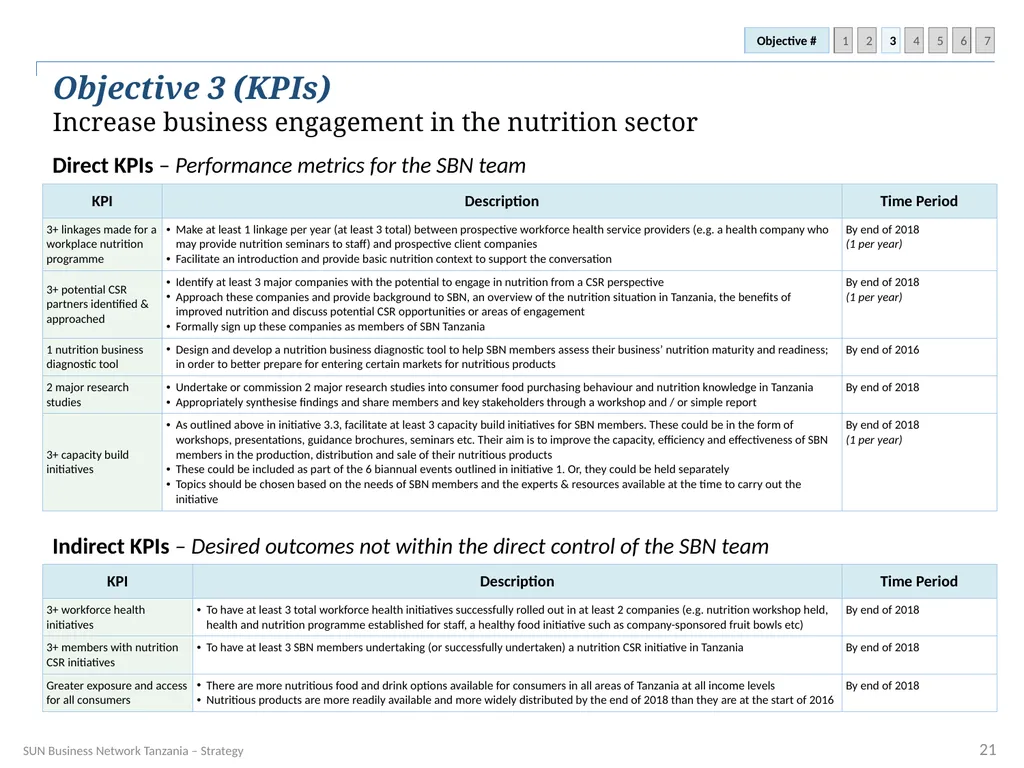
Objective 3 (KPIs)
Increase business engagement in the nutrition sector Indirect KPIs – Desired outcomes not within the direct control of the SBN team Direct KPIs – Performance metrics for the SBN team 1 2 3 4 5 6 Objective # 7<br>
Increase business engagement in the nutrition sector Indirect KPIs – Desired outcomes not within the direct control of the SBN team Direct KPIs – Performance metrics for the SBN team 1 2 3 4 5 6 Objective # 7<br>
22
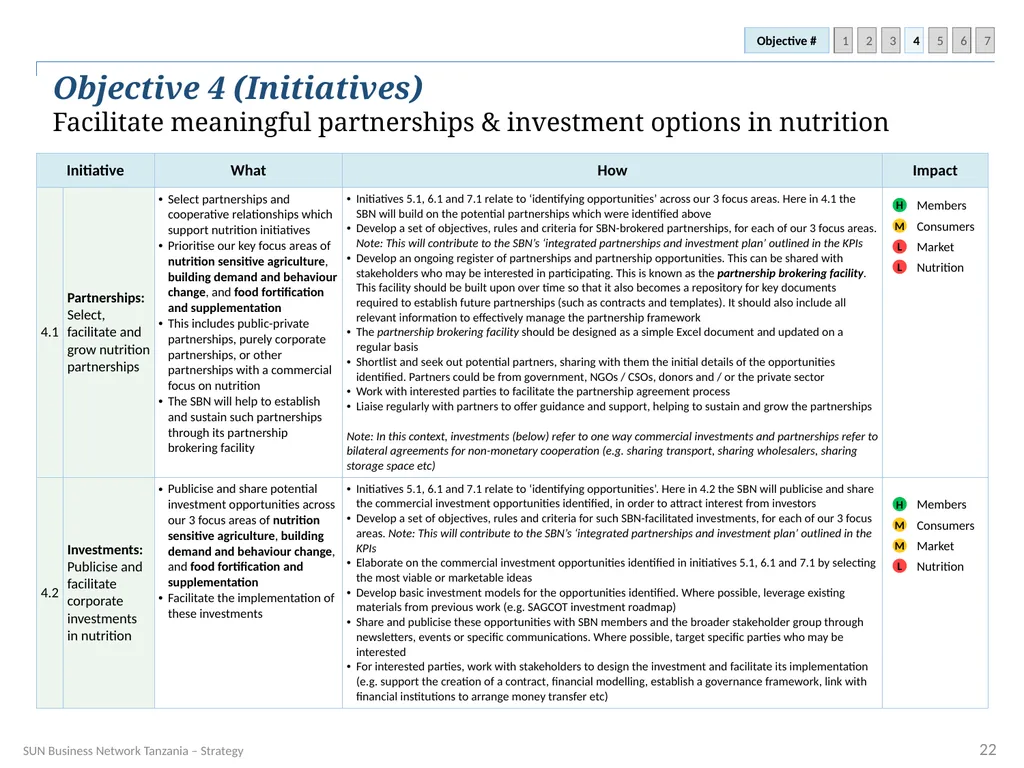
Objective 4 (Initiatives)
Facilitate meaningful partnerships & investment options in nutrition Members Consumers M Nutrition L Market L H Members Consumers M Nutrition L Market M H 1 2 3 4 5 6 Objective # 7<br>
Facilitate meaningful partnerships & investment options in nutrition Members Consumers M Nutrition L Market L H Members Consumers M Nutrition L Market M H 1 2 3 4 5 6 Objective # 7<br>
23
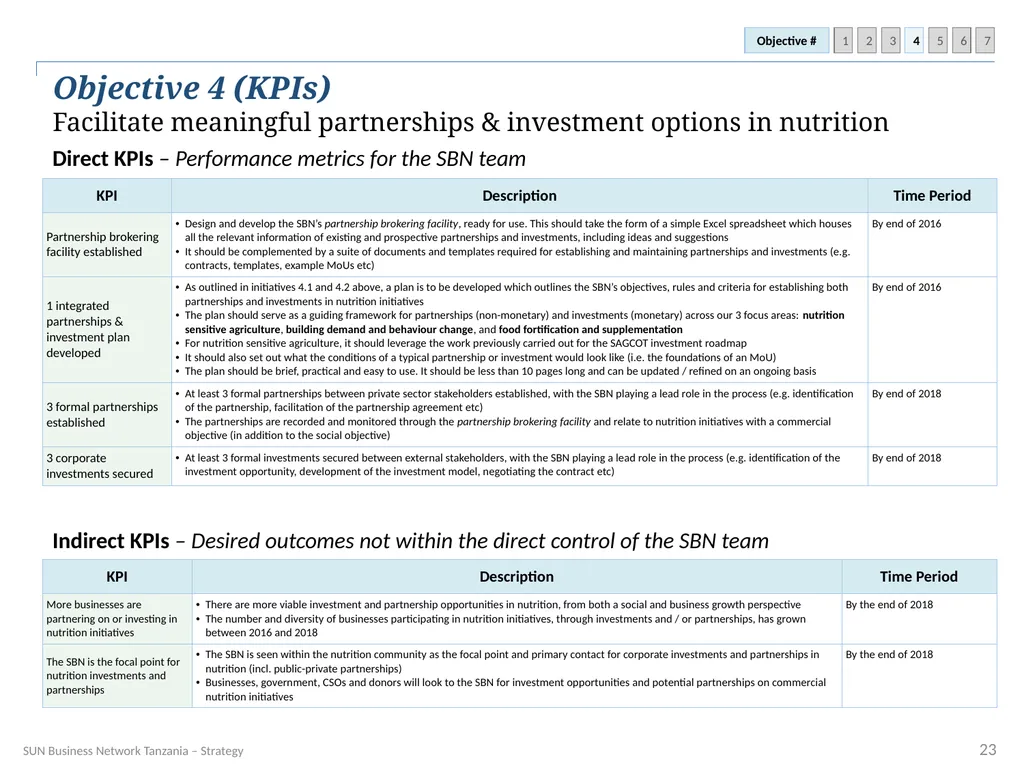
Objective 4 (KPIs)
Facilitate meaningful partnerships & investment options in nutrition Direct KPIs – Performance metrics for the SBN team Indirect KPIs – Desired outcomes not within the direct control of the SBN team 1 2 3 4 5 6 Objective # 7<br>
Facilitate meaningful partnerships & investment options in nutrition Direct KPIs – Performance metrics for the SBN team Indirect KPIs – Desired outcomes not within the direct control of the SBN team 1 2 3 4 5 6 Objective # 7<br>
24
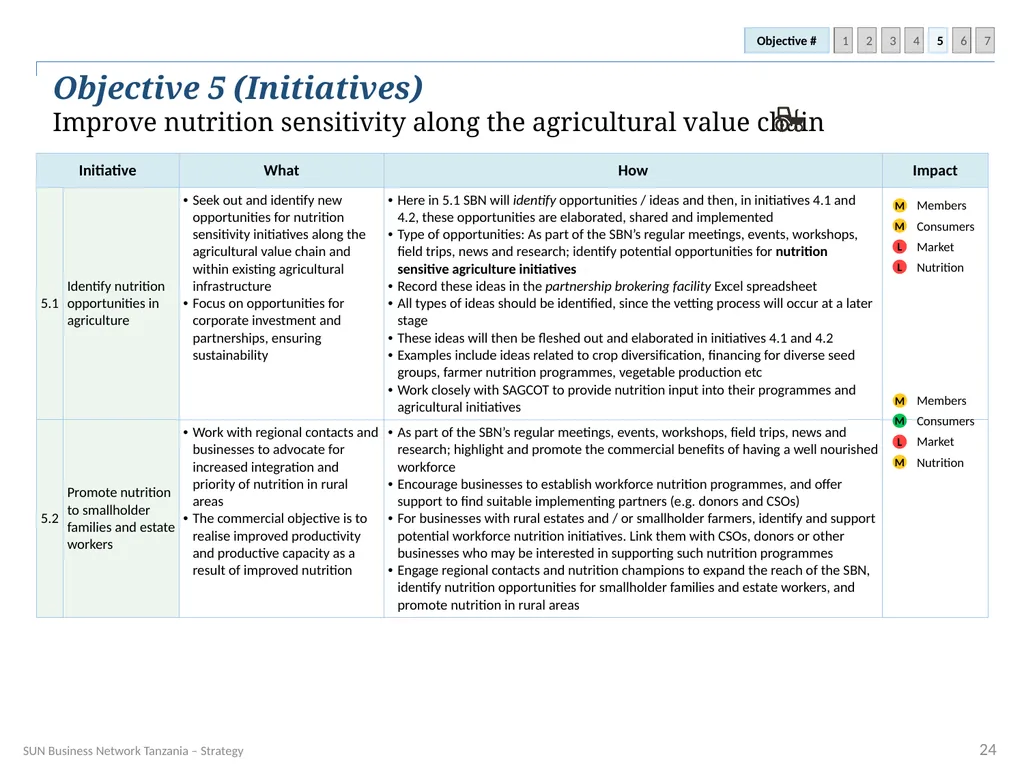
Objective 5 (Initiatives)
Improve nutrition sensitivity along the agricultural value chain Members M Consumers M Nutrition L Market L Members M Consumers M Nutrition M Market L 1 2 3 4 5 6 Objective # 7<br>
Improve nutrition sensitivity along the agricultural value chain Members M Consumers M Nutrition L Market L Members M Consumers M Nutrition M Market L 1 2 3 4 5 6 Objective # 7<br>
25
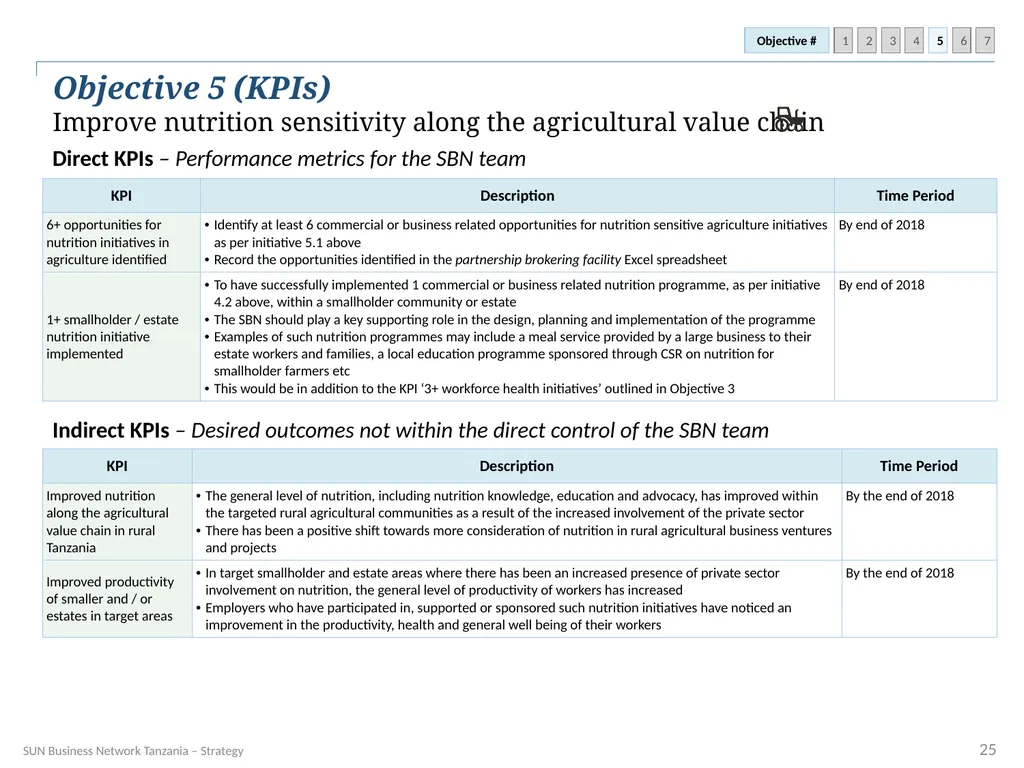
Objective 5 (KPIs)
Improve nutrition sensitivity along the agricultural value chain Direct KPIs – Performance metrics for the SBN team Indirect KPIs – Desired outcomes not within the direct control of the SBN team 1 2 3 4 5 6 Objective # 7<br>
Improve nutrition sensitivity along the agricultural value chain Direct KPIs – Performance metrics for the SBN team Indirect KPIs – Desired outcomes not within the direct control of the SBN team 1 2 3 4 5 6 Objective # 7<br>
26
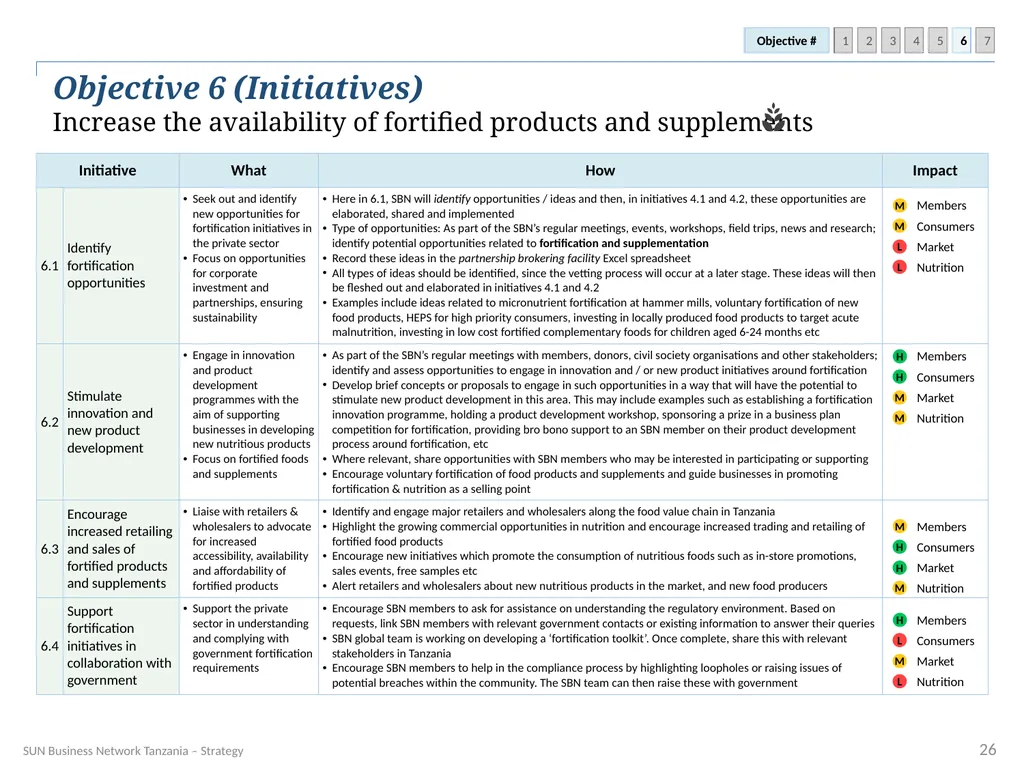
Objective 6 (Initiatives)
Increase the availability of fortified products and supplements Members M Consumers M Nutrition L Market L Members H Consumers H Nutrition M Market M Members M Consumers H Nutrition M Market H Members H Consumers L Nutrition L Market M 1 2 3 4 5 6 Objective # 7<br>
Increase the availability of fortified products and supplements Members M Consumers M Nutrition L Market L Members H Consumers H Nutrition M Market M Members M Consumers H Nutrition M Market H Members H Consumers L Nutrition L Market M 1 2 3 4 5 6 Objective # 7<br>
27
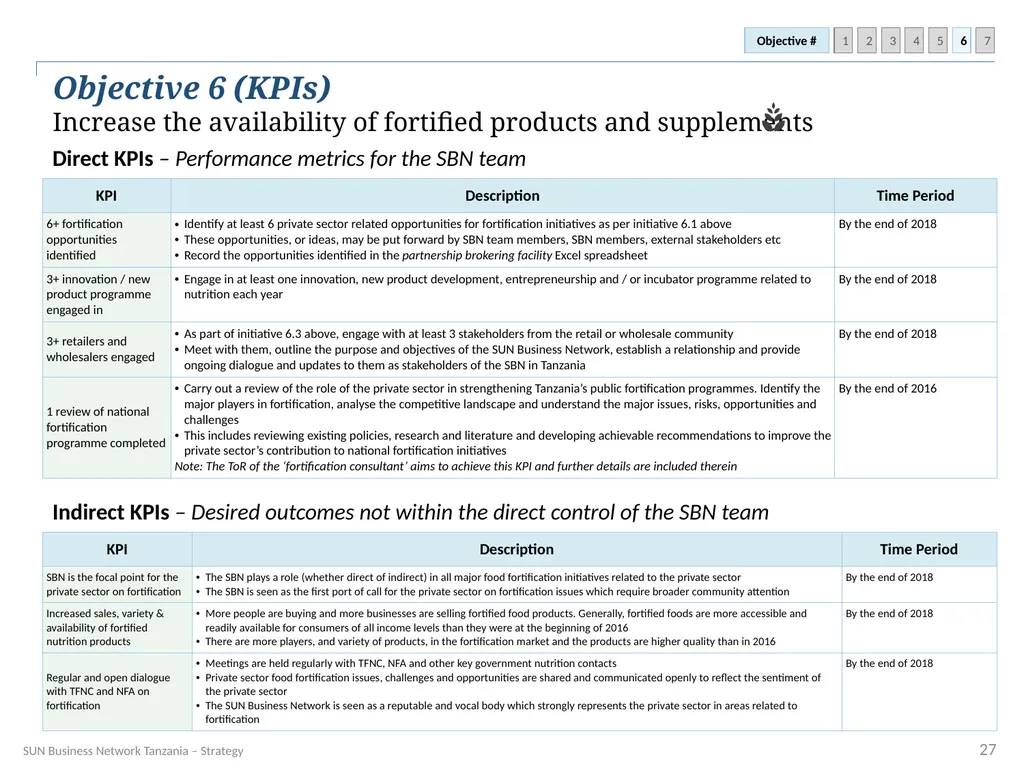
Objective 6 (KPIs)
Increase the availability of fortified products and supplements Direct KPIs – Performance metrics for the SBN team Indirect KPIs – Desired outcomes not within the direct control of the SBN team 1 2 3 4 5 6 Objective # 7<br>
Increase the availability of fortified products and supplements Direct KPIs – Performance metrics for the SBN team Indirect KPIs – Desired outcomes not within the direct control of the SBN team 1 2 3 4 5 6 Objective # 7<br>
28
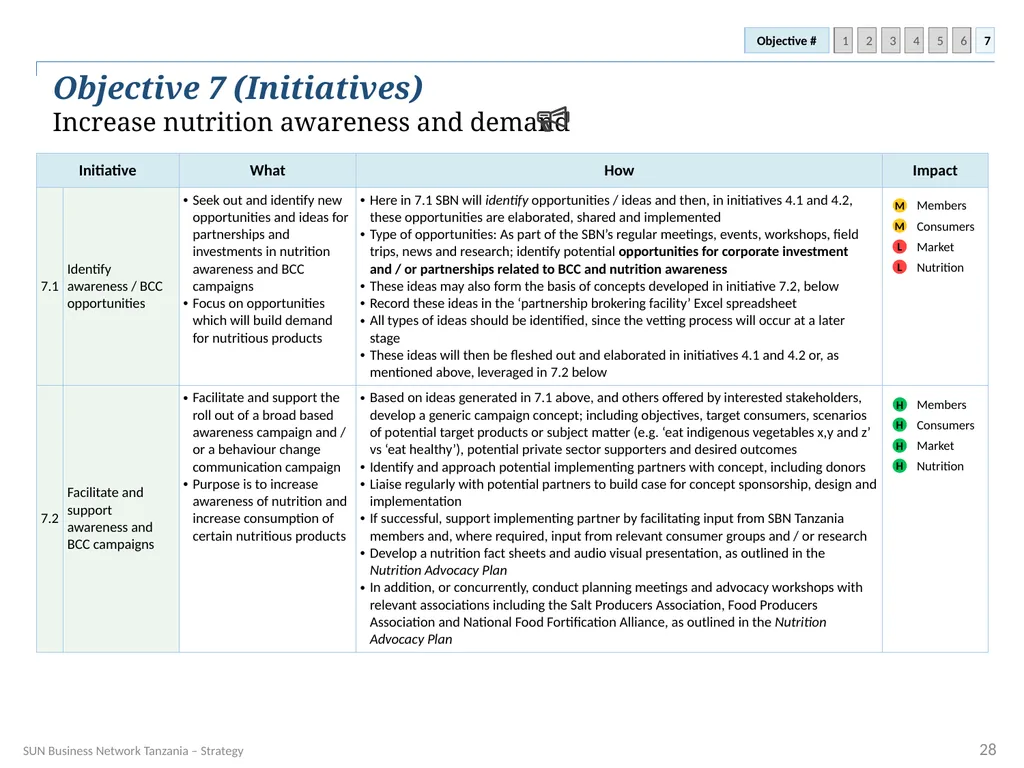
Objective 7 (Initiatives)
Increase nutrition awareness and demand Members M Consumers M Nutrition L Market L Members H Consumers H Nutrition H Market H 1 2 3 4 5 6 Objective # 7<br>
Increase nutrition awareness and demand Members M Consumers M Nutrition L Market L Members H Consumers H Nutrition H Market H 1 2 3 4 5 6 Objective # 7<br>
29
Objective 7 (KPIs)
Increase nutrition awareness and demand Direct KPIs – Performance metrics for the SBN team Indirect KPIs – Desired outcomes not within the direct control of the SBN team 1 2 3 4 5 6 Objective # 7<br>
Increase nutrition awareness and demand Direct KPIs – Performance metrics for the SBN team Indirect KPIs – Desired outcomes not within the direct control of the SBN team 1 2 3 4 5 6 Objective # 7<br>
30
Appendices<br>
31
A1 Timeline and current activities
What we’ve done so far, what’s coming up, and when they’ll get done<br>
What we’ve done so far, what’s coming up, and when they’ll get done<br>
32
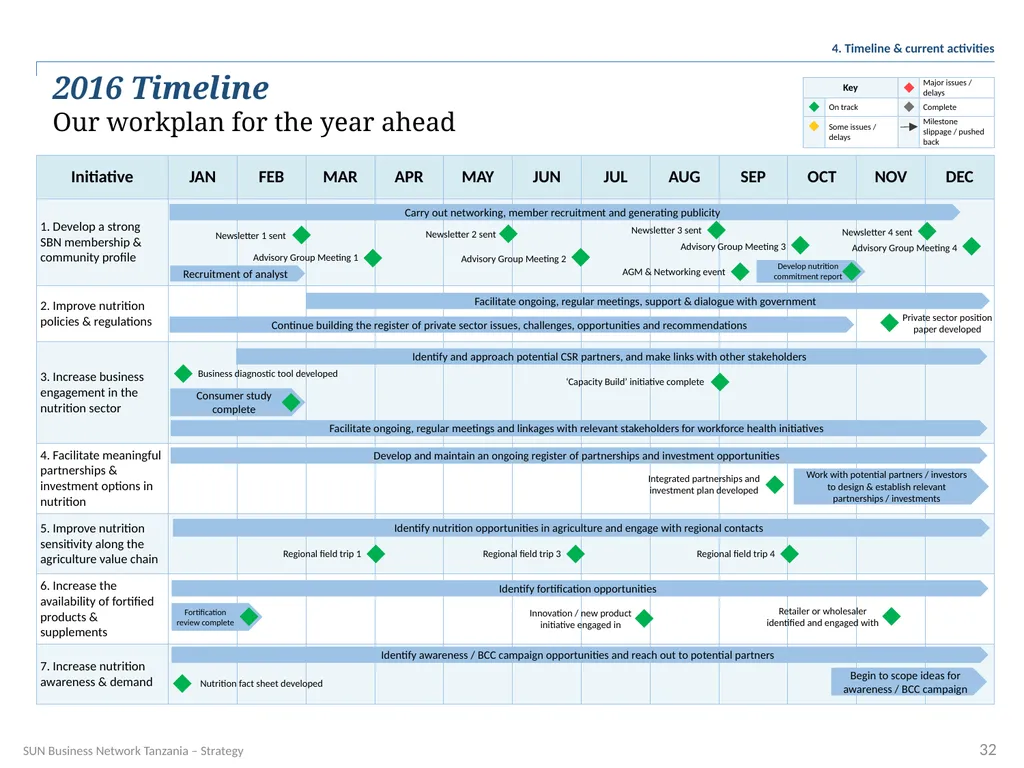
2016 Timeline
Our workplan for the year ahead Carry out networking, member recruitment and generating publicity Newsletter 1 sent Newsletter 2 sent Newsletter 3 sent Newsletter 4 sent Advisory Group Meeting 1 Facilitate ongoing, regular meetings, support & dialogue with government Identify and approach potential CSR partners, and make links with other stakeholders Recruitment of analyst 4. Timeline & current activities Advisory Group Meeting 2 Advisory Group Meeting 3 Advisory Group Meeting 4 Develop nutrition commitment report AGM & Networking event Continue building the register of private sector issues, challenges, opportunities and recommendations Private sector position paper developed Business diagnostic tool developed Consumer study complete ‘Capacity Build’ initiative complete Facilitate ongoing, regular meetings and linkages with relevant stakeholders for workforce health initiatives Develop and maintain an ongoing register of partnerships and investment opportunities Work with potential partners / investors to design & establish relevant partnerships / investments Integrated partnerships and investment plan developed Identify nutrition opportunities in agriculture and engage with regional contacts Identify fortification opportunities Identify awareness / BCC campaign opportunities and reach out to potential partners Regional field trip 1 Regional field trip 3 Regional field trip 4 Fortification review complete Innovation / new product initiative engaged in Retailer or wholesaler identified and engaged with Nutrition fact sheet developed Begin to scope ideas for awareness / BCC campaign<br>
Our workplan for the year ahead Carry out networking, member recruitment and generating publicity Newsletter 1 sent Newsletter 2 sent Newsletter 3 sent Newsletter 4 sent Advisory Group Meeting 1 Facilitate ongoing, regular meetings, support & dialogue with government Identify and approach potential CSR partners, and make links with other stakeholders Recruitment of analyst 4. Timeline & current activities Advisory Group Meeting 2 Advisory Group Meeting 3 Advisory Group Meeting 4 Develop nutrition commitment report AGM & Networking event Continue building the register of private sector issues, challenges, opportunities and recommendations Private sector position paper developed Business diagnostic tool developed Consumer study complete ‘Capacity Build’ initiative complete Facilitate ongoing, regular meetings and linkages with relevant stakeholders for workforce health initiatives Develop and maintain an ongoing register of partnerships and investment opportunities Work with potential partners / investors to design & establish relevant partnerships / investments Integrated partnerships and investment plan developed Identify nutrition opportunities in agriculture and engage with regional contacts Identify fortification opportunities Identify awareness / BCC campaign opportunities and reach out to potential partners Regional field trip 1 Regional field trip 3 Regional field trip 4 Fortification review complete Innovation / new product initiative engaged in Retailer or wholesaler identified and engaged with Nutrition fact sheet developed Begin to scope ideas for awareness / BCC campaign<br>
33
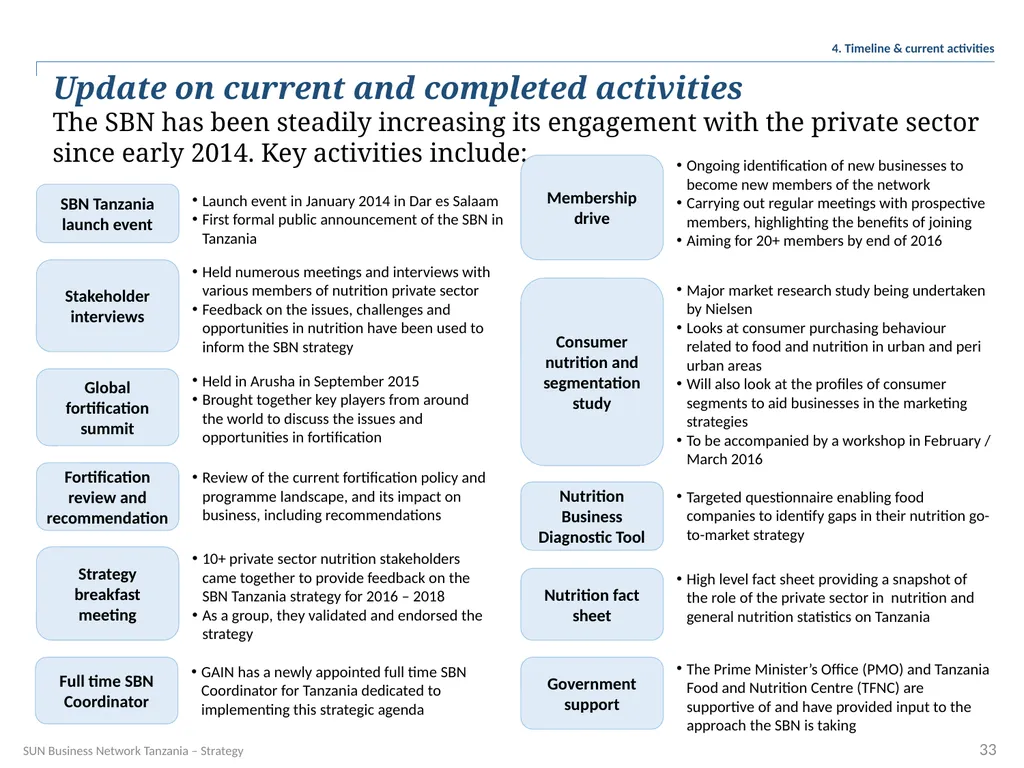
Update on current and completed activities
The SBN has been steadily increasing its engagement with the private sector since early 2014. Key activities include: Consumer nutrition and segmentation study Fortification review and recommendation Nutrition fact sheet Nutrition Business Diagnostic Tool Stakeholder interviews SBN Tanzania launch event Strategy breakfast meeting Global fortification summit Membership drive Launch event in January 2014 in Dar es Salaam
First formal public announcement of the SBN in Tanzania Ongoing identification of new businesses to become new members of the network
Carrying out regular meetings with prospective members, highlighting the benefits of joining
Aiming for 20+ members by end of 2016 Held numerous meetings and interviews with various members of nutrition private sector
Feedback on the issues, challenges and opportunities in nutrition have been used to inform the SBN strategy Review of the current fortification policy and programme landscape, and its impact on business, including recommendations 10+ private sector nutrition stakeholders came together to provide feedback on the SBN Tanzania strategy for 2016 – 2018
As a group, they validated and endorsed the strategy Held in Arusha in September 2015
Brought together key players from around the world to discuss the issues and opportunities in fortification Major market research study being undertaken by Nielsen
Looks at consumer purchasing behaviour related to food and nutrition in urban and peri urban areas
Will also look at the profiles of consumer segments to aid businesses in the marketing strategies
To be accompanied by a workshop in February / March 2016 Targeted questionnaire enabling food companies to identify gaps in their nutrition go-to-market strategy High level fact sheet providing a snapshot of the role of the private sector in nutrition and general nutrition statistics on Tanzania 4. Timeline & current activities Government support Full time SBN Coordinator GAIN has a newly appointed full time SBN Coordinator for Tanzania dedicated to implementing this strategic agenda The Prime Minister’s Office (PMO) and Tanzania Food and Nutrition Centre (TFNC) are supportive of and have provided input to the approach the SBN is taking<br>
The SBN has been steadily increasing its engagement with the private sector since early 2014. Key activities include: Consumer nutrition and segmentation study Fortification review and recommendation Nutrition fact sheet Nutrition Business Diagnostic Tool Stakeholder interviews SBN Tanzania launch event Strategy breakfast meeting Global fortification summit Membership drive Launch event in January 2014 in Dar es Salaam
First formal public announcement of the SBN in Tanzania Ongoing identification of new businesses to become new members of the network
Carrying out regular meetings with prospective members, highlighting the benefits of joining
Aiming for 20+ members by end of 2016 Held numerous meetings and interviews with various members of nutrition private sector
Feedback on the issues, challenges and opportunities in nutrition have been used to inform the SBN strategy Review of the current fortification policy and programme landscape, and its impact on business, including recommendations 10+ private sector nutrition stakeholders came together to provide feedback on the SBN Tanzania strategy for 2016 – 2018
As a group, they validated and endorsed the strategy Held in Arusha in September 2015
Brought together key players from around the world to discuss the issues and opportunities in fortification Major market research study being undertaken by Nielsen
Looks at consumer purchasing behaviour related to food and nutrition in urban and peri urban areas
Will also look at the profiles of consumer segments to aid businesses in the marketing strategies
To be accompanied by a workshop in February / March 2016 Targeted questionnaire enabling food companies to identify gaps in their nutrition go-to-market strategy High level fact sheet providing a snapshot of the role of the private sector in nutrition and general nutrition statistics on Tanzania 4. Timeline & current activities Government support Full time SBN Coordinator GAIN has a newly appointed full time SBN Coordinator for Tanzania dedicated to implementing this strategic agenda The Prime Minister’s Office (PMO) and Tanzania Food and Nutrition Centre (TFNC) are supportive of and have provided input to the approach the SBN is taking<br>
34
Research study overview
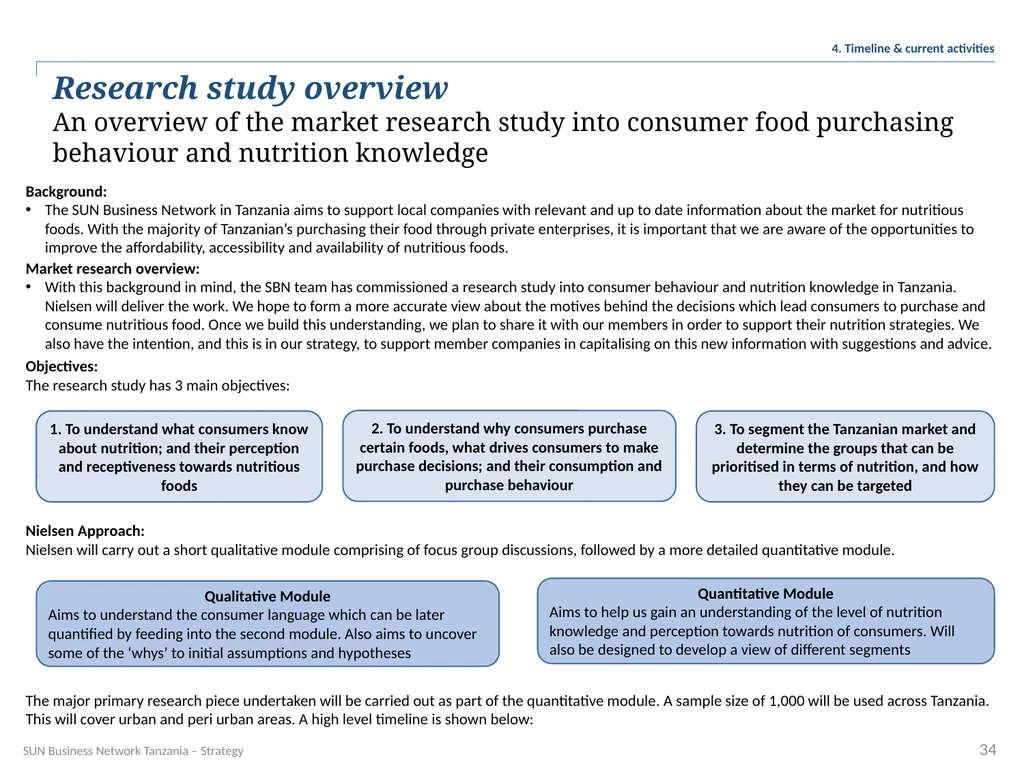
An overview of the market research study into consumer food purchasing behaviour and nutrition knowledge 4. Timeline & current activities Background:
The SUN Business Network in Tanzania aims to support local companies with relevant and up to date information about the market for nutritious foods. With the majority of Tanzanian’s purchasing their food through private enterprises, it is important that we are aware of the opportunities to improve the affordability, accessibility and availability of nutritious foods. Market research overview:
With this background in mind, the SBN team has commissioned a research study into consumer behaviour and nutrition knowledge in Tanzania. Nielsen will deliver the work. We hope to form a more accurate view about the motives behind the decisions which lead consumers to purchase and consume nutritious food. Once we build this understanding, we plan to share it with our members in order to support their nutrition strategies. We also have the intention, and this is in our strategy, to support member companies in capitalising on this new information with suggestions and advice. 1. To understand what consumers know about nutrition; and their perception and receptiveness towards nutritious foods Nielsen Approach:
Nielsen will carry out a short qualitative module comprising of focus group discussions, followed by a more detailed quantitative module. Qualitative Module
Aims to understand the consumer language which can be later quantified by feeding into the second module. Also aims to uncover some of the ‘whys’ to initial assumptions and hypotheses Quantitative Module
Aims to help us gain an understanding of the level of nutrition knowledge and perception towards nutrition of consumers. Will also be designed to develop a view of different segments The major primary research piece undertaken will be carried out as part of the quantitative module. A sample size of 1,000 will be used across Tanzania. This will cover urban and peri urban areas. A high level timeline is shown below: Objectives:
The research study has 3 main objectives: 2. To understand why consumers purchase certain foods, what drives consumers to make purchase decisions; and their consumption and purchase behaviour 3. To segment the Tanzanian market and determine the groups that can be prioritised in terms of nutrition, and how they can be targeted<br>
An overview of the market research study into consumer food purchasing behaviour and nutrition knowledge 4. Timeline & current activities Background:
The SUN Business Network in Tanzania aims to support local companies with relevant and up to date information about the market for nutritious foods. With the majority of Tanzanian’s purchasing their food through private enterprises, it is important that we are aware of the opportunities to improve the affordability, accessibility and availability of nutritious foods. Market research overview:
With this background in mind, the SBN team has commissioned a research study into consumer behaviour and nutrition knowledge in Tanzania. Nielsen will deliver the work. We hope to form a more accurate view about the motives behind the decisions which lead consumers to purchase and consume nutritious food. Once we build this understanding, we plan to share it with our members in order to support their nutrition strategies. We also have the intention, and this is in our strategy, to support member companies in capitalising on this new information with suggestions and advice. 1. To understand what consumers know about nutrition; and their perception and receptiveness towards nutritious foods Nielsen Approach:
Nielsen will carry out a short qualitative module comprising of focus group discussions, followed by a more detailed quantitative module. Qualitative Module
Aims to understand the consumer language which can be later quantified by feeding into the second module. Also aims to uncover some of the ‘whys’ to initial assumptions and hypotheses Quantitative Module
Aims to help us gain an understanding of the level of nutrition knowledge and perception towards nutrition of consumers. Will also be designed to develop a view of different segments The major primary research piece undertaken will be carried out as part of the quantitative module. A sample size of 1,000 will be used across Tanzania. This will cover urban and peri urban areas. A high level timeline is shown below: Objectives:
The research study has 3 main objectives: 2. To understand why consumers purchase certain foods, what drives consumers to make purchase decisions; and their consumption and purchase behaviour 3. To segment the Tanzanian market and determine the groups that can be prioritised in terms of nutrition, and how they can be targeted<br>
35
A2 The big picture
A look at the SBN in Tanzania beyond 2018<br>
A look at the SBN in Tanzania beyond 2018<br>
36
Regional integration
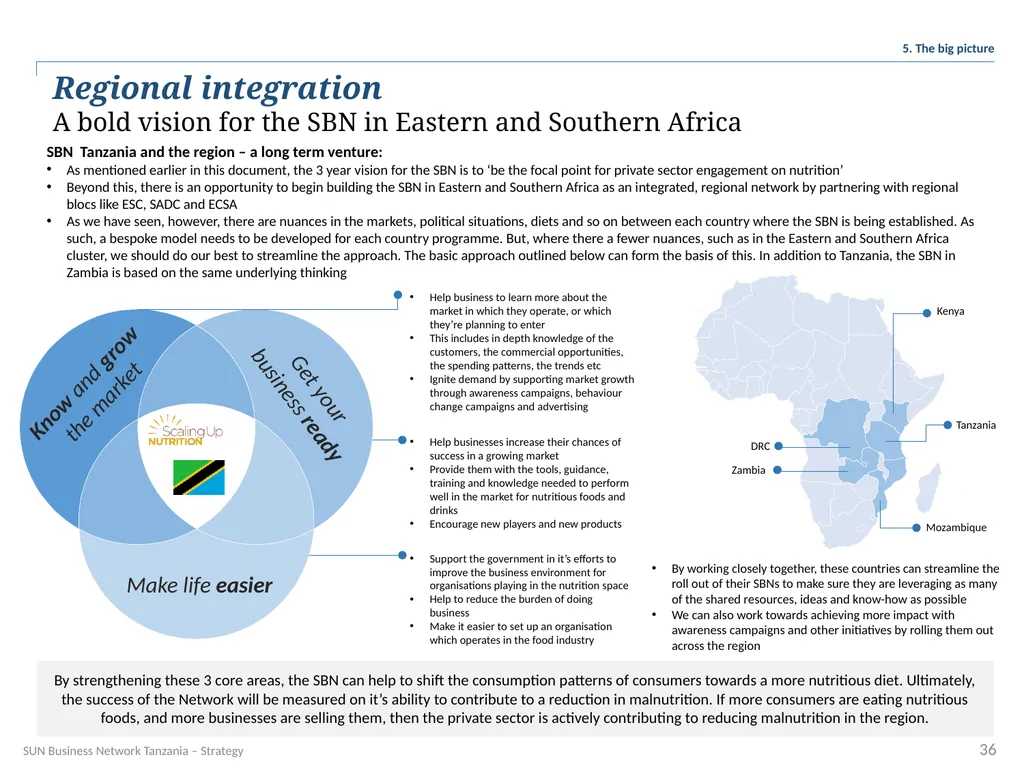
A bold vision for the SBN in Eastern and Southern Africa SBN Tanzania and the region – a long term venture:
As mentioned earlier in this document, the 3 year vision for the SBN is to ‘be the focal point for private sector engagement on nutrition’
Beyond this, there is an opportunity to begin building the SBN in Eastern and Southern Africa as an integrated, regional network by partnering with regional blocs like ESC, SADC and ECSA
As we have seen, however, there are nuances in the markets, political situations, diets and so on between each country where the SBN is being established. As such, a bespoke model needs to be developed for each country programme. But, where there a fewer nuances, such as in the Eastern and Southern Africa cluster, we should do our best to streamline the approach. The basic approach outlined below can form the basis of this. In addition to Tanzania, the SBN in Zambia is based on the same underlying thinking By strengthening these 3 core areas, the SBN can help to shift the consumption patterns of consumers towards a more nutritious diet. Ultimately, the success of the Network will be measured on it’s ability to contribute to a reduction in malnutrition. If more consumers are eating nutritious foods, and more businesses are selling them, then the private sector is actively contributing to reducing malnutrition in the region. Help business to learn more about the market in which they operate, or which they’re planning to enter
This includes in depth knowledge of the customers, the commercial opportunities, the spending patterns, the trends etc
Ignite demand by supporting market growth through awareness campaigns, behaviour change campaigns and advertising Help businesses increase their chances of success in a growing market
Provide them with the tools, guidance, training and knowledge needed to perform well in the market for nutritious foods and drinks
Encourage new players and new products Support the government in it’s efforts to improve the business environment for organisations playing in the nutrition space
Help to reduce the burden of doing business
Make it easier to set up an organisation which operates in the food industry 5. The big picture Kenya Tanzania Mozambique Zambia DRC By working closely together, these countries can streamline the roll out of their SBNs to make sure they are leveraging as many of the shared resources, ideas and know-how as possible
We can also work towards achieving more impact with awareness campaigns and other initiatives by rolling them out across the region<br>
A bold vision for the SBN in Eastern and Southern Africa SBN Tanzania and the region – a long term venture:
As mentioned earlier in this document, the 3 year vision for the SBN is to ‘be the focal point for private sector engagement on nutrition’
Beyond this, there is an opportunity to begin building the SBN in Eastern and Southern Africa as an integrated, regional network by partnering with regional blocs like ESC, SADC and ECSA
As we have seen, however, there are nuances in the markets, political situations, diets and so on between each country where the SBN is being established. As such, a bespoke model needs to be developed for each country programme. But, where there a fewer nuances, such as in the Eastern and Southern Africa cluster, we should do our best to streamline the approach. The basic approach outlined below can form the basis of this. In addition to Tanzania, the SBN in Zambia is based on the same underlying thinking By strengthening these 3 core areas, the SBN can help to shift the consumption patterns of consumers towards a more nutritious diet. Ultimately, the success of the Network will be measured on it’s ability to contribute to a reduction in malnutrition. If more consumers are eating nutritious foods, and more businesses are selling them, then the private sector is actively contributing to reducing malnutrition in the region. Help business to learn more about the market in which they operate, or which they’re planning to enter
This includes in depth knowledge of the customers, the commercial opportunities, the spending patterns, the trends etc
Ignite demand by supporting market growth through awareness campaigns, behaviour change campaigns and advertising Help businesses increase their chances of success in a growing market
Provide them with the tools, guidance, training and knowledge needed to perform well in the market for nutritious foods and drinks
Encourage new players and new products Support the government in it’s efforts to improve the business environment for organisations playing in the nutrition space
Help to reduce the burden of doing business
Make it easier to set up an organisation which operates in the food industry 5. The big picture Kenya Tanzania Mozambique Zambia DRC By working closely together, these countries can streamline the roll out of their SBNs to make sure they are leveraging as many of the shared resources, ideas and know-how as possible
We can also work towards achieving more impact with awareness campaigns and other initiatives by rolling them out across the region<br>
37
A3 Governance & resourcing
The people involved in making things happen<br>
The people involved in making things happen<br>
38
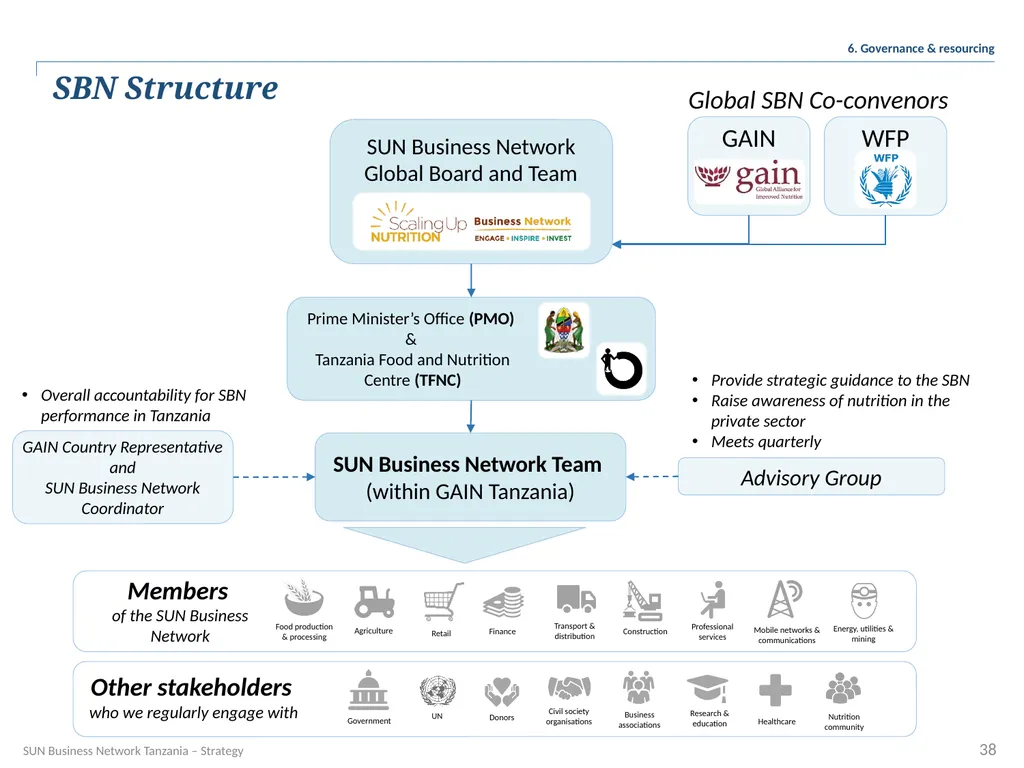
SBN Structure Advisory Group GAIN Country Representative and
SUN Business Network Coordinator SUN Business Network Team
(within GAIN Tanzania) WFP SUN Business Network Global Board and Team GAIN Prime Minister’s Office (PMO)
&
Tanzania Food and Nutrition Centre (TFNC) Global SBN Co-convenors Agriculture Food production & processing Finance Retail Transport & distribution Construction Energy, utilities & mining Mobile networks & communications Professional services Government Civil society organisations Business associations Healthcare Nutrition community Research & education UN Donors Provide strategic guidance to the SBN
Raise awareness of nutrition in the private sector
Meets quarterly Members
of the SUN Business Network Overall accountability for SBN performance in Tanzania Other stakeholders
who we regularly engage with 6. Governance & resourcing<br>
SUN Business Network Coordinator SUN Business Network Team
(within GAIN Tanzania) WFP SUN Business Network Global Board and Team GAIN Prime Minister’s Office (PMO)
&
Tanzania Food and Nutrition Centre (TFNC) Global SBN Co-convenors Agriculture Food production & processing Finance Retail Transport & distribution Construction Energy, utilities & mining Mobile networks & communications Professional services Government Civil society organisations Business associations Healthcare Nutrition community Research & education UN Donors Provide strategic guidance to the SBN
Raise awareness of nutrition in the private sector
Meets quarterly Members
of the SUN Business Network Overall accountability for SBN performance in Tanzania Other stakeholders
who we regularly engage with 6. Governance & resourcing<br>
39
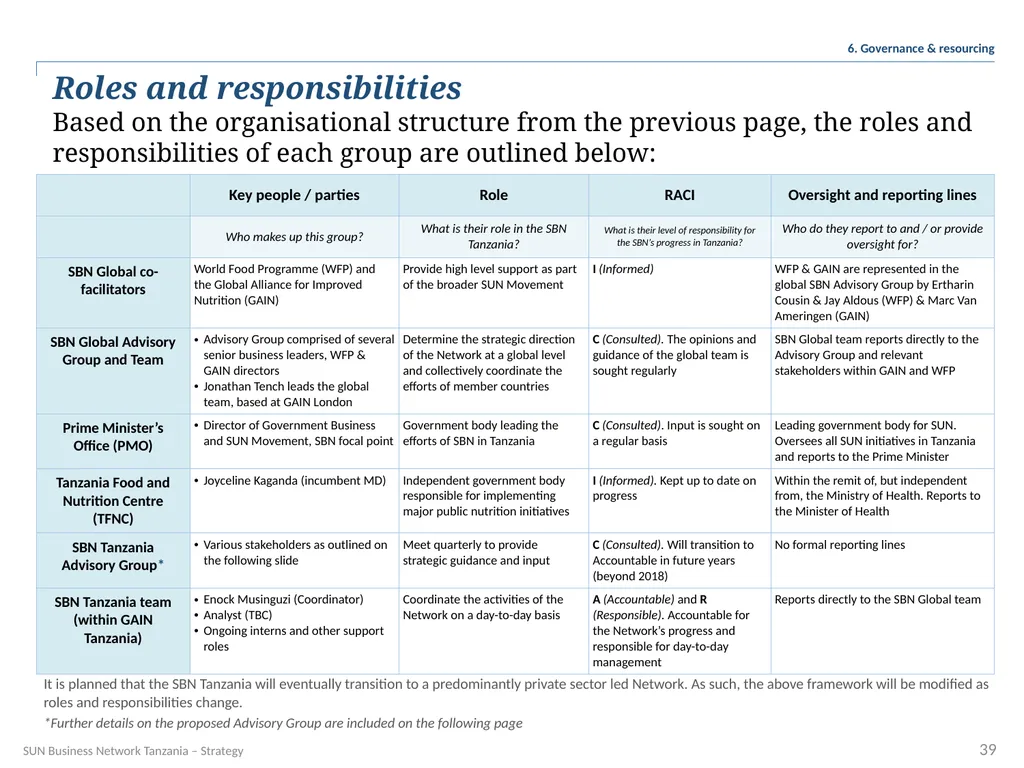
Roles and responsibilities
Based on the organisational structure from the previous page, the roles and responsibilities of each group are outlined below: It is planned that the SBN Tanzania will eventually transition to a predominantly private sector led Network. As such, the above framework will be modified as roles and responsibilities change.
*Further details on the proposed Advisory Group are included on the following page 6. Governance & resourcing<br>
Based on the organisational structure from the previous page, the roles and responsibilities of each group are outlined below: It is planned that the SBN Tanzania will eventually transition to a predominantly private sector led Network. As such, the above framework will be modified as roles and responsibilities change.
*Further details on the proposed Advisory Group are included on the following page 6. Governance & resourcing<br>
40
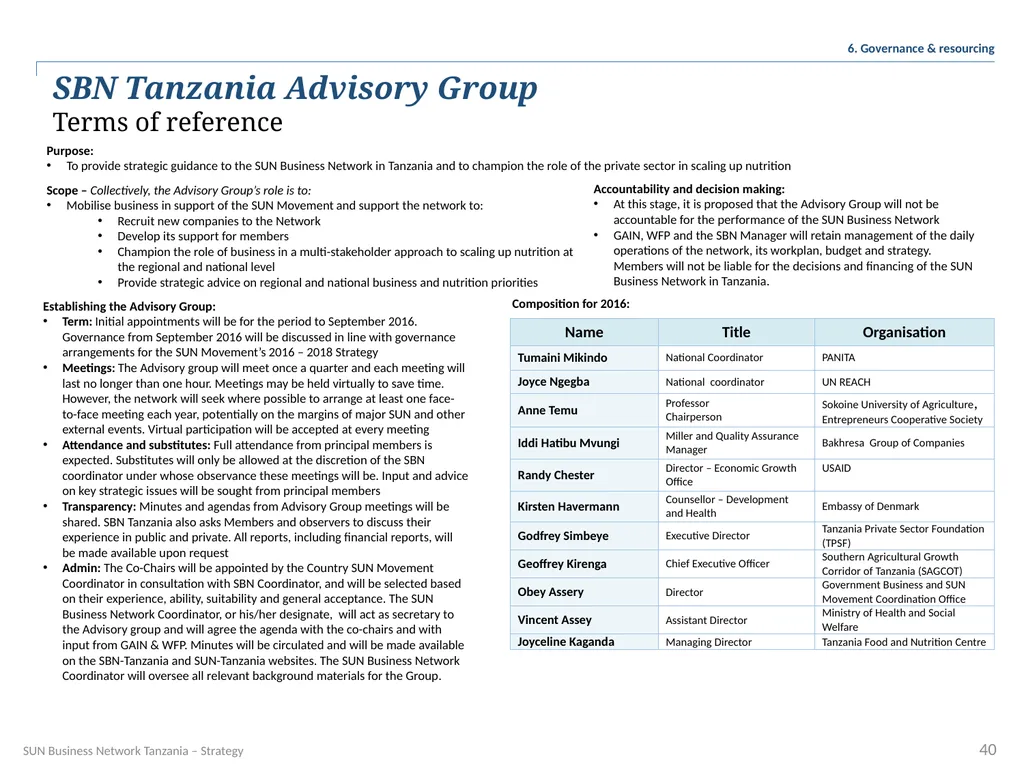
SBN Tanzania Advisory Group
Terms of reference Purpose:
To provide strategic guidance to the SUN Business Network in Tanzania and to champion the role of the private sector in scaling up nutrition Scope – Collectively, the Advisory Group’s role is to:
Mobilise business in support of the SUN Movement and support the network to:
Recruit new companies to the Network
Develop its support for members
Champion the role of business in a multi-stakeholder approach to scaling up nutrition at the regional and national level
Provide strategic advice on regional and national business and nutrition priorities Accountability and decision making:
At this stage, it is proposed that the Advisory Group will not be accountable for the performance of the SUN Business Network
GAIN, WFP and the SBN Manager will retain management of the daily operations of the network, its workplan, budget and strategy. Members will not be liable for the decisions and financing of the SUN Business Network in Tanzania. Establishing the Advisory Group:
Term: Initial appointments will be for the period to September 2016. Governance from September 2016 will be discussed in line with governance arrangements for the SUN Movement’s 2016 – 2018 Strategy
Meetings: The Advisory group will meet once a quarter and each meeting will last no longer than one hour. Meetings may be held virtually to save time. However, the network will seek where possible to arrange at least one face-to-face meeting each year, potentially on the margins of major SUN and other external events. Virtual participation will be accepted at every meeting
Attendance and substitutes: Full attendance from principal members is expected. Substitutes will only be allowed at the discretion of the SBN coordinator under whose observance these meetings will be. Input and advice on key strategic issues will be sought from principal members
Transparency: Minutes and agendas from Advisory Group meetings will be shared. SBN Tanzania also asks Members and observers to discuss their experience in public and private. All reports, including financial reports, will be made available upon request
Admin: The Co-Chairs will be appointed by the Country SUN Movement Coordinator in consultation with SBN Coordinator, and will be selected based on their experience, ability, suitability and general acceptance. The SUN Business Network Coordinator, or his/her designate, will act as secretary to the Advisory group and will agree the agenda with the co-chairs and with input from GAIN & WFP. Minutes will be circulated and will be made available on the SBN-Tanzania and SUN-Tanzania websites. The SUN Business Network Coordinator will oversee all relevant background materials for the Group. Composition for 2016: 6. Governance & resourcing<br>
Terms of reference Purpose:
To provide strategic guidance to the SUN Business Network in Tanzania and to champion the role of the private sector in scaling up nutrition Scope – Collectively, the Advisory Group’s role is to:
Mobilise business in support of the SUN Movement and support the network to:
Recruit new companies to the Network
Develop its support for members
Champion the role of business in a multi-stakeholder approach to scaling up nutrition at the regional and national level
Provide strategic advice on regional and national business and nutrition priorities Accountability and decision making:
At this stage, it is proposed that the Advisory Group will not be accountable for the performance of the SUN Business Network
GAIN, WFP and the SBN Manager will retain management of the daily operations of the network, its workplan, budget and strategy. Members will not be liable for the decisions and financing of the SUN Business Network in Tanzania. Establishing the Advisory Group:
Term: Initial appointments will be for the period to September 2016. Governance from September 2016 will be discussed in line with governance arrangements for the SUN Movement’s 2016 – 2018 Strategy
Meetings: The Advisory group will meet once a quarter and each meeting will last no longer than one hour. Meetings may be held virtually to save time. However, the network will seek where possible to arrange at least one face-to-face meeting each year, potentially on the margins of major SUN and other external events. Virtual participation will be accepted at every meeting
Attendance and substitutes: Full attendance from principal members is expected. Substitutes will only be allowed at the discretion of the SBN coordinator under whose observance these meetings will be. Input and advice on key strategic issues will be sought from principal members
Transparency: Minutes and agendas from Advisory Group meetings will be shared. SBN Tanzania also asks Members and observers to discuss their experience in public and private. All reports, including financial reports, will be made available upon request
Admin: The Co-Chairs will be appointed by the Country SUN Movement Coordinator in consultation with SBN Coordinator, and will be selected based on their experience, ability, suitability and general acceptance. The SUN Business Network Coordinator, or his/her designate, will act as secretary to the Advisory group and will agree the agenda with the co-chairs and with input from GAIN & WFP. Minutes will be circulated and will be made available on the SBN-Tanzania and SUN-Tanzania websites. The SUN Business Network Coordinator will oversee all relevant background materials for the Group. Composition for 2016: 6. Governance & resourcing<br>
41
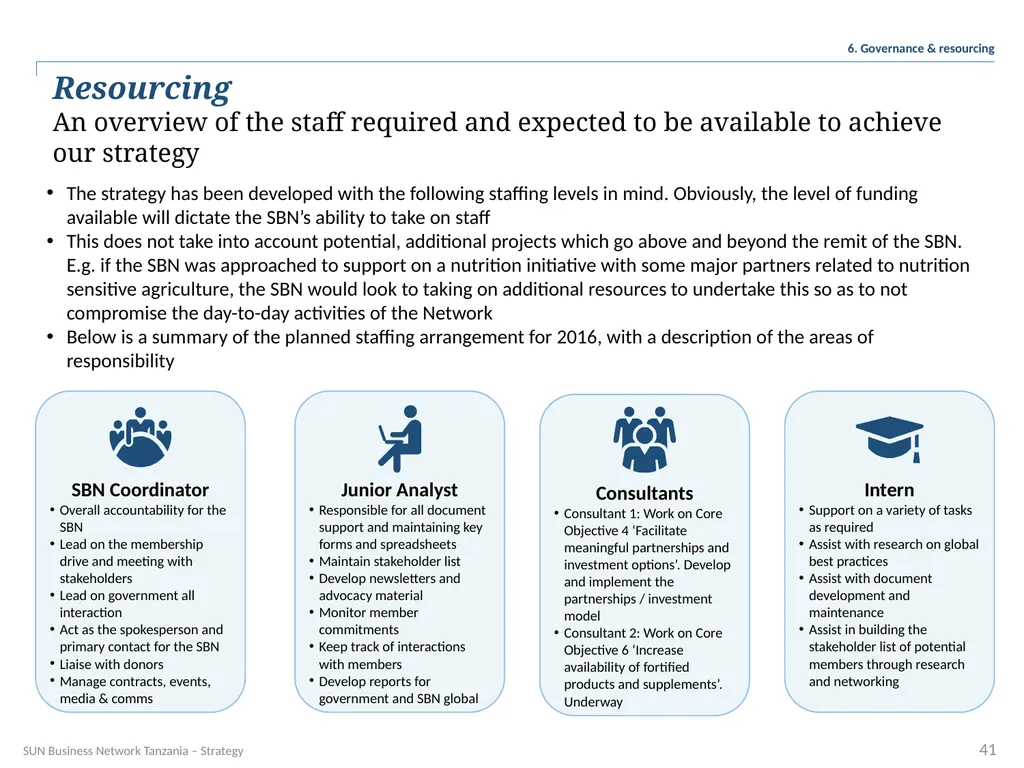
Resourcing
An overview of the staff required and expected to be available to achieve our strategy The strategy has been developed with the following staffing levels in mind. Obviously, the level of funding available will dictate the SBN’s ability to take on staff
This does not take into account potential, additional projects which go above and beyond the remit of the SBN. E.g. if the SBN was approached to support on a nutrition initiative with some major partners related to nutrition sensitive agriculture, the SBN would look to taking on additional resources to undertake this so as to not compromise the day-to-day activities of the Network
Below is a summary of the planned staffing arrangement for 2016, with a description of the areas of responsibility SBN Coordinator
Overall accountability for the SBN
Lead on the membership drive and meeting with stakeholders
Lead on government all interaction
Act as the spokesperson and primary contact for the SBN
Liaise with donors
Manage contracts, events, media & comms Junior Analyst
Responsible for all document support and maintaining key forms and spreadsheets
Maintain stakeholder list
Develop newsletters and advocacy material
Monitor member commitments
Keep track of interactions with members
Develop reports for government and SBN global Consultants
Consultant 1: Work on Core Objective 4 ‘Facilitate meaningful partnerships and investment options’. Develop and implement the partnerships / investment model
Consultant 2: Work on Core Objective 6 ‘Increase availability of fortified products and supplements’. Underway Intern
Support on a variety of tasks as required
Assist with research on global best practices
Assist with document development and maintenance
Assist in building the stakeholder list of potential members through research and networking 6. Governance & resourcing<br>
An overview of the staff required and expected to be available to achieve our strategy The strategy has been developed with the following staffing levels in mind. Obviously, the level of funding available will dictate the SBN’s ability to take on staff
This does not take into account potential, additional projects which go above and beyond the remit of the SBN. E.g. if the SBN was approached to support on a nutrition initiative with some major partners related to nutrition sensitive agriculture, the SBN would look to taking on additional resources to undertake this so as to not compromise the day-to-day activities of the Network
Below is a summary of the planned staffing arrangement for 2016, with a description of the areas of responsibility SBN Coordinator
Overall accountability for the SBN
Lead on the membership drive and meeting with stakeholders
Lead on government all interaction
Act as the spokesperson and primary contact for the SBN
Liaise with donors
Manage contracts, events, media & comms Junior Analyst
Responsible for all document support and maintaining key forms and spreadsheets
Maintain stakeholder list
Develop newsletters and advocacy material
Monitor member commitments
Keep track of interactions with members
Develop reports for government and SBN global Consultants
Consultant 1: Work on Core Objective 4 ‘Facilitate meaningful partnerships and investment options’. Develop and implement the partnerships / investment model
Consultant 2: Work on Core Objective 6 ‘Increase availability of fortified products and supplements’. Underway Intern
Support on a variety of tasks as required
Assist with research on global best practices
Assist with document development and maintenance
Assist in building the stakeholder list of potential members through research and networking 6. Governance & resourcing<br>
42
A4 Membership platform
The lifeblood of the SBN in Tanzania<br>
The lifeblood of the SBN in Tanzania<br>
43
Target members of the SUN Business Network
Overview of the membership framework As outlined in the ‘Strategy on a page’, a priority SBN initiative is to ‘recruit and retain members, tracking their commitments’
Below is an overview of the various groups the SBN aims to target for membership in Tanzania
The SBN aims to formally sign up 20+ members by the end of 2016 (building on the target of 10+ members by the end of 2015) Agriculture Food production & processing Finance Retail Transport & distribution Construction Energy, utilities & mining Mobile networks & comms Professional services Government Civil society organisations Business associations Healthcare Nutrition community Research & education United Nations Donors Private sector – To be targeted as members Non-Private sector – To be targeted as stakeholders only Others memberships factors: More detail available on the SBN membership form: Security 7. Membership platform<br>
Overview of the membership framework As outlined in the ‘Strategy on a page’, a priority SBN initiative is to ‘recruit and retain members, tracking their commitments’
Below is an overview of the various groups the SBN aims to target for membership in Tanzania
The SBN aims to formally sign up 20+ members by the end of 2016 (building on the target of 10+ members by the end of 2015) Agriculture Food production & processing Finance Retail Transport & distribution Construction Energy, utilities & mining Mobile networks & comms Professional services Government Civil society organisations Business associations Healthcare Nutrition community Research & education United Nations Donors Private sector – To be targeted as members Non-Private sector – To be targeted as stakeholders only Others memberships factors: More detail available on the SBN membership form: Security 7. Membership platform<br>
44
Being a member of the SBN Benefits of being a member of SBN Tanzania:
Network with other companies that have an interest in nutrition and expanding the nutrition market
Contribute to a collective voice & community for nutrition in Tanzania’s private sector, which does not currently exist
Provide input into government policy decisions and support recommendations for regulatory improvements
Receive updates on the food industry & relevant policy changes that may impact your business decisions
Enable your business to showcase its contributions to improving nutrition at a national and global level
Receive global exposure as a supporter of improved nutrition on the SBN website
Access a wide range of Corporate Social Responsibility (CSR) opportunities for your business to improve nutrition in the community
Explore partnership opportunities for private sector members to engage with each other, NGOs, professional associations and other interested organisations on nutrition
Receive practical advice, guidance and training, through workshops and events, to increase your company’s commercial engagement in nutrition
Participate in a national movement, including major events, aiming to grow the market and expand business involvement in nutrition Your organisation’s commitments to the SUN Business Network and it’s objectives. You commit to:
Supporting the SUN Business Network and being active in its Vision to be the focal point for private sector engagement on nutrition in Tanzania
The Principles of Engagement of the SUN Business Network (below)
Sharing general information about your organisation and its efforts to support nutrition
Marketing consumables in a way that strictly follows and adheres to the established national regulatory framework
Principles of Engagement of the SUN Business Network Tanzania:
Members should act in line with a commitment to uphold the equity and rights of all women, men and their children
Members should recognise the importance of moral and social action within a competitive nutrition market. Be advocates for the cause of improved nutrition in Tanzania
Members should support and respect the protection of internationally proclaimed human rights; and make sure that they are not complicit in human rights abuses
Members should comply with UN guidance on health and nutrition, with a specific mention of the International Code on Marketing of Breast Milk Substitutes and World Health Assembly resolutions related to Maternal, Infant and Young Child Nutrition
Members should work against corruption in all its forms, including extortion and bribery
Members should uphold the elimination of all forms of discrimination in respect of employment and occupation 7. Membership platform<br>
Network with other companies that have an interest in nutrition and expanding the nutrition market
Contribute to a collective voice & community for nutrition in Tanzania’s private sector, which does not currently exist
Provide input into government policy decisions and support recommendations for regulatory improvements
Receive updates on the food industry & relevant policy changes that may impact your business decisions
Enable your business to showcase its contributions to improving nutrition at a national and global level
Receive global exposure as a supporter of improved nutrition on the SBN website
Access a wide range of Corporate Social Responsibility (CSR) opportunities for your business to improve nutrition in the community
Explore partnership opportunities for private sector members to engage with each other, NGOs, professional associations and other interested organisations on nutrition
Receive practical advice, guidance and training, through workshops and events, to increase your company’s commercial engagement in nutrition
Participate in a national movement, including major events, aiming to grow the market and expand business involvement in nutrition Your organisation’s commitments to the SUN Business Network and it’s objectives. You commit to:
Supporting the SUN Business Network and being active in its Vision to be the focal point for private sector engagement on nutrition in Tanzania
The Principles of Engagement of the SUN Business Network (below)
Sharing general information about your organisation and its efforts to support nutrition
Marketing consumables in a way that strictly follows and adheres to the established national regulatory framework
Principles of Engagement of the SUN Business Network Tanzania:
Members should act in line with a commitment to uphold the equity and rights of all women, men and their children
Members should recognise the importance of moral and social action within a competitive nutrition market. Be advocates for the cause of improved nutrition in Tanzania
Members should support and respect the protection of internationally proclaimed human rights; and make sure that they are not complicit in human rights abuses
Members should comply with UN guidance on health and nutrition, with a specific mention of the International Code on Marketing of Breast Milk Substitutes and World Health Assembly resolutions related to Maternal, Infant and Young Child Nutrition
Members should work against corruption in all its forms, including extortion and bribery
Members should uphold the elimination of all forms of discrimination in respect of employment and occupation 7. Membership platform<br>
45
Frequently Asked Questions (FAQs)
FAQs and suggested answers to prepare for discussions with prospective members, donors and other stakeholders as the SBN builds its membership FAQs from prospective members: FAQs from donors and other stakeholders: 7. Membership platform<br>
FAQs and suggested answers to prepare for discussions with prospective members, donors and other stakeholders as the SBN builds its membership FAQs from prospective members: FAQs from donors and other stakeholders: 7. Membership platform<br>
46
Member recruitment
Our approach to recruiting more committed and active members to the SBN As outlined in Core Objective 1 (Develop a strong SBN membership and community profile), one of our key initiatives is to ‘Recruit and retain members’. The key points are revisited below
This page outlined the approach to member recruitment in slightly more detail, in order to assist the SBN team in building the membership base From section 3: ‘The Strategy Explained’ Member recruitment process: Identify potential members Build Network Sign up new members Support members and track commitments 1 2 3 Build the stakeholder list of existing companies in Tanzania
Determine the decision makers in the business and record their details 4 Make contact with and meet newly identified private sector people
Provide an overview of the network and highlight the benefits of joining up Work with new contacts to have them provide a nutrition commitment and sign the membership form
Add them to the membership list Check in regularly with members to offer support, updates and to understand progress made on their nutrition commitments 7. Membership platform<br>
Our approach to recruiting more committed and active members to the SBN As outlined in Core Objective 1 (Develop a strong SBN membership and community profile), one of our key initiatives is to ‘Recruit and retain members’. The key points are revisited below
This page outlined the approach to member recruitment in slightly more detail, in order to assist the SBN team in building the membership base From section 3: ‘The Strategy Explained’ Member recruitment process: Identify potential members Build Network Sign up new members Support members and track commitments 1 2 3 Build the stakeholder list of existing companies in Tanzania
Determine the decision makers in the business and record their details 4 Make contact with and meet newly identified private sector people
Provide an overview of the network and highlight the benefits of joining up Work with new contacts to have them provide a nutrition commitment and sign the membership form
Add them to the membership list Check in regularly with members to offer support, updates and to understand progress made on their nutrition commitments 7. Membership platform<br>
47
A5 Budget & funding
How we’re going to pay for everything<br>
How we’re going to pay for everything<br>
48
Funding
Funding requirements and sourcing efforts Funding overview:
Funding for the 2016 – 2018 strategic period will be provided exclusively by donors
The SBN is currently funded through the SBN global team’s budget, which expires at the end of 2016
Where funding is discussed in this section, it refers to the cost of covering the day-to-day activities of the Network including staff, research, events and selected projects. A key SBN design principle, however, is that there are opportunities for partners to enter the fold to fund and implement projects with coordination support from the Network. An example of this is the proposed nutrition awareness / behaviour change campaign Expenses:
A more detailed budget is outlined on the following page, however the main costs for the SBN include: Resourcing (Staff), Meetings (incl. Advisory Group meetings, networking events and workshops), Research (incl. market research and field trips) and Media & Communications (incl. PR, newspaper advertisements etc) Funding requirements:
The budget on the following page outlines a funding need of $173,000 for 12 months. Note that this is based on initial estimates only and a detailed budget is yet to be developed
It is envisaged this funding would be used to cover the SBN’s activities for 2016 only and not beyond Current funding sourcing efforts:
The team is reaching out to major donors in Tanzania to present the 2016 – 2018 strategy and to discuss potential funding opportunities
There has not yet been a specific call for proposal. A generic proposal is being developed to assist in the development of a detailed proposal when this may be required Currently funded by:
SBN Global funding Future funding needs:
Annual staffing:
~$125 – 130k
Annual non-staffing: ~$145 – 150k Funding period: Expires end Dec 2016 Sourcing efforts:
Detailed proposal and budget to be developed 8. Budget & funding<br>
Funding requirements and sourcing efforts Funding overview:
Funding for the 2016 – 2018 strategic period will be provided exclusively by donors
The SBN is currently funded through the SBN global team’s budget, which expires at the end of 2016
Where funding is discussed in this section, it refers to the cost of covering the day-to-day activities of the Network including staff, research, events and selected projects. A key SBN design principle, however, is that there are opportunities for partners to enter the fold to fund and implement projects with coordination support from the Network. An example of this is the proposed nutrition awareness / behaviour change campaign Expenses:
A more detailed budget is outlined on the following page, however the main costs for the SBN include: Resourcing (Staff), Meetings (incl. Advisory Group meetings, networking events and workshops), Research (incl. market research and field trips) and Media & Communications (incl. PR, newspaper advertisements etc) Funding requirements:
The budget on the following page outlines a funding need of $173,000 for 12 months. Note that this is based on initial estimates only and a detailed budget is yet to be developed
It is envisaged this funding would be used to cover the SBN’s activities for 2016 only and not beyond Current funding sourcing efforts:
The team is reaching out to major donors in Tanzania to present the 2016 – 2018 strategy and to discuss potential funding opportunities
There has not yet been a specific call for proposal. A generic proposal is being developed to assist in the development of a detailed proposal when this may be required Currently funded by:
SBN Global funding Future funding needs:
Annual staffing:
~$125 – 130k
Annual non-staffing: ~$145 – 150k Funding period: Expires end Dec 2016 Sourcing efforts:
Detailed proposal and budget to be developed 8. Budget & funding<br>
49
Budget
Estimated budget for 2016 Below is the current funding request budget for the SBN for 2016. It should be noted that this budget is an initial estimate only and detailed financial planning will be undertaken as individual funding proposals are developed
There is $100,000 available to support SBN activities from the global budget for 2016. This expires 31st December 2016. This should be factored into any request for funding. 8. Budget & funding<br>
Estimated budget for 2016 Below is the current funding request budget for the SBN for 2016. It should be noted that this budget is an initial estimate only and detailed financial planning will be undertaken as individual funding proposals are developed
There is $100,000 available to support SBN activities from the global budget for 2016. This expires 31st December 2016. This should be factored into any request for funding. 8. Budget & funding<br>
50
A6 Alignment & contribution to national nutrition goals
We’ve made sure our strategy aligns with and contributes to the broader national nutrition agenda in Tanzania<br>
We’ve made sure our strategy aligns with and contributes to the broader national nutrition agenda in Tanzania<br>
51
Tanzania National Nutrition Strategy (NNS)
The SBN Strategy has been designed to ensure that it aligns with and contributes to Tanzania’s national nutrition goals, spearheaded by the NNS 1. Develop a strong SBN membership & community profile 5. Improve nutrition sensitivity along the agricultural value chain 2. Improve nutrition policies & regulations Core objectives of the SBN: 3. Increase business engagement in the nutrition sector 4. Facilitate meaningful partnerships & investment options in nutrition 6. Increase the availability of fortified products & supplements 7. Increase nutrition awareness & demand *Refers to National Nutrition Strategy July 2011/12 – June 2015/16 These are the 7 core objectives of the SBN strategy outlined in previous sections SO 4.1: All govt development policies adequately incorporate nutrition as a priority area of achieving economic growth, stability & prosperity
SO 6.1: Establish & maintain nutrition high on the development agenda
SO 7.1: Develop framework/plans for M&E and research for nutrition SO 1.1: Increase access to nutrition services at the community & facility level
SO 2.1: Enhance the nutrition behaviours of women, community members etc SO 3.1: Strengthen implementation, monitoring & enforcement of legislation
SO 5.1: Build strategic and operational capacity for nutrition
SO 8.1: Enhance coherence & synergy in the delivery of nutrition interventions through coordination at all levels Contribution to the National Nutrition Strategy SO 1.1: Increase access to nutrition services at the community & facility level
SO 2.1: Enhance the nutrition behaviours of women, community members etc
SO 7.3: Strengthen the evidence base for nutrition policy and programming SO 1.1: Increase access to nutrition services at the community & facility level
SO 8.2: Strengthen partnerships for nutrition SO 5.1: Build strategic and operational capacity for nutrition SO 1.1: Increase access to nutrition services at the community & facility level
SO 2.1: Enhance the nutrition behaviours of women, community members etc These are the initiatives, from the National Nutrition Strategy*, which are directly contributed to by the corresponding SBN core objective. SO = Strategic Objective The advocacy agenda of the SBN will help to make noise around nutrition, elevating it’s priority on the national agenda
Monitoring business nutrition commitments can help to measure nutrition impact and success Targeting agricultural communities, particularly smallholder families and estate workers, will help to improve nutrition behaviour in the community SBN aims to support the government in making sure policies and regulations are creating an enabling business environment
Interaction with govt. will help to streamline nutrition initiatives since the SBN will represent the entire business community on nutrition Advocacy and marketing will improve nutrition behaviours (part of 1.1)
Targeting decision makers in the family home with new, nutritious food products will help the whole family
SBN is carrying out ongoing research to strengthen the evidence base Partnerships and investments aim to link together disparate sectors (part of 1.1)
The partnerships initiative will drive non-monetary cooperation with public initiatives, CSOs, donors and other businesses The fortification workstream helps to support companies in complying with the national fortification guidelines and directives
It does not include initiatives related to innovative fortification ideas, distribution, marketing or sales The focus of this SBN objective is on building awareness around nutrition and changing consumer behaviour in order to lift demand. This contributes directly to national initiatives which aim to improve nutrition behaviours Overview of the contribution Short description / rationale of how SBN’s core objectives aligns with and contributes to the relevant National Nutrition Strategy initiative 9. Alignment & contribution to national nutrition goals<br>
The SBN Strategy has been designed to ensure that it aligns with and contributes to Tanzania’s national nutrition goals, spearheaded by the NNS 1. Develop a strong SBN membership & community profile 5. Improve nutrition sensitivity along the agricultural value chain 2. Improve nutrition policies & regulations Core objectives of the SBN: 3. Increase business engagement in the nutrition sector 4. Facilitate meaningful partnerships & investment options in nutrition 6. Increase the availability of fortified products & supplements 7. Increase nutrition awareness & demand *Refers to National Nutrition Strategy July 2011/12 – June 2015/16 These are the 7 core objectives of the SBN strategy outlined in previous sections SO 4.1: All govt development policies adequately incorporate nutrition as a priority area of achieving economic growth, stability & prosperity
SO 6.1: Establish & maintain nutrition high on the development agenda
SO 7.1: Develop framework/plans for M&E and research for nutrition SO 1.1: Increase access to nutrition services at the community & facility level
SO 2.1: Enhance the nutrition behaviours of women, community members etc SO 3.1: Strengthen implementation, monitoring & enforcement of legislation
SO 5.1: Build strategic and operational capacity for nutrition
SO 8.1: Enhance coherence & synergy in the delivery of nutrition interventions through coordination at all levels Contribution to the National Nutrition Strategy SO 1.1: Increase access to nutrition services at the community & facility level
SO 2.1: Enhance the nutrition behaviours of women, community members etc
SO 7.3: Strengthen the evidence base for nutrition policy and programming SO 1.1: Increase access to nutrition services at the community & facility level
SO 8.2: Strengthen partnerships for nutrition SO 5.1: Build strategic and operational capacity for nutrition SO 1.1: Increase access to nutrition services at the community & facility level
SO 2.1: Enhance the nutrition behaviours of women, community members etc These are the initiatives, from the National Nutrition Strategy*, which are directly contributed to by the corresponding SBN core objective. SO = Strategic Objective The advocacy agenda of the SBN will help to make noise around nutrition, elevating it’s priority on the national agenda
Monitoring business nutrition commitments can help to measure nutrition impact and success Targeting agricultural communities, particularly smallholder families and estate workers, will help to improve nutrition behaviour in the community SBN aims to support the government in making sure policies and regulations are creating an enabling business environment
Interaction with govt. will help to streamline nutrition initiatives since the SBN will represent the entire business community on nutrition Advocacy and marketing will improve nutrition behaviours (part of 1.1)
Targeting decision makers in the family home with new, nutritious food products will help the whole family
SBN is carrying out ongoing research to strengthen the evidence base Partnerships and investments aim to link together disparate sectors (part of 1.1)
The partnerships initiative will drive non-monetary cooperation with public initiatives, CSOs, donors and other businesses The fortification workstream helps to support companies in complying with the national fortification guidelines and directives
It does not include initiatives related to innovative fortification ideas, distribution, marketing or sales The focus of this SBN objective is on building awareness around nutrition and changing consumer behaviour in order to lift demand. This contributes directly to national initiatives which aim to improve nutrition behaviours Overview of the contribution Short description / rationale of how SBN’s core objectives aligns with and contributes to the relevant National Nutrition Strategy initiative 9. Alignment & contribution to national nutrition goals<br>
52
Nutrition Advocacy Plan (NAP)
The NAP is a key national document which lays out the foundation for a comprehensive social and behavioural change approach to nutrition Document due diligence
The following documents have been cross checked and reconciled with this strategy. As it stands, this strategy brings together all previous planning documents related to the SBN in Tanzania. Develop inventory of private sector partners involved in food production and processing Conduct planning meetings with associations including SPA, FPA and NFFA Conduct planning meetings with potential private sector champions Conduct advocacy workshops on salt iodisation, food fortification and locally-produced food products Conduct capacity building workshops with private sector companies (small-scale processors) on food safety and quality Conduct follow up one-on-one meetings with private sector champions including food industry and other private sector companies Work with government of Tanzania to increase consumer awareness and demand of nutrient-dense, protein rich food Leveraging private sector investment in agriculture to improve nutrition in Tanzania – SAGCOT & SBN investment roadmap SBN Proposal Tanzania – September 2015 Tanzania Nutrition Advocacy Plan – October 2014 SBN Tanzania PPT for Nutrition Development Partners Working together for the future of Tanzania: A call to action on nutrition for the private sector – Fact Sheet for Private Sector National Nutrition Strategy July 2011/12 – June 2015/16 Foods, Markets and Nutrition: Maximizing the Impacts of Private Sector Engagement in Tanzania – IDS Study Concept note for the Second Tanzania Joint Multi-Sectoral Nutrition Review SUN Business Network Guide to Business Engagement Global Nutrition Report 2014 SUN Business Network Tanzania Launch Event – Summary report, from January 2014 Member information pack and draft strategy on a page – August 2015 Cost of food production
Limited awareness of consumers regarding the importance of buying higher quality food products and what that means
Poor infrastructure within many companies (i.e. limited electricity etc)
Inadequate skills on how to increase profits while making higher quality products
Limited interaction between private and public sector Barriers: The NAP identifies 5 major barriers to the private sector increasing its engagement in nutrition Outlined below are the 7 key activities proposed by the NAP to overcome these barriers. The SBN’s planned contributions to these activities are shown on the right, highlighting the core objective (CO) that aligns to the corresponding NAP activity: CO 2 and CO 7: Regular meetings will occur with government throughout the life of the SBN, including consulting relevant stakeholders in govt before a major BCC campaign CO 1: The membership drive involves building a large business list and meeting with them CO 7: Engaging these stakeholders will occur as part of the goal to roll out a BCC campaign CO 1: The membership drive involves building a large business list and meeting with them CO 7: Engaging these stakeholders will occur as part of the goal to roll out a BCC campaign CO 3: ‘Support food and nutrition companies with guidance, tools and information’ relates to improving their capacity and helping them to succeed in the nutrition market CO 1: The membership drive involves building a large business list and meeting with them, as well as additional networking events and Advisory Group meetings 9. Alignment & contribution to national nutrition goals<br>
The NAP is a key national document which lays out the foundation for a comprehensive social and behavioural change approach to nutrition Document due diligence
The following documents have been cross checked and reconciled with this strategy. As it stands, this strategy brings together all previous planning documents related to the SBN in Tanzania. Develop inventory of private sector partners involved in food production and processing Conduct planning meetings with associations including SPA, FPA and NFFA Conduct planning meetings with potential private sector champions Conduct advocacy workshops on salt iodisation, food fortification and locally-produced food products Conduct capacity building workshops with private sector companies (small-scale processors) on food safety and quality Conduct follow up one-on-one meetings with private sector champions including food industry and other private sector companies Work with government of Tanzania to increase consumer awareness and demand of nutrient-dense, protein rich food Leveraging private sector investment in agriculture to improve nutrition in Tanzania – SAGCOT & SBN investment roadmap SBN Proposal Tanzania – September 2015 Tanzania Nutrition Advocacy Plan – October 2014 SBN Tanzania PPT for Nutrition Development Partners Working together for the future of Tanzania: A call to action on nutrition for the private sector – Fact Sheet for Private Sector National Nutrition Strategy July 2011/12 – June 2015/16 Foods, Markets and Nutrition: Maximizing the Impacts of Private Sector Engagement in Tanzania – IDS Study Concept note for the Second Tanzania Joint Multi-Sectoral Nutrition Review SUN Business Network Guide to Business Engagement Global Nutrition Report 2014 SUN Business Network Tanzania Launch Event – Summary report, from January 2014 Member information pack and draft strategy on a page – August 2015 Cost of food production
Limited awareness of consumers regarding the importance of buying higher quality food products and what that means
Poor infrastructure within many companies (i.e. limited electricity etc)
Inadequate skills on how to increase profits while making higher quality products
Limited interaction between private and public sector Barriers: The NAP identifies 5 major barriers to the private sector increasing its engagement in nutrition Outlined below are the 7 key activities proposed by the NAP to overcome these barriers. The SBN’s planned contributions to these activities are shown on the right, highlighting the core objective (CO) that aligns to the corresponding NAP activity: CO 2 and CO 7: Regular meetings will occur with government throughout the life of the SBN, including consulting relevant stakeholders in govt before a major BCC campaign CO 1: The membership drive involves building a large business list and meeting with them CO 7: Engaging these stakeholders will occur as part of the goal to roll out a BCC campaign CO 1: The membership drive involves building a large business list and meeting with them CO 7: Engaging these stakeholders will occur as part of the goal to roll out a BCC campaign CO 3: ‘Support food and nutrition companies with guidance, tools and information’ relates to improving their capacity and helping them to succeed in the nutrition market CO 1: The membership drive involves building a large business list and meeting with them, as well as additional networking events and Advisory Group meetings 9. Alignment & contribution to national nutrition goals<br>
53
A7 The nutrition private sector
Where we fit into the broader nutrition private sector<br>
Where we fit into the broader nutrition private sector<br>
54
SWOT Analysis
Strengths, Weaknesses, Opportunities & Threats of the SBN venture in Tanzania INTERNAL Listed below are the key internal and external factors seen as important in the journey towards achieving our Vision and Objectives Good relationship with the Prime Minister’s Office and the SUN focal point
Strong momentum within nutrition circles, coming from the fortification summit and membership drive
GAIN has a strong reputation in the nutrition community
Good working relationship with existing members
Robust strategic foundation and long term plan Strengths Network of prospective SBN members and stakeholders is very small
No established relationship with retailers/distributors
Poor integration within national nutrition decision making groups & committees
Geographically sparse & decentralised private sector
Very long and slow road to impact realisation
Unproven formula. Based on research and analysis rather than sound market testing Weaknesses Members and prospective members may lose interest if we lose momentum
Our unproven model and the difficulty in measuring impact may limit future ability to raise funding
Existing nutrition development space is crowded and complex, making it difficult to streamline projects nationally Threats Nutrition is a topical issue at the moment with strong commercial and social appeal
The nutrition agenda has strong support from government and is a national priority
Key private sector stakeholders see the SBN as being able to their lives easier in nutrition / fortification
Tanzania is a big market with signification commercial growth opportunities in nutrition
Positive sentiment among donor and NGO groups about the need to engage the private sector on nutrition
Potential growth of network through partners (e.g. TPSF, SAGCOT etc) Opportunities EXTERNAL 10. The nutrition private sector<br>
Strengths, Weaknesses, Opportunities & Threats of the SBN venture in Tanzania INTERNAL Listed below are the key internal and external factors seen as important in the journey towards achieving our Vision and Objectives Good relationship with the Prime Minister’s Office and the SUN focal point
Strong momentum within nutrition circles, coming from the fortification summit and membership drive
GAIN has a strong reputation in the nutrition community
Good working relationship with existing members
Robust strategic foundation and long term plan Strengths Network of prospective SBN members and stakeholders is very small
No established relationship with retailers/distributors
Poor integration within national nutrition decision making groups & committees
Geographically sparse & decentralised private sector
Very long and slow road to impact realisation
Unproven formula. Based on research and analysis rather than sound market testing Weaknesses Members and prospective members may lose interest if we lose momentum
Our unproven model and the difficulty in measuring impact may limit future ability to raise funding
Existing nutrition development space is crowded and complex, making it difficult to streamline projects nationally Threats Nutrition is a topical issue at the moment with strong commercial and social appeal
The nutrition agenda has strong support from government and is a national priority
Key private sector stakeholders see the SBN as being able to their lives easier in nutrition / fortification
Tanzania is a big market with signification commercial growth opportunities in nutrition
Positive sentiment among donor and NGO groups about the need to engage the private sector on nutrition
Potential growth of network through partners (e.g. TPSF, SAGCOT etc) Opportunities EXTERNAL 10. The nutrition private sector<br>