
Support and Supervision Skills 2 Welcome Stephenie
MJ
Published · 89 slides · 0 views

1 / 1

Description
Support and Supervision Skills 2 Welcome Stephenie Linham Introductions In pairs -someone you dont work with Name and position Why you are here and your expectations Something we couldnt tell by looking at you Partner introduces you to
Related Topics
Share
Embed code
Download this presentation From Below
"Support and Supervision Skills 2 Welcome Stephenie" is the property of its rightful owner. Permission is granted to download and print the materials on this website for personal, non-commercial use only, and to display it on your personal computer provided you do not modify the materials and that you retain all copyright notices contained in the materials. By downloading content from our website, you accept the terms of this agreement.
Presentation Transcript
01
Support and Supervision Skills 2
Welcome Stephenie Linham<br>
02
Introductions In pairs -someone you don’t work with
Name and position
Why you are here and your
expectations
Something we couldn’t tell by looking at
you
Partner introduces you to the group<br>
Name and position
Why you are here and your
expectations
Something we couldn’t tell by looking at
you
Partner introduces you to the group<br>
03
Introductions Housekeeping
Ground rules?
Participate and share experiences
Time Keeping,
Confidentiality,
Anything else
Copy power point e - mailed at end of course<br>
Ground rules?
Participate and share experiences
Time Keeping,
Confidentiality,
Anything else
Copy power point e - mailed at end of course<br>
04
Programme Workbook. Page 2 course content.
This course assumes a basic knowledge
We will try to make you much more aware of
the importance and impact of your attitude
and style
That it is worth investing the time and effort
Components necessary for good support and
supervision
Various skills you will need<br>
This course assumes a basic knowledge
We will try to make you much more aware of
the importance and impact of your attitude
and style
That it is worth investing the time and effort
Components necessary for good support and
supervision
Various skills you will need<br>
05
Self assessment It is people that get results and are worth investing in
Understanding yourself is the first step to changing
and improving
It could be you that is holding your people back
Your management and communication style,
attitudes and behaviours have a huge impact on
others.
If you get it right people are challenged at the
appropriate level and supported to achieve – and feel
good<br>
Understanding yourself is the first step to changing
and improving
It could be you that is holding your people back
Your management and communication style,
attitudes and behaviours have a huge impact on
others.
If you get it right people are challenged at the
appropriate level and supported to achieve – and feel
good<br>
06
Good performance People who feel good about themselves
produce good results
People who produce good results feel good
about themselves
It’s your job to give them the clarity, management
style, feedback, motivation, effective delegation
and support and supervision they need to produce
good results for you –
and to make them feel good so they keep doing it.<br>
produce good results
People who produce good results feel good
about themselves
It’s your job to give them the clarity, management
style, feedback, motivation, effective delegation
and support and supervision they need to produce
good results for you –
and to make them feel good so they keep doing it.<br>
07
Managers as role models You are watched - you are the role model –
so model the behaviours you want.
Set the example.
Adhere to the good practice you preach
Turn up on time and keep appointments-
especially supervision
Have a good work/life balance. Remember
duty of care – working time directive – work
leisure balance<br>
so model the behaviours you want.
Set the example.
Adhere to the good practice you preach
Turn up on time and keep appointments-
especially supervision
Have a good work/life balance. Remember
duty of care – working time directive – work
leisure balance<br>
08
Managers as role models Really actively listen to people
Talk positively and demonstrate
enthusiasm – it is infectious
Stay calm and positive
Control body language – you are
always on parade!
Own up to your mistakes
Praise and acknowledge others
contributions and achievements<br>
Talk positively and demonstrate
enthusiasm – it is infectious
Stay calm and positive
Control body language – you are
always on parade!
Own up to your mistakes
Praise and acknowledge others
contributions and achievements<br>
09
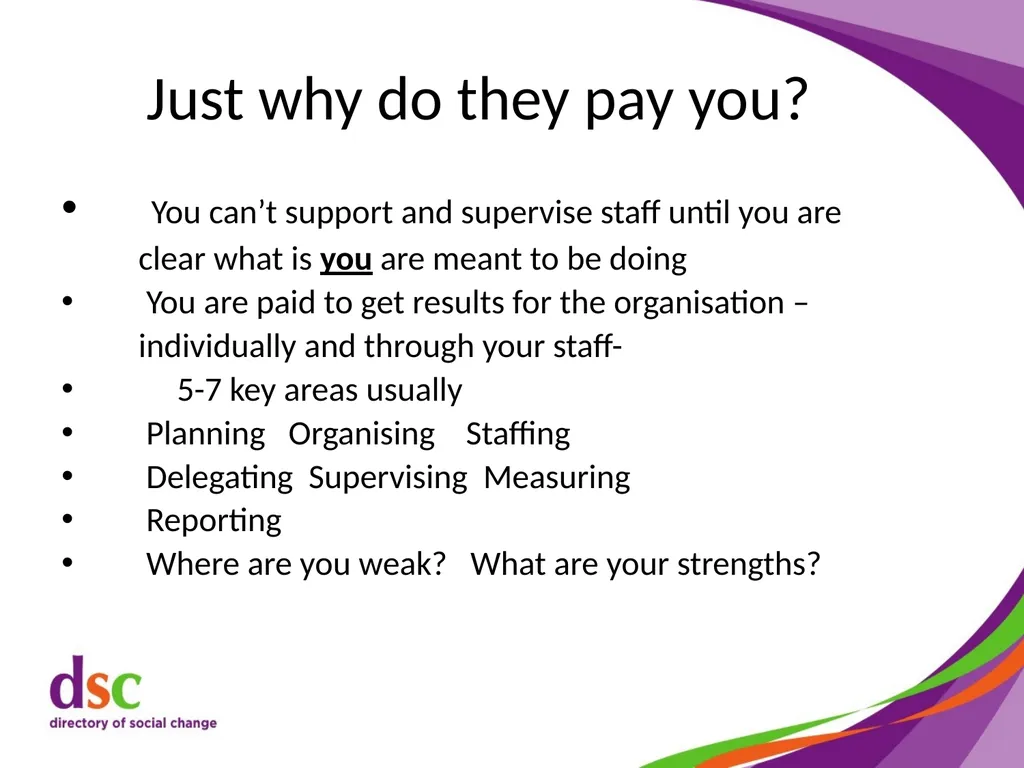
Just why do they pay you? You can’t support and supervise staff until you are
clear what is you are meant to be doing
You are paid to get results for the organisation –
individually and through your staff-
5-7 key areas usually
Planning Organising Staffing
Delegating Supervising Measuring
Reporting
Where are you weak? What are your strengths?<br>
clear what is you are meant to be doing
You are paid to get results for the organisation –
individually and through your staff-
5-7 key areas usually
Planning Organising Staffing
Delegating Supervising Measuring
Reporting
Where are you weak? What are your strengths?<br>
10
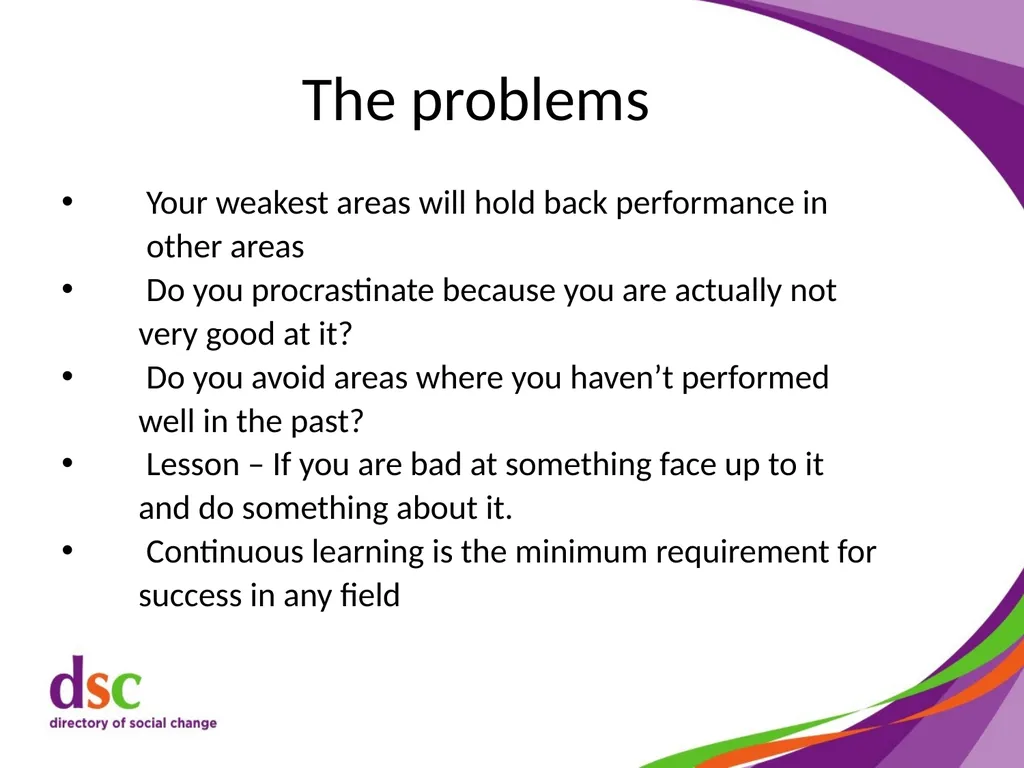
The problems Your weakest areas will hold back performance in
other areas
Do you procrastinate because you are actually not
very good at it?
Do you avoid areas where you haven’t performed
well in the past?
Lesson – If you are bad at something face up to it
and do something about it.
Continuous learning is the minimum requirement for
success in any field<br>
other areas
Do you procrastinate because you are actually not
very good at it?
Do you avoid areas where you haven’t performed
well in the past?
Lesson – If you are bad at something face up to it
and do something about it.
Continuous learning is the minimum requirement for
success in any field<br>
11
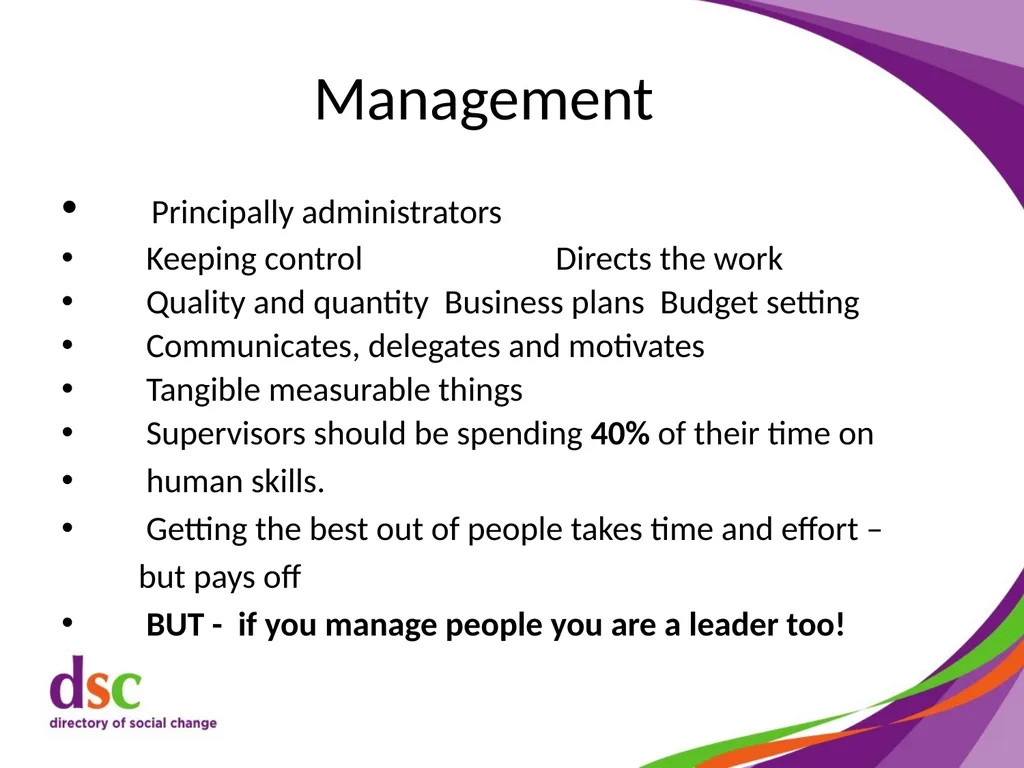
Management Principally administrators
Keeping control Directs the work
Quality and quantity Business plans Budget setting
Communicates, delegates and motivates
Tangible measurable things
Supervisors should be spending 40% of their time on
human skills.
Getting the best out of people takes time and effort –
but pays off
BUT - if you manage people you are a leader too!<br>
Keeping control Directs the work
Quality and quantity Business plans Budget setting
Communicates, delegates and motivates
Tangible measurable things
Supervisors should be spending 40% of their time on
human skills.
Getting the best out of people takes time and effort –
but pays off
BUT - if you manage people you are a leader too!<br>
12
Management x and y theories Workbook page 3 - Are you an x or y
manager?
Workbook page 4
Complete individually
Feedback session
Gives clues to your overall default
management style<br>
manager?
Workbook page 4
Complete individually
Feedback session
Gives clues to your overall default
management style<br>
13
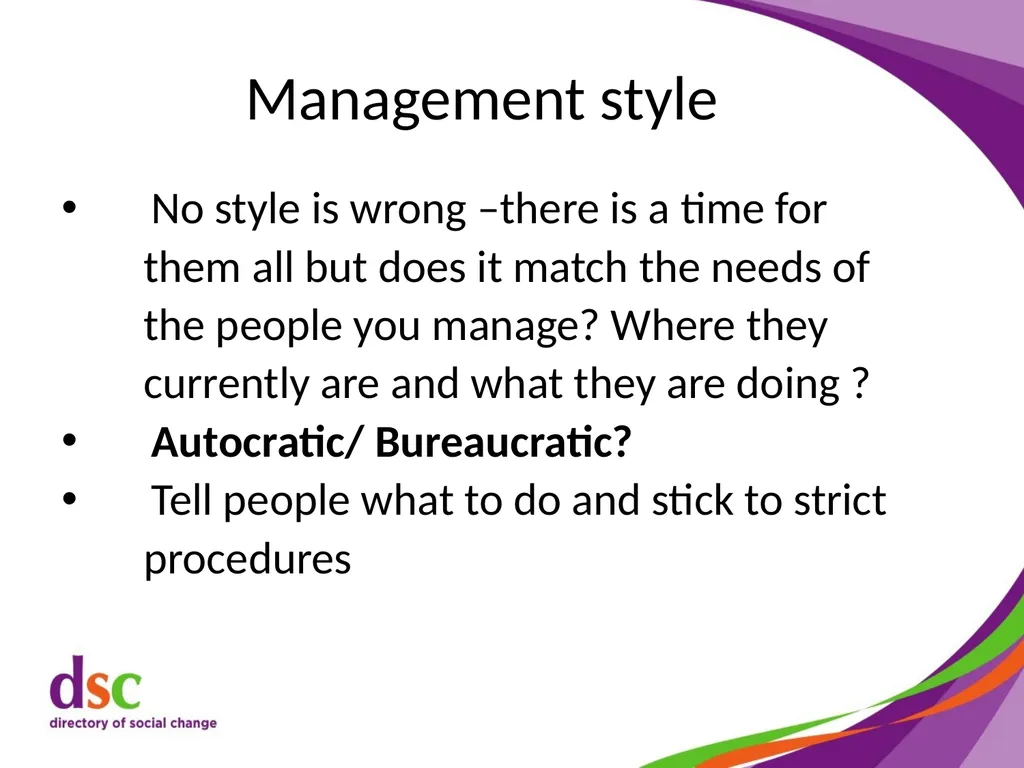
Management style No style is wrong –there is a time for
them all but does it match the needs of
the people you manage? Where they
currently are and what they are doing ?
Autocratic/ Bureaucratic?
Tell people what to do and stick to strict
procedures<br>
them all but does it match the needs of
the people you manage? Where they
currently are and what they are doing ?
Autocratic/ Bureaucratic?
Tell people what to do and stick to strict
procedures<br>
14
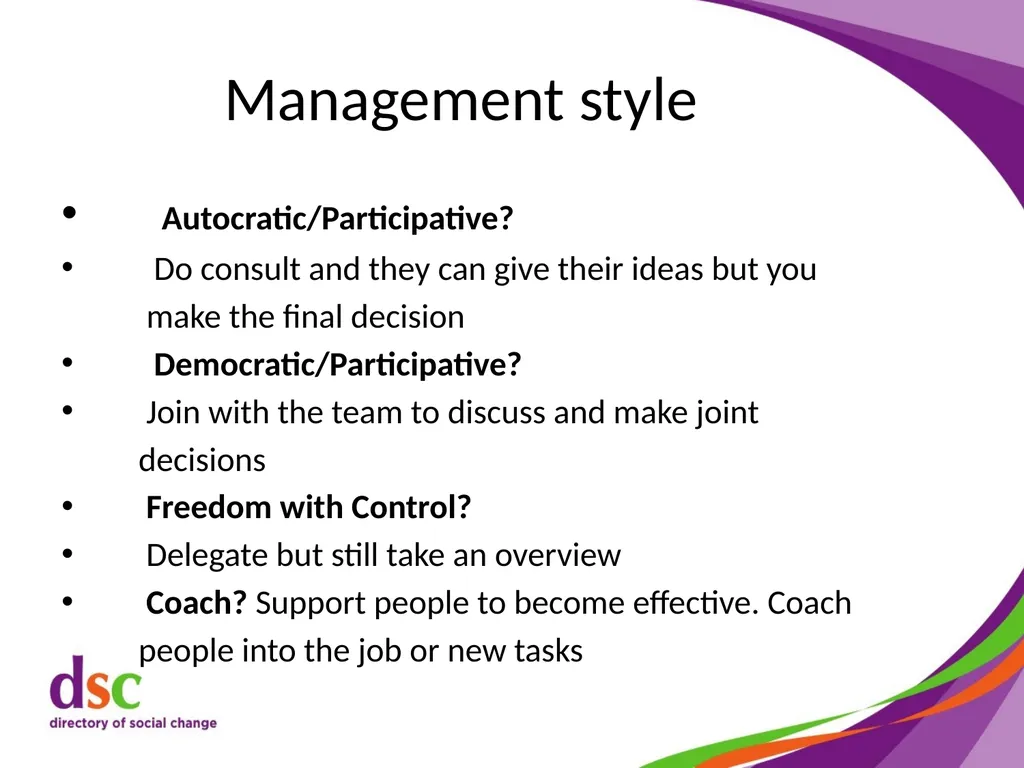
Management style Autocratic/Participative?
Do consult and they can give their ideas but you
make the final decision
Democratic/Participative?
Join with the team to discuss and make joint
decisions
Freedom with Control?
Delegate but still take an overview
Coach? Support people to become effective. Coach
people into the job or new tasks<br>
Do consult and they can give their ideas but you
make the final decision
Democratic/Participative?
Join with the team to discuss and make joint
decisions
Freedom with Control?
Delegate but still take an overview
Coach? Support people to become effective. Coach
people into the job or new tasks<br>
15
Situational Management Effective managers adjust their
style to provide what the individual
or group can’t provide for itself –
you are the missing ingredient
If you don’t change your style of
management appropriately staff will
under perform and can even become
resentful and de-motivated<br>
style to provide what the individual
or group can’t provide for itself –
you are the missing ingredient
If you don’t change your style of
management appropriately staff will
under perform and can even become
resentful and de-motivated<br>
16
Situational Management No style is always best
Style should change with the people, task
and situation
4 levels of staff capability and confidence –
Are they ready - or not?
Are they willing – or not?
Understand the links between above and
actively choose the best style for the situation<br>
Style should change with the people, task
and situation
4 levels of staff capability and confidence –
Are they ready - or not?
Are they willing – or not?
Understand the links between above and
actively choose the best style for the situation<br>
17
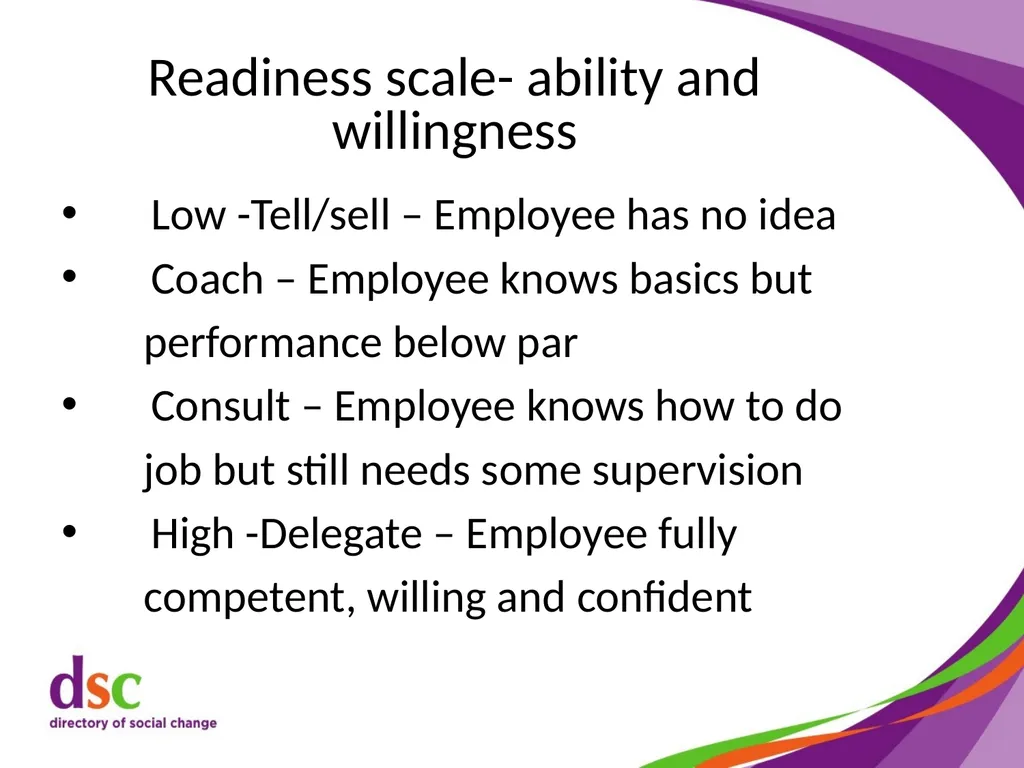
Readiness scale- ability and willingness Low -Tell/sell – Employee has no idea
Coach – Employee knows basics but
performance below par
Consult – Employee knows how to do
job but still needs some supervision
High -Delegate – Employee fully
competent, willing and confident<br>
Coach – Employee knows basics but
performance below par
Consult – Employee knows how to do
job but still needs some supervision
High -Delegate – Employee fully
competent, willing and confident<br>
18
Situational management Exercise Workbook page 5<br>
19
Motivation How much can you be responsible for some else’s
motivation?
Managers are often VERY good at demotivating staff
It is infectious
Motivation comes from them – find out what it is that
motivates them
Have to meet fundamental needs and have
confirmation of our belief in ourselves or we blame
someone else.
In work it is likely to be you and therefore you have
problems with conflict and de motivation.<br>
motivation?
Managers are often VERY good at demotivating staff
It is infectious
Motivation comes from them – find out what it is that
motivates them
Have to meet fundamental needs and have
confirmation of our belief in ourselves or we blame
someone else.
In work it is likely to be you and therefore you have
problems with conflict and de motivation.<br>
20
Motivation Group Exercise 10 minutes
What motivates you or your staff?
Does motivation change at different
times in our lives?<br>
What motivates you or your staff?
Does motivation change at different
times in our lives?<br>
21
Motivation People are motivated by many different factors and
motivation changes throughout our life depending on
our circumstances.
Experiment and find out what motivates your staff
Passion for the cause, paid fairly, benefits,
challenges, ticking boxes, praise, team, flexible
working, voice, listened to, have choices etc etc
Reminder
People who produce good results feel good about
themselves
People who feel good about themselves produce good
results<br>
motivation changes throughout our life depending on
our circumstances.
Experiment and find out what motivates your staff
Passion for the cause, paid fairly, benefits,
challenges, ticking boxes, praise, team, flexible
working, voice, listened to, have choices etc etc
Reminder
People who produce good results feel good about
themselves
People who feel good about themselves produce good
results<br>
22
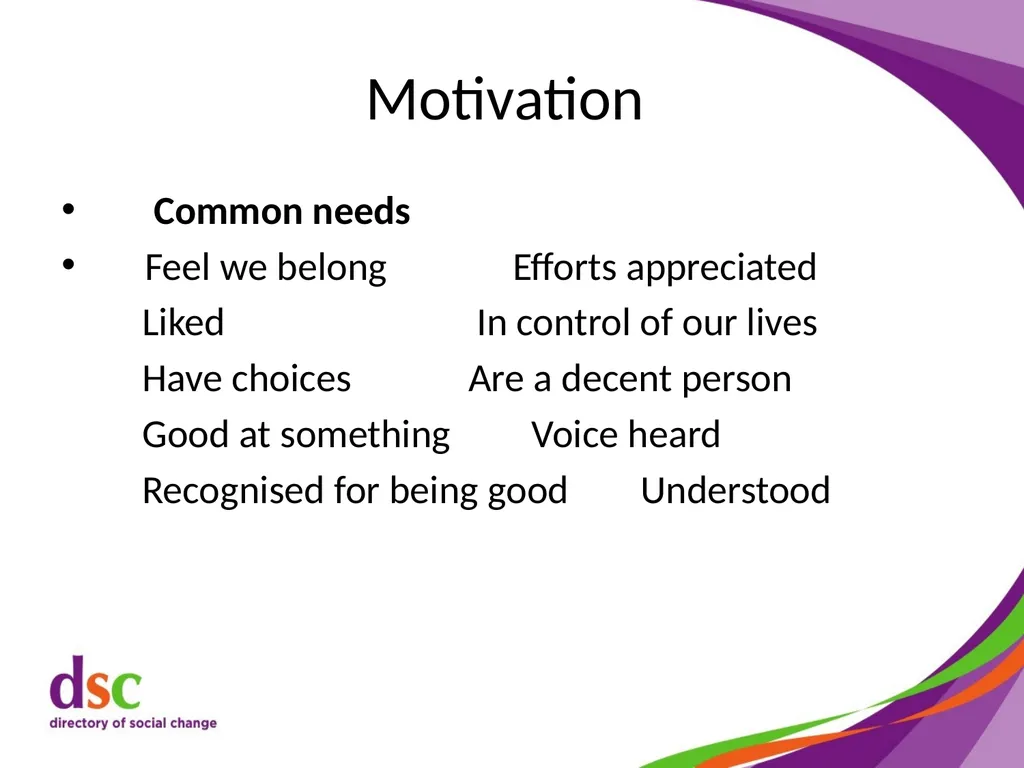
Motivation Common needs
Feel we belong Efforts appreciated
Liked In control of our lives
Have choices Are a decent person
Good at something Voice heard
Recognised for being good Understood<br>
Feel we belong Efforts appreciated
Liked In control of our lives
Have choices Are a decent person
Good at something Voice heard
Recognised for being good Understood<br>
23
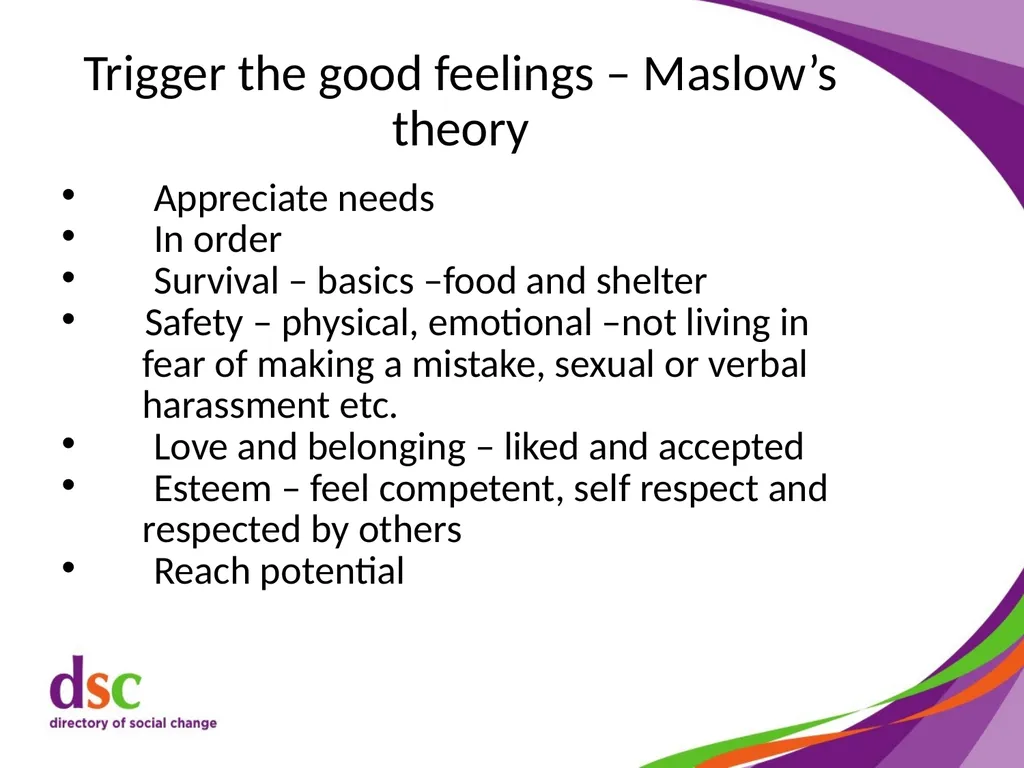
Trigger the good feelings – Maslow’s theory Appreciate needs
In order
Survival – basics –food and shelter
Safety – physical, emotional –not living in
fear of making a mistake, sexual or verbal
harassment etc.
Love and belonging – liked and accepted
Esteem – feel competent, self respect and
respected by others
Reach potential<br>
In order
Survival – basics –food and shelter
Safety – physical, emotional –not living in
fear of making a mistake, sexual or verbal
harassment etc.
Love and belonging – liked and accepted
Esteem – feel competent, self respect and
respected by others
Reach potential<br>
24
Motivation Self assessment - Workbook page 6
Motivation
Where are most of your scores?
Low? 1-3
Medium? 4-7
High? 8-10<br>
Motivation
Where are most of your scores?
Low? 1-3
Medium? 4-7
High? 8-10<br>
25
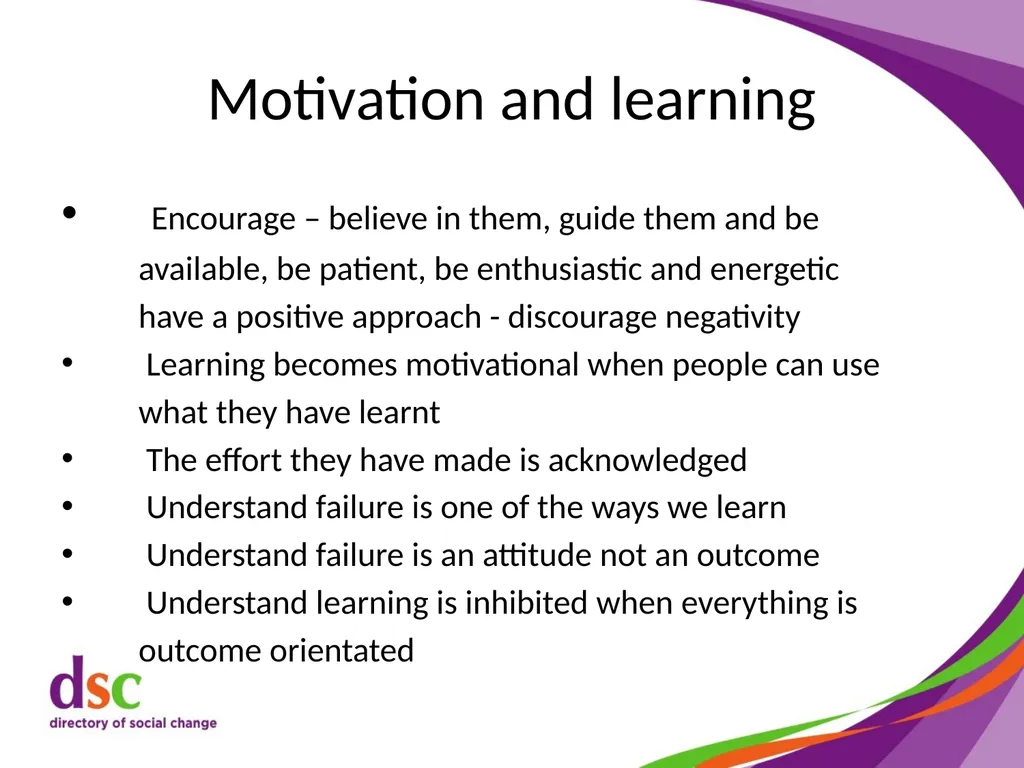
Motivation and learning Encourage – believe in them, guide them and be
available, be patient, be enthusiastic and energetic
have a positive approach - discourage negativity
Learning becomes motivational when people can use
what they have learnt
The effort they have made is acknowledged
Understand failure is one of the ways we learn
Understand failure is an attitude not an outcome
Understand learning is inhibited when everything is
outcome orientated<br>
available, be patient, be enthusiastic and energetic
have a positive approach - discourage negativity
Learning becomes motivational when people can use
what they have learnt
The effort they have made is acknowledged
Understand failure is one of the ways we learn
Understand failure is an attitude not an outcome
Understand learning is inhibited when everything is
outcome orientated<br>
26
Active Listening Listening- the heart of good communication
It is about -Listening to try and understand, for ways
to solve a problem, for actions, possibilities, ways to
resolve conflict and to build relationships
It is NOT about
Proving you are right or wrong, an opportunity to
punish, prove you know best, make your point, let of
steam or get your story across.
What you say is only 7% of communication – what
we see is 93%<br>
It is about -Listening to try and understand, for ways
to solve a problem, for actions, possibilities, ways to
resolve conflict and to build relationships
It is NOT about
Proving you are right or wrong, an opportunity to
punish, prove you know best, make your point, let of
steam or get your story across.
What you say is only 7% of communication – what
we see is 93%<br>
27
Body Language Shaking the head and shoulder shrug
Open palms – you have no weapon/non threatening/truthful
Palm down – showing authority – Hitler salute
Palm down with closed fist pointing - aggressive<br>
Open palms – you have no weapon/non threatening/truthful
Palm down – showing authority – Hitler salute
Palm down with closed fist pointing - aggressive<br>
28
Body language Finger pointing up on cheek with fingers across mouth with thumb supporting chin?
Raised steeple fingers?
Hand covering mouth?
Frequently touching your nose?
Want to intimidate? Power gaze at the third eye<br>
Raised steeple fingers?
Hand covering mouth?
Frequently touching your nose?
Want to intimidate? Power gaze at the third eye<br>
29
Active listening The 6 Es
Ears to hear the words – watch the tone
Eyes to observe the body language
Experience – it will colour what we hear
Emotions –how we were feeling
Expectation will be formed by our
emotions and experience
Egos – watch out or you will stop listening<br>
Ears to hear the words – watch the tone
Eyes to observe the body language
Experience – it will colour what we hear
Emotions –how we were feeling
Expectation will be formed by our
emotions and experience
Egos – watch out or you will stop listening<br>
30
Active listening Actively encourage to speak and tell their
story – ask open questions
Do not jump to conclusions and give
solutions – let them find and own the
solutions
Use silence – attentive and a useful tool –
someone has to fill the space
Reflect/Paraphrase/Summarise<br>
story – ask open questions
Do not jump to conclusions and give
solutions – let them find and own the
solutions
Use silence – attentive and a useful tool –
someone has to fill the space
Reflect/Paraphrase/Summarise<br>
31
Active listening exercise Practice the active listening skills
It is about listening to understand – not
giving solutions.
The person talking may find their own
solutions if given the space to do so.
Scenario workbook page 7<br>
It is about listening to understand – not
giving solutions.
The person talking may find their own
solutions if given the space to do so.
Scenario workbook page 7<br>
32
Deal with Conflict It is the managers job to deal with and try to resolve
conflict. Major cause of de motivation and stress.
Accept that conflict is normal – it is how we deal with
it that is important - too much causes stress.
Implications both physically and emotionally
Deal with it while it is still small and before it grows
and festers.
Denial solves nothing – but deal with your own
emotions first
Never personal -Separate the problem from the
person
Try to achieve a win win solution<br>
conflict. Major cause of de motivation and stress.
Accept that conflict is normal – it is how we deal with
it that is important - too much causes stress.
Implications both physically and emotionally
Deal with it while it is still small and before it grows
and festers.
Denial solves nothing – but deal with your own
emotions first
Never personal -Separate the problem from the
person
Try to achieve a win win solution<br>
33
Conflict and the workplace Discussion re causes of conflict<br>
34
Conflict strategies Learnt as a child
If it worked then it will work now –default behaviour
Strategies were learnt then and so you can learn
new ones now
Assertiveness is making a conscious decision
about choosing how you will respond to a conflict
situation rather than just reacting instinctively.<br>
If it worked then it will work now –default behaviour
Strategies were learnt then and so you can learn
new ones now
Assertiveness is making a conscious decision
about choosing how you will respond to a conflict
situation rather than just reacting instinctively.<br>
35
Behaviour Ego states Unique to individual depending on their
experiences, mentality, intelligence and
family
Reality – we are all tainted by our actual life
experience – e.g. our fall back conflict
strategy
Reality – by recognising this we can learn to
choose our behaviours – consciously decide
not to let this happen<br>
experiences, mentality, intelligence and
family
Reality – we are all tainted by our actual life
experience – e.g. our fall back conflict
strategy
Reality – by recognising this we can learn to
choose our behaviours – consciously decide
not to let this happen<br>
36
Behaviour Ego states People create pressure or feel
pressured to communicate in a
complimentary way to the
communication they are receiving
If you play one part expect the other
person to act out the other role!
E.g. If you, as the boss, act like a
controlling parent you can expect the
employee to act like a child<br>
pressured to communicate in a
complimentary way to the
communication they are receiving
If you play one part expect the other
person to act out the other role!
E.g. If you, as the boss, act like a
controlling parent you can expect the
employee to act like a child<br>
37
Conflict It happens- Could you be the cause?
Clarify expectations
Are performance expectations defined
and understood?
Do you have ground rules for
behaviour?
Have you talked about de personalising
conflict?<br>
Clarify expectations
Are performance expectations defined
and understood?
Do you have ground rules for
behaviour?
Have you talked about de personalising
conflict?<br>
38
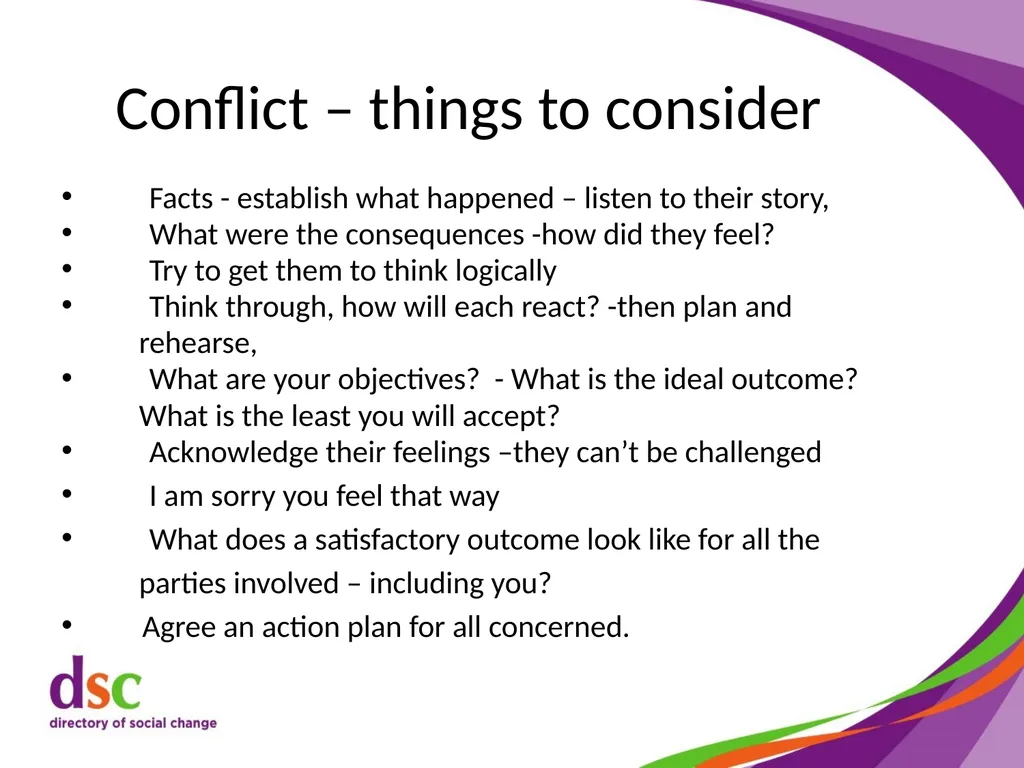
Conflict – things to consider Facts - establish what happened – listen to their story,
What were the consequences -how did they feel?
Try to get them to think logically
Think through, how will each react? -then plan and
rehearse,
What are your objectives? - What is the ideal outcome?
What is the least you will accept?
Acknowledge their feelings –they can’t be challenged
I am sorry you feel that way
What does a satisfactory outcome look like for all the
parties involved – including you?
Agree an action plan for all concerned.<br>
What were the consequences -how did they feel?
Try to get them to think logically
Think through, how will each react? -then plan and
rehearse,
What are your objectives? - What is the ideal outcome?
What is the least you will accept?
Acknowledge their feelings –they can’t be challenged
I am sorry you feel that way
What does a satisfactory outcome look like for all the
parties involved – including you?
Agree an action plan for all concerned.<br>
39
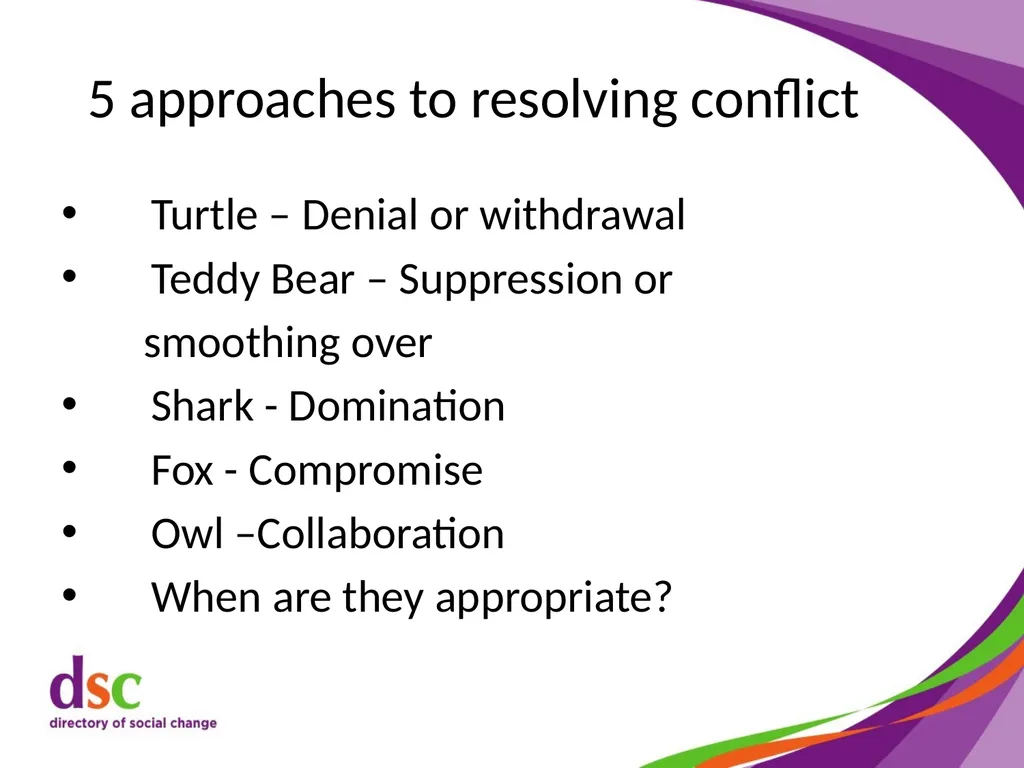
5 approaches to resolving conflict Turtle – Denial or withdrawal
Teddy Bear – Suppression or
smoothing over
Shark - Domination
Fox - Compromise
Owl –Collaboration
When are they appropriate?<br>
Teddy Bear – Suppression or
smoothing over
Shark - Domination
Fox - Compromise
Owl –Collaboration
When are they appropriate?<br>
40
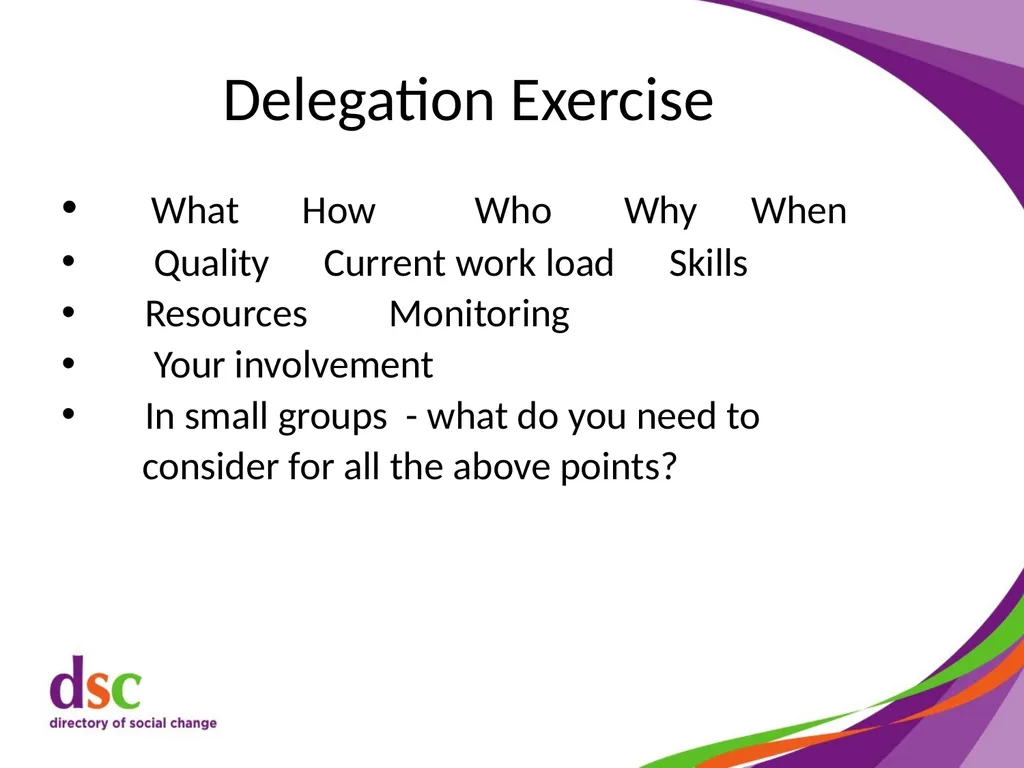
Delegation Exercise What How Who Why When
Quality Current work load Skills
Resources Monitoring
Your involvement
In small groups - what do you need to
consider for all the above points?<br>
Quality Current work load Skills
Resources Monitoring
Your involvement
In small groups - what do you need to
consider for all the above points?<br>
41
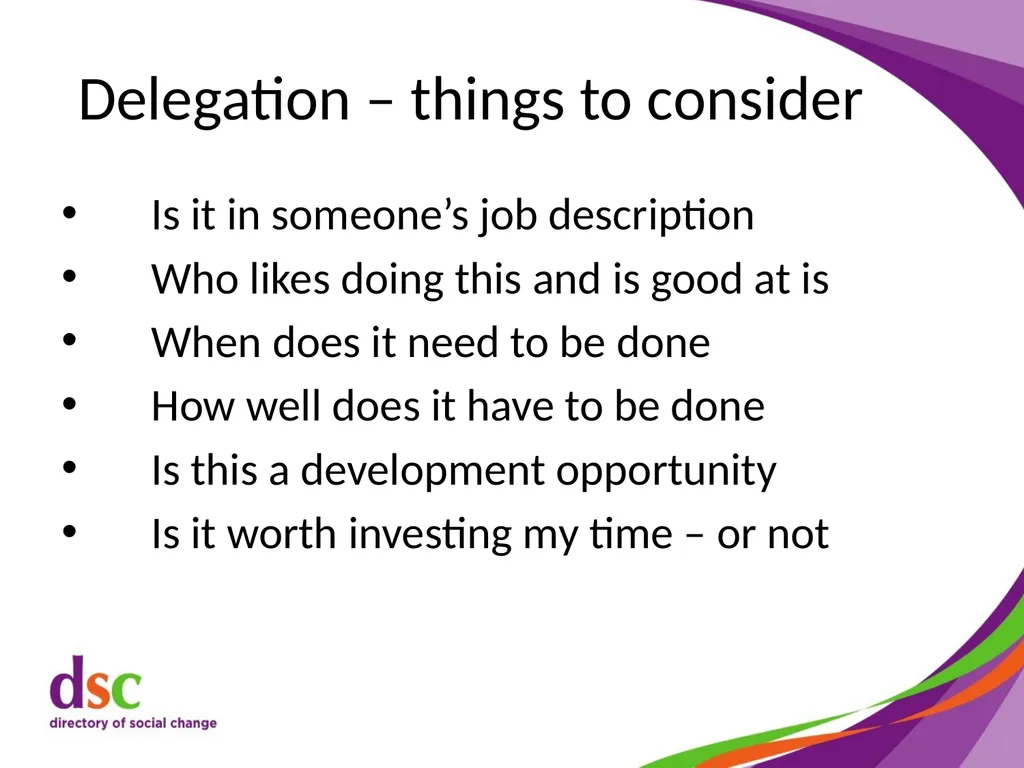
Delegation – things to consider Is it in someone’s job description
Who likes doing this and is good at is
When does it need to be done
How well does it have to be done
Is this a development opportunity
Is it worth investing my time – or not<br>
Who likes doing this and is good at is
When does it need to be done
How well does it have to be done
Is this a development opportunity
Is it worth investing my time – or not<br>
42
Delegation Beware of using the willing donkey – leads to all
round resentment and potential stress
Think of the sausage machine – what you put in
dictates what you get out at the other end
Do you have the time to support them properly?
If it is a new task for someone who is normally
ready and willing they will need to be managed in a
different way.
What is their existing work load?
Do they need training and support or are you
setting them up for failure?<br>
round resentment and potential stress
Think of the sausage machine – what you put in
dictates what you get out at the other end
Do you have the time to support them properly?
If it is a new task for someone who is normally
ready and willing they will need to be managed in a
different way.
What is their existing work load?
Do they need training and support or are you
setting them up for failure?<br>
43
Communication 4 main styles
Recognise your style, the impact of your
style and the style of others
Are you green, blue, yellow or red?
Workbook page 8
Do you recognise the colours in your team/
manager?
Very important to communicate appropriately
to make sure they really listen and you are
heard<br>
Recognise your style, the impact of your
style and the style of others
Are you green, blue, yellow or red?
Workbook page 8
Do you recognise the colours in your team/
manager?
Very important to communicate appropriately
to make sure they really listen and you are
heard<br>
44
Green Positives Feelings led
Warm, caring, supportive, nurturing
Interested in individuals
Relationships are important
Good listener
Cares about relationships<br>
Warm, caring, supportive, nurturing
Interested in individuals
Relationships are important
Good listener
Cares about relationships<br>
45
Blue Positives Fact
Authoritative
Practical
Pays attention to detail
Gets the facts right
Makes clear logical decisions
Takes time to think<br>
Authoritative
Practical
Pays attention to detail
Gets the facts right
Makes clear logical decisions
Takes time to think<br>
46
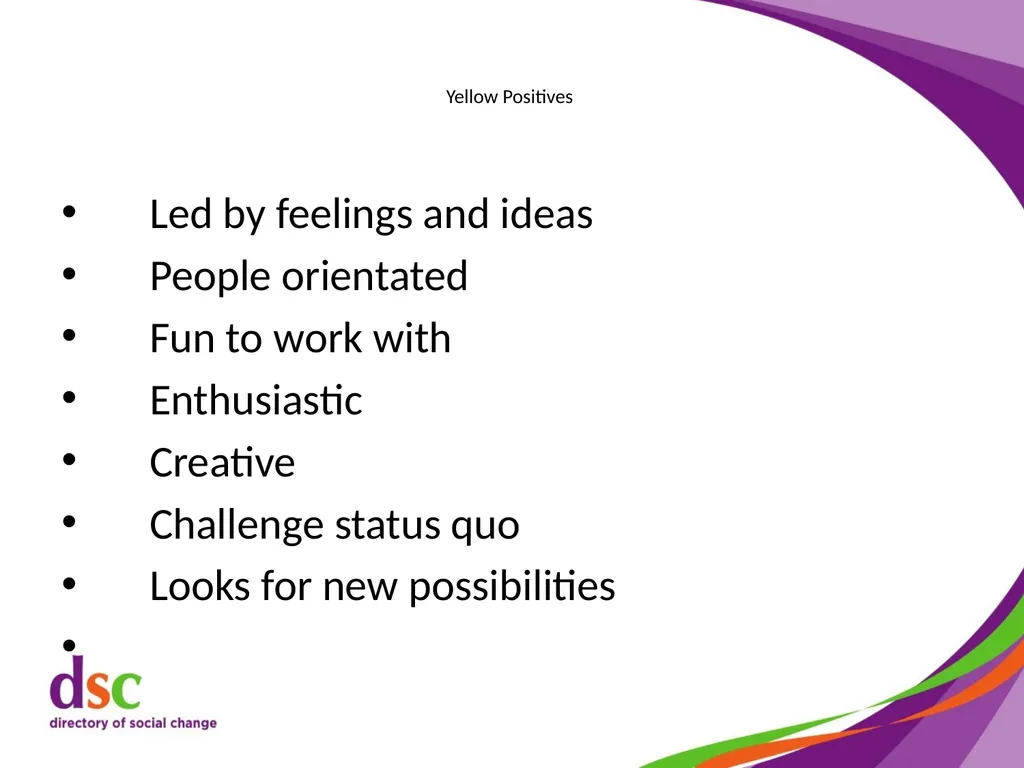
Yellow Positives Led by feelings and ideas
People orientated
Fun to work with
Enthusiastic
Creative
Challenge status quo
Looks for new possibilities<br>
People orientated
Fun to work with
Enthusiastic
Creative
Challenge status quo
Looks for new possibilities<br>
47
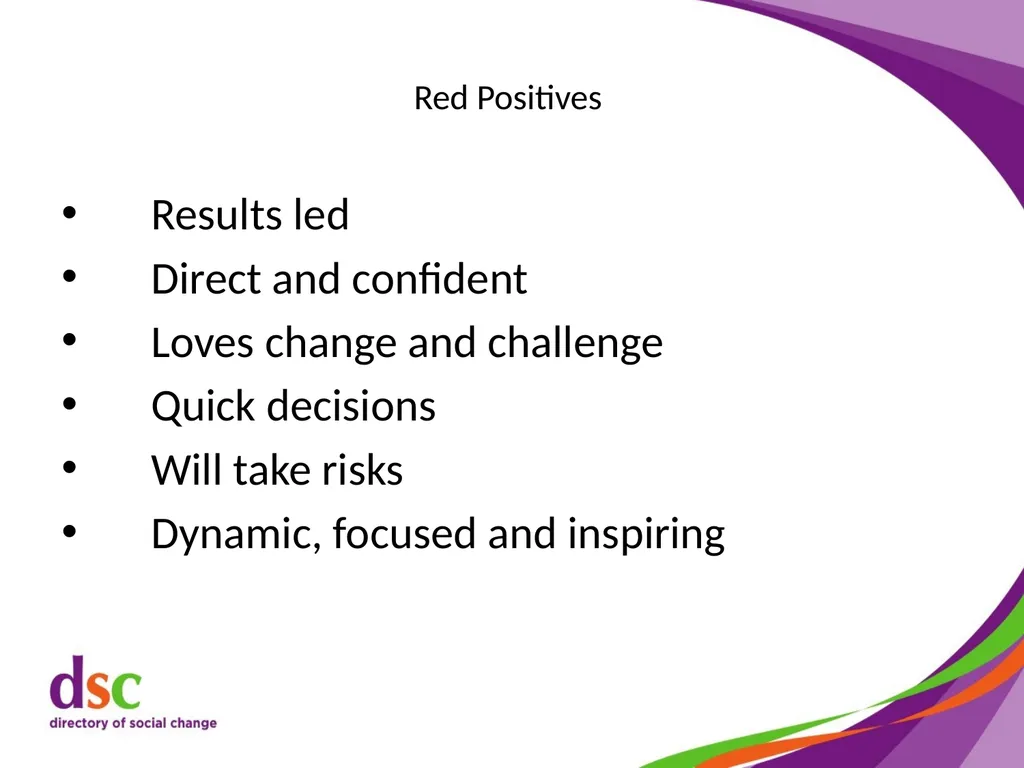
Red Positives Results led
Direct and confident
Loves change and challenge
Quick decisions
Will take risks
Dynamic, focused and inspiring<br>
Direct and confident
Loves change and challenge
Quick decisions
Will take risks
Dynamic, focused and inspiring<br>
48
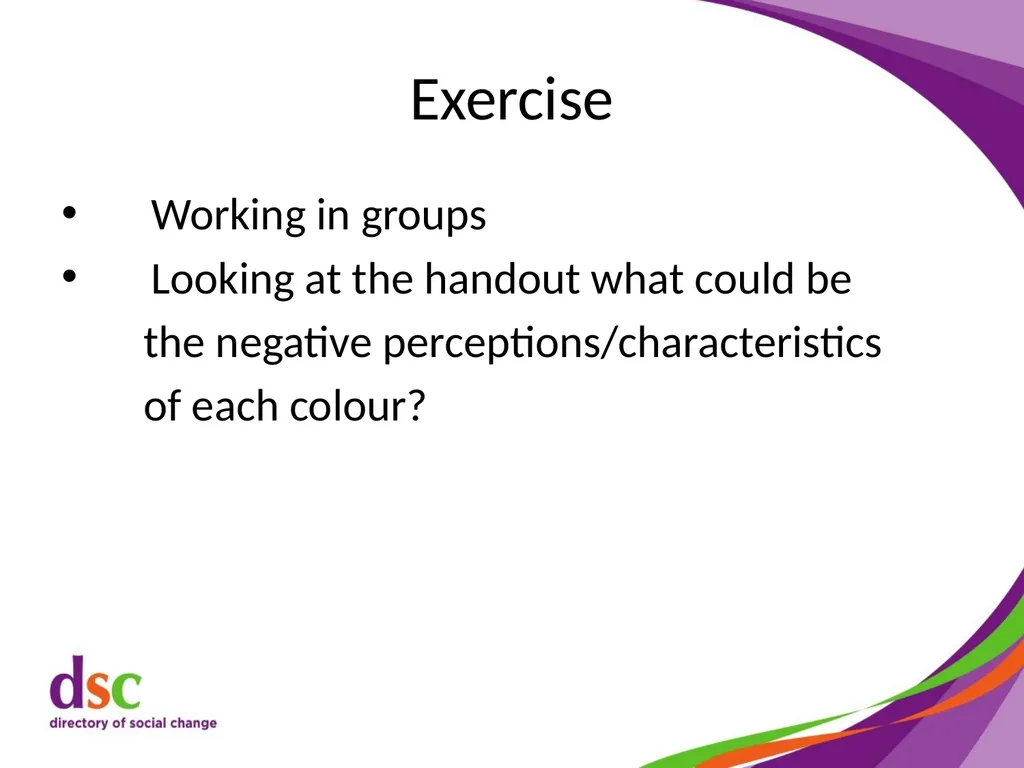
Exercise Working in groups
Looking at the handout what could be
the negative perceptions/characteristics
of each colour?<br>
Looking at the handout what could be
the negative perceptions/characteristics
of each colour?<br>
49
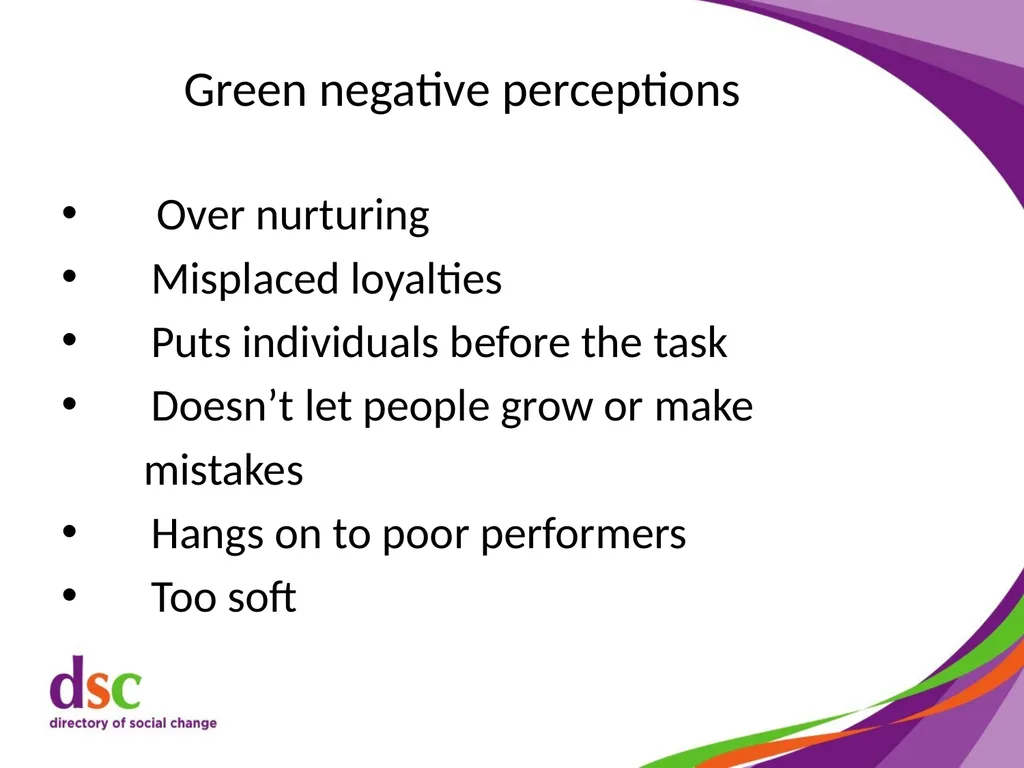
Green negative perceptions Over nurturing
Misplaced loyalties
Puts individuals before the task
Doesn’t let people grow or make
mistakes
Hangs on to poor performers
Too soft<br>
Misplaced loyalties
Puts individuals before the task
Doesn’t let people grow or make
mistakes
Hangs on to poor performers
Too soft<br>
50
Blue negative perceptions More concerned with ideas and
principles than people
Too much order
Over attention to facts and detail
Never gets anything done
Always plays by the rules
Closed mind
May be self critical<br>
principles than people
Too much order
Over attention to facts and detail
Never gets anything done
Always plays by the rules
Closed mind
May be self critical<br>
51
Yellow negative perceptions Addicted to change
Starts but doesn’t finish
Too many initiatives at once
Doesn’t get results
Doesn’t see things through<br>
Starts but doesn’t finish
Too many initiatives at once
Doesn’t get results
Doesn’t see things through<br>
52
Red negative perceptions Action only – wants results
Not concerned about individuals
Doesn’t listen well
Doesn’t think things through
Can be hasty
Takes risks
Not interested in detail<br>
Not concerned about individuals
Doesn’t listen well
Doesn’t think things through
Can be hasty
Takes risks
Not interested in detail<br>
53
Communication exercise Purpose? -Understand the various styles of
communication and use it to your advantage – know
how to communicate with the different styles more
effectively
How should you approach each of the colours?
Can you just knock on the door and walk in?
Should you plan and prepare anything?
What is the first 15 secs of conversation?
Exercise in groups<br>
communication and use it to your advantage – know
how to communicate with the different styles more
effectively
How should you approach each of the colours?
Can you just knock on the door and walk in?
Should you plan and prepare anything?
What is the first 15 secs of conversation?
Exercise in groups<br>
54
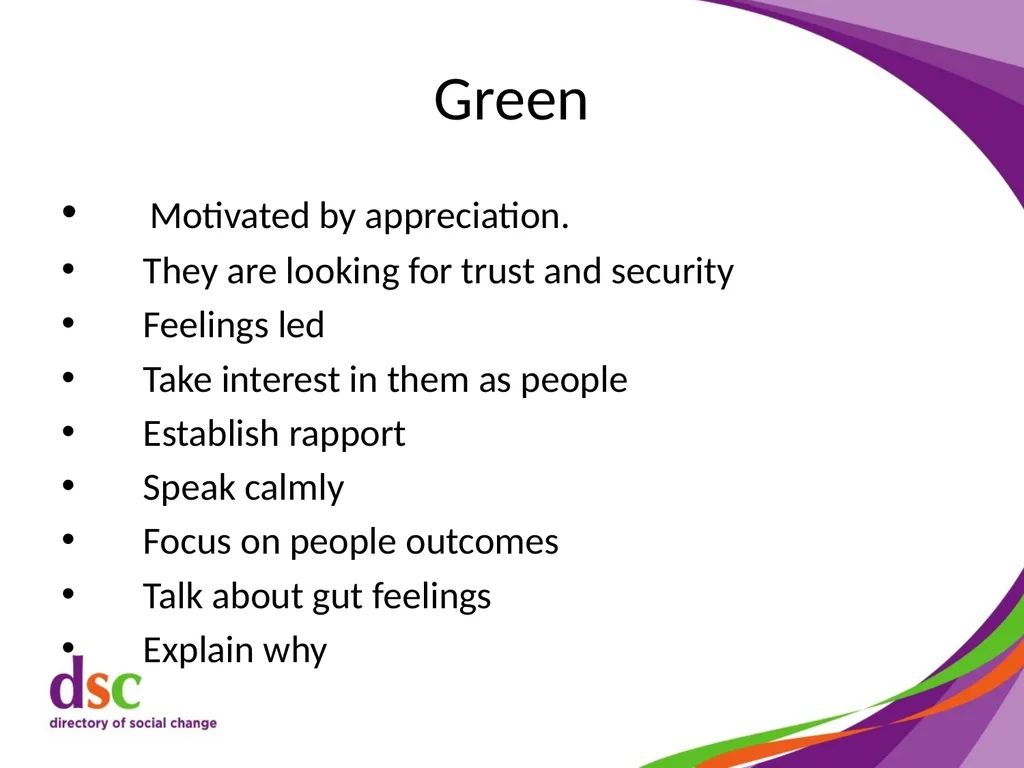
Green Motivated by appreciation.
They are looking for trust and security
Feelings led
Take interest in them as people
Establish rapport
Speak calmly
Focus on people outcomes
Talk about gut feelings
Explain why<br>
They are looking for trust and security
Feelings led
Take interest in them as people
Establish rapport
Speak calmly
Focus on people outcomes
Talk about gut feelings
Explain why<br>
55
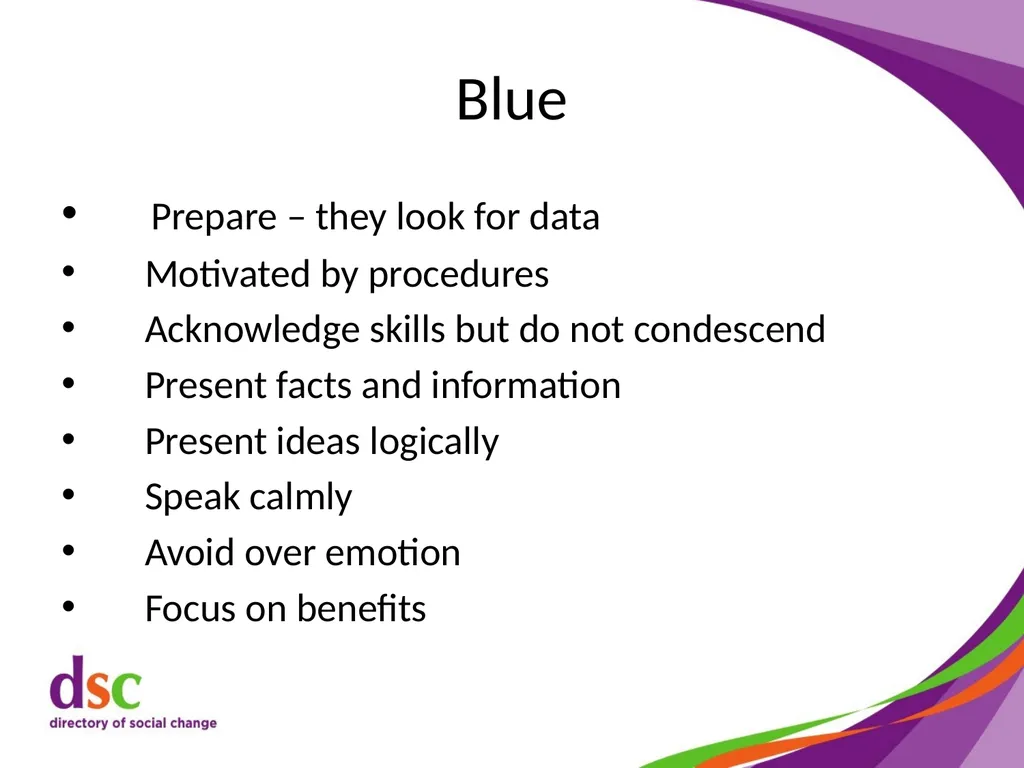
Blue Prepare – they look for data
Motivated by procedures
Acknowledge skills but do not condescend
Present facts and information
Present ideas logically
Speak calmly
Avoid over emotion
Focus on benefits<br>
Motivated by procedures
Acknowledge skills but do not condescend
Present facts and information
Present ideas logically
Speak calmly
Avoid over emotion
Focus on benefits<br>
56
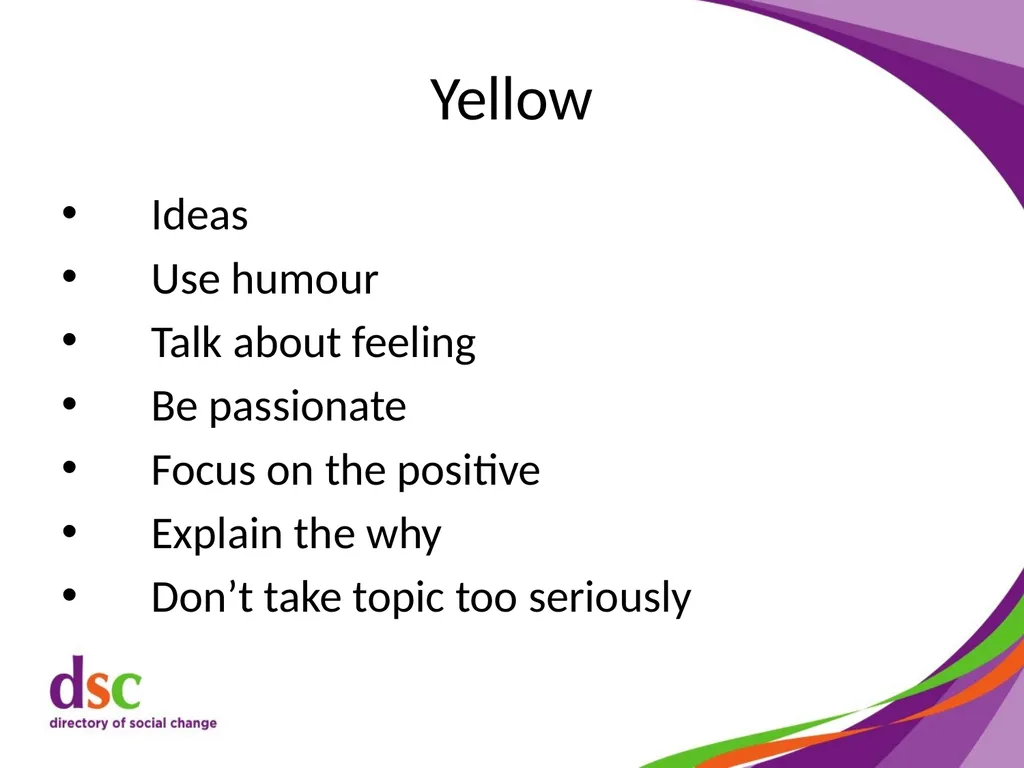
Yellow Ideas
Use humour
Talk about feeling
Be passionate
Focus on the positive
Explain the why
Don’t take topic too seriously<br>
Use humour
Talk about feeling
Be passionate
Focus on the positive
Explain the why
Don’t take topic too seriously<br>
57
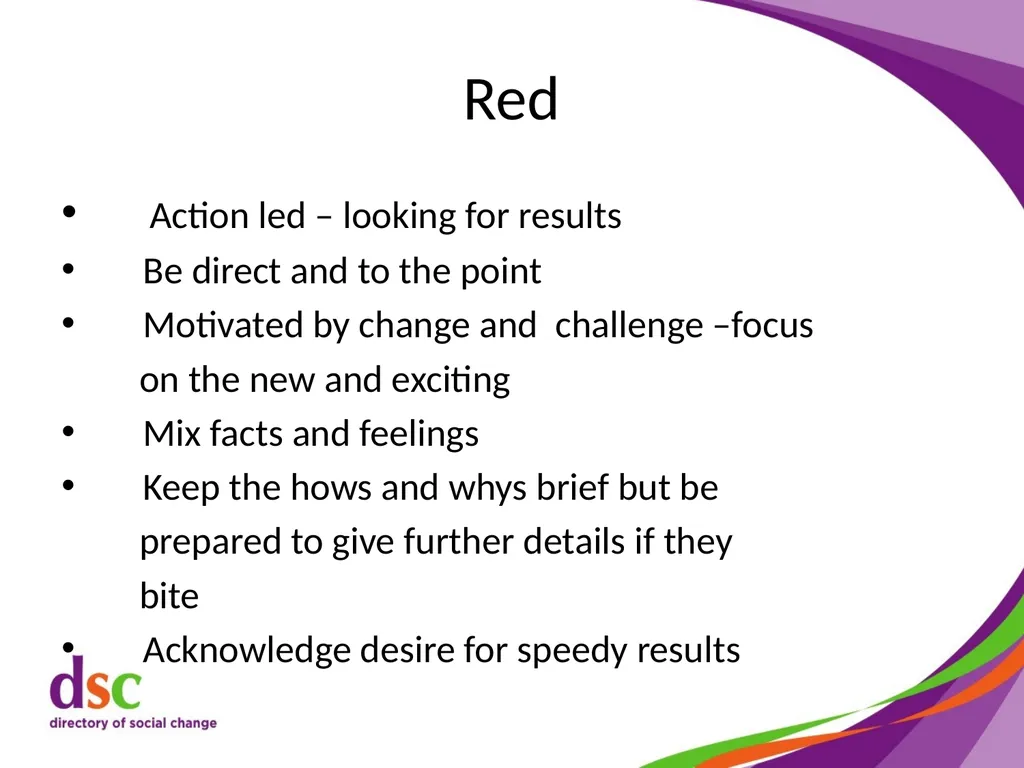
Red Action led – looking for results
Be direct and to the point
Motivated by change and challenge –focus
on the new and exciting
Mix facts and feelings
Keep the hows and whys brief but be
prepared to give further details if they
bite
Acknowledge desire for speedy results<br>
Be direct and to the point
Motivated by change and challenge –focus
on the new and exciting
Mix facts and feelings
Keep the hows and whys brief but be
prepared to give further details if they
bite
Acknowledge desire for speedy results<br>
58
Support and Supervision within the management structure<br>
59
Vision Needs to inspire, motivate and be memorable
Breaks down operational silos – every
member of staff knows how their work
contributes.
Without it you can’t plan, set targets or know
how to prioritise
Management is how you go about achieving
the Vision – objectives and then plans and
individual targets.
You might not know how you will get there yet
- but at least you know in which direction you
are going<br>
Breaks down operational silos – every
member of staff knows how their work
contributes.
Without it you can’t plan, set targets or know
how to prioritise
Management is how you go about achieving
the Vision – objectives and then plans and
individual targets.
You might not know how you will get there yet
- but at least you know in which direction you
are going<br>
60
Support and Supervision within the management structure Vision
Business plan
Team plans
Individual work plans
Annual appraisal
Supervision
Support, training and development
Group discussion – reflections, challenges?<br>
Business plan
Team plans
Individual work plans
Annual appraisal
Supervision
Support, training and development
Group discussion – reflections, challenges?<br>
61
PLANNING Proper prior planning prevents poor
performance
Planning isn’t a luxury – 10% of time spent
planning can save 90% of the time needed
to get the job done
Recognise priorities, set objectives and then
work out how they will be achieved –explicit,
clear and formal.
Maximises resources available
Automatic instinctive planning is not enough
Don’t confuse activity with accomplishment<br>
performance
Planning isn’t a luxury – 10% of time spent
planning can save 90% of the time needed
to get the job done
Recognise priorities, set objectives and then
work out how they will be achieved –explicit,
clear and formal.
Maximises resources available
Automatic instinctive planning is not enough
Don’t confuse activity with accomplishment<br>
62
PLANNING Plans – team and individual+ projects.
Gant charts. List what needs to be done.
Set crucial dates, milestones.
Match what needs to be done with who can
do it.
Useful for monitoring.
Use them yourselves and expect them from
staff<br>
Gant charts. List what needs to be done.
Set crucial dates, milestones.
Match what needs to be done with who can
do it.
Useful for monitoring.
Use them yourselves and expect them from
staff<br>
63
Planning Staff know their objectives and priorities so
have a basis to start planning.
20% activity leads to 80% results. The trick is
knowing which 20%.
What is important, urgent - and manage time
stealers.
Get organised or risk task taking 500% longer
Get everyone to develop good habits. Set at least
10 minutes aside to be alone, think and plan at the
end of the day so you know what your priorities are
tomorrow<br>
have a basis to start planning.
20% activity leads to 80% results. The trick is
knowing which 20%.
What is important, urgent - and manage time
stealers.
Get organised or risk task taking 500% longer
Get everyone to develop good habits. Set at least
10 minutes aside to be alone, think and plan at the
end of the day so you know what your priorities are
tomorrow<br>
64
Performance management Aims to improve performance thus achieve the
business objectives
Employees need to know what exactly they should
be focusing on and what their priorities are in order
to be able to achieve them and feel good
Performance management – Help them –Negotiate
5 clear priorities
. Clarity –ALWAYS -SMART targets Specific,
Measurable, Achievable, Realistic and
Timed.<br>
business objectives
Employees need to know what exactly they should
be focusing on and what their priorities are in order
to be able to achieve them and feel good
Performance management – Help them –Negotiate
5 clear priorities
. Clarity –ALWAYS -SMART targets Specific,
Measurable, Achievable, Realistic and
Timed.<br>
65
Performance management Agree objectives -give clear direction and
good detailed guidance
. Set clear deadlines with monitoring
procedures.
Make standards clear, recognise and
overcome difficulties
Make sure appropriate resources are
available
Opportunities to learn, change and develop<br>
good detailed guidance
. Set clear deadlines with monitoring
procedures.
Make standards clear, recognise and
overcome difficulties
Make sure appropriate resources are
available
Opportunities to learn, change and develop<br>
66
Feedback<br>
67
Feedback Real, precise, clear, relevant and regular
Help them reach their potential – catch them doing
something right. Make them feel valued.
Praise and encourage them to do more of the same
Builds self confidence
Respond immediately
“I” statements
Acknowledge feelings<br>
Help them reach their potential – catch them doing
something right. Make them feel valued.
Praise and encourage them to do more of the same
Builds self confidence
Respond immediately
“I” statements
Acknowledge feelings<br>
68
Effective challenging feedback Keeps them listening
You are solving a problem not apportioning
blame
Keeps relationship intact – not personal
– never in anger -it is about the behaviour –
not the individual
Be clear what it is you expect –be specific
and give real examples
Offer support, alternatives<br>
You are solving a problem not apportioning
blame
Keeps relationship intact – not personal
– never in anger -it is about the behaviour –
not the individual
Be clear what it is you expect –be specific
and give real examples
Offer support, alternatives<br>
69
Negative Feedback A Sandwich? Start with what is going well –
end on a positive note? Is this confusing?
Room for misconceptions or waiting for the
other shoe to drop! Positive feedback is not
heard.
Alternatively make the message clear, direct
and unemotional–make an observation, state
why this is a problem, state what needs to
happen to change it.<br>
end on a positive note? Is this confusing?
Room for misconceptions or waiting for the
other shoe to drop! Positive feedback is not
heard.
Alternatively make the message clear, direct
and unemotional–make an observation, state
why this is a problem, state what needs to
happen to change it.<br>
70
Feedback Exercise Are you comfortable with both giving
and receiving feedback?
Do your staff resist? Giving feedback to
you or receiving feedback?
Exercise in pairs
Workbook page 9 – giving challenging
feedback<br>
and receiving feedback?
Do your staff resist? Giving feedback to
you or receiving feedback?
Exercise in pairs
Workbook page 9 – giving challenging
feedback<br>
71
Annual Appraisals Are they meaningful and a useful
management tool?
Are they a waste of time? Do you do
them just because it is expected?
Are there barriers and challenges?
Have you seen anything positive come
from them?
General discussion with group<br>
management tool?
Are they a waste of time? Do you do
them just because it is expected?
Are there barriers and challenges?
Have you seen anything positive come
from them?
General discussion with group<br>
72
Annual Appraisal Framework to build on to manage people with
ongoing supervision and support.
Supervisor and Supervisee have equal input
Standard form sent out prior to session for
Supervisee to consider and complete and return to
Supervisor before session so they are prepared
- consider and plan session
Look at job description – still accurate and relevant?
Get them to own it e.g. Write up a record of meetings
Use active listening skills<br>
ongoing supervision and support.
Supervisor and Supervisee have equal input
Standard form sent out prior to session for
Supervisee to consider and complete and return to
Supervisor before session so they are prepared
- consider and plan session
Look at job description – still accurate and relevant?
Get them to own it e.g. Write up a record of meetings
Use active listening skills<br>
73
Annual Appraisal Compare current work and behaviour with
objectives-what has gone well and what has not?
What has helped? Training or knowledge gained?
Training or development needed
What has their contribution been to team or
organisational objectives? Back to the vision.
Have they gained or got unused skills?
Relationships? With you? The Team? Rest of
the organisation?<br>
objectives-what has gone well and what has not?
What has helped? Training or knowledge gained?
Training or development needed
What has their contribution been to team or
organisational objectives? Back to the vision.
Have they gained or got unused skills?
Relationships? With you? The Team? Rest of
the organisation?<br>
74
Training and development Group discussion
If training and development are
identified
How would you prioritise?
What means can we use especially
when there are budget restrictions?<br>
If training and development are
identified
How would you prioritise?
What means can we use especially
when there are budget restrictions?<br>
75
Supervision Regular, planned, formal and contracted
Focus on – tasks, workloads, roles,
responsibilities, accountability and
development
Relates to Appraisal, Grievance and
Disciplinary
Takes into account – past experience
and skills<br>
Focus on – tasks, workloads, roles,
responsibilities, accountability and
development
Relates to Appraisal, Grievance and
Disciplinary
Takes into account – past experience
and skills<br>
76
Monitoring via Supervision Vital cog in the wheel to check and monitor
the agreed Action Plan is being followed
through
Use a standard form so records are kept –
signed?
Example workbook pages 10-13
Meet regularly and keep the appointment
Privacy and confidentiality<br>
the agreed Action Plan is being followed
through
Use a standard form so records are kept –
signed?
Example workbook pages 10-13
Meet regularly and keep the appointment
Privacy and confidentiality<br>
77
Monitoring via Supervision Agree the agenda and be prepared
Revisit previous months meeting and
check progress
Empathise with pressures, anxieties,
look for success, give praise.
Prepare and be a friendly terrier –
never let things go<br>
Revisit previous months meeting and
check progress
Empathise with pressures, anxieties,
look for success, give praise.
Prepare and be a friendly terrier –
never let things go<br>
78
Support and Supervision Separate but tend to overlap – could conflict
Supervision normally informal – day to day,
week to week, month to month issues and
problems
Safe setting for staff to express themselves
Explore possibilities for development
Explore possible appropriate alternative
support
Maintain confidentiality but use discretion and
judgement<br>
Supervision normally informal – day to day,
week to week, month to month issues and
problems
Safe setting for staff to express themselves
Explore possibilities for development
Explore possible appropriate alternative
support
Maintain confidentiality but use discretion and
judgement<br>
79
Boundaries between work and personal issues Our personal lives will affect our working lives
– good supervision will take this into account
Only if the personal problem affects work
does it become an issue for you – perhaps
alternative ways of working, sick leave,
compassionate leave?
You are not there to provide therapy or
counselling as their supervisor
Support them to find outside support<br>
– good supervision will take this into account
Only if the personal problem affects work
does it become an issue for you – perhaps
alternative ways of working, sick leave,
compassionate leave?
You are not there to provide therapy or
counselling as their supervisor
Support them to find outside support<br>
80
Performance Everyone is a potential winner although
some are disguised as losers –don’t let
appearances fool you
Good performance management can
turn things around
The important thing is what happens
when you are NOT there – not when
you are<br>
some are disguised as losers –don’t let
appearances fool you
Good performance management can
turn things around
The important thing is what happens
when you are NOT there – not when
you are<br>
81
Poor Performance Poor performance can occur anywhere and at any
time. Its causes are many. Inherited or may creep up
slowly. Time/stress management. Lack clarity. De
motivation. Change
When results do not meet the required standard,
give immediate and constructive feedback and
possibly coaching.
Face things early on before it gets out of control
Establish the reasons for the performance
Personal? Individual? Organisational?<br>
time. Its causes are many. Inherited or may creep up
slowly. Time/stress management. Lack clarity. De
motivation. Change
When results do not meet the required standard,
give immediate and constructive feedback and
possibly coaching.
Face things early on before it gets out of control
Establish the reasons for the performance
Personal? Individual? Organisational?<br>
82
Poor performance Separate facts from feelings – Be in control
of your own feelings. Don’t let your personal
prejudices cloud your judgment
Sort out the facts. What is the person
supposed to be doing? What are they
actually doing? What are they doing well?
What are the weaknesses? What have they
not achieved?
Always listen to the person<br>
of your own feelings. Don’t let your personal
prejudices cloud your judgment
Sort out the facts. What is the person
supposed to be doing? What are they
actually doing? What are they doing well?
What are the weaknesses? What have they
not achieved?
Always listen to the person<br>
83
Make sure you….. Plan – outcome you want, their reaction, alternatives,
fall back position
What can you do to improve it? Clarity?
Give good guidance – objectives, detail, standards,
resources
Support – Meet regularly, empathise with pressures
anxieties, look for success, give praise, when giving
feedback focus on the behaviour, not the person
Build the team –Don’t focus on the poor performer to
the exclusion of the team, provide clear leadership to
create a sense of team work & positive attitude<br>
fall back position
What can you do to improve it? Clarity?
Give good guidance – objectives, detail, standards,
resources
Support – Meet regularly, empathise with pressures
anxieties, look for success, give praise, when giving
feedback focus on the behaviour, not the person
Build the team –Don’t focus on the poor performer to
the exclusion of the team, provide clear leadership to
create a sense of team work & positive attitude<br>
84
Face up to the reality At the end of the process you may have to accept that your
hope of a committed, motivated member of staff who is capable
of doing the job well & to high standards is simply not realistic.
You may have to settle for a member of staff who is
capable of doing the job, or aspects of the job, adequately,
someone who contributes in a limited, but still useful manner, to
the team.
If you believe that the removal of the person is inevitable
then at an early stage look to your policies & procedures
Lack of capability or unwillingness to do the job will probably
mean eventual disciplinary action. Take expert advice.<br>
hope of a committed, motivated member of staff who is capable
of doing the job well & to high standards is simply not realistic.
You may have to settle for a member of staff who is
capable of doing the job, or aspects of the job, adequately,
someone who contributes in a limited, but still useful manner, to
the team.
If you believe that the removal of the person is inevitable
then at an early stage look to your policies & procedures
Lack of capability or unwillingness to do the job will probably
mean eventual disciplinary action. Take expert advice.<br>
85
When is a risk not really a risk? ….. When the risk to the business is
higher if the employee stays than if
they go!!!<br>
higher if the employee stays than if
they go!!!<br>
86
Helpful skills for supervision And these are ………….?
A reminder and reflections before we
do supervision exercises
Workbook pages 14-15 contains a list<br>
A reminder and reflections before we
do supervision exercises
Workbook pages 14-15 contains a list<br>
87
Support, Supervision and Performance Case studies. Workbook page 16
Choose a scenario
Discuss in small groups. Think and plan
What could be happening here? What could the
reasons be? What are you going to do?
Agree the details of the scenario and then practise
supervising the employee.
1 person supervisor. 1 person supervisee +
observers
Complete workbook questionnaires pages 17-18<br>
Choose a scenario
Discuss in small groups. Think and plan
What could be happening here? What could the
reasons be? What are you going to do?
Agree the details of the scenario and then practise
supervising the employee.
1 person supervisor. 1 person supervisee +
observers
Complete workbook questionnaires pages 17-18<br>
88
Feedback session Challenges?
What went well?
What didn’t go so well?
What have you leant?<br>
What went well?
What didn’t go so well?
What have you leant?<br>
89
Action Plan Top 2 priorities
What skills do I want to develop more
effectively?
What action will I now take?
What changes will I make?
What will I try?<br>
What skills do I want to develop more
effectively?
What action will I now take?
What changes will I make?
What will I try?<br>