03
Maine Teachers Define Writing Writing is a lifelong, essential tool for communication. In order to prepare students for varied and evolving writing tasks, students should write routinely, in both long- and short-time frames, as a means of building writing stamina. Moreover, students should write in a breadth of modes and forms across all disciplines. This includes the foundational instruction of legible handwriting forms and skills such as printing, cursive, typing, as well as the use of technology to compose, where the use of formatting supports the task, audience, and purpose.
(Preamble – Provisionally adopted Maine Learning Results – April 2020)<br>
04
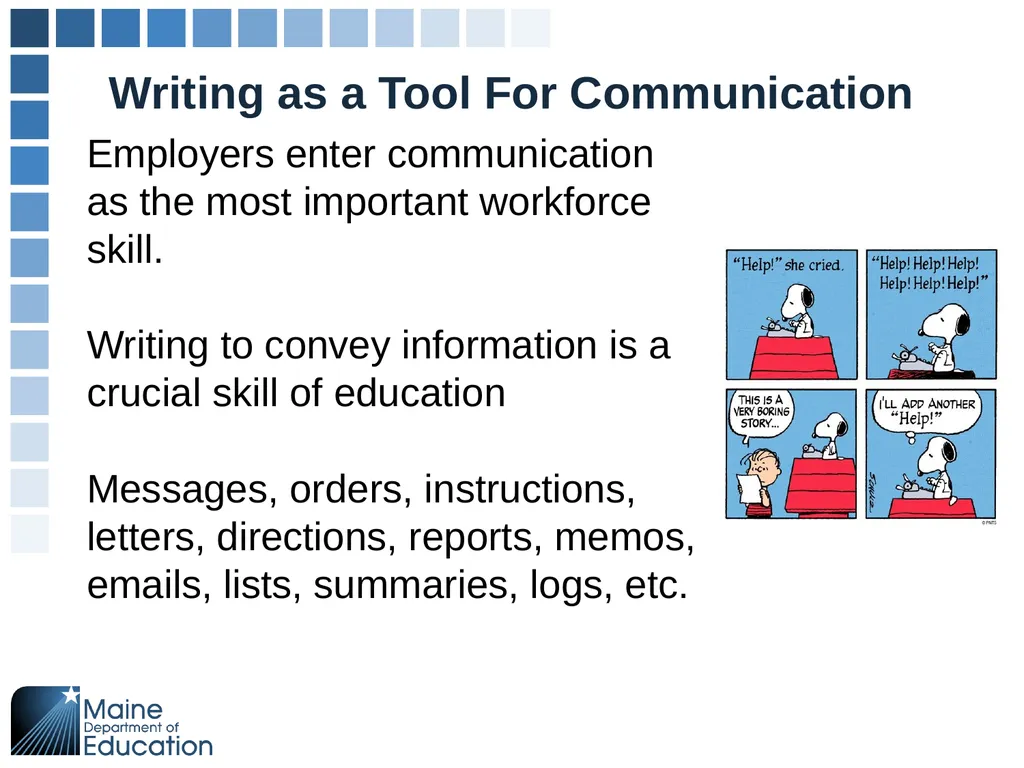
Writing as a Tool For Communication Employers enter communication as the most important workforce skill.
Writing to convey information is a crucial skill of education
Messages, orders, instructions, letters, directions, reports, memos, emails, lists, summaries, logs, etc.<br>
05
Writing Stamina Student ability to focus and write for extended periods of time without becoming distracted or giving up.
Generally writing stamina becomes stronger as the physical act of foundational skills becomes less mentally taxing and the ability to write for extended periods of time increases.<br>
06
Writing Across All Disciplines Writing requires thinking -
Clarify content
Clearly express content ideas
Give rationale for understanding of content
Narrow and formatively assess confusions<br>
07
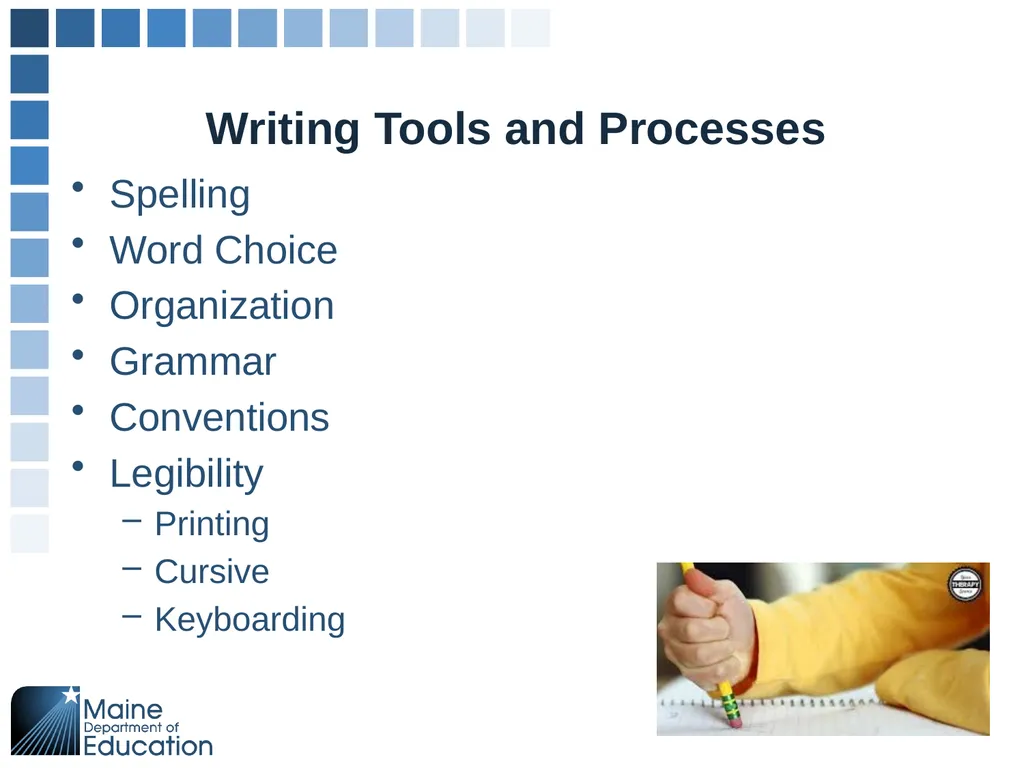
Writing Tools and Processes Spelling
Word Choice
Organization
Grammar
Conventions
Legibility
Printing
Cursive
Keyboarding<br>
08
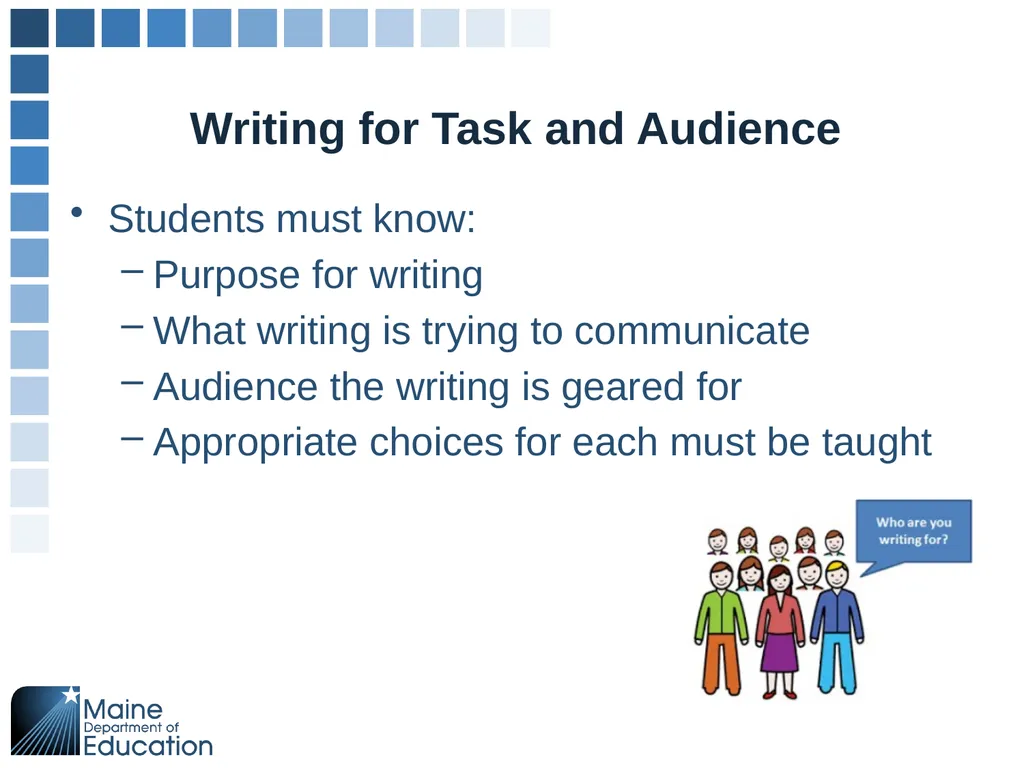
Writing for Task and Audience Students must know:
Purpose for writing
What writing is trying to communicate
Audience the writing is geared for
Appropriate choices for each must be taught<br>
09
Determine the Struggle of the Writer Ideas
“I don’t know what to write about.”
“I don’t have anything to say.”
Organization
“I don’t know how to start.”
“I’m done.”
Writing Refusal or Disengagement
“I can’t.
“This is dumb. I hate writing”<br>
10
Supporting Writers What Work Clearinghouse (2018) Recommendations for Teaching Elementary School Students to Become Effective Writers
1. Write daily
2. Teach writing process
3. Teach variety of purposes for writing
Teach fluency in handwriting, spelling, sentence construction and word processing.
Engage writers in high interest writing tasks<br>
11
Write Daily Ideas –
Pre-writing
Brainstorm or free write
Use a book or illustration for inspiration
Discussions – share ideas orally
Teacher models
Graphic organizers
Write collaboratively
Use sentence starters or framed paragraphs<br>
12
Write Daily Organization
Break down into smaller pieces that are more simple
Graphic organizers
Teacher models
Guided writing
Small, focused lessons on one area of writing<br>
13
Write Daily Motivation
Vary purpose, task and audience
Vary mode
Vary content
Small or individual writing conferences with concise feedback
Small celebrations
Make writing tasks relevant to students
Develop background knowledge
Publish and share writing
Share the pen<br>
14
Writing Process Planning –
Brainstorm - graphic organizers to number and sort
Brainstorm – narrow to main idea and develop
Ask, Reflect, Text – WWW questions, image and add text
TREE -
Tell what you believe
3 Reasons why
Explain/examine each reason
End writing
POW –
Pick Ideas (decide what to write about)
Organize notes into a plan
Write and expand ideas<br>
15
Writing Process Draft –
Keep it to very short parts
Focus on one aspect (i.e. strong topic sentences)
Give models
Share the pen
Share –
Share into tape recorder
Share with peer – practice giving constructive feedback<br>
16
Writing Process Evaluate
Teach students to self-evaluate and question – Are my ideas clear? Does my writing match my task, purpose and audience?
Celebrate self-evaluation and reflection
Share feedback
Encourage students independence
Revise & Edit
Lots of planning and talk
Word processing
Tools to simplify<br>
17
Varied Writing Purposes RAFT
Role of the Writer: Who or what are you as the writer? A pilgrim? A soldier? The President?
Audience: To whom are you writing? A friend? Your teacher? Readers of a newspaper?
Format: In what format are you writing? A letter? A poem? A speech?
Topic and strong verb: What are you writing about? Why? What's the subject or the point?<br>
18
Ideas for Writing Purpose Describe
Place or a thing
Character
Nature or science observations
Experiences
Feelings
Narrate
Diaries and journals
Eyewitness accounts
News and events
Short stories<br>
19
Ideas for Writing Purpose (cont.) Inform
Summarize new learning
Directions
Instructions
Letters
News
Reports
Persuade
Editorials
Essays
Reviews
Analysis<br>
20
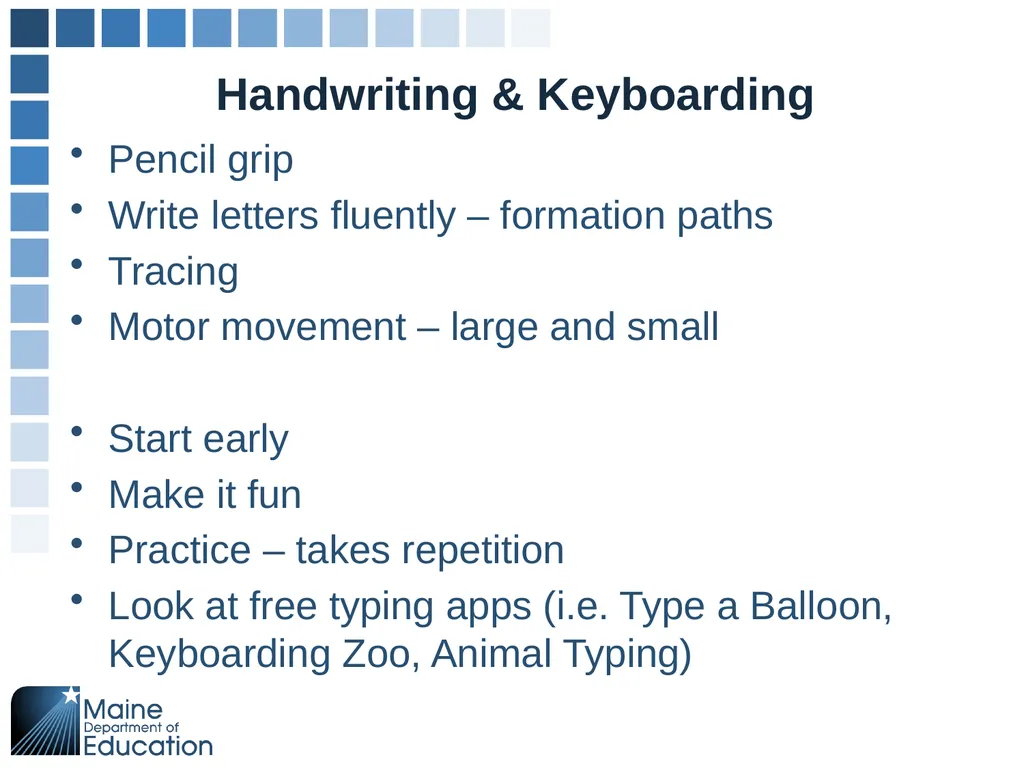
Handwriting & Keyboarding Pencil grip
Write letters fluently – formation paths
Tracing
Motor movement – large and small
Start early
Make it fun
Practice – takes repetition
Look at free typing apps (i.e. Type a Balloon, Keyboarding Zoo, Animal Typing)<br>
21
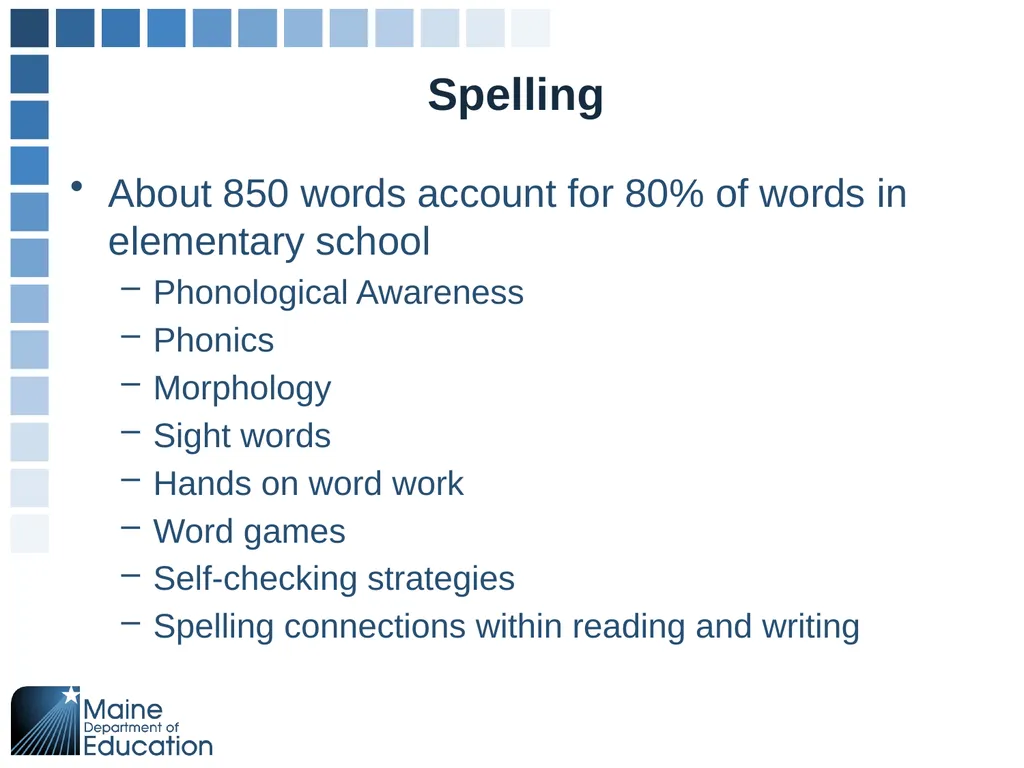
Spelling About 850 words account for 80% of words in elementary school
Phonological Awareness
Phonics
Morphology
Sight words
Hands on word work
Word games
Self-checking strategies
Spelling connections within reading and writing<br>
22
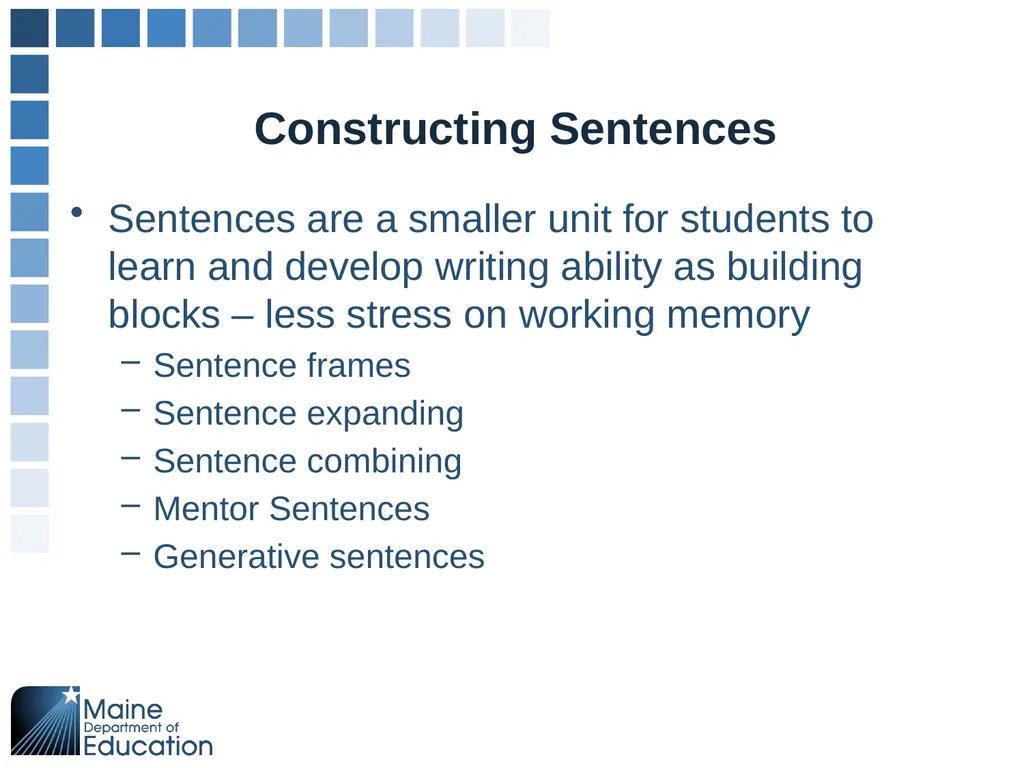
Constructing Sentences Sentences are a smaller unit for students to learn and develop writing ability as building blocks – less stress on working memory
Sentence frames
Sentence expanding
Sentence combining
Mentor Sentences
Generative sentences<br>
23
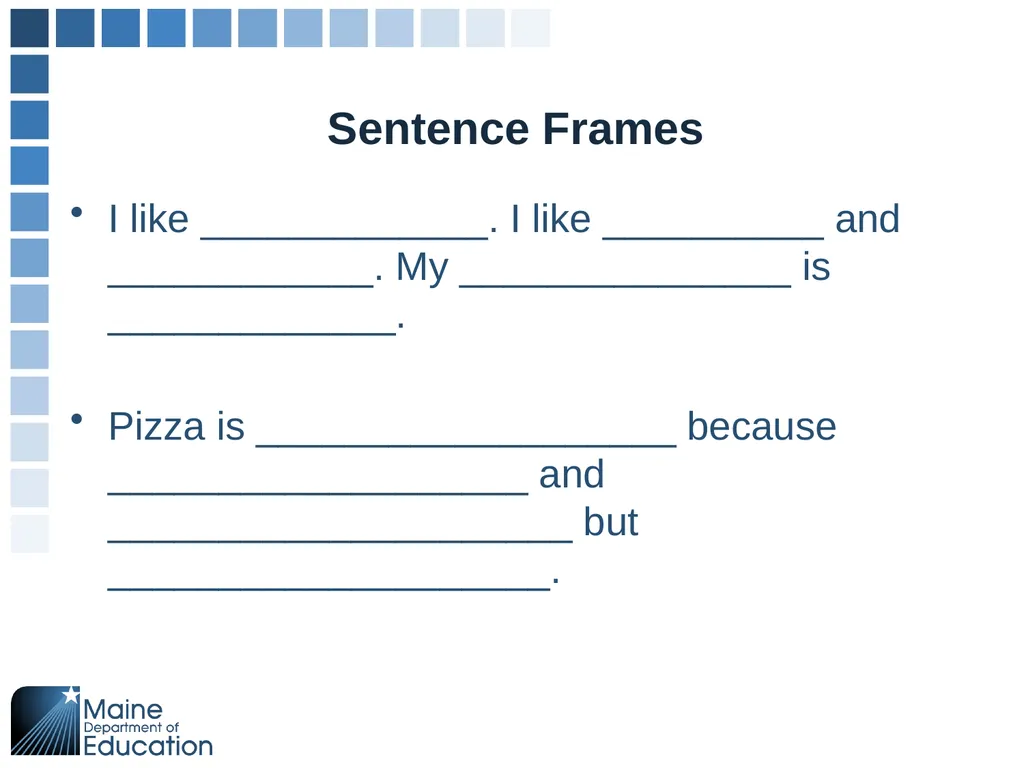
Sentence Frames I like _____________. I like __________ and ____________. My _______________ is _____________.
Pizza is ___________________ because ___________________ and _____________________ but ____________________.<br>
24
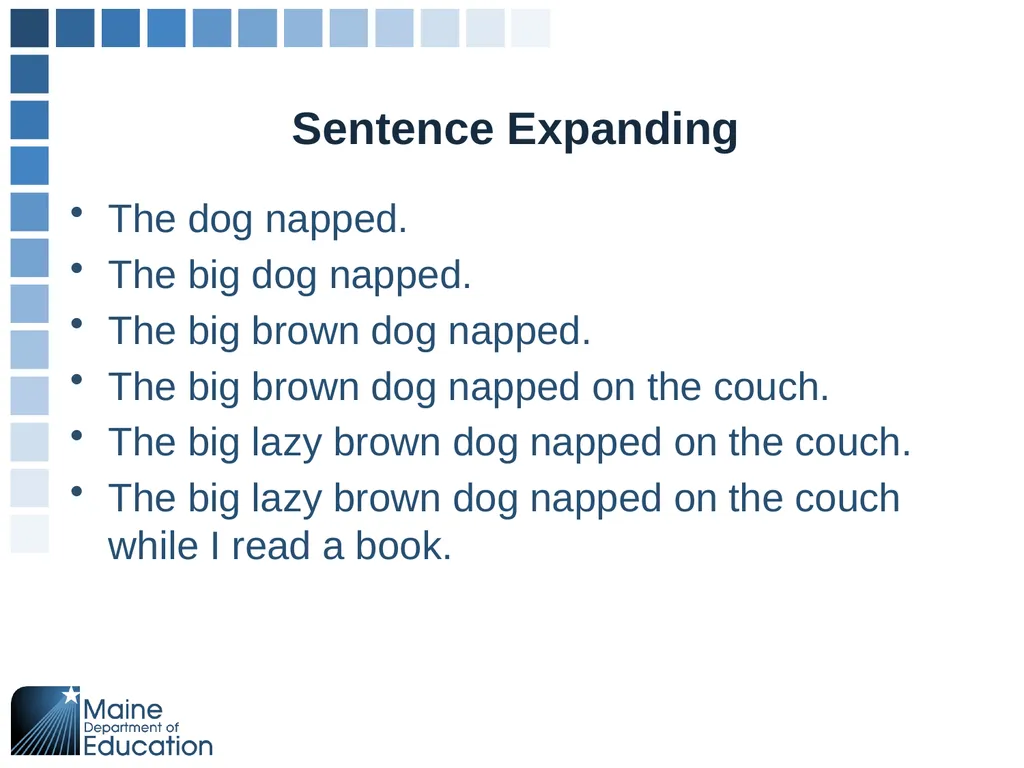
Sentence Expanding The dog napped.
The big dog napped.
The big brown dog napped.
The big brown dog napped on the couch.
The big lazy brown dog napped on the couch.
The big lazy brown dog napped on the couch while I read a book.<br>
25
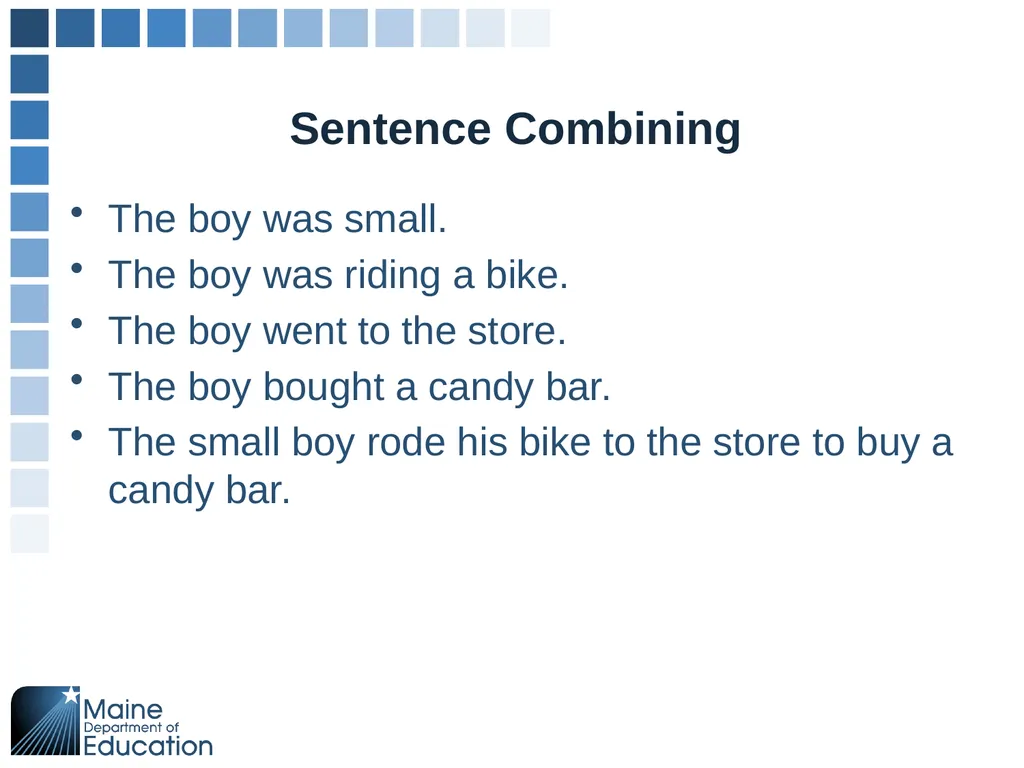
Sentence Combining The boy was small.
The boy was riding a bike.
The boy went to the store.
The boy bought a candy bar.
The small boy rode his bike to the store to buy a candy bar.<br>
26
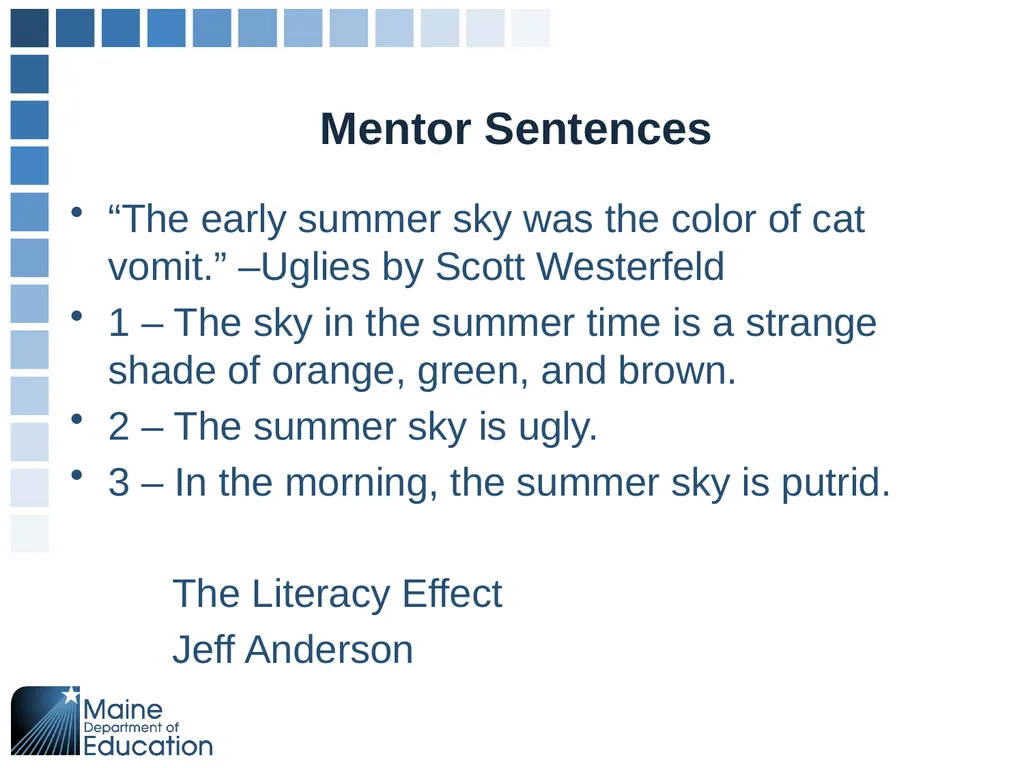
Mentor Sentences “The early summer sky was the color of cat vomit.” –Uglies by Scott Westerfeld
1 – The sky in the summer time is a strange shade of orange, green, and brown.
2 – The summer sky is ugly.
3 – In the morning, the summer sky is putrid.
The Literacy Effect
Jeff Anderson<br>
27
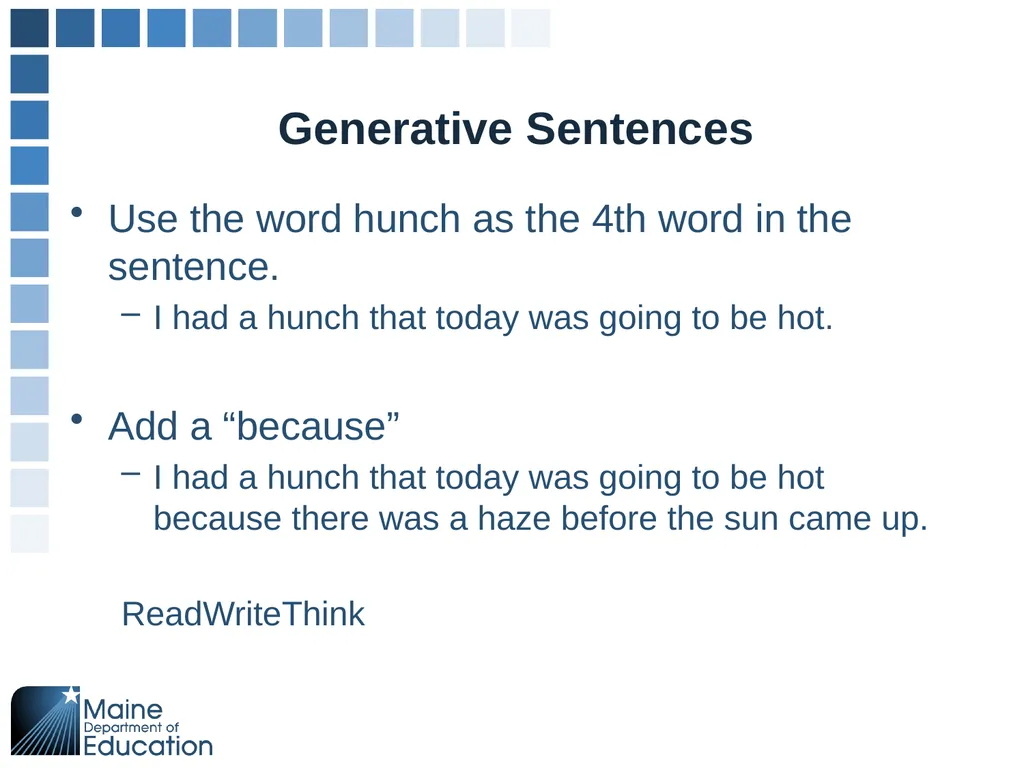
Generative Sentences Use the word hunch as the 4th word in the sentence.
I had a hunch that today was going to be hot.
Add a “because”
I had a hunch that today was going to be hot because there was a haze before the sun came up.
ReadWriteThink<br>
28
High Interest Writing Tasks Model and share your own writing as an adult
Have deep conversations and Think Alouds as a start to recording thoughts and ideas in print
Connect writing to background knowledge and authentic experiences – hands on learning
Allow students to develop writing together
Keep authenticity at the forefront – task, audience and purpose.
Provide immediate feedback<br>
29
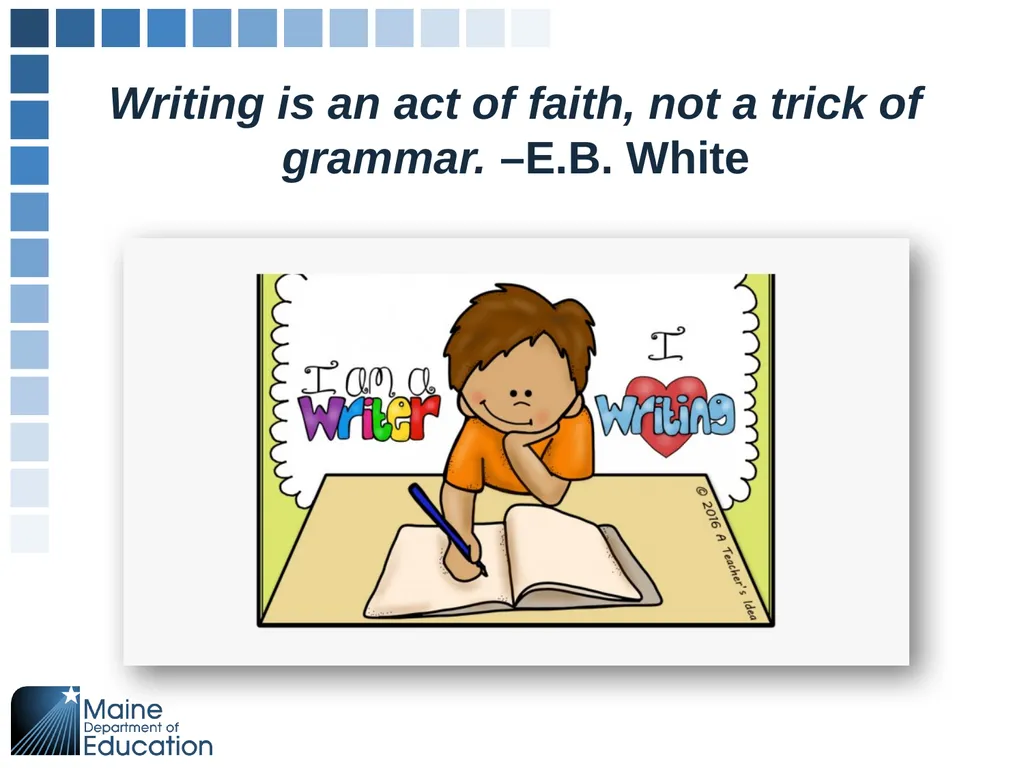
Writing is an act of faith, not a trick of grammar. –E.B. White<br>
30
Thank You https://bit.ly/36DIbyB
If you need any additional assistance or information please email me
danielle.m.saucier@maine.gov<br>