
Supporting Social Inclusion and Advocacy Module 7
DJ
Published · 40 slides · 0 views

1 / 1
Description
Supporting Social Inclusion and Advocacy Module 7 2 Recovery management Module 7 Outline Core principle Supporting Social Inclusion and Advocacy Recovery management 3 4 Recovery management Why Focus on Supporting Social Inclusion and
Related Topics
Share
Embed code
Download this presentation From Below
"Supporting Social Inclusion and Advocacy Module 7" is the property of its rightful owner. Permission is granted to download and print the materials on this website for personal, non-commercial use only, and to display it on your personal computer provided you do not modify the materials and that you retain all copyright notices contained in the materials. By downloading content from our website, you accept the terms of this agreement.
Presentation Transcript
01
Supporting Social Inclusion and Advocacy Module 7<br>
02
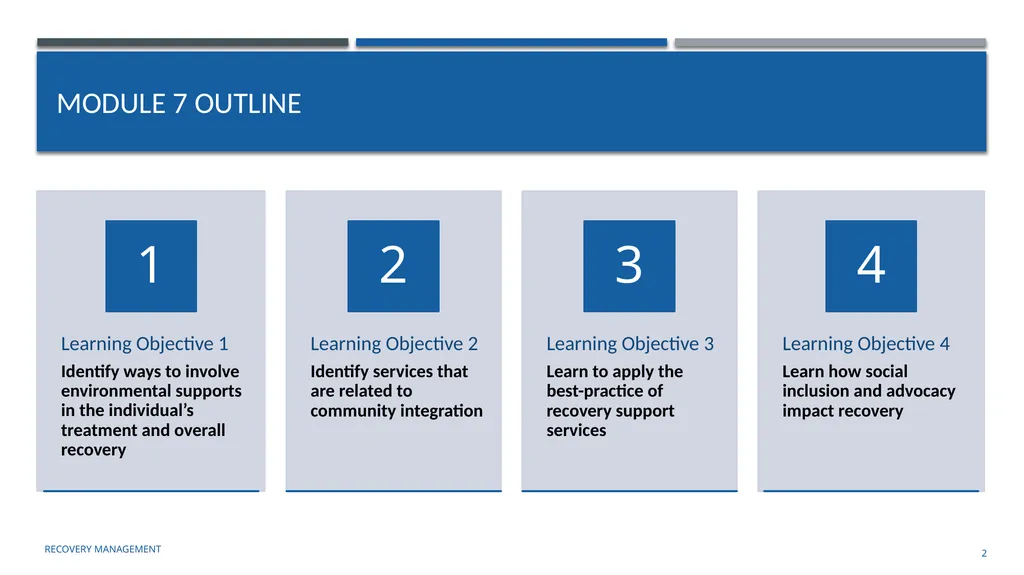
2 Recovery management Module 7 Outline<br>
03
Core principle Supporting Social Inclusion and Advocacy Recovery management 3<br>
04
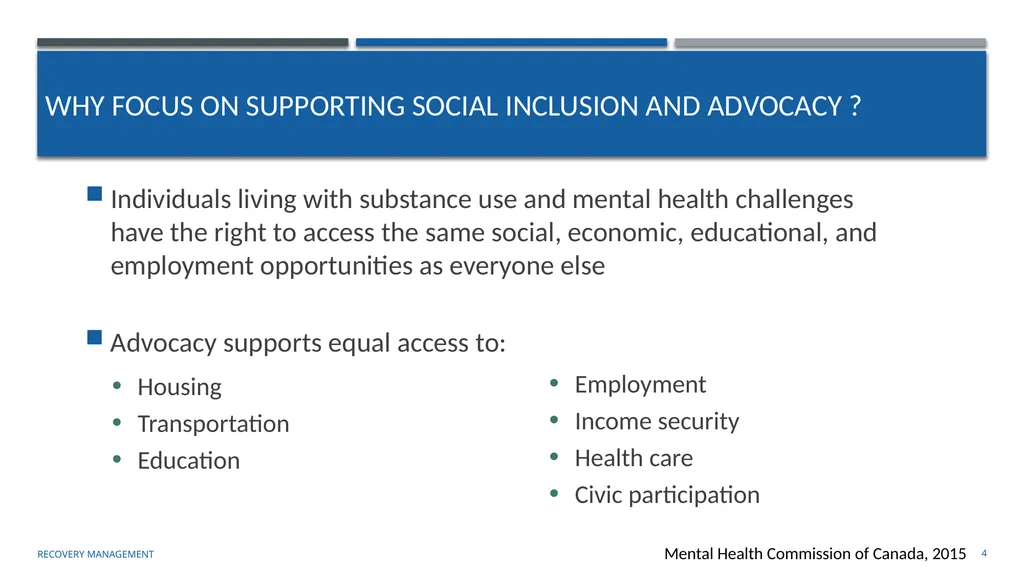
4 Recovery management Why Focus on Supporting Social Inclusion and Advocacy ? Individuals living with substance use and mental health challenges have the right to access the same social, economic, educational, and employment opportunities as everyone else Mental Health Commission of Canada, 2015 Advocacy supports equal access to:
Housing
Transportation
Education
Employment
Income security
Health care
Civic participation<br>
Housing
Transportation
Education
Employment
Income security
Health care
Civic participation<br>
05
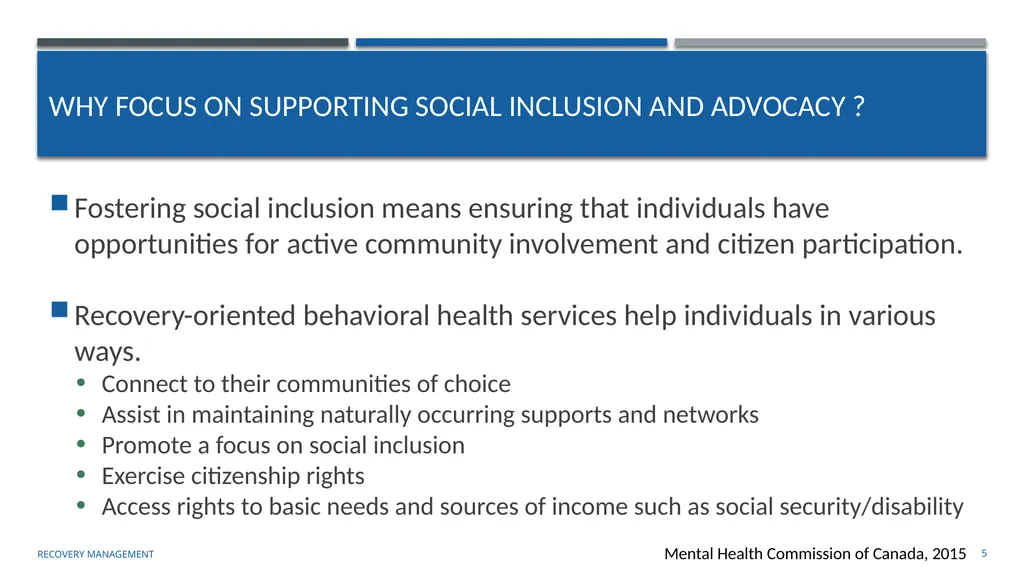
5 Recovery management Why Focus on Supporting Social Inclusion and Advocacy ? Fostering social inclusion means ensuring that individuals have opportunities for active community involvement and citizen participation.
Recovery-oriented behavioral health services help individuals in various ways.
Connect to their communities of choice
Assist in maintaining naturally occurring supports and networks
Promote a focus on social inclusion
Exercise citizenship rights
Access rights to basic needs and sources of income such as social security/disability Mental Health Commission of Canada, 2015<br>
06
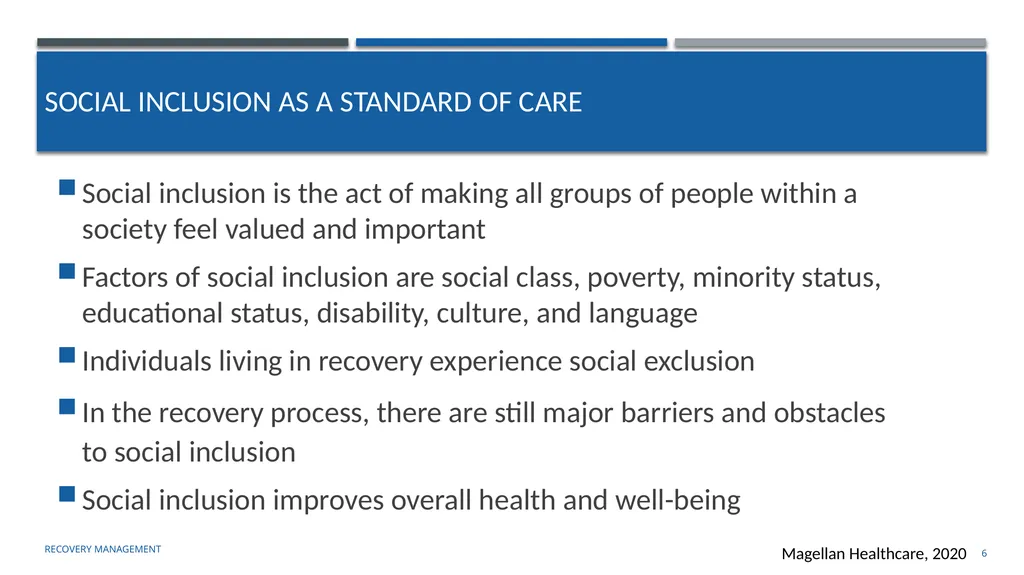
6 Recovery management Social inclusion as a standard of care Social inclusion is the act of making all groups of people within a society feel valued and important
Factors of social inclusion are social class, poverty, minority status, educational status, disability, culture, and language
Individuals living in recovery experience social exclusion
In the recovery process, there are still major barriers and obstacles to social inclusion
Social inclusion improves overall health and well-being Magellan Healthcare, 2020<br>
07
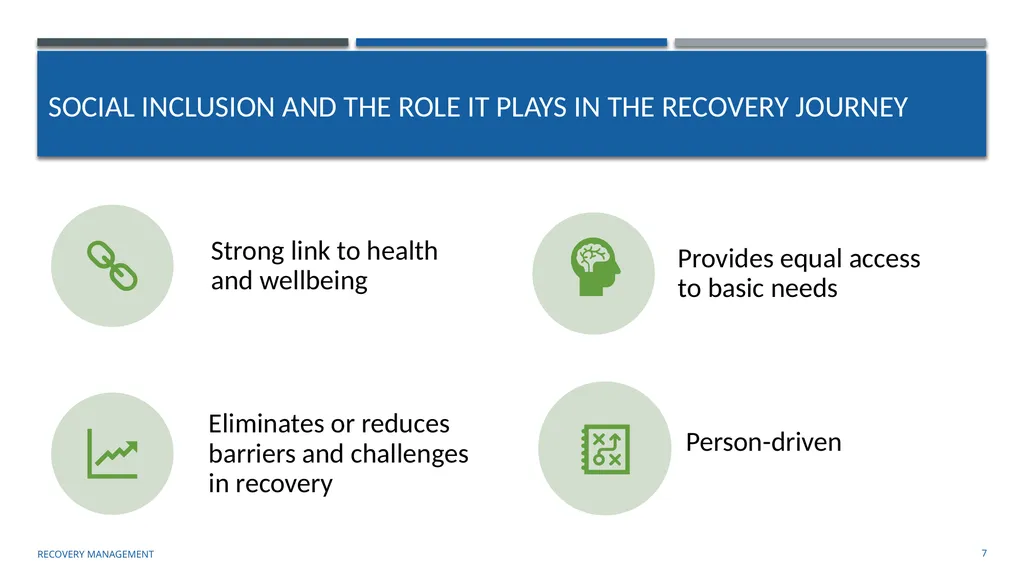
7 Recovery management social inclusion and the role it plays in the recovery journey<br>
08
Values & attitudes Supporting Social Inclusion and Advocacy Recovery management 8<br>
09
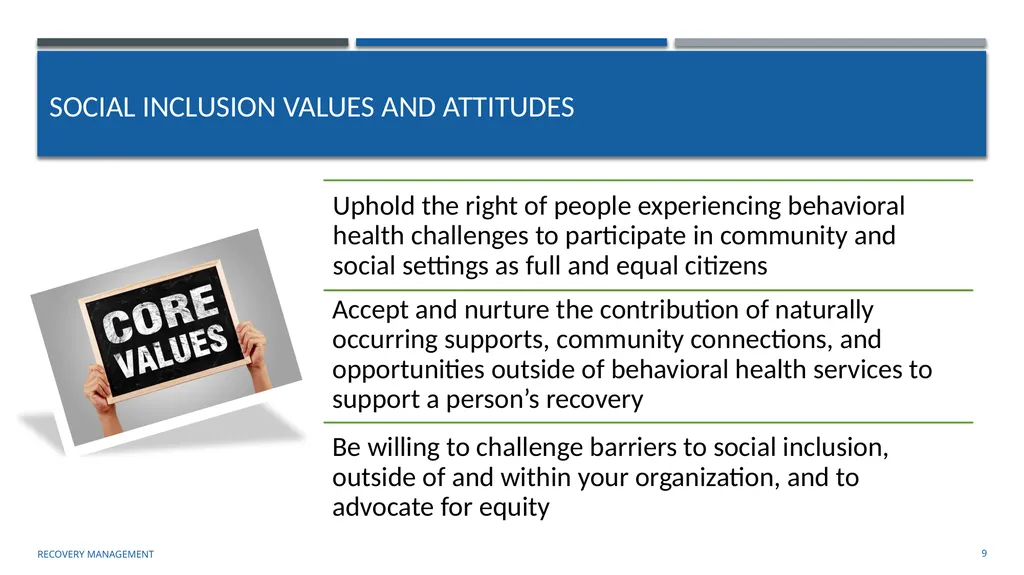
9 Recovery management Social inclusion Values and attitudes<br>
10
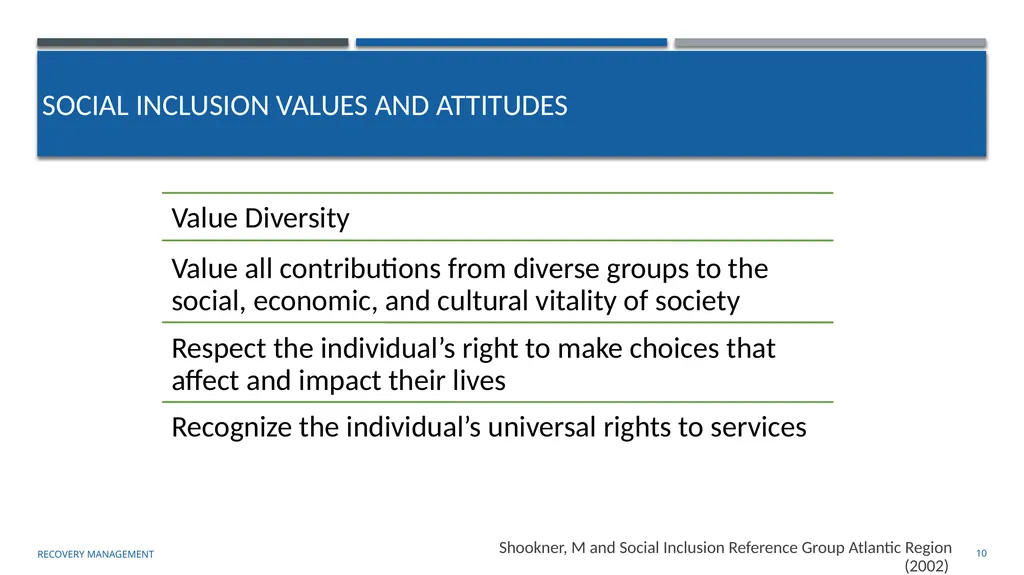
10 Recovery management Social inclusion Values and attitudes Shookner, M and Social Inclusion Reference Group Atlantic Region (2002)<br>
11
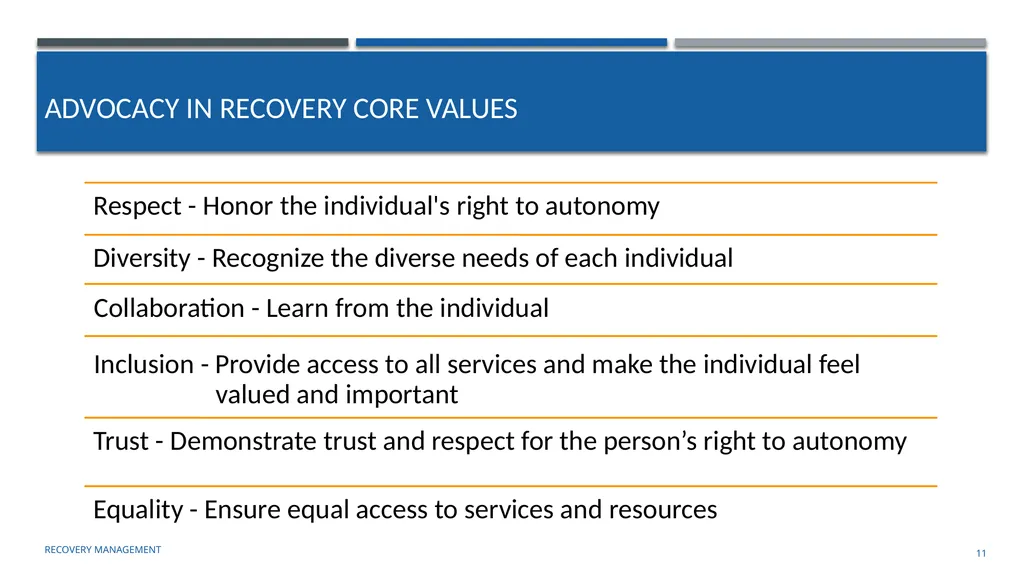
11 Recovery management advocacy in recovery core values<br>
12
What we know Supporting Social Inclusion and Advocacy Recovery management 12<br>
13
13 Recovery management Needed Knowledge base Understanding certain concepts is necessary to put into practice Supporting Social Inclusion and Advocacy.
Know how to apply the Inclusion Lens
Recognize the universal right of inclusion
Understand the concepts of diversity, inclusion, equity, and autonomy<br>
Know how to apply the Inclusion Lens
Recognize the universal right of inclusion
Understand the concepts of diversity, inclusion, equity, and autonomy<br>
14
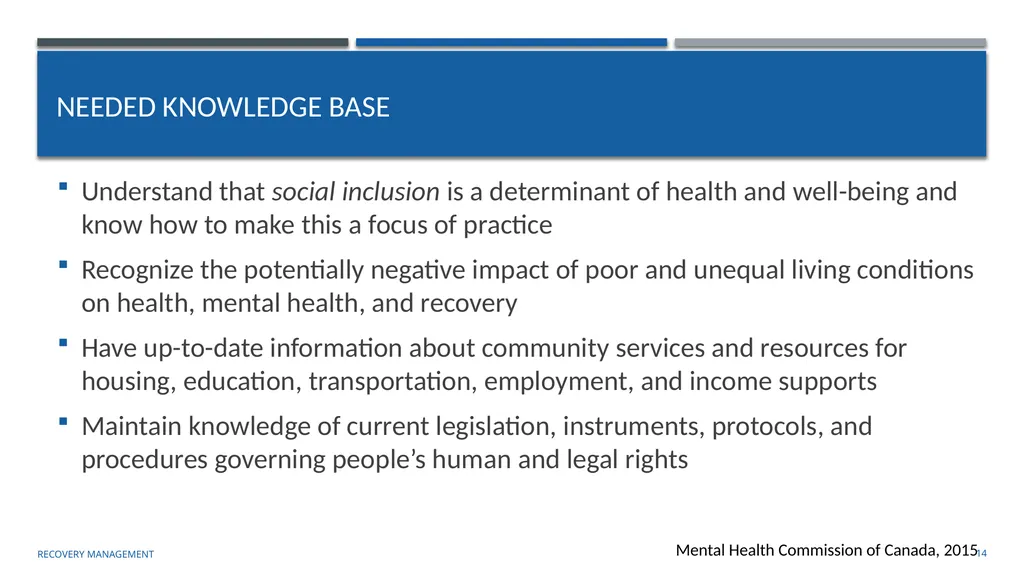
14 Recovery management Needed Knowledge base Understand that social inclusion is a determinant of health and well-being and know how to make this a focus of practice
Recognize the potentially negative impact of poor and unequal living conditions on health, mental health, and recovery
Have up-to-date information about community services and resources for housing, education, transportation, employment, and income supports
Maintain knowledge of current legislation, instruments, protocols, and procedures governing people’s human and legal rights Mental Health Commission of Canada, 2015<br>
15
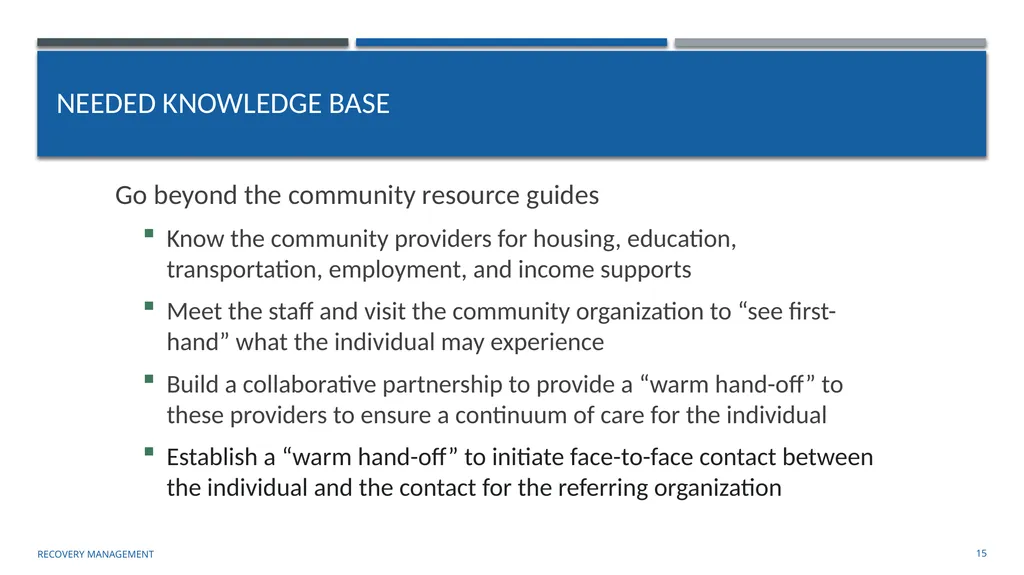
15 Recovery management Needed Knowledge base Go beyond the community resource guides
Know the community providers for housing, education, transportation, employment, and income supports
Meet the staff and visit the community organization to “see first-hand” what the individual may experience
Build a collaborative partnership to provide a “warm hand-off” to these providers to ensure a continuum of care for the individual
Establish a “warm hand-off” to initiate face-to-face contact between the individual and the contact for the referring organization<br>
16
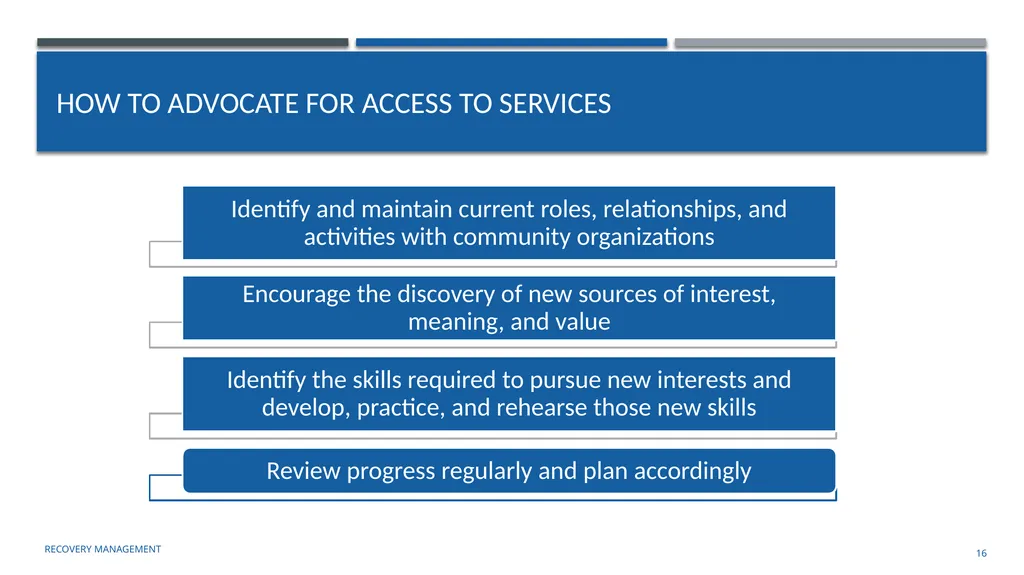
16 Recovery management HOW TO ADVOCATE FOR ACCESS TO SERVICES<br>
17
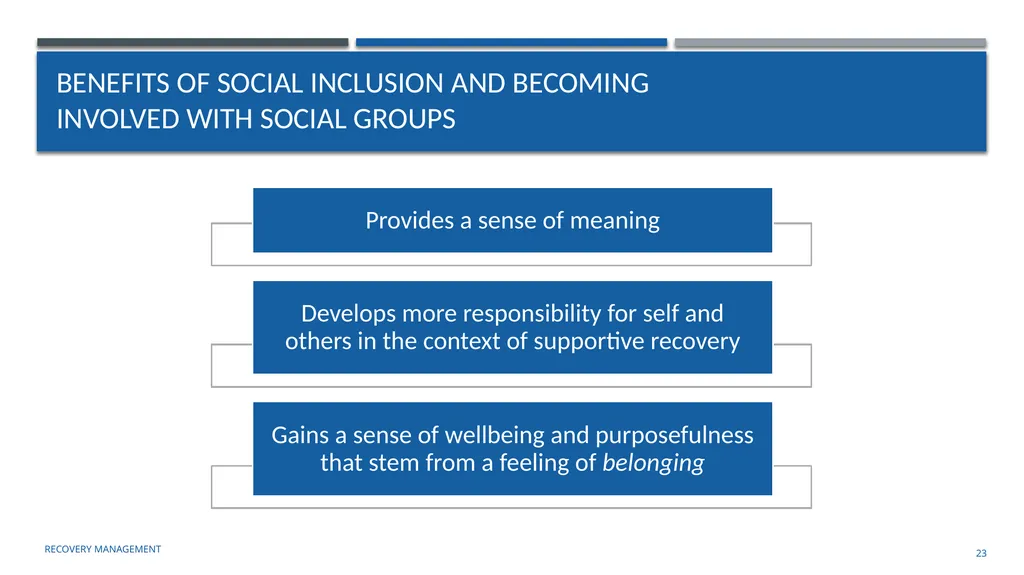
17 Recovery management Community Partnerships foster social inclusion Becoming involved with social groups offers a sense of meaning
Motivating individuals to engage and befriend other group members, provides a sense of wellbeing, purpose, and belonging.
Forging connections with others hope, healing, and empowerment (Buckingham et.al, 2017)<br>
Motivating individuals to engage and befriend other group members, provides a sense of wellbeing, purpose, and belonging.
Forging connections with others hope, healing, and empowerment (Buckingham et.al, 2017)<br>
18
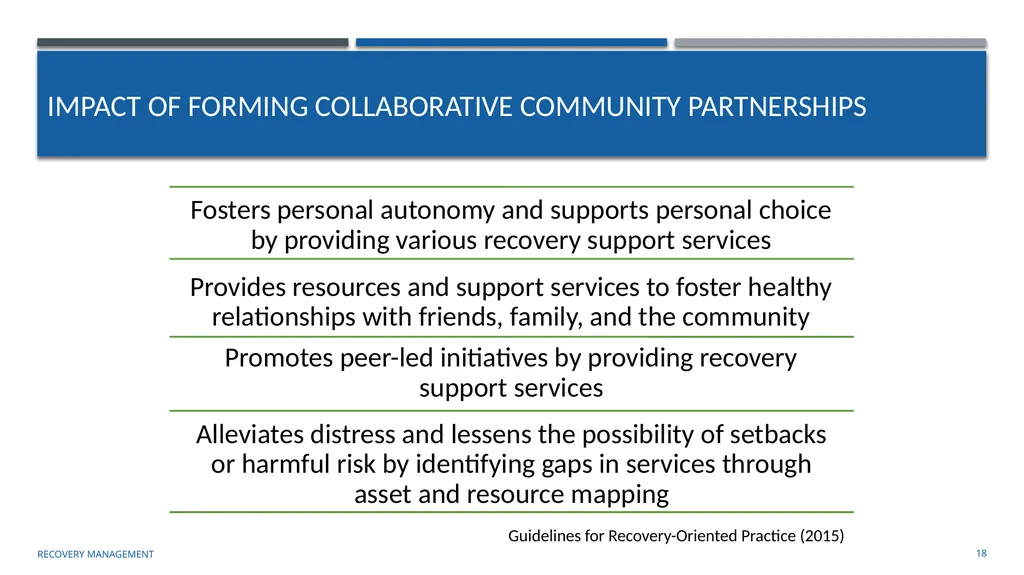
18 Recovery management impact of forming collaborative community partnerships<br>
19
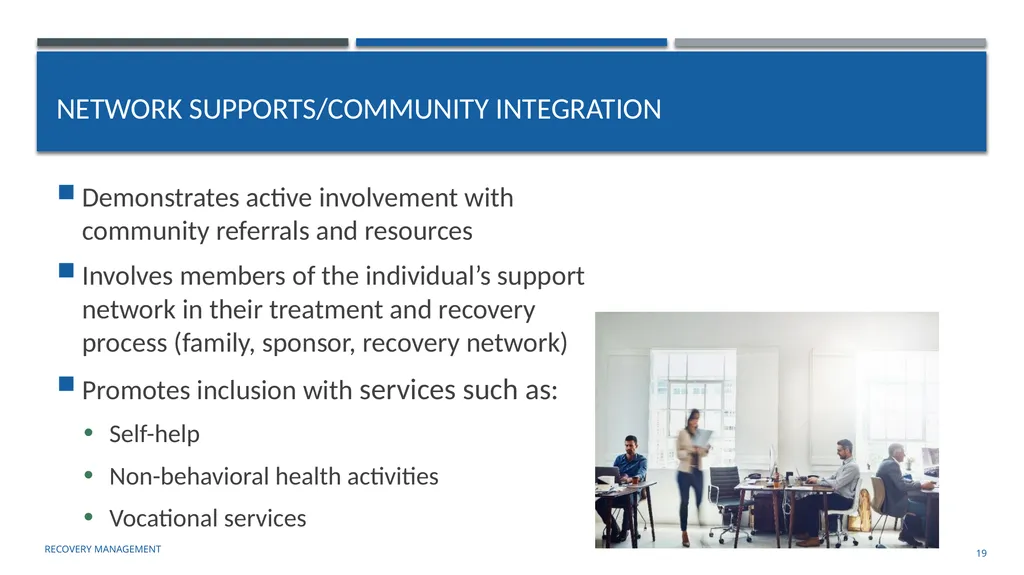
19 Recovery management Network Supports/Community Integration Demonstrates active involvement with community referrals and resources
Involves members of the individual’s support network in their treatment and recovery process (family, sponsor, recovery network)
Promotes inclusion with services such as:
Self-help
Non-behavioral health activities
Vocational services<br>
Involves members of the individual’s support network in their treatment and recovery process (family, sponsor, recovery network)
Promotes inclusion with services such as:
Self-help
Non-behavioral health activities
Vocational services<br>
20
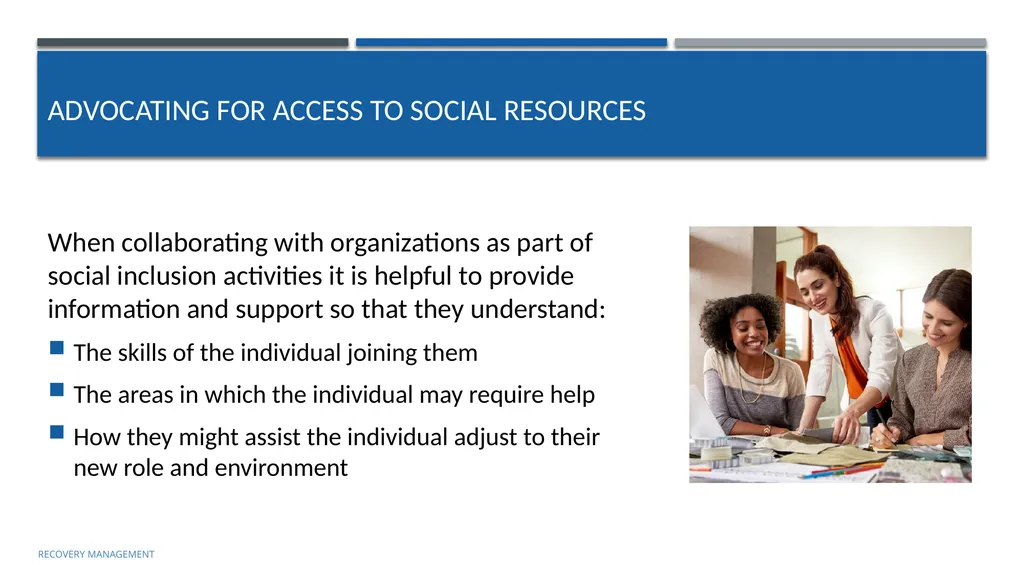
Advocating for Access to social Resources When collaborating with organizations as part of social inclusion activities it is helpful to provide information and support so that they understand:
The skills of the individual joining them
The areas in which the individual may require help
How they might assist the individual adjust to their new role and environment Recovery Management 20<br>
The skills of the individual joining them
The areas in which the individual may require help
How they might assist the individual adjust to their new role and environment Recovery Management 20<br>
21
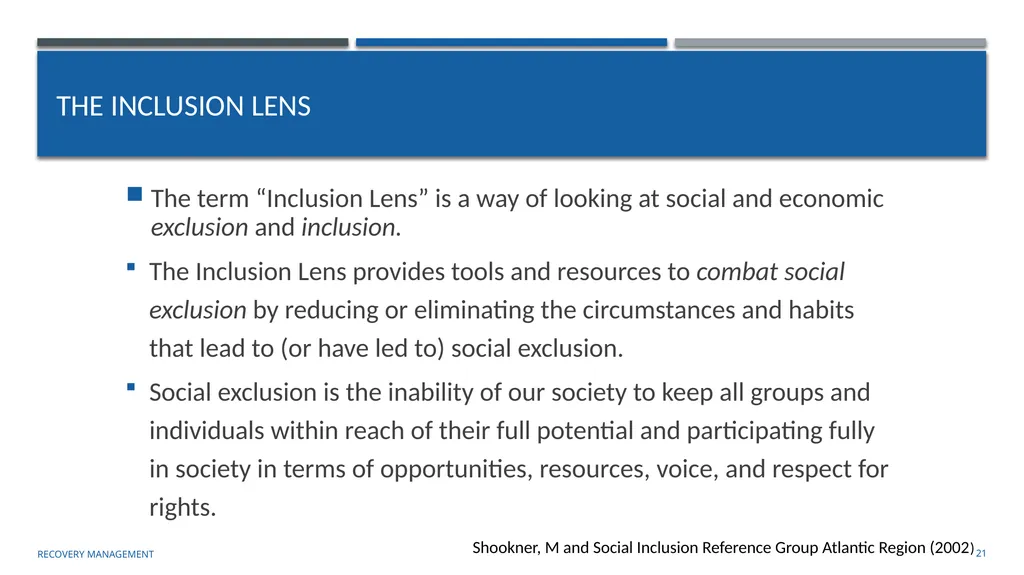
21 Recovery management The Inclusion Lens The term “Inclusion Lens” is a way of looking at social and economic exclusion and inclusion.
The Inclusion Lens provides tools and resources to combat social exclusion by reducing or eliminating the circumstances and habits that lead to (or have led to) social exclusion.
Social exclusion is the inability of our society to keep all groups and individuals within reach of their full potential and participating fully in society in terms of opportunities, resources, voice, and respect for rights. Shookner, M and Social Inclusion Reference Group Atlantic Region (2002)<br>
22
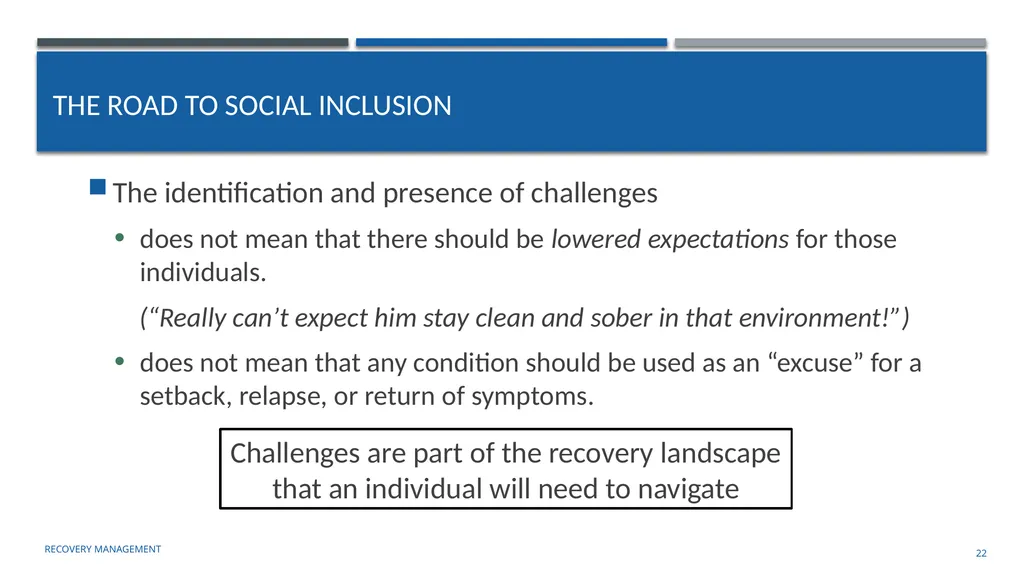
22 Recovery management The road to Social Inclusion The identification and presence of challenges
does not mean that there should be lowered expectations for those individuals.
(“Really can’t expect him stay clean and sober in that environment!”)
does not mean that any condition should be used as an “excuse” for a setback, relapse, or return of symptoms. Challenges are part of the recovery landscape that an individual will need to navigate<br>
23
23 Recovery management Benefits of Social Inclusion and Becoming involved with social groups<br>
24
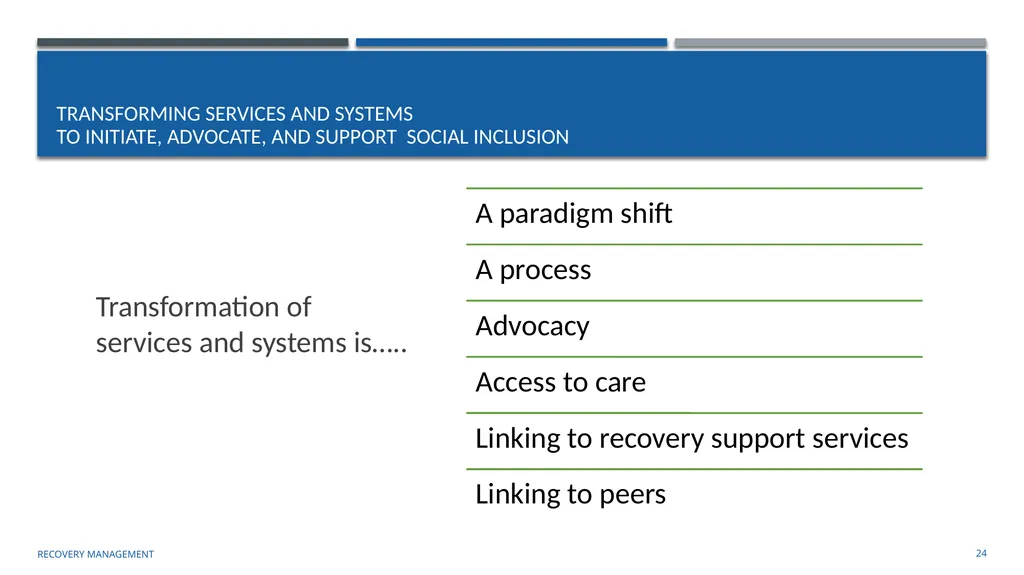
24 Recovery Management Transforming services and systems
To Initiate, Advocate, and Support Social Inclusion Transformation of services and systems is…..<br>
25
25 Recovery Management Transforming services and systems To Initiate, Advocate, and Support Social Inclusion is working together Guideline for Recovery-Oriented Practice (2015) Guidelines for Recovery-Oriented Practice (2015)<br>
26
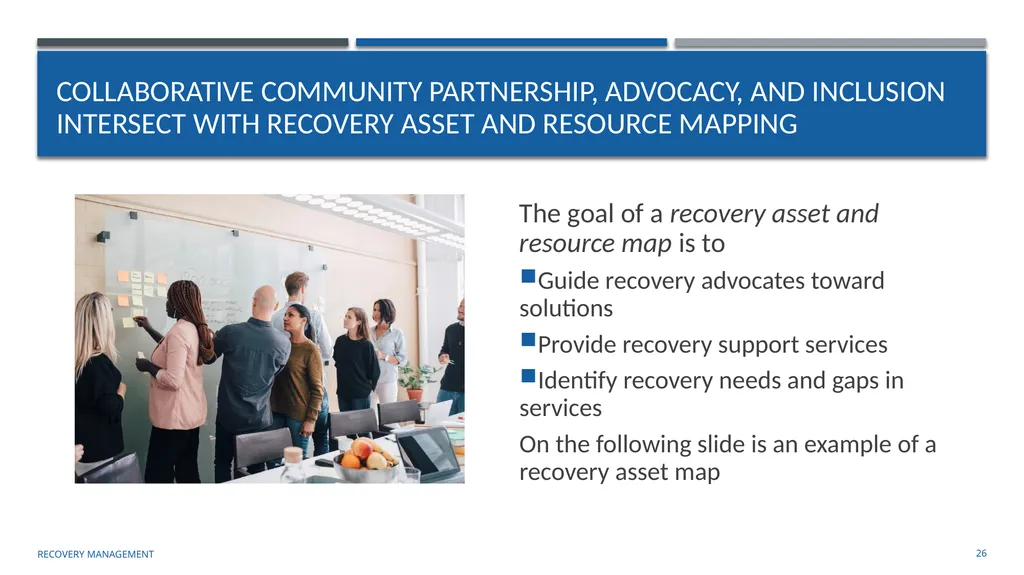
26 Recovery management Collaborative Community Partnership, Advocacy, and Inclusion Intersect with Recovery Asset and Resource Mapping The goal of a recovery asset and resource map is to
Guide recovery advocates toward solutions
Provide recovery support services
Identify recovery needs and gaps in services
On the following slide is an example of a recovery asset map<br>
Guide recovery advocates toward solutions
Provide recovery support services
Identify recovery needs and gaps in services
On the following slide is an example of a recovery asset map<br>
27
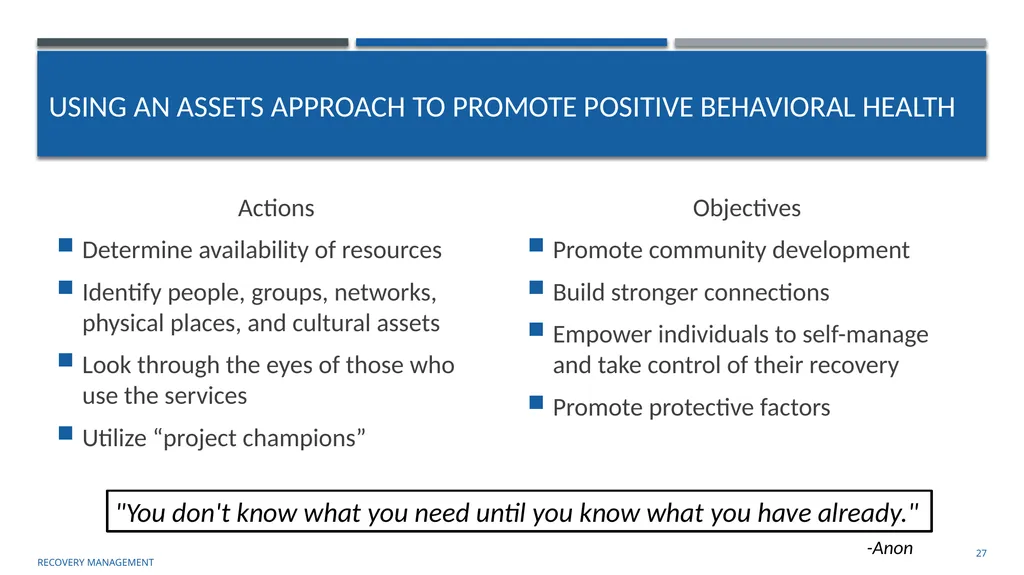
27 Recovery management Using an assets approach to promote positive behavioral health Actions
Determine availability of resources
Identify people, groups, networks, physical places, and cultural assets
Look through the eyes of those who use the services
Utilize “project champions” Objectives
Promote community development
Build stronger connections
Empower individuals to self-manage and take control of their recovery
Promote protective factors -Anon "You don't know what you need until you know what you have already."<br>
28
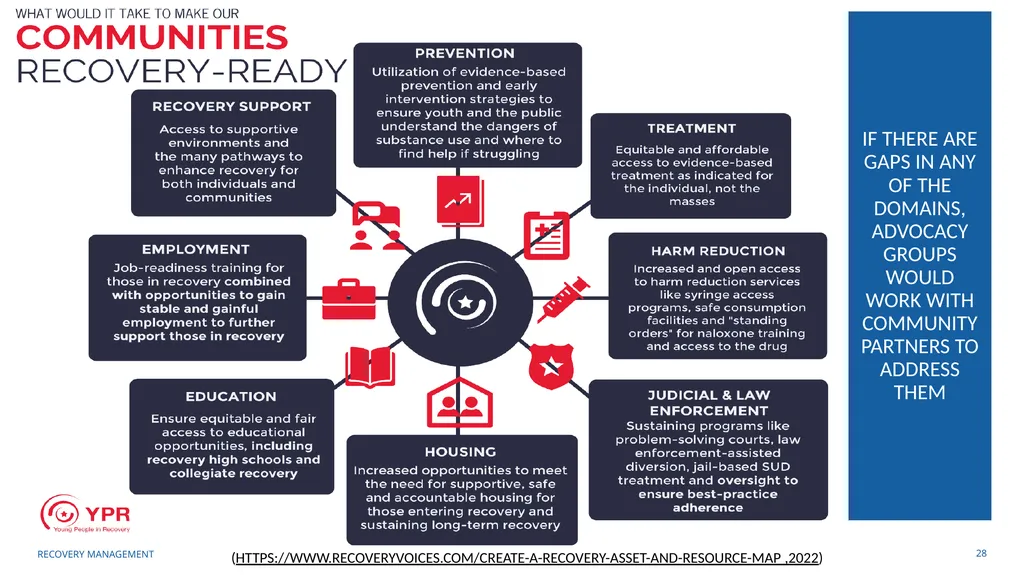
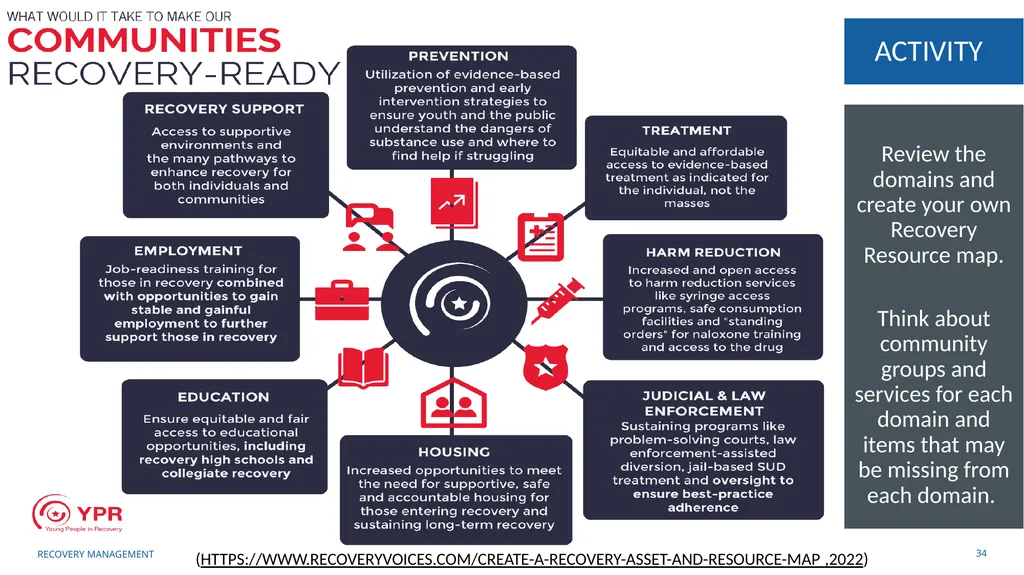
If there are gaps in any of the domains, advocacy groups would work with community partners to address thEM Recovery management 28 (https://www.recoveryvoices.com/create-a-recovery-asset-and-resource-map ,2022)<br>
29
Application to practice Supporting Social Inclusion and Advocacy Recovery management 29<br>
30
30 Recovery management Skills and Behaviors required for Social Inclusion and Advocacy Proactively draw attention to disparities, and work alongside people with lived experience and through community partnerships to mitigate disparities
Use knowledge of human and legal rights and systems operations to challenge social exclusion Initiate discussion of recovery goals, and make referrals to services and resources that contribute to:
meaningful social engagement
education and employment opportunities
income security
housing stability
food security
general health and well-being<br>
31
31 Recovery management Skills and Behaviors required for Social Inclusion and Advocacy Create culturally safe and responsive services
Develop working relationships with community organizations, corrections, and probation and parole services
Help people connect to a family physician or community health team to address ongoing general health needs and co-occurring medical conditions<br>
Develop working relationships with community organizations, corrections, and probation and parole services
Help people connect to a family physician or community health team to address ongoing general health needs and co-occurring medical conditions<br>
32
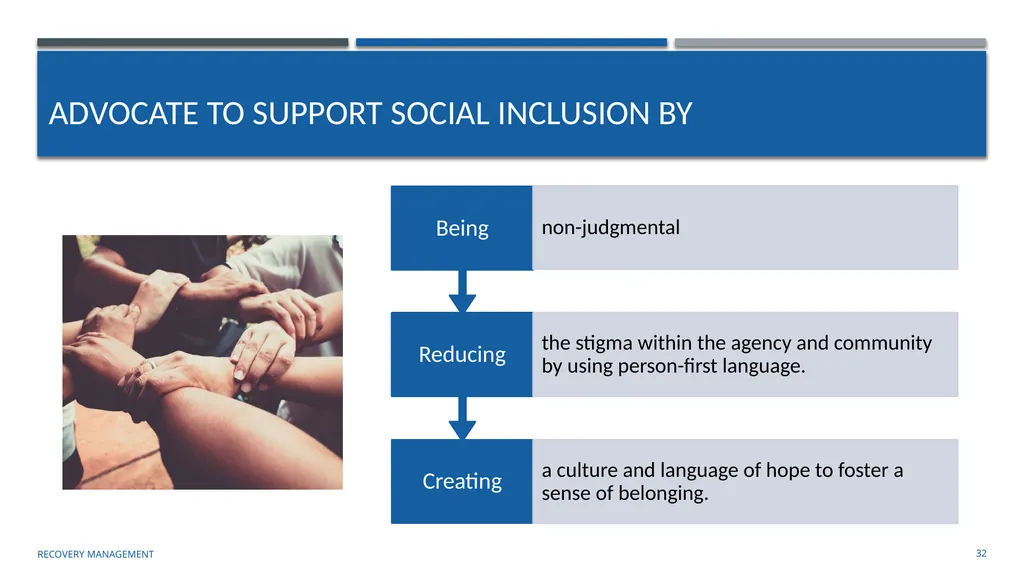
32 Recovery management Advocate To support social inclusion By<br>
33
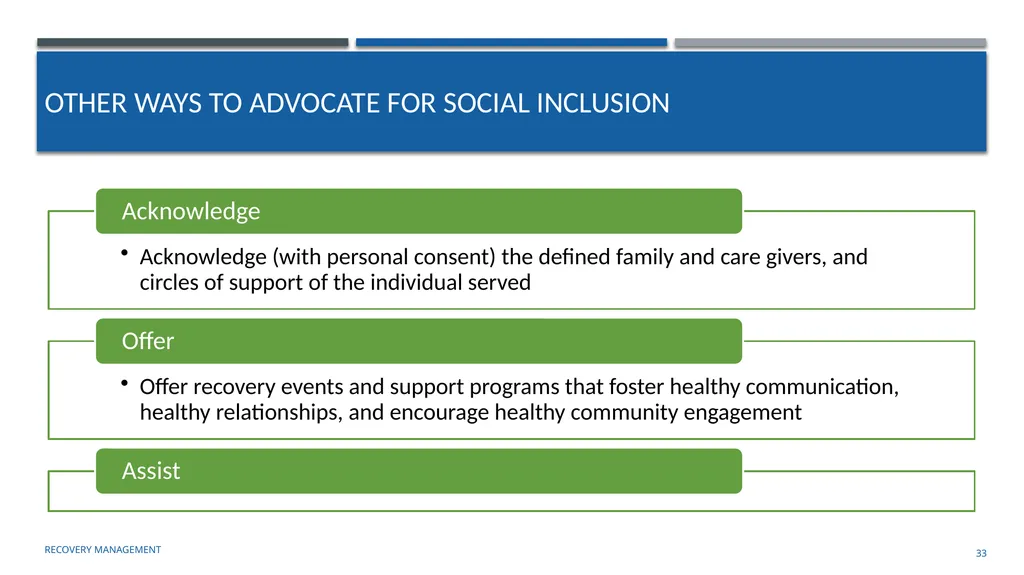
33 Recovery management Other ways to Advocate for social inclusion<br>
34
Review the domains and create your own Recovery Resource map.
Think about community groups and services for each domain and items that may be missing from each domain. Activity Recovery management 34 (https://www.recoveryvoices.com/create-a-recovery-asset-and-resource-map ,2022)<br>
Think about community groups and services for each domain and items that may be missing from each domain. Activity Recovery management 34 (https://www.recoveryvoices.com/create-a-recovery-asset-and-resource-map ,2022)<br>
35
Questions for Reflection Supporting Social Inclusion and Advocacy Recovery management 35<br>
36
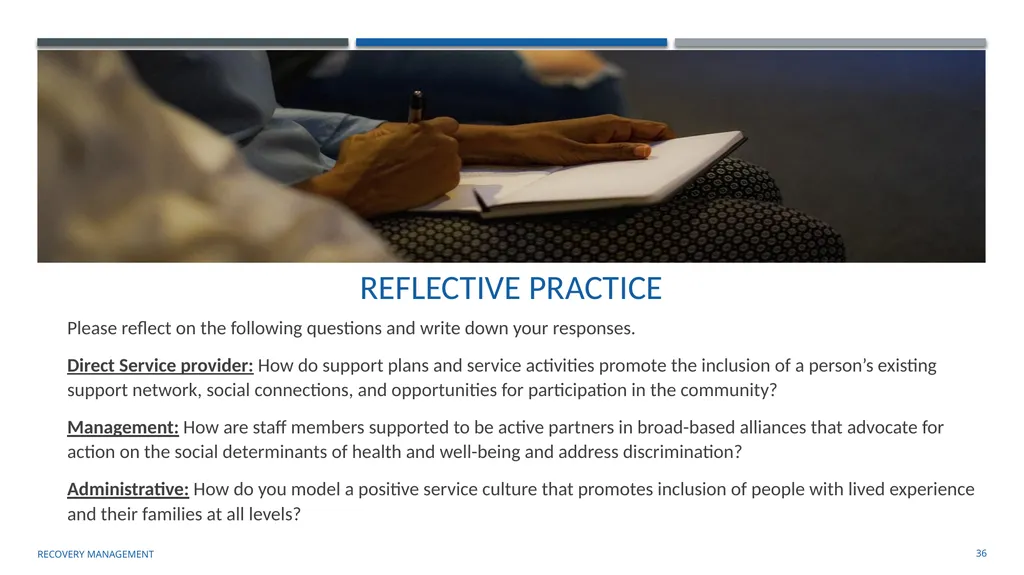
Reflective practice Please reflect on the following questions and write down your responses.
Direct Service provider: How do support plans and service activities promote the inclusion of a person’s existing support network, social connections, and opportunities for participation in the community?
Management: How are staff members supported to be active partners in broad-based alliances that advocate for action on the social determinants of health and well-being and address discrimination?
Administrative: How do you model a positive service culture that promotes inclusion of people with lived experience and their families at all levels? Recovery management 36<br>
37
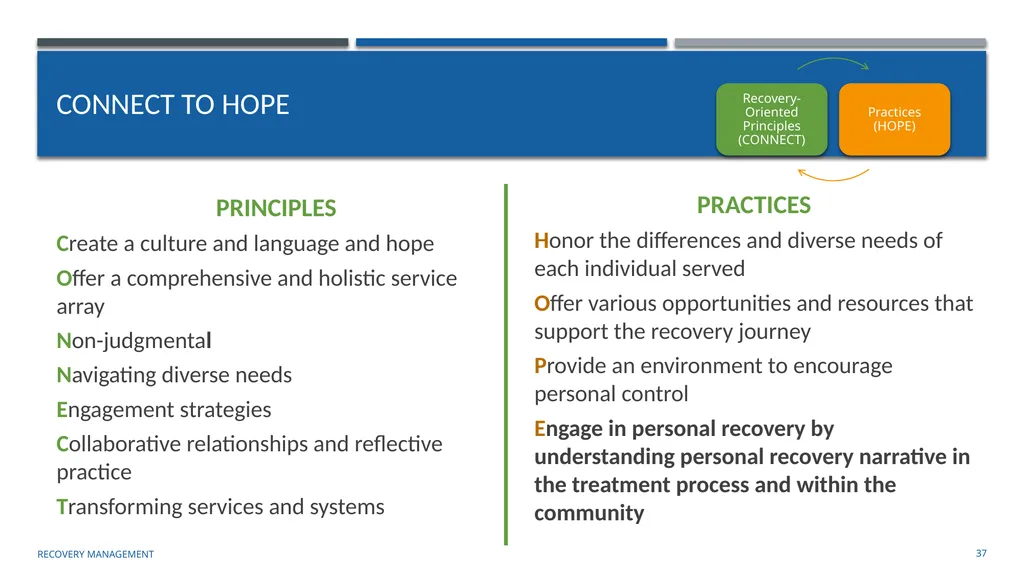
37 Recovery management Connect To Hope PRINCIPLES
Create a culture and language and hope
Offer a comprehensive and holistic service array
Non-judgmental
Navigating diverse needs
Engagement strategies
Collaborative relationships and reflective practice
Transforming services and systems PRACTICES
Honor the differences and diverse needs of each individual served
Offer various opportunities and resources that support the recovery journey
Provide an environment to encourage personal control
Engage in personal recovery by understanding personal recovery narrative in the treatment process and within the community<br>
38
38 Recovery management REFERENCES Buckingham, S.A. & Best, D. (2017). Addiction, Behavioral Change and Social Identity: The path to resilience and recovery. Taylor & Francis Kindle Edition.bid.
Iriss (2012). Using an assets approach for positive mental health and well-being. https://www.iriss.org.uk/resources/reports/using-assets-approach-positive-mental-health-and-well-being..
Magellan Healthcare webinar Social Inclusion and Recovery . https://www.magellanhealthcare.com/documents/2020/05/6510.pdf/.
Mental Health Commission of Canada (2015). Recovery Guidelines Ottawa, ON.<br>
39
39 Recovery management REFERENCES The National Center on Advancing Person-Centered Practices and Systems (NCAPPS) (2020). https://ncapps.acl.gov
The National Center on Advancing Person-Centered Practices and Systems (NCAPPS) (2020). Stakeholder Engagement and Asset Mapping FAQs.
Shookner, M and Social Inclusion Reference Group Atlantic Region (2002). An Inclusion Lens: Workbook for Looking at Social and Economic Exclusion and Inclusion. http://www.oaith.ca/assets/files/Publications/inclusion_lens.pdf.<br>
40
THANK YOU! Questions?<br>