Supporting the Digital Thread Using Requirements Traceability for Nuclear Power Plant Design Paul Lusardi 2025 DICE conference, Idaho Falls, ID My Background 30 years in database and information delivery 17 years involved in nuclear design
"Supporting the Digital Thread Using Requirements" is the property of its rightful owner. Permission is granted to
download and print the materials on this website for personal, non-commercial use only, and to display it
on your personal computer provided you do not modify the materials and that you retain all copyright
notices contained in the materials. By downloading content from our website, you accept the terms of this
agreement.
Presentation Transcript
01
Supporting the Digital Thread Using Requirements Traceability for Nuclear Power Plant Design Paul Lusardi
2025 DICE conference, Idaho Falls, ID<br>
02
My Background 30+ years in database and information delivery
17 years involved in nuclear design projects
Requirements management professional
Certified Data Management Professional (CDMP)<br>
03
Audience Poll How many have document based systems only for managing design and licensing requirements?
How many of you have a requirements management program that supports requirement statement traceability?
How many have parsed requirements external to your organization – regulations, standards, utility/client requirements, etc.<br>
04
What is So Special About Data Management*? Represents a collaborative, single source of truth
Stakeholder, Plant, System, and Component Requirements/Design Data are managed centrally
Additional characteristics are carried with data (such as rationale, safety class, applicability)
Data quality can be checked for consistency
Change management can be baselined/released
Allows reusability between First-of-a-Kind and Next-of-a-Kind designs/clients * Requirements management is embodied within data management<br>
05
What is So Special About Data Relationships? Completeness assurance is possible – during design maturity phases
Thread of traceability from source requirements to implementing SSC’s
Requirement gap and compliance reporting automatically generated
Licensing claims are traced between regulations and design supporting evidence
Impact analysis at a fine granularity, speeds up review and decisions
Generates requirements traceability matrices to assures confidence in:
Regulatory compliance
Impact of change
Audit look down<br>
06
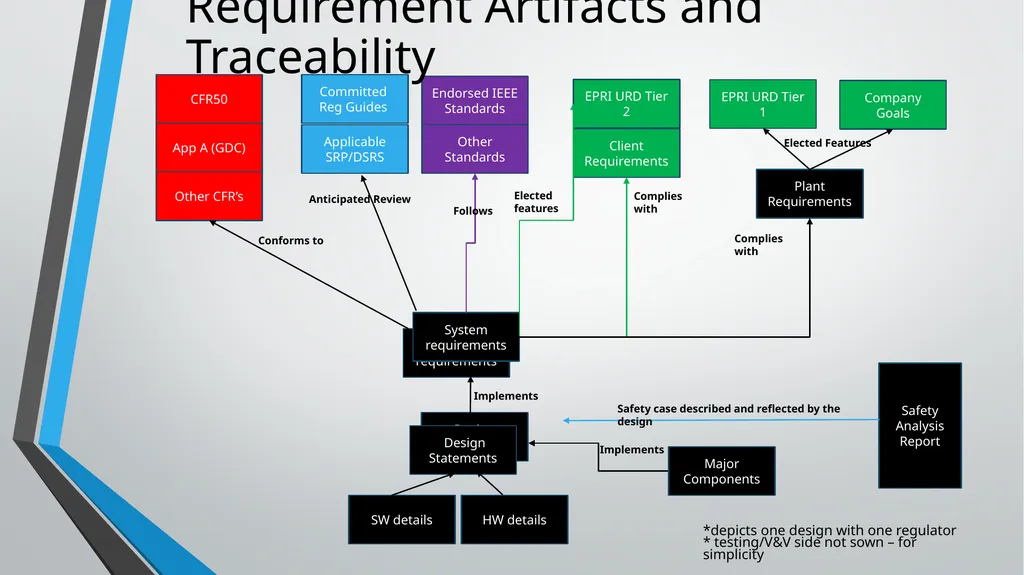
CFR50 App A (GDC) Other CFR’s Endorsed IEEE Standards Committed
Reg Guides Design Statements Plant
Requirements System requirements EPRI URD Tier 2 Applicable SRP/DSRS Other Standards Client Requirements System requirements Design Statements Major Components Conforms to Follows Elected features Elected Features Anticipated Review Safety Analysis Report Implements Implements Safety case described and reflected by the design SW details HW details Requirement Artifacts and Traceability EPRI URD Tier 1 Company Goals Complies with Complies with *depicts one design with one regulator
* testing/V&V side not sown – for simplicity<br>
07
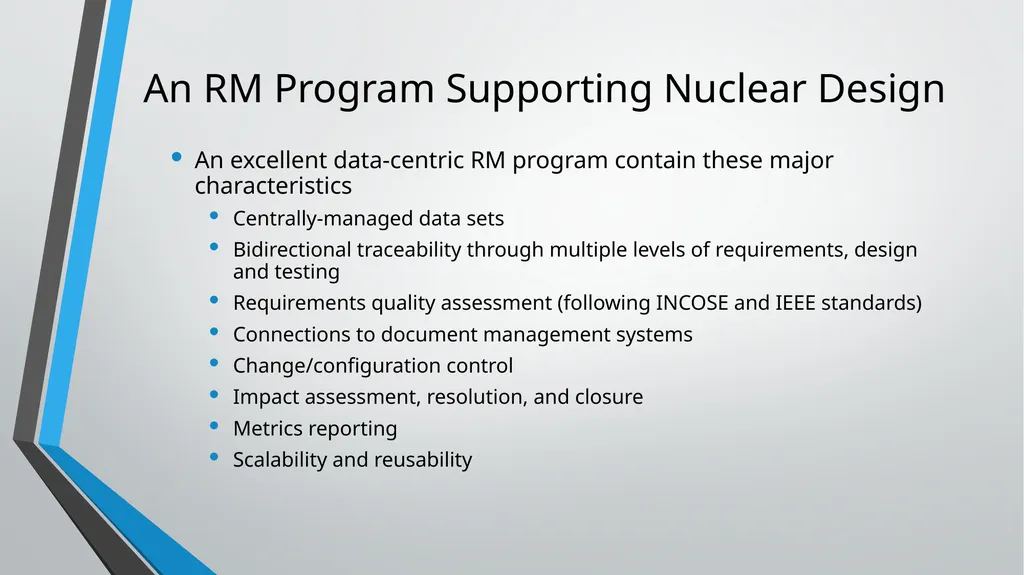
An RM Program Supporting Nuclear Design An excellent data-centric RM program contain these major characteristics
Centrally-managed data sets
Bidirectional traceability through multiple levels of requirements, design and testing
Requirements quality assessment (following INCOSE and IEEE standards)
Connections to document management systems
Change/configuration control
Impact assessment, resolution, and closure
Metrics reporting
Scalability and reusability<br>
08
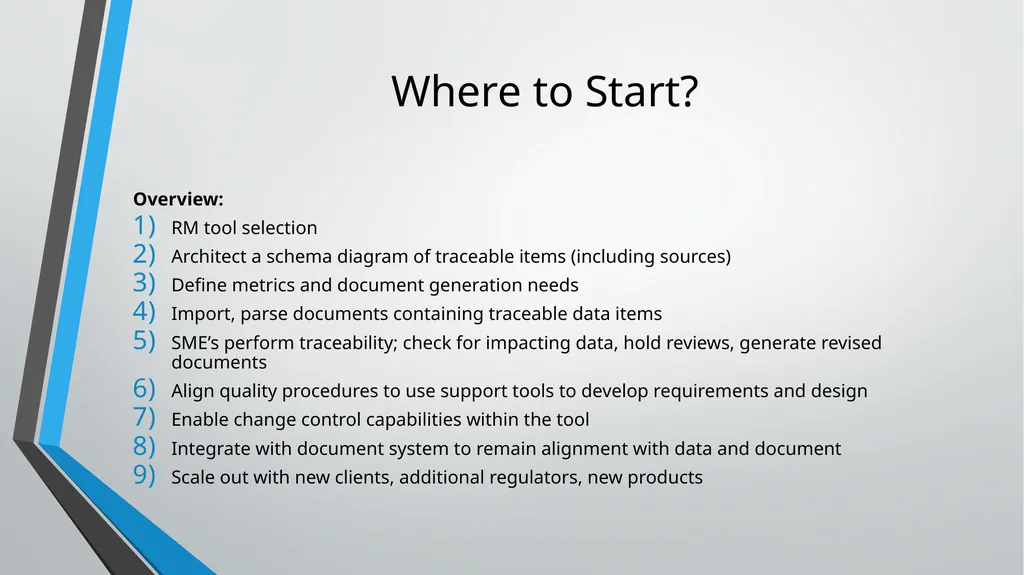
Where to Start? Overview:
RM tool selection
Architect a schema diagram of traceable items (including sources)
Define metrics and document generation needs
Import, parse documents containing traceable data items
SME’s perform traceability; check for impacting data, hold reviews, generate revised documents
Align quality procedures to use support tools to develop requirements and design
Enable change control capabilities within the tool
Integrate with document system to remain alignment with data and document
Scale out with new clients, additional regulators, new products<br>
09
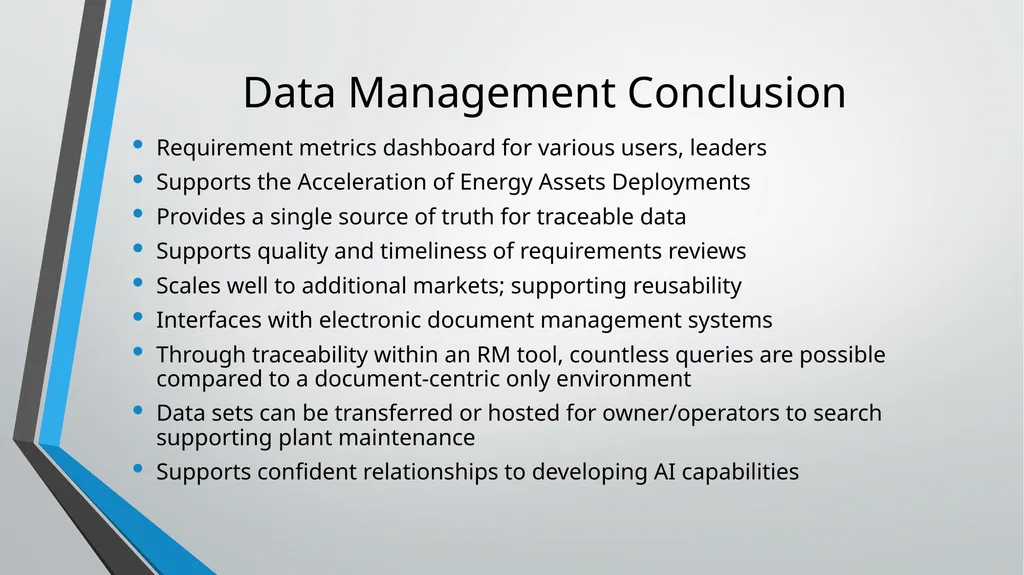
Data Management Conclusion Requirement metrics dashboard for various users, leaders
Supports the Acceleration of Energy Assets Deployments
Provides a single source of truth for traceable data
Supports quality and timeliness of requirements reviews
Scales well to additional markets; supporting reusability
Interfaces with electronic document management systems
Through traceability within an RM tool, countless queries are possible compared to a document-centric only environment
Data sets can be transferred or hosted for owner/operators to search supporting plant maintenance
Supports confident relationships to developing AI capabilities<br>
Free handout: Top 5 Requirements Management & Traceability Tools<br>
11
Backup Slides<br>
12
User Story Examples NPP design companies stand out in the NPP market by offering customers a digital thread of data from stakeholder to serialized parts; as an added feature to the requisite document package handover
Design teams are able to:
Identify and close gaps in large data sets
Respond to upstream changes (impact analyses)
Generate documents and traceability matrices
Business development teams are able to quickly assess impacts to a base product to meet potential client needs during a bid and proposal phase
Licensing teams are able to:
Gain confidence in their regulatory submittals during design phase
Able to view data as a regulator
Able to support requests for additional information during regulatory reviews
Owner/operators are able to use digital thread information quickly to assess if repair/replace components have any relationships to regulatory requirements, extending to equipment lists<br>