Surgical Management 2021 ATA Guidelines for Management of Patients with Anaplastic Thyroid Cancer Surgical evaluation for ATC Immediate airway evaluation Goal: R0R1resection Is tumor resectable? Determine extent of disease based on rapid
"Surgical Management 2021 ATA® Guidelines for" is the property of its rightful owner. Permission is granted to
download and print the materials on this website for personal, non-commercial use only, and to display it
on your personal computer provided you do not modify the materials and that you retain all copyright
notices contained in the materials. By downloading content from our website, you accept the terms of this
agreement.
Presentation Transcript
01
Surgical Management 2021 ATA® Guidelines for Management of Patients with Anaplastic Thyroid Cancer<br>
02
Surgical evaluation for ATC Immediate airway evaluation
Goal: R0/R1resection
Is tumor resectable?
Determine extent of disease based on rapid and accurate staging
Invasion into local structures?
Presence of distant metastases?
Is there a role for neoadjuvant therapy?
Goals of Care
Patient centered
Curative vs Palliative
Balance morbidity from surgery with expected benefits<br>
03
Immediate Airway Evaluation Does the patient have stridor?
Is immediate tracheostomy required to protect airway?
Placement of a tracheostomy results in immediate improvement of upper airway obstruction but requires significant education for care and understanding that tumor location and growth may make management of the tracheotomy complex.
In patients without impending airway compromise, we advise against preemptive tracheostomy placement. (GPS 7)<br>
04
Evaluation of Resectability Extent of local invasion
High resolution CT scan/MRI neck and chest with contrast to assess for presence of regional disease, vascular or visceral invasion.
Direct laryngoscopy to assess vocal cords, subglottic and upper trachea to assess for function and invasion.
Consider endoscopic evaluation of the esophagus to assess invasion.
Consider bronchoscopic evaluation of trachea to assess invasion.
Systemic evaluation
Confirm pathology
Radiological evaluation for distant metastases
Define clinical stage (IVA, IVB, IVC)
Patient comorbidities and fitness for surgery assessed and acceptable.
Patient goals of care, advanced directives defined.
Consensus achieved with patient/family and treatment team for decision for surgery.<br>
05
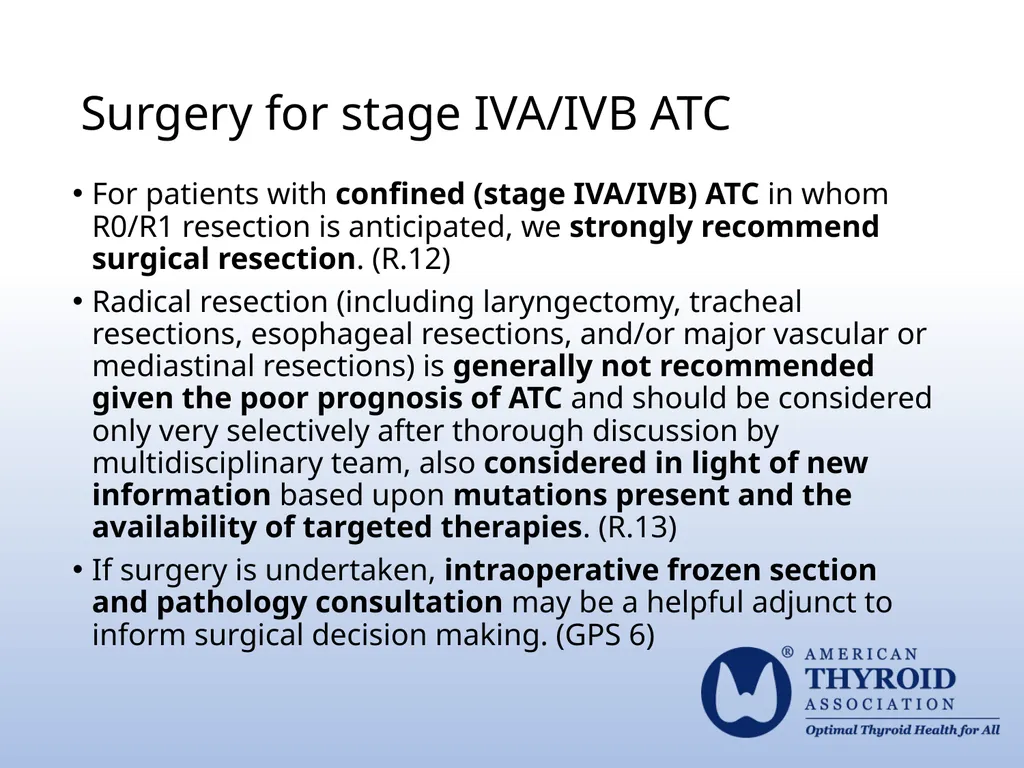
Surgery for stage IVA/IVB ATC For patients with confined (stage IVA/IVB) ATC in whom R0/R1 resection is anticipated, we strongly recommend surgical resection. (R.12)
Radical resection (including laryngectomy, tracheal resections, esophageal resections, and/or major vascular or mediastinal resections) is generally not recommended given the poor prognosis of ATC and should be considered only very selectively after thorough discussion by multidisciplinary team, also considered in light of new information based upon mutations present and the availability of targeted therapies. (R.13)
If surgery is undertaken, intraoperative frozen section and pathology consultation may be a helpful adjunct to inform surgical decision making. (GPS 6)<br>
06
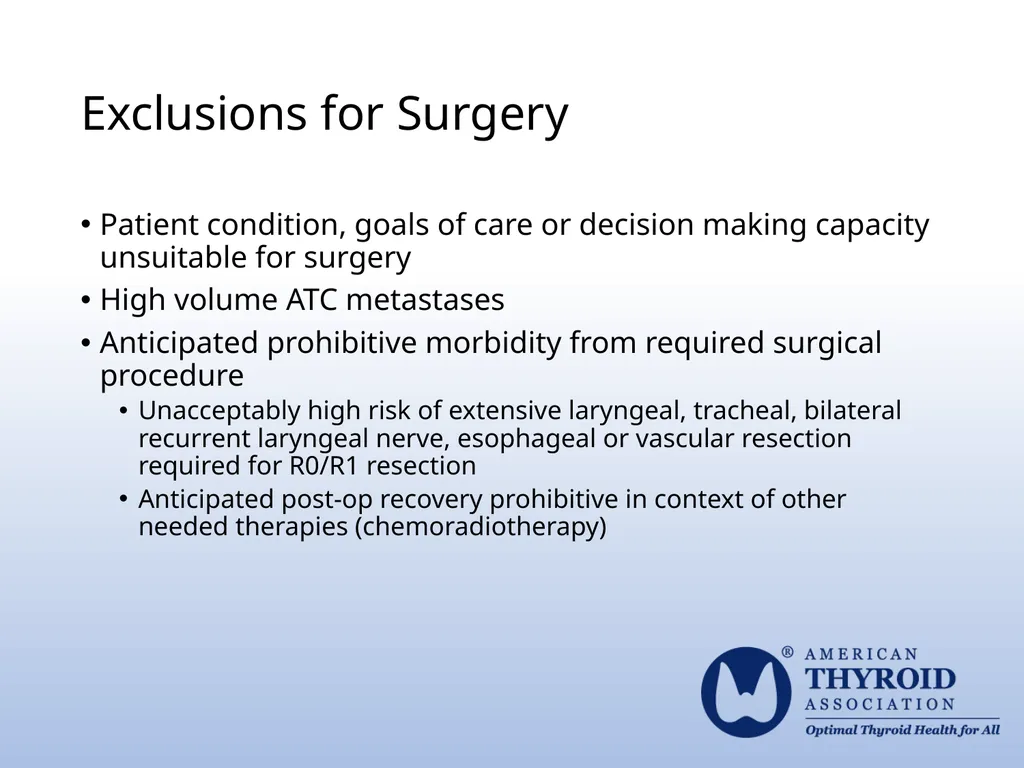
Exclusions for Surgery Patient condition, goals of care or decision making capacity unsuitable for surgery
High volume ATC metastases
Anticipated prohibitive morbidity from required surgical procedure
Unacceptably high risk of extensive laryngeal, tracheal, bilateral recurrent laryngeal nerve, esophageal or vascular resection required for R0/R1 resection
Anticipated post-op recovery prohibitive in context of other needed therapies (chemoradiotherapy)<br>